


oSIST prEN 18368:2026
(Main)Chemical disinfectants and antiseptics - Quantitative test method for the evaluation of virucidal activity on nonporous surfaces with mechanical action employing wipes in the medical area (4-field test) - Test method and requirements (phase 2, step 2)
General Information
- Abstract
This document specifies a test method and the minimum requirements for virucidal activity of chemical disinfectant products that form a homogeneous, physically stable preparation when diluted with hard water – or in the case of ready-to-use products – with water.
This document is applicable to products that are used in the medical area for disinfecting non-porous surfaces including surfaces of medical devices by wiping or mopping – regardless if they are covered by the Medical Device Regulation [1] or not.
Due to the new methods of application of surface disinfectants like pre-impregnated wipes this document was established to cover the different application methods.
This document is applicable for four methods of application of products for wiping and/or mopping:
a) soaking any non-specified wipe or mop with product;
b) spraying the product on any non-specified wipe and / or mop or a specified wipe or mop;
c) impregnation of specified wipes or mops by the user with the product according to the manufacturer’s recommendation;
d) pre-impregnation of specified wipes or mops by the manufacturer as ready-to-use wipes or mops.
In all types of application the water control has to be conducted with the standard wipe (5.3.2.17 a), because it is process or method control. The contact time for the water control is no longer than 5 min.
This document does not apply to products that are sprayed on or used for flooding of surfaces, without wiping or mopping during the contact time. In this case, the methods of phase 2/ step 2 without mechanical action apply.
The test-surface (5.3.2.16) was selected as a standard surface and should cover all non-porous surfaces. It was not intended to cover the influence of each different surface.
This document is applicable to areas and situations where disinfection is medically indicated. Such indications occur in patient care, for example:
— in hospitals, in community medical facilities and in dental institutions;
— in clinics of schools, of kindergartens and of nursing homes;
and can occur in the workplace and in the home. It can also include services such as laundries and kitchens supplying products directly for the patients.
NOTE This method corresponds to a phase 2, step 2 test.
EN 14885 specifies in detail the relationship of the various tests to one another and to “use recommendations”.
- Status
- Not Published
- Public Enquiry End Date
- 01-Oct-2026
- Technical Committee
- KDS - Cosmetics, chemical disinfectants and surface active agents
- Current Stage
- 4020 - Public enquire (PE) (Adopted Project)
- Start Date
- 22-Jul-2026
- Due Date
- 09-Dec-2026

Overview
oSIST prEN 18368:2026 is a draft European Standard developed by SIST and CEN/TC 216, focusing on chemical disinfectants and antiseptics. It specifies a quantitative 4-field test method for evaluating the virucidal activity of such products on nonporous surfaces in medical environments, specifically when applied via wipes or mops with mechanical action. This standard details test requirements and standard procedures for evaluating products, whether diluted with hard water or as ready-to-use formulations.
The standard is tailored for various application methods, including pre-impregnated wipes, products sprayed onto wipes or mops, and both user and manufacturer-prepared impregnations. It is intended for use in healthcare and medical-related settings where effective surface disinfection is critical for infection control.
Key Topics
- Surface Disinfection in Healthcare: Guidance for assessing the virucidal efficacy of disinfectant products used on nonporous surfaces such as in hospitals, clinics, dental offices, and related environments.
- Mechanical Application: Emphasizes mechanical action through wiping or mopping, which aligns with real-world cleaning practices, including pre-impregnated and freshly soaked wipes.
- Versatile Test Approaches: Covers four principle application methods:
- Soaking a wipe/mop with product
- Spraying the product onto a wipe or mop
- User impregnation of wipes/mops per manufacturer’s instructions
- Manufacturer pre-impregnated ready-to-use wipes/mops
- Testing Protocols: Involves laboratory simulation of actual product use, considering parameters like contact time (usually up to 5 minutes), interfering substances, temperature, and standard test surfaces.
- Scope and Limitations: Specifically does not cover disinfection where products are simply sprayed or used for flooding surfaces without mechanical action.
Applications
oSIST prEN 18368:2026 is highly relevant in environments requiring rigorous disinfection protocols to prevent healthcare-associated infections (HAI). Typical applications include:
- Hospitals and Clinics: Ensures virucidal efficacy of wipes and mopping systems for patient rooms, operating theaters, laboratories, and high-touch surfaces.
- Dental Offices and Medical Practices: Provides a basis for selecting and validating surface disinfectants for use on dental chairs, treatment rooms, and nonporous medical equipment.
- Community Medical Facilities: Applies to nursing homes, school nurse stations, and kindergartens, supporting infection control in public care settings.
- Ancillary Healthcare Services: Encompasses laundries and kitchens supplying the medical sector, where nonporous surface disinfection is required.
- Home and Workplace Healthcare: Supports safe cleaning protocols for home care or occupational health environments where clinical disinfection standards are desirable.
The use of an objective, standardized 4-field test method helps healthcare organizations, cleaning service providers, and disinfectant manufacturers compare products and ensure regulatory compliance.
Related Standards
oSIST prEN 18368:2026 refers to and complements several important international and European standards for chemical disinfectants and antiseptics:
- EN 14885: Outlines the application of European Standards for chemical disinfectants and clarifies the relationship between various test methods and practical use recommendations.
- EN 14476:2025: Specifies quantitative suspension tests for the evaluation of virucidal activity in the medical area, which is referenced for spectrum claims.
- EN 12353: Details procedures for preserving test organisms used in efficacy testing.
- Medical Device Regulation (EU 2017/745): While this standard applies regardless of MDR coverage, it aligns with MDR objectives for device hygiene.
Key terms: chemical disinfectants, virucidal activity, nonporous surfaces, mechanical wiping, pre-impregnated wipes, healthcare disinfection, antiseptics, EN 14885, EN 14476.
Adhering to oSIST prEN 18368:2026 enables healthcare and cleaning professionals to standardize disinfection practices, enhance infection prevention, and validate the effectiveness of surface disinfectants under practical conditions.
Get Certified
Connect with accredited certification bodies for this standard

BSI Group
BSI (British Standards Institution) is the business standards company that helps organizations make excellence a habit.

TÜV Rheinland
TÜV Rheinland is a leading international provider of technical services.

TÜV SÜD
TÜV SÜD is a trusted partner of choice for safety, security and sustainability solutions.
Sponsored listings
Frequently Asked Questions
oSIST prEN 18368:2026 is a draft published by the Slovenian Institute for Standardization (SIST). Its full title is "Chemical disinfectants and antiseptics - Quantitative test method for the evaluation of virucidal activity on nonporous surfaces with mechanical action employing wipes in the medical area (4-field test) - Test method and requirements (phase 2, step 2)". This standard covers: This document specifies a test method and the minimum requirements for virucidal activity of chemical disinfectant products that form a homogeneous, physically stable preparation when diluted with hard water – or in the case of ready-to-use products – with water. This document is applicable to products that are used in the medical area for disinfecting non-porous surfaces including surfaces of medical devices by wiping or mopping – regardless if they are covered by the Medical Device Regulation [1] or not. Due to the new methods of application of surface disinfectants like pre-impregnated wipes this document was established to cover the different application methods. This document is applicable for four methods of application of products for wiping and/or mopping: a) soaking any non-specified wipe or mop with product; b) spraying the product on any non-specified wipe and / or mop or a specified wipe or mop; c) impregnation of specified wipes or mops by the user with the product according to the manufacturer’s recommendation; d) pre-impregnation of specified wipes or mops by the manufacturer as ready-to-use wipes or mops. In all types of application the water control has to be conducted with the standard wipe (5.3.2.17 a), because it is process or method control. The contact time for the water control is no longer than 5 min. This document does not apply to products that are sprayed on or used for flooding of surfaces, without wiping or mopping during the contact time. In this case, the methods of phase 2/ step 2 without mechanical action apply. The test-surface (5.3.2.16) was selected as a standard surface and should cover all non-porous surfaces. It was not intended to cover the influence of each different surface. This document is applicable to areas and situations where disinfection is medically indicated. Such indications occur in patient care, for example: — in hospitals, in community medical facilities and in dental institutions; — in clinics of schools, of kindergartens and of nursing homes; and can occur in the workplace and in the home. It can also include services such as laundries and kitchens supplying products directly for the patients. NOTE This method corresponds to a phase 2, step 2 test. EN 14885 specifies in detail the relationship of the various tests to one another and to “use recommendations”.
This document specifies a test method and the minimum requirements for virucidal activity of chemical disinfectant products that form a homogeneous, physically stable preparation when diluted with hard water – or in the case of ready-to-use products – with water. This document is applicable to products that are used in the medical area for disinfecting non-porous surfaces including surfaces of medical devices by wiping or mopping – regardless if they are covered by the Medical Device Regulation [1] or not. Due to the new methods of application of surface disinfectants like pre-impregnated wipes this document was established to cover the different application methods. This document is applicable for four methods of application of products for wiping and/or mopping: a) soaking any non-specified wipe or mop with product; b) spraying the product on any non-specified wipe and / or mop or a specified wipe or mop; c) impregnation of specified wipes or mops by the user with the product according to the manufacturer’s recommendation; d) pre-impregnation of specified wipes or mops by the manufacturer as ready-to-use wipes or mops. In all types of application the water control has to be conducted with the standard wipe (5.3.2.17 a), because it is process or method control. The contact time for the water control is no longer than 5 min. This document does not apply to products that are sprayed on or used for flooding of surfaces, without wiping or mopping during the contact time. In this case, the methods of phase 2/ step 2 without mechanical action apply. The test-surface (5.3.2.16) was selected as a standard surface and should cover all non-porous surfaces. It was not intended to cover the influence of each different surface. This document is applicable to areas and situations where disinfection is medically indicated. Such indications occur in patient care, for example: — in hospitals, in community medical facilities and in dental institutions; — in clinics of schools, of kindergartens and of nursing homes; and can occur in the workplace and in the home. It can also include services such as laundries and kitchens supplying products directly for the patients. NOTE This method corresponds to a phase 2, step 2 test. EN 14885 specifies in detail the relationship of the various tests to one another and to “use recommendations”.
oSIST prEN 18368:2026 is classified under the following ICS (International Classification for Standards) categories: 11.080.20 - Disinfectants and antiseptics. The ICS classification helps identify the subject area and facilitates finding related standards.
oSIST prEN 18368:2026 is associated with the following European legislation: EU Directives/Regulations: 2017/745; Standardization Mandates: M/575, M/575 Amd 2. When a standard is cited in the Official Journal of the European Union, products manufactured in conformity with it benefit from a presumption of conformity with the essential requirements of the corresponding EU directive or regulation.
oSIST prEN 18368:2026 is available in PDF format for immediate download after purchase. The document can be added to your cart and obtained through the secure checkout process. Digital delivery ensures instant access to the complete standard document.
Standards Content (Sample)
SLOVENSKI STANDARD
01-september-2026
Kemična razkužila in antiseptiki - Kvantitativna preskusna metoda za vrednotenje
virucidnega delovanja na neporoznih površinah z mehanskim delovanjem z
odvzemom brisa v humani medicini (4-področni preskus) - Preskusna metoda in
zahteve (faza 2, stopnja 2)
Chemical disinfectants and antiseptics - Quantitative test method for the evaluation of
virucidal activity on nonporous surfaces with mechanical action employing wipes in the
medical area (4-field test) - Test method and requirements (phase 2, step 2)
Chemische Desinfektionsmittel und Antiseptika - Quantitatives Prüfverfahren zur
Bestimmung der viruziden Wirkung auf nicht-porösen Oberflächen mit mechanischer
Einwirkung mit Hilfe von Tüchern im humanmedizinischen Bereich (4-Felder-Test) -
Prüfverfahren und Anforderungen (Phase 2, Stufe 2)
Antiseptiques et désinfectants chimiques - Méthode d´essai quantitative pour l
´évaluation de l´activité virucide sur des surfaces non poreuses, avec action mécanique
à l´aide de lingettes dans le domaine médical (essai à 4 zones) - Méthode d'essai et
prescriptions (phase 2, étape 2)
Ta slovenski standard je istoveten z: prEN 18368
ICS:
11.080.20 Dezinfektanti in antiseptiki Disinfectants and antiseptics
2003-01.Slovenski inštitut za standardizacijo. Razmnoževanje celote ali delov tega standarda ni dovoljeno.
DRAFT
EUROPEAN STANDARD
NORME EUROPÉENNE
EUROPÄISCHE NORM
August 2026
ICS 11.080.20
English Version
Chemical disinfectants and antiseptics - Quantitative test
method for the evaluation of virucidal activity on
nonporous surfaces with mechanical action employing
wipes in the medical area (4-field test) - Test method and
requirements (phase 2, step 2)
Antiseptiques et désinfectants chimiques - Méthode Chemische Desinfektionsmittel und Antiseptika -
d´essai quantitative pour l´évaluation de l´activité Quantitatives Prüfverfahren zur Bestimmung der
virucide sur des surfaces non poreuses, avec action viruziden Wirkung auf nicht-porösen Oberflächen mit
mécanique à l´aide de lingettes dans le domaine mechanischer Einwirkung mit Hilfe von Tüchern im
médical (essai à 4 zones) - Méthode d'essai et humanmedizinischen Bereich (4-Felder-Test) -
prescriptions (phase 2, étape 2) Prüfverfahren und Anforderungen (Phase 2, Stufe 2)
This draft European Standard is submitted to CEN members for enquiry. It has been drawn up by the Technical Committee
CEN/TC 216.
If this draft becomes a European Standard, CEN members are bound to comply with the CEN/CENELEC Internal Regulations
which stipulate the conditions for giving this European Standard the status of a national standard without any alteration.
This draft European Standard was established by CEN in three official versions (English, French, German). A version in any other
language made by translation under the responsibility of a CEN member into its own language and notified to the CEN-CENELEC
Management Centre has the same status as the official versions.
CEN members are the national standards bodies of Austria, Belgium, Bulgaria, Croatia, Cyprus, Czech Republic, Denmark, Estonia,
Finland, France, Germany, Greece, Hungary, Iceland, Ireland, Italy, Latvia, Lithuania, Luxembourg, Malta, Netherlands, Norway,
Poland, Portugal, Republic of North Macedonia, Romania, Serbia, Slovakia, Slovenia, Spain, Sweden, Switzerland, Türkiye and
United Kingdom.
Recipients of this draft are invited to submit, with their comments, notification of any relevant patent rights of which they are
aware and to provide supporting documentation.
Warning : This document is not a European Standard. It is distributed for review and comments. It is subject to change without
notice and shall not be referred to as a European Standard.
EUROPEAN COMMITTEE FOR STANDARDIZATION
COMITÉ EUROPÉEN DE NORMALISATION
EUROPÄISCHES KOMITEE FÜR NORMUNG
CEN-CENELEC Management Centre: Rue de la Science 23, B-1040 Brussels
© 2026 CEN All rights of exploitation in any form and by any means reserved Ref. No. prEN 18368:2026 E
worldwide for CEN national Members.
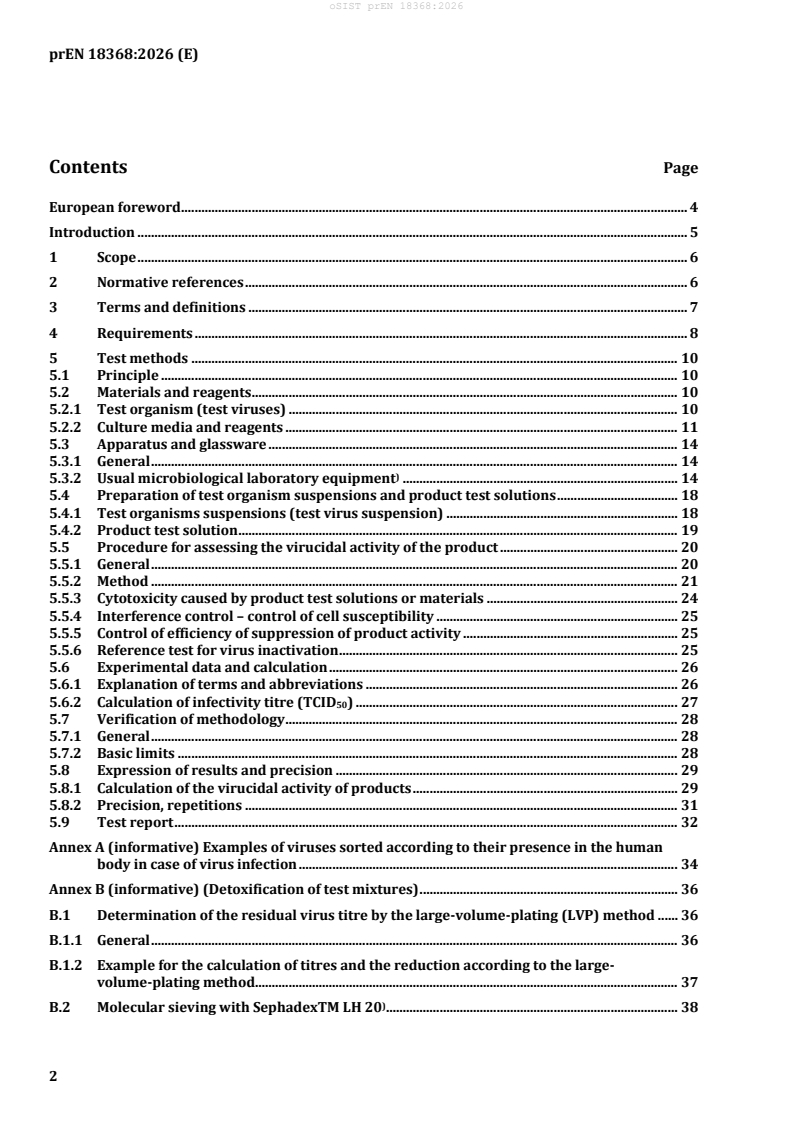
Contents Page
European foreword . 4
Introduction . 5
1 Scope . 6
2 Normative references . 6
3 Terms and definitions . 7
4 Requirements . 8
5 Test methods . 10
5.1 Principle . 10
5.2 Materials and reagents . 10
5.2.1 Test organism (test viruses) . 10
5.2.2 Culture media and reagents . 11
5.3 Apparatus and glassware . 14
5.3.1 General . 14
)
5.3.2 Usual microbiological laboratory equipment . 14
5.4 Preparation of test organism suspensions and product test solutions . 18
5.4.1 Test organisms suspensions (test virus suspension) . 18
5.4.2 Product test solution . 19
5.5 Procedure for assessing the virucidal activity of the product . 20
5.5.1 General . 20
5.5.2 Method . 21
5.5.3 Cytotoxicity caused by product test solutions or materials . 24
5.5.4 Interference control – control of cell susceptibility . 25
5.5.5 Control of efficiency of suppression of product activity . 25
5.5.6 Reference test for virus inactivation . 25
5.6 Experimental data and calculation . 26
5.6.1 Explanation of terms and abbreviations . 26
5.6.2 Calculation of infectivity titre (TCID ) . 27
5.7 Verification of methodology . 28
5.7.1 General . 28
5.7.2 Basic limits . 28
5.8 Expression of results and precision . 29
5.8.1 Calculation of the virucidal activity of products . 29
5.8.2 Precision, repetitions . 31
5.9 Test report . 32
Annex A (informative) Examples of viruses sorted according to their presence in the human
body in case of virus infection . 34
Annex B (informative) (Detoxification of test mixtures) . 36
B.1 Determination of the residual virus titre by the large-volume-plating (LVP) method . 36
B.1.1 General . 36
B.1.2 Example for the calculation of titres and the reduction according to the large-
volume-plating method . 37
)
B.2 Molecular sieving with SephadexTM LH 20 . 38
Principle . 38
Sephadex suspension . 38
Procedure . 38
TM
B.3 Molecular sieving using MicroSpin S 400 HR . 40
Annex C (informative) Calculation of the viral infectivity titre . 41
C.1 Quantal tests - Example of TCID50 determination by the Spearman-Kärber method . 41
Annex D (informative) Example of a typical test report . 46
Annex E (informative) Graphical representations of the test method . 49
Annex F (informative) Determination of the in-use period of impregnated wipes . 51
Bibliography . 52
European foreword
This document (prEN 18368:2026) has been prepared by Technical Committee CEN/TC 216 “Chemical
disinfectants and antiseptics”, the secretariat of which is held by AFNOR.
This document is currently submitted to the CEN-Enquiry.
Introduction
This document specifies a carrier test for establishing whether a chemical disinfectant for use on surfaces
administered with wipes has a virucidal activity in the fields described in the scope.
The laboratory test closely simulates practical conditions of application such as contact time,
temperature and interfering substances, including pre-drying specified test organisms on a test-surface
as a carrier and wiping the product on the test-surface with a wipe. The conditions are intended to cover
general purposes. However, if for some applications the recommendations of use of a product differ
additional test conditions may be or need to be used.
Each use concentration of the product identified by this test relates solely to the defined experimental
conditions.
1 Scope
This document specifies a test method and the minimum requirements for virucidal activity of chemical
disinfectant products that form a homogeneous, physically stable preparation when diluted with hard
water – or in the case of ready-to-use products – with water.
This document is applicable to products that are used in the medical area for disinfecting non-porous
surfaces including surfaces of medical devices by wiping or mopping – regardless if they are covered by
the Medical Device Regulation [1] or not.
Due to the new methods of application of surface disinfectants like pre-impregnated wipes this document
was established to cover the different application methods.
This document is applicable for four methods of application of products for wiping and/or mopping:
a) soaking any non-specified wipe or mop with product;
b) spraying the product on any non-specified wipe and / or mop or a specified wipe or mop;
c) impregnation of specified wipes or mops by the user with the product according to the
manufacturer’s recommendation;
d) pre-impregnation of specified wipes or mops by the manufacturer as ready-to-use wipes or mops.
In all types of application the water control has to be conducted with the standard wipe (5.3.2.17 a)),
because it is process or method control. The contact time for the water control is no longer than 5 min.
This document does not apply to products that are sprayed on or used for flooding of surfaces, without
wiping or mopping during the contact time. In this case, the methods of phase 2/ step 2 without
mechanical action apply.
The test-surface (5.3.2.16) was selected as a standard surface and should cover all non-porous surfaces.
It was not intended to cover the influence of each different surface.
This document is applicable to areas and situations where disinfection is medically indicated. Such
indications occur in patient care, for example:
— in hospitals, in community medical facilities and in dental institutions;
— in clinics of schools, of kindergartens and of nursing homes;
and can occur in the workplace and in the home. It can also include services such as laundries and
kitchens supplying products directly for the patients.
NOTE This method corresponds to a phase 2, step 2 test.
EN 14885 specifies in detail the relationship of the various tests to one another and to “use
recommendations”.
2 Normative references
The following documents, in whole or in part, are normatively referenced in this document and are
indispensable for its application. For dated references, only the edition cited applies. For undated
references, the latest edition of the referenced document (including any amendments) applies.
EN 12353, Chemical disinfectants and antiseptics — Preservation of test organisms used for the
determination of bactericidal (including Legionella), mycobactericidal, sporicidal, fungicidal and virucidal
(including bacteriophages) activity
EN 14476:2025, Chemical disinfectants and antiseptics — Quantitative suspension test for the evaluation
of virucidal activity in the medical area — Test method and requirements (Phase 2/Step 1)
EN 14885, Chemical disinfectants and antiseptics — Application of European Standards for chemical
disinfectants and antiseptics
3 Terms and definitions
For the purposes of this document, the terms and definitions given in EN 14885 and the following apply.
ISO and IEC maintain terminological databases for use in standardization at the following addresses:
— IEC Electropedia: available at https://www.electropedia.org/
— ISO Online browsing platform: available at https://www.iso.org/obp
3.1
ready-to-use wipe
pre-impregnated wipe
wipe containing disinfectant added by the wipe manufacturer at the manufacturing site
3.2
impregnated wipe
wipe containing disinfectant added by the user
Note 1 to entry: Examples include a dry wipe soaked in disinfectant by the user, a dry wipe sprayed with
disinfectant.
3.3
cytotoxicity
morphological alteration of cells and/or their destruction or their reduced sensitivity to virus
multiplication caused by the product
3.4
reference test for virus inactivation
test with a defined product (e.g. formaldehyde or glutaraldehyde) in parallel with a product under test
(suspension test or test under simulated use conditions) for the internal control of the test and the quality
/ stability of the test virus
Note 1 to entry: A defined product e.g. glutaraldehyde or formaldehyde could be used.
3.5
TCID (Tissue Culture Infectious Dose 50 %)
50 % infecting dose of a virus suspension or that dilution of the virus suspension that induce a CPE (3.6)
in 50 % of cell culture units
3.6
viral cytopathic effect
CPE
morphological alteration of cells and/or their destruction as a consequence of virus multiplication
3.7
virus titre
amount of infectious virus per unit volume present in a cell culture lysate, cell culture supernatant or in
a solution
4 Requirements
The product, when diluted with hard water or – in the case of ready-to-use products – with water, shall
demonstrate at least a decimal log (lg) reduction of 4 in virus titre (in justified cases at least a 3 lg
reduction) on test field 1, when tested in accordance with Table 1 and Clause 5.
As described in EN 14885:
— to claim virucidal activity against enveloped virus the product shall pass both EN 14476 and this
document with vaccinia virus;
— to claim limited spectrum virucidal activity the product shall pass both EN 14476 and this document
with adenovirus and murine norovirus;
— to claim the spectrum virucidal activity the product shall pass standards EN 14476 with poliovirus,
adenovirus and murine norovirus and this document with adenovirus and murine norovirus,
because poliovirus is not resistant to drying.
All data of test fields 2 to 4 shall be noted for N and N . Requirements for test fields 2 to 4 for N and N
a W a W
are given in 5.7.2. Details on the precision and repetition are given in 5.8.2 and EN 14885.
Table 1 — Minimum and additional test conditions
a
Minimum spectrum of test Virucidal activity
organisms
adenovirus
murine norovirus
b
Limited spectrum virucidal activity
adenovirus
murine norovirus
c
Virucidal activity against enveloped viruses
vaccinia virus
Test temperature Room temperature, the range shall be (21,5 ± 3,5) °C; further test
temperature(s) are allowed for example 4°C and 10°C according
d e
to the manufacturer’s recommendation
Contact time according to the manufacturer’s recommendation, but at minimum
1 min
f
and no longer than 60 min
based on the following rules: from 1 min to 5 min at intervals of
1 min and from 5 min to 60 min at intervals of 5 min
Interfering substances a) 0,3 g/l bovine serum albumin
a) clean and/or
b) dirty b) 3,0 g/l bovine serum albumin plus 3,0 ml erythrocytes
g
Additional conditions Any relevant contact time(s), interfering substance(s) or virus(es)
a
Poliovirus (as used in the corresponding suspension test) cannot be used for surfaces, because of drying
problems.
b
The test for “limited spectrum virucidal activity” will cover all enveloped viruses (Annex A) and norovirus,
rotavirus and adenovirus.
c
The test for “virucidal activity against enveloped viruses” will cover all enveloped viruses only (Annex A).
d
At temperatures higher than room temperature, the test surface needs to be placed in a temperature chamber
(prior and after the wiping procedure) and thus there is a higher safety risk of exposure to virus particles in
the laboratory and to the laboratory staff.
e
Where a different test temperature than room temperature is to be used for testing, all materials (test surface,
wipe, unitary weight etc.) and all used media (product test solution etc.) must be at test temperature prior to
testing.
f
For further information regarding validity at elevated contact times see EN 14885.
g
Where appropriate (specific purposes), additional specific virucidal activity shall be determined under other
conditions of time, temperature and interfering substances (see 5.2.2.7) in accordance with 5.5, in order to
take into account intended specific use conditions. Additional virus(es) can be tested, if relevant. For the
additional conditions, the concentration defined as a result can be lower than the one obtained under the
minimum test conditions.
5 Test methods
5.1 Principle
5.1.1 A test-surface is marked with 4 squares of 5 × 5 cm, the “test fields”, in a row. Test field 1 on the
test-surface is inoculated with a test suspension of virus in a solution of interfering substances. The
inoculum is dried. A wipe is soaked with a sample of the product as delivered and/or diluted with hard
water (5.2.2.6) (for ready to use products: water (5.2.2.2)). The test-surface is wiped with the soaked
wipe across the four marked test fields, starting in front of test field 1, turning immediately after test field
4 and wiped back to the starting point. In parallel a water control [5.5.2.2 h)] is performed with the
standard wipe which is soaked with hard water (5.2.2.6)) instead of the product in the same way to
ensure that the test organisms are spread on the 4 fields and their number reaches a certain level (contact
time limit for water control 5 min).
NOTE For the purposes of this document, references to wiping, wipe and wiped can be equated to mopping,
mop and mopped when the standard method is used to test a mopping application.
Temperature, interfering substance and contact time are employed as recommended by the
manufacturer. At the end of the contact time, the test organisms are recovered from each test field with
moistened swabs (5.3.2.19). The swabs are brought into a tube containing medium and the test organisms
are to be extracted from the swab by shaking. The numbers of infectious test organisms in each sample
are determined, and the reduction is calculated by comparing the results of the drying control D and the
Ct
results obtained with the product N . The test is performed using modified vaccinia virus Ankara as the
a
test organism for virucidal activity against enveloped viruses and murine norovirus (MNV) and
adenovirus for limited spectrum virucidal activity or virucidal activity.
5.1.2 Additional test virus strains, contact times and interfering substances can be used.
5.2 Materials and reagents
5.2.1 Test organism (test viruses)
The virucidal activity shall be evaluated using the following strains as test organisms selected according
1,
to Clause 4, Table 1. Virus strains shall be obtained from the national or international culture collection
The virucidal activity shall be evaluated using the following strains as test organisms:
a) Non-enveloped RNA virus
2)
Murine norovirus (MNV), strain S99 Berlin
a) Non-enveloped DNA virus
)
Adenovirus type 5 strain Adenoid 75, ATCC VR-5
1)
The ATCC numbers are the collection numbers of strains supplied by the American Type Culture Collections (ATCC). This
information is given for the convenience of users of this document and does not constitute an endorsement by CEN of the product
named.
2)
Murine norovirus may be obtained from Friedrich Loeffler Institute Federal Research Institute for Animal Health,
Headquarters Riems Island South Bank 10, 17493 Greifswald-Insel Riems, Germany; phone: +49 38351 7-0; fax: +49 38351 7-
121. http: www.fli.bund.de
3)
The ATCC numbers are the collection numbers of strains supplied by the American Type Culture Collections (ATCC). This
information is given for the convenience of users of this document and does not constitute an endorsement by CEN of the product
named.
b) Enveloped DNA virus
)
Modified vaccinia virus, strain Ankara (MVA), ATCC VR-1508
If additional test organisms are used, they shall be kept and used under optimum growth conditions
(temperature, time, atmosphere, media, susceptible cell line) noted in the test report. If these additional
test organisms (viruses and cell line) are not classified at a reference centre, their identification
characteristics shall be stated. In addition, they shall be held by the testing laboratory or national culture
collection under a reference for five years.
The required incubation temperature for these test organisms is 36 °C ± 1 °C or 37 °C ± 1 °C (5.3.2.3). The
same temperature (either 36 °C or 37 °C) shall be used for all incubations performed during a test and its
control and validation.
5.2.2 Culture media and reagents
5.2.2.1 General
All weights of chemical substances given in this document refer to the anhydrous salts. Hydrated forms
may be used as an alternative, but the weights required shall be adjusted to allow for consequent
molecular weight differences.
The reagents shall be of analytical grade and/or appropriate for microbiological purposes. They shall be
free from substances that are toxic or inhibitory to the test organism.
To improve reproducibility, it is recommended that commercially available dehydrated material – if
appropriate- is used for the preparation of culture media if it complies with the formulas given below.
The manufacturer's instructions relating to the preparation of these products should be rigorously
followed.
For each culture medium and reagent, a time limitation for use should be fixed.
All specified pH values are measured at 21,5 °C ± 3,5 °C (5.3.2.4).
5.2.2.2 Water
The water shall be freshly glass-distilled water or demineralized water, which meets the requirements of
ASTM D 1193 (Type I or II, see Table 2) or use water for injections (see [2]).
Sterilize in the autoclave [5.3.2.1]. Sterilization is not necessary if the water is used e.g. for preparation of
culture media and subsequently sterilized. Alternatively, cell culture grade water is suitable for
preparation of cell culture media and other solutions used in cell culture.
4)
The ATCC numbers are the collection numbers of strains supplied by the American Type Culture Collections (ATCC). This
information is given for the convenience of users of this document and does not constitute an endorsement by CEN of the product
named.
Table 2 — Consolidated classification of water qualities
Type I Type II
Characteristic Unit
(ultrapure water) (purified water)
Resistance (M/cm)Ω > 18 > 1
Conductivity µS/cm < 0,056 < 1
Silicates (SiO ) ppb or µg/L 3 3
TOC ppb or µg/l 50 50
Bacteria CFU/ml < 1 < 100
Endotoxin EU/ml < 0,001 0,03
Required for critical laboratory applications (e.g. for HPLC, GC; MS etc.). Also
Type I for the production of buffers for cell culture, as well as for applications in
molecular biology.
Used for buffers and microbiological culture media. Used as system water for
Type II
laboratory automats and for dissolving controls and reagents
See 5.2.2.6 for the procedure to prepare hard water.
5.2.2.3 Phosphate buffered saline (PBS)
Sodium chloride (NaCl) 8,00 g
Potassium chloride (KCl) 0,20 g
Disodium hydrogen phosphate, 12-hydrate (Na HPO x 12*H O)2,89 g
2 4 2
Potassium phosphate, monobasic (KH PO ) 0,20 g
2 4
Water (5.2.2.2) to 1 000,0 ml
5.2.2.4 Neutral Red (1:1 000 solution)
Prepare neutral red (e.g. Sigma N7005 ) stock solution at 0,1 mg/ml in water (5.2.2.2). Filter through a
0,40 µm pore size filter and store at 4 °C in the dark.
5.2.2.5 Foetal calf serum (FCS)
FCS shall be certified free of viruses and mycoplasma. Extraneous viruses and mycoplasma may interfere
with cell and virus growth resulting in false results.
For RAW 264.7 cells, low endotoxin FCS shall be used due to the cells’ high sensitivity to endotoxins.
5.2.2.6 Hard water for dilution of products
For the preparation of 1 l of hard water, the procedure is as follows:
— prepare solution A: dissolve 19,84 g magnesium chloride (MgCl ) and 46,24 g calcium chloride
(CaCl ) in water (5.2.2.2) and dilute to 1 000 ml. Sterilize by membrane filtration (5.3.2.7) or in the
autoclave [5.3.2.1 a)]. Autoclaving – if used - may cause a loss of liquid. In this case make up to
5)
Sigma N 7005 is an example of a suitable product available commercially. This information is given for the
convenience of users of this document and does not constitute an endorsement by CEN of this product.
1 000 ml with water (5.2.2.2) under aseptic conditions. Store the solution in the refrigerator (5.3.2.8)
for no longer than one month;
— prepare solution B: dissolve 35,02 g sodium bicarbonate (NaHCO ) in water (5.2.2.2) and dilute to
1 000 ml. Sterilize by membrane filtration (5.3.2.7). Store the solution in the refrigerator (5.3.2.8) for
no longer than one week;
— place 600 ml to 700 ml of water (5.2.2.2) in a 1 000 ml volumetric flask (5.3.2.12) and add 6,0 ml of
solution A (5.2.2.6), then 8,0 ml of solution B (5.2.2.6). Mix and dilute to 1 000 ml with water (5.2.2.2).
The pH (5.3.2.4) of the hard water shall be 7,0 ± 0,2. (5.3.2.4). If necessary, adjust the pH by using a
solution of approximately 40 g/l (approximately 1 mol/l) of sodium hydroxide (NaOH) or
approximately 36,5 g/l (approximately 1 mol/l) of hydrochloric acid (HCl).
The hard water shall be freshly prepared under aseptic conditions and used within 12 h.
NOTE When preparing the product test solutions (5.4.2), the addition of the product to the hard water
produces different final water hardness in each test tube. In any case, the final hardness in the test tube expressed
as calcium carbonate (CaCO3) is lower than 375 mg/l.
5.2.2.7 Interfering substances
5.2.2.7.1 General
The interfering substance shall be chosen according to the conditions of use laid down for the product.
The interfering substance shall be sterile and prepared at 10 times its final concentration in the test.
The ionic composition (e.g. pH, calcium and/or magnesium hardness) and chemical composition (e.g.
mineral substances, protein, carbohydrates, lipids, detergents) shall be specified.
NOTE The term “interfering substance” is used even if it contains more than one substance.
5.2.2.7.2 Clean conditions (bovine serum albumin solution – low concentration)
Dissolve 0,30 g of bovine serum albumin fraction V (suitable for microbiological purposes) in 100 ml of
water (5.2.2.2).
Sterilize by membrane filtration (5.3.2.7), keep in a refrigerator (5.3.2.8) and use within 1 month.
The final concentration of the bovine serum albumin in the test procedure (5.5) is 0,3 g/l.
5.2.2.7.3 Dirty conditions (mixture of bovine serum albumin solutions – high concentration with
sheep erythrocytes)
Dissolve 3,00 g of bovine serum albumin fraction V (suitable for microbiological purposes) in 97 ml of
water (5.2.2.2).
Sterilize by membrane filtration (5.3.2.7).
Prepare at least 8,0 ml fresh sterile defibrinated sheep blood (5.2.2.8). Centrifuge the erythrocytes at
800 g for 10 min (5.3.2.13). After discarding the supernatant, resuspend erythrocytes in sterile
N
phosphate buffer (PBS) (5.2.2.3). Repeat this procedure at least 3 times, until the supernatant is
colourless.
Resuspend 3 ml of the packed sheep erythrocytes in the 97 ml of sterilized bovine serum albumin
solution (see above). To avoid contamination this mixture should be split in portions aligned with the
expected need per day and kept in separate containers for a maximum of 7 days in a refrigerator at 2 °C
to 8 °C.
The final concentration of bovine serum albumin and sheep erythrocytes in the test procedure (5.5) shall
be 3 g/l and 3 ml/l respectively.
5.2.2.8 Defibrinated sheep blood
The defibrinated sheep blood shall be sterile (aseptic blood-letting and preparation). The defibrinated
sheep blood can be pooled from more than one sheep and can be acquired from a commercial supplier.
5.2.2.9 Medium for cell cultures
Eagle’s minimal essential medium (MEM) or equivalent, supplemented with FCS (5.2.2.5), antibiotics, and
other growth factors as needed shall be used.
a) A growth medium for cell multiplication is supplemented with 10 % FCS. Add 10 parts of FCS (5.2.2.5)
to 90 parts of MEM.
b) A maintenance medium to maintain the cell culture metabolism without stimulation of cell
proliferation is supplemented with 2 % FCS. Add 2 parts of FCS (5.2.2.5) to 98 parts of MEM.
Other media may be used if appropriate for certain cell lines.
See EN 12353 for a detailed description.
5.2.2.10 Cell cultures
Before virus inoculation, cell monolayers shall be at appropriate level of confluence based on the specific
virus (see also EN 12353). Cell lines are selected in accordance with their sensitivity to the test organisms
(5.2.1). Cells for virus titration, if used as suspensions in quantal tests, shall be added to the dilutions of
the test mixture (5.5.2) in such a density as to enable the formation of a monolayer in at least two days in
the cell control. Cell cultures can be used as cell monolayers or in suspensions for quantal tests. For details
of cell lines see (5.5.1.1 f)).
5.3 Apparatus and glassware
5.3.1 General
Sterilize all glassware and parts of the apparatus that will come into contact with the culture media and
reagents or the sample, except those which are supplied sterile, by one of the following methods:
a) by moist heat, in the autoclave [5.3.2.1 a)];
b) by dry heat, in the hot air oven [5.3.2.1 b)].
)
5.3.2 Usual microbiological laboratory equipment
and in particular, the following:
5.3.2.1 Apparatus for sterilization
+ 3
a) For moist heat sterilization, an autoclave capable of being maintained at 121 °C for a minimum
( )
holding time of 15 min;
6)
Disposable sterile equipment is an acceptable alternative to reusable glassware.
+5
b) for dry heat sterilization, a hot air oven capable of being maintained at (180 ) °C for a minimum
+5 +5
holding time of 30 min, at (170 ) °C for a minimum holding time of 1 h or at (160 ) °C for a
0 0
minimum holding time of 2 h.
5.3.2.2 Water baths, capable of being controlled at 21,5° C ± 3,5 °C and at additional test
temperatures ± 1 °C (5.5.1), or thermoblock or thermomixer.
5.3.2.3 CO Incubator (95 % air, 5 % CO ), capable of being controlled either at 36 °C ± 1 °C or
2 2
37 °C ± 1 °C (5.2.1). The same temperature shall be used for all incubations of the viruses performed
during a test and its controls and validation.
5.3.2.4 pH-meter, having a maximum permissible error of no more than ± 0,1 pH units at
21,5 °C ± 3,5 °C. A puncture electrode or a flat membrane electrode should be used for measuring the pH
of the media (5.2.2.3).
5.3.2.5 Stopwatch.
5.3.2.6 Shakers ®
a) Electromechanical agitator, e.g. Vortex mixer ;
b) Mechanical shaker.
5.3.2.7 Membrane filtration apparatus, constructed of a material compatible with the substances
to be filtered, with a filter holder of at least 50 ml volume, and suitable for use of filters of diameter 47 mm
to 50 mm and 0,22 µm pore size for sterilization of hard water (5.2.2.6) and bovine serum albumin
(5.2.2.7.2 and 5.2.2.7.3).
The vacuum source used shall give an even filtration flow rate. The device shall be set so as to obtain the
filtration of 100 ml in 20 s to 40 s.
5.3.2.8 Refrigerator, capable of being controlled at 2 °C to 8 °C.
5.3.2.9 Graduated pipettes of nominal capacities 10 ml and 1 ml and 0,1 ml. Calibrated automatic
pipettes may be used.
5.3.2.10 Ice producing machine or commercially available ice to cool the cell maintenance medium
and the reaction mixtures during the test.
5.3.2.11 Basin as ice bath with ice and water.
5.3.2.12 Volumetric flasks.
5.3.2.13 Centrifuge (400 g to 1 000 g ).
N N
5.3.2.14 Microtitre plates or tubes, petri dishes and flasks for cell culture use.
5.3.2.15 Magnetic stirrer for keeping cells in suspension before seeding.
7) ®
Vortex in an example of a suitable product available commercially. This information is given for the convenience of
users of this document and does not constitute an endorsement by CEN of this product.
5.3.2.16 Test-surface, PVC with or without PUR (Polyurethan) surface coating, thickness 2 mm;
measuring 20 cm × 50 cm. Mark with a pencil or a permanent marker four squares as test fields 1 to 4,
each measuring 5 cm × 5 cm, producing a row at a distance of 5 cm from one another. The row should be
approximately in the middle of the test-surface (see Figure 1). The drying controls D and D are
C0 Ct
performed on a smaller test-surface measuring minimum 7 cm × 13 cm - marked with two squares of
5 cm × 5 cm. Clean the test-surfaces with 2-propanol 70 % before using. To ensure uniform precleaning
a standard wiping cloth is impregnated with 16 ml 2-propanol (v/v) and, using the unitary weight, is
wiped once back and forth over the test surface to ensure that the whole test surface is clean. Each plate
shall be used only once, no reprocessing is allowed.
Example for the test-surface:
TM
a) PVC plate free foam (20 cm × 50 cm, thickness 2 mm) FOREX classic, white matt finished, one side
with foil, (art. nr. SFSFOXC020RWH1F, thyssenkrupp Plastics, Widdersdorfer Str. 158, 50825
Cologne, Germany) .
TM
b) Mipolam Troplan PUR Evercare , (art. nr. 85931006, Gerflor Mipolam GmbH, Mülheimer Straße 27,
53840 Troisdorf, Germany) .
TM
Figure 1 —PVC plate free foam (20 cm × 50 cm, thickness 2 mm) FOREX classic, white matt
finished, one side with foil, art. nr. SFSFOXC020RWH1F marked with 4 fields.
8)
This tool is an example of a suitable product available commercially. This information is given for the convenience of
users of this document and does not constitute an endorsement by CEN of this product.
9)
This tool is an example of a suitable product available commercially. This information is given for the convenience of
users of this document and does not constitute an endorsement by CEN of this product.
Key
Schematic representation of the test-surface
a = 50 cm b = 20 cm
with four test areas T1 to T4 (5 cm × 5 cm) and given wipe sweep range.
c = 5 cm d = 10 cm e = 5 cm
Size of the unitary weight:
f = 8,6 cm g = 12,1 cm
Test field 1 is inoculated with 0,1 ml of the test virus suspension / interfering substance mixture. The
arrow shows the cleaning sweep with the wipe. The starting point is in front of test field 1 and the turn is
immediately after test field 4. The end point of the wiping process is the starting point after passing test
field 1 for the second time.
Figure 2 — Scheme of the markings and the wipe sweep over four test fields on the test-surface
5.3.2.17 Wiping cloth
5.3.2.17 a) Standard wiping cloth (wipe): For testing according to 5.5.2.2 a) and for the water control
[5.5.2.2 g)] a standard wiping cloth with the dimension of 16,5 cm × 30 cm and composition of 55 % pulp,
TM
45 % polyethylene terephthalate (PET) is used; (example: “Tork Low-Lint Cleaning ”, art. nr. 190491,
supplier: “SCA Tork” ). Wipes are used only once.
5.3.2.17 b) Specified wiping cloth (wipe): For ready-to-use systems or impregnated wipe systems /
ready-to-use wipes the specified wiping cloth is used in combination with the disinfectant and shall be
tested as RTU product. The manufacturer describes precisely their composition and how they are to be
used (e.g. the number of layers). The wipes are used only once.
5.3.2.18 Unitary weight, granite block, 12,1 cm long, 8,6 cm wide and 8,6 cm high (the height may
differ with other materials), weighing (2,3 to 2,5) kg. The use of the unitary weight standardizes the
wiping procedure and simulates the average pressure when wiping is performed in practice.
10)
This tool is an example of a suitable product available commercially. This information is given for the convenience of
users of this document and does not constitute an endorsement by CEN of this product.
5.3.2.19 Swabs (sterile for single use only), the soakable part shall be made from nylon, free from
substances which might inhibit or promote the action of the product test solution and from substances
inhibiting the test organisms (Suggestion: FLOQSwabs Copan Diagnostics Inc., art.no. 502CS01 ).
5.3.2.20 Parafilm® (for single use only), to protect the lower horizontal surface and the vertical
surfaces of the unitary weight from any contamination during the wiping procedure a parafilm covering
these parts is used. This parafilm shall be replaced by a new one after each wiping procedure (example: ®
Parafilm M (100 mm) Art.Nr. 7016 05, BRAND GMBH + Co. KG, Postfach 11 55, 97861 Wertheim,
Germany).
5.3.2.21 Rubber, to fix the wipe to the unitary weight (e.g. width 1 cm, diameter 8,5 cm).
5.3.2.22 Inverted microscope for reading cell cultures microscopically.
5.3.2.23 Rectangular glass spatula (4 cm edge length).
5.3.2.24 Cell flasks for cell culture.
5.3.2.25 Biological safety cabinet, class II or higher, for growing cell cultures and viruses (see
EN 12353).
5.3.2.26 Freezer, −70 °C or less.
5.4 Preparation of test organism suspensions and product test solutions
5.4.1 Test organisms suspensions (test virus suspension)
5.4.1.1 General
For each test organism one “test virus suspension” shall be prepared. With this test virus suspension the
test, the controls and the method validation will be performed.
5.4.1.2 Preservation and stock cultures of test organisms
The test organism and its stock cultures shall be prepared and kept in accordance with EN 12353.
The stock virus suspension is multiplied in an appropriate cell line that produces high titres of infectious
viruses. The cell debris is separated by centrifugation (400 g for 15 min). This prepared virus
N
suspension is called “test virus sus
...