

SIST EN 2995-004:2009
(Main)Aerospace series - Circuit breakers, single-pole, temperature compensated, rated current 1 A to 25 A - Part 004: With signal contact - Product standard
- Abstract
This standard specifies the characteristics of single-pole circuit breakers, temperature compensated with a rated current from 1 A to 25 A, used in aircraft on-board circuits at a temperature between – 55 °C and 125 °C and at an altitude of 22 000 m max.
These circuit breakers are operated by a push-pull type single push button (actuator), with delayed action "trip-free" tripping with a signal contact which is open when main contacts are closed, and inversely.
They will continue to function up to the short-circuit current.
- Status
- Published
- Publication Date
- 19-Apr-2009
- Technical Committee
- I13 - Imaginarni 13
- Current Stage
- 6060 - National Implementation/Publication (Adopted Project)
- Start Date
- 07-Apr-2009
- Due Date
- 12-Jun-2009
- Completion Date
- 20-Apr-2009

SIST EN 2995-004:2009 is the Slovenian standard published by SIST for aerospace single-pole, temperature-compensated circuit breakers with a signal contact. It specifies the product characteristics for rated currents from 1 A to 25 A, for use in aircraft on-board circuits, and it is intended for designers, manufacturers, installers, testers and buyers who need the product definition and acceptance data.
What does SIST EN 2995-004:2009 specify?
SIST EN 2995-004:2009 specifies the characteristics of a single-pole circuit breaker series for aircraft use, including operating principle, installation interface, electrical behaviour and identification. It also sets the document structure, which runs from scope and references through dimensions, characteristics, designation, coded ratings, delivery codes, marking and the technical specification.
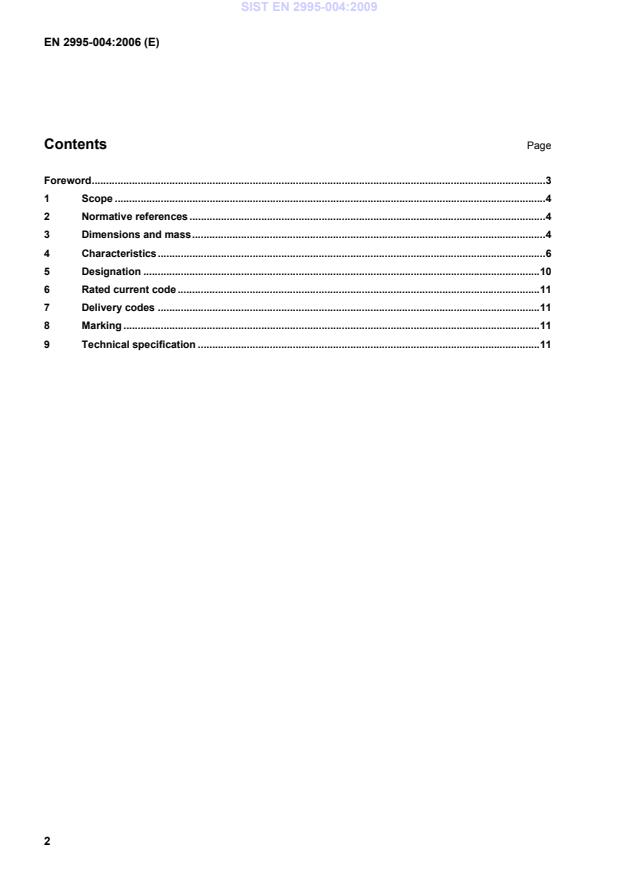
The standard is organized into these clauses:
- Scope
- Normative references
- Dimensions and mass
- Characteristics
- Designation
- Rated current code
- Delivery codes
- Marking
- Technical specification
This matters in practice because a reader can see both the required product type and where to find the data needed for design, procurement, installation and inspection.
What are the key requirements of SIST EN 2995-004:2009?
Clause 1 limits the product to aircraft on-board circuits, a temperature range from -55 °C to 125 °C, and an altitude up to 22 000 m. The breaker is a push-pull single push-button device with delayed-action trip-free tripping and a signal contact that changes state opposite to the main contacts, so status can be monitored electrically.
Clause 3 defines the physical interface. The breaker must follow the stated dimensions and mass limits, use the panel mounting arrangement referenced from EN 2995-001, and fit the panel cut-out and hardware shown in the document. For a buyer or installer, this is the fit check: the part must match the panel opening, terminals and mounting hardware used on the aircraft.
Clause 4.2 gives the installation details that matter for assembly control. It names the fasteners from EN 6113, gives tightening torques for the attaching nut and the connection hardware, and identifies recommended tools for auxiliary contact insertion and extraction. In practice, this helps avoid loose mounting, damaged contacts and inconsistent maintenance work.
Clause 4.2.5 to 4.2.7 set mechanical qualification checks such as vibration, shock and endurance. The breaker is tested under combined vibration conditions at elevated temperature, then under shock and repeated operation. This is the part to review when a program needs evidence that the breaker can survive aircraft service conditions.
Clause 4.4.1 to 4.4.2 define the electrical operating range and contact performance. The standard gives the nominal voltages for the main contacts and limits the voltage drop for both rated current and low-current operation, including the signal circuit. That means users can verify that the breaker will not waste too much voltage in service and that the signal contact still behaves properly at low current.
Clause 4.4.3 to 4.4.5 covers trip behaviour under overload and short-circuit. The document gives minimum and maximum tripping thresholds, overload trip times at different temperatures, and short-circuit test conditions at ground level and at 22 000 m. In practice, these clauses define how quickly the breaker should act under fault conditions and what kind of fault tests are needed for qualification.
Clause 4.4.6 to 4.4.8 covers endurance, dielectric rigidity and insulation resistance. The standard separates no-load and loaded endurance for the main and signal contacts, then sets the dielectric and insulation checks. These requirements matter for life testing, safety approval and acceptance of production lots.
Clause 5 defines the designation structure. SIST EN 2995-004:2009 uses a description block and an identity block that includes the standard number, the design code, the rated current code and the delivery code. Clause 6 links the actuator marking to the rated current code, and Clause 7 identifies the delivery codes for hardware kits.
Clause 8 defines the marking content for packaging and the product, including the designation, manufacture date, manufacturer identification and the electrical diagram and pin identification for the auxiliary contact. For procurement and traceability, this is the information that connects the delivered part to the correct configuration.
What terms does SIST EN 2995-004:2009 define?
- Actuator - The push-pull single push button used to operate the breaker.
- Trip-free - A tripping action in which the breaker opens even when the actuator is held in the operating position.
- Signal contact - The auxiliary contact pair that changes state opposite to the main contacts, so breaker status can be signalled.
- Main contacts - The power-carrying contacts, identified in the electrical diagram as terminals 1 and 2.
- Rated current code - The code used in the designation and on the actuator to identify the current rating.
- Delivery code - The code that identifies how the attachment and connection hardware kit is supplied.
- d.c. - Direct current.
- a.c. - Alternating current.
Who uses SIST EN 2995-004:2009?
Aerospace electrical designers use SIST EN 2995-004:2009 when selecting a breaker for an aircraft circuit and checking the fit, ratings and trip behaviour. Manufacturers use it to build the correct configuration and marking, while test laboratories use it to run vibration, shock, overload, short-circuit and dielectric checks.
Installers and maintenance teams use it for panel mounting, torque control and contact tooling. Quality managers and buyers use it to compare offers, confirm the delivery code, and verify that the supplied part matches the required hardware and identification.
Which standards are used with SIST EN 2995-004:2009?
- EN 2995-001 - Provides the technical specification for the series and is also referenced for panel mounting, material and surface treatment, endurance-related and environmental details, and insulation resistance.
- EN 3155-016 - Specifies the male crimp electrical contacts used in the connection system.
- EN 6113 - Covers the connecting and attachment hardware for the circuit breaker.
- TR 6083 - Gives the panel cut-outs for installation of electrical components.
- MIL-I-81969/1A - Identifies a metallic installing and removal tool for connector electrical contacts.
- MIL-I-81969/14C - Identifies a plastic installing and removal tool for connector electrical contacts.
- FED-STD-595B - Provides the green colour reference used for the actuator.
What does the SIST EN 2995-004:2009 document contain?
SIST EN 2995-004:2009 contains a dimensional figure and an electrical diagram, plus tables for voltages, voltage drop, tripping thresholds, overload trip times, short-circuit performance, endurance and dielectric rigidity. It also contains the designation rules, the rated current code table, the delivery code table and the marking requirements.
That makes it useful for design control, qualification testing, procurement and incoming inspection. The document gives the product definition, the operating limits, the test conditions and the identification rules in one place.
Relations
- Effective Date
- 28-Jan-2026
- Effective Date
- 28-Jan-2026
- Effective Date
- 28-Jan-2026
- Effective Date
- 28-Jan-2026
Get Certified
Connect with accredited certification bodies for this standard

BUREAU VERITAS Certification Germany
Bureau Veritas certification in Germany.

Element Materials Technology
Materials testing and product certification.

AQMS Ltd.
AQMS provides ISO certification to SMEs across the UK.
Sponsored listings
Frequently Asked Questions
SIST EN 2995-004:2009 is a standard published by the Slovenian Institute for Standardization (SIST). Its full title is "Aerospace series - Circuit breakers, single-pole, temperature compensated, rated current 1 A to 25 A - Part 004: With signal contact - Product standard". This standard covers: This standard specifies the characteristics of single-pole circuit breakers, temperature compensated with a rated current from 1 A to 25 A, used in aircraft on-board circuits at a temperature between – 55 °C and 125 °C and at an altitude of 22 000 m max. These circuit breakers are operated by a push-pull type single push button (actuator), with delayed action "trip-free" tripping with a signal contact which is open when main contacts are closed, and inversely. They will continue to function up to the short-circuit current.
This standard specifies the characteristics of single-pole circuit breakers, temperature compensated with a rated current from 1 A to 25 A, used in aircraft on-board circuits at a temperature between – 55 °C and 125 °C and at an altitude of 22 000 m max. These circuit breakers are operated by a push-pull type single push button (actuator), with delayed action "trip-free" tripping with a signal contact which is open when main contacts are closed, and inversely. They will continue to function up to the short-circuit current.
SIST EN 2995-004:2009 is classified under the following ICS (International Classification for Standards) categories: 49.060 - Aerospace electric equipment and systems. The ICS classification helps identify the subject area and facilitates finding related standards.
SIST EN 2995-004:2009 has the following relationships with other standards: It is inter standard links to SIST EN 3155-016:2025, SIST EN 2995-001:2024, SIST EN 4728:2015, SIST EN 3155-002:2024. Understanding these relationships helps ensure you are using the most current and applicable version of the standard.
SIST EN 2995-004:2009 is available in PDF format for immediate download after purchase. The document can be added to your cart and obtained through the secure checkout process. Digital delivery ensures instant access to the complete standard document.
Standards Content (Sample)
2003-01.Slovenski inštitut za standardizacijo. Razmnoževanje celote ali delov tega standarda ni dovoljeno.Aeronavtika - Odklopniki, enopolni, temperaturno kompenzirani, nazivni tok od 1 A do 25 A - 004. del: S signalnim kontaktom - Standard za proizvodLuft- und Raumfahrt - Schutzschalter, einpolig, Temperaturkompensiert, Nennströme von 1 A bis 25 A - Teil 004: Mit Signalkontakt - ProduktnormSérie aérospatiale - Disjoncteurs unipolaires compensés en température, intensités nominales 1 A à 25 A - Partie 004 : Avec contact de signalisation - Norme de produitAerospace series - Circuit breakers, single-pole, temperature compensated, rated current 1 A to 25 A - Part 004: With signal contact - Product standard49.060Aerospace electric equipment and systemsICS:Ta slovenski standard je istoveten z:EN 2995-004:2006SIST EN 2995-004:2009en,de01-junij-2009SIST EN 2995-004:2009SLOVENSKI
STANDARD
EUROPEAN STANDARDNORME EUROPÉENNEEUROPÄISCHE NORMEN 2995-004August 2006ICS 49.060 English VersionAerospace series - Circuit breakers, single-pole, temperaturecompensated, rated current 1 A to 25 A - Part 004: With signalcontact - Product standardSérie aérospatiale - Disjoncteurs unipolaires compensés entempérature, intensités nominales 1 A à 25 A - Partie 004 :Avec contact de signalisation - Norme de produitLuft- und Raumfahrt - Schutzschalter, einpolig,Temperaturkompensiert, Nennströme von 1 A bis 25 A -Teil 004: Mit Signalkontakt - ProduktnormThis European Standard was approved by CEN on 5 June 2006.CEN members are bound to comply with the CEN/CENELEC Internal Regulations which stipulate the conditions for giving this EuropeanStandard the status of a national standard without any alteration. Up-to-date lists and bibliographical references concerning such nationalstandards may be obtained on application to the Central Secretariat or to any CEN member.This European Standard exists in three official versions (English, French, German). A version in any other language made by translationunder the responsibility of a CEN member into its own language and notified to the Central Secretariat has the same status as the officialversions.CEN members are the national standards bodies of Austria, Belgium, Cyprus, Czech Republic, Denmark, Estonia, Finland, France,Germany, Greece, Hungary, Iceland, Ireland, Italy, Latvia, Lithuania, Luxembourg, Malta, Netherlands, Norway, Poland, Portugal, Romania,Slovakia, Slovenia, Spain, Sweden, Switzerland and United Kingdom.EUROPEAN COMMITTEE FOR STANDARDIZATIONCOMITÉ EUROPÉEN DE NORMALISATIONEUROPÄISCHES KOMITEE FÜR NORMUNGManagement Centre: rue de Stassart, 36
B-1050 Brussels© 2006 CENAll rights of exploitation in any form and by any means reservedworldwide for CEN national Members.Ref. No. EN 2995-004:2006: ESIST EN 2995-004:2009
Aerospace series – Circuit breakers, single-pole, temperature compensated, rated current 1 A to 25 A – Part 001: Technical specification.
EN 3155-016,
Aerospace series – Electrical contacts used in elements of connection – Part 016: Contacts, electrical, male, type A, crimp, class S – Product standard.
EN 6113,
Aerospace series – Circuit breaker, connecting and attachment hardware. 1) TR 6083,
Aerospace series – Cut-outs for installation of electrical components. 2) MIL-I-81969/1A,
Installing and removal tools, connector electrical contact, type III, class 2, composition C. 3) MIL-I-81969/14C,
...