


SIST-TP CEN/TR 18010:2024
(Main)Chemical disinfectants and antiseptics - Information on the preparation of spores and determination/exclusion of sporistatical activity
Chemical disinfectants and antiseptics - Information on the preparation of spores and determination/exclusion of sporistatical activity
This document provides additional information and recommendations on the preparation of spores and a
test method to determine / exclude sporistatical activity respectively differentiate between sporistatical
and sporicidal activity of a product.
Chemische Desinfektion und Antiseptika - Informationen zur Aufbereitung von Sporen und Bestimmung/Abgrenzung der sporistatischen Wirkung
Dieses Dokument stellt weitere Informationen und Empfehlungen über die Vorbereitung von Sporen zur Verfügung sowie eine Testmethode zur Bestimmung/zum Ausschluss sporistatischer Aktivität bzw. zur Unterscheidung zwischen sporistatischer und sporizider Aktivität eines Produkts.
Antiseptiques et désinfectants chimiques - Informations sur la préparation des spores et détermination/délimitation de l'effet sporistatique
Le présent document fournit des informations et des recommandations complémentaires concernant la préparation des spores, ainsi qu’une méthode d’essai permettant de déterminer/d’exclure l’activité sporistatique ou, selon le cas, de différencier l’activité sporistatique de l’activité sporicide d’un produit.
Kemična razkužila in antiseptiki - Informacije o pripravi spor in določanju/izključevanju sporocidnega delovanja
Ta dokument podaja dodatne informacije in priporočila o pripravi spor in metodi preskušanja za določanje/izključevanje sporocidnega delovanja in ločevanje med sporocidnim in sporistatičnim delovanjem izdelka.
General Information
- Status
- Published
- Public Enquiry End Date
- 02-Oct-2023
- Publication Date
- 11-Jan-2024
- Technical Committee
- KDS - Cosmetics, chemical disinfectants and surface active agents
- Current Stage
- 6060 - National Implementation/Publication (Adopted Project)
- Start Date
- 06-Dec-2023
- Due Date
- 10-Feb-2024
- Completion Date
- 12-Jan-2024
Overview
CEN/TR 18010:2023 - Technical Report from CEN/TC 216 - provides practical guidance on the preparation of bacterial spore suspensions and a complementary test procedure to determine or exclude sporistatical activity and to distinguish it from sporicidal activity. Approved 13 November 2023, the report gives additional recommendations to support suspension tests used for chemical disinfectants and antiseptics, especially where EN 13704 and EN 17126 leave gaps.
Key topics and requirements
- Scope and purpose: Advice on spore production, chemical susceptibility checks and an added control to differentiate sporistatical vs sporicidal effects.
- Target organisms: Guidance covers spores of Clostridioides difficile, Bacillus subtilis (ATCC 6633) and Bacillus cereus (CIP 105151).
- Chemical susceptibility checks: Use of glutardialdehyde (GA) and peracetic acid (PAA) as reference substances, with specified concentrations and exposure conditions to validate spore batch susceptibility and test sensitivity (examples and lg-reduction thresholds are provided).
- Storage and viability: Recommended storage conditions and minimum ageing periods before testing (e.g., 2–8 °C storage for defined weeks depending on species).
- Test execution details:
- Dilution-neutralization method with hard water as the diluent.
- Validation using defined spore suspension concentrations (provided ranges).
- Preparation of standard reference test solutions (Annex A) with worked dilution examples for GA and PAA.
- Sporistatical activity control (Annex B): Introduction of the original neutralization tube (ONT) procedure - incubating aliquots in TSB + neutralizer, monitoring growth, and re-challenging to confirm neutralization effectiveness and to exclude bacteriostatic (sporistatic) artefacts.
- Analytical support (Annex C): Practical titration procedure for determining actual PAA / hydrogen peroxide content prior to preparing test solutions.
Practical applications and users
This technical report is intended for:
- Microbiological test laboratories performing suspension tests for disinfectant efficacy.
- Manufacturers developing or validating chemical disinfectants and antiseptics.
- Regulatory bodies and notified bodies reviewing claims of sporicidal activity.
- Infection prevention specialists and quality managers seeking robust test methods to substantiate product performance.
Practical benefits include improved reproducibility of spore preparations, standardized reference controls (GA, PAA), and a clear means to exclude false positive sporicidal claims caused by sporistatic effects.
Related standards
- EN 13704 (sporocidal activity - suspension test)
- EN 17126 (C. difficile sporicidal activity)
- EN 14347 (basic sporicidal activity - includes sporistatical control)
- EN 14885 (application of European standards for chemical disinfectants and antiseptics)
Keywords: CEN/TR 18010:2023, chemical disinfectants, antiseptics, spore preparation, sporistatical activity, sporicidal activity, peracetic acid, glutardialdehyde, suspension test, EN 13704, EN 17126.

Frequently Asked Questions
SIST-TP CEN/TR 18010:2024 is a technical report published by the Slovenian Institute for Standardization (SIST). Its full title is "Chemical disinfectants and antiseptics - Information on the preparation of spores and determination/exclusion of sporistatical activity". This standard covers: This document provides additional information and recommendations on the preparation of spores and a test method to determine / exclude sporistatical activity respectively differentiate between sporistatical and sporicidal activity of a product.
This document provides additional information and recommendations on the preparation of spores and a test method to determine / exclude sporistatical activity respectively differentiate between sporistatical and sporicidal activity of a product.
SIST-TP CEN/TR 18010:2024 is classified under the following ICS (International Classification for Standards) categories: 11.080.20 - Disinfectants and antiseptics; 71.100.35 - Chemicals for industrial and domestic disinfection purposes. The ICS classification helps identify the subject area and facilitates finding related standards.
SIST-TP CEN/TR 18010:2024 is available in PDF format for immediate download after purchase. The document can be added to your cart and obtained through the secure checkout process. Digital delivery ensures instant access to the complete standard document.
Standards Content (Sample)
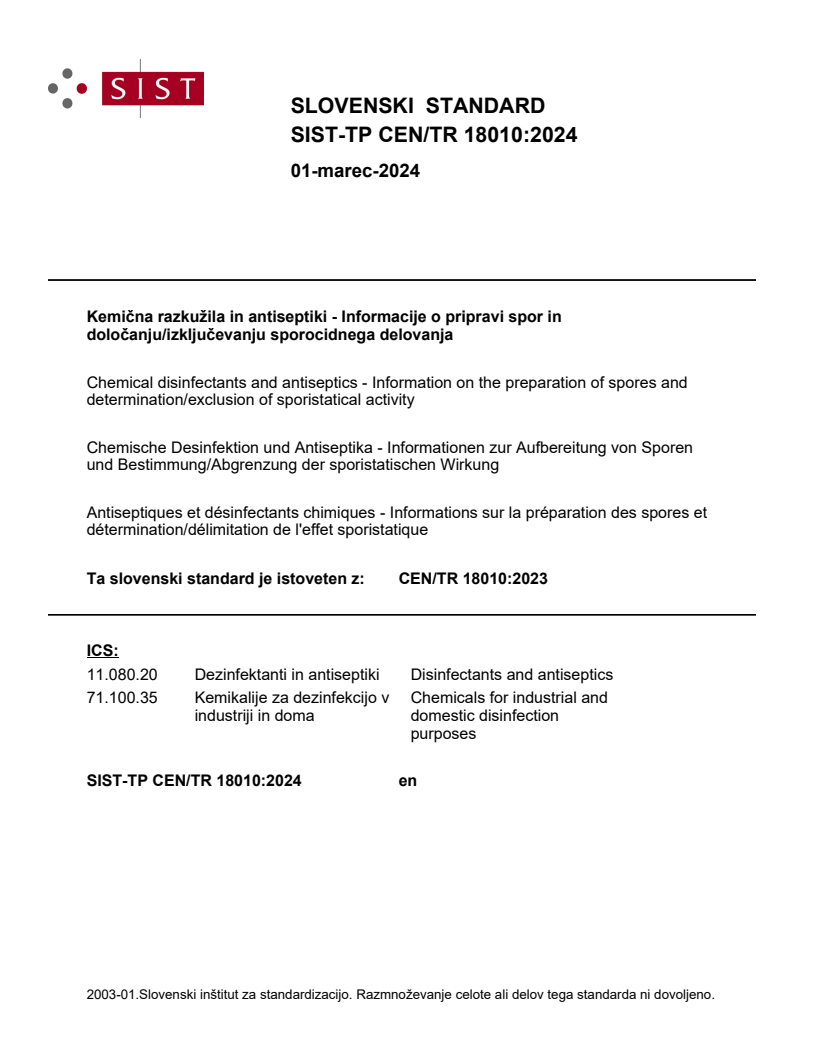
SLOVENSKI STANDARD
01-marec-2024
Kemična razkužila in antiseptiki - Informacije o pripravi spor in
določanju/izključevanju sporocidnega delovanja
Chemical disinfectants and antiseptics - Information on the preparation of spores and
determination/exclusion of sporistatical activity
Chemische Desinfektion und Antiseptika - Informationen zur Aufbereitung von Sporen
und Bestimmung/Abgrenzung der sporistatischen Wirkung
Antiseptiques et désinfectants chimiques - Informations sur la préparation des spores et
détermination/délimitation de l'effet sporistatique
Ta slovenski standard je istoveten z: CEN/TR 18010:2023
ICS:
11.080.20 Dezinfektanti in antiseptiki Disinfectants and antiseptics
71.100.35 Kemikalije za dezinfekcijo v Chemicals for industrial and
industriji in doma domestic disinfection
purposes
2003-01.Slovenski inštitut za standardizacijo. Razmnoževanje celote ali delov tega standarda ni dovoljeno.
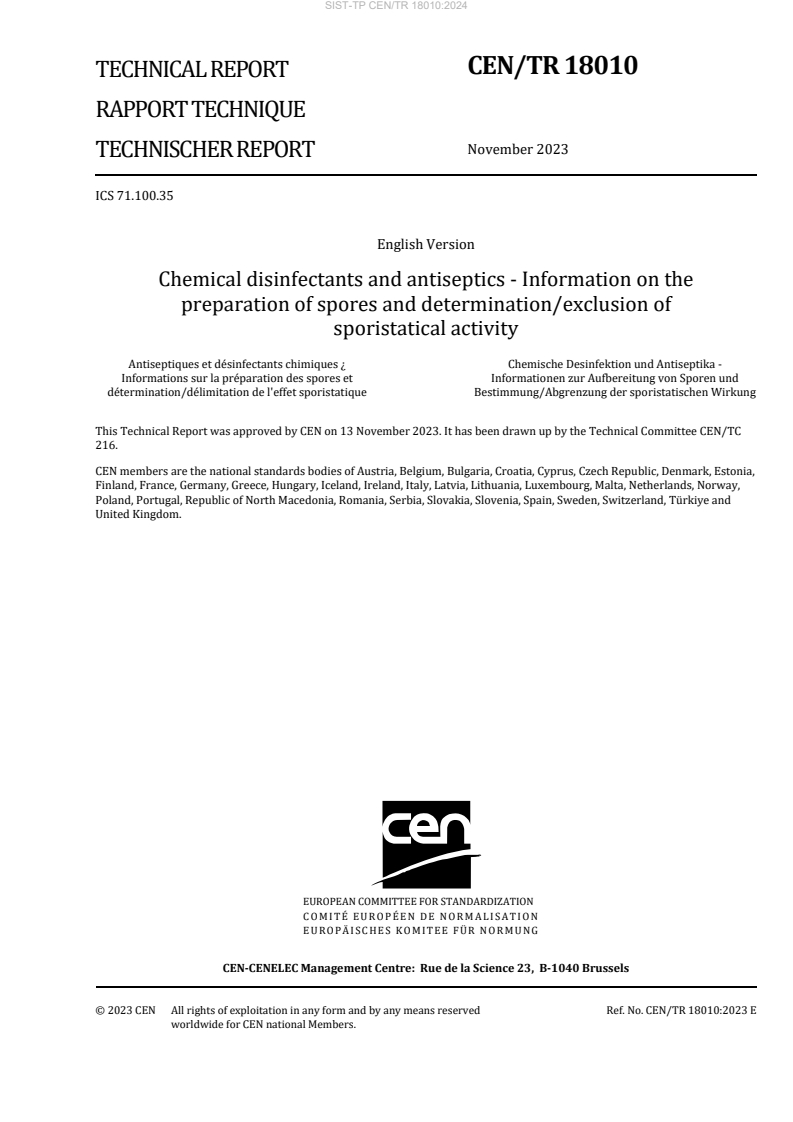
CEN/TR 18010
TECHNICAL REPORT
RAPPORT TECHNIQUE
November 2023
TECHNISCHER REPORT
ICS 71.100.35
English Version
Chemical disinfectants and antiseptics - Information on the
preparation of spores and determination/exclusion of
sporistatical activity
Antiseptiques et désinfectants chimiques ¿ Chemische Desinfektion und Antiseptika -
Informations sur la préparation des spores et Informationen zur Aufbereitung von Sporen und
détermination/délimitation de l'effet sporistatique Bestimmung/Abgrenzung der sporistatischen Wirkung
This Technical Report was approved by CEN on 13 November 2023. It has been drawn up by the Technical Committee CEN/TC
216.
CEN members are the national standards bodies of Austria, Belgium, Bulgaria, Croatia, Cyprus, Czech Republic, Denmark, Estonia,
Finland, France, Germany, Greece, Hungary, Iceland, Ireland, Italy, Latvia, Lithuania, Luxembourg, Malta, Netherlands, Norway,
Poland, Portugal, Republic of North Macedonia, Romania, Serbia, Slovakia, Slovenia, Spain, Sweden, Switzerland, Türkiye and
United Kingdom.
EUROPEAN COMMITTEE FOR STANDARDIZATION
COMITÉ EUROPÉEN DE NORMALISATION
EUROPÄISCHES KOMITEE FÜR NORMUNG
CEN-CENELEC Management Centre: Rue de la Science 23, B-1040 Brussels
© 2023 CEN All rights of exploitation in any form and by any means reserved Ref. No. CEN/TR 18010:2023 E
worldwide for CEN national Members.
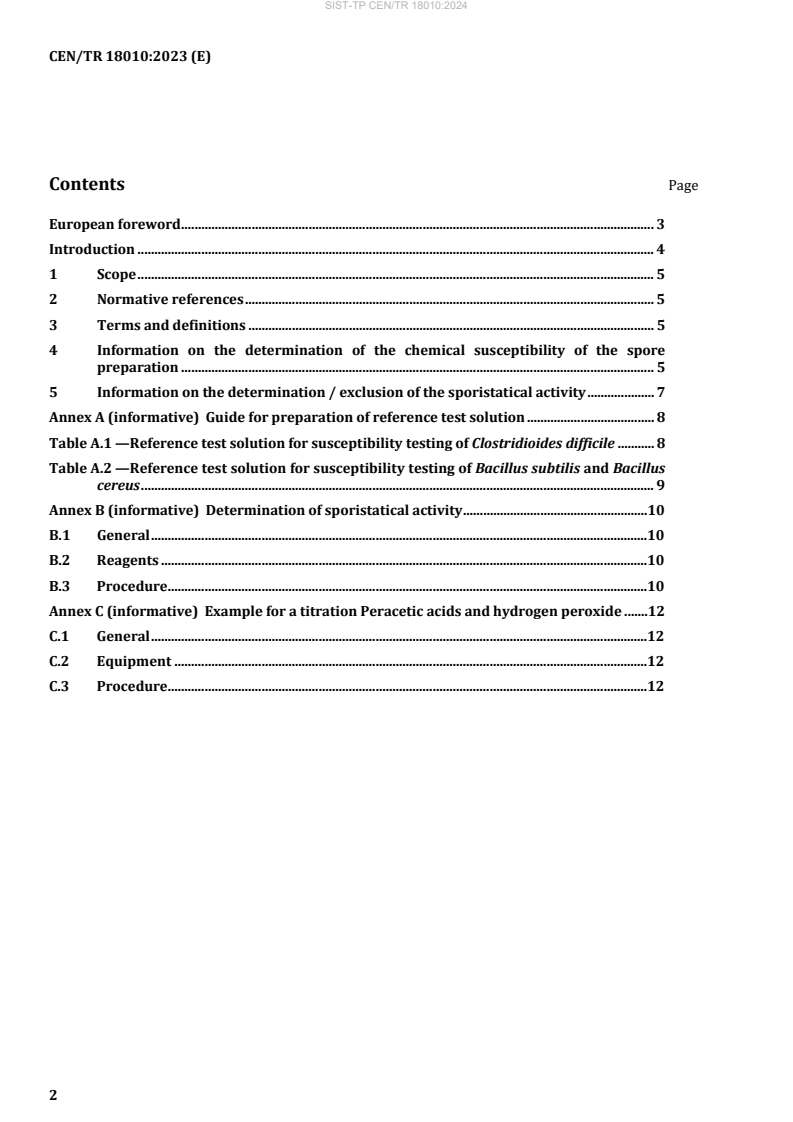
Contents Page
European foreword . 3
Introduction . 4
1 Scope . 5
2 Normative references . 5
3 Terms and definitions . 5
4 Information on the determination of the chemical susceptibility of the spore
preparation . 5
5 Information on the determination / exclusion of the sporistatical activity . 7
Annex A (informative) Guide for preparation of reference test solution . 8
Table A.1 —Reference test solution for susceptibility testing of Clostridioides difficile . 8
Table A.2 —Reference test solution for susceptibility testing of Bacillus subtilis and Bacillus
cereus . 9
Annex B (informative) Determination of sporistatical activity .10
B.1 General .10
B.2 Reagents .10
B.3 Procedure.10
Annex C (informative) Example for a titration Peracetic acids and hydrogen peroxide .12
C.1 General .12
C.2 Equipment .12
C.3 Procedure.12
European foreword
This document (CEN/TR 18010:2023) has been prepared by Technical Committee CEN/TC 216
“Chemical disinfectants and antiseptics”, the secretariat of which is held by AFNOR.
Attention is drawn to the possibility that some of the elements of this document may be the subject of
patent rights. CEN shall not be held responsible for identifying any or all such patent rights.
Any feedback and questions on this document should be directed to the users’ national standards body.
A complete listing of these bodies can be found on the CEN website.
Introduction
In the past, spore production has led to the following problems:
Chemical susceptibility of B. cereus and B. subtilis spore suspensions prepared according EN 13704 and
EN 17126 did not comply with the specified requirements/lg-reductions due to the lack of buffering of
the glutardialdehyde. In the updated version of EN 13704 a check of the chemical susceptibility for
C. sporogones with reference substances is missing. Data for Glutardialdehyde (GA) and Peracetic acid
(PAA) have to be collected and included in a revised EN 13704.
These problems can be avoided if the following notes and information are taken into account.
The chemical susceptibility test of C. difficile spore suspension at EN 17126 is unchanged and included
for completeness of this technical report.
Also a test method to differentiate between sporicidal and sporistatical activity of a product, which is
included in EN 14347, is missing in EN 13704 and EN 17126. Thus, an additional control to
determine/exclude a sporistatical activity is included.
This information will be taken into account in the revision of EN 17126 and EN 13704 or will be included
in the revision of EN 12353 and then referenced in the two standards mentioned.
1 Scope
This document provides additional information and recommendations on the preparation of spores and
a test method to determine / exclude sporistatical activity respectively differentiate between
sporistatical and sporicidal activity of a product.
2 Normative references
The following documents are referred to in the text in such a way that some or all of their content
constitutes requirements of this document. For dated references, only the edition cited applies. For
undated references, the latest edition of the referenced document (including any amendments) applies.
EN 14885, Chemical disinfectants and antiseptics - Application of European Standards for chemical
disinfectants and antiseptics
3 Terms and definitions
For the purposes of this document, the terms and definitions given in EN 14885 apply.
4 Information on the determination of the chemical susceptibility of the spore
preparation
When testing in accordance with EN 17126 and EN 13704 the following information is taken into account.
Viability is checked and the susceptibility of each spore batch after at least 8 weeks storage at 2 °C to 8°C
for Clostridioides spores and 4 weeks storage at 2 °C to 8 °C for Bacillus spores. Glutardialdehyde is used
and peracetic acid at set concentrations. Tests are performed according to the dilution-neutralization
method and use hard water instead of an interfering substance. The validation is performed with a
6 6
suspension adjusted to 1,5 x 10 cfu/ml to 5,0 x 10 cfu/ml.
Pre-examination studies agreed that at 20 °C ±1 °C:
a) With Clostridioides difficile NCTC 13366 without interfering substance:
— 1,0 % (v/v) – 15 min: Glutardialdehyde solution (unbuffered) is achieve a lg reduction of < 1,5 lg.
1)
The pH is within a range of 6,11 ±0,77 [Data from ring trial 2017/2019]
— 6,0 % (v/v) – 15 min: Glutardialdehyde solution (unbuffered) is achieve a lg reduction of ≥ 1,5 lg.
1)
The pH is within a range of 4,48 ±0,31 [Data from ring trial 2017] .
— 0,01 % (v/v) – 15 min: Peracetic acid solution (unbuffered) is achieve a lg reduction of < 1,5 lg.
1)
The pH is within a range of 4,92 ±0,28 [Data from ring trial 2017/2019] .
— 0,04 % (v/v) – 15 min: Peracetic acid solution (unbuffered) is achieve a lg reduction of ≥ 1,5 lg.
1)
The pH is within a range of 3,94 ±0,11 [Data from ring trial 2017/2019] .
1) TM
The. Data based on studies with BIOBAN GA 50 Antimicrobial and Lerasept® spezial; the pH values serve as orientation
and do not represent a criterion for exclusion, if they are within the range of the relevant pH range.
b) With Bacillus subtilis AT
...
Questions, Comments and Discussion
Ask us and Technical Secretary will try to provide an answer. You can facilitate discussion about the standard in here.
Loading comments...