

SIST EN 300 392-9 V1.4.1:2010
(Main)Terrestrial Trunked Radio (TETRA) - Voice plus Data (V+D) - Part 9: General requirements for supplementary services
- Abstract
Correction of editorial mistakes and inclusion of approved CRs, if any.
The present document defines principles and requirements generally applicable to the stage 2 and 3 descriptions of supplementary services for the Terrestrial Trunked Radio (TETRA). The present document is applicable to any TETRA terminal equipment (Mobile Station (MS) or Line Station (LS) and to any TETRA network (Switching and Management Infrastructure - SwMI)) which support at least one TETRA Supplementary Service (SS). In addition, its routeing requirements of supplementary service information are applicable to any TETRA network with a Voice plus Data (V+D) Inter-System Interface (ISI) to another TETRA network which
supports at least one TETRA SS.
- Status
- Published
- Publication Date
- 07-Sep-2010
- Technical Committee
- MOC - Mobile Communications
- Current Stage
- 6060 - National Implementation/Publication (Adopted Project)
- Start Date
- 11-Aug-2010
- Due Date
- 16-Oct-2010
- Completion Date
- 08-Sep-2010
Buy Documents


ETSI EN 300 392-9 V1.4.0 (2010-04) - Terrestrial Trunked Radio (TETRA); Voice plus Data (V+D); Part 9: General requirements for supplementary services


ETSI EN 300 392-9 V1.4.1 (2010-08) - Terrestrial Trunked Radio (TETRA); Voice plus Data (V+D); Part 9: General requirements for supplementary services



SIST EN 300 392-9 V1.4.1:2010 is the Slovenian adoption of ETSI EN 300 392-9 V1.4.1 for Terrestrial Trunked Radio (TETRA) - Voice plus Data (V+D). It defines common principles and requirements for stage 2 and stage 3 descriptions of TETRA Supplementary Services (SS), including how SS information is encoded and routed for Mobile Station (MS), Line Station (LS) and Switching and Management Infrastructure (SwMI) equipment. This version incorporates editorial corrections and approved change requests, where applicable.
What does SIST EN 300 392-9 V1.4.1:2010 specify?
SIST EN 300 392-9 V1.4.1:2010 sets the common rules that other TETRA supplementary service specifications build on. It covers the service model, the PDU structure, routing across the air or LS interface, and the Inter-System Interface (ISI) behaviour when SS information moves between TETRA networks.
Clause 1 limits the scope to TETRA equipment and networks that support at least one SS, and extends some routing requirements to V+D networks connected through ISI to another TETRA network that supports at least one SS.
| Annex | What it covers |
|---|---|
| Annex A | Definition of the ISI ROSE operation |
| Annex B | Examples of ANF-ISISS ROSE APDUs or PSS1 messages |
| Annex C | Suggested introduction for an SDL annex on call-related and call-unrelated procedures |
| Annex D | Change requests |
| Annex E | Bibliography |
The body of the document is organized into clauses on references, definitions and abbreviations, supplementary service concepts, service primitives, invocation order, information transfer at the MS interface, SS PDU contents, routeing, ANF-ISISS, exceptional cases, activation and interrogation procedures, and authentication issues.
What are the key requirements of SIST EN 300 392-9 V1.4.1:2010?
SIST EN 300 392-9 V1.4.1:2010 defines the shared signalling framework for supplementary services. In practice, this is the part that makes different TETRA SS specifications fit together at the air interface and across ISI.
Service order and transport
Clause 6 sets the order in which the SwMI checks active supplementary services before an outgoing call proceeds or an incoming call is offered. This matters because one SS can override another, so the network must apply them in the defined sequence.
Clause 7 gives four ways to carry SS information at the MS interface: facility information in a basic service PDU, specific elements in a basic service PDU, a Notification indicator information element, or a U/D-FACILITY PDU. This tells implementers which container to use for call-related and call-unrelated SS information.
PDU structure and encoding
Clause 8 defines the common SS PDU format. Every SS PDU starts with SS type and SS PDU type, and proprietary PDUs use a Manufacturer identifier. The clause also standardizes common encodings for user identity, character strings, external numbers, external call restriction, and generic failure reasons.
Routing and interworking
Clauses 9 and 10 define how SS PDUs are routed inside a SwMI and over ISI through ANF-ISISS (Additional Network Feature - Inter-System Interface Supplementary Service). This matters for roaming, inter-network calls, group calls, and requests that must reach another SwMI rather than stay local. The document also defines the ANF-ISISS service primitives and how call-related and call-unrelated SS PDUs are packaged in ROSE APDUs and PSS1 messages.
Exceptional cases and error handling
Clause 11 covers what happens when the destination MS is no longer registered, the target SwMI does not support the SS, ANF-ISISS is not available, or the ROSE APDU is invalid. It distinguishes between ReturnError and Reject responses and gives the expected network reaction, including when a call is cleared.
Activation, definition, interrogation and authentication
Clauses 12 and 13 provide the generic framework for activation, deactivation, definition and interrogation operations, and the associated authentication expectations. This helps service specifications decide when the authorized user, served user or affected user must be authenticated before a service action is accepted.
What terms does SIST EN 300 392-9 V1.4.1:2010 define?
- Affected user - the user who is subject to the supplementary service operation.
- Authorized user - the user responsible for defining, activating and deactivating the service, and sometimes interrogating it.
- Served user - the user for whom the supplementary service is invoked.
- Call related - information carried across QT using a call reference with an associated user-information connection.
- Call unrelated - information carried across QT without such a call reference and user-information connection.
- Functional Entity (FE) - one of the logical service entities used in stage 2 descriptions, such as FE1, FE2 or FE3.
- SwMI - Switching and Management Infrastructure, the TETRA network entity that controls registration and service handling.
- ANF-ISISS - the Inter-System Interface feature used to transport supplementary service information between SwMIs.
Who uses SIST EN 300 392-9 V1.4.1:2010?
SIST EN 300 392-9 V1.4.1:2010 is used by TETRA network designers, terminal and infrastructure suppliers, and interoperability test teams. It is also relevant to operators, quality managers and buyers who need to check how supplementary services are encoded, routed, authenticated and cleared across a TETRA network or between networks.
Which standards are used with SIST EN 300 392-9 V1.4.1:2010?
The document relies on EN 300 392-1 for general network design and reference points, EN 300 392-2 for air interface encoding rules, and EN 300 392-3-1 for ISI general design and ROSE transport. It also uses EN 300 392-3-2 and EN 300 392-3-3 for ISI individual and group call features, EN 300 392-7 for security, and EN 300 392-10-6 for Call Authorized by Dispatcher (CAD).
For supplementary services, it is linked to EN 300 392-11 and EN 300 392-12, which provide the stage 2 and stage 3 descriptions, and to ETS 300 392-12-7 for Short Number Addressing (SNA). It also references ISO/IEC 11571, 11572 and 11582 for numbering and supplementary-service signalling, ITU-T I.130, E.164, X.121, X.219, X.229 and Z.100, plus ISO/IEC 10646 and TS 100 392-18-3.
What does the SIST EN 300 392-9 V1.4.1:2010 document contain?
The document contains tables for SS type, SS PDU type, address type, user identity, character string, external number, call restriction and failure reason encoding, plus routing tables for U-FACILITY, D-FACILITY and ANF-ISISS PDUs. It also includes a supplementary-service invocation order table and a notification indicator table used at the MS interface.
It provides the ANF-ISISS service model, primitive definitions, and the rules for grouping, forwarding and rejecting SS PDUs over PSS1 signalling. The annexes add worked examples and SDL-oriented guidance, which are useful when implementing, reviewing or testing supplementary service signalling.
Buy Documents
ETSI EN 300 392-9 V1.4.0 (2010-04) - Terrestrial Trunked Radio (TETRA); Voice plus Data (V+D); Part 9: General requirements for supplementary services
ETSI EN 300 392-9 V1.4.1 (2010-08) - Terrestrial Trunked Radio (TETRA); Voice plus Data (V+D); Part 9: General requirements for supplementary services
Get Certified
Connect with accredited certification bodies for this standard

ANCE
Mexican certification and testing association.

Intertek Slovenia
Intertek testing, inspection, and certification services in Slovenia.

LNE (Laboratoire National de Métrologie et d'Essais)
French national laboratory for metrology and testing.
Sponsored listings
Frequently Asked Questions
SIST EN 300 392-9 V1.4.1:2010 is a standard published by the Slovenian Institute for Standardization (SIST). Its full title is "Terrestrial Trunked Radio (TETRA) - Voice plus Data (V+D) - Part 9: General requirements for supplementary services". This standard covers: Correction of editorial mistakes and inclusion of approved CRs, if any. The present document defines principles and requirements generally applicable to the stage 2 and 3 descriptions of supplementary services for the Terrestrial Trunked Radio (TETRA). The present document is applicable to any TETRA terminal equipment (Mobile Station (MS) or Line Station (LS) and to any TETRA network (Switching and Management Infrastructure - SwMI)) which support at least one TETRA Supplementary Service (SS). In addition, its routeing requirements of supplementary service information are applicable to any TETRA network with a Voice plus Data (V+D) Inter-System Interface (ISI) to another TETRA network which supports at least one TETRA SS.
Correction of editorial mistakes and inclusion of approved CRs, if any. The present document defines principles and requirements generally applicable to the stage 2 and 3 descriptions of supplementary services for the Terrestrial Trunked Radio (TETRA). The present document is applicable to any TETRA terminal equipment (Mobile Station (MS) or Line Station (LS) and to any TETRA network (Switching and Management Infrastructure - SwMI)) which support at least one TETRA Supplementary Service (SS). In addition, its routeing requirements of supplementary service information are applicable to any TETRA network with a Voice plus Data (V+D) Inter-System Interface (ISI) to another TETRA network which supports at least one TETRA SS.
SIST EN 300 392-9 V1.4.1:2010 is classified under the following ICS (International Classification for Standards) categories: 33.070.10 - Terrestrial Trunked Radio (TETRA). The ICS classification helps identify the subject area and facilitates finding related standards.
SIST EN 300 392-9 V1.4.1:2010 is available in PDF format for immediate download after purchase. The document can be added to your cart and obtained through the secure checkout process. Digital delivery ensures instant access to the complete standard document.
Standards Content (Sample)
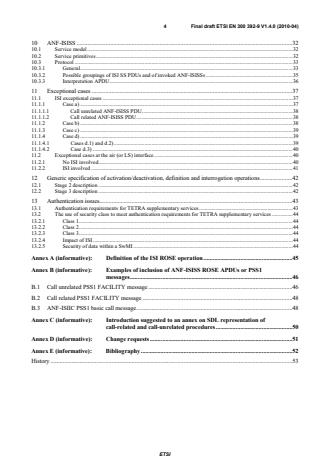
Contents
- 1 Scope
- 2 References
- 2.1 Normative references
- 8 Final draft ETSI EN 300 392-9 V1.4.0 (2010-04)
- 2.2 Informative references
- 3 Definitions, abbreviations and Functional
- 3.1 Definitions
- 9 Final draft ETSI EN 300 392-9 V1.4.0 (2010-04)
- 3.2 Abbreviations
- 10 Final draft ETSI EN 300 392-9 V1.4.0 (2010-04)
- 3.3 Functional Entities (FE)
- 11 Final draft ETSI EN 300 392-9 V1.4.0 (2010-04)
- 4 Supplementary service concepts
- 4.1 Stage 1, 2 and 3 descriptions
- 4.2 Concepts associated with supplementary services
- 12 Final draft ETSI EN 300 392-9 V1.4.0 (2010-04)
- 5 Service primitives
- 5.1 Service primitive general description
- 5.2 Notification service primitive
- 6 Supplementary service invocation order
- 13 Final draft ETSI EN 300 392-9 V1.4.0 (2010-04)
- 7 Transfer of information related to supplementary
- 7.1 Methods of transportation
- 7.2 Call related information
- 14 Final draft ETSI EN 300 392-9 V1.4.0 (2010-04)
- 15 Final draft ETSI EN 300 392-9 V1.4.0 (2010-04)
- 1 LE acknowledgement
- 2 LE paging
- 3 AL operation (see note 1)
- 4 Call barred by SS-BIC
- 5 Call barred by SS-BOC
- 6 Call is forwarded (diverting)
- 7 Forwarding (diversion) activated
- 8 Identity presentation restricted
- 9 Presentation restriction overridden
- 10 Call waiting invoked
- 11 Call put on hold (remote hold)
- 12 Call on hold retrieved (remote retrieval)
- 13 Include call (see note 2)
- 14 Multiparty call (see note 3)
- 15 LSC invoked
- 16 Call rejected due to SS-AS
- 17 SS-AS not invoked/supported
- 18 Called user alerted
- 19 Called user connected
- 20 Call proceeding
- 21 SS-CFU invoked
- 22 SS-CFB invoked
- 23 SS-CFNRy invoked
- 24 SS-CFNRc invoked
- 25 AL-call or speech item (see note 4)
- 26 Notice of imminent call disconnection
- 27 Limited group coverage
- 28 Reserved
- 63 Reserved
- 7.3 Call unrelated supplementary service information
- 16 Final draft ETSI EN 300 392-9 V1.4.0 (2010-04)
- 8 SS PDU contents
- 17 Final draft ETSI EN 300 392-9 V1.4.0 (2010-04)
- 8.1 SS type
- 1 CI Call Identification (see note 1)
- 2 CR Call Report
- 3 TPI Talking Party Identification
- 4 CF Call forwarding (see note 2)
- 5 LSC List Search Call
- 6 CAD Call Authorized by Dispatcher
- 7 SNA Short Number Addressing
- 8 AS Area Selection
- 9 AP Access Priority
- 10 PC Priority Call
- 11 CW Call Waiting
- 12 HOLD Call Hold
- 13 CCBS Call Completion to Busy Subscriber
- 14 LE Late Entry
- 15 Reserved
- 16 PPC Pre-emptive Priority Call
- 17 IC Include Call
- 18 BOC Barring of Outgoing Calls
- 19 BIC Barring of Incoming Calls
- 20 DL Discreet Listening
1 Scope
The present document defines principles and requirements generally applicable to the stage 2 and 3 descriptions of supplementary services for the Terrestrial Trunked Radio (TETRA). The present document is applicable to any TETRA terminal equipment (Mobile Station (MS) or Line Station (LS) and to any TETRA network (Switching and Management Infrastructure - SwMI)) which support at least one TETRA Supplementary Service (SS). In addition, its routeing requirements of supplementary service information are applicable to any TETRA network with a Voice plus Data (V+D) Inter-System Interface (ISI) to another TETRA network which supports at least one TETRA SS.
2 References
References are either specific (identified by date of publication and/or edition number or version number) or non-specific.
- For a specific reference, subsequent revisions do not apply.
- Non-specific reference may be made only to a complete document or a part thereof and only in the following cases:
- if it is accepted that it will be possible to use all future changes of the referenced document for the purposes of the referring document;
- for informative references.
Referenced documents which are not found to be publicly available in the expected location might be found at http://docbox.etsi.org/Reference.
NOTE: While any hyperlinks included in this clause were valid at the time of publication ETSI cannot guarantee their long term validity.
2.1 Normative references
The following referenced documents are indispensable for the application of the present document. For dated references, only the edition cited applies. For non-specific references, the latest edition of the referenced document (including any amendments) applies.
[1] ETSI EN 300 392-1: "Terrestrial Trunked Radio (TETRA); Voice plus Data (V+D); Part 1: General network design".
[2] ETSI EN 300 392-2: "Terrestrial Trunked Radio (TETRA); Voice plus Data (V+D); Part 2: Air Interface (AI)".
[3] ETSI EN 300 392-3-1: "Terrestrial Trunked Radio (TETRA); Voice plus Data (V+D); Part 3: Interworking at the Inter-System Interface (ISI); Sub-part 1: General design". [4] ETSI EN 300 392-3-2: "Terrestrial Trunked Radio (TETRA); Voice plus Data (V+D); Part 3: Interworking at the Inter-System Interface (ISI); Sub-part 2: Additional Network Feature Individual Call (ANF-ISIIC)".
[5] ETSI EN 300 392-3-3: "Terrestrial Trunked Radio (TETRA); Voice plus Data (V+D); Part 3: Interworking at the Inter-System Interface (ISI); Sub-part 3: Additional Network Feature Group Call (ANF-ISIGC)".
[6] ETSI EN 300 392-7: "Terrestrial Trunked Radio (TETRA); Voice plus Data (V+D); Part 7: Security".
[7] ETSI EN 300 392-10-6: "Terrestrial Trunked Radio (TETRA); Voice plus Data (V+D); Part 10: Supplementary services stage 1; Sub-part 6: Call Authorized by Dispatcher (CAD)". ETSI
8 Final draft ETSI EN 300 392-9 V1.4.0 (2010-04)
[8] ETSI EN/ETSI ETS 300 392-11 (all parts): "Terrestrial Trunked Radio (TETRA); Voice plus Data (V+D); Part 11: Supplementary services stage 2".
[9] ETSI EN/ETSI ETS 300 392-12 (all parts): "Terrestrial Trunked Radio (TETRA); Voice plus Data (V+D); Part 12: Supplementary services stage 3".
[10] ISO/IEC 11571 (1998): "Information technology - Telecommunications and information exchange between systems - Private Integrated Services Networks - Addressing". [11] ISO/IEC 11572: "Information technology - Telecommunications and information exchange between systems - Private Integrated Services Network - Circuit mode bearer services - Interexchange signalling procedures and protocol". [12] ISO/IEC 11582: "Information technology - Telecommunications and information exchange between systems - Private Integrated Services Network - Generic functional protocol for the support of supplementary services - Inter-exchange signalling procedures and protocol". [13] ITU-T Recommendation I.130 (1988): "Method for the characterization of telecommunication services supported by an ISDN and network capabilities of an ISDN". [14] ITU-T Recommendation E.164: "The international public telecommunication numbering plan". [15] ITU-T Recommendation X.121: "International numbering plan for public data networks". [16] ITU-T Recommendation X.219 (1988): "Remote Operations: Model, notation and service definition".
[17] ITU-T Recommendation X.229 (1988): "Remote Operations: Protocol specification". [18] ITU-T Recommendation Z.100: "Specification and Description Language (SDL)". [19] Void.
[20] ETSI ETS 300 392-12-7: "Terrestrial Trunked Radio (TETRA); Voice plus Data (V+D); Part 12: Supplementary services stage 3; Sub-part 7: Short Number Addressing (SNA)". [21] ISO/IEC 10646: "Information technology - Universal Multiple-Octet Coded Character Set (UCS)". [22] ETSI TS 100 392-18-3: "Terrestrial Trunked Radio (TETRA); Voice plus Data (V+D) and Direct Mode Operation (DMO); Part 18: Air interface optimized applications; Sub-part 3: Direct mode Over The Air Management protocol (DOTAM)".
2.2 Informative references
The following referenced documents are not essential to the use of the present document but they assist the user with regard to a particular subject area. For non-specific references, the latest version of the referenced document (including any amendments) applies.
[i.1] ETSI TR 102 300-5: "Terrestrial Trunked Radio (TETRA); Voice plus Data (V+D); Designers' guide; Part 5: Guidance on Numbering and addressing".
3 Definitions, abbreviations and Functional
Entities (FE)
3.1 Definitions
For the purposes of the present document, the terms and definitions given in EN 300 392-2 [2] and the following apply:
affected user: user who is subject to the operation affected user SwMI: SwMI where the affected user is currently registered ETSI
9 Final draft ETSI EN 300 392-9 V1.4.0 (2010-04)
authorized user: user who is responsible for the definition, activation and deactivation of the service NOTE: The authorized user may also interrogate the service. Affected user and served user may also be authorized user as defined in each supplementary service.
authorized user SwMI: SwMI where the authorized user is currently registered call related: property of information which is conveyed across the Q reference point (as defined in clause 4.3.3 of T EN 300 392-1 [1]) which uses a call reference which has an associated user-information connection (definition derived from that of the same term in clause 4.9 of ISO/IEC 11582 [12]) call unrelated: property of information which is conveyed across the Q reference point (as defined in clause 4.3.3 of T EN 300 392-1 [1]) which does not use a call reference which has an associated user-information connection (definition derived from that of "call independent" in clause 4.8 of ISO/IEC 11582 [12]) served user: user for whom the supplementary service is invoked served user SwMI: SwMI where the served user is currently registered user: entity using the services of a telecommunications network via an externally accessible service access point NOTE: A user may be a person or an application process.
user application: application process which acts as a user NOTE: See definition of user just above.
3.2 Abbreviations
For the purposes of the present document, the following abbreviations apply:
AL Ambience Listening ANF-ISIGC Additional Network Feature - Inter-System Interface Group Call ANF-ISIMM Additional Network Feature - Inter-System Interface Mobility Management ANF-ISISS Additional Network Feature - Inter-System Interface Supplementary Service AP Access Priority APDU Application Packet Data Unit AS Area Selection BIC Barring of Incoming Calls BOC Barring of Outgoing Calls CAD Call Authorized by Dispatcher CCBS Call Completion to Busy Subscriber CCNR Call Completion on No Reply CF Call Forwarding CI Call Identification CR Call Report CRT Call ReTention CW Call Waiting DGNA Dynamic Group Number Assignment DL Discreet Listening FE Functional Entity GSSI Group Short Subscriber Identity GTSI Group TETRA Subscriber Identity HOLD call Hold IC Include Call ISI Inter-System Interface ITSI Individual TETRA Subscriber Identity LE Late Entry LS Line Station LSC List Search Call MNI Mobile Network Identity MS Mobile Station MS-ISDN Mobile Station ISDN number ETSI
10 Final draft ETSI EN 300 392-9 V1.4.0 (2010-04)
PC Priority Call PDU Protocol Data Unit PISN Private Integrated Services Network PPC Pre-emptive Priority Call SAP Service Access Point SDL (Functional) Specification and Description Language SNA Short Number Addressing SS Supplementary Service NOTE: The abbreviation SS is only used when referring to a specific supplementary service. SS-AL Ambience Listening SS-AP Access Priority SS-AS Area Selection SS-BIC Barring of Incoming Calls SS-BOC Barring of Outgoing Calls SS-CAD Call Authorized by Dispatcher SS-CFB Call Forwarding on Busy SS-CFNRc Call Forwarding on Mobile Subscriber Not Reachable SS-CFNRy Call Forwarding on No Reply SS-CFU Call Forwarding Unconditional SS-CI Call Identification SS-CLIP Calling Line Identification Presentation SS-CLIR Calling/Connected Line Identification Restriction SS-COLP Connected Line Identification Presentation SS-CW Call Waiting SS-DGNA Dynamic Group Number Assignment SS-DL Discreet Listening SS-IC Include Call SS-PC Priority Call SS-SNA Short Number Addressing SS-TPI Talking Party Identification SSI Short Subscriber Identity SwMI Switching and Management Infrastructure TNCC-SAP TETRA Network layer Call Control - Service Access Point TNSS-SAP TETRA Network layer Supplementary Service - Service Access Point TPI Talking Party Identification TSI TETRA Subscriber Identity UCS-2 Universal Character Set coded in 2 octets ISSI Individual Short Subscriber Identity UTF-16BE Unicode Transformation Format serialized as two bytes in Big-Endian format V+D Voice plus Data
3.3 Functional Entities (FE)
The functional model for each supplementary service shall be comprised of a number of FEs. The FEs below should always have the following definitions:
- FE1 served user's service agent;
- FE2 SwMI service control functional entity;
- FE3 authorized user's service agent;
- FE5 service agent of the user affected by service operation;
- FE6 service agent of second listening party;
- FE7 service agent of dispatcher (in the case of SS-CAD) or of monitoring user (in the case of SS-DL);
- FE8 service agent of user removed from a call during a pre-emptive priority call; ETSI
11 Final draft ETSI EN 300 392-9 V1.4.0 (2010-04)
- FE9 service agent of user informed that another user has been removed from a call during a pre-emptive priority call;
- FE10 service agent of user affected by management functions. FE2, the SwMI functional entity, may be split into secondary FEs when needed for a given supplementary service. These FEs are called FE2x in the corresponding stage 2 description (in the related EN/ETS 300 392-11 [8]). An example of this splitting is given in clause C.1.1.
4 Supplementary service concepts
4.1 Stage 1, 2 and 3 descriptions
Supplementary service descriptions are covered in 3 stages according to the method described in ITU-T Recommendation I.130 [13], each stage in a separate document. The contents of each stage description are described in the following clauses.
4.1.1 Stage 1 description
This stage is the overall service description from the user viewpoint and also details the interaction of the service with other supplementary services.
4.1.2 Stage 2 description
Stage 2 identifies the functional capabilities and the information flows needed to support the supplementary service as specified in its stage 1 description. It defines the FEs, the information flow between these entities, the FE actions and the allocation of FEs to physical locations.
4.1.3 Stage 3 description
The stage 3 description specifies the signalling protocols needed to implement the service. The present document addresses the encoding of the service Protocol Data Units (PDU) and of the related information elements, the protocol procedures and the corresponding SDL diagrams.
NOTE: According to ITU-T Recommendation I.130 [13], the stage 3 description of any telecommunication service addresses the network implementation aspects. Consequently it comprises two steps, the specifications of all protocols at the various reference points involved in any of the service procedures (notably the service operation) are the first step of the stage 3 description, and the specifications of the functions of the corresponding network entities are its second step. The latter have not been provided since they can be derived from the specification of the FE actions in the stage 2 description. Service management procedures specified in the above stages (e.g. activation or interrogation) are optional unless otherwise stated in the specific supplementary service stage documents.
4.2 Concepts associated with supplementary services
The terms used to define the procedures associated with supplementary services are given in EN 300 392-1 [1], clause 14.3.1.
ETSI
12 Final draft ETSI EN 300 392-9 V1.4.0 (2010-04)
5 Service primitives
5.1 Service primitive general description
Primitives are specified for each supplementary service at the TNSS Service Access Point (TNSS-SAP), in a specific clause of the corresponding stage 3 description in EN/ETS 300 392-12 [9]. Primitive names shall take the form of TNSS-service-name type where:
- service - supplementary service identifier;
- name - indicates the type of function this primitive is performing (e.g. DEFINE);
- type - indicates whether the primitive is a request, confirm, indication or response. For example, an INTERROGATE request primitive for the supplementary service Ambience Listening (SS-AL) would be specified as TNSS-AL-INTERROGATE request, when primitives of more than one supplementary service are used in the same document. When a document refers only to one supplementary service the short form such as INTERROGATE request may be used.
Parameters are listed with mandatory and conditional parameters first, followed by optional parameters. Repeatable parameters are identified by a comment in the remarks column in the table specifying the primitive's parameters. Following the specifications of a service's primitives, there is a parameter description section listing alphabetically all primitive parameters used in this service and the values allowed. Among those parameters, special mention is to be made of the parameter access priority. This parameter has to be included in every service primitive request or response, since the priority defined for the corresponding air interface (uplink) PDUs is set according to the its value (i.e. low, high or emergency priority as seen by the user application of "0" to "7" as defined in the lower layer service primitives).
NOTE: For call related services the TNSS-SAP and TNCC-SAP logically form a combined SAP defining access to the total service. Some of the supplementary service parameters are actually defined as TNCC-SAP parameters.
5.2 Notification service primitive
Many of the air interface PDUs can carry supplementary service-related information in special information element notification. The notification information element values are used by many supplementary services to carry information to the equipment not supporting the specific supplementary service. The information in the notification information element may be displayed to the user in some format, e.g. in natural language or as a number code. The information is presented to the user application via TNSS-SAP using service primitive NOTIFICATION indication. The notification information element values are defined in clause 7.2.2. The same values are used as parameter values in the NOTIFICATION indication primitive.
6 Supplementary service invocation order
Before allowing an outgoing call from a calling user to proceed towards the called user, or before offering an incoming call to the called user, the SwMI shall search through the user supplementary service database for supplementary services activated and proceed with their invocation in the order detailed in table 1. Due to the interactions specified between supplementary services, the invocation of some of those listed in table 1 may result in the invocation of others further below in that list being overridden although they have been activated, e.g. SS-CAD overrides SS-BIC. ETSI
13 Final draft ETSI EN 300 392-9 V1.4.0 (2010-04)
Table 1: Supplementary service invocation order Incoming calls Outgoing calls PPC SNA PC PPC CAD CAD (see note 1) BIC BOC CFU AS CW PC (see note 1) CFB CFNRy (see note 2) CFNRc NOTE 1: If SS-PC has been invoked for a call and if SS-CAD for outgoing call is invoked for that call and operated with diversion towards a dispatcher registered in another SwMI, SS-PC shall also be invoked for this diversion.
NOTE 2: If the called user is busy, SS-CFNRy may only be invoked if SS-CW has been previously invoked. But the SS-CFNRy operation shall take precedence over further SS-CW operation when the CFNRy no-reply timer has elapsed.
7 Transfer of information related to supplementary
service at the MS interface
7.1 Methods of transportation
There are 4 methods by which information related to supplementary service may be transferred at the MS interface:
- using the facility information element in a basic service PDU;
- using specific elements in a basic service PDU (e.g. Area Selection (SS-AS) in a U-SETUP PDU);
- using the Notification indicator information element in a basic service PDU;
- using an U/D-FACILITY PDU.
7.2 Call related information
The first 3 methods in clause 7.1 may be used to send call related SS PDUs. NOTE: See definition of call related in clause 3.1.
ETSI
14 Final draft ETSI EN 300 392-9 V1.4.0 (2010-04)
7.2.1 Facility information element general construction
The facility information element is a type 3 CC PDU element as defined in clause 14.7 of EN 300 392-2 [2]. It is used to convey call related supplementary service PDUs (SS PDUs) across the air (or LS) interface and is present in all CC PDU definitions (except U/D-FACILITY). Each SS PDU is encoded as stated in clause 8. The encoding rules defined in annex E of EN 300 392-2 [2] shall apply for the definition of the facility information element. Notably according to clause 14.8.48 of EN 300 392-2 [2], the value of the corresponding type 3 element identifier will be equal to the binary value 0011 .
The contents of the facility information element in an uplink CC PDU shall be as defined in table 2. Table 2: Uplink facility information element contents Information sub-element Length C/O/M Remarks Routeing 2 M See note 1 MNI 24 C See note 2 SS PDU Variable M See note 3 NOTE 1: The meaning of the information sub-element routeing shall be the following:
- same SwMI, if its binary value is equal to 00 ;
- end SwMI, if its binary value is equal to 01 ;
- home SwMI of called ITSI/GTSI, if its binary value is equal to 10 ;
- other SwMI indicated by its MNI value, if its binary value is equal to 11 .
The binary value 102 is reserved.
NOTE 2: Shall be present if the binary value of the information sub-element routeing is equal to 11 .
NOTE 3: See clause 8.
NOTE: Since SS PDUs are not specified in table 2 as being repeatable, this means that as many different facility information elements will be needed in a CC PDU as there are SS PDUs to be conveyed. The contents of a facility information element in a downlink CC PDU shall be the same as that defined in table 2 except for that there shall be no information sub-element routeing and no information sub-element MNI. ETSI
...
Contents
- 1 Scope
- 2 References
- 2.1 Normative references
- 8 ETSI EN 300 392-9 V1.4.1 (2010-08)
- 2.2 Informative references
- 3 Definitions, abbreviations and Functional
- 3.1 Definitions
- 9 ETSI EN 300 392-9 V1.4.1 (2010-08)
- 3.2 Abbreviations
- 10 ETSI EN 300 392-9 V1.4.1 (2010-08)
- 3.3 Functional Entities (FE)
- 11 ETSI EN 300 392-9 V1.4.1 (2010-08)
- 4 Supplementary service concepts
- 4.1 Stage 1, 2 and 3 descriptions
- 4.2 Concepts associated with supplementary services
- 5 Service primitives
- 5.1 Service primitive general description
- 12 ETSI EN 300 392-9 V1.4.1 (2010-08)
- 5.2 Notification service primitive
- 6 Supplementary service invocation order
- 13 ETSI EN 300 392-9 V1.4.1 (2010-08)
- 7 Transfer of information related to supplementary
- 7.1 Methods of transportation
- 7.2 Call related information
- 14 ETSI EN 300 392-9 V1.4.1 (2010-08)
- 15 ETSI EN 300 392-9 V1.4.1 (2010-08)
- 1 LE acknowledgement
- 2 LE paging
- 3 AL operation (see note 1)
- 4 Call barred by SS-BIC
- 5 Call barred by SS-BOC
- 6 Call is forwarded (diverting)
- 7 Forwarding (diversion) activated
- 8 Identity presentation restricted
- 9 Presentation restriction overridden
- 10 Call waiting invoked
- 11 Call put on hold (remote hold)
- 12 Call on hold retrieved (remote retrieval)
- 13 Include call (see note 2)
- 14 Multiparty call (see note 3)
- 15 LSC invoked
- 16 Call rejected due to SS-AS
- 17 SS-AS not invoked/supported
- 18 Called user alerted
- 19 Called user connected
- 20 Call proceeding
- 21 SS-CFU invoked
- 22 SS-CFB invoked
- 23 SS-CFNRy invoked
- 24 SS-CFNRc invoked
- 25 AL-call or speech item (see note 4)
- 26 Notice of imminent call disconnection
- 27 Limited group coverage
- 28 Reserved
- 63 Reserved
- 7.3 Call unrelated supplementary service information
- 16 ETSI EN 300 392-9 V1.4.1 (2010-08)
- 8 SS PDU contents
- 17 ETSI EN 300 392-9 V1.4.1 (2010-08)
- 8.1 SS type
- 1 CI Call Identification (see note 1)
- 2 CR Call Report
- 3 TPI Talking Party Identification
- 4 CF Call forwarding (see note 2)
- 5 LSC List Search Call
- 6 CAD Call Authorized by Dispatcher
- 7 SNA Short Number Addressing
- 8 AS Area Selection
- 9 AP Access Priority
- 10 PC Priority Call
- 11 CW Call Waiting
- 12 HOLD Call Hold
- 13 CCBS Call Completion to Busy Subscriber
- 14 LE Late Entry
- 15 Reserved
- 16 PPC Pre-emptive Priority Call
- 17 IC Include Call
- 18 BOC Barring of Outgoing Calls
- 19 BIC Barring of Incoming Calls
- 20 DL Discreet Listening
1 Scope
The present document defines principles and requirements generally applicable to the stage 2 and 3 descriptions of supplementary services for the Terrestrial Trunked Radio (TETRA). The present document is applicable to any TETRA terminal equipment (Mobile Station (MS) or Line Station (LS) and to any TETRA network (Switching and Management Infrastructure - SwMI)) which support at least one TETRA Supplementary Service (SS). In addition, its routeing requirements of supplementary service information are applicable to any TETRA network with a Voice plus Data (V+D) Inter-System Interface (ISI) to another TETRA network which supports at least one TETRA SS.
2 References
References are either specific (identified by date of publication and/or edition number or version number) or non-specific. For specific references, only the cited version applies. For non-specific references, the latest version of the reference document (including any amendments) applies.
Referenced documents which are not found to be publicly available in the expected location might be found at http://docbox.etsi.org/Reference.
NOTE: While any hyperlinks included in this clause were valid at the time of publication ETSI cannot guarantee their long term validity.
2.1 Normative references
The following referenced documents are necessary for the application of the present document. [1] ETSI EN 300 392-1: "Terrestrial Trunked Radio (TETRA); Voice plus Data (V+D); Part 1: General network design".
[2] ETSI EN 300 392-2: "Terrestrial Trunked Radio (TETRA); Voice plus Data (V+D); Part 2: Air Interface (AI)".
[3] ETSI EN 300 392-3-1: "Terrestrial Trunked Radio (TETRA); Voice plus Data (V+D); Part 3: Interworking at the Inter-System Interface (ISI); Sub-part 1: General design". [4] ETSI EN 300 392-3-2: "Terrestrial Trunked Radio (TETRA); Voice plus Data (V+D); Part 3: Interworking at the Inter-System Interface (ISI); Sub-part 2: Additional Network Feature Individual Call (ANF-ISIIC)".
[5] ETSI EN 300 392-3-3: "Terrestrial Trunked Radio (TETRA); Voice plus Data (V+D); Part 3: Interworking at the Inter-System Interface (ISI); Sub-part 3: Additional Network Feature Group Call (ANF-ISIGC)".
[6] ETSI EN 300 392-7: "Terrestrial Trunked Radio (TETRA); Voice plus Data (V+D); Part 7: Security".
[7] ETSI EN 300 392-10-6: "Terrestrial Trunked Radio (TETRA); Voice plus Data (V+D); Part 10: Supplementary services stage 1; Sub-part 6: Call Authorized by Dispatcher (CAD)". [8] ETSI EN/ETSI ETS 300 392-11 (all parts): "Terrestrial Trunked Radio (TETRA); Voice plus Data (V+D); Part 11: Supplementary services stage 2".
[9] ETSI EN/ETSI ETS 300 392-12 (all parts): "Terrestrial Trunked Radio (TETRA); Voice plus Data (V+D); Part 12: Supplementary services stage 3".
[10] ISO/IEC 11571 (1998): "Information technology - Telecommunications and information exchange between systems - Private Integrated Services Networks - Addressing". ETSI
8 ETSI EN 300 392-9 V1.4.1 (2010-08)
[11] ISO/IEC 11572: "Information technology - Telecommunications and information exchange between systems - Private Integrated Services Network - Circuit mode bearer services - Interexchange signalling procedures and protocol". [12] ISO/IEC 11582: "Information technology - Telecommunications and information exchange between systems - Private Integrated Services Network - Generic functional protocol for the support of supplementary services - Inter-exchange signalling procedures and protocol". [13] ITU-T Recommendation I.130 (1988): "Method for the characterization of telecommunication services supported by an ISDN and network capabilities of an ISDN". [14] ITU-T Recommendation E.164: "The international public telecommunication numbering plan". [15] ITU-T Recommendation X.121: "International numbering plan for public data networks". [16] ITU-T Recommendation X.219 (1988): "Remote Operations: Model, notation and service definition".
[17] ITU-T Recommendation X.229 (1988): "Remote Operations: Protocol specification". [18] ITU-T Recommendation Z.100: "Specification and Description Language (SDL)". [19] Void.
[20] ETSI ETS 300 392-12-7: "Terrestrial Trunked Radio (TETRA); Voice plus Data (V+D); Part 12: Supplementary services stage 3; Sub-part 7: Short Number Addressing (SNA)". [21] ISO/IEC 10646: "Information technology - Universal Multiple-Octet Coded Character Set (UCS)". [22] ETSI TS 100 392-18-3: "Terrestrial Trunked Radio (TETRA); Voice plus Data (V+D) and Direct Mode Operation (DMO); Part 18: Air interface optimized applications; Sub-part 3: Direct mode Over The Air Management protocol (DOTAM)".
2.2 Informative references
The following referenced documents are not necessary for the application of the present document but they assist the user with regard to a particular subject area.
[i.1] ETSI TR 102 300-5: "Terrestrial Trunked Radio (TETRA); Voice plus Data (V+D); Designers' guide; Part 5: Guidance on Numbering and addressing".
3 Definitions, abbreviations and Functional
Entities (FE)
3.1 Definitions
For the purposes of the present document, the terms and definitions given in EN 300 392-2 [2] and the following apply:
affected user: user who is subject to the operation affected user SwMI: SwMI where the affected user is currently registered authorized user: user who is responsible for the definition, activation and deactivation of the service NOTE: The authorized user may also interrogate the service. Affected user and served user may also be authorized user as defined in each supplementary service.
authorized user SwMI: SwMI where the authorized user is currently registered ETSI
9 ETSI EN 300 392-9 V1.4.1 (2010-08)
call related: property of information which is conveyed across the Q reference point (as defined in clause 4.3.3 of T EN 300 392-1 [1]) which uses a call reference which has an associated user-information connection (definition derived from that of the same term in clause 4.9 of ISO/IEC 11582 [12]) call unrelated: property of information which is conveyed across the Q reference point (as defined in clause 4.3.3 of T EN 300 392-1 [1]) which does not use a call reference which has an associated user-information connection (definition derived from that of "call independent" in clause 4.8 of ISO/IEC 11582 [12]) served user: user for whom the supplementary service is invoked served user SwMI: SwMI where the served user is currently registered user: entity using the services of a telecommunications network via an externally accessible service access point NOTE: A user may be a person or an application process.
user application: application process which acts as a user NOTE: See definition of user just above.
3.2 Abbreviations
For the purposes of the present document, the following abbreviations apply:
AL Ambience Listening ANF-ISIGC Additional Network Feature - Inter-System Interface Group Call ANF-ISIMM Additional Network Feature - Inter-System Interface Mobility Management ANF-ISISS Additional Network Feature - Inter-System Interface Supplementary Service AP Access Priority APDU Application Packet Data Unit AS Area Selection BIC Barring of Incoming Calls BOC Barring of Outgoing Calls CAD Call Authorized by Dispatcher CCBS Call Completion to Busy Subscriber CCNR Call Completion on No Reply CF Call Forwarding CI Call Identification CR Call Report CRT Call ReTention CW Call Waiting DGNA Dynamic Group Number Assignment DL Discreet Listening FE Functional Entity GSSI Group Short Subscriber Identity GTSI Group TETRA Subscriber Identity HOLD call Hold IC Include Call ISI Inter-System Interface ITSI Individual TETRA Subscriber Identity LE Late Entry LS Line Station LSC List Search Call MNI Mobile Network Identity MS Mobile Station MS-ISDN Mobile Station ISDN number PC Priority Call PDU Protocol Data Unit PISN Private Integrated Services Network PPC Pre-emptive Priority Call SAP Service Access Point SDL (Functional) Specification and Description Language ETSI
10 ETSI EN 300 392-9 V1.4.1 (2010-08)
SNA Short Number Addressing SS Supplementary Service NOTE: The abbreviation SS is only used when referring to a specific supplementary service. SS-AL Ambience Listening SS-AP Access Priority SS-AS Area Selection SS-BIC Barring of Incoming Calls SS-BOC Barring of Outgoing Calls SS-CAD Call Authorized by Dispatcher SS-CFB Call Forwarding on Busy SS-CFNRc Call Forwarding on Mobile Subscriber Not Reachable SS-CFNRy Call Forwarding on No Reply SS-CFU Call Forwarding Unconditional SS-CI Call Identification SS-CLIP Calling Line Identification Presentation SS-CLIR Calling/Connected Line Identification Restriction SS-COLP Connected Line Identification Presentation SS-CW Call Waiting SS-DGNA Dynamic Group Number Assignment SS-DL Discreet Listening SS-IC Include Call SS-PC Priority Call SS-SNA Short Number Addressing SS-TPI Talking Party Identification SSI Short Subscriber Identity SwMI Switching and Management Infrastructure TNCC-SAP TETRA Network layer Call Control - Service Access Point TNSS-SAP TETRA Network layer Supplementary Service - Service Access Point TPI Talking Party Identification TSI TETRA Subscriber Identity UCS-2 Universal Character Set coded in 2 octets ISSI Individual Short Subscriber Identity UTF-16BE Unicode Transformation Format serialized as two bytes in Big-Endian format V+D Voice plus Data
3.3 Functional Entities (FE)
The functional model for each supplementary service shall be comprised of a number of FEs. The FEs below should always have the following definitions:
- FE1 served user's service agent;
- FE2 SwMI service control functional entity;
- FE3 authorized user's service agent;
- FE5 service agent of the user affected by service operation;
- FE6 service agent of second listening party;
- FE7 service agent of dispatcher (in the case of SS-CAD) or of monitoring user (in the case of SS-DL);
- FE8 service agent of user removed from a call during a pre-emptive priority call;
- FE9 service agent of user informed that another user has been removed from a call during a pre-emptive priority call;
- FE10 service agent of user affected by management functions. ETSI
11 ETSI EN 300 392-9 V1.4.1 (2010-08)
FE2, the SwMI functional entity, may be split into secondary FEs when needed for a given supplementary service. These FEs are called FE2x in the corresponding stage 2 description (in the related EN/ETS 300 392-11 [8]). An example of this splitting is given in clause C.1.1.
4 Supplementary service concepts
4.1 Stage 1, 2 and 3 descriptions
Supplementary service descriptions are covered in 3 stages according to the method described in ITU-T Recommendation I.130 [13], each stage in a separate document. The contents of each stage description are described in the following clauses.
4.1.1 Stage 1 description
This stage is the overall service description from the user viewpoint and also details the interaction of the service with other supplementary services.
4.1.2 Stage 2 description
Stage 2 identifies the functional capabilities and the information flows needed to support the supplementary service as specified in its stage 1 description. It defines the FEs, the information flow between these entities, the FE actions and the allocation of FEs to physical locations.
4.1.3 Stage 3 description
The stage 3 description specifies the signalling protocols needed to implement the service. The present document addresses the encoding of the service Protocol Data Units (PDU) and of the related information elements, the protocol procedures and the corresponding SDL diagrams.
NOTE: According to ITU-T Recommendation I.130 [13], the stage 3 description of any telecommunication service addresses the network implementation aspects. Consequently it comprises two steps, the specifications of all protocols at the various reference points involved in any of the service procedures (notably the service operation) are the first step of the stage 3 description, and the specifications of the functions of the corresponding network entities are its second step. The latter have not been provided since they can be derived from the specification of the FE actions in the stage 2 description. Service management procedures specified in the above stages (e.g. activation or interrogation) are optional unless otherwise stated in the specific supplementary service stage documents.
4.2 Concepts associated with supplementary services
The terms used to define the procedures associated with supplementary services are given in EN 300 392-1 [1], clause 14.3.1.
5 Service primitives
5.1 Service primitive general description
Primitives are specified for each supplementary service at the TNSS Service Access Point (TNSS-SAP), in a specific clause of the corresponding stage 3 description in EN/ETS 300 392-12 [9]. Primitive names shall take the form of TNSS-service-name type where:
- service - supplementary service identifier; ETSI
12 ETSI EN 300 392-9 V1.4.1 (2010-08)
- name - indicates the type of function this primitive is performing (e.g. DEFINE);
- type - indicates whether the primitive is a request, confirm, indication or response. For example, an INTERROGATE request primitive for the supplementary service Ambience Listening (SS-AL) would be specified as TNSS-AL-INTERROGATE request, when primitives of more than one supplementary service are used in the same document. When a document refers only to one supplementary service the short form such as INTERROGATE request may be used.
Parameters are listed with mandatory and conditional parameters first, followed by optional parameters. Repeatable parameters are identified by a comment in the remarks column in the table specifying the primitive's parameters. Following the specifications of a service's primitives, there is a parameter description section listing alphabetically all primitive parameters used in this service and the values allowed. Among those parameters, special mention is to be made of the parameter access priority. This parameter has to be included in every service primitive request or response, since the priority defined for the corresponding air interface (uplink) PDUs is set according to the its value (i.e. low, high or emergency priority as seen by the user application of "0" to "7" as defined in the lower layer service primitives).
NOTE: For call related services the TNSS-SAP and TNCC-SAP logically form a combined SAP defining access to the total service. Some of the supplementary service parameters are actually defined as TNCC-SAP parameters.
5.2 Notification service primitive
Many of the air interface PDUs can carry supplementary service-related information in special information element notification. The notification information element values are used by many supplementary services to carry information to the equipment not supporting the specific supplementary service. The information in the notification information element may be displayed to the user in some format, e.g. in natural language or as a number code. The information is presented to the user application via TNSS-SAP using service primitive NOTIFICATION indication. The notification information element values are defined in clause 7.2.2. The same values are used as parameter values in the NOTIFICATION indication primitive.
6 Supplementary service invocation order
Before allowing an outgoing call from a calling user to proceed towards the called user, or before offering an incoming call to the called user, the SwMI shall search through the user supplementary service database for supplementary services activated and proceed with their invocation in the order detailed in table 1. Due to the interactions specified between supplementary services, the invocation of some of those listed in table 1 may result in the invocation of others further below in that list being overridden although they have been activated, e.g. SS-CAD overrides SS-BIC. ETSI
13 ETSI EN 300 392-9 V1.4.1 (2010-08)
Table 1: Supplementary service invocation order Incoming calls Outgoing calls PPC SNA PC PPC CAD CAD (see note 1) BIC BOC CFU AS CW PC (see note 1) CFB CFNRy (see note 2) CFNRc NOTE 1: If SS-PC has been invoked for a call and if SS-CAD for outgoing call is invoked for that call and operated with diversion towards a dispatcher registered in another SwMI, SS-PC shall also be invoked for this diversion.
NOTE 2: If the called user is busy, SS-CFNRy may only be invoked if SS-CW has been previously invoked. But the SS-CFNRy operation shall take precedence over further SS-CW operation when the CFNRy no-reply timer has elapsed.
7 Transfer of information related to supplementary
service at the MS interface
7.1 Methods of transportation
There are 4 methods by which information related to supplementary service may be transferred at the MS interface:
- using the facility information element in a basic service PDU;
- using specific elements in a basic service PDU (e.g. Area Selection (SS-AS) in a U-SETUP PDU);
- using the Notification indicator information element in a basic service PDU;
- using an U/D-FACILITY PDU.
7.2 Call related information
The first 3 methods in clause 7.1 may be used to send call related SS PDUs. NOTE: See definition of call related in clause 3.1.
ETSI
14 ETSI EN 300 392-9 V1.4.1 (2010-08)
7.2.1 Facility information element general construction
The facility information element is a type 3 CC PDU element as defined in clause 14.7 of EN 300 392-2 [2]. It is used to convey call related supplementary service PDUs (SS PDUs) across the air (or LS) interface and is present in all CC PDU definitions (except U/D-FACILITY). Each SS PDU is encoded as stated in clause 8. The encoding rules defined in annex E of EN 300 392-2 [2] shall apply for the definition of the facility information element. Notably according to clause 14.8.48 of EN 300 392-2 [2], the value of the corresponding type 3 element identifier will be equal to the binary value 0011 .
The contents of the facility information element in an uplink CC PDU shall be as defined in table 2. Table 2: Uplink facility information element contents Information sub-element Length C/O/M Remarks Routeing 2 M See note 1 MNI 24 C See note 2 SS PDU Variable M See note 3 NOTE 1: The meaning of the information sub-element routeing shall be the following:
- same SwMI, if its binary value is equal to 00 ;
- end SwMI, if its binary value is equal to 01 ;
- home SwMI of called ITSI/GTSI, if its binary value is equal to 10 ;
- other SwMI indicated by its MNI value, if its binary value is equal to 11 .
The binary value 102 is reserved.
NOTE 2: Shall be present if the binary value of the information sub-element routeing is equal to 11 .
NOTE 3: See clause 8.
NOTE: Since SS PDUs are not specified in table 2 as being repeatable, this means that as many different facility information elements will be needed in a CC PDU as there are SS PDUs to be conveyed. The contents of a facility information element in a downlink CC PDU shall be the same as that defined in table 2 except for that there shall be no information sub-element routeing and no information sub-element MNI. ETSI
15 ETSI EN 300 392-9 V1.4.1 (2010-08)
7.2.2 Notification indicator information element
The notification indicator information element values that may be used shall be as shown in table 3. When, in a situation, more than one notification indicator value is applicable the SwMI may choose the most appropriate and reject the other values or it may send additional PDUs containing the other notification indicator values. Table 3: Notification indicator information element contents Information element Length Value Remarks Notification indicator 6 0 LE broadcast
...
2003-01.Slovenski inštitut za standardizacijo. Razmnoževanje celote ali delov tega standarda ni dovoljeno.Prizemni snopovni radio (TETRA) - Govor in podatki (V+D) - 9. del: Splošne zahteve za dopolnilne storitveTerrestrial Trunked Radio (TETRA) - Voice plus Data (V+D) - Part 9: General requirements for supplementary services33.070.10Prizemni snopovni radio (TETRA)Terrestrial Trunked Radio (TETRA)ICS:Ta slovenski standard je istoveten z:EN 300 392-9 Version 1.4.1SIST EN 300 392-9 V1.4.1:2010en01-oktober-2010SIST EN 300 392-9 V1.4.1:2010SLOVENSKI
STANDARD
ETSI ETSI EN 300 392-9 V1.4.1 (2010-08) 2
Reference REN/TETRA-03203 Keywords supplementary service, TETRA, V+D ETSI 650 Route des Lucioles F-06921 Sophia Antipolis Cedex - FRANCE
Tel.: +33 4 92 94 42 00
Fax: +33 4 93 65 47 16
Siret N° 348 623 562 00017 - NAF 742 C Association à but non lucratif enregistrée à la Sous-Préfecture de Grasse (06) N° 7803/88
Important notice Individual copies of the present document can be downloaded from: http://www.etsi.org The present document may be made available in more than one electronic version or in print. In any case of existing or perceived difference in contents between such versions, the reference version is the Portable Document Format (PDF). In case of dispute, the reference shall be the printing on ETSI printers of the PDF version kept on a specific network drive within ETSI Secretariat. Users of the present document should be aware that the document may be subject to revision or change of status. Information on the current status of this and other ETSI documents is available at http://portal.etsi.org/tb/status/status.asp If you find errors in the present document, please send your comment to one of the following services: http://portal.etsi.org/chaircor/ETSI_support.asp Copyright Notification No part may be reproduced except as authorized by written permission. The copyright and the foregoing restriction extend to reproduction in all media.
© European Telecommunications Standards Institute 2010. All rights reserved.
DECTTM, PLUGTESTSTM, UMTSTM, TIPHONTM, the TIPHON logo and the ETSI logo are Trade Marks of ETSI registered for the benefit of its Members. 3GPPTM is a Trade Mark of ETSI registered for the benefit of its Members and of the 3GPP Organizational Partners. LTE™ is a Trade Mark of ETSI currently being registered for the benefit of its Members and of the 3GPP Organizational Partners. GSM® and the GSM logo are Trade Marks registered and owned by the GSM Association. SIST EN 300 392-9 V1.4.1:2010
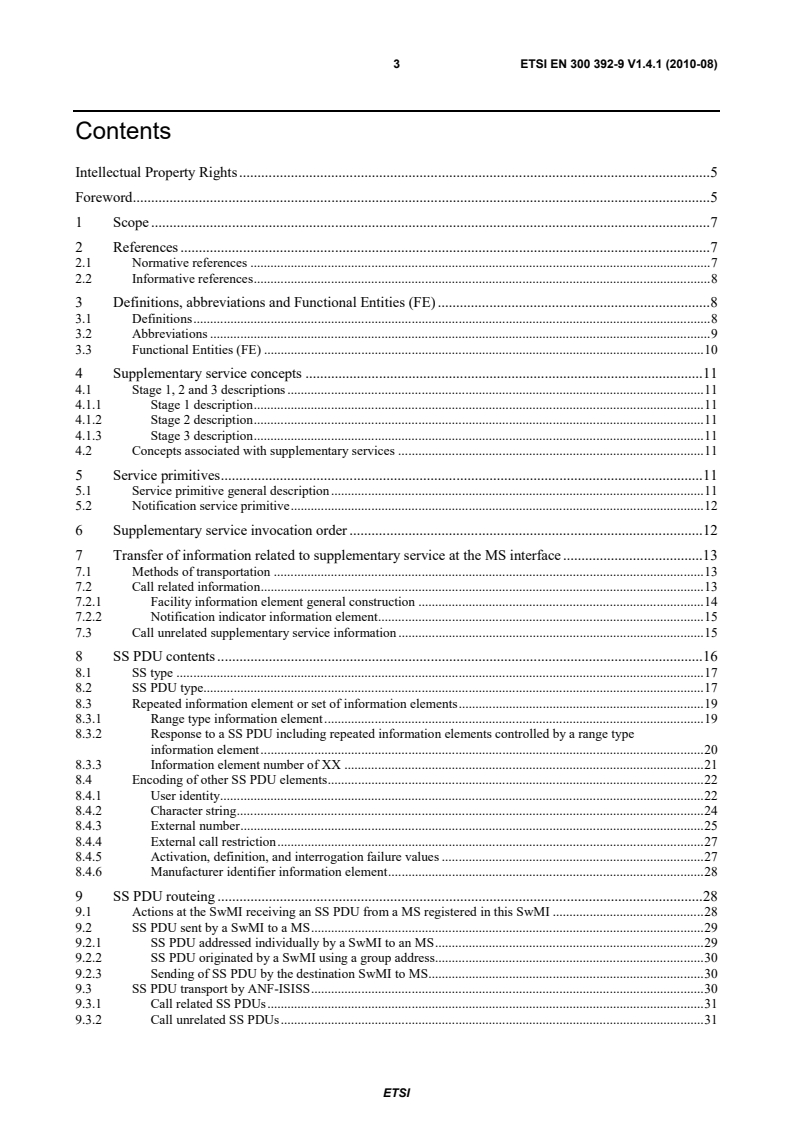
ETSI ETSI EN 300 392-9 V1.4.1 (2010-08) 3 Contents Intellectual Property Rights . 5 Foreword . 5 1 Scope . 7 2 References . 7 2.1 Normative references . 7 2.2 Informative references . 8 3 Definitions, abbreviations and Functional Entities (FE) . 8 3.1 Definitions . 8 3.2 Abbreviations . 9 3.3 Functional Entities (FE) . 10 4 Supplementary service concepts . 11 4.1 Stage 1, 2 and 3 descriptions . 11 4.1.1 Stage 1 description . 11 4.1.2 Stage 2 description . 11 4.1.3 Stage 3 description . 11 4.2 Concepts associated with supplementary services . 11 5 Service primitives . 11 5.1 Service primitive general description . 11 5.2 Notification service primitive . 12 6 Supplementary service invocation order . 12 7 Transfer of information related to supplementary service at the MS interface . 13 7.1 Methods of transportation . 13 7.2 Call related information . 13 7.2.1 Facility information element general construction . 14 7.2.2 Notification indicator information element . 15 7.3 Call unrelated supplementary service information . 15 8 SS PDU contents . 16 8.1 SS type . 17 8.2 SS PDU type. 17 8.3 Repeated information element or set of information elements . 19 8.3.1 Range type information element . 19 8.3.2 Response to a SS PDU including repeated information elements controlled by a range type information element . 20 8.3.3 Information element number of XX . 21 8.4 Encoding of other SS PDU elements . 22 8.4.1 User identity. 22 8.4.2 Character string . 24 8.4.3 External number . 25 8.4.4 External call restriction . 27 8.4.5 Activation, definition, and interrogation failure values . 27 8.4.6 Manufacturer identifier information element . 28 9 SS PDU routeing . 28 9.1 Actions at the SwMI receiving an SS PDU from a MS registered in this SwMI . 28 9.2 SS PDU sent by a SwMI to a MS . 29 9.2.1 SS PDU addressed individually by a SwMI to an MS . 29 9.2.2 SS PDU originated by a SwMI using a group address . 30 9.2.3 Sending of SS PDU by the destination SwMI to MS . 30 9.3 SS PDU transport by ANF-ISISS . 30 9.3.1 Call related SS PDUs . 31 9.3.2 Call unrelated SS PDUs . 31 SIST EN 300 392-9 V1.4.1:2010
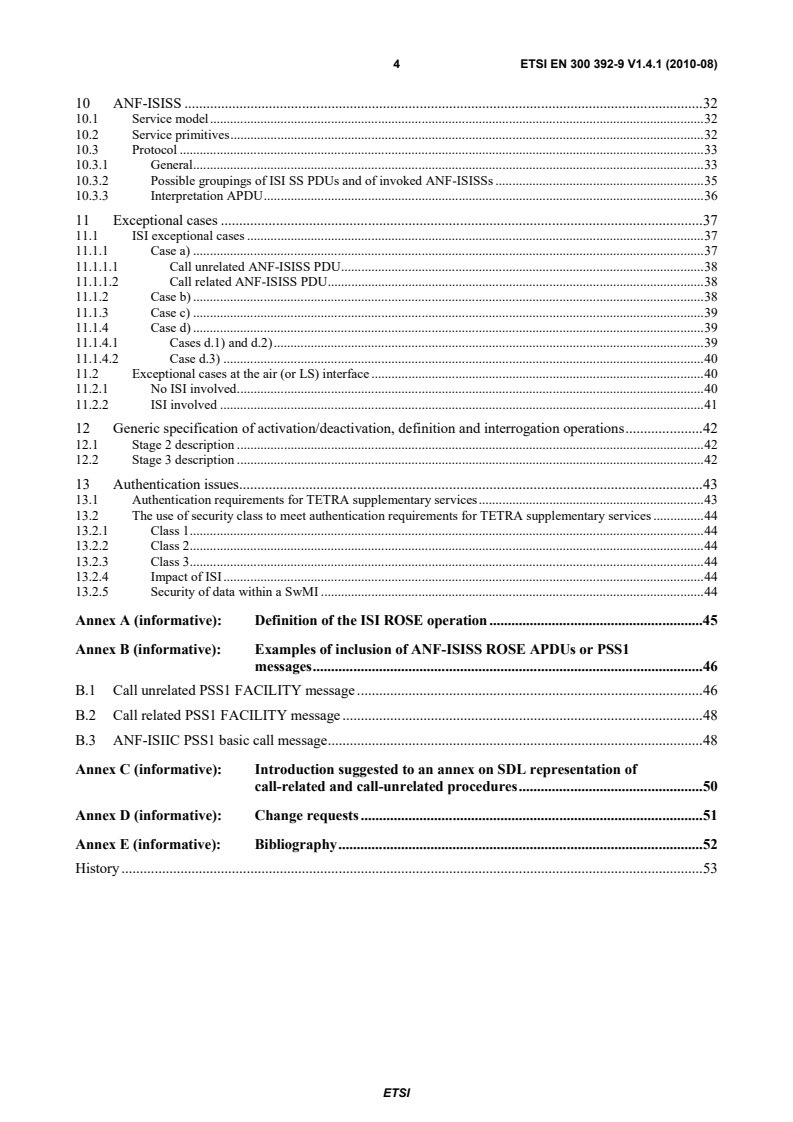
ETSI ETSI EN 300 392-9 V1.4.1 (2010-08) 4 10 ANF-ISISS . 32 10.1 Service model . 32 10.2 Service primitives . 32 10.3 Protocol . 33 10.3.1 General . 33 10.3.2 Possible groupings of ISI SS PDUs and of invoked ANF-ISISSs . 35 10.3.3 Interpretation APDU . 36 11 Exceptional cases . 37 11.1 ISI exceptional cases . 37 11.1.1 Case a) . 37 11.1.1.1 Call unrelated ANF-ISISS PDU . 38 11.1.1.2 Call related ANF-ISISS PDU . 38 11.1.2 Case b) . 38 11.1.3 Case c) . 39 11.1.4 Case d) . 39 11.1.4.1 Cases d.1) and d.2) . 39 11.1.4.2 Case d.3) . 40 11.2 Exceptional cases at the air (or LS) interface . 40 11.2.1 No ISI involved . 40 11.2.2 ISI involved . 41 12 Generic specification of activation/deactivation, definition and interrogation operations . 42 12.1 Stage 2 description . 42 12.2 Stage 3 description . 42 13 Authentication issues . 43 13.1 Authentication requirements for TETRA supplementary services . 43 13.2 The use of security class to meet authentication requirements for TETRA supplementary services . 44 13.2.1 Class 1 . 44 13.2.2 Class 2 . 44 13.2.3 Class 3 . 44 13.2.4 Impact of ISI . 44 13.2.5 Security of data within a SwMI . 44 Annex A (informative): Definition of the ISI ROSE operation . 45 Annex B (informative): Examples of inclusion of ANF-ISISS ROSE APDUs or PSS1 messages . 46 B.1 Call unrelated PSS1 FACILITY message . 46 B.2 Call related PSS1 FACILITY message . 48 B.3 ANF-ISIIC PSS1 basic call message . 48 Annex C (informative): Introduction suggested to an annex on SDL representation of call-related and call-unrelated procedures . 50 Annex D (informative): Change requests . 51 Annex E (informative): Bibliography . 52 History . 53
ETSI ETSI EN 300 392-9 V1.4.1 (2010-08) 5 Intellectual Property Rights IPRs essential or potentially essential to the present document may have been declared to ETSI. The information pertaining to these essential IPRs, if any, is publicly available for ETSI members and non-members, and can be found in ETSI SR 000 314: "Intellectual Property Rights (IPRs); Essential, or potentially Essential, IPRs notified to ETSI in respect of ETSI standards", which is available from the ETSI Secretariat. Latest updates are available on the ETSI Web server (http://webapp.etsi.org/IPR/home.asp). Pursuant to the ETSI IPR Policy, no investigation, including IPR searches, has been carried out by ETSI. No guarantee can be given as to the existence of other IPRs not referenced in ETSI SR 000 314 (or the updates on the ETSI Web server) which are, or may be, or may become, essential to the present document. Foreword This European Standard (Telecommunications series) has been produced by ETSI Technical Committee Terrestrial Trunked Radio (TETRA). The present document is part 9 of a multi-part deliverable covering Voice plus Data (V+D), as identified below: EN 300 392-1: "General network design"; EN 300 392-2: "Air Interface (AI)"; EN 300 392-3: "Interworking at the Inter-System Interface (ISI)"; ETS 300 392-4: "Gateways basic operation"; EN 300 392-5: "Peripheral Equipment Interface (PEI)"; EN 300 392-7: "Security"; EN 300 392-9: "General requirements for supplementary services"; EN 300 392-10: "Supplementary services stage 1"; EN 300 392-11: "Supplementary services stage 2"; EN 300 392-12: "Supplementary services stage 3"; ETS 300 392-13: "SDL model of the Air Interface (AI)"; ETS 300 392-14: "Protocol Implementation Conformance Statement (PICS) proforma specification"; TS 100 392-15: "TETRA frequency bands, duplex spacings and channel numbering"; TS 100 392-16: "Network Performance Metrics"; TR 100 392-17: "TETRA V+D and DMO specifications"; TS 100 392-18: "Air interface optimized applications". NOTE: Part 3, sub-parts 6 and 7 (Speech format implementation), part 4, sub-part 3 (Data networks gateway), part 10, sub-part 15 (Transfer of control), part 13 (SDL) and part 14 (PICS) of this multi-part deliverable are in status "historical" and are not maintained.
ETSI ETSI EN 300 392-9 V1.4.1 (2010-08) 6 National transposition dates Date of adoption of this EN: 2 August 2010 Date of latest announcement of this EN (doa): 30 November 2010 Date of latest publication of new National Standard or endorsement of this EN (dop/e):
31 May 2011 Date of withdrawal of any conflicting National Standard (dow): 31 May 2011
...