


SIST EN 50637:2018
(Main)Medical electrical equipment - Particular requirements for the basic safety and essential performance of medical beds for children
Medical electrical equipment - Particular requirements for the basic safety and essential performance of medical beds for children
201.1 Scope, object and related standards
Clause 1 of EN 60601-1:2006, Medical electrical equipment - Part 1: General requirements for basic safety and essential performance, applies, except as follows:
201.1.1 * Scope
Replacement:
This Standard applies to the BASIC SAFETY and ESSENTIAL PERFORMANCE of MEDICAL BEDS, hereafter referred to as MEDICAL BEDS as defined in 201.3.218, intended for CHILDREN as defined in 201.3.207, and ADULTS with atypical anatomy (ADULTS ranging outside the definition for ADULTS in 201.3.201).
This standard applies to medical beds with nonadjustable and electrical / mechanical adjustable functions.
This Standard applies to MEDICAL BEDS with an internal length of up to 180 cm suitable to a body length of 155 cm.
NOTE 1 The limitation of 180 cm is in order to minimize the foreseeable misuse, of a parent sharing the bed with the child or that the bed will be used by an ADULT.
If a manufacturer wishes to make a bed that can be used by both a child and an ADULT, e.g. length of 180 cm or more, then it will fulfil both EN 60601-2-52 and this particular standard.
This Standard does not apply to MEDICAL BEDS intended for ADULTS as defined in 201.3.201 (covered by EN 60601-2-52).
This Standard does not apply to :
- incubators covered by EN 60601-2-19 ;
- beds for children, covered by EN 716-1 and EN 716-2 ;
- cribs and cradles covered by EN 1130 (all parts) ;
- bunk beds and high beds, covered by EN 747-1 and 747-2.
If a clause or subclause is specifically intended to be applicable to a MEDICAL BED only, or to ME SYSTEMS only, the title and content of that clause or subclause will say so. If that is not the case, the clause or subclause applies both to MEDICAL BEDS and to ME SYSTEMS, as relevant.
HAZARDS inherent in the intended physiological function of MEDICAL BED or ME SYSTEMS within the scope of this standard are not covered by specific requirements in this standard except in 7.2.13 and 8.4.1 of EN 60601-1:2006.
NOTE 2 See also 4.2 of EN 60601-1:2006.
NOTE 3 Body length is measured from crown to sole.
Medizinische elektrische Geräte - Besondere Festlegungen für die Sicherheit einschließlich der wesentlichen Leistungsmerkmale von medizinischen Betten für Kinder
Abschnitt 1 von EN 60601-1:2006, Medizinische elektrische Geräte - Teil 1: Allgemeine Festlegungen für die Sicherheit einschließlich der WESENTLICHEN LEISTUNGSMERKMALE, gilt mit folgenden Abweichungen:
201.1.1 * Anwendungsbereich
Ersatz:
Diese Norm gilt für die BASISSICHERHEIT einschließlich der WESENTLICHEN LEISTUNGSMERKMALE von MEDIZINISCH GENUTZTEN BETTEN, nachfolgend als MEDIZINISCH GENUTZTE BETTEN bezeichnet, wie in 201.3.218 definiert, die für KINDER entsprechend der Definition in 201.3.207 und für ERWACHSENE mit atypischer Anatomie (ERWACHSENE, die nicht unter die Definition für ERWACHSENE in 201.3.201 fallen) vorgesehen sind.
Diese Norm gilt für medizinische Betten mit nicht einstellbaren und mit einstellbaren elektrischen/ mechanischen Funktionen.
Diese Norm gilt für MEDIZINISCH GENUTZTE BETTEN mit einer Innenlänge von bis zu 180 cm, die für eine Körperlänge von 155 cm geeignet sind.
ANMERKUNG 1 Die Begrenzung auf 180 cm soll den vernünftigerweise vorhersehbaren Missbrauch minimieren, dass sich ein Elternteil das Bett mit dem KIND teilt oder dass das Bett von einem ERWACHSENEN genutzt wird.
Wenn ein HERSTELLER ein Bett herstellen möchte, dass sowohl von einem KIND als auch von einem ERWACHSENEN genutzt werden kann, z. B. mit einer Länge von 180 cm oder mehr, dann wird es EN 60601-2-52 sowie diese Besonderen Festlegungen erfüllen.
Diese Norm gilt nicht für MEDIZINISCH GENUTZTE BETTEN, die für ERWACHSENE entsprechend der Definition in 201.3.201 vorgesehen sind (diese sind von EN 60601-2-52 erfasst).
Diese Norm gilt nicht für:
- Inkubatoren, die in EN 60601-2-19 behandelt werden;
- KINDERBETTEN, die in EN 716-1 und EN 716-2 behandelt werden;
- KRIPPEN und Wiegen, die in EN 1130 (alle Teile) behandelt werden;
- Etagenbetten und Hochbetten, die in EN 747-1 und EN 747-2 behandelt werden.
Ist ein Abschnitt oder Unterabschnitt speziell nur für die Anwendung auf ein MEDIZINISCH GENUTZTES BETT oder nur auf ME-SYSTEME vorgesehen, ist dies aus Überschrift und Inhalt des Abschnittes oder Unterabschnittes ersichtlich. Ist das nicht der Fall, trifft der Abschnitt oder Unterabschnitt, wo anwendbar, sowohl auf das MEDIZINISCH GENUTZTE BETT als auch auf das das ME-SYSTEM zu.
GEFÄHRDUNGEN, die sich aus der vorgesehenen physiologischen Wirkungsweise von MEDIZINISCH GENUTZTEN BETTEN oder ME-SYSTEMEN im Anwendungsbereich dieser Norm ergeben, sind nicht durch besondere Anforderungen in dieser Norm erfasst, ausgenommen in EN 60601-1:2006, 7.2.13 und 8.4.1.
ANMERKUNG 2 Siehe auch von EN 60601-1:2006, 4.2.
ANMERKUNG 3 Die Körperlänge wird vom Scheitel bis zur Sohle gemessen.
Appareils électromédicaux - Exigences particulières de sécurité de base et de performances essentielles des lits médicaux pour enfants
La présente norme s'applique à la SECURITE DE BASE et aux PERFORMANCES ESSENTIELLES des LITS MEDICAUX, désignés ci-après LITS MEDICAUX tels que définis en 201.3.218, destinés aux ENFANTS tels que définis en 201.3.207, et aux ADULTES présentant une anatomie atypique (ADULTES ne relevant pas de la définition propre aux ADULTES en 201.3.201).
La présente norme s'applique aux lits médicaux avec des fonctions non réglables et des fonctions électriques / mécaniques réglables.
Elle s'applique aux LITS MEDICAUX d'une longueur interne maximale de 180 cm adaptés à une longueur du corps (taille) de 155 cm.
NOTE 1 Cette limite de 180 cm vise à réduire le plus possible une mauvaise utilisation prévisible du lit par un parent partageant celui-ci avec un enfant, ou une utilisation du lit par un ADULTE.
Si un fabricant souhaite proposer un lit qui puisse être utilisé à la fois par un enfant et un ADULTE, par exemple, lit d'une longueur de 180 cm ou plus, il satisfait alors à l'EN 60601-2-52 et à la présente norme particulière.
La présente norme ne s'applique pas aux LITS MEDICAUX destinés aux ADULTES tels que définis en 201.3.201 (couverts par l'EN 60601-2-52).
La présente norme ne s’applique pas aux:
- incubateurs couverts par l'EN 60601-2-19;
- lits pour enfants, couverts par l'EN 716-1 et l'EN 716-2;
- berceaux couverts par l'EN 1130 (toutes les parties);
- lits superposés et lits surélevés, couverts par l'EN 747-1 et l'EN 747-2.
Si un article ou un paragraphe est spécifiquement destiné à être applicable uniquement à un LIT MEDICAL ou uniquement aux SYSTEMES EM, le titre et le contenu de cet article ou de ce paragraphe l'indiquent. Si cela n'est pas le cas, l'article ou le paragraphe s'applique à la fois aux LITS MEDICAUX et aux SYSTEMES EM, selon le cas.
Les DANGERS inhérents à la fonction physiologique prévue des LITS MEDICAUX ou des SYSTEMES EM dans le cadre du domaine d'application de la présente norme ne sont pas couverts par des exigences spécifiques contenues dans la présente norme, à l'exception de 7.2.13 et de 8.4.1 de l'EN 60601 1:2006.
NOTE 2 Voir aussi 4.2 de l'EN 60601-1:2006.
NOTE 3 La longueur du corps (taille) est mesurée entre le haut du crâne et la plante des pieds.
Medicinska električna oprema - Posebne zahteve za osnovno varnost in bistvene lastnosti medicinskih postelj za otroke
Ta standard se uporablja za OSNOVNO VARNOST in BISTVENE LASTNOSTI MEDICINSKIH POSTELJ (v nadaljevanju »MEDICINSKE POSTELJE«, kot je opredeljeno v točki 201.3.218), ki so namenjene ZA OTROKE, kot je opredeljeno v točki 201.3.207, in za ODRASLE z neznačilnimi anatomskimi lastnostmi (ODRASLI zunaj obsega opredelitve za ODRASLE v točki 201.3.201).
Ta standard se uporablja za medicinske postelje z neprilagodljivimi in električno/mehansko prilagodljivimi funkcijami.
Ta standard se uporablja za MEDICINSKE POSTELJE z notranjo dolžino do 180 cm, ki so primerne za dolžino telesa 155 cm.
OPOMBA 1: Omejitev 180 cm je namenjena za zmanjšanje predvidljive nepravilne uporabe, npr. da si eden od staršev deli posteljo z otrokom ali da posteljo uporablja ODRASLA OSEBA.
Če proizvajalec želi izdelati posteljo, ki jo lahko uporabljata otrok in ODRASLA OSEBA (npr. z dolžino 180 cm ali več), mora izpolniti zahteve standarda EN 60601-2-52 in tega standarda.
Ta standard se ne uporablja za MEDICINSKE POSTELJE, namenjene za ODRASLE, kot je določeno v točki 201.3.201 (zajeto v standardu EN 60601-2-52).
Ta standard se ne uporablja za:
– inkubatorje, obravnavane v standardu EN 60601-2-19;
– postelje za otroke, obravnavane v standardih EN 716-1 in EN 716-2;
– jaslice in zibelke, obravnavane v standardu EN 1130 (vsi deli);
– pograde in visoke postelje, obravnavane v standardih EN 747-1 in EN 747-2.
Če je točka ali podtočka namenjena samo obravnavi MEDICINSKE POSTELJE, bo to zapisano v naslovu in vsebini te točke ali podtočke. Če ni zapisano, točka ali podtočka obravnava MEDICINSKE POSTELJE in ELEKTROMEDICINSKE SISTEME.
Posebne zahteve tega standarda ne vključujejo temeljnih TVEGANJ pri predvideni fiziološki funkciji MEDICINSKE POSTELJE ali ELEKTROMEDICINSKIH SISTEMOV, ki spadajo na področje tega standarda, razen v točkah 7.2.13 in 8.4.1 standarda EN 60601-1:2006.
OPOMBA 2: Glej tudi točko 4.2 standarda EN 60601-1:2006.
OPOMBA 3: Dolžina telesa se meri od temena glave do podplata.
General Information
- Status
- Published
- Publication Date
- 05-Dec-2017
- Technical Committee
- IEMO - Electrical equipment in medical practice
- Current Stage
- 6060 - National Implementation/Publication (Adopted Project)
- Start Date
- 22-Nov-2017
- Due Date
- 27-Jan-2018
- Completion Date
- 06-Dec-2017
Relations
- Effective Date
- 01-Mar-2026
Overview
SIST EN 50637:2018 - Medical electrical equipment - Particular requirements for the basic safety and essential performance of medical beds for children - defines safety, performance and testing requirements specifically for medical beds for children (and adults with atypical anatomy). It is a particular standard referencing EN 60601-1 (general IEC/EN requirements for medical electrical equipment), adapted where indicated to address pediatric-specific hazards such as entrapment, side-rail design, stability and mattress compatibility. The standard covers electrically and mechanically adjustable beds and non‑adjustable beds with an internal length up to 180 cm (suitable for body length up to 155 cm).
Key topics and technical requirements
- Scope and applicability
- Applies to pediatric medical beds and adults outside typical adult dimensions; excludes adult medical beds covered by EN 60601-2-52 and other product-specific standards (incubators EN 60601-2-19; children's domestic beds EN 716; cribs EN 1130; bunk/high beds EN 747).
- Risk management and general safety
- Aligns with the EN 60601-1 risk management process for ME equipment and ME systems.
- Entrapment and mechanical hazards
- Detailed requirements and entrapment test tools (cone, finger probe, cylinder, ball-chain configurations).
- Tests and tools: loading pad, impactor, and side impactor for structural/mechanical testing.
- Requirements for edges, corners, clearance areas, moving parts and retention of loops/mass to reduce entrapment risks.
- Patient protection and fall prevention
- Side-rail and protection-rail requirements; dimensions, markings and strength tests to mitigate inadvertent patient falls.
- Marking, documentation and usability
- Identification, maximum patient weight/ safe working load marking, mattress compatibility labeling and storage/pendant control locations.
- Electrical and other hazards
- Electrical protection, interruption of mains supply, biocompatibility, electromagnetic compatibility (EMC), and programmable electrical medical systems (PEMS).
- Testing, stability and construction
- Lateral and longitudinal stability tests, load distribution, mechanical strength and component assembly rules.
Practical applications - who uses this standard
- Manufacturers and product designers of pediatric medical beds - for design, risk assessment and compliance testing.
- Test laboratories and certification bodies - to perform entrapment, impact and stability testing.
- Biomedical engineers, hospital procurement and safety officers - to specify compliant beds, review markings and mattress compatibility.
- Regulatory and compliance teams - to demonstrate conformity with European pediatric ME equipment requirements.
Related standards
- EN 60601-1 (general requirements for basic safety and essential performance)
- EN 60601-2-52 (adult medical beds)
- EN 60601-2-19 (incubators)
- EN 716-1 / EN 716-2 (children’s domestic beds)
- EN 1130 (cribs and cradles)
- EN 747-1 / EN 747-2 (bunk/high beds)
SIST EN 50637:2018 is essential reading for anyone designing, testing or procuring medical beds for children, providing prescriptive test methods, marking requirements and practical mitigation measures for pediatric safety risks.


Get Certified
Connect with accredited certification bodies for this standard

BSI Group
BSI (British Standards Institution) is the business standards company that helps organizations make excellence a habit.

TÜV Rheinland
TÜV Rheinland is a leading international provider of technical services.

TÜV SÜD
TÜV SÜD is a trusted partner of choice for safety, security and sustainability solutions.
Sponsored listings
Frequently Asked Questions
SIST EN 50637:2018 is a standard published by the Slovenian Institute for Standardization (SIST). Its full title is "Medical electrical equipment - Particular requirements for the basic safety and essential performance of medical beds for children". This standard covers: 201.1 Scope, object and related standards Clause 1 of EN 60601-1:2006, Medical electrical equipment - Part 1: General requirements for basic safety and essential performance, applies, except as follows: 201.1.1 * Scope Replacement: This Standard applies to the BASIC SAFETY and ESSENTIAL PERFORMANCE of MEDICAL BEDS, hereafter referred to as MEDICAL BEDS as defined in 201.3.218, intended for CHILDREN as defined in 201.3.207, and ADULTS with atypical anatomy (ADULTS ranging outside the definition for ADULTS in 201.3.201). This standard applies to medical beds with nonadjustable and electrical / mechanical adjustable functions. This Standard applies to MEDICAL BEDS with an internal length of up to 180 cm suitable to a body length of 155 cm. NOTE 1 The limitation of 180 cm is in order to minimize the foreseeable misuse, of a parent sharing the bed with the child or that the bed will be used by an ADULT. If a manufacturer wishes to make a bed that can be used by both a child and an ADULT, e.g. length of 180 cm or more, then it will fulfil both EN 60601-2-52 and this particular standard. This Standard does not apply to MEDICAL BEDS intended for ADULTS as defined in 201.3.201 (covered by EN 60601-2-52). This Standard does not apply to : - incubators covered by EN 60601-2-19 ; - beds for children, covered by EN 716-1 and EN 716-2 ; - cribs and cradles covered by EN 1130 (all parts) ; - bunk beds and high beds, covered by EN 747-1 and 747-2. If a clause or subclause is specifically intended to be applicable to a MEDICAL BED only, or to ME SYSTEMS only, the title and content of that clause or subclause will say so. If that is not the case, the clause or subclause applies both to MEDICAL BEDS and to ME SYSTEMS, as relevant. HAZARDS inherent in the intended physiological function of MEDICAL BED or ME SYSTEMS within the scope of this standard are not covered by specific requirements in this standard except in 7.2.13 and 8.4.1 of EN 60601-1:2006. NOTE 2 See also 4.2 of EN 60601-1:2006. NOTE 3 Body length is measured from crown to sole.
201.1 Scope, object and related standards Clause 1 of EN 60601-1:2006, Medical electrical equipment - Part 1: General requirements for basic safety and essential performance, applies, except as follows: 201.1.1 * Scope Replacement: This Standard applies to the BASIC SAFETY and ESSENTIAL PERFORMANCE of MEDICAL BEDS, hereafter referred to as MEDICAL BEDS as defined in 201.3.218, intended for CHILDREN as defined in 201.3.207, and ADULTS with atypical anatomy (ADULTS ranging outside the definition for ADULTS in 201.3.201). This standard applies to medical beds with nonadjustable and electrical / mechanical adjustable functions. This Standard applies to MEDICAL BEDS with an internal length of up to 180 cm suitable to a body length of 155 cm. NOTE 1 The limitation of 180 cm is in order to minimize the foreseeable misuse, of a parent sharing the bed with the child or that the bed will be used by an ADULT. If a manufacturer wishes to make a bed that can be used by both a child and an ADULT, e.g. length of 180 cm or more, then it will fulfil both EN 60601-2-52 and this particular standard. This Standard does not apply to MEDICAL BEDS intended for ADULTS as defined in 201.3.201 (covered by EN 60601-2-52). This Standard does not apply to : - incubators covered by EN 60601-2-19 ; - beds for children, covered by EN 716-1 and EN 716-2 ; - cribs and cradles covered by EN 1130 (all parts) ; - bunk beds and high beds, covered by EN 747-1 and 747-2. If a clause or subclause is specifically intended to be applicable to a MEDICAL BED only, or to ME SYSTEMS only, the title and content of that clause or subclause will say so. If that is not the case, the clause or subclause applies both to MEDICAL BEDS and to ME SYSTEMS, as relevant. HAZARDS inherent in the intended physiological function of MEDICAL BED or ME SYSTEMS within the scope of this standard are not covered by specific requirements in this standard except in 7.2.13 and 8.4.1 of EN 60601-1:2006. NOTE 2 See also 4.2 of EN 60601-1:2006. NOTE 3 Body length is measured from crown to sole.
SIST EN 50637:2018 is classified under the following ICS (International Classification for Standards) categories: 11.140 - Hospital equipment. The ICS classification helps identify the subject area and facilitates finding related standards.
SIST EN 50637:2018 has the following relationships with other standards: It is inter standard links to SIST EN IEC 80601-2-89:2026. Understanding these relationships helps ensure you are using the most current and applicable version of the standard.
SIST EN 50637:2018 is associated with the following European legislation: EU Directives/Regulations: 93/42/EEC; Standardization Mandates: M/467. When a standard is cited in the Official Journal of the European Union, products manufactured in conformity with it benefit from a presumption of conformity with the essential requirements of the corresponding EU directive or regulation.
SIST EN 50637:2018 is available in PDF format for immediate download after purchase. The document can be added to your cart and obtained through the secure checkout process. Digital delivery ensures instant access to the complete standard document.
Standards Content (Sample)
2003-01.Slovenski inštitut za standardizacijo. Razmnoževanje celote ali delov tega standarda ni dovoljeno.Appareils électromédicaux - Exigences particulières de sécurité de base et de performances essentielles des lits médicaux pour enfantsMedical electrical equipment - Particular requirements for the basic safety and essential performance of medical beds for children11.140Oprema bolnišnicHospital equipmentICS:Ta slovenski standard je istoveten z:EN 50637:2017SIST EN 50637:2018en01-januar-2018SIST EN 50637:2018SLOVENSKI
STANDARD
EUROPEAN STANDARD NORME EUROPÉENNE EUROPÄISCHE NORM
EN 50637
November 2017 ICS 11.140 English Version
Medical electrical equipment - Particular requirements for the basic safety and essential performance of medical beds for children
Appareils électromédicaux - Exigences particulières de sécurité de base et de performances essentielles des lits médicaux pour enfants
Medizinische elektrische Geräte - Besondere Festlegungen für die Sicherheit einschließlich der wesentlichen Leistungsmerkmale von medizinischen Betten für Kinder This European Standard was approved by CENELEC on 2017-08-30. CENELEC members are bound to comply with the CEN/CENELEC Internal Regulations which stipulate the conditions for giving this European Standard the status of a national standard without any alteration.Up-to-date lists and bibliographical references concerning such national standards may be obtained on application to the CEN-CENELEC Management Centre or to any CENELEC member.
This European Standard exists in three official versions (English, French, German). A version in any other language made by translation under the responsibility of a CENELEC member into its own language and notified to the CEN-CENELEC Management Centre has the same status as the official versions. CENELEC members are the national electrotechnical committees of Austria, Belgium, Bulgaria, Croatia, Cyprus, the Czech Republic, Denmark, Estonia, Finland, Former Yugoslav Republic of Macedonia, France, Germany, Greece, Hungary, Iceland, Ireland, Italy, Latvia, Lithuania, Luxembourg, Malta, the Netherlands, Norway, Poland, Portugal, Romania, Serbia, Slovakia, Slovenia, Spain, Sweden, Switzerland, Turkey and the United Kingdom. European Committee for Electrotechnical Standardization
Comité Européen de Normalisation Electrotechnique Europäisches Komitee für Elektrotechnische Normung CEN-CENELEC Management Centre: Avenue Marnix 17,
B-1000 Brussels © 2017 CENELEC All rights of exploitation in any form and by any means reserved worldwide for CENELEC Members.
Ref. No. EN 50637:2017 ESIST EN 50637:2018
(normative)
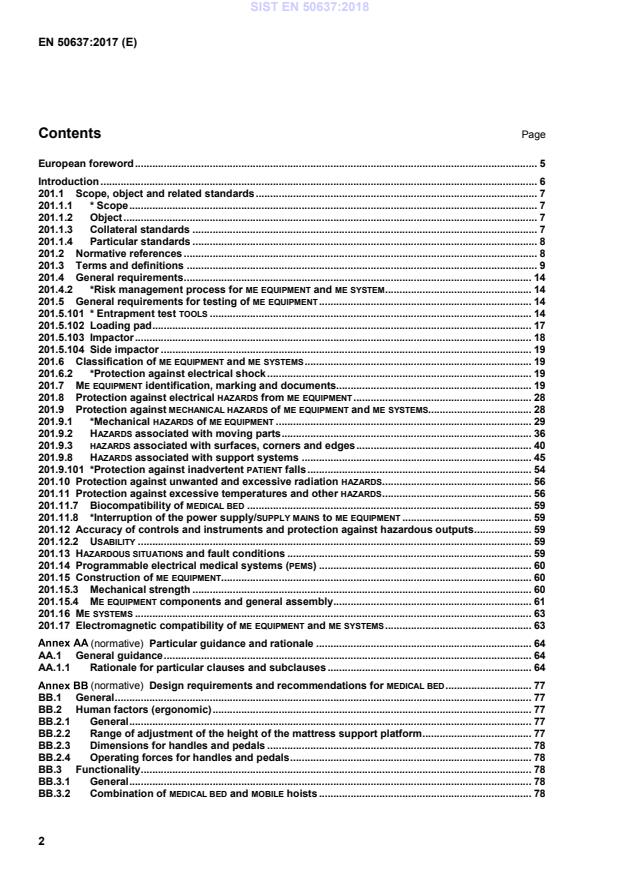
Particular guidance and rationale . 64 AA.1 General guidance . 64 AA.1.1 Rationale for particular clauses and subclauses . 64
(normative)
Design requirements and recommendations for MEDICAL BED . 77 BB.1 General . 77 BB.2 Human factors (ergonomic) . 77 BB.2.1 General . 77 BB.2.2 Range of adjustment of the height of the mattress support platform . 77 BB.2.3 Dimensions for handles and pedals . 78 BB.2.4 Operating forces for handles and pedals . 78 BB.3 Functionality . 78 BB.3.1 General . 78 BB.3.2 Combination of MEDICAL BED and MOBILE hoists . 78 SIST EN 50637:2018
(informative)
Particular guidance for assessing risk of entrapment in v-shaped openings . 81 Bibliography . 87
FIGURE 201.101 – MEDICAL BED, GENERAL ARRANGEMENT (EXAMPLE, SCHEMATIC PRESENTATION ONLY) . 13 FIGURE 201.102A – CONE TOOL . 15 FIGURE 201.102B – FINGER PROBE FOR MESH . 15 FIGURE 201.102C – CYLINDER TOOL . 15 FIGURE 201.102D – BALL CHAIN . 16 FIGURE 201.102E – BALL CHAIN LOOP AND SPHERICAL MASS . 16 FIGURE 201.102 – ENTRAPMENT TEST TOOLS . 16 FIGURE 201.103– LOADING PAD . 17 FIGURE 201.104 – IMPACTOR . 18 FIGURE 201.105 - SIDE IMPACTOR . 19 FIGURE 201.106 – GRAPHICAL SYMBOL FOR MAXIMUM PATIENT WEIGHT
AND SAFE WORKING LOAD . 20 FIGURE 201.107 – MARKING FOR COMPATIBLE MATTRESSES SPECIFIED BY THE MANUFACTURER . 21 FIGURE 201.108 – MARKING FOR DETACHABLE SIDE RAILS SPECIFIED BY THE MANUFACTURER . 21 FIGURE 201.109 DESCRIPTION OF ALLOWED LENGTH OF PATIENT. 22 FIGURE 201.110 EXAMPLE OF MARKING ON THE MEDICAL BED FOR POSITIONING PATIENT IN MEDICAL BED . 23 FIGURE 201.111 – MEDICAL BED FUNCTION CONTROLS AND/OR ACTUATORS: GUIDELINES FOR CREATING GRAPHICAL SYMBOLS . 25 FIGURE 201.112 MARKING ON THE MEDICAL BED OF STORAGE LOCATION FOR PENDANT CONTROL . 26 FIGURE 201.113 – EXAMPLE OF MEDICAL BED WITH SEGMENTED OR SPLIT SIDE RAIL . 30 FIGURE 201.114 – EXAMPLE OF MEDICAL BED WITH SINGLE PIECE SIDE RAIL AND PROTECTION SIDE RAIL . 31 FIGURE 201.115 - DIMENSION OF HANDLE FOR LIFTING POLE. . 35 FIGURE 201.116 – ALLOWABLE SPACING FOR FINGERS IN AREAS OF NORMAL REACH AROUND THE PERIMETER OF THE MATTRESS SUPPORT PLATFORM . 37 FIGURE 201.117 – EXAMPLE USING BARRIERS FOR CLEARANCE MEASUREMENT AROUND THE PERIMETER OF THE MATTRESS SUPPORT PLATFORM TO MITIGATE PATIENT-FINGER ENTRAPMENT . 38 FIGURE 201.118A – FOOT AND TOE CLEARANCE AREA BETWEEN MOVING PARTS AND THE FLOOR . 38 FIGURE 201.118B) – TOE CLEARANCE AREA BETWEEN MOVING PARTS AND THE FLOOR . 39 FIGURE 201.118 – CLEARANCE AREAS . 39 FIGURE 201.119 - REQUIRED MINIMUM RADII OF EDGES AND CORNERS . 40 FIGURE 201.120 — RETENTION OF LOOP AND MASS . 41 FIGURE 201.121 – LATERAL STABILITY TEST ALONG THE SIDE OF THE MEDICAL BED . 42 FIGURE 201.122 – LONGITUDINAL STABILITY TEST WITH REMOVABLE FOOT BOARD . 43 FIGURE 201.123 – LONGITUDINAL STABILITY TEST WITH FIXED HEAD/FOOT BOARDS . 43 FIGURE 201.124 – DISTRIBUTION OF SAFE WORKING LOAD FOR TESTS . 47 FIGURE 201.125 – POSITION OF LOADING PAD AND IMPACTOR . 49 FIGURE 201.126 - IMPACT TO SLATS AND SOLID ELEMENTS OF MEDICAL BEDS . 51 FIGURE 201.127 – APPLICATION OF FORCES FOR TEST OF SIDE RAIL . 53 FIGURE 201.128 – HEIGHT OF SIDE RAIL / PROTECTION SIDE RAIL . 55 FIGURE 201.129A – ANGLE γ BETWEEN THE BACK SECTION AND THE LEG SECTION OF THE MATTRESS SUPPORT PLATFORM . 61 FIGURE 201.129B – ANGLE γ BETWEEN THE BACK SECTION AND THE UPPER LEG SECTION OF THE MATTRESS SUPPORT PLATFORM . 61 FIGURE 201.129C – ANGLE γ BETWEEN THE ANGLED BACK SECTION AND UPPER LEG SECTION OF THE MATTRESS SUPPORT PLATFORM . 62 FIGURE 201.129D – ANGLE γ BETWEEN THE ANGLED BACK SECTION AND THE LEG/UPPER LEG SECTION OF THE MATTRESS SUPPORT PLATFORM . 62 FIGURE 201.129 – CONFIGURATIONS OF THE MATTRESS SUPPORT PLATFORM . 62 FIGURE AA.1 – RESULTANT FORCES WITHOUT MATTRESS . 68 FIGURE AA.2 – RESULTANT FORCES WITH MATTRESS . 68 SIST EN 50637:2018
SINGLE PIECE SIDE RAIL . 72 FIGURE BB.1 – SCHEMATIC PRESENTATION OF UNDER MEDICAL BED CLEARANCE . 79 FIGURE BB.2 – RECOMMENDATIONS AND REQUIREMENTS REGARDING ANGLES FOR DIFFERENT SECTIONS OF THE MATTRESS SUPPORT PLATFORM . 80 FIGURE CC.1 – WEDGE TOOL . 82 FIGURE CC.2 – V-SHAPED OPENING IN RELATION TO B . 83 FIGURE CC.3 – PASS/FAIL IN RELATION TO AREA B . 83 FIGURE CC.4 – POSITIONING OF WEDGE TOOL . 84 FIGURE CC.5 – PASS/FAIL IN RELATION TO AREA C BETWEEN HEAD BOARD AND FOOT BOARD . 85 FIGURE CC.6 – PASS/FAIL IN RELATION TO AREA C BETWEEN SPLIT SIDE RAILS . 86
*TABLE 201.101 – PROTECTION AGAINST PATIENT ENTRAPMENT . 32 TABLE 201.102 – PROTECTION AGAINST INADVERTENT PATIENT FALLS AND CLIMBING OUT OF MEDICAL BED . 56 TABLE 24 – ALLOWABLE MAXIMUM TEMPERATURES FOR SKIN CONTACT WITH MEDICAL BED APPLIED PARTS . 57 TABLE AA.1 – PROTECTION AGAINST PATIENT ENTRAPMENT IN NON-MOVING PARTS . 67 TABLE AA.2 – HEIGHT OF PROTECTIVE BARRIER ACCORDING TO AGE . 75
• latest date by which this document has to be implemented at national level by publication of an identical national standard or by endorsement (dop) 2018-08-30 • latest date by which the national standards conflicting with this document have to be withdrawn (dow) 2020-08-30
Attention is drawn to the possibility that some of the elements of this document may be the subject of patent rights. CENELEC shall not be held responsible for identifying any or all such patent rights. This document has been prepared under a mandate given to CEN and CENELEC by the European Commission. SIST EN 50637:2018
1) This document is currently impacted by the amendment EN 60601-2-52:2010/A1:2015 and the corrigendum EN 60601-2-52:2010/AC:2011. SIST EN 50637:2018
This Standard does not apply to : • incubators covered by EN 60601-2-19 ; • beds for children, covered by EN 716-1 and EN 716-2 ; • cribs and cradles covered by EN 1130 (all parts) ; • bunk beds and high beds, covered by EN 747-1 and 747-2. If a clause or subclause is specifically intended to be applicable to a MEDICAL BED only, or to ME SYSTEMS only, the title and content of that clause or subclause will say so. If that is not the case, the clause or subclause applies both to MEDICAL BEDS and to ME SYSTEMS, as relevant. HAZARDS inherent in the intended physiological function of MEDICAL BED or ME SYSTEMS within the scope of this standard are not covered by specific requirements in this standard except in 7.2.13 and 8.4.1 of EN 60601-1:2006. NOTE 2 See also 4.2 of EN 60601-1:2006. NOTE 3 Body length is measured from crown to sole. 201.1.2 Object Replacement: The object of this particular standard is to establish particular BASIC SAFETY and ESSENTIAL PERFORMANCE requirements and test methods for MEDICAL BEDS as defined in 201.3.218 intended for CHILDREN as defined in 201.3.207. 201.1.3 Collateral standards Addition: This particular standard refers to those applicable collateral standards that are listed in Clause 2 of EN 60601-1:2006 standard and its accociated amendments and corrigenda and Clause 2 of this particular standard. EN 60601-1-3 and EN 60601-1-10 do not apply. All other published collateral standards in the EN 60601-1 series apply as published. SIST EN 50637:2018
Replacement: In the EN 60601 series, particular standards may modify, replace or delete requirements contained in EN 60601-1:2006 and collateral standards as appropriate for the particular ME EQUIPMENT under consideration, and may add other BASIC SAFETY and ESSENTIAL PERFORMANCE requirements. A requirement of this particular standard takes priority over EN 60601-1:2006. The numbering of clauses and subclauses of this particular standard corresponds to that of EN 60601-1:2006 with the prefix “201” (e.g. 201.1 in this standard addresses the content of Clause 1 of EN 60601-1:2006) or applicable collateral standard with the prefix “20x” where x is the final digit(s) of the collateral standard document number (e.g. 202.4 in this particular standard addresses the content of Clause 4 of the EN 60601-1-2:2015 collateral standard, 203.4 in this particular standard addresses the content of Clause 4 of the EN 60601-1-3:2008 collateral standard, etc.). The changes to the text of EN 60601-1:2006 are specified by the use of the following words: "Replacement" means that the clause or subclause of EN 60601-1:2006 or applicable collateral standard is replaced completely by the text of this particular standard. "Addition" means that the text of this particular standard is additional to the requirements of EN 60601-1:2006 or applicable collateral standard. "Amendment" means that the clause or subclause of EN 60601-1:2006 or applicable collateral standard is amended as indicated by the text of this particular standard. Subclauses, figures or tables which are additional to those of EN 60601-1:2006 are numbered starting from 201.101. However, due to the fact that definitions in EN 60601-1:2006 are numbered 3.1 through 3.147, additional definitions in this standard are numbered beginning from 201.3.201. Additional annexes are lettered AA, BB, etc., and additional items aa), bb), etc. Subclauses, figures or tables which are additional to those of a collateral standard are numbered starting from 20x, where “x” is the number of the collateral standard, e.g. 202 for EN 60601-1-2, 203 for EN 60601-1-3, etc. The term "this standard" is used to make reference to EN 60601-1:2006, any applicable collateral standards and this particular standard taken together. Where there is no corresponding clause or subclause in this particular standard, the clause or subclause of EN 60601-1:2006 or applicable collateral standard, although possibly not relevant, applies without modification; where it is intended that any part of EN 60601-1:2006 or applicable collateral standard, although possibly relevant, is not to be applied, a statement to that effect is given in this particular standard. 201.2 Normative references NOTE Informative references are listed in the Bibliography. Clause 2 of EN 60601-1:2006, Medical electrical equipment — Part 1: General requirements for basic safety and essential performance, applies except as follows: Addition: EN 71-3, Safety of toys — Part 3: Migration of certain elements EN 716-2, Furniture — Children's cots and folding cots for domestic use — Part 2: Test methods EN 1021-1, Furniture — Assessment of the ignitability of upholstered furniture — Part 1: Ignition source smouldering cigarette EN 1021-2, Furniture — Assessment of the ignitability of upholstered furniture — Part 2: Ignition source match flame equivalent SIST EN 50637:2018
[SOURCE: EN 60601-2-52:2010/A1:2015, 201.3.219] 201.3.202 * APPLICATION ENVIRONMENT 1 intensive/critical care provided in a hospital where 24 h medical supervision and constant monitoring is required and provision of life support system/equipment used in medical procedures is essential to maintain or improve the vital functions of the PATIENT 201.3.203 * APPLICATION ENVIRONMENT 2 acute care provided in a hospital or other medical facility where medical supervision and monitoring is required and ME EQUIPMENT used in medical procedures is often provided to help maintain or improve the condition of the PATIENT 201.3.204 * APPLICATION ENVIRONMENT 3 long-term care in a medical area where medical supervision is required and monitoring is provided if necessary and ME EQUIPMENT used in medical procedures may be provided to help maintain or improve the condition of the PATIENT NOTE This includes use in CHILDREN’S nursing homes and in rehabilitation facilities. 201.3.205 * APPLICATION ENVIRONMENT 4 care provided in a domestic area where ME EQUIPMENT is used to alleviate or compensate for an injury, disability or disease NOTE This excludes use in all other APPLICATION ENVIRONMENTs (e.g. CHILDREN’S nursing homes and rehabilitation facilities) when a MEDICAL BED is purely designed for APPLICATION ENVIRONMENT 4. 201.3.206 * APPLICATION ENVIRONMENT 5 outpatient (ambulatory) care, which is provided in a hospital or other medical facility, under medical supervision where ME EQUIPMENT, is provided for the need of persons with illness, injury or disability for treatment, diagnosis or monitoring SIST EN 50637:2018
NOTE Mean length of approx. 145 cm is in several countries like Japan, China and Hungary equivalent to the age of 12 years. In the Netherlands 156 cm is equivalent to the mean length of a 12 year old boy and girl (Childata The Handbook of Child Measurements and Capabilities [7].) A 12 year old boy with a length of 155 cm and a mass of 70 kg has a BMI of 29,1 which for CHILDREN is considered obese. The 97th percentile weight of a 12 year old girl from Netherlands is 62 kg. 201.3.208 COT MEDICAL BED with an internal length from and including 90 cm up to 140 cm provided with PROTECTION SIDE RAILS also intended for CHILDREN able to stand up in bed
201.3.210 DISABLED PERSON person with one or more impairments, one or more activity limitations, one or more participation restrictions or a combination thereof [SOURCE: EN ISO 9999:2011] 201.3.211 HEAD/FOOT BOARD assembly/assemblies mounted to MEDICAL BED, which identifies for the PATIENT the edge of the head or foot end of the MEDICAL BED and/or MATTRESS SUPPORT PLATFORM NOTE It may be used as handles to push a MEDICAL BED intended to transport PATIENTS.
201.3.212 JUNIOR BED MEDICAL BED with an internal length from and including 140 cm up to 180 cm
201.3.213 LIFTING POLE ACCESSORY attached to a MEDICAL BED and intended to assist support of a PATIENT when changing position by providing a gripping support above the PATIENT
201.3.214 LOCKING DEVICE mechanism
intended to maintain the MEDICAL BED or parts of it in its locked position 201.3.215 LOCKING SYSTEM mechanism consisting of a LOCKING DEVICE and one or more operating devices, which can deactivate the LOCKING DEVICE, e.g. by pushing a button, pressing a lever or turning a knob SIST EN 50637:2018
NOTE See Figure 201.101 and 201.129 a) to 201.129 d).
Key 1 HEAD BOARD 2 Back section 3 Seat section 4 Upper leg section 5 Lower leg section 6 FOOT BOARD Figure 201.101 – MEDICAL BED, general arrangement (example, schematic presentation only) 201.3.218 * MEDICAL BED device for which the INTENDED USE is sleeping/resting that contains a MATTRESS SUPPORT PLATFORM and intended to assist in diagnosis, monitoring, prevention, treatment, alleviation of disease or compensation for an injury or handicap NOTE 1 Excluded are devices for which the INTENDED USE is mainly for examination or transportation under medical supervision (e.g. stretcher, examination table) NOTE 2
Whenever the term MEDICAL BED is used it comprises CRIBS, COTS AND JUNIOR BEDS. 201.3.219 MOTION LOCKOUT CONTROL auxiliary subsystem that deactivates motion controls 201.3.220 OVERSIZE COT COT with an internal length from and including 140 cm up to 180 cm provided with PROTECTION SIDE RAILS also intended for CHILDREN able to stand up in bed SIST EN 50637:2018
NOTE Integrated controls are excluded. 201.3.222 PROTECTION PERIMETER
fully enclosed solid physical barrier e.g.bowl or basin, which is integral to the overall construction of a MEDICAL BED, which will prevent the PATIENT from falling out of bed and which can be movable, e.g. sliding sides, drop sides, folding sides NOTE Wherever a solid physical barrier is used there might be a risk of suffocation caused by lack of oxygen. 201.3.223 PROTECTION SIDE RAIL physical barrier, which shall be integral to the overall construction of a MEDICAL BED and is positioned to the side(s) of the MEDICAL BED which will prevent the PATIENT from getting out of bed by itself, and which can be movable, e.g. sliding sides, drop sides, folding sides NOTE Whenever the term SIDE RAIL is used it comprises PROTECTION SIDE RAIL. – see COT and CRIB. 201.3.224 SIDE RAIL physical barrier, which may be a detachable ACCESSORY or integral to the overall construction of a MEDICAL BED and is mounted to the side(s) of the MEDICAL BED NOTE When a SIDE RAIL is closed/fully raised, it provides a physical barrier, which is intended to reduce the RISK of the PATIENT accidentally slipping or rolling off the mattress. 201.3.225 SPECIALITY MATTRESS mattress intended for prophylactic or therapeutic effect 201.3.226 UNDERCARRIAGE all components of the MEDICAL BED below the MATTRESS SUPPORT PLATFORM 201.4 General requirements Clause 4 of EN 60601-1:2006 applies, except as follows: 201.4.2 *Risk management process for ME EQUIPMENT and ME SYSTEM Addition: The MANUFACTURER shall include, in the RISK MANAGEMENT PROCESS, HAZARDS related to PATIENTS taller than 155 cm and with a mass greater than 70 kg. NOTE E.g. greater reach of arms in relation to safe distances for not being able to open PROTECTION SIDE RAILS. Compliance is checked by inspection of the RISK MANAGEMENT FILE 201.5 General requirements for testing of ME EQUIPMENT Clause 5 of EN 60601-1:2006 applies, except as follows: Additional subclauses: 201.5.101 * Entrapment test TOOLS Figures 201.102a through 201.102e illustrate entrapment test TOOLS. SIST EN 50637:2018
Key 1 Marked centre line Total weight 3,3 kg ± 0,05 kg
Surface roughness 1,6 µm Figure 201.102a – Cone TOOL Dimensions in millimetres
Figure 201.102b – Finger probe for mesh
Dimensions in millimetres Key 1 Surface roughness 1,6 µm 2 Total weight 3,3 kg ±0,05 Kg Figure 201.102c – Cylinder TOOL
Figure 201.102d – Ball chain Dimensions in millimetres
Key 1 ball chain loop with a length of 200 ± 2 mm 2 spherical mass, weight 2,5 ± 0,05 kg and diameter 115 ± 1 mm 3 fixing point NOTE
The ball chain loop is formed by the ball chain entering the spherical mass at a common fixing point. Figure 201.102e – Ball chain loop and spherical mass Figure 201.102 – Entrapment test TOOLS SIST EN 50637:2018
Figure 201.103– Loading pad
Key 1 connecting part of the lifting device which shall not restrain the free fall 2 striking surface Figure 201.104 – Impactor
Dimensions in millimetres
Key 1 pivot point 2 centre of gravity 3 rubber 76 to 78 IRHD Figure 201.105 - Side impactor 201.6 Classification of ME EQUIPMENT and ME SYSTEMS Clause 6 of EN 60601-1:2006 applies, except as follows: 201.6.2 *Protection against electrical shock Addition: For APPLICATION ENVIRONMENT 4, the MEDICAL BED shall be CLASS II. 201.7 ME EQUIPMENT identification, marking and documents Clause 7 of EN 60601-1:2006 applies, except as follows: SIST EN 50637:2018
Self-adhesive labels and decals shall not be used on the internal surfaces of MEDICAL BED, SIDE RAILS and HEAD/FOOT BOARDS. 201.7.2.2 Identification Replacement of the first paragraph:
...
Questions, Comments and Discussion
Ask us and Technical Secretary will try to provide an answer. You can facilitate discussion about the standard in here.
Loading comments...