


SIST EN 12521:2024
(Main)Furniture - Safety, strength and durability - Requirements for domestic tables
Furniture - Safety, strength and durability - Requirements for domestic tables
This document specifies the minimum requirements for the safety, strength and durability of all types of domestic tables intended for use by adults, including those with glass in their construction. It also contains additional test methods in Annex A and Annex B.
It does not apply to office tables and office desks, tables for non-domestic use, tables for educational institutions or outdoor tables for which European Standards exist.
It does not apply to trestle tables.
With the exception of stability tests, this document does not provide assessment of the suitability of any storage features included in domestic tables.
It does not include requirements for electrical safety.
It does not include requirements for the resistance to ageing and degradation.
Annex A (normative) contains test methods for finger entrapment.
Annex B (informative) contains a table top deflection test.
Annex C (informative) contains a rationale.
Möbel - Sicherheit, Festigkeit und Dauerhaltbarkeit - Anforderungen an Tische im Wohnbereich
Dieses Dokument legt Mindestanforderungen an die Sicherheit, Festigkeit und Dauerhaltbarkeit für alle Arten von Tischen im Wohnbereich fest, einschließlich Tischen mit Bauteilen aus Glas, die für die Nutzung durch Erwachsene vorgesehen sind. Ferner enthält es in Anhang A und Anhang B zusätzliche Prüfverfahren.
Dieses Dokument ist nicht anwendbar für Bürotische und Büroschreibtische, Tische für den Gebrauch im Nicht Wohnbereich, Tische für Bildungseinrichtungen oder Außentische, für die Europäische Normen existieren.
Dieses Dokument ist nicht anwendbar für Böcke mit lose aufliegender Tischplatte.
Mit Ausnahme von Standsicherheitsprüfungen enthält dieses Dokument keine Bewertung hinsichtlich der Eignung von Aufbewahrungsvorrichtungen in Tischen für den Wohnbereich.
Es enthält keine Anforderungen an die elektrische Sicherheit.
Es enthält keine Anforderungen an die Alterungsbeständigkeit oder Widerstandsfähigkeit gegen Zersetzung.
Anhang A (normativ) enthält Prüfverfahren für Fingerfangstellen.
Anhang B (informativ) enthält eine Prüfung der Durchbiegung einer Tischplatte.
Anhang C (informativ) enthält eine Begründung.
Meubles - Sécurité, résistance et durabilité - Exigences relatives aux tables à usage domestique
Le présent document spécifie les exigences minimales relatives à la sécurité, à la résistance et à la durabilité des tables pour adultes à usage domestique de tous types, y compris celles comportant du verre. Il contient également des méthodes d’essai supplémentaires dans les Annexes A et B.
Il ne s’applique ni aux tables et bureaux faisant partie du mobilier de bureau, ni aux tables à usage non domestique, ni aux tables pour les établissements d’enseignement, ni aux tables d’extérieur, qui font l’objet de Normes européennes.
Il ne s’applique pas aux tables à tréteaux.
À l’exception des essais de stabilité, le présent document ne fournit aucune évaluation sur l’aptitude à l’usage des éléments de rangement inclus dans les tables à usage domestique.
Il n’inclut aucune exigence relative à la sécurité électrique.
Il ne stipule pas d’exigences pour la résistance au vieillissement et à la dégradation.
L’Annexe A (normative) contient des méthodes d’essai pour le coincement des doigts.
L’Annexe B (informative) présente des méthodes d’essai de déformation du plateau de table.
L’Annexe C (informative) contient les justifications correspondantes.
Pohištvo - Varnost, trdnost in trajnost - Zahteve za mize za domačo uporabo
Ta evropski standard določa minimalne zahteve za varnost, trdnost in trajnost miz za domačo uporabo vseh vrst za odrasle, vključno z mizami, ki v svoji konstrukciji vključujejo steklo.
Ne uporablja se za pisarniške mize, mize za nestanovanjske prostore, mize za izobraževalne ustanove in zunanje mize, za katere obstajajo evropski standardi.
Ne velja za mize, pri katerih zgornji del ni pritrjen na podstrukturo, npr. pri izvajanju preskusa št. 3 iz preglednice 2 se zgornji del lahko odstrani od podstrukture.
Z izjemo preskušanja stabilnosti standard ne zagotavlja ocene primernosti za nobeno funkcijo shranjevanja, vključeno v mize za domačo uporabo.
Ne vključuje zahtev za trajnost kolesc in mehanizmov za prilagajanje višine. Ne vključuje zahtev za električno varnost.
Ne vključuje zahtev za odpornost proti staranju in razpadu. Dodatek A (informativno) vsebuje preskus upogibnosti zgornjega dela mize.
General Information
- Status
- Published
- Public Enquiry End Date
- 24-Sep-2022
- Publication Date
- 11-Jan-2024
- Technical Committee
- POH - Furniture
- Current Stage
- 6060 - National Implementation/Publication (Adopted Project)
- Start Date
- 30-Nov-2023
- Due Date
- 04-Feb-2024
- Completion Date
- 12-Jan-2024
Relations
- Replaces
SIST EN 12521:2016 - Furniture - Strength, durability and safety - Requirements for domestic tables - Effective Date
- 01-Feb-2024
- Effective Date
- 01-Feb-2026
Overview
EN 12521:2023 - published by CEN - specifies minimum requirements for the safety, strength and durability of domestic tables intended for adult use, including tables incorporating glass. It defines test conditions and sequences, prescribes safety limits (e.g., finger entrapment and shear/compression points), and references additional test methods in Annex A (normative) and Annex B (informative). The standard replaces EN 12521:2015 and excludes office, educational, many non-domestic and outdoor tables, and trestle tables.
Key topics and technical requirements
- Scope & exclusions: Covers all types of domestic tables for adults; does not apply to office desks, trestle tables, or tables already covered by other European standards.
- Safety design: Edges and corners in contact with users must be rounded or chamfered; accessible edges free from burrs/sharp edges; movable parts must avoid inadvertent operation or injury.
- Finger entrapment & holes: No accessible holes between 7 mm and 12 mm (unless penetration depth < 10 mm); Annex A provides test methods for finger entrapment.
- Shear and compression points: Limits on gaps created by moving parts:
- Powered mechanisms: no gap < 25 mm and > 8 mm during movement that could cause injury (tested per Annex A).
- During normal use: no gap < 18 mm and > 8 mm (tested per Annex A).
- Glass safety: Glass is classified as safety glass if it meets EN 12150-1 fragmentation criteria (or equivalent fragmentation mode). Table 2 vertical impact test applies to glass table tops.
- Stability: Specific stability tests for delicate tables (max surface area 0.30 m²) and other tables; delicate-table criteria include height ≥ 600 mm and weight > 10 kg.
- Strength & durability: Durability requirements cover fixed, height-adjustable, cantilever/pedestal tables and those with castors; tests reference EN 1730:2012. Test forces may be expressed as masses (10 N = 1 kg).
- Annexes: Annex A (normative) - finger entrapment and shear/compression test methods; Annex B (informative) - tabletop deflection test; Annex C (informative) - rationale.
Applications and users
- Manufacturers & designers: Use EN 12521:2023 to design compliant domestic tables and select appropriate materials (including glass).
- Testing laboratories: Apply the normative test methods (Annex A/B) and EN 1730 referenced procedures for conformity testing.
- Retailers, importers & compliance officers: Use requirements to verify product safety and prepare technical documentation for market access.
- Procurement & standards writers: Reference the standard for safety specifications in tenders and national adoption.
Related standards
- EN 1730:2012 - tables test methods (stability, strength, durability)
- EN 12150-1:2015+A1:2019 - thermally toughened soda lime safety glass
- EN 14072:2003 - glass in furniture - test methods
Keywords: EN 12521:2023, domestic table safety, table strength and durability, finger entrapment test, glass table safety, furniture standards, CEN.


Frequently Asked Questions
SIST EN 12521:2024 is a standard published by the Slovenian Institute for Standardization (SIST). Its full title is "Furniture - Safety, strength and durability - Requirements for domestic tables". This standard covers: This document specifies the minimum requirements for the safety, strength and durability of all types of domestic tables intended for use by adults, including those with glass in their construction. It also contains additional test methods in Annex A and Annex B. It does not apply to office tables and office desks, tables for non-domestic use, tables for educational institutions or outdoor tables for which European Standards exist. It does not apply to trestle tables. With the exception of stability tests, this document does not provide assessment of the suitability of any storage features included in domestic tables. It does not include requirements for electrical safety. It does not include requirements for the resistance to ageing and degradation. Annex A (normative) contains test methods for finger entrapment. Annex B (informative) contains a table top deflection test. Annex C (informative) contains a rationale.
This document specifies the minimum requirements for the safety, strength and durability of all types of domestic tables intended for use by adults, including those with glass in their construction. It also contains additional test methods in Annex A and Annex B. It does not apply to office tables and office desks, tables for non-domestic use, tables for educational institutions or outdoor tables for which European Standards exist. It does not apply to trestle tables. With the exception of stability tests, this document does not provide assessment of the suitability of any storage features included in domestic tables. It does not include requirements for electrical safety. It does not include requirements for the resistance to ageing and degradation. Annex A (normative) contains test methods for finger entrapment. Annex B (informative) contains a table top deflection test. Annex C (informative) contains a rationale.
SIST EN 12521:2024 is classified under the following ICS (International Classification for Standards) categories: 97.140 - Furniture. The ICS classification helps identify the subject area and facilitates finding related standards.
SIST EN 12521:2024 has the following relationships with other standards: It is inter standard links to SIST EN 12521:2016, SIST EN 12521:2024/oprA1:2026. Understanding these relationships helps ensure you are using the most current and applicable version of the standard.
You can purchase SIST EN 12521:2024 directly from iTeh Standards. The document is available in PDF format and is delivered instantly after payment. Add the standard to your cart and complete the secure checkout process. iTeh Standards is an authorized distributor of SIST standards.
Standards Content (Sample)
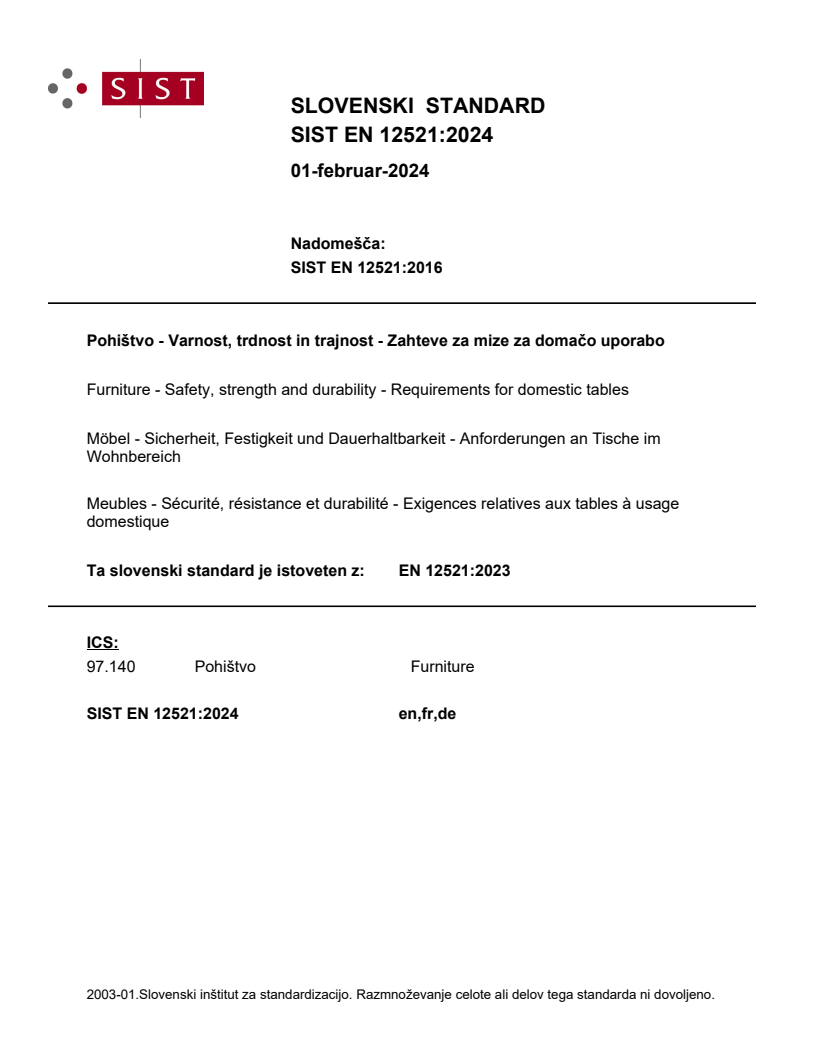
SLOVENSKI STANDARD
01-februar-2024
Nadomešča:
SIST EN 12521:2016
Pohištvo - Varnost, trdnost in trajnost - Zahteve za mize za domačo uporabo
Furniture - Safety, strength and durability - Requirements for domestic tables
Möbel - Sicherheit, Festigkeit und Dauerhaltbarkeit - Anforderungen an Tische im
Wohnbereich
Meubles - Sécurité, résistance et durabilité - Exigences relatives aux tables à usage
domestique
Ta slovenski standard je istoveten z: EN 12521:2023
ICS:
97.140 Pohištvo Furniture
2003-01.Slovenski inštitut za standardizacijo. Razmnoževanje celote ali delov tega standarda ni dovoljeno.
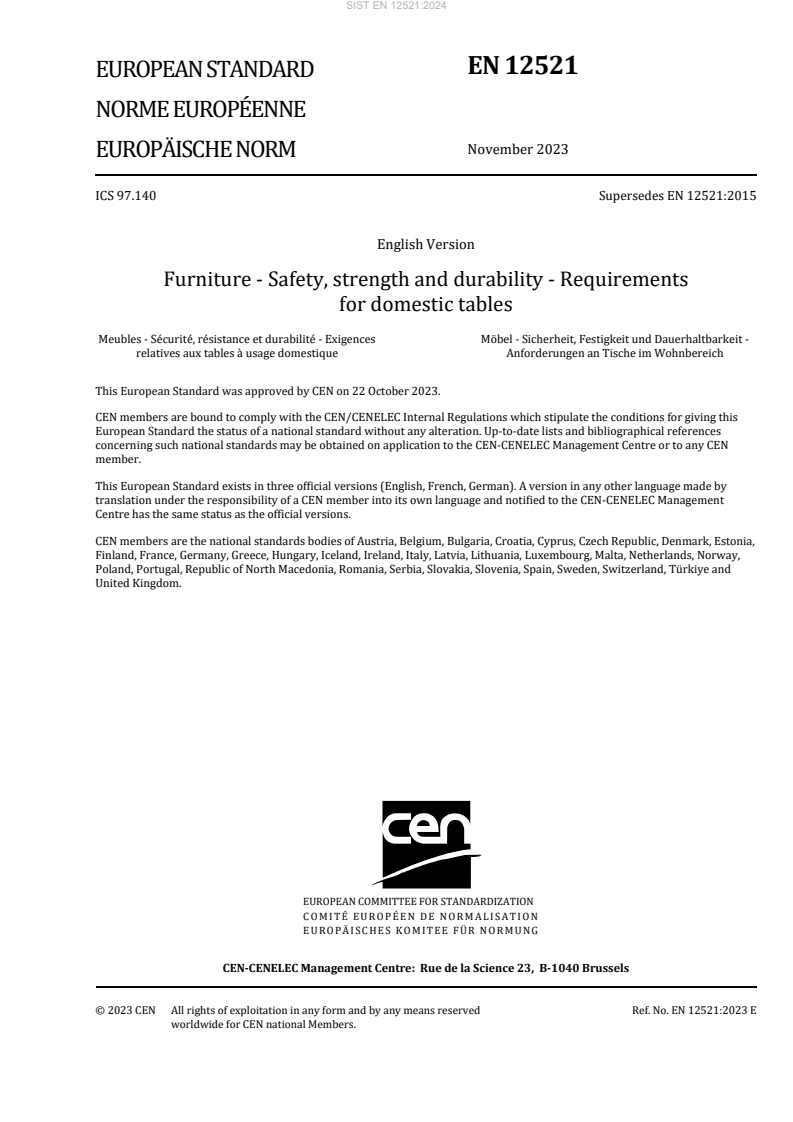
EN 12521
EUROPEAN STANDARD
NORME EUROPÉENNE
November 2023
EUROPÄISCHE NORM
ICS 97.140 Supersedes EN 12521:2015
English Version
Furniture - Safety, strength and durability - Requirements
for domestic tables
Meubles - Sécurité, résistance et durabilité - Exigences Möbel - Sicherheit, Festigkeit und Dauerhaltbarkeit -
relatives aux tables à usage domestique Anforderungen an Tische im Wohnbereich
This European Standard was approved by CEN on 22 October 2023.
CEN members are bound to comply with the CEN/CENELEC Internal Regulations which stipulate the conditions for giving this
European Standard the status of a national standard without any alteration. Up-to-date lists and bibliographical references
concerning such national standards may be obtained on application to the CEN-CENELEC Management Centre or to any CEN
member.
This European Standard exists in three official versions (English, French, German). A version in any other language made by
translation under the responsibility of a CEN member into its own language and notified to the CEN-CENELEC Management
Centre has the same status as the official versions.
CEN members are the national standards bodies of Austria, Belgium, Bulgaria, Croatia, Cyprus, Czech Republic, Denmark, Estonia,
Finland, France, Germany, Greece, Hungary, Iceland, Ireland, Italy, Latvia, Lithuania, Luxembourg, Malta, Netherlands, Norway,
Poland, Portugal, Republic of North Macedonia, Romania, Serbia, Slovakia, Slovenia, Spain, Sweden, Switzerland, Türkiye and
United Kingdom.
EUROPEAN COMMITTEE FOR STANDARDIZATION
COMITÉ EUROPÉEN DE NORMALISATION
EUROPÄISCHES KOMITEE FÜR NORMUNG
CEN-CENELEC Management Centre: Rue de la Science 23, B-1040 Brussels
© 2023 CEN All rights of exploitation in any form and by any means reserved Ref. No. EN 12521:2023 E
worldwide for CEN national Members.
Contents Page
European foreword . 4
1 Scope . 5
2 Normative references . 5
3 Terms and definitions . 5
4 Test conditions and test sequence . 6
5 Safety requirements . 6
5.1 General . 6
5.2 Holes in tubular or rigid components . 7
5.3 Shear and compression points . 7
5.3.1 General . 7
5.3.2 Shear and compression points when setting up and folding . 7
5.3.3 Shear and compression points under influence of powered mechanisms . 7
5.3.4 Shear and compression points during use . 7
5.4 Glass . 7
5.4.1 Safety glass . 7
5.4.2 Other glass . 8
5.5 Stability . 8
5.5.1 Delicate tables . 8
5.5.2 All tables except delicate tables . 8
5.5.3 Stability for tables with extension elements . 8
5.6 Strength and durability . 9
5.6.1 General . 9
5.6.2 Strength and durability requirements . 15
6 Information for use . 15
7 Test report . 15
Annex A (normative) Test methods for finger entrapment and shear and compression . 16
A.1 Finger entrapment . 16
A.1.1 Test equipment — Test probe and shape assessment probe . 16
A.1.2 Test method . 17
A.2 Shear and compression . 20
A.2.1 Test equipment — Test probes . 20
A.2.2 Test method — Shear and compression points created under the influence of powered
mechanisms. 20
A.2.3 Test method — Shear and compression points created during normal use . 21
Annex B (informative) Table top deflection test . 22
B.1 General . 22
B.2 Testing . 22
B.3 Recommendation . 22
Annex C (informative) Rationale . 23
Bibliography . 24
European foreword
This document (EN 12521:2023) has been prepared by Technical Committee CEN/TC 207 “Furniture”,
the secretariat of which is held by UNI.
This European Standard shall be given the status of a national standard, either by publication of an
identical text or by endorsement, at the latest by month May 2024, and conflicting national standards
shall be withdrawn at the latest by May 2024.
Attention is drawn to the possibility that some of the elements of this document may be the subject of
patent rights. CEN shall not be held responsible for identifying any or all such patent rights.
This document supersedes EN 12521:2015.
In comparison with the previous edition EN 12521:2015, the following modifications have been made:
— updated to reflect the finger entrapment requirements within CEN/TR 17202, including an Annex
containing test methods;
— new requirements for delicate tables added;
— improved definition of safety glass;
— durability requirements for height adjustable tables added;
— amended was a vertical durability test for cantilever or pedestal tables for tables ≤ 600 mm in height, or
for tables with tops with a surface area ≤ 0,3 m ;
— amended was a durability test for tables with castors.
Any feedback and questions on this document should be directed to the users’ national standards body.
A complete listing of these bodies can be found on the CEN website.
According to the CEN-CENELEC Internal Regulations, the national standards organisations of the
following countries are bound to implement this European Standard: Austria, Belgium, Bulgaria, Croatia,
Cyprus, Czech Republic, Denmark, Estonia, Finland, France, Germany, Greece, Hungary, Iceland, Ireland,
Italy, Latvia, Lithuania, Luxembourg, Malta, Netherlands, Norway, Poland, Portugal, Republic of North
Macedonia, Romania, Serbia, Slovakia, Slovenia, Spain, Sweden, Switzerland, Türkiye and the United
Kingdom.
1 Scope
This document specifies the minimum requirements for the safety, strength and durability of all types of
domestic tables intended for use by adults, including those with glass in their construction. It also
contains additional test methods in Annex A and Annex B.
It does not apply to office tables and office desks, tables for non-domestic use, tables for educational
institutions or outdoor tables for which European Standards exist.
It does not apply to trestle tables.
With the exception of stability tests, this document does not provide assessment of the suitability of any
storage features included in domestic tables.
It does not include requirements for electrical safety.
It does not include requirements for the resistance to ageing and degradation.
Annex A (normative) contains test methods for finger entrapment.
Annex B (informative) contains a table top deflection test.
Annex C (informative) contains a rationale.
2 Normative references
The following documents are referred to in the text in such a way that some or all of their content
constitutes requirements of this document. For dated references, only the edition cited applies. For
undated references, the latest edition of the referenced document (including any amendments) applies.
EN 1730:2012, Furniture — Tables — Test methods for the determination of stability, strength and
durability
EN 12150-1:2015+A1:2019, Glass in building — Thermally toughened soda lime silicate safety glass —
Part 1: Definition and description
EN 14072:2003, Glass in furniture — Test methods
3 Terms and definitions
For the purposes of this document, the following terms and definitions apply.
ISO and IEC maintain terminology databases for use in standardization at the following addresses:
— ISO Online browsing platform: available at https://www.iso.org/obp
— IEC Electropedia: available at https://www.electropedia.org/
3.1
accessible part
part to which access can easily be gained by the user when the table is in its intended configuration of use
and for which the probability of unintentional user contact is high, including all parts 100 mm in from the
edges
3.2
delicate table
table with a maximum surface area including extension of 0,30 m , intended to be used for placing light
objects
Note 1 to entry: Light objects can be telephones, flowers, books, lamps, etc.
3.3
extension element
storage component that can be pulled out and pushed in
EXAMPLES Drawers, suspended pocket files, keyboard trays.
[SOURCE: EN 16122:2012, 3.4, modified — “components” replaced by “storage component”]
3.4
trestle table
product where a top rests on two or more legs without being affixed to them, and where the legs can be
placed in any position
3.5
ancillary surface
surface additional to the main surface intended for occasional use as part of the table top
4 Test conditions and test sequence
The tests shall be carried out in the order in which they are listed in Table 2.
The test conditions shall be as contained in EN 1730:2012, 4.1.
The test forces may be replaced by masses. The relationship 10 N = 1 kg shall be used.
5 Safety requirements
5.1 General
The table shall be so designed as to minimize the risk of injury to the user.
All parts of the table with which the user comes into contact during intended use when the table is
positioned in its intended configuration of use shall be so designed that physical injury and damage are
avoided.
These requirements are met when:
a) the edges and corners of table tops which are directly in contact with the user are rounded or
chamfered;
b) all other edges and corners accessible during intended use are free from burrs and/or sharp edges.
Movable and adjustable parts shall be designed so that injuries and inadvertent operation are avoided.
It shall not be possible for any load bearing part of the table to come loose unintentionally.
All parts that are lubricated to assist sliding shall be designed to protect users from lubricant stains when
in normal use.
5.2 Holes in tubular or rigid components
There shall be no holes in tubular components or holes in rigid components in accessible parts between
7 mm and 12 mm, unless the depth of penetration is less than 10 mm. This requirement is fulfilled if there
is no hazard present when tested in accordance with A.1.
5.3 Shear and compression points
5.3.1 General
The requirements contained within 5.3.2, 5.3.3 and 5.3.4 do not apply to electrically operated furniture.
NOTE The requirements for electrically operated furniture will be provided in EN 17684, which is under
preparation.
5.3.2 Shear and compression points when setting up and folding
Unless 5.3.3 or 5.3.4 are applicable, shear and compression points that are created only during setting up
and folding are acceptable, because the user can be assumed to be in control of his/her movements and
to be able to cease applying the force immediately upon experiencing pain.
The edges of parts moving relative to each other and creating shear and compression points shall be as
specified in 5.1.
5.3.3 Shear and compression points under influence of powered mechanisms
With the exception of operation of doors, flaps and extension elements, there shall be no areas where the
distance between two accessible parts moving relative to each other can be less than 25 mm, and more
than 8 mm in any position during movement that could present a risk of injury to the user, created by
parts of the furniture operated by powered mechanisms, e.g. mechanical springs and gas lifts.
This requirement is fulfilled if there is no hazard present when tested in accordance with A.2.2.
5.3.4 Shear and compression points during use
With the exception of operation of doors, flaps and extension elements, there shall be no areas where the
distance between two accessible parts moving relative to each other can be less than 18 mm, and more
than 8 mm in any position that could present a risk of injury to the user, created by loads applied during
normal use.
The loads used for durability tests within Table 2 are considered representative of normal use.
This requirement is fulfilled if there is no hazard present when tested in accordance with A.2.3.
5.4 Glass
5.4.1 Safety glass
For glass to be considered to be ‘safety glass’ when tested in accordance with Table 2, Test 8 – Vertical
impact test for glass table tops, either:
a) the manufacturer, importer or retailer, provides verification that the glass fulfils the requirements in
EN 12150-1:2
...
SIST EN 12521:2024は、成人が使用する家庭用テーブルに関する安全性、強度、耐久性の最低要件を定義しており、ガラスを使用した構造のテーブルも含まれています。この標準の範囲は非常に明確であり、家庭用テーブル全般に適用される要件を網羅しています。特に、安定性に関するテストが含まれている点は、消費者の安全を確保する上で重要な要素です。 標準の強みは、具体的な試験方法を提供することにあります。付属書Aには、指の挟まりを防ぐための試験方法が示されており、家庭内での事故を防ぐための実用的な対策を講じています。付属書Bの天板たわみ試験も、製品の耐久性を判断するための重要な評価基準です。これにより、消費者は自分が購入する製品の品質を確保できると同時に、製造者は安全で持続的な商品の提供に努めることが求められます。 この標準は、オフィステーブルや教育機関向けテーブル、非家庭用テーブルには適用されないため、家庭用テーブルに特化した要件が明確に区分されている点が非常に重要です。また、電気的安全性や劣化抵抗に関する要件を含まないことで、標準がより焦点を絞ったものとなっている点も評価されます。 総じて、SIST EN 12521:2024は、家庭用テーブルの安全性、強度、耐久性に関する標準として、業界における質の向上と消費者の信頼性を向上させる強力な指針を提供しています。
Die Norm SIST EN 12521:2024 bietet umfassende und klare Richtlinien zur Sicherheit, Festigkeit und Haltbarkeit von Möbeln, insbesondere von domestischen Tischen. Der Umfang dieser Norm schließt alle Arten von Tischen ein, die für den Gebrauch durch Erwachsene bestimmt sind, auch solche mit Glaselementen in ihrer Konstruktion. Dies macht die Norm besonders relevant für Hersteller und Händler im Bereich der Möbelindustrie, da sie sicherstellt, dass alle Produkte mindestens die festgelegten Sicherheitsstandards erfüllen. Ein herausragendes Merkmal dieser Norm ist die detaillierte Behandlung der Sicherheitsanforderungen und der Testmethoden, die in den Anhängen A und B spezifiziert sind. Annex A, der normative Testmethoden für das Finger-Einfangen enthält, spielt eine wesentliche Rolle bei der Vermeidung von Verletzungen, was die Benutzerfreundlichkeit von Tischen erhöht. In Annex B wird ein Test zur Durchbiegung von Tischplatten beschrieben, der die Festigkeit und Langlebigkeit der Produkte überprüft. Diese beiden Anhänge sind entscheidend für die Gewährleistung der Qualität und Sicherheit von Möbeln. Die Standardisierung richtet sich spezifisch auf den häuslichen Gebrauch und schließt Tische für Büros, Bildungseinrichtungen und im Freien sowie Tische ohne Standard aus. Dies sorgt für eine zielgerichtete Anwendung und vermeidet Verwirrung in der Produktklassifizierung. Es ist wichtig zu beachten, dass die Norm keine Anforderungen an die elektrische Sicherheit oder die Widerstandsfähigkeit gegen Alterung und Abbau beinhaltet. Dadurch bleibt der Fokus auf den grundlegenden physiologischen Aspekten, die für den Nutzer von Bedeutung sind. Insgesamt ist die SIST EN 12521:2024 eine wichtige Norm, die nicht nur sicherstellt, dass Tische für den privaten Gebrauch sicher und langlebig sind, sondern auch spezifische Testmethoden bereitstellt, um diese Ansprüche zu überprüfen. Ihr Beitrag zur Möbelstandardisierung ist von hoher Relevanz und bietet sowohl Herstellern als auch Verbrauchern klare Richtlinien, die zur Verbesserung der Sicherheit und Benutzerfreundlichkeit von Möbelprodukten führen.
The SIST EN 12521:2024 standard provides a comprehensive framework for assessing the safety, strength, and durability of domestic tables designed for adult use. Its scope is notably focused, explicitly catering to various types of domestic tables while excluding office tables, educational institution tables, and outdoor tables that are already covered by existing European Standards. Additionally, trestle tables fall outside the purview of this standard, ensuring clarity in its application. One of the key strengths of this standard lies in its detailed specifications regarding safety requirements, which are crucial for consumer protection. By setting minimum requirements, it ensures that manufacturers maintain consistency and quality in the production of domestic tables. The inclusion of test methods in Annex A provides a vital mechanism for evaluating finger entrapment risks, addressing a common safety concern particularly relevant to domestic environments. Meanwhile, Annex B introduces a table top deflection test, adding depth to the assessment of durability and strength under varied conditions. The relevance of SIST EN 12521:2024 is underscored by the growing demand for safe and durable furniture among consumers. As households evolve and the use of diverse materials, including glass, becomes more prevalent, this standard plays a crucial role in guiding manufacturers in the design and production of reliable products. While the standard does not assess storage features or electrical safety, it successfully focuses on the fundamental aspects of furniture safety and stability, making it a vital reference point for stakeholders in the furniture industry. In summary, SIST EN 12521:2024 stands out for its clear scope and structured approach to establishing safety, strength, and durability requirements for domestic tables, thereby enhancing consumer confidence in the furniture market.
SIST EN 12521:2024는 가정용 테이블의 안전성, 강도 및 내구성을 위한 최소 요구 사항을 규정한 중요 문서입니다. 이 표준은 성인 사용자를 위한 모든 유형의 가정용 테이블을 대상으로 하며, 강화유리를 포함하는 구조물에 대해서도 적용됩니다. 이는 소비자 보호와 관련하여 필수적인 기준을 제공함으로써 가정에서의 사고를 방지하는 데 큰 기여를 합니다. 이 표준의 강점 중 하나는 Annex A와 Annex B를 통해 추가적인 시험 방법을 제공한다는 점입니다. Annex A에서는 손가락이 끼일 위험을 평가할 수 있는 테스트 방법이 명시되어 있어 안전성에 대한 신뢰성을 높입니다. Annex B는 테이블 상판의 처짐 시험을 포함하여 테이블이 사용 중 겪을 수 있는 물리적 압력을 평가하는 데 도움을 줍니다. 이러한 실험 방법들은 가정용 테이블이 일상적인 사용에 충분히 견딜 수 있도록 설계되었다는 것을 입증하는 데 중요한 요소로 작용합니다. SIST EN 12521:2024는 사무용 테이블, 비상업적 사용을 위한 테이블, 교육 기관을 위한 테이블, 야외 테이블과 같은 특정 카테고리에는 적용되지 않는다는 점이 중요합니다. 이는 이 표준이 가정용 테이블에만 집중하여 전문성을 더욱 강조하고 있다는 것을 보여줍니다. 또한, 전기 안전이나 노화 및 열화에 대한 저항력에 대한 요구 사항이 포함되어 있지 않지만, 이 문서는 가정 사용에 필요한 기본 안전성 및 내구성을 충분히 다루고 있습니다. 전반적으로 이 표준은 가정용 테이블의 안전, 강도 및 내구성을 보장하기 위한 필수적인 기준으로서, 가정에서의 안전한 환경을 조성하는 데 매우 중요한 역할을 합니다.
La norme SIST EN 12521:2024 établit des exigences minimales en matière de sécurité, de solidité et de durabilité pour tous les types de tables domestiques destinées à un usage adulte, y compris celles dont la construction inclut du verre. Ce cadre normatif est particulièrement pertinent dans un marché où la sécurité des produits est de plus en plus scrutée par les consommateurs et les régulateurs. En définissant ces exigences, la norme apporte une garantie de qualité qui rassure les utilisateurs sur la performance des meubles qu'ils achètent. Parmi ses points forts, la norme inclut des méthodes d'essai supplémentaires dans les annexes A et B, garantissant ainsi un contrôle de qualité rigoureux. L'annexe A précise les méthodes d'essai pour éviter le piège des doigts, un aspect incontournable pour la sécurité des utilisateurs, surtout dans un environnement domestique où des enfants peuvent être présents. De même, l'annexe B introduit un test de déviation du plateau, contribuant à évaluer la durabilité des tables dans le temps. La pertinence de cette norme est d'autant plus soulignée par son exclusivité à l'usage domestique, en faisant clairement la distinction avec les tables de bureau et les tables destinées à un usage non domestique. Cela permet de concentrer les exigences sur les besoins des consommateurs finaux et d'ouvrir un dialogue sur des normes spécifiques pour les autres types de mobilier. Cependant, il est important de noter certaines limites de la norme. Elle n'évalue pas la convenance des fonctionnalités de rangement incluses dans les tables domestiques, ni les exigences de sécurité électrique, ni encore la résistance au vieillissement et à la dégradation, ce qui pourrait être crucial pour des utilisateurs cherchant à assurer la longévité de leurs meubles. En conclusion, la norme SIST EN 12521:2024 se positionne comme un document essentiel pour les fabricants de meubles domestiques, offrant un cadre solide pour garantir la sécurité, la résistance et la durabilité des tables. Étant donné son approche détaillée et ses méthodes d'essai bien définies, elle représente une avancée significative vers des standards de qualité plus élevés dans l'industrie du meuble.
Questions, Comments and Discussion
Ask us and Technical Secretary will try to provide an answer. You can facilitate discussion about the standard in here.
Loading comments...