

SIST-TS CEN/TS 17438:2020
(Main)Source materials considered in the development of the Aggregate standards of TC 154
General Information
- Abstract
This document informs users about the source materials that have been considered in the development of the aggregate standards:
- EN 12620 'Aggregates for concrete';
- EN 13043 'Aggregates for bituminous mixtures and surface treatments for roads, airfields and other trafficked are-as';
- EN 13139 'Aggregates for mortar';
- EN 13242 'Aggregates for unbound and hydraulically bound materials for use in civil engineering work and road construction';
- EN 13383-1 'Armourstone - Part 1: Product standard';
- EN 13450 'Aggregates for railway ballast';
- EN 13055 'Lightweight aggregates';
Only source materials with a history of use in one or more member states are included in this document. It also specifies source material with a history of use for the scope of only one specific aggregate standard.
- Status
- Published
- Public Enquiry End Date
- 19-Nov-2019
- Publication Date
- 09-Aug-2020
- Technical Committee
- AGR - Aggregates
- Current Stage
- 6060 - National Implementation/Publication (Adopted Project)
- Start Date
- 14-Jul-2020
- Due Date
- 18-Sep-2020
- Completion Date
- 10-Aug-2020


Overview
CEN/TS 17438:2020 documents the source materials considered during development of the CEN/TC 154 aggregate standards. It provides an inventory of natural, manufactured and recycled source materials that have a documented history of use in one or more CEN member states and clarifies where additional national requirements apply. The Technical Specification is provisional (approved 29 Dec 2019) and was published to inform users and support consistent treatment of non‑conventional and secondary aggregates across standards for concrete, bituminous mixtures, mortar, unbound materials, armourstone, railway ballast and lightweight aggregates.
Key topics and requirements
- Scope and purpose: Lists source materials taken into account in preparing EN 12620, EN 13043, EN 13139, EN 13242, EN 13383‑1, EN 13450 and EN 13055.
- Inventory of source materials: Tabled classification of materials (natural rock types, reclaimed asphalt, crushed concrete, recycled railway ballast, foundry sand, slags, fly ashes, municipal incinerator bottom ash (MIBA), crushed glass, dredged material, etc.) that have a positive history of use.
- Definitions: Clear terms for aggregate types, including lightweight aggregate (LWA) (particle density ≤ 2000 kg/m3 or loose bulk density ≤ 1200 kg/m3), manufactured, natural and recycled aggregates.
- Additional national requirements: Identification of source materials that require extra characteristics in one or more Member States (e.g., loss on ignition/TOC for some ashes, thermal conductivity requirements for certain slags, swelling or metal content checks for specific materials).
- Lightweight aggregates: Inventory of LWA source materials and intended uses (concrete, mortar, bituminous, unbound/hydraulically bound applications).
- Incorporation procedure: Describes how new source materials can be proposed for inclusion - based on routine market use and a formal request from at least one CEN member.
- User obligation: Even where a source material is listed, users must assess and comply with any place‑of‑use or national additional requirements.
Applications
- Selecting and specifying appropriate aggregate sources for:
- Concrete production (EN 12620)
- Bituminous mixtures and surface treatments (EN 13043)
- Mortar and grout (EN 13139)
- Road construction, unbound and hydraulically bound materials (EN 13242)
- Armourstone and railway ballast (EN 13383‑1, EN 13450)
- Lightweight aggregate applications (EN 13055)
- Evaluating suitability of recycled and by‑product materials (slag, fly ash, MIBA) for construction uses.
- Informing conformity assessment, procurement and contract specifications where secondary aggregates are considered.
Who uses this standard
- Standards bodies and technical committees (CEN/TC 154)
- Aggregate producers and processors (natural, manufactured, recycled)
- Civil, geotechnical and materials engineers, specifiers and contractors
- Public authorities, procurement officers and testing laboratories
Related standards
- EN 12620, EN 13043, EN 13139, EN 13242, EN 13383‑1, EN 13450, EN 13055 - refer to these for the specific product and performance requirements.
Get Certified
Connect with accredited certification bodies for this standard

DIBt (Deutsches Institut für Bautechnik)
German Institute for Building Technology.
DIN CERTCO
DIN Group product certification.

Aboma Certification B.V.
Specialized in construction, metal, and transport sectors.
Sponsored listings
Frequently Asked Questions
SIST-TS CEN/TS 17438:2020 is a technical specification published by the Slovenian Institute for Standardization (SIST). Its full title is "Source materials considered in the development of the Aggregate standards of TC 154". This standard covers: This document informs users about the source materials that have been considered in the development of the aggregate standards: - EN 12620 'Aggregates for concrete'; - EN 13043 'Aggregates for bituminous mixtures and surface treatments for roads, airfields and other trafficked are-as'; - EN 13139 'Aggregates for mortar'; - EN 13242 'Aggregates for unbound and hydraulically bound materials for use in civil engineering work and road construction'; - EN 13383-1 'Armourstone - Part 1: Product standard'; - EN 13450 'Aggregates for railway ballast'; - EN 13055 'Lightweight aggregates'; Only source materials with a history of use in one or more member states are included in this document. It also specifies source material with a history of use for the scope of only one specific aggregate standard.
This document informs users about the source materials that have been considered in the development of the aggregate standards: - EN 12620 'Aggregates for concrete'; - EN 13043 'Aggregates for bituminous mixtures and surface treatments for roads, airfields and other trafficked are-as'; - EN 13139 'Aggregates for mortar'; - EN 13242 'Aggregates for unbound and hydraulically bound materials for use in civil engineering work and road construction'; - EN 13383-1 'Armourstone - Part 1: Product standard'; - EN 13450 'Aggregates for railway ballast'; - EN 13055 'Lightweight aggregates'; Only source materials with a history of use in one or more member states are included in this document. It also specifies source material with a history of use for the scope of only one specific aggregate standard.
SIST-TS CEN/TS 17438:2020 is classified under the following ICS (International Classification for Standards) categories: 91.100.15 - Mineral materials and products. The ICS classification helps identify the subject area and facilitates finding related standards.
SIST-TS CEN/TS 17438:2020 is associated with the following European legislation: EU Directives/Regulations: 305/2011; Standardization Mandates: M/125. When a standard is cited in the Official Journal of the European Union, products manufactured in conformity with it benefit from a presumption of conformity with the essential requirements of the corresponding EU directive or regulation.
SIST-TS CEN/TS 17438:2020 is available in PDF format for immediate download after purchase. The document can be added to your cart and obtained through the secure checkout process. Digital delivery ensures instant access to the complete standard document.
Standards Content (Sample)
SLOVENSKI STANDARD
01-september-2020
Izvorni materiali, obravnavani pri pripravi standardov tehničnega odbora CEN/TC
154 za agregate
Source materials considered in the development of the Aggregate standards of TC 154
Bei der Erarbeitung der Normen für Gesteinskörnungen des CEN/TC 154 betrachtete
Ausgangsstoffe
Ta slovenski standard je istoveten z: CEN/TS 17438:2020
ICS:
91.100.15 Mineralni materiali in izdelki Mineral materials and
products
2003-01.Slovenski inštitut za standardizacijo. Razmnoževanje celote ali delov tega standarda ni dovoljeno.
CEN/TS 17438
TECHNICAL SPECIFICATION
SPÉCIFICATION TECHNIQUE
June 2020
TECHNISCHE SPEZIFIKATION
ICS 91.100.15
English Version
Source materials considered in the development of the
Aggregate standards of TC 154
Matières premières secondaires prises en compte dans Bei der Erarbeitung der Normen für
l'élaboration des normes granulats du CEN/TC 154 Gesteinskörnungen des CEN/TC 154 betrachtete
Ausgangsstoffe
This Technical Specification (CEN/TS) was approved by CEN on 29 December 2019 for provisional application.
The period of validity of this CEN/TS is limited initially to three years. After two years the members of CEN will be requested to
submit their comments, particularly on the question whether the CEN/TS can be converted into a European Standard.
CEN members are required to announce the existence of this CEN/TS in the same way as for an EN and to make the CEN/TS
available promptly at national level in an appropriate form. It is permissible to keep conflicting national standards in force (in
parallel to the CEN/TS) until the final decision about the possible conversion of the CEN/TS into an EN is reached.
CEN members are the national standards bodies of Austria, Belgium, Bulgaria, Croatia, Cyprus, Czech Republic, Denmark, Estonia,
Finland, France, Germany, Greece, Hungary, Iceland, Ireland, Italy, Latvia, Lithuania, Luxembourg, Malta, Netherlands, Norway,
Poland, Portugal, Republic of North Macedonia, Romania, Serbia, Slovakia, Slovenia, Spain, Sweden, Switzerland, Turkey and
United Kingdom.
EUROPEAN COMMITTEE FOR STANDARDIZATION
COMITÉ EUROPÉEN DE NORMALISATION
EUROPÄISCHES KOMITEE FÜR NORMUNG
CEN-CENELEC Management Centre: Rue de la Science 23, B-1040 Brussels
© 2020 CEN All rights of exploitation in any form and by any means reserved Ref. No. CEN/TS 17438:2020 E
worldwide for CEN national Members.
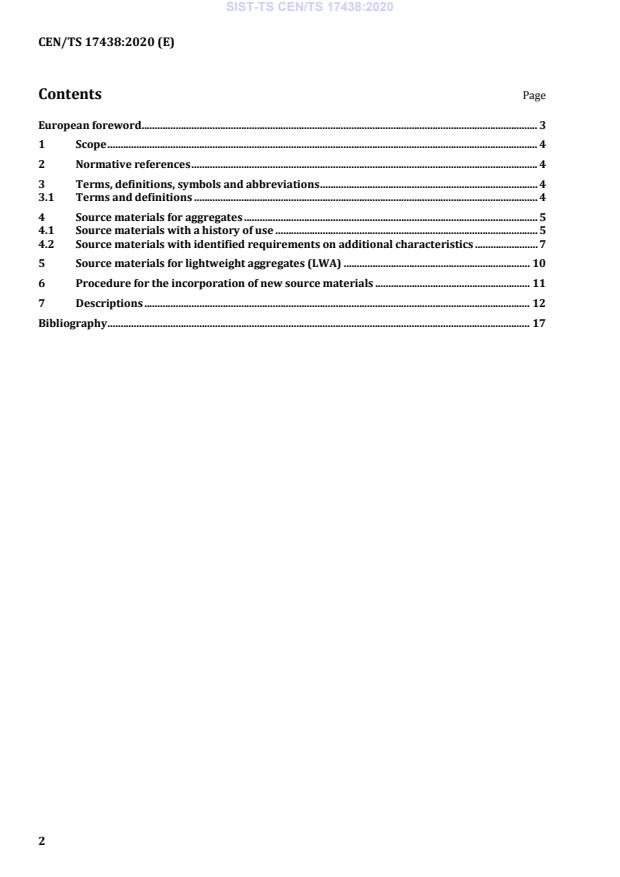
Contents Page
European foreword . 3
1 Scope . 4
2 Normative references . 4
3 Terms, definitions, symbols and abbreviations . 4
3.1 Terms and definitions . 4
4 Source materials for aggregates . 5
4.1 Source materials with a history of use . 5
4.2 Source materials with identified requirements on additional characteristics . 7
5 Source materials for lightweight aggregates (LWA) . 10
6 Procedure for the incorporation of new source materials . 11
7 Descriptions . 12
Bibliography . 17
European foreword
This document (CEN/TS 17438:2020) has been prepared by Technical Committee CEN/TC 154
“Aggregates”, the secretariat of which is held by BSI.
Attention is drawn to the possibility that some of the elements of this document may be the subject of
patent rights. CEN shall not be held responsible for identifying any or all such patent rights.
This document has been prepared under a mandate given to CEN by the European Commission and the
European Free Trade Association.
CEN/TC 154 intends to keep this document under continual review. Any relevant information to assist in
the updating, including any proposal for the incorporation of new source material types, can be submitted
to the secretariat of CEN/TC 154. The procedure for inclusion of new source materials is described in
Clause 6.
Source materials not described in this document can still be used as an aggregate, but the applicant will
be aware that the relevant standard will not necessarily include all relevant aspects for use.
Due to the dynamic character of this document, no reference from the TC 154 Aggregate standards
towards this document is made with regard to the scope of these standards.
According to the CEN-CENELEC Internal Regulations, the national standards organizations of the
following countries are bound to announce this Technical Specification: Austria, Belgium, Bulgaria,
Croatia, Cyprus, Czech Republic, Denmark, Estonia, Finland, France, Germany, Greece, Hungary, Iceland,
Ireland, Italy, Latvia, Lithuania, Luxembourg, Malta, Netherlands, Norway, Poland, Portugal, Republic of
North Macedonia, Romania, Serbia, Slovakia, Slovenia, Spain, Sweden, Switzerland, Turkey and the United
Kingdom.
1 Scope
This document informs users about the source materials that have been considered in the development
of the aggregate standards:
— EN 12620, Aggregates for concrete;
— EN 13043, Aggregates for bituminous mixtures and surface treatments for roads, airfields and other
trafficked areas;
— EN 13139, Aggregates for mortar;
— EN 13242, Aggregates for unbound and hydraulically bound materials for use in civil engineering work
and road construction;
— EN 13383-1, Armourstone — Part 1: Product standard;
— EN 13450, Aggregates for railway ballast;
— EN 13055, Lightweight aggregates;
Only source materials with a history of use in one or more member states are included in this document.
It also specifies source materials with a history of use for the scope of only one specific aggregate
standard.
2 Normative references
There are no normative references in this document.
3 Terms, definitions, symbols and abbreviations
3.1 Terms and definitions
For the purposes of this document, the following terms and definitions apply.
ISO and IEC maintain terminological databases for use in standardization at the following addresses:
— IEC Electropedia: available at http://www.electropedia.org/
— ISO Online browsing platform: available at https://www.iso.org/obp
3.1.1
aggregate
granular material of natural, manufactured or recycled origin used in construction
3.1.2
lightweight aggregate
LWA
3 3
granular material of mineral origin having a particle density not exceeding 2 000 kg/m (2,00 Mg/m ) or
3 3
a loose bulk density not exceeding 1 200 kg/m (1,20 Mg/m )
3.1.3
manufactured aggregates
aggregate of mineral origin resulting from an industrial process involving thermal or other modification
3.1.4
natural aggregate
aggregate from mineral sources which has been subjected to nothing more than mechanical processing
3.1.5
recycled aggregates
aggregate resulting from the processing of inorganic mineral material previously used in construction
Note 1 to entry: Recycled aggregates can also be obtained from production residues or nonconforming products,
e.g. crushed unused concrete.
4 Source materials for aggregates
4.1 Source materials with a history of use
All source materials which have been considered in the preparation of aggregate standards EN 12620,
EN 13043, EN 13139, EN 13242, EN 13383-1 and EN 13450 are listed in Table 1.
In some member states, there are additional requirements for the use of secondary aggregates. These
additional requirements are summarized in Table 2. It is advised to control all relevant specific
requirements in accordance with requirements at the place of use.
Table 1 — Inventory list with classification codes and status for source materials for aggregates
standards by CEN/TC 154
Sub- Specific EN EN EN EN EN EN
Nr. Source
nmbr material 12620 13043 13139 13242 13383 13450
All
Natural
rock types included
P P Yes Yes Yes Yes Yes Yes
aggregates
in EN 932-3
Reclaimed
a
A1 No (Yes) No Yes No No
a
asphalt
Crushed
A2 Yes No No Yes Yes No
concrete
Crushed bricks,
A3 Yes No No Yes No No
Construction
masonry
and
Hydraulically bound
A demolition
and
recycling
A4 Yes No No Yes No No
unbound
industries
materials
Mix of A1, A2, A3
b
A5 Yes No No Yes No
Yes
and A4
Recycled
A6 Yes Yes No Yes No Yes
railway ballast
Municipal
incinerator
Municipal
c
bottom ash
solid waste
B B1 Yes Yes No Yes No No
incineration
(excluding fly ash)
industry
(MIBA)
Sub- Specific EN EN EN EN EN EN
Nr. Source
nmbr material 12620 13043 13139 13242 13383 13450
Yes
Municipal
(Only as a
B2 incinerator fly ash No No No No No
component
(MIFA)
of compo-
d
site filler )
C1 Coal fly ash Yes Yes Yes Yes No No
Fluidized bed
C2 combustion fly ash No Yes No Yes No No
(FBCFA)
Coal power
C3 Boiler slag Yes Yes No Yes No No
C generation
industry
C4 Coal bottom ash No No No Yes No No
Fluidized bed
combustion bottom
C5 No No No Yes No No
ash (FBC bottom
ash)
Granulated blast
D1 furnace slag (GBS) Yes No No Yes No No
(vitrified)
Air-cooled blast
D2 furnace slag (ABS) Yes Yes Yes Yes Yes No
(crystallized)
Basic oxygene
furnace slag
D3 Yes Yes No Yes Yes No
(converter slag,
Iron and steel
D BOS)
industry
Electric arc furnace
slag (from carbon
D4 Yes Yes No Yes Yes No
steel production,
EAF C)
Electric arc furnace
slag (from
D5 stainless/high alloy Yes Yes No Yes No No
steel
production, EAF S)
E1 Copper slag Yes Yes No Yes Yes No
E2 Molybdenum slag Yes Yes No Yes No No
E3 Zinc slag Yes No No Yes No No
Non-ferrous
E
industry
E4 Phosphorus slag No Yes No Yes Yes No
E5 Lead slag Yes No No No Yes No
E6 Ferrochromium slag Yes Yes No Yes No No
F1 Foundry sand Yes Yes No Yes No No
Foundry
F
Foundry cupola
industry
F2 No Yes No Yes No No
furnace slag
Sub- Specific EN EN EN EN EN EN
Nr. Source
nmbr material 12620 13043 13139 13242 13383 13450
G1 Red coal shale No No No Yes No No
Refuse from hard
G2 coal mining (black No No No Yes Yes No
Mining and
coal shale)
G quarry
industry
Pre-selected all-in
G3 No No No Yes No No
from quarry/mining
G4 Spent oil shale No No No Yes No No
Maintenance
H dredging H1 Dredge spoil sand Yes No No Yes No No
works
Yes
(Only as a
I1 Paper sludge ash Yes component No Yes No No
of compo-
d
site filler )
Yes
Sewage sludge
(Only as a
I2 incineration ash No No Yes No No
component
I Miscellaneous
(municipal)
of compo-
d
site filler )
Yes
(Only as a
I3 Biomass ash No No Yes No No
component
of compo-
d
site filler )
I4 Crushed glass Yes Yes No Yes No No
a
Reclaimed Asphalt is an established component for bituminous mixtures but not an aggregate fitting to the scope of this
specification.
b
Only A2 and A3.
c
Requirements on MIBA are based on experience with grated installations.
d
Filler aggregate of mineral origin, which has been produced using two or more sources in Table 1.
4.2 Source materials with identified requirements on additional characteristics
In situations where the need for additional requirements has been identified by one or more Member
States, this means that these additional requirements are not (yet) included in the relevant standard(s).
This means that these sources are only suitable for its intended use when also the identified
characteristics in that Member State are taken into account before placed on the market as aggregates.
Additional characteristics may be specified on a case by case basis depending upon experience of use of
the product, and defined in specific contractual documents.
Table 2 — Source materials with a positive history of use and additional requirements in one or
more Member States
Sub- EN EN EN
Nr. Source Material EN 12620 EN 13043 EN 13242
nmbr 13139 13383 13450
All rock types
Natural
P P included in
aggregates
EN 932-3
Reclaimed
A1
a
asphalt
Crushed
A2
concrete
Crushed bricks,
Construction A3
masonry
and
Hydraulically
demolition
A
bound and
recycling
A4
unbound
industries
materials
Mix of A1, A2, A3
A5
and A4
Recycled railway
A6
ballast
Loss on
Loss on
Loss on
ignition or
Municipal
ignition or
ignition or
TOC
incinerator
TOC
TOC
b
B1 bottom ash Content of
Municipal
Content of
Content of
(excluding fly metals
solid waste
metals
metals
B
ash) (MIBA) (Soundness)
incineration
(Soundness)
(Soundness)
Swelling
industry
Municipal
B2 incinerator fly
ash (MIFA)
Loss on Loss on
C1 Coal fly ash ignition or ignition or
TOC TOC
Fluidized bed
C2 combustion fly
ash (FBCFA)
Coal power
C3 Boiler slag
C generation
Loss on
industry
C4 Coal bottom ash ignition or
TOC
Fluidized bed
combustion
C5
bottom ash (FBC
bottom ash)
Sub- EN EN EN
Nr. Source Material EN 12620 EN 13043 EN 13242
nmbr 13139 13383 13450
Granulated blast
D1 furnace slag
(GBS) (vitrified)
Air-cooled blast
furnace slag Thermal Thermal Thermal
D2
(ABS) conductivity conductivity conductivity
(crystallized)
Basic oxygene
furnace slag Thermal Thermal Thermal
D3
(converter slag, conductivity conductivity conductivity
BOS)
Iron and steel
D
Electric arc
industry
furnace slag
D4 (from carbon
steel production,
EAF C)
Electric arc
furnace slag
(from
D5 stainless/high
alloy steel
production,
EAF S)
E1 Copper slag
Molybdenum
E2
slag
E3 Zinc slag
Non-ferrous
E
industry
E4 Phosphorus slag
E5 Lead slag
Ferrochromium
E6
slag
F1 Foundry sand Swelling
Dicalcium Dicalcium
Foundry
F
Foundry cupola sil
...