

SIST EN 14212:2025
(Main)Ambient air - Standard method for the measurement of the concentration of sulphur dioxide by ultraviolet fluorescence
General Information
- Abstract
This document specifies a continuous measurement method for the determination of the concentration of sulfur dioxide present in ambient air based on the ultraviolet fluorescence measuring principle. This document describes the performance characteristics and sets the relevant minimum criteria required to select an appropriate ultraviolet fluorescence analyser by means of type testing. It also includes the evaluation of the suitability of an analyser for use in a specific fixed site so as to meet the data quality requirements as specified in Annex I of Directive 2008/50/EC [1] and requirements during sampling, calibration and quality assurance for use.
The method is applicable to the determination of the mass concentration of sulphur dioxide present in ambient air up to 1000 µg/m3. This concentration range represents the certification range for sulfur dioxide for type testing.
NOTE 1 It is possible to use other ranges depending on the levels present in ambient air.
NOTE 2 When this document is used for purposes other than for measurements required by Directive 2008/50/EC, the ranges and uncertainty requirements possibly do not apply.
The method covers the determination of ambient air concentrations of sulfur dioxide in locations classified as rural areas, urban-background areas, and for sampling influenced by traffic or industrial sources.
The results are expressed in µg/m3 (at 20 °C and 101,3 kPa).
NOTE 3 1 000 µg/m3 of SO2 corresponds to 376 nmol/mol of SO2.
This document contains information for different groups of users.
Clause 5 to Clause 7 and Annex C and Annex D contain general information about the principles of sulfur dioxide measurement by ultraviolet fluorescence analyser and sampling equipment.
Clause 8 and Annex E are specifically directed towards test houses and laboratories that perform type testing of sulfur dioxide analysers. These sections contain information about:
— type testing conditions, test procedures and test requirements;
— analyser performance requirements;
— evaluation of the type testing results;
— evaluation of the uncertainty of the measurement results of the sulfur dioxide analyser based on the type testing results.
Clause 9 to Clause 11 and Annex F and Annex G are directed towards monitoring networks performing the practical measurements of sulfur dioxide in ambient air. These sections contain information about:
— initial installation of the analyser in the monitoring network and acceptance testing;
— ongoing quality assurance/quality control;
— calculation and reporting of measurement results;
— evaluation of the uncertainty of the measurement results under practical monitoring conditions.
This document represents an evolution of earlier editions (EN 14212:2005 and EN 14212:2012). It is advisable that when equipment is procured it complies fully with this document.
NOTE 4 Type testing performed prior to the publication of this document for the purpose of demonstrating equivalence are still valid.
NOTE 5 Analysers type tested prior to the publication of this document remain valid for use for regulated monitoring purposes.
- Status
- Published
- Public Enquiry End Date
- 02-Jan-2023
- Publication Date
- 03-Mar-2025
- Technical Committee
- KAZ - Air quality
- Current Stage
- 6060 - National Implementation/Publication (Adopted Project)
- Start Date
- 10-Feb-2025
- Due Date
- 17-Apr-2025
- Completion Date
- 04-Mar-2025

Overview
EN 14212:2024 (CEN) - Ambient air: Standard method for the measurement of the concentration of sulphur dioxide by ultraviolet fluorescence - specifies a continuous measurement method for determining sulphur dioxide (SO2) in ambient air using the ultraviolet fluorescence principle. The standard defines performance characteristics, minimum criteria for type testing ultraviolet fluorescence analysers and gives procedures for on-site installation, sampling, calibration, quality assurance and uncertainty evaluation to meet data quality requirements (including those of Directive 2008/50/EC). The certified concentration range for type testing is up to 1000 µg/m3 (expressed as µg/m3 at 20 °C and 101,3 kPa).
Key topics and requirements
- Measuring principle: UV fluorescence detection of SO2 and related instrumental requirements.
- Type testing: Laboratory and field procedures, performance characteristics, test gases and purity specifications, and uncertainty calculation for analyser certification.
- Performance criteria: Minimum acceptance limits for sensitivity, linearity, detection limit, response time, stability and interferents.
- Sampling & analyser equipment: Recommendations for sampling location, manifold and sampling system design, flow control, pumps, filters and selective traps.
- Field operation & QA/QC: Initial installation checks, ongoing calibration frequency, maintenance, checks, and data handling/reporting.
- Uncertainty evaluation: Methods to calculate measurement uncertainty from type test and field data; procedures tailored for test houses and monitoring networks.
- Scope of application: Suitable for rural, urban-background, traffic-influenced and industrial-influenced sites; note that other concentration ranges may be used where appropriate.
Practical applications and users
Who benefits from EN 14212:2024:
- Environmental regulators and air quality authorities implementing compliance monitoring under Directive 2008/50/EC.
- Monitoring networks and fixed-site stations conducting continuous ambient SO2 measurements.
- Test houses and laboratories performing type testing and instrument certification.
- Manufacturers and procurement officers selecting and validating ultraviolet fluorescence analysers.
- Air quality consultants and researchers needing standardized procedures for calibration, QA/QC and uncertainty assessment.
Practical uses:
- Selecting analysers that meet certified performance for regulatory monitoring.
- Implementing standardized sampling systems and calibration regimes to ensure data comparability.
- Calculating and reporting SO2 concentrations and measurement uncertainty for compliance and public reporting.
Related standards and notes
- Builds on earlier editions EN 14212:2005 and EN 14212:2012 - procurement is recommended to comply fully with the 2024 edition.
- Linked to Directive 2008/50/EC data quality requirements; when used outside regulatory contexts some ranges or uncertainty requirements may not apply.
Relations
- Effective Date
- 01-Apr-2025
- Effective Date
- 01-Apr-2025
- Effective Date
- 28-Jan-2026
- Effective Date
- 28-Jan-2026
- Effective Date
- 28-Jan-2026
- Effective Date
- 28-Jan-2026
- Effective Date
- 28-Jan-2026
- Effective Date
- 28-Jan-2026
- Effective Date
- 28-Jan-2026
- Effective Date
- 28-Jan-2026
- Effective Date
- 28-Jan-2026
- Effective Date
- 28-Jan-2026
- Effective Date
- 28-Jan-2026
- Effective Date
- 28-Jan-2026
Get Certified
Connect with accredited certification bodies for this standard

CIS Institut d.o.o.
Personal Protective Equipment (PPE) certification body. Notified Body NB-2890 for EU Regulation 2016/425 PPE.

Kiwa BDA Testing
Building and construction product certification.
Kmetijski inštitut Slovenije
Agricultural Institute of Slovenia. Soil testing, plant health, agricultural product analysis.
Sponsored listings
Frequently Asked Questions
SIST EN 14212:2025 is a standard published by the Slovenian Institute for Standardization (SIST). Its full title is "Ambient air - Standard method for the measurement of the concentration of sulphur dioxide by ultraviolet fluorescence". This standard covers: This document specifies a continuous measurement method for the determination of the concentration of sulfur dioxide present in ambient air based on the ultraviolet fluorescence measuring principle. This document describes the performance characteristics and sets the relevant minimum criteria required to select an appropriate ultraviolet fluorescence analyser by means of type testing. It also includes the evaluation of the suitability of an analyser for use in a specific fixed site so as to meet the data quality requirements as specified in Annex I of Directive 2008/50/EC [1] and requirements during sampling, calibration and quality assurance for use. The method is applicable to the determination of the mass concentration of sulphur dioxide present in ambient air up to 1000 µg/m3. This concentration range represents the certification range for sulfur dioxide for type testing. NOTE 1 It is possible to use other ranges depending on the levels present in ambient air. NOTE 2 When this document is used for purposes other than for measurements required by Directive 2008/50/EC, the ranges and uncertainty requirements possibly do not apply. The method covers the determination of ambient air concentrations of sulfur dioxide in locations classified as rural areas, urban-background areas, and for sampling influenced by traffic or industrial sources. The results are expressed in µg/m3 (at 20 °C and 101,3 kPa). NOTE 3 1 000 µg/m3 of SO2 corresponds to 376 nmol/mol of SO2. This document contains information for different groups of users. Clause 5 to Clause 7 and Annex C and Annex D contain general information about the principles of sulfur dioxide measurement by ultraviolet fluorescence analyser and sampling equipment. Clause 8 and Annex E are specifically directed towards test houses and laboratories that perform type testing of sulfur dioxide analysers. These sections contain information about: — type testing conditions, test procedures and test requirements; — analyser performance requirements; — evaluation of the type testing results; — evaluation of the uncertainty of the measurement results of the sulfur dioxide analyser based on the type testing results. Clause 9 to Clause 11 and Annex F and Annex G are directed towards monitoring networks performing the practical measurements of sulfur dioxide in ambient air. These sections contain information about: — initial installation of the analyser in the monitoring network and acceptance testing; — ongoing quality assurance/quality control; — calculation and reporting of measurement results; — evaluation of the uncertainty of the measurement results under practical monitoring conditions. This document represents an evolution of earlier editions (EN 14212:2005 and EN 14212:2012). It is advisable that when equipment is procured it complies fully with this document. NOTE 4 Type testing performed prior to the publication of this document for the purpose of demonstrating equivalence are still valid. NOTE 5 Analysers type tested prior to the publication of this document remain valid for use for regulated monitoring purposes.
This document specifies a continuous measurement method for the determination of the concentration of sulfur dioxide present in ambient air based on the ultraviolet fluorescence measuring principle. This document describes the performance characteristics and sets the relevant minimum criteria required to select an appropriate ultraviolet fluorescence analyser by means of type testing. It also includes the evaluation of the suitability of an analyser for use in a specific fixed site so as to meet the data quality requirements as specified in Annex I of Directive 2008/50/EC [1] and requirements during sampling, calibration and quality assurance for use. The method is applicable to the determination of the mass concentration of sulphur dioxide present in ambient air up to 1000 µg/m3. This concentration range represents the certification range for sulfur dioxide for type testing. NOTE 1 It is possible to use other ranges depending on the levels present in ambient air. NOTE 2 When this document is used for purposes other than for measurements required by Directive 2008/50/EC, the ranges and uncertainty requirements possibly do not apply. The method covers the determination of ambient air concentrations of sulfur dioxide in locations classified as rural areas, urban-background areas, and for sampling influenced by traffic or industrial sources. The results are expressed in µg/m3 (at 20 °C and 101,3 kPa). NOTE 3 1 000 µg/m3 of SO2 corresponds to 376 nmol/mol of SO2. This document contains information for different groups of users. Clause 5 to Clause 7 and Annex C and Annex D contain general information about the principles of sulfur dioxide measurement by ultraviolet fluorescence analyser and sampling equipment. Clause 8 and Annex E are specifically directed towards test houses and laboratories that perform type testing of sulfur dioxide analysers. These sections contain information about: — type testing conditions, test procedures and test requirements; — analyser performance requirements; — evaluation of the type testing results; — evaluation of the uncertainty of the measurement results of the sulfur dioxide analyser based on the type testing results. Clause 9 to Clause 11 and Annex F and Annex G are directed towards monitoring networks performing the practical measurements of sulfur dioxide in ambient air. These sections contain information about: — initial installation of the analyser in the monitoring network and acceptance testing; — ongoing quality assurance/quality control; — calculation and reporting of measurement results; — evaluation of the uncertainty of the measurement results under practical monitoring conditions. This document represents an evolution of earlier editions (EN 14212:2005 and EN 14212:2012). It is advisable that when equipment is procured it complies fully with this document. NOTE 4 Type testing performed prior to the publication of this document for the purpose of demonstrating equivalence are still valid. NOTE 5 Analysers type tested prior to the publication of this document remain valid for use for regulated monitoring purposes.
SIST EN 14212:2025 is classified under the following ICS (International Classification for Standards) categories: 13.040.20 - Ambient atmospheres. The ICS classification helps identify the subject area and facilitates finding related standards.
SIST EN 14212:2025 has the following relationships with other standards: It is inter standard links to SIST EN 14212:2012, SIST EN 14212:2012/AC:2014, SIST EN ISO 6144:2006, SIST EN ISO 14956:2003, SIST EN 15267-1:2023, SIST-TS CEN ISO/TS 20440:2023, SIST EN ISO 6143:2026, SIST EN 15267-2:2023, SIST EN ISO 6145-7:2019, SIST EN ISO 6142-1:2015, SIST EN ISO 6145-10:2008, SIST EN ISO 6145-6:2017, SIST EN 15267-1:2009, SIST EN 16738:2016. Understanding these relationships helps ensure you are using the most current and applicable version of the standard.
SIST EN 14212:2025 is associated with the following European legislation: EU Directives/Regulations: 2008/50/EC, 2011-01-2525. When a standard is cited in the Official Journal of the European Union, products manufactured in conformity with it benefit from a presumption of conformity with the essential requirements of the corresponding EU directive or regulation.
SIST EN 14212:2025 is available in PDF format for immediate download after purchase. The document can be added to your cart and obtained through the secure checkout process. Digital delivery ensures instant access to the complete standard document.
Standards Content (Sample)
SLOVENSKI STANDARD
01-april-2025
Nadomešča:
SIST EN 14212:2012
SIST EN 14212:2012/AC:2014
Zunanji zrak - Standardna metoda za določanje koncentracije žveplovega dioksida
z ultravijolično fluorescenco
Ambient air - Standard method for the measurement of the concentration of sulphur
dioxide by ultraviolet fluorescence
Außenluft - Messverfahren zur Bestimmung der Konzentration von Schwefeldioxid mit
Ultraviolett-Fluoreszenz
Air ambiant - Méthode normalisée pour le mesurage de la concentration en dioxyde de
soufre par fluorescence U.V.
Ta slovenski standard je istoveten z: EN 14212:2024
ICS:
13.040.20 Kakovost okoljskega zraka Ambient atmospheres
2003-01.Slovenski inštitut za standardizacijo. Razmnoževanje celote ali delov tega standarda ni dovoljeno.
EN 14212
EUROPEAN STANDARD
NORME EUROPÉENNE
December 2024
EUROPÄISCHE NORM
ICS 13.040.20 Supersedes EN 14212:2012
English Version
Ambient air - Standard method for the measurement of the
concentration of sulphur dioxide by ultraviolet
fluorescence
Air ambiant - Méthode normalisée pour le mesurage de Außenluft - Messverfahren zur Bestimmung der
la concentration en dioxyde de soufre par fluorescence Konzentration von Schwefeldioxid mit Ultraviolett-
U.V. Fluoreszenz
This European Standard was approved by CEN on 11 November 2024.
CEN members are bound to comply with the CEN/CENELEC Internal Regulations which stipulate the conditions for giving this
European Standard the status of a national standard without any alteration. Up-to-date lists and bibliographical references
concerning such national standards may be obtained on application to the CEN-CENELEC Management Centre or to any CEN
member.
This European Standard exists in three official versions (English, French, German). A version in any other language made by
translation under the responsibility of a CEN member into its own language and notified to the CEN-CENELEC Management
Centre has the same status as the official versions.
CEN members are the national standards bodies of Austria, Belgium, Bulgaria, Croatia, Cyprus, Czech Republic, Denmark, Estonia,
Finland, France, Germany, Greece, Hungary, Iceland, Ireland, Italy, Latvia, Lithuania, Luxembourg, Malta, Netherlands, Norway,
Poland, Portugal, Republic of North Macedonia, Romania, Serbia, Slovakia, Slovenia, Spain, Sweden, Switzerland, Türkiye and
United Kingdom.
EUROPEAN COMMITTEE FOR STANDARDIZATION
COMITÉ EUROPÉEN DE NORMALISATION
EUROPÄISCHES KOMITEE FÜR NORMUNG
CEN-CENELEC Management Centre: Rue de la Science 23, B-1040 Brussels
© 2024 CEN All rights of exploitation in any form and by any means reserved Ref. No. EN 14212:2024 E
worldwide for CEN national Members.
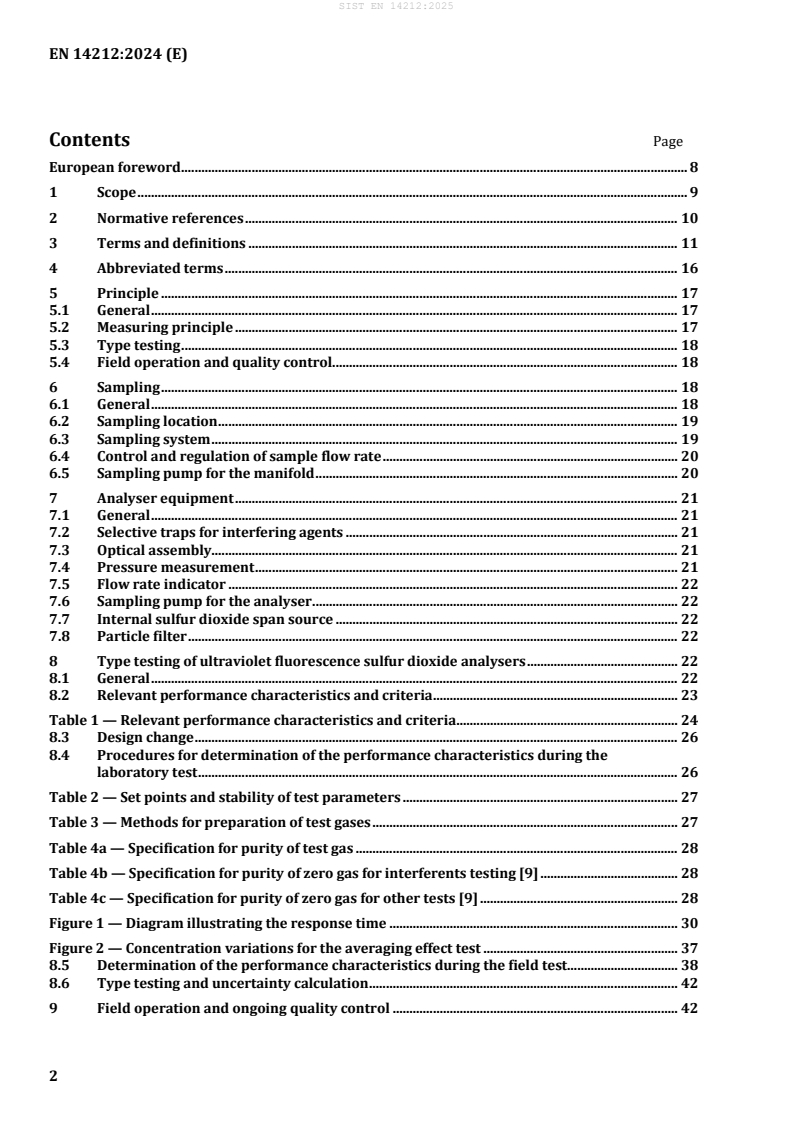
Contents Page
European foreword . 8
1 Scope . 9
2 Normative references . 10
3 Terms and definitions . 11
4 Abbreviated terms . 16
5 Principle . 17
5.1 General . 17
5.2 Measuring principle . 17
5.3 Type testing . 18
5.4 Field operation and quality control. 18
6 Sampling . 18
6.1 General . 18
6.2 Sampling location . 19
6.3 Sampling system . 19
6.4 Control and regulation of sample flow rate . 20
6.5 Sampling pump for the manifold . 20
7 Analyser equipment . 21
7.1 General . 21
7.2 Selective traps for interfering agents . 21
7.3 Optical assembly. 21
7.4 Pressure measurement . 21
7.5 Flow rate indicator . 22
7.6 Sampling pump for the analyser . 22
7.7 Internal sulfur dioxide span source . 22
7.8 Particle filter . 22
8 Type testing of ultraviolet fluorescence sulfur dioxide analysers . 22
8.1 General . 22
8.2 Relevant performance characteristics and criteria . 23
Table 1 — Relevant performance characteristics and criteria . 24
8.3 Design change . 26
8.4 Procedures for determination of the performance characteristics during the
laboratory test . 26
Table 2 — Set points and stability of test parameters . 27
Table 3 — Methods for preparation of test gases . 27
Table 4a — Specification for purity of test gas . 28
Table 4b — Specification for purity of zero gas for interferents testing [9] . 28
Table 4c — Specification for purity of zero gas for other tests [9] . 28
Figure 1 — Diagram illustrating the response time . 30
Figure 2 — Concentration variations for the averaging effect test . 37
8.5 Determination of the performance characteristics during the field test. 38
8.6 Type testing and uncertainty calculation . 42
9 Field operation and ongoing quality control . 42
9.1 General . 42
9.2 Suitability evaluation . 43
Table 5 — Site-specific conditions to be evaluated . 43
9.3 Initial installation . 44
9.4 Ongoing quality assurance/quality control . 46
Table 6 — Required frequency of calibration, checks and maintenance . 47
9.5 Calibration of the analyser . 49
Figure 3 — Flow scheme for performance of evaluation of effects of violation of
performance requirements and possibilities for data correction . 52
9.6 Checks . 53
9.7 Maintenance . 56
9.8 Data handling and data reports . 57
9.9 Measurement uncertainty . 57
10 Expression of results . 58
11 Test reports and documentation . 58
11.1 Type testing . 58
11.2 Field operation . 59
Annex A (normative) Test of lack of fit . 61
A.1 Establishment of the regression line . 61
A.2 Calculation of the residuals of the averages . 61
Annex B (informative) Sampling equipment . 63
Figure B.1 — Sampling layout with a main sampling manifold . 63
Figure B.2 — Sampling layout with individual lines . 64
Annex C (informative) Ultraviolet fluorescence analyser . 65
Figure C.1 — Schematic diagram of a UV fluorescence sulfur dioxide analyser . 65
Annex D (informative) Manifold testing . 66
D.1 Procedure for applying test gas . 66
Figure D.1 — Schematic diagram of manifold testing equipment . 67
D.2 Procedure for the cross test . 67
D.2.1 General . 67
D.2.2 Initial stage . 67
D.2.3 Stage 1 . 68
D.2.4 Stage 2 . 68
D.2.5 Data Processing . 68
D.2.6 Evaluation . 68
Annex E (normative) Type testing . 70
E.1 Type testing and uncertainty calculation . 70
E.1.1 Type testing . 70
E.1.2 Uncertainty calculation . 70
E.2 Type testing Requirement a) . 70
Table E.1 — Relevant performance characteristics and criteria . 71
E.3 Type testing Requirement b) . 72
E.3.1 General . 72
Table E.2 — Standard uncertainties to be incorporated in the calculation of the expanded
uncertainty after the laboratory tests . 73
Table E.3 — Standard uncertainty of the calibration gas to be incorporated in the
calculation of the expanded uncertainty after the laboratory tests . 73
E.3.2 Calculation of standard uncertainties . 75
E.3.2.1 General . 75
E.3.2.2 Repeatability at zero . 75
E.3.2.3 Repeatability at the hourly limit value of sulfur dioxide . 75
E.3.2.4 Lack of fit . 76
E.3.2.5 Influence quantities . 76
E.3.2.5.1 General . 76
E.3.2.5.2 Sample gas pressure . 77
E.3.2.5.3 Sample gas temperature . 77
E.3.2.5.4 Surrounding temperature . 78
E.3.2.5.5 Electrical voltage . 78
E.3.2.5.6 Water vapour . 79
E.3.2.5.7 Other interferents. 79
E.3.2.5.8 Averaging effect . 80
E.3.2.5.9 Calibration gas . 81
E.3.2.5.10 Difference sample/calibration port . 81
E.3.3 Example calculation . 82
Table E.4 —Example calculation . 82
E.4 Type testing Requirement c) . 84
Table E.5 — Relevant performance characteristics and criteria . 84
E.5 Type testing Requirement d) . 84
E.5.1 General . 84
Table E.6 — Standard uncertainties to be incorporated in the calculation of the expanded
uncertainty after the laboratory and field tests. 85
Table E.7 — Standard uncertainty of the calibration gas to be incorporated in the
calculation of the expanded uncertainty after the laboratory and field tests . 85
E.5.2 Combined standard uncertainty . 86
E.5.3 Absolute expanded uncertainty . 86
E.5.4 Relative expanded uncertainty . 87
E.5.5 Calculation of standard uncertainties . 87
E.5.6 Example calculation . 89
Table E.8 —Example calculation . 89
Annex F (informative) Calculation of uncertainty in field operation at the hourly limit value . 91
F.1 General . 91
F.2 Combined standard uncertainty . 91
F.3 Standard uncertainties . 92
F.3.1 General . 92
F.3.1.1 General . 92
F.3.1.2 Repeatability at zero . 92
F.3.1.3 Repeatability at the hourly limit value . 92
F.3.1.4 Lack of fit . 92
F.3.2 Influence quantities . 93
F.3.2.1 General . 93
F.3.2.2 Sample gas pressure . 93
F.3.2.3 Sample gas temperature . 93
F.3.2.4 Surrounding temperature . 94
F.3.2.5 Electrical voltage . 95
F.3.3 Interferents . 95
F.3.3.1 Water vapour . 95
F.3.3.2 Other interferents . 96
F.3.4 Averaging effect . 96
F.3.5 Reproducibility under field conditions . 96
F.3.6 Long-term drift at zero . 97
F.3.7 Long-term drift at level of the hourly limit value . 97
F.3.8 Zero gas . 97
F.3.9 Calibration gas . 97
F.3.10 Difference sample/calibration port . 97
F.4 Example calculation . 98
Table F.1 —Example calculation . 98
Annex G (informative) Calculation of uncertainty in field operation at the daily limit value . 100
G.1 General . 100
G.2 Combined standard uncertainty . 100
G.3 Standard uncertainties . 101
G.3.1 General . 101
G.3.1.1 General . 101
G.3.1.2 Repeatability at zero . 101
G.3.1.3 Repeatability at the daily limit value . 102
G.3.1.4 Lack of fit . 102
G.3.2 Influence quantities . 102
G.3.2.1 General . 102
G.3.2.2 Sample gas pressure . 103
G.3.2.3 Sample gas temperature . 103
G.3.2.4 Surrounding temperature . 104
G.3.2.5 Electrical voltage . 104
G.3.3 Interferents . 105
G.3.3.1 General . 105
G.3.3.2 Water vapour . 105
G.3.3.3 Other interferents . 106
G.3.4 Averaging effect . 107
G.3.5 Zero gas . 107
G.3.6 Calibration gas . 107
G.3.7 Difference sample/calibration port . 107
G.3.8 Reproducibility under field conditions . 108
G.3.9 Long-term drift at zero . 108
G.3.10 Long-term drift at level of the daily limit value . 108
G.4 Example calculation . 109
Table G.1 —Example calculation . 109
Annex H (informative) Calculation of uncertainty in field operation at the annual critical
level . 111
H.1 General . 111
H.2 Combined standard uncertainty . 111
H.3 H.3 Standard uncertainties . 113
H.3.1 General . 113
H.3.2 Repeatability at zero . 113
H.3.3 Repeatability at the annual limit value . 113
H.3.4 Lack of fit . 114
H.3.5 Influence quantities . 114
H.3.5.1 General . 114
H.3.5.2 Sample gas pressure . 114
H.3.5.3 Sample gas temperature . 115
H.3.5.4 Surrounding temperature . 115
H.3.5.5 Electrical voltage . 116
H.3.5.6 Interferents . 117
H.3.5.7 Water vapour . 117
H.3.5.8 Other interferents . 117
H.3.6 Averaging effect . 118
H.3.7 Zero gas . 119
H.3.8 Calibration gas . 119
H.3.9 Difference sample/calibration port . 119
H.3.10 Reproducibility under field conditions . 120
H.3.11 Long term drift at zero . 120
H.3.12 Long term drift at level of the annual critical level . 121
Annex I (informative) Test stand for the test point “sensitivity coefficient of sample gas
pressure”. 122
Figure I.1 — Test stand for the test point “sensitivity coefficient of sample gas pressure” . 122
Annex J (informative) Significant technical changes . 123
Table J.1 —Details of significant technical changes between this document and the previous
edition . 123
Bibliography . 124
European foreword
This document (EN 14212:2024) has been prepared by Technical Committee CEN/TC 264 “Air quality”,
the secretariat of which is held by DIN.
This European Standard shall be given the status of a national standard, either by publication of an
identical text or by endorsement, at the latest by June 2025, and conflicting national standards shall be
withdrawn at the latest by June 2025.
Attention is drawn to the possibility that some of the elements of this document may be the subject of
patent rights. CEN shall not be held responsible for identifying any or all such patent rights.
This document supersedes EN 14212:2012.
The technical modifications in comparison with the previous edition are listed in Annex J
of this document.
Any feedback and questions on this document should be directed to the users’ national standards body.
A complete listing of these bodies can be found on the CEN website.
According to the CEN-CENELEC Internal Regulations, the national standards organisations of the
following countries are bound to implement this European Standard: Austria, Belgium, Bulgaria, Croatia,
Cyprus, Czech Republic, Denmark, Estonia, Finland, France, Germany, Greece, Hungary, Iceland, Ireland,
Italy, Latvia, Lithuania, Luxembourg, Malta, Netherlands, Norway, Poland, Portugal, Republic of North
Macedonia, Romania, Serbia, Slovakia, Slovenia, Spain, Sweden, Switzerland, Türkiye and the United
Kingdom.
1 Scope
This document specifies a continuous measurement method for the determination of the concentration
of sulfur dioxide present in ambient air based on the ultraviolet fluorescence measuring principle. This
document describes the performance characteristics and sets the relevant minimum criteria required to
select an appropriate ultraviolet fluorescence analyser by means of type testing. It also includes the
evaluation of the suitability of an analyser for use in a specific fixed site so as to meet the data quality
requirements (see Annex I of Directive 2008/50/EC [1] for additional information) and requirements
during sampling, calibration and quality assurance for use.
The method is applicable to the determination of the mass concentration of sulfur dioxide present
in ambient air up to 1000 µg/m . This concentration range represents the certification range for sulfur
dioxide for type testing.
NOTE 1 It is possible to use other ranges depending on the levels present in ambient air.
NOTE 2 Exemplar uncertainty budget calculations are given in Annexes E to H referring to Directive
2008/50/EC [1]. In the event that the Limit Values are updated in future iterations of Directive 2008/50/EC [1], the
user can use these new values to calculate measurement uncertainties.
The method covers the determination of ambient air concentrations of sulfur dioxide in zones classified
as rural areas, urban-background areas, traffic-oriented locations and locations influenced by industrial
sources.
The results are expressed in µg/m (at 20 °C and 101,3 kPa).
NOTE 3 1 000 µg/m of SO corresponds to 376 nmol/mol of SO .
2 2
This document contains information for different groups of users.
Clause 5 to Clause 7 and Annex C and Annex D contain general information about the principles of sulfur
dioxide measurement by ultraviolet fluorescence analyser and sampling equipment.
Clause 8 and Annex E are specifically directed towards test houses and laboratories that perform type
testing of sulfur dioxide analysers. These sections contain information about:
— type testing conditions, test procedures and test requirements;
— analyser performance requirements;
— evaluation of the type testing results;
— evaluation of the associated uncertainty of the measurement performed by the sulfur dioxide
analyser based on the type testing results.
Clause 9 to Clause 11 and Annex F, Annex G and Annex H are directed towards monitoring networks
performing the practical measurements of sulfur dioxide in ambient air. These sections contain
information about:
— initial installation of the analyser in the monitoring network and acceptance testing;
— ongoing quality assurance/quality control;
— calculation and reporting of measurement results;
— evaluation of the uncertainty of the measurement results under practical monitoring conditions.
This document represents an evolution of earlier editions (EN 14212:2005 and EN 14212:2012).
NOTE 4 Analysers type tested prior to the publication of this document can still be used for regulated monitoring
purposes. As newer versions of analysers tested under this document become available, discontinue the use of older
reference analysers.
2 Normative references
The following documents are referred to in the text in such a way that some or all of their content
constitutes requirements of this document. For dated references, only the edition cited applies.
For undated references, the latest edition of the referenced document (including any amendments)
applies.
EN 15267-1, Air quality - Assessment of air quality monitoring equipment - Part 1: General principles of
certification
EN 15267-2, Air quality - Assessment of air quality monitoring equipment - Part 2: Initial assessment of the
manufacturer’s quality management system and post certification surveillance for the manufacturing
process
EN ISO 6142, Gas analysis — Preparation of calibration gas mixtures — Gravimetric method (ISO 6142)
EN ISO 6143, Gas analysis - Comparison methods for determining and checking the composition of
calibration gas mixtures (ISO 6143)
EN ISO 6144, Gas analysis - Preparation of calibration gas mixtures - Static volumetric method (ISO 6144)
EN ISO 6145-6, Gas analysis - Preparation of calibration gas mixtures using dynamic methods - Part 6:
Critical flow orifices (ISO 6145-6)
EN ISO 6145-7, Gas analysis - Preparation of calibration gas mixtures using dynamic methods - Part 7:
Thermal mass-flow controllers (ISO 6145-7)
EN ISO 6145-10, Gas analysis - Preparation of calibration gas mixtures using dynamic volumetric methods
- Part 10: Permeation method (ISO 6145-10)
EN ISO 14956, Air quality - Evaluation of the suitability of a measurement procedure by comparison with a
required measurement uncertainty (ISO 14956)
EN ISO 19229, Gas analysis - Purity analysis and the treatment of purity data
3 Terms and definitions
For the purposes of this document, the following terms and definitions apply.
ISO and IEC maintain terminological databases for use in standardization at the following addresses:
— ISO Online browsing platform: available at https://www.iso.org/obp
— IEC Electropedia: available at https://www.electropedia.org/
3.1
adjustment of a measuring system
set of operations carried out on a measuring system so that it provides prescribed indications
corresponding to given values of a quantity to be measured
Note 1 to entry: Types of adjustment of a measuring system include zero adjustment of a measuring system,
offset adjustment, and span adjustment (sometimes called gain adjustment).
Note 2 to entry: Adjustment of a measuring system should not be confused with calibration, which is a
prerequisite for adjustment.
Note 3 to entry: In the context of this document, adjustment is generally performed on measurement data rather
than on the analyser.
[SOURCE: JCGM 200:2012, 3.11 [2]]
3.2
ambient air
outdoor air in the troposphere where provisions concerning health and safety at work apply and to which
members of the public do not have regular access
Note 1 to entry: This excludes workplaces as defined by Directive 89/654/EEC.
[SOURCE: Council Directive 2008/50/EC [1]]
3.3
analyser
measuring system that provides an output signal which is a function of the concentration or partial
pressure of one or more components in a gas mixture and flow or temperature of this gas mixture
3.4
availability of the analyser
fraction of the time period for which valid measuring data of the ambient air concentration is available
from an analyser
3.5
calibration
operation that, under specified conditions, in a first step, establishes a relation between the quantity
values with measurement uncertainties provided by measurement standards and corresponding
indications with associated measurement uncertainties and, in a second step, uses this information
to establish a relation for obtaining a measurement result from an indication
Note 1 to entry: A calibration may be expressed by a statement, calibration function, calibration diagram,
calibration curve, or calibration table. In some cases, it may consist of an additive or multiplicative correction of the
indication with associated measurement uncertainty.
Note 2 to entry: Calibration should not be confused with adjustment of a measuring system, often mistakenly
called “self-calibration”, nor with verification of a calibration.
Note 3 to entry: Often, the first step alone in the above definition is
...