


SIST EN ISO 23500-5:2024
(Main)Preparation and quality management of fluids for haemodialysis and related therapies - Part 5: Quality of dialysis fluid for haemodialysis and related therapies (ISO 23500-5:2024)
Preparation and quality management of fluids for haemodialysis and related therapies - Part 5: Quality of dialysis fluid for haemodialysis and related therapies (ISO 23500-5:2024)
This document specifies the minimum chemical and microbiological quality requirements for dialysis fluids used in haemodialysis and related therapies.
This document applies to
— dialysis fluids used for haemodialysis and haemodiafiltration,
— substitution fluid produced online for haemodiafiltration and haemofiltration based on dialysis fluid
This document does not apply to
— the water and concentrates used to prepare dialysis fluid or the equipment to produce dialysis fluid
— sorbent-based dialysis fluid regeneration systems that regenerate and recirculate small volumes of dialysis fluid,
— systems for continuous renal replacement therapy that use pre-packaged solutions, and
— systems and solutions for peritoneal dialysis.
The delivery and monitoring of the dialysis fluid composition and its permitted deviation from set points is governed by protective systems defined in IEC 60601-2-16.
Herstellung und Qualitätsmanagement von Flüssigkeiten für die Hämodialyse und verwandte Therapien - Teil 5: Qualität von Flüssigkeiten für die Hämodialyse und verwandte Therapien (ISO 23500-5:2024)
Dieses Dokument legt die Mindestanforderungen an die chemische und mikrobiologische Qualität von Dialysierflüssigkeiten fest, die bei der Hämodialyse und verwandten Therapien zum Einsatz kommen.
Dieses Dokument ist anwendbar für:
- Dialysierflüssigkeiten, die für die Hämodialyse und die Hämodiafiltration eingesetzt werden;
- online-hergestellte Substitutionsflüssigkeit für die Hämodiafiltration und die Hämofiltration, basierend auf Dialysierflüssigkeit.
Dieses Dokument ist nicht anwendbar für:
- das Wasser und die Konzentrate oder die Ausrüstung zur Herstellung der Dialysierflüssigkeit;
- Sorbent basierte Dialysierflüssigkeits-Wiederaufbereitungssysteme, in denen kleine Volumina der Dialysierflüssigkeit wiederaufbereitet und wieder in Umlauf gebracht werden;
- Systeme für die kontinuierliche Nierenersatztherapie, bei denen vorverpackte Lösungen zum Einsatz kommen; und
- Systeme und Lösungen für die Peritonealdialyse.
Die Anlieferung und Überwachung der Zusammensetzung der Dialysierflüssigkeiten und ihrer erlaubten Abweichungen von den Sollwerten wird durch die in IEC 60601 2 16 definierten Schutzsysteme festgelegt.
Préparation et management de la qualité des liquides d'hémodialyse et de thérapies annexes - Partie 5: Qualité des liquides de dialyse pour hémodialyse et thérapies apparentées (ISO 23500-5:2024)
Le présent document spécifie les exigences minimales de qualité chimique et microbiologique pour les liquides de dialyse dans le cadre d’hémodialyses et de thérapies apparentées.
Le présent document s’applique à ce qui suit:
— les liquides de dialyse utilisés à des fins d’hémodialyse et d’hémodiafiltration;
— le liquide de substitution produit en ligne à des fins d’hémodiafiltration et d’hémofiltration sur la base du liquide de dialyse.
Le présent document ne s’applique pas à ce qui suit:
— l’eau et les concentrés utilisés pour préparer le liquide de dialyse ou l’équipement permettant de produire du liquide de dialyse;
— les systèmes de régénération de liquide de dialyse à base de sorbants qui régénèrent et recyclent de petites quantités de liquide de dialyse;
— les systèmes d’épuration extrarénale continue qui utilisent des solutions prêtes à l’emploi; et
— les systèmes et solutions utilisés en dialyse péritonéale.
La fourniture et la surveillance de la composition du liquide de dialyse et ses écarts admis par rapport aux points de consigne sont régis par des systèmes de protection définis dans l’IEC 60601-2-16.
Priprava in vodenje kakovosti tekočin za hemodializo in podobne terapije - 5. del: Kakovost tekočin za hemodializo in podobne terapije (ISO 23500-5:2024)
Ta dokument določa zahteve glede minimalne kakovosti za tekočine za hemodializo in podobne terapije.
Ta dokument vključuje tekočine za hemodializo in hemodiafiltracijo, vključno z nadomestno tekočino za hemodiafiltracijo in hemofiltracijo.
Ta dokument ne zajema vode in koncentratov, ki se uporabljajo za pripravo dializne tekočine, ali opreme, ki se uporablja za njeno pripravo. Te vidike obravnavajo drugi mednarodni standardi.
Prav tako ne zajema sistemov za regeneracijo dializne tekočine na osnovi sorbenta za regeneracijo in recirkulacijo majhnih količin dializne tekočine, sistemov za neprekinjeno nadomestno ledvično zdravljenje, pri katerih se uporabljajo predpakirane raztopine, ter sistemov in raztopin za peritonealno dializo.
General Information
- Status
- Published
- Public Enquiry End Date
- 30-Jan-2023
- Publication Date
- 13-May-2024
- Technical Committee
- VAZ - Healthcare
- Current Stage
- 6060 - National Implementation/Publication (Adopted Project)
- Start Date
- 09-May-2024
- Due Date
- 14-Jul-2024
- Completion Date
- 14-May-2024
Relations
- Effective Date
- 22-Dec-2021
Overview
EN ISO 23500-5:2024 (ISO 23500-5:2024) defines the minimum chemical and microbiological quality requirements for dialysis fluid used in haemodialysis and related therapies. Published by CEN and endorsed as a European Standard, this second edition updates the 2019 version and clarifies test methods and quality criteria for dialysis fluid and online-produced substitution fluids. It complements ISO 23500-1, -3 and -4 and supports safe fluid preparation and patient protection during extracorporeal therapies.
Key topics and technical requirements
- Scope and applicability
- Applies to dialysis fluids for haemodialysis and haemodiafiltration, and to online-produced substitution fluid used in haemodiafiltration and haemofiltration.
- Excludes water and concentrate specifications (covered in ISO 23500-3 and ISO 23500-4), sorbent-based regeneration systems, CRRT pre-packaged solutions, and peritoneal dialysis systems.
- Microbiological quality
- Defines microbiological acceptance criteria for standard and ultrapure dialysis fluid, and for online substitution fluids.
- Specifies sampling points (inlet to the dialyser) and culture methods for routine monitoring.
- Incorporates updated analytical alternatives (e.g., endotoxin testing using recombinant Factor C - rFC) in the second edition.
- Chemical composition and contaminants
- Requires verification of correct electrolyte composition and control of chemical contaminants that could harm patients.
- Details chemical testing methods and conformity procedures.
- Conformity testing
- Describes sampling protocols, culture techniques, and chemical assay requirements to demonstrate compliance.
- Safety & monitoring interfaces
- Notes that delivery and permitted deviations of dialysis fluid composition are governed by protective systems defined in IEC 60601-2-16.
Practical applications and users
EN ISO 23500-5:2024 is intended for:
- Nephrologists and clinicians responsible for dialysis prescriptions and patient safety.
- Dialysis unit managers and clinical engineers implementing routine fluid preparation and monitoring programs.
- Medical device and dialysis equipment manufacturers designing fluid delivery systems and online substitution features.
- Regulatory bodies and accreditation organizations assessing dialysis facility quality and compliance.
Practical uses include establishing routine testing schedules, validating microbiological and chemical testing methods, setting acceptance criteria for standard vs. ultrapure fluids, and integrating standard requirements into dialysis unit protocols.
Related standards
- ISO 23500-1 - General requirements and guidance
- ISO 23500-3 - Quality of water for haemodialysis
- ISO 23500-4 - Concentrates for haemodialysis
- IEC 60601-2-16 - Safety requirements for haemodialysis equipment
Keywords: ISO 23500-5:2024, EN ISO 23500-5, dialysis fluid quality, haemodialysis, haemodiafiltration, substitution fluid, microbiological requirements, chemical contaminants, dialysis fluid testing.

Frequently Asked Questions
SIST EN ISO 23500-5:2024 is a standard published by the Slovenian Institute for Standardization (SIST). Its full title is "Preparation and quality management of fluids for haemodialysis and related therapies - Part 5: Quality of dialysis fluid for haemodialysis and related therapies (ISO 23500-5:2024)". This standard covers: This document specifies the minimum chemical and microbiological quality requirements for dialysis fluids used in haemodialysis and related therapies. This document applies to — dialysis fluids used for haemodialysis and haemodiafiltration, — substitution fluid produced online for haemodiafiltration and haemofiltration based on dialysis fluid This document does not apply to — the water and concentrates used to prepare dialysis fluid or the equipment to produce dialysis fluid — sorbent-based dialysis fluid regeneration systems that regenerate and recirculate small volumes of dialysis fluid, — systems for continuous renal replacement therapy that use pre-packaged solutions, and — systems and solutions for peritoneal dialysis. The delivery and monitoring of the dialysis fluid composition and its permitted deviation from set points is governed by protective systems defined in IEC 60601-2-16.
This document specifies the minimum chemical and microbiological quality requirements for dialysis fluids used in haemodialysis and related therapies. This document applies to — dialysis fluids used for haemodialysis and haemodiafiltration, — substitution fluid produced online for haemodiafiltration and haemofiltration based on dialysis fluid This document does not apply to — the water and concentrates used to prepare dialysis fluid or the equipment to produce dialysis fluid — sorbent-based dialysis fluid regeneration systems that regenerate and recirculate small volumes of dialysis fluid, — systems for continuous renal replacement therapy that use pre-packaged solutions, and — systems and solutions for peritoneal dialysis. The delivery and monitoring of the dialysis fluid composition and its permitted deviation from set points is governed by protective systems defined in IEC 60601-2-16.
SIST EN ISO 23500-5:2024 is classified under the following ICS (International Classification for Standards) categories: 11.040.40 - Implants for surgery, prosthetics and orthotics. The ICS classification helps identify the subject area and facilitates finding related standards.
SIST EN ISO 23500-5:2024 has the following relationships with other standards: It is inter standard links to SIST EN ISO 23500-5:2019. Understanding these relationships helps ensure you are using the most current and applicable version of the standard.
SIST EN ISO 23500-5:2024 is available in PDF format for immediate download after purchase. The document can be added to your cart and obtained through the secure checkout process. Digital delivery ensures instant access to the complete standard document.
Standards Content (Sample)
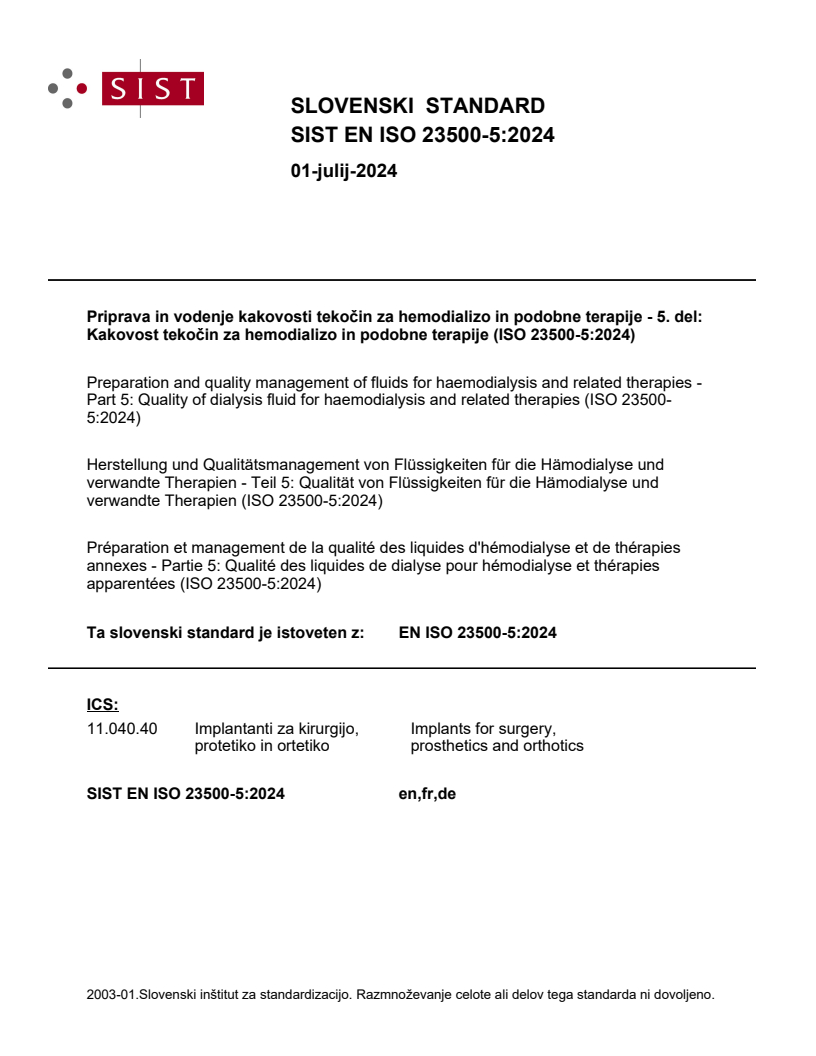
SLOVENSKI STANDARD
01-julij-2024
Priprava in vodenje kakovosti tekočin za hemodializo in podobne terapije - 5. del:
Kakovost tekočin za hemodializo in podobne terapije (ISO 23500-5:2024)
Preparation and quality management of fluids for haemodialysis and related therapies -
Part 5: Quality of dialysis fluid for haemodialysis and related therapies (ISO 23500-
5:2024)
Herstellung und Qualitätsmanagement von Flüssigkeiten für die Hämodialyse und
verwandte Therapien - Teil 5: Qualität von Flüssigkeiten für die Hämodialyse und
verwandte Therapien (ISO 23500-5:2024)
Préparation et management de la qualité des liquides d'hémodialyse et de thérapies
annexes - Partie 5: Qualité des liquides de dialyse pour hémodialyse et thérapies
apparentées (ISO 23500-5:2024)
Ta slovenski standard je istoveten z: EN ISO 23500-5:2024
ICS:
11.040.40 Implantanti za kirurgijo, Implants for surgery,
protetiko in ortetiko prosthetics and orthotics
2003-01.Slovenski inštitut za standardizacijo. Razmnoževanje celote ali delov tega standarda ni dovoljeno.
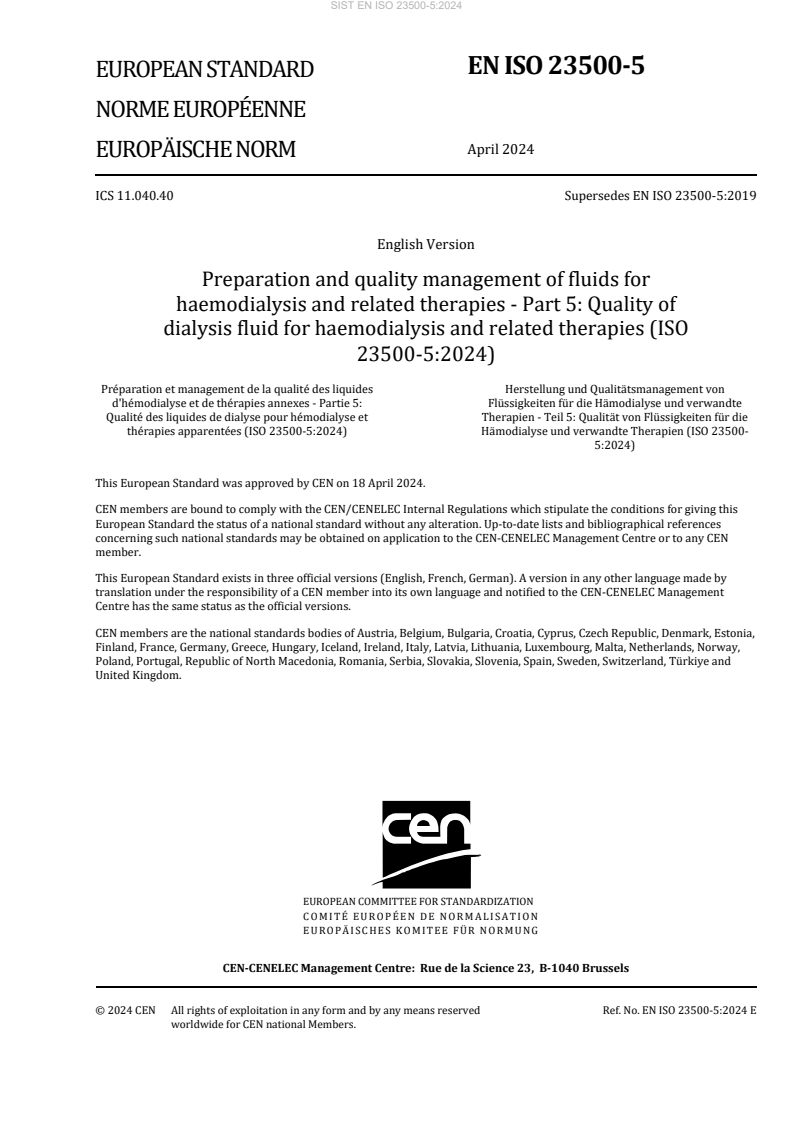
EN ISO 23500-5
EUROPEAN STANDARD
NORME EUROPÉENNE
April 2024
EUROPÄISCHE NORM
ICS 11.040.40 Supersedes EN ISO 23500-5:2019
English Version
Preparation and quality management of fluids for
haemodialysis and related therapies - Part 5: Quality of
dialysis fluid for haemodialysis and related therapies (ISO
23500-5:2024)
Préparation et management de la qualité des liquides Herstellung und Qualitätsmanagement von
d'hémodialyse et de thérapies annexes - Partie 5: Flüssigkeiten für die Hämodialyse und verwandte
Qualité des liquides de dialyse pour hémodialyse et Therapien - Teil 5: Qualität von Flüssigkeiten für die
thérapies apparentées (ISO 23500-5:2024) Hämodialyse und verwandte Therapien (ISO 23500-
5:2024)
This European Standard was approved by CEN on 18 April 2024.
CEN members are bound to comply with the CEN/CENELEC Internal Regulations which stipulate the conditions for giving this
European Standard the status of a national standard without any alteration. Up-to-date lists and bibliographical references
concerning such national standards may be obtained on application to the CEN-CENELEC Management Centre or to any CEN
member.
This European Standard exists in three official versions (English, French, German). A version in any other language made by
translation under the responsibility of a CEN member into its own language and notified to the CEN-CENELEC Management
Centre has the same status as the official versions.
CEN members are the national standards bodies of Austria, Belgium, Bulgaria, Croatia, Cyprus, Czech Republic, Denmark, Estonia,
Finland, France, Germany, Greece, Hungary, Iceland, Ireland, Italy, Latvia, Lithuania, Luxembourg, Malta, Netherlands, Norway,
Poland, Portugal, Republic of North Macedonia, Romania, Serbia, Slovakia, Slovenia, Spain, Sweden, Switzerland, Türkiye and
United Kingdom.
EUROPEAN COMMITTEE FOR STANDARDIZATION
COMITÉ EUROPÉEN DE NORMALISATION
EUROPÄISCHES KOMITEE FÜR NORMUNG
CEN-CENELEC Management Centre: Rue de la Science 23, B-1040 Brussels
© 2024 CEN All rights of exploitation in any form and by any means reserved Ref. No. EN ISO 23500-5:2024 E
worldwide for CEN national Members.
Contents Page
European foreword . 3
European foreword
This document (EN ISO 23500-5:2024) has been prepared by Technical Committee ISO/TC 150
"Implants for surgery" in collaboration with Technical Committee CEN/TC 205 “Non-active medical
devices” the secretariat of which is held by DIN.
This European Standard shall be given the status of a national standard, either by publication of an
identical text or by endorsement, at the latest by October 2024, and conflicting national standards shall
be withdrawn at the latest by October 2024.
Attention is drawn to the possibility that some of the elements of this document may be the subject of
patent rights. CEN shall not be held responsible for identifying any or all such patent rights.
This document supersedes EN ISO 23500-5:2019.
Any feedback and questions on this document should be directed to the users’ national standards
body/national committee. A complete listing of these bodies can be found on the CEN website.
According to the CEN-CENELEC Internal Regulations, the national standards organizations of the
following countries are bound to implement this European Standard: Austria, Belgium, Bulgaria,
Croatia, Cyprus, Czech Republic, Denmark, Estonia, Finland, France, Germany, Greece, Hungary, Iceland,
Ireland, Italy, Latvia, Lithuania, Luxembourg, Malta, Netherlands, Norway, Poland, Portugal, Republic of
North Macedonia, Romania, Serbia, Slovakia, Slovenia, Spain, Sweden, Switzerland, Türkiye and the
United Kingdom.
Endorsement notice
The text of ISO 23500-5:2024 has been approved by CEN as EN ISO 23500-5:2024 without any
modification.
International
Standard
ISO 23500-5
Second edition
Preparation and quality
2024-04
management of fluids for
haemodialysis and related
therapies —
Part 5:
Quality of dialysis fluid for
haemodialysis and related therapies
Préparation et management de la qualité des liquides
d'hémodialyse et de thérapies annexes —
Partie 5: Qualité des liquides de dialyse pour hémodialyse et
thérapies apparentées
Reference number
ISO 23500-5:2024(en) © ISO 2024
ISO 23500-5:2024(en)
© ISO 2024
All rights reserved. Unless otherwise specified, or required in the context of its implementation, no part of this publication may
be reproduced or utilized otherwise in any form or by any means, electronic or mechanical, including photocopying, or posting on
the internet or an intranet, without prior written permission. Permission can be requested from either ISO at the address below
or ISO’s member body in the country of the requester.
ISO copyright office
CP 401 • Ch. de Blandonnet 8
CH-1214 Vernier, Geneva
Phone: +41 22 749 01 11
Email: copyright@iso.org
Website: www.iso.org
Published in Switzerland
ii
ISO 23500-5:2024(en)
Contents Page
Foreword .iv
Introduction .v
1 Scope . 1
2 Normative references . 1
3 Terms and definitions . 1
4 Requirements . 2
4.1 Microbiological contaminants in dialysis fluid .2
4.1.1 General .2
4.1.2 Microbiological requirements for standard dialysis fluid .2
4.1.3 Microbiological requirements for ultrapure dialysis fluid .2
4.1.4 Microbiological requirements for online prepared substitution fluid .2
4.2 Chemical composition of dialysis fluid .3
4.3 Chemical contaminants in dialysis fluid .3
5 Tests for conformity . 3
5.1 Microbiological requirements.3
5.1.1 Sampling .3
5.1.2 Culture methods .3
5.2 Chemical requirements . .5
Annex A (informative) Rationale for the development and provisions of this document . 6
Annex B (informative) Reference tables . 9
Bibliography .11
iii
ISO 23500-5:2024(en)
Foreword
ISO (the International Organization for Standardization) is a worldwide federation of national standards
bodies (ISO member bodies). The work of preparing International Standards is normally carried out through
ISO technical committees. Each member body interested in a subject for which a technical committee
has been established has the right to be represented on that committee. International organizations,
governmental and non-governmental, in liaison with ISO, also take part in the work. ISO collaborates closely
with the International Electrotechnical Commission (IEC) on all matters of electrotechnical standardization.
The procedures used to develop this document and those intended for its further maintenance are described
in the ISO/IEC Directives, Part 1. In particular, the different approval criteria needed for the different types
of ISO document should be noted. This document was drafted in accordance with the editorial rules of the
ISO/IEC Directives, Part 2 (see www.iso.org/directives).
ISO draws attention to the possibility that the implementation of this document may involve the use of (a)
patent(s). ISO takes no position concerning the evidence, validity or applicability of any claimed patent
rights in respect thereof. As of the date of publication of this document, ISO had not received notice of (a)
patent(s) which may be required to implement this document. However, implementers are cautioned that
this may not represent the latest information, which may be obtained from the patent database available at
www.iso.org/patents. ISO shall not be held responsible for identifying any or all such patent rights.
Any trade name used in this document is information given for the convenience of users and does not
constitute an endorsement.
For an explanation of the voluntary nature of standards, the meaning of ISO specific terms and expressions
related to conformity assessment, as well as information about ISO's adherence to the World Trade
Organization (WTO) principles in the Technical Barriers to Trade (TBT), see www.iso.org/iso/foreword.html.
This document was prepared by Technical Committee ISO/TC 150, Implants for surgery, Subcommittee
SC 2, Cardiovascular implants and extracorporeal systems, in collaboration with the European Committee for
Standardization (CEN) Technical Committee CEN/TC 205, Non-active medical devices, in accordance with the
Agreement on technical cooperation between ISO and CEN (Vienna Agreement).
This second edition cancels and replaces the first edition (ISO 23500-5:2019), which has been technically
revised.
The main changes are: alternatives to classic microbial analytical methods [endotoxin testing using rFC (tp)]
have been incorporated.
A list of all parts of the ISO 23500 series can be found on the ISO website.
Any feedback or questions on this document should be directed to the user’s national standards body. A
complete listing of these bodies can be found at www.iso.org/members.html.
iv
ISO 23500-5:2024(en)
Introduction
Haemodialysis patients are directly exposed to large volumes of dialysis fluid, with the dialyser membrane
being the only barrier against transfer of hazardous contaminants from the dialysis fluid to the patient. It has
long been known that there can be hazardous contaminants in the water and concentrates used to prepare
the dialysis fluid. To minimize this hazard, ISO 23500-3 and ISO 23500-4 set forth quality requirements
for the water and concentrates used to prepare dialysis fluid. However, if the dialysis fluid is not prepared
carefully, it can contain unacceptable levels of contaminants even though it is prepared from water and
concentrates, conforming to the requirements of ISO 23500-3 and ISO 23500-4. Further, the dialysis fluid
can be used as the starting material for the online preparation of fluids intended for infusion into the
patient, for example, in therapies such as online haemodiafiltration. For these reasons, this document was
developed to complement the existing International Standards for water and concentrates, ISO 23500-3 and
ISO 23500-4, respectively. Guidelines to aid the user in routinely meeting the requirements of this document
and ISO 23500-3 can be found in ISO 23500-1.
Within these International Standards, measurement techniques current at the time of preparation have been
cited. Other standard methods can be used, provided that such methods have been appropriately validated
and are comparable to the cited methods. The rationale for the development of this document is given in
Annex A.
This document reflects the conscientious efforts of healthcare professionals, patients and medical device
manufacturers to develop recommendations for the quality of dialysis fluid. This document is applicable to
healthcare professionals involved in the management of dialysis facilities and the routine care of patients
treated in dialysis facilities, since they are responsible for the final preparation of dialysis fluid.
This document aims to help protect haemodialysis patients from adverse effects arising from known
chemical and microbiological contaminants that can be found in improperly prepared dialysis fluid.
However, the physician in charge of dialysis has the ultimate responsibility for ensuring that the dialysis
fluid is correctly formulated and meets the applicable quality standards.
The concepts incorporated in this document should not be considered inflexible or static. The requirements
and recommendations presented in this document should be reviewed periodically in order to assimilate
increased understanding of the role of dialysis fluid purity in patient outcomes and technological
developments.
v
International Standard ISO 23500-5:2024(en)
Preparation and quality management of fluids for
haemodialysis and related therapies —
Part 5:
Quality of dialysis fluid for haemodialysis and related
therapies
1 Scope
This document specifies the minimum chemical and microbiological quality requirements for dialysis fluids
used in haemodialysis and related therapies.
This document applies to
— dialysis fluids used for haemodialysis and haemodiafiltration,
— substitution fluid produced online for haemodiafiltration and haemofiltration based on dialysis fluid
This document does not apply to
— the water and concentrates used to prepare dialysis fluid or the equipment to produce dialysis fluid
— sorbent-based dialysis fluid regeneration systems that regenerate and recirculate small volumes of
dialysis fluid,
— systems for continuous renal replacement therapy that use pre-packaged solutions, and
— systems and solutions for peritoneal dialysis.
The delivery and monitoring of the dialysis fluid composition and its permitted deviation from set points is
governed by protective systems defined in IEC 60601-2-16.
2 Normative references
The following documents are referred to in the text in such a way that some or all of their content constitutes
requirements of this document. For dated references, only the edition cited applies. For undated references,
the latest edition of the referenced document (including any amendments) applies.
ISO 23500-1, Preparation and quality management of fluids for haemodialysis and related therapies — Part 1:
General requirements
ISO 23500-3, Preparation and quality management of fluids for haemodialysis and related therapies — Part 3:
Quality of water for haemodialysis and related therapies
ISO 23500-4, Preparation and quality management of fluids for haemodialysis and related therapies — Part 4:
Concentrates for haemodialysis and related therapies
3 Terms and definitions
For the purposes of this document, the terms and definitions given in ISO 23500-1 apply.
ISO 23500-5:2024(en)
ISO and IEC maintain terminology databases for use in standardization at the following addresses:
— ISO Online browsing platform: available at https:// www .iso .org/ obp
— IEC Electropedia: available at https:// www .electropedia .org/
4 Requirements
4.1 Microbiological contaminants in dialysis fluid
4.1.1 General
The requirements contained in Clause 4 apply to a sample of the dialysis fluid collected at the inlet to the
dialyser or the reinfusion point.
4.1.2 Microbiological requirements for standard dialysis fluid
Standard dialysis fluid shall contain a total viable microbial count of less than 100 CFU/ml (when tested in
accordance with Clause 5) and an endotoxin concentration of less than 0,5 EU/ml (when tested in accordance
with Clause 5).
Action levels for the total viable microbial count and endotoxin concentration in dialysis fluid should also be
set based on knowledge of the microbial dynamics of the system. Typically, the action levels are set at 50 %
of the maximum allowable levels for total viable microbial count and endotoxin; other levels can be set.
If microbial counts exceeding the action levels are observed in the dialysis fluid, corrective measures, such
as disinfection and retesting, should be taken promptly to reduce the levels.
Associated with the presence of bacteria and endotoxin in dialysis fluid is the likely presence of fungi (yeasts
and filamentous fungi).
Tests for microbial growth and endotoxins are not required if the dialysis machine fluid pathway is fitted
with an appropriate capacity bacteria-retentive and endotoxin-retentive filter validated by the manufacturer,
and operated and surveyed according to the manufacturer's instructions, unless the manufacturer requires
such tests in the instructions for use.
4.1.3 Microbiological requirements for ultrapure dialysis fluid
Ultrapure dialysis fluid shall contain a total viable microbial count of less than 0,1 CFU/ml (when tested in
accordance with Clause 5) and an endotoxin concentration less than 0,03 EU/ml (when tested in accordance
with Clause 5). If those limits are exceeded in ultrapure dialysis fluid, corrective measures should be taken to
reduce the levels to an acceptable level. The user is responsible for surveying the dialysis fluid bacteriology
of the system following installation. It is incumbent on the user to establish a regular surveillance routine.
Tests for microbial growth and endotoxins are not required if the dialysis machine fluid pathway is fitted
with an appropriate capacity bacteria-retentive and endotoxin-retentive filter validated by the manufacturer,
and operated and surveyed according to the manufacturer's instructions, unless the manufacturer requires
such tests in the instructions for use.
4.1.4 Microbiological requirements for online prepared substitution fluid
The requirements contained in this subclause apply to online prepared fluid intended to be infused into the
patient as it enters the patient's blood.
This fluid shall be sterile and nonpyrogenic.
Substitution fluid for convective therapies, such as haemodiafiltration and haemofiltration, can be produced
online by a process of ultrafiltration with bacteria- and endotoxin-retentive filters. This online process shall
be validated to produce fluid that is sterile and nonpyrogenic.
ISO 23500-5:2024(en)
Conformity of online produced fluid with the requirements of this document cannot be demonstrated with
traditional test procedures. For this reason, conformity with this document shall be ensured by proper
operation of a validated system, verified in accordance with the manufacturer's instructions at the time
of installation, and confirmed by the user with a regular surveillance and maintenance schedule. The user
shall follow the manufacturer’s instructions for use of the validated system and the user’s surveillance and
maintenance schedule shall be designed to confirm that the water and concentrates used to prepare the
substitution fluid continue to meet the specifications of ISO 23500-3 and ISO 23500-4.
4.2 Chemical composition of dialysis fluid
Dialysis fluid shall be prepared from water meeting the requirements of ISO 23500-3 and acid and
bicarbonate concentrates meeting the requirements of ISO 23500-4. The water and concentrates shall be
combined in accordance with the concentrate manufacturers dilution instructions using individual dialysis
fluid delivery systems as specified in IEC 60601-2-16 or a central dialysis fluid delivery system.
4.3 Chemical contaminants in dialysis fluid
The water and concentrates shall be combined using individual dialysis fluid delivery systems or a central
dialysis fluid delivery system constructed from materials that do not contribute chemical contaminants to
the final dialysis fluid.
The maximum levels of chemical contaminants permitted in water used to prepare dialysis fluid and
concentrates are given in ISO 23500-3 and are also shown in Annex B (see Tables B.1 and B.2) together with
methods of determination (see Table B.3). Other equivalent analytical methods can be used. Where testing
for the individual trace elements listed in Table B.2 is not available, an analysis for total heavy metals can be
used with a maximum allowable level of 0,1 mg/l.
5 Tests for conformity
5.1 Microbiological requirements
5.1.1 Sampling
In some newer dialysis machines, dialysis fluid flow stops when the effluent line is disconnected from
the dialyser. In these instances, the machines are equipped with dialysis fluid sampling ports that can be
accessed using a syringe. Sample ports can be disinfected with alcohol and allowed to air-dry. A sterile
syringe should be used to aspirate at least 10 ml of dialysis fluid out of the sampling port. The filled syringe
is discarded and a fresh sample of dialysis fluid collected using a new sterile syringe. For sample ports
consisting of a simple septum penetrated with a needle, the use of a second syringe is not necessary. If no
sampling port is available and if the dialysis machine permits, samples can be collected immediately before
the dialyser by disconnecting the inlet connector and aseptically collecting a “free/clean” catch sample after
allowing dialysis fluid to run for at least 60 s unless manufacturers’ instructions state otherwise.
Microbial analysis of any fluid sample should be conducted as soon as possible after collection to avoid
unpredictable changes in the microbial population. If samples cannot be analysed within 4 h of collection,
they should be stored at <10 °C without freezing and during transit to the laboratory. Sample storage for
more than 24 h should be avoided and sample shipping should be according to the laboratory’s instructions.
5.1.2 Culture methods
Accurate microbiological surveillance is important in the indication of the microbial content of dialysis water
and dialysis fluid. Culture results obtained using the methods outlined in this document and summarized in
Table 1 are only a relative indicator of the bioburden and do not provide an absolute measure of the absolute
microbial burden.
Total viable microbial counts (standard plate counts) shall be obtained using conventional microbiological
assay procedures (pour plate, spread plate, membrane filter techniques). The calibrated loop technique shall
not be used.
ISO 23500-5:2024(en)
Preferred methods and sample volumes are:
— for standard dialysis fluid:
— spread plate, 0,1 ml to 0,3 ml;
— pour plate, typically 1 ml;
— for ultrapure dialysis fluid: membrane filtration, 10 ml to 1 000 ml;
— for substitution fluid: sterility cannot be proven by sampling.
Different media types and incubation periods can result in varying colony concentrations and types of
microorganisms recovered.
The use of Reasoner’s 2A agar (R2A) has been shown in published studies to result in higher colony
[20][21]
counts than tryptic soy agar (TSA) for water and dialysis fluids samples . However, in a more recent
[22]
publication , the authors indicated that there were no significant differences for comparisons of bacterial
burden of standard dialysis water and standard dialysis fluid yielding colony counts ≥50 CFU/ml when
assayed using R2A and TSA at the conditions stated in Table 1.
Tryptone glucose extract agar (TGEA) incubated at 17 °C to 23 °C for a period of 7 d in previous studies also
yielded higher colony counts than TSA. In Reference [22], a comparison of this medium with TSA showed
that the proportion of standa
...
Questions, Comments and Discussion
Ask us and Technical Secretary will try to provide an answer. You can facilitate discussion about the standard in here.
Loading comments...