

oSIST prEN 843-3:2026
(Main)Advanced technical ceramics - Mechanical properties of monolithic ceramics at room temperature - Part 3: Determination of subcritical crack growth parameters from constant stressing rate flexural strength tests
- Abstract
This document specifies a method for the determination of subcritical crack growth parameters of advanced monolithic technical ceramics in the temperature range 15 °C to 30 °C by measuring the dependence of mean flexural strength on the rate of loading.
The method is based on strength test procedures described in EN 843 1.
The applicability of this method is limited by specific requirements for a low scatter of the initial strength of the test pieces and an upper limit of the stress load rate for the data points considered.
This document is not applicable to test pieces with artificially introduced flaws or cracks.
- Status
- Not Published
- Public Enquiry End Date
- 02-Sep-2026
- Technical Committee
- I13 - Imaginarni 13
- Current Stage
- 4020 - Public enquire (PE) (Adopted Project)
- Start Date
- 19-Jun-2026
- Due Date
- 06-Nov-2026
- Completion Date
- 03-Sep-2026

oSIST prEN 843-3:2026 is a CEN draft European Standard for advanced technical ceramics. It specifies a room-temperature method for determining subcritical crack growth parameters of advanced monolithic technical ceramics from constant stressing rate flexural strength tests.
The document is for laboratories, engineers, quality managers, and buyers who need repeatable strength data for comparing ceramic materials under load in different environments. It is part of the EN 843 series on mechanical properties of monolithic ceramics at room temperature.
What does oSIST prEN 843-3:2026 specify?
oSIST prEN 843-3:2026 specifies a test method for finding subcritical crack growth parameters by measuring how mean flexural strength changes with loading rate. It applies to advanced monolithic technical ceramics at 15 °C to 30 °C and is based on the flexural strength procedures in EN 843-1.
The method is limited by the need for low scatter in the initial strength of the test pieces and by an upper limit on the stress load rate used for valid data points. It is not applicable to test pieces with artificially introduced flaws or cracks.
The document is organized into 10 clauses, one informative annex, and a bibliography.
| Annex | What it covers |
|---|---|
| Annex A | Derivation of the relationship used to determine subcritical crack growth parameters from constant stressing rate flexural strength tests |
What are the key requirements of oSIST prEN 843-3:2026?
Test conditions and applicability
Clause 1 limits the method to monolithic technical ceramics tested between 15 °C and 30 °C. In practice, the environment matters because the document notes that humidity, water, and other conditions can strongly affect crack growth and therefore the measured parameters.
Clause 4 explains that the method is used to characterize susceptibility to subcritical crack growth and to compare materials for loss of strength under load in particular environments. It also states that the use of these parameters for design and lifetime estimation is outside the scope of the document.
Clause 4 also gives the basic crack-growth relationship and notes that the test environment shall be defined and controlled. That means the laboratory has to record and stabilize the atmosphere or liquid used for the test.
Test pieces and apparatus
Clause 5 requires a test jig in accordance with EN 843-1 and allows either three-point flexure or four-point flexure. The jig uses span A or span B, and the test machine must be able to apply constant rates across a wide range so the material response can be mapped over several decades of loading rate.
Clause 5 also requires environmental control when the tests are not done in ambient air, plus a calibrated test machine, a micrometer, a travelling microscope or similar device, a drying oven, and a humidity measuring device where relevant. In practice, the equipment has to be accurate enough that the measured strength changes come from the material, not from test-machine drift or poor specimen measurement.
Clause 6 sets out specimen preparation and surface finish categories I, II, III.1, and III.2, with dimensional limits, chamfers or edge rounding, drying, and equilibration before testing. It also requires at least 50 test pieces, with 10 tested at each of five stressing rates.
Test procedure, calculation, and reporting
Clause 7 requires at least five loading rates spanning at least four orders of magnitude, with at least 10 test pieces at each rate. The procedure also requires recording temperature, humidity where applicable, the force/displacement response, and the peak force at fracture, so the results can be traced and checked.
Clause 8 gives the equations for nominal flexural strength in three-point and four-point flexure and then uses a log-log plot of fracture stress versus stressing rate to obtain the slope and intercept by unweighted least squares. In practice, the slope gives n and the intercept gives B0, which are the parameters used to describe subcritical crack growth.
Clause 9 warns that uncertainty depends strongly on sample size and stressing-rate range, and says the method is considered appropriate for values of n less than 80. This matters because small differences between materials may not be significant once the uncertainty is taken into account.
Clause 10 requires the test report to follow EN ISO/IEC 17025 and to include the apparatus, material identification, preparation method, environmental conditions, loading rates, individual results, the log-log plot, the calculated parameters, and any observed nonlinearity or fracture-surface comments.
What terms does oSIST prEN 843-3:2026 define?
- Nominal flexural strength - the maximum nominal stress at failure when the material is loaded in linear elastic bending.
- Three-point flexure - bending with support near the ends of the beam and a single central load.
- Four-point flexure - bending with support near the ends and two equal loads placed symmetrically about the centre.
- Subcritical crack growth - extension of an existing crack or flaw under stress that does not cause immediate failure.
- Subcritical crack growth parameters - the parameters that describe the relationship between crack velocity and stress intensity factor.
Who uses oSIST prEN 843-3:2026?
Testing laboratories use oSIST prEN 843-3:2026 to run constant stressing rate flexural tests and report comparable results. Manufacturers of advanced monolithic technical ceramics use it to characterize material behavior under load and in different environments.
Quality managers and buyers use it when they need a defined test method for acceptance testing, supplier comparison, or technical documentation. Materials engineers and researchers use it to compare susceptibility to strength loss under load and to support material selection.
What changed in oSIST prEN 843-3:2026 from the previous edition?
oSIST prEN 843-3:2026 supersedes EN 843-3:2005.
The foreword states these changes relative to EN 843-3:2005:
- the scope was updated to clarify limitations of the mathematical-physical evaluation method
- the normative references were updated
- Annex A was updated to include criteria for valid data points
- the document was editorially revised
Which standards are used with oSIST prEN 843-3:2026?
- EN 843-1 - provides the flexural strength test procedures that this method builds on, including the basic test setup and specimen handling.
- EN ISO 3611 - gives the design and metrological characteristics for the micrometer used to measure specimen dimensions.
- EN ISO 7500-1 - sets the calibration and verification requirements for the force-measuring system in the testing machine.
- EN ISO/IEC 17025 - sets the competence and reporting framework for testing and calibration laboratories, and is used for the test report.
What does the oSIST prEN 843-3:2026 document contain?
The document contains clauses on scope, normative references, terms and definitions, significance and use, apparatus, test pieces, procedure, calculation, precision and interferences, and reporting. It also includes a table of test-piece dimensions and a figure showing the log-log plot used to extract the parameters.
Annex A gives the derivation of the relationship between crack growth and stressing rate. It also includes a criterion for judging whether a data point is suitable for valid parameter determination and notes the assumptions behind the evaluation method.
Relations
- Effective Date
- 18-Mar-2024
Frequently Asked Questions
oSIST prEN 843-3:2026 is a draft published by the Slovenian Institute for Standardization (SIST). Its full title is "Advanced technical ceramics - Mechanical properties of monolithic ceramics at room temperature - Part 3: Determination of subcritical crack growth parameters from constant stressing rate flexural strength tests". This standard covers: This document specifies a method for the determination of subcritical crack growth parameters of advanced monolithic technical ceramics in the temperature range 15 °C to 30 °C by measuring the dependence of mean flexural strength on the rate of loading. The method is based on strength test procedures described in EN 843 1. The applicability of this method is limited by specific requirements for a low scatter of the initial strength of the test pieces and an upper limit of the stress load rate for the data points considered. This document is not applicable to test pieces with artificially introduced flaws or cracks.
This document specifies a method for the determination of subcritical crack growth parameters of advanced monolithic technical ceramics in the temperature range 15 °C to 30 °C by measuring the dependence of mean flexural strength on the rate of loading. The method is based on strength test procedures described in EN 843 1. The applicability of this method is limited by specific requirements for a low scatter of the initial strength of the test pieces and an upper limit of the stress load rate for the data points considered. This document is not applicable to test pieces with artificially introduced flaws or cracks.
oSIST prEN 843-3:2026 is classified under the following ICS (International Classification for Standards) categories: 81.060.30 - Advanced ceramics. The ICS classification helps identify the subject area and facilitates finding related standards.
oSIST prEN 843-3:2026 has the following relationships with other standards: It is inter standard links to SIST EN 843-3:2005. Understanding these relationships helps ensure you are using the most current and applicable version of the standard.
oSIST prEN 843-3:2026 is available in PDF format for immediate download after purchase. The document can be added to your cart and obtained through the secure checkout process. Digital delivery ensures instant access to the complete standard document.
Standards Content (Sample)
SLOVENSKI STANDARD
01-september-2026
Sodobna tehnična keramika - Monolitna keramika - Mehanske lastnosti pri sobni
temperaturi - 3. del: Ugotavljanje parametrov rasti podkritičnih razpok na podlagi
preskusov upogibne trdnosti s konstantno hitrostjo obremenjevanja
Advanced technical ceramics - Mechanical properties of monolithic ceramics at room
temperature - Part 3: Determination of subcritical crack growth parameters from constant
stressing rate flexural strength tests
Hochleistungskeramik - Mechanische Eigenschaften monolithischer Keramik bei
Raumtemperatur - Teil 3: Bestimmung der Parameter des unterkritischen
Risswachstums aus Biegefestigkeitsprüfungen mit konstanter Spannungsrate
Céramiques techniques avancées - Propriétés mécaniques des céramiques
monolithiques à température ambiante - Partie 3: Détermination des paramètres de
propagation sous-critique des fissures à partir des essais de résistance à la flexion
réalisés à vitesse de contrainte constante
Ta slovenski standard je istoveten z: prEN 843-3
ICS:
81.060.30 Sodobna keramika Advanced ceramics
2003-01.Slovenski inštitut za standardizacijo. Razmnoževanje celote ali delov tega standarda ni dovoljeno.
DRAFT
EUROPEAN STANDARD
NORME EUROPÉENNE
EUROPÄISCHE NORM
June 2026
ICS 81.060.30 Will supersede EN 843-3:2005
English Version
Advanced technical ceramics - Mechanical properties of
monolithic ceramics at room temperature - Part 3:
Determination of subcritical crack growth parameters
from constant stressing rate flexural strength tests
Céramiques techniques avancées - Propriétés Hochleistungskeramik - Mechanische Eigenschaften
mécaniques des céramiques monolithiques à monolithischer Keramik bei Raumtemperatur - Teil 3:
température ambiante - Partie 3: Détermination des Bestimmung der Parameter des unterkritischen
paramètres de propagation sous-critique des fissures à Risswachstums aus Biegefestigkeitsprüfungen mit
partir des essais de résistance à la flexion réalisés à konstanter Spannungsrate
vitesse de contrainte constante
This draft European Standard is submitted to CEN members for enquiry. It has been drawn up by the Technical Committee
CEN/TC 184.
If this draft becomes a European Standard, CEN members are bound to comply with the CEN/CENELEC Internal Regulations
which stipulate the conditions for giving this European Standard the status of a national standard without any alteration.
This draft European Standard was established by CEN in three official versions (English, French, German). A version in any other
language made by translation under the responsibility of a CEN member into its own language and notified to the CEN-CENELEC
Management Centre has the same status as the official versions.
CEN members are the national standards bodies of Austria, Belgium, Bulgaria, Croatia, Cyprus, Czech Republic, Denmark, Estonia,
Finland, France, Germany, Greece, Hungary, Iceland, Ireland, Italy, Latvia, Lithuania, Luxembourg, Malta, Netherlands, Norway,
Poland, Portugal, Republic of North Macedonia, Romania, Serbia, Slovakia, Slovenia, Spain, Sweden, Switzerland, Türkiye and
United Kingdom.
Recipients of this draft are invited to submit, with their comments, notification of any relevant patent rights of which they are
aware and to provide supporting documentation.
Warning : This document is not a European Standard. It is distributed for review and comments. It is subject to change without
notice and shall not be referred to as a European Standard.
EUROPEAN COMMITTEE FOR STANDARDIZATION
COMITÉ EUROPÉEN DE NORMALISATION
EUROPÄISCHES KOMITEE FÜR NORMUNG
CEN-CENELEC Management Centre: Rue de la Science 23, B-1040 Brussels
© 2026 CEN All rights of exploitation in any form and by any means reserved Ref. No. prEN 843-3:2026 E
worldwide for CEN national Members.
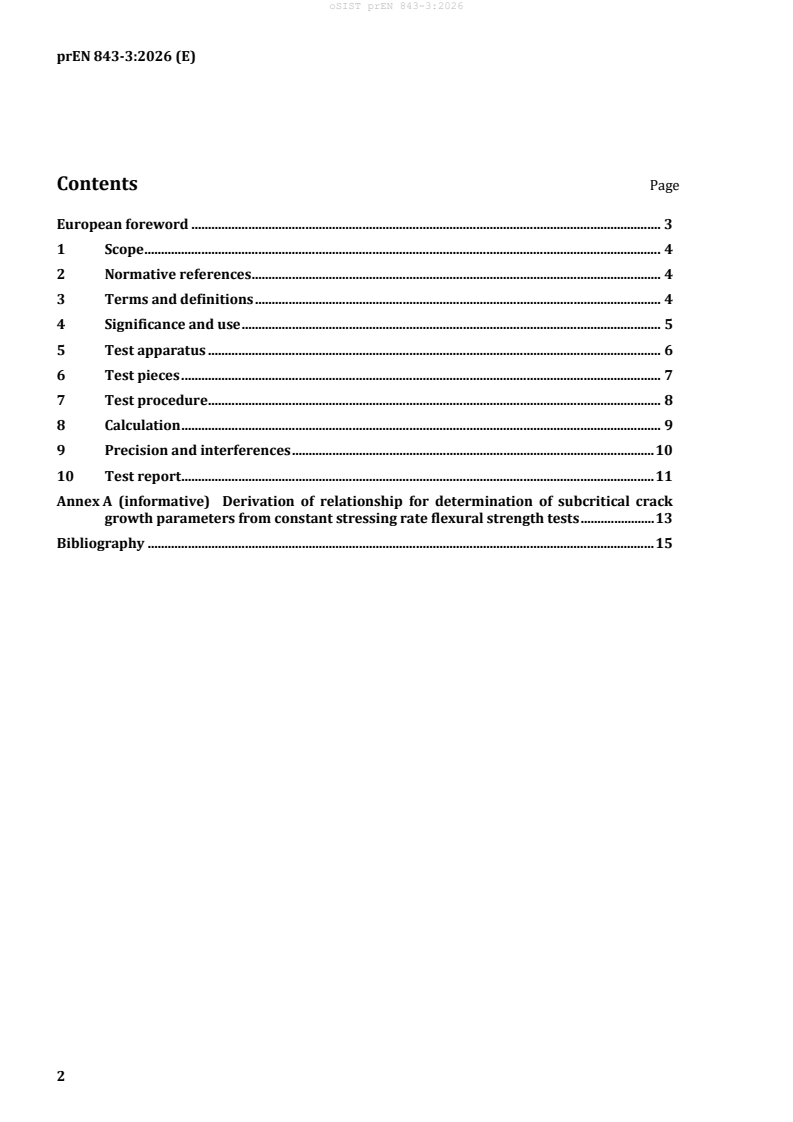
Contents Page
European foreword . 3
1 Scope . 4
2 Normative references . 4
3 Terms and definitions . 4
4 Significance and use . 5
5 Test apparatus . 6
6 Test pieces . 7
7 Test procedure . 8
8 Calculation . 9
9 Precision and interferences . 10
10 Test report . 11
Annex A (informative) Derivation of relationship for determination of subcritical crack
growth parameters from constant stressing rate flexural strength tests . 13
Bibliography . 15
European foreword
This document (prEN 843-3:2026) has been prepared by Technical Committee CEN/TC 184 “Advanced
technical ceramics”, the secretariat of which is held by DIN.
This document is currently submitted to the CEN Enquiry.
This document will supersede EN 843-3:2005.
a) the scope has been updated to include a clarification on the limitations of the underlying
mathematical-physical evaluation method;
b) the normative references have been updated;
c) Annex A has been updated to include a criteria for valid data points;
d) the document has been editorially revised.
A list of all parts in the EN 843 series, published under the general title Advanced technical ceramics —
Mechanical properties of monolithic ceramics at room temperature, can be found on the CEN website.
1 Scope
This document specifies a method for the determination of subcritical crack growth parameters of
advanced monolithic technical ceramics in the temperature range 15 °C to 30 °C by measuring the
dependence of mean flexural strength on the rate of loading.
The method is based on strength test procedures described in EN 843-1.
The applicability of this method is limited by specific requirements for a low scatter of the initial strength
of the test pieces and an upper limit of the stress load rate for the data points considered.
This document is not applicable to test pieces with artificially introduced flaws or cracks.
2 Normative references
The following documents are referred to in the text in such a way that some or all of their content
constitutes requirements of this document. For dated references, only the edition cited applies. For
undated references, the latest edition of the referenced document (including any amendments) applies.
EN 843-1, Advanced technical ceramics - Mechanical properties of monolithic ceramics at room
temperature - Part 1: Determination of flexural strength
EN ISO 3611, Geometrical product specifications (GPS) - Dimensional measuring equipment - Design and
metrological characteristics of micrometers for external measurements (ISO 3611:2023)
EN ISO 7500-1, Metallic materials - Calibration and verification of static uniaxial testing machines - Part 1:
Tension/compression testing machines - Calibration and verification of the force-measuring system
(ISO 7500-1)
EN ISO/IEC 17025, General requirements for the competence of testing and calibration laboratories
(ISO/IEC 17025)
3 Terms and definitions
For the purposes of this document, the following terms and definitions apply.
ISO and IEC maintain terminology databases for use in standardization at the following addresses:
— ISO Online browsing platform: available at https://www.iso.org/obp/
— IEC Electropedia: available at https://www.electropedia.org/
3.1
nominal flexural strength
maximum nominal stress at the instant of failure supported by the material when loaded in linear elastic
bending
3.2
three-point flexure
means of bending a beam test piece whereby the test piece is supported on bearings near its ends and a
central load is applied
3.3
four-point flexure
means of bending a beam test piece whereby the test piece is supported on bearings near its ends and is
equally loaded at two positions symmetrically disposed about the centre of the supported span
3.4
subcritical crack growth
extension of existing cracks or flaws under a stress which does not produce instant failure
3.5
subcritical crack growth parameters
parameters describing the relationship between crack velocity and stress intensity factor
4 Significance and use
Subcritical crack growth can occur in brittle solids at stress levels below that required to cause
instantaneous failure. This effect can be caused by the testing environment, or by the intrinsic crack
propagation behaviour of the material. The phenomenon leads to a decay of remaining strength in a
manner determined by the loading history of the component or test piece.
NOTE 1 A review of subcritical crack growth can be found in [1].
The determination of subcritical crack growth parameters in accordance with this document allows the
characterization of the susceptibility of the material to subcritical crack growth, and thus its ability to
support continued mechanical loading. Using these parameters, it is possible to compare materials for
susceptibility to loss of strength under load in particular environments, and to estimate the lifetime of a
component used under similar loading and environmental conditions.
NOTE 2 The use of these parameters in design and lifetime estimation is not within the scope of this document.
The relationship between the stress intensity factor at the tip of a crack or flaw and the velocity of the
subcritically growing crack can be given by:
n
K
I
vA= (1)
K
Ic
where
v is the velocity of the growing crack in metres per second;
A is a constant in metres per second;
K is the critical stress intensity factor developed at the crack tip by the applied stress in
I
1/2
Megapascals metres ;
K is critical stress intensity factor at the crack tip required to cause instantaneous crack
Ic
propagation.
NOTE 3 There are other algebraic representations of this relationship which are less convenient mathematically
but can be physically more realistic in practice. See, e.g. [2] and [3]. [2] considers that practical data cannot reliably
distinguish between various relationships. The mathematical analysis in this document therefore does not cover
such alternative relationships.
In Formula (1), the value of n at room temperature is normally high, typically in the range fifteen to
several hundred. At the lower end of this range, materials are very susceptible to subcritical crack growth,
while at the upper end the phenomenon becomes insignificant. It should be recognized that Formula (1)
implies a single simple relationship, but in practice it is possible that there are nonlinearities. There are
thought to be two principal causes of nonlinearity:
a) At low stress intensity factors it is possible that there is no subcritical crack growth. This is termed
the subcritical crack growth threshold, or “fatigue limit”.
b) At intermediate stress intensity factors, it is possible that the crack growth rate is limited by the rate
at which the environment can penetrate along the crack to control fracture at the tip. This results in
a plateau effect, which is maintained to K levels at which crack growth can occur in the absence of
I
an environmental effect.
It should be noted that n and A are often functions of the environmental conditions employed. In
particular, many ceramics show marked subcritical crack growth in humid air or in water, and much less
marked effects in dry or inert conditions. The test environment shall be defined and controlled for
reproducible results.
In this document, the parameter n and a parameter B , which is related to A , are determined from the
0 0
effect of stressing rate on flexural strength.
NOTE 4 The term “dynamic fatigue” is frequently used to describe such tests but tends to be misunderstood. Its
use is discouraged.
Annex A shows how the mathematical formulation of the relationship between the subcritical crack
growth parameters based on Formula (1) and the effect of stressing rate on strength is derived, yielding
the basic formula:
logσσlogB+ log (2)
f 0
n+1
where
B is a constant;
σ is the fracture strength of a test-piece in MPa;
f
σ is the stressing rate employed in MPa per second.
NOTE 5 Formula (2) is strictly correct only if a consistent failure probability at each loading rate is employed,
e.g. P = 0,5, which is calculable from a test piece population of ≥ 30 via, for example, fitting a Weibull distribution.
f
If a smaller number of tests is used, as in this test method, the potential uncertainty is likely to be greater.
NOTE 6 This test method can be used only to determine B . Calculation of A requires knowledge of other
0 0
material parameters not determined by this test method.
The subcritical crack growth parameters are determined by employing several different stressing rates,
plotting a graph of log σ versus log σ , and calculating the slope (1/(n+1)) and the intercept (log B ).
f 0
If the test material is to be exposed to an environment in which severely corrosive processes are likely to
occur, loss of strength with increasing exposure time can override true subcritical crack growth
behaviour. If such an eventuality is suspected, it is recommended that a test is performed in which
additional test pieces are exposed to the corrosive environment without stressing for a duration similar
to that required for the slowest testing anticipated in the test series and are subsequently strength-tested
to compare residual short-term strength with short-term strength before corrosion.
5 Test apparatus
5.1 Test jig, in accordance with EN 843-1, with the force being applied to the test piece through parallel
self-aligning freely rotating loading rollers of adequate hardness. The test jig span shall be either
(20 ± 0,5) mm (span A) or (40 ± 0,5) mm (span B), and the loading shall be in either three-point flexure
or four-point flexure. In four-point flexure, the central loading span shall be either (10 ± 0,2) mm for span
A or (20 ± 0,2) mm for span B and shall be symmetrically positioned to within 0,1 mm with respect to the
=
outer support span. The spans and distances between load and support rollers shall be measured with a
travelling microscope (5.5) to the nearest 0,1 mm along the length of the test piece using a travelling
microscope or similar device (5.4).
The material from which the test jig is constructed shall be compatible with the environment to be used
for the tests and shall not corrode in such a way as to impair its self-aligning by increased friction.
For testing in water, it is recommended that the test jig be constructed from a material in accordance with
EN 843-1 that is stable against corrosion.
5.2 Environmental control facility. If the tests are to be performed in any environment other than
ambient air, an appropriate containment facility shall be constructed to allow the test conditions to be
controlled. For testing in water, a simple water tank shall suffice. For controlled humidity or gaseous
environments, an environmental chamber and control system is required. For corrosive chemical
solutions, appropriate safety precautions shall be adopted for handling and containment.
NOTE Appropriate safety precautions can be found, e.g. in national or local regulations.
5.3 Test machine. The test jig (5.1) and environmental control facility (5.2) shall be assembled in a
suitable mechanical test machine that is capable of applying a force to the loading roller (three-point
flexure) or equally to the two loading rollers (four-point flexure) in order to stress the test-piece. The
machine shall be capable of applying the force at a range of constant rates covering at least four orders of
-1 -1
magnitude within the range 100 N s and 0,005 N s .
If the available test machine does not offer pre-selected loading rates (load control), it is permissible to
employ cross-head displacement rate control. The actual test piece stressing rate is determined from the
tangent of the force/time record at the time of failure.
The test machine shall be equipped for recording the peak force applied to the
...