


SIST EN IEC 61158-6-12:2019
(Main)Industrial communication networks - Fieldbus specifications - Part 6-12: Application layer protocol specification - Type 12 elements (IEC 61158-6-12:2019)
Industrial communication networks - Fieldbus specifications - Part 6-12: Application layer protocol specification - Type 12 elements (IEC 61158-6-12:2019)
IEC 61158-6-12:2019 provides common elements for basic time-critical and non-time-critical messaging communications between application programs in an automation environment and material specific to Type 2 fieldbus. The term “time-critical” is used to represent the presence of a time-window, within which one or more specified actions are required to be completed with some defined level of certainty. Failure to complete specified actions within the time window risks failure of the applications requesting the actions, with attendant risk to equipment, plant and possibly human life.
This International Standard specifies interactions between remote applications and defines the externally visible behavior provided by the Type 2 fieldbus application layer. The purpose of this document is to define the protocol provided to
a) define the wire-representation of the service primitives defined in this document, and
b) define the externally visible behavior associated with their transfer. This document specifies the protocol of the Type 2 fieldbus application layer, in conformance with the OSI Basic Reference Model (ISO/IEC 7498-1) and the OSI application layer structure (ISO/IEC 9545).
This fourth edition includes the following significant technical changes with respect to the previous edition:
- technical corrections; and
- editorial improvements for clarification.
Industrielle Kommunikationsnetze - Feldbusse - Teil 6-12: Protokollspezifikation des Application Layer (Anwendungsschicht) - Typ 12-Elemente (IEC 61158-6-12:2019)
Réseaux de communication industriels - Spécifications des bus de terrain - Partie 6-12: Spécification du protocole de la couche application - Eléments de type 12 (IEC 61158-6-12:2019)
L’IEC 61158-6-12:2019 fournit des éléments communs pour les communications de messagerie prioritaires et non prioritaires élémentaires entre les programmes d’application des environnements d’automatisation et le matériel spécifique au bus de terrain de type 12. On utilise le terme "prioritaire" pour traduire la présence d’une fenêtre temporelle, à l’intérieur de laquelle il est exigé qu’une ou plusieurs actions spécifiées soient terminées avec un niveau de certitude défini. Si les actions spécifiées ne sont pas réalisées dans la fenêtre temporelle, les applications demandant les actions risquent de connaître une défaillance, avec les risques que cela comporte pour les équipements, les installations et éventuellement la vie humaine.
La présente norme définit de manière abstraite le comportement, visible par un observateur externe, assuré par les différents Types de la couche Application de bus de terrain, en termes
a) de syntaxe abstraite définissant les unités de données de protocole de la couche Application, transmises entre les entités d’application en communication,
b) de syntaxe de transfert définissant les unités de données de protocole de la couche Application, transmises entre les entités d’application en communication;
c) de diagramme d’états de contexte d’application définissant le comportement de service d’application observable entre les entités d’application en communication; et
d) de diagrammes d’états de relations entre applications définissant le comportement de communication visible entre les entités d’application en communication
Industrijska komunikacijska omrežja - Specifikacije za procesna vodila - 6-12. del: Specifikacija protokola na aplikacijski ravni - Elementi tipa 12 (IEC 61158-6-12:2019)
Ta dokument določa skupne elemente za osnovne časovno kritične in časovno nekritične sporočilne komunikacije med aplikacijami v avtomatizacijskem okolju ter materialu, specifičnem za procesna vodila tipa 12. Izraz »časovno kritičen« se uporablja za predstavitev prisotnosti časovnega okna, v okviru katerega se zahteva dokončanje enega ali več opredeljenih dejanj z določeno stopnjo gotovosti. Zaradi neuspešnega dokončanja opredeljenih dejanj v časovnem oknu je možna odpoved aplikacij, ki zahtevajo dejanja, pri čemer so ogroženi oprema, obrat in morda človeška življenja. Ta mednarodni standard na abstrakten način določa zunanje vidno vedenje, ki ga zagotavljajo različni tipi aplikacijskega nivoja procesnih vodil v zvezi s/z: a) abstraktno sintakso, ki opredeljuje podatkovne enote protokola aplikacijskega nivoja, ki se prenašajo med aplikacijskimi osebki, ki komunicirajo, b) prenosno sintakso, ki opredeljuje podatkovne enote protokola aplikacijskega nivoja, ki se prenašajo med aplikacijskimi osebki, ki komunicirajo, c) strojem stanj aplikacijskega konteksta, ki opredeljuje vedenje aplikacijskega opravila, vidnega med aplikacijskimi osebki, ki komunicirajo, in d) stroji stanj aplikacijskega razmerja, ki opredeljujejo komunikacijsko vedenje med aplikacijskimi osebki, ki komunicirajo. Namen tega standarda je opredeliti protokol za: a) določitev žične predstavitve primitivov opravil iz standarda IEC 61158-5-12 in b) določitev zunanje vidnega vedenja, povezanega z njihovim prenosom. Ta dokument določa protokol aplikacijskega nivoja procesnih vodil IEC v skladu z osnovnim referenčnim modelom OSI (ISO/IEC 7498) in strukturo aplikacijskega nivoja OSI (ISO/IEC 9545). Opravila in protokole aplikacijskega nivoja procesnih vodil zagotavljajo aplikacijski osebki (AE) aplikacijskega nivoja procesnih vodil znotraj aplikacijskih procesov. Aplikacijski osebek aplikacijskega nivoja procesnih vodil sestavljata sklop objektno usmerjenih aplikacijskih opravilnih elementov (ASE) in osebek za upravljanje nivojev (LME), ki upravlja aplikacijski osebek. Aplikacijski opravilni elementi zagotavljajo komunikacijska opravila, ki delujejo na sklopu povezanih razredov objektov aplikacijskega procesa (APO). Med aplikacijske opravilne elemente aplikacijskega nivoja procesnih vodil spada aplikacijski opravilni element za upravljanje, ki zagotavlja skupen sklop opravil za upravljanje primerkov razredov aplikacijskega nivoja procesnih vodil. Čeprav ta opravila določajo način izdajanja ter dostavljanja zahtev in odzivov z vidika aplikacij, ne zajemajo specifikacije v zvezi s tem, kako naj se nanje odzovejo aplikacije, ki te zahteve in odzive oddajajo. To pomeni, da vedenjski vidiki aplikacij niso opredeljeni; opredeljena je le definicija zahtev in odzivov, ki jih lahko pošiljajo/prejemajo. Tako se uporabnikom aplikacijskega nivoja procesnih vodil omogoči večja prilagodljivost pri standardizaciji takega vedenja objektov. Poleg teh opravil so v tem dokumentu opredeljena tudi nekatera podporna opravila, da se omogoči dostop do aplikacijskega nivoja procesnih vodil za nadzorovanje nekaterih vidikov njegovega delovanja.
General Information
- Status
- Published
- Publication Date
- 10-Oct-2019
- Technical Committee
- MOV - Measuring equipment for electromagnetic quantities
- Current Stage
- 6060 - National Implementation/Publication (Adopted Project)
- Start Date
- 30-Aug-2019
- Due Date
- 04-Nov-2019
- Completion Date
- 11-Oct-2019
Relations
- Effective Date
- 27-Aug-2019
Overview
SIST EN IEC 61158-6-12:2019 (IEC 61158-6-12:2019) defines the application layer protocol specification for Type 12 elements of the IEC 61158 fieldbus family. It specifies the wire representation of service primitives and the externally visible behaviour of application-layer interactions between remote applications in industrial automation. The standard covers both time-critical (with defined time-windows) and non-time-critical messaging, and aligns the fieldbus application protocol with the OSI Basic Reference Model (ISO/IEC 7498-1) and OSI application layer structure (ISO/IEC 9545).
Key Topics and Technical Requirements
- Application-layer protocol definition: formal protocol rules that govern exchanges between application programs on fieldbus nodes.
- Wire representation of service primitives: encoding and transfer syntax for service requests, responses and notifications.
- Data types & encoding rules: Boolean, integers (signed/unsigned), floating point, visible/Unicode strings, octet strings, GUID, time-of-day/time-difference encodings.
- Service families & PDUs: definitions for AR (Application Relationship), SII, isochronous PDI, CoE (CANopen over EtherCAT-style object access), EoE (Ethernet over fieldbus), FoE (file access over fieldbus) and related PDUs.
- State machines and protocol machines: FAL service protocol machine (FSPM), Application Relationship Protocol Machines (ARPM), DLL mapping protocol machines (DMPM), mailbox handler and per-service state machines to ensure deterministic behavior.
- Safety and time-critical behavior: explicit handling of operations that must complete within defined time windows to avoid equipment, plant or human safety risk.
- Conformance & interoperability: definitions support implementers in producing interoperable application-layer stacks.
Practical Applications and Who Uses It
- Control system and automation engineers implementing or integrating fieldbus-enabled devices and controllers where reliable application-layer messaging is required.
- Device and gateway manufacturers building fieldbus stacks, object dictionaries, CoE/EoE/FoE features or DLL mappings.
- System integrators and OEMs deploying time-critical industrial networks in manufacturing, process control, robotics and safety-critical installations.
- Test labs and certification bodies validating conformance to IEC 61158 application-layer behaviour.
This standard is essential where determinism, precise message semantics and interoperability at the application layer are required for industrial communication networks.
Related Standards
- IEC 61158 series (Parts 1, 3-12, 5-12)
- ISO/IEC 7498-1 (OSI Basic Reference Model)
- ISO/IEC 9545 (OSI application layer structure)
- IEEE 802.1/802.3 and relevant IETF RFCs for underlying networking references
Keywords: IEC 61158-6-12, fieldbus application layer, Type 12, industrial communication networks, application layer protocol, time-critical messaging, fieldbus specifications, automation.


Frequently Asked Questions
SIST EN IEC 61158-6-12:2019 is a standard published by the Slovenian Institute for Standardization (SIST). Its full title is "Industrial communication networks - Fieldbus specifications - Part 6-12: Application layer protocol specification - Type 12 elements (IEC 61158-6-12:2019)". This standard covers: IEC 61158-6-12:2019 provides common elements for basic time-critical and non-time-critical messaging communications between application programs in an automation environment and material specific to Type 2 fieldbus. The term “time-critical” is used to represent the presence of a time-window, within which one or more specified actions are required to be completed with some defined level of certainty. Failure to complete specified actions within the time window risks failure of the applications requesting the actions, with attendant risk to equipment, plant and possibly human life. This International Standard specifies interactions between remote applications and defines the externally visible behavior provided by the Type 2 fieldbus application layer. The purpose of this document is to define the protocol provided to a) define the wire-representation of the service primitives defined in this document, and b) define the externally visible behavior associated with their transfer. This document specifies the protocol of the Type 2 fieldbus application layer, in conformance with the OSI Basic Reference Model (ISO/IEC 7498-1) and the OSI application layer structure (ISO/IEC 9545). This fourth edition includes the following significant technical changes with respect to the previous edition: - technical corrections; and - editorial improvements for clarification.
IEC 61158-6-12:2019 provides common elements for basic time-critical and non-time-critical messaging communications between application programs in an automation environment and material specific to Type 2 fieldbus. The term “time-critical” is used to represent the presence of a time-window, within which one or more specified actions are required to be completed with some defined level of certainty. Failure to complete specified actions within the time window risks failure of the applications requesting the actions, with attendant risk to equipment, plant and possibly human life. This International Standard specifies interactions between remote applications and defines the externally visible behavior provided by the Type 2 fieldbus application layer. The purpose of this document is to define the protocol provided to a) define the wire-representation of the service primitives defined in this document, and b) define the externally visible behavior associated with their transfer. This document specifies the protocol of the Type 2 fieldbus application layer, in conformance with the OSI Basic Reference Model (ISO/IEC 7498-1) and the OSI application layer structure (ISO/IEC 9545). This fourth edition includes the following significant technical changes with respect to the previous edition: - technical corrections; and - editorial improvements for clarification.
SIST EN IEC 61158-6-12:2019 is classified under the following ICS (International Classification for Standards) categories: 25.040.40 - Industrial process measurement and control; 35.100.70 - Application layer; 35.110 - Networking. The ICS classification helps identify the subject area and facilitates finding related standards.
SIST EN IEC 61158-6-12:2019 has the following relationships with other standards: It is inter standard links to SIST EN 61158-6-12:2015. Understanding these relationships helps ensure you are using the most current and applicable version of the standard.
SIST EN IEC 61158-6-12:2019 is available in PDF format for immediate download after purchase. The document can be added to your cart and obtained through the secure checkout process. Digital delivery ensures instant access to the complete standard document.
Standards Content (Sample)
SLOVENSKI STANDARD
01-november-2019
Nadomešča:
SIST EN 61158-6-12:2015
Industrijska komunikacijska omrežja - Specifikacije za procesna vodila - 6-12. del:
Specifikacija protokola na aplikacijski ravni - Elementi tipa 12 (IEC 61158-6-
12:2019)
Industrial communication networks - Fieldbus specifications - Part 6-12: Application layer
protocol specification - Type 12 elements (IEC 61158-6-12:2019)
Industrielle Kommunikationsnetze - Feldbusse - Teil 6-12: Protokollspezifikation des
Application Layer (Anwendungsschicht) - Typ 12-Elemente (IEC 61158-6-12:2019)
Réseaux de communication industriels - Spécifications des bus de terrain - Partie 6-12:
Spécification du protocole de la couche application - Eléments de type 12 (IEC 61158-6-
12:2019)
Ta slovenski standard je istoveten z: EN IEC 61158-6-12:2019
ICS:
25.040.40 Merjenje in krmiljenje Industrial process
industrijskih postopkov measurement and control
35.100.70 Uporabniški sloj Application layer
35.110 Omreževanje Networking
2003-01.Slovenski inštitut za standardizacijo. Razmnoževanje celote ali delov tega standarda ni dovoljeno.
EUROPEAN STANDARD EN IEC 61158-6-12
NORME EUROPÉENNE
EUROPÄISCHE NORM
August 2019
ICS 25.040.40; 35.100.70; 35.110 Supersedes EN 61158-6-12:2014 and all of its
amendments and corrigenda (if any)
English Version
Industrial communication networks - Fieldbus specifications -
Part 6-12: Application layer protocol specification - Type 12
elements
(IEC 61158-6-12:2019)
Réseaux de communication industriels - Spécifications des Industrielle Kommunikationsnetze - Feldbusse - Teil 6-12:
bus de terrain - Partie 6-12: Spécification du protocole de la Protokollspezifikation des Application Layer
couche application - Eléments de type 12 (Anwendungsschicht) - Typ 12-Elemente
(IEC 61158-6-12:2019) (IEC 61158-6-12:2019)
This European Standard was approved by CENELEC on 2019-07-25. CENELEC members are bound to comply with the CEN/CENELEC
Internal Regulations which stipulate the conditions for giving this European Standard the status of a national standard without any alteration.
Up-to-date lists and bibliographical references concerning such national standards may be obtained on application to the CEN-CENELEC
Management Centre or to any CENELEC member.
This European Standard exists in three official versions (English, French, German). A version in any other language made by translation
under the responsibility of a CENELEC member into its own language and notified to the CEN-CENELEC Management Centre has the
same status as the official versions.
CENELEC members are the national electrotechnical committees of Austria, Belgium, Bulgaria, Croatia, Cyprus, the Czech Republic,
Denmark, Estonia, Finland, France, Germany, Greece, Hungary, Iceland, Ireland, Italy, Latvia, Lithuania, Luxembourg, Malta, the
Netherlands, Norway, Poland, Portugal, Republic of North Macedonia, Romania, Serbia, Slovakia, Slovenia, Spain, Sweden, Switzerland,
Turkey and the United Kingdom.
European Committee for Electrotechnical Standardization
Comité Européen de Normalisation Electrotechnique
Europäisches Komitee für Elektrotechnische Normung
CEN-CENELEC Management Centre: Rue de la Science 23, B-1040 Brussels
© 2019 CENELEC All rights of exploitation in any form and by any means reserved worldwide for CENELEC Members.
Ref. No. EN IEC 61158-6-12:2019 E
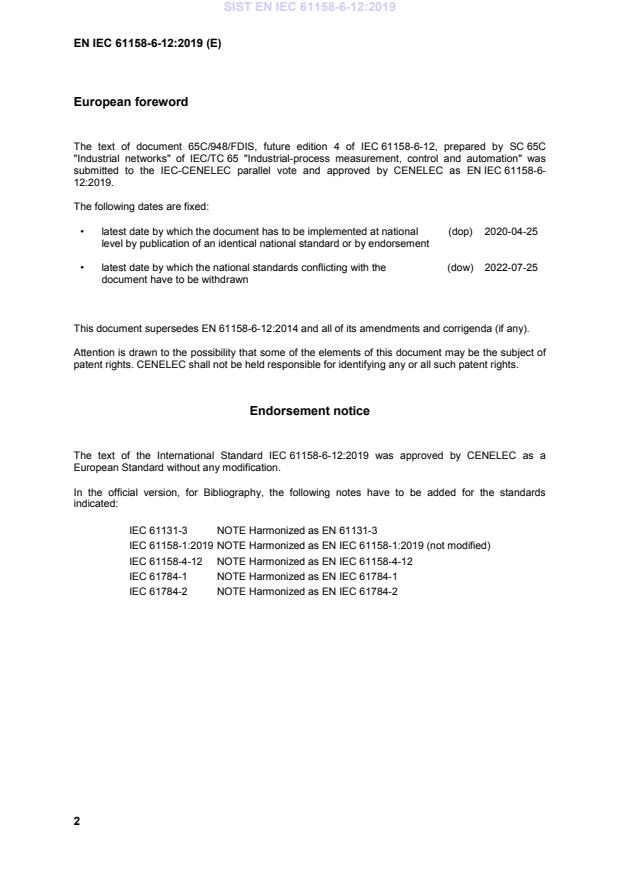
European foreword
The text of document 65C/948/FDIS, future edition 4 of IEC 61158-6-12, prepared by SC 65C
"Industrial networks" of IEC/TC 65 "Industrial-process measurement, control and automation" was
submitted to the IEC-CENELEC parallel vote and approved by CENELEC as EN IEC 61158-6-
12:2019.
The following dates are fixed:
• latest date by which the document has to be implemented at national (dop) 2020-04-25
level by publication of an identical national standard or by endorsement
• latest date by which the national standards conflicting with the (dow) 2022-07-25
document have to be withdrawn
This document supersedes EN 61158-6-12:2014 and all of its amendments and corrigenda (if any).
Attention is drawn to the possibility that some of the elements of this document may be the subject of
patent rights. CENELEC shall not be held responsible for identifying any or all such patent rights.
Endorsement notice
The text of the International Standard IEC 61158-6-12:2019 was approved by CENELEC as a
European Standard without any modification.
In the official version, for Bibliography, the following notes have to be added for the standards
indicated:
IEC 61131-3 NOTE Harmonized as EN 61131-3
IEC 61158-1:2019 NOTE Harmonized as EN IEC 61158-1:2019 (not modified)
IEC 61158-4-12 NOTE Harmonized as EN IEC 61158-4-12
IEC 61784-1 NOTE Harmonized as EN IEC 61784-1
IEC 61784-2 NOTE Harmonized as EN IEC 61784-2
Annex ZA
(normative)
Normative references to international publications
with their corresponding European publications
The following documents are referred to in the text in such a way that some or all of their content
constitutes requirements of this document. For dated references, only the edition cited applies. For
undated references, the latest edition of the referenced document (including any amendments)
applies.
NOTE 1 Where an International Publication has been modified by common modifications, indicated by (mod), the relevant
EN/HD applies.
NOTE 2 Up-to-date information on the latest versions of the European Standards listed in this annex is available here:
www.cenelec.eu.
Publication Year Title EN/HD Year
IEC 61158-3-12 - Industrial communication networks - EN IEC 61158-3-12 -
Fieldbus specifications - Part 3-12: Data-
link layer service definition - Type 12
elements
IEC 61158-5-12 - Industrial communication networks - EN IEC 61158-5-12 -
Fieldbus specifications - Part 5-12:
Application layer service definition - Type
12 elements
IEC 61158-6 series Industrial communication networks - - -
Fieldbus specifications - Part 6: Application
layer protocol specification
ISO/IEC 7498-1 - Information technology - Open Systems - -
Interconnection - Basic reference model:
The basic model
ISO/IEC 7498-3 - Information technology - Open Systems - -
Interconnection - Basic reference model:
Naming and addressing
ISO/IEC 9545 - Information technology - Open Systems - -
Interconnection - Application layer
structure
ISO/IEC 9899 - Information technology – Programming - -
languages – C
ISO/IEC 10731 - Information technology - Open Systems - -
Interconnection - Basic Reference Model -
Conventions for the definition of OSI
services
IEEE Std 802.1D - IEEE standard for Local and metropolitan
area networks – Common specifications –
Media access control (MAC) Bridges
IEEE Std 802.1Q - IEEE standard for Local and metropolitan
area networks – Bridges and Bridged
Networks
IETF RFC 768 - User Datagram Protocol - -
IETF RFC 791 - Internet protocol darpa internet program - -
protocol specification
IETF RFC 826 - Ethernet Address Resolution Protocol: Or - -
Converting Network Protocol Addresses to
48.bit Ethernet Address for Transmission
on Ethernet Hardware
ISO/IEC/IEEE - Information technology - Microprocessor - -
60559 Systems - Floating-Point arithmetic
ISO/IEC/IEEE 8802-- Standard for Ethernet - -
IEC 61158-6-12 ®
Edition 4.0 2019-06
INTERNATIONAL
STANDARD
Industrial communication networks – Fieldbus specifications –
Part 6-12: Application layer protocol specification – Type 12 elements
INTERNATIONAL
ELECTROTECHNICAL
COMMISSION
ICS 25.040.40; 35.100.70; 35.110 ISBN 978-2-8322-7011-0
– 2 – IEC 61158-6-12:2019 © IEC 2019
CONTENTS
FOREWORD . 8
INTRODUCTION . 10
1 Scope . 11
1.1 General . 11
1.2 Specifications . 12
1.3 Conformance . 12
2 Normative references . 12
3 Terms, definitions, symbols, abbreviations and conventions . 13
3.1 Reference model terms and definitions . 13
3.2 Service convention terms and definitions . 14
3.3 Application layer definitions . 14
3.4 Common symbols and abbreviations . 19
3.5 Additional symbols and abbreviations . 20
3.6 Conventions . 20
3.6.1 General concept . 20
3.6.2 Convention for the encoding of reserved bits and octets . 21
3.6.3 Conventions for the common codings of specific field octets . 21
3.6.4 Abstract syntax conventions . 22
3.6.5 State machine conventions . 23
4 Application layer protocol specification . 25
4.1 Operating principle . 25
4.2 Node reference model . 25
4.2.1 Mapping onto OSI basic reference model. 25
4.2.2 Data Link Layer features . 26
4.2.3 Application Layer structure . 26
5 FAL syntax description . 27
5.1 Coding principles . 27
5.2 Data types and encoding rules . 27
5.2.1 General description of data types and encoding rules . 27
5.2.2 Encoding of a Boolean value . 27
5.2.3 Encoding of a Time Of Day with and without date indication value . 27
5.2.4 Encoding of a Time Difference with and without date indication value . 28
5.2.5 Transfer syntax for bit sequences . 28
5.2.6 Encoding of a Unsigned Integer value . 28
5.2.7 Encoding of a Signed Integer value . 29
5.2.8 Encoding of a Floating Point value . 30
5.2.9 Encoding of a Visible String value. 30
5.2.10 Encoding of a Unicode String value . 30
5.2.11 Encoding of an Octet String value . 30
5.2.12 Encoding of GUID . 30
5.3 AR coding . 30
5.3.1 AL Control Request (Indication) . 30
5.3.2 AL Control Response (Confirmation) . 31
5.3.3 AL State Changed . 33
5.3.4 AL AR Attributes . 34
5.4 SII coding . 36
IEC 61158-6-12:2019 © IEC 2019 – 3 –
5.5 Isochronous PDI coding . 41
5.6 CoE coding . 43
5.6.1 PDU structure . 43
5.6.2 SDO . 44
5.6.3 SDO Information . 56
5.6.4 Emergency . 65
5.6.5 Process Data . 69
5.6.6 Command . 70
5.6.7 Object Dictionary . 71
5.7 EoE coding . 81
5.7.1 Initiate EoE . 81
5.7.2 EoE Fragment Data . 83
5.7.3 Data element for EoE . 84
5.7.4 Set IP Parameter . 85
5.7.5 Set Address Filter . 88
5.8 FoE Coding . 90
5.8.1 Read Request . 90
5.8.2 Write Request . 91
5.8.3 Data Request . 92
5.8.4 Ack Request . 93
5.8.5 Error Request . 94
5.8.6 Busy Request . 95
6 FAL protocol state machines . 96
6.1 Overall structure . 96
6.1.1 Overview . 96
6.1.2 Fieldbus Service Protocol Machines (FSPM). 97
6.1.3 Application Relationship Protocol Machines (ARPM) . 97
6.1.4 DLL Mapping Protocol Machines (DMPM) . 98
6.2 AP-Context state machine . 98
6.3 FAL service protocol machine (FSPM) . 98
6.4 Application Relationship Protocol Machines (ARPMs) . 98
6.4.1 AL state machine . 98
6.4.2 Mailbox handler state machine . 117
6.4.3 CoE state machine . 118
6.4.4 EoE state machine . 129
6.4.5 FoE state machine . 136
6.5 DLL mapping protocol machine (DMPM) . 141
Bibliography . 142
Figure 1 – Common structure of specific fields . 21
Figure 2 – Type description example. 22
Figure 3 – Slave Node Reference Model . 26
Figure 4 – Encoding of Time of Day value . 27
Figure 5 – Encoding of Time Difference value . 28
Figure 6 – AL Control Request structure . 30
Figure 7 – AL Control Response structure . 31
Figure 8 – AL State Changed structure . 34
– 4 – IEC 61158-6-12:2019 © IEC 2019
Figure 9 – PDI Control type description . 34
Figure 10 – Sync Configuration type description . 35
Figure 11 – Distributed Clock sync and latch type description . 41
Figure 12 – CoE general structure . 43
Figure 13 – SDO Download Expedited Request structure . 44
Figure 14 – SDO Download Expedited Response structure . 45
Figure 15 – SDO Download Normal Request structure . 46
Figure 16 – Download SDO Segment Request structure . 48
Figure 17 – Download SDO Segment Response structure . 49
Figure 18 – SDO Upload Expedited Request structure . 49
Figure 19 – SDO Upload Expedited Response structure . 50
Figure 20 – SDO Upload Normal Response structure . 52
Figure 21 – Upload SDO Segment Request structure . 53
Figure 22 – Upload SDO Segment Response structure . 53
Figure 23 – Abort SDO Transfer Request structure . 54
Figure 24 – SDO Information Service structure . 57
Figure 25 – Get OD List Request structure . 58
Figure 26 – Get OD List Response structure . 59
Figure 27 – Get Object Description Request structure . 60
Figure 28 – Get Object Description Response structure . 61
Figure 29 – Get Entry Description Request structure . 62
Figure 30 – Get Entry Description Response structure . 63
Figure 31 – SDO Info Error Request structure . 64
Figure 32 – EoE general structure . 81
Figure 33 – EoE Timestamp structure . 82
Figure 34 – EoE Fragment Data structure . 83
Figure 35 – Set IP Parameter Request structure . 85
Figure 36 – Set IP Parameter Response structure . 87
Figure 37 – Set MAC Filter Request structure . 88
Figure 38 – Set MAC Filter Response structure . 89
Figure 39 – Read Request structure. 90
Figure 40 – Write Request structure . 91
Figure 41 – Data Request structure . 92
Figure 42 – Ack Request structure . 93
Figure 43 – Error Request structure . 94
Figure 44 – Busy Request structure . 96
Figure 45 – Relationship among Protocol Machines . 97
Figure 46 – AR Protocol machines . 98
Figure 47 – ESM Diagramm . 100
Table 1 – PDU element description example . 22
Table 2 – Example attribute description . 23
Table 3 – State machine description elements . 24
IEC 61158-6-12:2019 © IEC 2019 – 5 –
Table 4 – Description of state machine elements . 24
Table 5 – Conventions used in state machines . 24
Table 6 – Transfer Syntax for bit sequences . 28
Table 7 – Transfer syntax for data type Unsignedn . 29
Table 8 – Transfer syntax for data type Integern . 30
Table 9 – AL Control Description . 31
Table 10 – AL Control Response . 32
Table 11 – AL Status Codes . 32
Table 12 – AL State Changed . 34
Table 13 – PDI Control . 35
Table 14 – PDI Configuration . 35
Table 15 – Sync Configuration . 35
Table 16 – Slave Information Interface Area . 36
Table 17 – Slave Information Interface Categories . 37
Table 18 – Mailbox Protocols Supported Types . 37
Table 19 – Categories Types . 37
Table 20 – Structure Category String . 38
Table 21 – Structure Category General . 38
Table 22 – Identification Methods . 39
Table 23 – Structure Category FMMU . 39
Table 24 – Structure Category SyncM for each Element . 40
Table 25 – Structure Category TXPDO and RXPDO for each PDO . 40
Table 26 – Structure PDO Entry . 41
Table 27 – Distributed Clock sync parameter . 42
Table 28 – Distributed Clock latch data . 43
Table 29 – CoE elements . 44
Table 30 – SDO Download Expedited Request . 45
Table 31 – SDO Download Expedited Response . 46
Table 32 – SDO Download Normal Request . 47
Table 33 – Download SDO Segment Request . 48
Table 34 – Download SDO Segment Response. 49
Table 35 – SDO Upload Expedited Request . 50
Table 36 – SDO Upload Expedited Response . 51
Table 37 – SDO Upload Normal Response. 52
Table 38 – Upload SDO Segment Request. 53
Table 39 – Upload SDO Segment Response . 54
Table 40 – Abort SDO Transfer Request . 55
Table 41 – SDO Abort Codes . 56
Table 42 – SDO Information Service . 57
Table 43 – Get OD List Request . 58
Table 44 – Get OD List Response . 59
Table 45 – Get Object Description Request . 60
Table 46 – Get Object Description Response . 61
– 6 – IEC 61158-6-12:2019 © IEC 2019
Table 47 – Get Entry Description Request . 62
Table 48 – Get Entry Description Response . 63
Table 49 – SDO Info Error Request . 65
Table 50 – Emergency Request . 66
Table 51 – Emergency Error Codes . 67
Table 52 – Error Code . 67
Table 53 – Diagnostic Data . 68
Table 54 – Sync Manager Length Error . 68
Table 55 – Sync Manager Address Error . 68
Table 56 – Sync Manager Settings Error . 68
Table 57 – RxPDO Transmission via mailbox . 69
Table 58 – TxPDO Transmission via mailbox . 69
Table 59 – RxPDO Remote Transmission Request . 70
Table 60 – TxPDO Remote Transmission Request . 70
Table 61 – Command object structure . 71
Table 62 – Object Dictionary Structure . 71
Table 63 – Object Code Definitions . 71
Table 64 – Basic Data Type Area . 72
Table 65 – Extended Data Type Area. 73
Table 66 – Enumeration Definition . 74
Table 67 – CoE Communication Area. 74
Table 68 – Device Type . 75
Table 69 – Error Register . 76
Table 70 – Manufacturer Device Name . 76
Table 71 – Manufacturer Hardware Version . 77
Table 72 – Manufacturer Software Version . 77
Table 73 – Identity Object . 77
Table 74 – Receive PDO Mapping . 78
Table 75 – Transmit PDO Mapping . 78
Table 76 – Sync Manager Communication Type . 79
Table 77 – Sync Manager Channel 0-31 . 80
Table 78 – Sync Manager Synchronization . 81
Table 79 – Initiate EoE Request . 82
Table 80 – Initiate EoE Response . 83
Table 81 – EoE Fragment Data . 84
Table 82 – EoE Data . 85
Table 83 – Set IP Parameter Request . 86
Table 84 – Set IP Parameter Response . 87
Table 85 – EoE Result Parameter . 88
Table 86 – Set MAC Filter Request . 88
Table 87 – Set MAC Filter Response . 90
Table 88 – Read Request . 91
Table 89 – Write Request . 92
IEC 61158-6-12:2019 © IEC 2019 – 7 –
Table 90 – Data Request . 93
Table 91 – Ack Request . 94
Table 92 – Error Request . 95
Table 93 – Error codes of FoE . 95
Table 94 – Busy Request . 96
Table 95 – State transitions and local management services . 100
Table 96 – Primitives issued by ESM to DL . 101
Table 97 – Primitives issued by DL to ESM . 102
Table 98 – Primitives issued by Application to ESM . 102
Table 99 – Primitives issued by ESM to Application . 102
Table 100 – ESM Variables . 103
Table 101 – ESM macros . 104
Table 102 – ESM functions . 104
Table 103 – ESM state table . 105
Table 104 – Primitives issued by Mailbox handler to DL . 117
Table 105 – Primitives issued by DL to Mailbox handler . 118
Table 106 – Primitives issued by Protocol handler to Mailbox handler . 118
Table 107 – Primitives issued by Mailbox handler to Protocol handler . 118
Table 108 – Primitives issued by Application to CoESM . 119
Table 109 – Primitives issued by CoESM to Application . 120
Table 110 – CoESM state table . 121
Table 111 – Primitives issued by Application to EoESM . 130
Table 112 – Primitives issued by EoESM to Application . 131
Table 113 – EoESM state table . 132
Table 114 – Primitives issued by Application to FoESM . 136
Table 115 – Primitives issued by FoESM to Application . 137
Table 116 – FoESM state table . 138
– 8 – IEC 61158-6-12:2019 © IEC 2019
INTERNATIONAL ELECTROTECHNICAL COMMISSION
____________
INDUSTRIAL COMMUNICATION NETWORKS –
FIELDBUS SPECIFICATIONS –
Part 6-12: Application layer protocol specification –
Type 12 elements
FOREWORD
1) The International Electrotechnical Commission (IEC) is a worldwide organization for standardization comprising
all national electrotechnical committees (IEC National Committees). The object of IEC is to promote
international co-operation on all questions concerning standardization in the electrical and electronic fields. To
this end and in addition to other activities, IEC publishes International Standards, Technical Specifications,
Technical Reports, Publicly Available Specifications (PAS) and Guides (hereafter referred to as
“IEC Publication(s)”). Their preparation is entrusted to technical committees; any IEC National Committee
interested in the subject dealt with may participate in this preparatory work. International, governmental and
non-governmental organizations liaising with the IEC also participate in this preparation. IEC collaborates
closely with the International Organization for Standardization (ISO) in accordance with conditions determined
by agreement between the two organizations.
2) The formal decisions or agreements of IEC on technical matters express, as nearly as possible, an international
consensus of opinion on the relevant subjects since each technical committee has representation from all
interested IEC National Committees.
3) IEC Publications have the form of recommendations for international use and are accepted by IEC National
Committees in that sense. While all reasonable efforts are made to ensure that the technical content of
IEC Publications is accurate, IEC cannot be held responsible for the way in which they are used or for any
misinterpretation by any end user.
4) In order to promote international uniformity, IEC National Committees undertake to apply IEC Publications
transparently to the maximum extent possible in their national and regional publications. Any divergence
between any IEC Publication and the corresponding national or regional publication shall be clearly indicated in
the latter.
5) IEC itself does not provide any attestation of conformity. Independent certification bodies provide conformity
assessment services and, in some areas, access to IEC marks of conformity. IEC is not responsible for any
services carried out by independent certification bodies.
6) All users should ensure that they have the latest edition of this publication.
7) No liability shall attach to IEC or its directors, employees, servants or agents including individual experts and
members of its technical committees and IEC National Committees for any personal injury, property damage or
other damage of any nature whatsoever, whether direct or indirect, or for costs (including legal fees) and
expenses arising out of the publication, use of, or reliance upon, this IEC Publication or any other
IEC Publications.
8) Attention is drawn to the Normative references cited in this publication. Use of the referenced publications is
indispensable for the correct application of this publication.
9) Attention is drawn to the possibility that some of the elements of this IEC Publication may be the subject of
patent rights. IEC shall not be held responsible for identifying any or all such patent rights.
Attention is drawn to the fact that the use of the associated protocol type is restricted by its
intellectual-property-right holders. In all cases, the commitment to limited release of
intellectual-property-rights made by the holders of those rights permits a layer protocol type to
be used with other layer protocols of the same type, or in other type combinations explicitly
authorized by its intellectual-property-right holders.
NOTE Combinations of protocol types are specified in IEC 61784-1 and IEC 61784-2.
International Standard IEC 61158-6-12 has been prepared by subcommittee 65C: Industrial
networks, of IEC technical committee 65: Industrial-process measurement, control and
automation.
This fourth edition cancels and replaces the third edition published in 2014. This edition
constitutes a technical revision.
IEC 61158-6-12:2019 © IEC 2019 – 9 –
This edition includes the following significant technical changes with respect to the previous
edition:
• technical corrections; and
• editorial improvements for clarification.
The text of this International Standard is based on the following documents:
FDIS Report on voting
65C/948/FDIS 65C/956/RVD
Full information on the voting for the approval of this International Standard can be found in
the report on voting indicated in the above table.
This publication has been drafted in accordance with ISO/IEC Directives, Part 2.
A list of all parts of the IEC 61158 series, published under the general title Industrial
communication networks – Fieldbus specifications, can be found on the IEC web site.
The committee has decided that the contents of this publication will remain unchanged until
the stability date indicated on the IEC web site under "http://webstore.iec.ch" in the data
related to the specific publication. At this date, the publication will be
• reconfirmed,
• withdrawn,
• replaced by a revised edition, or
• amended.
A bilingual version of this publication may be issued at a later date.
– 10 – IEC 61158-6-12:2019 © IEC 2019
INTRODUCTION
This document is one of a series produced to facilitate the int
...
Questions, Comments and Discussion
Ask us and Technical Secretary will try to provide an answer. You can facilitate discussion about the standard in here.
Loading comments...