

SIST EN 2591-403:2025
(Main)Aerospace series - Elements of electrical and optical connection - Test methods - Part 403: Sinusoidal and random vibration
General Information
- Abstract
This document specifies a method of determining the ability of elements of connection to withstand sinusoidal or random vibrations of specified severities.
It is used together with EN 2591-100.
This test is based on EN 60068-2-6 and EN 60068-2-64.
- Status
- Published
- Public Enquiry End Date
- 09-May-2023
- Publication Date
- 19-May-2025
- Technical Committee
- I13 - Imaginarni 13
- Current Stage
- 6060 - National Implementation/Publication (Adopted Project)
- Start Date
- 15-May-2025
- Due Date
- 20-Jul-2025
- Completion Date
- 20-May-2025

Overview
SIST EN 2591-403:2025 is a European standard specifically crafted for the aerospace sector. It defines comprehensive test methods for evaluating the performance of electrical and optical connection elements under sinusoidal and random vibration environments. This standard ensures that connectors used in aerospace applications can withstand vibration conditions of defined severity, supporting quality, reliability, and safety objectives critical to on-board aircraft and spacecraft equipment.
The document is intended to be used in conjunction with EN 2591-100, and the outlined vibration test procedures are based on internationally recognized environmental testing standards: EN 60068-2-6 (sinusoidal vibration) and EN 60068-2-64 (random vibration). By unifying testing protocols, the standard assists manufacturers and integrators in achieving compliance with European and global aerospace requirements.
Key Topics
- Test Scope and Purpose
- Establishes vibration test methods for electrical and optical connectors.
- Focuses on both sinusoidal and random vibration to simulate real operational stress.
- Specimen Preparation
- Requirements for specimen wiring, mounting methods, and initial measurements.
- Specifies handling for both mated and unmated connectors, accessories, and contact measurement techniques.
- Vibration Test Methods
- Method A: Sinusoidal vibration follows EN 60068-2-6, defining frequency ranges, amplitudes, acceleration levels, and endurance cycles.
- Method B: Random vibration uses EN 60068-2-64, outlining spectral shapes, density levels, axis orientation, and test durations.
- Method C: High vibration endurance assesses longer-term vibration resistance, including monitoring for discontinuities and verifying physical integrity post-test.
- Measurement and Monitoring
- Details on monitoring continuity, contact resistance, and mechanical alignment throughout testing.
- Requirements for measuring vibration at fixing points and throughout three perpendicular axes.
Applications
SIST EN 2591-403:2025 is widely applicable within the aerospace industry for tasks such as:
- Qualification and quality assurance: Ensuring all new designs of electrical and optical connectors meet stringent vibration resistance requirements before being deployed in aircraft or spacecraft systems.
- On-board equipment validation: Used by manufacturers of avionic systems, sensor interfaces, and communication networks to ensure robust, reliable interconnections.
- Maintenance and reliability assessments: Carrier operators and maintenance teams apply these methods to evaluate connector integrity over time, especially for critical systems subject to dynamic loads.
- Industry regulatory compliance: Adherence to this standard is necessary for manufacturers wishing to demonstrate compliance with European (CEN/SIST) and international aerospace equipment standards.
By applying the test methods in this standard, organizations can significantly mitigate the risk of connector failure due to vibration, thus improving overall aircraft and spacecraft safety and performance.
Related Standards
For comprehensive testing and validation, SIST EN 2591-403:2025 references and should be used in conjunction with the following standards:
- EN 2591-100: Aerospace series – Elements of electrical and optical connection – Test methods – General requirements.
- EN 2591-101: Visual examination of connection elements.
- EN 2591-201/202: Procedures for measuring contact resistance at low level and at rated current.
- EN 2591-204: Methods for detecting microsecond-scale contact discontinuities.
- EN 2591-408: Mating and unmating force testing for connectors.
- EN 60068-2-6: Environmental testing – Vibration (sinusoidal).
- EN 60068-2-64: Environmental testing – Broadband random vibration and guidance.
Adopting SIST EN 2591-403:2025 as part of a structured testing and compliance process ensures your aerospace connectors are fit for demanding vibration environments, supporting system reliability and regulatory alignment.
Relations
- Effective Date
- 09-Feb-2026
- Effective Date
- 09-Feb-2026
- Refers
SIST EN 60068-2-6:2008 - Environmental testing - Part 2-6: Tests - Test Fc: Vibration (sinusoidal) - Effective Date
- 09-Feb-2026
- Effective Date
- 28-Jan-2026
- Effective Date
- 28-Jan-2026
- Effective Date
- 28-Jan-2026
- Effective Date
- 28-Jan-2026
- Effective Date
- 28-Jan-2026
- Effective Date
- 24-Jun-2026
- Effective Date
- 24-Jun-2026
- Effective Date
- 10-Jun-2026
- Effective Date
- 10-Jun-2026
- Effective Date
- 10-Jun-2026
- Effective Date
- 10-Jun-2026
- Effective Date
- 10-Jun-2026
Get Certified
Connect with accredited certification bodies for this standard

BUREAU VERITAS Certification Germany
Bureau Veritas certification in Germany.

Element Materials Technology
Materials testing and product certification.

AQMS Ltd.
AQMS provides ISO certification to SMEs across the UK.
Sponsored listings
Frequently Asked Questions
SIST EN 2591-403:2025 is a standard published by the Slovenian Institute for Standardization (SIST). Its full title is "Aerospace series - Elements of electrical and optical connection - Test methods - Part 403: Sinusoidal and random vibration". This standard covers: This document specifies a method of determining the ability of elements of connection to withstand sinusoidal or random vibrations of specified severities. It is used together with EN 2591-100. This test is based on EN 60068-2-6 and EN 60068-2-64.
This document specifies a method of determining the ability of elements of connection to withstand sinusoidal or random vibrations of specified severities. It is used together with EN 2591-100. This test is based on EN 60068-2-6 and EN 60068-2-64.
SIST EN 2591-403:2025 is classified under the following ICS (International Classification for Standards) categories: 49.060 - Aerospace electric equipment and systems; 49.090 - On-board equipment and instruments. The ICS classification helps identify the subject area and facilitates finding related standards.
SIST EN 2591-403:2025 has the following relationships with other standards: It is inter standard links to SIST EN 60068-2-64:2008, SIST EN 60068-2-64:2008/A1:2020, SIST EN 60068-2-6:2008, SIST EN 2591-101:2001, SIST EN 2591-202:2001, SIST EN 2591-201:2001, SIST EN 2591-408:2001, SIST EN 2591-204:2001, SIST EN 3155-017:2026, SIST EN 3155-075:2026, SIST EN 3155-070:2026, SIST EN 3155-074:2026, SIST EN 3155-071:2026, SIST EN 3155-044:2026, SIST EN 3155-045:2026. Understanding these relationships helps ensure you are using the most current and applicable version of the standard.
SIST EN 2591-403:2025 is available in PDF format for immediate download after purchase. The document can be added to your cart and obtained through the secure checkout process. Digital delivery ensures instant access to the complete standard document.
Standards Content (Sample)
SLOVENSKI STANDARD
01-julij-2025
Aeronavtika - Elementi električnih in optičnih povezav - Preskusne metode - 403.
del: Sinusna in naključna nihanja
Aerospace series - Elements of electrical and optical connection - Test methods - Part
403: Sinusoidal and random vibration
Luft- und Raumfahrt - Elektrische und optische Verbindungselemente - Prüfverfahren -
Teil 403: Sinus- und rauschförmige Schwingungen
Série aérospatiale - Organes de connexion électrique et optique - Méthodes d’essais -
Partie 403: Vibrations sinusoïdales et aléatoires
Ta slovenski standard je istoveten z: EN 2591-403:2025
ICS:
49.060 Letalska in vesoljska Aerospace electric
električna oprema in sistemi equipment and systems
49.090 Oprema in instrumenti v On-board equipment and
zračnih in vesoljskih plovilih instruments
2003-01.Slovenski inštitut za standardizacijo. Razmnoževanje celote ali delov tega standarda ni dovoljeno.
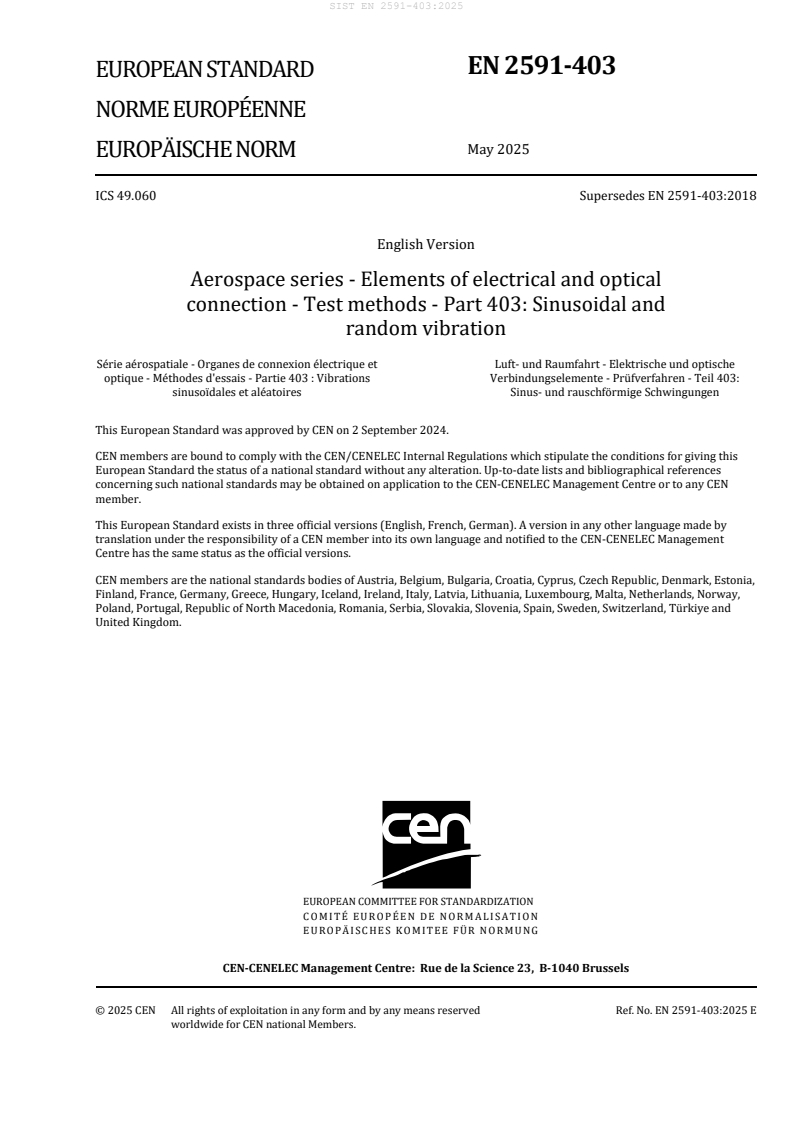
EN 2591-403
EUROPEAN STANDARD
NORME EUROPÉENNE
May 2025
EUROPÄISCHE NORM
ICS 49.060 Supersedes EN 2591-403:2018
English Version
Aerospace series - Elements of electrical and optical
connection - Test methods - Part 403: Sinusoidal and
random vibration
Série aérospatiale - Organes de connexion électrique et Luft- und Raumfahrt - Elektrische und optische
optique - Méthodes d'essais - Partie 403 : Vibrations Verbindungselemente - Prüfverfahren - Teil 403:
sinusoïdales et aléatoires Sinus- und rauschförmige Schwingungen
This European Standard was approved by CEN on 2 September 2024.
CEN members are bound to comply with the CEN/CENELEC Internal Regulations which stipulate the conditions for giving this
European Standard the status of a national standard without any alteration. Up-to-date lists and bibliographical references
concerning such national standards may be obtained on application to the CEN-CENELEC Management Centre or to any CEN
member.
This European Standard exists in three official versions (English, French, German). A version in any other language made by
translation under the responsibility of a CEN member into its own language and notified to the CEN-CENELEC Management
Centre has the same status as the official versions.
CEN members are the national standards bodies of Austria, Belgium, Bulgaria, Croatia, Cyprus, Czech Republic, Denmark, Estonia,
Finland, France, Germany, Greece, Hungary, Iceland, Ireland, Italy, Latvia, Lithuania, Luxembourg, Malta, Netherlands, Norway,
Poland, Portugal, Republic of North Macedonia, Romania, Serbia, Slovakia, Slovenia, Spain, Sweden, Switzerland, Türkiye and
United Kingdom.
EUROPEAN COMMITTEE FOR STANDARDIZATION
COMITÉ EUROPÉEN DE NORMALISATION
EUROPÄISCHES KOMITEE FÜR NORMUNG
CEN-CENELEC Management Centre: Rue de la Science 23, B-1040 Brussels
© 2025 CEN All rights of exploitation in any form and by any means reserved Ref. No. EN 2591-403:2025 E
worldwide for CEN national Members.
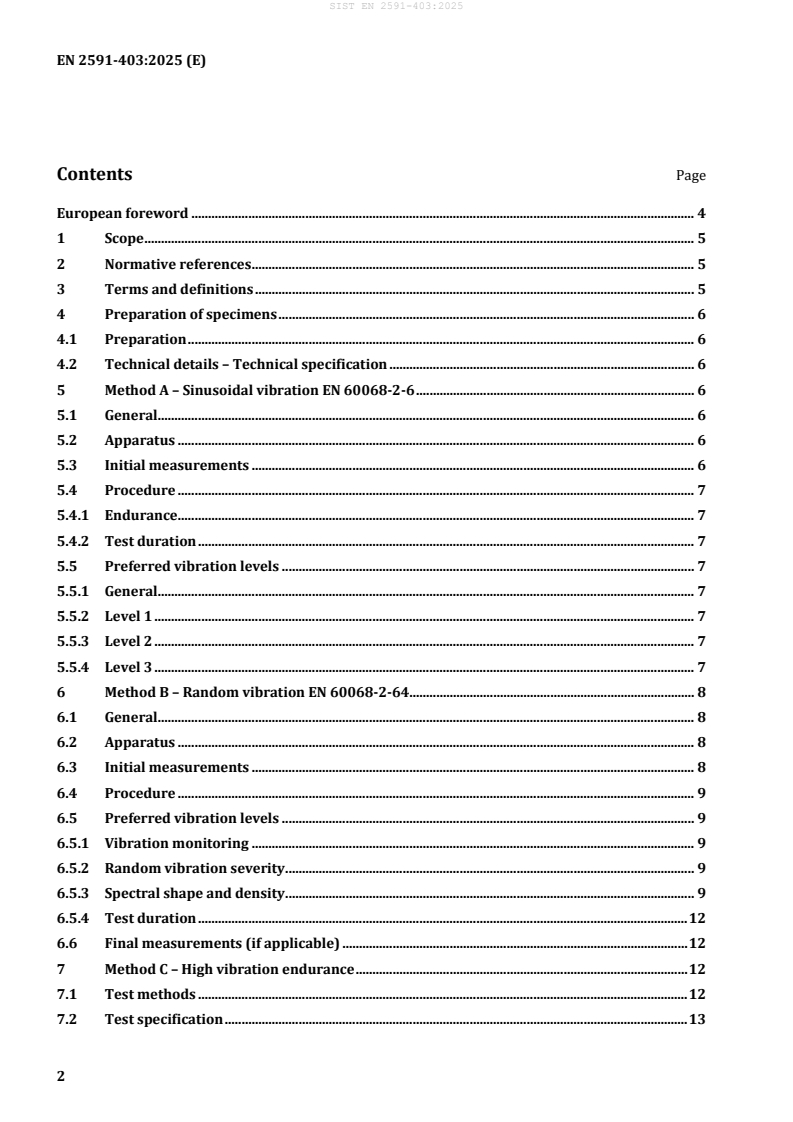
Contents Page
European foreword . 4
1 Scope . 5
2 Normative references . 5
3 Terms and definitions . 5
4 Preparation of specimens . 6
4.1 Preparation . 6
4.2 Technical details – Technical specification . 6
5 Method A – Sinusoidal vibration EN 60068-2-6 . 6
5.1 General. 6
5.2 Apparatus . 6
5.3 Initial measurements . 6
5.4 Procedure . 7
5.4.1 Endurance . 7
5.4.2 Test duration . 7
5.5 Preferred vibration levels . 7
5.5.1 General. 7
5.5.2 Level 1 . 7
5.5.3 Level 2 . 7
5.5.4 Level 3 . 7
6 Method B – Random vibration EN 60068-2-64 . 8
6.1 General. 8
6.2 Apparatus . 8
6.3 Initial measurements . 8
6.4 Procedure . 9
6.5 Preferred vibration levels . 9
6.5.1 Vibration monitoring . 9
6.5.2 Random vibration severity . 9
6.5.3 Spectral shape and density . 9
6.5.4 Test duration . 12
6.6 Final measurements (if applicable) . 12
7 Method C – High vibration endurance . 12
7.1 Test methods . 12
7.2 Test specification . 13
7.3 Performance requirements . 13
Bibliography . 14
European foreword
This document (EN 2591-403:2025) has been prepared by ASD-STAN.
After enquiries and votes carried out in accordance with the rules of this Association, this
document has received the approval of the National Associations and the Official Services of the
member countries of ASD-STAN, prior to its presentation to CEN.
This European Standard shall be given the status of a national standard, either by publication of an
identical text or by endorsement, at the latest by November 2025, and conflicting national
standards shall be withdrawn at the latest by November 2025.
Attention is drawn to the possibility that some of the elements of this document may be the subject
of patent rights. CEN shall not be held responsible for identifying any or all such patent rights.
This document supersedes EN 2591-403:2018.
This document includes the following significant technical changes with respect to
EN 2591-403:2018:
— normative references updated;
— scope: dated reference in Clause 5.4.1 and Clause 6.4 updated.
Any feedback and questions on this document should be directed to the users’ national standards
body. A complete listing of these bodies can be found on the CEN website.
According to the CEN-CENELEC Internal Regulations, the national standards organizations of the
following countries are bound to implement this European Standard: Austria, Belgium, Bulgaria,
Croatia, Cyprus, Czech Republic, Denmark, Estonia, Finland, France, Germany, Greece, Hungary,
Iceland, Ireland, Italy, Latvia, Lithuania, Luxembourg, Malta, Netherlands, Norway, Poland,
Portugal, Republic of North Macedonia, Romania, Serbia, Slovakia, Slovenia, Spain, Sweden,
Switzerland, Türkiye and the United Kingdom.
1 Scope
This document specifies a method of determining the ability of elements of connection to withstand
sinusoidal or random vibrations of specified sev
...