

oSIST prEN IEC 60076-1:2026
(Main)Power transformers - Part 1: General
- Status
- Not Published
- Public Enquiry End Date
- 29-Nov-2026
- Technical Committee
- ETR - Power transformers
- Current Stage
- 4020 - Public enquire (PE) (Adopted Project)
- Start Date
- 06-Oct-2026
- Due Date
- 23-Feb-2027

oSIST prEN IEC 60076-1:2026 is the Slovenian standard identical to prEN IEC 60076-1:2026, published by SIST. It sets the general requirements for power transformers, including service conditions, ratings, cooling, connections, markings and tests, for manufacturers, purchasers, installers and test laboratories.
What does oSIST prEN IEC 60076-1:2026 specify?
oSIST prEN IEC 60076-1:2026 specifies the general rules for power transformers. Its scope covers the common requirements that sit underneath more specific transformer standards, so it is the base document used when specifying, designing, ordering, testing and marking power transformers.
The scope excludes several special categories, including very small transformers, instrument transformers, traction transformers on rolling stock, starting, testing and welding transformers, explosion-proof and mining transformers, transformers for deep water applications, and transformers covered by TC96. For transformer families that have their own IEC standards, this part applies only where those standards call it up by cross-reference.
The document is organized into 10 clauses and 10 annexes.
| Annex | What it covers |
|---|---|
| Annex A | Check list of information to be provided with enquiry and order |
| Annex B | Examples of specifications for transformers with tappings |
| Annex C | Specification of short-circuit impedance by boundaries |
| Annex D | Graphic representation of three-phase transformer connections |
| Annex E | Temperature correction of load loss |
| Annex F | Transformer Monitoring: Benefits and Key Parameters |
| Annex G | Environmental and safety considerations |
| Annex H | Liquid-immersed power transformers using high temperature insulation systems |
| Annex I | Specific considerations for offshore applications |
| Annex J | Information on modified thermal concept |
What are the key requirements of oSIST prEN IEC 60076-1:2026?
Clause 5 is the core of oSIST prEN IEC 60076-1:2026. It sets the main rating, thermal, mechanical, safety and information requirements that purchasers and manufacturers need to agree before a transformer is built.
Ratings, cooling and thermal limits
Clause 5 requires the rated power, cooling method, rated voltage, rated frequency, highest voltage for equipment U, and dielectric test levels to be specified. In practice, this is the starting point for sizing the transformer and confirming how it will be cooled and insulated.
The standard also requires temperature limits and temperature rise limits to be defined for the rated power and rated temperature of the external cooling medium. Clause 5.3 and the thermal tables give the framework for normal thermal design, while Annex J explains the modified thermal concept and how the rated temperature of a site is derived.
Service conditions and abnormal duty
Clause 4 sets the normal service conditions, while Clause 5.12 requires the customer to identify unusual service conditions in the enquiry. Examples named in the document include high altitude, restricted ventilation, salt spray, dust, abnormal harmonics, DC current in the neutral, frequent energization, frequent short circuits and high-frequency switching transients.
This matters because the transformer design, cooling, insulation, corrosion protection and mechanical strength may all need to change when the installation is outside normal conditions. The standard repeatedly places these special cases under agreement between customer and manufacturer.
Tap-winding specification
Clause 6 gives the rules for transformers with a tapped winding. It defines how tapping ranges are written, how tapping voltage and tapping current are specified, and how full-power tappings and reduced-power tappings are distinguished.
The clause recognizes three tapping voltage variation categories - Constant flux voltage variation (CFVV), Variable flux voltage variation (VFVV) and Combined voltage variation (CbVV). In practice, this tells the purchaser what the tap changer is expected to do, what values apply at each tapping, and whether some tap positions are limited in power, voltage or current.
Connections, plates and tolerances
Clause 7 standardizes connection and phase displacement symbols for three-phase transformers, single-phase transformers in three-phase banks, and single-phase transformers not in three-phase banks. Clause 8 then defines the information required on rating plates, and Clause 9 gives tolerances.
This is important for ordering, installation and nameplate checking. It helps the user read the vector group, identify the unit correctly and verify delivered performance against agreed limits.
Tests and verification
Clause 10 covers routine, type, special and site tests. It includes measurement of winding resistance, voltage ratio and phase displacement, short-circuit impedance and load loss, no-load loss and current, zero-sequence impedance, on-load tap-changer operation, leak and tightness tests, vacuum and pressure deflection tests, core and frame insulation checks, DC insulation resistance, and low-voltage impedance measurement.
For a buyer or quality manager, Clause 10 is the part that turns the specification into acceptance checks. It shows what needs to be tested at the factory and what may be checked on site.
Materials, safety and environmental points
Clause 5.11 requires components and materials to comply with the relevant IEC standards where available, including bushings, tap-changers, insulating liquids, fittings, winding wires, core steel and cellulose-based insulation materials. Clause 5.14 adds safety, liquid tightness, internal arcing withstand, liquid preservation systems, energy performance, EMC, neutral connection sizing, DC currents in neutral circuits and high-frequency switching transients.
These requirements matter in practice because they govern component selection, tank robustness, leakage control, and how the transformer behaves in service, not just at nameplate level.
What terms does oSIST prEN IEC 60076-1:2026 define?
- Power transformer - a transformer used for transmitting electric power.
- Electromagnetic power transformer - a power transformer with two or more electromagnetically coupled windings.
- Electronic power transformer - a power transformer based on power electronic devices, introduced for emerging technology.
- Distribution transformer - a small power transformer used to transfer electrical energy between a distribution circuit and a consumer circuit.
- Auto-transformer - an electromagnetic power transformer in which at least two windings have a common part.
- Liquid-immersed type transformer - an electromagnetic power transformer whose magnetic circuit and windings are immersed in liquid.
- Dry-type transformer - an electromagnetic power transformer whose magnetic circuit and windings are not immersed in insulating liquid.
- Sealed transformer - a power transformer that is non-breathing, with no significant exchange with the external atmosphere.
Who uses oSIST prEN IEC 60076-1:2026?
oSIST prEN IEC 60076-1:2026 is used by transformer manufacturers, utility engineers, EPC teams, purchasers, test laboratories and quality managers. They use it when writing enquiries and tenders, choosing ratings and cooling methods, specifying tapping arrangements, selecting materials, planning factory and site tests, and checking nameplates and technical documentation.
It is also relevant to projects for distribution networks, generation plants, industrial installations, offshore applications and other cases where a power transformer is specified under IEC practice.
What changed in oSIST prEN IEC 60076-1:2026 from the previous edition?
oSIST prEN IEC 60076-1:2026 is the fourth edition and cancels and replaces the third edition published in 2011. The document states these significant technical changes:
- alignment of definitions with IEV
- new definitions for electromagnetic power transformer, electronic power transformer, distribution transformer, and small, medium and large power transformers
- incorporation of thermal requirements from IEC 60076-2
- change from temperature rise limits to temperature limits
- introduction of rated ambient temperature of external cooling medium as the basis for thermal requirements
- introduction of insulation system thermal class 120 and different temperature limits for thermal classes 105 and 120
- updated references to other standards
- addition of short-circuit capability requirements
- addition of reference to energy performance
- addition of internal arcing withstand specification
- changes to rating plate requirements and certain tolerances
- addition of tests applicable to distribution transformers only and site tests
- addition of a lifetime test for corrugated tanks
- updated annexes on transformer monitoring, high temperature insulation, offshore applications and modified thermal concept
Which standards are used with oSIST prEN IEC 60076-1:2026?
| Standard | What it contributes |
|---|---|
| IEC 60060 (all parts) | High-voltage test techniques |
| IEC 60076-2 | Thermal performance measurement and test procedures for liquid-immersed transformers |
| IEC 60076-3 | Insulation levels, dielectric tests and external clearances in air |
| IEC 60076-5 | Ability to withstand short circuit |
| IEC 60076-7 | Loading guide for oil-immersed power transformers |
| IEC 60076-8 | Application guide |
| IEC 60076-10 | Determination of sound levels |
| IEC 60076-11 | Dry-type transformers |
| IEC 60076-14 | Liquid-immersed power transformers using high-temperature insulation materials |
| IEC 60076-15 | Gas-filled power transformers |
| IEC 60076-18 | Measurement of frequency response |
| IEC 60076-22 (all parts) | Power transformer and reactor fittings |
| IEC 60137 | Insulated bushings for alternating voltages above 1 000 V |
| IEC 60214-1:2014 | Tap-changer performance requirements and test methods |
| IEC 60296 | Unused mineral insulating oils |
| IEC 60317 | Winding wires |
| IEC 60404 (all parts) | Magnetic materials |
| IEC 60422 | Supervision and maintenance guidance for mineral insulating oils |
| IEC 60554 | Cellulosic papers for electrical purposes |
| IEC 60599 | Interpretation of dissolved and free gases analysis |
| IEC 60641 | Pressboard and presspaper |
| IEC 60721-3-4:2019 | Environmental condition classification |
| IEC 60836 | Unused silicone insulating liquids |
| IEC 61039 | Classification of insulating liquids |
| IEC 61099 | Unused synthetic organic esters |
| IEC 61203 | Maintenance of transformer esters |
| IEC 62770 | Unused natural esters |
| IEC 62975 | Maintenance and use of natural esters |
| IEC 63012 | Unused modified or blended esters |
| ISO 2409 | Cross-cut test for paints and varnishes |
| ISO 7000 | Graphical symbols for use on equipment |
| ISO 9001 | Quality management systems |
| ISO 12944 (all parts) | Corrosion protection of steel structures by protective paint systems |
| ISO 19840 | Thickness measurement and acceptance criteria for dry films on rough surfaces |
The scope also names related transformer standards such as IEC 60076-6, IEC 60076-13, IEC 60076-16, IEC 60310, IEC 61378-1, IEC/IEEE 60076-57-129, IEC/IEEE 60076-57-1202 and IEC 60076-24 as documents where this part is used by cross-reference.
What does the oSIST prEN IEC 60076-1:2026 document contain?
oSIST prEN IEC 60076-1:2026 contains the main specification framework for power transformers, plus detailed clauses for tappings, vector groups, rating plates, tolerances and testing. Clause 10 provides the factory and site test methods, including routine, type, special and site tests.
The annexes add practical material without repeating the core requirements. Annex B gives worked examples for tapped transformers, Annex C shows how to specify short-circuit impedance by boundaries, Annex D provides graphical connection representations, and Annex E gives load-loss temperature correction formulae.
The more application-focused annexes are also substantial. Annex F lists monitoring parameters, Annex G collects environmental and safety considerations, Annex H covers high-temperature insulation systems, Annex I covers offshore installation issues, and Annex J explains the modified thermal concept with site-temperature examples.
Relations
- Effective Date
- 23-May-2023
Get Certified
Connect with accredited certification bodies for this standard

IMQ S.p.A. (Certification)
Italian electrical product certification.

SLG Prüf- und Zertifizierungs GmbH
German testing and certification body.

UL Solutions
Global safety science company with testing, inspection and certification.
Sponsored listings
Frequently Asked Questions
oSIST prEN IEC 60076-1:2026 is a draft published by the Slovenian Institute for Standardization (SIST). Its full title is "Power transformers - Part 1: General". This standard covers: Power transformers - Part 1: General
Power transformers - Part 1: General
oSIST prEN IEC 60076-1:2026 is classified under the following ICS (International Classification for Standards) categories: 29.180 - Transformers. Reactors. The ICS classification helps identify the subject area and facilitates finding related standards.
oSIST prEN IEC 60076-1:2026 has the following relationships with other standards: It is inter standard links to SIST EN 60076-1:2012. Understanding these relationships helps ensure you are using the most current and applicable version of the standard.
oSIST prEN IEC 60076-1:2026 is associated with the following European legislation: Standardization Mandates: M/617. When a standard is cited in the Official Journal of the European Union, products manufactured in conformity with it benefit from a presumption of conformity with the essential requirements of the corresponding EU directive or regulation.
oSIST prEN IEC 60076-1:2026 is available in PDF format for immediate download after purchase. The document can be added to your cart and obtained through the secure checkout process. Digital delivery ensures instant access to the complete standard document.
Standards Content (Sample)
SLOVENSKI STANDARD
01-november-2026
Močnostni transformatorji - 1. del: Splošno
Power transformers - Part 1: General
Leistungstransformatoren - Teil 1: Allgemeines
Transformateurs de puissance - Partie 1: Généralités
Ta slovenski standard je istoveten z: prEN IEC 60076-1:2026
ICS:
29.180 Transformatorji. Dušilke Transformers. Reactors
2003-01.Slovenski inštitut za standardizacijo. Razmnoževanje celote ali delov tega standarda ni dovoljeno.
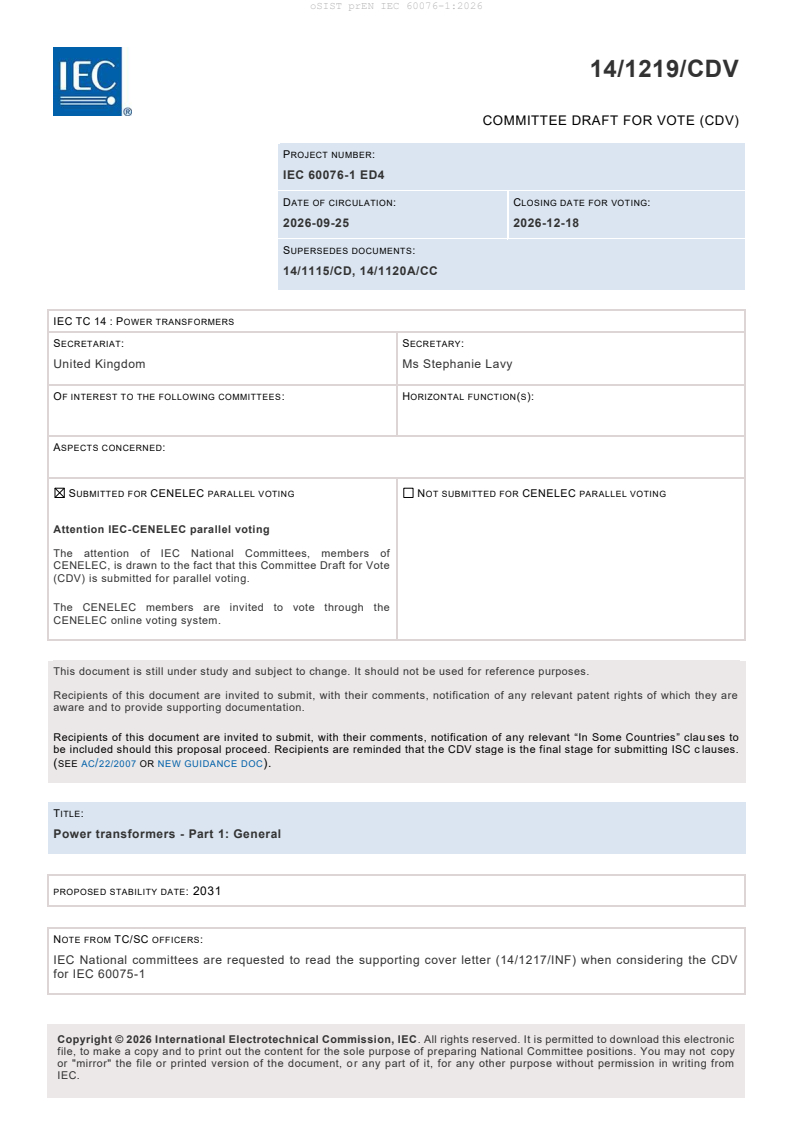
14/1219/CDV
COMMITTEE DRAFT FOR VOTE (CDV)
PROJECT NUMBER:
IEC 60076-1 ED4
DATE OF CIRCULATION: CLOSING DATE FOR VOTING:
2026-09-25 2026-12-18
SUPERSEDES DOCUMENTS:
14/1115/CD, 14/1120A/CC
IEC TC 14 : POWER TRANSFORMERS
SECRETARIAT: SECRETARY:
United Kingdom Ms Stephanie Lavy
OF INTEREST TO THE FOLLOWING COMMITTEES: HORIZONTAL FUNCTION(S):
ASPECTS CONCERNED:
SUBMITTED FOR CENELEC PARALLEL VOTING NOT SUBMITTED FOR CENELEC PARALLEL VOTING
Attention IEC-CENELEC parallel voting
The attention of IEC National Committees, members of
CENELEC, is drawn to the fact that this Committee Draft for Vote
(CDV) is submitted for parallel voting.
The CENELEC members are invited to vote through the
CENELEC online voting system.
This document is still under study and subject to change. It should not be used for reference purposes.
Recipients of this document are invited to submit, with their comments, notification of any relevant patent rights of which they are
aware and to provide supporting documentation.
Recipients of this document are invited to submit, with their comments, notification of any relevant “In Some Countries” clau ses to
be included should this proposal proceed. Recipients are reminded that the CDV stage is the final stage for submitting ISC c lauses.
(SEE AC/22/2007 OR NEW GUIDANCE DOC).
TITLE:
Power transformers - Part 1: General
PROPOSED STABILITY DATE: 2031
NOTE FROM TC/SC OFFICERS:
IEC National committees are requested to read the supporting cover letter (14/1217/INF) when considering the CDV
for IEC 60075-1
file, to make a copy and to print out the content for the sole purpose of preparing National Committee positions. You may not copy
or "mirror" the file or printed version of the document, or any part of it, for any other purpose without permission in writing from
IEC.
IEC CDV 60076-1 © IEC 2026
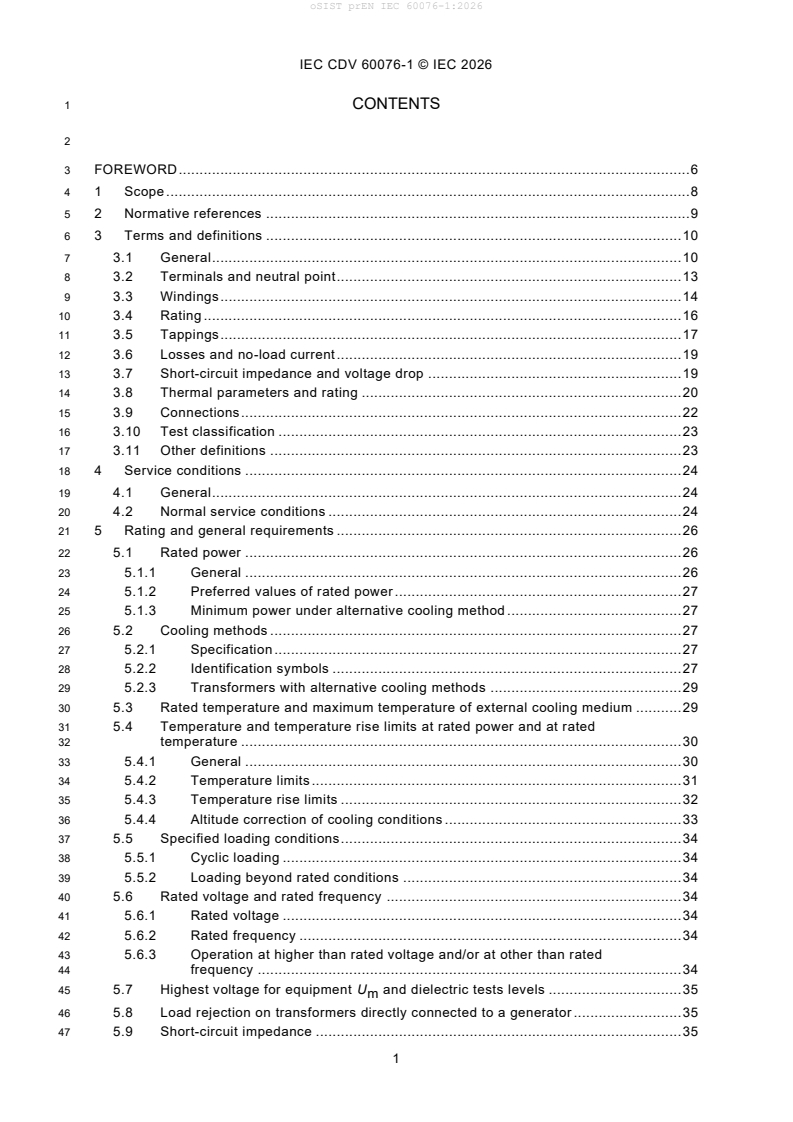
1 CONTENTS
3 FOREWORD . 6
4 1 Scope . 8
5 2 Normative references . 9
6 3 Terms and definitions . 10
7 3.1 General . 10
8 3.2 Terminals and neutral point . 13
9 3.3 Windings . 14
10 3.4 Rating . 16
11 3.5 Tappings . 17
12 3.6 Losses and no-load current . 19
13 3.7 Short-circuit impedance and voltage drop . 19
14 3.8 Thermal parameters and rating . 20
15 3.9 Connections . 22
16 3.10 Test classification . 23
17 3.11 Other definitions . 23
18 4 Service conditions . 24
19 4.1 General . 24
20 4.2 Normal service conditions . 24
21 5 Rating and general requirements . 26
22 5.1 Rated power . 26
23 5.1.1 General . 26
24 5.1.2 Preferred values of rated power . 27
25 5.1.3 Minimum power under alternative cooling method . 27
26 5.2 Cooling methods . 27
27 5.2.1 Specification . 27
28 5.2.2 Identification symbols . 27
29 5.2.3 Transformers with alternative cooling methods . 29
30 5.3 Rated temperature and maximum temperature of external cooling medium . 29
31 5.4 Temperature and temperature rise limits at rated power and at rated
32 temperature . 30
33 5.4.1 General . 30
34 5.4.2 Temperature limits . 31
35 5.4.3 Temperature rise limits . 32
36 5.4.4 Altitude correction of cooling conditions . 33
37 5.5 Specified loading conditions . 34
38 5.5.1 Cyclic loading . 34
39 5.5.2 Loading beyond rated conditions . 34
40 5.6 Rated voltage and rated frequency . 34
41 5.6.1 Rated voltage . 34
42 5.6.2 Rated frequency . 34
43 5.6.3 Operation at higher than rated voltage and/or at other than rated
44 frequency . 34
45 5.7 Highest voltage for equipment U and dielectric tests levels . 35
m
46 5.8 Load rejection on transformers directly connected to a generator . 35
47 5.9 Short-circuit impedance . 35
IEC CDV 60076-1 © IEC 2026
48 5.10 Short-circuit withstand capability . 36
49 5.11 Components and materials. 36
50 5.12 Provision for unusual service conditions . 37
51 5.13 Additional information required for enquiry . 38
52 5.13.1 Transformer classification . 38
53 5.13.2 Winding connection and number of phases . 38
54 5.13.3 Sound level . 38
55 5.13.4 Transport . 39
56 5.13.5 Marking for transportation and on-site installation . 39
57 5.13.6 Fire behaviour . 42
58 5.14 Safety, environmental and other requirements . 42
59 5.14.1 Safety considerations . 42
60 5.14.2 Transformer tightness . 42
61 5.14.3 Internal electrical arcing withstand specification of the tank and ancillary
62 components . 42
63 5.14.4 Liquid preservation system . 43
64 5.14.5 Energy performance requirements . 43
65 5.14.6 Electromagnetic compatibility (EMC) . 43
66 5.14.7 Dimensioning of neutral connection . 44
67 5.14.8 DC currents in neutral circuits . 44
68 5.14.9 High frequency switching transients . 44
69 6 Requirements for transformers having a tapped winding . 45
70 6.1 General – Notation of tapping range . 45
71 6.2 Tapping voltage – tapping current. Standard categories of tapping voltage
72 variation. Maximum voltage tapping . 45
73 6.3 Tapping power. Full-power tappings – reduced-power tappings . 48
74 6.4 Specification of tappings in enquiry and order . 49
75 6.4.1 General . 49
76 6.4.2 Constructional specification . 49
77 6.4.3 Functional specification . 49
78 6.5 Specification of short-circuit impedance . 50
79 6.5.1 General . 50
80 6.5.2 Specification of short-circuit impedance envelope . 51
81 6.6 Load loss and temperature rise . 51
82 7 Connection phase displacement symbols . 52
83 7.1 Connection and phase displacement symbols for three-phase transformers
84 and for single phase transformers connected in a three-phase bank . 52
85 7.1.1 Connection symbol . 52
86 7.1.2 Phase displacement in clock number notation . 52
87 7.1.3 Windings not intended to be loaded . 53
88 7.1.4 Reconnectable windings . 53
89 7.1.5 Examples. 53
90 7.2 Connection and phase displacement symbols for single phase transformers
91 not in three phase bank . 55
92 7.2.1 Connection symbol . 55
93 7.2.2 Phase displacement in clock number notation . 55
94 7.2.3 Windings not intended to be loaded . 55
95 7.2.4 Reconnectable windings . 55
96 8 Rating plates . 57
IEC CDV 60076-1 © IEC 2026
97 8.1 General . 57
98 8.2 Information to be given in all cases . 57
99 8.3 Additional information to be given when applicable . 58
100 9 Tolerances . 59
101 10 Tests . 61
102 10.1 General requirements for routine, type and special tests . 61
103 10.1.1 General requirements . 61
104 10.1.2 Reference temperature . 62
105 10.2 List of tests . 62
106 10.2.1 Type and routine tests for distribution transformers . 62
107 10.2.2 Type and routine tests for all other transformers . 63
108 10.2.3 Special tests . 64
109 10.2.4 Site tests . 65
110 10.3 Measurement of winding resistance . 65
111 10.3.1 General . 65
112 10.3.2 Site test . 66
113 10.4 Winding temperature determination for the purpose of loss and resistance
114 measurements . 66
115 10.5 Measurement of voltage ratio and check of phase displacement . 66
116 10.6 Measurement of short-circuit impedance and load loss . 66
117 10.6.1 Measurement at rated frequency . 66
118 10.6.2 Measurement at higher than rated frequency . 67
119 10.7 Measurement of no-load loss and current . 67
120 10.8 Measurement of zero-sequence impedance(s) on three-phase transformers . 68
121 10.9 Low voltage no-load current measurement . 70
122 10.10 Tests on on-load tap-changers ─ Operation test . 70
123 10.11 Leak testing with pressure for liquid-immersed transformers (tightness test) . 70
124 10.11.1 Rigid tanks . 70
125 10.11.2 Corrugated tanks and tanks with intentionally expandable radiators . 70
126 10.12 Lifetime test for corrugated tanks and tanks with intentionally expandable
127 radiators . 71
128 10.12.1 General information . 71
129 10.12.2 Temperature variation . 71
130 10.12.3 Sealing temperature, sealing level . 71
131 10.12.4 Calculation of the volume variation . 72
132 10.12.5 Test procedure . 72
133 10.13 Vacuum deflection test for liquid-immersed transformers . 74
134 10.14 Pressure deflection test for liquid-immersed transformers . 75
135 10.15 Vacuum tightness test on site for liquid-immersed transformers . 76
136 10.16 Check of core and frame insulation . 76
137 10.17 Measurement of DC insulation resistance between each winding to earth
138 and between windings . 76
139 10.18 Low voltage impedance measurement. 76
140 Annex A (informative) Check list of information to be provided with enquiry and order . 78
141 A.1 Rating and general data . 78
142 A.1.1 Normal information . 78
143 A.1.2 Special information . 79
144 A.2 Parallel operation . 81
145 Annex B (informative) Examples of specifications for transformers with tappings . 82
IEC CDV 60076-1 © IEC 2026
146 B.1 Example 1 – Constant flux voltage variation . 82
147 B.2 Example 2 – Variable flux voltage variation . 82
148 B.3 Example 3 – Combined voltage variation . 83
149 B.4 Example 4 – Functional specification of tapping . 83
150 B.4.1 Example 4.1 – Transformer specified with HV voltage variation . 84
151 B.4.2 Example 4.2 – Transformer specified with LV voltage variation . 85
152 Annex C (informative) Specification of short-circuit impedance by boundaries . 86
153 Annex D (normative) Graphic representation of three-phase transformer connections . 87
154 Annex E (normative) Temperature correction of load loss . 90
155 Annex F (informative) Transformer Monitoring: Benefits and Key Parameters . 92
156 F.1 Introduction . 92
157 F.2 Benefits of transformer monitoring . 92
158 F.3 Key parameters to monitor . 92
159 F.4 Data integration and utilization . 92
160 Annex G (informative) Environmental and safety considerations . 94
161 Annex H (normative) Liquid-immersed power transformers using high temperature
162 insulation systems . 95
163 H.1 Insulation systems . 95
164 H.2 Temperature limits . 95
165 H.2.1 General . 95
166 H.2.2 Reference temperature for high temperature insulation systems . 95
167 H.3 Special considerations . 96
168 Annex I (informative) Specific considerations for power transformers to be used in
169 offshore applications . 97
170 I.1 Scope . 97
171 I.2 Definition of Offshore transformer . 97
172 I.3 Offshore substations . 98
173 I.4 Considerations and specifications . 98
174 I.4.1 Introduction . 98
175 I.4.2 Wind . 98
176 I.4.3 Salt . 98
177 I.4.4 Splashing and spraying water . 98
178 I.4.5 Sway and vibration . 98
179 I.4.6 UV radiation . 98
180 I.4.7 Transportation and installation . 99
181 I.5 Reliability requirement . 99
182 I.6 Environmental, health and safety considerations . 100
183 I.7 Mass and dimension restrictions . 100
184 Annex J (informative) Information on modified thermal concept . 101
185 J.1 Introduction . 101
186 J.2 Transformer thermal requirements as per IEC 60076-1:2011 and
187 IEC 60076-2:2011 . 101
188 J.3 Information on new ambient temperature definition introduced in latest
189 edition of IEC 60076-1 . 101
190 J.4 Specification of ‘rated temperature’ . 103
191 J.5 Adapted temperature rise limits . 106
192 J.6 Benefits of the modified thermal concept . 106
193 Bibliography . 108
IEC CDV 60076-1 © IEC 2026
195 Figure 1 – Constant flux voltage variation (CFVV) . 48
196 Figure 2 – Variable flux voltage variation (VFVV) . 49
197 Figure 3 – Combined voltage variation (CbVV) . 50
198 Figure 4 – Illustration of ‘clock number’ notation . 55
199 Figure 5 – Illustration of 'clock number' notation for transformers with open windings . 57
200 Figure 6 – Illustration of 'clock number' notation for single phase transformers not in
201 three phase bank . 59
202 Figure 7 – Endurance test cycle . 75
203 Figure 8 – Examples of low voltage impedance measurement schemes . 79
204 Figure C.1 – Example of specification of short-circuit impedance by boundaries . 88
205 Figure D.1 – Common connections . 89
206 Figure D.2 – Additional connections . 90
207 Figure D.3 – Designation of connections of three-phase auto-transformers by
208 connection symbols (auto-transformer Ya0) . 91
209 Figure D.4 – Example of three single-phase transformers connected to form a three-
210 phase bank (connection symbol Yd5) . 91
211 Figure J.1 – Characteristic temperature profiles and parameters as occurring on earth . 104
213 Table 1 – Ambient temperature conditions . 31
214 Table 2 – Maximum temperatures of transformer windings for continuous service at
215 rated power and rated temperature of external cooling medium . 32
216 Table 3 – Maximum temperatures of metallic parts for continuous service at rated
217 power and rated temperature of external cooling medium . 32
218 Table 4 – Temperature rises of transformer windings for continuous service at rated
219 power and rated temperature of external cooling medium . 33
220 Table 5 – Temperature rise of metallic parts for continuous service at rated power and
221 rated temperature of external cooling medium. 34
222 Table 6 – Recognized minimum values of short-circuit impedance for transformers with
223 two separate windings . 37
224 Table 7 – Marking symbols applicable to transport and on-site installation . 42
225 Table 8 – Arc energy level for different voltage classes. 44
226 Table 9 – Tolerances . 62
227 Table B.1 – Example of combined voltage variation . 85
228 Table B.2 – Example of functional specification with HV voltage variation . 86
229 Table B.3 – Example of functional specification with LV voltage variation . 87
230 Table F.1 – Parameters to monitor . 95
231 Table H.1 – Insulation system thermal classes . 97
232 Table J.1 – Values of ambient temperature and derived temperature parameters in °C
233 for selected locations worldwide representing all populated regions . 107
235 INTERNATIONAL ELECTROTECHNICAL COMMISSION
236 ____________
238 POWER TRANSFORMERS –
IEC CDV 60076-1 © IEC 2026
240 Part 1: General
242 FOREWORD
243 1) The International Electrotechnical Commission (IEC) is a worldwide organization for standardization comprising
244 all national electrotechnical committees (IEC National Committees). The object of IEC is to promote international
245 co-operation on all questions concerning standardization in the electrical and electronic fields. To this end and
246 in addition to other activities, IEC publishes International Standards, Technical Specifications, Technical Reports,
247 Publicly Available Specifications (PAS) and Guides (hereafter referred to as “IEC Publication(s)”). Their
248 preparation is entrusted to technical committees; any IEC National Committee interested in the subject dealt with
249 may participate in this preparatory work. International, governmental and non-governmental organizations liaising
250 with the IEC also participate in this preparation. IEC collaborates closely with the International Organization for
251 Standardization (ISO) in accordance with conditions determined by agreement between the two organizations.
252 2) The formal decisions or agreements of IEC on technical matters express, as nearly as possible, an international
253 consensus of opinion on the relevant subjects since each technical committee has representation from all
254 interested IEC National Committees.
255 3) IEC Publications have the form of recommendations for international use and are accepted by IEC National
256 Committees in that sense. While all reasonable efforts are made to ensure that the technical content of IEC
257 Publications is accurate, IEC cannot be held responsible for the way in which they are used or for any
258 misinterpretation by any end user.
259 4) In order to promote international uniformity, IEC National Committees undertake to apply IEC Publications
260 transparently to the maximum extent possible in their national and regional publications. Any divergence between
261 any IEC Publication and the corresponding national or regional publication shall be clearly indicated in the latter.
262 5) IEC itself does not provide any attestation of conformity. Independent certification bodies provide conformity
263 assessment services and, in some areas, access to IEC marks of conformity. IEC is not responsible for any
264 services carried out by independent certification bodies.
265 6) All users should ensure that they have the latest edition of this publication.
266 7) No liability shall attach to IEC or its directors, employees, servants or agents including individual experts and
267 members of its technical committees and IEC National Committees for any personal injury, property damage or
268 other damage of any nature whatsoever, whether direct or indirect, or for costs (including legal fees) and
269 expenses arising out of the publication, use of, or reliance upon, this IEC Publication or any other IEC
270 Publications.
271 8) Attention is drawn to the Normative references cited in this publication. Use of the referenced publications is
272 indispensable for the correct application of this publication.
273 9) IEC draws attention to the possibility that the implementation of this document may involve the use of (a)
274 patent(s). IEC takes no position concerning the evidence, validity or applicability of any claimed patent rights in
275 respect thereof. As of the date of publication of this document, IEC had not received notice of (a) patent(s), which
276 may be required to implement this document. However, implementers are cautioned that this may not represent
277 the latest information, which may be obtained from the patent database available at https://patents.iec.ch. IEC
278 shall not be held responsible for identifying any or all such patent rights.
279 IEC 60076-1 has been prepared by IEC technical committee 14: Power Transformers. It is an
280 International Standard.
281 This fourth edition cancels and replaces the third edition published in 2011. This edition
282 constitutes a technical revision.
283 This edition includes the following significant technical changes with respect to the previous
284 edition:
285 – alignment of definitions with IEV;
286 – new definition introduced for electromagnetic power transformer and change of power
287 transformer definition to allow for alternative technologies;
288 – new definition introduced for distribution transformer;
289 – new definition introduced for small, medium and large power transformers;
290 – incorporation of thermal requirements from IEC 60076-2;
291 – change from specification of temperature rise limits to specification of temperature limits;
292 – introduction of rated ambient temperature of external cooling medium as basis for
293 transformer thermal requirements;
294 – introduction of insulation system thermal class 120;
IEC CDV 60076-1 © IEC 2026
295 – introduction of different temperature limits for insulation system thermal class 105 and 120;
296 – update of references to other standards, for example climatic conditions, components and
297 materials;
298 – addition of requirement for short-circuit capability;
299 – addition of reference to energy performance;
300 – addition of specifying internal arcing withstand;
301 – changes to rating plate requirements;
302 – changes to certain tolerances, for example no-load and load losses;
303 – addition of tests applicable to distribution transformers only;
304 – addition of site tests;
305 – determination of reference temperature;
306 – addition of lifetime test for corrugated tanks;
307 – change to annex on transformer monitoring;
308 – addition of annex on high temperature insulation;
309 – addition of annex on offshore applications;
310 – addition of annex on modified thermal concept;
311 The text of this International Standard is based on the following documents:
Draft Report on voting
XX/XX/FDIS XX/XX/RVD
313 Full information on the voting for its approval can be found in the report on voting indicated in
314 the above table.
315 The language used for the development of this International Standard is English.
316 This document was drafted in accordance with ISO/IEC Directives, Part 2, and developed in
317 accordance with ISO/IEC Directives, Part 1 and ISO/IEC Directives, IEC Supplement, available
318 at www.iec.ch/members_experts/refdocs. The main document types developed by IEC are
319 described in greater detail at www.iec.ch/publications.
320 The committee has decided that the contents of this document will remain unchanged until the
321 stability date indicated on the IEC website under webstore.iec.ch in the data related to the
322 specific document. At this date, the document will be
323 • reconfirmed,
324 • withdrawn, or
325 • revised.
IEC CDV 60076-1 © IEC 2026
329 POWER TRANSFORMERS –
331 Part 1: General
335 1 Scope
336 This part of IEC 60076 applies to power transformers with the exception of certain categories
337 of small and special transformers such as:
338 – transformers with rated power less than 1 kVA per phase;
339 – transformers which have no windings with a highest voltage for equipment with a U higher
m
340 than 1 000 V;
341 – instrument transformers;
342 – traction transformers mounted on rolling stock;
343 – starting transformers;
344 – testing transformers;
345 – welding transformers;
346 – explosion-proof and mining transformers;
347 – transformers for deep water (submerged) applications;
348 – transformers covered by the scope of TC96.
349 When IEC standards do not exist for such categories of transformers (in particular transformers
350 which have no windings with a highest voltage for equipment with a Um higher than 1 000 V for
351 industrial applications), this part of IEC 60076 may still be applicable either as a whole or in
352 part.
353 This standard does not address the requirements that would make a transformer suitable for
354 mounting in a position accessible to the general public.
355 For those categories of power transformers and reactors which have their own IEC standards,
356 this part is applicable to the extent to which it is specifically called up by cross-reference in the
357 other standard. Such standards exist for:
358 – reactors (IEC 60076-6);
359 – dry-type transformers (IEC 60076-11);
360 – self-protected transformers (IEC 60076-13);
361 – gas-filled power transformers (IEC 60076-15);
362 – transformers for wind turbine applications (IEC/IEEE 60076-16);
363 – traction transformers and inductors on board rolling stock (IEC 60310);
364 – converter transformers for industrial applications (IEC 61378-1);
365 – converter transformers for HVDC applications (IEC/IEEE 60076-57-129);
366 – phase-shifting transformers (IEC/IEEE 60076-57-1202);
367 – voltage regulated distribution transformers (IEC 60076-24).
368 At several places in this part it is specified or recommended that an 'agreement' sh ould be
369 reached concerning alternative or additional technical solutions or procedures. Such agreement
370 is made between the manufacturer and the customer. The matters should preferably be raised
371 at an early stage and the agreements included in the contract specification.
IEC CDV 60076-1 © IEC 2026
372 2 Normative references
373 The following documents are referred to in the text in such a way that some or all of their content
374 constitutes requirements of this document. For dated references, only the edition cited applies.
375 For undated references, the latest edition of the referenced document (including any
376 amendments) applies.
377 IEC 60060 (all parts), High-voltage test techniques
378 IEC 60076-2, Power transformers – Part 2: Thermal performance measurement and test
379 procedures for liquid-immersed transformers
380 IEC 60076-3, Power transformers – Part 3: Insulation levels, dielectric tests and external
381 clearances in air
382 IEC 60076-5, Power transformers – Part 5: Ability to withstand short circuit
383 IEC 60076-7, Power transformers – Part 7: Loading guide for oil-immersed power transformers
384 IEC 60076-8, Power transformers – Part 8: Application guide
385 IEC 60076-10, Power transformers – Part 10: Determination of sound levels
386 IEC 60076-11, Power transformers – Part 11: Dry-type transformers
387 IEC 60076-14, Power transformers – Part 14: Liquid-immersed power transformers using high-
388 temperature insulation materials
389 IEC 60076-15, Power transformers – Part 15: Gas-filled power transformers
390 IEC 60076-18, Power transformers - Part 18: Measurement of frequency response
391 IEC 60076-22 (all parts), Power transformers – Part 22: Power transformer and reactor fittings
392 IEC 60137, Insulated bushings for alternating voltages above 1 000 V
393 IEC 60214-1:2014, Tap-changers – Part 1: Performance requirements and test methods
394 IEC 60296, Fluids for electrotechnical applications – Unused mineral insulating oils for
395 transformers and switchgear
396 IEC 60317, Specifications for particular types of winding wires
397 IEC 60404 (all parts), Magnetic materials
398 IEC 60422, Mineral insulating oils in electrical equipment - Supervision and maintenance
399 guidance
400 IEC 60554, Cellulosic papers for electrical purposes
401 IEC 60599, Mineral oil-filled electrical equipment in service - Guidance on the interpretation of
402 dissolved and free gases analysis
403 IEC 60641, Pressboard and presspaper for electrical purposes
IEC CDV 60076-1 © IEC 2026
404 IEC 60721-3-4:2019, Classification of environmental conditions – Part 3: Classification of
405 groups of environmental parameters and their severities – Section 4: Stationary use at non-
406 weather protected locations
407 IEC 60836, Specifications for unused silicone insulating liquids for electrotechnical purposes
408 IEC 61039, Classification of insulating liquids
409 IEC 61099, Specifications for unused synthetic organic esters for electrical purposes
410 IEC 61203, Synthetic organic esters for electrical purposes - Guide for maintenance of
411 transformer esters in equipment
412 IEC 62770, Fluids for electrotechnical applications - Unused natural esters for transformers and
413 similar electrical equipment
414 IEC 62975, Natural esters - Guidelines for maintenance and use in electrical equipment
415 IEC 63012, Insulating liquids – Unused modified or blended esters for electrotechnical
416 applications
417 ISO 2409, Paints and varnishes — Cross-cut test
418 ISO 7000, Graphical symbols for use on equipment — Registered symbols
419 ISO 9001, Quality management systems – Requirements
420 ISO 12944 (all parts), Paints and varnishes – Corrosion protection of steel structures by
421 protective paint systems
422 ISO 19840, Paints and varnishes — Corrosion protection of steel structures by protective paint
423 systems — Measurement of, and acceptance criteria for, the thickness of dry films on rough
424 surfaces
425 3 Terms and definitions
426 For the purposes of this document, the following terms and definitions apply.
427 ISO and IEC maintain terminology databases for use in standardization at the following
428 addresses:
429 • IEC Electropedia: available at https://www.electropedia.org/
430 • ISO Online browsing platform: available at https://www.iso.org/obp
431 NOTE Other terms use the meanings ascribed to them in the International Electrotechnical Vocabulary (IEV).
432 3.1 General
433 3.1.1
434 power transformer
435 transformer (IEV 151-13-42) with the purpose of transmitting electric power (IEV 113-03-52)
436 3.1.2
437 electromagnetic power transformer
438 power transformer with two or more electromagnetically coupled windings
IEC CDV 60076-1 © IEC 2026
439 3.1.3
440 electronic power transformer
441 power transformer based on power electronic devices
442 Note 1 to entry: Electronic power transformers are not yet covered by any TC 14 standard but it is introduced to
443 prepare for this emerging technology.
444 Note 2 to entry: The terminal pairs are also called ports (IEV 131-12-60) in power electronic domain.
445 Note 3 to entry: Power electronic devices providing other conversions such as AC/DC, DC/AC, DC/DC, AC/AC with
446 different frequencies on the ports, are defined under IEV
...