

oSIST prEN 3197:2023
(Main)Aerospace series - Design and installation of aircraft electrical and optical interconnection systems
General Information
- Abstract
This document provides instructions on the methods to be used when designing, selecting, manufacturing, installing, repairing or modifying the aerospace vehicles electrical and optical interconnection networks, now called Electrical Wiring Interconnection System (EWIS), and Optical Fibre Interconnection Systems (OFIS), subject to the limitations defined in Clause 4 of this document. Aerospace Vehicles include manned and unmanned aeroplanes, helicopters, lighter-than- air vehicles, missiles and external pods.
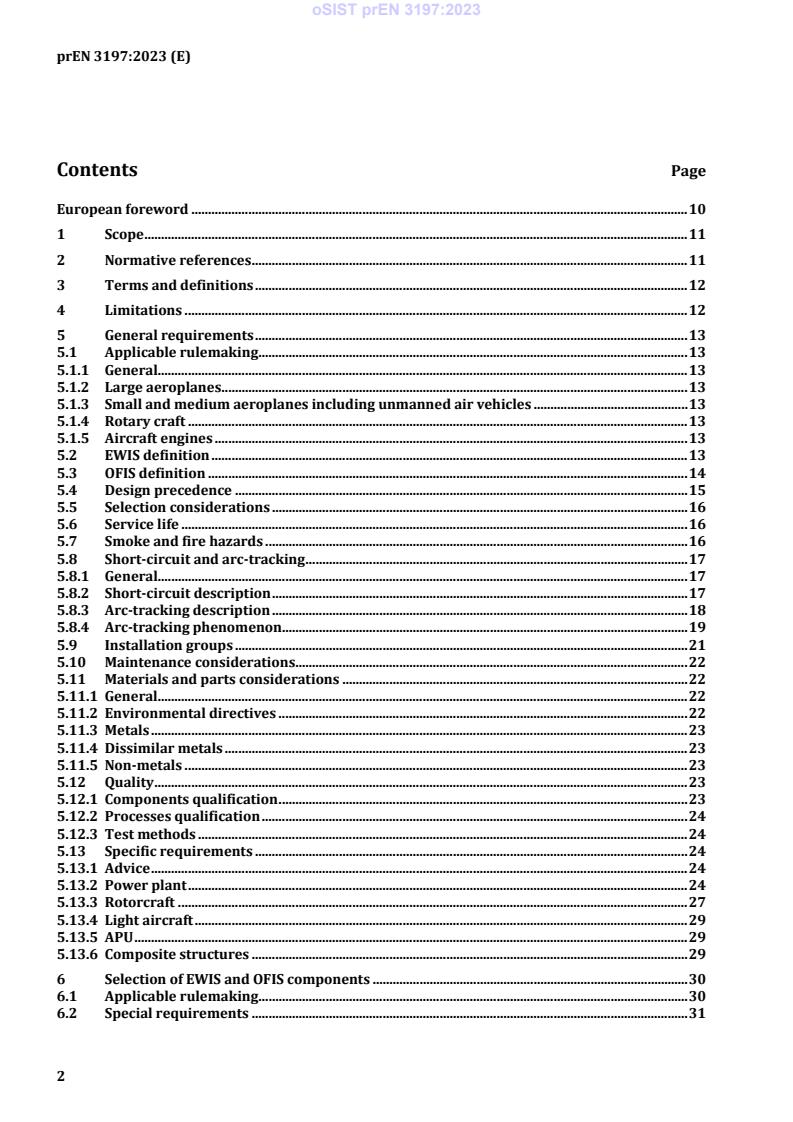
The general content of this document is described in page 2.
A detailed content of this document is given in Annex A.
This document lists all the relevant European standards related to EWIS and OFIS in Annex B.
- Status
- Not Published
- Public Enquiry End Date
- 25-Jul-2023
- Technical Committee
- I13 - Imaginarni 13
- Current Stage
- 98 - Abandoned project (Adopted Project)
- Start Date
- 21-May-2024
- Due Date
- 26-May-2024
- Completion Date
- 21-May-2024



Overview
oSIST prEN 3197:2023 is a draft European standard from SIST, focused on the design and installation of electrical and optical interconnection systems in aerospace vehicles. This standard provides comprehensive guidance for designing, selecting, manufacturing, installing, repairing, or modifying Electrical Wiring Interconnection Systems (EWIS) and Optical Fibre Interconnection Systems (OFIS) across a range of aircraft types, including manned and unmanned airplanes, helicopters, lighter-than-air vehicles, missiles, and external pods. Applicability and limits of the standard are defined in Clause 4.
The document aims to improve the safety, reliability, and efficiency of electrical and optical cabling systems in aerospace applications by standardizing best practices and ensuring consistency with related European regulations.
Key Topics
Definitions and Scope
Standardizes terminology and definitions related to EWIS and OFIS, providing a clear framework for aerospace engineers and manufacturers.Design and Selection Principles
Outlines comprehensive procedures for component and cable selection, considering factors such as environment, voltage, material compatibility, and safety requirements.Installation and Maintenance
Details best practices for the installation, routing, and securing of electrical and optical wiring, including guidelines for bend radius, attachment, and separation from other aircraft systems.Component Identification
Sets out marking and identification systems for wiring, connectors, and equipment to enhance traceability and maintainability.Safety and Environmental Considerations
Includes requirements related to fire and smoke hazards, electromagnetic compatibility (EMC), arc-tracking, and segregation of high-voltage systems from fuel, control, and passenger areas.Quality and Compliance
Specifies quality assurance processes for components and installations, as well as references to applicable rulemaking and qualification procedures.
Applications
The practical value of oSIST prEN 3197:2023 is seen throughout the aerospace industry in the following areas:
Aircraft Manufacturing
Ensures all electrical and optical interconnections are designed, selected, and installed to meet stringent safety and operational standards from the outset.System Integration
Guides integrators in harmonizing the use of EWIS and OFIS with other onboard systems, reducing risk of electromagnetic interference and mechanical conflicts.Maintenance and Modification
Provides instructions for the repair, inspection, and modification of wiring systems, extending the operational life and reliability of aerospace vehicles.Certification and Compliance
Supports organizations and engineers in demonstrating conformance with European regulatory requirements and industry best practices during certification processes.Safety Enhancements
Improves overall aircraft safety by setting out clear rules for separation, routing, and protection of wiring, particularly in critical zones such as fuel tanks and near flight controls.
Related Standards
The standard references a range of European and international standards for EWIS and OFIS, consolidated in Annex B. Key related standards include:
- EN 3197:2010 - Previous version, to be superseded by this draft
- Other aerospace-specific standards - Covering component qualification, installation procedures, and material selection
- Standards on electromagnetic compatibility, fire safety, and environmental directives - Ensuring EWIS and OFIS installations meet holistic aircraft safety requirements
By adhering to oSIST prEN 3197:2023, aerospace organizations can ensure their aircraft electrical and optical interconnection networks are robust, maintainable, and in line with industry advancements and regulations. This standard serves as an essential resource for engineers, manufacturers, and operators involved in the lifecycle management of aircraft wiring systems.
Relations
- Effective Date
- 19-Jan-2023
Get Certified
Connect with accredited certification bodies for this standard

BUREAU VERITAS Certification Germany
Bureau Veritas certification in Germany.

Element Materials Technology
Materials testing and product certification.

AQMS Ltd.
AQMS provides ISO certification to SMEs across the UK.
Sponsored listings
Frequently Asked Questions
oSIST prEN 3197:2023 is a draft published by the Slovenian Institute for Standardization (SIST). Its full title is "Aerospace series - Design and installation of aircraft electrical and optical interconnection systems". This standard covers: This document provides instructions on the methods to be used when designing, selecting, manufacturing, installing, repairing or modifying the aerospace vehicles electrical and optical interconnection networks, now called Electrical Wiring Interconnection System (EWIS), and Optical Fibre Interconnection Systems (OFIS), subject to the limitations defined in Clause 4 of this document. Aerospace Vehicles include manned and unmanned aeroplanes, helicopters, lighter-than- air vehicles, missiles and external pods. The general content of this document is described in page 2. A detailed content of this document is given in Annex A. This document lists all the relevant European standards related to EWIS and OFIS in Annex B.
This document provides instructions on the methods to be used when designing, selecting, manufacturing, installing, repairing or modifying the aerospace vehicles electrical and optical interconnection networks, now called Electrical Wiring Interconnection System (EWIS), and Optical Fibre Interconnection Systems (OFIS), subject to the limitations defined in Clause 4 of this document. Aerospace Vehicles include manned and unmanned aeroplanes, helicopters, lighter-than- air vehicles, missiles and external pods. The general content of this document is described in page 2. A detailed content of this document is given in Annex A. This document lists all the relevant European standards related to EWIS and OFIS in Annex B.
oSIST prEN 3197:2023 is classified under the following ICS (International Classification for Standards) categories: 49.060 - Aerospace electric equipment and systems; 49.090 - On-board equipment and instruments. The ICS classification helps identify the subject area and facilitates finding related standards.
oSIST prEN 3197:2023 has the following relationships with other standards: It is inter standard links to SIST EN 3197:2011. Understanding these relationships helps ensure you are using the most current and applicable version of the standard.
oSIST prEN 3197:2023 is available in PDF format for immediate download after purchase. The document can be added to your cart and obtained through the secure checkout process. Digital delivery ensures instant access to the complete standard document.
Standards Content (Sample)
SLOVENSKI STANDARD
01-julij-2023
Aeronavtika - Načrtovanje in vgradnja letalskih električnih in optičnih sistemov za
medsebojno povezovanje
Aerospace series - Design and installation of aircraft electrical and optical
interconnection systems
Luft- und Raumfahrt - Konstruktion und Installation elektrischer und optischer
Verkabelung in Luftfahrzeugen
Série aérospatiale - Conception et installation de systèmes d'interconnexion électrique et
optique d'aéronefs
Ta slovenski standard je istoveten z: prEN 3197
ICS:
49.060 Letalska in vesoljska Aerospace electric
električna oprema in sistemi equipment and systems
49.090 Oprema in instrumenti v On-board equipment and
zračnih in vesoljskih plovilih instruments
2003-01.Slovenski inštitut za standardizacijo. Razmnoževanje celote ali delov tega standarda ni dovoljeno.
DRAFT
EUROPEAN STANDARD
NORME EUROPÉENNE
EUROPÄISCHE NORM
April 2023
ICS 49.060; 49.090 Will supersede EN 3197:2010
English Version
Aerospace series - Design and installation of aircraft
electrical and optical interconnection systems
Série aérospatiale - Conception et installation de Luft- und Raumfahrt - Konstruktion und Installation
systèmes d'interconnexion électrique et optique elektrischer und optischer Verkabelung in
d'aéronefs Luftfahrzeugen
This draft European Standard is submitted to CEN members for enquiry. It has been drawn up by the Technical Committee ASD-
STAN.
If this draft becomes a European Standard, CEN members are bound to comply with the CEN/CENELEC Internal Regulations
which stipulate the conditions for giving this European Standard the status of a national standard without any alteration.
This draft European Standard was established by CEN in three official versions (English, French, German). A version in any other
language made by translation under the responsibility of a CEN member into its own language and notified to the CEN-CENELEC
Management Centre has the same status as the official versions.
CEN members are the national standards bodies of Austria, Belgium, Bulgaria, Croatia, Cyprus, Czech Republic, Denmark, Estonia,
Finland, France, Germany, Greece, Hungary, Iceland, Ireland, Italy, Latvia, Lithuania, Luxembourg, Malta, Netherlands, Norway,
Poland, Portugal, Republic of North Macedonia, Romania, Serbia, Slovakia, Slovenia, Spain, Sweden, Switzerland, Türkiye and
United Kingdom.
Recipients of this draft are invited to submit, with their comments, notification of any relevant patent rights of which they are
aware and to provide supporting documentation.
Warning : This document is not a European Standard. It is distributed for review and comments. It is subject to change without
notice and shall not be referred to as a European Standard.
EUROPEAN COMMITTEE FOR STANDARDIZATION
COMITÉ EUROPÉEN DE NORMALISATION
EUROPÄISCHES KOMITEE FÜR NORMUNG
CEN-CENELEC Management Centre: Rue de la Science 23, B-1040 Brussels
© 2023 CEN All rights of exploitation in any form and by any means reserved Ref. No. prEN 3197:2023 E
worldwide for CEN national Members.
Contents Page
European foreword . 10
1 Scope . 11
2 Normative references . 11
3 Terms and definitions . 12
4 Limitations . 12
5 General requirements . 13
5.1 Applicable rulemaking . 13
5.1.1 General. 13
5.1.2 Large aeroplanes . 13
5.1.3 Small and medium aeroplanes including unmanned air vehicles . 13
5.1.4 Rotary craft . 13
5.1.5 Aircraft engines . 13
5.2 EWIS definition . 13
5.3 OFIS definition . 14
5.4 Design precedence . 15
5.5 Selection considerations . 16
5.6 Service life . 16
5.7 Smoke and fire hazards . 16
5.8 Short-circuit and arc-tracking . 17
5.8.1 General. 17
5.8.2 Short-circuit description . 17
5.8.3 Arc-tracking description . 18
5.8.4 Arc-tracking phenomenon. 19
5.9 Installation groups . 21
5.10 Maintenance considerations . 22
5.11 Materials and parts considerations . 22
5.11.1 General. 22
5.11.2 Environmental directives . 22
5.11.3 Metals . 23
5.11.4 Dissimilar metals . 23
5.11.5 Non-metals . 23
5.12 Quality . 23
5.12.1 Components qualification . 23
5.12.2 Processes qualification . 24
5.12.3 Test methods . 24
5.13 Specific requirements . 24
5.13.1 Advice . 24
5.13.2 Power plant . 24
5.13.3 Rotorcraft . 27
5.13.4 Light aircraft . 29
5.13.5 APU . 29
5.13.6 Composite structures . 29
6 Selection of EWIS and OFIS components . 30
6.1 Applicable rulemaking . 30
6.2 Special requirements . 31
6.2.1 Commonality . 31
6.2.2 Maintenance, repair or modification. 31
6.2.3 Materials . 31
6.3 Electrical and fibre optic cable selection . 31
6.3.1 Environment . 31
6.3.2 Type of cable . 32
6.3.3 Electrical cables . 32
6.3.4 Voltage and current ratings . 34
6.3.5 Equipment cable . 34
6.3.6 Airframe cable . 34
6.3.7 Fireproof and fire-resistant cable . 34
6.3.8 Coaxial cable . 35
6.3.9 Data bus cable . 35
6.3.10 Thermocouple or extension cable . 35
6.3.11 Fibre optic cables . 35
6.3.12 Special cable types . 37
6.4 Connector selection . 38
6.4.1 Environment . 38
6.4.2 Types of connectors . 38
6.4.3 Construction . 39
6.4.4 Electrical contacts . 40
6.4.5 Fibre optic termini . 41
6.4.6 Cable outlet accessories . 41
6.4.7 Connector voltage ratings . 41
6.5 Circuit protective devices selection . 42
6.5.1 Type of protective devices . 42
6.5.2 Electrical protection . 42
6.5.3 Circuit Breaker . 45
6.5.4 Arc Fault Circuit Interrupter . 46
6.5.5 Arc Fault Circuit Breaker . 46
6.5.6 Remote Control Circuit Breaker . 46
6.5.7 Solid State Circuit Breaker . 46
6.5.8 Residual Current Device (RCD) . 46
6.5.9 Fuse . 46
6.6 Switching devices selection . 47
6.6.1 Type of switching devices . 47
6.6.2 Electrical switching . 47
6.6.3 Interrupter . 48
6.6.4 Switch . 48
6.6.5 Push-button . 48
6.6.6 Relays and micro-contactors . 48
6.6.7 Contactor . 50
6.6.8 Switching High Voltage DC Circuits . 50
6.7 Terminal junction systems . 50
6.7.1 Definition and requirements . 50
6.7.2 Environmental . 51
6.7.3 Design . 51
6.7.4 Mounting frames . 52
6.7.5 Other types of modules . 52
6.8 Terminal lugs selection . 53
6.8.1 Definition and requirements . 53
6.8.2 Selection criteria . 53
6.8.3 Inspection . 53
6.9 Splices selection . 54
6.9.2 Definition and requirements . 55
6.9.3 Installation constraints . 56
6.9.4 General notes on splices . 56
6.9.5 Screened cable splices . 56
6.9.6 Quick disconnect splices . 56
6.9.7 Closed end splices . 57
6.9.8 Splices for fibre optic cables . 57
6.9.9 Inspection . 57
6.10 Solder sleeves selection . 57
6.10.1 Description . 57
6.10.2 Solder and flux . 57
6.10.3 Solder sleeve selection . 57
6.10.4 Selection criteria . 58
6.11 Feedthrough Selection (Pressure Bung housing assemblies) . 58
6.11.1 General. 58
6.11.2 Selection criteria . 58
6.11.3 Design . 58
6.12 Clamp selection . 58
6.12.1 General. 58
6.12.2 Selection of “P” clamps . 59
6.12.3 Selection of “Ω” clips . 59
6.13 Protective parts selection . 59
6.13.1 General. 59
6.13.2 Selection criteria . 59
6.14 Identification parts selection . 60
6.14.1 General. 60
6.14.2 Selection criteria . 60
6.15 Installation components selection . 60
6.15.1 Selection of cable ties . 60
6.15.2 Tapes . 62
6.15.3 Raceways and cable tray . 62
6.16 Junction boxes . 63
6.16.1 General. 63
6.16.2 Construction . 63
6.16.3 Inside wiring . 64
6.16.4 Identification . 64
7 Components Identification . 64
7.1 Applicable rulemaking . 64
7.2 General. 64
7.3 Component manufacturer marking – Part number . 65
7.3.1 Component manufacturer identification . 65
7.3.2 Alternate manufacturer identification . 65
7.3.3 Identification intervals . 65
7.3.4 Types of wire manufacturer markings . 65
7.4 Airframer component function marking – Function identification number . 65
7.4.1 Airframe manufacturer identification . 65
7.4.2 Identification intervals . 66
7.4.3 Types of airframe manufacturer markings . 66
7.5 Identification of EWIS and OFIS bundles – Airframer identification – Routing. 66
7.5.1 Routing identification . 66
7.5.2 Types of routing identification . 67
7.5.3 Visible identification of critical design configuration limitations . 67
7.6 Identification of equipments . 67
7.7 Identification of user EWIS and OFIS modification or repair – Operators
identification coding . 68
8 Separation and principles to apply . 68
8.1 Applicable rulemaking . 68
8.2 General requirements . 68
8.2.1 General . 68
8.2.2 Segregation of functions . 69
8.2.3 Separation of different high voltage systems . 69
8.2.4 General . 69
8.2.5 Separation by physical distances versus separation by barrier . 69
8.2.6 Determination of separation . 70
8.2.7 Separation from personnel and cargo . 70
8.2.8 Electromagnetic interference (EMI) . 71
8.2.9 Separation from flammable fluids . 71
8.2.10 Separation from water waste . 71
8.2.11 Separation from flight controls . 71
8.2.12 Separation from high temperature equipment . 71
8.2.13 Redundant system separation . 72
8.3 Electrical requirements. 72
8.3.1 Voltage drop . 72
8.3.2 Coaxial and bus cable attenuation . 72
8.3.3 Ground electrical return . 72
8.3.4 Electromagnetic Compatibility (EMC) . 73
8.3.5 Grounding of screened cables . 73
8.3.6 Compass deviation . 73
8.3.7 Corona effect prevention . 73
8.3.8 High voltage AC. and DC. networks . 75
8.4 Ignition . 75
8.4.1 Magneto type . 75
8.4.2 Ignition High Energy/High Voltage (HE/HV) . 75
8.5 Mechanical requirements . 76
8.5.1 Cable handling . 76
8.5.2 Cable on engines (see 5.13.2 “Power plant” for further details) . 76
8.6 Environmental requirements . 76
8.6.1 Ambient temperature of installed harnesses . 76
8.6.2 Cable in undercarriage bays . 76
8.6.3 SWAMP areas . 76
8.7 Fuel tanks requirements . 76
8.7.1 Rational . 76
8.7.2 Cables inside fuel tanks . 77
8.7.3 Wiring segregation . 77
8.7.4 Harness installation . 77
8.7.5 Cable routing through fuel tanks . 77
8.8 Fire zone . 78
8.9 Attachment requirements . 78
8.10 Fibre optic cable requirements . 79
8.10.1 Installation . 79
8.10.2 Attenuation . 79
8.11 Size requirements . 79
8.12 EWIS and OFIS installation . 79
8.12.1 Zone categories . 79
8.12.2 General rules . 80
8.12.3 Protection against specific hazards . 80
8.12.4 Separation between route categories and codes . 80
8.12.5 Panels and boxes . 81
8.12.6 Cabin related harnesses . 81
9 Installation and manufacturing principles . 81
9.1 Applicable Rulemaking . 81
9.2 Security against high voltage . 81
9.3 General principles of cable routing . 82
9.3.1 Arrangement of cables . 82
9.3.2 Dead endings . 82
9.3.3 Drip loop and slack in cabling . 82
9.4 Arrangement and installation of power routes . 83
9.4.1 Feeder route . 83
9.4.2 Power route . 83
9.4.3 Power supply of equipment . 83
9.5 Minimum bending radius requirements . 83
9.5.1 General. 83
9.5.2 Method . 84
9.5.3 Bend radius for a standard wire or cable used alone . 84
9.5.4 Bend radius for an electrical transmission cable used alone . 85
9.5.5 Bend radius for fibre optic cables . 86
9.5.6 Bend radius for bundles or harnesses . 86
9.5.7 Bend radius for bundles or harnesses in hinge area . 87
9.5.8 Service loop for equipment removing (“blind” mounting) . 87
9.6 Cable preparation . 87
9.6.1 Marking . 87
9.6.2 Cutting to length . 87
9.6.3 Stripping . 88
9.7 Supports . 88
9.7.1 Cabling support . 88
9.7.2 Support at connectors . 88
9.7.3 Cable supports . 89
9.7.4 Installation of “P” clamps . 89
9.7.5 Adhesive clamps . 89
9.7.6 Installation of Omega clips . 90
9.8 Connectors and accessories . 90
9.8.1 Installation . 90
9.8.2 Precautions to ensure correct connector mating . 91
9.8.3 Terminals . 92
9.8.4 User control tests for terminals and splices (electrical) . 94
9.8.5 Fibre optic connectors . 95
9.9 Splices . 96
9.9.1 In-line splices . 96
9.9.2 Step-down splices . 96
9.9.3 Insulated splices . 96
9.9.4 Low air density splices . 96
9.9.5 Location of splices . 96
9.9.6 Support of splices . 97
9.9.7 Post-insulation of splices . 97
9.9.8 Recording procedure for splices . 97
9.10 Solder sleeve termination . 97
9.10.1 Installation . 97
9.10.2 Inspection .
...