

oSIST prEN 14351-1:2019
(Main)Windows and doors - Product standard, performance characteristics - Part 1: Windows and external pedestrian doorsets
General Information
- Abstract
This document identifies material independent performance characteristics, except resistance to fire and smoke control characteristics, that are applicable to windows (including roof windows, roof windows with external fire resistance and door height windows), external pedestrian doorsets (including unframed glass doorsets, escape route doorsets and their assemblies).
Fire resisting and/or smoke control characteristics for pedestrian doorsets and openable windows are covered by EN 16034.
This document applies to
- fixed windows or fixed lights, manually or power operated windows, French windows and screens for installation in vertical wall apertures and roof windows for installation in inclined roofs, complete with:
- related hardware, if any;
- weather stripping, if any;
- glazed apertures when intended to have glazed apertures;
- with or without incorporated shutters and/or shutter boxes and/or blinds;
and manually or power operated windows, roof windows, French windows and screens that are:
- fully or partially glazed including any non-transparent infill;
- fixed or partly fixed or openable with one or more casements/sashes (e.g. hinged, projecting, pivoted, sliding);
- manually operated external pedestrian doorsets or power operated external pedestrian hinged doorsets with flush or panelled leaves in construction works, complete with:
- integral fanlights, if any;
- adjacent parts that are contained within a single frame for inclusion in a single aperture, if any.
The windows covered by this document are not assessed regarding their ability to release (to open).
The products covered by this document are not assessed for structural applications.
This document does not apply to:
- rooflights according to EN 1873 and EN 14963;
- curtain walling according to EN 13830;
- industrial, commercial and garage doors and gates according to EN 13241;
- internal pedestrian doorsets according to EN 14351-2;
- revolving doorsets;
- power operated pedestrian doorsets according to EN 16361;
- windows intended to be part of internal partition.
- Status
- Not Published
- Public Enquiry End Date
- 09-Nov-2019
- Technical Committee
- ISTP - Doors and windows
- Current Stage
- 98 - Abandoned project (Adopted Project)
- Start Date
- 22-Apr-2024
- Due Date
- 27-Apr-2024
- Completion Date
- 22-Apr-2024

Overview
oSIST prEN 14351-1:2019 is an essential European draft standard developed by SIST, focused on regulating the performance characteristics of windows and external pedestrian doorsets. This document defines material-independent requirements for windows-including roof windows-and various types of external pedestrian doorsets such as unframed glass doors, escape route doors, and their assemblies. Importantly, it excludes fire and smoke control characteristics, which are covered by EN 16034.
The standard applies to a variety of windows (fixed, operable, roof, French, power-operated) and external pedestrian doorsets (manual, hinged, with or without fanlights, in single apertures) used in buildings. However, it does not cover structural aspects, rooflights, curtain walling, industrial doors, internal doorsets, revolving doors, or specific power-operated pedestrian doorsets provided for under other standards.
Key Topics
- Performance Characteristics: Defines product characteristics such as weathering, thermal performance, acoustic insulation, resistance to wind load, bullet and explosion resistance, burglar resistance, and child safety.
- Product Scope: Includes manually or power-operated windows and doors, with options for glazed or filled infills, shutters, shutter boxes, and blinds.
- Testing & Assessment: Specifies detailed methods for evaluating mechanical strength, thermal transmittance, air permeability, water tightness, durability, and more.
- Durability and Safety: Encompasses requirements for operating forces, load-bearing safety devices, and minimum standards for long-term product performance, including special considerations for automatic devices and doorsets in escape routes.
- Exclusions: Emphasizes that fire resisting and smoke control performance are outside this standard and instead governed by EN 16034.
- Classification: References product classes for resistance to wind, water, and impact; acoustic and thermal performance; and burglar or bullet resistance where appropriate.
Applications
This standard is widely applicable in the construction, manufacturing, and specification of windows and external pedestrian doorsets for buildings, assisting architects, builders, developers, specifiers, and manufacturers with:
- Product Selection and Specification: Ensuring that windows and doorsets meet harmonized EU standards for quality, energy efficiency, safety, and security.
- Testing and Certification: Providing a framework for the consistent testing, assessment, and verification of product performance, streamlining CE marking and compliance with EU regulations.
- Building Design and Compliance: Facilitating the integration of compliant windows and doorsets into residential, commercial, and public buildings, supporting building code fulfillment across Europe.
- Market Access: Assisting manufacturers in demonstrating compliance with pan-European requirements, enabling access to the wider European market without re-testing for each country.
Related Standards
oSIST prEN 14351-1:2019 is part of a broader suite of European standards related to windows, pedestrian doorsets, and associated hardware:
- EN 16034: Windows and doorsets with fire resisting and/or smoke control characteristics.
- EN 14351-2: Internal pedestrian doorsets.
- EN 16361: Power operated pedestrian doorsets.
- EN 13241: Industrial, commercial, and garage doors and gates.
- EN 13830: Curtain walling.
- EN 1873 / EN 14963: Rooflights.
- EN 1627: Burglar resistance requirements.
- EN 1522: Bullet resistance for windows and doors.
By following oSIST prEN 14351-1:2019, stakeholders contribute to safer, higher-performing, and more sustainable building envelopes aligned with modern European construction practices. This standard is pivotal for achieving compliance, ensuring product consistency, and upholding quality for windows and external pedestrian doorsets in all construction works.
Relations
- Effective Date
- 18-Jan-2023
- Effective Date
- 01-Nov-2019
Get Certified
Connect with accredited certification bodies for this standard

DIBt (Deutsches Institut für Bautechnik)
German Institute for Building Technology.
DIN CERTCO
DIN Group product certification.

Aboma Certification B.V.
Specialized in construction, metal, and transport sectors.
Sponsored listings
Frequently Asked Questions
oSIST prEN 14351-1:2019 is a draft published by the Slovenian Institute for Standardization (SIST). Its full title is "Windows and doors - Product standard, performance characteristics - Part 1: Windows and external pedestrian doorsets". This standard covers: This document identifies material independent performance characteristics, except resistance to fire and smoke control characteristics, that are applicable to windows (including roof windows, roof windows with external fire resistance and door height windows), external pedestrian doorsets (including unframed glass doorsets, escape route doorsets and their assemblies). Fire resisting and/or smoke control characteristics for pedestrian doorsets and openable windows are covered by EN 16034. This document applies to - fixed windows or fixed lights, manually or power operated windows, French windows and screens for installation in vertical wall apertures and roof windows for installation in inclined roofs, complete with: - related hardware, if any; - weather stripping, if any; - glazed apertures when intended to have glazed apertures; - with or without incorporated shutters and/or shutter boxes and/or blinds; and manually or power operated windows, roof windows, French windows and screens that are: - fully or partially glazed including any non-transparent infill; - fixed or partly fixed or openable with one or more casements/sashes (e.g. hinged, projecting, pivoted, sliding); - manually operated external pedestrian doorsets or power operated external pedestrian hinged doorsets with flush or panelled leaves in construction works, complete with: - integral fanlights, if any; - adjacent parts that are contained within a single frame for inclusion in a single aperture, if any. The windows covered by this document are not assessed regarding their ability to release (to open). The products covered by this document are not assessed for structural applications. This document does not apply to: - rooflights according to EN 1873 and EN 14963; - curtain walling according to EN 13830; - industrial, commercial and garage doors and gates according to EN 13241; - internal pedestrian doorsets according to EN 14351-2; - revolving doorsets; - power operated pedestrian doorsets according to EN 16361; - windows intended to be part of internal partition.
This document identifies material independent performance characteristics, except resistance to fire and smoke control characteristics, that are applicable to windows (including roof windows, roof windows with external fire resistance and door height windows), external pedestrian doorsets (including unframed glass doorsets, escape route doorsets and their assemblies). Fire resisting and/or smoke control characteristics for pedestrian doorsets and openable windows are covered by EN 16034. This document applies to - fixed windows or fixed lights, manually or power operated windows, French windows and screens for installation in vertical wall apertures and roof windows for installation in inclined roofs, complete with: - related hardware, if any; - weather stripping, if any; - glazed apertures when intended to have glazed apertures; - with or without incorporated shutters and/or shutter boxes and/or blinds; and manually or power operated windows, roof windows, French windows and screens that are: - fully or partially glazed including any non-transparent infill; - fixed or partly fixed or openable with one or more casements/sashes (e.g. hinged, projecting, pivoted, sliding); - manually operated external pedestrian doorsets or power operated external pedestrian hinged doorsets with flush or panelled leaves in construction works, complete with: - integral fanlights, if any; - adjacent parts that are contained within a single frame for inclusion in a single aperture, if any. The windows covered by this document are not assessed regarding their ability to release (to open). The products covered by this document are not assessed for structural applications. This document does not apply to: - rooflights according to EN 1873 and EN 14963; - curtain walling according to EN 13830; - industrial, commercial and garage doors and gates according to EN 13241; - internal pedestrian doorsets according to EN 14351-2; - revolving doorsets; - power operated pedestrian doorsets according to EN 16361; - windows intended to be part of internal partition.
oSIST prEN 14351-1:2019 is classified under the following ICS (International Classification for Standards) categories: 91.060.50 - Doors and windows. The ICS classification helps identify the subject area and facilitates finding related standards.
oSIST prEN 14351-1:2019 has the following relationships with other standards: It is inter standard links to SIST EN 14351-1:2006+A2:2016, SIST EN 14351-1:2006+A2:2016. Understanding these relationships helps ensure you are using the most current and applicable version of the standard.
oSIST prEN 14351-1:2019 is associated with the following European legislation: EU Directives/Regulations: 2006/42/EC, 305/2011; Standardization Mandates: M/101, M/122, M/126, M/130, M/396. When a standard is cited in the Official Journal of the European Union, products manufactured in conformity with it benefit from a presumption of conformity with the essential requirements of the corresponding EU directive or regulation.
oSIST prEN 14351-1:2019 is available in PDF format for immediate download after purchase. The document can be added to your cart and obtained through the secure checkout process. Digital delivery ensures instant access to the complete standard document.
Standards Content (Sample)
SLOVENSKI STANDARD
01-november-2019
Okna in vrata - Standard za proizvod, zahtevane lastnosti - 1. del: Okna in zunanja
vrata
Windows and doors - Product standard, performance characteristics - Part 1: Windows
and external pedestrian doorsets
Fenster und Türen - Produktnorm, Leistungseigenschaften - Teil 1: Fenster und
Außentüren
Fenêtres et portes - Norme produit, caractéristiques de performance - Partie 1 : Fenêtres
et blocs portes extérieurs pour piétons
Ta slovenski standard je istoveten z: prEN 14351-1
ICS:
91.060.50 Vrata in okna Doors and windows
2003-01.Slovenski inštitut za standardizacijo. Razmnoževanje celote ali delov tega standarda ni dovoljeno.
DRAFT
EUROPEAN STANDARD
NORME EUROPÉENNE
EUROPÄISCHE NORM
August 2019
ICS 91.060.50 Will supersede EN 14351-1:2006+A2:2016
English Version
Windows and doors - Product standard, performance
characteristics - Part 1: Windows and external pedestrian
doorsets
Fenêtres et portes - Norme produit, caractéristiques de Fenster und Türen - Produktnorm,
performance - Partie 1 : Fenêtres et blocs portes Leistungseigenschaften - Teil 1: Fenster und
extérieurs pour piétons Außentüren
This draft European Standard is submitted to CEN members for enquiry. It has been drawn up by the Technical Committee
CEN/TC 33.
If this draft becomes a European Standard, CEN members are bound to comply with the CEN/CENELEC Internal Regulations
which stipulate the conditions for giving this European Standard the status of a national standard without any alteration.
This draft European Standard was established by CEN in three official versions (English, French, German). A version in any other
language made by translation under the responsibility of a CEN member into its own language and notified to the CEN-CENELEC
Management Centre has the same status as the official versions.
CEN members are the national standards bodies of Austria, Belgium, Bulgaria, Croatia, Cyprus, Czech Republic, Denmark, Estonia,
Finland, France, Germany, Greece, Hungary, Iceland, Ireland, Italy, Latvia, Lithuania, Luxembourg, Malta, Netherlands, Norway,
Poland, Portugal, Republic of North Macedonia, Romania, Serbia, Slovakia, Slovenia, Spain, Sweden, Switzerland, Turkey and
United Kingdom.
Recipients of this draft are invited to submit, with their comments, notification of any relevant patent rights of which they are
aware and to provide supporting documentation.
Warning : This document is not a European Standard. It is distributed for review and comments. It is subject to change without
notice and shall not be referred to as a European Standard.
EUROPEAN COMMITTEE FOR STANDARDIZATION
COMITÉ EUROPÉEN DE NORMALISATION
EUROPÄISCHES KOMITEE FÜR NORMUNG
CEN-CENELEC Management Centre: Rue de la Science 23, B-1040 Brussels
© 2019 CEN All rights of exploitation in any form and by any means reserved Ref. No. prEN 14351-1:2019 E
worldwide for CEN national Members.
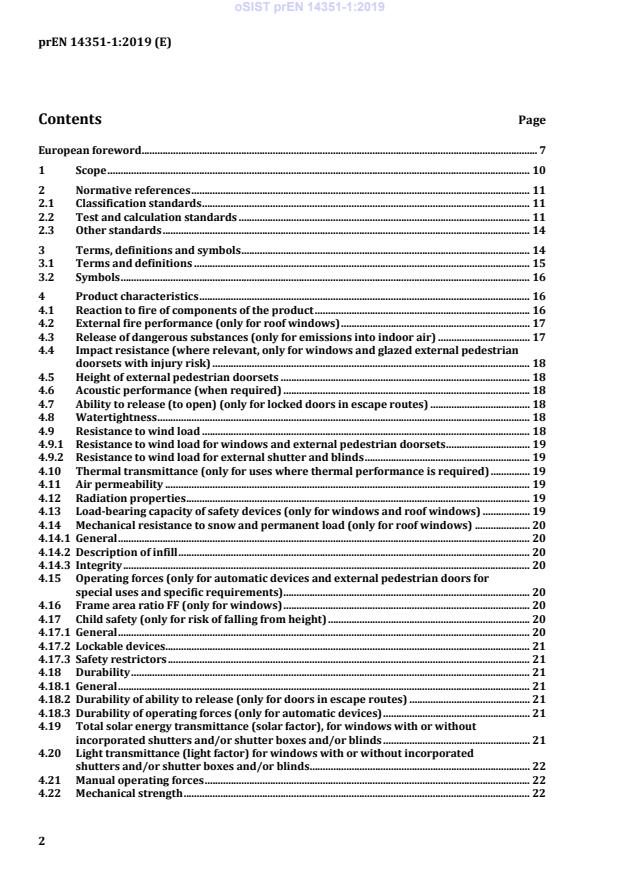
Contents Page
European foreword . 7
1 Scope . 10
2 Normative references . 11
2.1 Classification standards . 11
2.2 Test and calculation standards . 11
2.3 Other standards . 14
3 Terms, definitions and symbols . 14
3.1 Terms and definitions . 15
3.2 Symbols . 16
4 Product characteristics . 16
4.1 Reaction to fire of components of the product . 16
4.2 External fire performance (only for roof windows) . 17
4.3 Release of dangerous substances (only for emissions into indoor air) . 17
4.4 Impact resistance (where relevant, only for windows and glazed external pedestrian
doorsets with injury risk) . 18
4.5 Height of external pedestrian doorsets . 18
4.6 Acoustic performance (when required) . 18
4.7 Ability to release (to open) (only for locked doors in escape routes) . 18
4.8 Watertightness . 18
4.9 Resistance to wind load . 18
4.9.1 Resistance to wind load for windows and external pedestrian doorsets . 19
............................................................... 19
4.9.2 Resistance to wind load for external shutter and blinds
4.10 Thermal transmittance (only for uses where thermal performance is required) . 19
4.11 Air permeability . 19
4.12 Radiation properties . 19
4.13 Load-bearing capacity of safety devices (only for windows and roof windows) . 19
4.14 Mechanical resistance to snow and permanent load (only for roof windows) . 20
4.14.1 General . 20
4.14.2 Description of infill . 20
4.14.3 Integrity . 20
4.15 Operating forces (only for automatic devices and external pedestrian doors for
special uses and specific requirements) . 20
4.16 Frame area ratio FF (only for windows) . 20
4.17 Child safety (only for risk of falling from height) . 20
4.17.1 General . 20
4.17.2 Lockable devices . 21
4.17.3 Safety restrictors . 21
4.18 Durability . 21
4.18.1 General . 21
4.18.2 Durability of ability to release (only for doors in escape routes) . 21
4.18.3 Durability of operating forces (only for automatic devices) . 21
4.19 Total solar energy transmittance (solar factor), for windows with or without
incorporated shutters and/or shutter boxes and/or blinds . 21
4.20 Light transmittance (light factor) for windows with or without incorporated
shutters and/or shutter boxes and/or blinds . 22
4.21 Manual operating forces . 22
4.22 Mechanical strength . 22
4.23 Ventilation . 22
4.24 Bullet resistance . 22
4.25 Explosion resistance . 23
4.25.1 General . 23
4.25.2 Shock tube . 23
4.25.3 Range test . 23
4.26 Resistance to repeated opening and closing . 23
4.27 Behaviour between different climates . 23
4.27.1 Windows . 23
4.27.2 External pedestrian doorsets . 23
4.28 Burglar resistance . 23
4.29 Mechanical performance of bonded glazing (only relevant for products in which
glazed infills are bonded) . 24
4.29.1 Bond strength . 24
4.29.2 Resistance of the bonding against moisture . 24
4.29.3 Durability of the bond strength . 24
4.30 Requirements on unframed external pedestrian doorsets made of glass . 24
4.31 Requirements on power operated windows . 24
4.31.1 General . 24
4.31.2 Safety in use . 24
4.31.3 Electromagnetic Compatibility (EMC) . 24
4.32 Requirements on power operated external pedestrian doorsets . 25
4.32.1 General . 25
4.32.2 Safety in use (only for automatic devices) . 25
5 Testing, assessment and sampling methods . 25
5.1 Reaction to fire of components of the product. 25
5.2 External fire performance (only for roof windows) . 25
5.3 Release of dangerous substances (only for emissions into indoor air) . 25
5.4 Impact resistance (where relevant, only for windows and glazed external pedestrian
doorsets with injury risk) . 26
5.5 Height of external pedestrian doorsets . 26
5.6 Acoustic performance (when required) . 26
5.6.1 Reference method . 26
5.6.2 Alternative method . 26
5.7 Ability to release (to open) (only for external pedestrian doorsets in escape routes) . 26
5.7.1 Assessment of the construction . 26
5.7.2 Other hinges . 27
5.8 Watertightness . 27
5.9 Resistance to wind load . 27
5.9.1 Windows and external pedestrian doorsets . 27
5.9.2 Shutters and external blinds . 27
5.10 Thermal transmittance (only for uses where thermal performance is required). 27
5.10.1 Testing of windows with or without shutterboxes and external pedestrian doorsets . 27
5.10.2 Tabulated values of windows . 28
5.10.3 Calculation of windows with or without shutterboxes and external pedestrian
doorsets . 28
5.10.4 Testing of windows with incorporated shutters and/or blinds . 28
5.10.5 Calculation of windows with incorporated shutters and/or blinds . 28
5.11 Air permeability . 29
5.12 Radiation properties . 29
5.13 Load-bearing capacity of safety devices (only for windows and roof windows) . 29
5.14 Mechanical resistance to snow and permanent load (only for roof windows) . 29
5.15 Operating forces (only for automatic devices and external pedestrian doors for
special uses and specific requirements) . 29
5.16 Frame area ratio FF (only for windows) . 30
5.17 Child safety (only for risk of falling from height) . 30
5.18 Durability . 30
5.18.1 Durability of Watertightness . 30
5.18.2 Durability of air permeability . 30
5.18.3 Durability of thermal transmittance . 30
5.19 Total solar energy transmittance (solar factor), for the window with or without
incorporated shutters and/or shutter boxes and/or blinds . 30
5.20 Light transmittance (light factor) for the window with or without incorporated
shutters and/or shutter boxes and/or blinds . 31
5.21 Manual operation forces . 31
5.22 Mechanical strength . 31
5.23 Ventilation . 32
5.24 Bullet resistance . 32
5.25 Explosion resistance . 32
5.25.1 Shock tube . 32
5.25.2 Range test . 32
5.26 Resistance to repeated opening and closing . 32
5.27 Behaviour between different climates . 32
5.27.1 Windows . 32
5.27.2 External pedestrian doorsets . 32
5.28 Burglar resistance. . 32
5.29 Mechanical performance of bonded glazing (only relevant for products in which
glazed infills are bonded) . 32
5.29.1 Bond strength . 32
5.29.2 Resistance against moisture . 33
5.29.3 Durability of the bond strength . 33
6 Assessment and verification of constancy of performance —AVCP . 33
6.1 General . 33
6.2 Type testing . 33
6.2.1 General . 33
6.2.2 Test samples, testing and compliance criteria . 34
6.2.3 Test reports . 34
6.2.4 Shared other party results . 34
6.2.5 Cascading determination of the product type results . 35
6.3 Factory production control (FPC) . 36
6.3.1 General . 36
6.3.2 Requirements . 37
6.3.3 Product specific requirements . 39
6.3.4 Initial inspection of factory and of FPC . 39
6.3.5 Continuous surveillance of FPC . 40
6.3.6 Procedure for modifications . 40
6.3.7 One-off products, pre-production products (e.g. prototypes) and products produced
in very low quantity . 40
Annex A (informative) Interdependence between characteristics and components . 42
Annex B (normative) Determination of acoustic performance of windows . 45
B.1 General . 45
B.2 Determination of sound insulation by testing . 45
B.3 Determination of sound insulation of single windows with IGUs using tabulated
values . 46
B.3.1 Sound insulation of single windows based on IGU sound insulation data and window
construction criteria . 46
B.3.2 General conditions for use of procedure in B.3.3 . 46
B.3.3 Procedure for determination of window R (C; C ) based on IGU data . 46
w tr
B.4 Test results and tabulated values – Range of application . 48
B.5 Interpolation procedure for determining the sound insulation of windows based on
data for the IGU and measured test results of complete windows . 48
Annex C (normative) Tabulated values and extension of results following size and design
variations . 51
C.1 Characteristics for windows . 51
C.2 Characteristics for external pedestrian doorsets . 54
Annex D (informative) Optional selection of representative test specimens for windows . 57
D.1 Guidelines for an optional selection of representative test specimens . 57
Annex E (informative) Examples of test sequences for optional combined determination of
characteristics for windows. 59
E.1 Optional test sequences . 59
Annex F (normative) Selection, preparation mounting and fixing of test specimen for
reaction to fire tests of windows or external pedestrian doorsets and field of direct
application . 60
F.1 General . 60
F.2 EN ISO 11925-2 (Single flame test) . 60
F.2.1 Profile. 60
F.2.2 Infill or door leaf board . 62
F.2.3 Sealant and/or gasket between infill and profile . 62
F.2.4 Organic coating/top layers. 64
F.3 Mounting and fixing for EN 13823 (SBI-test) . 64
F.3.1 Testing of the individual components . 64
F.3.2 Testing of the window or external pedestrian doorset . 65
F.4 EN ISO 1182 (Non-combustibility test) . 67
F.5 EN ISO 1716 (Determination of the heat of combustion) . 67
F.6 Field of direct application . 67
Annex G (normative) Air permeability — Determination in accordance with constructive
details . 69
Annex H (normative) Application procedures for resistance to wind load on windows and
external pedestrian doorsets with framed door leaves with larger sizes than type
tested . 70
Annex I (normative) Thermal transmittance for windows with bars . 71
Annex J (informative) Classifications/values of individual characteristics. 73
Annex ZA (informative) Relationship of this European Standard with Regulation (EU)
No. 305/2011 . 79
ZA.1 Scope and relevant characteristics . 79
ZA.2 System of Assessment and Verification of Constancy of Performance (AVCP) . 84
ZA.3 Assignment of AVCP tasks . 84
Annex ZB (informative) Relationship between this European Standard and the Essential
Requirements of EU Directive 2006/42/EC . 89
Annex ZC (informative) Relationship between this European Standard and the Essential
Requirements of EU Directive 2014/30/EU . 90
Bibliography . 91
European foreword
This document (prEN 14351-1:2019) has been prepared by Technical Committee CEN/TC 33 “Doors,
windows, shutters, building hardware and curtain walling”, the secretariat of which is held by AFNOR.
This document is currently submitted to the CEN Enquiry.
This document will supersede EN 14351-1:2006+A2:2016.
Compared with EN 14351-1:2006+A2:2016, the following changes have been made:
a) the scope has been changed and now covers roof windows for installation in inclined roofs and
power operated external pedestrian hinged doorsets;
b) normative references were updated;
c) subclause 3.1, new terms and definitions have been added to for French windows (3.1.7), bonded
glazing (3.1.8) and direct glazing (3.1.9);
d) subclause 3.2 Symbols has been added;
e) the former Clause 4 has been transformed in two clauses:
1) Clause 4 Product characteristics;
2) Clause 5 Testing, assessment and sampling methods;
f) clarifications have been added for fixed windows and windows with incorporated shutters and/or
shutter boxes and/or blinds.
g) numerous editorial changes.
h) the following essential characteristics are new:
1) reaction to fire for windows and doors (was before: only for roof windows);
2) frame area ratio FF;
3) child safety (only for risk of falling from height);
4) operating forces (only for automatic devices and external pedestrian doors for special uses and
specific requirements) (4.15);
i) subclause 4.5 Width deleted;
j) subclause 4.7 Ability to release is clarified as “to open” and additional provisions for assessing
hinges not covered by EN 1935 were added;
k) subclause 4.9 Resistance to wind load for external shutters and blinds were added;
l) subclause 4.10, 4.12, 4.19, 4.20 Thermal transmittance and radiation properties including
shutterbox, shutters, blinds were added (only for windows);
m) subclause 4.13 Load bearing capacity of safety devices specified only for windows;
n) subclause 4.14 Mechanical resistance to snow and permanent load (only for roof windows) has
additional provisions for assessing the resistance of the roof window against impact from the
outside, if relevant;
o) subclause 4.18 Provisions for assessing the durability of operating forces (only for automatic
devices) have been added;
p) subclause 4.24 Bullet resistance, rules of applying results for similar design were added;
q) subclause 4.29 Provisions for assessing bonded glazing have been added;
r) subclause 4.31 Provisions for power operated windows and referenced standards have been
updated;
s) subclause 4.32 Requirements on power operated external pedestrian doorsets have been added;
t) Clause 5 has been aligned to the characteristics specified in the Clause 4 and has additional
provisions where relevant;
u) Clause 6 Assessment and verification of constancy of performance — AVCP has been revised
according to the new template and contains the provisions of the former Clauses 7 and 8;
v) most annexes have been renumbered.
w) Annex A has been amended to new the new elements of Clause 4;
x) Annex B has additional provisions for the interpolation of glazings different than tested;
y) Annex C is amending provisions of the former Annex E;
z) former Annex C (that listed standards for glazings (informative)) has been deleted;
aa) former Annex D (dealing with Examples of performance and requirement profiles of a roof window
(informative)) has been deleted;
bb) Annex F (former Annex H) has been updated and amended with provisions for windows and
external pedestrian doorsets;
cc) Annex H (new) has application procedures for resistance to wind load on windows and external
pedestrian doorsets with framed door leaves with larger sizes than type tested;
dd) Annex J Classifications/values of individual characteristics has been amended to new the new
elements of Clause 4;
ee) Annex ZA has been changed significantly to conform with the new template.
This document has been prepared under a standardization request given to CEN and CENELEC by the
European Commission and the European Free Trade Association, and supports Basic Work
Requirements of EU Regulation and essential requirements of EU Directive(s) and EU Regulations.
For relationship with EU Regulation/Directive(s), see informative Annexes ZA, ZB and ZC, which are an
integral part of this document.
This European standard is one of a series of standards for windows and pedestrian doorsets (see
Figure 1).
EN 14351-1 alone, applies to all windows and external pedestrian doorsets except resistance to fire and
smoke control characteristics.
For the windows and external pedestrian doorsets having fire resisting and/or smoke control
characteristics, EN 16034 applies in conjunction with EN 14351-1.
Figure 1 — Relationship between various standard
1 Scope
This document identifies material independent performance characteristics, except resistance to fire
and smoke control characteristics, that are applicable to windows (including roof windows, roof
windows with external fire resistance and door height windows), external pedestrian doorsets
(including unframed glass doorsets, escape route doorsets and their assemblies).
Fire resisting and/or smoke control characteristics for pedestrian doorsets and openable windows are
covered by EN 16034.
This document applies to
— fixed windows or fixed lights, manually or power operated windows, French windows and screens
for installation in vertical wall apertures and roof windows for installation in inclined roofs,
complete with:
— related hardware, if any;
— weather stripping, if any;
— glazed apertures when intended to have glazed apertures;
— with or without incorporated shutters and/or shutter boxes and/or blinds;
and manually or power operated windows, roof windows, French windows and screens that are:
— fully or partially glazed including any non-transparent infill;
— fixed or partly fixed or openable with one or more casements/sashes (e.g. hinged, projecting,
pivoted, sliding);
— manually operated external pedestrian doorsets or power operated external pedestrian hinged
doorsets with flush or panelled leaves in construction works, complete with:
— integral fanlights, if any;
— adjacent parts that are contained within a single frame for inclusion in a single aperture, if any.
The windows covered by this document are not assessed regarding their ability to release (to open).
The products covered by this document are not assessed for structural applications.
This document does not apply to:
— rooflights according to EN 1873 and EN 14963;
— curtain walling according to EN 13830;
— industrial, commercial and garage doors and gates according to EN 13241;
— internal pedestrian doorsets according to EN 14351-2;
— revolving doorsets;
— power operated pedestrian doorsets according to EN 16361;
— windows intended to be part of internal partition.
2 Normative references
The following documents are referred to in the text in such a way that some or all of their content
constitutes requirements of this document. For dated references, only the edition cited applies. For
undated references, the latest edition of the referenced document (including any amendments) applies.
2.1 Classification standards
EN 1192, Doors — Classification of strength requirements
EN 1522:1998, Windows, doors, shutters and blinds — Bullet resistance — Requirements and
classification
EN 1627, Pedestrian doorsets, windows, curtain walling, grilles and shutters — Burglar resistance —
Requirements and classification
EN 12207, Windows and doors — Air permeability — Classification
EN 12208, Windows and doors — Watertightness — Classification
EN 12210, Windows and doors — Resistance to wind load — Classification
EN 12217, Doors — Operating forces — Requirements and classification
EN 12219, Doors — Climatic influences — Requirements and classification
EN 12400:2002, Windows and pedestrian doors — Mechanical durability — Requirements and
classification
EN 13049, Windows — Soft and heavy body impact — Test method, safety requirements and classification
EN 13115, Windows — Classification of mechanical properties — Racking, torsion and operating forces
EN 13123-1, Windows, doors and shutters — Explosion resistance — Requirements and classification —
Part 1: Shock tube
EN 13123-2, Windows, doors, and shutters — Explosion resistance — Requirements and classification —
Part 2: Range test
EN 13501-1, Fire classification of construction products and building elements — Part 1: Classification
using data from reaction to fire tests
EN 13501-5, Fire classification of construction products and building elements — Part 5: Classification
using data from external fire exposure to roofs tests
2.2 Test and calculation standards
EN 179, Building hardware — Emergency exit devices operated by a lever handle or push pad, for use on
escape routes — Requirements and test methods
EN 410:2011, Glass in building — Determination of luminous and solar characteristics of glazing
EN 947, Hinged or pivoted doors — Determination of the resistance to vertical load
EN 948, Hinged or pivoted doors — Determination of the resistance to static torsion
EN 949, Windows and curtain walling, doors, blinds and shutters — Determination of the resistance to soft
and heavy body impact for doors
EN 950, Door leaves — Determination of the resistance to hard body impact
EN 1026, Windows and doors — Air permeability — Test method
EN 1027, Windows and doors — Watertightness — Test method
EN 1121, Doors — Behaviour between two different climates — Test method
EN 1125, Building hardware — Panic exit devices operated by a horizontal bar, for use on escape routes
— Requirements and test methods
CEN/TS 1187, Test methods for external fire exposure to roofs
EN 1191, Windows and doors — Resistance to repeated opening and closing — Test method
EN 1523, Windows, doors, shutters and blinds — Bullet resistance — Test method
EN 1628, Pedestrian doorsets, windows, curtain walling, grilles and shutters — Burglar resistance — Test
method for the determination of resistance under static loading
EN 1629, Pedestrian doorsets, windows, curtain walling, grilles and shutters — Burglar resistance — Test
method for the determination of resistance under dynamic loading
EN 1630, Pedestrian doorsets, windows, curtain walling, grilles and shutters — Burglar resistance — Test
method for the determination of resistance to manual burglary attempts
EN 1670, Building hardware — Corrosion resistance — Requirements and test methods
EN 12046-1, Operating forces — Test method — Part 1: Windows
EN 12046-2, Operating forces — Test method — Part 2: Doors
EN 12211, Windows and doors — Resistance to wind load — Test method
EN ISO 12354-3, Building acoustics — Estimation of acoustic performance of buildings from the
performance of elements — Part 3: Airborne sound insulation against outdoor sound (ISO 12354-3)
EN 12758:2011, Glass in building — Glazing and airborne sound insulation — Product descriptions and
determination of properties
EN 13124-1, Windows, doors and shutters — Explosion resistance — Test method — Part 1: Shock tube
EN 13124-2, Windows, doors and shutters — Explosion resistance — Test method — Part 2: Range test
EN 13126-5:2011+A1:2014, Building hardware — hardware for windows and door height windows —
Requirements and test methods — Part 5: Devices that restrict the opening of windows and door height
windows
EN 13141-1:2019, Ventilation for buildings — Performance testing of components/products for
residential ventilation — Part 1: Externally and internally mounted air transfer devices
EN 13238, Reaction to fire tests for building products — Conditioning procedures and general rules for
selection of substrates
EN 13363-1, Solar protection devices combined with glazing — Calculation of solar and light
transmittance — Part 1: Simplified method
EN 13363-2:2005, Solar protection devices combined with glazing — Calculation of total solar energy
transmittance and light transmittance — Part 2: Detailed calculation method
EN 13363-2:2005/AC:2006, Solar protection devices combined with glazing — Calculation of total solar
energy transmittance and light transmittance — Part 2: Detailed calculation method
EN 13420, Windows — Behaviour between different climates — Test m
...