

SIST EN 13123-2:2026
(Main)Windows, doors, shutters and curtain walling - Explosion resistance - Requirements and classification - Part 2: Arena test
General Information
- Abstract
This document specifies the requirements and classification for assessing the explosive resistance of windows, doors, shutters as well as curtain walling elements, complete with their frames, infills and fixings, for use in both internal and external locations in buildings, when submitted to an arena test in accordance with EN 13124-2:2025. This document gives no information on the explosion resistance capacity of the wall or other surrounding structure.
- Status
- Published
- Public Enquiry End Date
- 01-Nov-2023
- Publication Date
- 04-Dec-2025
- Technical Committee
- ISTP - Doors and windows
- Current Stage
- 6060 - National Implementation/Publication (Adopted Project)
- Start Date
- 04-Dec-2025
- Due Date
- 08-Feb-2026
- Completion Date
- 05-Dec-2025
Overview
EN 13123-2:2025 - published by CEN - specifies requirements and classification for explosion resistance of windows, doors, shutters and curtain walling when tested by an arena test (free-field blast). The standard covers complete elements including frames, infills and fixings for both internal and external building locations. It does not assess the explosion resistance of surrounding walls or structures.
EN 13123-2:2025 supersedes EN 13123-2:2004 and introduces testing of curtain walling, additional loading classes for small and large charges, and user‑defined load classes.
Key topics and technical requirements
- Scope of testing: Arena (free-field) tests in accordance with EN 13124-2:2025; for load profiles not reproducible in arena tests, shock tube methods (EN 13123-1 / EN 13124-1) apply.
- Loading classes: Predefined classes for small charges (PXR 1–PXR 7) and large charges (VXR 1–VXR 7) defined by minimum peak positive reflected pressure and peak positive reflected specific impulse. User-defined classes (PXRU/VXRU) are allowed.
- Representative blast ranges: Small-charge scenarios (≈3 kg to 20 kg TNT equivalent at 3–9 m) and large-charge scenarios (≈100 kg to 500 kg TNT equivalent at ≈15–30 m).
- Test criteria: A specimen must meet both peak pressure and impulse thresholds for the intended loading class, achieve internal hazard class per EN 13124-2:2025, and optionally an external hazard class if requested.
- Measurement & tolerances: Blast data must be recorded with high-resolution electronic equipment (≤0.01 ms sampling). Allowable tolerances for peak pressure and impulse are +0% to +20%. Annex A gives mathematical derivation (modified Friedlander formula) and recording procedures.
- Reporting: Tests must include unfiltered and any filtered pressure traces; Annexes provide guidance on equivalent charge masses/stand‑offs and conversion from earlier EXR ratings.
Applications and users
Who uses EN 13123-2:2025:
- Window/door/shutter and curtain wall manufacturers validating explosion‑resistant products
- Test laboratories performing arena blast testing
- Façade and building envelope designers specifying protective glazing and frames
- Building owners, security consultants and public authorities assessing façade resilience Practical uses:
- Product classification for markets requiring blast resistance
- Performance verification for critical infrastructure, public buildings, transport hubs, and high-threat environments
- Informing selection of glazing and framing systems where blast protection is required
Related standards
- EN 13123-1:2025 - Part 1: Shock tube
- EN 13124-2:2025 - Test method: Arena test
- EN 13124-1:2025 - Test method: Shock tube
- EN 12216, EN 12519, EN 13119 - Terminology and definitions
Keywords: EN 13123-2:2025, explosion resistance, arena test, windows doors shutters curtain walling, blast loading classes, PXR VXR, peak positive reflected pressure, specific impulse, blast testing, CEN.
Relations
- Effective Date
- 28-Jan-2026
- Effective Date
- 28-Jan-2026
- Effective Date
- 28-Jan-2026
- Effective Date
- 28-Jan-2026
- Effective Date
- 28-Jan-2026
- Effective Date
- 28-Jan-2026
- Effective Date
- 28-Jan-2026
- Effective Date
- 28-Jan-2026
- Effective Date
- 28-Jan-2026
- Effective Date
- 18-Jan-2023
Get Certified
Connect with accredited certification bodies for this standard

DIBt (Deutsches Institut für Bautechnik)
German Institute for Building Technology.
DIN CERTCO
DIN Group product certification.

Kiwa BDA Testing
Building and construction product certification.
Sponsored listings
Frequently Asked Questions
SIST EN 13123-2:2026 is a standard published by the Slovenian Institute for Standardization (SIST). Its full title is "Windows, doors, shutters and curtain walling - Explosion resistance - Requirements and classification - Part 2: Arena test". This standard covers: This document specifies the requirements and classification for assessing the explosive resistance of windows, doors, shutters as well as curtain walling elements, complete with their frames, infills and fixings, for use in both internal and external locations in buildings, when submitted to an arena test in accordance with EN 13124-2:2025. This document gives no information on the explosion resistance capacity of the wall or other surrounding structure.
This document specifies the requirements and classification for assessing the explosive resistance of windows, doors, shutters as well as curtain walling elements, complete with their frames, infills and fixings, for use in both internal and external locations in buildings, when submitted to an arena test in accordance with EN 13124-2:2025. This document gives no information on the explosion resistance capacity of the wall or other surrounding structure.
SIST EN 13123-2:2026 is classified under the following ICS (International Classification for Standards) categories: 13.230 - Explosion protection; 91.060.50 - Doors and windows. The ICS classification helps identify the subject area and facilitates finding related standards.
SIST EN 13123-2:2026 has the following relationships with other standards: It is inter standard links to SIST EN 13119:2016, SIST EN 12216:2018, SIST EN 12519:2018, SIST EN 13124-2:2026, SIST EN 13124-1:2026, SIST EN 13123-1:2026, SIST EN 14351-1:2006+A2:2016, SIST EN 13659:2015, SIST EN 14351-1:2006+A1:2010, SIST EN 13123-2:2004. Understanding these relationships helps ensure you are using the most current and applicable version of the standard.
SIST EN 13123-2:2026 is associated with the following European legislation: EU Directives/Regulations: 305/2011. When a standard is cited in the Official Journal of the European Union, products manufactured in conformity with it benefit from a presumption of conformity with the essential requirements of the corresponding EU directive or regulation.
SIST EN 13123-2:2026 is available in PDF format for immediate download after purchase. The document can be added to your cart and obtained through the secure checkout process. Digital delivery ensures instant access to the complete standard document.
Standards Content (Sample)
SLOVENSKI STANDARD
01-januar-2026
Okna, vrata, zapiralni elementi in obešene fasade - Odpornost proti eksplozijam -
Zahteve in razvrstitev - 2. del: Preskus v areni
Windows, doors, shutters and curtain walling - Explosion resistance - Requirements and
classification - Part 2: Arena test
Fenster, Türen, Abschlüsse und Vorhangfassaden - Sprengwirkungshemmung -
Anforderungen und Klassifizierung - Teil 2: Freilandversuch
Fenêtres, portes, fermetures et façades rideaux - Résistance à l'explosion - Exigences et
classification - Partie 2 : Essai en arène
Ta slovenski standard je istoveten z: EN 13123-2:2025
ICS:
13.230 Varstvo pred eksplozijo Explosion protection
91.060.50 Vrata in okna Doors and windows
2003-01.Slovenski inštitut za standardizacijo. Razmnoževanje celote ali delov tega standarda ni dovoljeno.
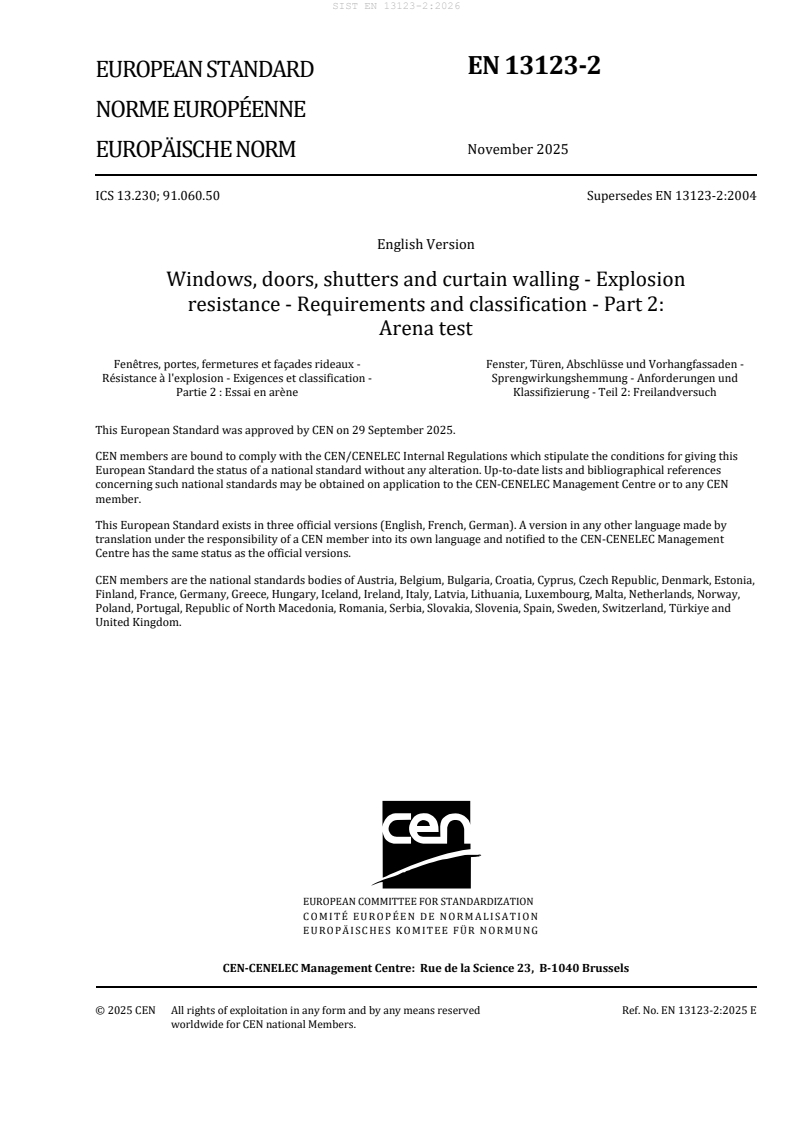
EN 13123-2
EUROPEAN STANDARD
NORME EUROPÉENNE
November 2025
EUROPÄISCHE NORM
ICS 13.230; 91.060.50 Supersedes EN 13123-2:2004
English Version
Windows, doors, shutters and curtain walling - Explosion
resistance - Requirements and classification - Part 2:
Arena test
Fenêtres, portes, fermetures et façades rideaux - Fenster, Türen, Abschlüsse und Vorhangfassaden -
Résistance à l'explosion - Exigences et classification - Sprengwirkungshemmung - Anforderungen und
Partie 2 : Essai en arène Klassifizierung - Teil 2: Freilandversuch
This European Standard was approved by CEN on 29 September 2025.
CEN members are bound to comply with the CEN/CENELEC Internal Regulations which stipulate the conditions for giving this
European Standard the status of a national standard without any alteration. Up-to-date lists and bibliographical references
concerning such national standards may be obtained on application to the CEN-CENELEC Management Centre or to any CEN
member.
This European Standard exists in three official versions (English, French, German). A version in any other language made by
translation under the responsibility of a CEN member into its own language and notified to the CEN-CENELEC Management
Centre has the same status as the official versions.
CEN members are the national standards bodies of Austria, Belgium, Bulgaria, Croatia, Cyprus, Czech Republic, Denmark, Estonia,
Finland, France, Germany, Greece, Hungary, Iceland, Ireland, Italy, Latvia, Lithuania, Luxembourg, Malta, Netherlands, Norway,
Poland, Portugal, Republic of North Macedonia, Romania, Serbia, Slovakia, Slovenia, Spain, Sweden, Switzerland, Türkiye and
United Kingdom.
EUROPEAN COMMITTEE FOR STANDARDIZATION
COMITÉ EUROPÉEN DE NORMALISATION
EUROPÄISCHES KOMITEE FÜR NORMUNG
CEN-CENELEC Management Centre: Rue de la Science 23, B-1040 Brussels
© 2025 CEN All rights of exploitation in any form and by any means reserved Ref. No. EN 13123-2:2025 E
worldwide for CEN national Members.
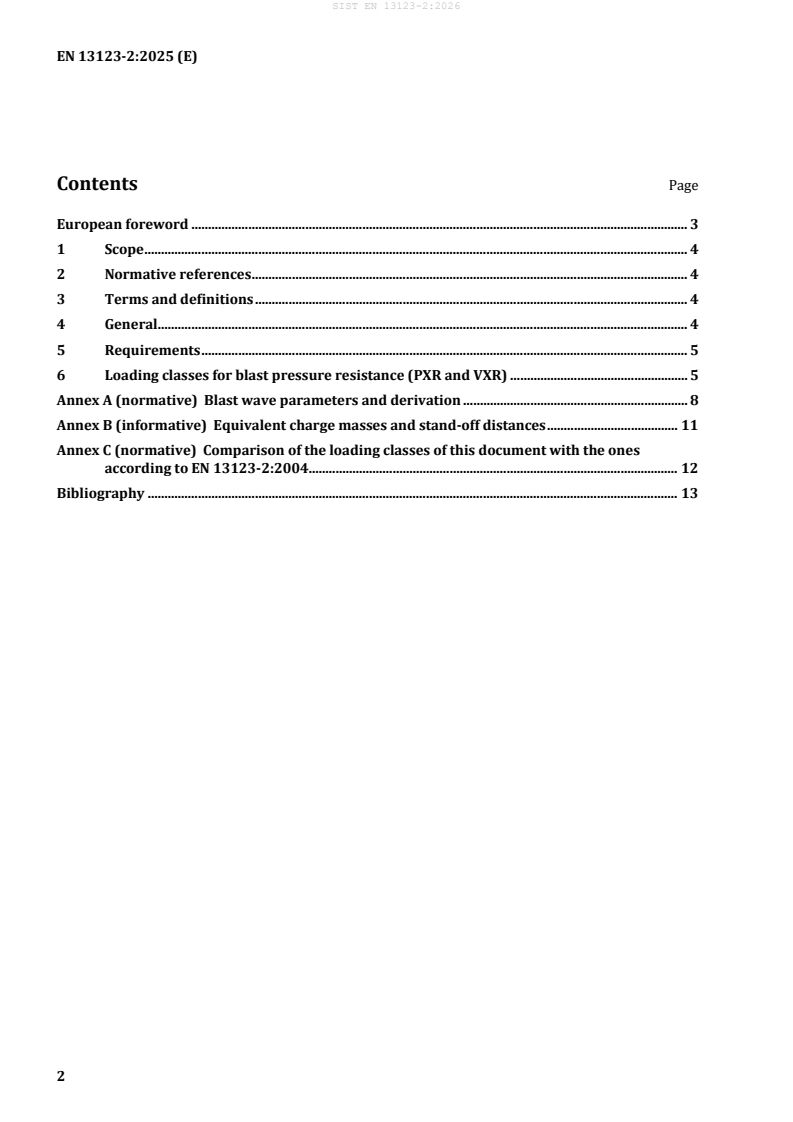
Contents Page
European foreword . 3
1 Scope . 4
2 Normative references . 4
3 Terms and definitions . 4
4 General. 4
5 Requirements . 5
6 Loading classes for blast pressure resistance (PXR and VXR) . 5
Annex A (normative) Blast wave parameters and derivation . 8
Annex B (informative) Equivalent charge masses and stand-off distances . 11
Annex C (normative) Comparison of the loading classes of this document with the ones
according to EN 13123-2:2004. 12
Bibliography . 13
European foreword
This document (EN 13123-2:2025) has been prepared by Technical Committee CEN/TC 33 “Doors,
windows, shutters, building hardware and curtain walling”, the secretariat of which is held by AFNOR.
This European Standard shall be given the status of a national standard, either by publication of an
identical text or by endorsement, at the latest by May 2026 and conflicting national standards shall be
withdrawn at the latest by May 2026.
Attention is drawn to the possibility that some of the elements of this document may be the subject of
patent rights. CEN shall not be held responsible for identifying any or all such patent rights.
This document supersedes EN 13123-2:2004.
— inclusion of testing of curtain walling;
— inclusion of additional classes for small and large changes and user defined load class;
— editorial changes.
The EN 13123 series of standards Windows, doors, shutters and curtain walling — Explosion resistance —
Requirements and classification currently consists of:
— Part 1: Shock tube;
— Part 2: Arena test.
Any feedback and questions on this document should be directed to the users’ national standards body.
A complete listing of these bodies can be found on the CEN website.
According to the CEN-CENELEC Internal Regulations, the national standards organizations of the
following countries are bound to implement this European Standard: Austria, Belgium, Bulgaria, Croatia,
Cyprus, Czech Republic, Denmark, Estonia, Finland, France, Germany, Greece, Hungary, Iceland, Ireland,
Italy, Latvia, Lithuania, Luxembourg, Malta, Netherlands, Norway, Poland, Portugal, Republic of North
Macedonia, Romania, Serbia, Slovakia, Slovenia, Spain, Sweden, Switzerland, Türkiye and the United
Kingdom.
1 Scope
This document specifies the requirements and classification for assessing the explosive resistance of
windows, doors, shutters as well as curtain walling elements, complete with their frames, infills and
fixings, for use in both internal and external locations in buildings, when submitted to an arena test in
accordance with EN 13124-2:2025. This document gives no information on the explosion resistance
capacity of the wall or other surrounding structure.
2 Normative references
The following documents are referred to in the text in such a way that some or all of their content
constitutes requirements of this document. For dated references, only the edition cited applies. For
undated references, the latest edition of the referenced document (including any amendments) applies.
EN 12216, Shutters, external blinds, internal blinds — Terminology, glossary and definitions
EN 12519, Windows and pedestrian doors — Terminology
EN 13119, Curtain walling — Terminology
EN 13123-1:2025, Windows, doors, shutters and curtain walling — Explosion resistance — Requirements
and classification — Part 1: Shock tube
EN 13123-2:2004, Windows, doors, and shutters — Explosion resistance — Requirements and classification
- Part 2: Range test
EN 13124-1:2025, Windows, doors, shutters and curtain walling — Explosion resistance — Test method —
Part 1: Shock tube
EN 13124-2:2025, Windows, doors, shutters and curtain walling — Explosion resistance — Test method —
Part 2: Arena test
3 Terms and definitions
For the purposes of this document, the terms and definitions given in EN 12216, EN 12519, EN 13119
and EN 13124-2:2025 apply.
ISO and IEC maintain terminology databases for use in standardization at the following addresses:
— ISO Online browsing platform: available at https://www.iso.org/obp/
— IEC Electropedia: available at https://www.electropedia.org/
4 General
This document considers free-field high explosive events equivalent to:
— 3 kg to 20 kg TNT equivalent at distances from 3 m to 9 m, described by the loading classes PXR 1 to
PXR 7;
— 100 kg to 500 kg TNT equivalent at distances from about 15 m to 30 m, described by the loading
classes VXR 1 to VXR 7.
Other explosive scenarios can be characterized by user-defined loading classes (PXRU or VXRU) for high
explosive detonations.
Load profiles, which cannot be reproduced by an arena test shall be reproduced by shock tube testing
according to EN 13123-1:2025 and EN 13124-1:2025.
5 Requirements
Resistance to damage and pressure shall be classified in accordance with Clause 6. This document
provides the option to do tests either:
a) for fixed loading classes (PXR and VXR classes); or
b) for user-defined loading class (PXU and VXU classes) with specified parameters for peak positive
reflected pressure and peak positive reflected specific impulse.
To achieve a particular loading class of explosion resistance, the test specimen shall:
a) be subjected to not less than the corresponding test level of each of peak positive reflected pressure,
peak positive reflected specific impulse specified in Clause 6, Table 1, Table 2 and Figure 1;
b) achieve an internal hazard class as specified in EN 13124-2:2025, 11.2;
c) if required by the test client, achieve an external hazard class as specified in EN 13124-2 :2025, 11.3.
It is not a requirement of the test that performance in other respects such as air permeability, water
tightness, wind resistance, etc. be maintained.
If the intended application of the window, door, shutter and curtain walling is such that it will be
specifically subjected to climatic extremes, the test specimen shall be tested at these climatic extremes if
required by the test client.
Requirements for the performance of opening and locking mechanisms or for testing in an open condition
may also be tested if required by the test client.
Care should be taken to ensure that all joints between the wall and the window or door have protection,
which is at least equal to that of the window or door, shutter and curtain walling.
6 Loading classes for blast pressure resistance (PXR and VXR)
The loading class of a test specimen is permitted for both:
a) predefined loading classes (PXR 1 to PXR 7 and VXR 1 to VXR 7) with respect to peak positive
reflected pressure and peak positive reflected specific impulse (Table 1 and Table 2). When a tested
test specimen achieves a particular loading class it also automatically achieves all classes
characterized by lower peak pressure and lower peak positive reflected specific impulse at the same
hazard level(s).
b) user-defined loading classes described by peak positive reflected pressure and peak positive
reflected specific impulse complementing the PXR and VXR classes to a wide range of possible
loading classes suitable for various blast scenarios due to high explosive detonations.
Table 1 — Blast parameters of the blast wave generated in arena tests for small charges
Minimum peak positive Minimum peak positive
reflected press
...