

SIST EN 300 392-12-21 V1.4.1:2011
(Main)Terrestrial Trunked Radio (TETRA) - Voice plus Data (V+D) - Part 12: Supplementary services stage 3 - Sub-part 21: Ambience Listening (AL)
- Abstract
The present document defines the stage 3 specification of the Supplementary Service Ambience Listening (SS-AL) for the Terrestrial Trunked Radio (TETRA). Stage 3 defines the signalling system protocols and switching functions needed to implement the service described in stage 1 and stage 2.
Charging principles and Man-Machine Interface (MMI) are outside the scope of the present document.
The SS-AL enables the served user to place a TETRA Mobile Station (MS) into a special type of voice call whereby the called MS transmits without any action from, or indication to, the affected user. The SS-AL call can include a second listening party. The affected user can ask other user to set an SS-AL call on him.
- Status
- Published
- Publication Date
- 23-Jun-2011
- Technical Committee
- MOC - Mobile Communications
- Current Stage
- 6060 - National Implementation/Publication (Adopted Project)
- Start Date
- 03-May-2011
- Due Date
- 08-Jul-2011
- Completion Date
- 24-Jun-2011
Buy Documents
en_3003921221v010400o - Terrestrial Trunked Radio (TETRA); Voice plus Data (V+D); Part 12: Supplementary services stage 3; Sub-part 21: Ambience Listening (AL)
en_3003921221v010401p - Terrestrial Trunked Radio (TETRA); Voice plus Data (V+D); Part 12: Supplementary services stage 3; Sub-part 21: Ambience Listening (AL)

SIST EN 300 392-12-21 V1.4.1:2011 is the Slovenian adoption of ETSI EN 300 392-12-21 V1.4.1 for Terrestrial Trunked Radio (TETRA) Voice plus Data (V+D). It specifies the stage 3 signalling protocols and switching functions for the Ambience Listening (AL) supplementary service. The document is for TETRA MS/LS and SwMI implementers who need to support, test or integrate AL behavior.
What does SIST EN 300 392-12-21 V1.4.1:2011 specify?
SIST EN 300 392-12-21 V1.4.1:2011 defines the SS-AL service description in clause 4 and the signalling protocol in clause 5. It excludes charging principles and Man-Machine Interface (MMI). The document covers service primitives, parameter coding, state definitions, procedures for the served user, affected user and second listening party, and interactions with other supplementary services.
| Annex | What it covers |
|---|---|
| Annex A | SS-AL Call request |
| Annex B | INTERROGATE ACK PDU encoding |
| Annex C | INVOKE1 and INVOKE1 ACK PDUs encoding |
| Annex D | Change requests |
What are the key requirements of SIST EN 300 392-12-21 V1.4.1:2011?
Service roles and service primitives
SIST EN 300 392-12-21 V1.4.1:2011 centers on three roles: the served user, the affected user and the second listening party. The affected user is always an individual user, while the second listening party may be an individual user or a group. In practice, these role definitions drive which identities may appear in the signalling.
The TNSS-SAP primitives are different for each role. The served user has INTERROGATE, INVOKE1, INVOKE2, INVOKE3 and STOP LISTENING; the affected user has INVOKE and INVOKE ACK; the second listening party has INFORMATION. INVOKE1 support is mandatory for the served user MS, INVOKE indication and INVOKE ACK are mandatory for the affected user MS, and INVOKE2 or INVOKE3 are optional depending on the use case.
PDU coding and addressing
SIST EN 300 392-12-21 V1.4.1:2011 defines how AL information is carried in call-control PDUs, D-FACILITY/U-FACILITY PDUs and notification indicators. The key notification values are "AL operation" for the affected user and "AL call or speech item" for the second listening party. That matters because the network must route and label the call so that the wrong user interface is not exposed.
Addressing uses SNA, SSI or TSI, and the PDU fields change with the address type identifier. The document also defines result fields such as accepted, busy, not authorized, unknown TETRA identity and parameters not valid. This gives implementers a fixed message format for success and failure handling.
Procedures and service behavior
SIST EN 300 392-12-21 V1.4.1:2011 sets separate procedures for the served user MS/LS, the affected user MS/LS, the SwMI and the second listening party. The served user can interrogate, invoke AL, add a second listening party and stop listening during an ongoing call. The SwMI checks authorization, busy conditions and support for SS-AL, then returns the matching acknowledgment or rejection.
For an active AL call, the affected user MS receives the INVOKE PDU and may accept or reject it, but the user is not given an AL-specific MMI indication. The document also allows a second listening party to join, and the second listening party sees the AL traffic as call traffic with AL indication. SS-AL takes precedence over Call Forwarding, and a new SS-AL request can be rejected if the user is already being ambience listened to.
What terms does SIST EN 300 392-12-21 V1.4.1:2011 define?
- affected user - the user to whom the served user is listening.
- Ambience Listening (AL) call - a call in which ambience listening is requested, where the called MS transmits without action from or indication to the affected user.
- served user - the user who invokes SS-AL and listens to the affected user.
- second listening party - a TETRA individual or group that additionally listens into the AL call.
- Mobile Station (MS) - the terminal that participates in the AL call at the user side.
- Switching and Management Infrastructure (SwMI) - the network entity that handles switching and service control.
- TETRA Network layer Supplementary Service - Service Access Point (TNSS-SAP) - the service boundary used for the defined primitives in the MS/LS.
Who uses SIST EN 300 392-12-21 V1.4.1:2011?
SIST EN 300 392-12-21 V1.4.1:2011 is used by TETRA terminal vendors, SwMI/network vendors, system integrators and conformance test engineers. It is especially relevant when implementing service primitives, PDU encoding, authorization checks, and interoperability at the TNSS-SAP boundary.
What changed in SIST EN 300 392-12-21 V1.4.1:2011 from the previous edition?
The document history states that it includes change requests since edition 1. The listed changes cover the Result of invocation values, an INTERROGATE ACK example, handling of timer T311 during invocation in an ongoing call, and INVOKE1 ACK PDU in D-CONNECT PDU.
Which standards are used with SIST EN 300 392-12-21 V1.4.1:2011?
| Standard | Contribution |
|---|---|
| ETSI EN 300 392-1 | General network design and identity coding |
| ETSI EN 300 392-2 | Air Interface, call control, PDU transport and general coding rules |
| ETSI EN 300 392-9 | General requirements for supplementary services |
| ETSI EN 300 392-3-2 | ISI requirements for Additional Network Feature Individual Call |
| ETSI EN 300 392-3-3 | ISI requirements for Additional Network Feature Group Call |
| ETSI EN 300 392-10-21 | Stage 1 specification for Ambience Listening |
| ETSI EN 300 392-11-21 | Stage 2 specification for Ambience Listening, used as an informative companion |
What does the SIST EN 300 392-12-21 V1.4.1:2011 document contain?
The document contains primitive definitions, parameter descriptions and PDU coding tables for AL signaling. It also gives protocol state definitions, step-by-step procedures for invocation, interrogation, second listening party handling and interruption, plus interaction rules with other supplementary services.
Annex B and Annex C provide encoding examples that help implementers build and test message formats. Annex A gives a pre-coded SS-AL call request based on U-STATUS, and Annex D records the change requests that led to this edition.
Buy Documents
en_3003921221v010400o - Terrestrial Trunked Radio (TETRA); Voice plus Data (V+D); Part 12: Supplementary services stage 3; Sub-part 21: Ambience Listening (AL)
en_3003921221v010401p - Terrestrial Trunked Radio (TETRA); Voice plus Data (V+D); Part 12: Supplementary services stage 3; Sub-part 21: Ambience Listening (AL)
Get Certified
Connect with accredited certification bodies for this standard

ANCE
Mexican certification and testing association.

Intertek Slovenia
Intertek testing, inspection, and certification services in Slovenia.

LNE (Laboratoire National de Métrologie et d'Essais)
French national laboratory for metrology and testing.
Sponsored listings
Frequently Asked Questions
SIST EN 300 392-12-21 V1.4.1:2011 is a standard published by the Slovenian Institute for Standardization (SIST). Its full title is "Terrestrial Trunked Radio (TETRA) - Voice plus Data (V+D) - Part 12: Supplementary services stage 3 - Sub-part 21: Ambience Listening (AL)". This standard covers: The present document defines the stage 3 specification of the Supplementary Service Ambience Listening (SS-AL) for the Terrestrial Trunked Radio (TETRA). Stage 3 defines the signalling system protocols and switching functions needed to implement the service described in stage 1 and stage 2. Charging principles and Man-Machine Interface (MMI) are outside the scope of the present document. The SS-AL enables the served user to place a TETRA Mobile Station (MS) into a special type of voice call whereby the called MS transmits without any action from, or indication to, the affected user. The SS-AL call can include a second listening party. The affected user can ask other user to set an SS-AL call on him.
The present document defines the stage 3 specification of the Supplementary Service Ambience Listening (SS-AL) for the Terrestrial Trunked Radio (TETRA). Stage 3 defines the signalling system protocols and switching functions needed to implement the service described in stage 1 and stage 2. Charging principles and Man-Machine Interface (MMI) are outside the scope of the present document. The SS-AL enables the served user to place a TETRA Mobile Station (MS) into a special type of voice call whereby the called MS transmits without any action from, or indication to, the affected user. The SS-AL call can include a second listening party. The affected user can ask other user to set an SS-AL call on him.
SIST EN 300 392-12-21 V1.4.1:2011 is classified under the following ICS (International Classification for Standards) categories: 33.070.10 - Terrestrial Trunked Radio (TETRA). The ICS classification helps identify the subject area and facilitates finding related standards.
SIST EN 300 392-12-21 V1.4.1:2011 is available in PDF format for immediate download after purchase. The document can be added to your cart and obtained through the secure checkout process. Digital delivery ensures instant access to the complete standard document.
Standards Content (Sample)
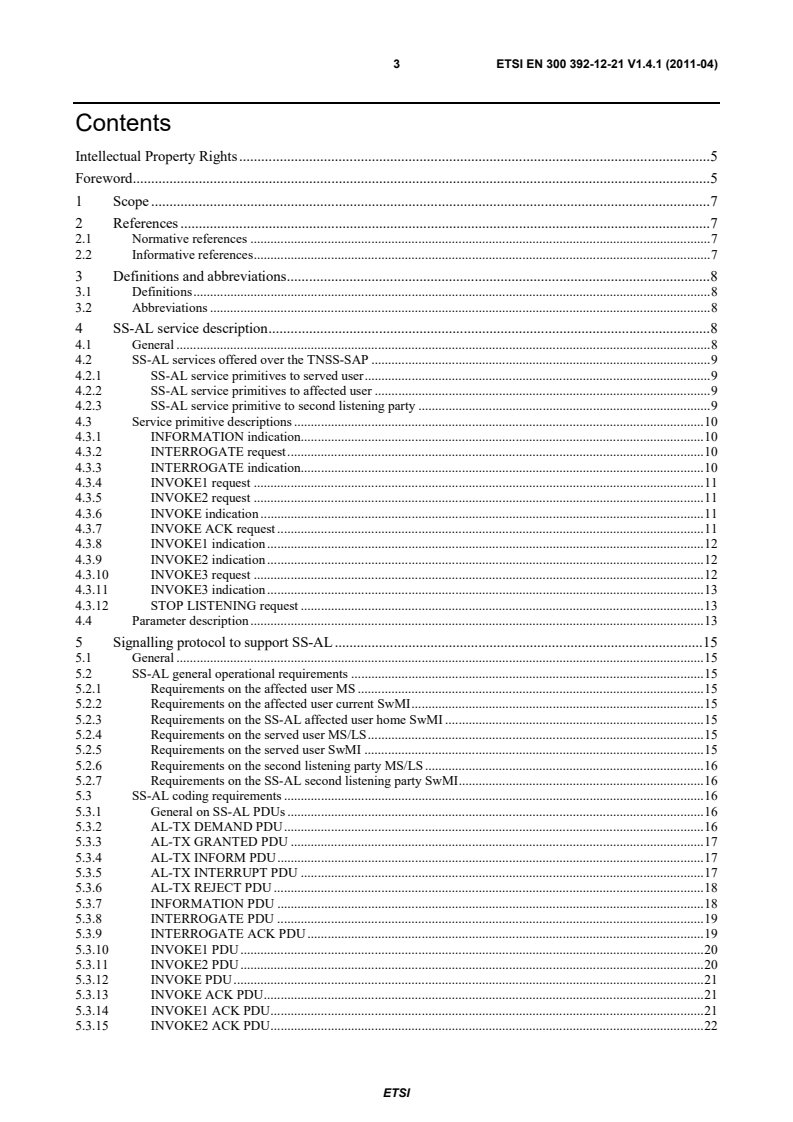
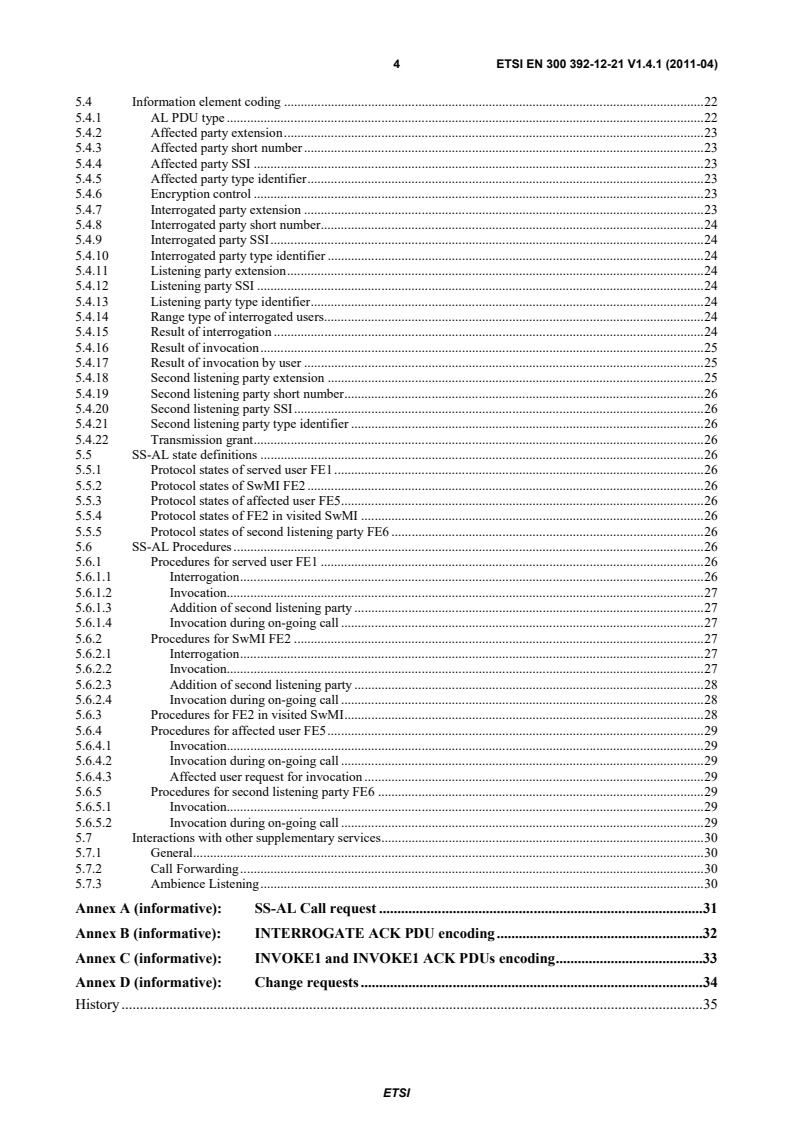
Contents
- 1 Scope
- 2 References
- 2.1 Normative references
- 2.2 Informative references
- 8 Final draft ETSI EN 300 392-12-21 V1.4.0 (2010-12)
- 3 Definitions and abbreviations
- 3.1 Definitions
- 3.2 Abbreviations
- 4 SS-AL service description
- 4.1 General
- 9 Final draft ETSI EN 300 392-12-21 V1.4.0 (2010-12)
- 4.2 SS-AL services offered over the TNSS-SAP
- 10 Final draft ETSI EN 300 392-12-21 V1.4.0 (2010-12)
- 4.3 Service primitive descriptions
- 11 Final draft ETSI EN 300 392-12-21 V1.4.0 (2010-12)
- 12 Final draft ETSI EN 300 392-12-21 V1.4.0 (2010-12)
- 13 Final draft ETSI EN 300 392-12-21 V1.4.0 (2010-12)
- 4.4 Parameter description
- 14 Final draft ETSI EN 300 392-12-21 V1.4.0 (2010-12)
- 15 Final draft ETSI EN 300 392-12-21 V1.4.0 (2010-12)
- 5 Signalling protocol to support SS-AL
- 5.1 General
- 5.2 SS-AL general operational requirements
- 16 Final draft ETSI EN 300 392-12-21 V1.4.0 (2010-12)
- 5.3 SS-AL coding requirements
- 17 Final draft ETSI EN 300 392-12-21 V1.4.0 (2010-12)
- 18 Final draft ETSI EN 300 392-12-21 V1.4.0 (2010-12)
- 19 Final draft ETSI EN 300 392-12-21 V1.4.0 (2010-12)
- 20 Final draft ETSI EN 300 392-12-21 V1.4.0 (2010-12)
- 21 Final draft ETSI EN 300 392-12-21 V1.4.0 (2010-12)
- 22 Final draft ETSI EN 300 392-12-21 V1.4.0 (2010-12)
- 5.4 Information element coding
- 23 Final draft ETSI EN 300 392-12-21 V1.4.0 (2010-12)
- 01 SSI
- 10 TSI
- 24 Final draft ETSI EN 300 392-12-21 V1.4.0 (2010-12)
- 25 Final draft ETSI EN 300 392-12-21 V1.4.0 (2010-12)
- 26 Final draft ETSI EN 300 392-12-21 V1.4.0 (2010-12)
- 5.5 SS-AL state definitions
- 5.6 SS-AL Procedures
- 27 Final draft ETSI EN 300 392-12-21 V1.4.0 (2010-12)
- 28 Final draft ETSI EN 300 392-12-21 V1.4.0 (2010-12)
- 29 Final draft ETSI EN 300 392-12-21 V1.4.0 (2010-12)
- 30 Final draft ETSI EN 300 392-12-21 V1.4.0 (2010-12)
- 5.7 Interactions with other supplementary services
- 31 Final draft ETSI EN 300 392-12-21 V1.4.0 (2010-12)
- 32 Final draft ETSI EN 300 392-12-21 V1.4.0 (2010-12)
- 1 Interrogated Party type identifier 2 1 M 1 SSI
- 2 Interrogated Party type identifier 2 1 M 1 SSI
- 3 Interrogated Party type identifier 2 1 M 1 SSI
- 33 Final draft ETSI EN 300 392-12-21 V1.4.0 (2010-12)
- 34 Final draft ETSI EN 300 392-12-21 V1.4.0 (2010-12)
- 35 Final draft ETSI EN 300 392-12-21 V1.4.0 (2010-12)
1 Scope
The present document defines the stage 3 specification of the Supplementary Service Ambience Listening (SS-AL) for the Terrestrial Trunked Radio (TETRA). Stage 3 defines the signalling system protocols and switching functions needed to implement the service described in stage 1 and stage 2. Charging principles and Man-Machine Interface (MMI) are outside the scope of the present document. The SS-AL enables the served user to place a TETRA Mobile Station (MS) into a special type of voice call whereby the called MS transmits without any action from, or indication to, the affected user. The SS-AL call can include a second listening party. The affected user can ask other user to set an SS-AL call on him.
2 References
References are either specific (identified by date of publication and/or edition number or version number) or non-specific. For specific references, only the cited version applies. For non-specific references, the latest version of the reference document (including any amendments) applies.
Referenced documents which are not found to be publicly available in the expected location might be found at http://docbox.etsi.org/Reference.
NOTE: While any hyperlinks included in this clause were valid at the time of publication ETSI cannot guarantee their long term validity.
2.1 Normative references
The following referenced documents are necessary for the application of the present document. [1] ETSI EN 300 392-2: "Terrestrial Trunked Radio (TETRA); Voice plus Data (V+D); Part 2: Air Interface (AI)".
[2] ETSI EN 300 392-1: "Terrestrial Trunked Radio (TETRA); Voice plus Data (V+D); Part 1: General network design".
[3] ETSI EN 300 392-9: "Terrestrial Trunked Radio (TETRA); Voice plus Data (V+D); Part 9: General requirements for supplementary services".
[4] ETSI EN 300 392-3-2: "Terrestrial Trunked Radio (TETRA); Voice plus Data (V+D); Part 3: Interworking at the Inter-System Interface (ISI); Sub-part 2: Additional Network Feature Individual Call (ANF-ISIIC)".
[5] ETSI EN 300 392-3-3: "Terrestrial Trunked Radio (TETRA); Voice plus Data (V+D); Part 3: Interworking at the Inter-System Interface (ISI); Sub-part 3: Additional Network Feature Group Call (ANF-ISIGC)".
[6] ETSI EN 300 392-10-21: "Terrestrial Trunked Radio (TETRA); Voice plus Data (V+D); Part 10: Supplementary services stage 1; Sub-part 21: Ambience Listening (AL)".
2.2 Informative references
The following referenced documents are not necessary for the application of the present document but they assist the user with regard to a particular subject area.
[i.1] ETSI EN 300 392-11-21: "Terrestrial Trunked Radio (TETRA); Voice plus Data (V+D); Part 11: Supplementary services stage 2; Sub-part 21: Ambience Listening (AL)". ETSI
8 Final draft ETSI EN 300 392-12-21 V1.4.0 (2010-12)
3 Definitions and abbreviations
3.1 Definitions
For the purposes of the present document, the following terms and definitions apply:
affected user: user to whom the served user is listening Ambience Listening (AL) call: call in which ambience listening functionality is requested NOTE: During an AL call, the affected user's MS transmits without any action from, or indication to, the affected user.
second listening party: TETRA individual or group which additionally listens into the AL call served user: user who invokes this supplementary service and listens to the affected user
3.2 Abbreviations
For the purposes of the present document, the following abbreviations apply:
AL Ambience Listening CC Call Control CFB Call Forwarding on Busy CLIR Calling Line Identification Restriction CMCE Circuit Mode Control Entity FE Functional Entity GSSI Group Short Subscriber Identity ISI Inter-System Interface ISSI Individual Short Subscriber Identity ITSI Individual TETRA Subscriber Identity LS Line Station MMI Man-Machine Interface MS Mobile Station PDU Protocol Data Unit SAP Service Access Point SDL (Functional) Specification and Description Language SNA Short Number Address SS Supplementary Service NOTE: The abbreviation SS is only used when referring to a specific supplementary service. SSI Short Subscriber Identity SwMI Switching and Management Infrastructure TNSS-SAP TETRA Network layer Supplementary Service - Service Access Point TSI TETRA Subscriber Identity
4 SS-AL service description
4.1 General
The SS-AL enables the served user to place a TETRA Mobile Station (MS) into a special type of voice call teleservice whereby the called MS transmits without any action from, or indication to, the affected user. The affected user shall be an individual user. The SS-AL call may include a second listening party. The second listening party may be either individual user or a group.
ETSI
9 Final draft ETSI EN 300 392-12-21 V1.4.0 (2010-12)
Clauses 4.2 and 4.3 describe SS-AL specific services offered by the Circuit Mode Control Entity (CMCE) at the Supplementary Services service access point (TNSS-SAP) of the TETRA voice plus data layer 3 service boundary. The SS-AL service access point is used in conformance testing as a normative boundary in TETRA Mobile Stations (MSs). NOTE 1: As the present document only deals with the SS-AL all the service primitives has been shown without a TNSS-AL-prefix e.g. the TNSS-AL-INVOKE request is shorten into an INVOKE request. The services offered to users of SS-AL are defined as service primitives containing service parameters. The service primitives are defined in clauses 4.2 and 4.3 and the service parameters are defined in clause 4.4. In addition to the defined service primitives a SwMI may respond by a service not supported or a process not supported primitives as appropriate, refer EN 300 392-9 [3].
NOTE 2: As the present document does not describe a man-machine interface nor user applications the service primitives are used to define information exchange to and from the standardized part of the MS/LS. Those primitives may not be accessible directly nor indirectly.
Examples of information flows are presented in EN 300 392-11-21 [i.1].
4.2 SS-AL services offered over the TNSS-SAP
4.2.1 SS-AL service primitives to served user
The SS-AL service primitives at the served user MS/LS (FE1) TNSS-SAP are:
a) INTERROGATE request; b) INTERROGATE indication; c) INVOKE1 request; d) INVOKE1 indication; e) INVOKE2 request; f) INVOKE2 indication; g) INVOKE3 request; h) INVOKE3 indication; and i) STOP LISTENING request.
4.2.2 SS-AL service primitives to affected user
The SS-AL service primitives at the affected user MS/LS (FE5) TNSS-SAP are:
a) INVOKE indication; and b) INVOKE ACK request.
4.2.3 SS-AL service primitive to second listening party
The SS-AL service primitive at the second listening party MS/LS (FE6) TNSS-SAP is:
a) INFORMATION indication.
NOTE: In the present document primitives request and indication are used instead of request and confirmation as there may not be a one to one correspondence between those primitives, e.g. there can be multiple responses as indications due to a single request.
ETSI
10 Final draft ETSI EN 300 392-12-21 V1.4.0 (2010-12)
The information contained in the following argument description tables correspond to the following key:
- C/O/M: conditional/optional/mandatory;
- Remark: comment.
4.3 Service primitive descriptions
4.3.1 INFORMATION indication
The INFORMATION indication shall be presented to the application from FE6 to indicate to the second listening party that the incoming call is an ambience listening call. The primitive shall contain the SS-AL information parameters listed in table 1.
Table 1: INFORMATION indication primitive contents Parameter Indication Remark Affected user TETRA identity M Listening party identity O See note NOTE: This parameter is not available, when the Notification indicator is used alone.
4.3.2 INTERROGATE request
The INTERROGATE request primitive shall be offered from application to FE1 over TNSS-SAP when a served user interrogates whether an affected user is ambience listened to. The primitive shall contain the SS-AL information parameters listed in table 2.
Interrogated TETRA identity parameter is a repeatable parameter that shall define one individual number, a list of individual numbers or a range of individual numbers. There shall be at least one defined TETRA identity in a INTERROGATE request. SNA, if used, should refer to a SNA defined for served user. The implementation of INTERROGATE request is optional.
Table 2: INTERROGATE request primitive contents Parameter Request Remark Interrogated TETRA identity M Repeatable
4.3.3 INTERROGATE indication
The INTERROGATE indication primitive shall be offered from FE1 to application over TNSS-SAP as a response to a previously sent interrogation request to the served user. The primitive shall contain the SS-AL information parameters listed in table 3.
Interrogated individual TETRA identity parameter is a repeatable parameter that shall define one individual number, a list of individual numbers or a range of individual numbers. There shall be at least one defined group TETRA identity in a INTERROGATE request. SNA, if used, should refer to a SNA defined for served user. Implementation of INTERROGATE indication is mandatory, if INTERROGATE request is supported. Table 3: INTERROGATE indication primitive contents Parameter Indication Remark Interrogated TETRA identity M Repeatable Interrogation result M Repeatable
ETSI
11 Final draft ETSI EN 300 392-12-21 V1.4.0 (2010-12)
4.3.4 INVOKE1 request
The INVOKE1 request primitive shall be offered from application to FE1 over TNSS-SAP when a served user invokes an ambience listening call request. The primitive shall contain the SS-AL information parameters listed in table 4. NOTE: The corresponding basic call request contains other relevant parameters such as call priority and encryption in the basic service information.
Support of INVOKE1 request is mandatory for the served user MS. Table 4: INVOKE1 request primitive contents Parameter Request Remark Affected user identity M
4.3.5 INVOKE2 request
The INVOKE2 request primitive shall be offered from application to FE1 over TNSS-SAP when a served user requests to include a second listening party into an ongoing ambience listening call. The primitive shall contain the SS-AL information parameters listed in table 5.
NOTE: The call and affected user is implied by the service access point number in the MS and the call identifier in the air interface signalling.
The support of INVOKE2 request is optional.
Table 5: INVOKE2 request primitive contents Parameter Request Remark Second listening party identity M
4.3.6 INVOKE indication
The INVOKE indication primitive shall be offered from affected user FE5 to application over TNSS-SAP when an affected user is the recipient of an ambience listening call. The primitive shall contain no SS-AL information parameters.
Support of INVOKE indication is mandatory for the affected user MS. NOTE: Although the INVOKE indication is provided in the model to the application, the application does not provide any indication to the user through a man machine interface.
4.3.7 INVOKE ACK request
The INVOKE ACK request primitive shall be offered from the application to affected user FE5 over TNSS-SAP when an affected user responds to an ambience listening call or speech item invocation. The primitive shall contain the SS-AL information parameters listed in table 6.
Support of INVOKE ACK is mandatory for the affected user MS.
NOTE: Although the INVOKE ACK request is provided in the model by the application, the application generates the response without any user action via a man machine interface. Table 6: INVOKE ACK request primitive contents Parameter Response Remark Invocation acknowledgement M
ETSI
12 Final draft ETSI EN 300 392-12-21 V1.4.0 (2010-12)
4.3.8 INVOKE1 indication
The INVOKE1 indication primitive shall be offered from served user FE1 to the application over TNSS-SAP to inform the served user of a successful, or otherwise, invocation of an ambience listening call. The primitive shall contain the SS-AL information parameters listed in table 7. Support of INVOKE1 indication is mandatory for served user MS. Table 7: INVOKE1 indication primitive contents Parameter Indication Remark Affected user identity O See note Invocation result M NOTE: The affected user may be implicit by the call control service access point number.
4.3.9 INVOKE2 indication
The INVOKE2 indication primitive shall be offered from FE1 to the application over TNSS-SAP to inform the served user of a successful, or otherwise, inclusion of a second listening party into an ongoing ambience listening call. The primitive shall contain the SS-AL information parameters listed in table 8. NOTE: The call and affected user is implied by the service access point number and the call identifier in the air interface signalling.
The support of INVOKE2 indication is mandatory, if INVOKE2 request is supported. Table 8: INVOKE2 indication primitive contents Parameter Confirm Remark Second listening party M Invocation2 result M
4.3.10 INVOKE3 request
The INVOKE3 request primitive shall be offered from application to FE1 over TNSS-SAP when a served user invokes an ambience listening during an ongoing call. The primitive shall contain the SS-AL information parameters listed in table 9.
NOTE: The INVOKE3 request contains equivalents of those parameters, which are in the basic call set-up message, refer to INVOKE1 request. If not provided by the application, then call control may use default values.
The support of INVOKE3 request is optional.
Table 9: INVOKE3 request primitive contents Parameter Request Remark Affected user TETRA identity M TX demand priority O Encryption control O
ETSI
13 Final draft ETSI EN 300 392-12-21 V1.4.0 (2010-12)
4.3.11 INVOKE3 indication
The INVOKE3 indication primitive shall be offered from served user FE1 to the application over TNSS-SAP to inform the served user of a successful, or otherwise, invocation of an ambience listening speech item. The INVOKE3 primitive shall contain the SS-AL information parameters as listed in table 10. Support of INVOKE3 indication is mandatory, if INVOKE3 request is supported. Table 10: INVOKE3 indication primitive contents Parameter Confirm Remark Invocation result M
4.3.12 STOP LISTENING request
The STOP LISTENING request primitive shall be offered from application to FE1 over TNSS-SAP when a served user stops an ambience listening during an ongoing call. The primitive shall contain no SS-AL information parameters. The support of STOP LISTENING request is mandatory, if INVOKE3 request is supported.
4.4 Parameter description
Affected user identity = - Short Number Address (SNA); - Short Subscriber Identity (SSI); or - TETRA Subscriber Identity (TSI = SSI + Address Extension).
NOTE 1: When a Short Number Address is used it refers to SS-SNA definitions for the served user. Interrogation result = - rejected for undefined reason; - invoked; - service not invoked for TETRA identity; - user not authorized; - unknown TETRA identity; - parameters not valid; or - insufficient information.
Interrogated identity = - Short Number Address (SNA); - Short Subscriber Identity (SSI); or - TETRA Subscriber Identity (TSI = SSI + Address Extension).
NOTE 2: When a Short Number Address is used it refers to SS-SNA definitions for the served user. ETSI
14 Final draft ETSI EN 300 392-12-21 V1.4.0 (2010-12)
Invocation acknowledgement = - rejected for undefined reason; - user busy; or - accepted.
Invocation result = - rejected for undefined reason; - accepted; - service not supported; - user not authorized; - affected user busy; - unknown TETRA identity; - parameters not valid; or - insufficient information.
Invocation2 result = - rejected for undefined reason; - accepted; - service not supported; - user not authorized; - second listening party not included; - unknown TETRA identity; - parameters not valid; or - insufficient information.
Listening party identity = - Short Subscriber Identity (SSI); or - TETRA Subscriber Identity (TSI = SSI + Address Extension).
Second listening party identity = - Short Number Address (SNA); - Short Subscriber Identity (SSI); or - TETRA Subscriber Identity (TSI = SSI + Address Extension).
NOTE 3: When a Short Number Address is used it refers to SS-SNA definitions for the served user. ETSI
15 Final draft ETSI EN 300 392-12-21 V1.4.0 (2010-12)
5 Signalling protocol to support SS-AL
5.1 General
The SS-AL layer 3 requirements and protocol for the SS-AL services is specified in clauses 5.2 to 5.6. The SS-AL protocol comprises of sub-protocols defined for SS and call control within CMCE. These SS-AL sub-protocols complement the call control protocol defined in EN 300 392-2 [1], clause 14. The present document is only normative for the protocol architecture and user application SAPs within the MS/LS, but gives an informative description of the protocol and the SAPs within the SwMI.
NOTE: The internal communication between processes within CMCE is outside the scope of the present document and will only be mentioned as informative statements.
5.2 SS-AL general operational requirements
5.2.1 Requirements on the affected user MS
The affected user MS/LS supporting FE5 shall comply with the requirements in clause 14 of EN 300 392-2 [1], which apply to the individual speech call service.
NOTE: In addition, the affected user MS recognizes the Notification indicator value "AL operation", answers the call and will not to give any indication to the user as defined in EN 300 392-9 [3], clause 7.2.2.
5.2.2 Requirements on the affected user current SwMI
That SwMI shall support the affected user MS complying with the requirements for individual calls and if second listening party is supported the requirements for groups calls set in EN 300 392-2 [1], clause 14 and in EN 300 392-9 [3]. If the call is over the ISI, the affected user current SwMI shall comply with the corresponding ISI requirements set in EN 300 392-3-2 [4] for individual calls and if second listening party is supported EN 300 392-3-3 [5] for group calls.
If the affected user current SwMI set-up SS-AL call to the affected user without involvement of the home SwMI of the affected user, it shall generate the Notification indicator value "AL operation" as defined in EN 300 392-9 [3], clause 7.2.2. If the current SwMI knows that the affected user MS does not support SS-AL, then it should not set-up an SS-AL call to the affected user, refer to EN 300 392-9 [3], clause 7.2.2. It is outside the scope of the present document how the SwMI knows whether the affected user supports SS-AL or not.
5.2.3 Requirements on the SS-AL affected user home SwMI
In addition to the requirements set in clause 5.2.2 the affected user home SwMI may recognize whether the affected user MS supports SS-AL. If the home SwMI knows that the affected user MS does not support SS-AL, then it should not set-up an SS-AL call to the affected user, refer to EN 300 392-9 [3], clause 7.2.2. It is outside the scope of the present document how the SwMI knows whether the affected user supports SS-AL or not.
5.2.4 Requirements on the served user MS/LS
The calling user MS/LS shall comply with the call setup and call release requirements of EN 300 392-2 [1], clause 14.
...
Contents
- 1 Scope
- 2 References
- 2.1 Normative references
- 2.2 Informative references
- 8 ETSI EN 300 392-12-21 V1.4.1 (2011-04)
- 3 Definitions and abbreviations
- 3.1 Definitions
- 3.2 Abbreviations
- 4 SS-AL service description
- 4.1 General
- 9 ETSI EN 300 392-12-21 V1.4.1 (2011-04)
- 4.2 SS-AL services offered over the TNSS-SAP
- 10 ETSI EN 300 392-12-21 V1.4.1 (2011-04)
- 4.3 Service primitive descriptions
- 11 ETSI EN 300 392-12-21 V1.4.1 (2011-04)
- 12 ETSI EN 300 392-12-21 V1.4.1 (2011-04)
- 13 ETSI EN 300 392-12-21 V1.4.1 (2011-04)
- 4.4 Parameter description
- 14 ETSI EN 300 392-12-21 V1.4.1 (2011-04)
- 15 ETSI EN 300 392-12-21 V1.4.1 (2011-04)
- 5 Signalling protocol to support SS-AL
- 5.1 General
- 5.2 SS-AL general operational requirements
- 16 ETSI EN 300 392-12-21 V1.4.1 (2011-04)
- 5.3 SS-AL coding requirements
- 17 ETSI EN 300 392-12-21 V1.4.1 (2011-04)
- 18 ETSI EN 300 392-12-21 V1.4.1 (2011-04)
- 19 ETSI EN 300 392-12-21 V1.4.1 (2011-04)
- 20 ETSI EN 300 392-12-21 V1.4.1 (2011-04)
- 21 ETSI EN 300 392-12-21 V1.4.1 (2011-04)
- 22 ETSI EN 300 392-12-21 V1.4.1 (2011-04)
- 5.4 Information element coding
- 23 ETSI EN 300 392-12-21 V1.4.1 (2011-04)
- 01 SSI
- 10 TSI
- 24 ETSI EN 300 392-12-21 V1.4.1 (2011-04)
- 25 ETSI EN 300 392-12-21 V1.4.1 (2011-04)
- 26 ETSI EN 300 392-12-21 V1.4.1 (2011-04)
- 5.5 SS-AL state definitions
- 5.6 SS-AL Procedures
- 27 ETSI EN 300 392-12-21 V1.4.1 (2011-04)
- 28 ETSI EN 300 392-12-21 V1.4.1 (2011-04)
- 29 ETSI EN 300 392-12-21 V1.4.1 (2011-04)
- 30 ETSI EN 300 392-12-21 V1.4.1 (2011-04)
- 5.7 Interactions with other supplementary services
- 31 ETSI EN 300 392-12-21 V1.4.1 (2011-04)
- 32 ETSI EN 300 392-12-21 V1.4.1 (2011-04)
- 1 Interrogated Party type identifier 2 1 M 1 SSI
- 2 Interrogated Party type identifier 2 1 M 1 SSI
- 3 Interrogated Party type identifier 2 1 M 1 SSI
- 33 ETSI EN 300 392-12-21 V1.4.1 (2011-04)
- 34 ETSI EN 300 392-12-21 V1.4.1 (2011-04)
- 35 ETSI EN 300 392-12-21 V1.4.1 (2011-04)
1 Scope
The present document defines the stage 3 specification of the Supplementary Service Ambience Listening (SS-AL) for the Terrestrial Trunked Radio (TETRA). Stage 3 defines the signalling system protocols and switching functions needed to implement the service described in stage 1 and stage 2. Charging principles and Man-Machine Interface (MMI) are outside the scope of the present document. The SS-AL enables the served user to place a TETRA Mobile Station (MS) into a special type of voice call whereby the called MS transmits without any action from, or indication to, the affected user. The SS-AL call can include a second listening party. The affected user can ask other user to set an SS-AL call on him.
2 References
References are either specific (identified by date of publication and/or edition number or version number) or non-specific. For specific references, only the cited version applies. For non-specific references, the latest version of the reference document (including any amendments) applies.
Referenced documents which are not found to be publicly available in the expected location might be found at http://docbox.etsi.org/Reference.
NOTE: While any hyperlinks included in this clause were valid at the time of publication ETSI cannot guarantee their long term validity.
2.1 Normative references
The following referenced documents are necessary for the application of the present document. [1] ETSI EN 300 392-2: "Terrestrial Trunked Radio (TETRA); Voice plus Data (V+D); Part 2: Air Interface (AI)".
[2] ETSI EN 300 392-1: "Terrestrial Trunked Radio (TETRA); Voice plus Data (V+D); Part 1: General network design".
[3] ETSI EN 300 392-9: "Terrestrial Trunked Radio (TETRA); Voice plus Data (V+D); Part 9: General requirements for supplementary services".
[4] ETSI EN 300 392-3-2: "Terrestrial Trunked Radio (TETRA); Voice plus Data (V+D); Part 3: Interworking at the Inter-System Interface (ISI); Sub-part 2: Additional Network Feature Individual Call (ANF-ISIIC)".
[5] ETSI EN 300 392-3-3: "Terrestrial Trunked Radio (TETRA); Voice plus Data (V+D); Part 3: Interworking at the Inter-System Interface (ISI); Sub-part 3: Additional Network Feature Group Call (ANF-ISIGC)".
[6] ETSI EN 300 392-10-21: "Terrestrial Trunked Radio (TETRA); Voice plus Data (V+D); Part 10: Supplementary services stage 1; Sub-part 21: Ambience Listening (AL)".
2.2 Informative references
The following referenced documents are not necessary for the application of the present document but they assist the user with regard to a particular subject area.
[i.1] ETSI EN 300 392-11-21: "Terrestrial Trunked Radio (TETRA); Voice plus Data (V+D); Part 11: Supplementary services stage 2; Sub-part 21: Ambience Listening (AL)". ETSI
8 ETSI EN 300 392-12-21 V1.4.1 (2011-04)
3 Definitions and abbreviations
3.1 Definitions
For the purposes of the present document, the following terms and definitions apply:
affected user: user to whom the served user is listening Ambience Listening (AL) call: call in which ambience listening functionality is requested NOTE: During an AL call, the affected user's MS transmits without any action from, or indication to, the affected user.
second listening party: TETRA individual or group which additionally listens into the AL call served user: user who invokes this supplementary service and listens to the affected user
3.2 Abbreviations
For the purposes of the present document, the following abbreviations apply:
AL Ambience Listening CC Call Control CFB Call Forwarding on Busy CLIR Calling Line Identification Restriction CMCE Circuit Mode Control Entity FE Functional Entity GSSI Group Short Subscriber Identity ISI Inter-System Interface ISSI Individual Short Subscriber Identity ITSI Individual TETRA Subscriber Identity LS Line Station MMI Man-Machine Interface MS Mobile Station PDU Protocol Data Unit SAP Service Access Point SDL (Functional) Specification and Description Language SNA Short Number Address SS Supplementary Service NOTE: The abbreviation SS is only used when referring to a specific supplementary service. SSI Short Subscriber Identity SwMI Switching and Management Infrastructure TNSS-SAP TETRA Network layer Supplementary Service - Service Access Point TSI TETRA Subscriber Identity
4 SS-AL service description
4.1 General
The SS-AL enables the served user to place a TETRA Mobile Station (MS) into a special type of voice call teleservice whereby the called MS transmits without any action from, or indication to, the affected user. The affected user shall be an individual user. The SS-AL call may include a second listening party. The second listening party may be either individual user or a group.
ETSI
9 ETSI EN 300 392-12-21 V1.4.1 (2011-04)
Clauses 4.2 and 4.3 describe SS-AL specific services offered by the Circuit Mode Control Entity (CMCE) at the Supplementary Services service access point (TNSS-SAP) of the TETRA voice plus data layer 3 service boundary. The SS-AL service access point is used in conformance testing as a normative boundary in TETRA Mobile Stations (MSs). NOTE 1: As the present document only deals with the SS-AL all the service primitives has been shown without a TNSS-AL-prefix e.g. the TNSS-AL-INVOKE request is shorten into an INVOKE request. The services offered to users of SS-AL are defined as service primitives containing service parameters. The service primitives are defined in clauses 4.2 and 4.3 and the service parameters are defined in clause 4.4. In addition to the defined service primitives a SwMI may respond by a service not supported or a process not supported primitives as appropriate, refer EN 300 392-9 [3].
NOTE 2: As the present document does not describe a man-machine interface nor user applications the service primitives are used to define information exchange to and from the standardized part of the MS/LS. Those primitives may not be accessible directly nor indirectly.
Examples of information flows are presented in EN 300 392-11-21 [i.1].
4.2 SS-AL services offered over the TNSS-SAP
4.2.1 SS-AL service primitives to served user
The SS-AL service primitives at the served user MS/LS (FE1) TNSS-SAP are:
a) INTERROGATE request; b) INTERROGATE indication; c) INVOKE1 request; d) INVOKE1 indication; e) INVOKE2 request; f) INVOKE2 indication; g) INVOKE3 request; h) INVOKE3 indication; and i) STOP LISTENING request.
4.2.2 SS-AL service primitives to affected user
The SS-AL service primitives at the affected user MS/LS (FE5) TNSS-SAP are:
a) INVOKE indication; and b) INVOKE ACK request.
4.2.3 SS-AL service primitive to second listening party
The SS-AL service primitive at the second listening party MS/LS (FE6) TNSS-SAP is:
a) INFORMATION indication.
NOTE: In the present document primitives request and indication are used instead of request and confirmation as there may not be a one to one correspondence between those primitives, e.g. there can be multiple responses as indications due to a single request.
ETSI
10 ETSI EN 300 392-12-21 V1.4.1 (2011-04)
The information contained in the following argument description tables correspond to the following key:
- C/O/M: conditional/optional/mandatory;
- Remark: comment.
4.3 Service primitive descriptions
4.3.1 INFORMATION indication
The INFORMATION indication shall be presented to the application from FE6 to indicate to the second listening party that the incoming call is an ambience listening call. The primitive shall contain the SS-AL information parameters listed in table 1.
Table 1: INFORMATION indication primitive contents Parameter Indication Remark Affected user TETRA identity M Listening party identity O See note NOTE: This parameter is not available, when the Notification indicator is used alone.
4.3.2 INTERROGATE request
The INTERROGATE request primitive shall be offered from application to FE1 over TNSS-SAP when a served user interrogates whether an affected user is ambience listened to. The primitive shall contain the SS-AL information parameters listed in table 2.
Interrogated TETRA identity parameter is a repeatable parameter that shall define one individual number, a list of individual numbers or a range of individual numbers. There shall be at least one defined TETRA identity in a INTERROGATE request. SNA, if used, should refer to a SNA defined for served user. The implementation of INTERROGATE request is optional.
Table 2: INTERROGATE request primitive contents Parameter Request Remark Interrogated TETRA identity M Repeatable
4.3.3 INTERROGATE indication
The INTERROGATE indication primitive shall be offered from FE1 to application over TNSS-SAP as a response to a previously sent interrogation request to the served user. The primitive shall contain the SS-AL information parameters listed in table 3.
Interrogated individual TETRA identity parameter is a repeatable parameter that shall define one individual number, a list of individual numbers or a range of individual numbers. There shall be at least one defined group TETRA identity in a INTERROGATE request. SNA, if used, should refer to a SNA defined for served user. Implementation of INTERROGATE indication is mandatory, if INTERROGATE request is supported. Table 3: INTERROGATE indication primitive contents Parameter Indication Remark Interrogated TETRA identity M Repeatable Interrogation result M Repeatable
ETSI
11 ETSI EN 300 392-12-21 V1.4.1 (2011-04)
4.3.4 INVOKE1 request
The INVOKE1 request primitive shall be offered from application to FE1 over TNSS-SAP when a served user invokes an ambience listening call request. The primitive shall contain the SS-AL information parameters listed in table 4. NOTE: The corresponding basic call request contains other relevant parameters such as call priority and encryption in the basic service information.
Support of INVOKE1 request is mandatory for the served user MS. Table 4: INVOKE1 request primitive contents Parameter Request Remark Affected user identity M
4.3.5 INVOKE2 request
The INVOKE2 request primitive shall be offered from application to FE1 over TNSS-SAP when a served user requests to include a second listening party into an ongoing ambience listening call. The primitive shall contain the SS-AL information parameters listed in table 5.
NOTE: The call and affected user is implied by the service access point number in the MS and the call identifier in the air interface signalling.
The support of INVOKE2 request is optional.
Table 5: INVOKE2 request primitive contents Parameter Request Remark Second listening party identity M
4.3.6 INVOKE indication
The INVOKE indication primitive shall be offered from affected user FE5 to application over TNSS-SAP when an affected user is the recipient of an ambience listening call. The primitive shall contain no SS-AL information parameters.
Support of INVOKE indication is mandatory for the affected user MS. NOTE: Although the INVOKE indication is provided in the model to the application, the application does not provide any indication to the user through a man machine interface.
4.3.7 INVOKE ACK request
The INVOKE ACK request primitive shall be offered from the application to affected user FE5 over TNSS-SAP when an affected user responds to an ambience listening call or speech item invocation. The primitive shall contain the SS-AL information parameters listed in table 6.
Support of INVOKE ACK is mandatory for the affected user MS.
NOTE: Although the INVOKE ACK request is provided in the model by the application, the application generates the response without any user action via a man machine interface. Table 6: INVOKE ACK request primitive contents Parameter Response Remark Invocation acknowledgement M
ETSI
12 ETSI EN 300 392-12-21 V1.4.1 (2011-04)
4.3.8 INVOKE1 indication
The INVOKE1 indication primitive shall be offered from served user FE1 to the application over TNSS-SAP to inform the served user of a successful, or otherwise, invocation of an ambience listening call. The primitive shall contain the SS-AL information parameters listed in table 7. Support of INVOKE1 indication is mandatory for served user MS. Table 7: INVOKE1 indication primitive contents Parameter Indication Remark Affected user identity O See note Invocation result M NOTE: The affected user may be implicit by the call control service access point number.
4.3.9 INVOKE2 indication
The INVOKE2 indication primitive shall be offered from FE1 to the application over TNSS-SAP to inform the served user of a successful, or otherwise, inclusion of a second listening party into an ongoing ambience listening call. The primitive shall contain the SS-AL information parameters listed in table 8. NOTE: The call and affected user is implied by the service access point number and the call identifier in the air interface signalling.
The support of INVOKE2 indication is mandatory, if INVOKE2 request is supported. Table 8: INVOKE2 indication primitive contents Parameter Confirm Remark Second listening party M Invocation2 result M
4.3.10 INVOKE3 request
The INVOKE3 request primitive shall be offered from application to FE1 over TNSS-SAP when a served user invokes an ambience listening during an ongoing call. The primitive shall contain the SS-AL information parameters listed in table 9.
NOTE: The INVOKE3 request contains equivalents of those parameters, which are in the basic call set-up message, refer to INVOKE1 request. If not provided by the application, then call control may use default values.
The support of INVOKE3 request is optional.
Table 9: INVOKE3 request primitive contents Parameter Request Remark Affected user TETRA identity M TX demand priority O Encryption control O
ETSI
13 ETSI EN 300 392-12-21 V1.4.1 (2011-04)
4.3.11 INVOKE3 indication
The INVOKE3 indication primitive shall be offered from served user FE1 to the application over TNSS-SAP to inform the served user of a successful, or otherwise, invocation of an ambience listening speech item. The INVOKE3 primitive shall contain the SS-AL information parameters as listed in table 10. Support of INVOKE3 indication is mandatory, if INVOKE3 request is supported. Table 10: INVOKE3 indication primitive contents Parameter Confirm Remark Invocation result M
4.3.12 STOP LISTENING request
The STOP LISTENING request primitive shall be offered from application to FE1 over TNSS-SAP when a served user stops an ambience listening during an ongoing call. The primitive shall contain no SS-AL information parameters. The support of STOP LISTENING request is mandatory, if INVOKE3 request is supported.
4.4 Parameter description
Affected user identity = - Short Number Address (SNA); - Short Subscriber Identity (SSI); or - TETRA Subscriber Identity (TSI = SSI + Address Extension).
NOTE 1: When a Short Number Address is used it refers to SS-SNA definitions for the served user. Interrogation result = - rejected for undefined reason; - invoked; - service not invoked for TETRA identity; - user not authorized; - unknown TETRA identity; - parameters not valid; or - insufficient information.
Interrogated identity = - Short Number Address (SNA); - Short Subscriber Identity (SSI); or - TETRA Subscriber Identity (TSI = SSI + Address Extension).
NOTE 2: When a Short Number Address is used it refers to SS-SNA definitions for the served user. ETSI
14 ETSI EN 300 392-12-21 V1.4.1 (2011-04)
Invocation acknowledgement = - rejected for undefined reason; - user busy; or - accepted.
Invocation result = - rejected for undefined reason; - accepted; - service not supported; - user not authorized; - affected user busy; - unknown TETRA identity; - parameters not valid; or - insufficient information.
Invocation2 result = - rejected for undefined reason; - accepted; - service not supported; - user not authorized; - second listening party not included; - unknown TETRA identity; - parameters not valid; or - insufficient information.
Listening party identity = - Short Subscriber Identity (SSI); or - TETRA Subscriber Identity (TSI = SSI + Address Extension).
Second listening party identity = - Short Number Address (SNA); - Short Subscriber Identity (SSI); or - TETRA Subscriber Identity (TSI = SSI + Address Extension).
NOTE 3: When a Short Number Address is used it refers to SS-SNA definitions for the served user. ETSI
15 ETSI EN 300 392-12-21 V1.4.1 (2011-04)
5 Signalling protocol to support SS-AL
5.1 General
The SS-AL layer 3 requirements and protocol for the SS-AL services is specified in clauses 5.2 to 5.6. The SS-AL protocol comprises of sub-protocols defined for SS and call control within CMCE. These SS-AL sub-protocols complement the call control protocol defined in EN 300 392-2 [1], clause 14. The present document is only normative for the protocol architecture and user application SAPs within the MS/LS, but gives an informative description of the protocol and the SAPs within the SwMI.
NOTE: The internal communication between processes within CMCE is outside the scope of the present document and will only be mentioned as informative statements.
5.2 SS-AL general operational requirements
5.2.1 Requirements on the affected user MS
The affected user MS/LS supporting FE5 shall comply with the requirements in clause 14 of EN 300 392-2 [1], which apply to the individual speech call service.
NOTE: In addition, the affected user MS recognizes the Notification indicator value "AL operation", answers the call and will not to give any indication to the user as defined in EN 300 392-9 [3], clause 7.2.2.
5.2.2 Requirements on the affected user current SwMI
That SwMI shall support the affected user MS complying with the requirements for individual calls and if second listening party is supported the requirements for groups calls set in EN 300 392-2 [1], clause 14 and in EN 300 392-9 [3]. If the call is over the ISI, the affected user current SwMI shall comply with the corresponding ISI requirements set in EN 300 392-3-2 [4] for individual calls and if second listening party is supported EN 300 392-3-3 [5] for group calls.
If the affected user current SwMI set-up SS-AL call to the affected user without involvement of the home SwMI of the affected user, it shall generate the Notification indicator value "AL operation" as defined in EN 300 392-9 [3], clause 7.2.2. If the current SwMI knows that the affected user MS does not support SS-AL, then it should not set-up an SS-AL call to the affected user, refer to EN 300 392-9 [3], clause 7.2.2. It is outside the scope of the present document how the SwMI knows whether the affected user supports SS-AL or not.
5.2.3 Requirements on the SS-AL affected user home SwMI
In addition to the requirements set in clause 5.2.2 the affected user home SwMI may recognize whether the affected user MS supports SS-AL. If the home SwMI knows that the affected user MS does not support SS-AL, then it should not set-up an SS-AL call to the affected user, refer to EN 300 392-9 [3], clause 7.2.2. It is outside the scope of the present document how the SwMI knows whether the affected user supports SS-AL or not.
5.2.4 Requirements on the served user MS/LS
The calling user MS/LS shall comply with the call setup and call release requirements of EN 300 392-2 [1], clause 14.
5.2.5 Requirements on the served user SwMI
The server user SwMI shall support the outgoing individual call set-up and release as specified in EN 300 392-2 [1]. If the call is over the ISI, the calling user SwMI shall comply with the corresponding ISI requirements set in EN 300 392-3-2 [4] for individual calls and if second listening party is supported EN 300 392-3-3 [5] for group calls. It shall also comply with the relevant call related and call unrelated requirements in clauses 9 to 11 of EN 300 392-9 [3]. ETSI
...
2003-01.Slovenski inštitut za standardizacijo. Razmnoževanje celote ali delov tega standarda ni dovoljeno.Prizemni snopovni radio (TETRA) - Govor in podatki (V+D) - 12. del: Dopolnilne storitve stopnje 3 - 21. poddel: Poslušanje okolice (AL)Terrestrial Trunked Radio (TETRA) - Voice plus Data (V+D) - Part 12: Supplementary services stage 3 - Sub-part 21: Ambience Listening (AL)33.070.10Prizemni snopovni radio (TETRA)Terrestrial Trunked Radio (TETRA)ICS:Ta slovenski standard je istoveten z:EN 300 392-12-21 Version 1.4.1SIST EN 300 392-12-21 V1.4.1:2011en01-julij-2011SIST EN 300 392-12-21 V1.4.1:2011SLOVENSKI
STANDARD
ETSI ETSI EN 300 392-12-21 V1.4.1 (2011-04)2
Reference REN/TETRA-03211 Keywords supplementary service, TETRA ETSI 650 Route des Lucioles F-06921 Sophia Antipolis Cedex - FRANCE
Tel.: +33 4 92 94 42 00
Fax: +33 4 93 65 47 16
Siret N° 348 623 562 00017 - NAF 742 C Association à but non lucratif enregistrée à la Sous-Préfecture de Grasse (06) N° 7803/88
Important notice Individual copies of the present document can be downloaded from: http://www.etsi.org The present document may be made available in more than one electronic version or in print. In any case of existing or perceived difference in contents between such versions, the reference version is the Portable Document Format (PDF). In case of dispute, the reference shall be the printing on ETSI printers of the PDF version kept on a specific network drive within ETSI Secretariat. Users of the present document should be aware that the document may be subject to revision or change of status. Information on the current status of this and other ETSI documents is available at http://portal.etsi.org/tb/status/status.asp If you find errors in the present document, please send your comment to one of the following services: http://portal.etsi.org/chaircor/ETSI_support.asp Copyright Notification No part may be reproduced except as authorized by written permission. The copyright and the foregoing restriction extend to reproduction in all media.
© European Telecommunications Standards Institute 2011. All rights reserved.
DECTTM, PLUGTESTSTM, UMTSTM, TIPHONTM, the TIPHON logo and the ETSI logo are Trade Marks of ETSI registered for the benefit of its Members. 3GPPTM is a Trade Mark of ETSI registered for the benefit of its Members and of the 3GPP Organizational Partners. LTE™ is a Trade Mark of ETSI currently being registered for the benefit of its Members and of the 3GPP Organizational Partners. GSM® and the GSM logo are Trade Marks registered and owned by the GSM Association. SIST EN 300 392-12-21 V1.4.1:2011
ETSI ETSI EN 300 392-12-21 V1.4.1 (2011-04)3 Contents Intellectual Property Rights . 5 Foreword . 5 1 Scope . 7 2 References . 7 2.1 Normative references . 7 2.2 Informative references . 7 3 Definitions and abbreviations . 8 3.1 Definitions . 8 3.2 Abbreviations . 8 4 SS-AL service description . 8 4.1 General . 8 4.2 SS-AL services offered over the TNSS-SAP . 9 4.2.1 SS-AL service primitives to served user . 9 4.2.2 SS-AL service primitives to affected user . 9 4.2.3 SS-AL service primitive to second listening party . 9 4.3 Service primitive descriptions . 10 4.3.1 INFORMATION indication. 10 4.3.2 INTERROGATE request . 10 4.3.3 INTERROGATE indication. 10 4.3.4 INVOKE1 request . 11 4.3.5 INVOKE2 request . 11 4.3.6 INVOKE indication . 11 4.3.7 INVOKE ACK request . 11 4.3.8 INVOKE1 indication . 12 4.3.9 INVOKE2 indication . 12 4.3.10 INVOKE3 request . 12 4.3.11 INVOKE3 indication . 13 4.3.12 STOP LISTENING request . 13 4.4 Parameter description . 13 5 Signalling protocol to support SS-AL . 15 5.1 General . 15 5.2 SS-AL general operational requirements . 15 5.2.1 Requirements on the affected user MS . 15 5.2.2 Requirements on the affected user current SwMI . 15 5.2.3 Requirements on the SS-AL affected user home SwMI . 15 5.2.4 Requirements on the served user MS/LS . 15 5.2.5 Requirements on the served user SwMI . 15 5.2.6 Requirements on the second listening party MS/LS . 16 5.2.7 Requirements on the SS-AL second listening party SwMI . 16 5.3 SS-AL coding requirements . 16 5.3.1 General on SS-AL PDUs . 16 5.3.2 AL-TX DEMAND PDU . 16 5.3.3 AL-TX GRANTED PDU . 17 5.3.4 AL-TX INFORM PDU . 17 5.3.5 AL-TX INTERRUPT PDU . 17 5.3.6 AL-TX REJECT PDU . 18 5.3.7 INFORMATION PDU . 18 5.3.8 INTERROGATE PDU . 19 5.3.9 INTERROGATE ACK PDU . 19 5.3.10 INVOKE1 PDU . 20 5.3.11 INVOKE2 PDU . 20 5.3.12 INVOKE PDU . 21 5.3.13 INVOKE ACK PDU . 21 5.3.14 INVOKE1 ACK PDU . 21 5.3.15 INVOKE2 ACK PDU . 22 SIST EN 300 392-12-21 V1.4.1:2011
...