

SIST EN 301 192 V1.8.1:2025
(Main)Digital Video Broadcasting (DVB) - DVB specification for data broadcasting
General Information
- Abstract
The present document specifies transport and encapsulation protocols, and signalling for carrying general purpose data
over DVB Transport Streams. The present document is designed to be used in conjunction with ETSI EN 300 468 [2].
Data broadcasting is an important extension of the MPEG-2 based DVB transmission standards. Examples are the
download of software over satellite, cable or terrestrial links, the delivery of Internet services over broadcast channels
(IP tunnelling), interactive TV, etc.
- Status
- Published
- Public Enquiry End Date
- 31-May-2025
- Publication Date
- 09-Jun-2025
- Technical Committee
- MOC - Mobile Communications
- Current Stage
- 6060 - National Implementation/Publication (Adopted Project)
- Start Date
- 09-Jun-2025
- Due Date
- 14-Aug-2025
- Completion Date
- 10-Jun-2025
Buy Documents
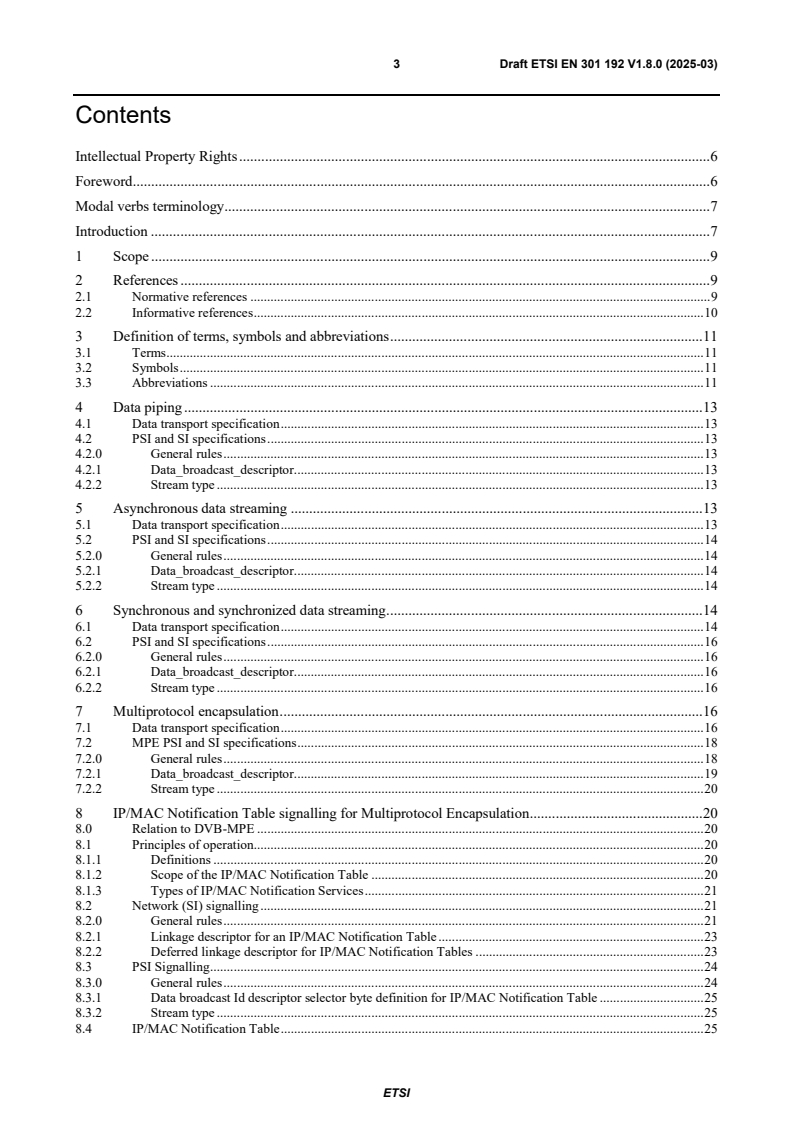
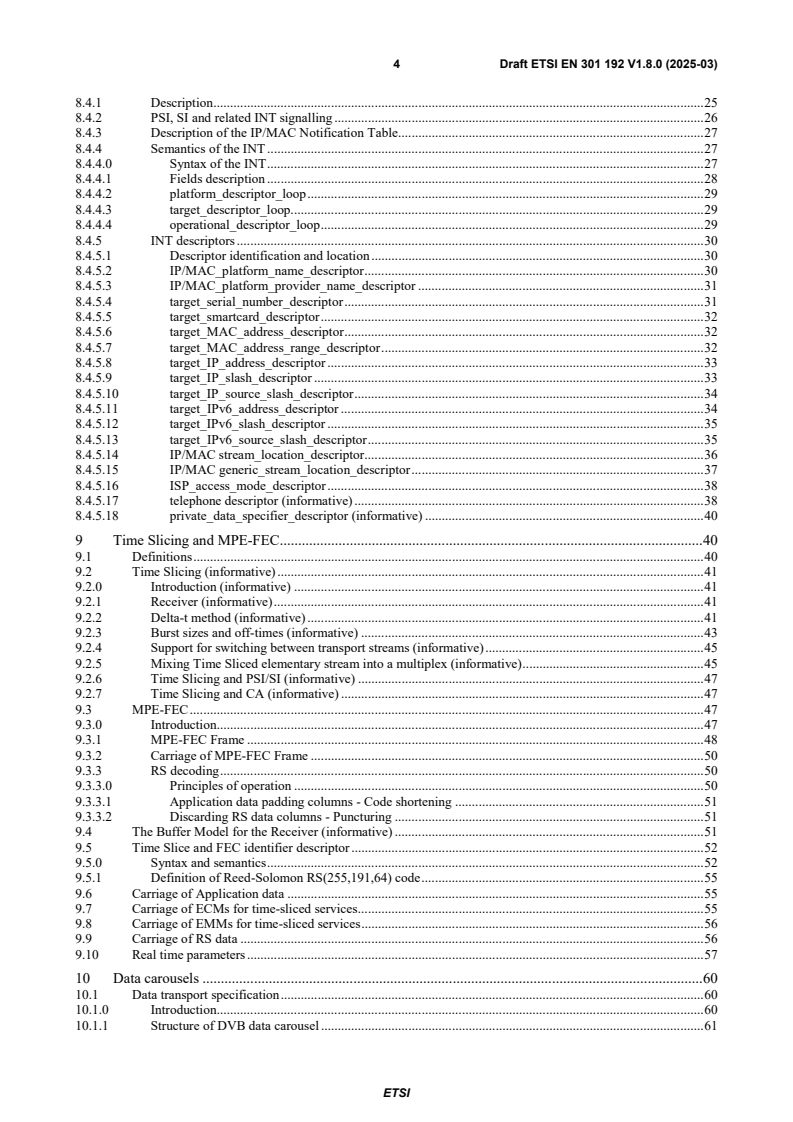
ETSI EN 301 192 V1.8.0 (2025-03) - Digital Video Broadcasting (DVB); DVB specification for data broadcasting
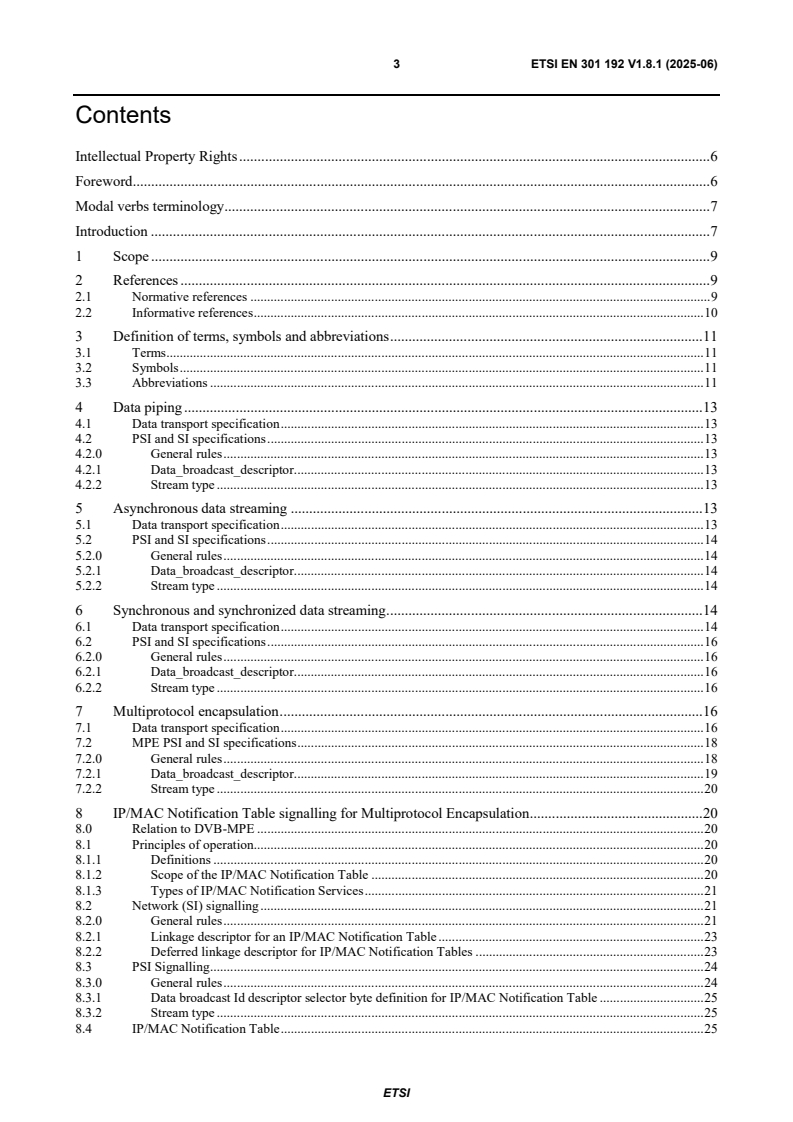
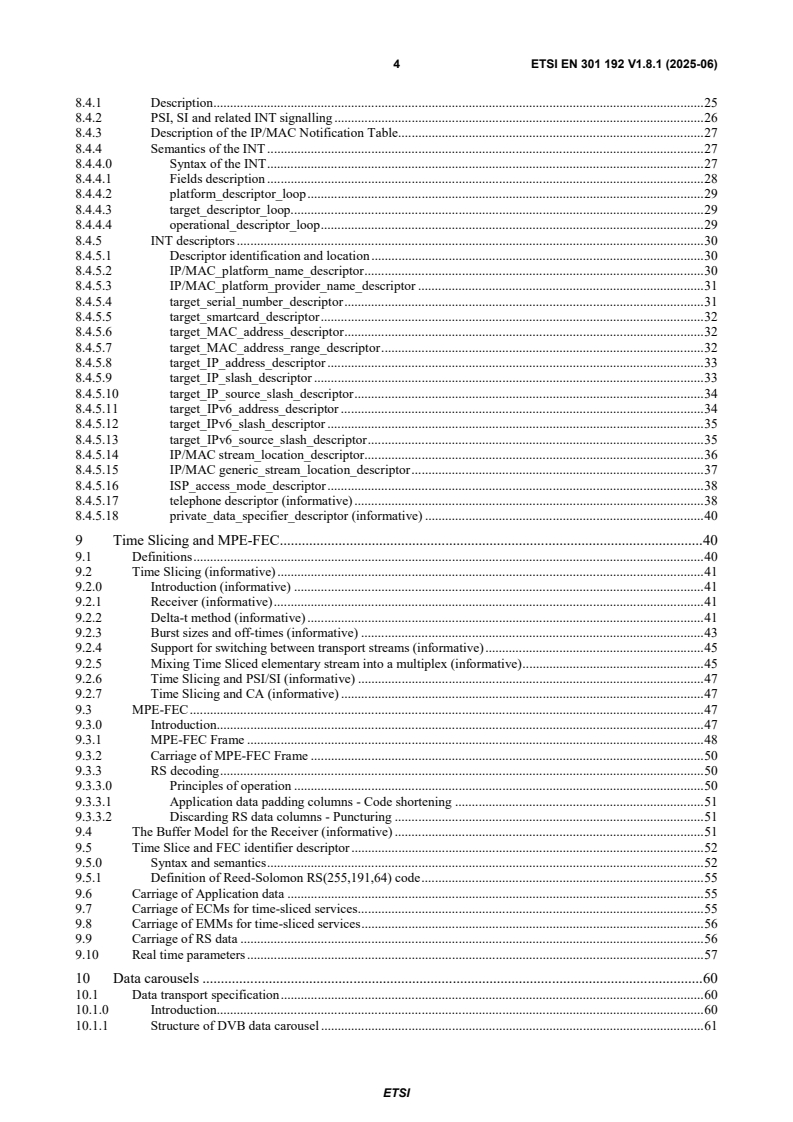
ETSI EN 301 192 V1.8.1 (2025-06) - Digital Video Broadcasting (DVB); DVB specification for data broadcasting

Overview
SIST EN 301 192 V1.8.1:2025 (ETSI EN 301 192 V1.8.1) defines the DVB specification for data broadcasting - the transport, encapsulation and signalling mechanisms used to carry general‑purpose data over DVB Transport Streams. Intended for use alongside ETSI EN 300 468, this standard extends MPEG‑2 based DVB transmissions to support services such as software download, IP tunnelling for Internet services over broadcast channels, and interactive TV.
Key topics and technical scope
The standard covers practical mechanisms and signalling elements needed to deliver data over DVB transports, including:
- Transport and encapsulation protocols for data carriage in DVB Transport Streams (TS).
- PSI/SI signalling rules and descriptors (e.g., Data_broadcast_descriptor, stream_type) to advertise and locate data services.
- Data piping models and modes: asynchronous streaming, synchronous/synchronized streaming, and piped data transport.
- Multiprotocol encapsulation (MPE) and associated PSI/SI requirements for carrying IP and other protocols.
- IP/MAC Notification Table (INT) signalling: definitions, semantics and descriptors (platform, target, operational) for notifying receivers of IP/MAC services.
- Time Slicing and MPE‑FEC (forward error correction): time‑sliced delivery models, burst timing, receiver buffer models and FEC frame handling.
- Detailed descriptor taxonomy (e.g., target_IP_slash_descriptor, target_MAC_address_descriptor, stream_location_descriptor) used for precise addressing and service targeting.
Practical applications and intended users
This standard is essential for stakeholders implementing reliable one‑to‑many data delivery over DVB broadcast infrastructures:
- Broadcasters and network operators who deploy software updates, EPG data, or broadcast broadband services.
- Satellite, cable and terrestrial system integrators designing multiplexes that carry data services.
- Receiver and set‑top box manufacturers, SoC and chipset vendors implementing MPE, time slicing and PSI/SI parsing.
- Middleware and application developers delivering interactive TV, hybrid broadcast/broadband (HbbTV) services, or broadcast IP distribution.
- Service providers using IP tunnelling over DVB for multicast content distribution or constrained connectivity scenarios.
Related standards
- ETSI EN 300 468 - Service Information (SI) specification for DVB (used in conjunction).
- MPEG‑2 transport specifications and related DVB EN documents covering conditional access, signalling and middleware.
This standard is a practical reference for designing robust DVB data services: ensuring correct encapsulation, signalling, receiver interoperability and efficient use of bandwidth for broadcast data delivery. Keywords: DVB, data broadcasting, DVB Transport Streams, MPE, MPE‑FEC, IP/MAC Notification Table, PSI/SI, time slicing, ETSI EN 301 192.
Buy Documents
ETSI EN 301 192 V1.8.0 (2025-03) - Digital Video Broadcasting (DVB); DVB specification for data broadcasting
ETSI EN 301 192 V1.8.1 (2025-06) - Digital Video Broadcasting (DVB); DVB specification for data broadcasting
Get Certified
Connect with accredited certification bodies for this standard

ANCE
Mexican certification and testing association.

Intertek Slovenia
Intertek testing, inspection, and certification services in Slovenia.

LNE (Laboratoire National de Métrologie et d'Essais)
French national laboratory for metrology and testing.
Sponsored listings
Frequently Asked Questions
SIST EN 301 192 V1.8.1:2025 is a standard published by the Slovenian Institute for Standardization (SIST). Its full title is "Digital Video Broadcasting (DVB) - DVB specification for data broadcasting". This standard covers: The present document specifies transport and encapsulation protocols, and signalling for carrying general purpose data over DVB Transport Streams. The present document is designed to be used in conjunction with ETSI EN 300 468 [2]. Data broadcasting is an important extension of the MPEG-2 based DVB transmission standards. Examples are the download of software over satellite, cable or terrestrial links, the delivery of Internet services over broadcast channels (IP tunnelling), interactive TV, etc.
The present document specifies transport and encapsulation protocols, and signalling for carrying general purpose data over DVB Transport Streams. The present document is designed to be used in conjunction with ETSI EN 300 468 [2]. Data broadcasting is an important extension of the MPEG-2 based DVB transmission standards. Examples are the download of software over satellite, cable or terrestrial links, the delivery of Internet services over broadcast channels (IP tunnelling), interactive TV, etc.
SIST EN 301 192 V1.8.1:2025 is classified under the following ICS (International Classification for Standards) categories: 33.170 - Television and radio broadcasting. The ICS classification helps identify the subject area and facilitates finding related standards.
SIST EN 301 192 V1.8.1:2025 is available in PDF format for immediate download after purchase. The document can be added to your cart and obtained through the secure checkout process. Digital delivery ensures instant access to the complete standard document.
Standards Content (Sample)
Draft ETSI EN 301 192 V1.8.0 (2025-03)
EUROPEAN STANDARD
Digital Video Broadcasting (DVB);
DVB specification for data broadcasting
2 Draft ETSI EN 301 192 V1.8.0 (2025-03)
Reference
REN/JTC-DVB-414
Keywords
broadcasting, data, digital, DVB, MPEG, video
ETSI
650 Route des Lucioles
F-06921 Sophia Antipolis Cedex - FRANCE
Tel.: +33 4 92 94 42 00 Fax: +33 4 93 65 47 16
Siret N° 348 623 562 00017 - APE 7112B
Association à but non lucratif enregistrée à la
Sous-Préfecture de Grasse (06) N° w061004871
Important notice
The present document can be downloaded from the
ETSI Search & Browse Standards application.
The present document may be made available in electronic versions and/or in print. The content of any electronic and/or
print versions of the present document shall not be modified without the prior written authorization of ETSI. In case of any
existing or perceived difference in contents between such versions and/or in print, the prevailing version of an ETSI
deliverable is the one made publicly available in PDF format on ETSI deliver repository.
Users should be aware that the present document may be revised or have its status changed,
this information is available in the Milestones listing.
If you find errors in the present document, please send your comments to
the relevant service listed under Committee Support Staff.
If you find a security vulnerability in the present document, please report it through our
Coordinated Vulnerability Disclosure (CVD) program.
Notice of disclaimer & limitation of liability
The information provided in the present deliverable is directed solely to professionals who have the appropriate degree of
experience to understand and interpret its content in accordance with generally accepted engineering or
other professional standard and applicable regulations.
No recommendation as to products and services or vendors is made or should be implied.
In no event shall ETSI be held liable for loss of profits or any other incidental or consequential damages.
Any software contained in this deliverable is provided "AS IS" with no warranties, express or implied, including but not
limited to, the warranties of merchantability, fitness for a particular purpose and non-infringement of intellectual property
rights and ETSI shall not be held liable in any event for any damages whatsoever (including, without limitation, damages
for loss of profits, business interruption, loss of information, or any other pecuniary loss) arising out of or related to the use
of or inability to use the software.
Copyright Notification
No part may be reproduced or utilized in any form or by any means, electronic or mechanical, including photocopying and
microfilm except as authorized by written permission of ETSI.
The content of the PDF version shall not be modified without the written authorization of ETSI.
The copyright and the foregoing restriction extend to reproduction in all media.
© ETSI 2025.
© European Broadcasting Union 2025.
All rights reserved.
ETSI
3 Draft ETSI EN 301 192 V1.8.0 (2025-03)
Contents
Intellectual Property Rights . 6
Foreword . 6
Modal verbs terminology . 7
Introduction . 7
1 Scope . 9
2 References . 9
2.1 Normative references . 9
2.2 Informative references . 10
3 Definition of terms, symbols and abbreviations . 11
3.1 Terms . 11
3.2 Symbols . 11
3.3 Abbreviations . 11
4 Data piping . 13
4.1 Data transport specification . 13
4.2 PSI and SI specifications . 13
4.2.0 General rules . 13
4.2.1 Data_broadcast_descriptor . 13
4.2.2 Stream type . 13
5 Asynchronous data streaming . 13
5.1 Data transport specification . 13
5.2 PSI and SI specifications . 14
5.2.0 General rules . 14
5.2.1 Data_broadcast_descriptor . 14
5.2.2 Stream type . 14
6 Synchronous and synchronized data streaming . 14
6.1 Data transport specification . 14
6.2 PSI and SI specifications . 16
6.2.0 General rules . 16
6.2.1 Data_broadcast_descriptor . 16
6.2.2 Stream type . 16
7 Multiprotocol encapsulation . 16
7.1 Data transport specification . 16
7.2 MPE PSI and SI specifications . 18
7.2.0 General rules . 18
7.2.1 Data_broadcast_descriptor . 19
7.2.2 Stream type . 20
8 IP/MAC Notification Table signalling for Multiprotocol Encapsulation . 20
8.0 Relation to DVB-MPE . 20
8.1 Principles of operation . 20
8.1.1 Definitions . 20
8.1.2 Scope of the IP/MAC Notification Table . 20
8.1.3 Types of IP/MAC Notification Services . 21
8.2 Network (SI) signalling . 21
8.2.0 General rules . 21
8.2.1 Linkage descriptor for an IP/MAC Notification Table . 23
8.2.2 Deferred linkage descriptor for IP/MAC Notification Tables . 23
8.3 PSI Signalling . 24
8.3.0 General rules . 24
8.3.1 Data broadcast Id descriptor selector byte definition for IP/MAC Notification Table . 25
8.3.2 Stream type . 25
8.4 IP/MAC Notification Table . 25
ETSI
4 Draft ETSI EN 301 192 V1.8.0 (2025-03)
8.4.1 Description . 25
8.4.2 PSI, SI and related INT signalling . 26
8.4.3 Description of the IP/MAC Notification Table . 27
8.4.4 Semantics of the INT . 27
8.4.4.0 Syntax of the INT . 27
8.4.4.1 Fields description . 28
8.4.4.2 platform_descriptor_loop . 29
8.4.4.3 target_descriptor_loop . 29
8.4.4.4 operational_descriptor_loop . 29
8.4.5 INT descriptors . 30
8.4.5.1 Descriptor identification and location . 30
8.4.5.2 IP/MAC_platform_name_descriptor . 30
8.4.5.3 IP/MAC_platform_provider_name_descriptor . 31
8.4.5.4 target_serial_number_descriptor . 31
8.4.5.5 target_smartcard_descriptor . 32
8.4.5.6 target_MAC_address_descriptor . 32
8.4.5.7 target_MAC_address_range_descriptor . 32
8.4.5.8 target_IP_address_descriptor . 33
8.4.5.9 target_IP_slash_descriptor . 33
8.4.5.10 target_IP_source_slash_descriptor . 34
8.4.5.11 target_IPv6_address_descriptor . 34
8.4.5.12 target_IPv6_slash_descriptor . 35
8.4.5.13 target_IPv6_source_slash_descriptor . 35
8.4.5.14 IP/MAC stream_location_descriptor . 36
8.4.5.15 IP/MAC generic_stream_location_descriptor . 37
8.4.5.16 ISP_access_mode_descriptor . 38
8.4.5.17 telephone descriptor (informative) . 38
8.4.5.18 private_data_specifier_descriptor (informative) . 40
9 Time Slicing and MPE-FEC . 40
9.1 Definitions . 40
9.2 Time Slicing (informative) . 41
9.2.0 Introduction (informative) . 41
9.2.1 Receiver (informative) . 41
9.2.2 Delta-t method (informative) . 41
9.2.3 Burst sizes and off-times (informative) . 43
9.2.4 Support for switching between transport streams (informative) . 45
9.2.5 Mixing Time Sliced elementary stream into a multiplex (informative) . 45
9.2.6 Time Slicing and PSI/SI (informative) . 47
9.2.7 Time Slicing and CA (informative) . 47
9.3 MPE-FEC . 47
9.3.0 Introduction. 47
9.3.1 MPE-FEC Frame . 48
9.3.2 Carriage of MPE-FEC Frame . 50
9.3.3 RS decoding . 50
9.3.3.0 Principles of operation . 50
9.3.3.1 Application data padding columns - Code shortening . 51
9.3.3.2 Discarding RS data columns - Puncturing . 51
9.4 The Buffer Model for the Receiver (informative) . 51
9.5 Time Slice and FEC identifier descriptor . 52
9.5.0 Syntax and semantics . 52
9.5.1 Definition of Reed-Solomon RS(255,191,64) code . 55
9.6 Carriage of Application data . 55
9.7 Carriage of ECMs for time-sliced services . 55
9.8 Carriage of EMMs for time-sliced services . 56
9.9 Carriage of RS data . 56
9.10 Real time parameters . 57
10 Data carousels . 60
10.1 Data transport specification . 60
10.1.0 Introduction. 60
10.1.1 Structure of DVB data carousel . 61
ETSI
5 Draft ETSI EN 301 192 V1.8.0 (2025-03)
10.1.2 DownloadServerInitiate message . 62
10.1.3 DownloadInfoIndication message . 63
10.1.4 DownloadDataBlock message . 64
10.1.5 DownloadCancel . 64
10.2 Descriptors . 64
10.2.1 Descriptor identification and location . 64
10.2.2 Type descriptor . 64
10.2.3 Name descriptor . 65
10.2.4 Info descriptor . 65
10.2.5 Module link descriptor . 66
10.2.6 CRC32 descriptor . 66
10.2.7 Location descriptor . 66
10.2.8 Estimated download time descriptor . 67
10.2.9 Group link descriptor . 67
10.2.10 Private descriptor . 68
10.2.11 Compressed module descriptor . 68
10.3 PSI and SI specifications . 69
10.3.0 General rules . 69
10.3.1 Data_broadcast_descriptor . 69
10.3.2 Stream type . 70
11 Object carousels . 70
11.1 Scope of the object carousels . 70
11.2 Data transport specification . 70
11.2.0 Introduction. 70
11.2.1 Carousel NSAP address . 70
11.3 Descriptors . 71
11.3.0 Use of data carousel descriptors . 71
11.3.1 PSI and SI specifications . 71
11.3.2 Data_broadcast_descriptor . 72
11.3.3 Deferred_association_tags_descriptor . 73
11.3.4 Stream type . 74
12 Higher protocols based on asynchronous data streams . 74
12.1 Data transport specification . 74
12.2 PSI and SI specifications . 74
12.2.0 General rules . 74
12.2.1 Data_broadcast_descriptor . 74
12.2.2 Stream type . 75
13 Decoder models . 75
Annex A: Void . 77
Annex B (normative): Simulcasting of IP/MAC streams . 78
Annex C (normative): Minimum repetition rates for the INT . 79
Annex D: Void . 80
Annex E (informative): Bibliography . 81
History . 82
ETSI
6 Draft ETSI EN 301 192 V1.8.0 (2025-03)
Intellectual Property Rights
Essential patents
IPRs essential or potentially essential to normative deliverables may have been declared to ETSI. The declarations
pertaining to these essential IPRs, if any, are publicly available for ETSI members and non-members, and can be
found in ETSI SR 000 314: "Intellectual Property Rights (IPRs); Essential, or potentially Essential, IPRs notified to
ETSI in respect of ETSI standards", which is available from the ETSI Secretariat. Latest updates are available on the
ETSI IPR online database.
Pursuant to the ETSI Directives including the ETSI IPR Policy, no investigation regarding the essentiality of IPRs,
including IPR searches, has been carried out by ETSI. No guarantee can be given as to the existence of other IPRs not
referenced in ETSI SR 000 314 (or the updates on the ETSI Web server) which are, or may be, or may become,
essential to the present document.
Trademarks
The present document may include trademarks and/or tradenames which are asserted and/or registered by their owners.
ETSI claims no ownership of these except for any which are indicated as being the property of ETSI, and conveys no
right to use or reproduce any trademark and/or tradename. Mention of those trademarks in the present document does
not constitute an endorsement by ETSI of products, services or organizations associated with those trademarks.
DECT™, PLUGTESTS™, UMTS™ and the ETSI logo are trademarks of ETSI registered for the benefit of its
Members. 3GPP™, LTE™ and 5G™ logo are trademarks of ETSI registered for the benefit of its Members and of the
3GPP Organizational Partners. oneM2M™ logo is a trademark of ETSI registered for the benefit of its Members and of ®
the oneM2M Partners. GSM and the GSM logo are trademarks registered and owned by the GSM Association.
Foreword
This draft European Standard (EN) has been produced by Joint Technical Committee (JTC) Broadcast of the European
Broadcasting Union (EBU), Comité Européen de Normalisation ELECtrotechnique (CENELEC) and the European
Telecommunications Standards Institute (ETSI), and is now submitted for the combined Public Enquiry and Vote phase
of the ETSI EN Approval Procedure.
NOTE: The EBU/ETSI JTC Broadcast was established in 1990 to co-ordinate the drafting of standards in the
specific field of broadcasting and related fields. Since 1995 the JTC Broadcast became a tripartite body
by including in the Memorandum of Understanding also CENELEC, which is responsible for the
standardization of radio and television receivers. The EBU is a professional association of broadcasting
organizations whose work includes the co-ordination of its members' activities in the technical, legal,
programme-making and programme-exchange domains. The EBU has active members in about
60 countries in the European broadcasting area; its headquarters is in Geneva.
European Broadcasting Union
CH-1218 GRAND SACONNEX (Geneva)
Switzerland
Tel: +41 22 717 21 11
Fax: +41 22 717 24 81 ®
The DVB Project is an industry-led consortium of broadcasters, manufacturers, network operators, software
developers, regulators and others from around the world committed to designing open, interoperable technical ®
specifications for the global delivery of digital media and broadcast services. DVB specifications cover all aspects of
digital television from transmission through interfacing, conditional access and interactivity for digital video, audio and
data. The consortium came together in 1993.
ETSI
7 Draft ETSI EN 301 192 V1.8.0 (2025-03)
Proposed national transposition dates
Date of latest announcement of this EN (doa): 3 months after ETSI publication
Date of latest publication of new National Standard
or endorsement of this EN (dop/e): 6 months after doa
Date of withdrawal of any conflicting National Standard (dow): 6 months after doa
Modal verbs terminology
In the present document "shall", "shall not", "should", "should not", "may", "need not", "will", "will not", "can" and
"cannot" are to be interpreted as described in clause 3.2 of the ETSI Drafting Rules (Verbal forms for the expression of
provisions).
"must" and "must not" are NOT allowed in ETSI deliverables except when used in direct citation.
Introduction
The DVB System provides a means of delivering MPEG-2 Transport Streams (TS) via a variety of transmission media.
MPEG-2 TSs were primarily intended for the delivery of Video and Audio. The present document introduces data
broadcasting as an extension to the MPEG-2 based DVB transmission standards.
Five different application areas with different requirements for the data transport are addressed. For each application
area a data broadcasting profile is specified in the present document. The following is a short description of the
application areas and the profiles.
Data piping:
• The data broadcast specification profile for data pipes (as defined in clause 4) supports data broadcast services
that require a simple, asynchronous, end-to-end delivery of data through DVB compliant broadcast networks.
Data streaming:
• The data broadcast specification profile for data streaming supports data broadcast services that require a
streaming-oriented, end-to-end delivery of data in either an asynchronous, synchronous or synchronized way
through DVB compliant broadcast networks.
• Asynchronous data streaming is defined in clause 5 and allows the streaming of data without any timing
requirements (e.g. RS-232 data).
• Synchronous data streaming is defined in clause 6 and allows the streaming of data with timing requirements
in the sense that the data and clock can be regenerated at the receiver into a synchronous data stream.
Multiprotocol encapsulation:
• The data broadcast specification profile for multiprotocol encapsulation (as defined in clause 7) supports data
broadcast services that require the transmission of datagrams of communication protocols via DVB compliant
broadcast networks.
• Clause 8 further defines a standard mechanism for signalling IP/MAC services deployed within DVB networks
and enables the implementation of DVB receivers that are completely self-tuning when accessing IP/MAC
streams on one or more transport streams.
• Mechanisms for power-optimized reception and forward error correction for multiprotocol encapsulation are
defined in clause 9.
ETSI
8 Draft ETSI EN 301 192 V1.8.0 (2025-03)
Data and object carousels:
• Data broadcast services that require the periodic transmission of data are called data carousels, and are defined
in clause 10.
• Object carousels (as defined in clause 11) are based on data carousels, and provide an additional hierarchical
structure and further metadata, such as for example needed to build a hierarchical file system.
Higher protocols based on asynchronous data streams:
• The data broadcast specification profile for higher protocols (as defined in clause 12) is based on asynchronous
data streams, and supports the transmission of protocols that require a stream-oriented delivery of
asynchronous data through DVB compliant broadcast networks.
ETSI
9 Draft ETSI EN 301 192 V1.8.0 (2025-03)
1 Scope
The present document specifies transport and encapsulation protocols, and signalling for carrying general purpose data
over DVB Transport Streams. The present document is designed to be used in conjunction with ETSI EN 300 468 [2].
Data broadcasting is an important extension of the MPEG-2 based DVB transmission standards. Examples are the
download of software over satellite, cable or terrestrial links, the delivery of Internet services over broadcast channels
(IP tunnelling), interactive TV, etc.
2 References
2.1 Normative references
References are either specific (identified by date of publication and/or edition number or version number) or
non-specific. For specific references, only the cited version applies. For non-specific references, the latest version of the
referenced document (including any amendments) applies.
Referenced documents which are not found to be publicly available in the expected location might be found in the
ETSI docbox.
NOTE: While any hyperlinks included in this clause were valid at the time of publication, ETSI cannot guarantee
their long term validity.
The following referenced documents are necessary for the application of the present document.
[1] ISO/IEC 13818-1: "Information technology -- Generic coding of moving pictures and associated
audio information -- Systems".
[2] ETSI EN 300 468: "Digital Video Broadcasting (DVB); Specification for Service Information (SI)
in DVB systems".
[3] ETSI TS 101 162: "Digital Video Broadcasting (DVB); Allocation of identifiers and codes for
Digital Video Broadcasting (DVB) systems".
[4] ISO/IEC 13818-6: "Information technology -- Generic coding of moving pictures and associated
audio information -- Part 6: Extensions for DSM-CC".
[5] ETSI EN 300 472: "Digital Video Broadcasting (DVB); Specification for conveying ITU-R
System B Teletext in DVB bitstreams".
[6] IETF RFC 1112 (August 1989): "Host extensions for IP multicasting".
[7] IETF RFC 2045 (November 1996): "Multipurpose Internet Mail Extensions (MIME) Part One:
Format of Internet Message Bodies", N. Freed, N. Borenstein.
[8] IETF RFC 2046 (November 1996): "Multipurpose Internet Mail Extensions (MIME) Part Two:
Media Types", N. Freed, N. Borenstein.
[9] ETSI ETS 300 802: "Digital Video Broadcasting (DVB); Network-independent protocols for DVB
interactive services".
[10] ISO/IEC 8802-1: "Information technology -- Telecommunications and information exchange
between systems -- Local and metropolitan area networks -- Specific requirements --
Part 1: Overview of Local Area Network Standards".
[11] ISO/IEC 8802-2: "Information technology -- Telecommunications and information exchange
between systems -- Local and metropolitan area networks -- Specific requirements --
Part 2: Logical link control".
[12] ETSI EN 300 743: "Digital Video Broadcasting (DVB); subtitling systems".
ETSI
10 Draft ETSI EN 301 192 V1.8.0 (2025-03)
[13] ISO/IEC 8859-1: "Information technology -- 8-bit single-byte coded graphic character sets --
Part 1: Latin alphabet No. 1".
[14] ISO 639: "Code for individual languages and language groups".
[15] IETF RFC 1950 (May 1996): "ZLIB Compressed Data Format Specification version 3.3".
[16] RTCM SC-104: "Recommended Standards for Differential GNSS (Global Navigation Satellite
Systems) Service".
[17] ISO/TS 18234-5: "Traffic and Travel Information (TTI) — TTI via Transport Protocol Expert
Group (TPEG) data-streams — Part 5: Public Transport Information (PTI) application".
[18] ETSI TS 102 006: "Digital Video Broadcasting (DVB); Specification for System Software Update
in DVB Systems".
[19] IETF RFC 2464 (December 1998): "Transmission of IPv6 Packets over Ethernet Networks".
[20] IETF RFC 1661 (July 1994): "The Point-to-Point Protocol (PPP)".
[21] ETSI TS 103 197: "Digital Video Broadcasting (DVB); Head-end implementation of DVB
SimulCrypt".
[22] ETSI EN 302 307-1: "Digital Video Broadcasting (DVB); Second generation framing structure,
channel coding and modulation systems for Broadcasting, Interactive Services, News Gathering
and other broadband satellite applications; Part 1: DVB-S2".
[23] ETSI EN 302 755: "Digital Video Broadcasting (DVB); Frame structure channel coding and
modulation for a second generation digital terrestrial television broadcasting system (DVB-T2)".
[24] ETSI EN 302 769: "Digital Video Broadcasting (DVB); Frame structure channel coding and
modulation for a second generation digital transmission system for cable systems (DVB-C2)".
[25] DVB BlueBook A160: "Digital Video Broadcasting (DVB); Next Generation broadcasting system
to Handheld, physical layer specification (DVB-NGH)".
[26] ETSI EN 302 307-2: "Digital Video Broadcasting (DVB); Second generation framing structure,
channel coding and modulation systems for Broadcasting, Interactive Services, News Gathering
and other broadband satellite applications; Part 2: DVB-S2 Extensions (DVB-S2X)".
[27] ETSI TS 102 606-2: "Digital Video Broadcasting (DVB); Generic Stream Encapsulation (GSE);
Part 2: Logical Link Control (LLC)".
2.2 Informative references
References are either specific (identified by date of publication and/or edition number or version number) or
non-specific. For specific references, only the cited version applies. For non-specific references, the latest version of the
referenced document (including any amendments) applies.
NOTE: While any hyperlinks included in this clause were valid at the time of publication, ETSI cannot guarantee
their long term validity.
The following referenced documents are not necessary for the application of the present document but they assist the
user with regard to a particular subject area.
[i.1] Void.
[i.2] IEEE 802-2001™: "Standard for Local and Metropolitan Area Networks: Overview and
Architecture".
ETSI
11 Draft ETSI EN 301 192 V1.8.0 (2025-03)
3 Definition of terms, symbols and abbreviations
3.1 Terms
Void.
3.2 Symbols
For the purposes of the present document, the following symbols apply:
kbits kilo bits
Mbits Mega bits
ms millisecond
3.3 Abbreviations
For the purposes of the present document, the following abbreviations apply:
AFI Authority and Format Identifier
BAT Bouquet Association Table
bslbf bit string, left bit first
CA Conditional Access
CAT Conditional Access Table
CRC Cyclic Redundancy Code
DAVIC Digital Audio VIsual Council
DDB DownloadDataBlock
dGNSS differential GNSS
DII DownloadInfoIndication
DSI DownloadServerInitiate
DSM-CC Digital Storage Media Command and Control (DSM-CC) data carousel
DVB Digital Video Broadcasting
DVB-C2 Second Generation DVB Cable Modulation
NOTE: See ETSI EN 302 769 [24].
DVB-NGH DVB Next Generation broadcasting system to Handheld
DVB-S2 Second Generation DVB Satellite Modulation
NOTE: See ETSI EN 302 307-1 [22].
DVB-T DVB Terrestrial Modulation (first generation)
DVB-T2 Second Generation DVB Terrestrial Modulation
NOTE: See ETSI EN 302 755 [23].
EBU European Broadcasting Union
ECM Entitlement Control Message
EIT Event Information Table
EMM Entitlement Management Message
FEC Forward Error Correction
GNSS Global Navigation Satellite Systems
IEC International Electrotechnical Commission
IEEE Institute of Electrical and Electronics Engineers (USA)
INT IP Notification Table
IP Internet Protocol
IRD Integrated Receiver/Decoder
ISDN Integrated Services Digital Network
ISI Input Stream Identifier
NOTE: See ETSI EN 302 307-1 [22].
ETSI
12 Draft ETSI EN 301 192 V1.8.0 (2025-03)
ISO International Organization for Standardization
ISP Internet Service Provider
LLC Logical Link Control
LSB Least Significant Bit
MAC Media Access Control
MHP Multimedia Home Platform
mi ModuleInfoBytes
MIME Multipurpose Internet Mail Extensions
MPE Multi-Protocol Encapsulation
MPEG Moving Pictures Expert Group
MSB Most Significant Bit
NIT Network Information Table
NSAP Network Service Access Point
OFDM Orthogonal Frequency-Division Multiplexing
OSI Open Systems Interconnection
OUI Organizational Unique Identifier
PAT Program Association Table
NOTE: See ISO/IEC 13818-1 [1].
PCR Program Clock Reference
PES Program Elementary Stream
PID Packet IDentifier
PLP Physical Layer Pipe
NOTE: See ETSI EN 302 755 [23], ETSI EN 302 769 [24] and DVB BlueBook A160 [25].
PLR Packet Loss Radio
PMT Program Map Table
PPP Point-to-Point Protocol
PSI Program Specific Information
PSTN Public Switched Telephone Network
PTS Presentation Time Stamps
RF Radio Frequency
RFC Request For Comment
rpchof remainder polynomial coefficients, highest order first
RS Reed Solomon
RTCM Radio Technical Commission For Maritime services
SDT Service Description Table
SI Service Information
SIS Systems for Interactive Services
SNAP SubNetwork Attachment Point
SSU System Software Update
TPEG Transport Protocol Experts Group
TS Transport Stream
T-STD Transport System Target Decoder
UDP User Datagram Protocol
uimsbf unsigned integer most significant bit first
UNT Update Notification Table
U-U User-User
VLSM Variable-Length Subnet Mask
XOR eXclusive OR
NOTE: See ETSI TS 102 006 [18].
ETSI
13 Draft ETSI EN 301 192 V1.8.0 (2025-03)
4 Data piping
4.1 Data transport specification
The data broadcast service shall insert the data to be broadcast directly
...
EUROPEAN STANDARD
Digital Video Broadcasting (DVB);
DVB specification for data broadcasting
2 ETSI EN 301 192 V1.8.1 (2025-06)
Reference
REN/JTC-DVB-414
Keywords
broadcasting, data, digital, DVB, MPEG, video
ETSI
650 Route des Lucioles
F-06921 Sophia Antipolis Cedex - FRANCE
Tel.: +33 4 92 94 42 00 Fax: +33 4 93 65 47 16
Siret N° 348 623 562 00017 - APE 7112B
Association à but non lucratif enregistrée à la
Sous-Préfecture de Grasse (06) N° w061004871
Important notice
The present document can be downloaded from the
ETSI Search & Browse Standards application.
The present document may be made available in electronic versions and/or in print. The content of any electronic and/or
print versions of the present document shall not be modified without the prior written authorization of ETSI. In case of any
existing or perceived difference in contents between such versions and/or in print, the prevailing version of an ETSI
deliverable is the one made publicly available in PDF format on ETSI deliver repository.
Users should be aware that the present document may be revised or have its status changed,
this information is available in the Milestones listing.
If you find errors in the present document, please send your comments to
the relevant service listed under Committee Support Staff.
If you find a security vulnerability in the present document, please report it through our
Coordinated Vulnerability Disclosure (CVD) program.
Notice of disclaimer & limitation of liability
The information provided in the present deliverable is directed solely to professionals who have the appropriate degree of
experience to understand and interpret its content in accordance with generally accepted engineering or
other professional standard and applicable regulations.
No recommendation as to products and services or vendors is made or should be implied.
In no event shall ETSI be held liable for loss of profits or any other incidental or consequential damages.
Any software contained in this deliverable is provided "AS IS" with no warranties, express or implied, including but not
limited to, the warranties of merchantability, fitness for a particular purpose and non-infringement of intellectual property
rights and ETSI shall not be held liable in any event for any damages whatsoever (including, without limitation, damages
for loss of profits, business interruption, loss of information, or any other pecuniary loss) arising out of or related to the use
of or inability to use the software.
Copyright Notification
No part may be reproduced or utilized in any form or by any means, electronic or mechanical, including photocopying and
microfilm except as authorized by written permission of ETSI.
The content of the PDF version shall not be modified without the written authorization of ETSI.
The copyright and the foregoing restriction extend to reproduction in all media.
© ETSI 2025.
© European Broadcasting Union 2025.
All rights reserved.
ETSI
3 ETSI EN 301 192 V1.8.1 (2025-06)
Contents
Intellectual Property Rights . 6
Foreword . 6
Modal verbs terminology . 7
Introduction . 7
1 Scope . 9
2 References . 9
2.1 Normative references . 9
2.2 Informative references . 10
3 Definition of terms, symbols and abbreviations . 11
3.1 Terms . 11
3.2 Symbols . 11
3.3 Abbreviations . 11
4 Data piping . 13
4.1 Data transport specification . 13
4.2 PSI and SI specifications . 13
4.2.0 General rules . 13
4.2.1 Data_broadcast_descriptor . 13
4.2.2 Stream type . 13
5 Asynchronous data streaming . 13
5.1 Data transport specification . 13
5.2 PSI and SI specifications . 14
5.2.0 General rules . 14
5.2.1 Data_broadcast_descriptor . 14
5.2.2 Stream type . 14
6 Synchronous and synchronized data streaming . 14
6.1 Data transport specification . 14
6.2 PSI and SI specifications . 16
6.2.0 General rules . 16
6.2.1 Data_broadcast_descriptor . 16
6.2.2 Stream type . 16
7 Multiprotocol encapsulation . 16
7.1 Data transport specification . 16
7.2 MPE PSI and SI specifications . 18
7.2.0 General rules . 18
7.2.1 Data_broadcast_descriptor . 19
7.2.2 Stream type . 20
8 IP/MAC Notification Table signalling for Multiprotocol Encapsulation . 20
8.0 Relation to DVB-MPE . 20
8.1 Principles of operation . 20
8.1.1 Definitions . 20
8.1.2 Scope of the IP/MAC Notification Table . 20
8.1.3 Types of IP/MAC Notification Services . 21
8.2 Network (SI) signalling . 21
8.2.0 General rules . 21
8.2.1 Linkage descriptor for an IP/MAC Notification Table . 23
8.2.2 Deferred linkage descriptor for IP/MAC Notification Tables . 23
8.3 PSI Signalling . 24
8.3.0 General rules . 24
8.3.1 Data broadcast Id descriptor selector byte definition for IP/MAC Notification Table . 25
8.3.2 Stream type . 25
8.4 IP/MAC Notification Table . 25
ETSI
4 ETSI EN 301 192 V1.8.1 (2025-06)
8.4.1 Description . 25
8.4.2 PSI, SI and related INT signalling . 26
8.4.3 Description of the IP/MAC Notification Table . 27
8.4.4 Semantics of the INT . 27
8.4.4.0 Syntax of the INT . 27
8.4.4.1 Fields description . 28
8.4.4.2 platform_descriptor_loop . 29
8.4.4.3 target_descriptor_loop . 29
8.4.4.4 operational_descriptor_loop . 29
8.4.5 INT descriptors . 30
8.4.5.1 Descriptor identification and location . 30
8.4.5.2 IP/MAC_platform_name_descriptor . 30
8.4.5.3 IP/MAC_platform_provider_name_descriptor . 31
8.4.5.4 target_serial_number_descriptor . 31
8.4.5.5 target_smartcard_descriptor . 32
8.4.5.6 target_MAC_address_descriptor . 32
8.4.5.7 target_MAC_address_range_descriptor . 32
8.4.5.8 target_IP_address_descriptor . 33
8.4.5.9 target_IP_slash_descriptor . 33
8.4.5.10 target_IP_source_slash_descriptor . 34
8.4.5.11 target_IPv6_address_descriptor . 34
8.4.5.12 target_IPv6_slash_descriptor . 35
8.4.5.13 target_IPv6_source_slash_descriptor . 35
8.4.5.14 IP/MAC stream_location_descriptor . 36
8.4.5.15 IP/MAC generic_stream_location_descriptor . 37
8.4.5.16 ISP_access_mode_descriptor . 38
8.4.5.17 telephone descriptor (informative) . 38
8.4.5.18 private_data_specifier_descriptor (informative) . 40
9 Time Slicing and MPE-FEC . 40
9.1 Definitions . 40
9.2 Time Slicing (informative) . 41
9.2.0 Introduction (informative) . 41
9.2.1 Receiver (informative) . 41
9.2.2 Delta-t method (informative) . 41
9.2.3 Burst sizes and off-times (informative) . 43
9.2.4 Support for switching between transport streams (informative) . 45
9.2.5 Mixing Time Sliced elementary stream into a multiplex (informative) . 45
9.2.6 Time Slicing and PSI/SI (informative) . 47
9.2.7 Time Slicing and CA (informative) . 47
9.3 MPE-FEC . 47
9.3.0 Introduction. 47
9.3.1 MPE-FEC Frame . 48
9.3.2 Carriage of MPE-FEC Frame . 50
9.3.3 RS decoding . 50
9.3.3.0 Principles of operation . 50
9.3.3.1 Application data padding columns - Code shortening . 51
9.3.3.2 Discarding RS data columns - Puncturing . 51
9.4 The Buffer Model for the Receiver (informative) . 51
9.5 Time Slice and FEC identifier descriptor . 52
9.5.0 Syntax and semantics . 52
9.5.1 Definition of Reed-Solomon RS(255,191,64) code . 55
9.6 Carriage of Application data . 55
9.7 Carriage of ECMs for time-sliced services . 55
9.8 Carriage of EMMs for time-sliced services . 56
9.9 Carriage of RS data . 56
9.10 Real time parameters . 57
10 Data carousels . 60
10.1 Data transport specification . 60
10.1.0 Introduction. 60
10.1.1 Structure of DVB data carousel . 61
ETSI
5 ETSI EN 301 192 V1.8.1 (2025-06)
10.1.2 DownloadServerInitiate message . 62
10.1.3 DownloadInfoIndication message . 63
10.1.4 DownloadDataBlock message . 64
10.1.5 DownloadCancel . 64
10.2 Descriptors . 64
10.2.1 Descriptor identification and location . 64
10.2.2 Type descriptor . 64
10.2.3 Name descriptor . 65
10.2.4 Info descriptor . 65
10.2.5 Module link descriptor . 66
10.2.6 CRC32 descriptor . 66
10.2.7 Location descriptor . 66
10.2.8 Estimated download time descriptor . 67
10.2.9 Group link descriptor . 67
10.2.10 Private descriptor . 68
10.2.11 Compressed module descriptor . 68
10.3 PSI and SI specifications . 69
10.3.0 General rules . 69
10.3.1 Data_broadcast_descriptor . 69
10.3.2 Stream type . 70
11 Object carousels . 70
11.1 Scope of the object carousels . 70
11.2 Data transport specification . 70
11.2.0 Introduction. 70
11.2.1 Carousel NSAP address . 70
11.3 Descriptors . 71
11.3.0 Use of data carousel descriptors . 71
11.3.1 PSI and SI specifications . 71
11.3.2 Data_broadcast_descriptor . 72
11.3.3 Deferred_association_tags_descriptor . 73
11.3.4 Stream type . 74
12 Higher protocols based on asynchronous data streams . 74
12.1 Data transport specification . 74
12.2 PSI and SI specifications . 74
12.2.0 General rules . 74
12.2.1 Data_broadcast_descriptor . 74
12.2.2 Stream type . 75
13 Decoder models . 75
Annex A: Void . 77
Annex B (normative): Simulcasting of IP/MAC streams . 78
Annex C (normative): Minimum repetition rates for the INT . 79
Annex D: Void . 80
Annex E (informative): Bibliography . 81
History . 82
ETSI
6 ETSI EN 301 192 V1.8.1 (2025-06)
Intellectual Property Rights
Essential patents
IPRs essential or potentially essential to normative deliverables may have been declared to ETSI. The declarations
pertaining to these essential IPRs, if any, are publicly available for ETSI members and non-members, and can be
found in ETSI SR 000 314: "Intellectual Property Rights (IPRs); Essential, or potentially Essential, IPRs notified to
ETSI in respect of ETSI standards", which is available from the ETSI Secretariat. Latest updates are available on the
ETSI IPR online database.
Pursuant to the ETSI Directives including the ETSI IPR Policy, no investigation regarding the essentiality of IPRs,
including IPR searches, has been carried out by ETSI. No guarantee can be given as to the existence of other IPRs not
referenced in ETSI SR 000 314 (or the updates on the ETSI Web server) which are, or may be, or may become,
essential to the present document.
Trademarks
The present document may include trademarks and/or tradenames which are asserted and/or registered by their owners.
ETSI claims no ownership of these except for any which are indicated as being the property of ETSI, and conveys no
right to use or reproduce any trademark and/or tradename. Mention of those trademarks in the present document does
not constitute an endorsement by ETSI of products, services or organizations associated with those trademarks.
DECT™, PLUGTESTS™, UMTS™ and the ETSI logo are trademarks of ETSI registered for the benefit of its
Members. 3GPP™, LTE™ and 5G™ logo are trademarks of ETSI registered for the benefit of its Members and of the
3GPP Organizational Partners. oneM2M™ logo is a trademark of ETSI registered for the benefit of its Members and of ®
the oneM2M Partners. GSM and the GSM logo are trademarks registered and owned by the GSM Association.
Foreword
This European Standard (EN) has been produced by Joint Technical Committee (JTC) Broadcast of the European
Broadcasting Union (EBU), Comité Européen de Normalisation ELECtrotechnique (CENELEC) and the European
Telecommunications Standards Institute (ETSI).
NOTE: The EBU/ETSI JTC Broadcast was established in 1990 to co-ordinate the drafting of standards in the
specific field of broadcasting and related fields. Since 1995 the JTC Broadcast became a tripartite body
by including in the Memorandum of Understanding also CENELEC, which is responsible for the
standardization of radio and television receivers. The EBU is a professional association of broadcasting
organizations whose work includes the co-ordination of its members' activities in the technical, legal,
programme-making and programme-exchange domains. The EBU has active members in about
60 countries in the European broadcasting area; its headquarters is in Geneva.
European Broadcasting Union
CH-1218 GRAND SACONNEX (Geneva)
Switzerland
Tel: +41 22 717 21 11
Fax: +41 22 717 24 81 ®
The DVB Project is an industry-led consortium of broadcasters, manufacturers, network operators, software
developers, regulators and others from around the world committed to designing open, interoperable technical ®
specifications for the global delivery of digital media and broadcast services. DVB specifications cover all aspects of
digital television from transmission through interfacing, conditional access and interactivity for digital video, audio and
data. The consortium came together in 1993.
ETSI
7 ETSI EN 301 192 V1.8.1 (2025-06)
National transposition dates
Date of adoption of this EN: 2 June 2025
Date of latest announcement of this EN (doa): 30 September 2025
Date of latest publication of new National Standard
or endorsement of this EN (dop/e): 31 March 2026
Date of withdrawal of any conflicting National Standard (dow): 31 March 2026
Modal verbs terminology
In the present document "shall", "shall not", "should", "should not", "may", "need not", "will", "will not", "can" and
"cannot" are to be interpreted as described in clause 3.2 of the ETSI Drafting Rules (Verbal forms for the expression of
provisions).
"must" and "must not" are NOT allowed in ETSI deliverables except when used in direct citation.
Introduction
The DVB System provides a means of delivering MPEG-2 Transport Streams (TS) via a variety of transmission media.
MPEG-2 TSs were primarily intended for the delivery of Video and Audio. The present document introduces data
broadcasting as an extension to the MPEG-2 based DVB transmission standards.
Five different application areas with different requirements for the data transport are addressed. For each application
area a data broadcasting profile is specified in the present document. The following is a short description of the
application areas and the profiles.
Data piping:
• The data broadcast specification profile for data pipes (as defined in clause 4) supports data broadcast services
that require a simple, asynchronous, end-to-end delivery of data through DVB compliant broadcast networks.
Data streaming:
• The data broadcast specification profile for data streaming supports data broadcast services that require a
streaming-oriented, end-to-end delivery of data in either an asynchronous, synchronous or synchronized way
through DVB compliant broadcast networks.
• Asynchronous data streaming is defined in clause 5 and allows the streaming of data without any timing
requirements (e.g. RS-232 data).
• Synchronous data streaming is defined in clause 6 and allows the streaming of data with timing requirements
in the sense that the data and clock can be regenerated at the receiver into a synchronous data stream.
Multiprotocol encapsulation:
• The data broadcast specification profile for multiprotocol encapsulation (as defined in clause 7) supports data
broadcast services that require the transmission of datagrams of communication protocols via DVB compliant
broadcast networks.
• Clause 8 further defines a standard mechanism for signalling IP/MAC services deployed within DVB networks
and enables the implementation of DVB receivers that are completely self-tuning when accessing IP/MAC
streams on one or more transport streams.
• Mechanisms for power-optimized reception and forward error correction for multiprotocol encapsulation are
defined in clause 9.
ETSI
8 ETSI EN 301 192 V1.8.1 (2025-06)
Data and object carousels:
• Data broadcast services that require the periodic transmission of data are called data carousels, and are defined
in clause 10.
• Object carousels (as defined in clause 11) are based on data carousels, and provide an additional hierarchical
structure and further metadata, such as for example needed to build a hierarchical file system.
Higher protocols based on asynchronous data streams:
• The data broadcast specification profile for higher protocols (as defined in clause 12) is based on asynchronous
data streams, and supports the transmission of protocols that require a stream-oriented delivery of
asynchronous data through DVB compliant broadcast networks.
ETSI
9 ETSI EN 301 192 V1.8.1 (2025-06)
1 Scope
The present document specifies transport and encapsulation protocols, and signalling for carrying general purpose data
over DVB Transport Streams. The present document is designed to be used in conjunction with ETSI EN 300 468 [2].
Data broadcasting is an important extension of the MPEG-2 based DVB transmission standards. Examples are the
download of software over satellite, cable or terrestrial links, the delivery of Internet services over broadcast channels
(IP tunnelling), interactive TV, etc.
2 References
2.1 Normative references
References are either specific (identified by date of publication and/or edition number or version number) or
non-specific. For specific references, only the cited version applies. For non-specific references, the latest version of the
referenced document (including any amendments) applies.
Referenced documents which are not found to be publicly available in the expected location might be found in the
ETSI docbox.
NOTE: While any hyperlinks included in this clause were valid at the time of publication, ETSI cannot guarantee
their long term validity.
The following referenced documents are necessary for the application of the present document.
[1] ISO/IEC 13818-1: "Information technology -- Generic coding of moving pictures and associated
audio information -- Systems".
[2] ETSI EN 300 468: "Digital Video Broadcasting (DVB); Specification for Service Information (SI)
in DVB systems".
[3] ETSI TS 101 162: "Digital Video Broadcasting (DVB); Allocation of identifiers and codes for
Digital Video Broadcasting (DVB) systems".
[4] ISO/IEC 13818-6: "Information technology -- Generic coding of moving pictures and associated
audio information -- Part 6: Extensions for DSM-CC".
[5] ETSI EN 300 472: "Digital Video Broadcasting (DVB); Specification for conveying ITU-R
System B Teletext in DVB bitstreams".
[6] IETF RFC 1112 (August 1989): "Host extensions for IP multicasting".
[7] IETF RFC 2045 (November 1996): "Multipurpose Internet Mail Extensions (MIME) Part One:
Format of Internet Message Bodies", N. Freed, N. Borenstein.
[8] IETF RFC 2046 (November 1996): "Multipurpose Internet Mail Extensions (MIME) Part Two:
Media Types", N. Freed, N. Borenstein.
[9] ETSI ETS 300 802: "Digital Video Broadcasting (DVB); Network-independent protocols for DVB
interactive services".
[10] ISO/IEC 8802-1: "Information technology -- Telecommunications and information exchange
between systems -- Local and metropolitan area networks -- Specific requirements --
Part 1: Overview of Local Area Network Standards".
[11] ISO/IEC 8802-2: "Information technology -- Telecommunications and information exchange
between systems -- Local and metropolitan area networks -- Specific requirements --
Part 2: Logical link control".
[12] ETSI EN 300 743: "Digital Video Broadcasting (DVB); subtitling systems".
ETSI
10 ETSI EN 301 192 V1.8.1 (2025-06)
[13] ISO/IEC 8859-1: "Information technology -- 8-bit single-byte coded graphic character sets --
Part 1: Latin alphabet No. 1".
[14] ISO 639: "Code for individual languages and language groups".
[15] IETF RFC 1950 (May 1996): "ZLIB Compressed Data Format Specification version 3.3".
[16] RTCM SC-104: "Recommended Standards for Differential GNSS (Global Navigation Satellite
Systems) Service".
[17] ISO/TS 18234-5: "Traffic and Travel Information (TTI) — TTI via Transport Protocol Expert
Group (TPEG) data-streams — Part 5: Public Transport Information (PTI) application".
[18] ETSI TS 102 006: "Digital Video Broadcasting (DVB); Specification for System Software Update
in DVB Systems".
[19] IETF RFC 2464 (December 1998): "Transmission of IPv6 Packets over Ethernet Networks".
[20] IETF RFC 1661 (July 1994): "The Point-to-Point Protocol (PPP)".
[21] ETSI TS 103 197: "Digital Video Broadcasting (DVB); Head-end implementation of DVB
SimulCrypt".
[22] ETSI EN 302 307-1: "Digital Video Broadcasting (DVB); Second generation framing structure,
channel coding and modulation systems for Broadcasting, Interactive Services, News Gathering
and other broadband satellite applications; Part 1: DVB-S2".
[23] ETSI EN 302 755: "Digital Video Broadcasting (DVB); Frame structure channel coding and
modulation for a second generation digital terrestrial television broadcasting system (DVB-T2)".
[24] ETSI EN 302 769: "Digital Video Broadcasting (DVB); Frame structure channel coding and
modulation for a second generation digital transmission system for cable systems (DVB-C2)".
[25] DVB BlueBook A160: "Digital Video Broadcasting (DVB); Next Generation broadcasting system
to Handheld, physical layer specification (DVB-NGH)".
[26] ETSI EN 302 307-2: "Digital Video Broadcasting (DVB); Second generation framing structure,
channel coding and modulation systems for Broadcasting, Interactive Services, News Gathering
and other broadband satellite applications; Part 2: DVB-S2 Extensions (DVB-S2X)".
[27] ETSI TS 102 606-2: "Digital Video Broadcasting (DVB); Generic Stream Encapsulation (GSE);
Part 2: Logical Link Control (LLC)".
2.2 Informative references
References are either specific (identified by date of publication and/or edition number or version number) or
non-specific. For specific references, only the cited version applies. For non-specific references, the latest version of the
referenced document (including any amendments) applies.
NOTE: While any hyperlinks included in this clause were valid at the time of publication, ETSI cannot guarantee
their long term validity.
The following referenced documents are not necessary for the application of the present document but they assist the
user with regard to a particular subject area.
[i.1] Void.
[i.2] IEEE 802-2001™: "Standard for Local and Metropolitan Area Networks: Overview and
Architecture".
ETSI
11 ETSI EN 301 192 V1.8.1 (2025-06)
3 Definition of terms, symbols and abbreviations
3.1 Terms
Void.
3.2 Symbols
For the purposes of the present document, the following symbols apply:
kbits kilo bits
Mbits Mega bits
ms millisecond
3.3 Abbreviations
For the purposes of the present document, the following abbreviations apply:
AFI Authority and Format Identifier
BAT Bouquet Association Table
bslbf bit string, left bit first
CA Conditional Access
CAT Conditional Access Table
CRC Cyclic Redundancy Code
DAVIC Digital Audio VIsual Council
DDB DownloadDataBlock
dGNSS differential GNSS
DII DownloadInfoIndication
DSI DownloadServerInitiate
DSM-CC Digital Storage Media Command and Control (DSM-CC) data carousel
DVB Digital Video Broadcasting
DVB-C2 Second Generation DVB Cable Modulation
NOTE: See ETSI EN 302 769 [24].
DVB-NGH DVB Next Generation broadcasting system to Handheld
DVB-S2 Second Generation DVB Satellite Modulation
NOTE: See ETSI EN 302 307-1 [22].
DVB-T DVB Terrestrial Modulation (first generation)
DVB-T2 Second Generation DVB Terrestrial Modulation
NOTE: See ETSI EN 302 755 [23].
EBU European Broadcasting Union
ECM Entitlement Control Message
EIT Event Information Table
EMM Entitlement Management Message
FEC Forward Error Correction
GNSS Global Navigation Satellite Systems
IEC International Electrotechnical Commission
IEEE Institute of Electrical and Electronics Engineers (USA)
INT IP Notification Table
IP Internet Protocol
IRD Integrated Receiver/Decoder
ISDN Integrated Services Digital Network
ISI Input Stream Identifier
NOTE: See ETSI EN 302 307-1 [22].
ETSI
12 ETSI EN 301 192 V1.8.1 (2025-06)
ISO International Organization for Standardization
ISP Internet Service Provider
LLC Logical Link Control
LSB Least Significant Bit
MAC Media Access Control
MHP Multimedia Home Platform
mi ModuleInfoBytes
MIME Multipurpose Internet Mail Extensions
MPE Multi-Protocol Encapsulation
MPEG Moving Pictures Expert Group
MSB Most Significant Bit
NIT Network Information Table
NSAP Network Service Access Point
OFDM Orthogonal Frequency-Division Multiplexing
OSI Open Systems Interconnection
OUI Organizational Unique Identifier
PAT Program Association Table
NOTE: See ISO/IEC 13818-1 [1].
PCR Program Clock Reference
PES Program Elementary Stream
PID Packet IDentifier
PLP Physical Layer Pipe
NOTE: See ETSI EN 302 755 [23], ETSI EN 302 769 [24] and DVB BlueBook A160 [25].
PLR Packet Loss Radio
PMT Program Map Table
PPP Point-to-Point Protocol
PSI Program Specific Information
PSTN Public Switched Telephone Network
PTS Presentation Time Stamps
RF Radio Frequency
RFC Request For Comment
rpchof remainder polynomial coefficients, highest order first
RS Reed Solomon
RTCM Radio Technical Commission For Maritime services
SDT Service Description Table
SI Service Information
SIS Systems for Interactive Services
SNAP SubNetwork Attachment Point
SSU System Software Update
TPEG Transport Protocol Experts Group
TS Transport Stream
T-STD Transport System Target Decoder
UDP User Datagram Protocol
uimsbf unsigned integer most significant bit first
UNT Update Notification Table
U-U User-User
VLSM Variable-Length Subnet Mask
XOR eXclusive OR
NOTE: See ETSI TS 102 006 [18].
ETSI
13 ETSI EN 301 192 V1.8.1 (2025-06)
4 Data piping
4.1 Data transport specification
The data broadcast service shall insert the data to be broadcast directly in the payload of MPEG-2 TS packets.
The data broadcast service may use the payload_unit_start_indicator field and the transport_priority field of the
MPEG-2 Transport Stream p
...
SLOVENSKI STANDARD
01-julij-2025
Digitalna videoradiodifuzija (DVB) - Specifikacija DVB za podatkovno radiodifuzijo
Digital Video Broadcasting (DVB) - DVB specification for data broadcasting
Ta slovenski standard je istoveten z: ETSI EN 301 192 V1.8.1 (2025-06)
ICS:
33.170 Televizijska in radijska Television and radio
difuzija broadcasting
2003-01.Slovenski inštitut za standardizacijo. Razmnoževanje celote ali delov tega standarda ni dovoljeno.
EUROPEAN STANDARD
Digital Video Broadcasting (DVB);
DVB specification for data broadcasting
2 ETSI EN 301 192 V1.8.1 (2025-06)
Reference
REN/JTC-DVB-414
Keywords
broadcasting, data, digital, DVB, MPEG, video
ETSI
650 Route des Lucioles
F-06921 Sophia Antipolis Cedex - FRANCE
Tel.: +33 4 92 94 42 00 Fax: +33 4 93 65 47 16
Siret N° 348 623 562 00017 - APE 7112B
Association à but non lucratif enregistrée à la
Sous-Préfecture de Grasse (06) N° w061004871
Important notice
The present document can be downloaded from the
ETSI Search & Browse Standards application.
The present document may be made available in electronic versions and/or in print. The content of any electronic and/or
print versions of the present document shall not be modified without the prior written authorization of ETSI. In case of any
existing or perceived difference in contents between such versions and/or in print, the prevailing version of an ETSI
deliverable is the one made publicly available in PDF format on ETSI deliver repository.
Users should be aware that the present document may be revised or have its status changed,
this information is available in the Milestones listing.
If you find errors in the present document, please send your comments to
the relevant service listed under Committee Support Staff.
If you find a security vulnerability in the present document, please report it through our
Coordinated Vulnerability Disclosure (CVD) program.
Notice of disclaimer & limitation of liability
The information provided in the present deliverable is directed solely to professionals who have the appropriate degree of
experience to understand and interpret its content in accordance with generally accepted engineering or
other professional standard and applicable regulations.
No recommendation as to products and services or vendors is made or should be implied.
In no event shall ETSI be held liable for loss of profits or any other incidental or consequential damages.
Any software contained in this deliverable is provided "AS IS" with no warranties, express or implied, including but not
limited to, the warranties of merchantability, fitness for a particular purpose and non-infringement of intellectual property
rights and ETSI shall not be held liable in any event for any damages whatsoever (including, without limitation, damages
for loss of profits, business interruption, loss of information, or any other pecuniary loss) arising out of or related to the use
of or inability to use the software.
Copyright Notification
No part may be reproduced or utilized in any form or by any means, electronic or mechanical, including photocopying and
microfilm except as authorized by written permission of ETSI.
The content of the PDF version shall not be modified without the written authorization of ETSI.
The copyright and the foregoing restriction extend to reproduction in all media.
© ETSI 2025.
© European Broadcasting Union 2025.
All rights reserved.
ETSI
3 ETSI EN 301 192 V1.8.1 (2025-06)
Contents
Intellectual Property Rights . 6
Foreword . 6
Modal verbs terminology . 7
Introduction . 7
1 Scope . 9
2 References . 9
2.1 Normative references . 9
2.2 Informative references . 10
3 Definition of terms, symbols and abbreviations . 11
3.1 Terms . 11
3.2 Symbols . 11
3.3 Abbreviations . 11
4 Data piping . 13
4.1 Data transport specification . 13
4.2 PSI and SI specifications . 13
4.2.0 General rules . 13
4.2.1 Data_broadcast_descriptor . 13
4.2.2 Stream type . 13
5 Asynchronous data streaming . 13
5.1 Data transport specification . 13
5.2 PSI and SI specifications . 14
5.2.0 General rules . 14
5.2.1 Data_broadcast_descriptor . 14
5.2.2 Stream type . 14
6 Synchronous and synchronized data streaming . 14
6.1 Data transport specification . 14
6.2 PSI and SI specifications . 16
6.2.0 General rules . 16
6.2.1 Data_broadcast_descriptor . 16
6.2.2 Stream type . 16
7 Multiprotocol encapsulation . 16
7.1 Data transport specification . 16
7.2 MPE PSI and SI specifications . 18
7.2.0 General rules . 18
7.2.1 Data_broadcast_descriptor . 19
7.2.2 Stream type . 20
8 IP/MAC Notification Table signalling for Multiprotocol Encapsulation . 20
8.0 Relation to DVB-MPE . 20
8.1 Principles of operation . 20
8.1.1 Definitions . 20
8.1.2 Scope of the IP/MAC Notification Table . 20
8.1.3 Types of IP/MAC Notification Services . 21
8.2 Network (SI) signalling . 21
8.2.0 General rules . 21
8.2.1 Linkage descriptor for an IP/MAC Notification Table . 23
8.2.2 Deferred linkage descriptor for IP/MAC Notification Tables . 23
8.3 PSI Signalling . 24
8.3.0 General rules . 24
8.3.1 Data broadcast Id descriptor selector byte definition for IP/MAC Notification Table . 25
8.3.2 Stream type . 25
8.4 IP/MAC Notification Table . 25
ETSI
4 ETSI EN 301 192 V1.8.1 (2025-06)
8.4.1 Description . 25
8.4.2 PSI, SI and related INT signalling . 26
8.4.3 Description of the IP/MAC Notification Table . 27
8.4.4 Semantics of the INT . 27
8.4.4.0 Syntax of the INT . 27
8.4.4.1 Fields description . 28
8.4.4.2 platform_descriptor_loop . 29
8.4.4.3 target_descriptor_loop . 29
8.4.4.4 operational_descriptor_loop . 29
8.4.5 INT descriptors . 30
8.4.5.1 Descriptor identification and location . 30
8.4.5.2 IP/MAC_platform_name_descriptor . 30
8.4.5.3 IP/MAC_platform_provider_name_descriptor . 31
8.4.5.4 target_serial_number_descriptor . 31
8.4.5.5 target_smartcard_descriptor . 32
8.4.5.6 target_MAC_address_descriptor . 32
8.4.5.7 target_MAC_address_range_descriptor . 32
8.4.5.8 target_IP_address_descriptor . 33
8.4.5.9 target_IP_slash_descriptor . 33
8.4.5.10 target_IP_source_slash_descriptor . 34
8.4.5.11 target_IPv6_address_descriptor . 34
8.4.5.12 target_IPv6_slash_descriptor . 35
8.4.5.13 target_IPv6_source_slash_descriptor . 35
8.4.5.14 IP/MAC stream_location_descriptor . 36
8.4.5.15 IP/MAC generic_stream_location_descriptor . 37
8.4.5.16 ISP_access_mode_descriptor . 38
8.4.5.17 telephone descriptor (informative) . 38
8.4.5.18 private_data_specifier_descriptor (informative) . 40
9 Time Slicing and MPE-FEC . 40
9.1 Definitions . 40
9.2 Time Slicing (informative) . 41
9.2.0 Introduction (informative) . 41
9.2.1 Receiver (informative) . 41
9.2.2 Delta-t method (informative) . 41
9.2.3 Burst sizes and off-times (informative) . 43
9.2.4 Support for switching between transport streams (informative) . 45
9.2.5 Mixing Time Sliced elementary stream into a multiplex (informative) . 45
9.2.6 Time Slicing and PSI/SI (informative) . 47
9.2.7 Time Slicing and CA (informative) . 47
9.3 MPE-FEC . 47
9.3.0 Introduction. 47
9.3.1 MPE-FEC Frame . 48
9.3.2 Carriage of MPE-FEC Frame . 50
9.3.3 RS decoding . 50
9.3.3.0 Principles of operation . 50
9.3.3.1 Application data padding columns - Code shortening . 51
9.3.3.2 Discarding RS data columns - Puncturing . 51
9.4 The Buffer Model for the Receiver (informative) . 51
9.5 Time Slice and FEC identifier descriptor . 52
9.5.0 Syntax and semantics . 52
9.5.1 Definition of Reed-Solomon RS(255,191,64) code . 55
9.6 Carriage of Application data . 55
9.7 Carriage of ECMs for time-sliced services . 55
9.8 Carriage of EMMs for time-sliced services . 56
9.9 Carriage of RS data . 56
9.10 Real time parameters . 57
10 Data carousels . 60
10.1 Data transport specification . 60
10.1.0 Introduction. 60
10.1.1 Structure of DVB data carousel . 61
ETSI
5 ETSI EN 301 192 V1.8.1 (2025-06)
10.1.2 DownloadServerInitiate message . 62
10.1.3 DownloadInfoIndication message . 63
10.1.4 DownloadDataBlock message . 64
10.1.5 DownloadCancel . 64
10.2 Descriptors . 64
10.2.1 Descriptor identification and location . 64
10.2.2 Type descriptor . 64
10.2.3 Name descriptor . 65
10.2.4 Info descriptor . 65
10.2.5 Module link descriptor . 66
10.2.6 CRC32 descriptor . 66
10.2.7 Location descriptor . 66
10.2.8 Estimated download time descriptor . 67
10.2.9 Group link descriptor . 67
10.2.10 Private descriptor . 68
10.2.11 Compressed module descriptor . 68
10.3 PSI and SI specifications . 69
10.3.0 General rules . 69
10.3.1 Data_broadcast_descriptor . 69
10.3.2 Stream type . 70
11 Object carousels . 70
11.1 Scope of the object carousels . 70
11.2 Data transport specification . 70
11.2.0 Introduction. 70
11.2.1 Carousel NSAP address . 70
11.3 Descriptors . 71
11.3.0 Use of data carousel descriptors . 71
11.3.1 PSI and SI specifications . 71
11.3.2 Data_broadcast_descriptor . 72
11.3.3 Deferred_association_tags_descriptor . 73
11.3.4 Stream type . 74
12 Higher protocols based on asynchronous data streams . 74
12.1 Data transport specification . 74
12.2 PSI and SI specifications . 74
12.2.0 General rules . 74
12.2.1 Data_broadcast_descriptor . 74
12.2.2 Stream type . 75
13 Decoder models . 75
Annex A: Void . 77
Annex B (normative): Simulcasting of IP/MAC streams . 78
Annex C (normative): Minimum repetition rates for the INT . 79
Annex D: Void . 80
Annex E (informative): Bibliography . 81
History . 82
ETSI
6 ETSI EN 301 192 V1.8.1 (2025-06)
Intellectual Property Rights
Essential patents
IPRs essential or potentially essential to normative deliverables may have been declared to ETSI. The declarations
pertaining to these essential IPRs, if any, are publicly available for ETSI members and non-members, and can be
found in ETSI SR 000 314: "Intellectual Property Rights (IPRs); Essential, or potentially Essential, IPRs notified to
ETSI in respect of ETSI standards", which is available from the ETSI Secretariat. Latest updates are available on the
ETSI IPR online database.
Pursuant to the ETSI Directives including the ETSI IPR Policy, no investigation regarding the essentiality of IPRs,
including IPR searches, has been carried out by ETSI. No guarantee can be given as to the existence of other IPRs not
referenced in ETSI SR 000 314 (or the updates on the ETSI Web server) which are, or may be, or may become,
essential to the present document.
Trademarks
The present document may include trademarks and/or tradenames which are asserted and/or registered by their owners.
ETSI claims no ownership of these except for any which are indicated as being the property of ETSI, and conveys no
right to use or reproduce any trademark and/or tradename. Mention of those trademarks in the present document does
not constitute an endorsement by ETSI of products, services or organizations associated with those trademarks.
DECT™, PLUGTESTS™, UMTS™ and the ETSI logo are trademarks of ETSI registered for the benefit of its
Members. 3GPP™, LTE™ and 5G™ logo are trademarks of ETSI registered for the benefit of its Members and of the
3GPP Organizational Partners. oneM2M™ logo is a trademark of ETSI registered for the benefit of its Members and of ®
the oneM2M Partners. GSM and the GSM logo are trademarks registered and owned by the GSM Association.
Foreword
This European Standard (EN) has been produced by Joint Technical Committee (JTC) Broadcast of the European
Broadcasting Union (EBU), Comité Européen de Normalisation ELECtrotechnique (CENELEC) and the European
Telecommunications Standards Institute (ETSI).
NOTE: The EBU/ETSI JTC Broadcast was established in 1990 to co-ordinate the drafting of standards in the
specific field of broadcasting and related fields. Since 1995 the JTC Broadcast became a tripartite body
by including in the Memorandum of Understanding also CENELEC, which is responsible for the
standardization of radio and television receivers. The EBU is a professional association of broadcasting
organizations whose work includes the co-ordination of its members' activities in the technical, legal,
programme-making and programme-exchange domains. The EBU has active members in about
60 countries in the European broadcasting area; its headquarters is in Geneva.
European Broadcasting Union
CH-1218 GRAND SACONNEX (Geneva)
Switzerland
Tel: +41 22 717 21 11
Fax: +41 22 717 24 81 ®
The DVB Project is an industry-led consortium of broadcasters, manufacturers, network operators, software
developers, regulators and others from around the world committed to designing open, interoperable technical ®
specifications for the global delivery of digital media and broadcast services. DVB specifications cover all aspects of
digital television from transmission through interfacing, conditional access and interactivity for digital video, audio and
data. The consortium came together in 1993.
ETSI
7 ETSI EN 301 192 V1.8.1 (2025-06)
National transposition dates
Date of adoption of this EN: 2 June 2025
Date of latest announcement of this EN (doa): 30 September 2025
Date of latest publication of new National Standard
or endorsement of this EN (dop/e): 31 March 2026
Date of withdrawal of any conflicting National Standard (dow): 31 March 2026
Modal verbs terminology
In the present document "shall", "shall not", "should", "should not", "may", "need not", "will", "will not", "can" and
"cannot" are to be interpreted as described in clause 3.2 of the ETSI Drafting Rules (Verbal forms for the expression of
provisions).
"must" and "must not" are NOT allowed in ETSI deliverables except when used in direct citation.
Introduction
The DVB System provides a means of delivering MPEG-2 Transport Streams (TS) via a variety of transmission media.
MPEG-2 TSs were primarily intended for the delivery of Video and Audio. The present document introduces data
broadcasting as an extension to the MPEG-2 based DVB transmission standards.
Five different application areas with different requirements for the data transport are addressed. For each application
area a data broadcasting profile is specified in the present document. The following is a short description of the
application areas and the profiles.
Data piping:
• The data broadcast specification profile for data pipes (as defined in clause 4) supports data broadcast services
that require a simple, asynchronous, end-to-end delivery of data through DVB compliant broadcast networks.
Data streaming:
• The data broadcast specification profile for data streaming supports data broadcast services that require a
streaming-oriented, end-to-end delivery of data in either an asynchronous, synchronous or synchronized way
through DVB compliant broadcast networks.
• Asynchronous data streaming is defined in clause 5 and allows the streaming of data without any timing
requirements (e.g. RS-232 data).
• Synchronous data streaming is defined in clause 6 and allows the streaming of data with timing requirements
in the sense that the data and clock can be regenerated at the receiver into a synchronous data stream.
Multiprotocol encapsulation:
• The data broadcast specification profile for multiprotocol encapsulation (as defined in clause 7) supports data
broadcast services that require the transmission of datagrams of communication protocols via DVB compliant
broadcast networks.
• Clause 8 further defines a standard mechanism for signalling IP/MAC services deployed within DVB networks
and enables the implementation of DVB receivers that are completely self-tuning when accessing IP/MAC
streams on one or more transport streams.
• Mechanisms for power-optimized reception and forward error correction for multiprotocol encapsulation are
defined in clause 9.
ETSI
8 ETSI EN 301 192 V1.8.1 (2025-06)
Data and object carousels:
• Data broadcast services that require the periodic transmission of data are called data carousels, and are defined
in clause 10.
• Object carousels (as defined in clause 11) are based on data carousels, and provide an additional hierarchical
structure and further metadata, such as for example needed to build a hierarchical file system.
Higher protocols based on asynchronous data streams:
• The data broadcast specification profile for higher protocols (as defined in clause 12) is based on asynchronous
data streams, and supports the transmission of protocols that require a stream-oriented delivery of
asynchronous data through DVB compliant broadcast networks.
ETSI
9 ETSI EN 301 192 V1.8.1 (2025-06)
1 Scope
The present document specifies transport and encapsulation protocols, and signalling for carrying general purpose data
over DVB Transport Streams. The present document is designed to be used in conjunction with ETSI EN 300 468 [2].
Data broadcasting is an important extension of the MPEG-2 based DVB transmission standards. Examples are the
download of software over satellite, cable or terrestrial links, the delivery of Internet services over broadcast channels
(IP tunnelling), interactive TV, etc.
2 References
2.1 Normative references
References are either specific (identified by date of publication and/or edition number or version number) or
non-specific. For specific references, only the cited version applies. For non-specific references, the latest version of the
referenced document (including any amendments) applies.
Referenced documents which are not found to be publicly available in the expected location might be found in the
ETSI docbox.
NOTE: While any hyperlinks included in this clause were valid at the time of publication, ETSI cannot guarantee
their long term validity.
The following referenced documents are necessary for the application of the present document.
[1] ISO/IEC 13818-1: "Information technology -- Generic coding of moving pictures and associated
audio information -- Systems".
[2] ETSI EN 300 468: "Digital Video Broadcasting (DVB); Specification for Service Information (SI)
in DVB systems".
[3] ETSI TS 101 162: "Digital Video Broadcasting (DVB); Allocation of identifiers and codes for
Digital Video Broadcasting (DVB) systems".
[4] ISO/IEC 13818-6: "Information technology -- Generic coding of moving pictures and associated
audio information -- Part 6: Extensions for DSM-CC".
[5] ETSI EN 300 472: "Digital Video Broadcasting (DVB); Specification for conveying ITU-R
System B Teletext in DVB bitstreams".
[6] IETF RFC 1112 (August 1989): "Host extensions for IP multicasting".
[7] IETF RFC 2045 (November 1996): "Multipurpose Internet Mail Extensions (MIME) Part One:
Format of Internet Message Bodies", N. Freed, N. Borenstein.
[8] IETF RFC 2046 (November 1996): "Multipurpose Internet Mail Extensions (MIME) Part Two:
Media Types", N. Freed, N. Borenstein.
[9] ETSI ETS 300 802: "Digital Video Broadcasting (DVB); Network-independent protocols for DVB
interactive services".
[10] ISO/IEC 8802-1: "Information technology -- Telecommunications and information exchange
between systems -- Local and metropolitan area networks -- Specific requirements --
Part 1: Overview of Local Area Network Standards".
[11] ISO/IEC 8802-2: "Information technology -- Telecommunications and information exchange
between systems -- Local and metropolitan area networks -- Specific requirements --
Part 2: Logical link control".
[12] ETSI EN 300 743: "Digital Video Broadcasting (DVB); subtitling systems".
ETSI
10 ETSI EN 301 192 V1.8.1 (2025-06)
[13] ISO/IEC 8859-1: "Information technology -- 8-bit single-byte coded graphic character sets --
Part 1: Latin alphabet No. 1".
[14] ISO 639: "Code for individual languages and language groups".
[15] IETF RFC 1950 (May 1996): "ZLIB Compressed Data Format Specification version 3.3".
[16] RTCM SC-104: "Recommended Standards for Differential GNSS (Global Navigation Satellite
Systems) Service".
[17] ISO/TS 18234-5: "Traffic and Travel Information (TTI) — TTI via Transport Protocol Expert
Group (TPEG) data-streams — Part 5: Public Transport Information (PTI) application".
[18] ETSI TS 102 006: "Digital Video Broadcasting (DVB); Specification for System Software Update
in DVB Systems".
[19] IETF RFC 2464 (December 1998): "Transmission of IPv6 Packets over Ethernet Networks".
[20] IETF RFC 1661 (July 1994): "The Point-to-Point Protocol (PPP)".
[21] ETSI TS 103 197: "Digital Video Broadcasting (DVB); Head-end implementation of DVB
SimulCrypt".
[22] ETSI EN 302 307-1: "Digital Video Broadcasting (DVB); Second generation framing structure,
channel coding and modulation systems for Broadcasting, Interactive Services, News Gathering
and other broadband satellite applications; Part 1: DVB-S2".
[23] ETSI EN 302 755: "Digital Video Broadcasting (DVB); Frame structure channel coding and
modulation for a second generation digital terrestrial television broadcasting system (DVB-T2)".
[24] ETSI EN 302 769: "Digital Video Broadcasting (DVB); Frame structure channel coding and
modulation for a second generation digital transmission system for cable systems (DVB-C2)".
[25] DVB BlueBook A160: "Digital Video Broadcasting (DVB); Next Generation broadcasting system
to Handheld, physical layer specification (DVB-NGH)".
[26] ETSI EN 302 307-2: "Digital Video Broadcasting (DVB); Second generation framing structure,
channel coding and modulation systems for Broadcasting, Interactive Services, News Gathering
and other broadband satellite applications; Part 2: DVB-S2 Extensions (DVB-S2X)".
[27] ETSI TS 102 606-2: "Digital Video Broadcasting (DVB); Generic Stream Encapsulation (GSE);
Part 2: Logical Link Control (LLC)".
2.2 Informative references
References are either specific (identified by date of publication and/or edition number or version number) or
non-specific. For specific references, only the cited version applies. For non-specific references, the latest version of the
referenced document (including any amendments) applies.
NOTE: While any hyperlinks included in this clause were valid at the time of publication, ETSI cannot guarantee
their long term validity.
The following referenced documents are not necessary for the application of the present document but they assist the
user with regard to a particular subject area.
[i.1] Void.
[i.2] IEEE 802-2001™: "Standard for Local and Metropolitan Area Networks: Overview and
Architecture".
ETSI
11 ETSI EN 301 192 V1.8.1 (2025-06)
3 Definition of terms, symbols and abbreviations
3.1 Terms
Void.
3.2 Symbols
For the purposes of the present document, the following symbols apply:
kbits kilo bits
Mbits Mega bits
ms millisecond
3.3 Abbreviations
For the purposes of the present document, the following abbreviations apply:
AFI Authority and Format Identifier
BAT Bouquet Association Table
bslbf bit string, left bit first
CA Conditional Access
CAT Conditional Access Table
CRC Cyclic Redundancy Code
DAVIC Digital Audio VIsual Council
DDB DownloadDataBlock
dGNSS differential GNSS
DII DownloadInfoIndication
DSI DownloadServerInitiate
DSM-CC Digital Storage Media Command and Control (DSM-CC) data carousel
DVB Digital Video Broadcasting
DVB-C2 Second Generation DVB Cable Modulation
NOTE: See ETSI EN 302 769 [24].
DVB-NGH DVB Next Generation broadcasting system to Handheld
DVB-S2 Second Generation DVB Satellite Modulation
NOTE: See ETSI EN 302 307-1 [22].
DVB-T DVB Terrestrial Modulation (first generation)
DVB-T2 Second Generation DVB Terrestrial Modulation
NOTE: See ETSI EN 302 755 [23].
EBU European Broadcasting Union
ECM Entitlement Control Message
EIT Event Information Table
EMM Entitlement Management Message
FEC Forward Error Correction
GNSS Global Navigation Satellite Systems
IEC International Electrotechnical Commission
IEEE Institute of Electrical and Electronics Engineers (USA)
INT IP Notification Table
IP Internet Protocol
IRD Integrated Receiver/Decoder
ISDN Integrated Services Digital Network
ISI Input Stream Identifier
NOTE: See ETSI EN 302 307-1 [22].
ETSI
12 ETSI EN 301 192 V1.8.1 (2025-06)
ISO International Organization for Standardization
ISP Internet Service Provider
LLC Logical Link Control
LSB Least Significant Bit
MAC Media Access Control
MHP Multimedia Home Platform
mi ModuleInfoBytes
MIME Multipurpose Internet Mail Extensions
MPE Multi-Protocol Encapsulation
MPEG Moving Pictures Expert Group
MSB Most Significant Bit
NIT Network Information Table
NSAP Network Service Access Point
OFDM Orthogonal Frequency-Division Multiplexing
OSI Open Systems Interconnection
OUI Organizational Unique Identifier
PAT Program Association Table
NOTE: See ISO/IEC 13818-1 [1].
PCR Program Clock Reference
PES Program Elementary Stream
PID Packet IDentifier
PLP Physical Layer Pipe
NOTE: See ETSI EN 302 755 [23], ETSI EN 302 769 [24] and DVB BlueBook A160 [25].
PLR Packet Loss Radio
PMT Program Map Table
PPP Point-to-Point Protocol
PSI Program Specific Information
PSTN Public Switched Telephone Network
PTS Presentation Time Stamps
RF Radio Frequency
RFC Request
...