

SIST EN 300 401 V2.2.1:2026
(Main)Radio Broadcasting Systems - Digital Audio Broadcasting (DAB) to mobile, portable and fixed receivers
- Abstract
The present document establishes a broadcasting standard for the Digital Audio Broadcasting (DAB) system designed for delivery of high-quality digital audio and video programmes and data services for mobile, portable and fixed reception from terrestrial transmitters in the Very High Frequency (VHF) frequency bands as well as for distribution through cable networks. The DAB system is designed to provide spectrum and power efficient techniques in terrestrial transmitter network planning, known as the Single Frequency Network (SFN) and the gap-filling technique. The DAB system meets the required sharing criteria with other radiocommunication services. The present document defines the DAB transmission signal. It includes the coding algorithms for multiplexing of audio and video programmes and data services, channel coding and modulation. Provision is also made for transmission of additional data services which may be programme related or not, within the limit of the total system capacity. The present document provides information on the system configuration which includes information about the ensembles, services, service components and linking of them. The present document describes the nominal characteristics of the emitted DAB signal. The aspects related to the receiver design are outside the scope of the present document.
- Status
- Published
- Public Enquiry End Date
- 30-Apr-2026
- Publication Date
- 17-Jun-2026
- Technical Committee
- MOC - Mobile Communications
- Current Stage
- 6060 - National Implementation/Publication (Adopted Project)
- Start Date
- 09-Jun-2026
- Due Date
- 14-Aug-2026
- Completion Date
- 18-Jun-2026
Buy Documents
ETSI EN 300 401 V2.2.1 (2026-02) - Radio Broadcasting Systems; Digital Audio Broadcasting (DAB) to mobile, portable and fixed receivers


ETSI EN 300 401 V2.2.1 (2026-06) - Radio Broadcasting Systems; Digital Audio Broadcasting (DAB) to mobile, portable and fixed receivers


SIST EN 300 401 V2.2.1:2026 is a Slovenian standard identical to ETSI EN 300 401 V2.2.1 (2026-06). It specifies the Digital Audio Broadcasting (DAB) system for mobile, portable and fixed receivers, including the multiplex structure, service information, coding and the transmitted signal. It is aimed at broadcasters, network planners and equipment designers; receiver design is outside the scope.
What does SIST EN 300 401 V2.2.1:2026 specify?
SIST EN 300 401 V2.2.1:2026 specifies the DAB broadcasting system for terrestrial VHF transmission and for distribution through cable networks. It defines how audio, video and data services are carried, signalled and modulated so that different services can share one ensemble.
The document is organized into clauses for scope, references, terms, the basic system description, transport mechanisms, Multiplex Configuration Information (MCI), audio coding, Service Information (SI), Conditional Access (CA), energy dispersal, convolutional coding, time interleaving, the Common Interleaved Frame (CIF), the transmission signal, and radio frequency characteristics. It also includes normative and informative annexes.
| Annex | What it covers |
|---|---|
| Annex A | DAB location coding |
| Annex D | Multiplex reconfiguration |
| Annex E | Calculation of the CRC word |
What are the key requirements of SIST EN 300 401 V2.2.1:2026?
SIST EN 300 401 V2.2.1:2026 defines a complete DAB transmission chain from service signalling to RF emission. The practical result is that implementers can build compatible multiplexers, transmitters and service data structures that fit the same air interface.
Transport channels and multiplex structure
Clause 5 describes three transmission channels: the Main Service Channel (MSC), the Fast Information Channel (FIC) and the synchronization channel. The MSC carries audio and data service components, while the FIC carries fast-access control information, especially the MCI and SI.
This matters because the FIC tells a receiver how to interpret the MSC. If the MCI or SI is wrong, services cannot be found, decoded or linked correctly.
Multiplex Configuration Information (MCI)
Clause 6 says the MCI describes the multiplex organization: sub-channel organization, services in the ensemble, links between services and service components, links between sub-channels and service components, and multiplex reconfiguration. The document uses FIG type 0 extensions for this signalling and distinguishes current and next configurations with the C/N flag.
In practice, this is the part that lets an operator change the ensemble without breaking service continuity. It is the signalling layer used to publish what is on air now and what will be on air next.
Service organization and service components
Clause 6.3 defines services and service components, including programme services and data services. It also defines service identifiers, service component identifiers, sub-channel identifiers, public prominence signalling, and the fields used for packet mode and stream mode.
This matters when a broadcaster maps each programme, data feed or application to the correct transport. It is also where Conditional Access-related fields are associated with the service or service component.
Audio coding and Programme Associated Data (PAD)
Clause 7 describes two audio coding methods: the original MPEG Layer II DAB audio and MPEG 4 HE-AACv2 DAB+ audio. It also describes PAD, including F-PAD and X-PAD, which carry programme-related data alongside the audio.
For implementers, this is where audio format decisions are made. It tells them how audio frames, audio super frames and PAD are packaged so that labels, dynamic text and other programme-linked data stay synchronized with the sound.
Service Information, labels and announcements
Clause 8 defines SI features such as service component language, date and time, country information, Service Component Information, announcement support and switching, frequency information, labels and service linking. The document gives specific FIG structures for programme service labels, data service labels, service component labels and X-PAD user application labels.
In practice, SI is what helps receivers show names, handle automatic selection and follow service changes. It also supports announcement behavior, including switching for alerts and other coordinated message types.
Conditional Access, energy dispersal and error protection
Clause 9 points to the CA system specified in ETSI TS 102 367. Clause 10 defines energy dispersal using a PRBS before convolutional coding. Clause 11 defines convolutional coding with Unequal Error Protection (UEP) and Equal Error Protection (EEP).
This matters for service security and reception robustness. CA controls who can decode a service, while dispersal and coding reduce the impact of channel impairments and allow different services to get different protection levels.
Time interleaving, CIF and the transmitted signal
Clauses 12 and 13 define time interleaving and the CIF. Clause 14 defines the DAB transmission signal as an OFDM-based frame structure with synchronization symbols, the FIC and the MSC. Clause 15 sets radio frequency characteristics, including the permitted central frequency and the spectrum mask.
For engineers, these clauses are the transmitter design core. They determine how data is spread in time and frequency, how frames are built, and what the emitted spectrum must look like.
What terms does SIST EN 300 401 V2.2.1:2026 define?
- Ensemble - the transmitted signal made up of closely spaced orthogonal carriers that carries a set of programme and data services.
- Multiplex Configuration Information (MCI) - the control information that describes how the DAB multiplex is organized.
- Fast Information Channel (FIC) - the channel that carries fast-access control information, including MCI and SI.
- Main Service Channel (MSC) - the channel that carries audio and data service components.
- Common Interleaved Frame (CIF) - the basic frame that groups the interleaved MSC payload into Capacity Units.
- Programme Associated Data (PAD) - information related to the audio programme in content and timing.
- Conditional Access (CA) - the mechanism used to make a service or service component unintelligible to unauthorized users.
- Single Frequency Network (SFN) - a transmitter network approach used for spectrum- and power-efficient terrestrial planning.
Who uses SIST EN 300 401 V2.2.1:2026?
SIST EN 300 401 V2.2.1:2026 is used by broadcasters, multiplex operators, transmitter engineers and broadcast network planners who need to build or run DAB services. It is also used by equipment manufacturers working on encoders, multiplexers, transmitters and service information generators.
Quality managers and buyers use it to check whether proposed DAB equipment or services match the system rules for signalling, coding and emission. Regulators and service planners can use its SI and announcement provisions when defining public prominence, alerting and service-linking behavior.
What changed in SIST EN 300 401 V2.2.1:2026 from the previous edition?
Compared with the previous version published in January 2017, this edition contains refinements agreed by the WorldDAB Forum. The foreword states three main changes: new and revised FIGs, signalling for services with public prominence, and addition of the DAB location coding system.
Which standards are used with SIST EN 300 401 V2.2.1:2026?
- ETSI TS 103 466 - specifies the original MPEG Layer II DAB audio coding referenced for DAB audio.
- ETSI TS 102 563 - specifies HE-AACv2 coding used for DAB+ audio.
- ETSI TS 102 367 - specifies Conditional Access and the access control system used by DAB CA signalling.
- ETSI TS 101 756 - provides the character repertoire, country codes and ECC-related interpretations used by several labels and identifiers.
- ETSI TS 103 176 - is used for user access to service components and for repetition-rate details in service information.
- ETSI TS 104 089 - defines the Emergency Warning System (EWS) behavior referenced by the DAB EWS signalling.
- ETSI EN 301 234 - is referenced for MOT and CA message transport in X-PAD.
- Recommendation ITU-T X.25 - is referenced for packet-mode interface terminology.
What does the SIST EN 300 401 V2.2.1:2026 document contain?
The document contains detailed field layouts for FIBs, FIGs, MSC packets, data groups, service labels, announcements and EWS signalling. It also includes tables for sub-channel sizes and protection levels, puncturing vectors, UEP and EEP coding parameters, average code rates, and equal protection profiles.
It provides step-by-step procedures for energy dispersal, convolutional coding, puncturing, time interleaving, FEC frame packing and CRC calculation. It also includes the signal-generation description for the OFDM main signal, synchronization channel and D-QPSK modulation, which are used for transmitter design and verification.
Annex A gives the location coding method based on spherical rectangles and WGS84 coordinates, which is used for alert-area coding. Annex D illustrates multiplex reconfiguration, and Annex E defines the CRC calculation method used for audio and data transmission error detection.
Buy Documents
ETSI EN 300 401 V2.2.1 (2026-02) - Radio Broadcasting Systems; Digital Audio Broadcasting (DAB) to mobile, portable and fixed receivers
ETSI EN 300 401 V2.2.1 (2026-06) - Radio Broadcasting Systems; Digital Audio Broadcasting (DAB) to mobile, portable and fixed receivers
Get Certified
Connect with accredited certification bodies for this standard

ANCE
Mexican certification and testing association.

Intertek Slovenia
Intertek testing, inspection, and certification services in Slovenia.

LNE (Laboratoire National de Métrologie et d'Essais)
French national laboratory for metrology and testing.
Sponsored listings
Frequently Asked Questions
SIST EN 300 401 V2.2.1:2026 is a standard published by the Slovenian Institute for Standardization (SIST). Its full title is "Radio Broadcasting Systems - Digital Audio Broadcasting (DAB) to mobile, portable and fixed receivers". This standard covers: The present document establishes a broadcasting standard for the Digital Audio Broadcasting (DAB) system designed for delivery of high-quality digital audio and video programmes and data services for mobile, portable and fixed reception from terrestrial transmitters in the Very High Frequency (VHF) frequency bands as well as for distribution through cable networks. The DAB system is designed to provide spectrum and power efficient techniques in terrestrial transmitter network planning, known as the Single Frequency Network (SFN) and the gap-filling technique. The DAB system meets the required sharing criteria with other radiocommunication services. The present document defines the DAB transmission signal. It includes the coding algorithms for multiplexing of audio and video programmes and data services, channel coding and modulation. Provision is also made for transmission of additional data services which may be programme related or not, within the limit of the total system capacity. The present document provides information on the system configuration which includes information about the ensembles, services, service components and linking of them. The present document describes the nominal characteristics of the emitted DAB signal. The aspects related to the receiver design are outside the scope of the present document.
The present document establishes a broadcasting standard for the Digital Audio Broadcasting (DAB) system designed for delivery of high-quality digital audio and video programmes and data services for mobile, portable and fixed reception from terrestrial transmitters in the Very High Frequency (VHF) frequency bands as well as for distribution through cable networks. The DAB system is designed to provide spectrum and power efficient techniques in terrestrial transmitter network planning, known as the Single Frequency Network (SFN) and the gap-filling technique. The DAB system meets the required sharing criteria with other radiocommunication services. The present document defines the DAB transmission signal. It includes the coding algorithms for multiplexing of audio and video programmes and data services, channel coding and modulation. Provision is also made for transmission of additional data services which may be programme related or not, within the limit of the total system capacity. The present document provides information on the system configuration which includes information about the ensembles, services, service components and linking of them. The present document describes the nominal characteristics of the emitted DAB signal. The aspects related to the receiver design are outside the scope of the present document.
SIST EN 300 401 V2.2.1:2026 is classified under the following ICS (International Classification for Standards) categories: 33.060.20 - Receiving and transmitting equipment; 33.170 - Television and radio broadcasting. The ICS classification helps identify the subject area and facilitates finding related standards.
SIST EN 300 401 V2.2.1:2026 is available in PDF format for immediate download after purchase. The document can be added to your cart and obtained through the secure checkout process. Digital delivery ensures instant access to the complete standard document.
Standards Content (Sample)
Draft ETSI EN 300 401 V2.2.1 (2026-02)
EUROPEAN STANDARD
Radio Broadcasting Systems;
Digital Audio Broadcasting (DAB) to mobile,
portable and fixed receivers
2 Draft ETSI EN 300 401 V2.2.1 (2026-02)
Reference
REN/JTC-DAB-114
Keywords
audio, broadcasting, DAB, data, digital, terrestrial
ETSI
650 Route des Lucioles
F-06921 Sophia Antipolis Cedex - FRANCE
Tel.: +33 4 92 94 42 00 Fax: +33 4 93 65 47 16
Siret N° 348 623 562 00017 - APE 7112B
Association à but non lucratif enregistrée à la
Sous-Préfecture de Grasse (06) N° w061004871
Important notice
The present document can be downloaded from the
ETSI Search & Browse Standards application.
The present document may be made available in electronic versions and/or in print. The content of any electronic and/or
print versions of the present document shall not be modified without the prior written authorization of ETSI. In case of any
existing or perceived difference in contents between such versions and/or in print, the prevailing version of an ETSI
deliverable is the one made publicly available in PDF format on ETSI deliver repository.
Users should be aware that the present document may be revised or have its status changed,
this information is available in the Milestones listing.
If you find errors in the present document, please send your comments to
the relevant service listed under Committee Support Staff.
If you find a security vulnerability in the present document, please report it through our
Coordinated Vulnerability Disclosure (CVD) program.
Notice of disclaimer & limitation of liability
The information provided in the present deliverable is directed solely to professionals who have the appropriate degree of
experience to understand and interpret its content in accordance with generally accepted engineering or
other professional standard and applicable regulations.
No recommendation as to products and services or vendors is made or should be implied.
In no event shall ETSI be held liable for loss of profits or any other incidental or consequential damages.
Any software contained in this deliverable is provided "AS IS" with no warranties, express or implied, including but not
limited to, the warranties of merchantability, fitness for a particular purpose and non-infringement of intellectual property
rights and ETSI shall not be held liable in any event for any damages whatsoever (including, without limitation, damages
for loss of profits, business interruption, loss of information, or any other pecuniary loss) arising out of or related to the use
of or inability to use the software.
Copyright Notification
No part may be reproduced or utilized in any form or by any means, electronic or mechanical, including photocopying and
microfilm except as authorized by written permission of ETSI.
The content of the PDF version shall not be modified without the written authorization of ETSI.
The copyright and the foregoing restriction extend to reproduction in all media.
© ETSI 2026.
© European Broadcasting Union 2026.
All rights reserved.
ETSI
3 Draft ETSI EN 300 401 V2.2.1 (2026-02)
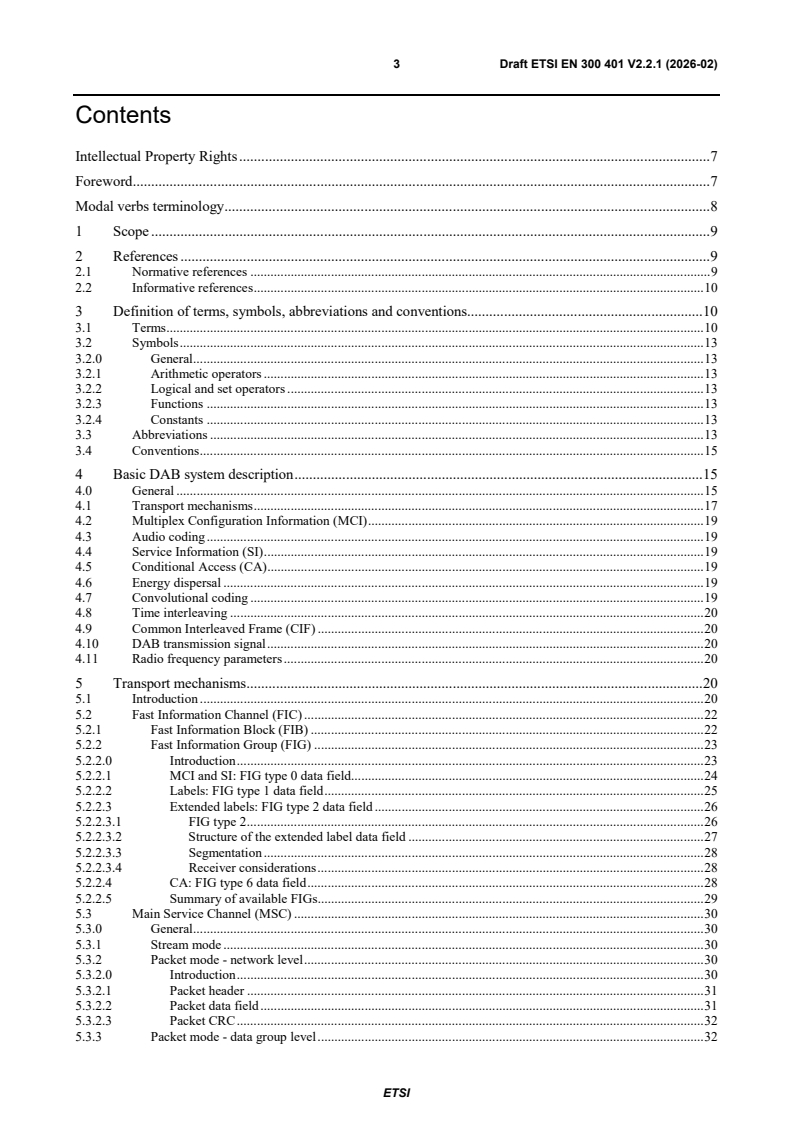
Contents
Intellectual Property Rights . 7
Foreword . 7
Modal verbs terminology . 8
1 Scope . 9
2 References . 9
2.1 Normative references . 9
2.2 Informative references . 10
3 Definition of terms, symbols, abbreviations and conventions . 10
3.1 Terms . 10
3.2 Symbols . 13
3.2.0 General . 13
3.2.1 Arithmetic operators . 13
3.2.2 Logical and set operators . 13
3.2.3 Functions . 13
3.2.4 Constants . 13
3.3 Abbreviations . 13
3.4 Conventions . 15
4 Basic DAB system description . 15
4.0 General . 15
4.1 Transport mechanisms . 17
4.2 Multiplex Configuration Information (MCI) . 19
4.3 Audio coding . 19
4.4 Service Information (SI) . 19
4.5 Conditional Access (CA) . 19
4.6 Energy dispersal . 19
4.7 Convolutional coding . 19
4.8 Time interleaving . 20
4.9 Common Interleaved Frame (CIF) . 20
4.10 DAB transmission signal . 20
4.11 Radio frequency parameters . 20
5 Transport mechanisms . 20
5.1 Introduction . 20
5.2 Fast Information Channel (FIC) . 22
5.2.1 Fast Information Block (FIB) . 22
5.2.2 Fast Information Group (FIG) . 23
5.2.2.0 Introduction . 23
5.2.2.1 MCI and SI: FIG type 0 data field . 24
5.2.2.2 Labels: FIG type 1 data field . 25
5.2.2.3 Extended labels: FIG type 2 data field . 26
5.2.2.3.1 FIG type 2 . 26
5.2.2.3.2 Structure of the extended label data field . 27
5.2.2.3.3 Segmentation . 28
5.2.2.3.4 Receiver considerations . 28
5.2.2.4 CA: FIG type 6 data field . 28
5.2.2.5 Summary of available FIGs. 29
5.3 Main Service Channel (MSC) . 30
5.3.0 General . 30
5.3.1 Stream mode . 30
5.3.2 Packet mode - network level . 30
5.3.2.0 Introduction . 30
5.3.2.1 Packet header . 31
5.3.2.2 Packet data field . 31
5.3.2.3 Packet CRC . 32
5.3.3 Packet mode - data group level . 32
ETSI
4 Draft ETSI EN 300 401 V2.2.1 (2026-02)
5.3.3.0 Introduction . 32
5.3.3.1 MSC data group header . 33
5.3.3.2 Session header . 33
5.3.3.3 MSC data group data field . 34
5.3.3.4 MSC data group CRC . 34
5.3.4 Interrelation of network and transport level in packet mode . 34
5.3.5 FEC for MSC packet mode . 35
5.3.5.0 Introduction . 35
5.3.5.1 FEC frame . 36
5.3.5.2 Transport of RS data . 36
5.3.5.3 Receiver considerations . 38
6 Multiplex Configuration Information (MCI). 38
6.1 Introduction . 38
6.2 Sub-channel organization . 40
6.2.0 General . 40
6.2.1 Basic sub-channel organization . 40
6.2.2 FEC sub-channel organization . 44
6.3 Service organization . 44
6.3.0 General . 44
6.3.1 Basic service and service component definition . 45
6.3.2 Service component in packet mode with or without Conditional Access . 46
6.3.3 Service component with Conditional Access in stream mode . 47
6.3.4 Void . 48
6.3.5 Service component global definition . 48
6.3.6 User application information . 49
6.3.7 Locating service components . 51
6.3.7.1 Service component identification . 51
6.3.7.2 Stream audio service components . 51
6.3.7.3 Stream data service components . 51
6.3.7.4 Packet data service components . 52
6.4 Ensemble and configuration information . 52
6.4.1 Ensemble information . 52
6.4.2 Configuration information . 53
6.5 Multiplex reconfiguration . 54
7 Audio coding . 54
7.1 Introduction . 54
7.2 Void . 55
7.3 Void . 55
7.4 Programme Associated Data (PAD) . 55
7.4.0 Introduction. 55
7.4.1 Coding of F-PAD . 55
7.4.2 Structure of X-PAD . 57
7.4.2.0 General . 57
7.4.2.1 Short X-PAD . 58
7.4.2.2 Variable size X-PAD. 58
7.4.3 Application types . 59
7.4.4 Contents indicator . 60
7.4.4.1 Contents indicator in short X-PAD . 60
7.4.4.2 Contents indicator in variable size X-PAD . 60
7.4.5 Applications in X-PAD . 61
7.4.5.0 Introduction . 61
7.4.5.1 MSC data groups in X-PAD . 61
7.4.5.1.0 Introduction . 61
7.4.5.1.1 X-PAD data group for data group length indicator . 61
7.4.5.1.2 X-PAD data group for MSC data group . 62
7.4.5.1.3 Transport of MSC data groups in short X-PAD . 62
7.4.5.1.4 Transport of MSC data groups in variable-sized X-PAD . 62
7.4.5.2 Dynamic label . 62
8 Service Information . 65
8.1 Service Information (SI) . 65
ETSI
5 Draft ETSI EN 300 401 V2.2.1 (2026-02)
8.1.1 Introduction. 65
8.1.2 Service component language . 67
8.1.3 Time and country identifier . 68
8.1.3.1 Date and time (d&t) . 68
8.1.3.2 Country, LTO and International table . 69
8.1.4 Service Component Information . 70
8.1.5 Programme Type . 72
8.1.6 Announcements . 73
8.1.6.0 General . 73
8.1.6.1 Announcement support . 73
8.1.6.2 Announcement switching . 74
8.1.6.3 OE Announcement support . 75
8.1.6.4 OE Announcement switching. 76
8.1.7 EWS information . 77
8.1.8 Frequency Information . 80
8.1.9 Void . 84
8.1.10 OE Services . 84
8.1.11 Void . 85
8.1.12 Void . 85
8.1.13 Ensemble label . 85
8.1.14 Service label. 85
8.1.14.1 Programme service label . 85
8.1.14.2 Data service label . 86
8.1.14.3 Service component label . 86
8.1.14.4 X-PAD user application label . 87
8.1.15 Service linking information . 87
9 Conditional Access (CA). 90
10 Energy dispersal . 90
10.1 General procedure . 90
10.2 Energy dispersal as applied in the Fast Information Channel . 90
10.3 Energy dispersal as applied in the Main Service Channel . 91
11 Convolutional coding . 91
11.0 Introduction . 91
11.1 Convolutional code. 91
11.1.1 Mother code . 91
11.1.2 Puncturing procedure . 92
11.2 Coding in the Fast Information Channel . 94
11.2.1 Transmission mode I . 94
11.3 Coding in the Main Service Channel . 94
11.3.0 Introduction. 94
11.3.1 Unequal Error Protection (UEP) coding . 94
11.3.2 Equal Error Protection (EEP) coding . 97
11.3.3 Future error protection coding . 98
12 Time interleaving . 99
13 Common Interleaved Frame . 105
14 DAB transmission signal . 105
14.1 General principles. 105
14.2 Structure of the main signal . 106
14.3 Synchronization channel . 109
14.3.0 Introduction. 109
14.3.1 Null symbol . 109
14.3.2 Phase reference symbol . 109
14.3.3 Time reference . 110
14.4 Block partitioning and association of blocks to OFDM symbols . 110
14.4.0 Introduction. 110
14.4.1 Block partitioning and association of blocks to OFDM symbols in the Fast Information Channel . 111
14.4.1.1 Transmission mode I . 111
14.4.2 Block partitioning and association of blocks to OFDM symbols in the Main Service Channel . 112
ETSI
6 Draft ETSI EN 300 401 V2.2.1 (2026-02)
14.4.2.1 Transmission mode I . 112
14.5 QPSK symbol mapper . 113
14.6 Frequency interleaving . 113
14.6.0 Introduction. 113
14.6.1 Transmission mode I . 114
14.7 Differential modulation . 114
14.8 Transmitter Identification Information signal . 115
14.8.0 Introduction. 115
14.8.1 Transmission mode I . 116
15 Radio frequency characteristics . 118
15.1 Use of the transmission mode. 118
15.2 Time characteristics . 118
15.3 Spectrum characteristics . 119
15.4 Spectrum mask . 120
15.5 Permitted values of the central frequency . 120
Annex A (normative): DAB location coding . 121
A.1 Introduction . 121
A.2 Coordinates . 121
A.3 Division into zones . 121
A.4 Division of the banded zones . 123
A.5 Division of the polar zones . 124
Annex B: Void . 127
Annex C: Void . 128
Annex D (informative): Multiplex reconfiguration . 129
Annex E (normative): Calculation of the CRC word . 131
History . 132
ETSI
7 Draft ETSI EN 300 401 V2.2.1 (2026-02)
Intellectual Property Rights
Essential patents
IPRs essential or potentially essential to normative deliverables may have been declared to ETSI. The declarations
pertaining to these essential IPRs, if any, are publicly available for ETSI members and non-members, and can be
found in ETSI SR 000 314: "Intellectual Property Rights (IPRs); Essential, or potentially Essential, IPRs notified to
ETSI in respect of ETSI standards", which is available from the ETSI Secretariat. Latest updates are available on the
ETSI IPR online database.
Pursuant to the ETSI Directives including the ETSI IPR Policy, no investigation regarding the essentiality of IPRs,
including IPR searches, has been carried out by ETSI. No guarantee can be given as to the existence of other IPRs not
referenced in ETSI SR 000 314 (or the updates on the ETSI Web server) which are, or may be, or may become,
essential to the present document.
Trademarks
The present document may include trademarks and/or tradenames which are asserted and/or registered by their owners.
ETSI claims no ownership of these except for any which are indicated as being the property of ETSI, and conveys no
right to use or reproduce any trademark and/or tradename. Mention of those trademarks in the present document does
not constitute an endorsement by ETSI of products, services or organizations associated with those trademarks.
DECT™, PLUGTESTS™, UMTS™ and the ETSI logo are trademarks of ETSI registered for the benefit of its
Members. 3GPP™, LTE™ and 5G™ logo are trademarks of ETSI registered for the benefit of its Members and of the
3GPP Organizational Partners. oneM2M™ logo is a trademark of ETSI registered for the benefit of its Members and of ®
the oneM2M Partners. GSM and the GSM logo are trademarks registered and owned by the GSM Association.
Foreword
This draft European Standard (EN) has been produced by Joint Technical Committee (JTC) Broadcast of the European
Broadcasting Union (EBU), Comité Européen de Normalisation ELECtrotechnique (CENELEC) and the European
Telecommunications Standards Institute (ETSI), and is now submitted for the combined Public Enquiry and Vote phase
of the ETSI EN Approval Procedure (ENAP).
NOTE 1: The EBU/ETSI JTC Broadcast was established in 1990 to co-ordinate the drafting of standards in the
specific field of broadcasting and related fields. Since 1995 the JTC Broadcast became a tripartite body
by including in the Memorandum of Understanding also CENELEC, which is responsible for the
standardization of radio and television receivers. The EBU is a professional association of broadcasting
organizations whose work includes the co-ordination of its members' activities in the technical, legal,
programme-making and programme-exchange domains. The EBU has active members in about
60 countries in the European broadcasting area; its headquarters is in Geneva.
European Broadcasting Union
CH-1218 GRAND SACONNEX (Geneva)
Switzerland
Tel: +41 22 717 21 11
Fax: +41 22 717 24 81
The Eureka Project 147 was established in 1987, with funding from the European Commission, to develop a system for
the broadcasting of audio and data to fixed, portable or mobile receivers. Their work resulted in the publication of ®
European Standard, ETSI ETS 300 401 [i.1], for DAB (see note) which now has worldwide acceptance. ®
NOTE 2: DAB is a registered trademark owned by one of the Eureka Project 147 partners.
® ®
The DAB family of standards is supported by World DAB , an organization with members drawn from broadcasting
organizations and telecommunication providers together with companies from the professional and consumer
electronics industry.
ETSI
8 Draft ETSI EN 300 401 V2.2.1 (2026-02)
With respect to the previous version of ETSI EN 300 401 [i.2] published in January 2017, the present document
contains several refinements to the DAB system. These refinements were performed and agreed by the WorldDAB
Forum and include the following areas:
• inclusion of new and revised FIGs;
• provision of signalling for indication of services with public prominence;
• addition of the DAB location coding system.
Proposed national transposition dates
Date of latest announcement of this EN (doa): 3 months after ETSI publication
Date of latest publication of new National Standard
or endorsement of this EN (dop/e): 6 months after doa
Date of withdrawal of any conflicting National Standard (dow): 6 months after doa
Modal verbs terminology
In the present document "shall", "shall not", "should", "should not", "may", "need not", "will", "will not", "can" and
"cannot" are to be interpreted as described in clause 3.2 of the ETSI Drafting Rules (Verbal forms for the expression of
provisions).
"must" and "must not" are NOT allowed in ETSI deliverables except when used in direct citation.
ETSI
9 Draft ETSI EN 300 401 V2.2.1 (2026-02)
1 Scope
The present document establishes a broadcasting standard for the Digital Audio Broadcasting (DAB) system designed
for delivery of high-quality digital audio and video programmes and data services for mobile, portable and fixed
reception from terrestrial transmitters in the Very High Frequency (VHF) frequency bands as well as for distribution
through cable networks. The DAB system is designed to provide spectrum and power efficient techniques in terrestrial
transmitter network planning, known as the Single Frequency Network (SFN) and the gap-filling technique. The DAB
system meets the required sharing criteria with other radiocommunication services.
The present document defines the DAB transmission signal. It includes the coding algorithms for multiplexing of audio
and video programmes and data services, channel coding and modulation. Provision is also made for transmission of
additional data services which may be programme related or not, within the limit of the total system capacity. The
present document provides information on the system configuration which includes information about the ensembles,
services, service components and linking of them.
The present document describes the nominal characteristics of the emitted DAB signal. The aspects related to the
receiver design are outside the scope of the present document.
2 References
2.1 Normative references
References are either specific (identified by date of publication and/or edition number or version number) or
non-specific. For specific references, only the cited version applies. For non-specific references, the latest version of the
referenced document (including any amendments) applies.
Referenced documents which are not found to be publicly available in the expected location might be found in the
ETSI docbox.
NOTE: While any hyperlinks included in this clause were valid at the time of publication, ETSI cannot guarantee
their long-term validity.
The following referenced documents are necessary for the application of the present document.
[1] ETSI TS 103 466: "Digital Audio Broadcasting (DAB); DAB audio coding (MPEG Layer II)".
[2] ETSI TS 102 563: "Digital Audio Broadcasting (DAB); Transport of Advanced Audio Coding
(AAC) audio".
[3] ETSI TS 101 756: "Digital Audio Broadcasting (DAB); Registered Tables".
[4] ETSI TS 102 367: "Digital Audio Broadcasting (DAB); Conditional access".
[5] ETSI TS 103 176: "Digital Audio Broadcasting (DAB); Rules of implementation; Service
information features".
[6] ETSI EN 301 234: "Digital Audio Broadcasting (DAB); Multimedia Object Transfer (MOT)
protocol".
[7] ETSI TS 102 980: "Digital Audio Broadcasting (DAB); Dynamic Label Plus (DL Plus);
Application specification".
[8] ETSI ES 201 980: "Digital Radio Mondiale (DRM); System Specification".
[9] ETSI TS 102 386: "Digital Radio Mondiale (DRM); AM signalling system (AMSS)".
[10] IEC 62106: "Radio data system (RDS) - VHF/FM sound broadcasting in the frequency range from
64,0 MHz to 108,0 MHz".
ETSI
10 Draft ETSI EN 300 401 V2.2.1 (2026-02)
[11] Recommendation ITU-T X.25: "Interface between Data Terminal Equipment (DTE) and Data
Circuit-terminating Equipment (DCE) for terminals operating in the packet mode and connected to
public data networks by dedicated circuit".
[12] ETSI TS 104 089: "Digital Audio Broadcasting (DAB); Emergency Warning System (EWS);
Definition and rules of behaviour".
2.2 Informative references
References are either specific (identified by date of publication and/or edition number or version number) or
non-specific. For specific references, only the cited version applies. For non-specific references, the latest version of the
referenced document (including any amendments) applies.
NOTE: While any hyperlinks included in this clause were valid at the time of publication, ETSI cannot guarantee
their long-term validity.
The following referenced documents may be useful in implementing an ETSI deliverable or add to the reader's
understanding, but are not required for conformance to the present document.
[i.1] ETSI ETS 300 401 (edition 1) (1995): "Radio Broadcasting Systems; Digital Audio Broadcasting
(DAB) to mobile, portable and fixed receivers".
[i.2] ETSI EN 300 401 (V2.1.1) (2017): "Radio Broadcasting Systems; Digital Audio Broadcasting
(DAB) to mobile, portable and fixed receivers".
3 Definition of terms, symbols, abbreviations and
conventions
3.1 Terms
For the purposes of the present document, the following terms apply:
Access Control System (ACS): particular set of rules for managing entitlement checking and conditional access
messages
announcement cluster: group of services which share the same announcement interruption privileges
Capacity Unit (CU): smallest addressable unit (64 bits) of the Common Interleaved F
...
EUROPEAN STANDARD
Radio Broadcasting Systems;
Digital Audio Broadcasting (DAB) to mobile,
portable and fixed receivers
2 ETSI EN 300 401 V2.2.1 (2026-06)
Reference
REN/JTC-DAB-114
Keywords
audio, broadcasting, DAB, data, digital, terrestrial
ETSI
650 Route des Lucioles
F-06921 Sophia Antipolis Cedex - FRANCE
Tel.: +33 4 92 94 42 00 Fax: +33 4 93 65 47 16
Siret N° 348 623 562 00017 - APE 7112B
Association à but non lucratif enregistrée à la
Sous-Préfecture de Grasse (06) N° w061004871
Important notice
The present document can be downloaded from the
ETSI Search & Browse Standards application.
The present document may be made available in electronic versions and/or in print. The content of any electronic and/or
print versions of the present document shall not be modified without the prior written authorization of ETSI. In case of any
existing or perceived difference in contents between such versions and/or in print, the prevailing version of an ETSI
deliverable is the one made publicly available in PDF format on ETSI deliver repository.
Users should be aware that the present document may be revised or have its status changed,
this information is available in the Milestones listing.
If you find errors in the present document, please send your comments to
the relevant service listed under Committee Support Staff.
If you find a security vulnerability in the present document, please report it through our
Coordinated Vulnerability Disclosure (CVD) program.
Notice of disclaimer & limitation of liability
The information provided in the present deliverable is directed solely to professionals who have the appropriate degree of
experience to understand and interpret its content in accordance with generally accepted engineering or
other professional standard and applicable regulations.
No recommendation as to products and services or vendors is made or should be implied.
In no event shall ETSI be held liable for loss of profits or any other incidental or consequential damages.
Any software contained in this deliverable is provided "AS IS" with no warranties, express or implied, including but not
limited to, the warranties of merchantability, fitness for a particular purpose and non-infringement of intellectual property
rights and ETSI shall not be held liable in any event for any damages whatsoever (including, without limitation, damages
for loss of profits, business interruption, loss of information, or any other pecuniary loss) arising out of or related to the use
of or inability to use the software.
Copyright Notification
No part may be reproduced or utilized in any form or by any means, electronic or mechanical, including photocopying and
microfilm except as authorized by written permission of ETSI.
The content of the PDF version shall not be modified without the written authorization of ETSI.
The copyright and the foregoing restriction extend to reproduction in all media.
© ETSI 2026.
© European Broadcasting Union 2026.
All rights reserved.
ETSI
3 ETSI EN 300 401 V2.2.1 (2026-06)
Contents
Intellectual Property Rights . 7
Foreword . 7
Modal verbs terminology . 8
1 Scope . 9
2 References . 9
2.1 Normative references . 9
2.2 Informative references . 10
3 Definition of terms, symbols, abbreviations and conventions . 10
3.1 Terms . 10
3.2 Symbols . 13
3.2.0 General . 13
3.2.1 Arithmetic operators . 13
3.2.2 Logical and set operators . 13
3.2.3 Functions . 13
3.2.4 Constants . 13
3.3 Abbreviations . 13
3.4 Conventions . 15
4 Basic DAB system description . 15
4.0 General . 15
4.1 Transport mechanisms . 17
4.2 Multiplex Configuration Information (MCI) . 19
4.3 Audio coding . 19
4.4 Service Information (SI) . 19
4.5 Conditional Access (CA) . 19
4.6 Energy dispersal . 19
4.7 Convolutional coding . 19
4.8 Time interleaving . 20
4.9 Common Interleaved Frame (CIF) . 20
4.10 DAB transmission signal . 20
4.11 Radio frequency parameters . 20
5 Transport mechanisms . 20
5.1 Introduction . 20
5.2 Fast Information Channel (FIC) . 22
5.2.1 Fast Information Block (FIB) . 22
5.2.2 Fast Information Group (FIG) . 23
5.2.2.0 Introduction . 23
5.2.2.1 MCI and SI: FIG type 0 data field . 24
5.2.2.2 Labels: FIG type 1 data field . 25
5.2.2.3 Extended labels: FIG type 2 data field . 26
5.2.2.3.1 FIG type 2 . 26
5.2.2.3.2 Structure of the extended label data field . 27
5.2.2.3.3 Segmentation . 28
5.2.2.3.4 Receiver considerations . 28
5.2.2.4 CA: FIG type 6 data field . 28
5.2.2.5 Summary of available FIGs. 29
5.3 Main Service Channel (MSC) . 30
5.3.0 General . 30
5.3.1 Stream mode . 30
5.3.2 Packet mode - network level . 30
5.3.2.0 Introduction . 30
5.3.2.1 Packet header . 31
5.3.2.2 Packet data field . 31
5.3.2.3 Packet CRC . 32
5.3.3 Packet mode - data group level . 32
ETSI
4 ETSI EN 300 401 V2.2.1 (2026-06)
5.3.3.0 Introduction . 32
5.3.3.1 MSC data group header . 33
5.3.3.2 Session header . 33
5.3.3.3 MSC data group data field . 34
5.3.3.4 MSC data group CRC . 34
5.3.4 Interrelation of network and transport level in packet mode . 34
5.3.5 FEC for MSC packet mode . 35
5.3.5.0 Introduction . 35
5.3.5.1 FEC frame . 36
5.3.5.2 Transport of RS data . 36
5.3.5.3 Receiver considerations . 38
6 Multiplex Configuration Information (MCI). 38
6.1 Introduction . 38
6.2 Sub-channel organization . 40
6.2.0 General . 40
6.2.1 Basic sub-channel organization . 40
6.2.2 FEC sub-channel organization . 44
6.3 Service organization . 44
6.3.0 General . 44
6.3.1 Basic service and service component definition . 45
6.3.2 Service component in packet mode with or without Conditional Access . 46
6.3.3 Service component with Conditional Access in stream mode . 47
6.3.4 Void . 48
6.3.5 Service component global definition . 48
6.3.6 User application information . 49
6.3.7 Locating service components . 51
6.3.7.1 Service component identification . 51
6.3.7.2 Stream audio service components . 51
6.3.7.3 Stream data service components . 51
6.3.7.4 Packet data service components . 52
6.4 Ensemble and configuration information . 52
6.4.1 Ensemble information . 52
6.4.2 Configuration information . 53
6.5 Multiplex reconfiguration . 54
7 Audio coding . 54
7.1 Introduction . 54
7.2 Void . 55
7.3 Void . 55
7.4 Programme Associated Data (PAD) . 55
7.4.0 Introduction. 55
7.4.1 Coding of F-PAD . 55
7.4.2 Structure of X-PAD . 57
7.4.2.0 General . 57
7.4.2.1 Short X-PAD . 58
7.4.2.2 Variable size X-PAD. 58
7.4.3 Application types . 59
7.4.4 Contents indicator . 60
7.4.4.1 Contents indicator in short X-PAD . 60
7.4.4.2 Contents indicator in variable size X-PAD . 60
7.4.5 Applications in X-PAD . 61
7.4.5.0 Introduction . 61
7.4.5.1 MSC data groups in X-PAD . 61
7.4.5.1.0 Introduction . 61
7.4.5.1.1 X-PAD data group for data group length indicator . 61
7.4.5.1.2 X-PAD data group for MSC data group . 62
7.4.5.1.3 Transport of MSC data groups in short X-PAD . 62
7.4.5.1.4 Transport of MSC data groups in variable-sized X-PAD . 62
7.4.5.2 Dynamic label . 62
8 Service Information . 65
8.1 Service Information (SI) . 65
ETSI
5 ETSI EN 300 401 V2.2.1 (2026-06)
8.1.1 Introduction. 65
8.1.2 Service component language . 67
8.1.3 Time and country identifier . 68
8.1.3.1 Date and time (d&t) . 68
8.1.3.2 Country, LTO and International table . 69
8.1.4 Service Component Information . 70
8.1.5 Programme Type . 72
8.1.6 Announcements . 73
8.1.6.0 General . 73
8.1.6.1 Announcement support . 73
8.1.6.2 Announcement switching . 74
8.1.6.3 OE Announcement support . 75
8.1.6.4 OE Announcement switching. 76
8.1.7 EWS information . 77
8.1.8 Frequency Information . 80
8.1.9 Void . 84
8.1.10 OE Services . 84
8.1.11 Void . 85
8.1.12 Void . 85
8.1.13 Ensemble label . 85
8.1.14 Service label. 85
8.1.14.1 Programme service label . 85
8.1.14.2 Data service label . 86
8.1.14.3 Service component label . 86
8.1.14.4 X-PAD user application label . 87
8.1.15 Service linking information . 87
9 Conditional Access (CA). 90
10 Energy dispersal . 90
10.1 General procedure . 90
10.2 Energy dispersal as applied in the Fast Information Channel . 90
10.3 Energy dispersal as applied in the Main Service Channel . 91
11 Convolutional coding . 91
11.0 Introduction . 91
11.1 Convolutional code. 91
11.1.1 Mother code . 91
11.1.2 Puncturing procedure . 92
11.2 Coding in the Fast Information Channel . 94
11.2.1 Transmission mode I . 94
11.3 Coding in the Main Service Channel . 94
11.3.0 Introduction. 94
11.3.1 Unequal Error Protection (UEP) coding . 94
11.3.2 Equal Error Protection (EEP) coding . 97
11.3.3 Future error protection coding . 98
12 Time interleaving . 99
13 Common Interleaved Frame . 105
14 DAB transmission signal . 105
14.1 General principles. 105
14.2 Structure of the main signal . 106
14.3 Synchronization channel . 109
14.3.0 Introduction. 109
14.3.1 Null symbol . 109
14.3.2 Phase reference symbol . 109
14.3.3 Time reference . 110
14.4 Block partitioning and association of blocks to OFDM symbols . 110
14.4.0 Introduction. 110
14.4.1 Block partitioning and association of blocks to OFDM symbols in the Fast Information Channel . 111
14.4.1.1 Transmission mode I . 111
14.4.2 Block partitioning and association of blocks to OFDM symbols in the Main Service Channel . 112
ETSI
6 ETSI EN 300 401 V2.2.1 (2026-06)
14.4.2.1 Transmission mode I . 112
14.5 QPSK symbol mapper . 113
14.6 Frequency interleaving . 113
14.6.0 Introduction. 113
14.6.1 Transmission mode I . 114
14.7 Differential modulation . 114
14.8 Transmitter Identification Information signal . 115
14.8.0 Introduction. 115
14.8.1 Transmission mode I . 116
15 Radio frequency characteristics . 118
15.1 Use of the transmission mode. 118
15.2 Time characteristics . 118
15.3 Spectrum characteristics . 119
15.4 Spectrum mask . 120
15.5 Permitted values of the central frequency . 120
Annex A (normative): DAB location coding . 121
A.1 Introduction . 121
A.2 Coordinates . 121
A.3 Division into zones . 121
A.4 Division of the banded zones . 123
A.5 Division of the polar zones . 124
Annex B: Void . 127
Annex C: Void . 128
Annex D (informative): Multiplex reconfiguration . 129
Annex E (normative): Calculation of the CRC word . 131
History . 132
ETSI
7 ETSI EN 300 401 V2.2.1 (2026-06)
Intellectual Property Rights
Essential patents
IPRs essential or potentially essential to normative deliverables may have been declared to ETSI. The declarations
pertaining to these essential IPRs, if any, are publicly available for ETSI members and non-members, and can be
found in ETSI SR 000 314: "Intellectual Property Rights (IPRs); Essential, or potentially Essential, IPRs notified to
ETSI in respect of ETSI standards", which is available from the ETSI Secretariat. Latest updates are available on the
ETSI IPR online database.
Pursuant to the ETSI Directives including the ETSI IPR Policy, no investigation regarding the essentiality of IPRs,
including IPR searches, has been carried out by ETSI. No guarantee can be given as to the existence of other IPRs not
referenced in ETSI SR 000 314 (or the updates on the ETSI Web server) which are, or may be, or may become,
essential to the present document.
Trademarks
The present document may include trademarks and/or tradenames which are asserted and/or registered by their owners.
ETSI claims no ownership of these except for any which are indicated as being the property of ETSI, and conveys no
right to use or reproduce any trademark and/or tradename. Mention of those trademarks in the present document does
not constitute an endorsement by ETSI of products, services or organizations associated with those trademarks.
DECT™, PLUGTESTS™, UMTS™ and the ETSI logo are trademarks of ETSI registered for the benefit of its
Members. 3GPP™, LTE™ and 5G™ logo are trademarks of ETSI registered for the benefit of its Members and of the
3GPP Organizational Partners. oneM2M™ logo is a trademark of ETSI registered for the benefit of its Members and of ®
the oneM2M Partners. GSM and the GSM logo are trademarks registered and owned by the GSM Association.
Foreword
This European Standard (EN) has been produced by Joint Technical Committee (JTC) Broadcast of the European
Broadcasting Union (EBU), Comité Européen de Normalisation ELECtrotechnique (CENELEC) and the European
Telecommunications Standards Institute (ETSI).
NOTE 1: The EBU/ETSI JTC Broadcast was established in 1990 to co-ordinate the drafting of standards in the
specific field of broadcasting and related fields. Since 1995 the JTC Broadcast became a tripartite body
by including in the Memorandum of Understanding also CENELEC, which is responsible for the
standardization of radio and television receivers. The EBU is a professional association of broadcasting
organizations whose work includes the co-ordination of its members' activities in the technical, legal,
programme-making and programme-exchange domains. The EBU has active members in about
60 countries in the European broadcasting area; its headquarters is in Geneva.
European Broadcasting Union
CH-1218 GRAND SACONNEX (Geneva)
Switzerland
Tel: +41 22 717 21 11
Fax: +41 22 717 24 81
The Eureka Project 147 was established in 1987, with funding from the European Commission, to develop a system for
the broadcasting of audio and data to fixed, portable or mobile receivers. Their work resulted in the publication of ®
European Standard, ETSI ETS 300 401 [i.1], for DAB (see note) which now has worldwide acceptance. ®
NOTE 2: DAB is a registered trademark owned by one of the Eureka Project 147 partners.
® ®
The DAB family of standards is supported by World DAB , an organization with members drawn from broadcasting
organizations and telecommunication providers together with companies from the professional and consumer
electronics industry.
ETSI
8 ETSI EN 300 401 V2.2.1 (2026-06)
With respect to the previous version of ETSI EN 300 401 [i.2] published in January 2017, the present document
contains several refinements to the DAB system. These refinements were performed and agreed by the WorldDAB
Forum and include the following areas:
• inclusion of new and revised FIGs;
• provision of signalling for indication of services with public prominence;
• addition of the DAB location coding system.
National transposition dates
Date of adoption of this EN: 28 May 2026
Date of latest announcement of this EN (doa): 31 August 2026
Date of latest publication of new National Standard
or endorsement of this EN (dop/e): 28 February 2027
Date of withdrawal of any conflicting National Standard (dow): 28 February 2027
Modal verbs terminology
In the present document "shall", "shall not", "should", "should not", "may", "need not", "will", "will not", "can" and
"cannot" are to be interpreted as described in clause 3.2 of the ETSI Drafting Rules (Verbal forms for the expression of
provisions).
"must" and "must not" are NOT allowed in ETSI deliverables except when used in direct citation.
ETSI
9 ETSI EN 300 401 V2.2.1 (2026-06)
1 Scope
The present document establishes a broadcasting standard for the Digital Audio Broadcasting (DAB) system designed
for delivery of high-quality digital audio and video programmes and data services for mobile, portable and fixed
reception from terrestrial transmitters in the Very High Frequency (VHF) frequency bands as well as for distribution
through cable networks. The DAB system is designed to provide spectrum and power efficient techniques in terrestrial
transmitter network planning, known as the Single Frequency Network (SFN) and the gap-filling technique. The DAB
system meets the required sharing criteria with other radiocommunication services.
The present document defines the DAB transmission signal. It includes the coding algorithms for multiplexing of audio
and video programmes and data services, channel coding and modulation. Provision is also made for transmission of
additional data services which may be programme related or not, within the limit of the total system capacity. The
present document provides information on the system configuration which includes information about the ensembles,
services, service components and linking of them.
The present document describes the nominal characteristics of the emitted DAB signal. The aspects related to the
receiver design are outside the scope of the present document.
2 References
2.1 Normative references
References are either specific (identified by date of publication and/or edition number or version number) or
non-specific. For specific references, only the cited version applies. For non-specific references, the latest version of the
referenced document (including any amendments) applies.
Referenced documents which are not found to be publicly available in the expected location might be found in the
ETSI docbox.
NOTE: While any hyperlinks included in this clause were valid at the time of publication, ETSI cannot guarantee
their long-term validity.
The following referenced documents are necessary for the application of the present document.
[1] ETSI TS 103 466: "Digital Audio Broadcasting (DAB); DAB audio coding (MPEG Layer II)".
[2] ETSI TS 102 563: "Digital Audio Broadcasting (DAB); Transport of Advanced Audio Coding
(AAC) audio".
[3] ETSI TS 101 756: "Digital Audio Broadcasting (DAB); Registered Tables".
[4] ETSI TS 102 367: "Digital Audio Broadcasting (DAB); Conditional access".
[5] ETSI TS 103 176: "Digital Audio Broadcasting (DAB); Rules of implementation; Service
information features".
[6] ETSI EN 301 234: "Digital Audio Broadcasting (DAB); Multimedia Object Transfer (MOT)
protocol".
[7] ETSI TS 102 980: "Digital Audio Broadcasting (DAB); Dynamic Label Plus (DL Plus);
Application specification".
[8] ETSI ES 201 980: "Digital Radio Mondiale (DRM); System Specification".
[9] ETSI TS 102 386: "Digital Radio Mondiale (DRM); AM signalling system (AMSS)".
[10] IEC 62106: "Radio data system (RDS) - VHF/FM sound broadcasting in the frequency range from
64,0 MHz to 108,0 MHz".
ETSI
10 ETSI EN 300 401 V2.2.1 (2026-06)
[11] Recommendation ITU-T X.25: "Interface between Data Terminal Equipment (DTE) and Data
Circuit-terminating Equipment (DCE) for terminals operating in the packet mode and connected to
public data networks by dedicated circuit".
[12] ETSI TS 104 089: "Digital Audio Broadcasting (DAB); Emergency Warning System (EWS);
Definition and rules of behaviour".
2.2 Informative references
References are either specific (identified by date of publication and/or edition number or version number) or
non-specific. For specific references, only the cited version applies. For non-specific references, the latest version of the
referenced document (including any amendments) applies.
NOTE: While any hyperlinks included in this clause were valid at the time of publication, ETSI cannot guarantee
their long-term validity.
The following referenced documents may be useful in implementing an ETSI deliverable or add to the reader's
understanding, but are not required for conformance to the present document.
[i.1] ETSI ETS 300 401 (edition 1) (1995): "Radio Broadcasting Systems; Digital Audio Broadcasting
(DAB) to mobile, portable and fixed receivers".
[i.2] ETSI EN 300 401 (V2.1.1) (2017): "Radio Broadcasting Systems; Digital Audio Broadcasting
(DAB) to mobile, portable and fixed receivers".
3 Definition of terms, symbols, abbreviations and
conventions
3.1 Terms
For the purposes of the present document, the following terms apply:
Access Control System (ACS): particular set of rules for managing entitlement checking and conditional access
messages
announcement cluster: group of services which share the same announcement interruption privileges
Capacity Unit (CU): smallest addressable unit (64 bits) of the Common Interleaved Frame (CIF)
Change Event Indication (CEI): set of FIG fields with particular values to indicate a change of database content for
certain service informati
...
SLOVENSKI STANDARD
01-julij-2026
Sistemi radiodifuzije - Digitalna zvokovna radiodifuzija (DAB) za mobilne,
prenosne in fiksne sprejemnike
Radio Broadcasting Systems - Digital Audio Broadcasting (DAB) to mobile, portable and
fixed receivers
Ta slovenski standard je istoveten z: ETSI EN 300 401 V2.2.1 (2026-06)
ICS:
33.060.20 Sprejemna in oddajna Receiving and transmitting
oprema equipment
33.170 Televizijska in radijska Television and radio
difuzija broadcasting
2003-01.Slovenski inštitut za standardizacijo. Razmnoževanje celote ali delov tega standarda ni dovoljeno.
EUROPEAN STANDARD
Radio Broadcasting Systems;
Digital Audio Broadcasting (DAB) to mobile,
portable and fixed receivers
2 ETSI EN 300 401 V2.2.1 (2026-06)
Reference
REN/JTC-DAB-114
Keywords
audio, broadcasting, DAB, data, digital, terrestrial
ETSI
650 Route des Lucioles
F-06921 Sophia Antipolis Cedex - FRANCE
Tel.: +33 4 92 94 42 00 Fax: +33 4 93 65 47 16
Siret N° 348 623 562 00017 - APE 7112B
Association à but non lucratif enregistrée à la
Sous-Préfecture de Grasse (06) N° w061004871
Important notice
The present document can be downloaded from the
ETSI Search & Browse Standards application.
The present document may be made available in electronic versions and/or in print. The content of any electronic and/or
print versions of the present document shall not be modified without the prior written authorization of ETSI. In case of any
existing or perceived difference in contents between such versions and/or in print, the prevailing version of an ETSI
deliverable is the one made publicly available in PDF format on ETSI deliver repository.
Users should be aware that the present document may be revised or have its status changed,
this information is available in the Milestones listing.
If you find errors in the present document, please send your comments to
the relevant service listed under Committee Support Staff.
If you find a security vulnerability in the present document, please report it through our
Coordinated Vulnerability Disclosure (CVD) program.
Notice of disclaimer & limitation of liability
The information provided in the present deliverable is directed solely to professionals who have the appropriate degree of
experience to understand and interpret its content in accordance with generally accepted engineering or
other professional standard and applicable regulations.
No recommendation as to products and services or vendors is made or should be implied.
In no event shall ETSI be held liable for loss of profits or any other incidental or consequential damages.
Any software contained in this deliverable is provided "AS IS" with no warranties, express or implied, including but not
limited to, the warranties of merchantability, fitness for a particular purpose and non-infringement of intellectual property
rights and ETSI shall not be held liable in any event for any damages whatsoever (including, without limitation, damages
for loss of profits, business interruption, loss of information, or any other pecuniary loss) arising out of or related to the use
of or inability to use the software.
Copyright Notification
No part may be reproduced or utilized in any form or by any means, electronic or mechanical, including photocopying and
microfilm except as authorized by written permission of ETSI.
The content of the PDF version shall not be modified without the written authorization of ETSI.
The copyright and the foregoing restriction extend to reproduction in all media.
© ETSI 2026.
© European Broadcasting Union 2026.
All rights reserved.
ETSI
3 ETSI EN 300 401 V2.2.1 (2026-06)
Contents
Intellectual Property Rights . 7
Foreword . 7
Modal verbs terminology . 8
1 Scope . 9
2 References . 9
2.1 Normative references . 9
2.2 Informative references . 10
3 Definition of terms, symbols, abbreviations and conventions . 10
3.1 Terms . 10
3.2 Symbols . 13
3.2.0 General . 13
3.2.1 Arithmetic operators . 13
3.2.2 Logical and set operators . 13
3.2.3 Functions . 13
3.2.4 Constants . 13
3.3 Abbreviations . 13
3.4 Conventions . 15
4 Basic DAB system description . 15
4.0 General . 15
4.1 Transport mechanisms . 17
4.2 Multiplex Configuration Information (MCI) . 19
4.3 Audio coding . 19
4.4 Service Information (SI) . 19
4.5 Conditional Access (CA) . 19
4.6 Energy dispersal . 19
4.7 Convolutional coding . 19
4.8 Time interleaving . 20
4.9 Common Interleaved Frame (CIF) . 20
4.10 DAB transmission signal . 20
4.11 Radio frequency parameters . 20
5 Transport mechanisms . 20
5.1 Introduction . 20
5.2 Fast Information Channel (FIC) . 22
5.2.1 Fast Information Block (FIB) . 22
5.2.2 Fast Information Group (FIG) . 23
5.2.2.0 Introduction . 23
5.2.2.1 MCI and SI: FIG type 0 data field . 24
5.2.2.2 Labels: FIG type 1 data field . 25
5.2.2.3 Extended labels: FIG type 2 data field . 26
5.2.2.3.1 FIG type 2 . 26
5.2.2.3.2 Structure of the extended label data field . 27
5.2.2.3.3 Segmentation . 28
5.2.2.3.4 Receiver considerations . 28
5.2.2.4 CA: FIG type 6 data field . 28
5.2.2.5 Summary of available FIGs. 29
5.3 Main Service Channel (MSC) . 30
5.3.0 General . 30
5.3.1 Stream mode . 30
5.3.2 Packet mode - network level . 30
5.3.2.0 Introduction . 30
5.3.2.1 Packet header . 31
5.3.2.2 Packet data field . 31
5.3.2.3 Packet CRC . 32
5.3.3 Packet mode - data group level . 32
ETSI
4 ETSI EN 300 401 V2.2.1 (2026-06)
5.3.3.0 Introduction . 32
5.3.3.1 MSC data group header . 33
5.3.3.2 Session header . 33
5.3.3.3 MSC data group data field . 34
5.3.3.4 MSC data group CRC . 34
5.3.4 Interrelation of network and transport level in packet mode . 34
5.3.5 FEC for MSC packet mode . 35
5.3.5.0 Introduction . 35
5.3.5.1 FEC frame . 36
5.3.5.2 Transport of RS data . 36
5.3.5.3 Receiver considerations . 38
6 Multiplex Configuration Information (MCI). 38
6.1 Introduction . 38
6.2 Sub-channel organization . 40
6.2.0 General . 40
6.2.1 Basic sub-channel organization . 40
6.2.2 FEC sub-channel organization . 44
6.3 Service organization . 44
6.3.0 General . 44
6.3.1 Basic service and service component definition . 45
6.3.2 Service component in packet mode with or without Conditional Access . 46
6.3.3 Service component with Conditional Access in stream mode . 47
6.3.4 Void . 48
6.3.5 Service component global definition . 48
6.3.6 User application information . 49
6.3.7 Locating service components . 51
6.3.7.1 Service component identification . 51
6.3.7.2 Stream audio service components . 51
6.3.7.3 Stream data service components . 51
6.3.7.4 Packet data service components . 52
6.4 Ensemble and configuration information . 52
6.4.1 Ensemble information . 52
6.4.2 Configuration information . 53
6.5 Multiplex reconfiguration . 54
7 Audio coding . 54
7.1 Introduction . 54
7.2 Void . 55
7.3 Void . 55
7.4 Programme Associated Data (PAD) . 55
7.4.0 Introduction. 55
7.4.1 Coding of F-PAD . 55
7.4.2 Structure of X-PAD . 57
7.4.2.0 General . 57
7.4.2.1 Short X-PAD . 58
7.4.2.2 Variable size X-PAD. 58
7.4.3 Application types . 59
7.4.4 Contents indicator . 60
7.4.4.1 Contents indicator in short X-PAD . 60
7.4.4.2 Contents indicator in variable size X-PAD . 60
7.4.5 Applications in X-PAD . 61
7.4.5.0 Introduction . 61
7.4.5.1 MSC data groups in X-PAD . 61
7.4.5.1.0 Introduction . 61
7.4.5.1.1 X-PAD data group for data group length indicator . 61
7.4.5.1.2 X-PAD data group for MSC data group . 62
7.4.5.1.3 Transport of MSC data groups in short X-PAD . 62
7.4.5.1.4 Transport of MSC data groups in variable-sized X-PAD . 62
7.4.5.2 Dynamic label . 62
8 Service Information . 65
8.1 Service Information (SI) . 65
ETSI
5 ETSI EN 300 401 V2.2.1 (2026-06)
8.1.1 Introduction. 65
8.1.2 Service component language . 67
8.1.3 Time and country identifier . 68
8.1.3.1 Date and time (d&t) . 68
8.1.3.2 Country, LTO and International table . 69
8.1.4 Service Component Information . 70
8.1.5 Programme Type . 72
8.1.6 Announcements . 73
8.1.6.0 General . 73
8.1.6.1 Announcement support . 73
8.1.6.2 Announcement switching . 74
8.1.6.3 OE Announcement support . 75
8.1.6.4 OE Announcement switching. 76
8.1.7 EWS information . 77
8.1.8 Frequency Information . 80
8.1.9 Void . 84
8.1.10 OE Services . 84
8.1.11 Void . 85
8.1.12 Void . 85
8.1.13 Ensemble label . 85
8.1.14 Service label. 85
8.1.14.1 Programme service label . 85
8.1.14.2 Data service label . 86
8.1.14.3 Service component label . 86
8.1.14.4 X-PAD user application label . 87
8.1.15 Service linking information . 87
9 Conditional Access (CA). 90
10 Energy dispersal . 90
10.1 General procedure . 90
10.2 Energy dispersal as applied in the Fast Information Channel . 90
10.3 Energy dispersal as applied in the Main Service Channel . 91
11 Convolutional coding . 91
11.0 Introduction . 91
11.1 Convolutional code. 91
11.1.1 Mother code . 91
11.1.2 Puncturing procedure . 92
11.2 Coding in the Fast Information Channel . 94
11.2.1 Transmission mode I . 94
11.3 Coding in the Main Service Channel . 94
11.3.0 Introduction. 94
11.3.1 Unequal Error Protection (UEP) coding . 94
11.3.2 Equal Error Protection (EEP) coding . 97
11.3.3 Future error protection coding . 98
12 Time interleaving . 99
13 Common Interleaved Frame . 105
14 DAB transmission signal . 105
14.1 General principles. 105
14.2 Structure of the main signal . 106
14.3 Synchronization channel . 109
14.3.0 Introduction. 109
14.3.1 Null symbol . 109
14.3.2 Phase reference symbol . 109
14.3.3 Time reference . 110
14.4 Block partitioning and association of blocks to OFDM symbols . 110
14.4.0 Introduction. 110
14.4.1 Block partitioning and association of blocks to OFDM symbols in the Fast Information Channel . 111
14.4.1.1 Transmission mode I . 111
14.4.2 Block partitioning and association of blocks to OFDM symbols in the Main Service Channel . 112
ETSI
6 ETSI EN 300 401 V2.2.1 (2026-06)
14.4.2.1 Transmission mode I . 112
14.5 QPSK symbol mapper . 113
14.6 Frequency interleaving . 113
14.6.0 Introduction. 113
14.6.1 Transmission mode I . 114
14.7 Differential modulation . 114
14.8 Transmitter Identification Information signal . 115
14.8.0 Introduction. 115
14.8.1 Transmission mode I . 116
15 Radio frequency characteristics . 118
15.1 Use of the transmission mode. 118
15.2 Time characteristics . 118
15.3 Spectrum characteristics . 119
15.4 Spectrum mask . 120
15.5 Permitted values of the central frequency . 120
Annex A (normative): DAB location coding . 121
A.1 Introduction . 121
A.2 Coordinates . 121
A.3 Division into zones . 121
A.4 Division of the banded zones . 123
A.5 Division of the polar zones . 124
Annex B: Void . 127
Annex C: Void . 128
Annex D (informative): Multiplex reconfiguration . 129
Annex E (normative): Calculation of the CRC word . 131
History . 132
ETSI
7 ETSI EN 300 401 V2.2.1 (2026-06)
Intellectual Property Rights
Essential patents
IPRs essential or potentially essential to normative deliverables may have been declared to ETSI. The declarations
pertaining to these essential IPRs, if any, are publicly available for ETSI members and non-members, and can be
found in ETSI SR 000 314: "Intellectual Property Rights (IPRs); Essential, or potentially Essential, IPRs notified to
ETSI in respect of ETSI standards", which is available from the ETSI Secretariat. Latest updates are available on the
ETSI IPR online database.
Pursuant to the ETSI Directives including the ETSI IPR Policy, no investigation regarding the essentiality of IPRs,
including IPR searches, has been carried out by ETSI. No guarantee can be given as to the existence of other IPRs not
referenced in ETSI SR 000 314 (or the updates on the ETSI Web server) which are, or may be, or may become,
essential to the present document.
Trademarks
The present document may include trademarks and/or tradenames which are asserted and/or registered by their owners.
ETSI claims no ownership of these except for any which are indicated as being the property of ETSI, and conveys no
right to use or reproduce any trademark and/or tradename. Mention of those trademarks in the present document does
not constitute an endorsement by ETSI of products, services or organizations associated with those trademarks.
DECT™, PLUGTESTS™, UMTS™ and the ETSI logo are trademarks of ETSI registered for the benefit of its
Members. 3GPP™, LTE™ and 5G™ logo are trademarks of ETSI registered for the benefit of its Members and of the
3GPP Organizational Partners. oneM2M™ logo is a trademark of ETSI registered for the benefit of its Members and of ®
the oneM2M Partners. GSM and the GSM logo are trademarks registered and owned by the GSM Association.
Foreword
This European Standard (EN) has been produced by Joint Technical Committee (JTC) Broadcast of the European
Broadcasting Union (EBU), Comité Européen de Normalisation ELECtrotechnique (CENELEC) and the European
Telecommunications Standards Institute (ETSI).
NOTE 1: The EBU/ETSI JTC Broadcast was established in 1990 to co-ordinate the drafting of standards in the
specific field of broadcasting and related fields. Since 1995 the JTC Broadcast became a tripartite body
by including in the Memorandum of Understanding also CENELEC, which is responsible for the
standardization of radio and television receivers. The EBU is a professional association of broadcasting
organizations whose work includes the co-ordination of its members' activities in the technical, legal,
programme-making and programme-exchange domains. The EBU has active members in about
60 countries in the European broadcasting area; its headquarters is in Geneva.
European Broadcasting Union
CH-1218 GRAND SACONNEX (Geneva)
Switzerland
Tel: +41 22 717 21 11
Fax: +41 22 717 24 81
The Eureka Project 147 was established in 1987, with funding from the European Commission, to develop a system for
the broadcasting of audio and data to fixed, portable or mobile receivers. Their work resulted in the publication of ®
European Standard, ETSI ETS 300 401 [i.1], for DAB (see note) which now has worldwide acceptance. ®
NOTE 2: DAB is a registered trademark owned by one of the Eureka Project 147 partners.
® ®
The DAB family of standards is supported by World DAB , an organization with members drawn from broadcasting
organizations and telecommunication providers together with companies from the professional and consumer
electronics industry.
ETSI
8 ETSI EN 300 401 V2.2.1 (2026-06)
With respect to the previous version of ETSI EN 300 401 [i.2] published in January 2017, the present document
contains several refinements to the DAB system. These refinements were performed and agreed by the WorldDAB
Forum and include the following areas:
• inclusion of new and revised FIGs;
• provision of signalling for indication of services with public prominence;
• addition of the DAB location coding system.
National transposition dates
Date of adoption of this EN: 28 May 2026
Date of latest announcement of this EN (doa): 31 August 2026
Date of latest publication of new National Standard
or endorsement of this EN (dop/e): 28 February 2027
Date of withdrawal of any conflicting National Standard (dow): 28 February 2027
Modal verbs terminology
In the present document "shall", "shall not", "should", "should not", "may", "need not", "will", "will not", "can" and
"cannot" are to be interpreted as described in clause 3.2 of the ETSI Drafting Rules (Verbal forms for the expression of
provisions).
"must" and "must not" are NOT allowed in ETSI deliverables except when used in direct citation.
ETSI
9 ETSI EN 300 401 V2.2.1 (2026-06)
1 Scope
The present document establishes a broadcasting standard for the Digital Audio Broadcasting (DAB) system designed
for delivery of high-quality digital audio and video programmes and data services for mobile, portable and fixed
reception from terrestrial transmitters in the Very High Frequency (VHF) frequency bands as well as for distribution
through cable networks. The DAB system is designed to provide spectrum and power efficient techniques in terrestrial
transmitter network planning, known as the Single Frequency Network (SFN) and the gap-filling technique. The DAB
system meets the required sharing criteria with other radiocommunication services.
The present document defines the DAB transmission signal. It includes the coding algorithms for multiplexing of audio
and video programmes and data services, channel coding and modulation. Provision is also made for transmission of
additional data services which may be programme related or not, within the limit of the total system capacity. The
present document provides information on the system configuration which includes information about the ensembles,
services, service components and linking of them.
The present document describes the nominal characteristics of the emitted DAB signal. The aspects related to the
receiver design are outside the scope of the present document.
2 References
2.1 Normative references
References are either specific (identified by date of publication and/or edition number or version number) or
non-specific. For specific references, only the cited version applies. For non-specific references, the latest version of the
referenced document (including any amendments) applies.
Referenced documents which are not found to be publicly available in the expected location might be found in the
ETSI docbox.
NOTE: While any hyperlinks included in this clause were valid at the time of publication, ETSI cannot guarantee
their long-term validity.
The following referenced documents are necessary for the application of the present document.
[1] ETSI TS 103 466: "Digital Audio Broadcasting (DAB); DAB audio coding (MPEG Layer II)".
[2] ETSI TS 102 563: "Digital Audio Broadcasting (DAB); Transport of Advanced Audio Coding
(AAC) audio".
[3] ETSI TS 101 756: "Digital Audio Broadcasting (DAB); Registered Tables".
[4] ETSI TS 102 367: "Digital Audio Broadcasting (DAB); Conditional access".
[5] ETSI TS 103 176: "Digital Audio Broadcasting (DAB); Rules of implementation; Service
information features".
[6] ETSI EN 301 234: "Digital Audio Broadcasting (DAB); Multimedia Object Transfer (MOT)
protocol".
[7] ETSI TS 102 980: "Digital Audio Broadcasting (DAB); Dynamic Label Plus (DL Plus);
Application specification".
[8] ETSI ES 201 980: "Digital Radio Mondiale (DRM); System Specification".
[9] ETSI TS 102 386: "Digital Radio Mondiale (DRM); AM signalling system (AMSS)".
[10] IEC 62106: "Radio data system (RDS) - VHF/FM sound broadcasting in the frequency range from
64,0 MHz to 108,0 MHz".
ETSI
10 ETSI EN 300 401 V2.2.1 (2026-06)
[11] Recommendation ITU-T X.25: "Interface between Data Terminal Equipment (DTE) and Data
Circuit-terminating Equipment (DCE) for terminals operating in the packet mode and connected to
public data networks by dedicated circuit".
[12] ETSI TS 104 089: "Digital Audio Broadcasting (DAB); Emergency Warning System (EWS);
Definition and rules of behaviour".
2.2 Informative references
References are either specific (identified by date of publication and/or edition number or version number) or
non-specific. For specific references, only the cited version applies. For non-specific references, the latest version of the
referenced document (including any amendments) applies.
NOTE: While any hyperlinks included in this clause were valid at the time of publication, ETSI cannot guarantee
their long-term validity.
T
...