

SIST ISO 6754:2026
(Main)Dried thyme (Thymus vulgaris L.) — Specification (ISO 6754:2026)
- Abstract
This document specifies the requirements for dried thyme (Thymus vulgaris L.) in the form of rubbed leaves.
Recommendations relating to storage and transport conditions are given in Annex A.
- Status
- Published
- Publication Date
- 05-Oct-2026
- Technical Committee
- KŽP - Agricultural food products
- Current Stage
- 6060 - National Implementation/Publication (Adopted Project)
- Start Date
- 06-Oct-2026
- Due Date
- 11-Dec-2026
- Completion Date
- 06-Oct-2026

SIST ISO 6754:2026 is the Slovenian standard published by SIST and identical to ISO 6754:2026. It specifies the requirements for dried thyme (Thymus vulgaris L.) in rubbed-leaf form, together with sampling, test methods, packaging, marking, and storage and transport recommendations for use in trade and quality control.
What does SIST ISO 6754:2026 specify?
SIST ISO 6754:2026 covers dried thyme (Thymus vulgaris L.) as rubbed leaves. The document is organized into clauses 1 to 7, with Annex A giving storage and transport recommendations.
| Annex | What it covers |
|---|---|
| Annex A | Recommendations relating to storage and transport conditions |
In practice, the scope tells a buyer, seller, or laboratory exactly which herb form is covered. If the material is not dried thyme in rubbed-leaf form, the specification in this document is not the intended reference.
What are the key requirements of SIST ISO 6754:2026?
SIST ISO 6754:2026 combines product description, sensory checks, physical cleanliness limits, chemical quality limits, sampling rules, and package labeling. These are the points that determine whether a lot can be accepted as conforming dried thyme.
Product appearance and sensory quality
Clause 4.1 describes the expected leaf shape and colour range for dried thyme, and Clause 4.2 requires a characteristic strong, aromatic odour and flavour with no foreign odour, especially no musty smell. In practice, this means the product should look and smell like thyme, not like damaged, stale, or contaminated herb material.
Physical purity
Clause 4.3 and Table 1 control animal foreign matter, non-animal foreign matter, extraneous matter, and stalk proportion. The product must be free from animal contamination, and the other listed impurities are limited.
This matters because physical contamination is often the first reason for rejection in purchasing, cleaning, or incoming inspection. The same clause also notes that for final consumption the product should be free from foreign matter.
Chemical quality
Clause 4.4 and Table 2 set limits for moisture content, total ash, acid-insoluble ash, and volatile oil. These requirements are the main indicators of dryness, mineral contamination, and aromatic strength.
For a buyer or quality manager, these checks show whether the batch is dry enough for storage and whether it still has the expected thyme character. For a laboratory, these are the routine analytical parameters to verify.
Sampling and test preparation
Clause 5 requires sampling according to ISO 948 and sample preparation according to ISO 2825. For whole-form dried thyme, the material is ground so that it passes through the specified sieve before the chemical determinations are made.
That step matters because analytical results depend on getting a representative and properly prepared test portion. Clause 6 then ties conformity checking to the test methods named in Tables 1 and 2.
Packaging, marking, and storage
Clause 7 requires packaging that protects the product from moisture, loss of volatile matter, and bright light, and it requires containers to be clean, sound, dry, and suitable for loose packing. The marking requirements cover product identity, producer or packer, origin, batch identification, shelf life, net mass, optional purchaser information, and reference to the standard when the product claims conformity.
Annex A gives practical storage and transport guidance: keep containers under cover, protect them from sun, rain, heat, odours, insects, vermin, and cross-infection. This is what preserves quality after packing and during logistics.
What terms does SIST ISO 6754:2026 define?
- Foreign matter - Material visible to the naked eye or under low magnification that is not part of the herb plant.
- Extraneous matter - Material visible to the naked eye or under low magnification that belongs to the plant but is waste rather than usable herb.
- ISO - The International Organization for Standardization, named in the foreword as the body that publishes the standard.
- IEC - The International Electrotechnical Commission, mentioned in the foreword as ISO’s partner on electrotechnical standardization.
- WTO - The World Trade Organization, referenced in the foreword in relation to the voluntary nature of standards and trade principles.
- TBT - Technical Barriers to Trade, the WTO agreement named in the foreword.
Who uses SIST ISO 6754:2026?
SIST ISO 6754:2026 is used by thyme producers, herb processors, packers, traders, importers, exporters, and laboratory staff. Quality managers and buyers use it to define acceptance criteria for incoming lots, while inspectors use it to check compliance in sampling, testing, packaging, and marking.
It is also relevant in the spices and condiments chain, especially where dried herbs are bought, stored, or certified against a named specification.
What changed in SIST ISO 6754:2026 from the previous edition?
SIST ISO 6754:2026 cancels and replaces SIST ISO 6754:1997, and it is identified as the third edition of ISO 6754. The changes stated in the document are:
- the normative references are now undated;
- the definitions of extraneous matter and foreign matter have been modified in line with ISO 927.
Which standards are used with SIST ISO 6754:2026?
| Normative reference | What it contributes |
|---|---|
| ISO 565 | Sieve openings used when preparing ground sample material |
| ISO 927 | Determination of extraneous matter and foreign matter content |
| ISO 928 | Determination of total ash |
| ISO 930 | Determination of acid-insoluble ash |
| ISO 939 | Determination of moisture content |
| ISO 948 | Sampling method for spices and condiments |
| ISO 2825 | Preparation of a ground sample for analysis |
| ISO 6571 | Determination of volatile oil content by hydrodistillation |
These references supply the test and preparation methods used to check conformity. In practice, they tell the laboratory how to sample, grind, and measure the listed quality characteristics.
What does the SIST ISO 6754:2026 document contain?
SIST ISO 6754:2026 contains one scope clause, one clause on normative references, one clause on terms and definitions, and a requirements section split into general, sensory, physical, and chemical requirements. It also includes clauses on sampling, test methods, packaging and marking, plus an informative annex on storage and transport.
The core technical content is split between Table 1 for physical requirements and Table 2 for chemical requirements. Clause 5 explains how to prepare the sample for the chemical tests, and Clause 7 provides the information needed for packaging and traceability in the supply chain.
Relations
- Effective Date
- 01-Nov-2026
Get Certified
Connect with accredited certification bodies for this standard

BSI Group
BSI (British Standards Institution) is the business standards company that helps organizations make excellence a habit.

Bureau Veritas
Bureau Veritas is a world leader in laboratory testing, inspection and certification services.

DNV
DNV is an independent assurance and risk management provider.
Sponsored listings
Frequently Asked Questions
SIST ISO 6754:2026 is a standard published by the Slovenian Institute for Standardization (SIST). Its full title is "Dried thyme (Thymus vulgaris L.) — Specification (ISO 6754:2026)". This standard covers: This document specifies the requirements for dried thyme (Thymus vulgaris L.) in the form of rubbed leaves. Recommendations relating to storage and transport conditions are given in Annex A.
This document specifies the requirements for dried thyme (Thymus vulgaris L.) in the form of rubbed leaves. Recommendations relating to storage and transport conditions are given in Annex A.
SIST ISO 6754:2026 is classified under the following ICS (International Classification for Standards) categories: 67.220.10 - Spices and condiments. The ICS classification helps identify the subject area and facilitates finding related standards.
SIST ISO 6754:2026 has the following relationships with other standards: It is inter standard links to SIST ISO 6754:1997. Understanding these relationships helps ensure you are using the most current and applicable version of the standard.
SIST ISO 6754:2026 is available in PDF format for immediate download after purchase. The document can be added to your cart and obtained through the secure checkout process. Digital delivery ensures instant access to the complete standard document.
Standards Content (Sample)
SLOVENSKI STANDARD
01-november-2026
Nadomešča:
SIST ISO 6754:1997
Posušen timijan (Thymus vulgaris L.) - Specifikacija (ISO 6754:2026)
Dried thyme (Thymus vulgaris L.) — Specification (ISO 6754:2026)
Thym séché (Thymus vulgaris L.) — Spécifications (ISO 6754:2026)
Ta slovenski standard je istoveten z: ISO 6754:2026
ICS:
67.220.10 Začimbe Spices and condiments
2003-01.Slovenski inštitut za standardizacijo. Razmnoževanje celote ali delov tega standarda ni dovoljeno.
International
Standard
ISO 6754
Third edition
Dried thyme (Thymus vulgaris L.) —
2026-04
Specification
Thym séché (Thymus vulgaris L.) — Spécifications
Reference number
© ISO 2026
All rights reserved. Unless otherwise specified, or required in the context of its implementation, no part of this publication may
be reproduced or utilized otherwise in any form or by any means, electronic or mechanical, including photocopying, or posting on
the internet or an intranet, without prior written permission. Permission can be requested from either ISO at the address below
or ISO’s member body in the country of the requester.
ISO copyright office
CP 401 • Ch. de Blandonnet 8
CH-1214 Vernier, Geneva
Phone: +41 22 749 01 11
Email: copyright@iso.org
Website: www.iso.org
Published in Switzerland
ii
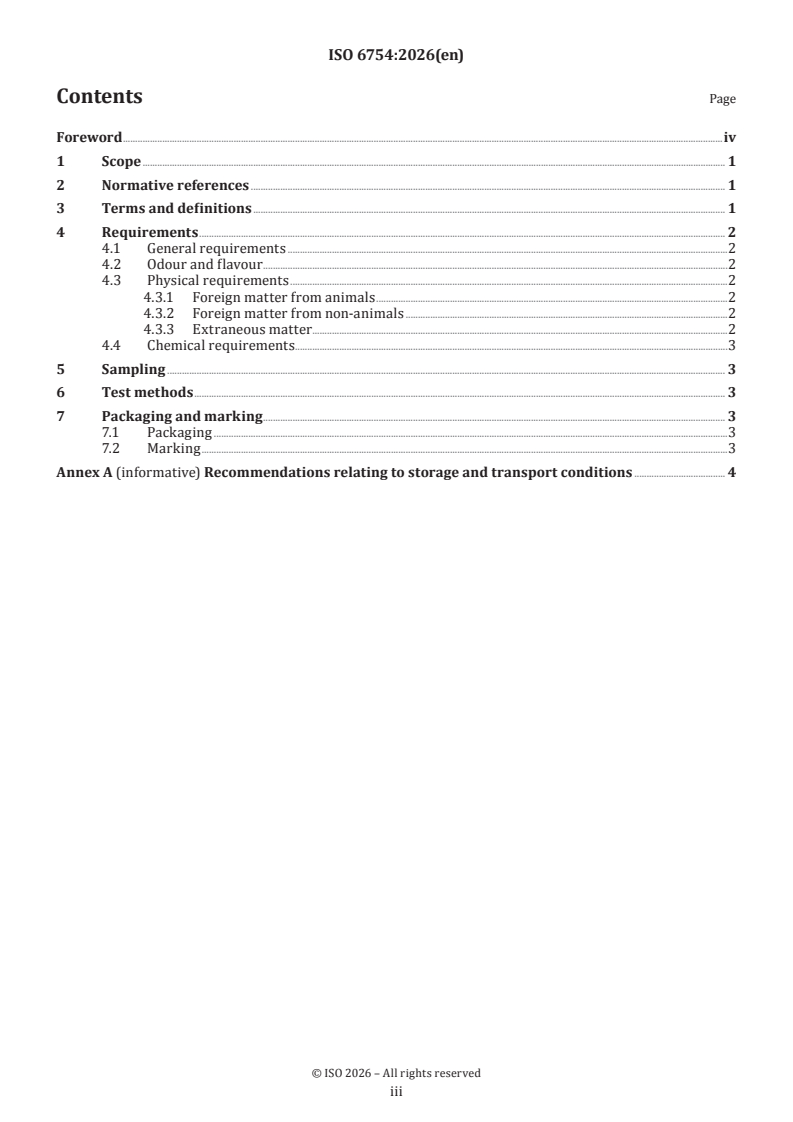
Contents Page
Foreword .iv
1 Scope . 1
2 Normative references . 1
3 Terms and definitions . 1
4 Requirements . 2
4.1 General requirements .2
4.2 Odour and flavour .2
4.3 Physical requirements .2
4.3.1 Foreign matter from animals .2
4.3.2 Foreign matter from non-animals .2
4.3.3 Extraneous matter . .2
4.4 Chemical requirements . .3
5 Sampling . 3
6 Test methods . 3
7 Packaging and marking . 3
7.1 Packaging .3
7.2 Marking .3
Annex A (informative) Recommendations relating to storage and transport conditions . 4
iii
Foreword
ISO (the International Organization for Standardization) is a worldwide federation of national standards
bodies (ISO member bodies). The work of preparing International Standards is normally carried out through
ISO technical committees. Each member body interested in a subject for which a technical committee
has been established has the right to be represented on that committee. International organizations,
governmental and non-governmental, in liaison with ISO, also take part in the work. ISO collaborates closely
with the International Electrotechnical Commission (IEC) on all matters of electrotechnical standardization.
The procedures used to develop this document and those intended for its further maintenance are described
in the ISO/IEC Directives, Part 1. In particular, the different approval criteria needed for the different types
of ISO document should be noted. This document was drafted in accordance with the editorial rules of the
ISO/IEC Directives, Part 2 (see www.iso.org/directives).
ISO draws attention to the possibility that the implementation of this document may involve the use of (a)
patent(s). ISO takes no position concerning the evidence, validity or applicability of any claimed patent
rights in respect thereof. As of the date of publication of this document, ISO had not received notice of (a)
patent(s) which may be required to implement this document. However, implementers are cautioned that
this may not represent the latest information, which may be obtained from the patent database available at
www.iso.org/patents. ISO shall not be held responsible for identifying any or all such patent rights.
Any trade name used in this document is information given for the convenience of users and does not
constitute an endorsement.
For an explanation of the voluntary nature of standards, the meaning of ISO specific terms and expressions
related to conformity assessment, as well as information about ISO’s adherence to the World Trade
Organization (WTO) principles in the Technical Barriers to Trade (TBT), see www.iso.org/iso/foreword.html.
This document was prepared by Technical Committee ISO/TC 34, Food products, Subcommittee SC 7, Spices,
culinary herbs and
...
International
Standard
ISO 6754
Third edition
Dried thyme (Thymus vulgaris L.) —
2026-04
Specification
Thym séché (Thymus vulgaris L.) — Spécifications
Reference number
© ISO 2026
All rights reserved. Unless otherwise specified, or required in the context of its implementation, no part of this publication may
be reproduced or utilized otherwise in any form or by any means, electronic or mechanical, including photocopying, or posting on
the internet or an intranet, without prior written permission. Permission can be requested from either ISO at the address below
or ISO’s member body in the country of the requester.
ISO copyright office
CP 401 • Ch. de Blandonnet 8
CH-1214 Vernier, Geneva
Phone: +41 22 749 01 11
Email: copyright@iso.org
Website: www.iso.org
Published in Switzerland
ii
Contents Page
Foreword .iv
1 Scope . 1
2 Normative references . 1
3 Terms and definitions . 1
4 Requirements . 2
4.1 General requirements .2
4.2 Odour and flavour .2
4.3 Physical requirements .2
4.3.1 Foreign matter from animals .2
4.3.2 Foreign matter from non-animals .2
4.3.3 Extraneous matter . .2
4.4 Chemical requirements . .3
5 Sampling . 3
6 Test methods . 3
7 Packaging and marking . 3
7.1 Packaging .3
7.2 Marking .3
Annex A (informative) Recommendations relating to storage and transport conditions . 4
iii
Foreword
ISO (the International Organization for Standardization) is a worldwide federation of national standards
bodies (ISO member bodies). The work of preparing International Standards is normally carried out through
ISO technical committees. Each member body interested in a subject for which a technical committee
has been established has the right to be represented on that committee. International organizations,
governmental and non-governmental, in liaison with ISO, also take part in the work. ISO collaborates closely
with the International Electrotechnical Commission (IEC) on all matters of electrotechnical standardization.
The procedures used to develop this document and those intended for its further maintenance are described
in the ISO/IEC Directives, Part 1. In particular, the different approval criteria needed for the different types
of ISO document should be noted. This document was drafted in accordance with the editorial rules of the
ISO/IEC Directives, Part 2 (see www.iso.org/directives).
ISO draws attention to the possibility that the implementation of this document may involve the use of (a)
patent(s). ISO takes no position concerning the evidence, validity or applicability of any claimed patent
rights in respect thereof. As of the date of publication of this document, ISO had not received notice of (a)
patent(s) which may be required to implement this document. However, implementers are cautioned that
this may not represent the latest information, which may be obtained from the patent database available at
www.iso.org/patents. ISO shall not be held responsible for identifying any or all such patent rights.
Any trade name used in this document is information given for the convenience of users and does not
constitute an endorsement.
For an explanation of the voluntary nature of standards, the meaning of ISO specific terms and expressions
related to conformity assessment, as well as information about ISO’s adherence to the World Trade
Organization (WTO) principles in the Technical Barriers to Trade (TBT), see www.iso.org/iso/foreword.html.
This document was prepared by Technical Committee ISO/TC 34, Food products, Subcommittee SC 7, Spices,
culinary herbs and condiments.
This third edition cancels and replaces the second edition (ISO 6754:1996), which has been technically
revised.
The main changes are as follows:
— the normative references have been undated;
— the definitions of extraneous matter and foreign matter have been modified in accordance with ISO 927.
Any feedback or questions on this document should be directed to the user’s national
...