

SIST ES 203 790 V1.3.1:2021
(Main)Methods for Testing and Specification (MTS) - The Testing and Test Control Notation version 3 - TTCN-3 Language Extensions: Object-Oriented Features
General Information
- Abstract
The present document defines the support for object-oriented features in TTCN-3. TTCN-3 can be used for the
specification of all types of reactive system tests over a variety of communication ports. Typical areas of application are
protocol testing (including mobile and Internet protocols), service testing (including supplementary services), module
testing, testing of OMG CORBA based platforms, APIs, etc. TTCN-3 is not restricted to conformance testing and can
be used for many other kinds of testing including interoperability, robustness, regression, system and integration testing.
The specification of test suites for physical layer protocols is outside the scope of the present document.
TTCN-3 packages are intended to define additional TTCN-3 concepts, which are not mandatory as concepts in the
TTCN-3 core language, but which are optional as part of a package which is suited for dedicated applications and/or
usages of TTCN-3.
While the design of TTCN-3 package has taken into account the consistency of a combined usage of the core language
with a number of packages, the concrete usages of and guidelines for this package in combination with other packages
is outside the scope of the present document.
- Status
- Published
- Publication Date
- 25-May-2021
- Technical Committee
- SPN - Services and Protocols for Networks
- Current Stage
- 6060 - National Implementation/Publication (Adopted Project)
- Start Date
- 25-May-2021
- Due Date
- 30-Jul-2021
- Completion Date
- 26-May-2021
Buy Documents
ETSI ES 203 790 V1.3.1 (2021-03) - Methods for Testing and Specification (MTS); The Testing and Test Control Notation version 3; TTCN-3 Language Extensions: Object-Oriented Features
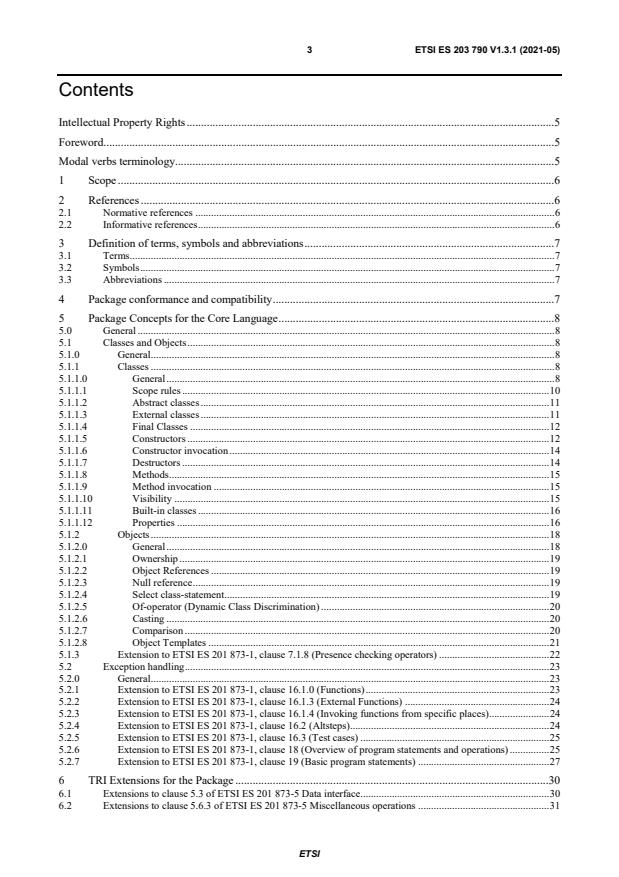
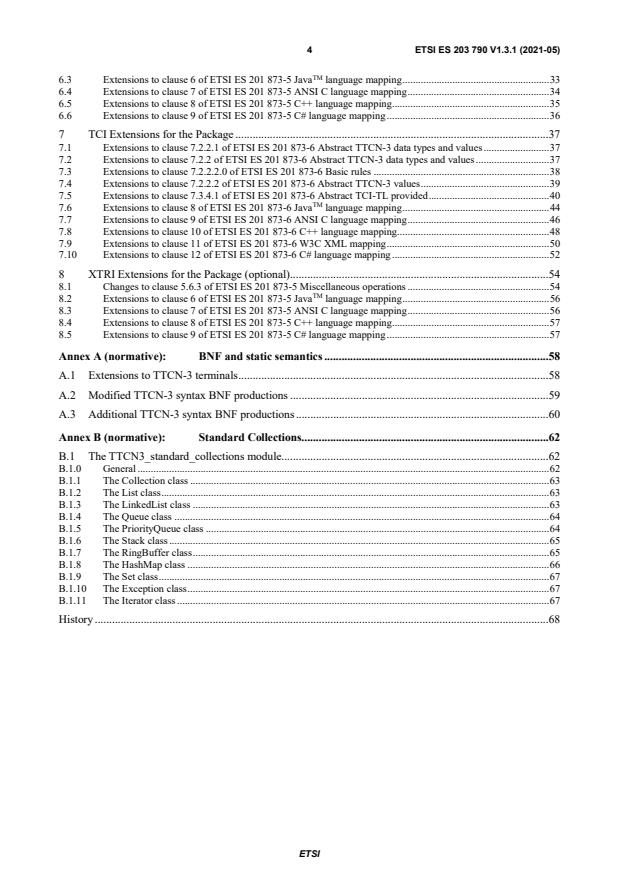
ETSI ES 203 790 V1.3.1 (2021-05) - Methods for Testing and Specification (MTS); The Testing and Test Control Notation version 3; TTCN-3 Language Extensions: Object-Oriented Features

Overview
SIST ES 203 790 V1.3.1:2021 is a standard developed by the Slovenian Institute for Standardization (SIST) that specifies object-oriented language extensions in the TTCN-3 (Testing and Test Control Notation version 3). TTCN-3 is widely recognized for defining and managing testing processes for reactive and communication-centric systems, such as network protocols, distributed platforms, and service APIs. This standard introduces modern object-oriented programming concepts-including classes, objects, and exception handling-directly into TTCN-3 to increase its expressiveness and reusability for test specifications.
Key Topics
Object-Oriented Extensions in TTCN-3
- Addition of classes, inheritance (including traits, abstract, and final classes), encapsulation, and object references.
- Support for advanced constructs such as constructors, destructors, method overloading, visibility (public, private, protected), and properties.
- Introduction of exception handling mechanisms for robust and modular test suite development.
Class and Object Management
- Syntactic and semantic structures for defining classes and creating object instances.
- Detailed rules for inheritance (single and multiple via traits), ownership, object reference handling, and member scope resolution.
- Rules and restrictions to ensure consistency in complex test architectures.
Package Compatibility
- Defined compatibility with the TTCN-3 core, operational semantics, runtime interface, and control interface as standardized in the ETSI ES 201 873 series.
- Guidance for integrating these optional object-oriented features without disrupting existing TTCN-3 test environments.
Applications
The object-oriented extensions specified in SIST ES 203 790 V1.3.1:2021 empower test developers to structure TTCN-3 test suites more flexibly and maintainably. Practical applications include:
Protocol and Service Testing
- Efficiently test telecommunications protocols (such as mobile, internet, and VoIP) by encapsulating protocol state and behavior within well-structured classes.
- Implement reusable test logic for supplementary services, modular components, and complex interaction scenarios.
API and Platform Validation
- Test API implementations and CORBA-based distributed systems by leveraging inheritance and polymorphism in test scenarios.
- Incorporate external class definitions to interface with object-oriented libraries or platform-specific adapters.
Interoperability and Regression Testing
- Develop sophisticated test strategies for system integration, interoperability, and regression analysis by modeling different test actors or system roles as classes and objects.
Robustness and Exception Handling
- Use object-oriented exception handling to build more resilient test suites that gracefully handle protocol errors, unexpected events, and edge cases.
Related Standards
The standard complements and extends key documents within the TTCN-3 ecosystem. Important related standards include:
- ETSI ES 201 873-1: Core language definition for TTCN-3
- ETSI ES 201 873-4: TTCN-3 operational semantics
- ETSI ES 201 873-5: TTCN-3 Runtime Interface (TRI)
- ETSI ES 201 873-6: TTCN-3 Control Interface (TCI)
- ETSI ES 201 873-7 to -10: Additional support for ASN.1, IDL mapping, XML schema, and TTCN-3 documentation specifications
Summary
SIST ES 203 790 V1.3.1:2021 enables structured, object-oriented test suite design within TTCN-3, bringing familiar features from mainstream object-oriented programming into the test specification process. By leveraging these enhancements, organizations can achieve more modular, scalable, and maintainable automated testing for modern reactive and communication systems. For efficient implementation, users should ensure compatibility with their TTCN-3 environment and consult the related ETSI standards.
Buy Documents
ETSI ES 203 790 V1.3.1 (2021-03) - Methods for Testing and Specification (MTS); The Testing and Test Control Notation version 3; TTCN-3 Language Extensions: Object-Oriented Features
ETSI ES 203 790 V1.3.1 (2021-05) - Methods for Testing and Specification (MTS); The Testing and Test Control Notation version 3; TTCN-3 Language Extensions: Object-Oriented Features
Get Certified
Connect with accredited certification bodies for this standard

BSI Group
BSI (British Standards Institution) is the business standards company that helps organizations make excellence a habit.

NYCE
Mexican standards and certification body.
Sponsored listings
Frequently Asked Questions
SIST ES 203 790 V1.3.1:2021 is a standard published by the Slovenian Institute for Standardization (SIST). Its full title is "Methods for Testing and Specification (MTS) - The Testing and Test Control Notation version 3 - TTCN-3 Language Extensions: Object-Oriented Features". This standard covers: The present document defines the support for object-oriented features in TTCN-3. TTCN-3 can be used for the specification of all types of reactive system tests over a variety of communication ports. Typical areas of application are protocol testing (including mobile and Internet protocols), service testing (including supplementary services), module testing, testing of OMG CORBA based platforms, APIs, etc. TTCN-3 is not restricted to conformance testing and can be used for many other kinds of testing including interoperability, robustness, regression, system and integration testing. The specification of test suites for physical layer protocols is outside the scope of the present document. TTCN-3 packages are intended to define additional TTCN-3 concepts, which are not mandatory as concepts in the TTCN-3 core language, but which are optional as part of a package which is suited for dedicated applications and/or usages of TTCN-3. While the design of TTCN-3 package has taken into account the consistency of a combined usage of the core language with a number of packages, the concrete usages of and guidelines for this package in combination with other packages is outside the scope of the present document.
The present document defines the support for object-oriented features in TTCN-3. TTCN-3 can be used for the specification of all types of reactive system tests over a variety of communication ports. Typical areas of application are protocol testing (including mobile and Internet protocols), service testing (including supplementary services), module testing, testing of OMG CORBA based platforms, APIs, etc. TTCN-3 is not restricted to conformance testing and can be used for many other kinds of testing including interoperability, robustness, regression, system and integration testing. The specification of test suites for physical layer protocols is outside the scope of the present document. TTCN-3 packages are intended to define additional TTCN-3 concepts, which are not mandatory as concepts in the TTCN-3 core language, but which are optional as part of a package which is suited for dedicated applications and/or usages of TTCN-3. While the design of TTCN-3 package has taken into account the consistency of a combined usage of the core language with a number of packages, the concrete usages of and guidelines for this package in combination with other packages is outside the scope of the present document.
SIST ES 203 790 V1.3.1:2021 is classified under the following ICS (International Classification for Standards) categories: 35.060 - Languages used in information technology. The ICS classification helps identify the subject area and facilitates finding related standards.
SIST ES 203 790 V1.3.1:2021 is available in PDF format for immediate download after purchase. The document can be added to your cart and obtained through the secure checkout process. Digital delivery ensures instant access to the complete standard document.
Standards Content (Sample)
Final draft ETSI ES 203 790 V1.3.1 (2021-03)
ETSI STANDARD
Methods for Testing and Specification (MTS);
The Testing and Test Control Notation version 3;
TTCN-3 Language Extensions: Object-Oriented Features
2 Final draft ETSI ES 203 790 V1.3.1 (2021-03)
Reference
RES/MTS-203790v131
Keywords
language, TTCN-3
ETSI
650 Route des Lucioles
F-06921 Sophia Antipolis Cedex - FRANCE
Tel.: +33 4 92 94 42 00 Fax: +33 4 93 65 47 16
Siret N° 348 623 562 00017 - NAF 742 C
Association à but non lucratif enregistrée à la
Sous-Préfecture de Grasse (06) N° 7803/88
Important notice
The present document can be downloaded from:
http://www.etsi.org/standards-search
The present document may be made available in electronic versions and/or in print. The content of any electronic and/or
print versions of the present document shall not be modified without the prior written authorization of ETSI. In case of any
existing or perceived difference in contents between such versions and/or in print, the prevailing version of an ETSI
deliverable is the one made publicly available in PDF format at www.etsi.org/deliver.
Users of the present document should be aware that the document may be subject to revision or change of status.
Information on the current status of this and other ETSI documents is available at
https://portal.etsi.org/TB/ETSIDeliverableStatus.aspx
If you find errors in the present document, please send your comment to one of the following services:
https://portal.etsi.org/People/CommiteeSupportStaff.aspx
Copyright Notification
No part may be reproduced or utilized in any form or by any means, electronic or mechanical, including photocopying
and microfilm except as authorized by written permission of ETSI.
The content of the PDF version shall not be modified without the written authorization of ETSI.
The copyright and the foregoing restriction extend to reproduction in all media.
© ETSI 2021.
All rights reserved.
DECT™, PLUGTESTS™, UMTS™ and the ETSI logo are trademarks of ETSI registered for the benefit of its Members.
3GPP™ and LTE™ are trademarks of ETSI registered for the benefit of its Members and
of the 3GPP Organizational Partners.
oneM2M™ logo is a trademark of ETSI registered for the benefit of its Members and
of the oneM2M Partners. ®
GSM and the GSM logo are trademarks registered and owned by the GSM Association.
ETSI
3 Final draft ETSI ES 203 790 V1.3.1 (2021-03)
Contents
Intellectual Property Rights . 5
Foreword . 5
Modal verbs terminology . 5
1 Scope . 6
2 References . 6
2.1 Normative references . 6
2.2 Informative references . 6
3 Definition of terms, symbols and abbreviations . 7
3.1 Terms . 7
3.2 Symbols . 7
3.3 Abbreviations . 7
4 Package conformance and compatibility . 7
5 Package Concepts for the Core Language . 8
5.0 General . 8
5.1 Classes and Objects . 8
5.1.0 General . 8
5.1.1 Classes . 8
5.1.1.0 General . 8
5.1.1.1 Scope rules . 10
5.1.1.2 Abstract classes . 11
5.1.1.3 External classes . 11
5.1.1.4 Final Classes . 12
5.1.1.5 Constructors . 12
5.1.1.6 Constructor invocation . 14
5.1.1.7 Destructors . 14
5.1.1.8 Methods . 15
5.1.1.9 Method invocation . 15
5.1.1.10 Visibility . 15
5.1.1.11 Built-in classes . 16
5.1.1.12 Properties . 16
5.1.2 Objects . 18
5.1.2.0 General . 18
5.1.2.1 Ownership . 19
5.1.2.2 Object References . 19
5.1.2.3 Null reference . 19
5.1.2.4 Select class-statement. 19
5.1.2.5 Of-operator (Dynamic Class Discrimination) . 20
5.1.2.6 Casting . 20
5.1.2.7 Comparison . 20
5.1.2.8 Object Templates . 21
5.1.3 Extension to ETSI ES 201 873-1, clause 7.1.8 (Presence checking operators) . 22
5.2 Exception handling . 23
5.2.0 General . 23
5.2.1 Extension to ETSI ES 201 873-1, clause 16.1.0 (Functions) . 23
5.2.2 Extension to ETSI ES 201 873-1, clause 16.1.3 (External Functions) . 24
5.2.3 Extension to ETSI ES 201 873-1, clause 16.1.4 (Invoking functions from specific places). 24
5.2.4 Extension to ETSI ES 201 873-1, clause 16.2 (Altsteps). 24
5.2.5 Extension to ETSI ES 201 873-1, clause 16.3 (Test cases) . 25
5.2.6 Extension to ETSI ES 201 873-1, clause 18 (Overview of program statements and operations) . 25
5.2.7 Extension to ETSI ES 201 873-1, clause 19 (Basic program statements) . 27
6 TRI Extensions for the Package . 30
6.1 Extensions to clause 5.3 of ETSI ES 201 873-5 Data interface. 30
6.2 Extensions to clause 5.6.3 of ETSI ES 201 873-5 Miscellaneous operations . 31
ETSI
4 Final draft ETSI ES 203 790 V1.3.1 (2021-03)
TM
6.3 Extensions to clause 6 of ETSI ES 201 873-5 Java language mapping . 33
6.4 Extensions to clause 7 of ETSI ES 201 873-5 ANSI C language mapping . 34
6.5 Extensions to clause 8 of ETSI ES 201 873-5 C++ language mapping. 35
6.6 Extensions to clause 9 of ETSI ES 201 873-5 C# language mapping . 36
7 TCI Extensions for the Package . 37
7.1 Extensions to clause 7.2.2.1 of ETSI ES 201 873-6 Abstract TTCN-3 data types and values . 37
7.2 Extensions to clause 7.2.2 of ETSI ES 201 873-6 Abstract TTCN-3 data types and values . 37
7.3 Extensions to clause 7.2.2.2.0 of ETSI ES 201 873-6 Basic rules . 38
7.4 Extensions to clause 7.2.2.2 of ETSI ES 201 873-6 Abstract TTCN-3 values . 39
7.5 Extensions to clause 7.3.4.1 of ETSI ES 201 873-6 Abstract TCI-TL provided . 40
TM
7.6 Extensions to clause 8 of ETSI ES 201 873-6 Java language mapping . 44
7.7 Extensions to clause 9 of ETSI ES 201 873-6 ANSI C language mapping . 46
7.8 Extensions to clause 10 of ETSI ES 201 873-6 C++ language mapping . 48
7.9 Extensions to clause 11 of ETSI ES 201 873-6 W3C XML mapping . 50
7.10 Extensions to clause 12 of ETSI ES 201 873-6 C# language mapping . 52
8 XTRI Extensions for the Package (optional) . 54
8.1 Changes to clause 5.6.3 of ETSI ES 201 873-5 Miscellaneous operations . 54
TM
8.2 Extensions to clause 6 of ETSI ES 201 873-5 Java language mapping . 56
8.3 Extensions to clause 7 of ETSI ES 201 873-5 ANSI C language mapping . 56
8.4 Extensions to clause 8 of ETSI ES 201 873-5 C++ language mapping. 57
8.5 Extensions to clause 9 of ETSI ES 201 873-5 C# language mapping . 57
Annex A (normative): BNF and static semantics . 58
A.1 Extensions to TTCN-3 terminals . 58
A.2 Modified TTCN-3 syntax BNF productions . 59
A.3 Additional TTCN-3 syntax BNF productions . 60
Annex B (normative): Standard Collections. 62
B.1 The TTCN3_standard_collections module. 62
B.1.0 General . 62
B.1.1 The Collection class . 63
B.1.2 The List class . 63
B.1.3 The LinkedList class . 63
B.1.4 The Queue class . 64
B.1.5 The PriorityQueue class . 64
B.1.6 The Stack class . 65
B.1.7 The RingBuffer class . 65
B.1.8 The HashMap class . 66
B.1.9 The Set class . 67
B.1.10 The Exception class . 67
B.1.11 The Iterator class . 67
History . 68
ETSI
5 Final draft ETSI ES 203 790 V1.3.1 (2021-03)
Intellectual Property Rights
Essential patents
IPRs essential or potentially essential to normative deliverables may have been declared to ETSI. The information
pertaining to these essential IPRs, if any, is publicly available for ETSI members and non-members, and can be found
in ETSI SR 000 314: "Intellectual Property Rights (IPRs); Essential, or potentially Essential, IPRs notified to ETSI in
respect of ETSI standards", which is available from the ETSI Secretariat. Latest updates are available on the ETSI Web
server (https://ipr.etsi.org/).
Pursuant to the ETSI IPR Policy, no investigation, including IPR searches, has been carried out by ETSI. No guarantee
can be given as to the existence of other IPRs not referenced in ETSI SR 000 314 (or the updates on the ETSI Web
server) which are, or may be, or may become, essential to the present document.
Trademarks
The present document may include trademarks and/or tradenames which are asserted and/or registered by their owners.
ETSI claims no ownership of these except for any which are indicated as being the property of ETSI, and conveys no
right to use or reproduce any trademark and/or tradename. Mention of those trademarks in the present document does
not constitute an endorsement by ETSI of products, services or organizations associated with those trademarks.
Foreword
This final draft ETSI Standard (ES) has been produced by ETSI Technical Committee Methods for Testing and
Specification (MTS), and is now submitted for the ETSI standards Membership Approval Procedure.
The use of underline (additional text) and strike through (deleted text) highlights the differences between base
document and extended documents.
The present document relates to the multi-part standard ETSI ES 201 873 covering the Testing and Test Control
Notation version 3, as identified in ETSI ES 201 873-1 [1].
Modal verbs terminology
In the present document "shall", "shall not", "should", "should not", "may", "need not", "will", "will not", "can" and
"cannot" are to be interpreted as described in clause 3.2 of the ETSI Drafting Rules (Verbal forms for the expression of
provisions).
"must" and "must not" are NOT allowed in ETSI deliverables except when used in direct citation.
ETSI
6 Final draft ETSI ES 203 790 V1.3.1 (2021-03)
1 Scope
The present document defines the support for object-oriented features in TTCN-3. TTCN-3 can be used for the
specification of all types of reactive system tests over a variety of communication ports. Typical areas of application are
protocol testing (including mobile and Internet protocols), service testing (including supplementary services), module
testing, testing of OMG CORBA based platforms, APIs, etc. TTCN-3 is not restricted to conformance testing and can
be used for many other kinds of testing including interoperability, robustness, regression, system and integration testing.
The specification of test suites for physical layer protocols is outside the scope of the present document.
TTCN-3 packages are intended to define additional TTCN-3 concepts, which are not mandatory as concepts in the
TTCN-3 core language, but which are optional as part of a package which is suited for dedicated applications and/or
usages of TTCN-3.
While the design of TTCN-3 package has taken into account the consistency of a combined usage of the core language
with a number of packages, the concrete usages of and guidelines for this package in combination with other packages
is outside the scope of the present document.
2 References
2.1 Normative references
References are either specific (identified by date of publication and/or edition number or version number) or
non-specific. For specific references, only the cited version applies. For non-specific references, the latest version of the
referenced document (including any amendments) applies.
Referenced documents which are not found to be publicly available in the expected location might be found at
https://docbox.etsi.org/Reference/.
NOTE: While any hyperlinks included in this clause were valid at the time of publication, ETSI cannot guarantee
their long term validity.
The following referenced documents are necessary for the application of the present document.
[1] ETSI ES 201 873-1: "Methods for Testing and Specification (MTS); The Testing and Test Control
Notation version 3; Part 1: TTCN-3 Core Language".
[2] ETSI ES 201 873-4: "Methods for Testing and Specification (MTS); The Testing and Test Control
Notation version 3; Part 4: TTCN-3 Operational Semantics".
[3] ETSI ES 201 873-5: "Methods for Testing and Specification (MTS); The Testing and Test Control
Notation version 3; Part 5: TTCN-3 Runtime Interface (TRI)".
[4] ETSI ES 201 873-6: "Methods for Testing and Specification (MTS); The Testing and Test Control
Notation version 3; Part 6: TTCN-3 Control Interface (TCI)".
2.2 Informative references
References are either specific (identified by date of publication and/or edition number or version number) or
non-specific. For specific references, only the cited version applies. For non-specific references, the latest version of the
referenced document (including any amendments) applies.
NOTE: While any hyperlinks included in this clause were valid at the time of publication, ETSI cannot guarantee
their long term validity.
The following referenced documents are not necessary for the application of the present document but they assist the
user with regard to a particular subject area.
[i.1] ETSI ES 201 873-7: "Methods for Testing and Specification (MTS); The Testing and Test Control
Notation version 3; Part 7: Using ASN.1 with TTCN-3".
ETSI
7 Final draft ETSI ES 203 790 V1.3.1 (2021-03)
[i.2] ETSI ES 201 873-8: "Methods for Testing and Specification (MTS); The Testing and Test Control
Notation version 3; Part 8: The IDL to TTCN-3 Mapping".
[i.3] ETSI ES 201 873-9: "Methods for Testing and Specification (MTS); The Testing and Test Control
Notation version 3; Part 9: Using XML schema with TTCN-3".
[i.4] ETSI ES 201 873-10: "Methods for Testing and Specification (MTS); The Testing and Test
Control Notation version 3; Part 10: TTCN-3 Documentation Comment Specification".
3 Definition of terms, symbols and abbreviations
3.1 Terms
For the purposes of the present document, the terms given in ETSI ES 201 873-1 [1], ETSI ES 201 873-4 [2], ETSI
ES 201 873-5 [3] and ETSI ES 201 873-6 [4] apply.
3.2 Symbols
Void.
3.3 Abbreviations
For the purposes of the present document, the abbreviations given in ETSI ES 201 873-1 [1], ETSI ES 201 873-4 [2],
ETSI ES 201 873-5 [3] and ETSI ES 201 873-6 [4] apply.
4 Package conformance and compatibility
The package presented in the present document is identified by the package tag:
"TTCN-3:2018 Object-Oriented features" - to be used with modules complying with the present document.
For an implementation claiming to conform to this package version, all features specified in the present document shall
be implemented consistently with the requirements given in the present document and in ETSI ES 201 873-1 [1] and
ETSI ES 201 873-4 [2].
The package presented in the present document is compatible to:
• ETSI ES 201 873-1 [1], version 4.10.1;
• ETSI ES 201 873-4 [2], version 4.6.1;
• ETSI ES 201 873-5 [3], version 4.8.1;
• ETSI ES 201 873-6 [4], version 4.9.1;
• ETSI ES 201 873-7 [i.1];
• ETSI ES 201 873-8 [i.2];
• ETSI ES 201 873-9 [i.3];
• ETSI ES 201 873-10 [i.4].
If later versions of those parts are available and should be used instead, the compatibility to the package presented in the
present document has to be checked individually.
ETSI
8 Final draft ETSI ES 203 790 V1.3.1 (2021-03)
5 Package Concepts for the Core Language
5.0 General
This package defines object-oriented features for TTCN-3, i.e. it extends the TTCN-3 core language (ETSI
ES 201 873-1 [1]) with well-known concepts from object-oriented programming and modelling languages. This
package realizes the following concepts:
• classes (i.e. class definition, scope rules, abstract and external classes, refinement, constructors, destructors,
methods, visibility, and built-in classes);
• objects (i.e. ownership, object references, select class-statement, dynamic class discrimination and casting);
and
• exception handling (i.e. ability to define exception handling for functions, external functions, altsteps and test
cases).
5.1 Classes and Objects
5.1.0 General
This clause introduces the concepts of class types and their values, called objects as well as the operations allowed to be
applied to these objects.
5.1.1 Classes
5.1.1.0 General
Syntactical Structure
[public | private]
type [external] class [@final |@abstract | @trait]
Identifier [extends ClassType {"," Identifier}]
[runsOnSpec] [systemSpec] [mtcSpec]
"{" {ClassMember} "}"
[finally StatementBlock]
Semantic Description
A class is a type where the values are called objects. A class can declare fields (variables, constants, templates, timers,
classes), methods and properties as its members. Each member name inside the class shall be unique, there is no
overloading. The private and protected fields and methods are only accessible by the methods of the class, while the
public members of the class can be accessed also from behaviour not defined in the class. The private members of the
class can be accessed directly only by members of the class itself. All members which are neither private nor public are
protected and can also be accessed by members of subclasses.
All fields may be declared without initializer, even const and template fields.
A class can be declared with the @trait modifier. Such a class is called a trait class. Other classes are called normal
classes. A trait class is an abstract class and can not be instantiated. It also shall only declare methods without function
bodies as members and no constructor.
A normal class can extend at most one other normal class and also any number of trait classes. The extended normal
class is called the superclass, the extended trait classes are called the supertraits, while the extending class is called the
subclass of all the classes it extends. Trait classes can only extend trait classes but not normal classes. The resulting type
of a class definition is the set of object instances of the class itself and all instances of its direct or indirect subclasses. A
subclass is a subtype of its direct and indirect superclasses and supertraits and its object instances are type compatible
with them. If a class does not explicitly extend another class type, it implicitly extends the root class type object.
Thus, all classes are directly or indirectly extensions of the object class.
ETSI
9 Final draft ETSI ES 203 790 V1.3.1 (2021-03)
A class inherits all members of its superclass and its supertraits that it does not override in its own class body. A non-
private non-abstract member from the superclass can always be accessed inside the class body by using the dotted
notation on the keyword super. Non overridden non-private members can be accessed without any dotted notation
before the member name.
A class can have optional runs on, mtc and system clauses. This restricts the type of component context that can create
objects of that class and all methods of this class. If a class does not have one of these clauses, it inherits it from its
superclass, if the superclass has one. If the superclass has or inherits a runs on, mtc or system clause, the subclass may
declare each of these clauses with a more specific component type than the one inherited. The function members of
classes shall not have runs on, system or mtc classes but inherit them from their surrounding class or its superclasses.
Classes can be used as field or element types of structured types.
Restrictions
a) Void.
b) Passing of object references and structured types containing fields or elements of class type to the create
operation of a component type or a function started on another component is not allowed.
c) No subtyping definition is allowed for class types via the normal subtype definition.
d) No local/global constants or module parameters of class type or structured types containing fields or elements
of class type are allowed.
e) Class type cannot be the contained value of an any type value.
f) The functions of a class shall not have a runs on, mtc or system clause.
g) The runs on type of a class shall be runs on compatible with the runs on type of the behaviour creating a class.
h) The runs on type of a class shall be runs on compatible with the runs on type of the superclass and the
supertraits.
i) The mtc and system type of a class shall be mtc and system compatible with the mtc and system types of the
superclass and the supertraits, respectively.
j) Class extension shall not contain cycles such that a class directly or indirectly extends itself.
k) Reference to a class shall not occur more than once in the list of classes being extended.
l) Neither fields not non-abstract methods shall be declared in trait classes.
m) Trait classes shall not define a constructor and shall not define a finally block.
n) A class shall extend at most one normal class.
o) If a structured type contains a field of a class type, this type is not seen as a data type and its values cannot be
used for encoding or decoding, sending or receiving and neither used as an actual parameter (or part thereof) to
a function started on another component.
Examples
EXAMPLE 1:
external function newGlobalId() return charstring;
type class @trait Identifiable {
public function @abstract setId(charstring id);
public function @abstract getId() return charstring;
}
type class MyIdentifiableClass extends Identifiable {
create() {
setId(newGlobalId());
}
var charstring id;
ETSI
10 Final draft ETSI ES 203 790 V1.3.1 (2021-03)
public function setId(charstring id) { this.id := id }
public function getId() return charstring { return id }
}
var Identifiable v_idObj := MyIdentifiableClass.create();
var charstring v_id := v_idObj.getId();
EXAMPLE 2: parallel inheritance
type class @trait A {
function @abstract f();
}
type class @trait B {
function @abstract f();
}
type class C extends A, B {
// legal, as it inherits A.f() and B.f() and they have the same parameters and return clause
}
type class @trait B2 extends A {
function @abstract f(); // overrides A.f()
}
type class C2 extends A, B2 { // legal, as B2 does not clash with A
function f() { . } // implements A.f() and B2.f()
}
type class C3 extends A {
function f() { . } // implements A.f()
}
type class D extends C2, C3 {
// illegal, as it only one non-trait class can be inherited
}
type class E extends A, C2 {
// legal, but inheriting A is redundant
}
5.1.1.1 Scope rules
Class constitutes a scope unit. For the uniqueness of identifiers, the rules specified in clause 5.2.2 of ETSI
ES 201 873-1 [1] apply with the following exceptions:
a) Identifiers from the higher scope can be reused for member declarations. A reference to a reused identifier
without a prefix occurring inside a class scope shall be resolved as a reference to the class member. In order to
refer to the declaration on the higher scope, the identifier shall be preceded with a module name and a dot (".").
b) Identifiers of member declarations can be reused inside methods for formal parameter and local declarations.
A reference to a reused identifier without a prefix occurring inside a class method shall be resolved as a
reference to the formal parameter or local declaration. In order to refer to the member declaration, the
identifier shall be preceded with the this keyword and a dot.
c) Reusing identifiers of members of the component type specified in the runs on clause of the class for members
and inside methods for formal parameters and local declarations is not allowed.
EXAMPLE:
module ClassModule {
const integer a := 1;
type class MyClass() {
const integer a := 2;
function doSomething (integer a := 3) {
log(a); // logs 3 (for the default value)
log(this.a); // logs 2
log(ClassModule.a); // logs 1
}
function doSomethingElse () {
log(a); // logs 2
log(this.a); // also logs 2
ETSI
11 Final draft ETSI ES 203 790 V1.3.1 (2021-03)
log(ClassModule.a); // logs 1
}
}
}
5.1.1.2 Abstract classes
A class can be declared as @abstract. In that case, it is allowed that it also declares abstract member functions, abstract
properties or properties with abstract getters or setters who shall be defined by all non-abstract subclasses. An abstract
method function has no function body but can be called in all concrete instances of subclasses of the abstract class
declaring it. Other members of the abstract class or its subclasses may use the abstract functions as if it was concrete
where at runtime the concrete overriding definition will be used.
Abstract getters and setters have no body but the properties containing them can be referenced in all concrete instance
of subclasses of the abstract class declaring them. Other members of the abstract class or its subclasses may reference
abstract properties as if they were concrete. At runtime the concrete overriding definition will always be used.
NOTE 1: Abstract classes are only useful as superclasses of concrete classes.
Restrictions
a) Abstract classes cannot be explicitly instantiated.
b) If a class that is not declared abstract extends an abstract class, all methods, property getters and setters that
have no implementation in the superclass shall be implemented in this class.
NOTE 2: Variables of an abstract class type can only contain references to instances of non-abstract subclasses.
5.1.1.3 External classes
A class may also be declared as external. In that case, it may declare external member functions without a function
body. It is allowed to omit the external keyword from these function declarations. External classes can extend
non-external classes but classes not declared as external shall not extend from external classes. External classes may
also define other members like normal classes. When instantiating an external class, the external object being created is
provided by the platform adapter and the external method calls to the external object are delegated via the platform
adapter to the corresponding method of the external object.
NOTE 1: External classes are a way to use object-oriented library functionality in TTCN-3 while still remaining
abstract and independent of actual implementation. Libraries for common constructs like stacks,
collections, tables can be defined or automatic import mechanisms could be provided.
If an object of an external class is instantiated, it implicitly creates an external object and the internal object has a
handle to the external one. The reference to the external object is called a handle. When an external method is invoked
on the internal object, the call is delegated to the handle.
NOTE 2: External objects are possibly shared between different parts of the test system. Therefore, racing
conditions and deadlocks have to be avoided by the external implementation.
Restrictions
a) Void
b) Void
c) Void
d) An internal class shall not extend an external class
EXAMPLE:
type class @abstract Collection {
function @abstract size() return integer;
// internal default implementation
function isEmpty() return boolean {
return size() == 0
}
ETSI
12 Final draft ETSI ES 203 790 V1.3.1 (2021-03)
}
type external class Stack extends Collection {
function push(integer v);
function pop() return integer;
function isEmpty() return boolean; // external implementation overrides internal
function size() return integer; // external implementation of abstract function}
5.1.1.4 Final Classes
If a class shall not be subclassed, it may be declared as @final. Final classes cannot be abstract.
5.1.1.5 Constructors
Syntactic Structure
create "(" { FormalParameter , }* ")"
[ external "(" { FormalParameter , }* ")" ]
[":" ClassType "(" { ActualParameter , }+ ")" ]
[ StatementBlock ]
Semantic Description
A class may define a constructor called create.
If no constructor is defined inside a class body, an implicit default constructor is provided where the formal parameters
of the constructor are the parameters of the (implicit or explicit) constructor of the direct superclass and one additional
formal in parameter for each declared var and var template field or automatic property of the class itself unless they
are declared with the @internal modifier and also all const or template fields with no initializer in their order
of declaration with the same type as in the declaration. If a var or var template field has an initializer, the additional
formal in parameter created for it, for the implicit constructor, shall have the initializer value as the default value of the
formal parameter.
NOTE 1: Having a default value in the implicit constructor for the var and var template fields with initializer,
makes it possible to skip that parameter when invoking the implicit constructor, or to override it with
another value if explicitly provided.
The constructor is invoked on a type reference to the class and the result of this invocation is a new instance object of
the constructor's specific class. If a class is extending another class with a constructor with at least one parameter
without default, that constructor shall be invoked by adding a super-constructor clause to the constructor declaration.
The super-constructor clause consist of a reference to the class being extended and an actual parameter list. An implicit
constructor will automatically pass the required actual parameters to the constructor of its superclass.
In the constructor, it is allowed to refer to the object being constructed as this to reference the fields of the object to
be created in case that the names of the formal parameters clash with the names of those fields. They are explicitly
allowed to have the same names as class members.
When an object is created via the invocation of a constructor, the fields of each class body in the class hierarchy that
have initializers are initialized before the execution of that class body's constructor body. The fields of a superclass that
have initializers are initialized before the fields of the subclass. Also, the constructor of the superclass is executed
before the constructor body of the subclass. Thus, it is ensured that all initialization of the superclass hierarchy as well
as local fields with initializers is finished before the execution of a constructor body.
Since the members of a class body can appear in any order and forward references are allowed between them, a field
with an initializer which is referenced by the initializer of another field, is initialized first.
As the underlying external constructor of external classes might need additional parameters, these can be provided via
the additional external formal parameter list. If no internal constructor needs to be defined, the constructor may be
defined without external formal parameter list and no body. In that case, the formal parameter list defines the formal
parameters passed to the external constructor.
Restrictions
a) All formal parameters of the constructor shall be in parameters.
ETSI
13 Final draft ETSI ES 203 790 V1.3.1 (2021-03)
b) The constructor body shall not assign anything to variables that are not local to the constructor body or
accessible fields of the class the constructor belongs to.
c) The constructor body shall not use blocking operations.
d) The initialization of a member field shall not invoke any member function in the object being initialized.
e) The constructor body shall not invoke any member function in the object being initialized.
f) A member constant or template shall be initialized exactly once, either by its initialization part or by at most
one constructor body.
g) Direct or indirect cyclic initialization is not allowed. That is the initializer of a field shall not use the same field
directly or indirectly.
h) The initializer of a field shall not use a field that does not have an initializer.
EXAMPLE 1:
type class MyClass {
var integer a;
const float b;
const float c := 7;
template float myTemplate := ?;
// implicit constructor:
// only using variable fields and non-variable fields with no initializer
//create(integer a, float b) { // no parameter for c and myTemplate
// this.a := a;
// this.b := b
//}
}
type class MyClass2 extends MyClass {
template integer t;
// explicit constructor
create(template integer t) : MyClass(2, 0.5) {
this.t := t;
}
}
type class MyClass3 extends MyClass {
var float f;
// implicit constructor:
// create(integer a, float b, float f) : MyClass(a, b) {
// this.f := f;
// }
}
EXAMPLE 2:
For each initialization statement it is marked with its initialization order in the comment.
type class MySuperClass {
var integer a := 5; // 1
const float b;
create(integer a, float b) {
this.a := a; // 3
this.b := b; // 4
}
}
type class MySubClass extends MySuperClass {
var template integer t := ?; // 2
create(template integer t) : MySuperClass(2, 0.5) {
this.t := t; // 5
}
}
EXAMPLE 3:
type class MySuperClass {
var integer a := 1;
var float b;
// implicit constructor:
// only using variable fields with and without initializer
ETSI
14 Final draft ETSI ES 203 790 V1.3.1 (2021-03)
//create(integer a := 1, float b) {
// this.a := a;
// this.b := b
//}
}
type class MySubClassWithDefault extends MySuperClass {
var float f := 1.0;
// implicit constructor:
// create(integer a := 1, float b, float f := 1.0) : MySuperClass(a, b) {
// this.f := f;
// }
}
5.1.1.6 Constructor invocation
Syntactic Structure
ClassReference "." create [ ActualParList ] [ external ActualParList ]
Semantic Description
To instantiate on object, the constructor of the class is invoked. The result of that operation is a reference to a newly
constructed of the given concrete class.
If the constructor is a constructor of an external class that has an external formal parameter list, an additional external
actual parameter list is given following the external keyword. If the constructor is to be invoked with a parameter list
with no actual parameters, then the whole actual parameter list may be omitted.
If the constructor of an external class is invoked, first the external object is created using the given external formal
parameters, then the internal constructor is evaluated to initialize the internal part of the object.
EXAMPLE:
type class Named {
var charstring name;
}
type external class Address extends Named {
create(charstring name)
external (charstring host, int portNr)
: Named(name){}
}
type external class UnnamedAddress {
create (charstring host, int portNr);
}
var Address v_addr := Address.create("Connection 1") external ("127.0.0.1", 555);
var UnnamedAddress := UnnamedAddress.create("127.0.0.1", 555);
var Stack v_stack := Stack.create; // only implicit external con
...
ETSI STANDARD
Methods for Testing and Specification (MTS);
The Testing and Test Control Notation version 3;
TTCN-3 Language Extensions: Object-Oriented Features
2 ETSI ES 203 790 V1.3.1 (2021-05)
Reference
RES/MTS-203790v131
Keywords
language, TTCN-3
ETSI
650 Route des Lucioles
F-06921 Sophia Antipolis Cedex - FRANCE
Tel.: +33 4 92 94 42 00 Fax: +33 4 93 65 47 16
Siret N° 348 623 562 00017 - APE 7112B
Association à but non lucratif enregistrée à la
Sous-Préfecture de Grasse (06) N° w061004871
Important notice
The present document can be downloaded from:
http://www.etsi.org/standards-search
The present document may be made available in electronic versions and/or in print. The content of any electronic and/or
print versions of the present document shall not be modified without the prior written authorization of ETSI. In case of any
existing or perceived difference in contents between such versions and/or in print, the prevailing version of an ETSI
deliverable is the one made publicly available in PDF format at www.etsi.org/deliver.
Users of the present document should be aware that the document may be subject to revision or change of status.
Information on the current status of this and other ETSI documents is available at
https://portal.etsi.org/TB/ETSIDeliverableStatus.aspx
If you find errors in the present document, please send your comment to one of the following services:
https://portal.etsi.org/People/CommiteeSupportStaff.aspx
Notice of disclaimer & limitation of liability
The information provided in the present deliverable is directed solely to professionals who have the appropriate degree of
experience to understand and interpret its content in accordance with generally accepted engineering or
other professional standard and applicable regulations.
No recommendation as to products and services or vendors is made or should be implied.
No representation or warranty is made that this deliverable is technically accurate or sufficient or conforms to any law
and/or governmental rule and/or regulation and further, no representation or warranty is made of merchantability or fitness
for any particular purpose or against infringement of intellectual property rights.
In no event shall ETSI be held liable for loss of profits or any other incidental or consequential damages.
Any software contained in this deliverable is provided "AS IS" with no warranties, express or implied, including but not
limited to, the warranties of merchantability, fitness for a particular purpose and non-infringement of intellectual property
rights and ETSI shall not be held liable in any event for any damages whatsoever (including, without limitation, damages
for loss of profits, business interruption, loss of information, or any other pecuniary loss) arising out of or related to the use
of or inability to use the software.
Copyright Notification
No part may be reproduced or utilized in any form or by any means, electronic or mechanical, including photocopying and
microfilm except as authorized by written permission of ETSI.
The content of the PDF version shall not be modified without the written authorization of ETSI.
The copyright and the foregoing restriction extend to reproduction in all media.
© ETSI 2021.
All rights reserved.
ETSI
3 ETSI ES 203 790 V1.3.1 (2021-05)
Contents
Intellectual Property Rights . 5
Foreword . 5
Modal verbs terminology . 5
1 Scope . 6
2 References . 6
2.1 Normative references . 6
2.2 Informative references . 6
3 Definition of terms, symbols and abbreviations . 7
3.1 Terms . 7
3.2 Symbols . 7
3.3 Abbreviations . 7
4 Package conformance and compatibility . 7
5 Package Concepts for the Core Language . 8
5.0 General . 8
5.1 Classes and Objects . 8
5.1.0 General . 8
5.1.1 Classes . 8
5.1.1.0 General . 8
5.1.1.1 Scope rules . 10
5.1.1.2 Abstract classes . 11
5.1.1.3 External classes . 11
5.1.1.4 Final Classes . 12
5.1.1.5 Constructors . 12
5.1.1.6 Constructor invocation . 14
5.1.1.7 Destructors . 14
5.1.1.8 Methods . 15
5.1.1.9 Method invocation . 15
5.1.1.10 Visibility . 15
5.1.1.11 Built-in classes . 16
5.1.1.12 Properties . 16
5.1.2 Objects . 18
5.1.2.0 General . 18
5.1.2.1 Ownership . 19
5.1.2.2 Object References . 19
5.1.2.3 Null reference . 19
5.1.2.4 Select class-statement. 19
5.1.2.5 Of-operator (Dynamic Class Discrimination) . 20
5.1.2.6 Casting . 20
5.1.2.7 Comparison . 20
5.1.2.8 Object Templates . 21
5.1.3 Extension to ETSI ES 201 873-1, clause 7.1.8 (Presence checking operators) . 22
5.2 Exception handling . 23
5.2.0 General . 23
5.2.1 Extension to ETSI ES 201 873-1, clause 16.1.0 (Functions) . 23
5.2.2 Extension to ETSI ES 201 873-1, clause 16.1.3 (External Functions) . 24
5.2.3 Extension to ETSI ES 201 873-1, clause 16.1.4 (Invoking functions from specific places). 24
5.2.4 Extension to ETSI ES 201 873-1, clause 16.2 (Altsteps). 24
5.2.5 Extension to ETSI ES 201 873-1, clause 16.3 (Test cases) . 25
5.2.6 Extension to ETSI ES 201 873-1, clause 18 (Overview of program statements and operations) . 25
5.2.7 Extension to ETSI ES 201 873-1, clause 19 (Basic program statements) . 27
6 TRI Extensions for the Package . 30
6.1 Extensions to clause 5.3 of ETSI ES 201 873-5 Data interface. 30
6.2 Extensions to clause 5.6.3 of ETSI ES 201 873-5 Miscellaneous operations . 31
ETSI
4 ETSI ES 203 790 V1.3.1 (2021-05)
TM
6.3 Extensions to clause 6 of ETSI ES 201 873-5 Java language mapping . 33
6.4 Extensions to clause 7 of ETSI ES 201 873-5 ANSI C language mapping . 34
6.5 Extensions to clause 8 of ETSI ES 201 873-5 C++ language mapping. 35
6.6 Extensions to clause 9 of ETSI ES 201 873-5 C# language mapping . 36
7 TCI Extensions for the Package . 37
7.1 Extensions to clause 7.2.2.1 of ETSI ES 201 873-6 Abstract TTCN-3 data types and values . 37
7.2 Extensions to clause 7.2.2 of ETSI ES 201 873-6 Abstract TTCN-3 data types and values . 37
7.3 Extensions to clause 7.2.2.2.0 of ETSI ES 201 873-6 Basic rules . 38
7.4 Extensions to clause 7.2.2.2 of ETSI ES 201 873-6 Abstract TTCN-3 values . 39
7.5 Extensions to clause 7.3.4.1 of ETSI ES 201 873-6 Abstract TCI-TL provided . 40
TM
7.6 Extensions to clause 8 of ETSI ES 201 873-6 Java language mapping . 44
7.7 Extensions to clause 9 of ETSI ES 201 873-6 ANSI C language mapping . 46
7.8 Extensions to clause 10 of ETSI ES 201 873-6 C++ language mapping . 48
7.9 Extensions to clause 11 of ETSI ES 201 873-6 W3C XML mapping . 50
7.10 Extensions to clause 12 of ETSI ES 201 873-6 C# language mapping . 52
8 XTRI Extensions for the Package (optional) . 54
8.1 Changes to clause 5.6.3 of ETSI ES 201 873-5 Miscellaneous operations . 54
TM
8.2 Extensions to clause 6 of ETSI ES 201 873-5 Java language mapping . 56
8.3 Extensions to clause 7 of ETSI ES 201 873-5 ANSI C language mapping . 56
8.4 Extensions to clause 8 of ETSI ES 201 873-5 C++ language mapping. 57
8.5 Extensions to clause 9 of ETSI ES 201 873-5 C# language mapping . 57
Annex A (normative): BNF and static semantics . 58
A.1 Extensions to TTCN-3 terminals . 58
A.2 Modified TTCN-3 syntax BNF productions . 59
A.3 Additional TTCN-3 syntax BNF productions . 60
Annex B (normative): Standard Collections. 62
B.1 The TTCN3_standard_collections module. 62
B.1.0 General . 62
B.1.1 The Collection class . 63
B.1.2 The List class . 63
B.1.3 The LinkedList class . 63
B.1.4 The Queue class . 64
B.1.5 The PriorityQueue class . 64
B.1.6 The Stack class . 65
B.1.7 The RingBuffer class . 65
B.1.8 The HashMap class . 66
B.1.9 The Set class . 67
B.1.10 The Exception class . 67
B.1.11 The Iterator class . 67
History . 68
ETSI
5 ETSI ES 203 790 V1.3.1 (2021-05)
Intellectual Property Rights
Essential patents
IPRs essential or potentially essential to normative deliverables may have been declared to ETSI. The declarations
pertaining to these essential IPRs, if any, are publicly available for ETSI members and non-members, and can be
found in ETSI SR 000 314: "Intellectual Property Rights (IPRs); Essential, or potentially Essential, IPRs notified to
ETSI in respect of ETSI standards", which is available from the ETSI Secretariat. Latest updates are available on the
ETSI Web server (https://ipr.etsi.org/).
Pursuant to the ETSI Directives including the ETSI IPR Policy, no investigation regarding the essentiality of IPRs,
including IPR searches, has been carried out by ETSI. No guarantee can be given as to the existence of other IPRs not
referenced in ETSI SR 000 314 (or the updates on the ETSI Web server) which are, or may be, or may become,
essential to the present document.
Trademarks
The present document may include trademarks and/or tradenames which are asserted and/or registered by their owners.
ETSI claims no ownership of these except for any which are indicated as being the property of ETSI, and conveys no
right to use or reproduce any trademark and/or tradename. Mention of those trademarks in the present document does
not constitute an endorsement by ETSI of products, services or organizations associated with those trademarks.
DECT™, PLUGTESTS™, UMTS™ and the ETSI logo are trademarks of ETSI registered for the benefit of its
Members. 3GPP™ and LTE™ are trademarks of ETSI registered for the benefit of its Members and of the 3GPP
Organizational Partners. oneM2M™ logo is a trademark of ETSI registered for the benefit of its Members and of the ®
oneM2M Partners. GSM and the GSM logo are trademarks registered and owned by the GSM Association.
Foreword
This ETSI Standard (ES) has been produced by ETSI Technical Committee Methods for Testing and Specification
(MTS).
The use of underline (additional text) and strike through (deleted text) highlights the differences between base
document and extended documents.
The present document relates to the multi-part standard ETSI ES 201 873 covering the Testing and Test Control
Notation version 3, as identified in ETSI ES 201 873-1 [1].
Modal verbs terminology
In the present document "shall", "shall not", "should", "should not", "may", "need not", "will", "will not", "can" and
"cannot" are to be interpreted as described in clause 3.2 of the ETSI Drafting Rules (Verbal forms for the expression of
provisions).
"must" and "must not" are NOT allowed in ETSI deliverables except when used in direct citation.
ETSI
6 ETSI ES 203 790 V1.3.1 (2021-05)
1 Scope
The present document defines the support for object-oriented features in TTCN-3. TTCN-3 can be used for the
specification of all types of reactive system tests over a variety of communication ports. Typical areas of application are
protocol testing (including mobile and Internet protocols), service testing (including supplementary services), module
testing, testing of OMG CORBA based platforms, APIs, etc. TTCN-3 is not restricted to conformance testing and can
be used for many other kinds of testing including interoperability, robustness, regression, system and integration testing.
The specification of test suites for physical layer protocols is outside the scope of the present document.
TTCN-3 packages are intended to define additional TTCN-3 concepts, which are not mandatory as concepts in the
TTCN-3 core language, but which are optional as part of a package which is suited for dedicated applications and/or
usages of TTCN-3.
While the design of TTCN-3 package has taken into account the consistency of a combined usage of the core language
with a number of packages, the concrete usages of and guidelines for this package in combination with other packages
is outside the scope of the present document.
2 References
2.1 Normative references
References are either specific (identified by date of publication and/or edition number or version number) or
non-specific. For specific references, only the cited version applies. For non-specific references, the latest version of the
referenced document (including any amendments) applies.
Referenced documents which are not found to be publicly available in the expected location might be found at
https://docbox.etsi.org/Reference/.
NOTE: While any hyperlinks included in this clause were valid at the time of publication, ETSI cannot guarantee
their long term validity.
The following referenced documents are necessary for the application of the present document.
[1] ETSI ES 201 873-1: "Methods for Testing and Specification (MTS); The Testing and Test Control
Notation version 3; Part 1: TTCN-3 Core Language".
[2] ETSI ES 201 873-4: "Methods for Testing and Specification (MTS); The Testing and Test Control
Notation version 3; Part 4: TTCN-3 Operational Semantics".
[3] ETSI ES 201 873-5: "Methods for Testing and Specification (MTS); The Testing and Test Control
Notation version 3; Part 5: TTCN-3 Runtime Interface (TRI)".
[4] ETSI ES 201 873-6: "Methods for Testing and Specification (MTS); The Testing and Test Control
Notation version 3; Part 6: TTCN-3 Control Interface (TCI)".
2.2 Informative references
References are either specific (identified by date of publication and/or edition number or version number) or
non-specific. For specific references, only the cited version applies. For non-specific references, the latest version of the
referenced document (including any amendments) applies.
NOTE: While any hyperlinks included in this clause were valid at the time of publication, ETSI cannot guarantee
their long term validity.
The following referenced documents are not necessary for the application of the present document but they assist the
user with regard to a particular subject area.
[i.1] ETSI ES 201 873-7: "Methods for Testing and Specification (MTS); The Testing and Test Control
Notation version 3; Part 7: Using ASN.1 with TTCN-3".
ETSI
7 ETSI ES 203 790 V1.3.1 (2021-05)
[i.2] ETSI ES 201 873-8: "Methods for Testing and Specification (MTS); The Testing and Test Control
Notation version 3; Part 8: The IDL to TTCN-3 Mapping".
[i.3] ETSI ES 201 873-9: "Methods for Testing and Specification (MTS); The Testing and Test Control
Notation version 3; Part 9: Using XML schema with TTCN-3".
[i.4] ETSI ES 201 873-10: "Methods for Testing and Specification (MTS); The Testing and Test
Control Notation version 3; Part 10: TTCN-3 Documentation Comment Specification".
3 Definition of terms, symbols and abbreviations
3.1 Terms
For the purposes of the present document, the terms given in ETSI ES 201 873-1 [1], ETSI ES 201 873-4 [2], ETSI
ES 201 873-5 [3] and ETSI ES 201 873-6 [4] apply.
3.2 Symbols
Void.
3.3 Abbreviations
For the purposes of the present document, the abbreviations given in ETSI ES 201 873-1 [1], ETSI ES 201 873-4 [2],
ETSI ES 201 873-5 [3] and ETSI ES 201 873-6 [4] apply.
4 Package conformance and compatibility
The package presented in the present document is identified by the package tag:
"TTCN-3:2018 Object-Oriented features" - to be used with modules complying with the present document.
For an implementation claiming to conform to this package version, all features specified in the present document shall
be implemented consistently with the requirements given in the present document and in ETSI ES 201 873-1 [1] and
ETSI ES 201 873-4 [2].
The package presented in the present document is compatible to:
• ETSI ES 201 873-1 [1], version 4.10.1;
• ETSI ES 201 873-4 [2], version 4.6.1;
• ETSI ES 201 873-5 [3], version 4.8.1;
• ETSI ES 201 873-6 [4], version 4.9.1;
• ETSI ES 201 873-7 [i.1];
• ETSI ES 201 873-8 [i.2];
• ETSI ES 201 873-9 [i.3];
• ETSI ES 201 873-10 [i.4].
If later versions of those parts are available and should be used instead, the compatibility to the package presented in the
present document has to be checked individually.
ETSI
8 ETSI ES 203 790 V1.3.1 (2021-05)
5 Package Concepts for the Core Language
5.0 General
This package defines object-oriented features for TTCN-3, i.e. it extends the TTCN-3 core language (ETSI
ES 201 873-1 [1]) with well-known concepts from object-oriented programming and modelling languages. This
package realizes the following concepts:
• classes (i.e. class definition, scope rules, abstract and external classes, refinement, constructors, destructors,
methods, visibility, and built-in classes);
• objects (i.e. ownership, object references, select class-statement, dynamic class discrimination and casting);
and
• exception handling (i.e. ability to define exception handling for functions, external functions, altsteps and test
cases).
5.1 Classes and Objects
5.1.0 General
This clause introduces the concepts of class types and their values, called objects as well as the operations allowed to be
applied to these objects.
5.1.1 Classes
5.1.1.0 General
Syntactical Structure
[public | private]
type [external] class [@final |@abstract | @trait]
Identifier [extends ClassType {"," Identifier}]
[runsOnSpec] [systemSpec] [mtcSpec]
"{" {ClassMember} "}"
[finally StatementBlock]
Semantic Description
A class is a type where the values are called objects. A class can declare fields (variables, constants, templates, timers,
classes), methods and properties as its members. Each member name inside the class shall be unique, there is no
overloading. The private and protected fields and methods are only accessible by the methods of the class, while the
public members of the class can be accessed also from behaviour not defined in the class. The private members of the
class can be accessed directly only by members of the class itself. All members which are neither private nor public are
protected and can also be accessed by members of subclasses.
All fields may be declared without initializer, even const and template fields.
A class can be declared with the @trait modifier. Such a class is called a trait class. Other classes are called normal
classes. A trait class is an abstract class and can not be instantiated. It also shall only declare methods without function
bodies as members and no constructor.
A normal class can extend at most one other normal class and also any number of trait classes. The extended normal
class is called the superclass, the extended trait classes are called the supertraits, while the extending class is called the
subclass of all the classes it extends. Trait classes can only extend trait classes but not normal classes. The resulting type
of a class definition is the set of object instances of the class itself and all instances of its direct or indirect subclasses. A
subclass is a subtype of its direct and indirect superclasses and supertraits and its object instances are type compatible
with them. If a class does not explicitly extend another class type, it implicitly extends the root class type object.
Thus, all classes are directly or indirectly extensions of the object class.
ETSI
9 ETSI ES 203 790 V1.3.1 (2021-05)
A class inherits all members of its superclass and its supertraits that it does not override in its own class body. A non-
private non-abstract member from the superclass can always be accessed inside the class body by using the dotted
notation on the keyword super. Non overridden non-private members can be accessed without any dotted notation
before the member name.
A class can have optional runs on, mtc and system clauses. This restricts the type of component context that can create
objects of that class and all methods of this class. If a class does not have one of these clauses, it inherits it from its
superclass, if the superclass has one. If the superclass has or inherits a runs on, mtc or system clause, the subclass may
declare each of these clauses with a more specific component type than the one inherited. The function members of
classes shall not have runs on, system or mtc classes but inherit them from their surrounding class or its superclasses.
Classes can be used as field or element types of structured types.
Restrictions
a) Void.
b) Passing of object references and structured types containing fields or elements of class type to the create
operation of a component type or a function started on another component is not allowed.
c) No subtyping definition is allowed for class types via the normal subtype definition.
d) No local/global constants or module parameters of class type or structured types containing fields or elements
of class type are allowed.
e) Class type cannot be the contained value of an any type value.
f) The functions of a class shall not have a runs on, mtc or system clause.
g) The runs on type of a class shall be runs on compatible with the runs on type of the behaviour creating a class.
h) The runs on type of a class shall be runs on compatible with the runs on type of the superclass and the
supertraits.
i) The mtc and system type of a class shall be mtc and system compatible with the mtc and system types of the
superclass and the supertraits, respectively.
j) Class extension shall not contain cycles such that a class directly or indirectly extends itself.
k) Reference to a class shall not occur more than once in the list of classes being extended.
l) Neither fields not non-abstract methods shall be declared in trait classes.
m) Trait classes shall not define a constructor and shall not define a finally block.
n) A class shall extend at most one normal class.
o) If a structured type contains a field of a class type, this type is not seen as a data type and its values cannot be
used for encoding or decoding, sending or receiving and neither used as an actual parameter (or part thereof) to
a function started on another component.
Examples
EXAMPLE 1:
external function newGlobalId() return charstring;
type class @trait Identifiable {
public function @abstract setId(charstring id);
public function @abstract getId() return charstring;
}
type class MyIdentifiableClass extends Identifiable {
create() {
setId(newGlobalId());
}
var charstring id;
ETSI
10 ETSI ES 203 790 V1.3.1 (2021-05)
public function setId(charstring id) { this.id := id }
public function getId() return charstring { return id }
}
var Identifiable v_idObj := MyIdentifiableClass.create();
var charstring v_id := v_idObj.getId();
EXAMPLE 2: parallel inheritance
type class @trait A {
function @abstract f();
}
type class @trait B {
function @abstract f();
}
type class C extends A, B {
// legal, as it inherits A.f() and B.f() and they have the same parameters and return clause
}
type class @trait B2 extends A {
function @abstract f(); // overrides A.f()
}
type class C2 extends A, B2 { // legal, as B2 does not clash with A
function f() { . } // implements A.f() and B2.f()
}
type class C3 extends A {
function f() { . } // implements A.f()
}
type class D extends C2, C3 {
// illegal, as it only one non-trait class can be inherited
}
type class E extends A, C2 {
// legal, but inheriting A is redundant
}
5.1.1.1 Scope rules
Class constitutes a scope unit. For the uniqueness of identifiers, the rules specified in clause 5.2.2 of ETSI
ES 201 873-1 [1] apply with the following exceptions:
a) Identifiers from the higher scope can be reused for member declarations. A reference to a reused identifier
without a prefix occurring inside a class scope shall be resolved as a reference to the class member. In order to
refer to the declaration on the higher scope, the identifier shall be preceded with a module name and a dot (".").
b) Identifiers of member declarations can be reused inside methods for formal parameter and local declarations.
A reference to a reused identifier without a prefix occurring inside a class method shall be resolved as a
reference to the formal parameter or local declaration. In order to refer to the member declaration, the
identifier shall be preceded with the this keyword and a dot.
c) Reusing identifiers of members of the component type specified in the runs on clause of the class for members
and inside methods for formal parameters and local declarations is not allowed.
EXAMPLE:
module ClassModule {
const integer a := 1;
type class MyClass() {
const integer a := 2;
function doSomething (integer a := 3) {
log(a); // logs 3 (for the default value)
log(this.a); // logs 2
log(ClassModule.a); // logs 1
}
function doSomethingElse () {
log(a); // logs 2
log(this.a); // also logs 2
ETSI
11 ETSI ES 203 790 V1.3.1 (2021-05)
log(ClassModule.a); // logs 1
}
}
}
5.1.1.2 Abstract classes
A class can be declared as @abstract. In that case, it is allowed that it also declares abstract member functions, abstract
properties or properties with abstract getters or setters who shall be defined by all non-abstract subclasses. An abstract
method function has no function body but can be called in all concrete instances of subclasses of the abstract class
declaring it. Other members of the abstract class or its subclasses may use the abstract functions as if it was concrete
where at runtime the concrete overriding definition will be used.
Abstract getters and setters have no body but the properties containing them can be referenced in all concrete instance
of subclasses of the abstract class declaring them. Other members of the abstract class or its subclasses may reference
abstract properties as if they were concrete. At runtime the concrete overriding definition will always be used.
NOTE 1: Abstract classes are only useful as superclasses of concrete classes.
Restrictions
a) Abstract classes cannot be explicitly instantiated.
b) If a class that is not declared abstract extends an abstract class, all methods, property getters and setters that
have no implementation in the superclass shall be implemented in this class.
NOTE 2: Variables of an abstract class type can only contain references to instances of non-abstract subclasses.
5.1.1.3 External classes
A class may also be declared as external. In that case, it may declare external member functions without a function
body. It is allowed to omit the external keyword from these function declarations. External classes can extend
non-external classes but classes not declared as external shall not extend from external classes. External classes may
also define other members like normal classes. When instantiating an external class, the external object being created is
provided by the platform adapter and the external method calls to the external object are delegated via the platform
adapter to the corresponding method of the external object.
NOTE 1: External classes are a way to use object-oriented library functionality in TTCN-3 while still remaining
abstract and independent of actual implementation. Libraries for common constructs like stacks,
collections, tables can be defined or automatic import mechanisms could be provided.
If an object of an external class is instantiated, it implicitly creates an external object and the internal object has a
handle to the external one. The reference to the external object is called a handle. When an external method is invoked
on the internal object, the call is delegated to the handle.
NOTE 2: External objects are possibly shared between different parts of the test system. Therefore, racing
conditions and deadlocks have to be avoided by the external implementation.
Restrictions
a) Void
b) Void
c) Void
d) An internal class shall not extend an external class
EXAMPLE:
type class @abstract Collection {
function @abstract size() return integer;
// internal default implementation
function isEmpty() return boolean {
return size() == 0
}
ETSI
12 ETSI ES 203 790 V1.3.1 (2021-05)
}
type external class Stack extends Collection {
function push(integer v);
function pop() return integer;
function isEmpty() return boolean; // external implementation overrides internal
function size() return integer; // external implementation of abstract function}
5.1.1.4 Final Classes
If a class shall not be subclassed, it may be declared as @final. Final classes cannot be abstract.
5.1.1.5 Constructors
Syntactic Structure
create "(" { FormalParameter , }* ")"
[ external "(" { FormalParameter , }* ")" ]
[":" ClassType "(" { ActualParameter , }+ ")" ]
[ StatementBlock ]
Semantic Description
A class may define a constructor called create.
If no constructor is defined inside a class body, an implicit default constructor is provided where the formal parameters
of the constructor are the parameters of the (implicit or explicit) constructor of the direct superclass and one additional
formal in parameter for each declared var and var template field or automatic property of the class itself unless they
are declared with the @internal modifier and also all const or template fields with no initializer in their order
of declaration with the same type as in the declaration. If a var or var template field has an initializer, the additional
formal in parameter created for it, for the implicit constructor, shall have the initializer value as the default value of the
formal parameter.
NOTE 1: Having a default value in the implicit constructor for the var and var template fields with initializer,
makes it possible to skip that parameter when invoking the implicit constructor, or to override it with
another value if explicitly provided.
The constructor is invoked on a type reference to the class and the result of this invocation is a new instance object of
the constructor's specific class. If a class is extending another class with a constructor with at least one parameter
without default, that constructor shall be invoked by adding a super-constructor clause to the constructor declaration.
The super-constructor clause consist of a reference to the class being extended and an actual parameter list. An implicit
constructor will automatically pass the required actual parameters to the constructor of its superclass.
In the constructor, it is allowed to refer to the object being constructed as this to reference the fields of the object to
be created in case that the names of the formal parameters clash with the names of those fields. They are explicitly
allowed to have the same names as class members.
When an object is created via the invocation of a constructor, the fields of each class body in the class hierarchy that
have initializers are initialized before the execution of that class body's constructor body. The fields of a superclass that
have initializers are initialized before the fields of the subclass. Also, the constructor of the superclass is executed
before the constructor body of the subclass. Thus, it is ensured that all initialization of the superclass hierarchy as well
as local fields with initializers is finished before the execution of a constructor body.
Since the members of a class body can appear in any order and forward references are allowed between them, a field
with an initializer which is referenced by the initializer of another field, is initialized first.
As the underlying external constructor of external classes might need additional parameters, these can be provided via
the additional external formal parameter list. If no internal constructor needs to be defined, the constructor may be
defined without external formal parameter list and no body. In that case, the formal parameter list defines the formal
parameters passed to the external constructor.
Restrictions
a) All formal parameters of the constructor shall be in parameters.
ETSI
13 ETSI ES 203 790 V1.3.1 (2021-05)
b) The constructor body shall not assign anything to variables that are not local to the constructor body or
accessible fields of the class the constructor belongs to.
c) The constructor body shall not use blocking operations.
d) The initialization of a member field shall not invoke any member function in the object being initialized.
e) The constructor body shall not invoke any member function in the object being initialized.
f) A member constant or template shall be initialized exactly once, either by its initialization part or by at most
one constructor body.
g) Direct or indirect cyclic initialization is not allowed. That is the initializer of a field shall not use the same field
directly or indirectly.
h) The initializer of a field shall not use a field that does not have an initializer.
EXAMPLE 1:
type class MyClass {
var integer a;
const float b;
const float c := 7;
template float myTemplate := ?;
// implicit constructor:
// only using variable fields and non-variable fields with no initializer
//create(integer a, float b) { // no parameter for c and myTemplate
// this.a := a;
// this.b := b
//}
}
type class MyClass2 extends MyClass {
template integer t;
// explicit constructor
create(template integer t) : MyClass(2, 0.5) {
this.t := t;
}
}
type class MyClass3 extends MyClass {
var float f;
// implicit constructor:
// create(integer a, float b, float f) : MyClass(a, b) {
// this.f := f;
// }
}
EXAMPLE 2:
For each initialization statement it is marked with its initialization order in the comment.
type class MySuperClass {
var integer a := 5; // 1
const float b;
create(integer a, float b) {
this.a := a; // 3
this.b := b; // 4
}
}
type class MySubClass extends MySuperClass {
var template integer t := ?; // 2
create(template integer t) : MySuperClass(2, 0.5) {
this.t := t; // 5
}
}
EXAMPLE 3:
type class MySuperClass {
var integer a := 1;
var float b;
// implicit constructor:
// only using variable fields with and without initializer
ETSI
14 ETSI ES 203 790 V1.3.1 (2021-05)
//create(integer a := 1, float b) {
// this.a := a;
// this.b := b
//}
}
type class MySubClassWithDefault extends MySuperClass {
var float f := 1.0;
// implicit constructor:
// create(integer a := 1, float b, float f := 1.0) : MySuperClass(a, b) {
// this.f := f;
// }
}
5.1.1.6 Constructor invocation
Syntactic Structure
ClassReference "." create [ ActualParList ] [ external ActualParList ]
Semantic De
...
SLOVENSKI STANDARD
01-julij-2021
Metode za preskušanje in specificiranje (MTS) - 3. različica zapisa preskušanja in
krmiljenja preskusov - Razširitev nabora jezikov TTCN-3: objektno orientirane
lastnosti
Methods for Testing and Specification (MTS) - The Testing and Test Control Notation
version 3 - TTCN-3 Language Extensions: Object-Oriented Features
Ta slovenski standard je istoveten z: ETSI ES 203 790 V1.3.1 (2021-05)
ICS:
35.060 Jeziki, ki se uporabljajo v Languages used in
informacijski tehniki in information technology
tehnologiji
2003-01.Slovenski inštitut za standardizacijo. Razmnoževanje celote ali delov tega standarda ni dovoljeno.
ETSI STANDARD
Methods for Testing and Specification (MTS);
The Testing and Test Control Notation version 3;
TTCN-3 Language Extensions: Object-Oriented Features
2 ETSI ES 203 790 V1.3.1 (2021-05)
Reference
RES/MTS-203790v131
Keywords
language, TTCN-3
ETSI
650 Route des Lucioles
F-06921 Sophia Antipolis Cedex - FRANCE
Tel.: +33 4 92 94 42 00 Fax: +33 4 93 65 47 16
Siret N° 348 623 562 00017 - APE 7112B
Association à but non lucratif enregistrée à la
Sous-Préfecture de Grasse (06) N° w061004871
Important notice
The present document can be downloaded from:
http://www.etsi.org/standards-search
The present document may be made available in electronic versions and/or in print. The content of any electronic and/or
print versions of the present document shall not be modified without the prior written authorization of ETSI. In case of any
existing or perceived difference in contents between such versions and/or in print, the prevailing version of an ETSI
deliverable is the one made publicly available in PDF format at www.etsi.org/deliver.
Users of the present document should be aware that the document may be subject to revision or change of status.
Information on the current status of this and other ETSI documents is available at
https://portal.etsi.org/TB/ETSIDeliverableStatus.aspx
If you find errors in the present document, please send your comment to one of the following services:
https://portal.etsi.org/People/CommiteeSupportStaff.aspx
Notice of disclaimer & limitation of liability
The information provided in the present deliverable is directed solely to professionals who have the appropriate degree of
experience to understand and interpret its content in accordance with generally accepted engineering or
other professional standard and applicable regulations.
No recommendation as to products and services or vendors is made or should be implied.
No representation or warranty is made that this deliverable is technically accurate or sufficient or conforms to any law
and/or governmental rule and/or regulation and further, no representation or warranty is made of merchantability or fitness
for any particular purpose or against infringement of intellectual property rights.
In no event shall ETSI be held liable for loss of profits or any other incidental or consequential damages.
Any software contained in this deliverable is provided "AS IS" with no warranties, express or implied, including but not
limited to, the warranties of merchantability, fitness for a particular purpose and non-infringement of intellectual property
rights and ETSI shall not be held liable in any event for any damages whatsoever (including, without limitation, damages
for loss of profits, business interruption, loss of information, or any other pecuniary loss) arising out of or related to the use
of or inability to use the software.
Copyright Notification
No part may be reproduced or utilized in any form or by any means, electronic or mechanical, including photocopying and
microfilm except as authorized by written permission of ETSI.
The content of the PDF version shall not be modified without the written authorization of ETSI.
The copyright and the foregoing restriction extend to reproduction in all media.
© ETSI 2021.
All rights reserved.
ETSI
3 ETSI ES 203 790 V1.3.1 (2021-05)
Contents
Intellectual Property Rights . 5
Foreword . 5
Modal verbs terminology . 5
1 Scope . 6
2 References . 6
2.1 Normative references . 6
2.2 Informative references . 6
3 Definition of terms, symbols and abbreviations . 7
3.1 Terms . 7
3.2 Symbols . 7
3.3 Abbreviations . 7
4 Package conformance and compatibility . 7
5 Package Concepts for the Core Language . 8
5.0 General . 8
5.1 Classes and Objects . 8
5.1.0 General . 8
5.1.1 Classes . 8
5.1.1.0 General . 8
5.1.1.1 Scope rules . 10
5.1.1.2 Abstract classes . 11
5.1.1.3 External classes . 11
5.1.1.4 Final Classes . 12
5.1.1.5 Constructors . 12
5.1.1.6 Constructor invocation . 14
5.1.1.7 Destructors . 14
5.1.1.8 Methods . 15
5.1.1.9 Method invocation . 15
5.1.1.10 Visibility . 15
5.1.1.11 Built-in classes . 16
5.1.1.12 Properties . 16
5.1.2 Objects . 18
5.1.2.0 General . 18
5.1.2.1 Ownership . 19
5.1.2.2 Object References . 19
5.1.2.3 Null reference . 19
5.1.2.4 Select class-statement. 19
5.1.2.5 Of-operator (Dynamic Class Discrimination) . 20
5.1.2.6 Casting . 20
5.1.2.7 Comparison . 20
5.1.2.8 Object Templates . 21
5.1.3 Extension to ETSI ES 201 873-1, clause 7.1.8 (Presence checking operators) . 22
5.2 Exception handling . 23
5.2.0 General . 23
5.2.1 Extension to ETSI ES 201 873-1, clause 16.1.0 (Functions) . 23
5.2.2 Extension to ETSI ES 201 873-1, clause 16.1.3 (External Functions) . 24
5.2.3 Extension to ETSI ES 201 873-1, clause 16.1.4 (Invoking functions from specific places). 24
5.2.4 Extension to ETSI ES 201 873-1, clause 16.2 (Altsteps). 24
5.2.5 Extension to ETSI ES 201 873-1, clause 16.3 (Test cases) . 25
5.2.6 Extension to ETSI ES 201 873-1, clause 18 (Overview of program statements and operations) . 25
5.2.7 Extension to ETSI ES 201 873-1, clause 19 (Basic program statements) . 27
6 TRI Extensions for the Package . 30
6.1 Extensions to clause 5.3 of ETSI ES 201 873-5 Data interface. 30
6.2 Extensions to clause 5.6.3 of ETSI ES 201 873-5 Miscellaneous operations . 31
ETSI
4 ETSI ES 203 790 V1.3.1 (2021-05)
TM
6.3 Extensions to clause 6 of ETSI ES 201 873-5 Java language mapping . 33
6.4 Extensions to clause 7 of ETSI ES 201 873-5 ANSI C language mapping . 34
6.5 Extensions to clause 8 of ETSI ES 201 873-5 C++ language mapping. 35
6.6 Extensions to clause 9 of ETSI ES 201 873-5 C# language mapping . 36
7 TCI Extensions for the Package . 37
7.1 Extensions to clause 7.2.2.1 of ETSI ES 201 873-6 Abstract TTCN-3 data types and values . 37
7.2 Extensions to clause 7.2.2 of ETSI ES 201 873-6 Abstract TTCN-3 data types and values . 37
7.3 Extensions to clause 7.2.2.2.0 of ETSI ES 201 873-6 Basic rules . 38
7.4 Extensions to clause 7.2.2.2 of ETSI ES 201 873-6 Abstract TTCN-3 values . 39
7.5 Extensions to clause 7.3.4.1 of ETSI ES 201 873-6 Abstract TCI-TL provided . 40
TM
7.6 Extensions to clause 8 of ETSI ES 201 873-6 Java language mapping . 44
7.7 Extensions to clause 9 of ETSI ES 201 873-6 ANSI C language mapping . 46
7.8 Extensions to clause 10 of ETSI ES 201 873-6 C++ language mapping . 48
7.9 Extensions to clause 11 of ETSI ES 201 873-6 W3C XML mapping . 50
7.10 Extensions to clause 12 of ETSI ES 201 873-6 C# language mapping . 52
8 XTRI Extensions for the Package (optional) . 54
8.1 Changes to clause 5.6.3 of ETSI ES 201 873-5 Miscellaneous operations . 54
TM
8.2 Extensions to clause 6 of ETSI ES 201 873-5 Java language mapping . 56
8.3 Extensions to clause 7 of ETSI ES 201 873-5 ANSI C language mapping . 56
8.4 Extensions to clause 8 of ETSI ES 201 873-5 C++ language mapping. 57
8.5 Extensions to clause 9 of ETSI ES 201 873-5 C# language mapping . 57
Annex A (normative): BNF and static semantics . 58
A.1 Extensions to TTCN-3 terminals . 58
A.2 Modified TTCN-3 syntax BNF productions . 59
A.3 Additional TTCN-3 syntax BNF productions . 60
Annex B (normative): Standard Collections. 62
B.1 The TTCN3_standard_collections module. 62
B.1.0 General . 62
B.1.1 The Collection class . 63
B.1.2 The List class . 63
B.1.3 The LinkedList class . 63
B.1.4 The Queue class . 64
B.1.5 The PriorityQueue class . 64
B.1.6 The Stack class . 65
B.1.7 The RingBuffer class . 65
B.1.8 The HashMap class . 66
B.1.9 The Set class . 67
B.1.10 The Exception class . 67
B.1.11 The Iterator class . 67
History . 68
ETSI
5 ETSI ES 203 790 V1.3.1 (2021-05)
Intellectual Property Rights
Essential patents
IPRs essential or potentially essential to normative deliverables may have been declared to ETSI. The declarations
pertaining to these essential IPRs, if any, are publicly available for ETSI members and non-members, and can be
found in ETSI SR 000 314: "Intellectual Property Rights (IPRs); Essential, or potentially Essential, IPRs notified to
ETSI in respect of ETSI standards", which is available from the ETSI Secretariat. Latest updates are available on the
ETSI Web server (https://ipr.etsi.org/).
Pursuant to the ETSI Directives including the ETSI IPR Policy, no investigation regarding the essentiality of IPRs,
including IPR searches, has been carried out by ETSI. No guarantee can be given as to the existence of other IPRs not
referenced in ETSI SR 000 314 (or the updates on the ETSI Web server) which are, or may be, or may become,
essential to the present document.
Trademarks
The present document may include trademarks and/or tradenames which are asserted and/or registered by their owners.
ETSI claims no ownership of these except for any which are indicated as being the property of ETSI, and conveys no
right to use or reproduce any trademark and/or tradename. Mention of those trademarks in the present document does
not constitute an endorsement by ETSI of products, services or organizations associated with those trademarks.
DECT™, PLUGTESTS™, UMTS™ and the ETSI logo are trademarks of ETSI registered for the benefit of its
Members. 3GPP™ and LTE™ are trademarks of ETSI registered for the benefit of its Members and of the 3GPP
Organizational Partners. oneM2M™ logo is a trademark of ETSI registered for the benefit of its Members and of the ®
oneM2M Partners. GSM and the GSM logo are trademarks registered and owned by the GSM Association.
Foreword
This ETSI Standard (ES) has been produced by ETSI Technical Committee Methods for Testing and Specification
(MTS).
The use of underline (additional text) and strike through (deleted text) highlights the differences between base
document and extended documents.
The present document relates to the multi-part standard ETSI ES 201 873 covering the Testing and Test Control
Notation version 3, as identified in ETSI ES 201 873-1 [1].
Modal verbs terminology
In the present document "shall", "shall not", "should", "should not", "may", "need not", "will", "will not", "can" and
"cannot" are to be interpreted as described in clause 3.2 of the ETSI Drafting Rules (Verbal forms for the expression of
provisions).
"must" and "must not" are NOT allowed in ETSI deliverables except when used in direct citation.
ETSI
6 ETSI ES 203 790 V1.3.1 (2021-05)
1 Scope
The present document defines the support for object-oriented features in TTCN-3. TTCN-3 can be used for the
specification of all types of reactive system tests over a variety of communication ports. Typical areas of application are
protocol testing (including mobile and Internet protocols), service testing (including supplementary services), module
testing, testing of OMG CORBA based platforms, APIs, etc. TTCN-3 is not restricted to conformance testing and can
be used for many other kinds of testing including interoperability, robustness, regression, system and integration testing.
The specification of test suites for physical layer protocols is outside the scope of the present document.
TTCN-3 packages are intended to define additional TTCN-3 concepts, which are not mandatory as concepts in the
TTCN-3 core language, but which are optional as part of a package which is suited for dedicated applications and/or
usages of TTCN-3.
While the design of TTCN-3 package has taken into account the consistency of a combined usage of the core language
with a number of packages, the concrete usages of and guidelines for this package in combination with other packages
is outside the scope of the present document.
2 References
2.1 Normative references
References are either specific (identified by date of publication and/or edition number or version number) or
non-specific. For specific references, only the cited version applies. For non-specific references, the latest version of the
referenced document (including any amendments) applies.
Referenced documents which are not found to be publicly available in the expected location might be found at
https://docbox.etsi.org/Reference/.
NOTE: While any hyperlinks included in this clause were valid at the time of publication, ETSI cannot guarantee
their long term validity.
The following referenced documents are necessary for the application of the present document.
[1] ETSI ES 201 873-1: "Methods for Testing and Specification (MTS); The Testing and Test Control
Notation version 3; Part 1: TTCN-3 Core Language".
[2] ETSI ES 201 873-4: "Methods for Testing and Specification (MTS); The Testing and Test Control
Notation version 3; Part 4: TTCN-3 Operational Semantics".
[3] ETSI ES 201 873-5: "Methods for Testing and Specification (MTS); The Testing and Test Control
Notation version 3; Part 5: TTCN-3 Runtime Interface (TRI)".
[4] ETSI ES 201 873-6: "Methods for Testing and Specification (MTS); The Testing and Test Control
Notation version 3; Part 6: TTCN-3 Control Interface (TCI)".
2.2 Informative references
References are either specific (identified by date of publication and/or edition number or version number) or
non-specific. For specific references, only the cited version applies. For non-specific references, the latest version of the
referenced document (including any amendments) applies.
NOTE: While any hyperlinks included in this clause were valid at the time of publication, ETSI cannot guarantee
their long term validity.
The following referenced documents are not necessary for the application of the present document but they assist the
user with regard to a particular subject area.
[i.1] ETSI ES 201 873-7: "Methods for Testing and Specification (MTS); The Testing and Test Control
Notation version 3; Part 7: Using ASN.1 with TTCN-3".
ETSI
7 ETSI ES 203 790 V1.3.1 (2021-05)
[i.2] ETSI ES 201 873-8: "Methods for Testing and Specification (MTS); The Testing and Test Control
Notation version 3; Part 8: The IDL to TTCN-3 Mapping".
[i.3] ETSI ES 201 873-9: "Methods for Testing and Specification (MTS); The Testing and Test Control
Notation version 3; Part 9: Using XML schema with TTCN-3".
[i.4] ETSI ES 201 873-10: "Methods for Testing and Specification (MTS); The Testing and Test
Control Notation version 3; Part 10: TTCN-3 Documentation Comment Specification".
3 Definition of terms, symbols and abbreviations
3.1 Terms
For the purposes of the present document, the terms given in ETSI ES 201 873-1 [1], ETSI ES 201 873-4 [2], ETSI
ES 201 873-5 [3] and ETSI ES 201 873-6 [4] apply.
3.2 Symbols
Void.
3.3 Abbreviations
For the purposes of the present document, the abbreviations given in ETSI ES 201 873-1 [1], ETSI ES 201 873-4 [2],
ETSI ES 201 873-5 [3] and ETSI ES 201 873-6 [4] apply.
4 Package conformance and compatibility
The package presented in the present document is identified by the package tag:
"TTCN-3:2018 Object-Oriented features" - to be used with modules complying with the present document.
For an implementation claiming to conform to this package version, all features specified in the present document shall
be implemented consistently with the requirements given in the present document and in ETSI ES 201 873-1 [1] and
ETSI ES 201 873-4 [2].
The package presented in the present document is compatible to:
• ETSI ES 201 873-1 [1], version 4.10.1;
• ETSI ES 201 873-4 [2], version 4.6.1;
• ETSI ES 201 873-5 [3], version 4.8.1;
• ETSI ES 201 873-6 [4], version 4.9.1;
• ETSI ES 201 873-7 [i.1];
• ETSI ES 201 873-8 [i.2];
• ETSI ES 201 873-9 [i.3];
• ETSI ES 201 873-10 [i.4].
If later versions of those parts are available and should be used instead, the compatibility to the package presented in the
present document has to be checked individually.
ETSI
8 ETSI ES 203 790 V1.3.1 (2021-05)
5 Package Concepts for the Core Language
5.0 General
This package defines object-oriented features for TTCN-3, i.e. it extends the TTCN-3 core language (ETSI
ES 201 873-1 [1]) with well-known concepts from object-oriented programming and modelling languages. This
package realizes the following concepts:
• classes (i.e. class definition, scope rules, abstract and external classes, refinement, constructors, destructors,
methods, visibility, and built-in classes);
• objects (i.e. ownership, object references, select class-statement, dynamic class discrimination and casting);
and
• exception handling (i.e. ability to define exception handling for functions, external functions, altsteps and test
cases).
5.1 Classes and Objects
5.1.0 General
This clause introduces the concepts of class types and their values, called objects as well as the operations allowed to be
applied to these objects.
5.1.1 Classes
5.1.1.0 General
Syntactical Structure
[public | private]
type [external] class [@final |@abstract | @trait]
Identifier [extends ClassType {"," Identifier}]
[runsOnSpec] [systemSpec] [mtcSpec]
"{" {ClassMember} "}"
[finally StatementBlock]
Semantic Description
A class is a type where the values are called objects. A class can declare fields (variables, constants, templates, timers,
classes), methods and properties as its members. Each member name inside the class shall be unique, there is no
overloading. The private and protected fields and methods are only accessible by the methods of the class, while the
public members of the class can be accessed also from behaviour not defined in the class. The private members of the
class can be accessed directly only by members of the class itself. All members which are neither private nor public are
protected and can also be accessed by members of subclasses.
All fields may be declared without initializer, even const and template fields.
A class can be declared with the @trait modifier. Such a class is called a trait class. Other classes are called normal
classes. A trait class is an abstract class and can not be instantiated. It also shall only declare methods without function
bodies as members and no constructor.
A normal class can extend at most one other normal class and also any number of trait classes. The extended normal
class is called the superclass, the extended trait classes are called the supertraits, while the extending class is called the
subclass of all the classes it extends. Trait classes can only extend trait classes but not normal classes. The resulting type
of a class definition is the set of object instances of the class itself and all instances of its direct or indirect subclasses. A
subclass is a subtype of its direct and indirect superclasses and supertraits and its object instances are type compatible
with them. If a class does not explicitly extend another class type, it implicitly extends the root class type object.
Thus, all classes are directly or indirectly extensions of the object class.
ETSI
9 ETSI ES 203 790 V1.3.1 (2021-05)
A class inherits all members of its superclass and its supertraits that it does not override in its own class body. A non-
private non-abstract member from the superclass can always be accessed inside the class body by using the dotted
notation on the keyword super. Non overridden non-private members can be accessed without any dotted notation
before the member name.
A class can have optional runs on, mtc and system clauses. This restricts the type of component context that can create
objects of that class and all methods of this class. If a class does not have one of these clauses, it inherits it from its
superclass, if the superclass has one. If the superclass has or inherits a runs on, mtc or system clause, the subclass may
declare each of these clauses with a more specific component type than the one inherited. The function members of
classes shall not have runs on, system or mtc classes but inherit them from their surrounding class or its superclasses.
Classes can be used as field or element types of structured types.
Restrictions
a) Void.
b) Passing of object references and structured types containing fields or elements of class type to the create
operation of a component type or a function started on another component is not allowed.
c) No subtyping definition is allowed for class types via the normal subtype definition.
d) No local/global constants or module parameters of class type or structured types containing fields or elements
of class type are allowed.
e) Class type cannot be the contained value of an any type value.
f) The functions of a class shall not have a runs on, mtc or system clause.
g) The runs on type of a class shall be runs on compatible with the runs on type of the behaviour creating a class.
h) The runs on type of a class shall be runs on compatible with the runs on type of the superclass and the
supertraits.
i) The mtc and system type of a class shall be mtc and system compatible with the mtc and system types of the
superclass and the supertraits, respectively.
j) Class extension shall not contain cycles such that a class directly or indirectly extends itself.
k) Reference to a class shall not occur more than once in the list of classes being extended.
l) Neither fields not non-abstract methods shall be declared in trait classes.
m) Trait classes shall not define a constructor and shall not define a finally block.
n) A class shall extend at most one normal class.
o) If a structured type contains a field of a class type, this type is not seen as a data type and its values cannot be
used for encoding or decoding, sending or receiving and neither used as an actual parameter (or part thereof) to
a function started on another component.
Examples
EXAMPLE 1:
external function newGlobalId() return charstring;
type class @trait Identifiable {
public function @abstract setId(charstring id);
public function @abstract getId() return charstring;
}
type class MyIdentifiableClass extends Identifiable {
create() {
setId(newGlobalId());
}
var charstring id;
ETSI
10 ETSI ES 203 790 V1.3.1 (2021-05)
public function setId(charstring id) { this.id := id }
public function getId() return charstring { return id }
}
var Identifiable v_idObj := MyIdentifiableClass.create();
var charstring v_id := v_idObj.getId();
EXAMPLE 2: parallel inheritance
type class @trait A {
function @abstract f();
}
type class @trait B {
function @abstract f();
}
type class C extends A, B {
// legal, as it inherits A.f() and B.f() and they have the same parameters and return clause
}
type class @trait B2 extends A {
function @abstract f(); // overrides A.f()
}
type class C2 extends A, B2 { // legal, as B2 does not clash with A
function f() { . } // implements A.f() and B2.f()
}
type class C3 extends A {
function f() { . } // implements A.f()
}
type class D extends C2, C3 {
// illegal, as it only one non-trait class can be inherited
}
type class E extends A, C2 {
// legal, but inheriting A is redundant
}
5.1.1.1 Scope rules
Class constitutes a scope unit. For the uniqueness of identifiers, the rules specified in clause 5.2.2 of ETSI
ES 201 873-1 [1] apply with the following exceptions:
a) Identifiers from the higher scope can be reused for member declarations. A reference to a reused identifier
without a prefix occurring inside a class scope shall be resolved as a reference to the class member. In order to
refer to the declaration on the higher scope, the identifier shall be preceded with a module name and a dot (".").
b) Identifiers of member declarations can be reused inside methods for formal parameter and local declarations.
A reference to a reused identifier without a prefix occurring inside a class method shall be resolved as a
reference to the formal parameter or local declaration. In order to refer to the member declaration, the
identifier shall be preceded with the this keyword and a dot.
c) Reusing identifiers of members of the component type specified in the runs on clause of the class for members
and inside methods for formal parameters and local declarations is not allowed.
EXAMPLE:
module ClassModule {
const integer a := 1;
type class MyClass() {
const integer a := 2;
function doSomething (integer a := 3) {
log(a); // logs 3 (for the default value)
log(this.a); // logs 2
log(ClassModule.a); // logs 1
}
function doSomethingElse () {
log(a); // logs 2
log(this.a); // also logs 2
ETSI
11 ETSI ES 203 790 V1.3.1 (2021-05)
log(ClassModule.a); // logs 1
}
}
}
5.1.1.2 Abstract classes
A class can be declared as @abstract. In that case, it is allowed that it also declares abstract member functions, abstract
properties or properties with abstract getters or setters who shall be defined by all non-abstract subclasses. An abstract
method function has no function body but can be called in all concrete instances of subclasses of the abstract class
declaring it. Other members of the abstract class or its subclasses may use the abstract functions as if it was concrete
where at runtime the concrete overriding definition will be used.
Abstract getters and setters have no body but the properties containing them can be referenced in all concrete instance
of subclasses of the abstract class declaring them. Other members of the abstract class or its subclasses may reference
abstract properties as if they were concrete. At runtime the concrete overriding definition will always be used.
NOTE 1: Abstract classes are only useful as superclasses of concrete classes.
Restrictions
a) Abstract classes cannot be explicitly instantiated.
b) If a class that is not declared abstract extends an abstract class, all methods, property getters and setters that
have no implementation in the superclass shall be implemented in this class.
NOTE 2: Variables of an abstract class type can only contain references to instances of non-abstract subclasses.
5.1.1.3 External classes
A class may also be declared as external. In that case, it may declare external member functions without a function
body. It is allowed to omit the external keyword from these function declarations. External classes can extend
non-external classes but classes not declared as external shall not extend from external classes. External classes may
also define other members like normal classes. When instantiating an external class, the external object being created is
provided by the platform adapter and the external method calls to the external object are delegated via the platform
adapter to the corresponding method of the external object.
NOTE 1: External classes are a way to use object-oriented library functionality in TTCN-3 while still remaining
abstract and independent of actual implementation. Libraries for common constructs like stacks,
collections, tables can be defined or automatic import mechanisms could be provided.
If an object of an external class is instantiated, it implicitly creates an external object and the internal object has a
handle to the external one. The reference to the external object is called a handle. When an external method is invoked
on the internal object, the call is delegated to the handle.
NOTE 2: External objects are possibly shared between different parts of the test system. Therefore, racing
conditions and deadlocks have to be avoided by the external implementation.
Restrictions
a) Void
b) Void
c) Void
d) An internal class shall not extend an external class
EXAMPLE:
type class @abstract Collection {
function @abstract size() return integer;
// internal default implementation
function isEmpty() return boolean {
return size() == 0
}
ETSI
12 ETSI ES 203 790 V1.3.1 (2021-05)
}
type external class Stack extends Collection {
function push(integer v);
function pop() return integer;
function isEmpty() return boolean; // external implementation overrides internal
function size() return integer; // external implementation of abstract function}
5.1.1.4 Final Classes
If a class shall not be subclassed, it may be declared as @final. Final classes cannot be abstract.
5.1.1.5 Constructors
Syntactic Structure
create "(" { FormalParameter , }* ")"
[ external "(" { FormalParameter , }* ")" ]
[":" ClassType "(" { ActualParameter , }+ ")" ]
[ StatementBlock ]
Semantic Description
A class may define a constructor called create.
If no constructor is defined inside a class body, an implicit default constructor is provided where the formal parameters
of the constructor are the parameters of the (implicit or explicit) constructor of the direct superclass and one additional
formal in parameter for each declared var and var template field or automatic property of the class itself unless they
are declared with the @internal modifier and also all const or template fields with no initializer in their order
of declaration with the same type as in the declaration. If a var or var template field has an initializer, the additional
formal in parameter created for it, for the implicit constructor, shall have the initializer value as the default value of the
formal parameter.
NOTE 1: Having a default value in the implicit constructor for the var and var template fields with initializer,
makes it possible to skip that parameter when invoking the implicit constructor, or to override it with
another value if explicitly provided.
The constructor is invoked on a type reference to the class and the result of this invocation is a new instance object of
the constructor's specific class. If a class is extending another class with a constructor with at least one parameter
without default, that constructor shall be invoked by adding a super-constructor clause to the constructor declaration.
The super-constructor clause consist of a reference to the class being extended and an actual parameter list. An implicit
constructor will automatically pass the required actual parameters to the constructor of its superclass.
In the constructor, it is allowed to refer to the object being constructed as this to reference the fields of the object to
be created in case that the names of the formal parameters clash with the names of those fields. They are explicitly
allowed to have the same names as class members.
When an object is created via the invocation of a constructor, the fields of each class body in the class hierarchy that
have initializers are initialized before the execution of that class body's constructor body. The fields of a superclass that
have initializers are initialized before the fields of the subclass. Also, the constructor of the superclass is executed
before the constructor body of the subclass. Thus, it is ensured that all initialization of the superclass hierarchy as well
as local fields with initializers is finished before the execution of a constructor body.
Since the members of a class body can appear in any order and forward references are allowed between them, a field
with an initializer which is referenced by the initializer of another field, is initialized first.
As the underlying external constructor of external classes might need additional parameters, these can be provided via
the additional external formal parameter list. If no internal constructor needs to be defined, the constructor may be
defined without external formal parameter list and no body. In that case, the formal parameter list defines the formal
parameters passed to the external constructor.
Restrictions
a) All formal parameters of the constructor shall be in parameters.
ETSI
13 ETSI ES 203 790 V1.3.1 (2021-05)
b) The constructor body shall not assign anything to variables that are not local to the constructor body or
accessible fields of the class the constructor belongs to.
c) The constructor body shall not use blocking operations.
d) The initialization of a member field shall not invoke any member function in the object being initialized.
e) The constructor body shall not invoke any member function in the object being initialized.
f) A member constant or template shall be initialized exactly once, either by its initialization part or by at most
one constructor body.
g) Direct or indirect cyclic initialization is not allowed. That is the initializer of a field shall not use the same field
directly or indirectly.
h) The initializer of a field shall not use a field that does not have an initializer.
EXAMPLE 1:
type class MyClass {
var integer a;
const float b;
const float c := 7;
template float myTemplate := ?;
// implicit constructor:
// only using variable fields and non-variable fields with no initializer
//create(integer a, float b) { // no parameter for c and myTemplate
// this.a := a;
// this.b := b
//}
}
type class MyClass2 extends MyClass {
template integer t;
// explicit constructor
create(template integer t) : MyClass(2, 0.5) {
this.t := t;
}
}
type class MyClass3 extends MyClass {
var float f;
// implicit const
...