

SIST ES 203 119-1 V1.7.1:2024
(Main)Methods for Testing and Specification (MTS) - The Test Description Language (TDL) - Part 1: Abstract Syntax and Associated Semantics
General Information
- Abstract
The present document specifies the abstract syntax of the Test Description Language (TDL) in the form of a
meta-model based on the OMG® Meta Object Facility™ (MOF) [1]. It also specifies the semantics of the individual
elements of the TDL meta-model. The intended use of the present document is to serve as the basis for the development
of TDL concrete syntaxes aimed at TDL users and to enable TDL tools such as documentation generators, specification
analysers and code generators.
The specification of concrete syntaxes for TDL is outside the scope of the present document. However, for illustrative
purposes, an example of a possible textual syntax together with its application on some existing ETSI test descriptions
are provided.
NOTE: OMG®, UML®, OCL™ and UTP™ are the trademarks of OMG (Object Management Group). This
information is given for the convenience of users of the present document and does not constitute an
endorsement by ETSI of the products named.
- Status
- Published
- Publication Date
- 19-Dec-2023
- Technical Committee
- SPN - Services and Protocols for Networks
- Current Stage
- 6060 - National Implementation/Publication (Adopted Project)
- Start Date
- 19-Dec-2023
- Due Date
- 23-Feb-2024
- Completion Date
- 20-Dec-2023
Buy Documents
ETSI ES 203 119-1 V1.7.1 (2023-10) - Methods for Testing and Specification (MTS); The Test Description Language (TDL); Part 1: Abstract Syntax and Associated Semantics
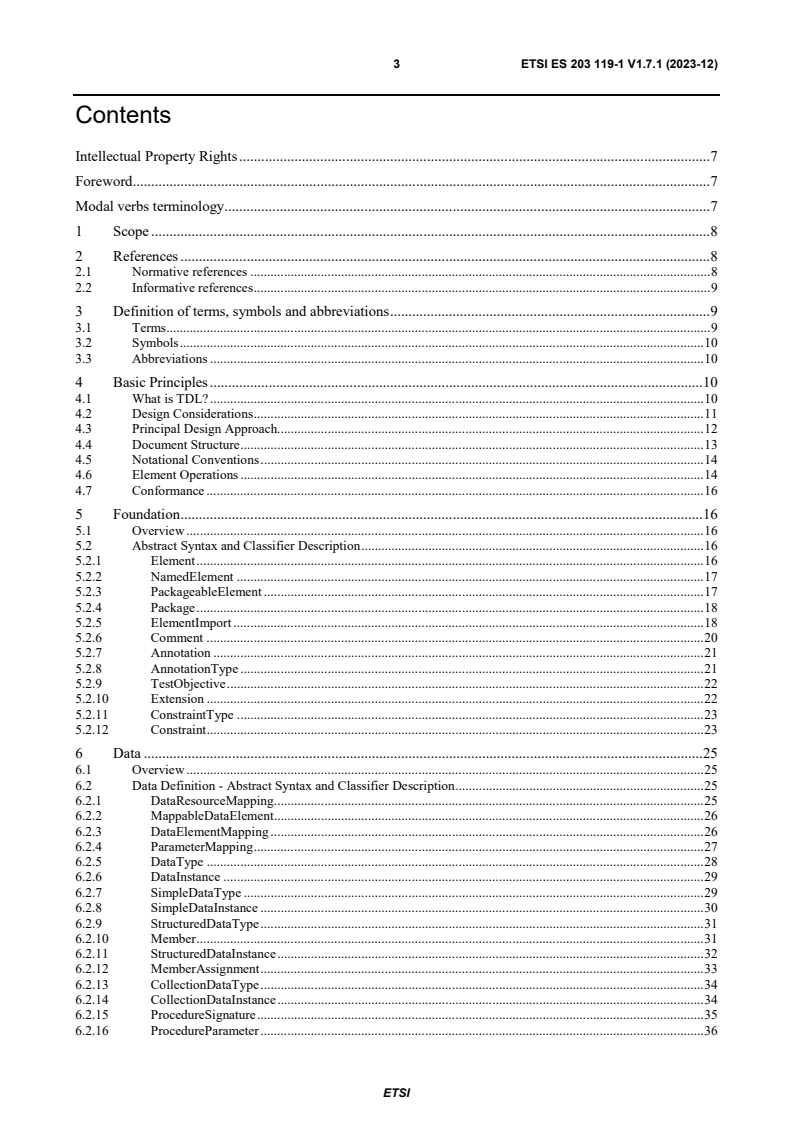
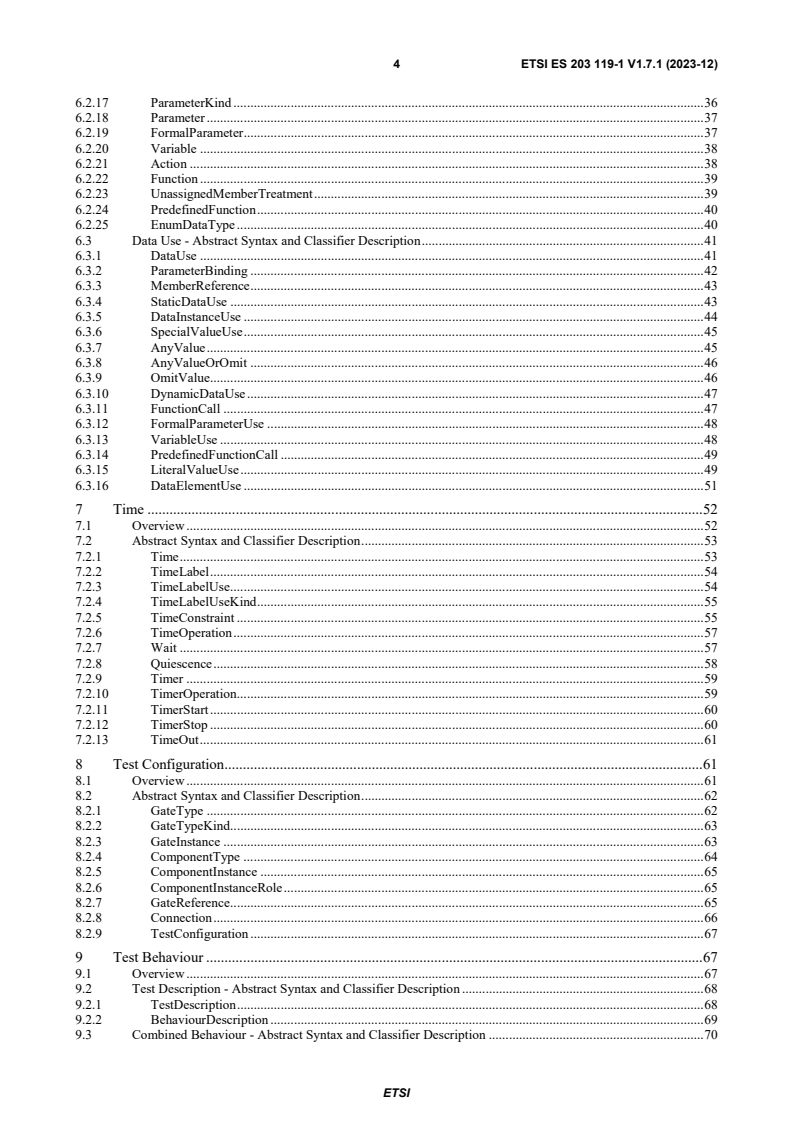
ETSI ES 203 119-1 V1.7.1 (2023-12) - Methods for Testing and Specification (MTS); The Test Description Language (TDL); Part 1: Abstract Syntax and Associated Semantics

Overview
SIST ES 203 119-1 V1.7.1:2024, titled "Methods for Testing and Specification (MTS) - The Test Description Language (TDL) - Part 1: Abstract Syntax and Associated Semantics", is a Slovenian standard aligned with ETSI ES 203 119-1 V1.7.1. Developed by SIST, this standard defines the abstract syntax and semantics of the Test Description Language (TDL) using a meta-model based on the OMG Meta Object Facility (MOF). The main objective is to provide a foundation for developers and tool creators to implement concrete TDL syntaxes and support TDL-based tools-including documentation generators, specification analysers, and code generators.
TDL enables formalized, consistent, and reusable test descriptions for systems under test, supporting methodologies such as model-based testing (MBT). This standard does not address concrete (graphical or textual) TDL syntaxes, but lays the groundwork necessary for future extensions and practical implementations.
Key Topics
- Abstract Syntax of TDL: Provides a meta-model for TDL based on OMG MOF, establishing a structural framework for all TDL concepts.
- Semantics of Meta-Model Elements: Clarifies the meaning and interrelationships of each element in the TDL abstract syntax, allowing for unambiguous tool development and test specification.
- Model-Based Testing: Supports methodologies like MBT by providing a formal language for specifying test behaviours, configurations, data, and timing.
- Tool Enablement: Acts as a foundation for developing a wide range of TDL tools-such as test automation systems, code generation tools, and test analysis platforms.
- Examples and Illustrations: While the standard does not specify concrete syntaxes, it provides examples to illustrate the application of TDL elements to real test descriptions.
- Alignment with International Standards: The use of established frameworks like MOF and references to standards such as UML, OCL, and UTP ensures interoperability and industry acceptance.
Applications
The abstract syntax and semantics defined in SIST ES 203 119-1 V1.7.1:2024 are crucial for various applications in the field of system and software testing:
- Development of TDL Tools: Enables the creation of documentation generators, specification analysers, and test code generators that operate on TDL models.
- Formal Test Specifications: Provides a consistent, machine-readable format for specifying tests, improving reproducibility, maintenance, and scalability of testing processes.
- Model-Based Testing Solutions: Supports the automation and optimization of test procedures using structured models in complex application domains such as telecommunications, embedded systems, and information technology.
- Interoperability with Other Standards: Facilitates integration with testing frameworks like TTCN-3 and UML-based modelling tools.
By using this standard, organizations can ensure their test descriptions conform to recognized best practices, promoting quality and consistency in both manual and automated testing environments.
Related Standards
SIST ES 203 119-1 V1.7.1:2024 forms Part 1 of a broader set of standards related to TDL and its usage. Other relevant standards and initiatives include:
- ETSI ES 203 119 Series: The complete TDL family, including parts on graphical syntax, exchange formats, structured test objective specifications, UML profiles, TTCN-3 mappings, and textual syntaxes.
- Part 2: Graphical Syntax
- Part 3: Exchange Format
- Part 4: Structured Test Objective Specification
- Part 5: UML Profile for TDL
- Part 6: Mapping to TTCN-3
- Part 7: Extended Test Configurations
- Part 8: Textual Syntax
- OMG Meta Object Facility (MOF): The meta-modelling foundation upon which TDL’s abstract syntax is defined.
- UML (Unified Modeling Language), OCL (Object Constraint Language), and UTP (UML Testing Profile): Cited as related modelling and testing frameworks for integration and interchange.
- TTCN-3 (Testing and Test Control Notation version 3): A popular test automation language often used in conjunction with TDL.
For more information about the latest status and availability of these standards, consult the ETSI standards search portal.
Keywords: Test Description Language, TDL, abstract syntax, meta-model, model-based testing, testing tools, specification, MOF, semantics, ETSI, SIST.
Buy Documents
ETSI ES 203 119-1 V1.7.1 (2023-10) - Methods for Testing and Specification (MTS); The Test Description Language (TDL); Part 1: Abstract Syntax and Associated Semantics
ETSI ES 203 119-1 V1.7.1 (2023-12) - Methods for Testing and Specification (MTS); The Test Description Language (TDL); Part 1: Abstract Syntax and Associated Semantics
Get Certified
Connect with accredited certification bodies for this standard

BSI Group
BSI (British Standards Institution) is the business standards company that helps organizations make excellence a habit.

NYCE
Mexican standards and certification body.
Sponsored listings
Frequently Asked Questions
SIST ES 203 119-1 V1.7.1:2024 is a standard published by the Slovenian Institute for Standardization (SIST). Its full title is "Methods for Testing and Specification (MTS) - The Test Description Language (TDL) - Part 1: Abstract Syntax and Associated Semantics". This standard covers: The present document specifies the abstract syntax of the Test Description Language (TDL) in the form of a meta-model based on the OMG® Meta Object Facility™ (MOF) [1]. It also specifies the semantics of the individual elements of the TDL meta-model. The intended use of the present document is to serve as the basis for the development of TDL concrete syntaxes aimed at TDL users and to enable TDL tools such as documentation generators, specification analysers and code generators. The specification of concrete syntaxes for TDL is outside the scope of the present document. However, for illustrative purposes, an example of a possible textual syntax together with its application on some existing ETSI test descriptions are provided. NOTE: OMG®, UML®, OCL™ and UTP™ are the trademarks of OMG (Object Management Group). This information is given for the convenience of users of the present document and does not constitute an endorsement by ETSI of the products named.
The present document specifies the abstract syntax of the Test Description Language (TDL) in the form of a meta-model based on the OMG® Meta Object Facility™ (MOF) [1]. It also specifies the semantics of the individual elements of the TDL meta-model. The intended use of the present document is to serve as the basis for the development of TDL concrete syntaxes aimed at TDL users and to enable TDL tools such as documentation generators, specification analysers and code generators. The specification of concrete syntaxes for TDL is outside the scope of the present document. However, for illustrative purposes, an example of a possible textual syntax together with its application on some existing ETSI test descriptions are provided. NOTE: OMG®, UML®, OCL™ and UTP™ are the trademarks of OMG (Object Management Group). This information is given for the convenience of users of the present document and does not constitute an endorsement by ETSI of the products named.
SIST ES 203 119-1 V1.7.1:2024 is classified under the following ICS (International Classification for Standards) categories: 35.060 - Languages used in information technology. The ICS classification helps identify the subject area and facilitates finding related standards.
SIST ES 203 119-1 V1.7.1:2024 is available in PDF format for immediate download after purchase. The document can be added to your cart and obtained through the secure checkout process. Digital delivery ensures instant access to the complete standard document.
Standards Content (Sample)
Final draft ETSI ES 203 119-1 V1.7.1 (2023-10)
ETSI STANDARD
Methods for Testing and Specification (MTS);
The Test Description Language (TDL);
Part 1: Abstract Syntax and Associated Semantics
2 Final draft ETSI ES 203 119-1 V1.7.1 (2023-10)
Reference
RES/MTS-TDL2031191
Keywords
language, MBT, methodology, model, testing,
TSS&TP, TTCN-3, UML
ETSI
650 Route des Lucioles
F-06921 Sophia Antipolis Cedex - FRANCE
Tel.: +33 4 92 94 42 00 Fax: +33 4 93 65 47 16
Siret N° 348 623 562 00017 - APE 7112B
Association à but non lucratif enregistrée à la
Sous-Préfecture de Grasse (06) N° w061004871
Important notice
The present document can be downloaded from:
https://www.etsi.org/standards-search
The present document may be made available in electronic versions and/or in print. The content of any electronic and/or
print versions of the present document shall not be modified without the prior written authorization of ETSI. In case of any
existing or perceived difference in contents between such versions and/or in print, the prevailing version of an ETSI
deliverable is the one made publicly available in PDF format at www.etsi.org/deliver.
Users of the present document should be aware that the document may be subject to revision or change of status.
Information on the current status of this and other ETSI documents is available at
https://portal.etsi.org/TB/ETSIDeliverableStatus.aspx
If you find errors in the present document, please send your comment to one of the following services:
https://portal.etsi.org/People/CommiteeSupportStaff.aspx
If you find a security vulnerability in the present document, please report it through our
Coordinated Vulnerability Disclosure Program:
https://www.etsi.org/standards/coordinated-vulnerability-disclosure
Notice of disclaimer & limitation of liability
The information provided in the present deliverable is directed solely to professionals who have the appropriate degree of
experience to understand and interpret its content in accordance with generally accepted engineering or
other professional standard and applicable regulations.
No recommendation as to products and services or vendors is made or should be implied.
No representation or warranty is made that this deliverable is technically accurate or sufficient or conforms to any law
and/or governmental rule and/or regulation and further, no representation or warranty is made of merchantability or fitness
for any particular purpose or against infringement of intellectual property rights.
In no event shall ETSI be held liable for loss of profits or any other incidental or consequential damages.
Any software contained in this deliverable is provided "AS IS" with no warranties, express or implied, including but not
limited to, the warranties of merchantability, fitness for a particular purpose and non-infringement of intellectual property
rights and ETSI shall not be held liable in any event for any damages whatsoever (including, without limitation, damages
for loss of profits, business interruption, loss of information, or any other pecuniary loss) arising out of or related to the use
of or inability to use the software.
Copyright Notification
No part may be reproduced or utilized in any form or by any means, electronic or mechanical, including photocopying and
microfilm except as authorized by written permission of ETSI.
The content of the PDF version shall not be modified without the written authorization of ETSI.
The copyright and the foregoing restriction extend to reproduction in all media.
© ETSI 2023.
All rights reserved.
ETSI
3 Final draft ETSI ES 203 119-1 V1.7.1 (2023-10)
Contents
Intellectual Property Rights . 7
Foreword . 7
Modal verbs terminology . 7
1 Scope . 8
2 References . 8
2.1 Normative references . 8
2.2 Informative references . 9
3 Definition of terms, symbols and abbreviations . 9
3.1 Terms . 9
3.2 Symbols . 10
3.3 Abbreviations . 10
4 Basic Principles . 10
4.1 What is TDL? . 10
4.2 Design Considerations . 11
4.3 Principal Design Approach. 12
4.4 Document Structure . 13
4.5 Notational Conventions . 14
4.6 Element Operations . 14
4.7 Conformance . 16
5 Foundation . 16
5.1 Overview . 16
5.2 Abstract Syntax and Classifier Description . 16
5.2.1 Element . 16
5.2.2 NamedElement . 17
5.2.3 PackageableElement . 17
5.2.4 Package . 18
5.2.5 ElementImport . 18
5.2.6 Comment . 20
5.2.7 Annotation . 21
5.2.8 AnnotationType . 21
5.2.9 TestObjective . 22
5.2.10 Extension . 22
5.2.11 ConstraintType . 23
5.2.12 Constraint . 23
6 Data . 25
6.1 Overview . 25
6.2 Data Definition - Abstract Syntax and Classifier Description . 25
6.2.1 DataResourceMapping . 25
6.2.2 MappableDataElement . 26
6.2.3 DataElementMapping . 26
6.2.4 ParameterMapping . 27
6.2.5 DataType . 28
6.2.6 DataInstance . 29
6.2.7 SimpleDataType . 29
6.2.8 SimpleDataInstance . 30
6.2.9 StructuredDataType . 31
6.2.10 Member . 31
6.2.11 StructuredDataInstance . 32
6.2.12 MemberAssignment . 33
6.2.13 CollectionDataType . 34
6.2.14 CollectionDataInstance . 34
6.2.15 ProcedureSignature . 35
6.2.16 ProcedureParameter . 36
ETSI
4 Final draft ETSI ES 203 119-1 V1.7.1 (2023-10)
6.2.17 ParameterKind . 36
6.2.18 Parameter . 37
6.2.19 FormalParameter . 37
6.2.20 Variable . 38
6.2.21 Action . 38
6.2.22 Function . 39
6.2.23 UnassignedMemberTreatment . 39
6.2.24 PredefinedFunction . 40
6.2.25 EnumDataType . 40
6.3 Data Use - Abstract Syntax and Classifier Description . 41
6.3.1 DataUse . 41
6.3.2 ParameterBinding . 42
6.3.3 MemberReference . 43
6.3.4 StaticDataUse . 43
6.3.5 DataInstanceUse . 44
6.3.6 SpecialValueUse . 45
6.3.7 AnyValue . 45
6.3.8 AnyValueOrOmit . 46
6.3.9 OmitValue. 46
6.3.10 DynamicDataUse . 47
6.3.11 FunctionCall . 47
6.3.12 FormalParameterUse . 48
6.3.13 VariableUse . 48
6.3.14 PredefinedFunctionCall . 49
6.3.15 LiteralValueUse . 49
6.3.16 DataElementUse . 51
7 Time . 52
7.1 Overview . 52
7.2 Abstract Syntax and Classifier Description . 53
7.2.1 Time . 53
7.2.2 TimeLabel . 54
7.2.3 TimeLabelUse . 54
7.2.4 TimeLabelUseKind . 55
7.2.5 TimeConstraint . 55
7.2.6 TimeOperation . 57
7.2.7 Wait . 57
7.2.8 Quiescence . 58
7.2.9 Timer . 59
7.2.10 TimerOperation . 59
7.2.11 TimerStart . 60
7.2.12 TimerStop . 60
7.2.13 TimeOut . 61
8 Test Configuration . 61
8.1 Overview . 61
8.2 Abstract Syntax and Classifier Description . 62
8.2.1 GateType . 62
8.2.2 GateTypeKind . 63
8.2.3 GateInstance . 63
8.2.4 ComponentType . 64
8.2.5 ComponentInstance . 65
8.2.6 ComponentInstanceRole . 65
8.2.7 GateReference . 65
8.2.8 Connection . 66
8.2.9 TestConfiguration . 67
9 Test Behaviour . 67
9.1 Overview . 67
9.2 Test Description - Abstract Syntax and Classifier Description . 68
9.2.1 TestDescription . 68
9.2.2 BehaviourDescription . 69
9.3 Combined Behaviour - Abstract Syntax and Classifier Description . 70
ETSI
5 Final draft ETSI ES 203 119-1 V1.7.1 (2023-10)
9.3.1 Behaviour . 70
9.3.2 Block . 71
9.3.3 LocalExpression . 72
9.3.4 CombinedBehaviour . 72
9.3.5 SingleCombinedBehaviour . 73
9.3.6 CompoundBehaviour . 73
9.3.7 BoundedLoopBehaviour . 74
9.3.8 UnboundedLoopBehaviour . 75
9.3.9 OptionalBehaviour . 75
9.3.10 MultipleCombinedBehaviour . 76
9.3.11 AlternativeBehaviour . 76
9.3.12 ConditionalBehaviour . 78
9.3.13 ParallelBehaviour . 79
9.3.14 ExceptionalBehaviour . 80
9.3.15 DefaultBehaviour . 82
9.3.16 InterruptBehaviour . 83
9.3.17 PeriodicBehaviour . 83
9.4 Atomic Behaviour - Abstract Syntax and Classifier Description . 84
9.4.1 AtomicBehaviour . 84
9.4.2 Break . 85
9.4.3 Stop . 85
9.4.4 VerdictAssignment . 86
9.4.5 Assertion . 86
9.4.6 Interaction . 87
9.4.7 Message . 88
9.4.8 ProcedureCall . 90
9.4.9 Target . 92
9.4.10 ValueAssignment . 93
9.4.11 TestDescriptionReference . 94
9.4.12 ComponentInstanceBinding . 96
9.4.13 ActionBehaviour . 97
9.4.14 ActionReference . 98
9.4.15 InlineAction . 98
9.4.16 Assignment . 98
10 Predefined TDL Model Instances . 99
10.1 Overview . 99
10.2 Predefined Instances of the 'SimpleDataType' Element . 99
10.2.1 Boolean . 99
10.2.2 Integer . 99
10.2.3 String . 100
10.2.4 Verdict . 100
10.3 Predefined Instances of 'SimpleDataInstance' Element . 100
10.3.1 True . 100
10.3.2 False . 100
10.3.3 pass . 100
10.3.4 fail . 100
10.3.5 inconclusive . 100
10.4 Predefined Instances of 'Time' Element . 100
10.4.1 Second . 100
10.5 Predefined Instances of the 'PredefinedFunction' Element . 101
10.5.1 Overview . 101
10.5.2 Functions of Return Type 'Boolean' . 101
10.5.3 Functions of Return Type 'Integer' . 102
10.5.4 Functions of Return Type of Instance of 'Time' . 102
10.6 Predefined Instances of the 'AnnotationType' Element . 102
10.6.1 Master . 102
10.6.2 MappingName . 102
10.7 Predefined Instances of 'ConstraintType' Element . 102
10.7.1 length . 102
10.7.2 minLength . 103
10.7.3 maxLength . 103
ETSI
6 Final draft ETSI ES 203 119-1 V1.7.1 (2023-10)
10.7.4 range . 103
10.7.5 format . 103
10.7.6 union . 103
10.7.7 uniontype . 103
Annex A (informative): Technical Representation of the TDL Meta-Model . 104
Annex B (informative): Legacy Examples of a TDL Concrete Textual Syntax . 105
B.1 Introduction . 105
B.2 A 3GPP Conformance Example in Textual Syntax . 105
B.3 An IMS Interoperability Example in Textual Syntax . 107
B.4 An Example Demonstrating TDL Data Concepts . 109
B.5 TDL Legacy Textual Syntax Reference . 111
B.5.1 Conventions for the TDLan Syntax Definition . 111
B.5.2 TDL Textual Syntax EBNF Production Rules . 111
Annex C (informative): Bibliography . 117
History . 118
ETSI
7 Final draft ETSI ES 203 119-1 V1.7.1 (2023-10)
Intellectual Property Rights
Essential patents
IPRs essential or potentially essential to normative deliverables may have been declared to ETSI. The declarations
pertaining to these essential IPRs, if any, are publicly available for ETSI members and non-members, and can be
found in ETSI SR 000 314: "Intellectual Property Rights (IPRs); Essential, or potentially Essential, IPRs notified to
ETSI in respect of ETSI standards", which is available from the ETSI Secretariat. Latest updates are available on the
ETSI Web server (https://ipr.etsi.org/).
Pursuant to the ETSI Directives including the ETSI IPR Policy, no investigation regarding the essentiality of IPRs,
including IPR searches, has been carried out by ETSI. No guarantee can be given as to the existence of other IPRs not
referenced in ETSI SR 000 314 (or the updates on the ETSI Web server) which are, or may be, or may become,
essential to the present document.
Trademarks
The present document may include trademarks and/or tradenames which are asserted and/or registered by their owners.
ETSI claims no ownership of these except for any which are indicated as being the property of ETSI, and conveys no
right to use or reproduce any trademark and/or tradename. Mention of those trademarks in the present document does
not constitute an endorsement by ETSI of products, services or organizations associated with those trademarks.
DECT™, PLUGTESTS™, UMTS™ and the ETSI logo are trademarks of ETSI registered for the benefit of its
Members. 3GPP™ and LTE™ are trademarks of ETSI registered for the benefit of its Members and of the 3GPP
Organizational Partners. oneM2M™ logo is a trademark of ETSI registered for the benefit of its Members and of the ®
oneM2M Partners. GSM and the GSM logo are trademarks registered and owned by the GSM Association.
Foreword
This final draft ETSI Standard (ES) has been produced by ETSI Technical Committee Methods for Testing and
Specification (MTS), and is now submitted for the ETSI standards Membership Approval Procedure.
The present document is part 1 of a multi-part deliverable covering the Test Description Language, as identified below:
Part 1: "Abstract Syntax and Associated Semantics";
Part 2: "Graphical Syntax";
Part 3: "Exchange Format";
Part 4: "Structured Test Objective Specification (Extension)";
Part 5: "UML profile for TDL";
Part 6: "Mapping to TTCN-3";
Part 7: "Extended Test Configurations";
Part 8: "Textual Syntax".
Modal verbs terminology
In the present document "shall", "shall not", "should", "should not", "may", "need not", "will", "will not", "can" and
"cannot" are to be interpreted as described in clause 3.2 of the ETSI Drafting Rules (Verbal forms for the expression of
provisions).
"must" and "must not" are NOT allowed in ETSI deliverables except when used in direct citation.
ETSI
8 Final draft ETSI ES 203 119-1 V1.7.1 (2023-10)
1 Scope
The present document specifies the abstract syntax of the Test Description Language (TDL) in the form of a ®
meta-model based on the OMG Meta Object Facility™ (MOF) [1]. It also specifies the semantics of the individual
elements of the TDL meta-model. The intended use of the present document is to serve as the basis for the development
of TDL concrete syntaxes aimed at TDL users and to enable TDL tools such as documentation generators, specification
analysers and code generators.
The specification of concrete syntaxes for TDL is outside the scope of the present document. However, for illustrative
purposes, an example of a possible textual syntax together with its application on some existing ETSI test descriptions
are provided.
® ® ™ ™
NOTE: OMG , UML , OCL and UTP are the trademarks of OMG (Object Management Group). This
information is given for the convenience of users of the present document and does not constitute an
endorsement by ETSI of the products named.
2 References
2.1 Normative references
References are either specific (identified by date of publication and/or edition number or version number) or
non-specific. For specific references, only the cited version applies. For non-specific references, the latest version of the
referenced document (including any amendments) applies.
Referenced documents which are not found to be publicly available in the expected location might be found at
https://docbox.etsi.org/Reference.
NOTE: While any hyperlinks included in this clause were valid at the time of publication, ETSI cannot guarantee
their long term validity.
The following referenced documents are necessary for the application of the present document. ®
[1] OMG formal/2013-06-01: "Documents Associated With Meta Object Facility™ (MOF™)
Version 2.4.1". ®
[2] OMG formal/2011-08-06: "OMG Unified Modeling Language™ (OMG UML), Superstructure,
Version 2.4.1". ®
[3] OMG formal/2014-02-03: "Documents Associated With Object Constraint Language™
(OCL™), Version 2.4".
[4] Void.
[5] ETSI ES 203 119-3: "Methods for Testing and Specification (MTS); The Test Description
Language (TDL); Part 3: Exchange Format".
[6] ETSI ES 203 119-4: "Methods for Testing and Specification (MTS); The Test Description
Language (TDL); Part 4: Structured Test Objective Specification (Extension)".
[7] ISO/IEC 9646-1:1994: "Information technology - Open Systems Interconnection -- Conformance
testing methodology and framework -- Part 1: General concepts".
[8] ETSI ES 203 119-8: "Methods for Testing and Specification (MTS); The Test Description
Language (TDL); Part 8: Textual Syntax".
ETSI
9 Final draft ETSI ES 203 119-1 V1.7.1 (2023-10)
2.2 Informative references
References are either specific (identified by date of publication and/or edition number or version number) or
non-specific. For specific references, only the cited version applies. For non-specific references, the latest version of the
referenced document (including any amendments) applies.
NOTE: While any hyperlinks included in this clause were valid at the time of publication, ETSI cannot guarantee
their long term validity.
The following referenced documents are not necessary for the application of the present document but they assist the
user with regard to a particular subject area.
[i.1] ETSI ES 201 873-1 (V4.5.1): "Methods for Testing and Specification (MTS); The Testing and
Test Control Notation version 3; Part 1: TTCN-3 Core Language".
[i.2] ETSI TS 136 523-1 (V10.2.0): "LTE; Evolved Universal Terrestrial Radio Access (E-UTRA) and
Evolved Packet Core (EPC); User Equipment (UE) conformance specification; Part 1: Protocol
conformance specification (3GPP TS 36.523-1 version 10.2.0 Release 10)".
[i.3] ETSI TS 186 011-2 (V3.1.1): "IMS Network Testing (INT); IMS NNI Interoperability Test
Specifications; Part 2: Test Description for IMS NNI Interoperability".
[i.4] ETSI: The TDL Open Source Project Website (last visited 20.12.2021).
3 Definition of terms, symbols and abbreviations
3.1 Terms
For the purposes of the present document, the following terms apply:
abstract syntax: graph structure representing a TDL specification in an independent form of any particular encoding
action: any procedure carried out by a component of a test configuration or an actor during test execution
actor: abstraction of entities outside a test configuration that interact directly with the components of that test
configuration
component: active element of a test configuration that is either in the role tester or system under test
concrete syntax: particular representation of a TDL specification, encoded in a textual, graphical, tabular or any other
format suitable for the users of this language
effectively static: any data specification that is statically determined (also recursively for all parameter bindings) and
can be considered constant during the execution
interaction: any form of communication between components that is accompanied with an exchange of data
meta-model: modelling elements representing the abstract syntax of a language
resolved data type: data type of a data use, determined by a referenced data instance, data type, parameter, return type
of a function, or the context where the data use is defined
scope of behaviour: components participating in a behaviour
System Under Test (SUT): role of a component within a test configuration whose behaviour is validated when
executing a test description
TDL model: instance of the TDL meta-model
TDL specification: representation of a TDL model given in a concrete syntax
test configuration: specification of a set of components that contains at least one tester component and one system
under test component plus their interconnections via gates and connections
ETSI
10 Final draft ETSI ES 203 119-1 V1.7.1 (2023-10)
test description: specification of test behaviour that runs on a given test configuration
test verdict: result from executing a test description
tester: role of a component within a test configuration that controls the execution of a test description against the
components in the role system under test
tester-input event: event that occurs at a component in the role tester and determines the subsequent behaviour of this
tester component
NOTE: Tester-input events in the present document are the following:
Quiescence.
TimeOut.
An 'Interaction' with a 'Target' that in turn-via its 'GateReference'-refers to a 'ComponentInstance'
in the role 'Tester'. If the source of an 'Interaction' is also a tester then it is not a tester-input event.
: semantical concept denoting an undefined data value
3.2 Symbols
Void.
3.3 Abbreviations
For the purposes of the present document, the following abbreviations apply:
ADT Abstract Data Type
EBNF Extended Backus-Naur Form
ID Identification
IEC International Electrotechnical Comm
...
ETSI STANDARD
Methods for Testing and Specification (MTS);
The Test Description Language (TDL);
Part 1: Abstract Syntax and Associated Semantics
2 ETSI ES 203 119-1 V1.7.1 (2023-12)
Reference
RES/MTS-TDL2031191
Keywords
language, MBT, methodology, model, testing,
TSS&TP, TTCN-3, UML
ETSI
650 Route des Lucioles
F-06921 Sophia Antipolis Cedex - FRANCE
Tel.: +33 4 92 94 42 00 Fax: +33 4 93 65 47 16
Siret N° 348 623 562 00017 - APE 7112B
Association à but non lucratif enregistrée à la
Sous-Préfecture de Grasse (06) N° w061004871
Important notice
The present document can be downloaded from:
https://www.etsi.org/standards-search
The present document may be made available in electronic versions and/or in print. The content of any electronic and/or
print versions of the present document shall not be modified without the prior written authorization of ETSI. In case of any
existing or perceived difference in contents between such versions and/or in print, the prevailing version of an ETSI
deliverable is the one made publicly available in PDF format at www.etsi.org/deliver.
Users of the present document should be aware that the document may be subject to revision or change of status.
Information on the current status of this and other ETSI documents is available at
https://portal.etsi.org/TB/ETSIDeliverableStatus.aspx
If you find errors in the present document, please send your comment to one of the following services:
https://portal.etsi.org/People/CommiteeSupportStaff.aspx
If you find a security vulnerability in the present document, please report it through our
Coordinated Vulnerability Disclosure Program:
https://www.etsi.org/standards/coordinated-vulnerability-disclosure
Notice of disclaimer & limitation of liability
The information provided in the present deliverable is directed solely to professionals who have the appropriate degree of
experience to understand and interpret its content in accordance with generally accepted engineering or
other professional standard and applicable regulations.
No recommendation as to products and services or vendors is made or should be implied.
No representation or warranty is made that this deliverable is technically accurate or sufficient or conforms to any law
and/or governmental rule and/or regulation and further, no representation or warranty is made of merchantability or fitness
for any particular purpose or against infringement of intellectual property rights.
In no event shall ETSI be held liable for loss of profits or any other incidental or consequential damages.
Any software contained in this deliverable is provided "AS IS" with no warranties, express or implied, including but not
limited to, the warranties of merchantability, fitness for a particular purpose and non-infringement of intellectual property
rights and ETSI shall not be held liable in any event for any damages whatsoever (including, without limitation, damages
for loss of profits, business interruption, loss of information, or any other pecuniary loss) arising out of or related to the use
of or inability to use the software.
Copyright Notification
No part may be reproduced or utilized in any form or by any means, electronic or mechanical, including photocopying and
microfilm except as authorized by written permission of ETSI.
The content of the PDF version shall not be modified without the written authorization of ETSI.
The copyright and the foregoing restriction extend to reproduction in all media.
© ETSI 2023.
All rights reserved.
ETSI
3 ETSI ES 203 119-1 V1.7.1 (2023-12)
Contents
Intellectual Property Rights . 7
Foreword . 7
Modal verbs terminology . 7
1 Scope . 8
2 References . 8
2.1 Normative references . 8
2.2 Informative references . 9
3 Definition of terms, symbols and abbreviations . 9
3.1 Terms . 9
3.2 Symbols . 10
3.3 Abbreviations . 10
4 Basic Principles . 10
4.1 What is TDL? . 10
4.2 Design Considerations . 11
4.3 Principal Design Approach. 12
4.4 Document Structure . 13
4.5 Notational Conventions . 14
4.6 Element Operations . 14
4.7 Conformance . 16
5 Foundation . 16
5.1 Overview . 16
5.2 Abstract Syntax and Classifier Description . 16
5.2.1 Element . 16
5.2.2 NamedElement . 17
5.2.3 PackageableElement . 17
5.2.4 Package . 18
5.2.5 ElementImport . 18
5.2.6 Comment . 20
5.2.7 Annotation . 21
5.2.8 AnnotationType . 21
5.2.9 TestObjective . 22
5.2.10 Extension . 22
5.2.11 ConstraintType . 23
5.2.12 Constraint . 23
6 Data . 25
6.1 Overview . 25
6.2 Data Definition - Abstract Syntax and Classifier Description . 25
6.2.1 DataResourceMapping . 25
6.2.2 MappableDataElement . 26
6.2.3 DataElementMapping . 26
6.2.4 ParameterMapping . 27
6.2.5 DataType . 28
6.2.6 DataInstance . 29
6.2.7 SimpleDataType . 29
6.2.8 SimpleDataInstance . 30
6.2.9 StructuredDataType . 31
6.2.10 Member . 31
6.2.11 StructuredDataInstance . 32
6.2.12 MemberAssignment . 33
6.2.13 CollectionDataType . 34
6.2.14 CollectionDataInstance . 34
6.2.15 ProcedureSignature . 35
6.2.16 ProcedureParameter . 36
ETSI
4 ETSI ES 203 119-1 V1.7.1 (2023-12)
6.2.17 ParameterKind . 36
6.2.18 Parameter . 37
6.2.19 FormalParameter . 37
6.2.20 Variable . 38
6.2.21 Action . 38
6.2.22 Function . 39
6.2.23 UnassignedMemberTreatment . 39
6.2.24 PredefinedFunction . 40
6.2.25 EnumDataType . 40
6.3 Data Use - Abstract Syntax and Classifier Description . 41
6.3.1 DataUse . 41
6.3.2 ParameterBinding . 42
6.3.3 MemberReference . 43
6.3.4 StaticDataUse . 43
6.3.5 DataInstanceUse . 44
6.3.6 SpecialValueUse . 45
6.3.7 AnyValue . 45
6.3.8 AnyValueOrOmit . 46
6.3.9 OmitValue. 46
6.3.10 DynamicDataUse . 47
6.3.11 FunctionCall . 47
6.3.12 FormalParameterUse . 48
6.3.13 VariableUse . 48
6.3.14 PredefinedFunctionCall . 49
6.3.15 LiteralValueUse . 49
6.3.16 DataElementUse . 51
7 Time . 52
7.1 Overview . 52
7.2 Abstract Syntax and Classifier Description . 53
7.2.1 Time . 53
7.2.2 TimeLabel . 54
7.2.3 TimeLabelUse . 54
7.2.4 TimeLabelUseKind . 55
7.2.5 TimeConstraint . 55
7.2.6 TimeOperation . 57
7.2.7 Wait . 57
7.2.8 Quiescence . 58
7.2.9 Timer . 59
7.2.10 TimerOperation . 59
7.2.11 TimerStart . 60
7.2.12 TimerStop . 60
7.2.13 TimeOut . 61
8 Test Configuration . 61
8.1 Overview . 61
8.2 Abstract Syntax and Classifier Description . 62
8.2.1 GateType . 62
8.2.2 GateTypeKind . 63
8.2.3 GateInstance . 63
8.2.4 ComponentType . 64
8.2.5 ComponentInstance . 65
8.2.6 ComponentInstanceRole . 65
8.2.7 GateReference . 65
8.2.8 Connection . 66
8.2.9 TestConfiguration . 67
9 Test Behaviour . 67
9.1 Overview . 67
9.2 Test Description - Abstract Syntax and Classifier Description . 68
9.2.1 TestDescription . 68
9.2.2 BehaviourDescription . 69
9.3 Combined Behaviour - Abstract Syntax and Classifier Description . 70
ETSI
5 ETSI ES 203 119-1 V1.7.1 (2023-12)
9.3.1 Behaviour . 70
9.3.2 Block . 71
9.3.3 LocalExpression . 72
9.3.4 CombinedBehaviour . 72
9.3.5 SingleCombinedBehaviour . 73
9.3.6 CompoundBehaviour . 73
9.3.7 BoundedLoopBehaviour . 74
9.3.8 UnboundedLoopBehaviour . 75
9.3.9 OptionalBehaviour . 75
9.3.10 MultipleCombinedBehaviour . 76
9.3.11 AlternativeBehaviour . 76
9.3.12 ConditionalBehaviour . 78
9.3.13 ParallelBehaviour . 79
9.3.14 ExceptionalBehaviour . 80
9.3.15 DefaultBehaviour . 82
9.3.16 InterruptBehaviour . 83
9.3.17 PeriodicBehaviour . 83
9.4 Atomic Behaviour - Abstract Syntax and Classifier Description . 84
9.4.1 AtomicBehaviour . 84
9.4.2 Break . 85
9.4.3 Stop . 85
9.4.4 VerdictAssignment . 86
9.4.5 Assertion . 86
9.4.6 Interaction . 87
9.4.7 Message . 88
9.4.8 ProcedureCall . 90
9.4.9 Target . 92
9.4.10 ValueAssignment . 93
9.4.11 TestDescriptionReference . 94
9.4.12 ComponentInstanceBinding . 96
9.4.13 ActionBehaviour . 97
9.4.14 ActionReference . 98
9.4.15 InlineAction . 98
9.4.16 Assignment . 98
10 Predefined TDL Model Instances . 99
10.1 Overview . 99
10.2 Predefined Instances of the 'SimpleDataType' Element . 99
10.2.1 Boolean . 99
10.2.2 Integer . 99
10.2.3 String . 100
10.2.4 Verdict . 100
10.3 Predefined Instances of 'SimpleDataInstance' Element . 100
10.3.1 True . 100
10.3.2 False . 100
10.3.3 pass . 100
10.3.4 fail . 100
10.3.5 inconclusive . 100
10.4 Predefined Instances of 'Time' Element . 100
10.4.1 Second . 100
10.5 Predefined Instances of the 'PredefinedFunction' Element . 101
10.5.1 Overview . 101
10.5.2 Functions of Return Type 'Boolean' . 101
10.5.3 Functions of Return Type 'Integer' . 102
10.5.4 Functions of Return Type of Instance of 'Time' . 102
10.6 Predefined Instances of the 'AnnotationType' Element . 102
10.6.1 Master . 102
10.6.2 MappingName . 102
10.7 Predefined Instances of 'ConstraintType' Element . 102
10.7.1 length . 102
10.7.2 minLength . 103
10.7.3 maxLength . 103
ETSI
6 ETSI ES 203 119-1 V1.7.1 (2023-12)
10.7.4 range . 103
10.7.5 format . 103
10.7.6 union . 103
10.7.7 uniontype . 103
Annex A (informative): Technical Representation of the TDL Meta-Model . 104
Annex B (informative): Legacy Examples of a TDL Concrete Textual Syntax . 105
B.1 Introduction . 105
B.2 A 3GPP Conformance Example in Textual Syntax . 105
B.3 An IMS Interoperability Example in Textual Syntax . 107
B.4 An Example Demonstrating TDL Data Concepts . 109
B.5 TDL Legacy Textual Syntax Reference . 111
B.5.1 Conventions for the TDLan Syntax Definition . 111
B.5.2 TDL Textual Syntax EBNF Production Rules . 111
Annex C (informative): Bibliography . 117
History . 118
ETSI
7 ETSI ES 203 119-1 V1.7.1 (2023-12)
Intellectual Property Rights
Essential patents
IPRs essential or potentially essential to normative deliverables may have been declared to ETSI. The declarations
pertaining to these essential IPRs, if any, are publicly available for ETSI members and non-members, and can be
found in ETSI SR 000 314: "Intellectual Property Rights (IPRs); Essential, or potentially Essential, IPRs notified to
ETSI in respect of ETSI standards", which is available from the ETSI Secretariat. Latest updates are available on the
ETSI Web server (https://ipr.etsi.org/).
Pursuant to the ETSI Directives including the ETSI IPR Policy, no investigation regarding the essentiality of IPRs,
including IPR searches, has been carried out by ETSI. No guarantee can be given as to the existence of other IPRs not
referenced in ETSI SR 000 314 (or the updates on the ETSI Web server) which are, or may be, or may become,
essential to the present document.
Trademarks
The present document may include trademarks and/or tradenames which are asserted and/or registered by their owners.
ETSI claims no ownership of these except for any which are indicated as being the property of ETSI, and conveys no
right to use or reproduce any trademark and/or tradename. Mention of those trademarks in the present document does
not constitute an endorsement by ETSI of products, services or organizations associated with those trademarks.
DECT™, PLUGTESTS™, UMTS™ and the ETSI logo are trademarks of ETSI registered for the benefit of its
Members. 3GPP™ and LTE™ are trademarks of ETSI registered for the benefit of its Members and of the 3GPP
Organizational Partners. oneM2M™ logo is a trademark of ETSI registered for the benefit of its Members and of the ®
oneM2M Partners. GSM and the GSM logo are trademarks registered and owned by the GSM Association.
Foreword
This ETSI Standard (ES) has been produced by ETSI Technical Committee Methods for Testing and Specification
(MTS).
The present document is part 1 of a multi-part deliverable covering the Test Description Language, as identified below:
Part 1: "Abstract Syntax and Associated Semantics";
Part 2: "Graphical Syntax";
Part 3: "Exchange Format";
Part 4: "Structured Test Objective Specification (Extension)";
Part 5: "UML profile for TDL";
Part 6: "Mapping to TTCN-3";
Part 7: "Extended Test Configurations";
Part 8: "Textual Syntax".
Modal verbs terminology
In the present document "shall", "shall not", "should", "should not", "may", "need not", "will", "will not", "can" and
"cannot" are to be interpreted as described in clause 3.2 of the ETSI Drafting Rules (Verbal forms for the expression of
provisions).
"must" and "must not" are NOT allowed in ETSI deliverables except when used in direct citation.
ETSI
8 ETSI ES 203 119-1 V1.7.1 (2023-12)
1 Scope
The present document specifies the abstract syntax of the Test Description Language (TDL) in the form of a ®
meta-model based on the OMG Meta Object Facility™ (MOF) [1]. It also specifies the semantics of the individual
elements of the TDL meta-model. The intended use of the present document is to serve as the basis for the development
of TDL concrete syntaxes aimed at TDL users and to enable TDL tools such as documentation generators, specification
analysers and code generators.
The specification of concrete syntaxes for TDL is outside the scope of the present document. However, for illustrative
purposes, an example of a possible textual syntax together with its application on some existing ETSI test descriptions
are provided.
® ® ™ ™
NOTE: OMG , UML , OCL and UTP are the trademarks of OMG (Object Management Group). This
information is given for the convenience of users of the present document and does not constitute an
endorsement by ETSI of the products named.
2 References
2.1 Normative references
References are either specific (identified by date of publication and/or edition number or version number) or
non-specific. For specific references, only the cited version applies. For non-specific references, the latest version of the
referenced document (including any amendments) applies.
Referenced documents which are not found to be publicly available in the expected location might be found at
https://docbox.etsi.org/Reference.
NOTE: While any hyperlinks included in this clause were valid at the time of publication, ETSI cannot guarantee
their long term validity.
The following referenced documents are necessary for the application of the present document. ®
[1] OMG formal/2013-06-01: "Documents Associated With Meta Object Facility™ (MOF™)
Version 2.4.1". ®
[2] OMG formal/2011-08-06: "OMG Unified Modeling Language™ (OMG UML), Superstructure,
Version 2.4.1". ®
[3] OMG formal/2014-02-03: "Documents Associated With Object Constraint Language™
(OCL™), Version 2.4".
[4] Void.
[5] ETSI ES 203 119-3: "Methods for Testing and Specification (MTS); The Test Description
Language (TDL); Part 3: Exchange Format".
[6] ETSI ES 203 119-4: "Methods for Testing and Specification (MTS); The Test Description
Language (TDL); Part 4: Structured Test Objective Specification (Extension)".
[7] ISO/IEC 9646-1:1994: "Information technology - Open Systems Interconnection -- Conformance
testing methodology and framework -- Part 1: General concepts".
[8] ETSI ES 203 119-8: "Methods for Testing and Specification (MTS); The Test Description
Language (TDL); Part 8: Textual Syntax".
ETSI
9 ETSI ES 203 119-1 V1.7.1 (2023-12)
2.2 Informative references
References are either specific (identified by date of publication and/or edition number or version number) or
non-specific. For specific references, only the cited version applies. For non-specific references, the latest version of the
referenced document (including any amendments) applies.
NOTE: While any hyperlinks included in this clause were valid at the time of publication, ETSI cannot guarantee
their long term validity.
The following referenced documents are not necessary for the application of the present document but they assist the
user with regard to a particular subject area.
[i.1] ETSI ES 201 873-1 (V4.5.1): "Methods for Testing and Specification (MTS); The Testing and
Test Control Notation version 3; Part 1: TTCN-3 Core Language".
[i.2] ETSI TS 136 523-1 (V10.2.0): "LTE; Evolved Universal Terrestrial Radio Access (E-UTRA) and
Evolved Packet Core (EPC); User Equipment (UE) conformance specification; Part 1: Protocol
conformance specification (3GPP TS 36.523-1 version 10.2.0 Release 10)".
[i.3] ETSI TS 186 011-2 (V3.1.1): "IMS Network Testing (INT); IMS NNI Interoperability Test
Specifications; Part 2: Test Description for IMS NNI Interoperability".
[i.4] ETSI: The TDL Open Source Project Website (last visited 20.12.2021).
3 Definition of terms, symbols and abbreviations
3.1 Terms
For the purposes of the present document, the following terms apply:
abstract syntax: graph structure representing a TDL specification in an independent form of any particular encoding
action: any procedure carried out by a component of a test configuration or an actor during test execution
actor: abstraction of entities outside a test configuration that interact directly with the components of that test
configuration
component: active element of a test configuration that is either in the role tester or system under test
concrete syntax: particular representation of a TDL specification, encoded in a textual, graphical, tabular or any other
format suitable for the users of this language
effectively static: any data specification that is statically determined (also recursively for all parameter bindings) and
can be considered constant during the execution
interaction: any form of communication between components that is accompanied with an exchange of data
meta-model: modelling elements representing the abstract syntax of a language
resolved data type: data type of a data use, determined by a referenced data instance, data type, parameter, return type
of a function, or the context where the data use is defined
scope of behaviour: components participating in a behaviour
System Under Test (SUT): role of a component within a test configuration whose behaviour is validated when
executing a test description
TDL model: instance of the TDL meta-model
TDL specification: representation of a TDL model given in a concrete syntax
test configuration: specification of a set of components that contains at least one tester component and one system
under test component plus their interconnections via gates and connections
ETSI
10 ETSI ES 203 119-1 V1.7.1 (2023-12)
test description: specification of test behaviour that runs on a given test configuration
test verdict: result from executing a test description
tester: role of a component within a test configuration that controls the execution of a test description against the
components in the role system under test
tester-input event: event that occurs at a component in the role tester and determines the subsequent behaviour of this
tester component
NOTE: Tester-input events in the present document are the following:
Quiescence.
TimeOut.
An 'Interaction' with a 'Target' that in turn-via its 'GateReference'-refers to a 'ComponentInstance'
in the role 'Tester'. If the source of an 'Interaction' is also a tester then it is not a tester-input event.
: semantical concept denoting an undefined data value
3.2 Symbols
Void.
3.3 Abbreviations
For the purposes of the present document, the following abbreviations apply:
ADT Abstract Data Type
EBNF Extended Backus-Naur Form
ID Identification
IEC International Electrotechnical Commission
IMS IP Multimedia Subsystem
ISO International Organization for Standardization
MBT Model-Based Testing
MOF Meta Object Facility™
OCL Object Constraint Language™ ®
OMG Object Management Group
SUT Syst
...
SLOVENSKI STANDARD
01-februar-2024
Metode za preskušanje in specificiranje (MTS) - Jezik za opis preskusa (TDL) - 1.
del: Abstraktna skladnja in pripadajoče pomenoslovje
Methods for Testing and Specification (MTS) - The Test Description Language (TDL) -
Part 1: Abstract Syntax and Associated Semantics
Ta slovenski standard je istoveten z: ETSI ES 203 119-1 V1.7.1 (2023-12)
ICS:
35.060 Jeziki, ki se uporabljajo v Languages used in
informacijski tehniki in information technology
tehnologiji
2003-01.Slovenski inštitut za standardizacijo. Razmnoževanje celote ali delov tega standarda ni dovoljeno.
ETSI STANDARD
Methods for Testing and Specification (MTS);
The Test Description Language (TDL);
Part 1: Abstract Syntax and Associated Semantics
2 ETSI ES 203 119-1 V1.7.1 (2023-12)
Reference
RES/MTS-TDL2031191
Keywords
language, MBT, methodology, model, testing,
TSS&TP, TTCN-3, UML
ETSI
650 Route des Lucioles
F-06921 Sophia Antipolis Cedex - FRANCE
Tel.: +33 4 92 94 42 00 Fax: +33 4 93 65 47 16
Siret N° 348 623 562 00017 - APE 7112B
Association à but non lucratif enregistrée à la
Sous-Préfecture de Grasse (06) N° w061004871
Important notice
The present document can be downloaded from:
https://www.etsi.org/standards-search
The present document may be made available in electronic versions and/or in print. The content of any electronic and/or
print versions of the present document shall not be modified without the prior written authorization of ETSI. In case of any
existing or perceived difference in contents between such versions and/or in print, the prevailing version of an ETSI
deliverable is the one made publicly available in PDF format at www.etsi.org/deliver.
Users of the present document should be aware that the document may be subject to revision or change of status.
Information on the current status of this and other ETSI documents is available at
https://portal.etsi.org/TB/ETSIDeliverableStatus.aspx
If you find errors in the present document, please send your comment to one of the following services:
https://portal.etsi.org/People/CommiteeSupportStaff.aspx
If you find a security vulnerability in the present document, please report it through our
Coordinated Vulnerability Disclosure Program:
https://www.etsi.org/standards/coordinated-vulnerability-disclosure
Notice of disclaimer & limitation of liability
The information provided in the present deliverable is directed solely to professionals who have the appropriate degree of
experience to understand and interpret its content in accordance with generally accepted engineering or
other professional standard and applicable regulations.
No recommendation as to products and services or vendors is made or should be implied.
No representation or warranty is made that this deliverable is technically accurate or sufficient or conforms to any law
and/or governmental rule and/or regulation and further, no representation or warranty is made of merchantability or fitness
for any particular purpose or against infringement of intellectual property rights.
In no event shall ETSI be held liable for loss of profits or any other incidental or consequential damages.
Any software contained in this deliverable is provided "AS IS" with no warranties, express or implied, including but not
limited to, the warranties of merchantability, fitness for a particular purpose and non-infringement of intellectual property
rights and ETSI shall not be held liable in any event for any damages whatsoever (including, without limitation, damages
for loss of profits, business interruption, loss of information, or any other pecuniary loss) arising out of or related to the use
of or inability to use the software.
Copyright Notification
No part may be reproduced or utilized in any form or by any means, electronic or mechanical, including photocopying and
microfilm except as authorized by written permission of ETSI.
The content of the PDF version shall not be modified without the written authorization of ETSI.
The copyright and the foregoing restriction extend to reproduction in all media.
© ETSI 2023.
All rights reserved.
ETSI
3 ETSI ES 203 119-1 V1.7.1 (2023-12)
Contents
Intellectual Property Rights . 7
Foreword . 7
Modal verbs terminology . 7
1 Scope . 8
2 References . 8
2.1 Normative references . 8
2.2 Informative references . 9
3 Definition of terms, symbols and abbreviations . 9
3.1 Terms . 9
3.2 Symbols . 10
3.3 Abbreviations . 10
4 Basic Principles . 10
4.1 What is TDL? . 10
4.2 Design Considerations . 11
4.3 Principal Design Approach. 12
4.4 Document Structure . 13
4.5 Notational Conventions . 14
4.6 Element Operations . 14
4.7 Conformance . 16
5 Foundation . 16
5.1 Overview . 16
5.2 Abstract Syntax and Classifier Description . 16
5.2.1 Element . 16
5.2.2 NamedElement . 17
5.2.3 PackageableElement . 17
5.2.4 Package . 18
5.2.5 ElementImport . 18
5.2.6 Comment . 20
5.2.7 Annotation . 21
5.2.8 AnnotationType . 21
5.2.9 TestObjective . 22
5.2.10 Extension . 22
5.2.11 ConstraintType . 23
5.2.12 Constraint . 23
6 Data . 25
6.1 Overview . 25
6.2 Data Definition - Abstract Syntax and Classifier Description . 25
6.2.1 DataResourceMapping . 25
6.2.2 MappableDataElement . 26
6.2.3 DataElementMapping . 26
6.2.4 ParameterMapping . 27
6.2.5 DataType . 28
6.2.6 DataInstance . 29
6.2.7 SimpleDataType . 29
6.2.8 SimpleDataInstance . 30
6.2.9 StructuredDataType . 31
6.2.10 Member . 31
6.2.11 StructuredDataInstance . 32
6.2.12 MemberAssignment . 33
6.2.13 CollectionDataType . 34
6.2.14 CollectionDataInstance . 34
6.2.15 ProcedureSignature . 35
6.2.16 ProcedureParameter . 36
ETSI
4 ETSI ES 203 119-1 V1.7.1 (2023-12)
6.2.17 ParameterKind . 36
6.2.18 Parameter . 37
6.2.19 FormalParameter . 37
6.2.20 Variable . 38
6.2.21 Action . 38
6.2.22 Function . 39
6.2.23 UnassignedMemberTreatment . 39
6.2.24 PredefinedFunction . 40
6.2.25 EnumDataType . 40
6.3 Data Use - Abstract Syntax and Classifier Description . 41
6.3.1 DataUse . 41
6.3.2 ParameterBinding . 42
6.3.3 MemberReference . 43
6.3.4 StaticDataUse . 43
6.3.5 DataInstanceUse . 44
6.3.6 SpecialValueUse . 45
6.3.7 AnyValue . 45
6.3.8 AnyValueOrOmit . 46
6.3.9 OmitValue. 46
6.3.10 DynamicDataUse . 47
6.3.11 FunctionCall . 47
6.3.12 FormalParameterUse . 48
6.3.13 VariableUse . 48
6.3.14 PredefinedFunctionCall . 49
6.3.15 LiteralValueUse . 49
6.3.16 DataElementUse . 51
7 Time . 52
7.1 Overview . 52
7.2 Abstract Syntax and Classifier Description . 53
7.2.1 Time . 53
7.2.2 TimeLabel . 54
7.2.3 TimeLabelUse . 54
7.2.4 TimeLabelUseKind . 55
7.2.5 TimeConstraint . 55
7.2.6 TimeOperation . 57
7.2.7 Wait . 57
7.2.8 Quiescence . 58
7.2.9 Timer . 59
7.2.10 TimerOperation . 59
7.2.11 TimerStart . 60
7.2.12 TimerStop . 60
7.2.13 TimeOut . 61
8 Test Configuration . 61
8.1 Overview . 61
8.2 Abstract Syntax and Classifier Description . 62
8.2.1 GateType . 62
8.2.2 GateTypeKind . 63
8.2.3 GateInstance . 63
8.2.4 ComponentType . 64
8.2.5 ComponentInstance . 65
8.2.6 ComponentInstanceRole . 65
8.2.7 GateReference . 65
8.2.8 Connection . 66
8.2.9 TestConfiguration . 67
9 Test Behaviour . 67
9.1 Overview . 67
9.2 Test Description - Abstract Syntax and Classifier Description . 68
9.2.1 TestDescription . 68
9.2.2 BehaviourDescription . 69
9.3 Combined Behaviour - Abstract Syntax and Classifier Description . 70
ETSI
5 ETSI ES 203 119-1 V1.7.1 (2023-12)
9.3.1 Behaviour . 70
9.3.2 Block . 71
9.3.3 LocalExpression . 72
9.3.4 CombinedBehaviour . 72
9.3.5 SingleCombinedBehaviour . 73
9.3.6 CompoundBehaviour . 73
9.3.7 BoundedLoopBehaviour . 74
9.3.8 UnboundedLoopBehaviour . 75
9.3.9 OptionalBehaviour . 75
9.3.10 MultipleCombinedBehaviour . 76
9.3.11 AlternativeBehaviour . 76
9.3.12 ConditionalBehaviour . 78
9.3.13 ParallelBehaviour . 79
9.3.14 ExceptionalBehaviour . 80
9.3.15 DefaultBehaviour . 82
9.3.16 InterruptBehaviour . 83
9.3.17 PeriodicBehaviour . 83
9.4 Atomic Behaviour - Abstract Syntax and Classifier Description . 84
9.4.1 AtomicBehaviour . 84
9.4.2 Break . 85
9.4.3 Stop . 85
9.4.4 VerdictAssignment . 86
9.4.5 Assertion . 86
9.4.6 Interaction . 87
9.4.7 Message . 88
9.4.8 ProcedureCall . 90
9.4.9 Target . 92
9.4.10 ValueAssignment . 93
9.4.11 TestDescriptionReference . 94
9.4.12 ComponentInstanceBinding . 96
9.4.13 ActionBehaviour . 97
9.4.14 ActionReference . 98
9.4.15 InlineAction . 98
9.4.16 Assignment . 98
10 Predefined TDL Model Instances . 99
10.1 Overview . 99
10.2 Predefined Instances of the 'SimpleDataType' Element . 99
10.2.1 Boolean . 99
10.2.2 Integer . 99
10.2.3 String . 100
10.2.4 Verdict . 100
10.3 Predefined Instances of 'SimpleDataInstance' Element . 100
10.3.1 True . 100
10.3.2 False . 100
10.3.3 pass . 100
10.3.4 fail . 100
10.3.5 inconclusive . 100
10.4 Predefined Instances of 'Time' Element . 100
10.4.1 Second . 100
10.5 Predefined Instances of the 'PredefinedFunction' Element . 101
10.5.1 Overview . 101
10.5.2 Functions of Return Type 'Boolean' . 101
10.5.3 Functions of Return Type 'Integer' . 102
10.5.4 Functions of Return Type of Instance of 'Time' . 102
10.6 Predefined Instances of the 'AnnotationType' Element . 102
10.6.1 Master . 102
10.6.2 MappingName . 102
10.7 Predefined Instances of 'ConstraintType' Element . 102
10.7.1 length . 102
10.7.2 minLength . 103
10.7.3 maxLength . 103
ETSI
6 ETSI ES 203 119-1 V1.7.1 (2023-12)
10.7.4 range . 103
10.7.5 format . 103
10.7.6 union . 103
10.7.7 uniontype . 103
Annex A (informative): Technical Representation of the TDL Meta-Model . 104
Annex B (informative): Legacy Examples of a TDL Concrete Textual Syntax . 105
B.1 Introduction . 105
B.2 A 3GPP Conformance Example in Textual Syntax . 105
B.3 An IMS Interoperability Example in Textual Syntax . 107
B.4 An Example Demonstrating TDL Data Concepts . 109
B.5 TDL Legacy Textual Syntax Reference . 111
B.5.1 Conventions for the TDLan Syntax Definition . 111
B.5.2 TDL Textual Syntax EBNF Production Rules . 111
Annex C (informative): Bibliography . 117
History . 118
ETSI
7 ETSI ES 203 119-1 V1.7.1 (2023-12)
Intellectual Property Rights
Essential patents
IPRs essential or potentially essential to normative deliverables may have been declared to ETSI. The declarations
pertaining to these essential IPRs, if any, are publicly available for ETSI members and non-members, and can be
found in ETSI SR 000 314: "Intellectual Property Rights (IPRs); Essential, or potentially Essential, IPRs notified to
ETSI in respect of ETSI standards", which is available from the ETSI Secretariat. Latest updates are available on the
ETSI Web server (https://ipr.etsi.org/).
Pursuant to the ETSI Directives including the ETSI IPR Policy, no investigation regarding the essentiality of IPRs,
including IPR searches, has been carried out by ETSI. No guarantee can be given as to the existence of other IPRs not
referenced in ETSI SR 000 314 (or the updates on the ETSI Web server) which are, or may be, or may become,
essential to the present document.
Trademarks
The present document may include trademarks and/or tradenames which are asserted and/or registered by their owners.
ETSI claims no ownership of these except for any which are indicated as being the property of ETSI, and conveys no
right to use or reproduce any trademark and/or tradename. Mention of those trademarks in the present document does
not constitute an endorsement by ETSI of products, services or organizations associated with those trademarks.
DECT™, PLUGTESTS™, UMTS™ and the ETSI logo are trademarks of ETSI registered for the benefit of its
Members. 3GPP™ and LTE™ are trademarks of ETSI registered for the benefit of its Members and of the 3GPP
Organizational Partners. oneM2M™ logo is a trademark of ETSI registered for the benefit of its Members and of the ®
oneM2M Partners. GSM and the GSM logo are trademarks registered and owned by the GSM Association.
Foreword
This ETSI Standard (ES) has been produced by ETSI Technical Committee Methods for Testing and Specification
(MTS).
The present document is part 1 of a multi-part deliverable covering the Test Description Language, as identified below:
Part 1: "Abstract Syntax and Associated Semantics";
Part 2: "Graphical Syntax";
Part 3: "Exchange Format";
Part 4: "Structured Test Objective Specification (Extension)";
Part 5: "UML profile for TDL";
Part 6: "Mapping to TTCN-3";
Part 7: "Extended Test Configurations";
Part 8: "Textual Syntax".
Modal verbs terminology
In the present document "shall", "shall not", "should", "should not", "may", "need not", "will", "will not", "can" and
"cannot" are to be interpreted as described in clause 3.2 of the ETSI Drafting Rules (Verbal forms for the expression of
provisions).
"must" and "must not" are NOT allowed in ETSI deliverables except when used in direct citation.
ETSI
8 ETSI ES 203 119-1 V1.7.1 (2023-12)
1 Scope
The present document specifies the abstract syntax of the Test Description Language (TDL) in the form of a ®
meta-model based on the OMG Meta Object Facility™ (MOF) [1]. It also specifies the semantics of the individual
elements of the TDL meta-model. The intended use of the present document is to serve as the basis for the development
of TDL concrete syntaxes aimed at TDL users and to enable TDL tools such as documentation generators, specification
analysers and code generators.
The specification of concrete syntaxes for TDL is outside the scope of the present document. However, for illustrative
purposes, an example of a possible textual syntax together with its application on some existing ETSI test descriptions
are provided.
® ® ™ ™
NOTE: OMG , UML , OCL and UTP are the trademarks of OMG (Object Management Group). This
information is given for the convenience of users of the present document and does not constitute an
endorsement by ETSI of the products named.
2 References
2.1 Normative references
References are either specific (identified by date of publication and/or edition number or version number) or
non-specific. For specific references, only the cited version applies. For non-specific references, the latest version of the
referenced document (including any amendments) applies.
Referenced documents which are not found to be publicly available in the expected location might be found at
https://docbox.etsi.org/Reference.
NOTE: While any hyperlinks included in this clause were valid at the time of publication, ETSI cannot guarantee
their long term validity.
The following referenced documents are necessary for the application of the present document. ®
[1] OMG formal/2013-06-01: "Documents Associated With Meta Object Facility™ (MOF™)
Version 2.4.1". ®
[2] OMG formal/2011-08-06: "OMG Unified Modeling Language™ (OMG UML), Superstructure,
Version 2.4.1". ®
[3] OMG formal/2014-02-03: "Documents Associated With Object Constraint Language™
(OCL™), Version 2.4".
[4] Void.
[5] ETSI ES 203 119-3: "Methods for Testing and Specification (MTS); The Test Description
Language (TDL); Part 3: Exchange Format".
[6] ETSI ES 203 119-4: "Methods for Testing and Specification (MTS); The Test Description
Language (TDL); Part 4: Structured Test Objective Specification (Extension)".
[7] ISO/IEC 9646-1:1994: "Information technology - Open Systems Interconnection -- Conformance
testing methodology and framework -- Part 1: General concepts".
[8] ETSI ES 203 119-8: "Methods for Testing and Specification (MTS); The Test Description
Language (TDL); Part 8: Textual Syntax".
ETSI
9 ETSI ES 203 119-1 V1.7.1 (2023-12)
2.2 Informative references
References are either specific (identified by date of publication and/or edition number or version number) or
non-specific. For specific references, only the cited version applies. For non-specific references, the latest version of the
referenced document (including any amendments) applies.
NOTE: While any hyperlinks included in this clause were valid at the time of publication, ETSI cannot guarantee
their long term validity.
The following referenced documents are not necessary for the application of the present document but they assist the
user with regard to a particular subject area.
[i.1] ETSI ES 201 873-1 (V4.5.1): "Methods for Testing and Specification (MTS); The Testing and
Test Control Notation version 3; Part 1: TTCN-3 Core Language".
[i.2] ETSI TS 136 523-1 (V10.2.0): "LTE; Evolved Universal Terrestrial Radio Access (E-UTRA) and
Evolved Packet Core (EPC); User Equipment (UE) conformance specification; Part 1: Protocol
conformance specification (3GPP TS 36.523-1 version 10.2.0 Release 10)".
[i.3] ETSI TS 186 011-2 (V3.1.1): "IMS Network Testing (INT); IMS NNI Interoperability Test
Specifications; Part 2: Test Description for IMS NNI Interoperability".
[i.4] ETSI: The TDL Open Source Project Website (last visited 20.12.2021).
3 Definition of terms, symbols and abbreviations
3.1 Terms
For the purposes of the present document, the following terms apply:
abstract syntax: graph structure representing a TDL specification in an independent form of any particular encoding
action: any procedure carried out by a component of a test configuration or an actor during test execution
actor: abstraction of entities outside a test configuration that interact directly with the components of that test
configuration
component: active element of a test configuration that is either in the role tester or system under test
concrete syntax: particular representation of a TDL specification, encoded in a textual, graphical, tabular or any other
format suitable for the users of this language
effectively static: any data specification that is statically determined (also recursively for all parameter bindings) and
can be considered constant during the execution
interaction: any form of communication between components that is accompanied with an exchange of data
meta-model: modelling elements representing the abstract syntax of a language
resolved data type: data type of a data use, determined by a referenced data instance, data type, parameter, return type
of a function, or the context where the data use is defined
scope of behaviour: components participating in a behaviour
System Under Test (SUT): role of a component within a test configuration whose behaviour is validated when
executing a test description
TDL model: instance of the TDL meta-model
TDL specification: representation of a TDL model given in a concrete syntax
test configuration: specification of a set of components that contains at least one tester component and one system
under test component plus their interconnections via gates and connections
ETSI
10 ETSI ES 203 119-1 V1.7.1 (2023-12)
test description: specification of test behaviour that runs on a given test configuration
test verdict: result from executing a test d
...