

SIST EN 4049-004:2009
(Main)Aerospace series - Thermocouple extension cable - Operating tempera-tures between - 65 °C to 260 °C - Part 004: Two core nickel chro-mium/nickel aluminium shielded and jacketed - Product standard
- Abstract
This standard specifies the characteristics of thermocouple cables used for the connection between the ther-mocouple and the equipment. Temperatures between - 65 °C and 260 °C (except otherwise specified in the product standard).
- Status
- Published
- Publication Date
- 19-Apr-2009
- Technical Committee
- I13 - Imaginarni 13
- Current Stage
- 6060 - National Implementation/Publication (Adopted Project)
- Start Date
- 23-Mar-2009
- Due Date
- 28-May-2009
- Completion Date
- 20-Apr-2009

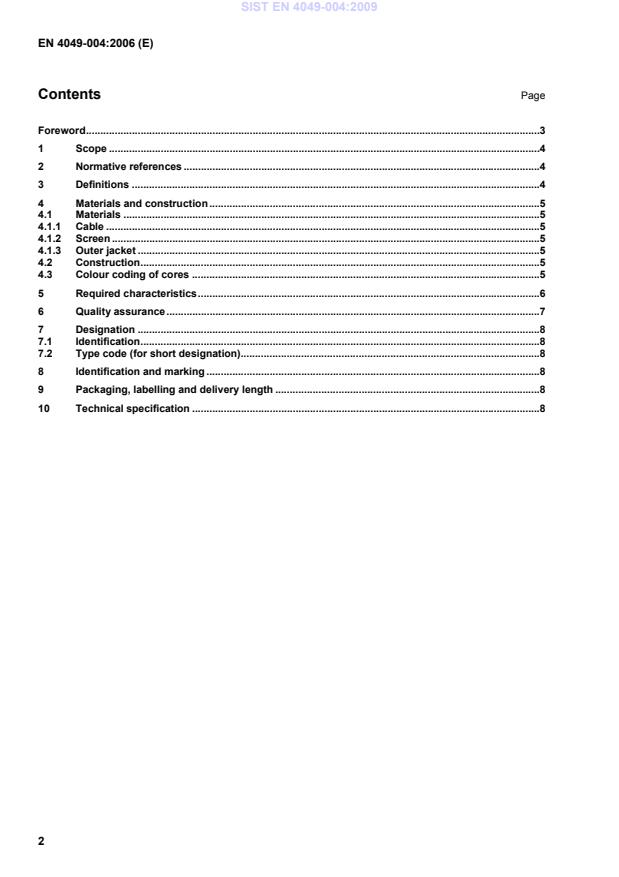
SIST EN 4049-004:2009 is the Slovenian adoption of EN 4049-004:2006 from CEN. It specifies the characteristics of two-core nickel chromium/nickel aluminium thermocouple extension cable, shielded and jacketed, for aerospace use between a thermocouple and equipment at operating temperatures from - 65 °C to 260 °C unless the product standard states otherwise.
What does SIST EN 4049-004:2009 specify?
SIST EN 4049-004:2009 specifies one product type in the EN 4049 series: a thermocouple extension cable for aerospace applications. In practice, it tells manufacturers and buyers what the cable is made of, how it is built, what tests it must pass, and how it is identified and marked.
The document is organized into clauses for scope, normative references, definitions, materials and construction, required characteristics, quality assurance, designation, identification and marking, packaging, labelling and delivery length, and technical specification. The companion parts EN 4049-001, EN 4049-002 and EN 4049-003 are used throughout the document for technical details, identification and core coding.
What are the key requirements of SIST EN 4049-004:2009?
SIST EN 4049-004:2009 requires a two-core cable built for thermocouple extension service. Clause 4 matters because it fixes the conductor pair, the screen, the outer jacket and the way the cable is constructed, so suppliers cannot substitute a different build and still claim conformity.
Materials and construction
Clause 4.1 requires the two cores to follow EN 4049-003, with nickel chromium used as the positive conductor and nickel aluminium as the negative conductor. The cores are twisted, and filler cores are not allowed. For the user, that means the cable is intended to preserve thermocouple behaviour rather than act like a generic electrical cable.
Clause 4.1 also specifies a nickel plated copper braid screen and a jacket made from two tapes: a polyimide tape with a fluorocarbon coating, then a PTFE tape wound in the opposite direction. This matters because the screening and jacket are part of the cable’s mechanical protection and environmental resistance.
Construction data and sizes
Clause 4.2 and Table 1 give the construction codes for the nominal sections used by the standard. The table links the code, nominal section, AWG size, linear resistance, screen strand diameter, external diameter and mass. For procurement and design work, this is the table used to choose the cable size that fits the electrical and installation limits of the assembly.
Colour coding and identification
Clause 4.3 points to EN 4049-002 for core colour coding. Clause 7 then defines the cable designation, including the description block and identity block, and gives a short type code through TR 6058. In practice, these clauses are what you use to order, label and trace the correct cable variant.
Required characteristics and testing
Clause 5 requires conformity with EN 4049-001 and EN 3475-100, then Table 2 assigns the relevant tests. The cable is checked for visual condition, mass, dimensions, resistance per unit length, voltage proof, insulation resistance, continuity, ageing, shrinkage and delamination, thermal shock, bending, cold bend, flammability, fluid resistance, tensile performance of conductors and strands, strippability and permanence of marking. For a buyer or quality manager, this is the core evidence that the cable can survive aerospace handling and service conditions.
Clause 5 also includes the thermoelectric performance check from ISO 8056-1, with magnetic properties of the conductors and an electromotive force (EMF) test at 260 °C. That matters because the cable must behave as a thermocouple extension lead, not just as insulated wire.
Quality assurance
Clause 6 sends quality assurance to EN 9133. This links the product standard to the aerospace qualification procedure for standard parts, which is important when the cable is being approved, sourced or audited.
What terms does SIST EN 4049-004:2009 define?
SIST EN 4049-004:2009 uses definitions from EN 3475-100, ISO 8056-1 and ISO 8815, and its technical clauses make the following terms important in practice:
- Thermocouple extension cable - a cable used between a thermocouple and the measuring or control equipment.
- Nickel chromium (NiCr) - the conductor material used as the positive core in this cable type.
- Nickel aluminium (NiAl) - the conductor material used as the negative core in this cable type.
- Screen - the braided metallic layer that shields the cable.
- Outer jacket - the outer protective layer made from the specified tape construction.
- AWG - the wire size designation used in Table 1 for the nominal section codes.
- EMF - electromotive force, the electrical output checked in the thermoelectric test.
Who uses SIST EN 4049-004:2009?
SIST EN 4049-004:2009 is used by aerospace cable manufacturers, cable assemblers, test laboratories, quality assurance teams and procurement staff. It is relevant wherever thermocouple signals have to be carried from the sensing point to equipment in aircraft or related aerospace electrical systems.
Design engineers use it to specify the correct cable construction and size. Buyers and inspectors use it to verify that supplied cable matches the coded designation, test requirements and marking rules.
Which standards are used with SIST EN 4049-004:2009?
The standard relies on several companion documents:
- EN 4049-001 - gives the technical specification framework, including packaging, labelling and delivery length.
- EN 4049-002 - provides general requirements and the colour coding of cores.
- EN 4049-003 - covers the single-core nickel chromium/nickel aluminium conductor details used by this part.
- EN 3475-100 - provides the general test methods for aerospace cables.
- EN 2083 - specifies copper or copper alloy conductors for electrical cables.
- EN 9133 - gives the quality management and qualification procedure for aerospace standard parts.
- ISO 2574 - covers identification marking for aircraft electrical cables.
- ISO 8056-1 - provides conductor requirements and tests for nickel-chromium and nickel-aluminium thermocouple extension cables.
- ISO 8815 - supplies the vocabulary for aircraft electrical cables and cable harnesses.
- TR 6058 - provides the cable code identification list used for short designation.
What does the SIST EN 4049-004:2009 document contain?
SIST EN 4049-004:2009 contains Table 1 for nominal section and construction data, and Table 2 for the required test programme. It also includes a worked designation example and a short type-code table in Clause 7, which are used for ordering and traceability.
The document describes the material build-up of the cable, the screen and jacket construction, and the permitted coding of the cores. It also points readers to the related standards for colour coding, marking, packaging and technical specification details that sit outside the main product description.
Relations
- Effective Date
- 28-Jan-2026
- Effective Date
- 28-Jan-2026
- Effective Date
- 28-Jan-2026
- Effective Date
- 28-Jan-2026
- Effective Date
- 28-Jan-2026
- Effective Date
- 28-Jan-2026
- Effective Date
- 28-Jan-2026
- Effective Date
- 28-Jan-2026
- Effective Date
- 28-Jan-2026
- Effective Date
- 28-Jan-2026
Get Certified
Connect with accredited certification bodies for this standard

BUREAU VERITAS Certification Germany
Bureau Veritas certification in Germany.

Element Materials Technology
Materials testing and product certification.

AQMS Ltd.
AQMS provides ISO certification to SMEs across the UK.
Sponsored listings
Frequently Asked Questions
SIST EN 4049-004:2009 is a standard published by the Slovenian Institute for Standardization (SIST). Its full title is "Aerospace series - Thermocouple extension cable - Operating tempera-tures between - 65 °C to 260 °C - Part 004: Two core nickel chro-mium/nickel aluminium shielded and jacketed - Product standard". This standard covers: This standard specifies the characteristics of thermocouple cables used for the connection between the ther-mocouple and the equipment. Temperatures between - 65 °C and 260 °C (except otherwise specified in the product standard).
This standard specifies the characteristics of thermocouple cables used for the connection between the ther-mocouple and the equipment. Temperatures between - 65 °C and 260 °C (except otherwise specified in the product standard).
SIST EN 4049-004:2009 is classified under the following ICS (International Classification for Standards) categories: 49.060 - Aerospace electric equipment and systems. The ICS classification helps identify the subject area and facilitates finding related standards.
SIST EN 4049-004:2009 has the following relationships with other standards: It is inter standard links to SIST EN 2083:2002, SIST EN 3475-100:2010, SIST EN 9133:2018, SIST EN 4049-001:2009, SIST EN 4049-003:2009, SIST EN 4049-002:2006, SIST EN 3155-057:2009, SIST EN 3155-056:2009, SIST EN 3155-054:2009, SIST EN 3155-055:2009. Understanding these relationships helps ensure you are using the most current and applicable version of the standard.
SIST EN 4049-004:2009 is available in PDF format for immediate download after purchase. The document can be added to your cart and obtained through the secure checkout process. Digital delivery ensures instant access to the complete standard document.
Standards Content (Sample)
2003-01.Slovenski inštitut za standardizacijo. Razmnoževanje celote ali delov tega standarda ni dovoljeno.Luft- und Raumfahrt - Thermoelement Ausgleichsleitung - Betriebstemperaturen zwischen - 65 °C to 260 °C - Teil 004: Eindadrig Nickel-Chrom und Nickel Aluminium geschirmt und ummantelt - ProduktnormSérie aérospatiale - Câbles, thermocouple - Températures de fonctionnement comprises entre - 65 °C et 260 °C - Partie 004 : Paire Nickel chrome/Nickel aluminium blindée gainée - Norme de produitAerospace series - Thermocouple extension cable - Operating tempera-tures between - 65 °C to 260 °C - Part 004: Two core nickel chro-mium/nickel aluminium shielded and jacketed - Product standard49.060Aerospace electric equipment and systemsICS:Ta slovenski standard je istoveten z:EN 4049-004:2006SIST EN 4049-004:2009en,de01-maj-2009SIST EN 4049-004:2009SLOVENSKI
STANDARD
EUROPEAN STANDARDNORME EUROPÉENNEEUROPÄISCHE NORMEN 4049-004December 2006ICS 49.060 English VersionAerospace series - Thermocouple extension cable - Operatingtempera-tures between - 65
C to 260
C - Part 004: Two corenickel chro-mium/nickel aluminium shielded and jacketed -Product standardSérie aérospatiale - Câbles, thermocouple - Températuresde fonctionnement comprises entre - 65
C et 260
C -Partie 004 : Paire Nickel chrome/Nickel aluminium blindéegainée - Norme de produitLuft- und Raumfahrt - Thermoelement Ausgleichsleitung -Betriebstemperaturen zwischen - 65
C to 260
C - Teil 004:Eindadrig Nickel-chrom und Nickel Aluminium geschirmtund ummantelt - ProduktnormThis European Standard was approved by CEN on 28 October 2005.CEN members are bound to comply with the CEN/CENELEC Internal Regulations which stipulate the conditions for giving this EuropeanStandard the status of a national standard without any alteration. Up-to-date lists and bibliographical references concerning such nationalstandards may be obtained on application to the Central Secretariat or to any CEN member.This European Standard exists in three official versions (English, French, German). A version in any other language made by translationunder the responsibility of a CEN member into its own language and notified to the Central Secretariat has the same status as the officialversions.CEN members are the national standards bodies of Austria, Belgium, Cyprus, Czech Republic, Denmark, Estonia, Finland, France,Germany, Greece, Hungary, Iceland, Ireland, Italy, Latvia, Lithuania, Luxembourg, Malta, Netherlands, Norway, Poland, Portugal, Romania,Slovakia, Slovenia, Spain, Sweden, Switzerland and United Kingdom.EUROPEAN COMMITTEE FOR STANDARDIZATIONCOMITÉ EUROPÉEN DE NORMALISATIONEUROPÄISCHES KOMITEE FÜR NORMUNGManagement Centre: rue de Stassart, 36
B-1050 Brussels© 2006 CENAll rights of exploitation in any form and by any means reservedworldwide for CEN national Members.Ref. No. EN 4049-004:2006: ESIST EN 4049-004:2009
...