

oSIST prEN 18037-2:2026
(Main)Guidelines on a sectoral cybersecurity assessment - Part 2: Application of sectoral cybersecurity assessment results by ICT product manufacturers
- Abstract
This document provides guidance for sectoral stakeholders and product manufacturers in generating ICT product-relevant information based on EN 18037.
Sectoral stakeholders are supported in applying the risk and cybersecurity assessment methodology so that the information needs of product manufacturers are covered by the sectoral assessment report.
Product manufacturers receive guidance in using methodology according to EN 18037 for own assumptions of their ICT product’s sector-specific risks and security requirements.
This document uses a step-by-step approach for guiding sectoral stakeholders and product manufacturers through the assessment. For each step, the relevant information provided by EN 18037 is summarized or referenced and the enhancements or clarifications in support of the information needs of the ICT product manufacturers are pointed out.
From the perspective of product manufacturers, the re-use of existing product-specific specifications and certification tools is of particular relevance. Therefore, this document provides guidance how the results of sectoral assessments according to EN 18037 can be connected with these specifications and tools.
- Status
- Not Published
- Public Enquiry End Date
- 18-Nov-2026
- Technical Committee
- ITC - Information technology
- Current Stage
- 4020 - Public enquire (PE) (Adopted Project)
- Start Date
- 17-Sep-2026
- Due Date
- 04-Feb-2027
- Completion Date
- 07-Oct-2026

oSIST prEN 18037-2:2026 is SIST’s draft European Standard on how ICT product manufacturers and sectoral stakeholders use the results of a sectoral cybersecurity assessment. It provides guidance for generating ICT product-relevant information from EN 18037 and for linking that assessment output to product specifications and certification tools.
What does oSIST prEN 18037-2:2026 specify?
oSIST prEN 18037-2:2026 specifies guidance for sectoral stakeholders and ICT product manufacturers who need sector-specific cybersecurity assessment results. The standard explains how to use EN 18037 so that the sectoral assessment report also supports product manufacturers’ information needs.
The document is organized as a step-by-step guide. It covers scope, normative references, terms and abbreviations, an overview of the EN 18037 assessment from the manufacturer’s perspective, the sectoral information manufacturers need, guidance for sectoral stakeholders, guidance for product manufacturers, and an informative example annex.
| Annex | What it covers |
|---|---|
| Annex A | An example assessment of a fictitious sectoral system, used to illustrate the guidance in Clause 7 |
The introduction also states that the methodology generates sector-specific threats, risks, risk treatment decisions, and resulting security and assurance requirements, but does not itself define specific security controls or evaluation and certification means. Instead, it shows how those results can be connected to product specifications and certification tools.
What are the key requirements of oSIST prEN 18037-2:2026?
oSIST prEN 18037-2:2026 is mainly a guidance standard, but it sets out the assessment information that sectoral stakeholders and product manufacturers should produce and how to use it in practice.
Sectoral stakeholders must build a usable sector context
Clause 7.3 guides sectoral stakeholders to document the market sector, stakeholder types, business and operational processes, stakeholder objectives, the architecture of the sectoral system, subsystems, and sectoral cyberthreat intelligence (CTI). In practice, this gives product manufacturers the context they need to judge the intended use of an ICT product, the operating environment, and the kinds of threats that matter.
Clause 7.2 also points stakeholders to use estimations and assumptions in a disciplined way and to maintain impartiality and non-discriminatory access. That matters because the assessment should support the sector, not favor one manufacturer.
The primary asset assessment drives the sector’s risk decisions
Clause 7.4 covers the primary asset assessment. Sectoral stakeholders identify risks, define assessment scenarios per business process, rate the risks, determine security and assurance level requirements, and decide on risk treatment per risk scenario. In practice, the product only inherits requirements from risks the sector actually decides to treat.
Clause 5 explains that EN 18037 uses a risk and cybersecurity assessment based on EN ISO/IEC 27005, and that the security and assurance requirements are derived from the attacker potential associated with the relevant risks. This is important because it gives a common basis for comparing requirements across sectors and across product uses.
Supporting assets connect the sectoral risk to the ICT product
Clause 7.5 guides the supporting asset assessment of ICT products. Sectoral stakeholders define and document system-level risk mitigation measures, identify the ICT products that act as supporting assets, aggregate product-related information, re-assess supporting assets per risk scenario, and then aggregate the results per ICT product. In practice, one ICT product may inherit requirements from several risk scenarios and several intended uses.
Clause 5.4 is especially relevant for multi-market ICT products. The standard says product manufacturers should have sectoral assessment reports from all targeted market sectors, and the reports need comparable security and assurance requirements. The text says EN 18037 supports that comparability by using attack potential as the leading parameter.
Risk treatment decisions determine product requirements
Clause 5.5 states that risk treatment decisions are made by the sectoral stakeholders and risk owners, and those decisions determine whether security controls or certification are needed for the ICT product. If a risk is accepted, the product manufacturer does not have to implement mitigation or certification for that risk.
Clause 6 lists the sectoral information that should be generated and documented for each ICT product, including responsible stakeholders, relevant standards and legal or regulatory obligations, attacker types and attack paths, intended uses, associated risks, risk treatment decisions, and aggregated security and assurance requirements. This is the core output manufacturers need for product definition and market alignment.
Existing product specifications and certification tools should be reused where possible
Clause 7.6 covers mapping the detected security and assurance requirements to existing specifications and certification tools. The standard expects a gap analysis, identification of possible resolutions, and guidance when no resolution is available for a product-specific gap. In practice, this is where existing product security profiles, protection profiles, or certification schemes can be reused before developing anything new.
Clause 7.7 says the assessment report should be maintained over time. That matters because threats, objectives, and mitigation options change, so the sectoral report needs review and update.
Product manufacturers can also apply the method themselves
Clause 8 gives manufacturers guidance for documenting the sectoral context from a product perspective, estimating relevant objectives and assets from the intended use, and estimating sectoral CTI. It then points manufacturers to the primary asset assessment and supporting asset assessment logic in Clause 7, while noting that risk treatment decisions remain with sectoral stakeholders. Manufacturers then document how they will address the resulting requirements through security controls and, where needed, ICT security evaluation and certification.
What terms does oSIST prEN 18037-2:2026 define?
- Attack method - How an attack can be carried out, possibly using several attack means and different attack potential levels.
- Attack path - The attacker’s steps for finding and exploiting a vulnerability.
- Attacker scenario - The relevant attacker type’s capacities, means, and motivation in a risk scenario.
- Intended use - The role and purpose of an ICT product in an ICT system, including supported functions, processed data, relevant threats, and operational environment.
- Cyberthreat intelligence (CTI) - Sectoral information about likely attacker types, their attack potential, motivation, and attack approaches.
- Attack potential level (APL) - A level used to express attacker potential in the assessment.
- Meta-risk class (MRC) - A result used when rating risk scenarios before deriving security and assurance requirements.
- Common Assurance Reference (CAR) - An assurance reference term used in the document’s terminology set.
Who uses oSIST prEN 18037-2:2026?
oSIST prEN 18037-2:2026 is used by sectoral stakeholders who run the sectoral cybersecurity assessment and by ICT product manufacturers who need to understand how sector-specific risks affect their products. It is also relevant for product and certification experts who help map the assessment results to controls, protection profiles, security targets, or certification schemes.
In practice, the standard supports work in sectoral and application-specific ICT systems, especially where products are components of a larger system and need to fit the sector’s business processes, technical architecture, and regulatory obligations. It is also useful for manufacturers targeting more than one sector, because they need a way to compare and combine requirements across markets.
Which standards are used with oSIST prEN 18037-2:2026?
- EN 18037:2025 - The core sectoral cybersecurity assessment methodology that this guide supports.
- EN ISO/IEC 27005 - The risk management approach used for the risk assessment stages.
- EN ISO/IEC 15408 series - The assurance framework whose way of expressing security and assurance requirements is described as compatible with EN 18037.
- SESIP - An evaluation and certification standard described as compatible with the EN 18037 way of describing requirements.
What does the oSIST prEN 18037-2:2026 document contain?
oSIST prEN 18037-2:2026 contains a clause-by-clause guide for turning sectoral cybersecurity assessment results into ICT product-relevant information. The main body explains the assessment overview, the sectoral information manufacturers need, the work of sectoral stakeholders, and the work of product manufacturers.
Annex A provides an informative worked example for a fictitious sectoral system. It walks through context documentation, primary asset assessment, risk treatment decisions, supporting asset assessment, and gap analysis, with tables and step sequences that show how the method is applied in practice.
The document is useful for assessment planning, product definition, gap analysis, and preparation for evaluation or certification activities.
Get Certified
Connect with accredited certification bodies for this standard

BSI Group
BSI (British Standards Institution) is the business standards company that helps organizations make excellence a habit.

Bureau Veritas
Bureau Veritas is a world leader in laboratory testing, inspection and certification services.

DNV
DNV is an independent assurance and risk management provider.
Sponsored listings
Frequently Asked Questions
oSIST prEN 18037-2:2026 is a draft published by the Slovenian Institute for Standardization (SIST). Its full title is "Guidelines on a sectoral cybersecurity assessment - Part 2: Application of sectoral cybersecurity assessment results by ICT product manufacturers". This standard covers: This document provides guidance for sectoral stakeholders and product manufacturers in generating ICT product-relevant information based on EN 18037. Sectoral stakeholders are supported in applying the risk and cybersecurity assessment methodology so that the information needs of product manufacturers are covered by the sectoral assessment report. Product manufacturers receive guidance in using methodology according to EN 18037 for own assumptions of their ICT product’s sector-specific risks and security requirements. This document uses a step-by-step approach for guiding sectoral stakeholders and product manufacturers through the assessment. For each step, the relevant information provided by EN 18037 is summarized or referenced and the enhancements or clarifications in support of the information needs of the ICT product manufacturers are pointed out. From the perspective of product manufacturers, the re-use of existing product-specific specifications and certification tools is of particular relevance. Therefore, this document provides guidance how the results of sectoral assessments according to EN 18037 can be connected with these specifications and tools.
This document provides guidance for sectoral stakeholders and product manufacturers in generating ICT product-relevant information based on EN 18037. Sectoral stakeholders are supported in applying the risk and cybersecurity assessment methodology so that the information needs of product manufacturers are covered by the sectoral assessment report. Product manufacturers receive guidance in using methodology according to EN 18037 for own assumptions of their ICT product’s sector-specific risks and security requirements. This document uses a step-by-step approach for guiding sectoral stakeholders and product manufacturers through the assessment. For each step, the relevant information provided by EN 18037 is summarized or referenced and the enhancements or clarifications in support of the information needs of the ICT product manufacturers are pointed out. From the perspective of product manufacturers, the re-use of existing product-specific specifications and certification tools is of particular relevance. Therefore, this document provides guidance how the results of sectoral assessments according to EN 18037 can be connected with these specifications and tools.
oSIST prEN 18037-2:2026 is classified under the following ICS (International Classification for Standards) categories: 35.030 - IT Security. The ICS classification helps identify the subject area and facilitates finding related standards.
oSIST prEN 18037-2:2026 is available in PDF format for immediate download after purchase. The document can be added to your cart and obtained through the secure checkout process. Digital delivery ensures instant access to the complete standard document.
Standards Content (Sample)
SLOVENSKI STANDARD
01-november-2026
Smernice za sektorsko oceno kibernetske varnosti - 2. del: Uporaba rezultatov
sektorske ocene kibernetske varnosti pri proizvajalcih IKT izdelkov
Guidelines on a sectoral cybersecurity assessment - Part 2: Application of sectoral
cybersecurity assessment results by ICT product manufacturers
Leitlinien für eine sektorale Bewertung der Cybersicherheit - Teil 2: Anwendung der
Ergebnisse der sektoralen Bewertung der Cybersicherheit durch Hersteller von IKT-
Produkten
Ta slovenski standard je istoveten z: prEN 18037-2
ICS:
35.030 Informacijska varnost IT Security
2003-01.Slovenski inštitut za standardizacijo. Razmnoževanje celote ali delov tega standarda ni dovoljeno.
EUROPEAN STANDARD DRAFT
NORME EUROPÉENNE
EUROPÄISCHE NORM
September 2026
ICS 35.030
English version
Guidelines on a sectoral cybersecurity assessment - Part 2:
Application of sectoral cybersecurity assessment results
by ICT product manufacturers
Leitlinien für eine sektorale Bewertung der
Cybersicherheit - Teil 2: Anwendung der Ergebnisse
der sektoralen Bewertung der Cybersicherheit durch
Hersteller von IKT-Produkten
This draft European Standard is submitted to CEN members for enquiry. It has been drawn up by the Technical Committee
CEN/CLC/JTC 13.
If this draft becomes a European Standard, CEN and CENELEC members are bound to comply with the CEN/CENELEC Internal
Regulations which stipulate the conditions for giving this European Standard the status of a national standard without any
alteration.
This draft European Standard was established by CEN and CENELEC in three official versions (English, French, German). A
version in any other language made by translation under the responsibility of a CEN and CENELEC member into its own language
and notified to the CEN-CENELEC Management Centre has the same status as the official versions.
CEN and CENELEC members are the national standards bodies and national electrotechnical committees of Austria, Belgium,
Bulgaria, Croatia, Cyprus, Czech Republic, Denmark, Estonia, Finland, France, Germany, Greece, Hungary, Iceland, Ireland, Italy,
Latvia, Lithuania, Luxembourg, Malta, Netherlands, Norway, Poland, Portugal, Republic of North Macedonia, Romania, Serbia,
Slovakia, Slovenia, Spain, Sweden, Switzerland, Türkiye and United Kingdom.
Recipients of this draft are invited to submit, with their comments, notification of any relevant patent rights of which they are
aware and to provide supporting documentation.Recipients of this draft are invited to submit, with their comments, notification
of any relevant patent rights of which they are aware and to provide supporting documentation.
Warning : This document is not a European Standard. It is distributed for review and comments. It is subject to change without
notice and shall not be referred to as a European Standard.
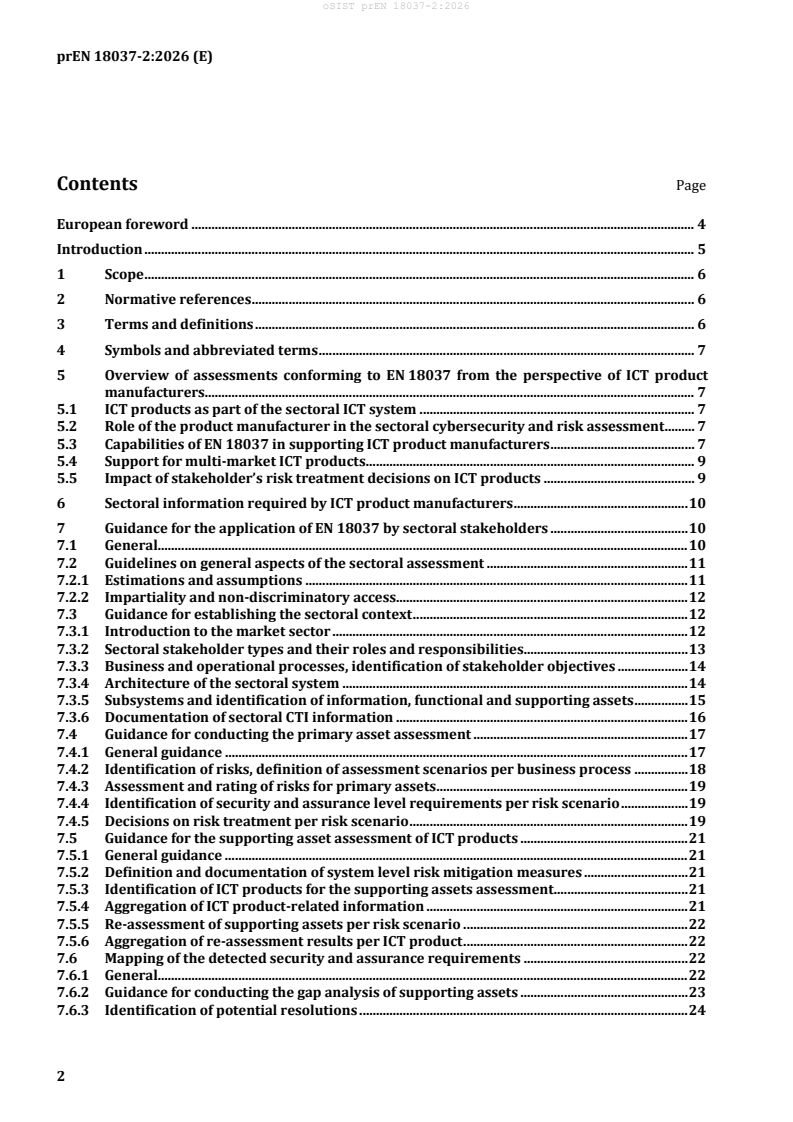
Contents Page
European foreword . 4
Introduction . 5
1 Scope . 6
2 Normative references . 6
3 Terms and definitions . 6
4 Symbols and abbreviated terms . 7
5 Overview of assessments conforming to EN 18037 from the perspective of ICT product
manufacturers. 7
5.1 ICT products as part of the sectoral ICT system . 7
5.2 Role of the product manufacturer in the sectoral cybersecurity and risk assessment . 7
5.3 Capabilities of EN 18037 in supporting ICT product manufacturers . 7
5.4 Support for multi-market ICT products . 9
5.5 Impact of stakeholder’s risk treatment decisions on ICT products . 9
6 Sectoral information required by ICT product manufacturers . 10
7 Guidance for the application of EN 18037 by sectoral stakeholders . 10
7.1 General. 10
7.2 Guidelines on general aspects of the sectoral assessment . 11
7.2.1 Estimations and assumptions . 11
7.2.2 Impartiality and non-discriminatory access. 12
7.3 Guidance for establishing the sectoral context . 12
7.3.1 Introduction to the market sector . 12
7.3.2 Sectoral stakeholder types and their roles and responsibilities . 13
7.3.3 Business and operational processes, identification of stakeholder objectives . 14
7.3.4 Architecture of the sectoral system . 14
7.3.5 Subsystems and identification of information, functional and supporting assets . 15
7.3.6 Documentation of sectoral CTI information . 16
7.4 Guidance for conducting the primary asset assessment . 17
7.4.1 General guidance . 17
7.4.2 Identification of risks, definition of assessment scenarios per business process . 18
7.4.3 Assessment and rating of risks for primary assets . 19
7.4.4 Identification of security and assurance level requirements per risk scenario . 19
7.4.5 Decisions on risk treatment per risk scenario . 19
7.5 Guidance for the supporting asset assessment of ICT products . 21
7.5.1 General guidance . 21
7.5.2 Definition and documentation of system level risk mitigation measures . 21
7.5.3 Identification of ICT products for the supporting assets assessment . 21
7.5.4 Aggregation of ICT product-related information . 21
7.5.5 Re-assessment of supporting assets per risk scenario . 22
7.5.6 Aggregation of re-assessment results per ICT product . 22
7.6 Mapping of the detected security and assurance requirements . 22
7.6.1 General. 22
7.6.2 Guidance for conducting the gap analysis of supporting assets . 23
7.6.3 Identification of potential resolutions . 24
7.6.4 Guidance in case of unavailability of resolutions for product-specific gaps . 24
7.7 Maintenance of the assessment report . 24
8 Guidance for the application of EN 18037 by product manufacturers. 25
8.1 General . 25
8.2 Guidance to product manufacturers for documenting the sectoral context . 25
8.2.1 General guidance . 25
8.2.2 Estimating relevant objectives and assets based on the product’s intended use . 25
8.2.3 Estimating sectoral CTI information . 26
8.3 Guidance to product manufacturers for conducting the primary asset assessment . 26
8.4 Guidance to product manufacturers for conducting the supporting asset assessment. 26
8.5 Mapping of the detected security and assurance requirements . 26
Annex A (informative) Example assessment of a fictitious sectoral system . 28
Bibliography . 58
European foreword
This document (prEN 18037-2:2026) has been prepared by Technical Committee CEN/CLC/JTC 13
“Cybersecurity and Data Protection”, the secretariat of which is held by DIN.
This document is currently submitted to the CEN Enquiry.
Introduction
EN 18037 specifies a methodology for risk and cybersecurity assessments of sectoral multi-stakeholder
systems. The assessment is carried out by the sectoral stakeholders with focus on their particular
objectives.
This document provides guidance to ensure that the assessment by the sectoral stakeholders also
addresses the information needs of product manufacturers that offer ICT products for the particular
sector.
Product manufacturers might not have sufficiently access to risk information and security and assurance
requirements regarding the sector-specific use of their ICT products. The first aim of this document is to
guide the sectoral stakeholders conducting their sectoral assessment according to EN 18037 so that the
information needs of product manufacturers are also considered and met. The second aim is to provide
guidance to product manufacturers on how they can use EN 18037’s methodology for own assumptions
of their ICT product’s sector-specific risks and security requirements if assessment results from the
sectoral stakeholders should not be available or if these are incomplete.
By applying EN 18037 and this document, product manufacturers will benefit from sector-specific risk
information and requirements concerning their products. This supports the product manufacturers in
the definition of their products and increases the probability that these will be accepted by the sectoral
market.
The EN 18037 assessment methodology generates sector-specific information on threats, risks, risk
treatment decisions and the resulting security and assurance requirements for the sectoral ICT systems,
ICT processes and ICT products but it does not define specific security controls or evaluation and
certification means. However, sector-specific standards, product-specific security controls or
certification tools that match the requirements identified in the assessment conforming to EN 18037 can
be integrated into the sectoral assessment report.
The methodology of EN 18037 and its way to describe security and assurance requirements is compatible
with the EN ISO/IEC 15408 series and the SESIP evaluation and certification standard.
1 Scope
This document provides guidance for sectoral stakeholders and product manufacturers in generating ICT
product-relevant information based on EN 18037.
Sectoral stakeholders are supported in applying the risk and cybersecurity assessment methodology so
that the information needs of product manufacturers are covered by the sectoral assessment report.
Product manufacturers receive guidance in using methodology according to EN 18037 for own
assumptions of their ICT product’s sector-specific risks and security requirements.
This document uses a step-by-step approach for guiding sectoral stakeholders and product
manufacturers through the assessment. For each step, the relevant information provided by EN 18037 is
summarized or referenced and the enhancements or clarifications in support of the information needs of
the ICT product manufacturers are pointed out.
From the perspective of product manufacturers, the re-use of existing product-specific specifications and
certification tools is of particular relevance. Therefore, this document provides guidance how the results
of sectoral assessments according to EN 18037 can be connected with these specifications and tools.
2 Normative references
The following documents are referred to in the text in such a way that some or all of their content
constitutes requirements of this document. For dated references, only the edition cited applies. For
undated references, the latest edition of the referenced document (including any amendments) applies.
EN 18037:2025, Guidelines on a sectoral cybersecurity assessment
3 Terms and definitions
For the purposes of this document, the terms and definitions given in EN 18037 and the following apply.
ISO and IEC maintain terminology databases for use in standardization at the following addresses:
— ISO Online browsing platform: available at https://www.iso.org/obp/
— IEC Electropedia: available at https://www.electropedia.org/
3.1
attack method
how an attack can be carried out
Note 1 to entry: An attack method can require several attack means and can be carried out at different attack
potential levels.
3.2
attack path
attacker activities for finding and exploiting a vulnerability
Note 1 to entry: An attack path can include several steps where different attack methods can be used.
3.3
attacker scenario
relevant attacker type’s capacities, means and motivation to conduct actions that could potentially impact
functional and information assets in the context of a risk scenario
3.4
intended use
role and purpose of an ICT product in an ICT system, in particular the supported ICT functions, the data
processed, relevant threats and the operational environment
4 Symbols and abbreviated terms
For the purposes of this document, the following symbols and abbreviations apply:
APL Attack potential level
AVA_VAN Assurance family defined by EN ISO/IEC 15408-3 that addresses the vulnerability
analysis
CAR Common Assurance Reference
CSL Common security level
CTI Cyberthreat intelligence
EAL Evaluation assurance level
IC Impact class
ICT Information and communication technology
IoT Internet of Things
MRC Meta-risk class
PL Probability level
5 Overview of assessments conforming to EN 18037 from the perspective of ICT
product manufacturers
5.1 ICT products as part of the sectoral ICT system
Sectoral ICT systems and their characteristics are documented in EN 18037:2025 Clause 6. According to
this model, the sectoral ICT system supports the sectoral services provided to consumers or business
customers. ICT products serve as components of the sectoral system.
The sectoral system’s architecture defines the ICT product’s particular role, purpose and the conditions
under which the ICT product is operated, the ICT product’s intended use.
5.2 Role of the product manufacturer in the sectoral cybersecurity and risk assessment
The cybersecurity and risk assessment of a sectoral or application-specific ICT system is conducted by
the sectoral stakeholders. They decide if manufacturers of ICT products are directly involved in the
assessment. For manufacturers of ICT products which are not specifically designed for the sector, this is
typically not the case.
5.3 Capabilities of EN 18037 in supporting ICT product manufacturers
The 1st stage of the cybersecurity assessment in accordance with EN 18037 prepares the risk assessment
in accordance with EN ISO/IEC 27005. As per EN ISO/IEC 27005, the assessment starts with the
documentation of the sectoral context, followed by the identification of assets, potential threats, attackers
and attack paths and a first estimation on the criticality of ICT products.
The context documentation describes the environment in which the sectoral or application-specific risk
and cybersecurity assessment should carried out. Technical, operational and business-related
information required for the following stages of the assessment is documented:
— Identification of stakeholders of the sectoral system and a description of their roles and
responsibilities within the sectoral system;
— Documentation of business or operational processes to be supported, the involvement and
responsibilities of stakeholders and their objectives per process;
— Identification of the sectoral stakeholder’s business objectives, obligations and, based on this, the
definition of the sectoral primary assets;
— Documentation of the sectoral ICT system architecture down to the ICT product level, including a
description of functions and data supported by the ICT product in its intended use;
— Documentation of sectoral cyber threat intelligence (CTI), which includes in particular assumptions
on potentially relevant attacker types, their attack potential and their motivation and approaches to
conduct attacks targeting the sectoral system.
The documentation of the sectoral context provides the option to document the intended use of an ICT
product in its sectoral or application-specific context in very detail. This includes the product’s role in the
sectoral ICT system’s architecture, the functions and the information supported by the ICT product in this
role, the operational environment and the sectoral stakeholder type in charge for the operations of the
ICT product.
Based on the documentation of the sectoral context, a first identification of potentially critical system
functions and data are conducted. This can be used for a first estimation, if the ICT product in its intended
use should be considered as security-critical. If so, the product is classified as “supporting asset” and
threats, attacker types and attack paths that could be relevant for the ICT product in its intended use
should be estimated.
The 2nd stage of the cybersecurity and risk assessment in accordance with EN 18037, the primary asset
assessment, encompasses a risk assessment in accordance with EN ISO/IEC 27005. It starts with the
identification of primary assets which are typically related to the stakeholder’s objectives or obligations
rather than the technical implementation of the system. Thereafter, the risks to these assets are identified
and assessed by using risk scenarios. The risk ratings are conducted by the sectoral stakeholders. If they
decide to treat the risk, the security and assurance level requirements are determined with the potential
of the relevant attacker types serving as leading parameter.
The primary asset assessment focuses on risks concerning the primary assets and does not regard the
individual ICT product. However, the security and assurance level requirements resulting from these
risks are inherited by those ICT products that could contribute to the primary asset’s risk scenarios if
compromised. What is particularly important for product manufacturers is that the need to apply
dedicated controls depends on the risk treatment decision of the sectoral stakeholders. If they, for
instance, should decide that the potential consequences of the risk do not justify the cost for its mitigation,
the risk may be accepted.
The 3rd stage of the cybersecurity and risk assessment in accordance with EN 18037, the supporting
asset assessment, focusses on consolidating the security and assurance requirements to those ICT
products that are relevant for the treatment of a particular risk.
As starting point, the risk-relevant supporting assets inherit the security and assurance level
requirements identified for a dedicated risk scenario in the previous assessment stage. This assessment
is being repeated for each relevant supporting asset, now considering product-specific attacker and
threat information as well as the ICT product’s intended use, technology and operational environment.
As result, the risk scenario-specific security and assurance level requirements for the supporting asset in
its intended use are determined.
An ICT product could be a relevant supporting asset for multiple risk scenarios and could have, on top of
that, multiple intended uses in the sectoral ICT system. This is considered in the next step by documenting
the overall set of specific security and assurance requirements to an ICT product, which consists of the
aggregate of the risk-scenario specific requirements and, if applicable, of the requirements related to
different intended uses of the ICT product. This aggregated set of security and assurance requirements is
what the manufacturer needs to address by implementing appropriate security controls and certification
for the ICT product targeting the sectoral system.
The 4th stage of the risk and cybersecurity assessment in accordance with EN 18037 supports the
identification of appropriate controls and product certification schemes that match the requirements to
the ICT product determined in the previous stages.
In a first step, existing security specifications and certification schemes are applied to the product as far
as possible. Then, an analysis detects the gaps that remain between the security measures already defined
for the product and the security and assurance requirements identified by the previous assessment steps.
If the requirements are not completely covered, the remaining gaps should be addressed by developing
security controls and, for addressing assurance requirements, feasible security targets, protection
profiles or even product certification schemes. This last step requires expert knowledge concerning the
security implementation of the ICT product and related evaluation and certification. Typically, sectoral
stakeholders conducting the assessment involve product and certification experts.
5.4 Support for multi-market ICT products
In many cases, product manufacturers target more than one market sector with their ICT products.
NOTE Multi-market products with intended uses in multiple targeted market sectors must comply with
requirements for all intended uses in all targeted sectors.
The risk and cybersecurity assessment in accordance with EN 18037 is conducted per market sector or
application area by the stakeholders of a particular sector. For multi-market ICT products, the product
manufacturer should have the sectoral assessment reports from all targeted market sectors.
The aggregation of the product-specific requirements from these market sectors by the product
manufacturer requires that the statements concerning risk level and, most important, the security and
assurance level requirements are comparable.
The cybersecurity and risk assessment in accordance with EN 18037 provides comparability of security
and assurance level requirements across sectoral assessment reports by using the attack potential as
leading parameter for product-specific security and assurance level requirements.
5.5 Impact of stakeholder’s risk treatment decisions on ICT products
The assessment in accordance with EN 18037 encompasses a risk assessment in accordance with
EN ISO/IEC 27005 and a dedicated decision on how the identified and rated risks should be treated. The
risk treatment decisions are taken by the sectoral stakeholders and risk owners and are documented in
the sectoral assessment report.
The risk treatment decision determines the security and assurance requirements for the ICT product. If
the sectoral stakeholders and risk owners decide that the risk does not merit mitigation, the application
of security controls or certification of the ICT product are not required for this risk. Therefore, the
availability and accessibility of sectoral risk treatment decisions is crucial for the product manufacturer.
6 Sectoral information required by ICT product manufacturers
Product manufacturers need sectoral information from their targeted market sectors to ensure that their
ICT products fulfil the sectoral market’s requirements and are accepted by the sectoral clients. Typically,
the product should support the following capabilities and properties:
a) Conformance of the ICT product with the sector-specific functional, security and assurance
requirements;
b) Appropriate protection against threats potentially targeting the ICT product and consequences that
could occur if the ICT product should be compromised;
c) Conformance with technical standards and legal or regulatory obligations relevant for the ICT
product;
d) Commercial competitiveness, in particular by optimization of product development and production
cost.
In order to support the needs listed above, the following information should be generated and
documented by the sectoral assessment per ICT product:
a) Sectoral stakeholders responsible for deployment, operations, security and maintenance of the ICT
product;
b) Technical standards and legal or regulatory obligations relevant for the ICT product;
c) Attacker types potentially targeting the ICT product, their attack potential and assumed attack paths;
d) Intended uses per ICT product
— Description of the ICT product’s purpose and role in the sectoral ICT system and the sectoral
business processes;
— Functional and information assets supported by the ICT product;
— Operational environment of the ICT product;
e) Assets and risks associated with the ICT product
— Risks to primary assets potentially resulting from compromises of the ICT product;
— Risk scenarios involving the ICT product in its role as supporting asset, including potentially
impacted primary assets, relevant attacker types, the identified risks and the risk rating;
f) Risk treatment decisions affecting the security and assurance requirements to the ICT product;
g) Security and assurance requirements per ICT product, aggregated from all risk scenario-specific
requirements and, if appropriate, different intended uses of the ICT product in the sectoral system.
7 Guidance for the application of EN 18037 by sectoral stakeholders
7.1 General
The sectoral cybersecurity and risk assessment is typically carried out by the sectoral stakeholders. The
guidance given in this clause is intended to support these sectoral stakeholders in conducting the context
establishment and the following steps of the assessment in a manner that ensures that all information
required by product manufacturers is generated and documented. It also includes some general
suggestions, for instance to ensure impartiality and non-discriminatory access for all interested product
manufacturers to the sectoral market.
Clause 6 describes the information that the sectoral cybersecurity and risk assessment should generate
and document to support product manufacturers.
As depicted in EN 18037:2025 Figure 1, sectoral assessments are carried out according to EN 18037 in
three phases:
a) The documentation of the sectoral context;
b) The sectoral risk and cybersecurity assessment, which provides a normalized representation to risk,
cybersecurity and assurance and is carried out in two steps, the primary asset assessment and the
supporting asset assessment;
c) The mapping of the security and assurance requirements identified by the sectoral assessment to the
specifications and certifications tools of the ICT systems and ICT products used for by the sector.
For the first two phases, the guidance provided in the following subclauses focusses on making sure that
the information needs of product manufacturers are considered by the sectoral stakeholders.
The mapping of the detected security and assurance requirements to ICT systems and ICT products, the
third phase of the sectoral assessment, should build on existing horizontal and vertical specifications that
are applicable for the sectoral ICT systems and ICT products. Therefore, detailed expertise concerning
the particular ICT systems and ICT products and the relevant standards is required for this last step of
the assessment. If needed and possible, the sectoral stakeholder should reach out to competent
standardization bodies, industry organizations and potentially also manufacturers.
Starting with subclause 7.3 it is explained in a step-by-step approach how sectoral stakeholders should
implement the assessment according to EN 18037 so that not only their own but also the product
manufacturer’s information needs are served.
7.2 Guidelines on general aspects of the sectoral assessment
7.2.1 Estimations and assumptions
For most sectors, there are no reliable sources of CTI information available. Information on relevant
attacker types, their capacities and motivation, typical attack paths etc. should be estimated based, for
instance, on information from public sources or based on observations and assumptions of the sectoral
stakeholders.
The same applies in principle for ICT products. Here, the product manufacturers are typically the main
sources of information on relevant threats, attack paths etc.
Risk ratings and risk treatment decisions are largely depending on the risk perception and the risk
tolerance of those stakeholders whose assets could be impacted.
CTI information, risk ratings etc. are essential for the subsequent steps of the assessment and the
resulting security and assurance requirements to ICT products. However, these are often based on
estimations, assumptions or individual views.
Assessment-relevant information that is based on estimations or assumptions should be flagged. The
sources and the rationale behind those estimations and assumptions should be documented so that
plausibility checks can be conducted whenever required.
7.2.2 Impartiality and non-discriminatory access
The sectoral stakeholders might want to use the expertise of product manufacturers for the assessment.
These will commonly be involved in the assessment if ICT products are specifically designed for the sector
and the manufacturers work on behalf of the sector. However, if generic ICT products are acquired from
the market, the product manufacturer’s involvement in the sectoral assessment should ensure
impartiality and non-discriminatory participation. The following guidance is intended to accomplish this:
— Practicality will likely require that only few selected product manufacturers can be involved in the
assessment. Their competitors could see this as inappropriate advantage.
— If product manufacturers will be involved in the assessment, provisions should be taken that they
cannot use their participation to position competitive advantages for their products or technologies.
— All assessment steps and results should be documented and made available to all interested parties.
— If possible, expertise from standardization organizations or industry bodies should be involved to
ensure that preferential treatment of individual product manufacturers is excluded.
— If public tenders are used for acquiring ICT products, depending on the sectoral or legal rules, the
participation of individual product manufacturers in the sectoral assessment could be seen as
participation in the preparation of the tender. This could disqualify them for participating in the
tender. In this case, expertise from standardization organizations, commercial chambers or industry
bodies should be used.
7.3 Guidance for establishing the sectoral context
7.3.1 Introduction to the market sector
The documentation of the sectoral context starts with a general introduction to the market sector or
application area.
This should include the following information:
— The services typically provided by the sector;
— Typical clients of these sectoral services;
— The societal relevance of these services, particularly if the services are of public interest and are
associated with dedicated obligations;
— The area in which these services are provided, for instance if these are offered in a certain region,
nationally or internationally;
— Interactions with other market sectors or infrastructure, for instance the employment of Identity,
payment or mobile network services;
— Legal or regulatory obligations that apply for the sector or its services.
To specifically support product manufacturers, the introduction to the market sector should characterize
the relationship between the particular sector and its product manufacturers. The following questions
are intended as guidance for identifying and documenting the sectoral situation:
— Are there specific requirements, beyond the technical requirements to the product, that the product
manufacturer shall fulfil, for instance legal or regulatory obligations, sectoral governance rules etc.?
— Are there product manufacturers that are considered stakeholders of the sector?
— Does the sector typically use market-customary ICT products that are also used by other sectors?
— Are sector-specific ICT products employed which are specifically designed for the sector?
— Is the sector in the position to obtain sector-specific products or sector-specific features from the
market or does it need to rely on common-market ICT products?
— Does the sector typically work with system integrators for the definition and implementation of the
sectoral ICT system?
— Does the sector typically involve product manufacturers in the specification of the sectoral system or
in the specification of the ICT products?
— Does the sector employ specific product manufacturers as suppliers?
7.3.2 Sectoral stakeholder types and their roles and responsibilities
The detailed documentation of the sectoral context starts with the documentation of the sectoral
stakeholder types and their roles and responsibilities, those entities that actively contribute to the
provisioning of the sectoral services or that consume those.
First, it should be checked if a sectoral specification of the stakeholder types and their roles is available.
If so, like for instance in mobile networks, credit card payment or eIDAS-conformant identification, this
specification should be re-used.
As first step of the documentation, the sectoral stakeholder types are identified. Stakeholders qualify as
sectoral stakeholders if the sectoral market is an area of their activities and if they act according to
governance rules defined for the sectoral role play.
Sectors that require a coordinated cooperation between multiple stakeholder types often employ a
coordinating stakeholder role, called coordinating entity in EN 18037. This coordinating entity takes care
for tasks overarching the sectoral system like defining sectoral technical specifications and governance
rules, acting as registrar or security manager, coordinating daily operations and last but not least
conducting sectoral risk and cybersecurity assessments.
For any sectoral stakeholder types, the following information should be identified and documented:
— Stakeholder types should be identified and given a descriptive name;
— The role and the responsibilities of the stakeholder type in the sectoral context, in particular in
provisioning or consuming the services provided by the sector;
— The stakeholder type’s relation with other sectoral stakeholder types;
— The stakeholder type’s relation with external suppliers of services or products;
— The relation between stakeholders of the same stakeholder type, in particular if these potentially are
competing with each other.
Typically, a sector cannot completely rely on own stakeholders but has dependencies from external
service providers and suppliers that do not necessarily follow the sectoral governance rules. Examples
are mobile device suppliers, mobile network operators, ID service providers, payment service providers
etc. These external stakeholders and the sectoral dependencies on their ICT services or ICT products
should be documented as well.
To specifically support product manufacturers, the assessment should document the typical
interrelationship between the sectoral stakeholders and product manufacturers. The following questions
are intended as guidance to determine the roles and responsibilities of sectoral stakeholders in their
relation with the ICT products employed by the sector:
— Which stakeholder type does specify which ICT systems and ICT products?
— Which stakeholder type is responsible for system deployment, operations, ICT security, updates etc.
of which ICT product?
— Is there a sectoral entity that conducts ICT product tenders, coordinates ICT product updates,
conducts ICT product release testing etc. on behalf of the sectoral stakeholders?
7.3.3 Business and operational processes, identification of stakeholder objectives
The sectoral business and operational processes that are essential for the provisioning of the sectoral
services should be identified. In particular processes that involve more than one stakeholder type should
be selected for the documentation in the sectoral context.
The documentation of the identified business or operational processes is carried out per process in a
step-by-step approach and should include the following information:
— the preconditions that need to be in place at the start of the process;
— a brief description of every step of the process;
— the sectoral stakeholder types responsible for implementing and operating the process or individual
process steps;
— the stakeholder types contributing to individual process steps;
— stakeholder types depending on the results of the process;
— data generated, stored, processed or distributed by the process including a first estimation of the
criticality of these functions and data for the process and the services supported by the process.
After the process is documented, the objectives or obligations of the involved or depending stakeholder
types regarding the process should be identified and rated concerning their criticality for the particular
stakeholder type. Critical objectives or obligations that could be impacted in case of an incident affecting
the process should be identified per stakeholder type and documented. For all these considerations, the
involved and also the depending stakeholders should be consulted.
This step of the context documentation does typically not address the technical implementation of the
sectoral system and the particular role of products in the sectoral system.
An exception is when the ICT product is a central element of the sectoral services and when the sectoral
processes directly support the objectives of the product manufacturer related to this product. In such
case, the product manufacturer should be seen as sectoral stakeholder and the processes as well as the
product manufacturer’s objectives should be documented.
EXAMPLE Business and operational processes that support consumer home appliances by providing updates
or value-added services offered by the product manufacturer should be included in the context documentation.
7.3.4 Architecture of the sectoral system
After describing the organizational and business aspects of the sector, the technical layer that supports
the sector’s processes and services should be documented.
EN 18037:2025 6.1 introduces the definitions that should be used and the principle, how ICT services,
ICT system, ICT processes and ICT products are interrelated. The relevance of the sectoral ICT system
architecture for the risk assessment is described in EN 18037:2025 6.1.4.
The sectoral ICT system supports the sectoral business processes and the services to the sectoral clients.
The sectoral system architecture describes how ICT products, stakeholder ICT systems and ICT processes
are composed to build the sectoral ICT system. ICT products could be part of the overall sectoral ICT
system or the individual ICT systems operated by the sectoral stakeholders. The particular function and
operational environment of the ICT products in these ICT systems defines their intend use.
As first step, the reference architecture of the sectoral ICT system should be identified. If available,
existing sectoral architecture specifications should be re-used. There could be sectors with more than
one ICT system and related system architecture, for instance if different application areas are addressed
by the sector. All sectoral system architectures that should undergo the sectoral assessment should be
documented.
The documentation of the sectoral system architecture is described at a functional level. In addition to a
high-level description of its functions at sectoral level, the following aspects should be covered:
— The ICT systems operated by the sectoral stakeholders;
— The interfaces connecting the sectoral stakeholder’s ICT systems;
— ICT processes supporting the sectoral ICT system, for instance system update processes;
— ICT products and their intended use in the sectoral ICT system or in stakeholder ICT systems;
— ICT processes supporting ICT products, for instance for information on vulnerabilities, software
updates or replacements;
— ICT infrastructures and ICT infrastructure services employed by the sectoral ICT system or ICT
systems of sectoral stakeholders;
— Existing standards and specifications that apply for the sectoral ICT system and its components.
The documentation of the sectoral system architecture should include the responsibilities of the sectoral
stakeholders for the components of the sectoral architecture, in part
...