

oSIST prEN 3052:2026
(Main)Aerospace series - Bolt, normal hexagonal head, close tolerance normal shank, short thread, in heat and corrosion resisting steel, passivated - Classification : 1 100 MPa (at ambient temperature) / 425 °C
- Abstract
This document specifies the characteristics of bolts, normal hexagonal head, close tolerance normal shank, short thread, in heat and corrosion resisting steel, passivated.
Classification: 1 100 MPa 1/ 425 °C2.
- Status
- Not Published
- Public Enquiry End Date
- 09-Sep-2026
- Technical Committee
- I13 - Imaginarni 13
- Current Stage
- 4020 - Public enquire (PE) (Adopted Project)
- Start Date
- 15-Jul-2026
- Due Date
- 02-Dec-2026
- Completion Date
- 11-Sep-2026

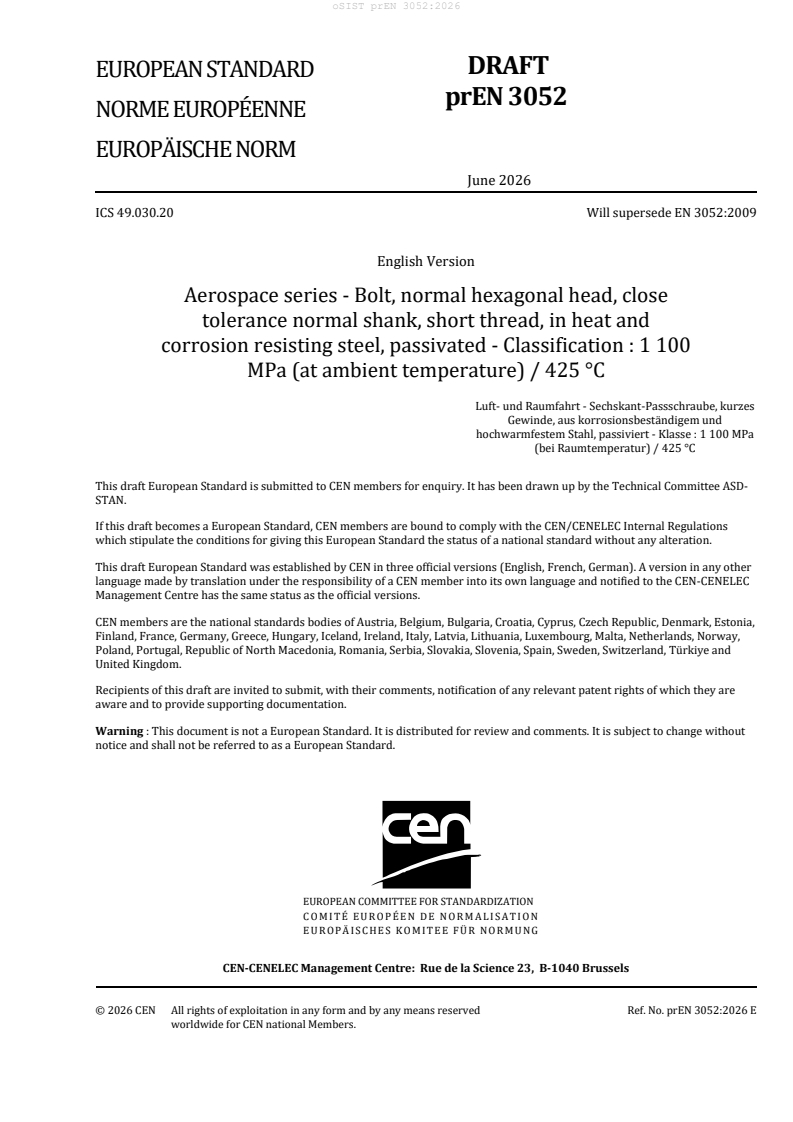
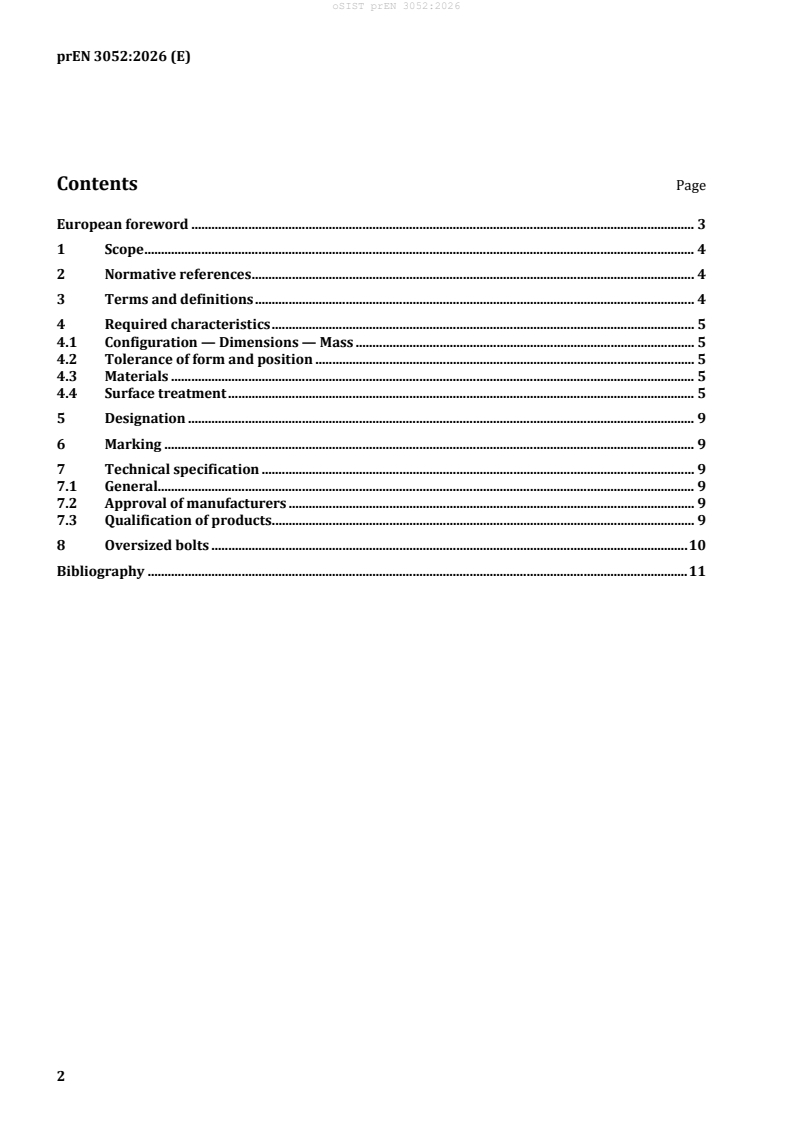
oSIST prEN 3052:2026 is the Slovenian version of draft European Standard prEN 3052 from CEN/ASD-STAN. It specifies the characteristics of aerospace bolts with a normal hexagonal head, close tolerance normal shank, short thread, made of heat and corrosion resisting steel and passivated, for the classification 1 100 MPa at ambient temperature / 425 °C. In practice, it is a specification for designers, manufacturers, purchasers and quality teams who need a common definition of the bolt geometry, material, surface treatment, marking and qualification rules.
What does oSIST prEN 3052:2026 specify?
oSIST prEN 3052:2026 specifies the characteristics of bolts, normal hexagonal head, close tolerance normal shank, short thread, in heat and corrosion resisting steel, passivated. It places those bolts in the classification 1 100 MPa / 425 °C and organizes the document into clauses for scope, references, definitions, required characteristics, designation, marking, technical specification and oversized bolts.
- Clause 1 gives the scope and classification.
- Clause 2 lists the documents used to make parts of the standard mandatory.
- Clause 3 gives the terms and definitions used in the document.
- Clause 4 sets the required characteristics, including configuration, dimensions, tolerances, materials and surface treatment.
- Clause 5 defines the designation system.
- Clause 6 covers marking.
- Clause 7 covers the technical specification, manufacturer approval and product qualification.
- Clause 8 covers oversized bolts.
What are the key requirements of oSIST prEN 3052:2026?
oSIST prEN 3052:2026 ties together geometry, material, surface condition, identification and qualification so that the bolt can be specified and controlled consistently across aerospace supply chains.
Configuration, dimensions and mass
Clause 4.1 requires the bolt configuration, dimensions and mass to match Figure 1 and Table 1. Dimensions and tolerances are given in millimetres and apply after surface treatment. In practice, this means the finished bolt has to meet the stated geometry after coating or passivation, which is important for fit, strength and interchangeability.
Form, position and thread-related geometry
Clause 4.2 requires tolerances of form and position to follow ISO 7913. Clause 4.1 also ties the thread and lead/runout details to ISO 3353-1 and the MJ thread limits to ISO 5855-2. This matters because aerospace fasteners need controlled thread fit and repeatable geometry to assemble correctly and carry load as intended.
Materials and surface treatment
Clause 4.3 requires materials in accordance with TR 3775 for heat and corrosion resisting steel, strength class 1 100 MPa. Clause 4.4 requires surface treatment in accordance with EN 2516, with surface-related values taken before treatment. In practice, suppliers must control both the base material and the surface process, because both affect corrosion resistance and service performance.
Designation and hole code
Clause 5 defines the designation format and uses diameter code, length code and hole code. Table 2 gives the hole-code options for lockwire, split pin, both, or no locking. This lets buyers order the exact bolt variant without describing the full geometry in words.
Marking for traceability
Clause 6 requires marking in accordance with EN 2424 and Figure 1, with the marking style linked to the diameter code and locking arrangement in Table 3. For production and receiving inspection, this supports identification and traceability of the fastener type.
Technical specification, approval and qualification
Clause 7.1 refers the technical specification to ISO 8168 with modifications in this document. Clause 7.2 requires the manufacturer to be an approved production organization for aerospace products and to maintain a quality management system such as EN 9100 or an equivalent accepted aerospace system. Clause 7.3 requires qualification of products using a procedure such as EN 9133 or an equivalent aerospace qualification procedure, documented with the specified tests unless otherwise agreed. In practice, suppliers need both organizational approval and product evidence before the bolts can be accepted for aerospace use.
Oversized bolts
Clause 8 states that oversized bolts are covered by EN 4016. That gives users a separate route when a standard-size bolt is not suitable for the application.
What terms does oSIST prEN 3052:2026 define?
- Classification - The document uses this to link the bolt to a minimum tensile strength at ambient temperature and a maximum service temperature of 425 °C.
- MJ thread - The aerospace metric thread form used for these bolts, with dimensions controlled by the referenced thread standards.
- Close tolerance normal shank - A shank made to tighter dimensional control so the bolt fits accurately in the joint.
- Passivated - A surface condition applied in accordance with EN 2516 to support corrosion resistance.
- Approved production organization - A manufacturer organization approved for aerospace products and able to maintain the required quality system.
- Qualification of products - The documented procedure used to show that the bolt meets the specified tests and requirements.
- Oversized bolts - A separate bolt category covered by EN 4016 when the standard bolt size is not sufficient.
Who uses oSIST prEN 3052:2026?
oSIST prEN 3052:2026 is used by aerospace designers, fastener manufacturers, procurement teams, quality managers and inspection laboratories. Designers use it to specify the bolt in a controlled way, buyers use it to order the correct designation and marking, and quality teams use it to check material, surface treatment, approval and qualification evidence.
What changed in oSIST prEN 3052:2026 from the previous edition?
oSIST prEN 3052:2026 will supersede EN 3052:2009. The foreword states three significant changes: Clause 3, “Terms and Definitions”, was added, Figure 1 was updated, and Clause 7, “Technical specification”, was editorially revised.
Which standards are used with oSIST prEN 3052:2026?
| Standard | What it contributes |
|---|---|
| EN 2424 | Marking of aerospace products |
| EN 2516 | Passivation of corrosion resisting steels and decontamination of nickel or cobalt base alloys |
| EN 4016 | Oversized bolts |
| ISO 3193 | Dimensions for aerospace bolts with normal hexagonal head and normal shank |
| ISO 3353-1 | Lead and runout threads for rolled external threads |
| ISO 5855-2 | Limit dimensions for MJ threads |
| ISO 7913 | Tolerances of form and position for aerospace bolts and screws |
| ISO 8168 | Procurement specification for bolts in heat and corrosion resisting steel, strength class 1 100 MPa |
| TR 3775 | Materials for aerospace bolts and pins |
| EN 9100 | Example of an acceptable aerospace quality management system |
| EN 9133 | Example of an aerospace qualification procedure for standard products |
What does the oSIST prEN 3052:2026 document contain?
oSIST prEN 3052:2026 contains a configuration drawing in Figure 1, a dimensions-and-mass table in Table 1, a hole-code table in Table 2 and a marking table in Table 3. It also includes a designation example that shows how the diameter code, length code and hole code are combined for ordering and identification.
Clause 4 gives the controlling data for geometry, tolerances, material and surface treatment, while Clause 7 gives the approval and qualification framework used in procurement and supplier control. The document therefore serves both as a fastener definition and as a basis for inspection, marking and aerospace supply qualification.
Relations
- Effective Date
- 20-Jan-2026
Get Certified
Connect with accredited certification bodies for this standard

BUREAU VERITAS Certification Germany
Bureau Veritas certification in Germany.

Element Materials Technology
Materials testing and product certification.

AQMS Ltd.
AQMS provides ISO certification to SMEs across the UK.
Sponsored listings
Frequently Asked Questions
oSIST prEN 3052:2026 is a draft published by the Slovenian Institute for Standardization (SIST). Its full title is "Aerospace series - Bolt, normal hexagonal head, close tolerance normal shank, short thread, in heat and corrosion resisting steel, passivated - Classification : 1 100 MPa (at ambient temperature) / 425 °C". This standard covers: This document specifies the characteristics of bolts, normal hexagonal head, close tolerance normal shank, short thread, in heat and corrosion resisting steel, passivated. Classification: 1 100 MPa 1/ 425 °C2.
This document specifies the characteristics of bolts, normal hexagonal head, close tolerance normal shank, short thread, in heat and corrosion resisting steel, passivated. Classification: 1 100 MPa 1/ 425 °C2.
oSIST prEN 3052:2026 is classified under the following ICS (International Classification for Standards) categories: 49.025.10 - Steels; 49.030.20 - Bolts, screws, studs. The ICS classification helps identify the subject area and facilitates finding related standards.
oSIST prEN 3052:2026 has the following relationships with other standards: It is inter standard links to SIST EN 3052:2009. Understanding these relationships helps ensure you are using the most current and applicable version of the standard.
oSIST prEN 3052:2026 is available in PDF format for immediate download after purchase. The document can be added to your cart and obtained through the secure checkout process. Digital delivery ensures instant access to the complete standard document.
Standards Content (Sample)
SLOVENSKI STANDARD
01-september-2026
Aeronavtika - Sorniki, normalna šestroba glava, ozka toleranca, kratek navoj, iz
toplotno in korozijsko odpornega jekla, pasivirani - Klasifikacija: 1100 MPa (pri
temperaturi okolice)/425 °C
Aerospace series - Bolt, normal hexagonal head, close tolerance normal shank, short
thread, in heat and corrosion resisting steel, passivated - Classification : 1 100 MPa (at
ambient temperature) / 425 °C
Luft- und Raumfahrt - Sechskant-Passschraube, kurzes Gewinde, aus
korrosionsbeständigem und hochwarmfestem Stahl, passiviert - Klasse : 1 100 MPa (bei
Raumtemperatur) / 425 °C
Ta slovenski standard je istoveten z: prEN 3052
ICS:
49.025.10 Jekla Steels
49.030.20 Sorniki, vijaki, stebelni vijaki Bolts, screws, studs
2003-01.Slovenski inštitut za standardizacijo. Razmnoževanje celote ali delov tega standarda ni dovoljeno.
DRAFT
EUROPEAN STANDARD
NORME EUROPÉENNE
EUROPÄISCHE NORM
June 2026
ICS 49.030.20 Will supersede EN 3052:2009
English Version
Aerospace series - Bolt, normal hexagonal head, close
tolerance normal shank, short thread, in heat and
corrosion resisting steel, passivated - Classification : 1 100
MPa (at ambient temperature) / 425 °C
Luft- und Raumfahrt - Sechskant-Passschraube, kurzes
Gewinde, aus korrosionsbeständigem und
hochwarmfestem Stahl, passiviert - Klasse : 1 100 MPa
(bei Raumtemperatur) / 425 °C
This draft European Standard is submitted to CEN members for enquiry. It has been drawn up by the Technical Committee ASD-
STAN.
If this draft becomes a European Standard, CEN members are bound to comply with the CEN/CENELEC Internal Regulations
which stipulate the conditions for giving this European Standard the status of a national standard without any alteration.
This draft European Standard was established by CEN in three official versions (English, French, German). A version in any other
language made by translation under the responsibility of a CEN member into its own language and notified to the CEN-CENELEC
Management Centre has the same status as the official versions.
CEN members are the national standards bodies of Austria, Belgium, Bulgaria, Croatia, Cyprus, Czech Republic, Denmark, Estonia,
Finland, France, Germany, Greece, Hungary, Iceland, Ireland, Italy, Latvia, Lithuania, Luxembourg, Malta, Netherlands, Norway,
Poland, Portugal, Republic of North Macedonia, Romania, Serbia, Slovakia, Slovenia, Spain, Sweden, Switzerland, Türkiye and
United Kingdom.
Recipients of this draft are invited to submit, with their comments, notification of any relevant patent rights of which they are
aware and to provide supporting documentation.
Warning : This document is not a European Standard. It is distributed for review and comments. It is subject to change without
notice and shall not be referred to as a European Standard.
EUROPEAN COMMITTEE FOR STANDARDIZATION
COMITÉ EUROPÉEN DE NORMALISATION
EUROPÄISCHES KOMITEE FÜR NORMUNG
CEN-CENELEC Management Centre: Rue de la Science 23, B-1040 Brussels
© 2026 CEN All rights of exploitation in any form and by any means reserved Ref. No. prEN 3052:2026 E
worldwide for CEN national Members.
Contents Page
European foreword . 3
1 Scope . 4
2 Normative references . 4
3 Terms and definitions . 4
4 Required characteristics . 5
4.1 Configuration — Dimensions — Mass . 5
4.2 Tolerance of form and position . 5
4.3 Materials . 5
4.4 Surface treatment . 5
5 Designation . 9
6 Marking . 9
7 Technical specification . 9
7.1 General. 9
7.2 Approval of manufacturers . 9
7.3 Qualification of products . 9
8 Oversized bolts . 10
Bibliography . 11
European foreword
This document (prEN 3052:2026) has been prepared by ASD-STAN.
After enquiries and votes carried out in accordance with the rules of this Association, this document has
received the approval of the National Associations and the Official Services of the member countries of
ASD-STAN, prior to its presentation to CEN.
This document is currently submitted to the CEN Enquiry.
This document will supersede EN 3052:2009.
This document includes the following significant technical changes with respect to EN 3052:2009.
— Clause 3, “Terms and Definitions”, added;
— Figure 1 updated;
— Clause 7, “Technical specification”, editorially revised.
1 Scope
This document specifies the characteristics of bolts, normal hexagonal head, close tolerance normal
shank, short thread, in heat and corrosion resisting steel, passivated.
1 2
Classification: 1 100 MPa / 425 °C .
2 Normative references
The following documents are referred to in the text in such a way that some or all of their content
constitutes requirements of this document. For dated references, only the edition cited applies. For
undated references, the latest edition of the referenced document (including any amendments) applies
...