

kSIST FprEN IEC 61300-2-21:2026
(Main)Fibre optic interconnecting devices and passive components - Basic test and measurement procedures - Part 2-21: Tests - Composite temperature/humidity cyclic test
- Abstract
DOW = DOR + 12 months + DOW
- Status
- Not Published
- Public Enquiry End Date
- 24-Apr-2025
- Technical Committee
- MOC - Mobile Communications
- Current Stage
- 5020 - Formal vote (FV) (Adopted Project)
- Start Date
- 28-Jul-2026
- Due Date
- 15-Sep-2026
- Completion Date
- 03-Aug-2026

kSIST FprEN IEC 61300-2-21:2026 is a CLC document in the IEC 61300 series for fibre optic interconnecting devices and passive components. It specifies a composite temperature/humidity cyclic test used to assess resistance to high temperature, humidity and cold conditions. Engineers, laboratories, quality managers and buyers use it when they need a defined environmental test for a device or component and when a product specification points to IEC 61753 or IEC 62005 criteria.
What does kSIST FprEN IEC 61300-2-21:2026 specify?
kSIST FprEN IEC 61300-2-21:2026 specifies the test procedure, equipment and reporting details for a composite temperature/humidity cyclic test on fibre optic devices or components. The document is organized into scope, normative references, terms and definitions, general guidance, apparatus, procedure, severity, and details to be specified and reported.
The scope links the test to IEC 60068-2-38, test Z/AD. Figures 1 and 2 show the preconditioning step and the temperature/humidity cycle with the cold subcycle.
What are the key requirements of kSIST FprEN IEC 61300-2-21:2026?
kSIST FprEN IEC 61300-2-21:2026 defines a 10-cycle environmental test with humid heat, cycling temperature and selected cold exposures. The main point is to reveal damage caused by breathing effects, moisture condensation and freezing water in cracks or fissures, especially in devices made from different materials.
Test purpose and severity
Clause 1 says the test is aimed at resistance to high temperature, humidity and cold. In practice, this means the test is not just a damp-heat exposure - it is designed to stress seals, interfaces and mixed-material assemblies in ways that can expose hidden weaknesses.
Clause 7 defines severity by the combination of humidity, cold temperature, exposure time, cycle time and number of cold cycles. If a specification uses a number other than 10 cycles, it must define the number and position of the cold cycles. That matters because the exact sequence changes the stress level and the acceptance result.
Chambers and measurement equipment
Clause 5 allows exposure to humidity and cold in one chamber or in two separate chambers. The humidity chamber must cycle between 25 °C and 65 °C while holding the stated humidity levels, and the cold chamber must hold -10 °C for 3 h with uniform conditions. If a combined chamber is used, it must also meet the specified cooling and heating transition times.
Clause 5.5 requires optical source and detector equipment that complies with IEC 61300-3-3. In practice, the optical measurement setup must be suitable for monitoring attenuation and return loss during the test.
Preparation, preconditioning and initial checks
Clause 6.1 requires preparation of the DUT [device under test] according to IEC 61300-1, with enough fibre cable to connect the test equipment, and cleaning according to the manufacturer’s instructions. Clause 6.2 adds a 24 h preconditioning at 55 °C and low humidity before the test starts.
Clause 6.3 requires initial examinations and measurements as specified by the relevant IEC 61753 performance standard or IEC 62005 reliability document, together with visual examination per IEC 61300-3-1. In practice, the starting condition must be documented before the cyclic stress begins.
Cycle sequence, recovery and final checks
Clause 6.4 sets the core cycle sequence: 10 cycles of 24 h each, with cold exposure during any five of the first nine cycles after the humid subcycle. The remaining four of those first nine cycles run without cold, and the final cycle ends with a 3 h 30 min stabilization before final measurements.
Clause 6.5 requires at least 2 h recovery at standard atmospheric conditions after the final cycle. Clause 6.6 then requires final visual inspection and final optical measurements, and the results must meet the acceptance criteria in the relevant IEC 61753 or IEC 62005 document. This is the pass/fail point for qualification, reliability or product verification.
What terms does kSIST FprEN IEC 61300-2-21:2026 define?
kSIST FprEN IEC 61300-2-21:2026 uses the terms and definitions from IEC 61300-1. The most important terms in this procedure are:
- DUT - device under test, the fibre optic device or component being evaluated.
- RH - relative humidity, the moisture level controlled in the chamber.
- Preconditioning - the 24 h exposure before the test to stabilize the DUT under hot, dry conditions.
- Recovery - the post-test holding period at standard atmospheric conditions before final checks.
- Severity - the selected combination of humidity, cold, timing and cycle count.
- Standard atmospheric conditions - the reference ambient conditions used for stabilization and recovery.
Who uses kSIST FprEN IEC 61300-2-21:2026?
kSIST FprEN IEC 61300-2-21:2026 is used by test laboratories, manufacturers, reliability engineers and quality teams working on fibre optic interconnecting devices and passive components. It is also used when a product needs environmental qualification or when acceptance criteria are taken from IEC 61753 performance standards or IEC 62005 reliability documents.
What changed in kSIST FprEN IEC 61300-2-21:2026 from the previous edition?
kSIST FprEN IEC 61300-2-21:2026 cancels and replaces the second edition published in 2009. The stated changes are:
- the whole standard was reconsidered;
- Figures 1 and 2 were updated according to IEC 60068-2-38:2021.
Which standards are used with kSIST FprEN IEC 61300-2-21:2026?
kSIST FprEN IEC 61300-2-21:2026 depends on several related standards:
- IEC 60068-2-38:2021 - provides the composite temperature/humidity cyclic test method used as the basis for this part.
- IEC 61300-1 - provides preparation of the DUT, standard atmospheric conditions and the applicable terms and definitions.
- IEC 61300-3-1 - provides visual examination before and after the test.
- IEC 61300-3-3 - provides the optical source and detector used for attenuation and return loss monitoring.
- IEC 61753 (all parts) - provides performance requirements and acceptance criteria.
- IEC 62005 (all parts) - provides reliability requirements and acceptance criteria.
What does the kSIST FprEN IEC 61300-2-21:2026 document contain?
kSIST FprEN IEC 61300-2-21:2026 contains chamber requirements, DUT preparation, preconditioning, the 24 h cycle timing, cold-subcycle timing, recovery and final examination steps. It also describes when optical measurements are taken during the test and what must be reported.
Figures 1 and 2 illustrate the preconditioning step and the composite humid-heat/cold cycle sequence. The document also specifies the details that must be stated in the test report, including DUT characteristics, severity, measurement points and any deviations from the procedure.
Relations
- Effective Date
- 01-Jun-2021
Get Certified
Connect with accredited certification bodies for this standard

ANCE
Mexican certification and testing association.

Intertek Slovenia
Intertek testing, inspection, and certification services in Slovenia.

LNE (Laboratoire National de Métrologie et d'Essais)
French national laboratory for metrology and testing.
Sponsored listings
Frequently Asked Questions
kSIST FprEN IEC 61300-2-21:2026 is a draft published by the Slovenian Institute for Standardization (SIST). Its full title is "Fibre optic interconnecting devices and passive components - Basic test and measurement procedures - Part 2-21: Tests - Composite temperature/humidity cyclic test". This standard covers: DOW = DOR + 12 months + DOW
DOW = DOR + 12 months + DOW
kSIST FprEN IEC 61300-2-21:2026 is classified under the following ICS (International Classification for Standards) categories: 33.180.20 - Fibre optic interconnecting devices. The ICS classification helps identify the subject area and facilitates finding related standards.
kSIST FprEN IEC 61300-2-21:2026 has the following relationships with other standards: It is inter standard links to SIST EN 61300-2-21:2010. Understanding these relationships helps ensure you are using the most current and applicable version of the standard.
kSIST FprEN IEC 61300-2-21:2026 is available in PDF format for immediate download after purchase. The document can be added to your cart and obtained through the secure checkout process. Digital delivery ensures instant access to the complete standard document.
Standards Content (Sample)
SLOVENSKI STANDARD
oSIST prEN IEC 61300-2-21:2025
01-april-2025
Optični spojni elementi in pasivne komponente - Osnovni preskusni in merilni
postopki - 2-21. del: Preskusi - Sestavljeno ciklično preskušanje temperatura-vlaga
Fibre optic interconnecting devices and passive components - Basic test and
measurement procedures - Part 2-21: Tests - Composite temperature/humidity cyclic test
Lichtwellenleiter - Verbindungselemente und passive Bauteile - Grundlegende Prüf- und
Messverfahren - Teil 2-21: Prüfungen - kombinierte Temperatur/Feuchte, zyklisch
Dispositifs d'interconnexion et composants passifs à fibres optiques - Méthodes
fondamentales d'essais et de mesures - Partie 2-21: Essais - Essai cyclique composite
de température et d'humidité
Ta slovenski standard je istoveten z: prEN IEC 61300-2-21:2025
ICS:
33.180.20 Povezovalne naprave za Fibre optic interconnecting
optična vlakna devices
oSIST prEN IEC 61300-2-21:2025 en
2003-01.Slovenski inštitut za standardizacijo. Razmnoževanje celote ali delov tega standarda ni dovoljeno.
oSIST prEN IEC 61300-2-21:2025
oSIST prEN IEC 61300-2-21:2025
86B/4988/CDV
COMMITTEE DRAFT FOR VOTE (CDV)
PROJECT NUMBER:
IEC 61300-2-21 ED3
DATE OF CIRCULATION: CLOSING DATE FOR VOTING:
2025-01-31 2025-04-25
SUPERSEDES DOCUMENTS:
86B/4945/CD, 86B/4957A/CC
IEC SC 86B : FIBRE OPTIC INTERCONNECTING DEVICES AND PASSIVE COMPONENTS
SECRETARIAT: SECRETARY:
Japan Mr Ryo Koyama
OF INTEREST TO THE FOLLOWING COMMITTEES: HORIZONTAL FUNCTION(S):
ASPECTS CONCERNED:
SUBMITTED FOR CENELEC PARALLEL VOTING NOT SUBMITTED FOR CENELEC PARALLEL VOTING
Attention IEC-CENELEC parallel voting
The attention of IEC National Committees, members of
CENELEC, is drawn to the fact that this Committee Draft for
Vote (CDV) is submitted for parallel voting.
The CENELEC members are invited to vote through the
CENELEC online voting system.
This document is still under study and subject to change. It should not be used for reference purposes.
Recipients of this document are invited to submit, with their comments, notification of any relevant patent rights of which
they are aware and to provide supporting documentation.
Recipients of this document are invited to submit, with their comments, notification of any relevant “In Some Countries”
clauses to be included should this proposal proceed. Recipients are reminded that the CDV stage is the final stage for
submitting ISC clauses. (SEE AC/22/2007 OR NEW GUIDANCE DOC).
TITLE:
Fibre optic interconnecting devices and passive components - Basic test and measurement
procedures - Part 2-21: Tests - Composite temperature/humidity cyclic test
PROPOSED STABILITY DATE: 2032
NOTE FROM TC/SC OFFICERS:
electronic file, to make a copy and to print out the content for the sole purpose of preparing National Committee positions.
You may not copy or "mirror" the file or printed version of the document, or any part of it, for any other purpose without
permission in writing from IEC.
oSIST prEN IEC 61300-2-21:2025
IEC CDV 61300-2-21/Ed3 © IEC 2025 2 86B/4988/CDV
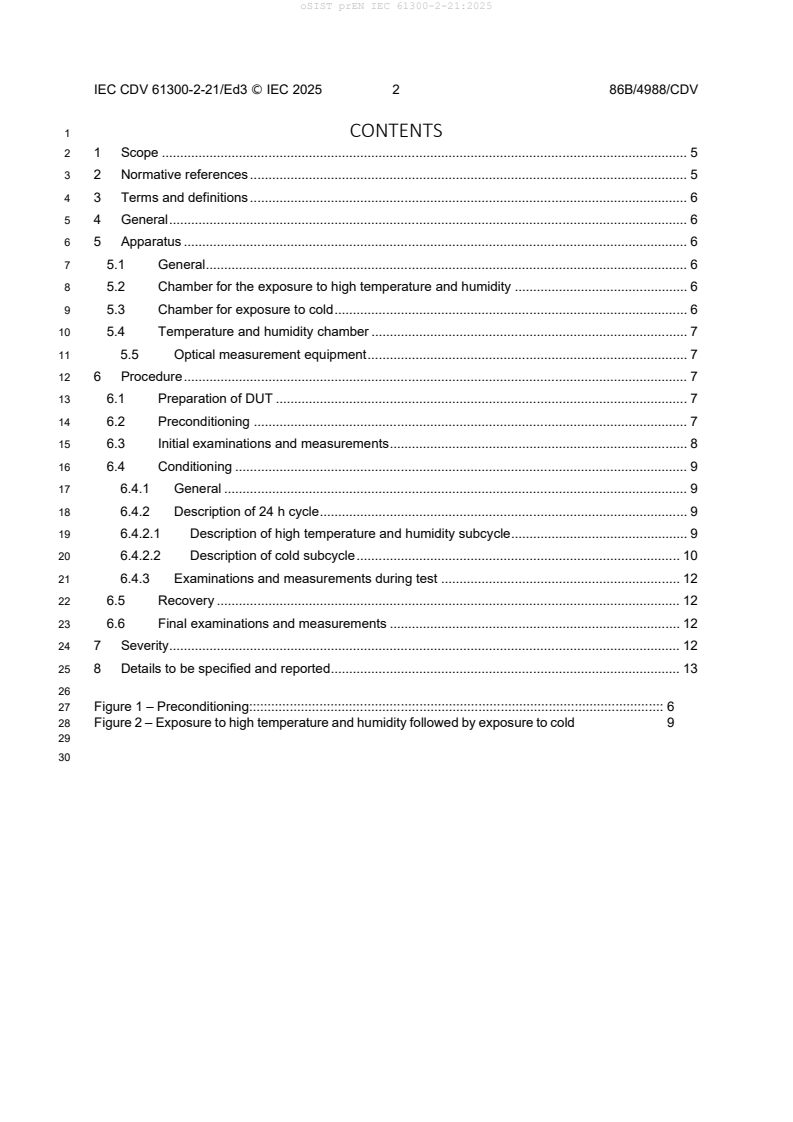
1 CONTENTS
2 1 Scope . 5
3 2 Normative references . 5
4 3 Terms and definitions . 6
5 4 General . 6
6 5 Apparatus . 6
7 5.1 General . 6
8 5.2 Chamber for the exposure to high temperature and humidity . 6
9 5.3 Chamber for exposure to cold . 6
10 5.4 Temperature and humidity chamber . 7
11 5.5 Optical measurement equipment . 7
12 6 Procedure . 7
13 6.1 Preparation of DUT . 7
14 6.2 Preconditioning . 7
15 6.3 Initial examinations and measurements . 8
16 6.4 Conditioning . 9
17 6.4.1 General . 9
18 6.4.2 Description of 24 h cycle . 9
19 6.4.2.1 Description of high temperature and humidity subcycle . 9
20 6.4.2.2 Description of cold subcycle . 10
21 6.4.3 Examinations and measurements during test . 12
22 6.5 Recovery . 12
23 6.6 Final examinations and measurements . 12
24 7 Severity. 12
25 8 Details to be specified and reported . 13
27 Figure 1 – Preconditioning:::::::::::::::::::::::::::::::::::::::::::::::::::::::::::::::::::::::::::::::::::::::::::::::::::::::::::::::: 6
28 Figure 2 – Exposure to high temperature and humidity followed by exposure to cold 9
oSIST prEN IEC 61300-2-21:2025
IEC CDV 61300-2-21/Ed3 © IEC 2025 3 86B/4988/CDV
32 INTERNATIONAL ELECTROTECHNICAL COMMISSION
33 ____________
35 FIBRE OPTIC INTERCONNECTING
36 DEVICES AND PASSIVE COMPONENTS –
37 BASIC TEST AND MEASUREMENT PROCEDURES –
39 Part 2-21: Tests –
40 Composite temperature/humidity cyclic test
43 FOREWORD
44 1) The International Electrotechnical Commission (IEC) is a worldwide organization for standardization comprising all national
45 electrotechnical committees (IEC National Committees). The object of IEC is to promote international co-operation on all
46 questions concerning standardization in the electrical and electronic fields. To this end and in addition to other activities, IEC
47 publishes International Standards, Technical Specifications, Technical Reports, Publicly Available Specifications (PAS) and
48 Guides (hereafter referred to as “IEC Publication(s)”). Their preparation is entrusted to technical committees; any IEC National
49 Committee interested in the subject dealt with may participate in this preparatory work. International, governmental and non-
50 governmental organizations liaising with the IEC also participate in this preparation. IEC collaborates closely with the
51 International Organization for Standardization (ISO) in accordance with conditions determined by agreement between the two
52 organizations.
53 2) The formal decisions or agreements of IEC on technical matters express, as nearly as possible, an international consensus
54 of opinion on the relevant subjects since each technical committee has representation from all interested IEC National
55 Committees.
56 3) IEC Publications have the form of recommendations for international use and are accepted by IEC National Committees in
57 that sense. While all reasonable efforts are made to ensure that the technical content of IEC Publications is accurate, IEC
58 cannot be held responsible for the way in which they are used or for any misinterpretation by any end user.
59 4) In order to promote international uniformity, IEC National Committees undertake to apply IEC Publications transparently to
60 the maximum extent possible in their national and regional publications. Any divergence between any IEC Publication and the
61 corresponding national or regional publication shall be clearly indicated in the latter.
62 5) IEC itself does not provide any attestation of conformity. Independent certification bodies provide conformity assessment
63 services and, in some areas, access to IEC marks of conformity. IEC is not responsible for any services carried out by
64 independent certification bodies.
65 6) All users should ensure that they have the latest edition of this publication.
66 7) No liability shall attach to IEC or its directors, employees, servants or agents including individual experts and members of its
67 technical committees and IEC National Committees for any personal injury, property damage or other damage of any nature
68 whatsoever, whether direct or indirect, or for costs (including legal fees) and expenses arising out of the publication, use of,
69 or reliance upon, this IEC Publication or any other IEC Publications.
70 8) Attention is drawn to the Normative references cited in this publication. Use of the referenced publications is indispensable
71 for the correct application of this publication.
72 9) Attention is drawn to the possibility that some of the elements of this IEC Publication may be the subject of patent rights. IEC
73 shall not be held responsible for identifying any or all such patent rights.
74 International Standard IEC 61300-2-21 has been prepared by subcommittee 86B: Fibre optic
75 interconnecting devices and passive components, of IEC technical committee 86: Fibre optics.
76 This third edition cancels and replaces the second edition published in 2009. It constitutes a technical
77 revision. The changes with respect to the previous edition are:
78 – to reconsider the whole parts of the standard;
79 – update of Figures 1 and 2 according to IEC 60068-2-38: 2021.
80 The text of this standard is based on the following documents:
FDIS Report on voting
oSIST prEN IEC 61300-2-21:2025
IEC CDV 61300-2-21/Ed3 © IEC 2025 4 86B/4988/CDV
86B/XX/FDIS 86B/XX/RVD
81 This publication has been drafted in accordance with the ISO/IEC Directives, Part 2.
82 A list of all the parts of IEC 61300 series, under the general title, Fibre optic interconnecting devices and
83 passive components – Basic test and measurement procedures, can be found on the IEC website.
84 The committee has decided that the contents of this publication will remain unchanged until the stability
85 date indicated on the IEC web site under "http://webstore.iec.ch" in the data related to the specific
86 publication. At this date, the publication will be
87 • reconfirmed,
88 • withdrawn,
89 • replaced by a revised edition, or
90 • amended.
oSIST prEN IEC 61300-2-21:2025
IEC CDV 61300-2-21/Ed3 © IEC 2025 5 86B/4988/CDV
91 FIBRE OPTIC INTERCONNECTING
92 DEVICES AND PASSIVE COMPONENTS –
93 BASIC TEST AND MEASUREMENT PROCEDURES –
95 Part 2-21: Tests –
96 Composite temperature/humidity cyclic test
100 1 Scope
101 The purpose of this part of IEC 61300 is to determine the resistance of a fibre optic device or component
102 to the deteriorative effects of high temperature, humidity and cold conditions.
103 It is intended to reveal defects in a device under test (DUT) caused by breathing as opposed to
104 absorption of moisture. The test covers the effect of the freezing of trapped water in cracks and fissures
105 as well as condensation. However, the degree of condensation will vary depending on the size and
106 thermal mass of the DUT.
107 This test differs from other cyclic damp heat tests in that it derives its increased severity from:
108 a) a greater number of temperature variations leading to pumping actions in a given time;
109 b) a greater cyclic temperature range;
110 c) a higher rate of change of temperature;
111 d) the inclusion of a number of excursions to sub-zero temperature.
112 This type of test is particularly important for fibre optic devices or components made of a variety of
113 different materials.
114 2 Normative references
115 The following referenced documents are indispensable for the application of this document. For dated
116 references, only the edition cited applies. For undated references, the latest edition of the referenced
117 document (including any amendments) applies.
118 IEC 60068-2-38: 2021, Environmental testing – Part 2-38: Tests – Test Z/AD: Composite
119 temperature/humidity cyclic test
120 IEC 61300-1, Fibre optic interconnecting devices and passive components – Basic test and
121 measurement procedures – Part 3-1: Examinations and measurements – Visual examination
122 IEC 61300-3-1, Fibre optic interconnecting devices and passive components – Basic test and
123 measurement procedures – Part 1: General and guidance
124 IEC 61300-3-3
...