

SIST EN 12441-1:2004
(Main)Zinc and zinc alloys - Chemical analysis - Part 1: Determination of aluminium in zinc alloys - Titrimetric method
General Information
- Abstract
This European Standard specifies a titrimetric method for the determination of aluminium in zinc alloys. It is applicable to the products specified in EN 1774 and EN 12844.
It is suitable for the determination of aluminium contents (mass fractions) between 3 % and 30 %.
- Status
- Published
- Publication Date
- 31-Dec-2003
- Technical Committee
- INEK - Nonferrous metals
- Current Stage
- 6060 - National Implementation/Publication (Adopted Project)
- Start Date
- 01-Jan-2004
- Due Date
- 01-Jan-2004
- Completion Date
- 01-Jan-2004


Overview
SIST EN 12441-1:2004 is a European Standard developed by CEN for the chemical analysis of aluminium content in zinc alloys using a titrimetric method. This standard applies specifically to zinc alloy products defined under EN 1774 and EN 12844. It is designed for the accurate determination of aluminium mass fractions ranging from 3% to 30%. The method is part of a comprehensive series of standards for various elemental analyses in zinc and zinc alloys.
Key Topics
Scope and Applicability
- Designed for zinc alloys compliant with EN 1774 (foundry alloy ingots and liquids) and EN 12844 (castings).
- Aluminium content determination suited for mass fractions between 3% and 30%.
Analytical Principle
- The test involves adding an excess of EDTA to a hydrochloric acid solution of the test sample.
- The excess EDTA is quantified by complexing with a standard zinc solution, then decomposed by sodium fluoride.
- Titration of the liberated EDTA with standard zinc solution determines aluminium content.
Reagents and Apparatus
- Use of analytical-grade reagents like hydrochloric acid, nitric acid, hydrogen peroxide, hydroxylammonium chloride, and EDTA.
- Standard zinc solution (0.05 M) preparation and use of methyl red, xylenol orange, and sodium fluoride solutions are specified.
- Glassware cleaning with aqua regia prior to testing to avoid contamination.
Sampling and Sample Preparation
- Sampling procedures conform with EN 12060, ensuring representative and consistent test portions.
- Typical sample weight is 5 grams, dissolved carefully in hydrochloric acid and oxidized for complete dissolution.
Procedure Highlights
- Dissolution of zinc alloy sample followed by elimination of excess hydrogen peroxide.
- Buffering, boiling, and titration steps are carefully controlled for precise endpoint detection.
- Use of color indicators such as methyl red and xylenol orange facilitates accurate titration endpoint identification.
Calculation and Reporting
- Aluminium content calculated based on titrant volume and expressed as mass percentage.
- Repeatability and reproducibility data provided, reflecting high accuracy and reliability of the method.
- Test reports require full documentation including sample identification, test method, results, and any deviations.
Applications
Quality Control in Zinc Alloy Production
Ensures the aluminium content in zinc alloys meets product specifications, critical for foundry and casting quality.Material Certification and Compliance
Provides standardized analytical data to comply with European and international requirements for zinc alloy composition.Research and Development
Useful for metallurgical analysis during alloy formulation, process optimization, and material characterization.Industrial Laboratories
Routine chemical analysis service in metal production plants, quality assurance labs, and certification bodies.
Related Standards
SIST EN 12441-1:2004 is part of a wider series of standards detailing chemical analysis methods for zinc alloys:
- EN 12441-2: Determination of magnesium in zinc alloys by flame atomic absorption spectrometry.
- EN 12441-3: Determination of lead, cadmium, and copper via atomic absorption.
- EN 12441-4 & 5: Spectrophotometric methods for iron determination in zinc alloys and primary zinc.
- EN 12441-6: Flame atomic absorption method for aluminium and iron.
- EN 12441-7 & 8: Flame atomic absorption methods for tin determination.
- EN 12441-9, 10 & 11: Methods for nickel, chromium, titanium, and silicon analysis in zinc alloys.
Additionally, EN 12060 covers sampling of zinc and zinc alloys, and EN 1774/EN 12844 define product specifications related to zinc alloys analyzed under this method.
This standard ensures a robust, validated titrimetric method for aluminium analysis in zinc alloys, supporting manufacturers and laboratories with precise, repeatable testing protocols essential for quality assurance in metal industries.
Relations
- Effective Date
- 25-Aug-2026
- Refers
SIST EN 1414:2000/A1:2000 - Touch and close fasteners - Cycling procedure for subsequent testing - Effective Date
- 28-Jan-2026
- Effective Date
- 28-Jan-2026
- Effective Date
- 28-Jan-2026
- Effective Date
- 28-Jan-2026
- Effective Date
- 28-Jan-2026
- Effective Date
- 22-Dec-2008
- Effective Date
- 22-Dec-2008
- Effective Date
- 22-Dec-2008
Get Certified
Connect with accredited certification bodies for this standard

Element Materials Technology
Materials testing and product certification.

Inštitut za kovinske materiale in tehnologije
Institute of Metals and Technology. Materials testing, metallurgical analysis, NDT.
Sponsored listings
Frequently Asked Questions
SIST EN 12441-1:2004 is a standard published by the Slovenian Institute for Standardization (SIST). Its full title is "Zinc and zinc alloys - Chemical analysis - Part 1: Determination of aluminium in zinc alloys - Titrimetric method". This standard covers: This European Standard specifies a titrimetric method for the determination of aluminium in zinc alloys. It is applicable to the products specified in EN 1774 and EN 12844. It is suitable for the determination of aluminium contents (mass fractions) between 3 % and 30 %.
This European Standard specifies a titrimetric method for the determination of aluminium in zinc alloys. It is applicable to the products specified in EN 1774 and EN 12844. It is suitable for the determination of aluminium contents (mass fractions) between 3 % and 30 %.
SIST EN 12441-1:2004 is classified under the following ICS (International Classification for Standards) categories: 77.040.30 - Chemical analysis of metals; 77.120.60 - Lead, zinc, tin and their alloys. The ICS classification helps identify the subject area and facilitates finding related standards.
SIST EN 12441-1:2004 has the following relationships with other standards: It is inter standard links to SIST ISO 5725-1:2003, SIST EN 1414:2000/A1:2000, SIST EN 12060:2000, SIST EN 12844:1999, SIST EN 1774:1998, SIST EN ISO 8624:2011, SIST EN 12441-1:2004/A1:2004; is excused to SIST EN 12441-2:2004, SIST EN 12441-3:2004. Understanding these relationships helps ensure you are using the most current and applicable version of the standard.
SIST EN 12441-1:2004 is available in PDF format for immediate download after purchase. The document can be added to your cart and obtained through the secure checkout process. Digital delivery ensures instant access to the complete standard document.
Standards Content (Sample)
2003-01.Slovenski inštitut za standardizacijo. Razmnoževanje celote ali delov tega standarda ni dovoljeno.Zink und Zinklegierungen - Chemische Analyse - Teil 1: Bestimmung von Aluminium in Zinklegierungen - Titrimetrisches VerfahrenZinc et alliages de zinc - Analyse chimique - Partie 1: Dosage de l'aluminium dans les alliages de zinc - Méthode titrimétriqueZinc and zinc alloys - Chemical analysis - Part 1: Determination of aluminium in zinc alloys - Titrimetric method77.120.60Svinec, cink, kositer in njihove zlitineLead, zinc, tin and their alloys77.040.30Kemijska analiza kovinChemical analysis of metalsICS:Ta slovenski standard je istoveten z:EN 12441-1:2001SIST EN 12441-1:2004en01-januar-2004SIST EN 12441-1:2004SLOVENSKI
STANDARD
EUROPEAN STANDARDNORME EUROPÉENNEEUROPÄISCHE NORMEN 12441-1October 2001ICS 77.040.30; 77.120.60English versionZinc and zinc alloys - Chemical analysis - Part 1: Determinationof aluminium in zinc alloys - Titrimetric methodZinc et alliages de zinc - Analyse chimique - Partie 1:Dosage de l'aluminium dans les alliages de zinc - MéthodetitrimétriqueZink und Zinklegierungen - Chemische Analyse - Teil 1:Bestimmung von Aluminium in Zinklegierungen -Titrimetrisches VerfahrenThis European Standard was approved by CEN on 11 August 2001.CEN members are bound to comply with the CEN/CENELEC Internal Regulations which stipulate the conditions for giving this EuropeanStandard the status of a national standard without any alteration. Up-to-date lists and bibliographical references concerning such nationalstandards may be obtained on application to the Management Centre or to any CEN member.This European Standard exists in three official versions (English, French, German). A version in any other language made by translationunder the responsibility of a CEN member into its own language and notified to the Management Centre has the same status as the officialversions.CEN members are the national standards bodies of Austria, Belgium, Czech Republic, Denmark, Finland, France, Germany, Greece,Iceland, Ireland, Italy, Luxembourg, Netherlands, Norway, Portugal, Spain, Sweden, Switzerland and United Kingdom.EUROPEAN COMMITTEE FOR STANDARDIZATIONCOMITÉ EUROPÉEN DE NORMALISATIONEUROPÄISCHES KOMITEE FÜR NORMUNGManagement Centre: rue de Stassart, 36
B-1050 Brussels© 2001 CENAll rights of exploitation in any form and by any means reservedworldwide for CEN national Members.Ref. No. EN 12441-1:2001 ESIST EN 12441-1:2004
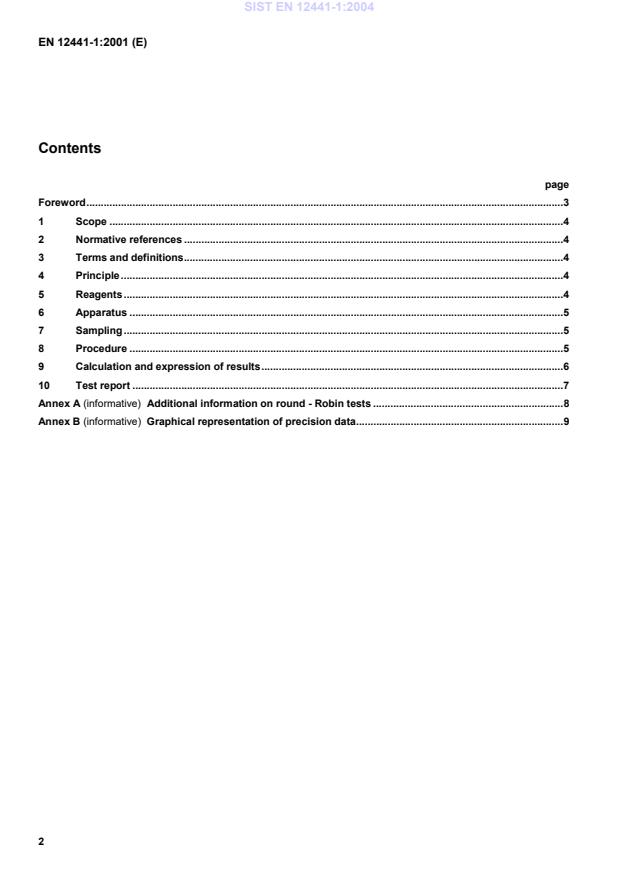
Additional information on round - Robin tests.8Annex B (informative)
Graphical representation of precision data.9SIST EN 12441-1:2004
...