

SIST EN 315:2004
(Main)Plywood - Tolerances for dimensions
General Information
- Abstract
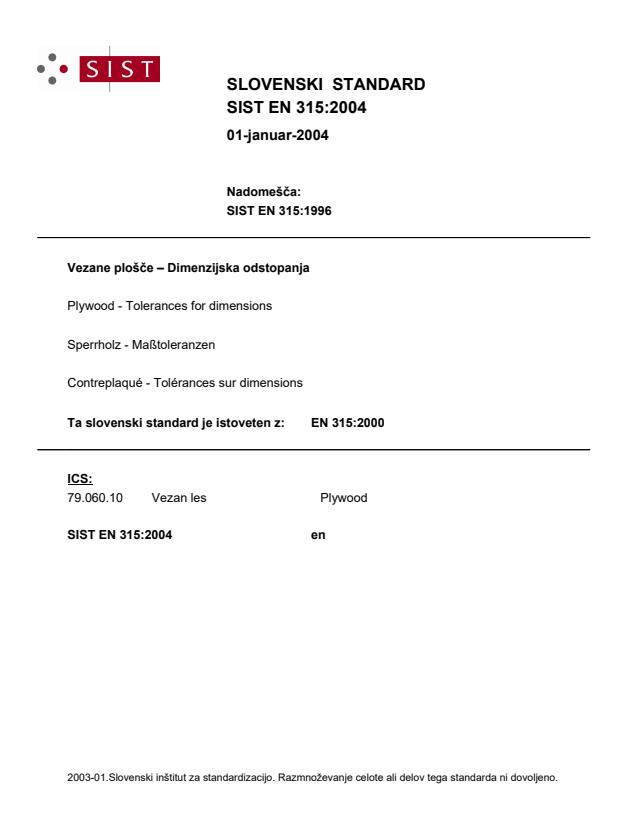
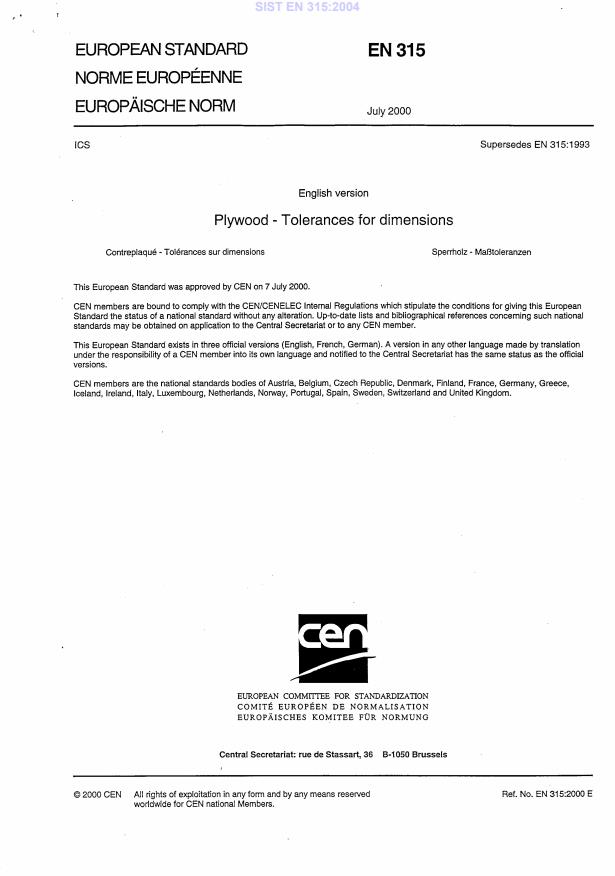
This European Standard specifies dimensional tolerances of plywood panels (length, width, thickness) and tolerances for squareness and edge straightness. NOTE Some uses of plywood can require narrower tolerances: see specific standards for types or perfor-mance
standards.
- Status
- Published
- Publication Date
- 31-Dec-2003
- Technical Committee
- LLZ - Les, lesni izdelki in zaščita lesa
- Current Stage
- 6060 - National Implementation/Publication (Adopted Project)
- Start Date
- 01-Jan-2004
- Due Date
- 01-Jan-2004
- Completion Date
- 01-Jan-2004

Overview
EN 315:2000 – Plywood: Tolerances for dimensions is a European CEN standard that defines the dimensional tolerances applicable to plywood panels. The standard sets requirements for allowable variation in length, width and thickness, and also covers geometric tolerances such as squareness and edge straightness. EN 315 is intended to be used when specifying, manufacturing, inspecting and accepting plywood panels, while noting that some applications may require tighter limits - in which case specific product or performance standards apply.
Key Topics
- Dimensional tolerance scope
- Tolerances for panel length and width
- Tolerances for thickness across the panel
- Geometric tolerances
- Squareness (90° corner deviation)
- Edge straightness (warpage along panel edges)
- Application note
- The standard flags that narrower tolerances may be required by specific uses; users should refer to product-specific or performance standards when tighter control is needed.
- Conformance and inspection
- Guidance for specifying tolerances in purchase orders and for quality control checks during production and acceptance inspections.
Applications
EN 315 is practical for anyone involved with plywood in manufacturing, quality assurance, procurement or design. Typical users include:
- Plywood manufacturers: to set production targets and quality control limits.
- Timber processors and laminators: for cutting, laminating and assembly operations that require consistent panel sizes.
- Furniture and joinery makers: to ensure components fit accurately and assemblies meet dimensional expectations.
- Construction and flooring contractors: for specifying panels used in subfloors, formwork or interior finishes.
- Purchasing and inspection teams: to verify conformance of delivered plywood to agreed tolerances.
Using EN 315 helps reduce rework, improve component fit, and provide a clear contractual basis for acceptance or rejection of plywood shipments.
Related Standards
- EN 315 is part of the broader set of plywood and timber product standards published by CEN.
- For specific applications (structural plywood, flooring, decorative grades), consult the relevant product or performance standards which may specify narrower dimensional tolerances or additional performance requirements.
Keywords: EN 315, plywood tolerances, dimensional tolerances plywood, plywood panels, CEN standard, squareness, edge straightness.
Relations
- Effective Date
- 01-Jan-2004
- Effective Date
- 28-Jan-2026
- Effective Date
- 28-Jan-2026
- Effective Date
- 28-Jan-2026
- Referred By
SIST EN 636:2013 - Plywood - Specifications - Effective Date
- 28-Jan-2026
- Effective Date
- 28-Jan-2026
- Effective Date
- 28-Jan-2026
- Effective Date
- 28-Jan-2026
Get Certified
Connect with accredited certification bodies for this standard

Gozdarski inštitut Slovenije
Slovenian Forestry Institute. Forest management certification support, timber testing.
Sponsored listings
Frequently Asked Questions
SIST EN 315:2004 is a standard published by the Slovenian Institute for Standardization (SIST). Its full title is "Plywood - Tolerances for dimensions". This standard covers: This European Standard specifies dimensional tolerances of plywood panels (length, width, thickness) and tolerances for squareness and edge straightness. NOTE Some uses of plywood can require narrower tolerances: see specific standards for types or perfor-mance standards.
This European Standard specifies dimensional tolerances of plywood panels (length, width, thickness) and tolerances for squareness and edge straightness. NOTE Some uses of plywood can require narrower tolerances: see specific standards for types or perfor-mance standards.
SIST EN 315:2004 is classified under the following ICS (International Classification for Standards) categories: 79.060.10 - Plywood. The ICS classification helps identify the subject area and facilitates finding related standards.
SIST EN 315:2004 has the following relationships with other standards: It is inter standard links to SIST EN 315:1996, SIST EN 324-1:1996, SIST EN 322:1996, SIST EN 324-2:1996, SIST EN 636:2013, SIST EN 14279:2005+A1:2009, SIST EN 13810-1:2004, SIST EN 636:2013+A1:2015. Understanding these relationships helps ensure you are using the most current and applicable version of the standard.
SIST EN 315:2004 is associated with the following European legislation: EU Directives/Regulations: 305/2011, 89/106/EEC. When a standard is cited in the Official Journal of the European Union, products manufactured in conformity with it benefit from a presumption of conformity with the essential requirements of the corresponding EU directive or regulation.
SIST EN 315:2004 is available in PDF format for immediate download after purchase. The document can be added to your cart and obtained through the secure checkout process. Digital delivery ensures instant access to the complete standard document.
Standards Content (Sample)
2003-01.Slovenski inštitut za standardizacijo. Razmnoževanje celote ali delov tega standarda ni dovoljeno.Sperrholz - MaßtoleranzenContreplaqué - Tolérances sur dimensionsPlywood - Tolerances for dimensions79.060.10Vezan lesPlywoodICS:Ta slovensk
...