

SIST ISO 2950:1998
(Main)Brown coals and lignites -- Classification by types on the basis of total moisture content and tar yield
General Information
- Abstract
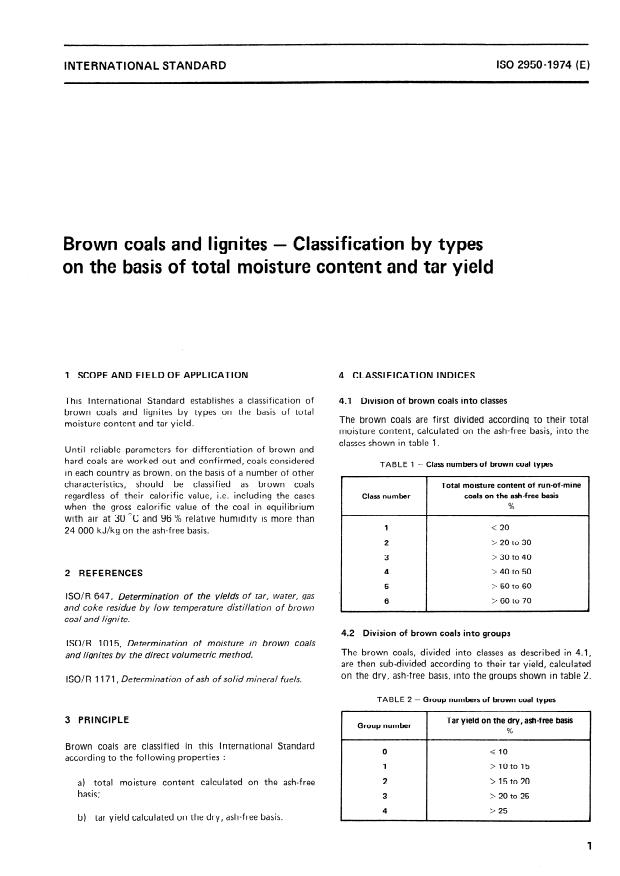
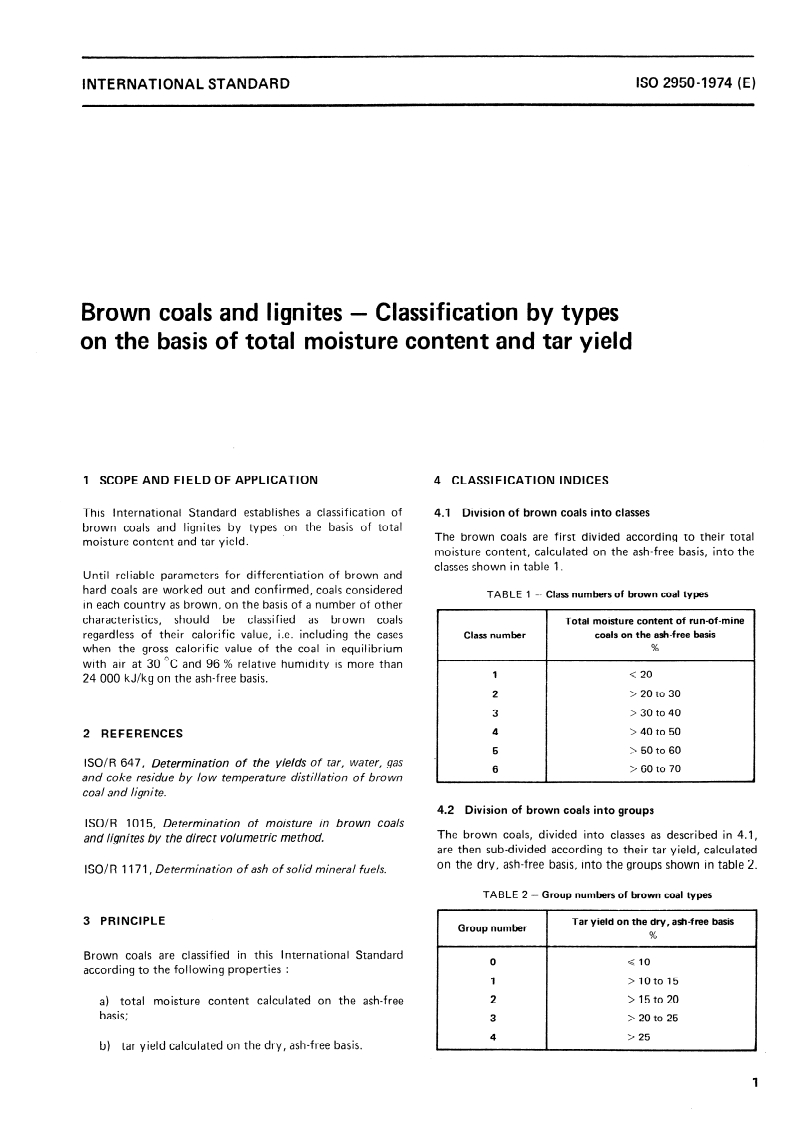
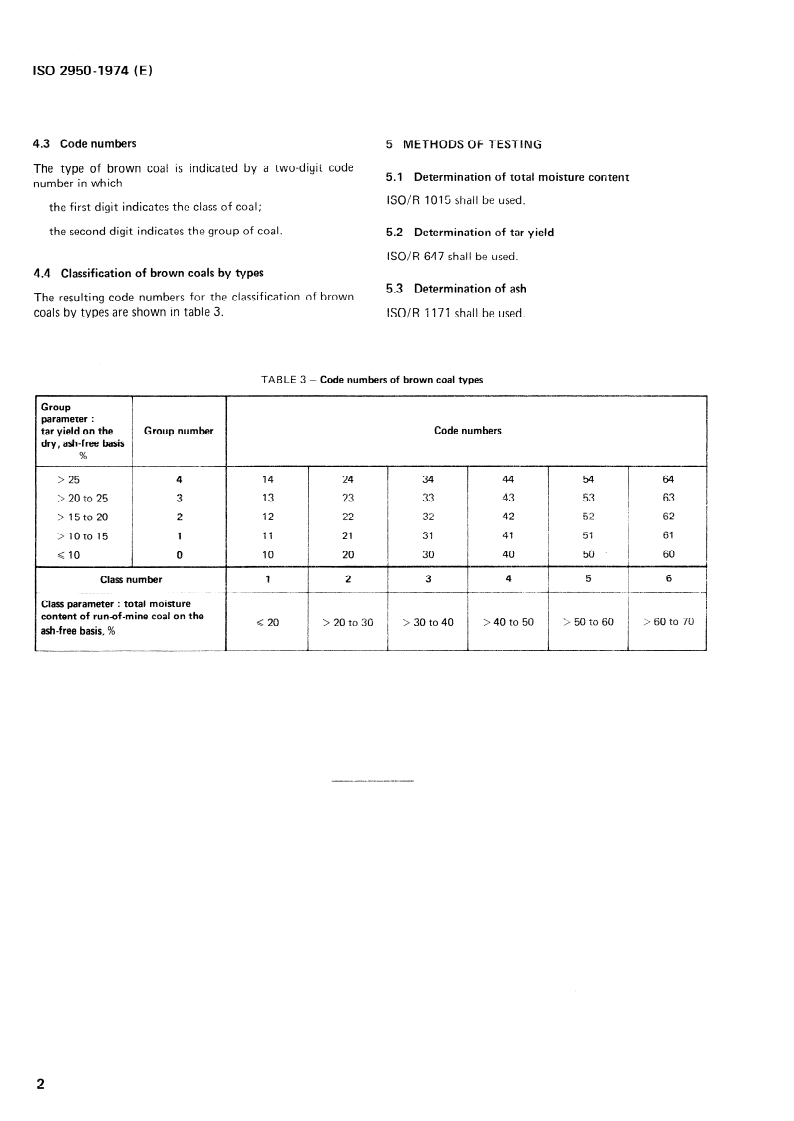
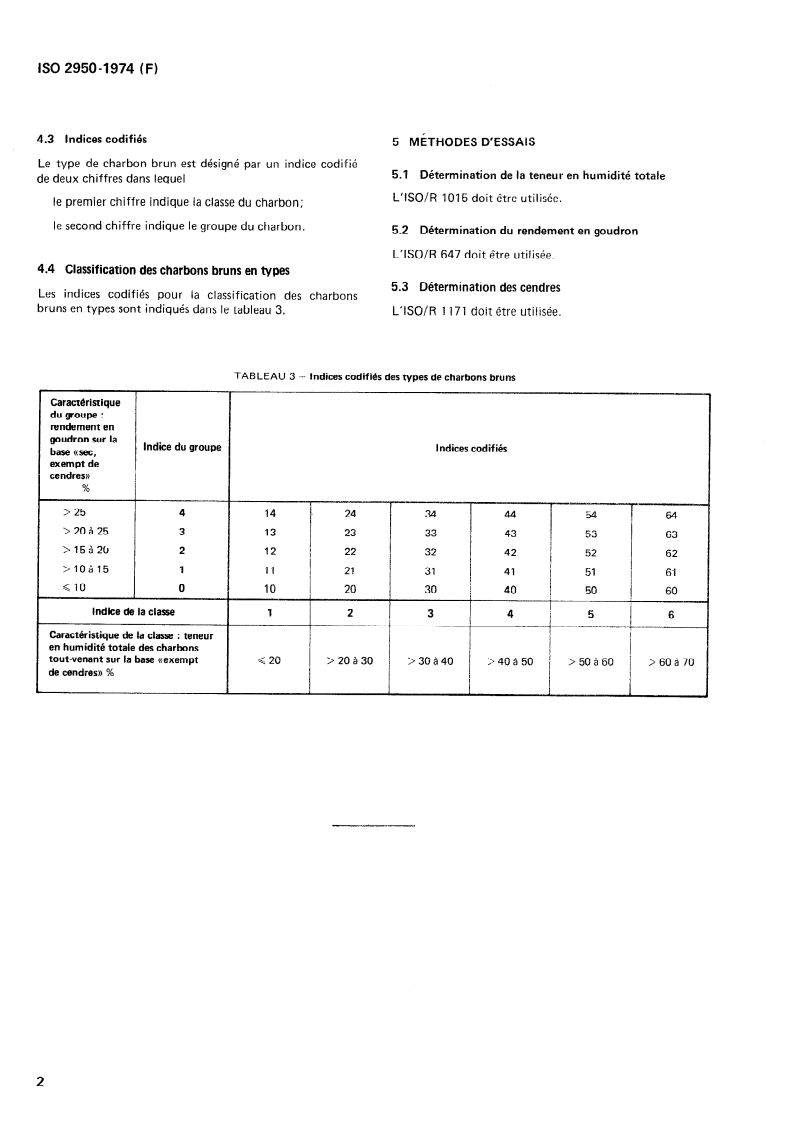
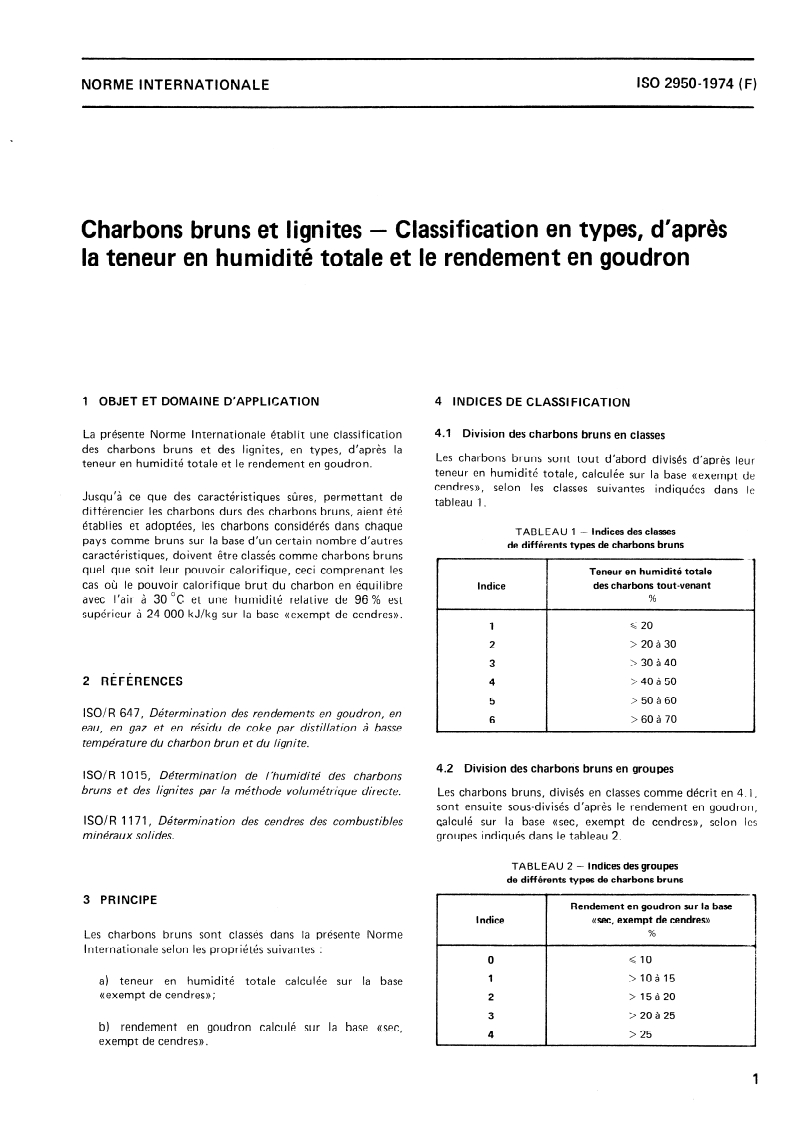
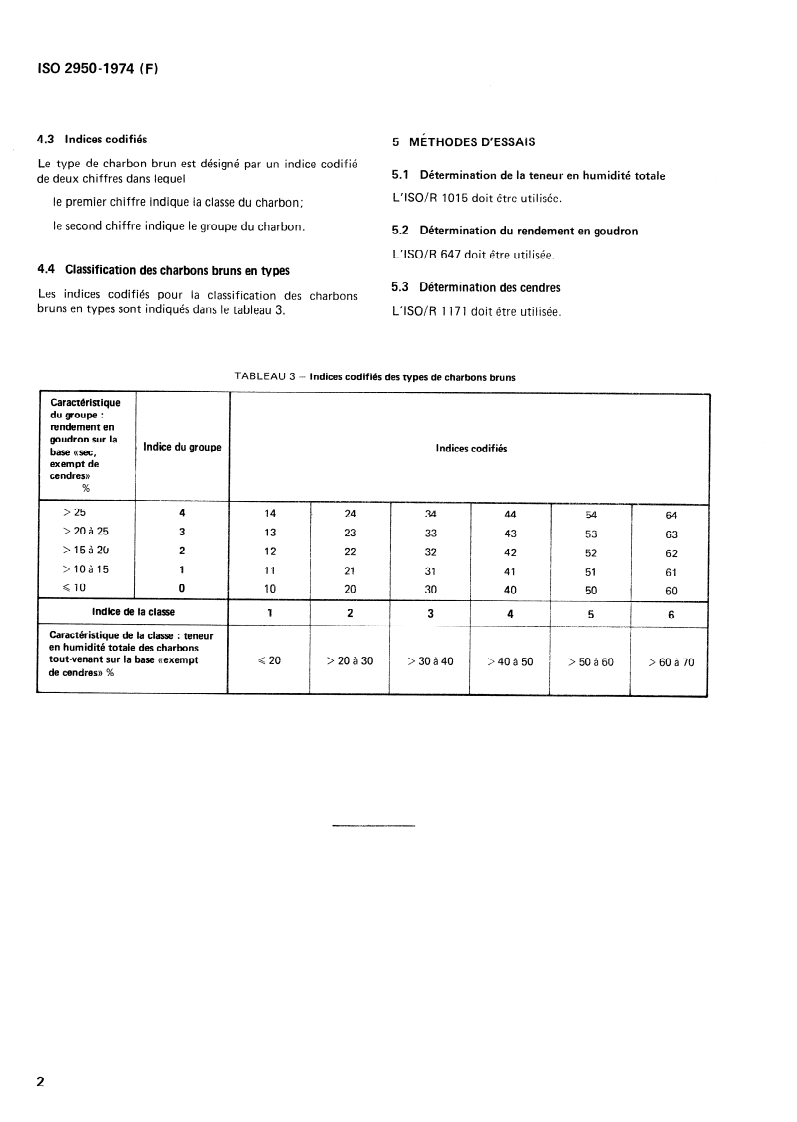
Brown coals are classified in this International Standard according to the following properties: total moisture content calculated on the ash-free basis; tar hiels calculated on the dry, ash-free basis. In tables class numbers, group number and code numbers of brown coal types are given.
- Status
- Published
- Publication Date
- 31-Jan-1998
- Technical Committee
- IRUD - Mining
- Current Stage
- 6060 - National Implementation/Publication (Adopted Project)
- Start Date
- 01-Feb-1998
- Due Date
- 01-Feb-1998
- Completion Date
- 01-Feb-1998
Buy Documents


ISO 2950:1974 - Brown coals and lignites -- Classification by types on the basis of total moisture content and tar yield
ISO 2950:1974 - Brown coals and lignites — Classification by types on the basis of total moisture content and tar yield/1/1974
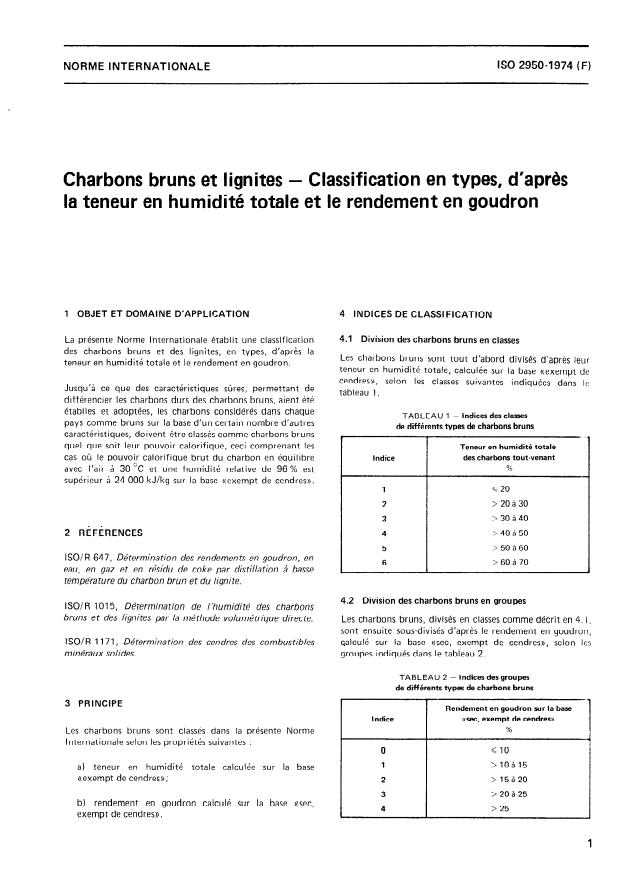

ISO 2950:1974 - Charbons bruns et lignites -- Classification en types, d'apres la teneur en humidité totale et le rendement en goudron
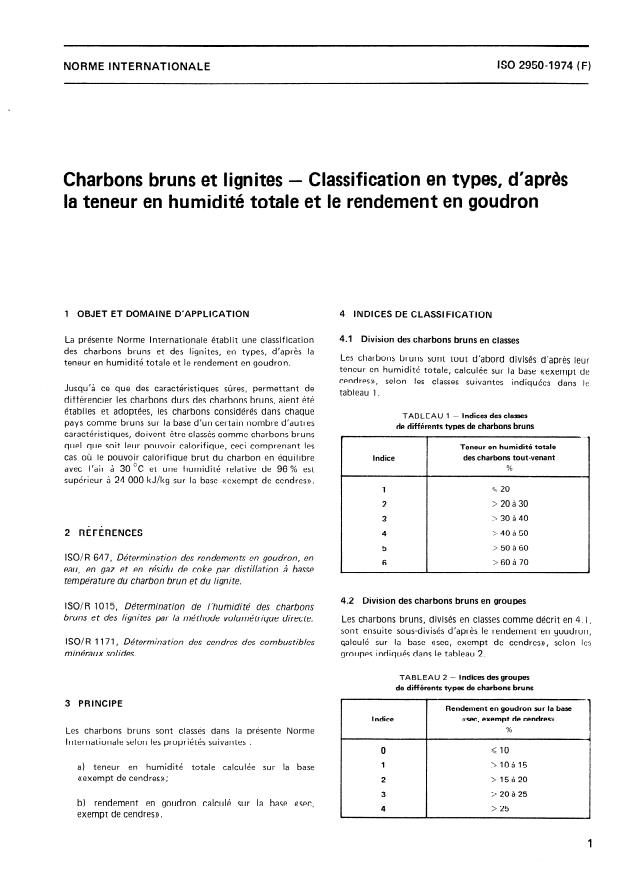

ISO 2950:1974 - Charbons bruns et lignites -- Classification en types, d'apres la teneur en humidité totale et le rendement en goudron
ISO 2950:1974 - Charbons bruns et lignites — Classification en types, d'après la teneur en humidité totale et le rendement en goudron/1/1974
ISO 2950:1974 - Charbons bruns et lignites — Classification en types, d'après la teneur en humidité totale et le rendement en goudron/1/1974
Overview
SIST ISO 2950:1998 provides an internationally recognized system for the classification of brown coals and lignites. This standard, developed by the International Organization for Standardization (ISO), outlines a method to categorize these types of solid mineral fuels based on two key measurable properties: total moisture content (ash-free basis) and tar yield (dry, ash-free basis). The standard offers a concise and structured approach, using class numbers, group numbers, and code numbers to ensure consistency and clarity in the classification of brown coals across different regions and industries.
Key Topics
Total Moisture Content (Ash-Free Basis):
- Brown coals are first divided based on their total moisture content, which is established on an ash-free basis. This parameter helps distinguish between different classes of coal.
Tar Yield (Dry, Ash-Free Basis):
- Each class is further subdivided according to tar yield, calculated on a dry, ash-free basis. Tar yield is a crucial indicator in industrial processing and utilization.
Classification System:
- The standard uses a two-digit code to express coal type:
- The first digit identifies the moisture class.
- The second digit specifies the tar-yield group.
- This system creates a clear taxonomy for brown coal types, aiding in standardized reporting and trade.
- The standard uses a two-digit code to express coal type:
Methodological References:
- The standard references analytical methods for determining total moisture (ISO/R 1015), tar yield (ISO/R 647), and ash content (ISO/R 1171).
Applications
The classification system detailed in SIST ISO 2950:1998 offers substantial practical value in several sectors:
Coal Mining and Production:
- Enables mining companies to classify and market brown coal and lignite according to recognized international criteria.
- Facilitates more accurate resource management and operational logistics.
Energy Generation:
- Power plants and energy producers benefit from standardized coal classification to optimize fuel selection and combustion processes.
- Ensures consistency in fuel characteristics for efficient power generation.
Industrial Processing:
- Chemical plants, particularly those involved in tar extraction or coke production, rely on precise tar yield data for processing efficiency.
- Supports improved process design and product quality control.
Trade and Regulatory Compliance:
- Harmonizes trade specifications and contractual documentation across international markets.
- Assists regulatory bodies in environmental monitoring and resource reporting based on standardized coal quality metrics.
Related Standards
For effective classification and analysis, SIST ISO 2950:1998 is commonly used in conjunction with other key international standards, including:
- ISO/R 647: Determination of tar, water, gas, and coke yields by low temperature distillation of brown coal and lignite.
- ISO/R 1015: Determination of moisture in brown coals and lignites by the direct volumetric method.
- ISO/R 1171: Determination of ash content in solid mineral fuels.
These related standards define the methods for measuring the core properties needed for the classification defined in SIST ISO 2950:1998.
Keywords: brown coal classification, lignite types, total moisture content, tar yield, coal quality standards, international coal standards, ISO 2950, SIST standards, coal trade compliance, coal analysis methods
Buy Documents
ISO 2950:1974 - Brown coals and lignites -- Classification by types on the basis of total moisture content and tar yield
ISO 2950:1974 - Brown coals and lignites — Classification by types on the basis of total moisture content and tar yield/1/1974
ISO 2950:1974 - Charbons bruns et lignites -- Classification en types, d'apres la teneur en humidité totale et le rendement en goudron
ISO 2950:1974 - Charbons bruns et lignites -- Classification en types, d'apres la teneur en humidité totale et le rendement en goudron
ISO 2950:1974 - Charbons bruns et lignites — Classification en types, d'après la teneur en humidité totale et le rendement en goudron/1/1974
ISO 2950:1974 - Charbons bruns et lignites — Classification en types, d'après la teneur en humidité totale et le rendement en goudron/1/1974
Get Certified
Connect with accredited certification bodies for this standard

Bureau Veritas Chile
Bureau Veritas certification services in Chile.
Bureau Veritas Peru
Bureau Veritas certification services in Peru.
BVQI Peru
Bureau Veritas certification in Peru.
Sponsored listings
Frequently Asked Questions
SIST ISO 2950:1998 is a standard published by the Slovenian Institute for Standardization (SIST). Its full title is "Brown coals and lignites -- Classification by types on the basis of total moisture content and tar yield". This standard covers: Brown coals are classified in this International Standard according to the following properties: total moisture content calculated on the ash-free basis; tar hiels calculated on the dry, ash-free basis. In tables class numbers, group number and code numbers of brown coal types are given.
Brown coals are classified in this International Standard according to the following properties: total moisture content calculated on the ash-free basis; tar hiels calculated on the dry, ash-free basis. In tables class numbers, group number and code numbers of brown coal types are given.
SIST ISO 2950:1998 is classified under the following ICS (International Classification for Standards) categories: 73.040 - Coals. The ICS classification helps identify the subject area and facilitates finding related standards.
SIST ISO 2950:1998 is available in PDF format for immediate download after purchase. The document can be added to your cart and obtained through the secure checkout process. Digital delivery ensures instant access to the complete standard document.
Standards Content (Sample)
SLOVENSKI STANDARD
01-februar-1998
Rjavi premogi in ligniti - Razvrstitev v vrste po deležu celotne vlage in deležu
katrana
Brown coals and lignites -- Classification by types on the basis of total moisture content
and tar yield
Charbons bruns et lignites -- Classification en types, d'après la teneur en humidité totale
et le rendement en goudron
Ta slovenski standard je istoveten z: ISO 2950:1974
ICS:
73.040 Premogi Coals
2003-01.Slovenski inštitut za standardizacijo. Razmnoževanje celote ali delov tega standarda ni dovoljeno.
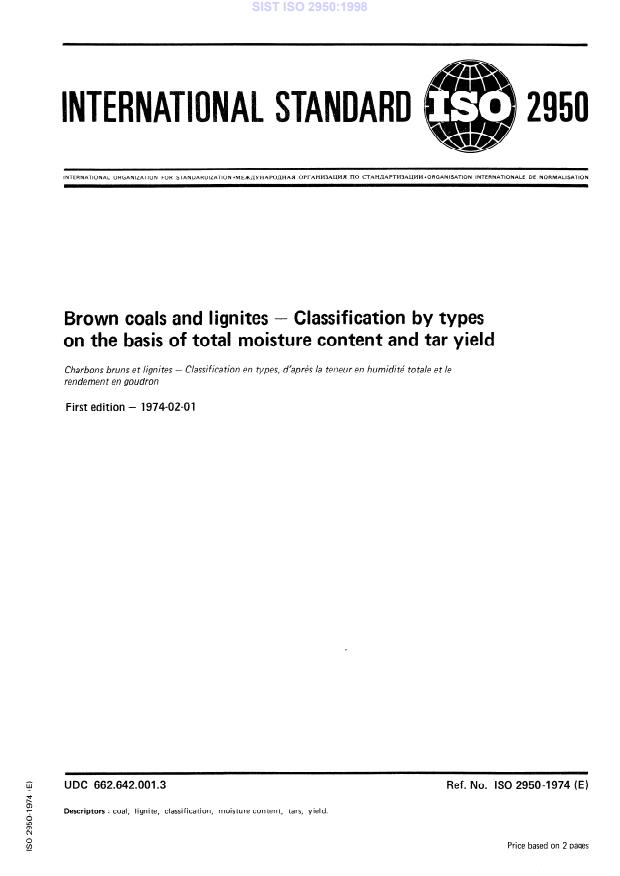
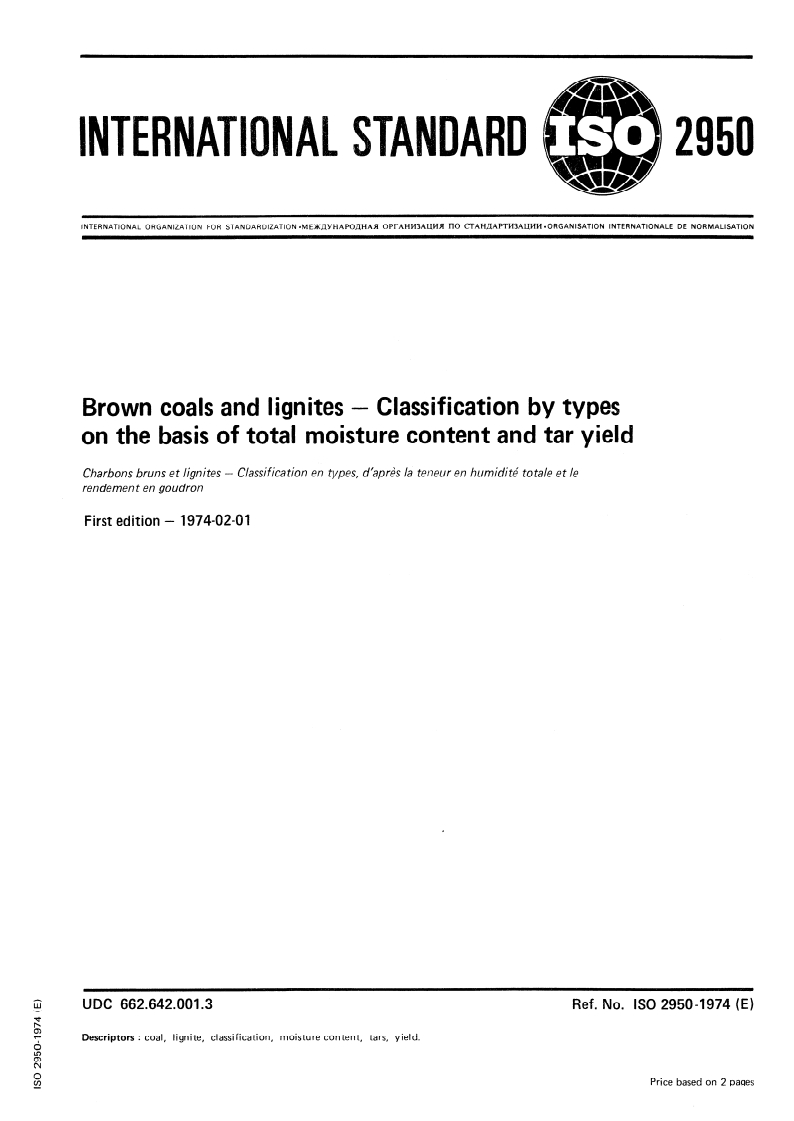
INTERNATIONAL ORGANIZATION FOR STANDARDIZATION l MEXJ(YHAPOAHAR OPI-AHM3ALWR I-IO CTAHAAPTM3AWiW.ORGANISATION INTERNATIONALE DE NORMALISATION
Brown coals and lignites - Classification by types
on the basis of total moisture content and tar yield
Classification en types, dapks Ia teneur en humiditt! totale et Ie
Charbons bruns et lignites -
rendemen t en goudron
First edition - 1974-02-01
UDC 662.642.001.3
Red. No. ISO 2950-1974 (E)
Descriptors : coal, Iignite, classification, moisture content, tars, yield.
Price based on 2 pages
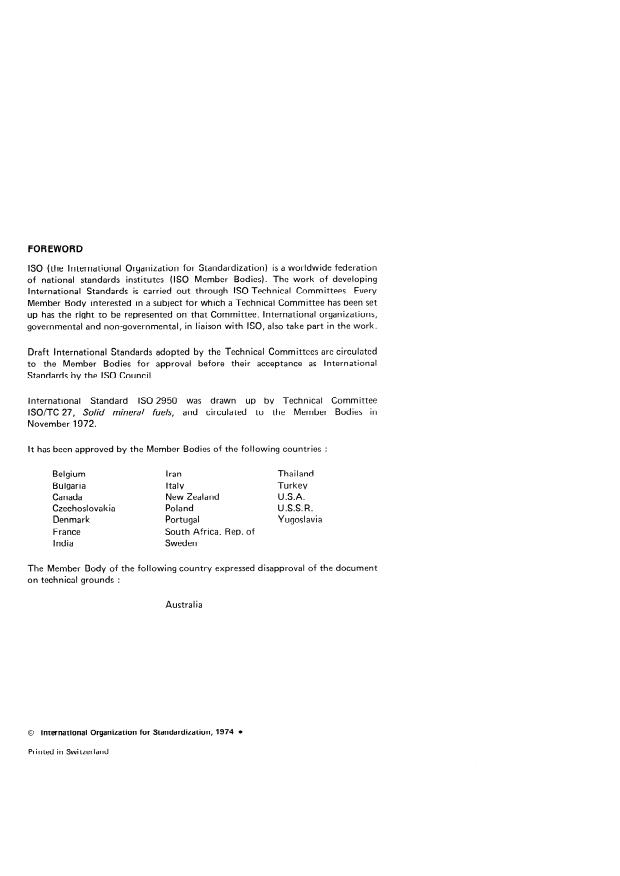
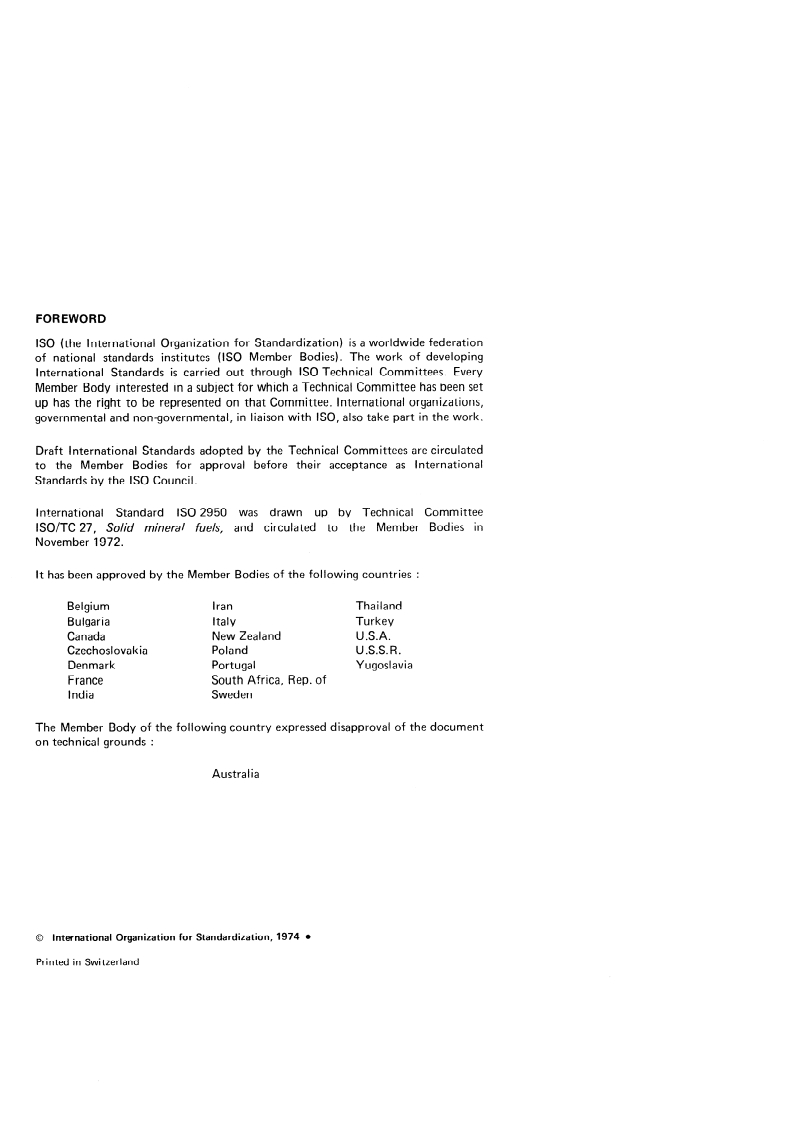
FOREWORD
ISO (the International Organization for Standardization) is a worldwide federation
of national Standards institutes (ISO Member Bodies). The work of developing
International Standards is carried out through ISO Technical Committees. Every
Member Body interested in a subject for which a Technical Committee has been set
up has the right to be represented on that Committee. International organizations,
governmental and non-governmental, in liaison with ISO, also take part in the work.
Draft International Standards adopted by the Technical Committees are circulated
to the Member Bodies for approval before their acceptance as International
Standards Dy the ISO Council.
International Standard ISO 2950 was drawn up by Technical Committee
ISO/TC 27, Solid minera/ fue/s, and circulated to the Member Bodies in
November 1972.
lt has been approved by the Member Bodies of the following countries :
Belgium Iran Thailand
Bulgaria Italy Turkey
Canada New Zealand U .S.A.
Czechoslovakia Poland U S.S. R.
Denmark Portugal Yugoslavia
France South Africa, Rep. of
India Sweden
The Member Body of the following country expressed disapproval of the document
on technical grounds :
Australia
0 International Organkation for Standardkation, 1974 l
Printed in Switzerland
INTERNATIONAL STANDARD ISO 29504974 (E)
Brown coals and lignites - Classification by types
on the basis of total moisture content and tar yield
1 SCOPE AND FIELD OF APPLICA
...
INTERNATIONAL ORGANIZATION FOR STANDARDIZATION l MEXJ(YHAPOAHAR OPI-AHM3ALWR I-IO CTAHAAPTM3AWiW.ORGANISATION INTERNATIONALE DE NORMALISATION
Brown coals and lignites - Classification by types
on the basis of total moisture content and tar yield
Classification en types, dapks Ia teneur en humiditt! totale et Ie
Charbons bruns et lignites -
rendemen t en goudron
First edition - 1974-02-01
UDC 662.642.001.3
Red. No. ISO 2950-1974 (E)
Descriptors : coal, Iignite, classification, moisture content, tars, yield.
Price based on 2 pages
FOREWORD
ISO (the International Organization for Standardization) is a worldwide federation
of national Standards institutes (ISO Member Bodies). The work of developing
International Standards is carried out through ISO Technical Committees. Every
Member Body interested in a subject for which a Technical Committee has been set
up has the right to be represented on that Committee. International organizations,
governmental and non-governmental, in liaison with ISO, also take part in the work.
Draft International Standards adopted by the Technical Committees are circulated
to the Member Bodies for approval before their acceptance as International
Standards Dy the ISO Council.
International Standard ISO 2950 was drawn up by Technical Committee
ISO/TC 27, Solid minera/ fue/s, and circulated to the Member Bodies in
November 1972.
lt has been approved by the Member Bodies of the following countries :
Belgium Iran Thailand
Bulgaria Italy Turkey
Canada New Zealand U .S.A.
Czechoslovakia Poland U S.S. R.
Denmark Portugal Yugoslavia
France South Africa, Rep. of
India Sweden
The Member Body of the following country expressed disapproval of the document
on technical grounds :
Australia
0 International Organkation for Standardkation, 1974 l
Printed in Switzerland
INTERNATIONAL STANDARD ISO 29504974 (E)
Brown coals and lignites - Classification by types
on the basis of total moisture content and tar yield
1 SCOPE AND FIELD OF APPLICATION 4 CLASSIFICATION INDICES
This International Standard establishes a classification of 4.1 Division of brown coals into classes
brown coals and lignites by types on the basis of total
The brown coals are first divided according to their total
moisture content and tar yield. .
moisture content, calculated on the ash-free basis, into the
classes shown in table 1.
Unt
...
INTERNATIONAL ORGANIZATION FOR STANDARDIZATION l MEXJ(YHAPOAHAR OPI-AHM3ALWR I-IO CTAHAAPTM3AWiW.ORGANISATION INTERNATIONALE DE NORMALISATION
Brown coals and lignites - Classification by types
on the basis of total moisture content and tar yield
Classification en types, dapks Ia teneur en humiditt! totale et Ie
Charbons bruns et lignites -
rendemen t en goudron
First edition - 1974-02-01
UDC 662.642.001.3
Red. No. ISO 2950-1974 (E)
Descriptors : coal, Iignite, classification, moisture content, tars, yield.
Price based on 2 pages
FOREWORD
ISO (the International Organization for Standardization) is a worldwide federation
of national Standards institutes (ISO Member Bodies). The work of developing
International Standards is carried out through ISO Technical Committees. Every
Member Body interested in a subject for which a Technical Committee has been set
up has the right to be represented on that Committee. International organizations,
governmental and non-governmental, in liaison with ISO, also take part in the work.
Draft International Standards adopted by the Technical Committees are circulated
to the Member Bodies for approval before their acceptance as International
Standards Dy the ISO Council.
International Standard ISO 2950 was drawn up by Technical Committee
ISO/TC 27, Solid minera/ fue/s, and circulated to the Member Bodies in
November 1972.
lt has been approved by the Member Bodies of the following countries :
Belgium Iran Thailand
Bulgaria Italy Turkey
Canada New Zealand U .S.A.
Czechoslovakia Poland U S.S. R.
Denmark Portugal Yugoslavia
France South Africa, Rep. of
India Sweden
The Member Body of the following country expressed disapproval of the document
on technical grounds :
Australia
0 International Organkation for Standardkation, 1974 l
Printed in Switzerland
INTERNATIONAL STANDARD ISO 29504974 (E)
Brown coals and lignites - Classification by types
on the basis of total moisture content and tar yield
1 SCOPE AND FIELD OF APPLICATION 4 CLASSIFICATION INDICES
This International Standard establishes a classification of 4.1 Division of brown coals into classes
brown coals and lignites by types on the basis of total
The brown coals are first divided according to their total
moisture content and tar yield. .
moisture content, calculated on the ash-free basis, into the
classes shown in table 1.
Unt
...
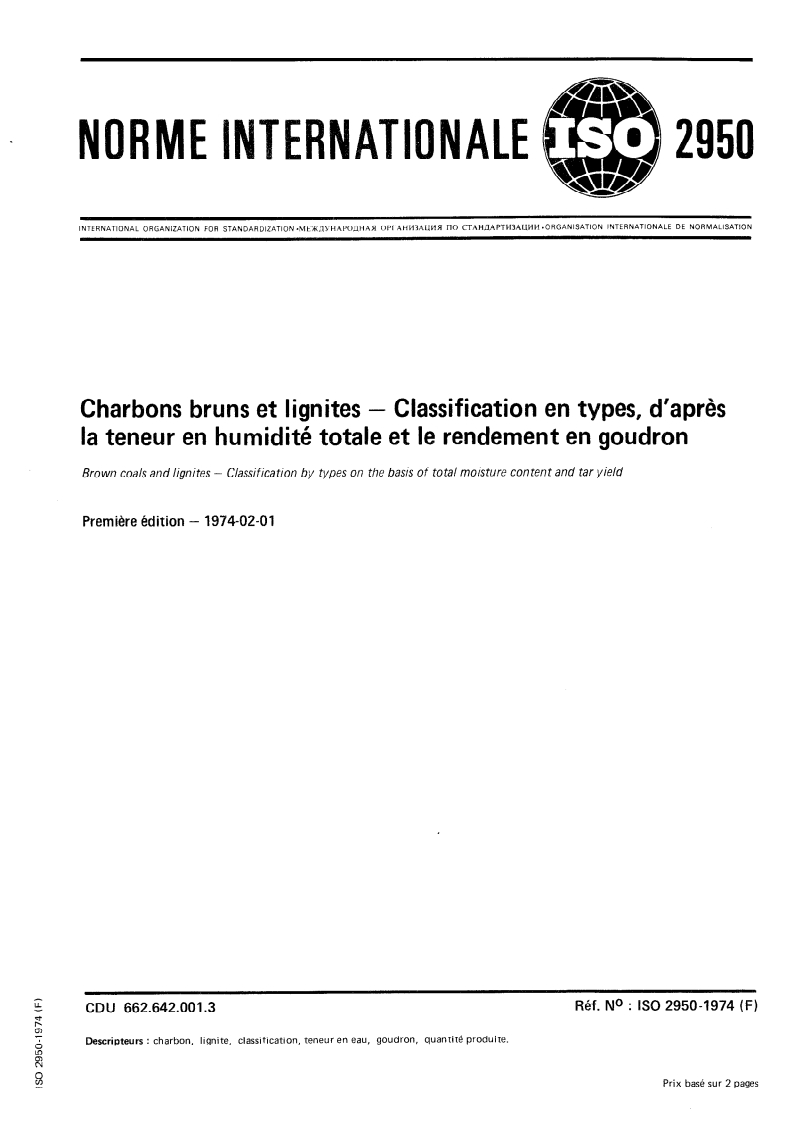
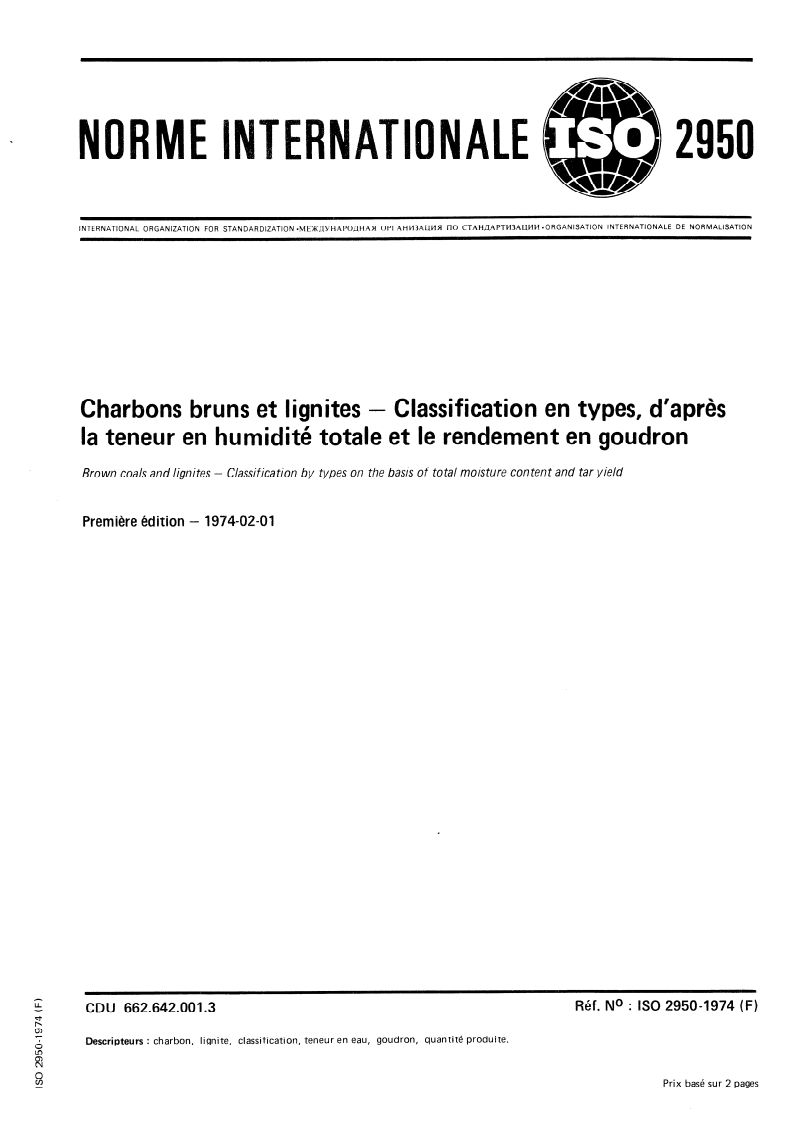
INTERNATIONAL ORGANIZATION FOR STANDARDIZATION #MEJKlJb’HAPOfiHAII OPI-AHM3AUM~ I-I0 CTAH~APTM3AUMM =ORGANISATION INTERNATIONALE DE NORMALISATION
- Classification en types, d’après
Charbons runs et lignites
la teneur en humidité totale et le rendement en goudron
Brown coals and lignites - Classification by types on the basis of total moisture content and tar yield
Première édition - 1974~02-01
Réf. No : ISQ 2950-1974 (F)
CDU 662.642.001.3
classification, teneur en eau, goudron, quantité produite.
Descripteurs : charbon, lignite,
Prix basé sur 2 pages
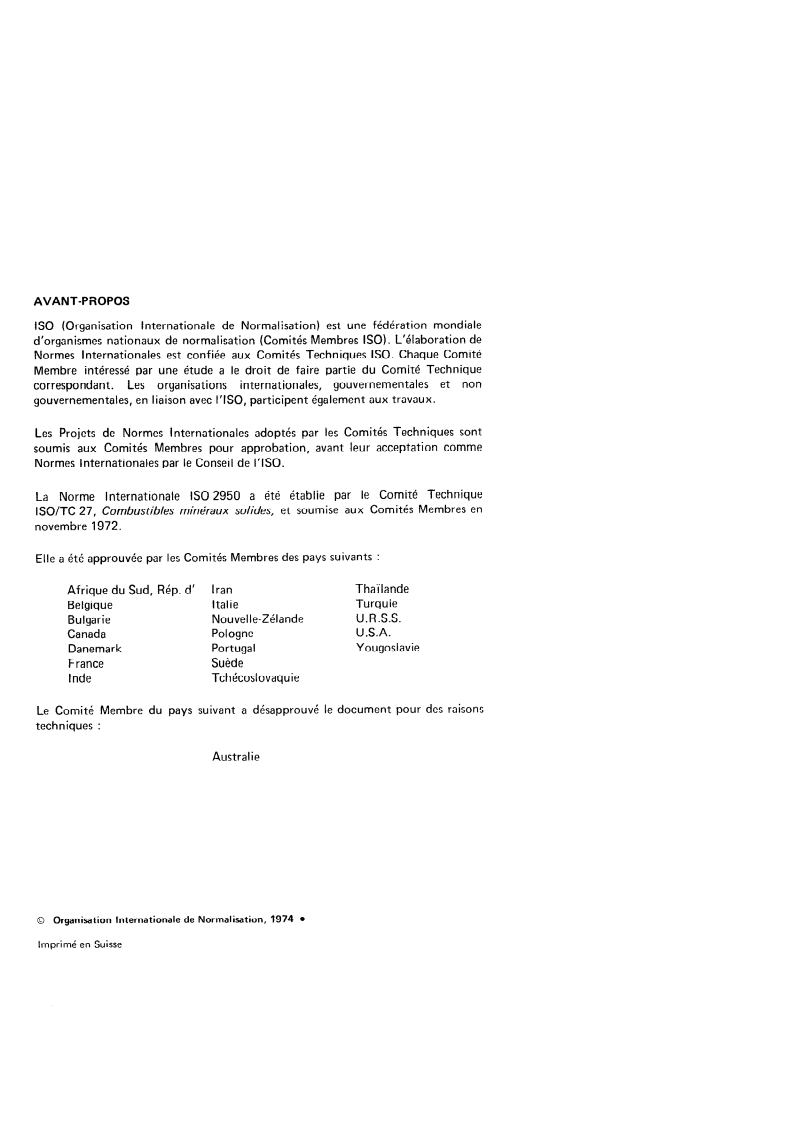
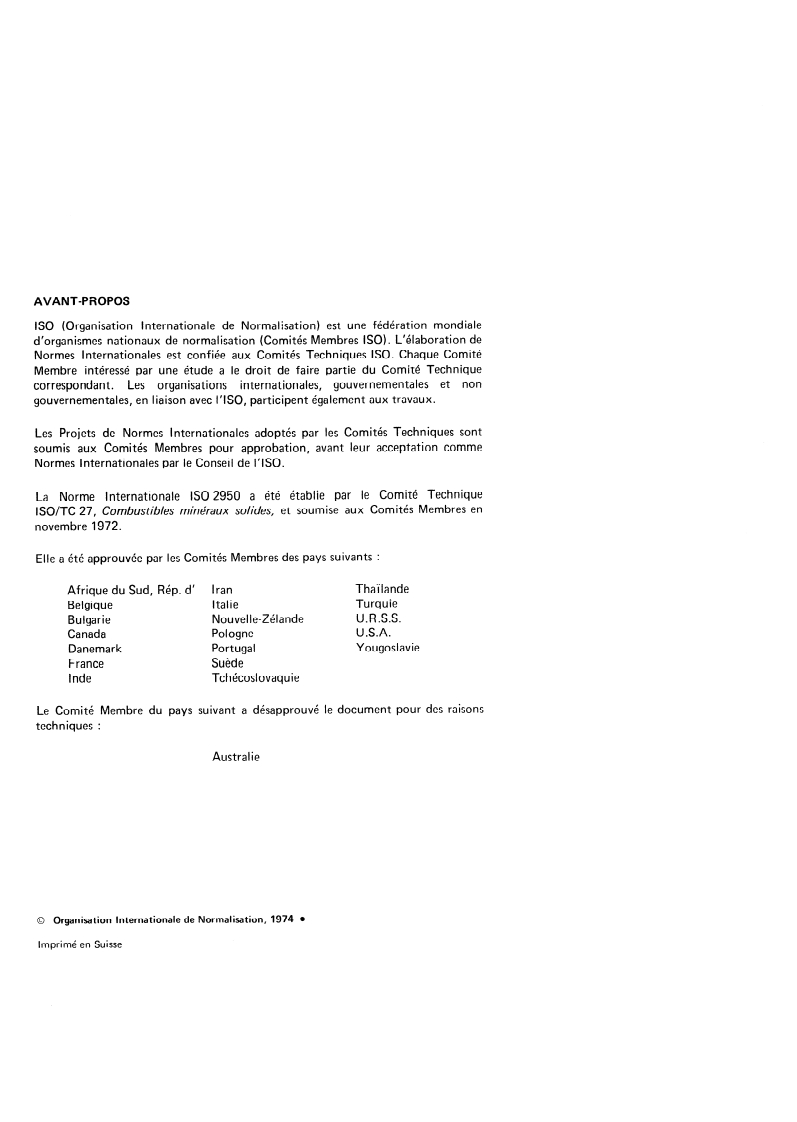
AVANT-PROPOS
ISO (Organisation Internationale de Normalisation) est une fédération mondiale
d’organismes nationaux de normalisation (Comités Membres ISO). L’élaboration de
Normes Internationales est confiée aux Comités Techniques ISO. Chaque Comité
Membre intéressé par une étude a le droit de faire partie du Comité Technique
correspondant.
Les organisations internationales, gouvernementales et non
gouvernementales, en liaison avec I’ISO, participent également aux travaux.
Les Projets de Normes Internationales adoptés par les Comités Techniques sont
soumis aux Comités Membres pour approbation, avant leur acceptation comme
Normes Internationales par le Conseil de I’ISO.
La Norme Internationale ISO 2950 a été établie par le Comité Technique
ISO/TC 27, Combustibles minéraux solides, et soumise aux Comités Membres en
novembre 1972.
Elle a été approuvée par les Comités Membres des pays suivants :
Afrique du Sud, Rép. d’ Iran Thaïlande
Belgique Italie Turquie
Bulgarie Nouvelle-Zélande U.R.S.S.
Canada Pologne U.S.A.
Danemark Portugal Yougoslavie
France Suède
Inde Tchécoslovaquie
document pour des raisons
Le Comité Membre du pays suivant a désapprouvé le
techniques
Australie
0 Organisation Internationale de Normalisation, 1974 l
Imprimé en Suisse
ISO 2950-1974 (F)
NORME INTERNATIONALE
Classification en types, d’après
Charbons bruns et lignites -
la teneur en humidité totale et le rendement en goudron
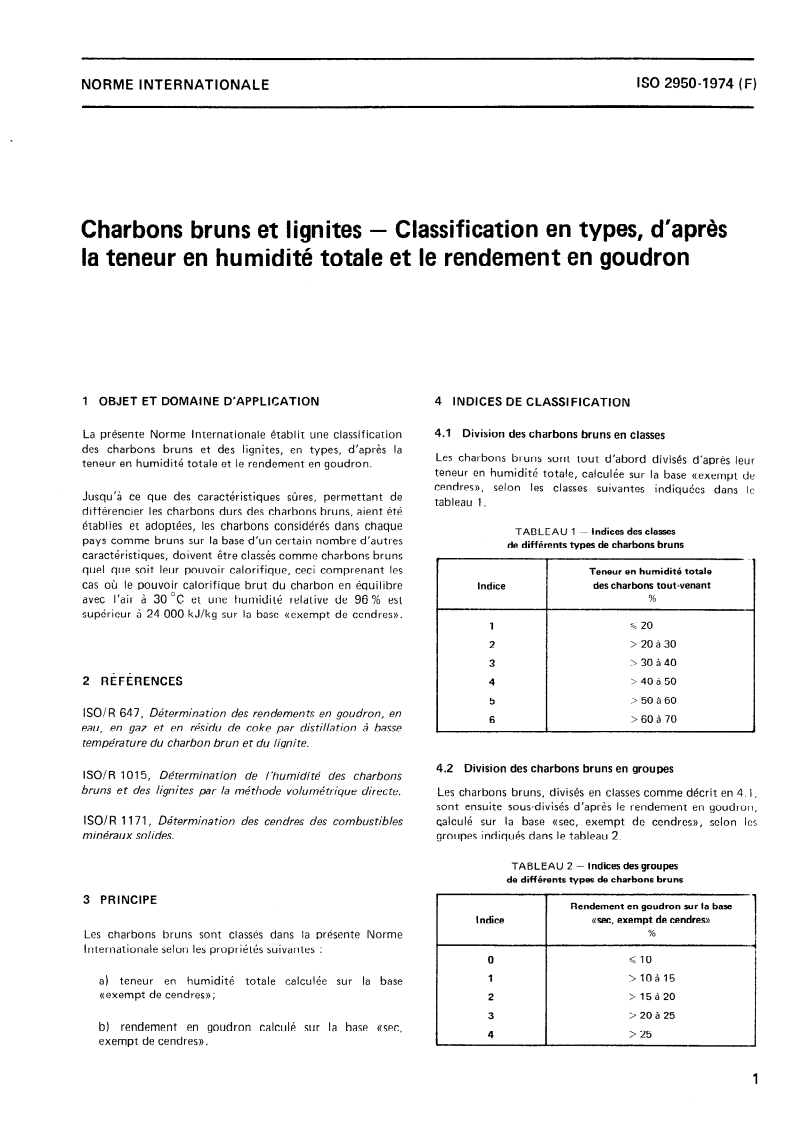
‘I OBJET ET DOMAINE D’APPLICATION 4 INDICES DE CLASSIFICATION
4.1 Division des charbons bruns en classes
La présente Norme Internationale établit une classification
des charbons bruns et des lignites, en types, d’après la
Les charbons bruns sont tout d’abord divisés d’après leur
teneur en humidité totale et le rendement en goudron.
teneur en humidité totale, calculée sur la base «exempt de
cendres)),
selon les classes suivantes indiquées dans le
Jusqu’à ce que des caractéristiques sûres, permet
...
INTERNATIONAL ORGANIZATION FOR STANDARDIZATION #MEJKlJb’HAPOfiHAII OPI-AHM3AUM~ I-I0 CTAH~APTM3AUMM =ORGANISATION INTERNATIONALE DE NORMALISATION
- Classification en types, d’après
Charbons runs et lignites
la teneur en humidité totale et le rendement en goudron
Brown coals and lignites - Classification by types on the basis of total moisture content and tar yield
Première édition - 1974~02-01
Réf. No : ISQ 2950-1974 (F)
CDU 662.642.001.3
classification, teneur en eau, goudron, quantité produite.
Descripteurs : charbon, lignite,
Prix basé sur 2 pages
AVANT-PROPOS
ISO (Organisation Internationale de Normalisation) est une fédération mondiale
d’organismes nationaux de normalisation (Comités Membres ISO). L’élaboration de
Normes Internationales est confiée aux Comités Techniques ISO. Chaque Comité
Membre intéressé par une étude a le droit de faire partie du Comité Technique
correspondant.
Les organisations internationales, gouvernementales et non
gouvernementales, en liaison avec I’ISO, participent également aux travaux.
Les Projets de Normes Internationales adoptés par les Comités Techniques sont
soumis aux Comités Membres pour approbation, avant leur acceptation comme
Normes Internationales par le Conseil de I’ISO.
La Norme Internationale ISO 2950 a été établie par le Comité Technique
ISO/TC 27, Combustibles minéraux solides, et soumise aux Comités Membres en
novembre 1972.
Elle a été approuvée par les Comités Membres des pays suivants :
Afrique du Sud, Rép. d’ Iran Thaïlande
Belgique Italie Turquie
Bulgarie Nouvelle-Zélande U.R.S.S.
Canada Pologne U.S.A.
Danemark Portugal Yougoslavie
France Suède
Inde Tchécoslovaquie
Le Comité Membre du pays suivant a désapprouvé le document pour des raisons
techniques :
Australie
0 Organisation Internationale de Normalisation, 1974 l
Imprimé en Suisse
ISO 2950-1974 (F)
NORME INTERNATIONALE
Classification en types, d’après
Charbons bruns et lignites -
la teneur en humidité totale et le rendement en goudron
‘I OBJET ET DOMAINE D’APPLICATION 4 INDICES DE CLASSIFICATION
4.1 Division des charbons bruns en classes
La présente Norme Internationale établit une classification
des charbons bruns et des lignites, en types, d’après la
Les charbons bruns sont tout d’abord divisés d’après leur
teneur en humidité totale et le rendement en goudron.
teneur en humidité totale, calculée sur la base «exempt de
cendres)), selon les classes suivantes indiquées dans le
Jusqu’à ce que des caractéristiques sû
...
INTERNATIONAL ORGANIZATION FOR STANDARDIZATION #MEJKlJb’HAPOfiHAII OPI-AHM3AUM~ I-I0 CTAH~APTM3AUMM =ORGANISATION INTERNATIONALE DE NORMALISATION
- Classification en types, d’après
Charbons runs et lignites
la teneur en humidité totale et le rendement en goudron
Brown coals and lignites - Classification by types on the basis of total moisture content and tar yield
Première édition - 1974~02-01
Réf. No : ISQ 2950-1974 (F)
CDU 662.642.001.3
classification, teneur en eau, goudron, quantité produite.
Descripteurs : charbon, lignite,
Prix basé sur 2 pages
AVANT-PROPOS
ISO (Organisation Internationale de Normalisation) est une fédération mondiale
d’organismes nationaux de normalisation (Comités Membres ISO). L’élaboration de
Normes Internationales est confiée aux Comités Techniques ISO. Chaque Comité
Membre intéressé par une étude a le droit de faire partie du Comité Technique
correspondant.
Les organisations internationales, gouvernementales et non
gouvernementales, en liaison avec I’ISO, participent également aux travaux.
Les Projets de Normes Internationales adoptés par les Comités Techniques sont
soumis aux Comités Membres pour approbation, avant leur acceptation comme
Normes Internationales par le Conseil de I’ISO.
La Norme Internationale ISO 2950 a été établie par le Comité Technique
ISO/TC 27, Combustibles minéraux solides, et soumise aux Comités Membres en
novembre 1972.
Elle a été approuvée par les Comités Membres des pays suivants :
Afrique du Sud, Rép. d’ Iran Thaïlande
Belgique Italie Turquie
Bulgarie Nouvelle-Zélande U.R.S.S.
Canada Pologne U.S.A.
Danemark Portugal Yougoslavie
France Suède
Inde Tchécoslovaquie
document pour des raisons
Le Comité Membre du pays suivant a désapprouvé le
techniques
Australie
0 Organisation Internationale de Normalisation, 1974 l
Imprimé en Suisse
ISO 2950-1974 (F)
NORME INTERNATIONALE
Classification en types, d’après
Charbons bruns et lignites -
la teneur en humidité totale et le rendement en goudron
‘I OBJET ET DOMAINE D’APPLICATION 4 INDICES DE CLASSIFICATION
4.1 Division des charbons bruns en classes
La présente Norme Internationale établit une classification
des charbons bruns et des lignites, en types, d’après la
Les charbons bruns sont tout d’abord divisés d’après leur
teneur en humidité totale et le rendement en goudron.
teneur en humidité totale, calculée sur la base «exempt de
cendres)),
selon les classes suivantes indiquées dans le
Jusqu’à ce que des caractéristiques sûres, permet
...
INTERNATIONAL ORGANIZATION FOR STANDARDIZATION #MEJKlJb’HAPOfiHAII OPI-AHM3AUM~ I-I0 CTAH~APTM3AUMM =ORGANISATION INTERNATIONALE DE NORMALISATION
- Classification en types, d’après
Charbons runs et lignites
la teneur en humidité totale et le rendement en goudron
Brown coals and lignites - Classification by types on the basis of total moisture content and tar yield
Première édition - 1974~02-01
Réf. No : ISQ 2950-1974 (F)
CDU 662.642.001.3
classification, teneur en eau, goudron, quantité produite.
Descripteurs : charbon, lignite,
Prix basé sur 2 pages
AVANT-PROPOS
ISO (Organisation Internationale de Normalisation) est une fédération mondiale
d’organismes nationaux de normalisation (Comités Membres ISO). L’élaboration de
Normes Internationales est confiée aux Comités Techniques ISO. Chaque Comité
Membre intéressé par une étude a le droit de faire partie du Comité Technique
correspondant.
Les organisations internationales, gouvernementales et non
gouvernementales, en liaison avec I’ISO, participent également aux travaux.
Les Projets de Normes Internationales adoptés par les Comités Techniques sont
soumis aux Comités Membres pour approbation, avant leur acceptation comme
Normes Internationales par le Conseil de I’ISO.
La Norme Internationale ISO 2950 a été établie par le Comité Technique
ISO/TC 27, Combustibles minéraux solides, et soumise aux Comités Membres en
novembre 1972.
Elle a été approuvée par les Comités Membres des pays suivants :
Afrique du Sud, Rép. d’ Iran Thaïlande
Belgique Italie Turquie
Bulgarie Nouvelle-Zélande U.R.S.S.
Canada Pologne U.S.A.
Danemark Portugal Yougoslavie
France Suède
Inde Tchécoslovaquie
Le Comité Membre du pays suivant a désapprouvé le document pour des raisons
techniques :
Australie
0 Organisation Internationale de Normalisation, 1974 l
Imprimé en Suisse
ISO 2950-1974 (F)
NORME INTERNATIONALE
Classification en types, d’après
Charbons bruns et lignites -
la teneur en humidité totale et le rendement en goudron
‘I OBJET ET DOMAINE D’APPLICATION 4 INDICES DE CLASSIFICATION
4.1 Division des charbons bruns en classes
La présente Norme Internationale établit une classification
des charbons bruns et des lignites, en types, d’après la
Les charbons bruns sont tout d’abord divisés d’après leur
teneur en humidité totale et le rendement en goudron.
teneur en humidité totale, calculée sur la base «exempt de
cendres)), selon les classes suivantes indiquées dans le
Jusqu’à ce que des caractéristiques sû
...