

oSIST prEN 843-9:2026
(Main)Advanced technical ceramics - Mechanical properties of monolithic ceramics at room temperature - Part 9: Test method for the determination of edge-chip resistance
- Abstract
This document specifies two test methods for the determination of the resistance of the edges of brittle ceramic materials to be damaged by chipping.
This document is applicable to homogeneous monolithic ceramics with flat surfaces and straight sharp or chamfered edges.
- Status
- Not Published
- Public Enquiry End Date
- 30-Jul-2026
- Technical Committee
- I13 - Imaginarni 13
- Current Stage
- 4020 - Public enquire (PE) (Adopted Project)
- Start Date
- 10-Jun-2026
- Due Date
- 28-Oct-2026
- Completion Date
- 03-Aug-2026

oSIST prEN 843-9:2026 is a CEN draft European Standard for advanced technical ceramics. It specifies two room-temperature test methods for measuring how resistant brittle monolithic ceramic edges are to chipping. Engineers, laboratories, and buyers use it when they need repeatable edge-chip resistance data for flat, homogeneous parts with sharp or chamfered edges.
What does oSIST prEN 843-9:2026 specify?
oSIST prEN 843-9:2026 covers test methods for the edge-chip resistance of homogeneous monolithic ceramics at room temperature. The document is organized into clauses 1 to 8, followed by a bibliography.
It starts with scope, normative references, terms and definitions, and the test principle. The technical content is then split into Method A, direct force application, and Method B, sliding force application, each with apparatus, preparation, procedure, and calculation.
What are the key requirements of oSIST prEN 843-9:2026?
oSIST prEN 843-9:2026 gives two ways to quantify edge damage: one by measuring the force needed to start chipping at a chosen distance from the edge, and one by measuring how far from the edge chipping starts under a chosen force. In both cases, the result is a force-to-distance measure of edge-chip resistance, which helps compare materials and check whether a chamfer is effective.
Method A - direct force application
Method A uses a mechanical testing machine in constant displacement rate mode, a fixed test-piece holder, and a diamond indenter. The machine accuracy is tied to EN ISO 7500-1, Grade 1, and the load should be recorded with sensitivity better than 1 % of maximum load.
The test piece is clamped flat, with the indenter positioned a chosen distance from the edge. A starting distance of about 0,5 mm is recommended for unknown materials, and the displacement rate shall be no more than 0,5 mm/min. At least 10 tests are made, and edge-chip positions must be spaced so the chips do not overlap.
The result is calculated as force divided by distance from the edge, then averaged and reported with standard deviation. In practice, this means the user must control positioning carefully and keep the distance measurements consistent, or the comparison between materials becomes unreliable.
Method B - sliding force application
Method B uses either a scratch tester or a universal testing machine with a translated test piece. The preferred scratch tester applies a controlled force in the range 0,1 N to 100 N and moves at 0,1 mm/s to 1 mm/s. A diamond indenter is again used, and the setup should let the operator stop when the edge-chip forms.
The test piece needs a carefully prepared square edge, free from edge-chips greater than 5 µm. The contact surface should be flat, smooth, and substantially damage free, with Ra no more than 1 µm. For forces below 10 N, polished surfaces and a chip-free edge are recommended.
The specimen is moved toward the edge until chipping occurs, then the distance from the original edge to the center of the scar is measured with an optical microscope. At least 10 edge-chips are made, and the same force divided by measured distance gives the edge-chip resistance.
Interferences and reporting
oSIST prEN 843-9:2026 notes that indenter type and residual stresses can affect results. Near-edge behavior may differ between a sharp indenter and a Rockwell geometry indenter, especially at small distances from the edge. Machining stresses and internal thermal stresses can also influence chipping, so sample preparation matters when results are being compared.
The test report follows EN ISO/IEC 17025 and must state the test method used, the test item details, surface and edge preparation, calibration information, test parameters, individual results, averages, standard deviation, comments on chip size or shape, and any deviations from the procedure. That makes the result traceable and easier to audit.
What terms does oSIST prEN 843-9:2026 define?
oSIST prEN 843-9:2026 defines edge-chip as a recessed defect at the edge caused by localised stress or impact. It is the defect the test is looking for.
Flake means a detached piece of material from the edge. In practice, this is the piece lost when chipping develops.
Edge chipping is the process of producing an edge-chip by localised loading or impact. The two test methods create edge chipping in controlled ways.
Edge chip resistance or edge toughness is the measure used for comparison. The standard defines it through the applied force and the distance at which the chip forms.
Who uses oSIST prEN 843-9:2026?
oSIST prEN 843-9:2026 is used by testing laboratories, ceramic manufacturers, quality managers, and engineers who need to compare edge durability. It is also useful for buyers and technical specifiers who want to verify the effect of chamfers, machining, or edge finishing on brittle ceramic parts.
The standard fits work in product development, incoming inspection, batch comparison, and failure analysis where edge damage is a concern.
What changed in oSIST prEN 843-9:2026 from the previous edition?
oSIST prEN 843-9:2026 will supersede CEN/TS 843-9:2010. The foreword lists these significant technical changes:
- conversion into a European Standard
- update of the normative references
- revised definitions of edge-chip and flake
- editorial revision
Which standards are used with oSIST prEN 843-9:2026?
| Standard | What it contributes |
|---|---|
| EN ISO 7500-1 | Force calibration and verification of the testing machine |
| EN ISO/IEC 17025 | Laboratory competence and test report requirements |
| EN 623-4 | Surface roughness terminology and measurement reference for Ra |
| EN ISO 14705 | Recommended Rockwell geometry diamond indenter |
| EN ISO 20502 | Scratch tester context for the sliding-force method |
What does the oSIST prEN 843-9:2026 document contain?
oSIST prEN 843-9:2026 contains two worked test methods with apparatus descriptions, specimen preparation, procedures, and calculation steps. It also includes schematic figures showing the indentation and sliding setups, plus formulas for calculating individual results, averages, and standard deviation.
Clause 4 explains the principle behind edge-chip formation and why the force-to-distance ratio is used. Clause 7 discusses interferences, especially indenter geometry and residual stress, and Clause 8 defines the reporting items needed for traceable use in testing and quality work.
Relations
- Effective Date
- 18-Jun-2025
Frequently Asked Questions
oSIST prEN 843-9:2026 is a draft published by the Slovenian Institute for Standardization (SIST). Its full title is "Advanced technical ceramics - Mechanical properties of monolithic ceramics at room temperature - Part 9: Test method for the determination of edge-chip resistance". This standard covers: This document specifies two test methods for the determination of the resistance of the edges of brittle ceramic materials to be damaged by chipping. This document is applicable to homogeneous monolithic ceramics with flat surfaces and straight sharp or chamfered edges.
This document specifies two test methods for the determination of the resistance of the edges of brittle ceramic materials to be damaged by chipping. This document is applicable to homogeneous monolithic ceramics with flat surfaces and straight sharp or chamfered edges.
oSIST prEN 843-9:2026 is classified under the following ICS (International Classification for Standards) categories: 81.060.30 - Advanced ceramics. The ICS classification helps identify the subject area and facilitates finding related standards.
oSIST prEN 843-9:2026 has the following relationships with other standards: It is inter standard links to SIST-TS CEN/TS 843-9:2010. Understanding these relationships helps ensure you are using the most current and applicable version of the standard.
oSIST prEN 843-9:2026 is available in PDF format for immediate download after purchase. The document can be added to your cart and obtained through the secure checkout process. Digital delivery ensures instant access to the complete standard document.
Standards Content (Sample)
SLOVENSKI STANDARD
01-julij-2026
Sodobna tehnična keramika - Mehanske lastnosti monolitske keramike pri sobni
temperaturi - 9. del: Preskusna metoda za ugotavljanje odpornosti proti krušenju
robov
Advanced technical ceramics - Mechanical properties of monolithic ceramics at room
temperature - Part 9: Test method for the determination of edge-chip resistance
Hochleistungskeramik - Mechanische Eigenschaften monolithischer Keramik bei
Raumtemperatur - Teil 9: Prüfverfahren zur Bestimmung der Kantenbeständigkeit gegen
Abplatzung
Céramiques techniques avancées - Propriétés mécaniques des céramiques
monolithiques à température ambiante - Partie 9 : Méthode d'essai pour la détermination
de la résistance à l'écaillage des bords
Ta slovenski standard je istoveten z: prEN 843-9
ICS:
81.060.30 Sodobna keramika Advanced ceramics
2003-01.Slovenski inštitut za standardizacijo. Razmnoževanje celote ali delov tega standarda ni dovoljeno.
DRAFT
EUROPEAN STANDARD
NORME EUROPÉENNE
EUROPÄISCHE NORM
May 2026
ICS 81.060.30 Will supersede CEN/TS 843-9:2010
English Version
Advanced technical ceramics - Mechanical properties of
monolithic ceramics at room temperature - Part 9: Test
method for the determination of edge-chip resistance
Céramiques techniques avancées - Propriétés Hochleistungskeramik - Mechanische Eigenschaften
mécaniques des céramiques monolithiques à monolithischer Keramik bei Raumtemperatur - Teil 9:
température ambiante - Partie 9 : Méthode d'essai pour Prüfverfahren zur Bestimmung der
la détermination de la résistance à l'écaillage des bords Kantenbeständigkeit gegen Abplatzung
This draft European Standard is submitted to CEN members for enquiry. It has been drawn up by the Technical Committee
CEN/TC 184.
If this draft becomes a European Standard, CEN members are bound to comply with the CEN/CENELEC Internal Regulations
which stipulate the conditions for giving this European Standard the status of a national standard without any alteration.
This draft European Standard was established by CEN in three official versions (English, French, German). A version in any other
language made by translation under the responsibility of a CEN member into its own language and notified to the CEN-CENELEC
Management Centre has the same status as the official versions.
CEN members are the national standards bodies of Austria, Belgium, Bulgaria, Croatia, Cyprus, Czech Republic, Denmark, Estonia,
Finland, France, Germany, Greece, Hungary, Iceland, Ireland, Italy, Latvia, Lithuania, Luxembourg, Malta, Netherlands, Norway,
Poland, Portugal, Republic of North Macedonia, Romania, Serbia, Slovakia, Slovenia, Spain, Sweden, Switzerland, Türkiye and
United Kingdom.
Recipients of this draft are invited to submit, with their comments, notification of any relevant patent rights of which they are
aware and to provide supporting documentation.
Warning : This document is not a European Standard. It is distributed for review and comments. It is subject to change without
notice and shall not be referred to as a European Standard.
EUROPEAN COMMITTEE FOR STANDARDIZATION
COMITÉ EUROPÉEN DE NORMALISATION
EUROPÄISCHES KOMITEE FÜR NORMUNG
CEN-CENELEC Management Centre: Rue de la Science 23, B-1040 Brussels
© 2026 CEN All rights of exploitation in any form and by any means reserved Ref. No. prEN 843-9:2026 E
worldwide for CEN national Members.
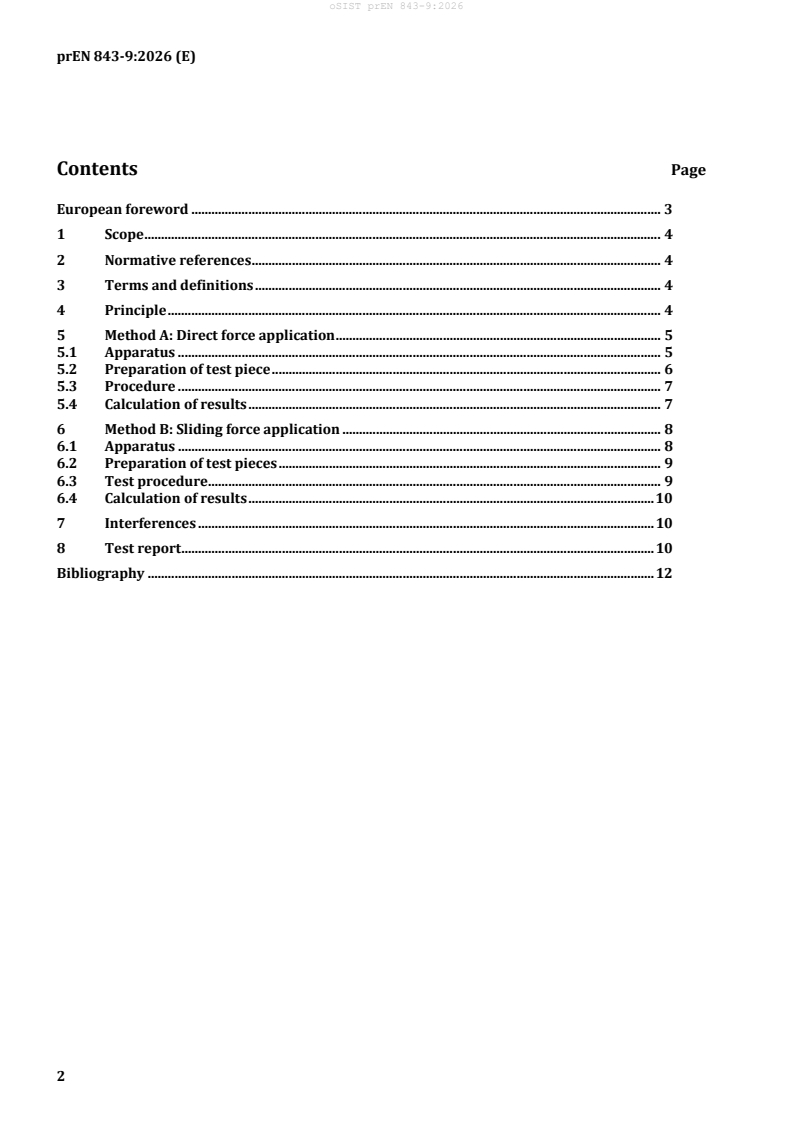
Contents Page
European foreword . 3
1 Scope . 4
2 Normative references . 4
3 Terms and definitions . 4
4 Principle . 4
5 Method A: Direct force application . 5
5.1 Apparatus . 5
5.2 Preparation of test piece . 6
5.3 Procedure . 7
5.4 Calculation of results . 7
6 Method B: Sliding force application . 8
6.1 Apparatus . 8
6.2 Preparation of test pieces . 9
6.3 Test procedure . 9
6.4 Calculation of results . 10
7 Interferences . 10
8 Test report . 10
Bibliography . 12
European foreword
This document (prEN 843-9:2026) has been prepared by Technical Committee CEN/TC 184 “Advanced
technical ceramics”, the secretariat of which is held by DIN.
This document is currently submitted to the CEN Enquiry.
This document will supersede CEN/TS 843-9:2010.
prEN 849-9:2026 includes the following significant technical changes with respect to
CEN/TS 843-9:2010:
a) conversion into a European Standard;
b) update of the normative references;
c) revised definitions of edge-chip and flake;
d) editorial revision.
A list of all parts in the EN 843 series, published under the general title Advanced technical ceramics —
Mechanical properties of monolithic ceramics at room temperature, can be found on the CEN website.
1 Scope
This document specifies two test methods for the determination of the resistance of the edges of brittle
ceramic materials to be damaged by chipping.
This document is applicable to homogeneous monolithic ceramics with flat surfaces and straight sharp
or chamfered edges.
2 Normative references
The following documents are referred to in the text in such a way that some or all of their content
constitutes requirements of this document. For dated references, only the edition cited applies. For
undated references, the latest edition of the referenced document (including any amendments) applies.
EN ISO 7500-1, Metallic materials — Calibration and verification of static uniaxial testing machines —
Part 1: Tension/compression testing machines — Calibration and verification of the force-measuring system
(ISO 7500-1)
EN ISO/IEC 17025, General requirements for the competence of testing and calibration laboratories
(ISO/IEC 17025)
3 Terms and definitions
For the purposes of this document, the following terms and definitions apply.
ISO and IEC maintain terminology databases for use in standardization at the following addresses:
— ISO Online browsing platform: available at https://www.iso.org/obp/
— IEC Electropedia: available at https://www.electropedia.org/
3.1
edge-chip
recessed defect at the edge of a component or test piece caused by localised stress or impact
3.2
flake
detached piece of material from the edge of a component or test piece
3.3
edge chipping
process of producing an edge-chip from the edge of a component or test piece by localised loading or
impact
3.4
edge chip resistance
edge toughness
measure of the resistance of the edge of a component or test piece to chipping determined by dividing
the force applied by the maximum thickness of the edge-chip or the distance of the centre of the applied
force from the edge at which it is formed
4 Principle
Localized loading near the edge of a ceramic component can lead to spalling of the edge, and hence to loss
of function of the component. The test methods in this document provide means of quantifying the
resistance of a ceramic product to edge damage, either by applying a monotonically increasing force to
an indenter positioned a fixed distance from the edge (Method A), or by applying a predetermined force
to an indenter positioned remotely from the edge and dragging it towards the edge (Method B). In the
case of method A, the force required to cause an edge-chip to form at a pre-determined position is
recorded while in the case of Method B, the distance from the edge at which the edge-chip is formed under
a pre-determined force is measured. In both cases (see Figure 1), the force applied, F, divided by the
distance from the edge at which the edge-chip is formed, d, commonly known as the ‘edge toughness’, is
then a measure of edge-chip resistance.
This test can also be used to determine the effectiveness of chamfers placed on edges. A chamfer prevents
direct loading near the edge. The size of the chamfer required for the component to withstand a given
near-edge loading can be determined by this test.
a) b)
Key
F indenter applying force normal to plane
d maximum edge-chip depth into bulk
w maximum edge-chip width on face
Figure 1 — Schematic of indentation near an edge using a hard indenter (a) cross-sectional view
of an edge-chip formed at an edge, and (b) edge-chip shape viewed from edge side
5 Method A: Direct force application
5.1 Apparatus
The force required shall be applied by any suitable mechanical testing machine which operates in a
constant displacement rate mode. The machine shall drive an indenter (5.1.3) into the surface of a
component or test piece at a pre-determined location near the edge until the edge-chip forms.
NOTE The mechanism of edge-chip formation is thought be the preferred extension of those radial cracks
emanating from the indentation which are roughly parallel with the edge. Owing to the lack of elastic constraint
near the edge, these propagate sideways and into the material to form a shell-shaped crack, which once past a
certain size becomes unstable and forms a detached flake.
5.1.1 Test machine. A mechanical testing machine shall be used, which is capable of applying a force
to the test jig at a constant displacement rate. The test machine shall be equipped for recording the load
applied to the test jig at any point in time, and preferably of capturing the peak force applied. The accuracy
of the test machine shall be in accordance with EN ISO 7500-1, Grade 1 (1 % of indicated load), and shall
be capable of recording to a sensitivity of better than 1 % of the maximum load employed.
5.1.2 Test piece holder. The test-piece shall be held in a clamping device which enables the test piece
or test item to be held in a fixed position in the testing machine (Figure 2). Preferably the clamping device
incorporates two orthogonal means of adjusting position so that the location of the indenter (5.1.3) can
be adjusted precisely, e.g. using an X-Y micrometer screw table which can be locked when indenting.
NOTE It is convenient to see the indentation position by sighting normal to the indentation surface using a
microscope or other suitable device, e.g. by moving the indenter out of the line of sight. Such an arrangement permits
the indenter to be positioned an exact distance from the edge of the test piece.
Key
1 load cell
2 indenter
3 test piece or test item
4 X-Y lockable table
Figure 2 — Schematic of indentation technique for Method A
5.1.3 Indenter. A sharp or a blunt diamond indenter shall be used for this test, as appropriate to
requirements.
It is recommended that for reliability, especially in high force tests, a Rockwell geometry diamond (see
EN ISO 14705) with a tip radius of 0,2 mm and manufactured from polycrystalline diamond is employed.
If a Vickers or Knoop diamond is used, ensure that the diagonal length of the indentation is consistently
aligned with the edge of the test piece.
5.2 Preparat
...