

oSIST prEN ISO 8501-1:2026
(Main)Preparation of steel substrates before application of paints and related products - Visual assessment of surface cleanliness - Part 1: Rust grades and preparation grades of uncoated steel substrates and of steel substrates after overall removal of previous coatings (ISO/DIS 8501-1:2025)
General Information
- Abstract
ISO 8501-1:2007 is a hardback A5-format book in four languages (English, French, German and Swedish), which specifies a series of rust grades and preparation grades of steel surfaces. The various grades are defined by written descriptions together with photographs that are representative examples within the tolerance for each grade as described in words.
It is applicable to hot-rolled steel surfaces prepared for painting by methods such as blast-cleaning, hand and power tool cleaning and flame cleaning, although these methods rarely lead to comparable results. Essentially, these methods are intended for hot-rolled steel, but blast-cleaning methods, in particular, could also be used on cold-rolled steel of sufficient thickness to withstand any deformation caused by the impact of the abrasive or the effects of power tool cleaning.
This part of ISO 8501 is applicable also to steel substrates that show residues of firmly adhering paint and other foreign matter in addition to residual mill scale.
- Status
- Not Published
- Public Enquiry End Date
- 01-Mar-2026
- Technical Committee
- IBLP - Paints and varnishes
- Current Stage
- 4020 - Public enquire (PE) (Adopted Project)
- Start Date
- 08-Jan-2026
- Due Date
- 28-May-2026
- Completion Date
- 16-Mar-2026


Overview
oSIST prEN ISO 8501-1:2026 is the draft European standard specifying the visual assessment of surface cleanliness for steel substrates before the application of paints and related products. Maintained by CEN and aligned with ISO/DIS 8501-1:2025, this standard provides a systematic approach to evaluating the rust grades and preparation grades of both uncoated steel substrates and steel surfaces that have undergone complete removal of previous coatings. The standard supports the reliable preparation of steel surfaces for optimal adhesion and performance of protective coatings.
The document outlines a range of rust grades using written descriptions and photographic examples, assisting professionals in consistently determining surface conditions. It applies to hot-rolled steel surfaces prepared by methods such as blast-cleaning, hand and power tool cleaning, and acid pickling, and can also apply to cold-rolled steels of sufficient thickness. The assessment considers both substrates with and without residues, addressing mill scale, firmly adhering paint, and other foreign matter.
Key Topics
- Rust Grades: Definition of common rust grades found on uncoated and weathered steel, described in writing and with reference photographs.
- Preparation Grades: Detailed classification of surface cleanliness following different cleaning methods, including:
- Abrasive blast-cleaning
- Hand tool cleaning
- Power tool cleaning
- Acid pickling
- Visual Assessment Procedures: Step-by-step processes for evaluating steel surface conditions visually, supporting quality control prior to painting.
- Photographic Examples: Inclusion of over 50 photographs to ensure objective, repeatable assessments of rust and preparation grades.
- Surface Cleaning Limitations: Recognition that some cleaning methods may not remove oil, grease, or soluble salts, emphasizing the importance of understanding method capabilities.
- Terminology: Clear definitions for terms such as firmly adhering material, residual contamination, surface profile, and localized corrosion.
Applications
ISO 8501-1 is widely used across industries where corrosion protection and coating performance are critical, such as construction, shipbuilding, oil & gas, and infrastructure maintenance. Key practical applications include:
- Project Specification: Specifying required rust and preparation grades in construction or maintenance contracts and technical guidelines.
- Inspection & Quality Assurance: Enabling inspectors and contractors to agree on surface conditions based on objective visual standards.
- Coating System Performance: Facilitating optimal adhesion and long-term corrosion resistance by ensuring a standardized level of surface cleanliness before painting.
- Training: Assisting in the education of workers and inspectors on acceptable standards of surface preparation with visual aids.
Related Standards
For a comprehensive approach to steel surface preparation and cleanliness, the following standards are closely related:
- ISO 8502 Series: Test methods for assessing the presence of surface contaminants (e.g., salts, dust, oil) that are not visually obvious but can affect coating performance.
- ISO 8503 Series: Evaluation of surface roughness characteristics, supporting the assessment of surface profile post-blasting.
- ISO 8504 Series: Guidelines on the techniques and capabilities of various surface cleaning methods.
- ISO 4628-3: Assessment and classification of coating degradation by rusting.
oSIST prEN ISO 8501-1:2026 supports consistent, objective, and effective preparation of steel substrates worldwide, underpinning high-quality paint applications and extending asset life through enhanced corrosion protection. Organizations seeking to comply with international best practices in surface preparation and coating application will find this standard an essential reference.
Relations
- Effective Date
- 01-Feb-2026
Get Certified
Connect with accredited certification bodies for this standard

DVS-ZERT GmbH
German welding certification society.
CARES (UK Certification Authority for Reinforcing Steels)
UK certification for reinforcing steels and construction.
EWF/IIW (European/International Welding Federation)
International welding personnel certification.
Sponsored listings
Frequently Asked Questions
oSIST prEN ISO 8501-1:2026 is a draft published by the Slovenian Institute for Standardization (SIST). Its full title is "Preparation of steel substrates before application of paints and related products - Visual assessment of surface cleanliness - Part 1: Rust grades and preparation grades of uncoated steel substrates and of steel substrates after overall removal of previous coatings (ISO/DIS 8501-1:2025)". This standard covers: ISO 8501-1:2007 is a hardback A5-format book in four languages (English, French, German and Swedish), which specifies a series of rust grades and preparation grades of steel surfaces. The various grades are defined by written descriptions together with photographs that are representative examples within the tolerance for each grade as described in words. It is applicable to hot-rolled steel surfaces prepared for painting by methods such as blast-cleaning, hand and power tool cleaning and flame cleaning, although these methods rarely lead to comparable results. Essentially, these methods are intended for hot-rolled steel, but blast-cleaning methods, in particular, could also be used on cold-rolled steel of sufficient thickness to withstand any deformation caused by the impact of the abrasive or the effects of power tool cleaning. This part of ISO 8501 is applicable also to steel substrates that show residues of firmly adhering paint and other foreign matter in addition to residual mill scale.
ISO 8501-1:2007 is a hardback A5-format book in four languages (English, French, German and Swedish), which specifies a series of rust grades and preparation grades of steel surfaces. The various grades are defined by written descriptions together with photographs that are representative examples within the tolerance for each grade as described in words. It is applicable to hot-rolled steel surfaces prepared for painting by methods such as blast-cleaning, hand and power tool cleaning and flame cleaning, although these methods rarely lead to comparable results. Essentially, these methods are intended for hot-rolled steel, but blast-cleaning methods, in particular, could also be used on cold-rolled steel of sufficient thickness to withstand any deformation caused by the impact of the abrasive or the effects of power tool cleaning. This part of ISO 8501 is applicable also to steel substrates that show residues of firmly adhering paint and other foreign matter in addition to residual mill scale.
oSIST prEN ISO 8501-1:2026 is classified under the following ICS (International Classification for Standards) categories: 25.220.10 - Surface preparation; 87.020 - Paint coating processes. The ICS classification helps identify the subject area and facilitates finding related standards.
oSIST prEN ISO 8501-1:2026 has the following relationships with other standards: It is inter standard links to SIST EN ISO 8501-1:2007. Understanding these relationships helps ensure you are using the most current and applicable version of the standard.
oSIST prEN ISO 8501-1:2026 is available in PDF format for immediate download after purchase. The document can be added to your cart and obtained through the secure checkout process. Digital delivery ensures instant access to the complete standard document.
Standards Content (Sample)
SLOVENSKI STANDARD
01-februar-2026
Priprava jeklenih podlag pred nanašanjem barv in sorodnih premazov - Vizualno
ocenjevanje čistosti površine - 1. del: Stopnje korodiranosti in stopnje priprave
nezaščitenih jeklenih podlag ter jeklenih podlag po popolni odstranitvi starih
premazov (ISO/DIS 8501-1:2025)
Preparation of steel substrates before application of paints and related products - Visual
assessment of surface cleanliness - Part 1: Rust grades and preparation grades of
uncoated steel substrates and of steel substrates after overall removal of previous
coatings (ISO/DIS 8501-1:2025)
Vorbereitung von Stahloberflächen vor dem Auftragen von Beschichtungsstoffen -
Visuelle Beurteilung der Oberflächenreinheit - Teil 1: Rostgrade und
Oberflächenvorbereitungsgrade von unbeschichteten Stahloberflächen und
Stahloberflächen nach ganzflächigem Entfernen vorhandener Beschichtungen (ISO/DIS
8501-1:2025)
Préparation des subjectiles d'acier avant application de peintures et de produits
assimilés - Évaluation visuelle de la propreté de surface Partie 1: Grades de rouille et
grades de préparation des subjectiles d’acier non revêtus et des subjectiles d’acier après
décapage sur toute la surface des précédents revêtements (ISO/DIS 8501-1:2025)
Ta slovenski standard je istoveten z: prEN ISO 8501-1
ICS:
25.220.10 Priprava površine Surface preparation
87.020 Postopki za nanašanje Paint coating processes
barvnih premazov
2003-01.Slovenski inštitut za standardizacijo. Razmnoževanje celote ali delov tega standarda ni dovoljeno.
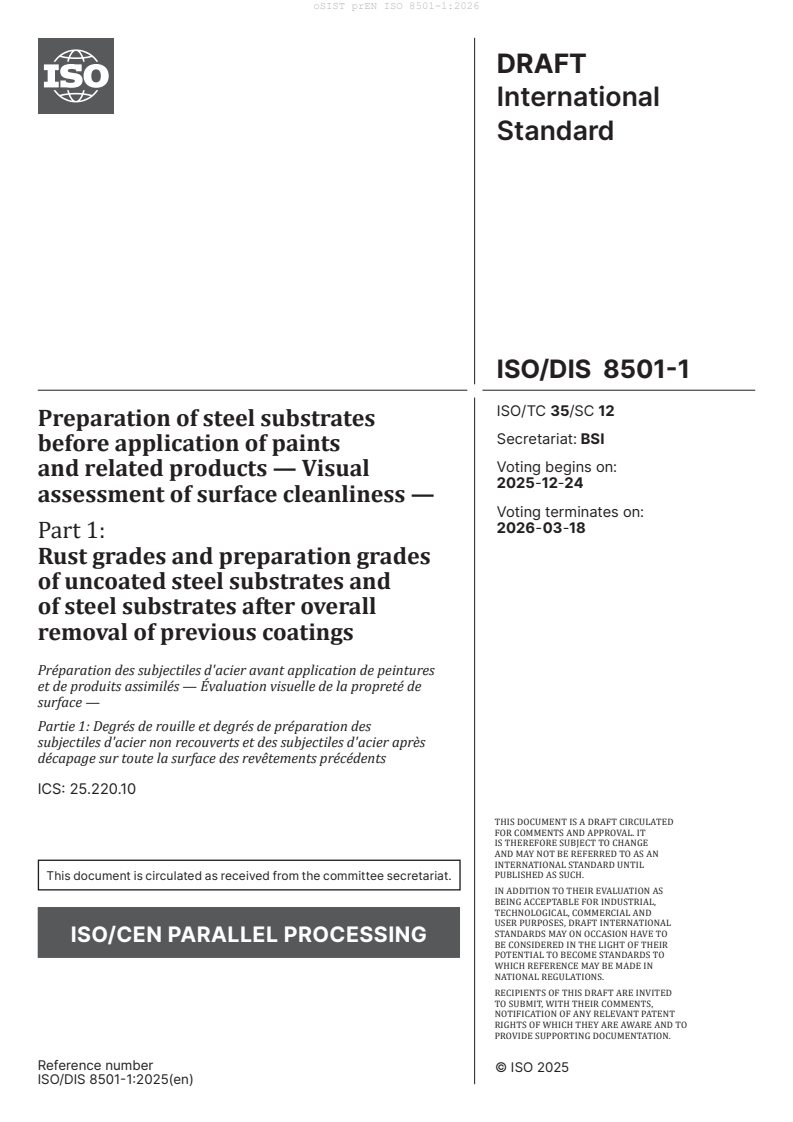
DRAFT
International
Standard
ISO/DIS 8501-1
ISO/TC 35/SC 12
Preparation of steel substrates
Secretariat: BSI
before application of paints
Voting begins on:
and related products — Visual
2025-12-24
assessment of surface cleanliness —
Voting terminates on:
2026-03-18
Part 1:
Rust grades and preparation grades
of uncoated steel substrates and
of steel substrates after overall
removal of previous coatings
Préparation des subjectiles d'acier avant application de peintures
et de produits assimilés — Évaluation visuelle de la propreté de
surface —
Partie 1: Degrés de rouille et degrés de préparation des
subjectiles d'acier non recouverts et des subjectiles d'acier après
décapage sur toute la surface des revêtements précédents
ICS: 25.220.10
THIS DOCUMENT IS A DRAFT CIRCULATED
FOR COMMENTS AND APPROVAL. IT
IS THEREFORE SUBJECT TO CHANGE
AND MAY NOT BE REFERRED TO AS AN
INTERNATIONAL STANDARD UNTIL
PUBLISHED AS SUCH.
This document is circulated as received from the committee secretariat.
IN ADDITION TO THEIR EVALUATION AS
BEING ACCEPTABLE FOR INDUSTRIAL,
TECHNOLOGICAL, COMMERCIAL AND
USER PURPOSES, DRAFT INTERNATIONAL
STANDARDS MAY ON OCCASION HAVE TO
ISO/CEN PARALLEL PROCESSING
BE CONSIDERED IN THE LIGHT OF THEIR
POTENTIAL TO BECOME STANDARDS TO
WHICH REFERENCE MAY BE MADE IN
NATIONAL REGULATIONS.
RECIPIENTS OF THIS DRAFT ARE INVITED
TO SUBMIT, WITH THEIR COMMENTS,
NOTIFICATION OF ANY RELEVANT PATENT
RIGHTS OF WHICH THEY ARE AWARE AND TO
PROVIDE SUPPORTING DOCUMENTATION.
Reference number
ISO/DIS 8501-1:2025(en)
DRAFT
ISO/DIS 8501-1:2025(en)
International
Standard
ISO/DIS 8501-1
ISO/TC 35/SC 12
Preparation of steel substrates
Secretariat: BSI
before application of paints
Voting begins on:
and related products — Visual
assessment of surface cleanliness —
Voting terminates on:
Part 1:
Rust grades and preparation grades
of uncoated steel substrates and
of steel substrates after overall
removal of previous coatings
Préparation des subjectiles d'acier avant application de peintures
et de produits assimilés — Évaluation visuelle de la propreté de
surface —
Partie 1: Degrés de rouille et degrés de préparation des
subjectiles d'acier non recouverts et des subjectiles d'acier après
décapage sur toute la surface des revêtements précédents
ICS: 25.220.10
THIS DOCUMENT IS A DRAFT CIRCULATED
FOR COMMENTS AND APPROVAL. IT
IS THEREFORE SUBJECT TO CHANGE
AND MAY NOT BE REFERRED TO AS AN
INTERNATIONAL STANDARD UNTIL
PUBLISHED AS SUCH.
This document is circulated as received from the committee secretariat.
IN ADDITION TO THEIR EVALUATION AS
BEING ACCEPTABLE FOR INDUSTRIAL,
© ISO 2025
TECHNOLOGICAL, COMMERCIAL AND
USER PURPOSES, DRAFT INTERNATIONAL
All rights reserved. Unless otherwise specified, or required in the context of its implementation, no part of this publication may
STANDARDS MAY ON OCCASION HAVE TO
ISO/CEN PARALLEL PROCESSING
be reproduced or utilized otherwise in any form or by any means, electronic or mechanical, including photocopying, or posting on
BE CONSIDERED IN THE LIGHT OF THEIR
the internet or an intranet, without prior written permission. Permission can be requested from either ISO at the address below
POTENTIAL TO BECOME STANDARDS TO
WHICH REFERENCE MAY BE MADE IN
or ISO’s member body in the country of the requester.
NATIONAL REGULATIONS.
ISO copyright office
RECIPIENTS OF THIS DRAFT ARE INVITED
CP 401 • Ch. de Blandonnet 8
TO SUBMIT, WITH THEIR COMMENTS,
CH-1214 Vernier, Geneva
NOTIFICATION OF ANY RELEVANT PATENT
Phone: +41 22 749 01 11
RIGHTS OF WHICH THEY ARE AWARE AND TO
PROVIDE SUPPORTING DOCUMENTATION.
Email: copyright@iso.org
Website: www.iso.org
Published in Switzerland Reference number
ISO/DIS 8501-1:2025(en)
ii
ISO/DIS 8501-1:2025(en) ISO/DIS 8501-1:2025 (E)
Contents
Foreword . iv
Introduction . v
1 Scope . 1
2 Normative references . 1
3 Terms and definitions. 1
4 Rust grades . 3
5 Preparation grades . 3
5.1 General . 3
5.2 Abrasive blast-cleaning, Sa . 4
5.3 Hand tool cleaning, St. 5
5.4 Power tool cleaning, Ma . 5
5.5 Acid pickling, Be . 7
6 Procedure for visual assessment of steel substrates . 7
Annex A (informative) Photographs . 8
Annex B (informative) Representative photographic examples of the change of appearance
imparted to steel when blast-cleaned with different abrasives . 10
Bibliography . 14
ISO/DIS 8501-1:2025 (E) ISO/DIS 8501-1:2025(en)
Foreword
ISO (the International Organization for Standardization) is a worldwide federation of national standards
bodies (ISO member bodies). The work of preparing International Standards is normally carried out
through ISO technical committees. Each member body interested in a subject for which a technical
committee has been established has the right to be represented on that committee. International
organizations, governmental and non-governmental, in liaison with ISO, also take part in the work. ISO
collaborates closely with the International Electrotechnical Commission (IEC) on all matters of
electrotechnical standardization.
The procedures used to develop this document and those intended for its further maintenance are
described in the ISO/IEC Directives, Part 1. In particular, the different approval criteria needed for the
different types of ISO documents should be noted. This document was drafted in accordance with the
editorial rules of the ISO/IEC Directives, Part 2 (see www.iso.org/directives).
Attention is drawn to the possibility that some of the elements of this document may be the subject of
patent rights. ISO shall not be held responsible for identifying any or all such patent rights. Details of any
patent rights identified during the development of the document will be in the Introduction and/or on
the ISO list of patent declarations received (see www.iso.org/patents).
Any trade name used in this document is information given for the convenience of users and does not
constitute an endorsement.
For an explanation of the voluntary nature of standards, the meaning of ISO specific terms and
expressions related to conformity assessment, as well as information about ISO's adherence to the World
Trade Organization (WTO) principles in the Technical Barriers to Trade (TBT), see
www.iso.org/iso/foreword.html.
This document was prepared by Technical Committee ISO/TC 35, Paints and varnishes, Subcommittee
SC 12, Preparation of steel substrates before application of paints and related products.
This third edition cancels and replaces the second edition (ISO 8501-1:2007), which has been technically
revised.
The main changes are as follows:
— Hand tool cleaning and Power tool cleaning have been separated because modern power tools
can achieve a higher standard of cleanliness than the St grades.
— Introduction of the surface preparation grades Ma for power tool cleaning and Be for acid
pickling.
— Revision of the tables for the description of the preparation levels.
— The photographs have been moved to Annex A.
— Photographs have been added for the new surface preparation grades Ma and Be.
— A comparison of surface cleanliness achieved with various power tools has been added as Annex
C.
A list of all parts in the ISO 8501 series can be found on the ISO website.
Any feedback or questions on this document should be directed to the user’s national standards body. A
complete listing of these bodies can be found at www.iso.org/members.html.
iv © ISO 2025 – All rights reserved
ISO/DIS 8501-1:2025(en) ISO/DIS 8501-1:2025 (E)
Introduction
The performance of protective coatings of paint and related products applied to steel is significantly
affected by the state of the steel surface immediately prior to painting. The principal factors that are
known to influence this performance are:
a) the presence of rust and mill scale;
b) the presence of surface contaminants, including salts, dust, oils and greases;
c) the surface profile.
International Standards ISO 8501 (all parts), ISO 8502(all parts) and ISO 8503(all parts) have been
prepared to provide methods of assessing these factors, while ISO 8504(all parts) provides guidance on
the preparation methods that are available for cleaning steel substrates, indicating the capabilities of each
in attaining specified levels of cleanliness.
These International Standards do not contain recommendations for the protective coating systems to be
applied to the steel surface. Neither do they contain recommendations for the surface quality
requirements for specific situations even though surface quality can have a direct influence on the choice
of protective coating to be applied and on its performance. Such recommendations are given in other
documents such as national standards and codes of practice. It will be necessary for the users of these
International Standards to ensure that the qualities specified are:
— compatible and appropriate both for the environmental conditions to which the steel will be exposed
and for the protective coating system to be used;
— within the capability of the cleaning procedure specified.
The four International Standards referred to above deal with the following aspects of preparation of steel
substrates:
ISO 8501 — Visual assessment of surface cleanliness;
ISO 8502 — Tests for the assessment of surface cleanliness;
ISO 8503 — Surface roughness characteristics of blast-cleaned steel substrates;
ISO 8504 — Surface preparation methods.
Each of these International Standards is in turn divided into separate parts.
This part of ISO 8501 specifies four levels (designated as “rust grades”) of mill scale and rust that are
commonly found on surfaces of uncoated erected steel and steel held in stock. It also specifies certain
degrees of visual cleanliness after surface preparation of uncoated steel surfaces and of steel surfaces
after overall removal of any previous coating. These levels of visual cleanliness are related to the common
methods of surface preparation that are used prior to painting.
In many instances, the visual cleanliness is sufficient for the purpose of assessing if the steel is clean
enough for coating application. However, for coatings likely to be exposed to severe environments, such
as water immersion, marine exposure and continuous condensation conditions, consideration should be
given to testing for soluble salts and other invisible contaminants on the visually clean surface by the
physical and chemical methods which form the subjects of the various parts of ISO 8502 [2]. The
roughness characteristics of the surface should also be considered by reference to the various parts of
ISO 8503 [3].
Preparation by blasting or power tool cleaning requires sufficient thickness of the substrate to withstand
warping or loss of flatness caused by the impact of abrasive.
Blasting, power tool cleaning and hand tool cleaning are not cleaning methods intended to remove oil or
soluble salts.
This part of ISO 8501 defines rust grades and preparation grades.
The informative Annex A includes 55 representative photographic examples to aid in the assessment.
ISO/DIS 8501-1:2025 (E) ISO/DIS 8501-1:2025(en)
Fourtee n of these photographic examples show steel surfaces that have been subjected to dry blast-
cleaning using quartz sand as the abrasive. The use of other abrasives may affect the appearance of the
surface. Colour changes caused by different abrasives are shown in Annex B.
Four photographs in Annex C illustrates the different appearance of the prepared surface using different
power tools
NOTE 1 Twenty-four of the photographs originated from the Swedish standard SS 05 59 00-1967, Pictorial surface
preparation standards for painting steel surfaces.
NOTE 2 The preparation grades of previously painted steel surfaces after only localized removal of paint coatings
are covered by ISO 8501-2 [1].
vi © ISO 2025 – All rights reserved
ISO/DIS 8501-1:2025(en) ISO/DIS 8501-1:2025 (E)
Preparation of steel substrates before application of paints and
related products —Visual assessment of surface cleanliness —
Part 1: Rust grades and preparation grades of uncoated steel
substrates and of steel substrates after overall removal of
previous coatings
1 Scope
This document specifies a series of rust grades and preparation grades of steel surfaces.
This document describes the preparation grades of the substrate based on visual assessment of the initial
rust grade, preparation method used and visual evaluation of the resulting degree of cleanliness.
It is applicable to hot-rolled steel surfaces prepared for painting by methods such as blast-cleaning, hand
or power tool cleaning and acid pickling. These methods are primarily intended for removing firmly
adhering mill scale on hot rolled steel. They can be used to remove coatings, mill scale or other firmly
adhering extraneous material.
This document is also applicable to steel substrates that show residues of firmly adhering paint and other
foreign matter in addition to residual mill scale.
2 Normative references
The following documents are referred to in the text in such a way that some or all of their content
constitutes requirements of this document. For dated references, only the edition cited applies. For
undated references, the latest edition of the referenced document (including any amendments) applies.
ISO 4628-3, Paints and varnishes — Evaluation of degradation of coatings — Designation of quantity and
size of defects, and of intensity of uniform changes in appearance - Part 3: Assessment of degree of rusting
ISO 8504 (all parts), Preparation of steel substrates before application of paints and related products —
Surface preparation methods
3 Terms and definitions
For the purposes of this document, the following terms and definitions apply.
ISO and IEC maintain terminology databases for use in standardization at the following addresses:
— ISO Online browsing platform: available at https://www.iso.org/obp
— IEC Electropedia: available at https://www.electropedia.org/
3.1
poorly adhering
substance or material which can be easily removed by lifting with a dull putty knife
3.2
firmly adhering
substance or material which cannot be easily removed by lifting with a dull putty knife
ISO/DIS 8501-1:2025 (E) ISO/DIS 8501-1:2025(en)
3.3
residual contamination
firmly adhering material left on the surface after a mechanical cleaning operation
3.4
embedment
particle(s) embedded in the substrate as a result of mechanical cleaning that cannot be removed with
brushing, blow-off with compressed air or vacuum cleaning
3.5
surface profile
micro-roughness of a surface
Note 1 to entry: This is generally expressed as the height of the major peaks relative to the major valleys.
[SOURCE: ISO 8503-1:2012, 3.1]
3.6
localized corrosion
corrosion preferentially concentrated on discrete sites of the metal surface exposed to the corrosive
environment
Note 1 to entry: Localized corrosion can result in, for example, pits, cracks or grooves.
[SOURCE: ISO 8044:2024, 4.10]
3.7
shallow pitting corrosion
corrosion with non-uniform attack causing craters
Note 1 to entry: In marginal cases the surface attack outside of the craters can be very low
3.8
crater
metal loss in the surface where the maximum depth is less than its maximum diameter
3.9
pits
small holes in the surface of a metal that are deeper than their diameter
3.10
pitting corrosion
localized corrosion resulting in pits, i.e. cavities extending from the surface into the metal
[SOURCE: ISO 8044:2024, 4.15]
3.11
rust
visible corrosion products consisting, in the case of ferrous metals, mainly of hydrated iron oxides
[SOURCE: ISO 12944-4:2018, 3.8]
3.12
mill scale
heavy oxide layer formed during hot fabrication or heat treatment of steel.
[SOURCE: ISO 12944-4: 2018, 3.7]
2 © ISO 2025 – All rights reserved
ISO/DIS 8501-1:2025(en) ISO/DIS 8501-1:2025 (E)
4 Rust grades
Four rust grades, designated A, B, C and D respectively, are specified in Table 1. The rust grades are
defined by written descriptions.
Representative photographic examples of these rust grades are appended to this document (see Annex A
for details).
Table 1 — Rust grades
A Steel surface that is covered with adhering mill scale. Scattered rust spots may
break through the mill scale.
B Steel surface where the mill scale has begun to flake off and localized corrosion has
begun.
C Steel surface where the mill scale has detached or can be scraped off and there is
visible uniform corrosion over the entire surface. Slight shallow pitting corrosion
may be visible.
D Steel surface where the mill scale has completely detached and there is significant
material loss from the underlying steel. Significant material loss may appear as
spalling with laminated rust and/or widespread localized corrosion visible as
pits/craters before surface preparation.
Assessment shall be made without magnification as stated in Clause 6.
NOTE See photographs in Annex A.
5 Preparation grades
5.1 General
A number of preparation grades, indicating the rust grade, method of surface preparation and the degree
of cleanliness, are specified. The cleaning methods and corresponding degree of cleanliness are defined
in 5.2, 5.3, 5.4 and 5.5 by written descriptions of the surface appearance after the cleaning operation.
Representative photographic examples of these preparation grades are appended to this document (see
Annex A for details).
Each preparation grade is composed of three variables:
— The initial rust grade A, B, C, D (see clause 4) or for previously coated steel for example Ri grades
according to ISO 4628-3,
— following the cleaning method that is used by the letters “Sa”, “St”, “Ma” or “Be” according to ISO
8504 (all parts) and
— a number following, if any, indicates the degree of cleanliness from mill scale, rust and previous
coatings. The degree of cleanliness is specific to the initial rust grade and preparation method.
NOTE 1 For preparation methods and details see ISO 8504 series.
NOTE 2 Defects or degradation of the previously coated steel can be assessed according to the ISO 4628 series.
ISO/DIS 8501-1:2025 (E) ISO/DIS 8501-1:2025(en)
5.2 Abrasive blast-cleaning, Sa
5.2.1 Abrasive blast cleanliness grades
Surface preparation by abrasive blast-cleaning is designated by the letters “Sa”. Descriptions of the
abrasive blast-cleaning grades are given in Table 2.
Prior to abrasive blast-cleaning, any heavy layers of rust shall be removed by chipping. Visible oil, grease
and dirt shall also be removed.
After abrasive blast-cleaning, the surface shall be cleaned from loose dust and debris.
NOTE 1 Descriptions of surface preparation methods by abrasive blast-cleaning, including treatment prior to, and
after, the blast-cleaning procedure, are given in ISO 8504-2 [4].
Table 2 — Abrasive blast-cleanliness grades
Sa 1 Light abrasive blast- The surface shall be free from visible oil, grease and dirt. All loose
cleaning mill scale, rust, residual coatings and any other foreign matter shall
be removed.
All residual contamination shall be firmly adhering to the substrate.
Sa 2 Thorough abrasive The surface shall be free from visible oil, grease and dirt. Most mill
blast-cleaning scale, rust, residual coatings and any other foreign matter shall be
removed. Remaining contamination appearing as a large sum of
stains and traces scattered over the entire surface is acceptable. Any
residual contamination shall be firmly adhering to the substrate.
NOTE It has been found that a total area of residual contamination
not exceeding 33% of the total surface area satisfies this requirement.
Sa 2½ Very thorough The surface shall be free from visible oil, grease and dirt. Mill scale,
abrasive blast- rust, residual coatings and any other foreign matter shall be
cleaning removed in full other than minimal traces appearing as shadows,
slight stains or spots. Any traces of residual contamination shall be
firmly adhering to the substrate.
NOTE It has been found that a total area of residual contamination
not exceeding 10% of the total surface area satisfies this requirement.
Sa 3 Abrasive blast- The surface shall be free from visible oil, grease, dirt, mill scale, rust,
cleaning to bare residual coatings and any other foreign matter. The surface shall be
metal free from any traces of residual contamination.
Assessment shall be made without magnification as stated in Clause 6.
The percentages in this standard shall be assessed visually and not be measured.
NOTE 1 See photographs in Annex A and Annex B.
NOTE 2 It may not be possible to achieve the cleanliness grade of Sa 2½ or Sa3 on D grade steel.
NOTE 2 To achieve D Sa 3 in the pitting and/or craters it might be necessary to re-blast with a finer grade of abrasive
material.
4 © ISO 2025 – All rights reserved
ISO/DIS 8501-1:2025(en) ISO/DIS 8501-1:2025 (E)
5 .2.2 Colour cast
All abrasives produce a different colour cast, that are influenced by, for example, abrasive embedment,
angle of impact, depth and angularity of the surface profile.
NOTE The surface profile is generally influenced by the size, shape, hardness and type of the abrasive.
Embedment of abrasive can occur with all blasting techniques and abrasive types.
The colour cast of the prepared substrate does not have a negative influence on the performance of the
corrosion protection system. A colour cast is only acceptable if this is caused by the abrasive and not by
any other type of contamination, the level of cleanliness required shall always be achieved.
5.3 Hand tool cleaning, St
Surface preparation by hand, such as scraping or manual wire-brushing is designated by the letters “St”.
Description of the hand tool cleaning grades are given in Table 3. Preparation grades less than St 2 are
not included, as it would correspond to a surface unsuitable for corrosion protection according to ISO
12944 series.
Prior to hand tool cleaning, any heavy layers of rust shall be removed. Visible oil, grease and dirt shall
also be removed. After hand tool cleaning, the surface shall be cleaned from dust and loose debris.
NOTE Descriptions of surface preparation methods by hand tool cleaning, including treatment prior to, and after,
the hand tool cleaning procedure, are given in ISO 8504-3.
Table 3 — Hand tool cleanliness grades
St 2 Thorough hand tool cleaning The surface shall be free from visible oil, grease and dirt. All
loose or poorly adhering mill scale, rust, coatings and
foreign matter shall be removed. Any residual
contamination shall be firmly adhering to the substrate.
St 3 Very thorough hand tool The surface shall be free from visible oil, grease and dirt. All
cleaning loose or poorly adhering mill scale, rust, residual coatings
and any other foreign matter shall be removed. The surface
shall be scored to reveal the underlying metallic substrate.
Any residual contamination shall be firmly adhering to the
substrate
To achieve St 3 the substrate shall be treated as St 2, but more thoroughly.
For St 3 it is not a requirement for all of the metallic substrate to be revealed.
Assessment shall be made without magnification as stated in Clause 6.
NOTE 1 See photographs in Annex A.
NOTE 2 The metallic substrate is typically visible within the scores and sometimes limited to the high
points of the topography of the surface and not in the craters or pits.
NOTE 3 It is not always possible to achieve D St 3 due to the limitation of hand tool preparation.
5.4 Power tool cleaning, Ma
Surface preparation by power tool cleaning such as power wire brushes, needle gun, grinders, rotary
descalers, rotary impact tool, or other power-assisted tools is designated by the letters “Ma”. Descriptions
of the power tool cleanliness grades are given in Table 4.
ISO/DIS 8501-1:2025 (E) ISO/DIS 8501-1:2025(en)
Prior to power tool cleaning visible oil, grease and dirt shall be removed.
After power tool cleaning, the surface shall be cleaned from loose dust and debris.
NOTE 1 Descriptions of surface preparation methods by power tool cleaning, including treatment prior to, and after,
the power tool cleaning procedure, are given in ISO 8504-3. Take care not to polish or burnish the substrate.
NOTE 2 Preparation grade Ma 3 can be achieved, however the additional time to prepare the substrate from Ma 2½
to Ma 3 is considerably more.
Table 4 — Power tool cleanliness grades
Ma 1 Light power- The surface shall be free from visible oil, grease and dirt. All loose or
tool-cleaning poorly adhering mill scale, rust, coatings and foreign matter shall be
removed. The lower part of any pits and/or craters may contain
corrosion residues and residual coatings. Any residual contamination
shall be firmly adhering to the substrate.
Ma 2 Thorough The surface shall be free from visible oil, grease and dirt. Most mill scale,
power-tool- rust, residual coatings and other foreign matter shall be removed. Any
cleaning residual contamination shall be firmly adhering to the substrate. The
lower part of any pits and/or craters may contain minor coating or
corrosion residues.
NOTE It has b
...