

SIST-TS ETSI/TS 102 232-1 V3.37.1:2026
(Main)Lawful Interception (LI) - Handover Interface and Service-Specific Details (SSD) for IP delivery - Part 1: Handover specification for IP delivery
- Abstract
The present document specifies the general aspects of HI2 and HI3 interfaces for handover via IP based networks. The present document:
• specifies the modular approach used for specifying IP based handover interfaces;
• specifies the header(s) to be added to IRI and CC sent over the HI2 and HI3 interfaces respectively;
• specifies protocols for the transfer of IRI and CC across the handover interfaces;
• specifies protocol profiles for the handover interface.
The present document is designed to be used where appropriate in conjunction with other deliverables that define the service-specific IRI data formats (including ETSI TS 102 227 [i.1], ETSI TS 101 909-20-1 [33], ETSI TS 101 909-20-2 [34], ETSI TS 102 232-2 [5], ETSI TS 102 232-3 [6], ETSI TS 102 232-4 [32], ETSI TS 102 232-5 [37], ETSI TS 102 232-6 [36] and ETSI TS 102 232-7 [38]). Where possible, the present document aligns with 3GPP TS 33.108 [9] and ETSI TS 101 671 [4] and supports the requirements and capabilities defined in ETSI TS 101 331 [i.9] and ETSI TR 101 944 [i.4].
For the handover of intercepted data within GSM/UMTS PS and CS domains, the present document does not override or supersede any specifications or requirements in 3GPP TS 33.108 [9].
For the handover of services defined in 3GPP TS 33.128 [46], in the event of conflict between the present document and 3GPP TS 33.128 [46], the terms of 3GPP TS 33.128 [46] apply.
- Status
- Published
- Publication Date
- 23-Sep-2026
- Technical Committee
- SPN - Services and Protocols for Networks
- Current Stage
- 6060 - National Implementation/Publication (Adopted Project)
- Start Date
- 18-Sep-2026
- Due Date
- 23-Nov-2026
- Completion Date
- 24-Sep-2026

SIST-TS ETSI/TS 102 232-1 V3.37.1:2026 is the Slovenian adoption of ETSI TS 102 232-1, a technical specification for lawful interception over IP delivery. It specifies the general HI2 and HI3 handover interface for carrying Intercept Related Information (IRI) and Content of Communication (CC) across IP-based networks, for use by Communications Service Providers (CSPs), network operators, access providers, and Law Enforcement Monitoring Facilities (LEMFs).
What does SIST-TS ETSI/TS 102 232-1 V3.37.1:2026 specify?
SIST-TS ETSI/TS 102 232-1 V3.37.1:2026 sets the common IP handover rules for lawful interception. It covers the transport, labeling, and delivery of IRI and CC, while service-specific interception details are handled by companion parts and other referenced standards.
The document is organized around:
- Clause 4 - general model and relationship to other standards
- Clause 5 - headers for HI2 and HI3 traffic
- Clause 6 - data exchange, session handling, and transport behavior
- Clause 7 - delivery networks and security requirements
- Annex A - normative ASN.1 syntax trees
- Annexes B to K - recommendations, implementation notes, examples, family mapping, and change history
Annexes are grouped by purpose:
| Annex | What it covers |
|---|---|
| A | ASN.1 syntax trees and the ASN.1 module for HI2 and HI3 headers |
| B | Recommendation note |
| C | TCP tuning notes |
| D | IRI-only interception |
| E | Purpose of profiles |
| F | Traffic management of the handover interface |
| G | Payload encryption implementation |
| H | ETSI TS 102 232 family relationship |
| I | Option negotiation examples |
| J | Integrity checks implementation |
| K | Change history |
What are the key requirements of SIST-TS ETSI/TS 102 232-1 V3.37.1:2026?
The core requirement of SIST-TS ETSI/TS 102 232-1 V3.37.1:2026 is to provide a standard IP delivery method for lawful interception data. In practice, this means implementers must format intercepted data consistently so that a CSP side mediation function and a LEMF can exchange it reliably and securely.
1) The standard defines the non-service-specific part of the handover interface
Clause 4 says the document covers the transport and formatting parts of the handover chain, not the internal functions of the CSP or LEMF. That matters because product teams can implement the same transport framework for different intercepted services and add service-specific behavior through companion standards.
2) HI2 and HI3 traffic must carry identifying header information
Clause 5 makes headers mandatory for HI2 and HI3 information, using the PSHeader ASN.1 type. The header carries identifiers such as LIID, CIN, country code, and sequence number so that the receiving side can identify, order, and associate IRI and CC correctly.
3) Communication and sequencing are tightly controlled
Clause 5.2.4 requires a Communication IDentifier structure built from operator and network identifiers, with a delivery country code when needed. Clause 5.2.5 requires a sequence number for interception traffic so the receiving side can detect gaps or reordering; this is important for evidence handling and troubleshooting delivery loss.
4) Data exchange is split into layers with different responsibilities
Clause 6 separates handover, session, transport, and network functions. The handover layer handles payload aggregation, header association, padding, integrity, and encryption; the session layer manages connection opening, keep-alives, option negotiation, and PDU acknowledgement; the transport layer uses TCP; and the network layer uses IP.
5) Reliability mechanisms are built into the session layer
Clause 6.3 defines keep-alive and option negotiation behavior, and Clause 6.3.6 defines PDU acknowledgement. These mechanisms matter because they help both sides confirm that the transport path is alive, that options match, and that delivered PDUs have been seen.
6) Security and delivery behavior depend on the network and agreement between parties
Clause 7 classifies delivery networks as private, public with strict control, or public with loose control. It also points to confidentiality, authentication, and integrity measures, including the use of X.509 certificates for authentication, so implementers must choose a delivery design that matches the operational and legal environment.
7) Encryption and integrity checks have defined processing rules
Annex G gives the implementation sequence for payload encryption, including encoding, digest creation, and IV construction from the sequence number. Annex J defines integrity chains, hashes, signatures, and the timing or count-based rules that trigger them. This matters when the delivery path must protect data against tampering or prove data continuity.
8) The standard is meant to be used with service-specific parts
Clause 1 and clause 4 say the document is normally used together with service-specific standards that define what IRI data looks like for a given service. For an implementer, this means the base IP handover is shared, but the intercepted service still determines which IRI or CC payloads are sent and when.
What terms does SIST-TS ETSI/TS 102 232-1 V3.37.1:2026 define?
- Handover Interface (HI) - the physical and logical interface used to request interception measures and deliver interception results from the provider side to the LEMF.
- Intercept Related Information (IRI) - information associated with a target identity, including communication-related, service-related, and location information.
- Content of Communication (CC) - the information exchanged between users of a telecommunications service, excluding IRI.
- Transport Related Information (TRI) - information sent across the Handover Interface to maintain, test, or secure the interface.
- Lawful Interception IDentifier (LIID) - the identifier used to label interception and associate it with the lawful interception case.
- Communication Identity Number (CIN) - the session-related number used to associate IRI and CC within a communications session.
- Law Enforcement Monitoring Facility (LEMF) - the destination that receives the results of interception for a given interception subject.
- Mediation Function (MF) - the function that passes information between the provider domain and the Handover Interface.
Who uses SIST-TS ETSI/TS 102 232-1 V3.37.1:2026?
SIST-TS ETSI/TS 102 232-1 V3.37.1:2026 is used by CSP engineering teams, network operators, access providers, and vendor integrators who implement lawful interception delivery. It is also used by LEA and LEMF teams that need to receive, interpret, buffer, acknowledge, or verify intercepted data.
Typical tasks include defining HI2 and HI3 interfaces, building mediation and delivery functions, selecting TCP and TLS behavior, implementing encryption and integrity checks, and testing interworking between provider and law-enforcement equipment. Quality and compliance teams use it to verify that the delivered interface follows the agreed headers, sequencing, and transport behavior.
What changed in SIST-TS ETSI/TS 102 232-1 V3.37.1:2026 from the previous edition?
Annex K lists the changes included in V3.37.1. The update adds ILHI to the Payload Type List, clarifies the IRI Report message correlated to a session, and corrects Clause 6.2.4.
Which standards are used with SIST-TS ETSI/TS 102 232-1 V3.37.1:2026?
The document relies on several companion standards and protocols to be used correctly:
- ETSI TS 102 232-2, -3, -4, -5, -6, -7 - service-specific details for messaging, internet access, layer 2, IP multimedia, PSTN/ISDN, and mobile services
- ETSI TS 101 671 - historical HI material still referenced for some ASN.1 and interoperability context
- ETSI TS 133 108 and ETSI TS 133 128 - 3GPP lawful interception handover and stage 3 behavior for relevant mobile and GPRS/UMTS/EPS/5G services
- ETSI TS 103 280 - common LI parameters dictionary
- ETSI TS 103 462 - inter-LEMF handover interface
- ITU-T X.680 and X.690 - ASN.1 notation and BER encoding
- RFC 791, RFC 9293, RFC 5246, RFC 8446, RFC 6818 - IP, TCP, TLS, and certificate profile support
- FIPS PUB 180-4 and FIPS PUB 186-5 - hash and digital signature methods used in integrity mechanisms
What does the SIST-TS ETSI/TS 102 232-1 V3.37.1:2026 document contain?
The document contains a protocol framework, ASN.1 definitions, and implementation guidance for lawful interception over IP delivery. It includes a protocol stack overview, tables for layer responsibilities and sequence-number context, and detailed header-field descriptions for HI2 and HI3 traffic.
It also contains practical annexes for transport tuning, encryption processing, option negotiation, and integrity checks. For implementers, these annexes are the parts that turn the abstract handover model into a working interface, testable on real networks and interoperable between provider and law-enforcement systems.
Get Certified
Connect with accredited certification bodies for this standard

BSI Group
BSI (British Standards Institution) is the business standards company that helps organizations make excellence a habit.

NYCE
Mexican standards and certification body.
Sponsored listings
Frequently Asked Questions
SIST-TS ETSI/TS 102 232-1 V3.37.1:2026 is a standard published by the Slovenian Institute for Standardization (SIST). Its full title is "Lawful Interception (LI) - Handover Interface and Service-Specific Details (SSD) for IP delivery - Part 1: Handover specification for IP delivery". This standard covers: The present document specifies the general aspects of HI2 and HI3 interfaces for handover via IP based networks. The present document: • specifies the modular approach used for specifying IP based handover interfaces; • specifies the header(s) to be added to IRI and CC sent over the HI2 and HI3 interfaces respectively; • specifies protocols for the transfer of IRI and CC across the handover interfaces; • specifies protocol profiles for the handover interface. The present document is designed to be used where appropriate in conjunction with other deliverables that define the service-specific IRI data formats (including ETSI TS 102 227 [i.1], ETSI TS 101 909-20-1 [33], ETSI TS 101 909-20-2 [34], ETSI TS 102 232-2 [5], ETSI TS 102 232-3 [6], ETSI TS 102 232-4 [32], ETSI TS 102 232-5 [37], ETSI TS 102 232-6 [36] and ETSI TS 102 232-7 [38]). Where possible, the present document aligns with 3GPP TS 33.108 [9] and ETSI TS 101 671 [4] and supports the requirements and capabilities defined in ETSI TS 101 331 [i.9] and ETSI TR 101 944 [i.4]. For the handover of intercepted data within GSM/UMTS PS and CS domains, the present document does not override or supersede any specifications or requirements in 3GPP TS 33.108 [9]. For the handover of services defined in 3GPP TS 33.128 [46], in the event of conflict between the present document and 3GPP TS 33.128 [46], the terms of 3GPP TS 33.128 [46] apply.
The present document specifies the general aspects of HI2 and HI3 interfaces for handover via IP based networks. The present document: • specifies the modular approach used for specifying IP based handover interfaces; • specifies the header(s) to be added to IRI and CC sent over the HI2 and HI3 interfaces respectively; • specifies protocols for the transfer of IRI and CC across the handover interfaces; • specifies protocol profiles for the handover interface. The present document is designed to be used where appropriate in conjunction with other deliverables that define the service-specific IRI data formats (including ETSI TS 102 227 [i.1], ETSI TS 101 909-20-1 [33], ETSI TS 101 909-20-2 [34], ETSI TS 102 232-2 [5], ETSI TS 102 232-3 [6], ETSI TS 102 232-4 [32], ETSI TS 102 232-5 [37], ETSI TS 102 232-6 [36] and ETSI TS 102 232-7 [38]). Where possible, the present document aligns with 3GPP TS 33.108 [9] and ETSI TS 101 671 [4] and supports the requirements and capabilities defined in ETSI TS 101 331 [i.9] and ETSI TR 101 944 [i.4]. For the handover of intercepted data within GSM/UMTS PS and CS domains, the present document does not override or supersede any specifications or requirements in 3GPP TS 33.108 [9]. For the handover of services defined in 3GPP TS 33.128 [46], in the event of conflict between the present document and 3GPP TS 33.128 [46], the terms of 3GPP TS 33.128 [46] apply.
SIST-TS ETSI/TS 102 232-1 V3.37.1:2026 is classified under the following ICS (International Classification for Standards) categories: 35.240.95 - Internet applications. The ICS classification helps identify the subject area and facilitates finding related standards.
SIST-TS ETSI/TS 102 232-1 V3.37.1:2026 is available in PDF format for immediate download after purchase. The document can be added to your cart and obtained through the secure checkout process. Digital delivery ensures instant access to the complete standard document.
Standards Content (Sample)
TECHNICAL SPECIFICATION
Lawful Interception (LI);
Handover Interface and
Service-Specific Details (SSD) for IP delivery;
Part 1: Handover specification for IP delivery
2 ETSI TS 102 232-1 V3.37.1 (2026-05)
Reference
RTS/LI-00316-1
Keywords
handover, IP, lawful interception, security
ETSI
650 Route des Lucioles
F-06921 Sophia Antipolis Cedex - FRANCE
Tel.: +33 4 92 94 42 00 Fax: +33 4 93 65 47 16
Siret N° 348 623 562 00017 - APE 7112B
Association à but non lucratif enregistrée à la
Sous-Préfecture de Grasse (06) N° w061004871
Important notice
The present document can be downloaded from the
ETSI Search & Browse Standards application.
The present document may be made available in electronic versions and/or in print. The content of any electronic and/or
print versions of the present document shall not be modified without the prior written authorization of ETSI. In case of any
existing or perceived difference in contents between such versions and/or in print, the prevailing version of an ETSI
deliverable is the one made publicly available in PDF format on ETSI deliver repository.
Users should be aware that the present document may be revised or have its status changed,
this information is available in the Milestones listing.
If you find errors in the present document, please send your comments to
the relevant service listed under Committee Support Staff.
If you find a security vulnerability in the present document, please report it through our
Coordinated Vulnerability Disclosure (CVD) program.
Notice of disclaimer & limitation of liability
The information provided in the present deliverable is directed solely to professionals who have the appropriate degree of
experience to understand and interpret its content in accordance with generally accepted engineering or
other professional standard and applicable regulations.
No recommendation as to products and services or vendors is made or should be implied.
No representation or warranty is made that this deliverable is technically accurate or sufficient or conforms to any law
and/or governmental rule and/or regulation and further, no representation or warranty is made of merchantability or fitness
for any particular purpose or against infringement of intellectual property rights.
In no event shall ETSI be held liable for loss of profits or any other incidental or consequential damages.
Any software contained in this deliverable is provided "AS IS" with no warranties, express or implied, including but not
limited to, the warranties of merchantability, fitness for a particular purpose and non-infringement of intellectual property
rights and ETSI shall not be held liable in any event for any damages whatsoever (including, without limitation, damages
for loss of profits, business interruption, loss of information, or any other pecuniary loss) arising out of or related to the use
of or inability to use the software.
Copyright Notification
No part may be reproduced or utilized in any form or by any means, electronic or mechanical, including photocopying and
microfilm except as authorized by written permission of ETSI.
The content of the PDF version shall not be modified without the written authorization of ETSI.
The copyright and the foregoing restriction extend to reproduction in all media.
© ETSI 2026.
All rights reserved.
ETSI
3 ETSI TS 102 232-1 V3.37.1 (2026-05)
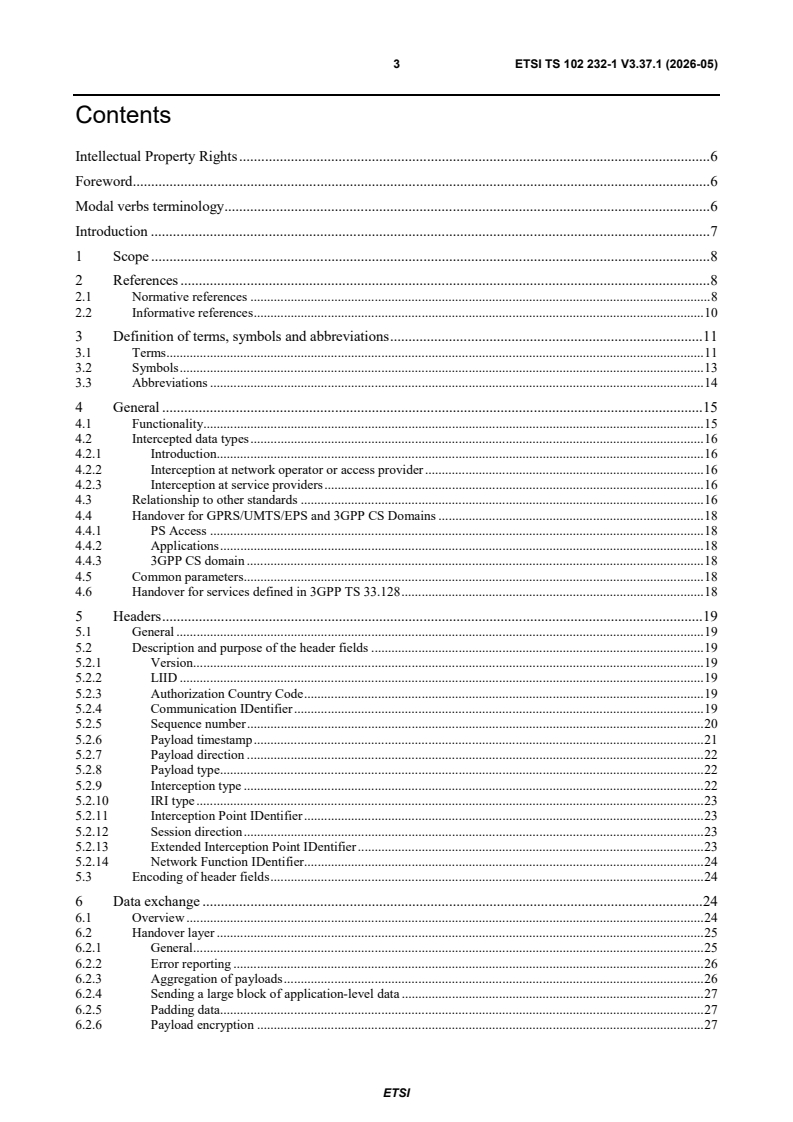
Contents
Intellectual Property Rights . 6
Foreword . 6
Modal verbs terminology . 6
Introduction . 7
1 Scope . 8
2 References . 8
2.1 Normative references . 8
2.2 Informative references . 10
3 Definition of terms, symbols and abbreviations . 11
3.1 Terms . 11
3.2 Symbols . 13
3.3 Abbreviations . 14
4 General . 15
4.1 Functionality . 15
4.2 Intercepted data types . 16
4.2.1 Introduction. 16
4.2.2 Interception at network operator or access provider . 16
4.2.3 Interception at service providers . 16
4.3 Relationship to other standards . 16
4.4 Handover for GPRS/UMTS/EPS and 3GPP CS Domains . 18
4.4.1 PS Access . 18
4.4.2 Applications . 18
4.4.3 3GPP CS domain . 18
4.5 Common parameters. 18
4.6 Handover for services defined in 3GPP TS 33.128 . 18
5 Headers . 19
5.1 General . 19
5.2 Description and purpose of the header fields . 19
5.2.1 Version . 19
5.2.2 LIID . 19
5.2.3 Authorization Country Code . 19
5.2.4 Communication IDentifier . 19
5.2.5 Sequence number . 20
5.2.6 Payload timestamp . 21
5.2.7 Payload direction . 22
5.2.8 Payload type. 22
5.2.9 Interception type . 22
5.2.10 IRI type . 23
5.2.11 Interception Point IDentifier . 23
5.2.12 Session direction . 23
5.2.13 Extended Interception Point IDentifier . 23
5.2.14 Network Function IDentifier. 24
5.3 Encoding of header fields . 24
6 Data exchange . 24
6.1 Overview . 24
6.2 Handover layer . 25
6.2.1 General . 25
6.2.2 Error reporting . 26
6.2.3 Aggregation of payloads . 26
6.2.4 Sending a large block of application-level data . 27
6.2.5 Padding data. 27
6.2.6 Payload encryption . 27
ETSI
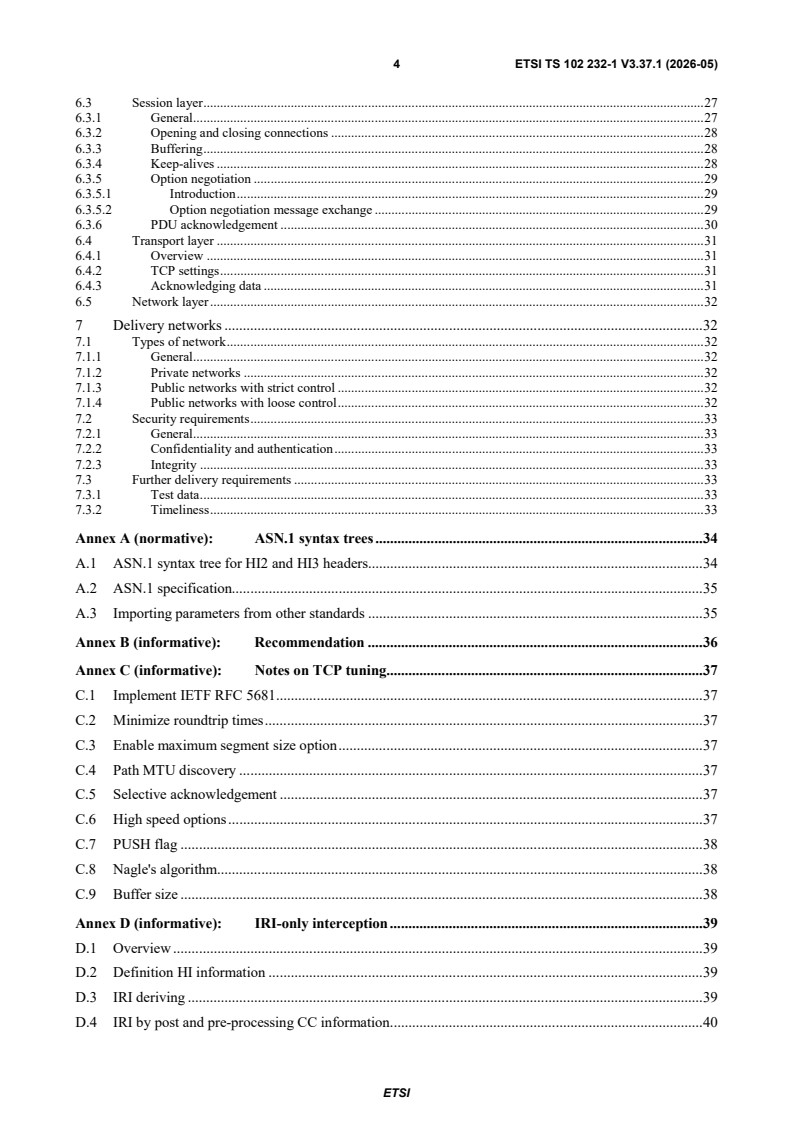
4 ETSI TS 102 232-1 V3.37.1 (2026-05)
6.3 Session layer . 27
6.3.1 General . 27
6.3.2 Opening and closing connections . 28
6.3.3 Buffering . 28
6.3.4 Keep-alives . 28
6.3.5 Option negotiation . 29
6.3.5.1 Introduction . 29
6.3.5.2 Option negotiation message exchange . 29
6.3.6 PDU acknowledgement . 30
6.4 Transport layer . 31
6.4.1 Overview . 31
6.4.2 TCP settings . 31
6.4.3 Acknowledging data . 31
6.5 Network layer . 32
7 Delivery networks . 32
7.1 Types of network . 32
7.1.1 General . 32
7.1.2 Private networks . 32
7.1.3 Public networks with strict control . 32
7.1.4 Public networks with loose control . 32
7.2 Security requirements . 33
7.2.1 General . 33
7.2.2 Confidentiality and authentication . 33
7.2.3 Integrity . 33
7.3 Further delivery requirements . 33
7.3.1 Test data . 33
7.3.2 Timeliness . 33
Annex A (normative): ASN.1 syntax trees . 34
A.1 ASN.1 syntax tree for HI2 and HI3 headers. 34
A.2 ASN.1 specification. 35
A.3 Importing parameters from other standards . 35
Annex B (informative): Recommendation . 36
Annex C (informative): Notes on TCP tuning. 37
C.1 Implement IETF RFC 5681 . 37
C.2 Minimize roundtrip times . 37
C.3 Enable maximum segment size option . 37
C.4 Path MTU discovery . 37
C.5 Selective acknowledgement . 37
C.6 High speed options . 37
C.7 PUSH flag . 38
C.8 Nagle's algorithm . 38
C.9 Buffer size . 38
Annex D (informative): IRI-only interception . 39
D.1 Overview . 39
D.2 Definition HI information . 39
D.3 IRI deriving . 39
D.4 IRI by post and pre-processing CC information . 40
ETSI
5 ETSI TS 102 232-1 V3.37.1 (2026-05)
Annex E (informative): Purpose of profiles . 41
E.0 Background . 41
E.1 Formal definitions . 41
E.2 Purpose of profiles . 41
Annex F (informative): Traffic management of the handover interface . 43
F.0 Rationale . 43
F.1 Factors to consider . 43
F.1.0 Background . 43
F.1.1 Burstiness . 43
F.1.2 Mixed content . 43
F.1.3 Network facilities for traffic management . 44
F.1.4 Evidentiary considerations . 44
F.1.5 National considerations . 44
F.2 Traffic management strategies . 44
F.3 Bandwidth estimation . 45
F.4 National considerations . 45
F.5 Implementation considerations . 46
F.5.1 Volatile versus non-volatile storage . 46
F.5.2 Maximum buffering time . 46
F.5.3 Transmission order of buffered data . 46
F.5.4 Buffer overflow processing . 46
Annex G (normative): Implementation of payload encryption . 47
Annex H (informative): ETSI TS 102 232 family relationship . 48
Annex I (informative): Option negotiation . 51
I.0 Summary . 51
I.1 Example use cases . 51
I.1.1 Option negotiation not supported in LGW . 51
I.1.2 Simple negotiation by both endpoints . 52
I.1.3 Simple DF-only option request . 53
I.1.4 Simple LGW-only option request . 54
I.1.5 Complex negotiation . 55
Annex J (normative): Implementation of Integrity Checks . 56
J.1 Definitions . 56
J.2 Process description . 56
J.3 Example integrity Chain . 57
Annex K (informative): Change history . 59
History . 65
ETSI
6 ETSI TS 102 232-1 V3.37.1 (2026-05)
Intellectual Property Rights
Essential patents
IPRs essential or potentially essential to normative deliverables may have been declared to ETSI. The declarations
pertaining to these essential IPRs, if any, are publicly available for ETSI members and non-members, and can be
found in ETSI SR 000 314: "Intellectual Property Rights (IPRs); Essential, or potentially Essential, IPRs notified to
ETSI in respect of ETSI standards", which is available from the ETSI Secretariat. Latest updates are available on the
ETSI IPR online database.
Pursuant to the ETSI Directives including the ETSI IPR Policy, no investigation regarding the essentiality of IPRs,
including IPR searches, has been carried out by ETSI. No guarantee can be given as to the existence of other IPRs not
referenced in ETSI SR 000 314 (or the updates on the ETSI Web server) which are, or may be, or may become,
essential to the present document.
Trademarks
The present document may include trademarks and/or tradenames which are asserted and/or registered by their owners.
ETSI claims no ownership of these except for any which are indicated as being the property of ETSI, and conveys no
right to use or reproduce any trademark and/or tradename. Mention of those trademarks in the present document does
not constitute an endorsement by ETSI of products, services or organizations associated with those trademarks.
DECT™, PLUGTESTS™, UMTS™ and the ETSI logo are trademarks of ETSI registered for the benefit of its
Members. 3GPP™, LTE™ and 5G™ logo are trademarks of ETSI registered for the benefit of its Members and of the
3GPP Organizational Partners. oneM2M™ logo is a trademark of ETSI registered for the benefit of its Members and of ®
the oneM2M Partners. GSM and the GSM logo are trademarks registered and owned by the GSM Association.
Foreword
This Technical Specification (TS) has been produced by ETSI Technical Committee Lawful Interception (LI).
The present document is part 1 of a multi-part deliverable covering the Handover Interface and Service-Specific
Details (SSD) for IP delivery, as identified below:
Part 1: "Handover specification for IP delivery";
Part 2: "Service-specific details for messaging services";
Part 3: "Service-specific details for internet access services";
Part 4: "Service-specific details for Layer 2 services";
Part 5: "Service-specific details for IP Multimedia services";
Part 6: "Service-specific details for PSTN/ISDN services";
Part 7: "Service-specific details for Mobile Services".
The ASN.1 module is available as an electronic attachment to the present document (see clause A.2 for more details).
Modal verbs terminology
In the present document "shall", "shall not", "should", "should not", "may", "need not", "will", "will not", "can" and
"cannot" are to be interpreted as described in clause 3.2 of the ETSI Drafting Rules (Verbal forms for the expression of
provisions).
"must" and "must not" are NOT allowed in ETSI deliverables except when used in direct citation.
ETSI
7 ETSI TS 102 232-1 V3.37.1 (2026-05)
Introduction
The objective of the present document is to form the basis for a standardized handover interface for use by both
telecommunications service providers and network operators, including Internet Service Providers that will deliver the
interception information required by Law Enforcement Authorities under various European treaties and national
regulations.
The present document describes how to handover intercepted information via IP-based networks from a CSP to an
LEMF. The present document covers the transportation of traffic, but does not specify functionality within CSPs or
LEMF (see clause 4.1). The present document handles the transportation of intercepted Content of Communication
(CC), Intercept-Related Information (IRI), Transport Related Information (TRI) and HI1 notification information. The
tasking and management of Lawful Interception via the HI1 interface is outside the scope of the present document.
The present document is intended to be general enough to be used in a variety of situations: it is not focused on a
particular IP-based service. The present document therefore provides information that is not dependent on the type of
service being intercepted. In particular the present document describes delivery mechanisms (clause 6), and the
structure and header details (clause 5) for both HI2 and HI3 information.
References within the main body of the present document are made if applicable to the 3GPP specification number with
in square brackets the reference number as listed in clause 2. In clause 2 "References" the corresponding ETSI
specification number is indicated with a reference to the 3GPP specification number. 3GPP specifications are available
faster than the equivalent ETSI specifications.
ETSI
8 ETSI TS 102 232-1 V3.37.1 (2026-05)
1 Scope
The present document specifies the general aspects of HI2 and HI3 interfaces for handover via IP based networks.
The present document:
• specifies the modular approach used for specifying IP based handover interfaces;
• specifies the header(s) to be added to IRI and CC sent over the HI2 and HI3 interfaces respectively;
• specifies protocols for the transfer of IRI and CC across the handover interfaces;
• specifies protocol profiles for the handover interface.
The present document is designed to be used where appropriate in conjunction with other deliverables that define the
service-specific IRI data formats (including ETSI TS 102 227 [i.1], ETSI TS 101 909-20-1 [33], ETSI
TS 101 909-20-2 [34], ETSI TS 102 232-2 [5], ETSI TS 102 232-3 [6], ETSI TS 102 232-4 [32], ETSI
TS 102 232-5 [37], ETSI TS 102 232-6 [36] and ETSI TS 102 232-7 [38]). Where possible, the present document aligns
with 3GPP TS 33.108 [9] and ETSI TS 101 671 [4] and supports the requirements and capabilities defined in ETSI
TS 101 331 [i.9] and ETSI TR 101 944 [i.4].
For the handover of intercepted data within GSM/UMTS PS and CS domains, the present document does not override
or supersede any specifications or requirements in 3GPP TS 33.108 [9].
For the handover of services defined in 3GPP TS 33.128 [46], in the event of conflict between the present document
and 3GPP TS 33.128 [46], the terms of 3GPP TS 33.128 [46] apply.
2 References
2.1 Normative references
References are either specific (identified by date of publication and/or edition number or version number) or
non-specific. For specific references, only the cited version applies. For non-specific references, the latest version of the
referenced document (including any amendments) applies.
Referenced documents which are not found to be publicly available in the expected location might be found in the
ETSI docbox.
NOTE: While any hyperlinks included in this clause were valid at the time of publication, ETSI cannot guarantee
their long-term validity.
The following referenced documents are necessary for the application of the present document.
[1] Void.
[2] Void.
[3] Void.
[4] ETSI TS 101 671: "Lawful Interception (LI); Handover interface for the lawful interception of
telecommunications traffic".
NOTE: ETSI TS 101 671 is in status "historical" and is not maintained.
[5] ETSI TS 102 232-2: "Lawful Interception (LI); Handover Interface and Service-Specific Details
(SSD) for IP delivery; Part 2: Service-specific details for messaging services".
[6] ETSI TS 102 232-3: "Lawful Interception (LI); Handover Interface and Service-Specific Details
(SSD) for IP delivery; Part 3: Service-specific details for internet access services".
[7] Void.
ETSI
9 ETSI TS 102 232-1 V3.37.1 (2026-05)
[8] Void.
[9] ETSI TS 133 108: "Universal Mobile Telecommunications System (UMTS); LTE; Digital cellular
telecommunications system (Phase 2+) (GSM); 3G security; Handover interface for Lawful
Interception (LI) (3GPP TS 33.108)".
[10] ISO 3166-1: "Codes for the representation of names of countries and their subdivisions — Part 1:
Country code".
[11] Recommendation ITU-T X.680: "Information technology - Abstract Syntax Notation One
(ASN.1): Specification of basic notation".
[12] Recommendation ITU-T X.690: "Information technology - ASN.1 encoding rules: Specification of
Basic Encoding Rules (BER), Canonical Encoding Rules (CER) and Distinguished Encoding
Rules (DER)".
[13] Void.
[14] IETF RFC 791: "Internet Protocol".
[15] Void.
[16] IETF RFC 9293: "Transmission Control Protocol (TCP)".
[17] IETF RFC 1122: "Requirements for Internet Hosts - Communication Layers".
[18] Void.
[19] Void.
[20] Void.
[21] IETF RFC 5246: "The Transport Layer Security (TLS) Protocol Version 1.2".
NOTE 1: IETF RFC 5246 obsoletes IETF RFC 4346: "The Transport Layer Security (TLS) Protocol Version 1.1"
and IETF RFC 3268: "Advanced Encryption Standard (AES) Ciphersuites for Transport Layer Security
(TLS)" which was referenced until ETSI TS 102 232-1 (V2.6.1).
NOTE 2: IETF RFC 4346 obsoletes IETF RFC 2246: "The TLS Protocol Version 1.0".
[22] Void.
[23] IETF RFC 5681: "TCP Congestion Control".
NOTE: IETF RFC 5681 obsoletes IETF RFC 2581: "TCP Congestion Control".
[24] Void.
[25] Void.
[26] Void.
[27] IETF RFC 6298: "Computing TCP's Retransmission Timer".
NOTE: IETF RFC 6298 obsoletes IETF RFC 2988: "Computing TCP's Retransmission Timer".
[28] Void.
[29] Void.
[30] IETF RFC 6818: "Updates to the Internet X.509 Public Key Infrastructure Certificate and
Certificate Revocation List (CRL) Profile".
NOTE: IETF RFC 6818 updates IETF RFC 5280: "Internet X.509 Public Key Infrastructure Certificate and
Certificate Revocation List (CRL) Profile".
[31] Void.
ETSI
10 ETSI TS 102 232-1 V3.37.1 (2026-05)
[32] ETSI TS 102 232-4: "Lawful Interception (LI); Handover Interface and Service-Specific Details
(SSD) for IP delivery; Part 4: Service-specific details for Layer 2 services".
[33] ETSI TS 101 909-20-1: "Digital Broadband Cable Access to the Public Telecommunications
Network; IP Multimedia Time Critical Services; Part 20: Lawful Interception; Sub-part 1: CMS
based Voice Telephony Services".
[34] ETSI TS 101 909-20-2: "Digital Broadband Cable Access to the Public Telecommunications
Network; IP Multimedia Time Critical Services; Part 20: Lawful Interception; Sub-part 2:
Streamed multimedia services".
[35] Void.
[36] ETSI TS 102 232-6: "Lawful interception (LI); Handover Interface and Service-Specific Details
(SSD) for IP delivery; Part 6: Service-specific details for PSTN/ISDN services".
[37] ETSI TS 102 232-5: "Lawful Interception (LI); Handover Interface and Service-Specific Details
(SSD) for IP delivery; Part 5: Service-specific details for IP Multimedia Services".
[38] ETSI TS 102 232-7: "Lawful Interception (LI); Handover Interface and Service-Specific Details
(SSD) for IP delivery; Part 7: Service-specific details for Mobile Services".
[39] Void.
[40] FIPS PUB 186-5: "Digital Signature Standard (DSS)".
[41] IETF RFC 7525: "Recommendations for Secure Use of Transport Layer Security (TLS) and
Datagram Transport Layer Security (DTLS)".
[42] FIPS PUB 180-4: "Secure Hash Standard (SHS)".
[43] Void.
[44] ETSI TS 103 280: "Lawful Interception (LI); Dictionary for common parameters".
[45] ETSI TS 103 462: "Lawful Interception (LI); Inter LEMF Handover Interface".
[46] ETSI TS 133 128: "Digital cellular telecommunications system (Phase 2+) (GSM); Universal
Mobile Telecommunications System (UMTS); LTE; 5G; Security; Protocol and procedures for
Lawful Interception (LI); Stage 3 (3GPP TS 33.128)".
[47] IETF RFC 8446: "The Transport Layer Security (TLS) Protocol Version 1.3".
2.2 Informative references
References are either specific (identified by date of publication and/or edition number or version number) or
non-specific. For specific references, only the cited version applies. For non-specific references, the latest version of the
referenced document (including any amendments) applies.
NOTE: While any hyperlinks included in this clause were valid at the time of publication, ETSI cannot guarantee
their long-term validity.
The following referenced documents may be useful in implementing an ETSI deliverable or add to the reader's
understanding, but are not required for conformance to the present document.
[i.1] ETSI TS 102 227: "Telecommunications and Internet Protocol Harmonization Over Networks
(TIPHON) Release 4; Functional Entities, Information Flow and Reference Point Definitions;
Lawful Interception".
[i.2] Library of Congress document Z39.50.
[i.3] Void.
[i.4] ETSI TR 101 944: "Telecommunications security; Lawful Interception (LI); Issues on IP
Interception".
ETSI
11 ETSI TS 102 232-1 V3.37.1 (2026-05)
[i.5] ETSI TR 102 503: "Lawful Interception (LI); ASN.1 Object Identifiers in Lawful Interception and
Retained data handling Specifications".
[i.6] Void.
[i.7] IETF RFC 2923: "TCP Problems with Path MTU Discovery".
[i.8] ISO/IEC TR 10000-1: "Information technology — Framework and taxonomy of International
Standardized Profiles — Part 1: General principles and documentation framework".
[i.9] ETSI TS 101 331: "Lawful Interception (LI); Requirements of Law Enforcement Agencies".
[i.10] ETSI TS 101 158: "Telecommunications security; Lawful Interception (LI); Requirements for
network functions".
[i.11] IETF RFC 792: "Internet Control Message Protocol".
[i.12] IETF RFC 7323: "TCP Extensions for High Performance".
[i.13] IETF RFC 1191: "Path MTU discovery".
[i.14] IETF RFC 2018: "TCP Selective Acknowledgement Options".
3 Definition of terms, symbols and abbreviations
3.1 Terms
For the purposes of the present document, the terms given in ETSI TS 101 158 [i.10], 3GPP TS 33.128 [46], ETSI
TS 101 331 [i.9] and the following apply:
Access Provider (AP): provides a user of some network with access from the user's terminal to that network
NOTE: This definition applies specifically for the present document. In a particular case, the access provider and
network operator may be a common commercial entity.
(to) buffer: temporary storing of information in case the connection to the LEMF is temporarily unavailable
call: any temporary switched connection capable of transferring information between two or more users of a
telecommunications system
NOTE: In this context a user may be a person or a machine.
communication: information transfer according to agreed conventions
Communication IDentifier (CID): See definition in clause 5.2.4.
Communication Identity Number (CIN): See definition in clause 5.2.4.
Communications Service Provider (CSP): organizations (e.g. Service Providers (SvP), Network Operators (NWO) or
Access Providers (AP)) who are obliged by law to provide interception
communications session: session that consists of either a single self-contained transaction or a series of protocol data
units that together form a single self-contained communication
Content of Communication (CC): information exchanged between two or more users of a telecommunication service,
excluding Intercept Related Information
NOTE: This includes information which may, as part of some telecommunication service, be stored by one user
for subsequent retrieval by another.
Handover Interface (HI): physical and logical interface across which the interception measures are requested from
network operator/access provider/service provider, and the results of interception are delivered from a network
operator/access provider/service provider to a Law Enforcement Monitoring Facility
ETSI
12 ETSI TS 102 232-1 V3.37.1 (2026-05)
identity: technical label which may represent the origin or destination of any telecommunications traffic, as a rule
clearly identified by a physical telecommunication identity number (such as a telephone number) or the logical or
virtual telecommunication identity number (such as a personal number) which the subscriber can assign to a physical
access on a case-by-case basis
information: intelligence or knowledge capable of being represented in forms suitable for communication, storage or
processing
NOTE: Information may be represented for example by signs, symbols, pictures or sounds.
interception: action (based on the law), performed by a network operator/access provider/service provider, of making
available certain information and providing that information to a Law Enforcement Monitoring Facility
NOTE: In the present document the term interception is not used to describe the action of observing
communications by a law enforcement agency.
interception measure: technical measure which facilitates the interception of telecommunications traffic pursuant to
the relevant national laws and regulations
interception subject: person or persons, specified in a lawful authorization, whose telecommunications are to be
intercepted
Intercept Related Information (IRI): collection of information or data associated with telecommunication services
involving the target identity, specifically communication associated information or data (including unsuccessful
communication attempts), service associated information or data (e.g. service profile management by subscriber) and
location information
international standardized profile: internationally agreed-to, harmonised document which describes one or more
profiles
invocation and operation: describes the action and conditions under which the service is brought into operation
NOTE: In the case of a lawful interception this may only be on a particular communication. It should be noted
that when lawful interception is activated, invocation is applicable on all communications (invocation
takes place either subsequent to or simultaneously with activation). Operation is the procedure which
occurs once a service has been invoked.
Law Enforcement Agency (LEA): organization authorized by a lawful authorization based on a national law to
request interception measures and to receive the results of telecommunications interceptions
Law Enforcement Monitoring Facility (LEMF): transmission destination for the results of interception relating to a
particular interception subject
lawful authorization: permission granted to a LEA under certain conditions to intercept specified telecommunications
and requiring co-operation from a network operator/access provider/service provider
NOTE: Typically this refers to a warrant or order issued by a lawfully authorized body.
Lawful Interception (LI): See interception.
Lawful Interception IDentifier (LIID): See definition in clause 5.2.2.
location information: information relating to the geographic, physical or logical location of an identity relating to an
interception subject
Mediation Function (MF): mechanism which passes information between a network operator, an access provider or
service provider and a Handover Interface, and information between the Internal Network Interface and the Handover
Interface
network element: component of the network structure, such as a local exchange, higher order switch or service control
processor
Network Element IDentifier (NEID): See definition in clause 5.2.4.
...
SLOVENSKI STANDARD
01-november-2026
Zakonito prestrezanje (LI) - Izročilni vmesnik in storitveno specifične podrobnosti
(SSD) za IP-dostavo vsebin - 1. del: Izročilna specifikacija za IP-dostavo vsebin
Lawful Interception (LI) - Handover Interface and Service-Specific Details (SSD) for IP
delivery - Part 1: Handover specification for IP delivery
Ta slovenski standard je istoveten z: ETSI TS 102 232-1 V3.37.1 (2026-05)
ICS:
35.240.95 Spletne uporabniške rešitve Internet applications
2003-01.Slovenski inštitut za standardizacijo. Razmnoževanje celote ali delov tega standarda ni dovoljeno.
TECHNICAL SPECIFICATION
Lawful Interception (LI);
Handover Interface and
Service-Specific Details (SSD) for IP delivery;
Part 1: Handover specification for IP delivery
2 ETSI TS 102 232-1 V3.37.1 (2026-05)
Reference
RTS/LI-00316-1
Keywords
handover, IP, lawful interception, security
ETSI
650 Route des Lucioles
F-06921 Sophia Antipolis Cedex - FRANCE
Tel.: +33 4 92 94 42 00 Fax: +33 4 93 65 47 16
Siret N° 348 623 562 00017 - APE 7112B
Association à but non lucratif enregistrée à la
Sous-Préfecture de Grasse (06) N° w061004871
Important notice
The present document can be downloaded from the
ETSI Search & Browse Standards application.
The present document may be made available in electronic versions and/or in print. The content of any electronic and/or
print versions of the present document shall not be modified without the prior written authorization of ETSI. In case of any
existing or perceived difference in contents between such versions and/or in print, the prevailing version of an ETSI
deliverable is the one made publicly available in PDF format on ETSI deliver repository.
Users should be aware that the present document may be revised or have its status changed,
this information is available in the Milestones listing.
If you find errors in the present document, please send your comments to
the relevant service listed under Committee Support Staff.
If you find a security vulnerability in the present document, please report it through our
Coordinated Vulnerability Disclosure (CVD) program.
Notice of disclaimer & limitation of liability
The information provided in the present deliverable is directed solely to professionals who have the appropriate degree of
experience to understand and interpret its content in accordance with generally accepted engineering or
other professional standard and applicable regulations.
No recommendation as to products and services or vendors is made or should be implied.
No representation or warranty is made that this deliverable is technically accurate or sufficient or conforms to any law
and/or governmental rule and/or regulation and further, no representation or warranty is made of merchantability or fitness
for any particular purpose or against infringement of intellectual property rights.
In no event shall ETSI be held liable for loss of profits or any other incidental or consequential damages.
Any software contained in this deliverable is provided "AS IS" with no warranties, express or implied, including but not
limited to, the warranties of merchantability, fitness for a particular purpose and non-infringement of intellectual property
rights and ETSI shall not be held liable in any event for any damages whatsoever (including, without limitation, damages
for loss of profits, business interruption, loss of information, or any other pecuniary loss) arising out of or related to the use
of or inability to use the software.
Copyright Notification
No part may be reproduced or utilized in any form or by any means, electronic or mechanical, including photocopying and
microfilm except as authorized by written permission of ETSI.
The content of the PDF version shall not be modified without the written authorization of ETSI.
The copyright and the foregoing restriction extend to reproduction in all media.
© ETSI 2026.
All rights reserved.
ETSI
3 ETSI TS 102 232-1 V3.37.1 (2026-05)
Contents
Intellectual Property Rights . 6
Foreword . 6
Modal verbs terminology . 6
Introduction . 7
1 Scope . 8
2 References . 8
2.1 Normative references . 8
2.2 Informative references . 10
3 Definition of terms, symbols and abbreviations . 11
3.1 Terms . 11
3.2 Symbols . 13
3.3 Abbreviations . 14
4 General . 15
4.1 Functionality . 15
4.2 Intercepted data types . 16
4.2.1 Introduction. 16
4.2.2 Interception at network operator or access provider . 16
4.2.3 Interception at service providers . 16
4.3 Relationship to other standards . 16
4.4 Handover for GPRS/UMTS/EPS and 3GPP CS Domains . 18
4.4.1 PS Access . 18
4.4.2 Applications . 18
4.4.3 3GPP CS domain . 18
4.5 Common parameters. 18
4.6 Handover for services defined in 3GPP TS 33.128 . 18
5 Headers . 19
5.1 General . 19
5.2 Description and purpose of the header fields . 19
5.2.1 Version . 19
5.2.2 LIID . 19
5.2.3 Authorization Country Code . 19
5.2.4 Communication IDentifier . 19
5.2.5 Sequence number . 20
5.2.6 Payload timestamp . 21
5.2.7 Payload direction . 22
5.2.8 Payload type. 22
5.2.9 Interception type . 22
5.2.10 IRI type . 23
5.2.11 Interception Point IDentifier . 23
5.2.12 Session direction . 23
5.2.13 Extended Interception Point IDentifier . 23
5.2.14 Network Function IDentifier. 24
5.3 Encoding of header fields . 24
6 Data exchange . 24
6.1 Overview . 24
6.2 Handover layer . 25
6.2.1 General . 25
6.2.2 Error reporting . 26
6.2.3 Aggregation of payloads . 26
6.2.4 Sending a large block of application-level data . 27
6.2.5 Padding data. 27
6.2.6 Payload encryption . 27
ETSI
4 ETSI TS 102 232-1 V3.37.1 (2026-05)
6.3 Session layer . 27
6.3.1 General . 27
6.3.2 Opening and closing connections . 28
6.3.3 Buffering . 28
6.3.4 Keep-alives . 28
6.3.5 Option negotiation . 29
6.3.5.1 Introduction . 29
6.3.5.2 Option negotiation message exchange . 29
6.3.6 PDU acknowledgement . 30
6.4 Transport layer . 31
6.4.1 Overview . 31
6.4.2 TCP settings . 31
6.4.3 Acknowledging data . 31
6.5 Network layer . 32
7 Delivery networks . 32
7.1 Types of network . 32
7.1.1 General . 32
7.1.2 Private networks . 32
7.1.3 Public networks with strict control . 32
7.1.4 Public networks with loose control . 32
7.2 Security requirements . 33
7.2.1 General . 33
7.2.2 Confidentiality and authentication . 33
7.2.3 Integrity . 33
7.3 Further delivery requirements . 33
7.3.1 Test data . 33
7.3.2 Timeliness . 33
Annex A (normative): ASN.1 syntax trees . 34
A.1 ASN.1 syntax tree for HI2 and HI3 headers. 34
A.2 ASN.1 specification. 35
A.3 Importing parameters from other standards . 35
Annex B (informative): Recommendation . 36
Annex C (informative): Notes on TCP tuning. 37
C.1 Implement IETF RFC 5681 . 37
C.2 Minimize roundtrip times . 37
C.3 Enable maximum segment size option . 37
C.4 Path MTU discovery . 37
C.5 Selective acknowledgement . 37
C.6 High speed options . 37
C.7 PUSH flag . 38
C.8 Nagle's algorithm . 38
C.9 Buffer size . 38
Annex D (informative): IRI-only interception . 39
D.1 Overview . 39
D.2 Definition HI information . 39
D.3 IRI deriving . 39
D.4 IRI by post and pre-processing CC information . 40
ETSI
5 ETSI TS 102 232-1 V3.37.1 (2026-05)
Annex E (informative): Purpose of profiles . 41
E.0 Background . 41
E.1 Formal definitions . 41
E.2 Purpose of profiles . 41
Annex F (informative): Traffic management of the handover interface . 43
F.0 Rationale . 43
F.1 Factors to consider . 43
F.1.0 Background . 43
F.1.1 Burstiness . 43
F.1.2 Mixed content . 43
F.1.3 Network facilities for traffic management . 44
F.1.4 Evidentiary considerations . 44
F.1.5 National considerations . 44
F.2 Traffic management strategies . 44
F.3 Bandwidth estimation . 45
F.4 National considerations . 45
F.5 Implementation considerations . 46
F.5.1 Volatile versus non-volatile storage . 46
F.5.2 Maximum buffering time . 46
F.5.3 Transmission order of buffered data . 46
F.5.4 Buffer overflow processing . 46
Annex G (normative): Implementation of payload encryption . 47
Annex H (informative): ETSI TS 102 232 family relationship . 48
Annex I (informative): Option negotiation . 51
I.0 Summary . 51
I.1 Example use cases . 51
I.1.1 Option negotiation not supported in LGW . 51
I.1.2 Simple negotiation by both endpoints . 52
I.1.3 Simple DF-only option request . 53
I.1.4 Simple LGW-only option request . 54
I.1.5 Complex negotiation . 55
Annex J (normative): Implementation of Integrity Checks . 56
J.1 Definitions . 56
J.2 Process description . 56
J.3 Example integrity Chain . 57
Annex K (informative): Change history . 59
History . 65
ETSI
6 ETSI TS 102 232-1 V3.37.1 (2026-05)
Intellectual Property Rights
Essential patents
IPRs essential or potentially essential to normative deliverables may have been declared to ETSI. The declarations
pertaining to these essential IPRs, if any, are publicly available for ETSI members and non-members, and can be
found in ETSI SR 000 314: "Intellectual Property Rights (IPRs); Essential, or potentially Essential, IPRs notified to
ETSI in respect of ETSI standards", which is available from the ETSI Secretariat. Latest updates are available on the
ETSI IPR online database.
Pursuant to the ETSI Directives including the ETSI IPR Policy, no investigation regarding the essentiality of IPRs,
including IPR searches, has been carried out by ETSI. No guarantee can be given as to the existence of other IPRs not
referenced in ETSI SR 000 314 (or the updates on the ETSI Web server) which are, or may be, or may become,
essential to the present document.
Trademarks
The present document may include trademarks and/or tradenames which are asserted and/or registered by their owners.
ETSI claims no ownership of these except for any which are indicated as being the property of ETSI, and conveys no
right to use or reproduce any trademark and/or tradename. Mention of those trademarks in the present document does
not constitute an endorsement by ETSI of products, services or organizations associated with those trademarks.
DECT™, PLUGTESTS™, UMTS™ and the ETSI logo are trademarks of ETSI registered for the benefit of its
Members. 3GPP™, LTE™ and 5G™ logo are trademarks of ETSI registered for the benefit of its Members and of the
3GPP Organizational Partners. oneM2M™ logo is a trademark of ETSI registered for the benefit of its Members and of ®
the oneM2M Partners. GSM and the GSM logo are trademarks registered and owned by the GSM Association.
Foreword
This Technical Specification (TS) has been produced by ETSI Technical Committee Lawful Interception (LI).
The present document is part 1 of a multi-part deliverable covering the Handover Interface and Service-Specific
Details (SSD) for IP delivery, as identified below:
Part 1: "Handover specification for IP delivery";
Part 2: "Service-specific details for messaging services";
Part 3: "Service-specific details for internet access services";
Part 4: "Service-specific details for Layer 2 services";
Part 5: "Service-specific details for IP Multimedia services";
Part 6: "Service-specific details for PSTN/ISDN services";
Part 7: "Service-specific details for Mobile Services".
The ASN.1 module is available as an electronic attachment to the present document (see clause A.2 for more details).
Modal verbs terminology
In the present document "shall", "shall not", "should", "should not", "may", "need not", "will", "will not", "can" and
"cannot" are to be interpreted as described in clause 3.2 of the ETSI Drafting Rules (Verbal forms for the expression of
provisions).
"must" and "must not" are NOT allowed in ETSI deliverables except when used in direct citation.
ETSI
7 ETSI TS 102 232-1 V3.37.1 (2026-05)
Introduction
The objective of the present document is to form the basis for a standardized handover interface for use by both
telecommunications service providers and network operators, including Internet Service Providers that will deliver the
interception information required by Law Enforcement Authorities under various European treaties and national
regulations.
The present document describes how to handover intercepted information via IP-based networks from a CSP to an
LEMF. The present document covers the transportation of traffic, but does not specify functionality within CSPs or
LEMF (see clause 4.1). The present document handles the transportation of intercepted Content of Communication
(CC), Intercept-Related Information (IRI), Transport Related Information (TRI) and HI1 notification information. The
tasking and management of Lawful Interception via the HI1 interface is outside the scope of the present document.
The present document is intended to be general enough to be used in a variety of situations: it is not focused on a
particular IP-based service. The present document therefore provides information that is not dependent on the type of
service being intercepted. In particular the present document describes delivery mechanisms (clause 6), and the
structure and header details (clause 5) for both HI2 and HI3 information.
References within the main body of the present document are made if applicable to the 3GPP specification number with
in square brackets the reference number as listed in clause 2. In clause 2 "References" the corresponding ETSI
specification number is indicated with a reference to the 3GPP specification number. 3GPP specifications are available
faster than the equivalent ETSI specifications.
ETSI
8 ETSI TS 102 232-1 V3.37.1 (2026-05)
1 Scope
The present document specifies the general aspects of HI2 and HI3 interfaces for handover via IP based networks.
The present document:
• specifies the modular approach used for specifying IP based handover interfaces;
• specifies the header(s) to be added to IRI and CC sent over the HI2 and HI3 interfaces respectively;
• specifies protocols for the transfer of IRI and CC across the handover interfaces;
• specifies protocol profiles for the handover interface.
The present document is designed to be used where appropriate in conjunction with other deliverables that define the
service-specific IRI data formats (including ETSI TS 102 227 [i.1], ETSI TS 101 909-20-1 [33], ETSI
TS 101 909-20-2 [34], ETSI TS 102 232-2 [5], ETSI TS 102 232-3 [6], ETSI TS 102 232-4 [32], ETSI
TS 102 232-5 [37], ETSI TS 102 232-6 [36] and ETSI TS 102 232-7 [38]). Where possible, the present document aligns
with 3GPP TS 33.108 [9] and ETSI TS 101 671 [4] and supports the requirements and capabilities defined in ETSI
TS 101 331 [i.9] and ETSI TR 101 944 [i.4].
For the handover of intercepted data within GSM/UMTS PS and CS domains, the present document does not override
or supersede any specifications or requirements in 3GPP TS 33.108 [9].
For the handover of services defined in 3GPP TS 33.128 [46], in the event of conflict between the present document
and 3GPP TS 33.128 [46], the terms of 3GPP TS 33.128 [46] apply.
2 References
2.1 Normative references
References are either specific (identified by date of publication and/or edition number or version number) or
non-specific. For specific references, only the cited version applies. For non-specific references, the latest version of the
referenced document (including any amendments) applies.
Referenced documents which are not found to be publicly available in the expected location might be found in the
ETSI docbox.
NOTE: While any hyperlinks included in this clause were valid at the time of publication, ETSI cannot guarantee
their long-term validity.
The following referenced documents are necessary for the application of the present document.
[1] Void.
[2] Void.
[3] Void.
[4] ETSI TS 101 671: "Lawful Interception (LI); Handover interface for the lawful interception of
telecommunications traffic".
NOTE: ETSI TS 101 671 is in status "historical" and is not maintained.
[5] ETSI TS 102 232-2: "Lawful Interception (LI); Handover Interface and Service-Specific Details
(SSD) for IP delivery; Part 2: Service-specific details for messaging services".
[6] ETSI TS 102 232-3: "Lawful Interception (LI); Handover Interface and Service-Specific Details
(SSD) for IP delivery; Part 3: Service-specific details for internet access services".
[7] Void.
ETSI
9 ETSI TS 102 232-1 V3.37.1 (2026-05)
[8] Void.
[9] ETSI TS 133 108: "Universal Mobile Telecommunications System (UMTS); LTE; Digital cellular
telecommunications system (Phase 2+) (GSM); 3G security; Handover interface for Lawful
Interception (LI) (3GPP TS 33.108)".
[10] ISO 3166-1: "Codes for the representation of names of countries and their subdivisions — Part 1:
Country code".
[11] Recommendation ITU-T X.680: "Information technology - Abstract Syntax Notation One
(ASN.1): Specification of basic notation".
[12] Recommendation ITU-T X.690: "Information technology - ASN.1 encoding rules: Specification of
Basic Encoding Rules (BER), Canonical Encoding Rules (CER) and Distinguished Encoding
Rules (DER)".
[13] Void.
[14] IETF RFC 791: "Internet Protocol".
[15] Void.
[16] IETF RFC 9293: "Transmission Control Protocol (TCP)".
[17] IETF RFC 1122: "Requirements for Internet Hosts - Communication Layers".
[18] Void.
[19] Void.
[20] Void.
[21] IETF RFC 5246: "The Transport Layer Security (TLS) Protocol Version 1.2".
NOTE 1: IETF RFC 5246 obsoletes IETF RFC 4346: "The Transport Layer Security (TLS) Protocol Version 1.1"
and IETF RFC 3268: "Advanced Encryption Standard (AES) Ciphersuites for Transport Layer Security
(TLS)" which was referenced until ETSI TS 102 232-1 (V2.6.1).
NOTE 2: IETF RFC 4346 obsoletes IETF RFC 2246: "The TLS Protocol Version 1.0".
[22] Void.
[23] IETF RFC 5681: "TCP Congestion Control".
NOTE: IETF RFC 5681 obsoletes IETF RFC 2581: "TCP Congestion Control".
[24] Void.
[25] Void.
[26] Void.
[27] IETF RFC 6298: "Computing TCP's Retransmission Timer".
NOTE: IETF RFC 6298 obsoletes IETF RFC 2988: "Computing TCP's Retransmission Timer".
[28] Void.
[29] Void.
[30] IETF RFC 6818: "Updates to the Internet X.509 Public Key Infrastructure Certificate and
Certificate Revocation List (CRL) Profile".
NOTE: IETF RFC 6818 updates IETF RFC 5280: "Internet X.509 Public Key Infrastructure Certificate and
Certificate Revocation List (CRL) Profile".
[31] Void.
ETSI
10 ETSI TS 102 232-1 V3.37.1 (2026-05)
[32] ETSI TS 102 232-4: "Lawful Interception (LI); Handover Interface and Service-Specific Details
(SSD) for IP delivery; Part 4: Service-specific details for Layer 2 services".
[33] ETSI TS 101 909-20-1: "Digital Broadband Cable Access to the Public Telecommunications
Network; IP Multimedia Time Critical Services; Part 20: Lawful Interception; Sub-part 1: CMS
based Voice Telephony Services".
[34] ETSI TS 101 909-20-2: "Digital Broadband Cable Access to the Public Telecommunications
Network; IP Multimedia Time Critical Services; Part 20: Lawful Interception; Sub-part 2:
Streamed multimedia services".
[35] Void.
[36] ETSI TS 102 232-6: "Lawful interception (LI); Handover Interface and Service-Specific Details
(SSD) for IP delivery; Part 6: Service-specific details for PSTN/ISDN services".
[37] ETSI TS 102 232-5: "Lawful Interception (LI); Handover Interface and Service-Specific Details
(SSD) for IP delivery; Part 5: Service-specific details for IP Multimedia Services".
[38] ETSI TS 102 232-7: "Lawful Interception (LI); Handover Interface and Service-Specific Details
(SSD) for IP delivery; Part 7: Service-specific details for Mobile Services".
[39] Void.
[40] FIPS PUB 186-5: "Digital Signature Standard (DSS)".
[41] IETF RFC 7525: "Recommendations for Secure Use of Transport Layer Security (TLS) and
Datagram Transport Layer Security (DTLS)".
[42] FIPS PUB 180-4: "Secure Hash Standard (SHS)".
[43] Void.
[44] ETSI TS 103 280: "Lawful Interception (LI); Dictionary for common parameters".
[45] ETSI TS 103 462: "Lawful Interception (LI); Inter LEMF Handover Interface".
[46] ETSI TS 133 128: "Digital cellular telecommunications system (Phase 2+) (GSM); Universal
Mobile Telecommunications System (UMTS); LTE; 5G; Security; Protocol and procedures for
Lawful Interception (LI); Stage 3 (3GPP TS 33.128)".
[47] IETF RFC 8446: "The Transport Layer Security (TLS) Protocol Version 1.3".
2.2 Informative references
References are either specific (identified by date of publication and/or edition number or version number) or
non-specific. For specific references, only the cited version applies. For non-specific references, the latest version of the
referenced document (including any amendments) applies.
NOTE: While any hyperlinks included in this clause were valid at the time of publication, ETSI cannot guarantee
their long-term validity.
The following referenced documents may be useful in implementing an ETSI deliverable or add to the reader's
understanding, but are not required for conformance to the present document.
[i.1] ETSI TS 102 227: "Telecommunications and Internet Protocol Harmonization Over Networks
(TIPHON) Release 4; Functional Entities, Information Flow and Reference Point Definitions;
Lawful Interception".
[i.2] Library of Congress document Z39.50.
[i.3] Void.
[i.4] ETSI TR 101 944: "Telecommunications security; Lawful Interception (LI); Issues on IP
Interception".
ETSI
11 ETSI TS 102 232-1 V3.37.1 (2026-05)
[i.5] ETSI TR 102 503: "Lawful Interception (LI); ASN.1 Object Identifiers in Lawful Interception and
Retained data handling Specifications".
[i.6] Void.
[i.7] IETF RFC 2923: "TCP Problems with Path MTU Discovery".
[i.8] ISO/IEC TR 10000-1: "Information technology — Framework and taxonomy of International
Standardized Profiles — Part 1: General principles and documentation framework".
[i.9] ETSI TS 101 331: "Lawful Interception (LI); Requirements of Law Enforcement Agencies".
[i.10] ETSI TS 101 158: "Telecommunications security; Lawful Interception (LI); Requirements for
network functions".
[i.11] IETF RFC 792: "Internet Control Message Protocol".
[i.12] IETF RFC 7323: "TCP Extensions for High Performance".
[i.13] IETF RFC 1191: "Path MTU discovery".
[i.14] IETF RFC 2018: "TCP Selective Acknowledgement Options".
3 Definition of terms, symbols and abbreviations
3.1 Terms
For the purposes of the present document, the terms given in ETSI TS 101 158 [i.10], 3GPP TS 33.128 [46], ETSI
TS 101 331 [i.9] and the following apply:
Access Provider (AP): provides a user of some network with access from the user's terminal to that network
NOTE: This definition applies specifically for the present document. In a particular case, the access provider and
network operator may be a common commercial entity.
(to) buffer: temporary storing of information in case the connection to the LEMF is temporarily unavailable
call: any temporary switched connection capable of transferring information between two or more users of a
telecommunications system
NOTE: In this context a user may be a person or a machine.
communication: information transfer according to agreed conventions
Communication IDentifier (CID): See definition in clause 5.2.4.
Communication Identity Number (CIN): See definition in clause 5.2.4.
Communications Service Provider (CSP): organizations (e.g. Service Providers (SvP), Network Operators (NWO) or
Access Providers (AP)) who are obliged by law to provide interception
communications session: session that consists of either a single self-contained transaction or a series of protocol data
units that together form a single self-contained communication
Content of Communication (CC): information exchanged between two or more users of a telecommunication service,
excluding Intercept Related Information
NOTE: This includes information which may, as part of some telecommunication service, be stored by one user
for subsequent retrieval by another.
Handover Interface (HI): physical and logical interface across which the interception measures are requested from
network operator/access provider/service provider, and the results of interception are delivered from a network
operator/access provider/service provider to a Law Enforcement Monitoring Facility
ETSI
12 ETSI TS 102 232-1 V3.37.1 (2026-05)
identity: technical label which may represent the origin or destination of any telecommunications traffic, as a rule
clearly identified by a physical telecommunication identity number (such as a telephone number) or the logical or
virtual telecommunication identity number (such as a personal number) which the subscriber can assign to a physical
access on a case-by-case basis
information: intelligence or knowledge capable of being represented in forms suitable for communication, storage or
processing
NOTE: Information may be represented for example by signs, symbols, pictures or sounds.
interception: action (based on the law), performed by a network operator/access provider/service provider, of making
available certain information and providing that information to a Law Enforcement Monitoring Facility
NOTE: In the present document the term interception is not used to describe the action of observing
communications by a law enforcement agency.
interception measure: technical measure which facilitates the interception of telecommunications traffic pursuant to
the relevant national laws and regulations
interception subject: person or persons, specified in a lawful authorization, whose telecommunications are to be
intercepted
Intercept Related Information (IRI): collection of information or data associated with telecommunication services
involving the target identity, specifically communication associated information or data (including unsuccessful
communication attempts), service associated information or data (e.g. service profile management by subscriber) and
location information
international standardized profile: internationally agreed-to, harmonised document which describes one or more
profiles
invocation and operation: describes the action and conditions under which the service is brought into operation
NOTE: In the case of a lawful interception this may only be on a particular communication. It should be noted
that when lawful interception is activated, invocation is applicable on all communications (invocation
takes place either subsequent to or simultaneously with activation). Operation is the procedure which
occurs once a service has been invoked.
Law Enforcem
...