

SIST EN ISO 10451:2026
(Main)Dentistry - Contents of a technical file for dental implant systems (ISO 10451:2026)
General Information
- Abstract
This document specifies requirements for the contents of a technical file to demonstrate the fulfilment of regulatory requirements for an endosseous dental implant that can include:
implant body;
implant abutment;
abutment screw;
implant connecting part;
implant connecting part screw;
prosthetic screw;
implant cover screw;
transmucosal healing component.
This document also specifies requirements for intended use and performance, design attributes, components, biocompatibility, manufacturing, packaging, sterilization, shelf life, marking, labelling and information supplied by the manufacturer.
This document does not apply to the following devices:
dental implants incorporating animal or human components or bioactive characteristics;
custom-made devices that have no pre-fabricated connection;
implantable materials for bone filling and augmentation in oral and maxillofacial surgery;
membrane materials for guided tissue regeneration in oral and maxillofacial surgery;
specific instruments indicated to be used as part of a dental implant system.
NOTE 1 ISO 22794 specifies the necessary content of technical files for implantable materials for bone filling and augmentation in oral and maxillofacial surgery. ISO 22803 specifies the necessary content of technical files for membrane materials for guided tissue regeneration in oral and maxillofacial surgery. These materials require a separate technical file.
NOTE 2 ISO 13504 gives the general requirements for specific instruments indicated to be used as part of a dental implant system. These instruments require a separate technical file.
NOTE 3 Custom-made devices are defined in IMDRF/PMD WG/N49 [5].
- Status
- Published
- Public Enquiry End Date
- 29-Jan-2025
- Publication Date
- 16-Apr-2026
- Technical Committee
- VAZ - Healthcare
- Current Stage
- 6060 - National Implementation/Publication (Adopted Project)
- Start Date
- 09-Apr-2026
- Due Date
- 14-Jun-2026
- Completion Date
- 17-Apr-2026

Overview
SIST EN ISO 10451:2026 – Dentistry – Contents of a technical file for dental implant systems is an international standard developed by ISO and CEN. It specifies requirements for the technical documentation needed to demonstrate regulatory compliance for endosseous dental implant systems. These systems typically include the implant body, abutments, screws, connecting parts, cover screws, and healing components. The standard outlines in detail the information that manufacturers of dental implants must provide to support safety, performance, and market approval. It facilitates consistency across regulatory jurisdictions and is crucial for ensuring patient safety and product reliability.
Key Topics
The core requirements defined by SIST EN ISO 10451:2026 for the contents of a technical file include:
Device Description and Specification:
- Clear identification and description of all components.
- Intended use, design attributes, patient indications, and any contraindications.
- Material composition and properties.
Risk Management:
- Execution of a comprehensive risk analysis following ISO 14971.
- Documentation of measures taken to control and communicate residual risks.
Manufacturing Information:
- Details and locations of manufacturing sites.
- Description of quality management systems (e.g., compliant with ISO 13485).
- Flowcharts, process validation, and packaging controls.
Verification and Validation:
- Test reports and plans demonstrating product safety and performance (biocompatibility, mechanical testing, sterilization validation, and more).
- Conformance to relevant test methods and standards for dental implants.
Clinical Evaluation and Investigation:
- Summaries of clinical data, literature reviews, or clinical trials, particularly for new or innovative devices.
- Risk-benefit assessment and reporting requirements.
Labelling and Information:
- Clear labelling, instructions for use, indications, and warnings.
- Use of standardized symbols in compliance with ISO 15223.
Post-Market Surveillance:
- Procedures for collecting real-world data, maintaining clinical safety, and addressing post-market issues.
Applications
SIST EN ISO 10451:2026 is practically valuable for:
- Manufacturers of dental implants: Providing a roadmap for assembling a compliant technical file that facilitates market access in Europe and internationally.
- Regulatory authorities and notified bodies: Serving as a benchmark to assess the safety, quality, and compliance of dental implant systems.
- Quality managers and regulatory affairs professionals: Guiding the integration of risk management, clinical evaluation, and post-market surveillance into product development and lifecycle management.
- Dental professionals and clinics: Enhancing confidence in selecting certified dental implant products backed by rigorous technical documentation.
Related Standards
Several important ISO standards are referenced within SIST EN ISO 10451:2026 to ensure comprehensive coverage of safety and performance aspects:
- ISO 13485: Medical devices – Quality management systems.
- ISO 14971: Medical devices – Application of risk management.
- ISO 10993-1 & ISO 10993-17: Biological evaluation of medical devices.
- ISO 11135, ISO 11137, ISO 17665: Sterilization of healthcare products.
- ISO 14801: Dynamic loading test for endosseous dental implants.
- ISO 20417: Information to be supplied by the manufacturer.
- ISO 15223-1 & ISO 15223-2: Medical device symbols for labelling.
- ISO 14155: Clinical investigation of medical devices.
- ISO 22683: Rotational adaptability of implant components.
For technical files concerning related but excluded products (such as bone filling materials, custom-made devices, or guided tissue regeneration membranes), see:
- ISO 22794: Technical files for bone filling/augmentation.
- ISO 22803: Technical files for membrane materials.
- ISO 13504: Requirements for dental implant system instruments.
Conclusion
SIST EN ISO 10451:2026 streamlines the regulatory pathway for dental implant systems by defining the essential contents of a technical file. Its adoption supports compliance in the dental industry, fosters international harmonization, and underpins patient safety and product efficacy in dental implantology.
Relations
- Effective Date
- 01-Jun-2026
- Effective Date
- 01-Apr-2026
Get Certified
Connect with accredited certification bodies for this standard

BSI Group
BSI (British Standards Institution) is the business standards company that helps organizations make excellence a habit.

TÜV Rheinland
TÜV Rheinland is a leading international provider of technical services.

TÜV SÜD
TÜV SÜD is a trusted partner of choice for safety, security and sustainability solutions.
Sponsored listings
Frequently Asked Questions
SIST EN ISO 10451:2026 is a standard published by the Slovenian Institute for Standardization (SIST). Its full title is "Dentistry - Contents of a technical file for dental implant systems (ISO 10451:2026)". This standard covers: This document specifies requirements for the contents of a technical file to demonstrate the fulfilment of regulatory requirements for an endosseous dental implant that can include: implant body; implant abutment; abutment screw; implant connecting part; implant connecting part screw; prosthetic screw; implant cover screw; transmucosal healing component. This document also specifies requirements for intended use and performance, design attributes, components, biocompatibility, manufacturing, packaging, sterilization, shelf life, marking, labelling and information supplied by the manufacturer. This document does not apply to the following devices: dental implants incorporating animal or human components or bioactive characteristics; custom-made devices that have no pre-fabricated connection; implantable materials for bone filling and augmentation in oral and maxillofacial surgery; membrane materials for guided tissue regeneration in oral and maxillofacial surgery; specific instruments indicated to be used as part of a dental implant system. NOTE 1 ISO 22794 specifies the necessary content of technical files for implantable materials for bone filling and augmentation in oral and maxillofacial surgery. ISO 22803 specifies the necessary content of technical files for membrane materials for guided tissue regeneration in oral and maxillofacial surgery. These materials require a separate technical file. NOTE 2 ISO 13504 gives the general requirements for specific instruments indicated to be used as part of a dental implant system. These instruments require a separate technical file. NOTE 3 Custom-made devices are defined in IMDRF/PMD WG/N49 [5].
This document specifies requirements for the contents of a technical file to demonstrate the fulfilment of regulatory requirements for an endosseous dental implant that can include: implant body; implant abutment; abutment screw; implant connecting part; implant connecting part screw; prosthetic screw; implant cover screw; transmucosal healing component. This document also specifies requirements for intended use and performance, design attributes, components, biocompatibility, manufacturing, packaging, sterilization, shelf life, marking, labelling and information supplied by the manufacturer. This document does not apply to the following devices: dental implants incorporating animal or human components or bioactive characteristics; custom-made devices that have no pre-fabricated connection; implantable materials for bone filling and augmentation in oral and maxillofacial surgery; membrane materials for guided tissue regeneration in oral and maxillofacial surgery; specific instruments indicated to be used as part of a dental implant system. NOTE 1 ISO 22794 specifies the necessary content of technical files for implantable materials for bone filling and augmentation in oral and maxillofacial surgery. ISO 22803 specifies the necessary content of technical files for membrane materials for guided tissue regeneration in oral and maxillofacial surgery. These materials require a separate technical file. NOTE 2 ISO 13504 gives the general requirements for specific instruments indicated to be used as part of a dental implant system. These instruments require a separate technical file. NOTE 3 Custom-made devices are defined in IMDRF/PMD WG/N49 [5].
SIST EN ISO 10451:2026 is classified under the following ICS (International Classification for Standards) categories: 11.060.15 - Dental implants. The ICS classification helps identify the subject area and facilitates finding related standards.
SIST EN ISO 10451:2026 has the following relationships with other standards: It is inter standard links to SIST EN ISO 10451:2010, SIST EN 1642:2012. Understanding these relationships helps ensure you are using the most current and applicable version of the standard.
SIST EN ISO 10451:2026 is available in PDF format for immediate download after purchase. The document can be added to your cart and obtained through the secure checkout process. Digital delivery ensures instant access to the complete standard document.
Standards Content (Sample)
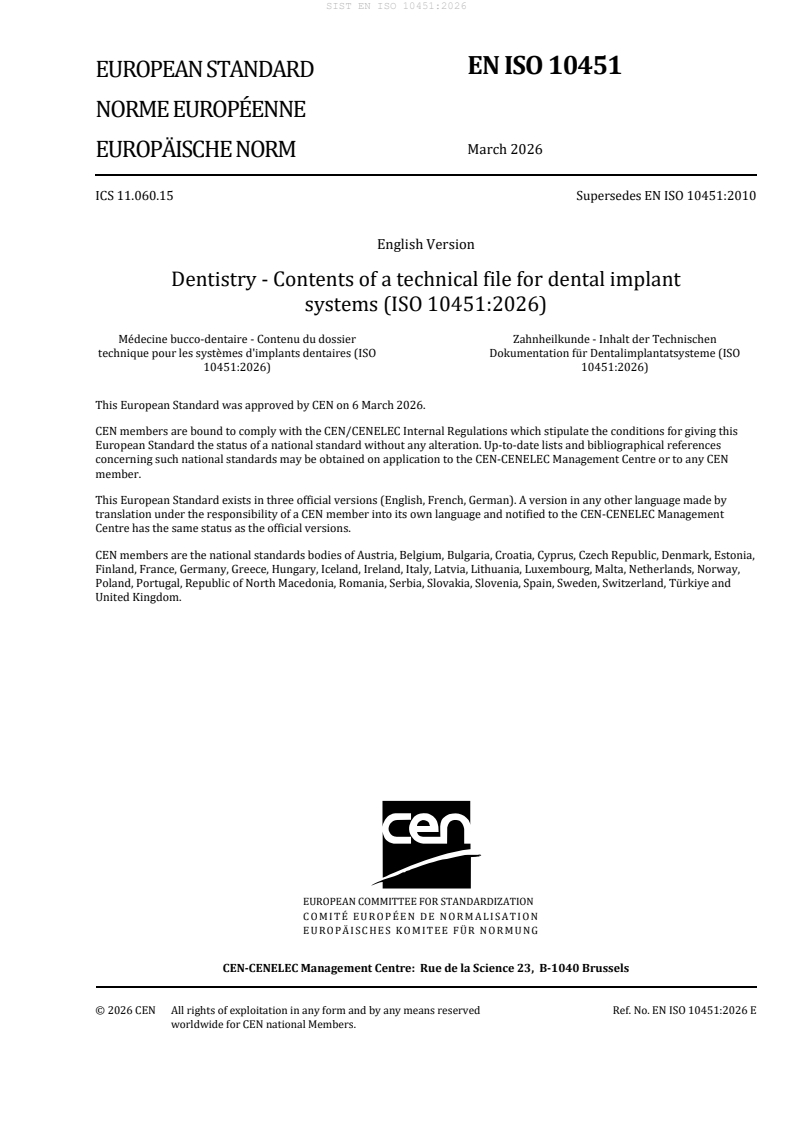
SLOVENSKI STANDARD
01-junij-2026
Nadomešča:
SIST EN ISO 10451:2010
Zobozdravstvo - Vsebina tehnične mape za sistem zobnih vsadkov (implantatov)
(ISO 10451:2026)
Dentistry - Contents of a technical file for dental implant systems (ISO 10451:2026)
Zahnheilkunde - Inhalt der Technischen Dokumentation für Dentalimplantatsysteme (ISO
10451:2026)
Médecine bucco-dentaire - Contenu du dossier technique pour les systèmes d'implants
dentaires (ISO 10451:2026)
Ta slovenski standard je istoveten z: EN ISO 10451:2026
ICS:
11.060.15 Zobni implantati Dental implants
2003-01.Slovenski inštitut za standardizacijo. Razmnoževanje celote ali delov tega standarda ni dovoljeno.
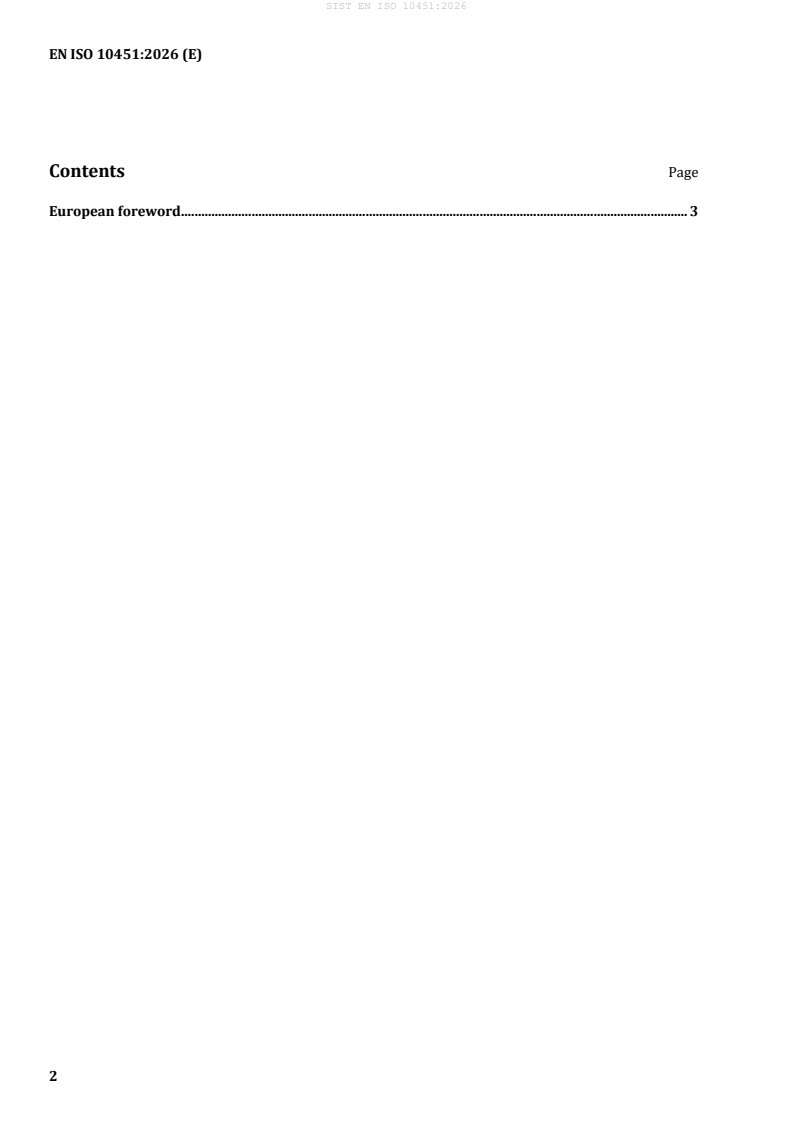
EN ISO 10451
EUROPEAN STANDARD
NORME EUROPÉENNE
March 2026
EUROPÄISCHE NORM
ICS 11.060.15 Supersedes EN ISO 10451:2010
English Version
Dentistry - Contents of a technical file for dental implant
systems (ISO 10451:2026)
Médecine bucco-dentaire - Contenu du dossier Zahnheilkunde - Inhalt der Technischen
technique pour les systèmes d'implants dentaires (ISO Dokumentation für Dentalimplantatsysteme (ISO
10451:2026) 10451:2026)
This European Standard was approved by CEN on 6 March 2026.
CEN members are bound to comply with the CEN/CENELEC Internal Regulations which stipulate the conditions for giving this
European Standard the status of a national standard without any alteration. Up-to-date lists and bibliographical references
concerning such national standards may be obtained on application to the CEN-CENELEC Management Centre or to any CEN
member.
This European Standard exists in three official versions (English, French, German). A version in any other language made by
translation under the responsibility of a CEN member into its own language and notified to the CEN-CENELEC Management
Centre has the same status as the official versions.
CEN members are the national standards bodies of Austria, Belgium, Bulgaria, Croatia, Cyprus, Czech Republic, Denmark, Estonia,
Finland, France, Germany, Greece, Hungary, Iceland, Ireland, Italy, Latvia, Lithuania, Luxembourg, Malta, Netherlands, Norway,
Poland, Portugal, Republic of North Macedonia, Romania, Serbia, Slovakia, Slovenia, Spain, Sweden, Switzerland, Türkiye and
United Kingdom.
EUROPEAN COMMITTEE FOR STANDARDIZATION
COMITÉ EUROPÉEN DE NORMALISATION
EUROPÄISCHES KOMITEE FÜR NORMUNG
CEN-CENELEC Management Centre: Rue de la Science 23, B-1040 Brussels
© 2026 CEN All rights of exploitation in any form and by any means reserved Ref. No. EN ISO 10451:2026 E
worldwide for CEN national Members.
Contents Page
European foreword . 3
European foreword
This document (EN ISO 10451:2026) has been prepared by Technical Committee ISO/TC 106
"Dentistry" in collaboration with Technical Committee CEN/TC 55 “Dentistry” the secretariat of which
is held by DIN.
This European Standard shall be given the status of a national standard, either by publication of an
identical text or by endorsement, at the latest by September 2026, and conflicting national standards
shall be withdrawn at the latest by September 2026.
Attention is drawn to the possibility that some of the elements of this document may be the subject of
patent rights. CEN shall not be held responsible for identifying any or all such patent rights.
This document supersedes EN ISO 10451:2010.
Any feedback and questions on this document should be directed to the users’ national standards
body/national committee. A complete listing of these bodies can be found on the CEN website.
According to the CEN-CENELEC Internal Regulations, the national standards organizations of the
following countries are bound to implement this European Standard: Austria, Belgium, Bulgaria,
Croatia, Cyprus, Czech Republic, Denmark, Estonia, Finland, France, Germany, Greece, Hungary, Iceland,
Ireland, Italy, Latvia, Lithuania, Luxembourg, Malta, Netherlands, Norway, Poland, Portugal, Republic of
North Macedonia, Romania, Serbia, Slovakia, Slovenia, Spain, Sweden, Switzerland, Türkiye and the
United Kingdom.
Endorsement notice
The text of ISO 10451:2026 has been approved by CEN as EN ISO 10451:2026 without any modification.
International
Standard
ISO 10451
Third edition
Dentistry — Contents of a technical
2026-03
file for dental implant systems
Médecine bucco-dentaire — Contenu du dossier technique pour
les systèmes d'implants dentaires
Reference number
ISO 10451:2026(en) © ISO 2026
ISO 10451:2026(en)
© ISO 2026
All rights reserved. Unless otherwise specified, or required in the context of its implementation, no part of this publication may
be reproduced or utilized otherwise in any form or by any means, electronic or mechanical, including photocopying, or posting on
the internet or an intranet, without prior written permission. Permission can be requested from either ISO at the address below
or ISO’s member body in the country of the requester.
ISO copyright office
CP 401 • Ch. de Blandonnet 8
CH-1214 Vernier, Geneva
Phone: +41 22 749 01 11
Email: copyright@iso.org
Website: www.iso.org
Published in Switzerland
ii
ISO 10451:2026(en)
Contents Page
Foreword .iv
Introduction .v
1 Scope . 1
2 Normative references . 1
3 Terms and definitions . 3
4 Technical file content and requirements. 3
4.1 General .3
4.2 Device description and specification.4
4.3 Risk analysis .5
4.4 Infection and microbial contamination .5
4.5 Manufacturing information .5
4.6 Verification and validation activities .6
4.7 Clinical evaluation and clinical investigation .7
4.8 Information supplied by the manufacturer .8
4.9 Post market surveillance .9
Annex A (informative) List of identified hazards for dental implants .10
Bibliography .12
iii
ISO 10451:2026(en)
Foreword
ISO (the International Organization for Standardization) is a worldwide federation of national standards
bodies (ISO member bodies). The work of preparing International Standards is normally carried out through
ISO technical committees. Each member body interested in a subject for which a technical committee
has been established has the right to be represented on that committee. International organizations,
governmental and non-governmental, in liaison with ISO, also take part in the work. ISO collaborates closely
with the International Electrotechnical Commission (IEC) on all matters of electrotechnical standardization.
The procedures used to develop this document and those intended for its further maintenance are described
in the ISO/IEC Directives, Part 1. In particular, the different approval criteria needed for the different types
of ISO document should be noted. This document was drafted in accordance with the editorial rules of the
ISO/IEC Directives, Part 2 (see www.iso.org/directives).
ISO draws attention to the possibility that the implementation of this document may involve the use of (a)
patent(s). ISO takes no position concerning the evidence, validity or applicability of any claimed patent
rights in respect thereof. As of the date of publication of this document, ISO had not received notice of (a)
patent(s) which may be required to implement this document. However, implementers are cautioned that
this may not represent the latest information, which may be obtained from the patent database available at
www.iso.org/patents. ISO shall not be held responsible for identifying any or all such patent rights.
Any trade name used in this document is information given for the convenience of users and does not
constitute an endorsement.
For an explanation of the voluntary nature of standards, the meaning of ISO specific terms and expressions
related to conformity assessment, as well as information about ISO's adherence to the World Trade
Organization (WTO) principles in the Technical Barriers to Trade (TBT), see www.iso.org/iso/foreword.html.
This document was prepared by Technical Committee ISO/TC 106, Dentistry, Subcommittee SC 8, Dental
implants, in collaboration with the European Committee for Standardization (CEN) Technical Committee
CEN/TC 55, Dentistry, in accordance with the Agreement on technical cooperation between ISO and CEN
(Vienna Agreement).
This third edition cancels and replaces the second edition (ISO 10451:2010), which has been technically
revised.
The main changes are as follows:
[1]
— technical file has been reworked to take into account the new European Medical Device Regulation ;
— Annex A has been added.
Any feedback or questions on this document should be directed to the user’s national standards body. A
complete listing of these bodies can be found at www.iso.org/members.html.
iv
ISO 10451:2026(en)
Introduction
Legal and regulatory requirements on the documentation of the design, manufacture and performance of
dental implants are developing in different ways around the world. As the dental implant industry is already
active on a global basis, and is becoming more so, concern is growing as to the need for international and
mutually recognized standards for the documentation of the design and performance of such devices.
v
International Standard ISO 10451:2026(en)
Dentistry — Contents of a technical file for dental implant
systems
1 Scope
This document specifies requirements for the contents of a technical file to demonstrate the fulfilment of
regulatory requirements for an endosseous dental implant that can include:
— implant body;
— implant abutment;
— abutment screw;
— implant connecting part;
— implant connecting part screw;
— prosthetic screw;
— implant cover screw;
— transmucosal healing component.
This document also specifies requirements for intended use and performance, design attributes, components,
biocompatibility, manufacturing, packaging, sterilization, shelf life, marking, labelling and information
supplied by the manufacturer.
This document does not apply to the following devices:
— dental implants incorporating animal or human components or bioactive characteristics;
— custom-made devices that have no pre-fabricated connection;
— implantable materials for bone filling and augmentation in oral and maxillofacial surgery;
— membrane materials for guided tissue regeneration in oral and maxillofacial surgery;
— specific instruments indicated to be used as part of a dental implant system.
NOTE 1 ISO 22794 specifies the necessary content of technical files for implantable materials for bone filling
and augmentation in oral and maxillofacial surgery. ISO 22803 specifies the necessary content of technical files for
membrane materials for guided tissue regeneration in oral and maxillofacial surgery. These materials require a
separate technical file.
NOTE 2 ISO 13504 gives the general requirements for specific instruments indicated to be used as part of a dental
implant system. These instruments require a separate technical file.
[5]
NOTE 3 Custom-made devices are defined in IMDRF/PMD WG/N49 .
2 Normative references
The following documents are referred to in the text in such a way that some or all of their content constitutes
requirements of this document. For dated references, only the edition cited applies. For undated references,
the latest edition of the referenced document (including any amendments) applies.
ISO 1942, Dentistry — Vocabulary
ISO 10451:2026(en)
ISO 3950, Dentistry — Designation system for teeth and areas of the oral cavity
ISO 7405, Dentistry — Evaluation of biocompatibility of medical devices used in dentistry
ISO 10271, Dentistry — Corrosion test methods for metallic materials
ISO 10993-1, Biological evaluation of medical devices — Part 1: Requirements and general principles for the
evaluation of biological safety within a risk management process
ISO 10993-17, Biological evaluation of medical devices — Part 17: Toxicological risk assessment of medical
device constituents
ISO 11135, Sterilization of health-care products — Ethylene oxide — Requirements for the development,
validation and routine control of a sterilization process for medical devices
ISO 11137-1, Sterilization of health care products — Radiation — Part 1: Requirements for the development,
validation and routine control of a sterilization process for medical devices
ISO 11137-2, Sterilization of health care products — Radiation — Part 2: Establishing the sterilization dose
ISO 11607-1, Packaging for terminally sterilized medical devices — Part 1: Requirements for materials, sterile
barrier systems and packaging systems
ISO 11607-2, Packaging for terminally sterilized medical devices — Part 2: Validation requirements for forming,
sealing and assembly processes
ISO 13485, Medical devices — Quality management systems — Requirements for regulatory purposes
ISO 14155, Clinical investigation of medical devices for human subjects — Good clinical practice
ISO 14644-1, Cleanrooms and associated controlled environments — Part 1: Classification of air cleanliness by
particle concentration
ISO 14801, Dentistry — Implants — Dynamic loading test for endosseous dental implants
ISO 14971, Medical devices — Application of risk management to medical devices
ISO 15223-1, Medical devices — Symbols to be used with information to be supplied by the manufacturer — Part
1: General requirements
ISO 15223-2, Medical devices — Symbols to be used with medical device labels, labelling, and information to be
supplied — Part 2: Symbol development, selection and validation
ISO 16443, Dentistry — Vocabulary for dental implants systems and related procedure
ISO 17664-1, Processing of health care products — Information to be provided by the medical device
manufacturer for the processing of medical devices — Part 1: Critical and semi-critical medical devices
ISO 17665, Sterilization of health care products — Moist heat — Requirements for the development, validation
and routine control of a sterilization process for medical devices
ISO 20417, Medical devices — Information to be supplied by the manufacturer
ISO 22683, Dentistry — Rotational adaptability test between implant body and implant abutment in dental
implant systems
IEC 62366-1, Medical devices — Part 1: Application of usability engineering to medical devices
ISO 10451:2026(en)
3 Terms and definitions
For the purposes of this document, the terms and definitions given in ISO 1942, ISO 3950, ISO 16443,
ISO 13485 and the following apply.
ISO and IEC maintain terminology databases for use in standardization at the following addresses:
— ISO Online browsing platform: available at https:// www .iso .org/ obp
— IEC Electropedia: available at https:// www .electropedia .org/
3.1
clinical evaluation
assessment and analysis of clinical data pertaining to a medical device to verify the clinical safety and
performance of the device when used as intended by the manufacturer
[SOURCE: ISO 13485:2016, 3.3]
3.2
dental implant assembly
assembly of dental implant components as recommended by the manufacturer to serve the purposes of a
dental implant
[SOURCE: ISO 16443:2014, 3.2.3]
3.3
implant component coating
layer of material, different from the constitutive material of the implant component, used to cover or
partially cover a defined surface of an implant body or an implant component
[SOURCE: ISO 1942:2020, 3.7.2.7]
3.4
technical documentation
manufacturer's set of data showing conformity of a device to a list of requirements of this document and
which is intended to be used as part of the technical documentation required for conformity assessment
procedures performed by conformity assessment bodies (3.2)
Note 1 to entry: See Reference [6] for an explanation of the term “conformity assessment body”.
Note 2 to entry: In Europe, notified bodies are considered as being conformity assessment bodies and every member
state has a national regulatory authority (e.g. Zentralstelle der Länder für Gesundheitsschutz for Germany, Agence
Nationale de Sécurité du Médicament et des Produits de Santé for France). In the United States, the Food and Drug
Agency is both a regulatory authority and a conformity assessment body.
3.5
subtractive surface treatment
process that modifies a component’s surface by subtraction of material
EXAMPLE Sandblasting and acid etching are considered subtractive surface treatments.
4 Technical file content and requirements
4.1 General
The technical file should be kept up-to-date and kept for a defined period after the last device has been
placed on t
...