


June 2026: New Interface Standards Advance Automotive Automation
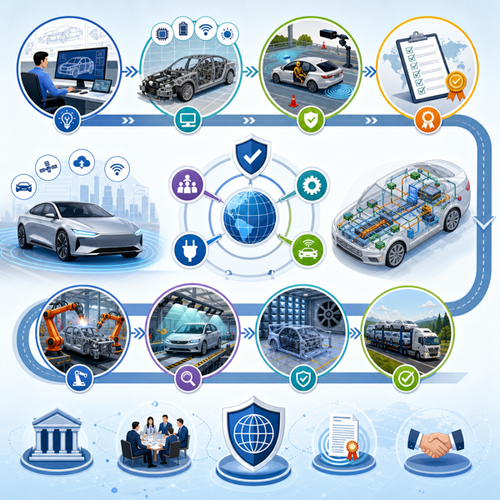
The June 2026 update marks a pivotal moment for the Automotive and Road Vehicles sector, introducing five substantial ISO standards that define new logical interface requirements for sensors and data fusion units in automated driving functions. These newly published specifications provide detailed frameworks for technology-specific interfaces—spanning cameras, ultrasonics, microphones, supportive information, and object-level data—empowering automotive developers, engineers, and compliance professionals to enhance performance, safety, and interoperability in next-generation vehicles.
Overview
The ongoing evolution of automated driving technology is transforming the Automotive and Road Vehicles industry. With the rapid proliferation of sensors and complex data fusion units, robust interface standards have become essential to ensure system reliability, functional safety, and seamless component integration. The ISO 23150 series, newly updated in June 2026, delivers precise logical interface definitions in multiple technology domains. This article explores five critical standards, their technical significance, and the practical considerations for industry stakeholders.
You will discover:
- The functional scope and requirements of each new interface standard
- Key takeaways and implementation highlights
- The broader industry impact, from compliance to innovation
- Actionable insights for integration, testing, and certification
Detailed Standards Coverage
ISO 23150-13:2026 - Camera-Specific Logical Interfaces
Road vehicles — Logical interface between sensors and data fusion unit for automated driving functions — Part 13: Camera specific interfaces
This standard addresses the logical interfaces required for camera sensors or sensor clusters within the context of automated driving. It specifies definitions and structures for communication at three interface levels: feature-level, advanced detection level, and detection level. The purpose is to ensure that camera-generated data is delivered to the data fusion unit in a standardized, semantically rich manner, enabling accurate environmental modeling and decision-making by autonomous systems.
Scope & Requirements
- Applies to all road vehicles equipped with automated driving features using camera sensors.
- Defines logical (not electrical or mechanical) communication protocols and data representations for image-based feature, advanced detection, and detection data.
- Excludes raw data interfaces; focuses on processed, interpreted outputs.
- Outlines significant structural components like interface headers, versioning, feature entities, and profiles tailored to camera technology.
Implementation & Compliance
- Essential for OEMs, tier-one suppliers, and development teams responsible for integrating camera-based perception.
- Facilitates interoperability between varying sensor makes and central fusion units.
- Required for certifying vehicles with advanced driver assistance features and L3/L4 automation.
Notable Updates from Previous Editions
- Comprehensive restructuring with new definitions for generic and technology-specific interfaces.
- Introduces explicit advanced detection-level interfaces for nuanced camera data.
Key highlights:
- Modular approach with clear separation of interface levels
- Incorporates redundancy, version control, and data quality indicators
- Strong alignment with ISO 23150-1 for general interface principles
Access the full standard:View ISO 23150-13:2026 on iTeh Standards
ISO 23150-14:2026 - Ultrasonic-Specific Logical Interfaces
Road vehicles — Logical interface between sensors and data fusion unit for automated driving functions — Part 14: Ultrasonic specific interfaces
Focusing on the integration of ultrasonic sensors, this standard sets forth the interface specifications for feature-, advanced detection-, and detection-level data derived from ultrasonic sensor arrays. As ultrasonic technology is crucial for close-proximity and parking systems, standardized logical interfaces support more reliable and effective maneuvering, particularly in urban and low-speed scenarios.
Scope & Requirements
- Targets manufacturers and system integrators using ultrasonic sensors in automated functions (e.g., park assist, object detection).
- Standardizes semantic representation, interface structure, and signal grouping for processed ultrasonic data.
- Mandates unambiguous versioning, signal profiling, and status metrics.
- Interfaces are interoperable with other sensor types via shared ISO 23150-1 profiles and definitions.
Practical Implications
- Ensures that ultrasonic data can be interpreted alongside camera, radar, and other sensor inputs in fusion units.
- Facilitates error handling and robust detection profile management.
- Supports both single sensors and sensor clusters, easing development across vehicle platforms.
Key highlights:
- Uniform data structures for multiple interface levels
- Enhanced compatibility with existing road environment models
- Promotes reliable short-range perception for automated maneuvers
Access the full standard:View ISO 23150-14:2026 on iTeh Standards
ISO 23150-15:2026 - Microphone-Specific Logical Interfaces
Road vehicles — Logical interface between sensors and data fusion unit for automated driving functions — Part 15: Microphone specific interfaces
This standard introduces harmonized detection-level interfaces for microphone sensors and sensor clusters deployed in automated driving functions. Microphone arrays contribute valuable data for recognizing road surface types, noise sources, and warnings, adding a new dimension to environmental perception.
Scope & Requirements
- Covers the definition and structure of logical interfaces between microphone sensors and fusion units.
- Only a detection-level interface is defined (no feature or advanced detection level for microphones at this stage).
- Reinforces usage of standard interface headers, signal options, and model types for sound data classification.
- Specifies detailed parameters for sound-based perception, including classification types, confidence metrics, road surface condition reporting, and noise floor.
Implementation Considerations
- Highly relevant for R&D teams working on sound-based recognition and driver alert systems.
- Supports seamless integration into broader data fusion frameworks and safety systems.
- Facilitates robust testing and functional safety validation, where misclassification of sounds could be a critical risk.
Key highlights:
- Introduces microphone-specific detection models and confidence scoring
- Harmonizes data from sound sensors with vision and distance sensors for rich perception
- Supports both object detection and road property analysis
Access the full standard:View ISO 23150-15:2026 on iTeh Standards
ISO 23150-20:2026 - Supportive and Sensor Input Interfaces
Road vehicles — Logical interface between sensors and data fusion unit for automated driving functions — Part 20: Supportive and sensor input interfaces
ISO 23150-20 provides the crucial backbone for the management and health of all sensor systems involved in automated driving. It establishes supportive sensor interfaces and common sensor input interfaces—enabling monitoring of sensor performance, health diagnostics, calibration, and contextual input across all sensor technologies.
Scope & Requirements
- Defines supportive interfaces for:
- Sensor performance: Characterizes the operational range and quality of sensor data output, supporting safety checks and redundancy planning.
- Sensor health: Delivers real-time diagnostics, error reporting, and status tracking for individual sensors and clusters.
- Sensor calibration: Includes specifications for reporting and managing calibration data, allowing both hardware and software alignment.
- Common sensor input: Structures all non-sensor environmental/contextual data (e.g., weather, road conditions) that influence perception systems.
- Interfaces are compatible with any sensor or sensor cluster, streamlining integration within multi-sensor systems.
Impact for Implementation
- Vital for vehicle system designers, calibration engineers, quality managers, and testing teams.
- Supports dynamic configuration, on-the-fly diagnostics, and response to impairment conditions (fog, dirt, damage, etc.).
- Enables command interfaces for real-time operational changes.
Key highlights:
- Standardizes health and performance metrics across sensor ecosystems
- Empowers real-time calibration and environmental parameter monitoring
- Essential for compliance with system safety and reliability standards
Access the full standard:View ISO 23150-20:2026 on iTeh Standards
ISO 23150-2:2026 - Object-Level Interfaces
Road vehicles — Logical interface between sensors and data fusion unit for automated driving functions — Part 2: Object level interfaces
This standard is foundational for multi-sensor fusion in automated driving—defining the logical interface protocols for a range of object categories: potentially moving objects, road objects, static objects, and free-space objects. These definitions create a harmonized language for environmental perception, allowing for precise and consistent identification and tracking across all sensor types.
Scope & Requirements
- Applies to automated road vehicles using object-level environmental models for path planning and control.
- Specifies logical data structures and message types for four object classes:
- Potentially moving objects (e.g., vehicles, pedestrians)
- Road objects (e.g., markings, lanes, road boundaries)
- Static objects (e.g., buildings, street furniture)
- Free-space objects (e.g., unoccupied road segments)
- Leverages generic interface constructs from ISO 23150-1, enabling consistent and scalable information exchange.
Implementation & Application
- Essential for sensor manufacturers, ADAS/AV OEMs, and simulation environments.
- Guarantees consistency in perception models, facilitating easier regulatory compliance and safety validation.
- Offers extensible profiles and signal groupings for advanced classification and scenario coverage.
Key highlights:
- Accommodates diverse object classes for richer environmental modeling
- Enhances scene understanding for higher-level automated driving functions
- Provides robust foundations for data-driven safety engineering
Access the full standard:View ISO 23150-2:2026 on iTeh Standards
Industry Impact & Compliance
The introduction of these five ISO standards represents a significant evolution for the Automotive and Road Vehicles industry. As automation and data-driven control gain momentum, adherence to formalized logical interfaces ensures:
- Enhanced interoperability: Components from different vendors communicate using common, well-defined interface schemas. This simplifies development, retrofitting, and lifecycle management.
- Regulatory and market compliance: Adoption of ISO standards is increasingly critical for legal, safety, and market acceptance, especially in evolving international markets.
- System reliability and functional safety: Standardization reduces ambiguity and error risk during data interpretation and action planning in safety-critical systems.
Compliance considerations:
- Early engagement with standard specifications is advised for OEMs and suppliers to avoid costly redesigns downstream.
- Implementation guidelines recommend 18-24 month transition periods for full compliance in product design and qualification.
- Risks of non-compliance include regulatory penalties, interoperability issues, and increased recall or warranty events.
Benefits of adoption:
- Faster development and certification cycles
- Simplified supply chain integration
- Cost reduction in validation and verification efforts
Technical Insights
Across all five standards, several important technical patterns and best practices emerge:
Layered Interface Levels: Feature, detection, and object abstractions permit flexible data fusion strategies, adapting to varying use cases and computational resources.
Generic & Technology-Specific Profiles: Standards leverage both generic message structures (per ISO 23150-1) and sensor-specific details, balancing interoperability with precision.
Data Quality, Versioning, and Redundancy: Built-in support for version control, cycle counters, and data quality metrics streamline diagnostic routines, software updates, and fail-safe operations.
Calibration and Health Reporting: Emphasizing dynamic calibration and sensor health fosters resilience to environmental conditions and hardware aging.
Implementation Best Practices
- Early Architecture Planning: Align sensor and ECU interfaces to ISO 23150 series early in the design lifecycle.
- Validation and Testing: Develop verification testbenches for each interface, using simulated and real sensor data streams.
- Continuous Compliance Tracking: Employ monitoring tools to ensure ongoing alignment with published interface definitions as standards evolve.
Testing and Certification Considerations
- Set up scenario-based tests to validate correct data formatting, semantic consistency, and timing across sensors.
- Document interface versioning in system architecture files to facilitate audits.
- Participate in cross-industry working groups to share lessons learned and harmonize interpretations.
Conclusion / Next Steps
The June 2026 arrival of these ISO standards for Automotive and Road Vehicles signals a new era of clarity and reliability in automated driving system development. By formalizing logical interfaces for all sensor modalities and supporting systems, the standards enable a common technical language that accelerates both innovation and compliance.
Key takeaways:
- Interface standardization is foundational for safe, scalable, and interoperable automated vehicles.
- Adoption delivers tangible benefits in development speed, safety, and regulatory acceptance.
- Proactive implementation is crucial to maintaining a competitive edge and meeting future directives.
Recommendations:
- Review the full text for each standard relevant to your area of responsibility.
- Start gap analysis and roadmap alignment now—engage with suppliers, development teams, and quality management to operationalize requirements.
- Stay updated by subscribing to iTeh Standards' alerts and exploring related documentation as new revisions emerge.
Explore all the latest Automotive and Road Vehicles standards and stay at the forefront of automotive innovation at iTeh Standards.
Categories
- Latest News
- New Arrivals
- Generalities
- Services and Management
- Natural Sciences
- Health Care
- Environment
- Metrology and Measurement
- Testing
- Mechanical Systems
- Fluid Systems
- Manufacturing
- Energy and Heat
- Electrical Engineering
- Electronics
- Telecommunications
- Information Technology
- Image Technology
- Precision Mechanics
- Road Vehicles
- Railway Engineering
- Shipbuilding
- Aircraft and Space
- Materials Handling
- Packaging
- Textile and Leather
- Clothing
- Agriculture
- Food technology
- Chemical Technology
- Mining and Minerals
- Petroleum
- Metallurgy
- Wood technology
- Glass and Ceramics
- Rubber and Plastics
- Paper Technology
- Paint Industries
- Construction
- Civil Engineering
- Military Engineering
- Entertainment