

ISO 23150-14:2026
(Main)Road vehicles — Logical interface between sensors and data fusion unit for automated driving functions — Part 14: Ultrasonic specific interfaces
- Abstract
This document is applicable to road vehicles with automated driving functions and specifies the technology-specific logical interfaces for ultrasonic sensors or sensor clusters: feature level interface; advanced detection level interface; detection level interface. This document does not provide electrical and mechanical interface specifications. Raw data interfaces are also excluded.
- Status
- Published
- Publication Date
- 28-Jun-2026
- Technical Committee
- ISO/TC 22/SC 31 - Data communication
- Current Stage
- 6060 - International Standard published
- Start Date
- 29-Jun-2026
- Due Date
- 09-Oct-2026
- Completion Date
- 29-Jun-2026
ISO 23150-14:2026 is an International Standard from ISO for road vehicles with automated driving functions. It specifies technology-specific logical interfaces for ultrasonic sensors or sensor clusters at feature level, advanced detection level, and detection level, so sensor data can be exchanged with a data fusion unit in a structured way. It excludes electrical and mechanical interface specifications and excludes raw data interfaces.
What does ISO 23150-14:2026 specify?
ISO 23150-14:2026 specifies the ultrasonic-specific logical interfaces used by road vehicles with automated driving functions. It is organized around feature level in Clause 5, advanced detection level in Clause 6, detection level in Clause 7, and the normative ultrasonic interface signals in Annex A.
The document is built on the generic framework in ISO 23150-1:2026. That matters in practice because implementations are expected to follow the shared ISO 23150 structure first, then add the ultrasonic-specific data groups defined here.
| Annex | What it covers |
|---|---|
| Annex A | Normative ultrasonic interface signals for feature level and detection level |
The scope also makes the boundaries clear: ISO 23150-14:2026 does not define electrical or mechanical interfaces, and it does not cover raw data interfaces.
What are the key requirements of ISO 23150-14:2026?
ISO 23150-14:2026 defines how ultrasonic sensors or sensor clusters shall describe features and detections in logical messages. The key requirement is not a physical wiring standard - it is a data interface standard that tells implementers what information belongs in each message and how the pieces are grouped.
The standard reuses the generic ISO 23150 framework
ISO 23150-14:2026 bases both the ultrasonic feature interface (UFI) and the ultrasonic detection interface (UDI) on the generic interfaces in ISO 23150-1:2026. It also relies on the generic header signals, generic profiles, and signal options from ISO 23150-1:2026.
In practice, that means an implementer should not design a standalone ultrasonic message format from scratch. The ultrasonic part fits into the shared ISO 23150 structure, which helps different sensor technologies coexist in the same automated driving architecture.
The UFI is a structured list of feature entities
ISO 23150-14:2026 defines the UFI as a header plus multiple feature entities. Clause 5 requires the interface to use the ultrasonic feature header, the feature entity structure, and the signal definitions in Annex A.
The feature-level data includes the number of valid serving sensors, feature identifiers, timestamps, feature status, feature classifications, and geometric attributes such as position, orientation, extent height, and velocity. For a reader, this means the UFI is meant to describe recognized ultrasonic features, not raw echoes or internal sensor processing steps.
Feature entities carry status, segment information, and segment points
ISO 23150-14:2026 states that each ultrasonic feature entity consists of several logical signal groups. Clause 5.3 describes three parts: status, segment information, and segment points.
This matters because a feature is not just a single coordinate. The interface can also carry classification type, confidence, trilateration status, and point geometry, which supports downstream functions that need shape or motion information from the sensor cluster.
The UDI describes measured detections
ISO 23150-14:2026 defines the UDI as a header plus multiple detections. Clause 7 requires the ultrasonic detection header, detection entities, and the signal definitions in Annex A.
The detection-level data includes timestamped measurements, recognized detections capability and status, detection IDs, references to emitting and sensing sensors, reflectivity, mean distance, and ultrasonic height information. In practice, this is the level used when the system needs individual detections from an ultrasonic sensor or sensor cluster rather than grouped features.
The ultrasonic sensor cluster profile controls how emitting and sensing sensors are represented
ISO 23150-14:2026 includes a profile for an ultrasonic sensor cluster in Clause 7.4.1. That profile explains how the interface can represent a real sensor that emits and senses its own pulse, or a virtual sensor built from separate emitting and sensing sensors.
This is important for integration work because the same physical arrangement can be reported in different interface patterns. The header and the signal "Second sensor ID reference" are used to identify which sensor emitted the pulse and which sensor sensed the return, so the receiving system can interpret the detection correctly.
Advanced detection level is not defined for ultrasonic sensors
ISO 23150-14:2026 states in Clause 6 that there is no ADLI defined for ultrasonic sensors or sensor clusters. That means implementations of this part focus on feature level and detection level, not on an ultrasonic advanced detection layer.
For a buyer or system designer, this is a practical boundary. If a project requires an ADLI for ultrasonic sensing, this part does not provide one.
Annex A defines the actual ultrasonic signals
ISO 23150-14:2026 uses Annex A for the ultrasonic-specific signal definitions. Annex A covers feature-level signals such as ultrasonic feature classification type, confidence, point count, pitch, height, velocity, and trilateration status, and detection-level signals such as second sensor ID reference, mean distance, and ultrasonic height.
This is the part that implementers use when mapping software objects to the standard. It tells them what each signal represents, the kind of value it carries, and how it fits into the message structure.
What terms does ISO 23150-14:2026 define?
ISO 23150-14:2026 uses the definitions from ISO 23150-1:2026 and adds ultrasonic-specific abbreviated terms.
- Ultrasonic feature interface (UFI) - The feature-level interface for ultrasonic sensors or sensor clusters, used to report recognized features and their attributes.
- Ultrasonic detection interface (UDI) - The detection-level interface for ultrasonic sensors or sensor clusters, used to report measured detections and related sensor references.
- Feature level interface (FLI) - The shared logical interface level for feature-oriented sensor data, with ultrasonic-specific content defined here.
- Detection level interface (DLI) - The shared logical interface level for detection-oriented sensor data, with ultrasonic-specific content defined here.
- Advanced detection level interface (ADLI) - The intermediate interface level named by the ISO 23150 framework, but not defined for ultrasonic sensors in this part.
- Sensor cluster - A group of sensors that can serve one interface, including configurations with separate emitting and sensing elements.
- Second sensor ID reference - The signal that identifies the corresponding sensor in a virtual or paired ultrasonic arrangement.
- Trilateration status - The signal that indicates whether a feature position is based on trilaterated measurements or on fewer detections.
Who uses ISO 23150-14:2026?
ISO 23150-14:2026 is used by engineers, system architects, and software developers who design automated driving sensor interfaces for ultrasonic sensing. It is also relevant to validation teams and quality managers who need to check whether an ultrasonic interface matches the expected ISO 23150 structure.
Suppliers and vehicle integrators use it when defining how ultrasonic sensors, sensor clusters, and data fusion units exchange feature-level and detection-level information. Buyers and technical procurement teams can use it to compare interface compatibility between sensors and vehicle platforms.
The standard is aimed at road vehicle applications with automated driving functions, especially where ultrasonic sensors contribute to environmental perception.
What changed in ISO 23150-14:2026 from the previous edition?
ISO 23150-14:2026 is the first edition of this part, and it cancels and replaces ISO 23150:2023 together with ISO 23150-1, ISO 23150-2, ISO 23150-11, ISO 23150-12, ISO 23150-13, ISO 23150-15 and ISO 23150-20.
The document states these main changes:
- reorganization of the document structure
- use of generic interfaces, generic signals, generic profiles, and terms and definitions from ISO 23150-1 as the basis
- separation of technology-specific interfaces into individual parts
- ultrasonic-specific content collected in this part
- revision of the logical interfaces
Which standards are used with ISO 23150-14:2026?
ISO 23150-14:2026 depends on and is read together with these ISO 23150 parts:
- ISO 23150-1:2026 - Provides the general information and principles, plus the generic interface levels, signals, profiles, and terms used throughout this part.
- ISO 23150-2 - Covers object level interfaces, which are mentioned as an additional possible interface path for ultrasonic sensors or sensor clusters.
- ISO 23150-11 - Covers radar specific interfaces.
- ISO 23150-12 - Covers lidar specific interfaces.
- ISO 23150-13 - Covers camera specific interfaces.
- ISO 23150-15 - Covers microphone specific interfaces.
- ISO 23150-20 - Covers supportive and sensor input interfaces.
What does the ISO 23150-14:2026 document contain?
ISO 23150-14:2026 contains interface structure tables, signal-group tables, and normative signal definitions for ultrasonic feature and detection data. It also includes profile descriptions that show how ultrasonic sensor clusters can be represented when one interface corresponds to one real sensor or to a virtual sensor made from separate emitting and sensing elements.
The document uses figures to illustrate ultrasonic geometry, including how a mean distance can be interpreted for different sensor arrangements. Annex A provides the detailed signal descriptions, value types, and units that engineers need for implementation, integration, and verification of the interface.
Relations
- Effective Date
- 28-Oct-2023
Get Certified
Connect with accredited certification bodies for this standard

TÜV Rheinland
TÜV Rheinland is a leading international provider of technical services.

TÜV SÜD
TÜV SÜD is a trusted partner of choice for safety, security and sustainability solutions.

DEKRA Certification Inc.
DEKRA US certification services.
Sponsored listings
Frequently Asked Questions
ISO 23150-14:2026 is a standard published by the International Organization for Standardization (ISO). Its full title is "Road vehicles — Logical interface between sensors and data fusion unit for automated driving functions — Part 14: Ultrasonic specific interfaces". This standard covers: This document is applicable to road vehicles with automated driving functions and specifies the technology-specific logical interfaces for ultrasonic sensors or sensor clusters: feature level interface; advanced detection level interface; detection level interface. This document does not provide electrical and mechanical interface specifications. Raw data interfaces are also excluded.
This document is applicable to road vehicles with automated driving functions and specifies the technology-specific logical interfaces for ultrasonic sensors or sensor clusters: feature level interface; advanced detection level interface; detection level interface. This document does not provide electrical and mechanical interface specifications. Raw data interfaces are also excluded.
ISO 23150-14:2026 is classified under the following ICS (International Classification for Standards) categories: 43.040.15 - Car informatics. On board computer systems. The ICS classification helps identify the subject area and facilitates finding related standards.
ISO 23150-14:2026 has the following relationships with other standards: It is inter standard links to ISO 23150:2023. Understanding these relationships helps ensure you are using the most current and applicable version of the standard.
ISO 23150-14:2026 is available in PDF format for immediate download after purchase. The document can be added to your cart and obtained through the secure checkout process. Digital delivery ensures instant access to the complete standard document.
Standards Content (Sample)
International
Standard
ISO 23150-14
First edition
Road vehicles — Logical interface
2026-06
between sensors and data fusion
unit for automated driving
functions —
Part 14:
Ultrasonic specific interfaces
Véhicules routiers — Interface logique entre capteurs et unité de
fusion de données pour les fonctions de conduite automatisée —
Partie 14: Interfaces spécifiques de capteur ultrasonique
Reference number
© ISO 2026
All rights reserved. Unless otherwise specified, or required in the context of its implementation, no part of this publication may
be reproduced or utilized otherwise in any form or by any means, electronic or mechanical, including photocopying, or posting on
the internet or an intranet, without prior written permission. Permission can be requested from either ISO at the address below
or ISO’s member body in the country of the requester.
ISO copyright office
CP 401 • Ch. de Blandonnet 8
CH-1214 Vernier, Geneva
Phone: +41 22 749 01 11
Email: copyright@iso.org
Website: www.iso.org
Published in Switzerland
ii
Contents Page
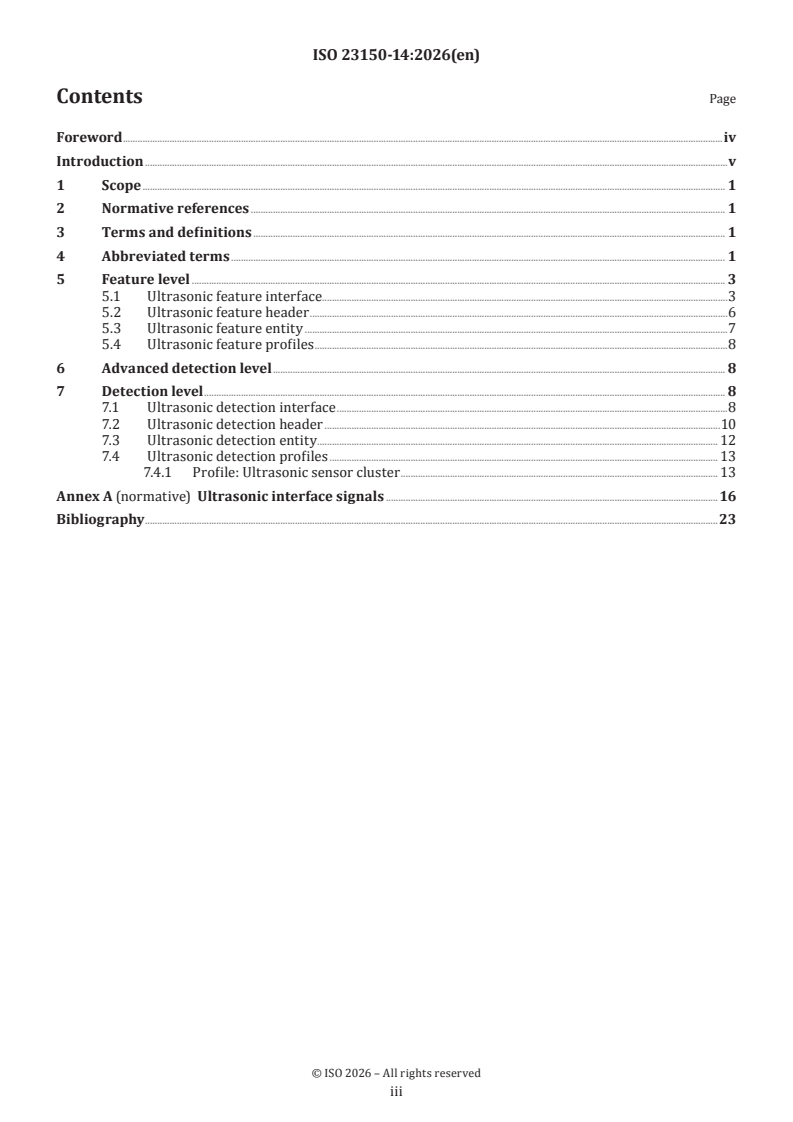
Foreword .iv
Introduction .v
1 Scope . 1
2 Normative references . 1
3 Terms and definitions . 1
4 Abbreviated terms . 1
5 Feature level . 3
5.1 Ultrasonic feature interface . .3
5.2 Ultrasonic feature header .6
5.3 Ultrasonic feature entity .7
5.4 Ultrasonic feature profiles .8
6 Advanced detection level . 8
7 Detection level . 8
7.1 Ultrasonic detection interface .8
7.2 Ultrasonic detection header .10
7.3 Ultrasonic detection entity . . 12
7.4 Ultrasonic detection profiles . 13
7.4.1 Profile: Ultrasonic sensor cluster . 13
Annex A (normative) Ultrasonic interface signals .16
Bibliography .23
iii
Foreword
ISO (the International Organization for Standardization) is a worldwide federation of national standards
bodies (ISO member bodies). The work of preparing International Standards is normally carried out through
ISO technical committees. Each member body interested in a subject for which a technical committee
has been established has the right to be represented on that committee. International organizations,
governmental and non-governmental, in liaison with ISO, also take part in the work. ISO collaborates closely
with the International Electrotechnical Commission (IEC) on all matters of electrotechnical standardization.
The procedures used to develop this document and those intended for its further maintenance are described
in the ISO/IEC Directives, Part 1. In particular, the different approval criteria needed for the different types
of ISO document should be noted. This document was drafted in accordance with the editorial rules of the
ISO/IEC Directives, Part 2 (see http://www.iso.org/directives).
ISO draws attention to the possibility that the implementation of this document may involve the use of (a)
patent(s). ISO takes no position concerning the evidence, validity or applicability of any claimed patent
rights in respect thereof. As of the date of publication of this document, ISO had not received notice of (a)
patent(s) which may be required to implement this document. However, implementers are cautioned that
this may not represent the latest information, which may be obtained from the patent database available at
http://www.iso.org/patents. ISO shall not be held responsible for identifying any or all such patent rights.
Any trade name used in this document is information given for the convenience of users and does not
constitute an endorsement. For an explanation of the voluntary nature of standards, the meaning of ISO
specific terms and expressions related to conformity assessment, as well as information about ISO's
adherence to the World Trade Organization (WTO) principles in the Technical Barriers to Trade (TBT), see
http://www.iso.org/iso/foreword.html.
This document was prepared by Technical Committee ISO/TC 22, Road vehicles, Subcommittee SC 31, Data
communication.
[1] [2] [3]
This first edition of ISO 23150-14, together with ISO 23150-1 , ISO 23150-2 , ISO 23150-11 , ISO 23150-12
[4] [5] [6] [7]
, ISO 23150-13 , ISO 23150-15 and ISO 23150-20 , cancels and replaces ISO 23150:2023, which has
been technically revised.
The main changes are as follows:
— reorganisation of the document structure; use of generic interfaces, generic signals, generic profiles and
[1]
terms and definitions defined in ISO 23150-1 as a basis for this document;
— specific collection of interfaces in separated documents; in this document specific collection of all
technology specific interfaces for ultrasonic;
— revise of the logical interfaces.
A list of all parts in the ISO 23150 series can be found on the ISO website.
Any feedback or questions on this document should be directed to the user’s national standards body. A
complete listing of these bodies can be found at www.iso.org/members.html.
iv
Introduction
Vehicle environmental perception sensors (single sensor or sensor cluster) provide logical interfaces
according to the ISO 23150 series to the fusion unit or automated driving functions. The fusion unit
generates a surround model and interprets the scene around the vehicle based on the sensor data. Interfaces
are defined on different levels and described in a modular and semantic representation. The interfaces
on feature level, advanced detection level and detection level are technology specific and differ by each
technology.
Figure 1 shows the schematic and contextual relationships between the documents relating to logical
interfaces of the ISO 23150 series.
Key
scope of this document
Figure 1 — Relationship of the ISO 23150 series
This document specifies technology-specific interfaces for ultrasonic sensors as well as sensor clusters.
[1]
The interfaces are based on the generic specifications of the interfaces in ISO 23150-1 . This document
references the generic specifications of signals for the interface header, the generic interface levels and the
profiles.
An ultrasonic sensor or sensor cluster may also implement (provide or receive) logical interfaces:
[2]
— on object level (see ISO 23150-2 );
— for additional interfaces as supportive sensor interfaces and sensor input information interfaces (see
[7]
ISO 23150-20 ).
This document is not intended to replace the logical interface specifications of other documents in the
ISO 23150 series.
[1]
This document is based on the generic specifications in ISO 23150-1 as shown in Figure 2:
— generic sensor cluster feature interface;
— generic sensor advanced detection interface;
— generic sensor detection interface;
— general level-independent profiles.
v
Key
scope of this document
Figure 2 — Interfaces in the scope of this document and the related interfaces of the ISO 23150
series
vi
International Standard ISO 23150-14:2026(en)
Road vehicles — Logical interface between sensors and data
fusion unit for automated driving functions —
Part 14:
Ultrasonic specific interfaces
1 Scope
This document is applicable to road vehicles with automated driving functions and specifies the technology-
specific logical interfaces for ultrasonic sensors or sensor clusters:
— feature level interface;
— advanced detection level interface;
— detection level interface.
This document does not provide electrical and mechanical interface specifications. Raw data interfaces are
also excluded.
2 Normative references
The following documents are referred to in the text in such a way that some or all of their content constitutes
requirements of this document. For dated references, only the edition cited applies. For undated references,
the latest edition of the referenced document (including any amendments) applies.
ISO 23150-1, Road vehicles — Logical interface between sensors and data fusion unit for automated driving
functions — Part 1: General information and principles
ISO 23150-1:2026, Road vehicles — Logical interface between sensors and data fusion unit for automated
driving functions — Part 1: General information and principles
3 Terms and definitions
For the purposes of this document, the terms and definitions given in ISO 23150-1 apply.
ISO and IEC maintain terminology databases for use in standardization at the following addresses:
— ISO Online browsing platform: available at http:// www .iso .org/ obp
— IEC Electropedia: available at http:// www .electropedia .org/
4 Abbreviated terms
For the purposes of this document, the abbreviated terms given in ISO 23150-1 and the following apply.
A2I assign to interface
AD automated driving
ADLI advanced detection level interface
AER alternative entity representation
C conditional
CADI camera advanced detection interface
CDI camera detection interface
CFI camera feature interface
D dimensional
DE default enumerators
DLI detection level interface
ECU electronic control unit
EES extended enumeration signal
EM error model
FLI feature level interface
ID identifier
IQR interquartile range
IR infrared
IRI international roughness index
IV implicit value
LL list length
LSG logical signal group
M mandatory
O optional
OLI object level interface
RL requirement level
SII sensor input interface
SSI supportive sensor interface
UDI ultrasonic detection interface
UFI ultrasonic feature interface
UTL unrolling tuple list
VRO value representation optimisation
5 Feature level
5.1 Ultrasonic feature interface
[8]
The generic specification of the feature interfaces is defined in ISO 23150-1:2026 , Clause 8. The ultrasonic
feature interface shall base on the generic sensor cluster feature interface as specified in ISO 23150-1:2026,
8.2. Table 1 provides the logical structure of the UFI.
Table 1 — Ultrasonic feature interface structure
Structure Multiplicity Option
Ultrasonic feature header (5.2) 1
Features Multiple Size type:
dynamic/fixed
The logical structure of the UFI shall be implemented in accordance with the interface definition specified in
Table 2, the signals as defined in Annex A and ISO 23150-1:2026, Annex A. Furthermore, the generic profiles
[1]
as defined in 5.4 and in ISO 23150-1 as well as the signal options defined in ISO 23150-1:2026, Annex B
shall also be considered.
Table 2 — Ultrasonic feature interface
RL LSG RL signal
LSG Signal Option
M/C/O M/C/O
Information: M Interface version ID {major, minor, M Profile: Uniqueness of
[8]
interface patch} (ISO 23150-1:2026 , A.1.2) interface versioning (ISO
[8]
23150-1:2026 , 6.5.1)
[8]
Interface ID (ISO 23150-1:2026 , O Profile: Uniqueness of
A.1.3) interface versioning (ISO
[8]
23150-1:2026 , 6.5.1)
Number of valid serving sensors (ISO M Profile: Uniqueness of
[8]
23150-1:2026 , A.1.4) interface versioning (ISO
[8]
23150-1:2026 , 6.5.1)
Optimise LL (ISO 23150-
[8]
1:2026 , B.1.2)
Alternative UTL (ISO
[8]
23150-1:2026 , B.1.7)
Key: Sensor ID (ISO 23150-
[8]
1:2026 , A.1.5)
Size type: dynamic/fixed
[8]
Size #: Number of valid serving sensors (ISO 23150-1:2026 , A.1.4)
[8]
Sensor ID (ISO 23150-1:2026 , M Profile: Uniqueness of
A.1.5) interface versioning (ISO
[8]
23150-1:2026 , 6.5.1)
Alternative VRO (ISO
[8]
23150-1:2026 , B.1.4)
Time stamp – prediction (ISO 23150- M
[8]
1:2026 , A.1.6.1)
a
Features may not be tracked continuously. The same feature may be tracked as a new entity multiple times. Therefore, the
[8]
profile does not provide the signal "Age" (ISO 23150-1:2026 , A.2.22) on FLI.
TTabablele 2 2 ((ccoonnttiinnueuedd))
RL LSG RL signal
LSG Signal Option
M/C/O M/C/O
[8]
Cycle counter (ISO 23150-1:2026 , O Redundancy (ISO 23150-
[8]
A.1.7.1) 1:2026 , B.1.3)
Signal: Time stamp – pre-
diction (ISO 23150-1:2026
[8]
, A.1.6.1)
Interface cycle time (ISO 23150-1:2026 O
[8]
, A.1.8)
Interface cycle time – variation (ISO O
[8]
23150-1:2026 , A.1.9)
[8]
Data qualifier (ISO 23150-1:2026 , M Optimise DE (ISO 23150-
[8]
A.1.10) 1:2026 , B.1.8)
Optimise EES (ISO 23150-
[8]
1:2026 , B.1.9)
Features
Features infor- M Recognised features – capability (ISO O
[8]
mation 23150-1:2026 , A.1.11.2)
Recognised features – status (ISO O Redundancy (ISO 23150-
[8] [8]
23150-1:2026 , A.1.12.2) 1:2026 , B.1.3)
Signal: Recognised features
– capability (ISO 23150-
[8]
1:2026 , A.1.11.2)
Optimise DE (ISO 23150-
[8]
1:2026 , B.1.8)
Optimise EES (ISO 23150-
[8]
1:2026 , B.1.9)
Number of valid features (ISO 23150- M Optimise LL (ISO 23150-
[8] [8]
1:2026 , A.1.13.2) 1:2026 , B.1.2)
Optimize AER (ISO 23150-
[8]
1:2026 , B.1.5)
Size type: dynamic/fixed
[8]
Size #: Number of valid features (ISO 23150-1:2026 , A.1.13.2)
↪ Status M Existence probability – feature level M
[8]
(ISO 23150-1:2026 , A.4.2)
[8]
Feature ID (ISO 23150-1:2026 , C (ISO 23150- Alternative A2I (ISO 23150-
[8] [8]
A.4.3) 1:2026 , B.3.2) 1:2026 , B.3.3)
Exist: DLI
Object ID reference (ISO 23150- C (ISO 23150- Alternative A2I (ISO 23150-
[8] [8] [8]
1:2026 , A.2.69) 1:2026 , B.3.2) 1:2026 , B.3.3)
Exist: OLI
Time stamp difference – feature M Optimise IV (ISO 23150-
[8] [8]
level (ISO 23150-1:2026 , A.4.4) 1:2026 , B.1.6)
Number of valid observations (ISO O Profile: OObservations (ISO
[8] [8] a
23150-1:2026 , A.2.23) 23150-1:2026 , 6.5.8)
Optimise LL (ISO 23150-
[8]
1:2026 , B.1.2)
Alternative UTL (ISO
[8]
23150-1:2026 , B.1.7)
Key: Time stamp reference
[8]
(ISO 23150-1:2026 ,
A.2.24)
a
Features may not be tracked continuously. The same feature may be tracked as a new entity multiple times. Therefore, the
[8]
profile does not provide the signal "Age" (ISO 23150-1:2026 , A.2.22) on FLI.
TTabablele 2 2 ((ccoonnttiinnueuedd))
RL LSG RL signal
LSG Signal Option
M/C/O M/C/O
Size type: dynamic/fixed
[8]
Size #: Number of valid observations (ISO 23150-1:2026 , A.2.23)
Time stamp reference (ISO M Profile: Observations (ISO
[8] [8] a
23150-1:2026 , A.2.24) 23150-1:2026 , 6.5.8)
Alternative VRO (ISO
[8]
23150-1:2026 , B.1.4)
Observation status (ISO 23150- M Profile: Observations (ISO
[8] [8] a
1:2026 , A.2.25) 23150-1:2026 , 6.5.8)
Redundancy (ISO 23150-
[8]
1:2026 , B.1.3)
Signal: Feature ID (ISO
[8]
23150-1:2026 , A.4.3) (if
unique over time), Time
stamp – prediction (ISO
[8]
23150-1:2026 , A.1.6.1)
Optimise DE (ISO 23150-
[8]
1:2026 , B.1.8)
Optimise EES (ISO 23150-
[8]
1:2026 , B.1.9)
↪ Segment M Number of valid ultrasonic feature M Optimise LL (ISO 23150-
[8]
information classifications (A.2.2) 1:2026 , B.1.2)
Alternative UTL (ISO
[8]
23150-1:2026 , B.1.7)
Key: Ultrasonic feature clas-
sification type (A.2.3)
Size type: dynamic/fixed
Size #: Number of valid ultrasonic feature classifications (A.2.2)
Ultrasonic feature classification M Alternative VRO (ISO
[8]
type (A.2.3) 23150-1:2026 , B.1.4)
Optimise DE (ISO 23150-
[8]
1:2026 , B.1.8)
Optimise EES (ISO 23150-
[8]
1:2026 , B.1.9)
Ultrasonic feature classification M
type – confidence (A.2.4)
↪ Segment M Number of valid points (A.2.5) M Optimise LL (ISO 23150-
[8]
points 1:2026 , B.1.2)
Size type: dynamic/fixed
Size #: Number of valid points (A.2.5)
Position {x, y, z} (ISO 23150- {M, M, O} Profile: Position {x, y, z}
[8] [8]
1:2026 , A.2.43) (ISO 23150-1:2026 ,
6.5.11.2)
Position {x, y, z} – error (ISO C Profile: Position {x, y, z}
[8] [8]
23150-1:2026 , A.2.44) Analog: Position (ISO 23150-1:2026 ,
{x, y, z} (ISO 6.5.11.2)
23150-1:2026
Implementation EM (ISO
[8]
, A.2.43) [8]
23150-1:2026 , B.4.2)
Orientation {pitch} (A.2.6) O
Orientation {pitch} – error O Implementation EM (ISO
[8]
(A.2.7) 23150-1:2026 , B.4.2)
Extent {height} (A.2.8) O
a
Features may not be tracked continuously. The same feature may be tracked as a new entity multiple times. Therefore, the
[8]
profile does not provide the signal "Age" (ISO 23150-1:2026 , A.2.22) on FLI.
TTabablele 2 2 ((ccoonnttiinnueuedd))
RL LSG RL signal
LSG Signal Option
M/C/O M/C/O
Extent {height} – error (A.2.9) O Implementation EM (ISO
[8]
23150-1:2026 , B.4.2)
Velocity {x, y} (A.2.10) O
Velocity {x, y} – error (A.2.11) O Implementation EM (ISO
[8]
23150-1:2026 , B.4.2)
Trilateration status (A.2.12) M Optimise DE (ISO 23150-
[8]
1:2026 , B.1.8)
Optimise EES (ISO 23150-
[8]
1:2026 , B.1.9)
Measurement status (ISO 23150- M Profile: Measurement sta-
[8] [8]
1:2026 , A.2.68) tus (ISO 23150-1:2026 ,
6.5.18)
Optimise DE (ISO 23150-
[8]
1:2026 , B.1.8)
Optimise EES (ISO 23150-
[8]
1:2026 , B.1.9)
a
Features may not be tracked continuously. The same feature may be tracked as a new entity multiple times. Therefore, the
[8]
profile does not provide the signal "Age" (ISO 23150-1:2026 , A.2.22) on FLI.
5.2 Ultrasonic feature header
Table 3 defines the interface header for ultrasonic features and the changes due to the adaptation in
comparison to the "generic sensor cluster feature header" as specified in ISO 23150-1:2026, 8.3, which shall
be used as the interface header. The header of the UFI specifies the list of valid ultrasonic feature entities
(see 5.3).
Table 3 — Specific signal grouping: ultrasonic feature header
Signal RL signal Option
Interface version ID {major, minor, patch} Mandatory Profile: Uniqueness of interface versioning
[8] [8]
(ISO 23150-1:2026 , A.1.2) (ISO 23150-1:2026 , 6.5.1)
[8]
Interface ID (ISO 23150-1:2026 , A.1.3) Optional Profile: Uniqueness of interface versioning
[8]
(ISO 23150-1:2026 , 6.5.1)
Number of valid serving sensors (ISO 23150- Mandatory Profile: Uniqueness of interface versioning
[8] [8]
1:2026 , A.1.4) (ISO 23150-1:2026 , 6.5.1)
[8]
Optimise LL (ISO 23150-1:2026 , B.1.2)
[8]
Alternative UTL (ISO 23150-1:2026 , B.1.7)
[8]
Key: Sensor ID (ISO 23150-1:2026 , A.1.5)
[8]
↪ Sensor ID (ISO 23150-1:2026 , A.1.5) Mandatory Profile: Uniqueness of interface versioning
[8]
(ISO 23150-1:2026 , 6.5.1)
[8]
Alternative VRO (ISO 23150-1:2026 , B.1.4)
Time stamp – prediction (ISO 23150-1:2026 Mandatory
[8]
, A.1.6.1)
[8] [8]
Cycle counter (ISO 23150-1:2026 , A.1.7.1) Optional Redundancy (ISO 23150-1:2026 , B.1.3)
Signal: Time stamp – prediction (ISO 23150-
[8]
1:2026 , A.1.6.1)
[8]
Interface cycle time (ISO 23150-1:2026 , Optional
A.1.8)
Interface cycle time – variation (ISO 23150- Optional
[8]
1:2026 , A.1.9)
a [8]
Further signals of "need of logical signal group" (ISO 23150-1:2026 , B.3.4) profiles may be added to this header (see cell
options).
TTabablele 3 3 ((ccoonnttiinnueuedd))
Signal RL signal Option
[8] [8]
Data qualifier (ISO 23150-1:2026 , A.1.10) Mandatory Optimise DE (ISO 23150-1:2026 , B.1.8)
[8]
Optimise EES (ISO 23150-1:2026 , B.1.9)
a
... Need of logical signal group (ISO 23150-
[8]
1:2026 , B.3.4)
Profile: Vehicle coordinate system (ISO
[8]
23150-1:2026 , 6.5.3)
[8]
Profile: Sensor pose (ISO 23150-1:2026 ,
6.5.5)
[8]
Profile: Calibration (ISO 23150-1:2026 ,
6.5.6)
[8]
Profile: Sensor cluster (ISO 23150-1:2026 ,
6.5.7)
Features
Recognised features – capability (ISO 23150- Optional
[8]
1:2026 , A.1.11.2)
[8]
Recognised features – status (ISO 23150- Optional Redundancy (ISO 23150-1:2026 , B.1.3)
[8]
1:2026 , A.1.12.2) Signal: Recognised features – capability (ISO
[8]
23150-1:2026 , A.1.11.2)
[8]
Optimise DE (ISO 23150-1:2026 , B.1.8)
[8]
Optimise EES (ISO 23150-1:2026 , B.1.9)
[8]
Number of valid features (ISO 23150-1:2026 Mandatory Optimise LL (ISO 23150-1:2026 , B.1.2)
[8]
, A.1.13.2) [8]
Optimize AER (ISO 23150-1:2026 , B.1.5)
↪ Feature entities
a [8]
Further signals of "need of logical signal group" (ISO 23150-1:2026 , B.3.4) profiles may be added to this header (see cell
options).
5.3 Ultrasonic feature entity
Each feature of an ultrasonic sensor cluster shall describe a recognised feature and consists of several LSGs.
— Status: the status describes general information of the feature. This information is based on basic feature
history information. Table 4 defines the signal grouping "ultrasonic feature entity status", which shall
be used as the entity status. It defines this status LSG of the feature and redefines the signal grouping
"generic sensor cluster feature entity status", which shall be as specified in ISO 23150-1:2026, 8.4.
— Segment information: the segment information describes the attributes of the tracked segment.
— Segment points: the segment points describe the geometric vertices of the hull for the feature segment.
Table 4 — Specific signal grouping: ultrasonic feature entity status
Signal RL signal Option
Existence probability – feature level (ISO 23150-1:2026 Mandatory
[8]
, A.4.2)
[8]
Feature ID (ISO 23150-1:2026 , A.4.3) Conditional (ISO Alternative A2I (ISO 23150-
[8] [8]
23150-1:2026 , 1:2026 , B.3.3)
B.3.2)
Exist: DLI
[8]
Object ID reference (ISO 23150-1:2026 , A.2.69) Conditional (ISO Alternative A2I (ISO 23150-
[8] [8]
23150-1:2026 , 1:2026 , B.3.3)
B.3.2)
Exist: OLI
a
Features may not be tracked continuously. The same feature may be tracked as a new entity multiple times. Therefore the
[8]
profile does not provide the signal "Age" (ISO 23150-1:2026 , A.2.22) on FLI.
TTabablele 4 4 ((ccoonnttiinnueuedd))
Signal RL signal Option
Time stamp difference – feature level (ISO 23150-1:2026 Mandatory Optimise IV (ISO 23150-1:2026
[8] [8]
, A.4.4) , B.1.6)
[8]
Number of valid observations (ISO 23150-1:2026 , Optional Profile: Observations (ISO 23150-
[8] a
A.2.23) 1:2026 , 6.5.8)
Optimise LL (ISO 23150-1:2026
[8]
, B.1.2)
Alternative UTL (ISO 23150-
[8]
1:2026 , B.1.7)
Key: Time stamp reference (ISO
[8]
23150-1:2026 , A.2.24)
[8]
↪ Time stamp reference (ISO 23150-1:2026 , A.2.24) Mandatory Profile: Observations (ISO 23150-
[8] a
1:2026 , 6.5.8)
Alternative VRO (ISO 23150-
[8]
1:2026 , B.1.4)
[8]
↪ Observation status (ISO 23150-1:2026 , A.2.25) Mandatory Profile: Observations (ISO 23150-
[8] a
1:2026 , 6.5.8)
Redundancy (ISO 23150-1:2026
[8]
, B.1.3)
Signal: Feature ID (ISO 23150-
[8]
1:2026 , A.4.3) (if unique over
time), Time stamp – prediction
[8]
(ISO 23150-1:2026 , A.1.6.1)
Optimise DE (ISO 23150-1:2026
[8]
, B.1.8)
Optimise EES (ISO 23150-1:2026
[8]
, B.1.9)
a
Features may not be tracked continuously. The same feature may be tracked as a new entity multiple times. Therefore the
[8]
profile does not provide the signal "Age" (ISO 23150-1:2026 , A.2.22) on FLI.
5.4 Ultrasonic feature profiles
For UFI, no specific profiles are defined.
6 Advanced detection level
There is no ADLI defined for ultrasonic sensors or sensor clusters.
7 Detection level
7.1 Ultrasonic detection interface
[8]
The generic specifi
...