


June 2026: Latest Electrical Engineering Standards Transform Safety and Connectivity
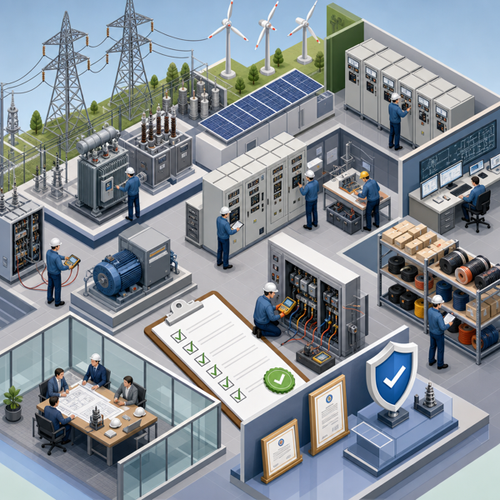
Electrification and digital transformation are reshaping the electrical engineering landscape in 2026. In June, five newly published standards address key priorities for modern infrastructure, spanning lightning protection, electrical safety, intelligent connectivity, microgrid testing, and industrial networking. Each standard brings new guidelines and tested requirements vital for industry professionals, engineers, quality managers, and technical decision-makers.
Overview / Introduction
Electrical engineering forms the backbone of industrial, commercial, and residential innovation worldwide. Reliable connectivity, safe installation, and future-ready integration are only possible when global standards evolve in pace with technology. This article analyzes five significant standards published in June 2026, each representing the cutting edge in their domain. Readers will find detailed breakdowns of scope, compliance requirements, implementation insights, and direct access to each standard.
Expect to gain:
- An understanding of key regulations and technical expectations
- Practical implications for products and projects
- Guidance on compliance timelines
- Essential reading for engineers, procurement specialists, compliance officers, and quality managers
Detailed Standards Coverage
IEC 62561-8:2026 – Components for Electrically Insulated Lightning Protection Systems
Lightning protection system components (LPSC) – Part 8: Requirements for components for electrically insulated LPS
This standard lays the foundation for modern, electrically insulated lightning protection systems (LPS) by defining requirements and test procedures for insulating stand-offs and down-conductors. Covering installation arrangements, environmental resistance, mechanical and electrical tests, and marking protocols, the specification ensures these components maintain separation distance, even under severe environmental conditions.
Key improvements in this 2026 edition include: updated corrosion and atmosphere resistance (per IEC 60068-2-52 and ISO 22479 standards), alternative pull-out and impulse test configurations, refined pollution data, and a new annex addressing test applicability. These changes reflect lessons learned since the previous technical specification and increase system reliability.
Who should comply?
- Electrical contractors, construction firms, and maintenance teams for buildings with critical lightning protection needs
- Designers and manufacturers of LPS components
Practical implications:
- Enhanced safety for structures where insulation is essential
- Detailed documentation, installation, and reporting requirements
- Clear pass/fail criteria for high voltage impulse scenarios
Key highlights:
- Expanded corrosion/UV/humidity testing for field durability
- Multiple test arrangements for real-world simulation
- New normative annexes for comprehensive validation
Access the full standard:View IEC 62561-8:2026 on iTeh Standards
IEC 60884-3-2:2026 – Plugs and Socket-Outlets with Additional Functions
Plugs and socket-outlets for household and similar purposes – Part 3-2: Particular requirements for accessories incorporating electronic components to perform additional functions
Consumer and commercial electronics increasingly require socket-outlets and plugs with integrated electronic components—such as control, power conditioning, and protection modules. IEC 60884-3-2:2026 introduces safety and EMC requirements for these advanced accessories, covering AC plugs and portable/fixed socket-outlets for up to 440 V and 32 A.
This standard ensures that household, industrial, and commercial installations utilize components that safely manage extra functionalities (e.g., surge protection, remote control, energy monitoring), even in harsh conditions. It details marking, terminal, creepage/clearance distances, EMC/EMF regulations, and additional factory and on-site tests.
Who should comply?
- Manufacturers and suppliers of smart plugs, multi-socket extensions, and electronic socket assemblies
- Electrical designers and installers for smart buildings, homes, and industrial settings
Practical implications:
- Safer integration of electronics into everyday power accessories
- Factories and importers must meet stricter factory wiring and EMC verification
- Compatibility and marking to avoid installation confusion
Key highlights:
- Enhanced safety and EMC criteria for embedded electronics
- Detailed testing protocols for both standard and high-load applications
- New requirements for operation under extreme temperature and humidity
Access the full standard:View IEC 60884-3-2:2026 on iTeh Standards
IEC TS 62898-3-5:2026 – Testing Microgrid Monitoring, Control & Energy Management Systems
Microgrids – Part 3-5: Technical requirements – Testing for microgrid monitoring, control, and energy management systems
With decentralized energy systems surging globally, verifying the accurate function of microgrid monitoring, control, and energy management systems (MMCS and MEMS) is critical. IEC TS 62898-3-5:2026 provides a framework for laboratory hardware-in-the-loop (HIL) testing, commissioning, and periodic verification, tailored to grid-connected and isolated microgrids.
The guidance specifies:
- Laboratory HIL test environments for MEMS/MMCS
- Testing for dispatch optimization, forecast, flexible resource management, anti-maloperation, black start, and islanding detection
- Commissioning phase requirements for ensuring system readiness
- Scheduled periodic performance verification
Who should comply?
- Distributed generation operators
- Utilities and microgrid integrators
- Testing laboratories and system vendors
Practical implications:
- Assurance of microgrid stability and reliability under all conditions
- Streamlined test documentation and reporting
- Compliance drives product consistency and interoperability
Key highlights:
- Standardized testing metrics and procedures
- Emphasis on simulation-based validation prior to field commissioning
- Performance benchmarks for fault detection and control capabilities
Access the full standard:View IEC TS 62898-3-5:2026 on iTeh Standards
FprEN IEC 60034-8:2026 – Terminal Markings & Rotation for Rotating Electrical Machines
Rotating electrical machines – Part 8: Terminal markings and direction of rotation
Clear terminal identification and control of rotation direction are foundational to safe and reliable operation of motors and generators. FprEN IEC 60034-8:2026 updates the global reference for marking, connection diagrams, and rotation standards across all types of rotating machines, now including turbine-type synchronous machines.
This edition updates standardization for armature, field, and auxiliary windings; covers new connection diagrams; and clarifies rules for both AC and DC machines. These updates support greater consistency in installation, troubleshooting, and international supply and commissioning.
Who should comply?
- Motor and generator manufacturers
- Installers and plant engineers
- OEMs integrating rotating machinery
Practical implications:
- Reduced installation and wiring errors
- Improved safety and maintenance productivity
- Supports global harmonization of equipment
Key highlights:
- Expanded scope to include turbine-type synchronous machines
- Comprehensive connection diagrams for multi-winding/multi-voltage motors
- Unified approach across both legacy and advanced designs
Access the full standard:View FprEN IEC 60034-8:2026 on iTeh Standards
IEC TS 63444:2026 – Ethernet-APL and Ethernet-SPE Profiles for Industrial Networks
Industrial networks – Ethernet-APL port profile / Ethernet-SPE profile specification
IEC TS 63444:2026 is a milestone for process and industrial automation, detailing how advanced 10BASE-T1L Ethernet-APL and Ethernet-SPE ports are to be specified, profiled, and tested. Covering both intrinsically safe (hazardous areas) and standard non-intrinsically safe installations, the standard sets out profiles for topology, cabling, trunk/spur installation, power classes, and conformance checks.
This edition introduces new power classes for Ethernet-APL, incorporates Ethernet-SPE for wider factory/building use, and clarifies guidelines for mixing Ethernet-APL and Ethernet-SPE installations. Detailed network configuration, cable options, shielding, and communication parameters are included to simplify compliance and enable seamless integration.
Who should comply?
- Automation system integrators
- Process and manufacturing plant operators
- Device manufacturers building Ethernet-connected field devices
Practical implications:
- Simplified design and installation of industrial Ethernet networks
- Enhanced safety for process automation, especially in hazardous environments
- Faster, more reliable device interoperability and power/data delivery over two-wire networks
Key highlights:
- Intrinsic safety and non-hazardous installations addressed
- New Ethernet-SPE profile and interconnection modules
- Cabling and power supply rules for 1000-meter (long-distance) segments
Access the full standard:View IEC TS 63444:2026 on iTeh Standards
Industry Impact & Compliance
Adoption of these new standards in electrical engineering will have widespread impact:
- Reduced risk: Clearly defined requirements mean fewer field failures and accidents, particularly in lightning protection, rotating machinery wiring, and complex socket/outlet applications.
- Increased efficiency: Standardized testing and marking methods streamline installation, commissioning, and maintenance for plant operators and contractors.
- Competitive advantage: Early adoption signals commitment to quality and regulatory alignment, aiding market access and reducing compliance delays.
- Deadlines: Manufacturers and solution providers are advised to immediately review and implement new requirements for all products introduced after June 2026, especially where harmonized or referenced by local regulation or tender documents.
Risks of non-compliance:
- Product recalls, certification bottlenecks, or stalled projects
- Increased cost of field retrofits and re-testing
- Legal and insurance liabilities in the event of safety failures
Technical Insights
Across these standards, several technical trends emerge:
- Testing Regimes: Greater emphasis on comprehensive testing—both in lab environments (HIL, functional, environmental) and real-world commissioning.
- Marking & Identification: Consistent labeling, clear terminal marking, and detailed documentation are ubiquitous, minimizing wiring errors and misconfiguration.
- EMC & Safety: All electrical interfaces, from socket-outlets to fieldbus ports, are now subject to rigorous EMC and insulation coordination criteria. Hazardous area compliance is a recurring theme for both mechanical and electronic devices.
- Integration & Modularity: Standards are embracing modular, profile-driven approaches—Ethernet-APL/Ethernet-SPE, plug-and-play socket-outlets, and microgrid system blocks enable rapid upscaling and interoperability.
Implementation Best Practices:
- Start by reviewing product portfolios against these new requirements.
- Engage early with test labs on the new procedures and reporting duties.
- Train installation and service teams on revised marking systems and circuit diagrams.
- Keep up-to-date documentation and ensure supply chain partners are informed.
Testing and Certification:
- Engage with third-party certification bodies recognized for these standards.
- Implement continuous training on new test setups and lab protocols for quality teams.
- Maintain traceability for all documentation and test reports, as now mandated in most standards.
Conclusion / Next Steps
June 2026 marks a pivotal moment in the advancement of international electrical engineering standards. The five new standards covered here will directly influence everything from safe power delivery to industrial connectivity and microgrid reliability.
Key takeaways:
- Proactively integrate these requirements into design, installation, and quality processes.
- Stay informed through iTeh Standards for updates and future revisions.
- Invest in compliance and training now to avoid disruptions and ensure a competitive edge.
Recommendations:
- Download and study the full texts of each standard via the iTeh Standards platform.
- Mobilize cross-functional teams—engineering, quality, compliance, and procurement—to implement necessary changes without delay.
- Subscribe to updates to stay ahead as Part 3 and future standards emerge.
Future-ready organizations will use these new standards not merely for compliance, but as enablers of safer, smarter, more resilient electrical infrastructures.
Categories
- Latest News
- New Arrivals
- Generalities
- Services and Management
- Natural Sciences
- Health Care
- Environment
- Metrology and Measurement
- Testing
- Mechanical Systems
- Fluid Systems
- Manufacturing
- Energy and Heat
- Electrical Engineering
- Electronics
- Telecommunications
- Information Technology
- Image Technology
- Precision Mechanics
- Road Vehicles
- Railway Engineering
- Shipbuilding
- Aircraft and Space
- Materials Handling
- Packaging
- Textile and Leather
- Clothing
- Agriculture
- Food technology
- Chemical Technology
- Mining and Minerals
- Petroleum
- Metallurgy
- Wood technology
- Glass and Ceramics
- Rubber and Plastics
- Paper Technology
- Paint Industries
- Construction
- Civil Engineering
- Military Engineering
- Entertainment