

IEC 62561-8:2026
(Main)Lightning protection system components (LPSC) - Part 8: Requirements for components for electrically insulated LPS
- Abstract
IEC 62561-8:2026 specifies the requirements and tests for components used for electrically insulated LPS. These components, which can reduce the separation distance, are as follows:
- insulating stand-offs, used in conjunction with an air-termination system and down-conductors with the aim of maintaining the proper separation distance;
- insulating down‑conductors, including their specific fasteners.
Testing of insulating stand-offs and insulating down-conductor components for an explosive atmosphere is not covered by this document. This first edition cancels and replaces IEC TS 62561-8 published in 2018. This edition constitutes a technical revision.
This edition includes the following significant technical changes with respect to IEC TC 62561-8:2018:
a) title and scope of the standard has been adjusted;
b) the document has been updated in line with IEC 60068-2-52:2017 on salt mist treatment;
c) the document has been updated in line with ISO 22479:2019 on humid sulphureous atmosphere treatment;
d) two different possible example configurations for pull out tests have been introduced;
e) additional information on pollution has been included;
f) an alternate test arrangement for high voltage impulse test has been included;
g) a new normative Annex H for applicability of previous tests has been introduced;
h) pass criteria for high voltage impulse testing updated;
i) explanation on high voltage impulse testing with negative polarity has been added.
- Status
- Published
- Publication Date
- 14-Jun-2026
- Technical Committee
- TC 81 - Lightning protection
- Drafting Committee
- MT 14 - TC 81/MT 14
- Current Stage
- PPUB - Publication issued
- Start Date
- 15-Jun-2026
- Completion Date
- 03-Jul-2026
Buy Documents
REDLINE IEC 62561-8:2026 CMV - Lightning protection system components (LPSC) - Part 8: Requirements for components for electrically insulated LPS
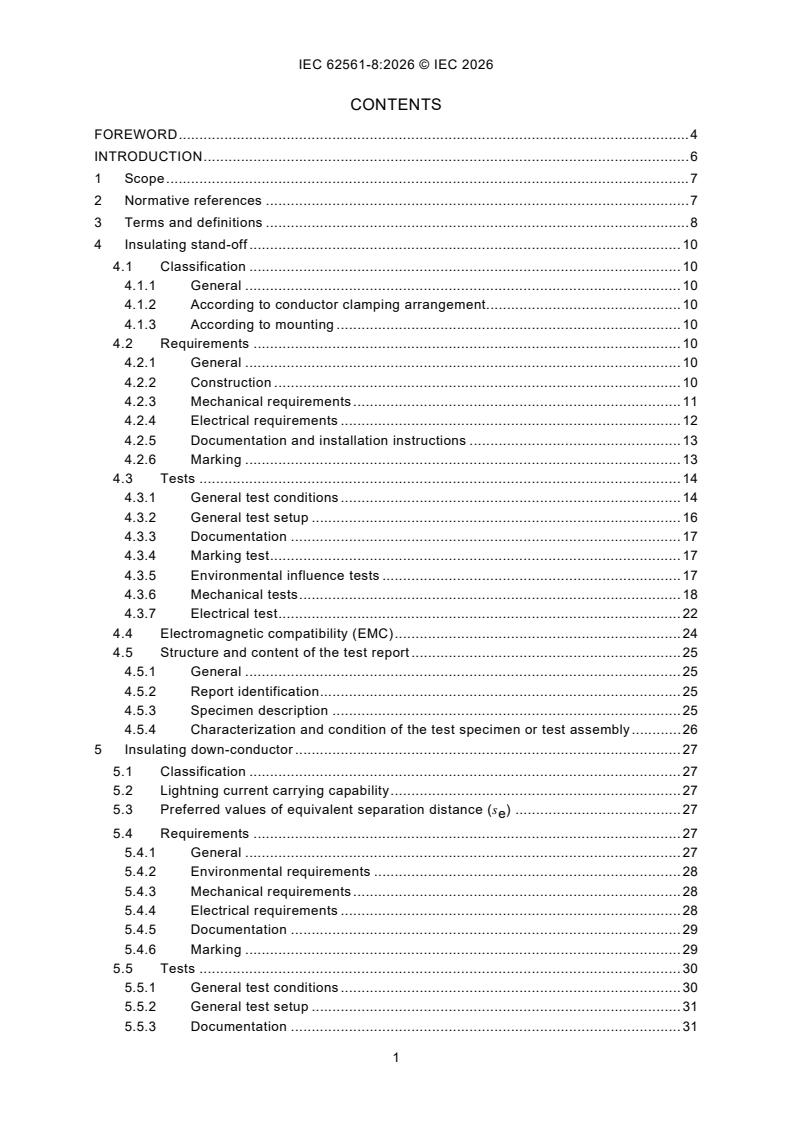
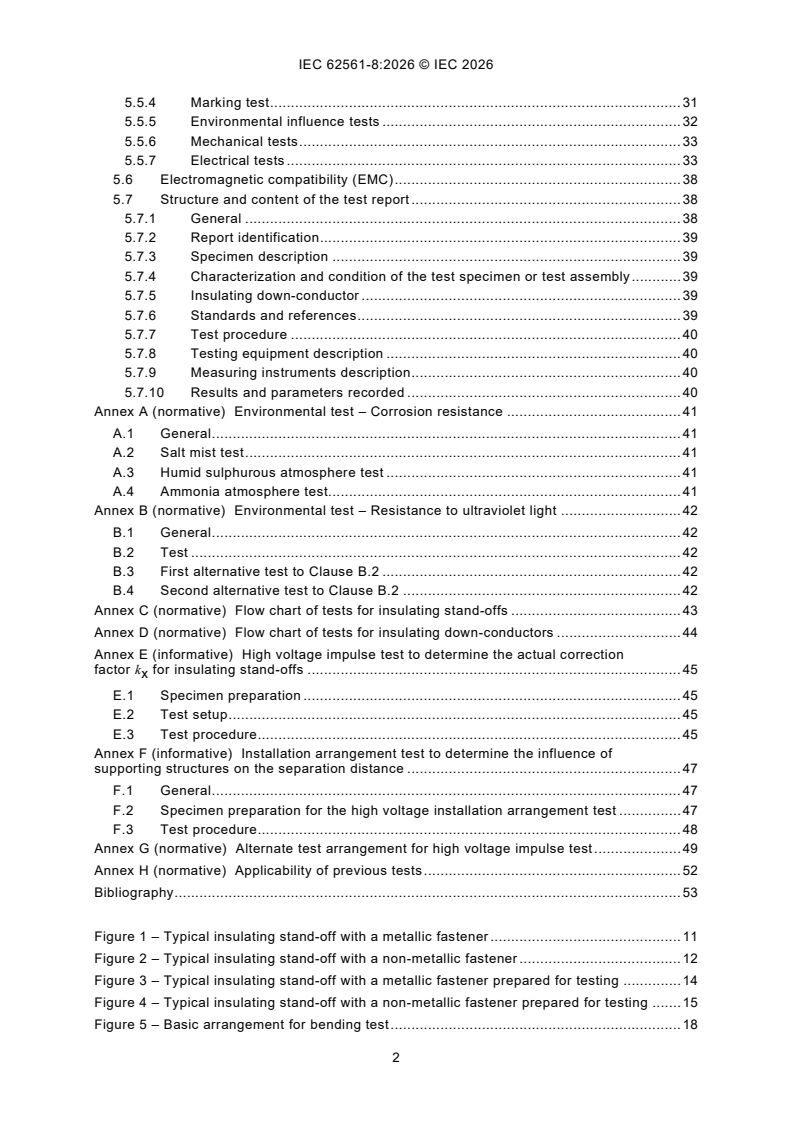
iec62561-8{ed1.0}en - Lightning protection system components (LPSC) - Part 8: Requirements for components for electrically insulated LPS
iec62561-8{ed1.0}fr - Composants des systemes de protection contre la foudre (CSPF) - Partie 8: Exigences pour les composants de systeme électriquement isolé de protection contre la foudre
IEC 62561-8:2026 is an IEC International Standard for lightning protection system components used in electrically insulated LPS. It specifies requirements and tests for insulating stand-offs and insulating down-conductors, including their specific fasteners, so manufacturers, test laboratories, designers, and installers can verify that these parts maintain the required separation distance under mechanical, environmental, and high-voltage stress.
What does IEC 62561-8:2026 specify?
IEC 62561-8:2026 covers the components used to reduce the separation distance in electrically insulated LPS. It applies to insulating stand-offs used with air-termination systems and down-conductors, and to insulating down-conductors with their specific fasteners.
The document does not cover testing for explosive atmospheres. It is organized into five main clauses, followed by annexes A to H.
| Annex | What it covers |
|---|---|
| A | Environmental corrosion tests: salt mist, humid sulphurous atmosphere, ammonia |
| B | Environmental UV resistance tests |
| C | Test flow for insulating stand-offs |
| D | Test flow for insulating down-conductors |
| E | Informative high-voltage impulse test to determine the real correction factor k for insulating stand-offs |
| F | Informative installation-device test to assess the influence of support structures on separation distance |
| G | Alternative test arrangement for the high-voltage impulse test |
| H | Applicability of previous tests from IEC TS 62561-8:2018 |
What are the key requirements of IEC 62561-8:2026?
For insulating stand-offs
IEC 62561-8:2026 classifies insulating stand-offs by conductor clamping arrangement and by mounting arrangement. That matters in practice because the test sequence and the declared use must match the actual product configuration.
The stand-off must support, fix, and insulate the conductor under lightning impulse conditions and under environmental loads such as snow, ice, wind, and thermal expansion. It must also be compatible with the conductor and the mounting surface.
Clause 4 requires a sound surface finish, corrosion resistance, UV resistance, mechanical resistance, clear installation instructions, and durable marking. In practice, this means the manufacturer has to declare the product limits and the installer needs enough information to fit it safely and correctly.
Type testing in 4.3 uses three specimens per sequence, with the order given in Annex C. If one specimen fails, the affected sequence is repeated with three new specimens; if two fail, the design is not compliant. The document also fixes the test environment, torque tool accuracy, and the minimum waiting time for non-metallic specimens.
The key tests for stand-offs are:
- documentation and marking review
- corrosion and UV conditioning
- flexion, impact, and pull-out tests
- a high-voltage impulse test that compares the stand-off against a comparison spark gap
That electrical test is important because the declared effective length or correction factor k must support the required separation distance from IEC 62305-3.
For insulating down-conductors
IEC 62561-8:2026 classifies insulating down-conductors by lightning current withstand level. Table 2 gives the current and related energy values used for the manufacturer’s declared class.
The document also gives preferred values for equivalent separation distance s. These are practical reference values for selection and design, while the actual installation may require lower or, in some cases, higher values.
A down-conductor system must insulate safely under lightning stress, resist mechanical and environmental influences, and remain compatible with the mounting surface. Its documentation must include the declared class, dimensions, compatible materials, recommended mounting method, separation distance s, and, for indoor use, information relevant to flame spread and smoke density.
The main tests in 5.5 are:
- documentation and marking review
- construction inspection
- UV resistance and corrosion resistance
- lightning current withstand test
- high-voltage impulse test for equivalent separation distance
- installation-device test when support structures may affect dielectric performance
The lightning current test in 5.5.7.1 simulates installation stress by bending and straightening the specimen before the test. The impulse test in 5.5.7.2 uses negative polarity only and a comparison spark gap, with the test timing constrained by the specified cut-off interval. For readers, that means the whole assembly, not just the cable, has to be planned and tested as installed.
What terms does IEC 62561-8:2026 define?
- support isolant - A non-metallic or composite component made of the insulator and its fixings, designed to fix, support, and insulate a conductor at the required separation distance.
- conducteur de descente isolant - A down-conductor with an electrical insulation layer intended to reduce the separation distance.
- distance de séparation équivalente s - The corrected distance used instead of the stand-off’s insulating length when comparing with the separation distance required by IEC 62305-3.
- longueur effective l_eff - The equivalent spark-gap length used to represent the insulating performance of a stand-off.
- facteur de correction de la longueur effective k - The factor used to relate the effective length to the insulating length for stand-offs.
- facteur de correction de raideur is_st / dc_st - The correction factor used in the impulse tests to account for steeper impulse conditions and the likelihood of short-duration negative strokes.
- dispositif d'installation - The complete installation, including one or more insulating down-conductors and the additional mounting means needed to maintain the declared separation distance.
- courant admissible de foudre - The lightning impulse current level that the down-conductor can withstand, as declared by the manufacturer and verified by test.
Who uses IEC 62561-8:2026?
IEC 62561-8:2026 is used by manufacturers of lightning protection system components, especially makers of insulating stand-offs and insulating down-conductors. It is also used by test laboratories that perform type tests and generate reports to the prescribed format.
Designers and specifiers use it when selecting components for an electrically insulated LPS and when checking the required separation distance against IEC 62305-3. Quality, compliance, and procurement teams use it to define product acceptance, compare declarations against test evidence, and review documentation and marking.
What changed in IEC 62561-8:2026 from the previous edition?
IEC 62561-8:2026 is the first edition and it cancels and replaces IEC TS 62561-8:2018. The standard identifies these technical changes:
- title and scope adjusted
- updated for IEC 60068-2-52:2017 salt mist treatment
- updated for ISO 22479:2019 humid sulphurous atmosphere treatment
- two pull-out test configurations added
- more information on pollution added
- alternative high-voltage impulse test arrangement added
- new normative Annex H on applicability of previous tests added
- high-voltage impulse pass criteria updated
- explanation added for negative-polarity high-voltage impulse testing
Which standards are used with IEC 62561-8:2026?
| Standard | What it contributes |
|---|---|
| IEC 60060-2:2025 | High-voltage measuring systems for impulse tests |
| IEC 60068-2-52:2017 | Cyclic salt mist test used in Annex A |
| IEC 60068-2-75:2014 | Hammer impact test method used for mechanical impact |
| IEC 61083-1 | Requirements for instruments used in impulse measurements |
| IEC 61083-2 | Software requirements for impulse measurements |
| IEC 62305-3 | Separation distance reference for electrically insulated LPS |
| IEC 62561-1:2023 | Connector requirements and tests used for conductor assemblies |
| IEC 62561-2:2025 | Down-conductor and earth electrode requirements used for conductor-related checks |
| IEC 62561-4 | Requirements for conductor fixings used with down-conductors |
| ISO 4892-2 | Xenon-arc UV exposure method used in Annex B |
| ISO 4892-3:2024 | UV fluorescent exposure method used in Annex B |
| ISO 4892-4 | Carbon-arc UV exposure method used in Annex B |
| ISO 6957:1988 | Ammonia atmosphere corrosion test used in Annex A |
| ISO 22479:2019 | Humid sulphurous atmosphere corrosion test used in Annex A |
What does the IEC 62561-8:2026 document contain?
IEC 62561-8:2026 contains test sequences, acceptance criteria, and reporting requirements for both product families. Tables 1 and 3 set out the type-test sequences for insulating stand-offs and insulating down-conductors, while Table 2 gives the lightning current classes for down-conductors.
The figures show typical product constructions and the detailed test arrangements, including pull-out, flexion, impact, UV preparation, lightning current, and high-voltage impulse setups. Annexes C and D give the test order, and Annexes E, F, and G provide informative or alternative test arrangements for special cases.
It also defines the minimum content of test reports, so the same document supports design review, laboratory testing, certification work, and compliance audits.
Relations
- Effective Date
- 05-Sep-2023
Buy Documents
REDLINE IEC 62561-8:2026 CMV - Lightning protection system components (LPSC) - Part 8: Requirements for components for electrically insulated LPS
iec62561-8{ed1.0}en - Lightning protection system components (LPSC) - Part 8: Requirements for components for electrically insulated LPS
iec62561-8{ed1.0}fr - Composants des systemes de protection contre la foudre (CSPF) - Partie 8: Exigences pour les composants de systeme électriquement isolé de protection contre la foudre
Get Certified
Connect with accredited certification bodies for this standard

DIBt (Deutsches Institut für Bautechnik)
German Institute for Building Technology.
DIN CERTCO
DIN Group product certification.

IMQ S.p.A. (Certification)
Italian electrical product certification.
Sponsored listings
Frequently Asked Questions
IEC 62561-8:2026 is a standard published by the International Electrotechnical Commission (IEC). Its full title is "Lightning protection system components (LPSC) - Part 8: Requirements for components for electrically insulated LPS". This standard covers: IEC 62561-8:2026 specifies the requirements and tests for components used for electrically insulated LPS. These components, which can reduce the separation distance, are as follows: - insulating stand-offs, used in conjunction with an air-termination system and down-conductors with the aim of maintaining the proper separation distance; - insulating down‑conductors, including their specific fasteners. Testing of insulating stand-offs and insulating down-conductor components for an explosive atmosphere is not covered by this document. This first edition cancels and replaces IEC TS 62561-8 published in 2018. This edition constitutes a technical revision. This edition includes the following significant technical changes with respect to IEC TC 62561-8:2018: a) title and scope of the standard has been adjusted; b) the document has been updated in line with IEC 60068-2-52:2017 on salt mist treatment; c) the document has been updated in line with ISO 22479:2019 on humid sulphureous atmosphere treatment; d) two different possible example configurations for pull out tests have been introduced; e) additional information on pollution has been included; f) an alternate test arrangement for high voltage impulse test has been included; g) a new normative Annex H for applicability of previous tests has been introduced; h) pass criteria for high voltage impulse testing updated; i) explanation on high voltage impulse testing with negative polarity has been added.
IEC 62561-8:2026 specifies the requirements and tests for components used for electrically insulated LPS. These components, which can reduce the separation distance, are as follows: - insulating stand-offs, used in conjunction with an air-termination system and down-conductors with the aim of maintaining the proper separation distance; - insulating down‑conductors, including their specific fasteners. Testing of insulating stand-offs and insulating down-conductor components for an explosive atmosphere is not covered by this document. This first edition cancels and replaces IEC TS 62561-8 published in 2018. This edition constitutes a technical revision. This edition includes the following significant technical changes with respect to IEC TC 62561-8:2018: a) title and scope of the standard has been adjusted; b) the document has been updated in line with IEC 60068-2-52:2017 on salt mist treatment; c) the document has been updated in line with ISO 22479:2019 on humid sulphureous atmosphere treatment; d) two different possible example configurations for pull out tests have been introduced; e) additional information on pollution has been included; f) an alternate test arrangement for high voltage impulse test has been included; g) a new normative Annex H for applicability of previous tests has been introduced; h) pass criteria for high voltage impulse testing updated; i) explanation on high voltage impulse testing with negative polarity has been added.
IEC 62561-8:2026 is classified under the following ICS (International Classification for Standards) categories: 29.020 - Electrical engineering in general; 91.120.40 - Lightning protection. The ICS classification helps identify the subject area and facilitates finding related standards.
IEC 62561-8:2026 has the following relationships with other standards: It is inter standard links to IEC TS 62561-8:2018. Understanding these relationships helps ensure you are using the most current and applicable version of the standard.
IEC 62561-8:2026 is available in PDF format for immediate download after purchase. The document can be added to your cart and obtained through the secure checkout process. Digital delivery ensures instant access to the complete standard document.
Standards Content (Sample)
IEC 62561-8 ®
Edition 1.0 2026-06
INTERNATIONAL
STANDARD
COMMENTED VERSION
Lightning protection system components (LPSC) -
Part 8: Requirements for components for isolated electrically insulated LPS
ICS 29.020; 91.120.40 ISBN 978-2-8327-1340-2
All rights reserved. Unless otherwise specified, no part of this publication may be reproduced or utilized in any form or
by any means, electronic or mechanical, including photocopying and microfilm, without permission in writing from either
IEC or IEC's member National Committee in the country of the requester. If you have any questions about IEC copyright
or have an enquiry about obtaining additional rights to this publication, please contact the address below or your local
IEC member National Committee for further information.
IEC Secretariat Tel.: +41 22 919 02 11
3, rue de Varembé info@iec.ch
CH-1211 Geneva 20 www.iec.ch
Switzerland
About the IEC
The International Electrotechnical Commission (IEC) is the leading global organization that prepares and publishes
International Standards for all electrical, electronic and related technologies.
About IEC publications
The technical content of IEC publications is kept under constant review by the IEC. Please make sure that you have the
latest edition, a corrigendum or an amendment might have been published.
IEC publications search - IEC Products & Services Portal - products.iec.ch
webstore.iec.ch/advsearchform Discover our powerful search engine and read freely all the
The advanced search enables to find IEC publications by a publications previews, graphical symbols and the glossary.
variety of criteria (reference number, text, technical With a subscription you will always have access to up to date
committee, …). It also gives information on projects, content tailored to your needs.
replaced and withdrawn publications.
Electropedia - www.electropedia.org
IEC Just Published - webstore.iec.ch/justpublished The world's leading online dictionary on electrotechnology,
Stay up to date on all new IEC publications. Just Published containing more than 22 500 terminological entries in English
details all new publications released. Available online and and French, with equivalent terms in 25 additional languages.
once a month by email. Also known as the International Electrotechnical Vocabulary
(IEV) online.
IEC Customer Service Centre - webstore.iec.ch/csc
If you wish to give us your feedback on this publication or
need further assistance, please contact the Customer
Service Centre: sales@iec.ch.
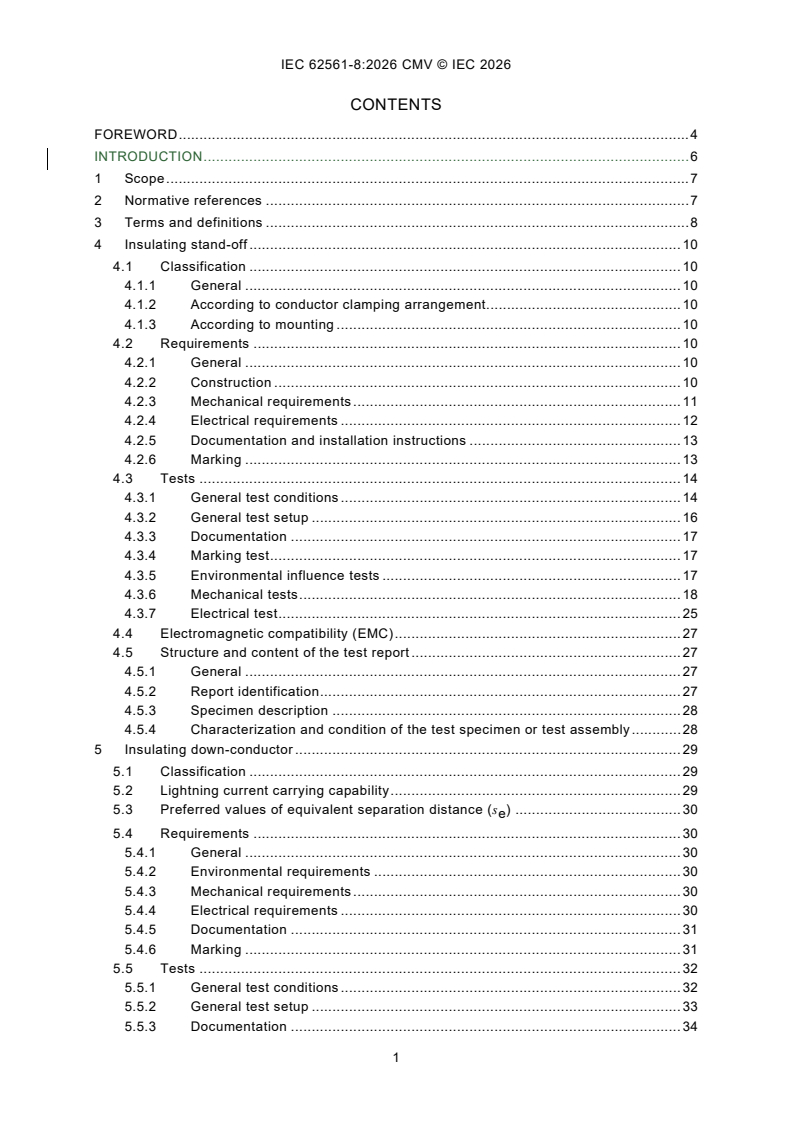
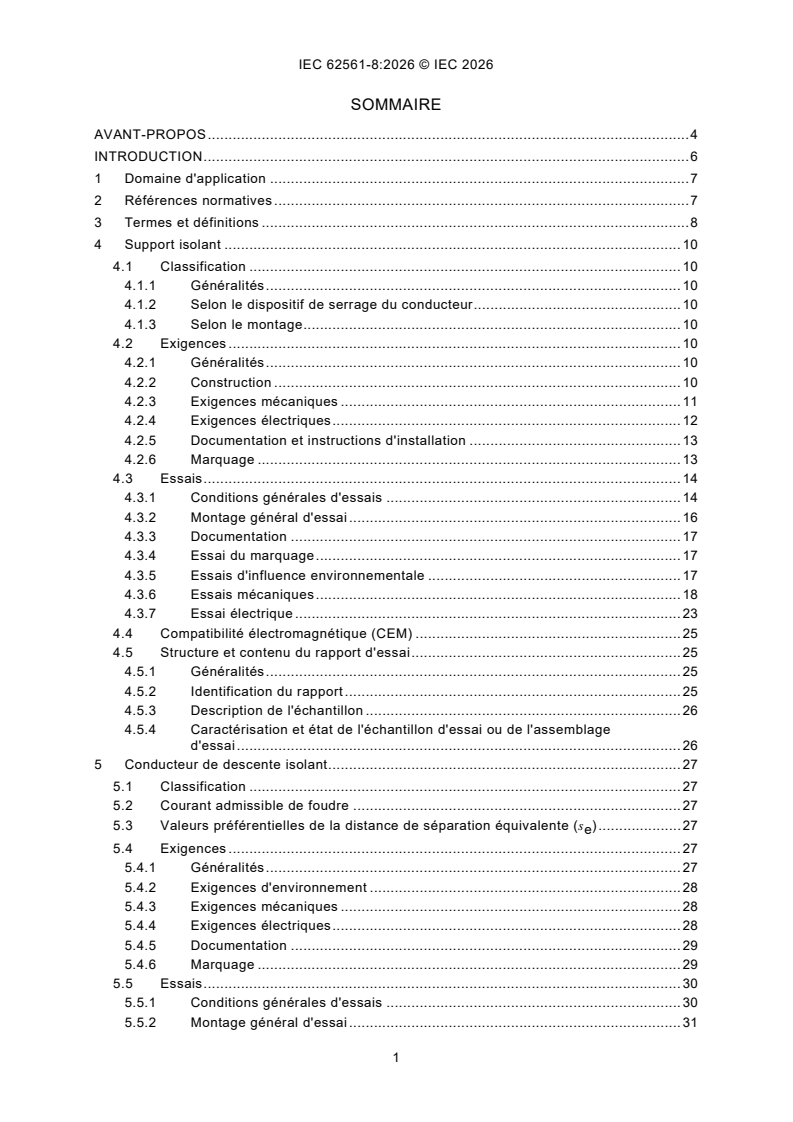
CONTENTS
FOREWORD . 4
INTRODUCTION . 6
1 Scope . 7
2 Normative references . 7
3 Terms and definitions . 8
4 Insulating stand-off . 10
4.1 Classification . 10
4.1.1 General . 10
4.1.2 According to conductor clamping arrangement. 10
4.1.3 According to mounting . 10
4.2 Requirements . 10
4.2.1 General . 10
4.2.2 Construction . 10
4.2.3 Mechanical requirements . 11
4.2.4 Electrical requirements . 12
4.2.5 Documentation and installation instructions . 13
4.2.6 Marking . 13
4.3 Tests . 14
4.3.1 General test conditions . 14
4.3.2 General test setup . 16
4.3.3 Documentation . 17
4.3.4 Marking test . 17
4.3.5 Environmental influence tests . 17
4.3.6 Mechanical tests . 18
4.3.7 Electrical test . 25
4.4 Electromagnetic compatibility (EMC) . 27
4.5 Structure and content of the test report . 27
4.5.1 General . 27
4.5.2 Report identification . 27
4.5.3 Specimen description . 28
4.5.4 Characterization and condition of the test specimen or test assembly . 28
5 Insulating down-conductor . 29
5.1 Classification . 29
5.2 Lightning current carrying capability . 29
5.3 Preferred values of equivalent separation distance (s ) . 30
e
5.4 Requirements . 30
5.4.1 General . 30
5.4.2 Environmental requirements . 30
5.4.3 Mechanical requirements . 30
5.4.4 Electrical requirements . 30
5.4.5 Documentation . 31
5.4.6 Marking . 31
5.5 Tests . 32
5.5.1 General test conditions . 32
5.5.2 General test setup . 33
5.5.3 Documentation . 34
5.5.4 Marking test . 34
5.5.5 Environmental influence tests . 34
5.5.6 Mechanical tests . 36
5.5.7 Electrical tests . 40
5.6 Electromagnetic compatibility (EMC) . 48
5.7 Structure and content of the test report . 48
5.7.1 General . 48
5.7.2 Report identification . 49
5.7.3 Specimen description . 49
5.7.4 Characterization and condition of the test specimen or test assembly . 49
5.7.5 Insulating down-conductor . 49
5.7.6 Standards and references . 50
5.7.7 Test procedure . 50
5.7.8 Testing equipment description . 50
5.7.9 Measuring instruments description . 50
5.7.10 Results and parameters recorded . 50
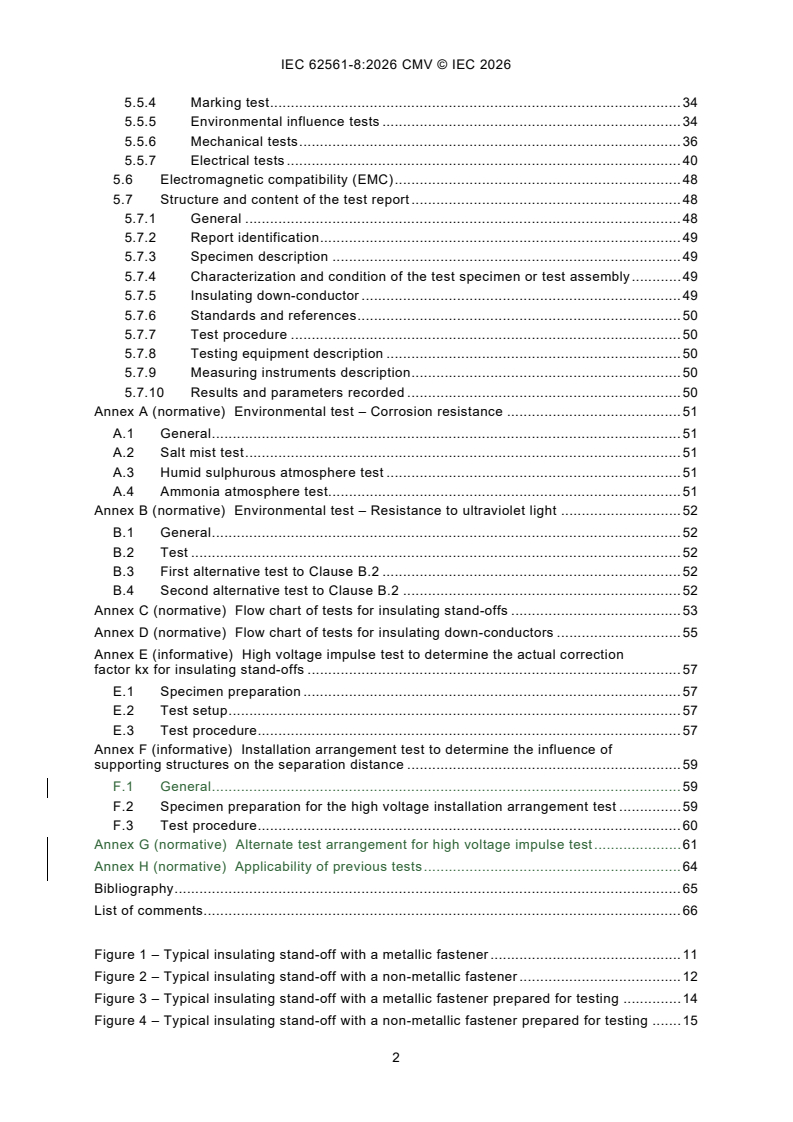
Annex A (normative) Environmental test – Corrosion resistance . 51
A.1 General . 51
A.2 Salt mist test . 51
A.3 Humid sulphurous atmosphere test . 51
A.4 Ammonia atmosphere test. 51
Annex B (normative) Environmental test – Resistance to ultraviolet light . 52
B.1 General . 52
B.2 Test . 52
B.3 First alternative test to Clause B.2 . 52
B.4 Second alternative test to Clause B.2 . 52
Annex C (normative) Flow chart of tests for insulating stand-offs . 53
Annex D (normative) Flow chart of tests for insulating down-conductors . 55
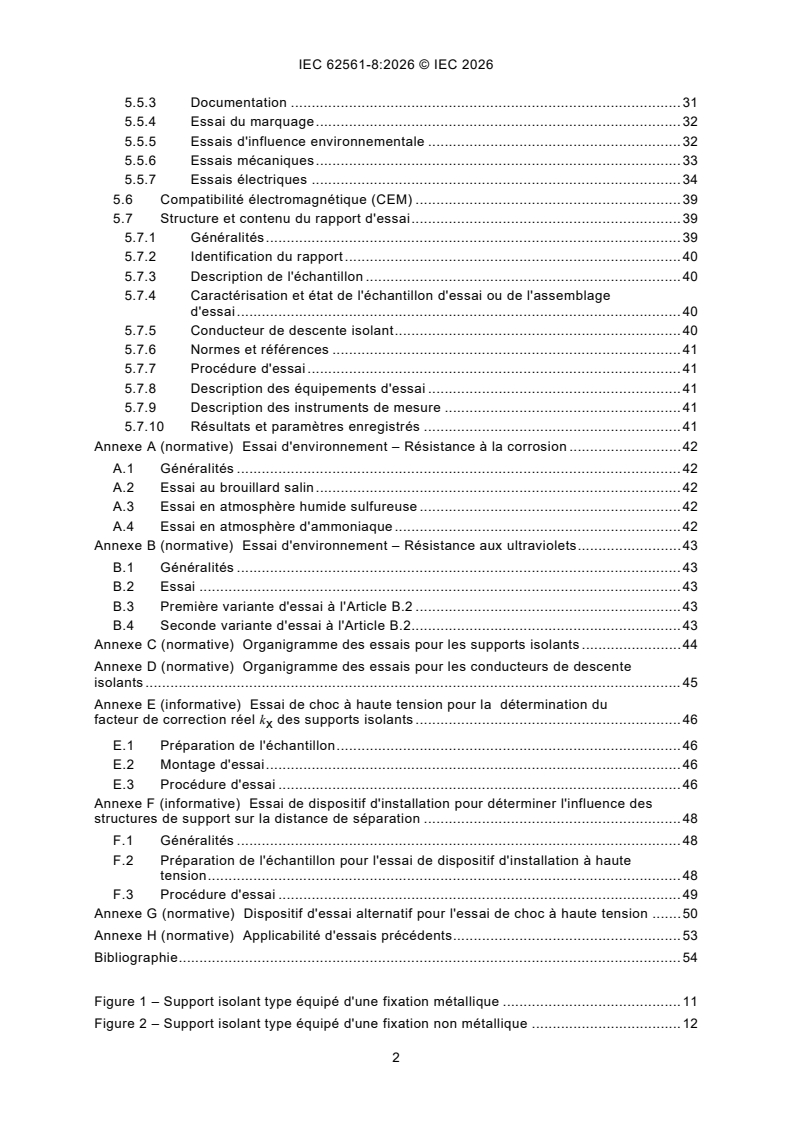
Annex E (informative) High voltage impulse test to determine the actual correction
factor kx for insulating stand-offs . 57
E.1 Specimen preparation . 57
E.2 Test setup . 57
E.3 Test procedure. 57
Annex F (informative) Installation arrangement test to determine the influence of
supporting structures on the separation distance . 59
F.1 General . 59
F.2 Specimen preparation for the high voltage installation arrangement test . 59
F.3 Test procedure. 60
Annex G (normative) Alternate test arrangement for high voltage impulse test . 61
Annex H (normative) Applicability of previous tests . 64
Bibliography . 65
List of comments. 66
Figure 1 – Typical insulating stand-off with a metallic fastener . 11
Figure 2 – Typical insulating stand-off with a non-metallic fastener . 12
Figure 3 – Typical insulating stand-off with a metallic fastener prepared for testing . 14
Figure 4 – Typical insulating stand-off with a non-metallic fastener prepared for testing . 15
Figure 5 – Basic arrangement for bending test . 19
Figure 6 – Pendulum hammer test apparatus . 20
Figure 7 – Basic arrangement for pull out test on rigidly
fixed insulating stand-off .
Figure 7 – Two alternative basic arrangements for pull out test on rigidly fixed
insulating stand-off . 22
Figure 8 – Basic arrangement for pull out test on
free standing insulating stand-off .
Figure 8 – Two alternative basic arrangements for pull out test on free standing
insulating stand-off . 24
Figure 9 – General description of the Typical test arrangement for the high voltage
impulse test of an insulating stand-off . 25
Figure 10 – Specimen preparation for UV light test . 35
Figure 11 – Basic arrangement for lateral load test .
Figure 12 – Typical arrangement for axial movement test .
Figure 14 – General description of the test setup for the high voltage
impulse test of the insulating down-conductor .
Figure 11 – Basic arrangement for the lightning current carrying capability test . 41
Figure 12 – Test arrangements for the high voltage impulse test of the insulating down-
conductor . 44
Figure 15 – Test arrangement for insulating down-conductors .
Figure 16 – Test arrangement for partial insulating down -conductors .
Figure 13 – Test arrangements for insulting down conductors . 47
Figure C.1 – Tests for insulating stand-offs . 54
Figure D.1 – Tests for insulating down-conductors . 56
Figure E.1 – General description of the test arrangement to determine
the actual correction factor k for insulating stand-offs .
x
Figure F.1 – Example for installation arrangement test – Specimen under test . 59
Figure F.2 – Alternate example for installation arrangement test – Specimen under test . 60
Figure G.1 – Typical test arrangement for the high voltage impulse test of an insulating
stand-off – Alternate test arrangement to Figure 9 . 61
Figure G.2 – General description of the test setup for the high voltage impulse test of
the insulating down-conductor – Alternate test set-up to Figure 12 a) . 62
Figure G.3 – Alternate test arrangement for the high voltage impulse test of the
insulating down conductor – alternate test set-up to Figure 12 b) . 62
Figure G.4 – General description rod tip and rod – Plane arrangement geometry . 63
Table 1 – Type test requirements for an insulating stand-off . 16
Table 2 – Lightning impulse current (I ) parameters . 29
imp
Table 3 – Type test requirements for an insulating down-conductor and fasteners . 33
Table H.1 – Differences in the requirements for electrically insulated LPS complying
with IEC TS 62561-8:2018 . 64
INTERNATIONAL ELECTROTECHNICAL COMMISSION
____________
Lightning protection system components (LPSC) -
Part 8: Requirements for components for isolated electrically
insulated LPS 1
FOREWORD
1) The International Electrotechnical Commission (IEC) is a worldwide organization for standardization comprising
all national electrotechnical committees (IEC National Committees). The object of IEC is to promote international
co-operation on all questions concerning standardization in the electrical and electronic fields. To this end and
in addition to other activities, IEC publishes International Standards, Technical Specifications, Technical Reports,
Publicly Available Specifications (PAS) and Guides (hereafter referred to as “IEC Publication(s)”). Their
preparation is entrusted to technical committees; any IEC National Committee interested in the subject dealt with
may participate in this preparatory work. International, governmental and non-governmental organizations liaising
with the IEC also participate in this preparation. IEC collaborates closely with the International Organization for
Standardization (ISO) in accordance with conditions determined by agreement between the two organizations.
2) The formal decisions or agreements of IEC on technical matters express, as nearly as possible, an international
consensus of opinion on the relevant subjects since each technical committee has representation from all
interested IEC National Committees.
3) IEC Publications have the form of recommendations for international use and are accepted by IEC National
Committees in that sense. While all reasonable efforts are made to ensure that the technical content of IEC
Publications is accurate, IEC cannot be held responsible for the way in which they are used or for any
misinterpretation by any end user.
4) In order to promote international uniformity, IEC National Committees undertake to apply IEC Publications
transparently to the maximum extent possible in their national and regional publications. Any divergence between
any IEC Publication and the corresponding national or regional publication shall be clearly indicated in the latter.
5) IEC itself does not provide any attestation of conformity. Independent certification bodies provide conformity
assessment services and, in some areas, access to IEC marks of conformity. IEC is not responsible for any
services carried out by independent certification bodies.
6) All users should ensure that they have the latest edition of this publication.
7) No liability shall attach to IEC or its directors, employees, servants or agents including individual experts and
members of its technical committees and IEC National Committees for any personal injury, property damage or
other damage of any nature whatsoever, whether direct or indirect, or for costs (including legal fees) and
expenses arising out of the publication, use of, or reliance upon, this IEC Publication or any other IEC
Publications.
8) Attention is drawn to the Normative references cited in this publication. Use of the referenced publications is
indispensable for the correct application of this publication.
9) IEC draws attention to the possibility that the implementation of this document may involve the use of (a)
patent(s). IEC takes no position concerning the evidence, validity or applicability of any claimed patent rights in
respect thereof. As of the date of publication of this document, IEC had not received notice of (a) patent(s), which
may be required to implement this document. However, implementers are cautioned that this may not represent
the latest information, which may be obtained from the patent database available at https://patents.iec.ch. IEC
shall not be held responsible for identifying any or all such patent rights.
This redline version of the official IEC Standard allows the user to identify the changes made
to the previous edition IEC TS 62561-8:2018. A vertical bar appears in the margin wherever a
change has been made. Additions are in green text, deletions are in strikethrough red text.
IEC 62561-8 has been prepared by IEC technical committee 81: Lightning protection. It is an
International Standard.
This first edition cancels and replaces IEC TS 62561-8 published in 2018. This edition
constitutes a technical revision.
This edition includes the following significant technical changes with respect to IEC TC
62561-8:2018:
a) title and scope of the standard has been adjusted;
b) the document has been updated in line with IEC 60068-2-52:2017 on salt mist treatment;
c) the document has been updated in line with ISO 22479:2019 on humid sulphureous
atmosphere treatment;
d) two different possible example configurations for pull out tests have been introduced;
e) additional information on pollution has been included;
f) an alternate test arrangement for high voltage impulse test has been included;
g) a new normative Annex H for applicability of previous tests has been introduced;
h) pass criteria for high voltage impulse testing updated;
i) explanation on high voltage impulse testing with negative polarity has been added.
The text of this International Standard is based on the following documents:
Draft Report on voting
81/806/FDIS 81/808/RVD
Full information on the voting for its approval can be found in the report on voting indicated in
the above table.
The language used for the development of this International Standard is English.
This document was drafted in accordance with ISO/IEC Directives, Part 2, and developed in
accordance with ISO/IEC Directives, Part 1 and ISO/IEC Directives, IEC Supplement, available
at www.iec.ch/members_experts/refdocs. The main document types developed by IEC are
described in greater detail at www.iec.ch/publications.
A list of all parts in the 62561 series, published under the general title Lightning protection
system components (LPSC), can be found on the IEC website.
The committee has decided that the contents of this document will remain unchanged until the
stability date indicated on the IEC website under webstore.iec.ch in the data related to the
specific document. At this date, the document will be
– reconfirmed,
– withdrawn, or
– revised.
INTRODUCTION
This part of IEC 62561 deals with the requirements and tests for lightning protection system
components (LPSC), specifically components for electrically insulated LPS, used for the
installation of a lightning protection system (LPS) designed and implemented according to the
IEC 62305 series [1] .
___________
Numbers in square brackets refer to the Bibliography.
1 Scope
This document specifies the requirements and tests for components used for electrically
insulated LPS. These components, which can reduce the separation distance, are as follows:
– insulating stand-offs, used in conjunction with an air-termination system and down-
conductors with the aim of maintaining the proper separation distance, and the requirements
and tests for insulating down-conductors, including their specific fasteners, able to reduce
the separation distance.;
– insulating down-conductors, including their specific fasteners. 2
Testing of insulating stand-offs and insulating down-conductor components for an explosive
atmosphere is not covered by this document.
Requirements and tests for other types of components for isolated LPS are under consideration.
2 Normative references
The following documents are referred to in the text in such a way that some or all of their content
constitutes requirements of this document. For dated references, only the edition cited applies.
For undated references, the latest edition of the referenced document (including any
amendments) applies.
IEC 60060-2:20102025, High-voltage test techniques - Part 2: Measuring systems
IEC 60068-2-52:2017, Environmental testing - Part 2-52: Tests - Test Kb: Salt mist, cyclic
(sodium chloride solution) 3
IEC 60068-2-75:2014, Environmental testing - Part 2-75: Tests - Test Eh: Hammer tests
IEC 61083-1, Instruments and software used for measurements in high-voltage impulse and
high-current tests - Part 1: Requirements for instruments for impulse tests
IEC 61083-2, Instruments and software used for measurement in high-voltage and high-current
tests - Part 2: Requirements for software for tests with impulse voltages and currents
IEC 62305-3, Protection against lightning - Part 3: Physical damage to structures and life
hazard
IEC 62561-1:20172023, Lightning protection system components (LPSC) - Part 1:
Requirements for connection components
IEC 62561-2:20122025, Lightning protection system components (LPSC) - Part 2:
Requirements for conductors and earth electrodes
IEC 62561-4, Lightning protection system components (LPSC) - Part 4: Requirements for
conductor fasteners
ISO 4892-2, Plastics - Methods of exposure to laboratory light sources - Part 2: Xenon-arc
lamps
ISO 4892-3:20162024, Plastics - Methods of exposure to laboratory light sources - Part 3:
Fluorescent UV lamps
ISO 4892-4, Plastics - Methods of exposure to laboratory light sources - Part 4: Open-flame
carbon-arc lamps
ISO 6988:1985, Metallic and other non-organic coatings – Sulfur dioxide test with general
condensation of moisture
ISO 6957:1988, Copper alloys - Ammonia test for stress corrosion resistance
ISO 22479:2019, Corrosion of metals and alloys - Sulfur dioxide test in a humid atmosphere
(fixed gas method) 4
3 Terms and definitions
For the purposes of this document, the following terms and definitions apply.
ISO and IEC maintain terminological databases for use in standardization at the following
addresses:
– IEC Electropedia: available at http://www.electropedia.org/
– ISO Online browsing platform: available at http://www.iso.org/obp
3.1
insulating stand-off
non-metallic or composite component, consisting of the insulator and fixation parts, designed
to retain, support and insulate the air-termination system and/or down-conductors at a required
separation distance
3.2
effective length correction factor
k
x
factor evaluating the different withstand voltages of air gaps and insulators under test voltages
and environmental influences like pollution and/or UV light degradation
3.3
steepness correction factor
c
is_st
factor considering the effect of higher steepness and the probability of
occurrence of subsequent negative short strokes on the flashover disruptive voltage of an
insulating stand-off
Note 1 to entry: The value is defined in the test procedure.
3.4
effective length
l
eff
length (distance) of an air gap with equivalent breakdown behaviour to
an insulating stand-off
3.5
corrected distance value of an insulating length
l
st
shortest measured clearance distance between two conductive elements
of different electrical potential, for example between a metallic conductor fastener and a
mounting assembly
3.6
equivalent separation distance
s
e
corrected distance value to be used instead of the insulating length of a stand-off distance value
equivalent to the separation distance of conventional down-conductors required in IEC 62305-3
3.7
down-conductor
conductor made of bare metal
part of the down-conductor system intended to conduct lightning current from the air-termination
system to the earth-termination system of the LPS
[SOURCE: IEC 62561-2:2025, 3.7]
3.8
insulating down-conductor
conductor provided with a layer of electric insulation with the purpose to reduce the separation
distance
3.9
steepness correction factor
c
dc_st
factor considering the effect of higher steepness and the
probability of occurrence of subsequent negative short strokes on the withstand voltage of
insulating down-conductors during testing
Note 1 to entry: The value is defined in the test procedure.
3.10
partial insulating down-conductor
conductor provided with a layer of insulation with the purpose to reduce the separation distance,
supported by insulating stand-offs
3.10
clearance of the comparison arrangement
s
c
gap distance of the comparison arrangement used for verification of the effective length
correction factor k and separation distance s
x e
3.11
time to chopping
T
c
virtual parameter defined as the interval between the virtual origin and the instant of chopping
3.12
effective material insulating factor
k
m
coefficient of material which depends on the electrical insulation material
Note 1 to entry: See IEC 62305-3.
3.13
installation arrangement
installation containing one or more insulating down-conductors and additional installation
means (according to the manufacturer's instruction) to keep the defined separation distance
and to support the insulating down-conductor mechanically
Note 1 to entry: One example is given in Figure F.1.
3.14
fasteners for insulating down-conductors
metallic, non-metallic or composite components designed to retain and support down-conductor
installed at intervals along the length of the conductors
4 Insulating stand-off
4.1 Classification
4.1.1 General
Classification of the product depends on the withstand capability of mechanical forces.
4.1.2 According to conductor clamping arrangement
There are two classes of insulating stand-off according to the conducting clamping
arrangement:
a) conductor fasteners that are designed to clamp the conductor;
b) conductor fasteners that are designed to clamp but allow axial movement of the conductor.
4.1.3 According to mounting
Regarding the mounting, there are two classes of insulating stand-off:
a) free standing;
b) rigidly fixed on a structure.
4.2 Requirements
4.2.1 General
An insulating stand-off shall retain, support and insulate the conductor when subjected to the
stress of a lightning discharge under high impulse voltage and shall withstand the mechanical
and environmental influences such as perpendicular and axial compression loads caused by
the weight of the supported conductor along with snow, ice, wind and thermal expansion/ or
contraction of the conductor.
An insulating stand-off shall be compatible with the conductor it is supporting and the surface
to which it is fixed.
4.2.2 Construction
4.2.2.1 General
An insulating stand-off shall be so designed and constructed that
a) the surface is free from burrs, flash moulding, deformation and similar inconsistencies which
are likely to inflict injury to the installer or user, and
Compliance is checked by visual inspection.
b) it carries the perpendicular and axial compression loads caused by the weight of the
supported conductor along with snow, ice, wind and thermal expansion/contraction of the
conductor.
Compliance to a) is checked by visual inspection and compliance to b) is checked in accordance
with 4.3.6.2 and 4.3.6.4.
4.2.2.2 Corrosion resistance
An insulating stand-off shall withstand the effects of corrosion typical of the environment to
which it is exposed.
Compliance is checked by testing in accordance with 4.3.5.1.
4.2.2.3 UV light resistance
An insulating stand-off shall withstand the effects of UV exposure typical of the environment to
which it is exposed.
Compliance is checked by testing in accordance with 4.3.5.2.
4.2.3 Mechanical requirements
4.2.3.1 General
An insulating stand-off may can consist of a mounting assembly, an insulator and a conductor
fastener as shown in Figure 1 and/or Figure 2. The manufacturer of the insulating stand-off
shall guarantee with appropriate mechanical tests or calculations that the stand-off fulfills the
requirements stated in their documentation.
Compliance is checked by testing in accordance with 4.3.
Key
1 mounting assembly
2 insulator
3 metallic conductor fastener
4 conductor
insulating length
l
st
Figure 1 – Typical insulating stand-off with a metallic fastener
Key
1 mounting assembly
2 insulator
3 non metallic conductor fastener
4 conductor
l insulating length
st
Figure 2 – Typical insulating stand-off with a non-metallic fastener
4.2.3.2 Mounting assembly
The mounting assembly, which holds the insulator in position on the structure, shall withstand
mechanical stress.
Compliance is checked by testing in accordance with 4.3.6.
4.2.3.3 Insulator
The insulator shall withstand mechanical stress, for example pull out force, impact strength and
bending load.
Compliance is checked by testing in accordance with 4.3.6.
4.2.3.4 Conductor fastener
The conductor fastener, which is part of the insulating stand-off, shall comply with the
requirements and tests of IEC 62561-4.
4.2.4 Electrical requirements
An insulating stand-off shall be capable of withstanding the very high impulse voltages
generated by a lightning strike.
An insulating stand-off has an insulating length l , as shown in Figure 1 and Figure 2. This is
st
different from its effective length l , which is the value which shall to be compared to the
eff,
required separation distance s according to IEC 62305-3. This effective length of the insulating
stand-off shall be equal to or greater than the required separation distance s.
The isolating capability of an insulating stand-off may can be provided by either
a) its effective length l , or
eff
b) its effective length correction factor k .
x
The effective length correction factor k is determined from the effective length l and the
x eff
insulating length l as showed in Formula (1):
st
I
eff
k =
(1)
x
I
st
Compliance is checked by testing in accordance with 4.3.1, 4.3.2 and 4.3.7.
For the purpose of calculating the separation distance as used in IEC 62305-3, the value of the
effective material insulating factor k can be set equal to the value k .
m x
NOTE Based on experience, A value of k = 0,7 for GFRP, PE and PVC insulating stand-offs under normal operating
x
conditions has been found to be typical can be used, based on laboratory test results [2].
4.2.5 Documentation and installation instructions
The manufacturer or supplier of the insulating stand-off shall provide adequate information in
the installation instructions to ensure that the installer can select and install the component in
a suitable and safe manner in accordance with the requirements of IEC 62305-3.
Compliance is checked by inspection in accordance with 4.3.3.
4.2.6 Marking
4.2.6.1 Content of marking
An insulating stand-off shall be marked with
a) the manufacturer's or responsible vendor's name, logo or trademark, and
b) the product identification or type.
Where it is not possible to make these marks directly onto the product, they shall be provided
on the smallest supplied packaging.
Compliance is checked by visual inspection.
4.2.6.2 Durability and legibility
Marking on the product shall be durable and easily legible.
NOTE Marking can be applied for example by moulding, pressing, engraving, printing, adhesive labels or water
slide transfers.
Compliance is checked by testing in accordance with 4.3.4.
4.3 Tests
4.3.1 General test conditions
Tests according to this document are type tests. These tests are of such a nature that, after
they have been performed, they need are not required to be repeated unless changes are made
to the materials, design or type of manufacturing process, which might can change the
performance characteristics of the insulating stand-off.
Unless otherwise specified, All tests are carried out with the specimens assembled and installed
as in normal use according to the manufacturer's or supplier's instructions, using the
recommended conductor materials, sizes and tightening torques.
The insulating length l of all specimens shall be (500 ± 5) mm unless otherwise specified in
st
the relevant test procedure. The manufacturer shall prepare the test specimens according to
Figure 3 for a metallic fastener or Figure 4 for a non-metallic fastener.
Dimensions in millimetres
Key
1 mounting assembly
2 insulator
3 metallic conductor fastener
4 conductor
l insulating length
st
Figure 3 – Typical insulating stand-off with a metallic fastener prepared for testing
Dimensions in millimetres
Key
1 mounting assembly
2 insulator
3 non-metallic conductor fastener
4 conductor
l insulating length
st
Figure 4 – Typical insulating stand-off with a non-metallic fastener prepared for testing
This document cannot cover all possible types of insulating stand-offs and the way of fixing
them on various surfaces of different materials. When required for these applications,
agreement should be obtained between the test engineer and manufacturer on the specific
testing regime.
An insulating stand-off classified by the manufacturer in more than one of the classifications in
4.1 shall be tested for each applicable category.
Type tests are carried out on three specimens according to the test sequence indicated in
Table 1. Within any test sequence, the tests shall be carried out in the order given in Annex C.
A specimen has passed a test sequence of Table 1 if all the requirements of the relevant test
clauses and the relevant pass criteria have been fulfilled.
If the required number of specimens passes a test sequence, the design of the insulating
stand-off is acceptable for that test sequence. If two or more test specimens fail a test
sequence, the insulating stand-off does not comply with this document.
In the event that a single specimen does not pass a test, this test, and those preceding in the
same test sequence that may could have influenced the result of this test, shall be repeated
with three new specimens. No failure of any specimen is allowed in the second sequence of
tests. One set of three specimens may can be used for more than one test sequence if agreed
by the manufacturer.
The applicants, when submitting the first set of specimens may, can also submit an additional
set of specimens that may can be necessary should one specimen fail. The test house shall
then, without further request, test the additional set of specimens and shall only reject if a
further failure occurs. If the additional set of specimens is not submitted at the same time, a
failure of one specimen shall entail rejection.
Tests on non-metallic specimens shall not commence earlier than 168 h from the time of
manufacture.
NOTE The value of 168 h is a curing time and is a typical value based on experience.
When not otherwise specified, The test shall be performed in free air, with an ambient
temperature between +15 °C and +40 °C and relative humidity between 25 % and 75 %.
A torque meter having a resolution of at least 0,5 Nm and an accuracy of at least 4 % shall be
used for all tightening operations.
NOTE Upon the instructions of the manufacturer, a set of specimens previously tested may also be suitable for use
in other tests of this document as well.
Table 1 – Type test requirements for an insulating stand-off
Identification of
Test sets (one set
Test description Sub-clause Number of specimens
sequence consists of three
specimens)
1 Documentation 4.3.3 A 1
Marking test 4.3.4 A 3
Construction 4.3.6.1 A 3
Corrosion test 4.3.5.1 AE 3
Pull out test 4.3.6.4 AE 3
3 9 or more due to surface
UV light test 4.3.5.2 B, C, D deterioration during high voltage
test.
a
Bending test 4.3.6.2 3
B
a
Impact test of the insulator 4.3.6.3 C 3
3 or more due to surface
a
Electrical test 4.3.7 deterioration during high voltage
D
test.
a
Upon the agreement between the manufacturer and the laboratory, a set of specimens previously tested can
also be suitable for use in other tests of this document as well.
4.3.2 General test setup
Unless otherwise specified by the manufacturer, the conductors and specimens shall be
cleaned by using a suitable degreasing agent followed by cleaning in demineralized water and
drying. They shall then be assembled according to the manufacturer's installation instructions,
for example with the recommended conductors and tightening torques.
The tightening torque should be applied in a steady and uniform manner.
Any insulating stand-off accommodating a range of conductor diameters conductor's variance
in diameter shall be tested on the minimum conductor size recommended.
4.3.3 Documentation
The manufacturer or responsible vendor shall provide the following in their literature:
a) classifications according to 4.1;
b) maximum and minimum conductor dimensions;
c) conductor materials to be used;
d) type of mounting surface to be fixed;
e) recommended method of assembly, installation and fixing to the mounting surface;
f) pull out force;
g) bending force;
h) mechanical strength (e.g. load torque, support load);
i) k coefficient.
x
Compliance is checked by inspection.
4.3.4 Marking test
Marking on the product shall be durable and easily legible.
The durability of marking shall be tested by easy rubbing for ten times with a piece of cloth
soaked with water.
Markings made by moulding, pressing or engraving are not subjected to this test.
Pass criteria:
The specimen is deemed to have passed the test if the marking
...
IEC 62561-8 ®
Edition 1.0 2026-06
INTERNATIONAL
STANDARD
Lightning protection system components (LPSC) -
Part 8: Requirements for components for electrically insulated LPS
ICS 29.020; 91.120.40 ISBN 978-2-8327-1299-3
All rights reserved. Unless otherwise specified, no part of this publication may be reproduced or utilized in any form or
by any means, electronic or mechanical, including photocopying and microfilm, without permission in writing from either
IEC or IEC's member National Committee in the country of the requester. If you have any questions about IEC copyright
or have an enquiry about obtaining additional rights to this publication, please contact the address below or your local
IEC member National Committee for further information.
IEC Secretariat Tel.: +41 22 919 02 11
3, rue de Varembé info@iec.ch
CH-1211 Geneva 20 www.iec.ch
Switzerland
About the IEC
The International Electrotechnical Commission (IEC) is the leading global organization that prepares and publishes
International Standards for all electrical, electronic and related technologies.
About IEC publications
The technical content of IEC publications is kept under constant review by the IEC. Please make sure that you have the
latest edition, a corrigendum or an amendment might have been published.
IEC publications search - IEC Products & Services Portal - products.iec.ch
webstore.iec.ch/advsearchform Discover our powerful search engine and read freely all the
The advanced search enables to find IEC publications by a publications previews, graphical symbols and the glossary.
variety of criteria (reference number, text, technical With a subscription you will always have access to up to date
committee, …). It also gives information on projects, content tailored to your needs.
replaced and withdrawn publications.
Electropedia - www.electropedia.org
The world's leading online dictionary on electrotechnology,
IEC Just Published - webstore.iec.ch/justpublished
Stay up to date on all new IEC publications. Just Published containing more than 22 500 terminological entries in English
details all new publications released. Available online and and French, with equivalent terms in 25 additional languages.
once a month by email. Also known as the International Electrotechnical Vocabulary
(IEV) online.
IEC Customer Service Centre - webstore.iec.ch/csc
If you wish to give us your feedback on this publication or
need further assistance, please contact the Customer
Service Centre: sales@iec.ch.
CONTENTS
FOREWORD . 4
INTRODUCTION . 6
1 Scope . 7
2 Normative references . 7
3 Terms and definitions . 8
4 Insulating stand-off . 10
4.1 Classification . 10
4.1.1 General . 10
4.1.2 According to conductor clamping arrangement. 10
4.1.3 According to mounting . 10
4.2 Requirements . 10
4.2.1 General . 10
4.2.2 Construction . 10
4.2.3 Mechanical requirements . 11
4.2.4 Electrical requirements . 12
4.2.5 Documentation and installation instructions . 13
4.2.6 Marking . 13
4.3 Tests . 14
4.3.1 General test conditions . 14
4.3.2 General test setup . 16
4.3.3 Documentation . 17
4.3.4 Marking test . 17
4.3.5 Environmental influence tests . 17
4.3.6 Mechanical tests . 18
4.3.7 Electrical test . 22
4.4 Electromagnetic compatibility (EMC) . 24
4.5 Structure and content of the test report . 25
4.5.1 General . 25
4.5.2 Report identification . 25
4.5.3 Specimen description . 25
4.5.4 Characterization and condition of the test specimen or test assembly . 26
5 Insulating down-conductor . 27
5.1 Classification . 27
5.2 Lightning current carrying capability . 27
5.3 Preferred values of equivalent separation distance (s ) . 27
e
5.4 Requirements . 27
5.4.1 General . 27
5.4.2 Environmental requirements . 28
5.4.3 Mechanical requirements . 28
5.4.4 Electrical requirements . 28
5.4.5 Documentation . 29
5.4.6 Marking . 29
5.5 Tests . 30
5.5.1 General test conditions . 30
5.5.2 General test setup . 31
5.5.3 Documentation . 31
5.5.4 Marking test . 31
5.5.5 Environmental influence tests . 32
5.5.6 Mechanical tests . 33
5.5.7 Electrical tests . 33
5.6 Electromagnetic compatibility (EMC) . 38
5.7 Structure and content of the test report . 38
5.7.1 General . 38
5.7.2 Report identification . 39
5.7.3 Specimen description . 39
5.7.4 Characterization and condition of the test specimen or test assembly . 39
5.7.5 Insulating down-conductor . 39
5.7.6 Standards and references . 39
5.7.7 Test procedure . 40
5.7.8 Testing equipment description . 40
5.7.9 Measuring instruments description . 40
5.7.10 Results and parameters recorded . 40
Annex A (normative) Environmental test – Corrosion resistance . 41
A.1 General . 41
A.2 Salt mist test . 41
A.3 Humid sulphurous atmosphere test . 41
A.4 Ammonia atmosphere test. 41
Annex B (normative) Environmental test – Resistance to ultraviolet light . 42
B.1 General . 42
B.2 Test . 42
B.3 First alternative test to Clause B.2 . 42
B.4 Second alternative test to Clause B.2 . 42
Annex C (normative) Flow chart of tests for insulating stand-offs . 43
Annex D (normative) Flow chart of tests for insulating down-conductors . 44
Annex E (informative) High voltage impulse test to determine the actual correction
factor k for insulating stand-offs . 45
x
E.1 Specimen preparation . 45
E.2 Test setup . 45
E.3 Test procedure. 45
Annex F (informative) Installation arrangement test to determine the influence of
supporting structures on the separation distance . 47
F.1 General . 47
F.2 Specimen preparation for the high voltage installation arrangement test . 47
F.3 Test procedure. 48
Annex G (normative) Alternate test arrangement for high voltage impulse test . 49
Annex H (normative) Applicability of previous tests . 52
Bibliography . 53
Figure 1 – Typical insulating stand-off with a metallic fastener . 11
Figure 2 – Typical insulating stand-off with a non-metallic fastener . 12
Figure 3 – Typical insulating stand-off with a metallic fastener prepared for testing . 14
Figure 4 – Typical insulating stand-off with a non-metallic fastener prepared for testing . 15
Figure 5 – Basic arrangement for bending test . 18
Figure 6 – Pendulum hammer test apparatus . 19
Figure 7 – Two alternative basic arrangements for pull out test on rigidly fixed
insulating stand-off . 21
Figure 8 – Two alternative basic arrangements for pull out test on free standing
insulating stand-off . 22
Figure 9 – Typical test arrangement for the high voltage impulse test of an insulating
stand-off . 23
Figure 10 – Specimen preparation for UV light test . 32
Figure 11 – Basic arrangement for the lightning current carrying capability test . 34
Figure 12 – Test arrangements for the high voltage impulse test of the insulating down-
conductor . 36
Figure 13 – Test arrangements for insulting down conductors . 37
Figure C.1 – Tests for insulating stand-offs . 43
Figure D.1 – Tests for insulating down-conductors . 44
Figure F.1 – Example for installation arrangement test – Specimen under test . 47
Figure F.2 – Alternate example for installation arrangement test – Specimen under test . 48
Figure G.1 – Typical test arrangement for the high voltage impulse test of an insulating
stand-off – Alternate test arrangement to Figure 9 . 49
Figure G.2 – General description of the test setup for the high voltage impulse test of
the insulating down-conductor – Alternate test set-up to Figure 12 a) . 50
Figure G.3 – Alternate test arrangement for the high voltage impulse test of the
insulating down conductor – alternate test set-up to Figure 12 b) . 50
Figure G.4 – General description rod tip and rod – Plane arrangement geometry . 51
Table 1 – Type test requirements for an insulating stand-off . 16
Table 2 – Lightning impulse current (I ) parameters . 27
imp
Table 3 – Type test requirements for an insulating down-conductor . 31
Table H.1 – Differences in the requirements for electrically insulated LPS complying
with IEC TS 62561-8:2018 . 52
INTERNATIONAL ELECTROTECHNICAL COMMISSION
____________
Lightning protection system components (LPSC) -
Part 8: Requirements for components for electrically insulated LPS
FOREWORD
1) The International Electrotechnical Commission (IEC) is a worldwide organization for standardization comprising
all national electrotechnical committees (IEC National Committees). The object of IEC is to promote international
co-operation on all questions concerning standardization in the electrical and electronic fields. To this end and
in addition to other activities, IEC publishes International Standards, Technical Specifications, Technical Reports,
Publicly Available Specifications (PAS) and Guides (hereafter referred to as “IEC Publication(s)”). Their
preparation is entrusted to technical committees; any IEC National Committee interested in the subject dealt with
may participate in this preparatory work. International, governmental and non-governmental organizations liaising
with the IEC also participate in this preparation. IEC collaborates closely with the International Organization for
Standardization (ISO) in accordance with conditions determined by agreement between the two organizations.
2) The formal decisions or agreements of IEC on technical matters express, as nearly as possible, an international
consensus of opinion on the relevant subjects since each technical committee has representation from all
interested IEC National Committees.
3) IEC Publications have the form of recommendations for international use and are accepted by IEC National
Committees in that sense. While all reasonable efforts are made to ensure that the technical content of IEC
Publications is accurate, IEC cannot be held responsible for the way in which they are used or for any
misinterpretation by any end user.
4) In order to promote international uniformity, IEC National Committees undertake to apply IEC Publications
transparently to the maximum extent possible in their national and regional publications. Any divergence between
any IEC Publication and the corresponding national or regional publication shall be clearly indicated in the latter.
5) IEC itself does not provide any attestation of conformity. Independent certification bodies provide conformity
assessment services and, in some areas, access to IEC marks of conformity. IEC is not responsible for any
services carried out by independent certification bodies.
6) All users should ensure that they have the latest edition of this publication.
7) No liability shall attach to IEC or its directors, employees, servants or agents including individual experts and
members of its technical committees and IEC National Committees for any personal injury, property damage or
other damage of any nature whatsoever, whether direct or indirect, or for costs (including legal fees) and
expenses arising out of the publication, use of, or reliance upon, this IEC Publication or any other IEC
Publications.
8) Attention is drawn to the Normative references cited in this publication. Use of the referenced publications is
indispensable for the correct application of this publication.
9) IEC draws attention to the possibility that the implementation of this document may involve the use of (a)
patent(s). IEC takes no position concerning the evidence, validity or applicability of any claimed patent rights in
respect thereof. As of the date of publication of this document, IEC had not received notice of (a) patent(s), which
may be required to implement this document. However, implementers are cautioned that this may not represent
the latest information, which may be obtained from the patent database available at https://patents.iec.ch. IEC
shall not be held responsible for identifying any or all such patent rights.
IEC 62561-8 has been prepared by IEC technical committee 81: Lightning protection. It is an
International Standard.
This first edition cancels and replaces IEC TS 62561-8 published in 2018. This edition
constitutes a technical revision.
This edition includes the following significant technical changes with respect to IEC TC
62561-8:2018:
a) title and scope of the standard has been adjusted;
b) the document has been updated in line with IEC 60068-2-52:2017 on salt mist treatment;
c) the document has been updated in line with ISO 22479:2019 on humid sulphureous
atmosphere treatment;
d) two different possible example configurations for pull out tests have been introduced;
e) additional information on pollution has been included;
f) an alternate test arrangement for high voltage impulse test has been included;
g) a new normative Annex H for applicability of previous tests has been introduced;
h) pass criteria for high voltage impulse testing updated;
i) explanation on high voltage impulse testing with negative polarity has been added.
The text of this International Standard is based on the following documents:
Draft Report on voting
81/806/FDIS 81/808/RVD
Full information on the voting for its approval can be found in the report on voting indicated in
the above table.
The language used for the development of this International Standard is English.
This document was drafted in accordance with ISO/IEC Directives, Part 2, and developed in
accordance with ISO/IEC Directives, Part 1 and ISO/IEC Directives, IEC Supplement, available
at www.iec.ch/members_experts/refdocs. The main document types developed by IEC are
described in greater detail at www.iec.ch/publications.
A list of all parts in the 62561 series, published under the general title Lightning protection
system components (LPSC), can be found on the IEC website.
The committee has decided that the contents of this document will remain unchanged until the
stability date indicated on the IEC website under webstore.iec.ch in the data related to the
specific document. At this date, the document will be
– reconfirmed,
– withdrawn, or
– revised.
INTRODUCTION
This part of IEC 62561 deals with the requirements and tests for lightning protection system
components (LPSC), specifically components for electrically insulated LPS, used for the
installation of a lightning protection system (LPS) designed and implemented according to the
IEC 62305 series [1] .
___________
Numbers in square brackets refer to the Bibliography.
1 Scope
This document specifies the requirements and tests for components used for electrically
insulated LPS. These components, which can reduce the separation distance, are as follows:
– insulating stand-offs, used in conjunction with an air-termination system and down-
conductors with the aim of maintaining the proper separation distance;
– insulating down-conductors, including their specific fasteners.
Testing of insulating stand-offs and insulating down-conductor components for an explosive
atmosphere is not covered by this document.
2 Normative references
The following documents are referred to in the text in such a way that some or all of their content
constitutes requirements of this document. For dated references, only the edition cited applies.
For undated references, the latest edition of the referenced document (including any
amendments) applies.
IEC 60060-2:2025, High-voltage test techniques - Part 2: Measuring systems
IEC 60068-2-52:2017, Environmental testing - Part 2-52: Tests - Test Kb: Salt mist, cyclic
(sodium chloride solution)
IEC 60068-2-75:2014, Environmental testing - Part 2-75: Tests - Test Eh: Hammer tests
IEC 61083-1, Instruments and software used for measurements in high-voltage and
high-current tests - Part 1: Requirements for instruments for impulse tests
IEC 61083-2, Instruments and software used for measurement in high-voltage and high-current
tests - Part 2: Requirements for software for tests with impulse voltages and currents
IEC 62305-3, Protection against lightning - Part 3: Physical damage to structures and life
hazard
IEC 62561-1:2023, Lightning protection system components (LPSC) - Part 1: Requirements for
connection components
IEC 62561-2:2025, Lightning protection system components (LPSC) - Part 2: Requirements for
conductors and earth electrodes
IEC 62561-4, Lightning protection system components (LPSC) - Part 4: Requirements for
conductor fasteners
ISO 4892-2, Plastics - Methods of exposure to laboratory light sources - Part 2: Xenon-arc
lamps
ISO 4892-3:2024, Plastics - Methods of exposure to laboratory light sources - Part 3:
Fluorescent UV lamps
ISO 4892-4, Plastics - Methods of exposure to laboratory light sources - Part 4: Open-flame
carbon-arc lamps
ISO 6957:1988, Copper alloys - Ammonia test for stress corrosion resistance
ISO 22479:2019, Corrosion of metals and alloys - Sulfur dioxide test in a humid atmosphere
(fixed gas method)
3 Terms and definitions
For the purposes of this document, the following terms and definitions apply.
ISO and IEC maintain terminological databases for use in standardization at the following
addresses:
– IEC Electropedia: available at http://www.electropedia.org/
– ISO Online browsing platform: available at http://www.iso.org/obp
3.1
insulating stand-off
non-metallic or composite component, consisting of the insulator and fixation parts, designed
to retain, support and insulate the air-termination system or down-conductors at a required
separation distance
3.2
effective length correction factor
k
x
factor evaluating the different withstand voltages of air gaps and insulators under test voltages
3.3
steepness correction factor
c
is_st
factor considering the effect of higher steepness and the probability of
occurrence of subsequent negative short strokes on the disruptive voltage of an insulating
stand-off
Note 1 to entry: The value is defined in the test procedure.
3.4
effective length
l
eff
length (distance) of an air gap with equivalent breakdown behaviour to
an insulating stand-off
3.5
insulating length
l
st
shortest measured clearance distance between two conductive elements
of different electrical potential, for example between a metallic conductor fastener and a
mounting assembly
3.6
equivalent separation distance
s
e
corrected distance value to be used instead of the insulating length of a stand-off distance value
equivalent to the separation distance of conventional down-conductors required in IEC 62305-3
3.7
down-conductor
part of the down-conductor system intended to conduct lightning current from the air-termination
system to the earth-termination system of the LPS
[SOURCE: IEC 62561-2:2025, 3.7]
3.8
insulating down-conductor
conductor provided with a layer of electric insulation with the purpose to reduce the separation
distance
3.9
steepness correction factor
c
dc_st
factor considering the effect of higher steepness and the
probability of occurrence of subsequent negative short strokes on the withstand voltage of
insulating down-conductors during testing
Note 1 to entry: The value is defined in the test procedure.
3.10
clearance of the comparison arrangement
s
c
gap distance of the comparison arrangement used for verification of the effective length
correction factor k and separation distance s
x e
3.11
time to chopping
T
c
virtual parameter defined as the interval between the virtual origin and the instant of chopping
3.12
effective material insulating factor
k
m
coefficient of material which depends on the electrical insulation material
Note 1 to entry: See IEC 62305-3.
3.13
installation arrangement
installation containing one or more insulating down-conductors and additional installation
means (according to the manufacturer's instruction) to keep the defined separation distance
and to support the insulating down-conductor mechanically
Note 1 to entry: One example is given in Figure F.1.
3.14
fasteners for insulating down-conductors
metallic, non-metallic or composite components designed to retain and support down-conductor
installed at intervals along the length of the conductors
4 Insulating stand-off
4.1 Classification
4.1.1 General
Classification of the product depends on the withstand capability of mechanical forces.
4.1.2 According to conductor clamping arrangement
There are two classes of insulating stand-off according to the conducting clamping
arrangement:
a) conductor fasteners that are designed to clamp the conductor;
b) conductor fasteners that are designed to clamp but allow axial movement of the conductor.
4.1.3 According to mounting
Regarding the mounting, there are two classes of insulating stand-off:
a) free standing;
b) rigidly fixed on a structure.
4.2 Requirements
4.2.1 General
An insulating stand-off shall retain, support and insulate the conductor when subjected to the
stress of a lightning discharge under high impulse voltage and shall withstand the mechanical
and environmental influences such as perpendicular and axial compression loads caused by
the weight of the supported conductor along with snow, ice, wind and thermal expansion or
contraction of the conductor.
An insulating stand-off shall be compatible with the conductor it is supporting and the surface
to which it is fixed.
4.2.2 Construction
4.2.2.1 General
An insulating stand-off shall be so designed and constructed that
a) the surface is free from burrs, flash moulding, deformation and similar inconsistencies which
are likely to inflict injury to the installer or user, and
b) it carries the perpendicular and axial compression loads caused by the weight of the
supported conductor along with snow, ice, wind and thermal expansion/contraction of the
conductor.
Compliance to a) is checked by visual inspection and compliance to b) is checked in accordance
with 4.3.6.2 and 4.3.6.4.
4.2.2.2 Corrosion resistance
An insulating stand-off shall withstand the effects of corrosion typical of the environment to
which it is exposed.
Compliance is checked by testing in accordance with 4.3.5.1.
4.2.2.3 UV light resistance
An insulating stand-off shall withstand the effects of UV exposure typical of the environment to
which it is exposed.
Compliance is checked by testing in accordance with 4.3.5.2.
4.2.3 Mechanical requirements
4.2.3.1 General
An insulating stand-off can consist of a mounting assembly, an insulator and a conductor
fastener as shown in Figure 1 and Figure 2. The manufacturer of the insulating stand-off shall
guarantee with appropriate mechanical tests or calculations that the stand-off fulfills the
requirements stated in their documentation.
Compliance is checked by testing in accordance with 4.3.
Key
1 mounting assembly
2 insulator
3 metallic conductor fastener
4 conductor
l insulating length
st
Figure 1 – Typical insulating stand-off with a metallic fastener
Key
1 mounting assembly
2 insulator
3 non metallic conductor fastener
4 conductor
l insulating length
st
Figure 2 – Typical insulating stand-off with a non-metallic fastener
4.2.3.2 Mounting assembly
The mounting assembly, which holds the insulator in position on the structure, shall withstand
mechanical stress.
Compliance is checked by testing in accordance with 4.3.6.
4.2.3.3 Insulator
The insulator shall withstand mechanical stress, for example pull out force, impact strength and
bending load.
Compliance is checked by testing in accordance with 4.3.6.
4.2.3.4 Conductor fastener
The conductor fastener, which is part of the insulating stand-off, shall comply with the
requirements and tests of IEC 62561-4.
4.2.4 Electrical requirements
An insulating stand-off shall be capable of withstanding the very high impulse voltages
generated by a lightning strike.
An insulating stand-off has an insulating length l , as shown in Figure 1 and Figure 2. This is
st
different from its effective length l , which is the value to be compared to the required
eff
separation distance s according to IEC 62305-3. This effective length of the insulating stand-off
shall be equal to or greater than the required separation distance s.
The isolating capability of an insulating stand-off can be provided by either
a) its effective length l , or
eff
b) its effective length correction factor k .
x
The effective length correction factor k is determined from the effective length l and the
x eff
insulating length l as showed in Formula (1):
st
I
eff
k =
(1)
x
I
st
Compliance is checked by testing in accordance with 4.3.1, 4.3.2 and 4.3.7.
For the purpose of calculating the separation distance as used in IEC 62305-3, the value of the
effective material insulating factor k can be set equal to the value k .
m x
NOTE A value of k = 0,7 for GFRP, PE and PVC insulating stand-offs under normal operating conditions can be
x
used, based on laboratory test results [2].
4.2.5 Documentation and installation instructions
The manufacturer or supplier of the insulating stand-off shall provide adequate information in
the installation instructions to ensure that the installer can select and install the component in
a suitable and safe manner in accordance with the requirements of IEC 62305-3.
Compliance is checked by inspection in accordance with 4.3.3.
4.2.6 Marking
4.2.6.1 Content of marking
An insulating stand-off shall be marked with
a) the manufacturer's or responsible vendor's name, logo or trademark, and
b) the product identification or type.
Where it is not possible to make these marks directly onto the product, they shall be provided
on the smallest supplied packaging.
Compliance is checked by visual inspection.
4.2.6.2 Durability and legibility
Marking on the product shall be durable and easily legible.
NOTE Marking can be applied for example by moulding, pressing, engraving, printing, adhesive labels or water
slide transfers.
Compliance is checked by testing in accordance with 4.3.4.
4.3 Tests
4.3.1 General test conditions
Tests according to this document are type tests. These tests are of such a nature that, after
they have been performed, they are not required to be repeated unless changes are made to
the materials, design or type of manufacturing process, which can change the performance
characteristics of the insulating stand-off.
All tests are carried out with the specimens assembled and installed as in normal use according
to the manufacturer's or supplier's instructions, using the recommended conductor materials,
sizes and tightening torques.
The insulating length l of all specimens shall be (500 ± 5) mm unless otherwise specified in
st
the relevant test procedure. The manufacturer shall prepare the test specimens according to
Figure 3 for a metallic fastener or Figure 4 for a non-metallic fastener.
Dimensions in millimetres
Key
1 mounting assembly
2 insulator
3 metallic conductor fastener
4 conductor
l insulating length
st
Figure 3 – Typical insulating stand-off with a metallic fastener prepared for testing
Dimensions in millimetres
Key
1 mounting assembly
2 insulator
3 non-metallic conductor fastener
4 conductor
l insulating length
st
Figure 4 – Typical insulating stand-off with a non-metallic fastener prepared for testing
This document cannot cover all possible types of insulating stand-offs and the way of fixing
them on various surfaces of different materials. When required for these applications,
agreement should be obtained between the test engineer and manufacturer on the specific
testing regime.
An insulating stand-off classified by the manufacturer in more than one of the classifications in
4.1 shall be tested for each applicable category.
Type tests are carried out on three specimens according to the test sequence indicated in
Table 1. Within any test sequence, the tests shall be carried out in the order given in Annex C.
A specimen has passed a test sequence of Table 1 if all the requirements of the relevant test
clauses and the relevant pass criteria have been fulfilled.
If the required number of specimens passes a test sequence, the design of the insulating
stand-off is acceptable for that test sequence. If two or more test specimens fail a test
sequence, the insulating stand-off does not comply with this document.
In the event that a single specimen does not pass a test, this test, and those preceding in the
same test sequence that could have influenced the result of this test, shall be repeated with
three new specimens. No failure of any specimen is allowed in the second sequence of tests.
One set of three specimens can be used for more than one test sequence if agreed by the
manufacturer.
The applicants, when submitting the first set of specimens, can also submit an additional set of
specimens that can be necessary should one specimen fail. The test house shall then, without
further request, test the additional set of specimens and shall only reject if a further failure
occurs. If the additional set of specimens is not submitted at the same time, a failure of one
specimen shall entail rejection.
Tests on non-metallic specimens shall not commence earlier than 168 h from the time of
manufacture.
NOTE The value of 168 h is a curing time and is a typical value based on experience.
The test shall be performed in free air, with an ambient temperature between +15 °C and +40 °C
and relative humidity between 25 % and 75 %.
A torque meter having a resolution of at least 0,5 Nm and an accuracy of at least 4 % shall be
used for all tightening operations.
Table 1 – Type test requirements for an insulating stand-off
Test Identification of
Test description Sub-clause Number of specimens
sequence sets
1 Documentation 4.3.3 A 1
Marking test 4.3.4 A 3
Construction 4.3.6.1 A 3
Corrosion test 4.3.5.1 E 3
Pull out test 4.3.6.4 E 3
9 or more due to surface
UV light test 4.3.5.2 B, C, D deterioration during high voltage
test.
a
Bending test 4.3.6.2 B 3
a
Impact test of the insulator 4.3.6.3 3
C
3 or more due to surface
a
Electrical test 4.3.7 deterioration during high voltage
D
test.
a
Upon the agreement between the manufacturer and the laboratory, a set of specimens previously tested can
also be suitable for use in other tests of this document as well.
4.3.2 General test setup
Unless otherwise specified by the manufacturer, the conductors and specimens shall be
cleaned by using a suitable degreasing agent followed by cleaning in demineralized water and
drying. They shall then be assembled according to the manufacturer's installation instructions,
for example with the recommended conductors and tightening torques.
The tightening torque should be applied in a steady and uniform manner.
Any insulating stand-off accommodating a range of conductor's variance in diameter shall be
tested on the minimum conductor size recommended.
4.3.3 Documentation
The manufacturer or responsible vendor shall provide the following in their literature:
a) classifications according to 4.1;
b) maximum and minimum conductor dimensions;
c) conductor materials to be used;
d) type of mounting surface to be fixed;
e) recommended method of assembly, installation and fixing to the mounting surface;
f) pull out force;
g) bending force;
h) mechanical strength (e.g. load torque, support load);
i) k coefficient.
x
Compliance is checked by inspection.
4.3.4 Marking test
The durability of marking shall be tested by easy rubbing for ten times with a piece of cloth
soaked with water.
Markings made by moulding, pressing or engraving are not subjected to this test.
The specimen is deemed to have passed the test if the marking remains legible.
4.3.5 Environmental influence tests
4.3.5.1 Corrosion test
An insulating stand-off with metallic components, including its conductor fastener and mounting
assembly, shall be subjected to environmental influence tests consisting of a salt mist test as
specified in Clause A.2 followed by a humid sulphurous atmosphere test as specified in Clause
A.3. An additional test by an ammonia atmosphere as specified in Clause A.4 shall be carried
out on an insulating stand-off having parts made of copper alloy with a copper content less than
80 %.
The specimens are deemed to have passed the test if no base metals of the metallic
components show any corrosive deterioration visible to normal or corrected vision.
NOTE White rust, patina and surface oxidation are not considered as corrosive deterioration.
4.3.5.2 UV light test
The insulating part (insulator) of the insulating stand-off shall be subjected to an environmental
test consisting of an ultraviolet light test as specified in Annex B.
The length of the test specimen shall be sufficient so that, after the UV light test, a complete
insulating stand-off can be assembled for further tests requiring an insulating length l of
st
(500 ± 5) mm.
The specimens are deemed to have passed the test if there are no signs of disintegration and
cracks visible under normal or corrected vision.
4.3.5.3 Pollution test
As the voltage stress for insulating stand-offs and insulating down-conductors is in the range
of microseconds, pollution is not effective. Therefore, a specific test is not applicable [3], [4].
4.3.6 Mechanical tests
4.3.6.1 Construction
The surface of the insulating stand-off shall be free from burrs associated with the cutting
process, moulding joint deformation and similar inconsistencies which are likely to inflict injury
to the installer or user.
Compliance is checked by visual and manual inspection.
4.3.6.2 Bending test
Upon completion of the UV light test described in 4.3.5.2, one set of specimens shall be
subjected to a bending test. A load declared by the manufacturer but not less than 10 N is
applied at the end distant from the mounting as illustrated in Figure 5. The load shall be applied
for a period of (60 ± 1) min.
NOTE Specimens can be used for 4.3.6.2 as long as the samples have fulfilled the pass criteria of the UV light
test.
Dimensions in millimetres
Key
1 mounting plate fixed on a solid wall (wall is not shown in drawing)
2 insulator
3 applied force
4 conductor fastener
l deflection
l reduction of the straight length
Figure 5 – Basic arrangement for bending test
All tests are carried out at a temperature of –10 °C ± 1 K and repeated at a temperature of
+40 °C ± 4 K.
The specimens are deemed to hav
...
IEC 62561-8 ®
Edition 1.0 2026-06
NORME
INTERNATIONALE
Composants des systèmes de protection contre la foudre (CSPF) –
Partie 8: Exigences pour les composants de système électriquement isolé de
protection contre la foudre
ICS 29.020; 91.120.40 ISBN 978-2-8327-1299-3
Droits de reproduction réservés. Sauf indication contraire, aucune partie de cette publication ne peut être reproduite ni
utilisée sous quelque forme que ce soit et par aucun procédé, électronique ou mécanique, y compris la photocopie et
les microfilms, sans l'accord écrit de l'IEC ou du Comité national de l'IEC du pays du demandeur. Si vous avez des
questions sur le copyright de l'IEC ou si vous désirez obtenir des droits supplémentaires sur cette publication, utilisez
les coordonnées ci-après ou contactez le Comité national de l'IEC de votre pays de résidence.
IEC Secretariat Tel.: +41 22 919 02 11
3, rue de Varembé info@iec.ch
CH-1211 Geneva 20 www.iec.ch
Switzerland
A propos de l'IEC
La Commission Electrotechnique Internationale (IEC) est la première organisation mondiale qui élabore et publie des
Normes internationales pour tout ce qui a trait à l'électricité, à l'électronique et aux technologies apparentées.
A propos des publications IEC
Le contenu technique des publications IEC est constamment revu. Veuillez vous assurer que vous possédez l’édition la
plus récente, un corrigendum ou amendement peut avoir été publié.
Recherche de publications IEC - IEC Products & Services Portal - products.iec.ch
webstore.iec.ch/advsearchform Découvrez notre puissant moteur de recherche et consultez
La recherche avancée permet de trouver des publications gratuitement tous les aperçus des publications, symboles
IEC en utilisant différents critères (numéro de référence, graphiques et le glossaire. Avec un abonnement, vous aurez
texte, comité d’études, …). Elle donne aussi des toujours accès à un contenu à jour adapté à vos besoins.
informations sur les projets et les publications remplacées
ou retirées. Electropedia - www.electropedia.org
Le premier dictionnaire d'électrotechnologie en ligne au
IEC Just Published - webstore.iec.ch/justpublished monde, avec plus de 22 500 articles terminologiques en
Restez informé sur les nouvelles publications IEC. Just anglais et en français, ainsi que les termes équivalents
dans 25 langues additionnelles. Egalement appelé
Published détaille les nouvelles publications parues.
Disponible en ligne et une fois par mois par email. Vocabulaire Electrotechnique International (IEV) en ligne.
Service Clients - webstore.iec.ch/csc
Si vous désirez nous donner des commentaires sur cette
publication ou si vous avez des questions contactez-
nous: sales@iec.ch.
SOMMAIRE
AVANT-PROPOS . 4
INTRODUCTION . 6
1 Domaine d'application . 7
2 Références normatives . 7
3 Termes et définitions . 8
4 Support isolant . 10
4.1 Classification . 10
4.1.1 Généralités . 10
4.1.2 Selon le dispositif de serrage du conducteur . 10
4.1.3 Selon le montage . 10
4.2 Exigences . 10
4.2.1 Généralités . 10
4.2.2 Construction . 10
4.2.3 Exigences mécaniques . 11
4.2.4 Exigences électriques . 12
4.2.5 Documentation et instructions d'installation . 13
4.2.6 Marquage . 13
4.3 Essais . 14
4.3.1 Conditions générales d'essais . 14
4.3.2 Montage général d'essai . 16
4.3.3 Documentation . 17
4.3.4 Essai du marquage . 17
4.3.5 Essais d'influence environnementale . 17
4.3.6 Essais mécaniques . 18
4.3.7 Essai électrique . 23
4.4 Compatibilité électromagnétique (CEM) . 25
4.5 Structure et contenu du rapport d'essai . 25
4.5.1 Généralités . 25
4.5.2 Identification du rapport . 25
4.5.3 Description de l'échantillon . 26
4.5.4 Caractérisation et état de l'échantillon d'essai ou de l'assemblage
d'essai . 26
5 Conducteur de descente isolant . 27
5.1 Classification . 27
5.2 Courant admissible de foudre . 27
5.3 Valeurs préférentielles de la distance de séparation équivalente (s ) . 27
e
5.4 Exigences . 27
5.4.1 Généralités . 27
5.4.2 Exigences d'environnement . 28
5.4.3 Exigences mécaniques . 28
5.4.4 Exigences électriques . 28
5.4.5 Documentation . 29
5.4.6 Marquage . 29
5.5 Essais . 30
5.5.1 Conditions générales d'essais . 30
5.5.2 Montage général d'essai . 31
5.5.3 Documentation . 31
5.5.4 Essai du marquage . 32
5.5.5 Essais d'influence environnementale . 32
5.5.6 Essais mécaniques . 33
5.5.7 Essais électriques . 34
5.6 Compatibilité électromagnétique (CEM) . 39
5.7 Structure et contenu du rapport d'essai . 39
5.7.1 Généralités . 39
5.7.2 Identification du rapport . 40
5.7.3 Description de l'échantillon . 40
5.7.4 Caractérisation et état de l'échantillon d'essai ou de l'assemblage
d'essai . 40
5.7.5 Conducteur de descente isolant . 40
5.7.6 Normes et références . 41
5.7.7 Procédure d'essai . 41
5.7.8 Description des équipements d'essai . 41
5.7.9 Description des instruments de mesure . 41
5.7.10 Résultats et paramètres enregistrés . 41
Annexe A (normative) Essai d'environnement – Résistance à la corrosion . 42
A.1 Généralités . 42
A.2 Essai au brouillard salin . 42
A.3 Essai en atmosphère humide sulfureuse . 42
A.4 Essai en atmosphère d'ammoniaque . 42
Annexe B (normative) Essai d'environnement – Résistance aux ultraviolets . 43
B.1 Généralités . 43
B.2 Essai . 43
B.3 Première variante d'essai à l'Article B.2 . 43
B.4 Seconde variante d'essai à l'Article B.2. 43
Annexe C (normative) Organigramme des essais pour les supports isolants . 44
Annexe D (normative) Organigramme des essais pour les conducteurs de descente
isolants . 45
Annexe E (informative) Essai de choc à haute tension pour la détermination du
facteur de correction réel k des supports isolants . 46
x
E.1 Préparation de l'échantillon . 46
E.2 Montage d'essai . 46
E.3 Procédure d'essai . 46
Annexe F (informative) Essai de dispositif d'installation pour déterminer l'influence des
structures de support sur la distance de séparation . 48
F.1 Généralités . 48
F.2 Préparation de l'échantillon pour l'essai de dispositif d'installation à haute
tension . 48
F.3 Procédure d'essai . 49
Annexe G (normative) Dispositif d'essai alternatif pour l'essai de choc à haute tension . 50
Annexe H (normative) Applicabilité d'essais précédents . 53
Bibliographie . 54
Figure 1 – Support isolant type équipé d'une fixation métallique . 11
Figure 2 – Support isolant type équipé d'une fixation non métallique . 12
Figure 3 – Support isolant type équipé d'une fixation métallique et préparé pour les
essais . 14
Figure 4 – Support isolant type équipé d'une fixation non métallique et préparé pour
les essais . 15
Figure 5 – Dispositif de base pour l'essai de flexion . 19
Figure 6 – Appareillage d'essai au marteau pendulaire . 20
Figure 7 – Deux dispositifs de base alternatifs pour l'essai d'arrachement sur support
isolant fixé fermement . 21
Figure 8 – Deux dispositifs de base alternatifs pour l'essai d'arrachement sur support
isolant en pose libre . 22
Figure 9 – Dispositif d'essai type pour l'essai de choc à haute tension d'un support
isolant . 23
Figure 10 – Préparation de l'échantillon pour l'essai à la lumière UV . 33
Figure 11 – Dispositif de base pour l'essai de courant admissible de foudre . 35
Figure 12 – Dispositifs d'essai pour l'essai de choc à haute tension du conducteur de
descente isolant . 37
Figure 13 – Dispositifs d'essai pour les conducteurs de descente isolants . 38
Figure C.1 – Essais pour les supports isolants . 44
Figure D.1 – Essais pour les conducteurs de descente isolants . 45
Figure F.1 – Exemple d'essai de dispositif d'installation – Échantillon en essai . 48
Figure F.2 – Exemple d'essai de dispositif d'installation alternatif – Échantillon en
essai . 49
Figure G.1 – Dispositif d'essai type pour l'essai de choc à haute tension d'un support
isolant – Dispositif d'essai alternatif à la Figure 9. 50
Figure G.2 – Description générale du montage d'essai pour l'essai de choc à haute
tension du conducteur de descente isolant – Montage d'essai alternatif à la
Figure 12 a) . 51
Figure G.3 – Dispositif d'essai alternatif pour l'essai de choc à haute tension du
conducteur de descente isolant – Montage d'essai alternatif à la Figure 12 b) . 51
Figure G.4 – Description générale de la géométrie du bout de la tige et de l'installation
tige – Plan . 52
Tableau 1 – Exigences applicables à l'essai de type pour un support isolant . 16
Tableau 2 – Paramètres du courant de choc de foudre (I ) . 27
imp
Tableau 3 – Exigences applicables à l'essai de type pour un conducteur de descente
isolant . 31
Tableau H.1 – Différences concernant les exigences pour les systèmes électriquement
isolés de protection contre la foudre conformes à l'IEC TS 62561-8:2018 . 53
COMMISSION ÉLECTROTECHNIQUE INTERNATIONALE
____________
Composants des systèmes de protection contre la foudre (CSPF) -
Partie 8: Exigences pour les composants de système électriquement
isolé de protection contre la foudre
AVANT-PROPOS
1) La Commission Électrotechnique Internationale (IEC) est une organisation mondiale de normalisation composée
de l'ensemble des comités électrotechniques nationaux (Comités nationaux de l'IEC). L'IEC a pour objet de
favoriser la coopération internationale pour toutes les questions de normalisation dans les domaines de
l'électricité et de l'électronique. À cet effet, l'IEC – entre autres activités – publie des Normes internationales,
des Spécifications techniques, des Rapports techniques, des Spécifications accessibles au public (PAS) et des
Guides (ci-après dénommés "Publication(s) de l'IEC"). Leur élaboration est confiée à des comités d'études, aux
travaux desquels tout Comité national intéressé par le sujet traité peut participer. Les organisations
internationales, gouvernementales et non gouvernementales, en liaison avec l'IEC, participent également aux
travaux. L'IEC collabore étroitement avec l'Organisation Internationale de Normalisation (ISO), selon des
conditions fixées par accord entre les deux organisations.
2) Les décisions ou accords officiels de l'IEC concernant les questions techniques représentent, dans la mesure du
possible, un accord international sur les sujets étudiés, étant donné que les Comités nationaux de l'IEC intéressés
sont représentés dans chaque comité d'études.
3) Les Publications de l'IEC se présentent sous la forme de recommandations internationales et sont agréées
comme telles par les Comités nationaux de l'IEC. Tous les efforts raisonnables sont entrepris afin que l'IEC
s'assure de l'exactitude du contenu technique de ses publications; l'IEC ne peut pas être tenue responsable de
l'éventuelle mauvaise utilisation ou interprétation qui en est faite par un quelconque utilisateur final.
4) Dans le but d'encourager l'uniformité internationale, les Comités nationaux de l'IEC s'engagent, dans toute la
mesure possible, à appliquer de façon transparente les Publications de l'IEC dans leurs publications nationales
et régionales. Toutes divergences entre toutes Publications de l'IEC et toutes publications nationales ou
régionales correspondantes doivent être indiquées en termes clairs dans ces dernières.
5) L'IEC elle-même ne fournit aucune attestation de conformité. Des organismes de certification indépendants
fournissent des services d'évaluation de conformité et, dans certains secteurs, accèdent aux marques de
conformité de l'IEC. L'IEC n'est responsable d'aucun des services effectués par les organismes de certification
indépendants.
6) Tous les utilisateurs doivent s'assurer qu'ils sont en possession de la dernière édition de cette publication.
7) Aucune responsabilité ne doit être imputée à l'IEC, à ses administrateurs, employés, auxiliaires ou mandataires,
y compris ses experts particuliers et les membres de ses comités d'études et des Comités nationaux de l'IEC,
pour tout préjudice causé en cas de dommages corporels et matériels, ou de tout autre dommage de quelque
nature que ce soit, directe ou indirecte, ou pour supporter les coûts (y compris les frais de justice) et les dépenses
découlant de la publication ou de l'utilisation de cette Publication de l'IEC ou de toute autre Publication de l'IEC,
ou au crédit qui lui est accordé.
8) L'attention est attirée sur les références normatives citées dans cette publication. L'utilisation de publications
référencées est obligatoire pour une application correcte de la présente publication.
9) L'IEC attire l'attention sur le fait que la mise en application du présent document peut entraîner l'utilisation d'un
ou de plusieurs brevets. L'IEC ne prend pas position quant à la preuve, à la validité et à l'applicabilité de tout
droit de brevet revendiqué à cet égard. À la date de publication du présent document, l'IEC n'avait pas reçu
notification qu'un ou plusieurs brevets pouvaient être nécessaires à sa mise en application. Toutefois, il y a lieu
d'avertir les responsables de la mise en application du présent document que des informations plus récentes
sont susceptibles de figurer dans la base de données de brevets, disponible à l'adresse https://patents.iec.ch.
L'IEC ne saurait être tenue pour responsable de ne pas avoir identifié de tels droits de brevets.
L'IEC 62561-8 a été établie par le comité d'études 81 de l'IEC: Protection contre la foudre. Il
s'agit d'une Norme internationale.
Cette première édition annule et remplace l'IEC TS 62561-8 parue en 2018. Cette édition
constitue une révision technique.
Cette édition inclut les modifications techniques majeures suivantes par rapport à
l'IEC TS 62561-8:2018:
a) le titre et le domaine d'application de la norme ont été adaptés;
b) le document a été mis à jour conformément à l'IEC 60068-2-52:2017 concernant le
traitement au brouillard salin;
c) le document a été mis à jour conformément à l'ISO 22479:2019 concernant le traitement en
atmosphère humide sulfureuse;
d) deux exemples de configurations différentes possibles pour les essais d'arrachement ont
été ajoutés;
e) des informations supplémentaires concernant la pollution ont été ajoutées;
f) un dispositif d'essai alternatif pour l'essai de choc à haute tension a été ajouté;
g) une nouvelle Annexe H normative concernant l'applicabilité d'essais précédents a été
ajoutée;
h) les critères d'acceptation pour les essais de choc à haute tension ont été mis à jour;
i) une explication concernant les essais de choc à haute tension avec une polarité négative a
été ajoutée.
Le texte de cette Norme internationale est issu des documents suivants:
Projet Rapport de vote
81/806/FDIS 81/808/RVD
Le rapport de vote indiqué dans le tableau ci-dessus donne toute information sur le vote ayant
abouti à son approbation.
La langue employée pour l'élaboration de cette Norme internationale est l'anglais.
Ce document a été rédigé selon les Directives ISO/IEC, Partie 2, il a été développé selon les
Directives ISO/IEC, Partie 1 et les Directives ISO/IEC, Supplément IEC, disponibles sous
www.iec.ch/members_experts/refdocs. Les principaux types de documents développés par
l'IEC sont décrits plus en détail sous www.iec.ch/publications.
Une liste de toutes les parties de la série IEC 62561, publiée sous le titre général Composants
des systèmes de protection contre la foudre (CSPF), se trouve sur le site web de l'IEC.
Le comité a décidé que le contenu de ce document ne sera pas modifié avant la date de stabilité
indiquée sur le site web de l'IEC sous webstore.iec.ch dans les données relatives au document
recherché. À cette date, le document sera
– reconduit,
– supprimé, ou
– révisé.
INTRODUCTION
La présente partie de l'IEC 62561 traite des exigences et des essais pour les composants des
systèmes de protection contre la foudre (CSPF), en particulier pour les composants des
systèmes électriquement isolés de protection contre la foudre, utilisés pour l'installation d'un
système de protection contre la foudre (SPF) conçu et mis en œuvre conformément à la série
IEC 62305 [1] .
___________
Les chiffres entre crochets renvoient à la Bibliographie.
1 Domaine d'application
Le présent document spécifie les exigences et les essais pour les composants utilisés pour les
systèmes électriquement isolés de protection contre la foudre. Ces composants peuvent réduire
la distance de séparation, notamment:
– les supports isolants, utilisés conjointement avec un dispositif de capture et des
conducteurs de descente afin de maintenir une distance de séparation appropriée;
– les conducteurs de descente isolants, y compris leurs fixations spécifiques.
Les essais réalisés sur les composants des supports isolants et des conducteurs de descente
isolants pour une atmosphère explosive ne sont pas couverts par le présent document.
2 Références normatives
Les documents suivants sont cités dans le texte de sorte qu'ils constituent, pour tout ou partie
de leur contenu, des exigences du présent document. Pour les références datées, seule
l'édition citée s'applique. Pour les références non datées, la dernière édition du document de
référence s'applique (y compris les éventuels amendements).
IEC 60060-2:2025, Techniques des essais à haute tension - Partie 2: Systèmes de mesure
IEC 60068-2-52:2017, Essais d'environnement - Partie 2-52: Essais - Essai Kb: Brouillard salin,
essai cyclique (solution de chlorure de sodium)
IEC 60068-2-75:2014, Essais d'environnement - Partie 2-75: Essais - Test Eh: Essais au
marteau
IEC 61083-1, Appareils et logiciels utilisés pour les mesurages pendant les essais à tension et
courant élevés - Partie 1: Exigences pour les appareils utilisés pour les essais de choc
IEC 61083-2, Appareils et logiciels utilisés pour les mesures pendant les essais à haute tension
et haute intensité - Partie 2: Exigences pour le logiciel pour les essais avec des tensions et des
courants de choc
IEC 62305-3, Protection contre la foudre - Partie 3: Dommages physiques sur les structures et
risques humains
IEC 62561-1:2023, Composants des systèmes de protection contre la foudre (CSPF) - Partie 1:
Exigences pour les composants de connexion
IEC 62561-2:2025, Composants des systèmes de protection contre la foudre (CSPF) - Partie 2:
Exigences pour les conducteurs et les électrodes de terre
IEC 62561-4, Composants des systèmes de protection contre la foudre (CSPF) - Partie 4:
Exigences pour les fixations de conducteurs
ISO 4892-2, Plastiques - Méthodes d'exposition à des sources lumineuses de laboratoire -
Partie 2: Lampes à arc au xénon
ISO 4892-3:2024, Plastiques - Méthodes d'exposition à des sources lumineuses de
laboratoire - Partie 3: Lampes fluorescentes UV
ISO 4892-4, Plastiques - Méthodes d'exposition à des sources lumineuses de laboratoire -
Partie 4: Lampes à arc au carbone
ISO 6957:1988, Alliages de cuivre - Essai à l'ammoniaque pour la résistance à la corrosion
sous contrainte
ISO 22479:2019, Corrosion des métaux et alliages - Essai au dioxyde de soufre en atmosphère
humide (méthode avec volume fixe de gaz)
3 Termes et définitions
Pour les besoins du présent document, les termes et définitions suivants s'appliquent.
L'ISO et l'IEC tiennent à jour des bases de données terminologiques destinées à être utilisées
en normalisation, consultables aux adresses suivantes:
– IEC Electropedia: disponible à l'adresse http://www.electropedia.org/
– ISO Online browsing platform: disponible à l'adresse http://www.iso.org/obp
3.1
support isolant
composant non métallique ou composite composé de l'isolateur et des fixations, conçu pour
fixer, soutenir et isoler le dispositif de capture ou les conducteurs de descente à une distance
de séparation exigée
3.2
facteur de correction de la longueur effective
k
x
facteur qui permet d'évaluer les différentes tensions de tenue des entrefers et des isolateurs
soumis à des tensions d'essai
3.3
facteur de correction de raideur
c
is_st
facteur qui tient compte de l'effet d'une raideur plus importante et de la
probabilité que des coups de foudre de courte durée aux effets négatifs surviennent
ultérieurement sur la tension disruptive de contournement du support isolant
Note 1 à l'article: La valeur est définie dans la procédure d'essai.
3.4
longueur effective
l
eff
longueur (distance) d'un entrefer à claquage équivalent à un support isolant
3.5
longueur isolante
l
st
distance d'isolement la plus courte mesurée entre deux éléments conducteurs
au potentiel électrique différent, par exemple entre une fixation de conducteur métallique et un
dispositif de montage
3.6
distance de séparation équivalente
s
e
valeur corrigée de la distance à utiliser à la place de la longueur isolante d'une valeur de la
distance d'un support, équivalente à la distance de séparation des conducteurs de descente
conventionnels exigée dans l'IEC 62305-3
3.7
conducteur de descente
partie du réseau de conducteurs de descente destinée à conduire le courant de décharge
atmosphérique depuis le dispositif de capture vers le réseau de prises de terre du SPF
[SOURCE: IEC 62561-2:2025, 3.7]
3.8
conducteur de descente isolant
conducteur qui comporte une couche d'isolation électrique dans le but de réduire la distance
de séparation
3.9
facteur de correction de raideur
c
dc_st
facteur qui tient compte de l'effet d'une raideur plus
importante et de la probabilité que des coups de foudre de courte durée aux effets négatifs
surviennent ultérieurement sur la tension de tenue des conducteurs de descente isolants au
cours des essais
Note 1 à l'article: La valeur est définie dans la procédure d'essai.
3.10
distance d'isolement de l'installation de comparaison
s
c
distance d'écartement de l'installation de comparaison utilisée pour la vérification du facteur de
correction de la longueur effective k et de la distance de séparation s
x e
3.11
durée jusqu'à la coupure
T
c
paramètre virtuel défini comme l'intervalle de temps entre l'origine virtuelle et l'instant de
coupure
3.12
facteur d'isolation du matériel effectif
k
m
coefficient du matériau qui dépend du matériau d'isolation électrique
Note 1 à l'article: Voir l'IEC 62305-3
3.13
dispositif d'installation
installation qui comprend un ou plusieurs conducteurs de descente isolants et des moyens
d'installation complémentaires (selon les instructions du fabricant) afin de maintenir la distance
de séparation définie et de soutenir mécaniquement le conducteur de descente isolant
Note 1 à l'article: Un exemple est donné à la Figure F.1.
3.14
fixations pour les conducteurs de descente isolants
composants métalliques, non métalliques ou composites qui permettent de fixer et de supporter
le conducteur de descente, installé à intervalles réguliers le long des conducteurs
4 Support isolant
4.1 Classification
4.1.1 Généralités
La classification des produits dépend de la capacité de tenue des forces mécaniques.
4.1.2 Selon le dispositif de serrage du conducteur
Il existe deux classes de supports isolants selon le dispositif de serrage du conducteur:
a) fixations de conducteurs conçues pour emprisonner le conducteur;
b) fixations de conducteurs conçues pour emprisonner le conducteur, mais permettre un
déplacement axial de ce conducteur.
4.1.3 Selon le montage
En ce qui concerne le montage, il existe deux classes de supports isolants:
a) en pose libre;
b) fixé fermement à une structure.
4.2 Exigences
4.2.1 Généralités
Un support isolant doit fixer, soutenir et isoler le conducteur quand ce dernier est soumis à une
haute tension de choc de décharge de foudre et doit résister à des contraintes mécaniques et
environnementales, telles que les charges perpendiculaires et de compression axiale dues au
poids du conducteur soutenu et à la neige, à la glace, au vent et à la dilatation ou la contraction
thermique du conducteur.
Un support isolant doit être compatible avec le conducteur qu'il soutient et la surface à laquelle
il est fixé.
4.2.2 Construction
4.2.2.1 Généralités
Un support isolant doit être conçu et construit de façon que
a) la surface ne comporte pas de bavures à l'issue du moulage, de déformations ou de défauts
similaires susceptibles de blesser l'installateur ou l'utilisateur, et
b) soient prises en compte les charges perpendiculaires et de compression axiale dues au
poids du conducteur soutenu et à la neige, à la glace, au vent et à la dilatation/contraction
thermique du conducteur.
La conformité au a) est vérifiée par examen visuel, et la conformité au b) est vérifiée selon
le 4.3.6.2 et le 4.3.6.4.
4.2.2.2 Résistance à la corrosion
Un support isolant doit résister aux effets de la corrosion propres à l'environnement auquel il
est exposé.
La conformité est vérifiée par essai selon le 4.3.5.1.
4.2.2.3 Résistance à la lumière UV
Un support isolant doit résister aux effets de l'exposition aux UV propres à l'environnement
auquel il est exposé.
La conformité est vérifiée par essai selon le 4.3.5.2.
4.2.3 Exigences mécaniques
4.2.3.1 Généralités
Un support isolant peut être composé d'un dispositif de montage, d'un isolateur et d'une fixation
de conducteur, comme cela est représenté à la Figure 1 et à la Figure 2. Le fabricant du support
isolant doit s'assurer, à l'aide d'essais mécaniques ou de calculs appropriés, que le support
satisfait aux exigences énoncées dans sa documentation.
La conformité est vérifiée par essai selon le 4.3.
Légende
1 dispositif de montage
2 isolateur
3 fixation de conducteur métallique
4 conducteur
l longueur isolante
st
Figure 1 – Support isolant type équipé d'une fixation métallique
Légende
1 dispositif de montage
2 isolateur
3 fixation de conducteur non métallique
4 conducteur
l longueur isolante
st
Figure 2 – Support isolant type équipé d'une fixation non métallique
4.2.3.2 Dispositif de montage
Le dispositif de montage qui maintient l'isolateur en place dans la structure doit résister à la
contrainte mécanique.
La conformité est vérifiée par essai selon le 4.3.6.
4.2.3.3 Isolateur
L'isolateur doit résister à la contrainte mécanique, par exemple la force d'arrachement, la
résistance à l'impact et la charge de flexion.
La conformité est vérifiée par essai selon le 4.3.6.
4.2.3.4 Fixation de conducteur
La fixation de conducteur, qui fait partie du support isolant, doit être conforme aux exigences
et aux essais de l'IEC 62561-4.
4.2.4 Exigences électriques
Un support isolant doit être capable de résister aux très hautes tensions de choc générées par
un coup de foudre.
Un support isolant possède une longueur isolante l , comme cela est représenté à la Figure 1
st
et à la Figure 2. Elle se distingue de sa longueur effective l , qui est la valeur à comparer à la
eff
distance de séparation exigée s conformément à l'IEC 62305-3. Cette longueur effective du
support isolant doit être supérieure ou égale à la distance de séparation exigée s.
La capacité d'isolation d'un support isolant peut être donnée soit
a) par sa longueur effective l , soit
eff
b) par son facteur de correction de la longueur effective k .
x
Le facteur de correction de la longueur effective k est déterminé à partir de la longueur
x
effective l et de la longueur isolante l , à l'aide de la Formule (1):
eff st
I
eff
k =
(1)
x
I
st
La conformité est vérifiée par essai selon le 4.3.1, le 4.3.2 et le 4.3.7.
En vue de calculer la distance de séparation utilisée dans l'IEC 62305-3, la valeur du facteur
d'isolation du matériel effectif k peut être prise égale à la valeur de k .
m x
NOTE Une valeur de k = 0,7 pour les supports isolants GFRP, PE et PVC dans des conditions normales de
x
fonctionnement peut être utilisée, d'après les résultats d'essai en laboratoire [2].
4.2.5 Documentation et instructions d'installation
Le fabricant ou le fournisseur du support isolant doit fournir dans les instructions d'installation
les informations pertinentes afin de s'assurer que l'installateur puisse choisir et installer le
composant de manière sûre et adaptée, conformément aux exigences de l'IEC 62305-3.
La conformité est vérifiée par examen selon le 4.3.3.
4.2.6 Marquage
4.2.6.1 Contenu du marquage
Un support isolant doit comporter les marquages suivants:
a) le nom, le logo ou la marque du fabricant ou du fournisseur responsable, et
b) le type ou l'identification du produit.
S'il n'est pas possible d'apposer ces marquages directement sur le produit, ils doivent être
inscrits sur le plus petit emballage.
La conformité est vérifiée par examen visuel.
4.2.6.2 Durabilité et lisibilité
Le marquage sur le produit doit être durable et facilement lisible.
NOTE Le marquage peut par exemple être réalisé par moulage, emboutissage, gravure, impression, étiquettes
adhésives ou décalcomanies.
La conformité est vérifiée par essai selon le 4.3.4.
4.3 Essais
4.3.1 Conditions générales d'essais
Les essais réalisés selon le présent document sont des essais de type. Ces essais sont de telle
nature qu'après avoir été réalisés, il n'est pas nécessaire de les répéter, à moins que des
modifications n'aient été introduites dans les matériaux, dans la conception ou dans le type de
procédé de fabrication, susceptibles de modifier les caractéristiques de performance du support
isolant.
Tous les essais sont effectués avec des échantillons assemblés et installés dans les conditions
d'utilisation normale spécifiées dans les instructions du fabricant ou du fournisseur, avec les
matériaux de conducteur, les dimensions et les couples de serrage recommandés.
La longueur isolante l de tous les échantillons doit être de (500 ± 5) mm, sauf spécification
st
contraire dans la procédure d'essai correspondante. Le fabricant doit préparer les échantillons
d'essai conformément à la Figure 3 dans le cas d'une fixation métallique ou à la Figure 4 dans
le cas d'une fixation non métallique.
Dimensions en millimètres
Légende
1 dispositif de montage
2 isolateur
3 fixation de conducteur métallique
4 conducteur
l longueur isolante
st
Figure 3 – Support isolant type équipé d'une fixation métallique
et préparé pour les essais
Dimensions en millimètres
Légende
1 dispositif de montage
2 isolateur
3 fixation de conducteur non métallique
4 conducteur
l longueur isolante
st
Figure 4 – Support isolant type équipé d'une fixation non métallique
et préparé pour les essais
Le présent document ne peut pas couvrir tous les types de supports isolants et les façons de
les fixer sur les différentes surfaces des matériaux. Lorsque cela est exigé pour ces
applications, il convient de déterminer le protocole d'essai spécifique par accord entre
l'ingénieur d'essai et le fabricant.
Un support isolant classé par le fabricant dans plus d'une des classifications du 4.1 doit être
soumis à l'essai pour chaque catégorie applicable.
Les essais de type sont effectués sur trois échantillons conformément à la séquence d'essai
indiquée dans le Tableau 1. Dans chaque séquence, les essais doivent être réalisés dans
l'ordre indiqué à l'Annexe C.
Un échantillon satisfait à une séquence d'essai du Tableau 1 si toutes les exigences relatives
aux articles d'essai et aux critères d'acceptation correspondants ont été remplies.
Si le nombre exigé d'échantillons satisfait à une séquence d'essai, la conception du support
isolant est acceptable pour cette séquence d'essai. Si au moins deux échantillons d'essai ne
satisfont pas à une séquence d'essai, le support isolant n'est pas conforme au présent
document.
Si un seul échantillon ne satisfait pas à un essai, cet essai (ainsi que ceux effectués
précédemment dans la même séquence d'essai qui ont pu influencer le résultat de cet essai)
doit être répété avec trois nouveaux échantillons. Aucune défaillance sur un quelconque
échantillon n'est admise dans la seconde séquence d'essai. Un jeu de trois échantillons peut
être utilisé pour plusieurs séquences d'essai avec l'accord du fabricant.
Lorsqu'ils soumettent le premier jeu d'échantillons, les candidats peuvent aussi soumettre un
jeu supplémentaire d'échantillons qui peut être nécessaire si un échantillon ne satisfait pas à
l'essai. Sans demande supplémentaire, le laboratoire d'essai doit ensuite soumettre aux essais
le jeu supplémentaire d'échantillons et ne doit rejeter ce dernier que si une nouvelle défaillance
apparaît. Si le jeu supplémentaire d'échantillons n'est pas simultanément soumis aux essais,
une défaillance d'un seul échantillon doit entraîner l'échec des essais.
Les essais pour les échantillons non métalliques doivent démarrer au plus tôt 168 h après leur
fabrication.
NOTE La valeur de 168 h correspond à un temps de traitement et est une valeur type fondée sur l'expérience.
L'essai doit être effectué à l'air libre avec une température ambiante comprise entre +15 °C et
+40 °C et une humidité relative comprise entre 25 % et 75 %.
Un torsiomètre qui présente une résolution d'au moins 0,5 Nm et une exactitude d'au moins
4 % doit être utilisé pour toutes les opérations de serrage.
Tableau 1 – Exigences applicables à l'essai de type pour un support isolant
Séquence Identification des
Description de l'essai Paragraphe Nombre d'échantillons
d'essai jeux
1 Documentation 4.3.3 A 1
Essai du marquage 4.3.4 A 3
Construction 4.3.6.1 A 3
Essai de corrosion 4.3.5.1 E 3
Essai d'arrachement 4.3.6.4 E 3
3 9 ou plus en raison de la
Essai à la lumière UV 4.3.5.2 B, C, D détérioration de la surface au
cours de l'essai à haute tension.
a
Essai de flexion 4.3.6.2 B 3
a
Essai d'impact de l'isolateur 4.3.6.3 3
C
3 ou plus en raison de la
a
Essai électrique 4.3.7 détérioration de la surface au
D
cours de l'essai à haute tension.
a
Par accord entre le fabricant et le laboratoire, un jeu d'échantillons déjà soumis à l'essai peut être réutilisé pour
les autres essais du présent document.
4.3.2 Montage général d'essai
Sauf spécification contraire du fabricant, les conducteurs et les échantillons doivent être
nettoyés avec un agent dégraissant adéquat, puis rincés à l'eau déminéralisée et séchés. Ils
doivent alors être assemblés selon les instructions d'installation du fabricant, par exemple avec
les conducteurs et les couples de serrage recommandés.
Il convient d'appliquer les couples de serrage
...