


June 2026: New Electrical Engineering Standards for Batteries, Rotating Machines, and Surge Protection
June 2026: New Electrical Engineering Standards for Batteries, Rotating Machines, and Surge Protection
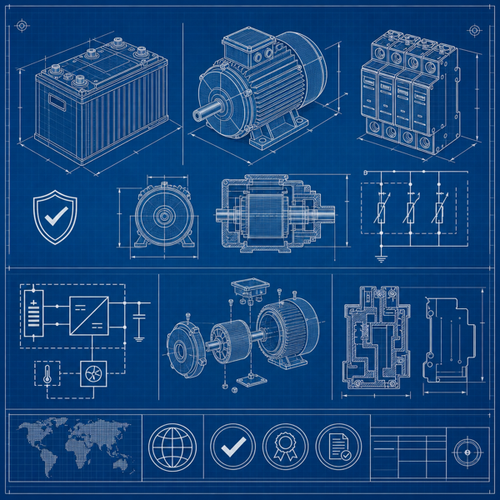
A major wave of international standards updates is reshaping best practices in the electrical engineering sector this June 2026. Covering rotating electrical machines, primary battery specifications, and surge protection components, five new IEC standards have been published. Each brings significant technical revisions, expanded scope, or fresh classifications that will affect manufacturers, product designers, quality managers, and compliance specialists across a range of industries.
Overview
Electrical engineering continues to serve as a linchpin for innovation across sectors such as power generation, consumer electronics, industrial automation, and telecommunication. With the rapid integration of advanced technologies and renewed focus on safety and interoperability, up-to-date standards are crucial for ensuring product reliability and global market access. The June 2026 publications include comprehensive updates to core specifications for rotating machines, primary batteries (including both aqueous and lithium types), and surge protection devices, impacting a broad audience from R&D engineers to procurement officers.
In this article, we explore the key features, compliance implications, and implementation strategies for the following five new standards. Whether you are a product developer or a supply chain manager, this summary—complete with direct access links to each standard—equips you with the actionable knowledge needed to meet current and future industry requirements.
Detailed Standards Coverage
IEC 60034-8:2026 - Terminal Markings and Direction of Rotation for Rotating Electrical Machines
Rotating electrical machines – Part 8: Terminal markings and direction of rotation
The updated IEC 60034-8:2026 defines clear rules for marked winding terminals, identification of winding connection points, and direction of rotation across both AC and DC machines. This fourth edition is a substantial revision, notably expanding the scope to incorporate turbine-type synchronous machines – critical for modern energy infrastructure and rotating device fleets.
Key topics include:
- Standardization of terminal marking methods for multi-phase (including six-phase) machines
- Guidelines for auxiliary device terminal markings, ensuring unambiguous integration of thermal and measurement devices
- Comprehensive connection diagrams addressing common industrial applications, such as dual-voltage three-phase motors and reversible single-phase designs
- Harmonized relationship between terminal markings and intended direction of rotation, fostering interoperability and ease of maintenance
Organizations in manufacturing, automation, and power generation must integrate this revision for all new designs, as well as consider retrofitting for legacy systems to ensure safety and consistency.
Key highlights:
- Inclusion of turbine-type synchronous machines in the standard
- Enhanced diagrams for a broader variety of connection types
- Revised marking conventions for improved clarity and compliance
Access the full standard:View IEC 60034-8:2026 on iTeh Standards
IEC 60086-1:2026 - General Requirements for Primary Batteries
Primary batteries – Part 1: General
The fourteenth edition of IEC 60086-1:2026 establishes universal criteria for primary batteries concerning dimensions, nomenclature, terminal configurations, standardized markings, safety, and environmental performance. This edition is pivotal for battery manufacturers and device designers, as it aligns with recent global regulations (including the EU Batteries Regulation 2023/1542) and introduces granular classification and upgraded test methods.
Major updates include the reordering and expansion of electrochemical system classifications, change in maximum allowable open circuit voltage for manganese dioxide systems, consolidation of multiple testing protocols, and an improved compliance checklist structure. This standard serves as the reference point for form, fit, and function interchangeability between battery brands, driving uniformity for OEMs, device integrators, and global procurement.
Key highlights:
- Integrated Annex I providing detailed guidance for EU regulatory compliance
- Addition of electrochemical letter "T" in battery classification
- Revised voltage parameters and harmonized test procedures
Access the full standard:View IEC 60086-1:2026 on iTeh Standards
IEC 60086-2-1:2026 - Physical and Electrical Specifications of Batteries with Aqueous Electrolyte
Primary batteries – Part 2-1: Physical and electrical specifications of batteries with aqueous electrolyte
This new first edition, IEC 60086-2-1:2026, delineates dimensions and discharge test requirements for primary batteries using aqueous-based chemistries. The standard reorganizes essential testing protocols to distinguish strictly between aqueous and lithium systems (the latter now under IEC 60086-2-2:2026). The revision reflects current market needs for higher drain capabilities and diversified application tests, accommodating the latest use cases in personal care, digital audio, radio/remote control, and grooming devices.
Coverage includes detailed tables for physical configurations; voltage and application test conditions adapted for contemporary devices; and category definitions for popular cells such as LR03, R6, and 3LR12. Manufacturers and battery integrators are strongly encouraged to implement the new load and performance curves, especially for high-drain and modern electronic applications.
Key highlights:
- Segregation of lithium specifications into a dedicated standard (IEC 60086-2-2)
- Adjusted digital audio test loads and addition of specialized use-case scenarios
- Streamlined compliance processes and updated common designation tables
Access the full standard:View IEC 60086-2-1:2026 on iTeh Standards
IEC 60086-2-2:2026 - Physical and Electrical Specifications of Lithium Batteries
Primary batteries – Part 2-2: Physical and electrical specifications of lithium batteries
Marking a critical milestone, IEC 60086-2-2:2026 is the first dedicated physical and electrical specification for primary lithium batteries, separating them entirely from aqueous types for the first time. The new structure provides precise test requirements, including discharge conditions, load variations for digital audio and portable lighting, and application-specific tests for consumer and industrial lithium batteries.
Major technical updates involve revised maximum open circuit voltage ratings for lithium chemistries (notably FR10G445 and FR14505 cells), the introduction of new load test values, and expanded test scenarios—such as those for toys and remote-control applications. These changes ensure that lithium batteries’ performance and safety claims can be reliably verified and are harmonized globally, supporting confidence among device developers and regulatory authorities.
Key highlights:
- Complete separation of lithium and aqueous specification standards
- Updated voltage criteria and discharge test currents for lithium cells
- Enhanced support for portable lighting, gaming, and high-performance applications
Access the full standard:View IEC 60086-2-2:2026 on iTeh Standards
IEC TR 61643-333:2026 - Characteristic Equations and Life Evaluation for Metal Oxide Varistors (MOV)
Components for low-voltage surge protection – Part 333: Characteristic equations and life evaluation for metal oxide varistors (MOV)
The technical report IEC TR 61643-333:2026 introduces crucial methodologies for quantifying the electrical behavior (U-I/R-I equations) and expected lifespan of MOV surge protection components. These devices are indispensable for safeguarding low-voltage circuits (up to 1,000 V AC or 1,500 V DC) in power, telecom, and signaling installations.
Of particular interest to system designers and quality engineers, the report offers:
- Analytical models for evaluating MOV performance under both continuous operating and impulse current stresses
- Application of Weibull statistical methods for lifespan estimation, enabling more accurate product selection and reliability analysis
- Detailed R-I and V-I curves to predict clamping behavior, degradation timelines, and failure modes
This standard is a valuable tool for component qualification, supplier auditing, and reliability benchmarking in all markets where electrical surge risks must be managed.
Key highlights:
- Empirical and statistical life evaluation techniques for MOVs
- Guidance for performance parameter degradation tracking
- Explicit waveform response modeling for advanced surge scenarios
Access the full standard:View IEC TR 61643-333:2026 on iTeh Standards
Industry Impact & Compliance
The June 2026 standards updates present both challenges and opportunities for businesses operating in electrical engineering and related markets. Key impacts include:
- Universal Product Safety: Enhanced requirements for terminal markings, battery testing, and surge protection ensure not only greater end-user safety but also reduce the risk of costly recalls and liability events.
- Interoperability & Market Access: Increased harmonization in nomenclature, dimensions, and testing conditions smooths global supply chains by enabling cross-brand compatibility—critical for OEMs and multinational vendors.
- Compliance & Regulation: Integrators, device designers, and battery manufacturers can align their operations with emerging EU and international directives, reducing the likelihood of export/import compliance issues.
- Timeline: Most standards are effective immediately on publication, but organizations are advised to transition designs, processes, and documentation within a clearly defined period—typically 12–24 months.
- Risks of Non-compliance: Delayed adoption can result in legal, financial, and reputational risks, as outdated products may fail new regulatory and procurement requirements.
Technical Insights
Common Technical Requirements
Key themes across these standards include:
- Clear terminal and connector marking schemas (for machines, batteries, and auxiliary devices)
- Standardized discharge testing protocols for batteries, scaled for both performance and specific application scenarios
- Expanded test loads for contemporary device categories (high drain, portable lighting, remote controls)
- Rigorous statistical analysis for component lifetime prediction (especially for surge protection)
Implementation Best Practices
- Cross-functional Training: Engineers, QA teams, and technical sales staff should be briefed on the new standards’ impacts on their respective processes and products.
- Documentation Updates: Product datasheets, wiring diagrams, and assembly instructions should reflect revised terminal, voltage, and test labeling requirements.
- Supplier Coordination: For products with embedded batteries or surge protection, ensure all suppliers are certifying to the latest IEC editions. Request updated compliance declarations and test reports.
- Testing and Certification: Collaborate with accredited laboratories to validate sample lots according to new IEC test matrices. Rely on Annex H/J compliance checklists for audit preparation.
- Lifecycle Management: Integrate MOV life evaluation methods early in the design stage for critical infrastructure applications; factor statistical results into maintenance cycles.
Conclusion & Next Steps
The June 2026 electrical engineering standards round out a comprehensive set of industry guidance designed to elevate safety, enable innovation, and harmonize global commerce. Staying abreast of these standards is essential for effective risk management, product competitiveness, and compliance in a continually evolving regulatory landscape.
Recommendations:
- Audit your product lines and supply chains to ensure all referenced standards are adopted and current.
- Train technical and compliance teams on the new requirements—especially for products targeted at international markets or sensitive applications.
- Engage early with your certification bodies and update product literature to reflect current compliance.
- Visit iTeh Standards for full texts and customizable guidance on each standard.
Stay proactive and ensure your organization remains ahead of both regulatory and market trends by fully integrating these landmark 2026 standards updates.
Categories
- Latest News
- New Arrivals
- Generalities
- Services and Management
- Natural Sciences
- Health Care
- Environment
- Metrology and Measurement
- Testing
- Mechanical Systems
- Fluid Systems
- Manufacturing
- Energy and Heat
- Electrical Engineering
- Electronics
- Telecommunications
- Information Technology
- Image Technology
- Precision Mechanics
- Road Vehicles
- Railway Engineering
- Shipbuilding
- Aircraft and Space
- Materials Handling
- Packaging
- Textile and Leather
- Clothing
- Agriculture
- Food technology
- Chemical Technology
- Mining and Minerals
- Petroleum
- Metallurgy
- Wood technology
- Glass and Ceramics
- Rubber and Plastics
- Paper Technology
- Paint Industries
- Construction
- Civil Engineering
- Military Engineering
- Entertainment