

IEC 60086-1:2026
(Main)Primary batteries - Part 1: General
- Abstract
IEC 60086-1:2026 is intended to standardize primary batteries with respect to dimensions, nomenclature, terminal configurations, markings, test methods, typical performance, safety and environmental aspects. This document on one side specifies requirements for primary cells and batteries. On the other side, this document also specifies procedures of how requirements for these batteries are to be standardized. As a classification tool for primary batteries, this document specifies system letters, electrodes, electrolytes, and nominal as well as maximum open circuit voltage of electrochemical systems. The object of this part of IEC 60086 is to benefit primary battery users, device designers and battery manufacturers by ensuring that batteries from different manufacturers are interchangeable according to standard form, fit and function. Furthermore, to ensure compliance with the above, this document specifies standard test methods for testing primary cells and batteries. This document also contains requirements in Annex A of this document justifying the inclusion or the ongoing retention of batteries in the IEC 60086 series. This fourteenth edition cancels and replaces the thirteenth edition published in 2021. This edition constitutes a technical revision.
This edition includes the following significant technical changes with respect to the previous edition:
a) In Clause 3, terms were reordered according to their functions: basic terms, electrochemical systems, battery shapes, electrical characteristics, specifications, failure modes;
b) New letter "T" was added in Table 1, Standardized electrochemical systems of 4.1.4 classification;
c) Maximum open circuit voltage of letter "F" was changed from 1,83 to 1,90 V;
d) Drawing of pulse tests with multiple load was moved from IEC 60086-2 to 5.2.2.2, Application tests with multiple loads;
e) Annex F, Guidance for proposing value of minimum average duration was modified;
f) Annex D of IEC 60086-2:2021, Common designation, has been transferred to Annex H of this document;
g) Table H.1, Common designation index, was modified to provide reference to IEC 60086 2 1 and IEC 60086-2-2 for each battery;
h) Annex I identifies the batteries of general use and the applicable tests to compare their performance, in support of Regulation (EU) 2023/1542 (Batteries Regulation).
- Status
- Published
- Publication Date
- 01-Jun-2026
- Technical Committee
- TC 35 - Primary cells and batteries
- Drafting Committee
- MT 14 - TC 35/MT 14
- Current Stage
- PPUB - Publication issued
- Start Date
- 02-Jun-2026
- Completion Date
- 24-Apr-2026
Buy Documents
IEC 60086-1:2026 - Primary batteries - Part 1: General
REDLINE IEC 60086-1:2026 CMV - Primary batteries - Part 1: General

IEC 60086-1:2026 - Piles électriques - Partie 1: Généralités
IEC 60086-1:2026 is an International Standard from the International Electrotechnical Commission (IEC) for primary batteries. It sets the general rules for dimensions, nomenclature, terminal configurations, markings, test methods, typical performance, safety and environmental aspects so that battery users, device designers and manufacturers can work with batteries that match in form, fit and function.
This part also defines how primary batteries are classified and how their requirements are standardized across the IEC 60086 series. In practice, it is the general reference that supports battery identification, testing and interchangeability.
What does IEC 60086-1:2026 specify?
IEC 60086-1:2026 specifies the general framework for primary cells and batteries, including the way they are classified, marked, tested and checked for interchangeability. It also gives the criteria for deciding whether a battery or electrochemical system belongs in the IEC 60086 series.
The document is organized into clauses 1 to 8 and annexes A to J.
| Annex | What it covers |
|---|---|
| A | Criteria for standardization of batteries |
| B | Recommendations for equipment design |
| C | Designation system (nomenclature) |
| D | Standard discharge voltage and its determination |
| E | Preparation of standard methods of measuring performance |
| F | Guidance for proposing minimum average duration values |
| G | Code of practice for packaging, shipment, storage, use and disposal |
| H | Common designation |
| I | Measurement methods for non-rechargeable portable batteries of general use |
| J | Compliance checklist |
What are the key requirements of IEC 60086-1:2026?
IEC 60086-1:2026 focuses on a few practical controls that matter every day: battery classification, marking, voltage compatibility, test conditions, and acceptance checks. These are the parts that determine whether batteries can be identified correctly, fit the equipment, and be compared fairly across suppliers.
Classification, design and interchangeability
- Clause 4.1.4 classifies primary batteries by electrochemical system and assigns system letters to standardized chemistries. Table 1 gives the negative electrode, electrolyte, positive electrode, nominal voltage and maximum open-circuit voltage for each system. This is the basic code used to identify battery families and compare chemistry and voltage.
- Clause 4.1.5 bases the designation of a primary battery on its physical parameters, electrochemical system and any needed modifiers. Annex C explains the nomenclature in detail. This matters because the designation is what buyers, designers and distributors use to order and specify the right battery.
- Clause 4.1.7 defines interchangeability by battery voltage using the standard discharge voltage. Batteries in the two recognized voltage ranges must be physically non-interchangeable. In practice, this reduces the risk of inserting a battery with a very different discharge profile into equipment.
Marking, terminals and safety-related design
- Clause 4.1.3 sets terminal requirements, including good electrical contact, corrosion resistance and specific terminal types such as cap and base, cap and case, screw terminals, flat contacts, snap fasteners and wire leads. For designers, this is the section that links battery construction to the equipment contact design.
- Clause 4.1.6 requires each battery to carry the designation, recommended usage period or manufacturing date, polarity, nominal voltage, manufacturer or supplier identification and cautionary advice, with some items allowed on packaging for small batteries. This supports traceability and safe use at the point of sale and installation.
- Clause 4.1.6.3 says disposal marking shall follow local legal requirements. Annex G then gives practical advice on packaging, storage, handling, use and disposal.
Performance, testing and acceptance
- Clause 4.2.2 requires batteries to stay within the specified dimensions during discharge testing, with noted height changes for some button and coin cells under defined conditions. This matters for compartment fit and for avoiding mechanical problems in equipment.
- Clause 4.2.3 requires no leakage under the standard storage and discharge conditions in this document. Clause 5.8 adds leakage and deformation checking after discharge. This is a key safety and reliability check for equipment makers and quality teams.
- Clause 5 separates discharge testing into application tests and service output tests. Clause 5.2 explains how loads are chosen, how pulse tests with multiple loads are handled, and when a simpler service output test may be used. This helps match the test to the way the battery will actually be used.
- Clause 5.3 gives the conformance check to a specified minimum average duration using two samples of eight batteries if needed. This is the main acceptance rule for comparing performance results.
- Clauses 6.1 to 6.8 define the test conditions, including storage before testing, discharge timing, load resistance values, tolerances, activation of P-system batteries, and measuring equipment accuracy. These details matter because small changes in temperature, load or timing can change the result.
- Clause 7 addresses sampling and quality assurance. If buyer and manufacturer do not agree on another plan, ISO 2859 and ISO 22514-2 are the fallback references.
What terms does IEC 60086-1:2026 define?
- Cell - the basic functional unit that converts chemical energy directly into electrical energy.
- Battery - one or more electrically connected cells fitted with the devices needed for use.
- Primary cell / primary battery - a cell or battery that is not designed to be electrically recharged.
- Open-circuit voltage (OCV) - the voltage across the terminals when the battery is off discharge.
- End-point voltage (EV) - the specified voltage at which discharge is stopped.
- Minimum average duration (MAD) - the acceptable minimum average discharge time used to judge compliance.
- Service output - the life, capacity or energy output under specified discharge conditions.
- Portable battery of general use - a portable non-rechargeable battery made to be interoperable, in common formats such as AA, AAA, C, D, 9 Volts and others listed in Annex I.
Who uses IEC 60086-1:2026?
IEC 60086-1:2026 is used by battery manufacturers, device designers and battery users who need batteries to be interchangeable across suppliers. It is also relevant to quality managers, buyers and test laboratories because it gives the terminology, marking rules, testing framework and acceptance checks used to compare products.
Equipment designers use Annex B when designing battery compartments, polarity guidance and voltage cut-off. Distributors, retailers and packers use Annex G for storage, shipment, display and disposal practices. Conformity assessors and teams working to the European Batteries Regulation also use Annex I.
What changed in IEC 60086-1:2026 from the previous edition?
IEC 60086-1:2026 is the fourteenth edition and replaces the 2021 edition. The stated technical changes are:
- Clause 3 terms were reordered by function.
- Letter T was added to the standardized electrochemical systems table.
- The maximum open-circuit voltage of letter F changed from 1.83 V to 1.90 V.
- The drawing for pulse tests with multiple load was moved into Clause 5.2.2.2.
- Annex F on minimum average duration guidance was modified.
- Annex D from IEC 60086-2:2021 on common designation was transferred to Annex H.
- Table H.1 was updated to reference IEC 60086-2-1 and IEC 60086-2-2 for each battery.
- Annex I was added to identify batteries of general use and the applicable tests in support of Regulation (EU) 2023/1542.
Which standards are used with IEC 60086-1:2026?
| Reference | What it contributes |
|---|---|
| IEC 60086-2-1:2026 | Physical and electrical specifications of batteries with aqueous electrolyte |
| IEC 60086-2-2:2026 | Physical and electrical specifications of lithium batteries |
| IEC 60086-3:2021 | Watch battery specifications and related test methods |
| IEC 60086-4 | Safety of lithium batteries |
| IEC 60086-5 | Safety of batteries with aqueous electrolyte |
| IEC 60086-6 | Environmental aspects of primary batteries |
| IEC 62281 | Safety of primary and secondary lithium cells and batteries during transport |
| ISO 2859 | Sampling procedures by attributes when no other sampling plan is agreed |
| ISO 22514-2 | Statistical guidance for capability and performance assessment |
What does the IEC 60086-1:2026 document contain?
IEC 60086-1:2026 contains tables for standardized electrochemical systems, marking requirements, storage and test conditions, load values and tolerances, plus detailed designation tables and examples. It also includes figures for battery nomenclature and the C/R-plot method used in determining standard discharge voltage.
The annexes add practical material that supports design, testing and compliance work. Annex C provides many designation examples, Annex D gives formulas and a method for determining standard discharge voltage, and Annex I gives tables linking common portable battery formats to applicable tests for performance and durability.
Relations
- Effective Date
- 05-Sep-2023
- Effective Date
- 05-Sep-2023
Buy Documents
IEC 60086-1:2026 - Primary batteries - Part 1: General
REDLINE IEC 60086-1:2026 CMV - Primary batteries - Part 1: General
IEC 60086-1:2026 - Piles électriques - Partie 1: Généralités
Get Certified
Connect with accredited certification bodies for this standard

IMQ S.p.A. (Certification)
Italian electrical product certification.

SLG Prüf- und Zertifizierungs GmbH
German testing and certification body.

UL Solutions
Global safety science company with testing, inspection and certification.
Sponsored listings
Frequently Asked Questions
IEC 60086-1:2026 is a standard published by the International Electrotechnical Commission (IEC). Its full title is "Primary batteries - Part 1: General". This standard covers: IEC 60086-1:2026 is intended to standardize primary batteries with respect to dimensions, nomenclature, terminal configurations, markings, test methods, typical performance, safety and environmental aspects. This document on one side specifies requirements for primary cells and batteries. On the other side, this document also specifies procedures of how requirements for these batteries are to be standardized. As a classification tool for primary batteries, this document specifies system letters, electrodes, electrolytes, and nominal as well as maximum open circuit voltage of electrochemical systems. The object of this part of IEC 60086 is to benefit primary battery users, device designers and battery manufacturers by ensuring that batteries from different manufacturers are interchangeable according to standard form, fit and function. Furthermore, to ensure compliance with the above, this document specifies standard test methods for testing primary cells and batteries. This document also contains requirements in Annex A of this document justifying the inclusion or the ongoing retention of batteries in the IEC 60086 series. This fourteenth edition cancels and replaces the thirteenth edition published in 2021. This edition constitutes a technical revision. This edition includes the following significant technical changes with respect to the previous edition: a) In Clause 3, terms were reordered according to their functions: basic terms, electrochemical systems, battery shapes, electrical characteristics, specifications, failure modes; b) New letter "T" was added in Table 1, Standardized electrochemical systems of 4.1.4 classification; c) Maximum open circuit voltage of letter "F" was changed from 1,83 to 1,90 V; d) Drawing of pulse tests with multiple load was moved from IEC 60086-2 to 5.2.2.2, Application tests with multiple loads; e) Annex F, Guidance for proposing value of minimum average duration was modified; f) Annex D of IEC 60086-2:2021, Common designation, has been transferred to Annex H of this document; g) Table H.1, Common designation index, was modified to provide reference to IEC 60086 2 1 and IEC 60086-2-2 for each battery; h) Annex I identifies the batteries of general use and the applicable tests to compare their performance, in support of Regulation (EU) 2023/1542 (Batteries Regulation).
IEC 60086-1:2026 is intended to standardize primary batteries with respect to dimensions, nomenclature, terminal configurations, markings, test methods, typical performance, safety and environmental aspects. This document on one side specifies requirements for primary cells and batteries. On the other side, this document also specifies procedures of how requirements for these batteries are to be standardized. As a classification tool for primary batteries, this document specifies system letters, electrodes, electrolytes, and nominal as well as maximum open circuit voltage of electrochemical systems. The object of this part of IEC 60086 is to benefit primary battery users, device designers and battery manufacturers by ensuring that batteries from different manufacturers are interchangeable according to standard form, fit and function. Furthermore, to ensure compliance with the above, this document specifies standard test methods for testing primary cells and batteries. This document also contains requirements in Annex A of this document justifying the inclusion or the ongoing retention of batteries in the IEC 60086 series. This fourteenth edition cancels and replaces the thirteenth edition published in 2021. This edition constitutes a technical revision. This edition includes the following significant technical changes with respect to the previous edition: a) In Clause 3, terms were reordered according to their functions: basic terms, electrochemical systems, battery shapes, electrical characteristics, specifications, failure modes; b) New letter "T" was added in Table 1, Standardized electrochemical systems of 4.1.4 classification; c) Maximum open circuit voltage of letter "F" was changed from 1,83 to 1,90 V; d) Drawing of pulse tests with multiple load was moved from IEC 60086-2 to 5.2.2.2, Application tests with multiple loads; e) Annex F, Guidance for proposing value of minimum average duration was modified; f) Annex D of IEC 60086-2:2021, Common designation, has been transferred to Annex H of this document; g) Table H.1, Common designation index, was modified to provide reference to IEC 60086 2 1 and IEC 60086-2-2 for each battery; h) Annex I identifies the batteries of general use and the applicable tests to compare their performance, in support of Regulation (EU) 2023/1542 (Batteries Regulation).
IEC 60086-1:2026 is classified under the following ICS (International Classification for Standards) categories: 29.220.10 - Primary cells and batteries. The ICS classification helps identify the subject area and facilitates finding related standards.
IEC 60086-1:2026 has the following relationships with other standards: It is inter standard links to IEC 60086-1:2021/COR1:2022, IEC 60086-1:2021. Understanding these relationships helps ensure you are using the most current and applicable version of the standard.
IEC 60086-1:2026 is available in PDF format for immediate download after purchase. The document can be added to your cart and obtained through the secure checkout process. Digital delivery ensures instant access to the complete standard document.
Standards Content (Sample)
IEC 60086-1 ®
Edition 14.0 2026-06
INTERNATIONAL
STANDARD
Primary batteries -
Part 1: General
ICS 29.220.10 ISBN 978-2-8327-1214-6
All rights reserved. Unless otherwise specified, no part of this publication may be reproduced or utilized in any form or
by any means, electronic or mechanical, including photocopying and microfilm, without permission in writing from either
IEC or IEC's member National Committee in the country of the requester. If you have any questions about IEC copyright
or have an enquiry about obtaining additional rights to this publication, please contact the address below or your local
IEC member National Committee for further information.
IEC Secretariat Tel.: +41 22 919 02 11
3, rue de Varembé info@iec.ch
CH-1211 Geneva 20 www.iec.ch
Switzerland
About the IEC
The International Electrotechnical Commission (IEC) is the leading global organization that prepares and publishes
International Standards for all electrical, electronic and related technologies.
About IEC publications
The technical content of IEC publications is kept under constant review by the IEC. Please make sure that you have the
latest edition, a corrigendum or an amendment might have been published.
IEC publications search - IEC Products & Services Portal - products.iec.ch
webstore.iec.ch/advsearchform Discover our powerful search engine and read freely all the
The advanced search enables to find IEC publications by a publications previews, graphical symbols and the glossary.
variety of criteria (reference number, text, technical With a subscription you will always have access to up to date
committee, …). It also gives information on projects, content tailored to your needs.
replaced and withdrawn publications.
Electropedia - www.electropedia.org
The world's leading online dictionary on electrotechnology,
IEC Just Published - webstore.iec.ch/justpublished
Stay up to date on all new IEC publications. Just Published containing more than 22 500 terminological entries in English
details all new publications released. Available online and and French, with equivalent terms in 25 additional languages.
once a month by email. Also known as the International Electrotechnical Vocabulary
(IEV) online.
IEC Customer Service Centre - webstore.iec.ch/csc
If you wish to give us your feedback on this publication or
need further assistance, please contact the Customer
Service Centre: sales@iec.ch.
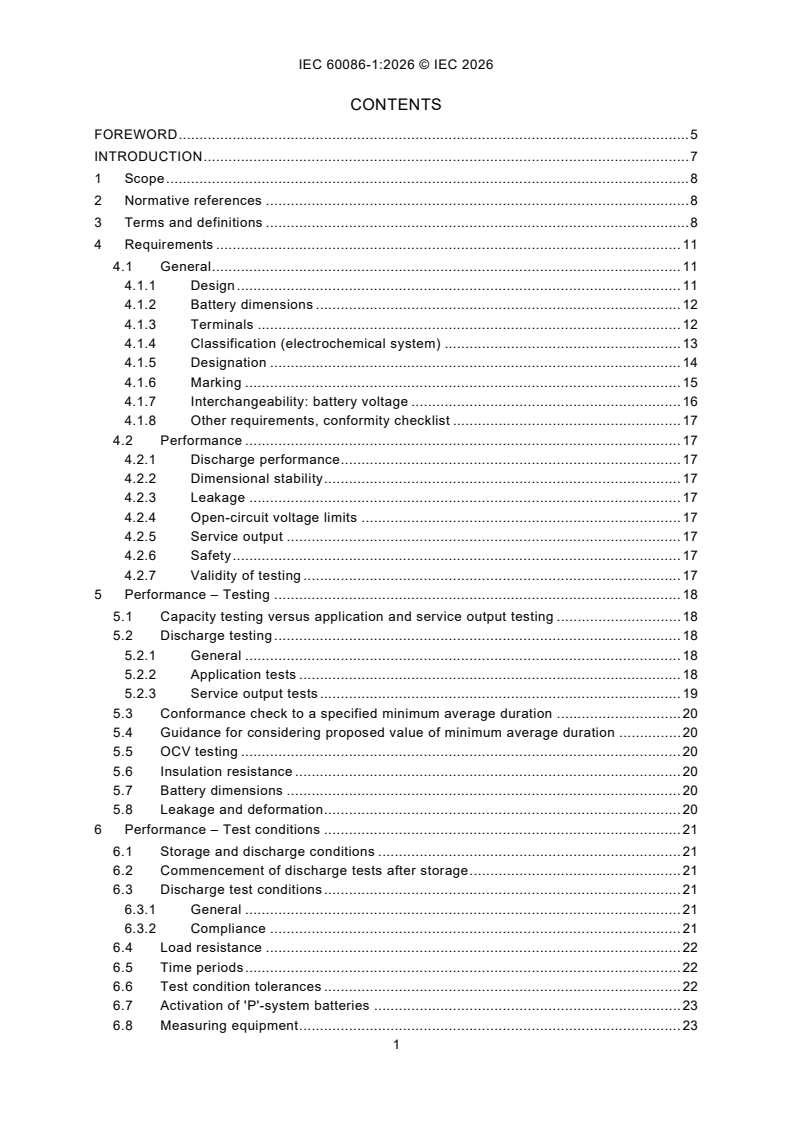
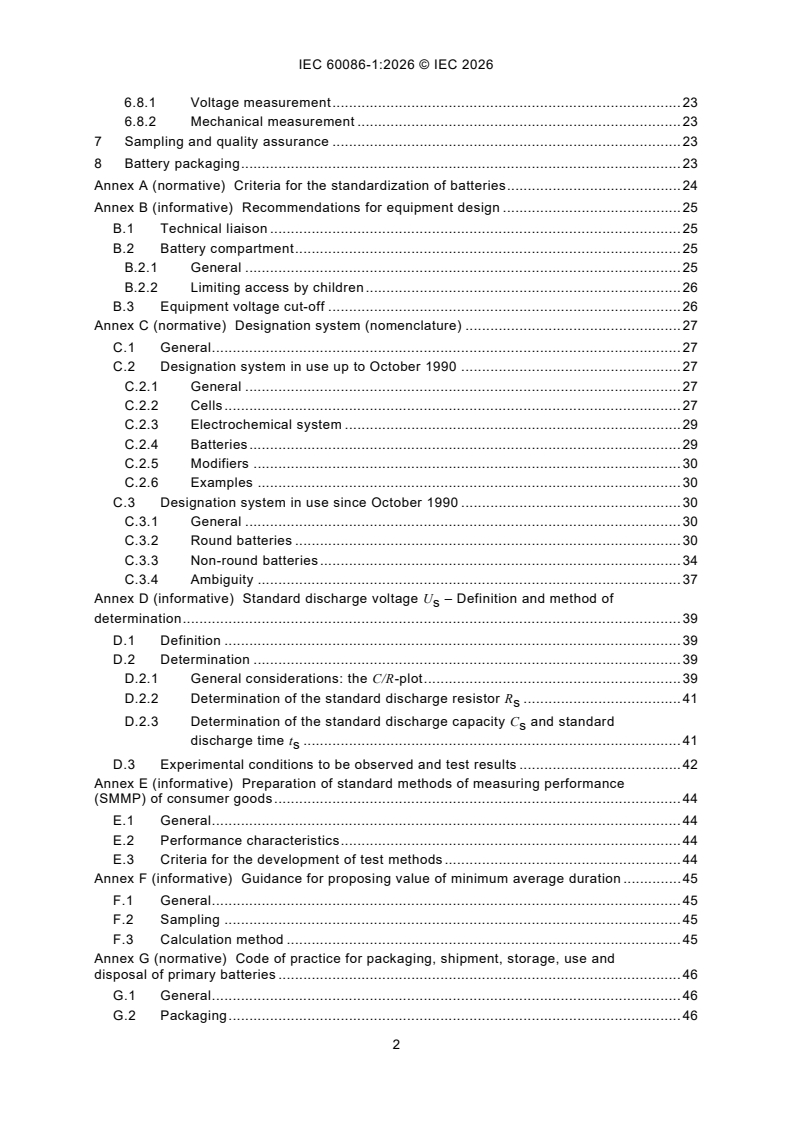
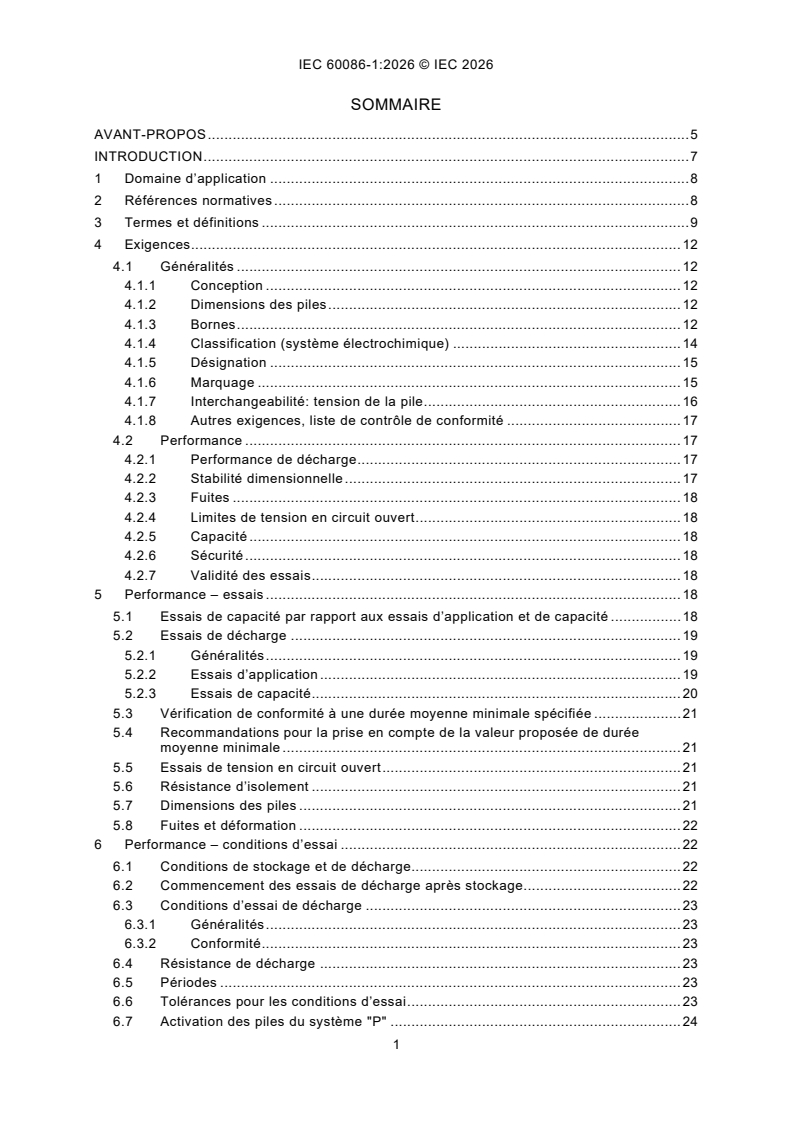
CONTENTS
FOREWORD . 5
INTRODUCTION . 7
1 Scope . 8
2 Normative references . 8
3 Terms and definitions . 8
4 Requirements . 11
4.1 General . 11
4.1.1 Design . 11
4.1.2 Battery dimensions . 12
4.1.3 Terminals . 12
4.1.4 Classification (electrochemical system) . 13
4.1.5 Designation . 14
4.1.6 Marking . 15
4.1.7 Interchangeability: battery voltage . 16
4.1.8 Other requirements, conformity checklist . 17
4.2 Performance . 17
4.2.1 Discharge performance . 17
4.2.2 Dimensional stability . 17
4.2.3 Leakage . 17
4.2.4 Open-circuit voltage limits . 17
4.2.5 Service output . 17
4.2.6 Safety . 17
4.2.7 Validity of testing . 17
5 Performance – Testing . 18
5.1 Capacity testing versus application and service output testing . 18
5.2 Discharge testing . 18
5.2.1 General . 18
5.2.2 Application tests . 18
5.2.3 Service output tests . 19
5.3 Conformance check to a specified minimum average duration . 20
5.4 Guidance for considering proposed value of minimum average duration . 20
5.5 OCV testing . 20
5.6 Insulation resistance . 20
5.7 Battery dimensions . 20
5.8 Leakage and deformation . 20
6 Performance – Test conditions . 21
6.1 Storage and discharge conditions . 21
6.2 Commencement of discharge tests after storage . 21
6.3 Discharge test conditions . 21
6.3.1 General . 21
6.3.2 Compliance . 21
6.4 Load resistance . 22
6.5 Time periods . 22
6.6 Test condition tolerances . 22
6.7 Activation of 'P'-system batteries . 23
6.8 Measuring equipment . 23
6.8.1 Voltage measurement . 23
6.8.2 Mechanical measurement . 23
7 Sampling and quality assurance . 23
8 Battery packaging . 23
Annex A (normative) Criteria for the standardization of batteries . 24
Annex B (informative) Recommendations for equipment design . 25
B.1 Technical liaison . 25
B.2 Battery compartment . 25
B.2.1 General . 25
B.2.2 Limiting access by children . 26
B.3 Equipment voltage cut-off . 26
Annex C (normative) Designation system (nomenclature) . 27
C.1 General . 27
C.2 Designation system in use up to October 1990 . 27
C.2.1 General . 27
C.2.2 Cells . 27
C.2.3 Electrochemical system . 29
C.2.4 Batteries . 29
C.2.5 Modifiers . 30
C.2.6 Examples . 30
C.3 Designation system in use since October 1990 . 30
C.3.1 General . 30
C.3.2 Round batteries . 30
C.3.3 Non-round batteries . 34
C.3.4 Ambiguity . 37
Annex D (informative) Standard discharge voltage U – Definition and method of
s
determination . 39
D.1 Definition . 39
D.2 Determination . 39
D.2.1 General considerations: the C/R-plot . 39
D.2.2 Determination of the standard discharge resistor R . 41
s
D.2.3 Determination of the standard discharge capacity C and standard
s
discharge time t . 41
s
D.3 Experimental conditions to be observed and test results . 42
Annex E (informative) Preparation of standard methods of measuring performance
(SMMP) of consumer goods . 44
E.1 General . 44
E.2 Performance characteristics . 44
E.3 Criteria for the development of test methods . 44
Annex F (informative) Guidance for proposing value of minimum average duration . 45
F.1 General . 45
F.2 Sampling . 45
F.3 Calculation method . 45
Annex G (normative) Code of practice for packaging, shipment, storage, use and
disposal of primary batteries . 46
G.1 General . 46
G.2 Packaging . 46
G.3 Transport and handling . 46
G.4 Storage and stock rotation . 46
G.5 Displays at sales points . 47
G.6 Selection, use and disposal . 47
G.6.1 Purchase . 47
G.6.2 Installation . 47
G.6.3 Use. 48
G.6.4 Replacement . 48
G.6.5 Disposal . 48
Annex H (informative) Common designation . 49
Annex I (informative) Measurement methods for the determination of the performance
and durability of non-rechargeable portable batteries . 51
I.1 Overview . 51
I.2 Interoperability . 51
I.3 IEC designations of portable batteries of general use . 51
I.4 Performance and durability tests for non-rechargeable portable batteries of
general use . 52
I.4.1 Average duration of discharge . 52
I.4.2 Delayed discharge performance . 53
I.4.3 Resistance to leakage . 54
I.5 Determination of average duration for the purpose of labelling . 54
Annex J (informative) Compliance checklist . 55
Bibliography . 56
Figure 1 – Pulse tests with multiple load . 19
Figure C.1 – Designation system for round batteries: diameter d < 100 mm;
height h < 100 mm . 31
Figure C.2 – Diameter code for non-recommended diameters . 32
Figure C.3 – Height code for denoting the hundredths of a millimetre of height . 33
Figure C.4 – Designation system for round batteries: diameter d ≥ 100 mm;
height h ≥ 100 mm . 34
Figure C.5 – Designation system for non-round batteries, dimensions < 100 mm . 35
Figure C.6 – Designation system for non-round batteries, dimensions ≥ 100 mm . 36
Figure C.7 – Height code for discrimination per tenth of a millimetre . 37
Figure D.1 – Normalized C/R-plot (schematic) . 40
Figure D.2 – Standard discharge voltage (schematic) . 42
Table 1 – Standardized electrochemical systems . 14
Table 2 – Marking requirements . 15
Table 3 – Conditions for storage before and during discharge testing . 21
Table 4 – Resistive loads for tests . 22
Table 5 – Time periods for tests . 22
Table 6 – Test condition tolerances . 22
Table A.1 – Items necessary to standardize . 24
Table C.1 – Physical designation and dimensions of round cells and batteries . 28
Table C.2 – Physical designation and nominal overall dimensions of flat cells . 29
Table C.3 – Physical designation and dimensions of square cells and batteries . 29
Table C.4 – Examples of battery designations . 30
Table C.5 – Diameter code for recommended diameter . 32
Table C.6 – Physical designation and dimensions of round cell and batteries
based on Clause C.3 . 37
Table C.7 – Physical designation and dimensions of non-round batteries
based on Clause C.3 . 38
Table D.1 – Standard discharge voltage by system . 42
Table H.1 – Index . 49
Table I.1 – IEC and common formats of portable batteries of general use . 51
Table I.2 – Discharge testing of non-rechargeable portable batteries of general use . 52
INTERNATIONAL ELECTROTECHNICAL COMMISSION
____________
Primary batteries -
Part 1: General
FOREWORD
1) The International Electrotechnical Commission (IEC) is a worldwide organization for standardization comprising
all national electrotechnical committees (IEC National Committees). The object of IEC is to promote international
co-operation on all questions concerning standardization in the electrical and electronic fields. To this end and
in addition to other activities, IEC publishes International Standards, Technical Specifications, Technical Reports,
Publicly Available Specifications (PAS) and Guides (hereafter referred to as "IEC Publication(s)"). Their
preparation is entrusted to technical committees; any IEC National Committee interested in the subject dealt with
may participate in this preparatory work. International, governmental and non-governmental organizations liaising
with the IEC also participate in this preparation. IEC collaborates closely with the International Organization for
Standardization (ISO) in accordance with conditions determined by agreement between the two organizations.
2) The formal decisions or agreements of IEC on technical matters express, as nearly as possible, an international
consensus of opinion on the relevant subjects since each technical committee has representation from all
interested IEC National Committees.
3) IEC Publications have the form of recommendations for international use and are accepted by IEC National
Committees in that sense. While all reasonable efforts are made to ensure that the technical content of IEC
Publications is accurate, IEC cannot be held responsible for the way in which they are used or for any
misinterpretation by any end user.
4) In order to promote international uniformity, IEC National Committees undertake to apply IEC Publications
transparently to the maximum extent possible in their national and regional publications. Any divergence between
any IEC Publication and the corresponding national or regional publication shall be clearly indicated in the latter.
5) IEC itself does not provide any attestation of conformity. Independent certification bodies provide conformity
assessment services and, in some areas, access to IEC marks of conformity. IEC is not responsible for any
services carried out by independent certification bodies.
6) All users should ensure that they have the latest edition of this publication.
7) No liability shall attach to IEC or its directors, employees, servants or agents including individual experts and
members of its technical committees and IEC National Committees for any personal injury, property damage or
other damage of any nature whatsoever, whether direct or indirect, or for costs (including legal fees) and
expenses arising out of the publication, use of, or reliance upon, this IEC Publication or any other IEC
Publications.
8) Attention is drawn to the Normative references cited in this publication. Use of the referenced publications is
indispensable for the correct application of this publication.
9) IEC draws attention to the possibility that the implementation of this document may involve the use of (a)
patent(s). IEC takes no position concerning the evidence, validity or applicability of any claimed patent rights in
respect thereof. As of the date of publication of this document, IEC had not received notice of (a) patent(s), which
may be required to implement this document. However, implementers are cautioned that this may not represent
the latest information, which may be obtained from the patent database available at https://patents.iec.ch. IEC
shall not be held responsible for identifying any or all such patent rights.
IEC 60086-1 has been prepared by IEC technical committee 35: Primary cells and batteries. It
is an International Standard.
This fourteenth edition cancels and replaces the thirteenth edition published in 2021. This
edition constitutes a technical revision.
This edition includes the following significant technical changes with respect to the previous
edition:
a) In Clause 3, terms were reordered according to their functions: basic terms, electrochemical
systems, battery shapes, electrical characteristics, specifications, failure modes;
b) New letter "T" was added in Table 1, Standardized electrochemical systems of 4.1.4
classification;
c) Maximum open circuit voltage of letter "F" was changed from 1,83 V to 1,90 V;
d) Drawing of pulse tests with multiple load was moved from IEC 60086-2 to 5.2.2.2,
Application tests with multiple loads;
e) Annex F, Guidance for proposing value of minimum average duration was modified;
f) Annex D of IEC 60086-2:2021, Common designation, has been transferred to Annex H of
this document;
g) Table H.1, Common designation index, was modified to provide reference to IEC 60086-2-1
and IEC 60086-2-2 for each battery;
h) Annex I identifies the batteries of general use and the applicable tests to compare their
performance, in support of Regulation (EU) 2023/1542 (Batteries Regulation).
The text of this International Standard is based on the following documents:
Draft Report on voting
35/1590/FDIS 35/1600/RVD
Full information on the voting for its approval can be found in the report on voting indicated in
the above table.
The language used for the development of this International Standard is English.
This document was drafted in accordance with ISO/IEC Directives, Part 2, and developed in
accordance with ISO/IEC Directives, Part 1 and ISO/IEC Directives, IEC Supplement, available
at www.iec.ch/members_experts/refdocs. The main document types developed by IEC are
described in greater detail at www.iec.ch/publications.
A list of all parts in the IEC 60086 series, under the general title Primary batteries, can be found
on the IEC website.
The committee has decided that the contents of this document will remain unchanged until the
stability date indicated on the IEC website under webstore.iec.ch in the data related to the
specific document. At this date, the document will be
– reconfirmed,
– withdrawn, or
– revised.
INTRODUCTION
The technical content of this part of IEC 60086 provides fundamental requirements and
information on primary cells and batteries. In this sense, IEC 60086-1 is the main component
of the IEC 60086 series and forms the basis for the subsequent parts. For example, this part
includes elementary information on definitions, nomenclature, dimensions and marking. While
specific requirements are included, the content of this part tends to explain methodology (how)
and justification (why).
Over the years, this part has been changed to improve its content and remains under continual
scrutiny to ensure that the publication is kept up to date with the advances in both battery and
battery-powered device technologies.
Safety requirements and recommendations are available in IEC 60086-4, IEC 60086-5 and
IEC 62281. Specifications are available in IEC 60086-2-1, IEC 60086-2-2 and IEC 60086-3.
Environmental aspects are dealt with in IEC 60086-6.
1 Scope
This part of IEC 60086 is intended to standardize primary batteries with respect to dimensions,
nomenclature, terminal configurations, markings, test methods, typical performance, safety and
environmental aspects.
This document on one side specifies requirements for primary cells and batteries. On the other
side, this document also specifies procedures of how requirements for these batteries are to be
standardised.
As a classification tool for primary batteries, this document specifies system letters, electrodes,
electrolytes, and nominal as well as maximum open circuit voltage of electrochemical systems.
The object of this part of IEC 60086 is to benefit primary battery users, device designers and
battery manufacturers by ensuring that batteries from different manufacturers are
interchangeable according to standard form, fit and function. Furthermore, to ensure
compliance with the above, this document specifies standard test methods for testing primary
cells and batteries.
This document also contains requirements in Annex A of this document justifying the inclusion
or the ongoing retention of batteries in the IEC 60086 series.
2 Normative references
The following documents are referred to in the text in such a way that some or all of their content
constitutes requirements of this document. For dated references, only the edition cited applies.
For undated references, the latest edition of the referenced document (including any
amendments) applies.
IEC 60086-2-1:2026, Primary batteries - Part 2-1: Physical and electrical specifications of
batteries with aqueous electrolyte
IEC 60086-2-2:2026, Primary batteries - Part 2-2: Physical and electrical specifications of
lithium batteries
IEC 60086-3:2021, Primary batteries - Part 3: Watch batteries
IEC 60086-4, Primary batteries - Part 4: Safety of lithium batteries
IEC 60086-5, Primary batteries - Part 5: Safety of batteries with aqueous electrolyte
3 Terms and definitions
For the purposes of this document, the following terms and definitions apply.
ISO and IEC maintain terminology databases for use in standardization at the following
addresses:
– IEC Electropedia: available at https://www.electropedia.org/
– ISO Online browsing platform: available at https://www.iso.org/obp
3.1
cell
basic functional unit, consisting of an assembly of electrodes, electrolyte, container, terminals
and usually separators, that is a source of electric energy obtained by direct conversion of
chemical energy
[SOURCE: IEC 60050-482:2004, 482-01-01, modified – removal of Note]
3.2
battery
one or more cells electrically connected and fitted with devices necessary for use, for example
case, labels, terminals, marking and protective devices etc.
[SOURCE: IEC 60050-482:2004, 482-01-04, modified – addition of "electrically connected",
"labels" and "etc."]
3.3
primary cell
primary battery
cell or battery that is not designed to be electrically recharged
3.4
round cell
round battery
cell or battery with circular cross section
3.5
button cell
button battery
small round cell or battery where the overall height is less than the diameter, containing
aqueous electrolyte
Note 1 to entry: See coin cell, coin battery, lithium button cell, lithium button battery.
[SOURCE: IEC 60050-482:2004, 482-02-40, modified – addition of "small round", "or battery",
removal of "e.g. in the shape of a button or a coin", addition of "containing aqueous electrolyte"]
3.6
coin cell
coin battery
lithium button cell
lithium button battery
small round cell or battery where the overall height is less than the diameter, containing non-
aqueous electrolyte
Note 1 to entry: The nominal voltage of lithium batteries is typically greater than 2 V.
Note 2 to entry: See button cell, button battery.
3.7
cylindrical cell
cylindrical battery
round cell or battery in which the overall height is equal to or greater than the diameter
[SOURCE: IEC 60050-482:2004, 482-02-39, modified – "cell with a cylindrical shape" replaced
with "round cell or battery"]
3.8
nominal voltage
U
n
suitable approximate value of the voltage used to designate or identify a cell, a battery or an
electrochemical system
[SOURCE: IEC 60050-482:2004, 482-03-31, modified – addition of U ]
n
3.9
open-circuit voltage
OCV
voltage across the terminals of a cell or battery when it is off discharge
3.10
closed-circuit voltage
CCV
voltage across the terminals of a battery when it is on discharge
[SOURCE: IEC 60050-482:2004, 482-03-28, modified – "voltage between the terminals of a cell
or battery" replaced by "voltage across the terminals of a battery"]
3.11
end-point voltage
EV
specified voltage of a battery at which the battery discharge is terminated
[SOURCE: IEC 60050-482:2004, 482-03-30]
3.12
minimum average duration
MAD
acceptable minimum average time on discharge, which is met by testing a sample of batteries
according to specified methods, to be deemed compliant
Note 1 to entry: The discharge test is carried out according to the specified methods or standards and designed to
show conformity with the standard applicable to the battery types.
3.13
application test
simulation of the actual use of a battery in a specific application
3.14
discharge
operation during which a battery delivers current to an external circuit
3.15
service output
service life, or capacity, or energy output of a battery under specified conditions of discharge
3.16
service output test
test designed to measure the service output of a battery
3.17
storage life
duration under specified conditions at the end of which a battery retains its ability to perform a
specified service output
[SOURCE: IEC 60050-482:2004, 482-03-47, modified – "function" replaced by "service output"]
3.18
terminal
conductive parts of a battery providing connection to an external circuit
[SOURCE: IEC 60050-482:2004, 482-02-22, modified – "conductive part of a device, electric
circuit or electric network, provided" replaced by to "conductive parts of a battery providing"
and "device, electric circuit or electric network to one or more external conductor" replaced by
"an external circuit"]
3.19
leakage
unplanned escape of electrolyte, gas or other material from a cell or battery
[SOURCE: IEC 60050-482:2004, 482-02-32]
3.20
terms applicable to Annex I
3.20.1
non-rechargeable battery
battery that is not designed to be electrically recharged
Note 1 to entry: The term "non-rechargeable" is used in the European Batteries Regulation in place of "primary".
[SOURCE: Batteries Regulation, Article 2(1), point (6), modified — Note to entry has been
added]
3.20.2
portable battery of general use
portable battery specifically produced to be interoperable and with the following common
formats: 4,5 Volts (3R12), button cell, D, C, AA, AAA, AAAA, A23, 9 Volts (PP3)
Note 1 to entry: See I.2 for more information on the meaning of "interoperable".
Note 2 to entry: See I.3 for a tabulation of portable non-rechargeable batteries of general use.
Note 3 to entry: (3R12) is not part of the common designation but part of some IEC designations. See Table I.1.
[SOURCE: Batteries Regulation, Article 2(1), point (10), modified — Notes to entry have been
added]
4 Requirements
4.1 General
4.1.1 Design
Primary batteries are sold mainly in consumer markets. In recent years, they have become more
sophisticated in both chemistry and construction, for example both capacity and rate capability
have increased to meet the growing demands from new, battery-powered equipment technology.
When designing primary batteries, the aforementioned considerations shall be taken into
account. Specifically, their dimensional conformity and stability, their physical and electrical
performance and their safe operation under normal use and foreseeable misuse conditions shall
be assured.
Additional information on equipment design can be found in Annex B of this document.
4.1.2 Battery dimensions
The dimensions for individual types of batteries are given in IEC 60086-2-1, IEC 60086-2-2 and
IEC 60086-3.
4.1.3 Terminals
4.1.3.1 General
Terminals shall be in accordance with Clause 8 of IEC 60086-2-1:2026 and IEC 60086-2-2.
Their physical shape shall be designed in such a way that they ensure that the batteries make
and maintain good electrical contact at all times.
They shall be made of materials that provide good electrical conductivity and resistance to
corrosion.
4.1.3.2 Contact pressure resistance
Where stated in the battery specification tables or the individual specification sheets in
IEC 60086-2-1 and IEC 60086-2-2, the following applies:
– a force of 10 N applied through a steel ball of 1 mm diameter at the centre of each contact
area for a period of 10 s shall not cause any apparent deformation which might prevent
satisfactory operation of the battery.
NOTE See also IEC 60086-3:2021, 4.5 for exceptions.
4.1.3.3 Cap and base
This type of terminal is used for batteries which have their dimensions specified according to
Figures 1 to 6 of IEC 60086-2-1:2026 and Figures 1 to 4 of IEC 60086-2-2:2026 which have the
cylindrical side of the battery insulated from the terminals.
4.1.3.4 Cap and case
This type of terminal is used for batteries which have their dimensions specified according to
Figures 7, 8, 9, 13, 14 of IEC 60086-2-1:2026 and Figures 5, 6, 7 of IEC 60086-2-2:2026, but
in which the cylindrical side of the battery forms part of the positive terminal.
4.1.3.5 Screw terminals
This contact consists of a threaded rod in combination with either a metal or insulated metal
nut.
4.1.3.6 Flat contacts
These are essentially flat metal surfaces adapted to make electrical contact by suitable contact
mechanisms bearing against them.
4.1.3.7 Flat or spiral springs
These contacts comprise flat metal strips or spirally wound wires which are in a form that
provides pressure contact.
4.1.3.8 Plug-in-sockets
These are made up of a suitable assembly of metal contacts, mounted in an insulated housing
or holding device and adapted to receive the corresponding pins of a mating plug.
4.1.3.9 Snap fasteners
4.1.3.9.1 General
These contacts are composed of a combination comprising a stud (non-resilient) for the positive
terminal and a socket (resilient) for the negative terminal.
They shall be of suitable metal so as to provide efficient electrical connection when joined to
the corresponding parts of an external circuit.
4.1.3.9.2 Snap fastener
This type of terminal consists of a stud for the positive terminal and a socket for the negative
terminal. These shall be made from nickel plated steel or other suitable material. They shall be
designed to provide a secure physical and electrical connection, when fitted with similar
corresponding parts for connection to an electrical circuit.
4.1.3.10 Wire
Wire leads may be single or multi-strand flexible insulated tinned copper. The positive terminal
wire covering shall be red and the negative black.
4.1.3.11 Other spring contacts or clips
These contacts are generally used on batteries when the corresponding parts of the external
circuit are not precisely known. They shall be of spring brass or of other material having similar
properties.
4.1.4 Classification (electrochemical system)
Primary batteries are classified according to their electrochemical system.
Each system, with the exception of the zinc-ammonium chloride, zinc chloride-manganese
dioxide system, has been allocated a letter denoting the particular system.
The electrochemical systems that have been standardized up to now are given in Table 1.
Table 1 – Standardized electrochemical systems
Maximum
Negative Nominal
Letter Electrolyte Positive electrode open-circuit
electrode voltage
voltage
V V
No letter Zinc (Zn) Ammonium chloride, Manganese dioxide (MnO ) 1,5 1,73
zinc chloride
A Zinc (Zn) Ammonium chloride, Oxygen (O ) 1,4 1,55
zinc chloride
B Lithium (Li) Organic electrolyte Carbon monofluoride (CF) 3,0 3,7
x
C Lithium (Li) Organic electrolyte Manganese dioxide (MnO ) 3,0 3,7
E Lithium (Li) Non-aqueous Thionyl chloride (SOCl ) 3,6 3,9
inorganic
F Lithium (Li) Organic electrolyte Iron disulfide (FeS ) 1,5 1,90
G Lithium (Li) Organic electrolyte Copper (II) oxide (CuO) 1,5 2,3
L Zinc (Zn) Alkali metal hydroxide Manganese dioxide (MnO ) 1,5 1,68
P Zinc (Zn) Alkali metal hydroxide Oxygen (O ) 1,4 or 1,45 1,59
S Zinc (Zn) Alkali metal hydroxide Silver oxide (Ag O) 1,55 1,63
T Zinc (Zn) Alkali metal hydroxide Manganese dioxide (MnO ) / 1,5 1,75
Nickel (III) oxide (NiO )
x
W Lithium (Li) Organic electrolyte Sulfur dioxide (SO ) 3,0 3,05
Y Lithium (Li) Non-aqueous Sulfuryl chloride (SO Cl ) 3,9 4,1
2 2
inorganic
Z Zinc (Zn) Alkali metal hydroxide Nickel oxyhydroxide 1,5 1,78
(NiOOH)
NOTE 1 The value of the nominal voltage is not verifiable; therefore it is only given as a reference.
NOTE 2 The maximum open-circuit voltage (see 3.9) is measured as defined in 5.5 and 6.8.1.
NOTE 3 When referring to an electrochemical system, common protocol is to list negative electrode first, followed
by positive electrode, e.g. lithium-iron disulfide.
NOTE 4 Reference to the electrochemical systems of this table usually appears in a simplified form such as, for
example, "B and C system batteries" or "batteries of the no letter system".
The required criteria for standardization of batteries are provided in Annex A of this document.
4.1.5 Designation
The designation of primary batteries is based on their physical parameters, their
electrochemical system as well as modifiers, if needed.
A comprehensive explanation of the designation system (nomenclature) can be found in
Annex C of this document.
4.1.6 Marking
4.1.6.1 General
For an overview of marking requirements refer to Table 2. With the exception of batteries too
small to mark with all items (see 4.1.6.2), each battery shall be marked with the following
information:
a) designation, IEC or common;
b) expiration of a recommended usage period or year and month or week of manufacture.
The year and month or week of manufacture may be in code;
c) polarity of the positive (+) terminal;
d) nominal voltage;
e) name or trademark of the manufacturer or supplier;
f) cautionary advice.
NOTE Examples of the common designations can be found in Annex H of this document.
4.1.6.2 Marking of batteries too small to accommodate all markings
a) Some batteries, mainly category 3 and category 4 batteries, have a surface too small to
accommodate all markings shown in 4.1.6.1. For these batteries the designation 4.1.6.1a)
and the polarity 4.1.6.1c) shall be marked on the battery. All other markings shown in 4.1.6.1
may be given on the immediate packaging instead of on the battery.
b) For P-system batteries, 4.1.6.1a) may be on the battery, the sealing tab or the package.
4.1.6.1c) may be marked on the sealing tab and/or on the battery. 4.1.6.1b), 4.1.6.1d) and
4.1.6.1e) may be given on the immediate packaging instead of on the battery. The nominal
voltage may be marked either 1,4 V or 1,45 V.
c) Caution for ingestion of swallowable batteries shall be given. Refer to IEC 60086-4 and
IEC 60086-5 for details.
Table 2 – Marking requirements
Batteries too small to
Batteries with the
accommodate all markings
exception of batteries too
Marking
Batteries
small to accommodate all
other than P-system
markings
P-system batteries
a) Designation, IEC or common A A C
b) Expiration of a recommended usage
period or year and month or week of
A B B
manufacture. The year and month or week
of manufacture may be in code
c) Polarity of the positive (+) terminal A A D
d) Nominal voltage A B B
e) Name or trademark of the manufacturer or
A B B
supplier
a a
f) Cautionary advice
A B B
Key
A: shall be marked on the battery
B: may be marked on the immediate packaging instead of on the battery
C: may be marked on the battery, the sealing tab or the immediate packaging
D: may be marked on the sealing tab and/or on the battery
a
Caution for ingestion of swallowable batteries shall be given. Refer to IEC 60086-4 and IEC 60086-5 for details.
4.1.6.3 Marking of batteries regarding method of disposal
...
IEC 60086-1 ®
Edition 14.0 2026-06
INTERNATIONAL
STANDARD
COMMENTED VERSION
Primary batteries -
Part 1: General
ICS 29.220.10 ISBN 978-2-8327-1295-5
All rights reserved. Unless otherwise specified, no part of this publication may be reproduced or utilized in any form or
by any means, electronic or mechanical, including photocopying and microfilm, without permission in writing from either
IEC or IEC's member National Committee in the country of the requester. If you have any questions about IEC copyright
or have an enquiry about obtaining additional rights to this publication, please contact the address below or your local
IEC member National Committee for further information.
IEC Secretariat Tel.: +41 22 919 02 11
3, rue de Varembé info@iec.ch
CH-1211 Geneva 20 www.iec.ch
Switzerland
About the IEC
The International Electrotechnical Commission (IEC) is the leading global organization that prepares and publishes
International Standards for all electrical, electronic and related technologies.
About IEC publications
The technical content of IEC publications is kept under constant review by the IEC. Please make sure that you have the
latest edition, a corrigendum or an amendment might have been published.
IEC publications search - IEC Products & Services Portal - products.iec.ch
webstore.iec.ch/advsearchform Discover our powerful search engine and read freely all the
The advanced search enables to find IEC publications by a publications previews, graphical symbols and the glossary.
variety of criteria (reference number, text, technical With a subscription you will always have access to up to date
committee, …). It also gives information on projects, content tailored to your needs.
replaced and withdrawn publications.
Electropedia - www.electropedia.org
The world's leading online dictionary on electrotechnology,
IEC Just Published - webstore.iec.ch/justpublished
Stay up to date on all new IEC publications. Just Published containing more than 22 500 terminological entries in English
details all new publications released. Available online and and French, with equivalent terms in 25 additional languages.
once a month by email. Also known as the International Electrotechnical Vocabulary
(IEV) online.
IEC Customer Service Centre - webstore.iec.ch/csc
If you wish to give us your feedback on this publication or
need further assistance, please contact the Customer
Service Centre: sales@iec.ch.
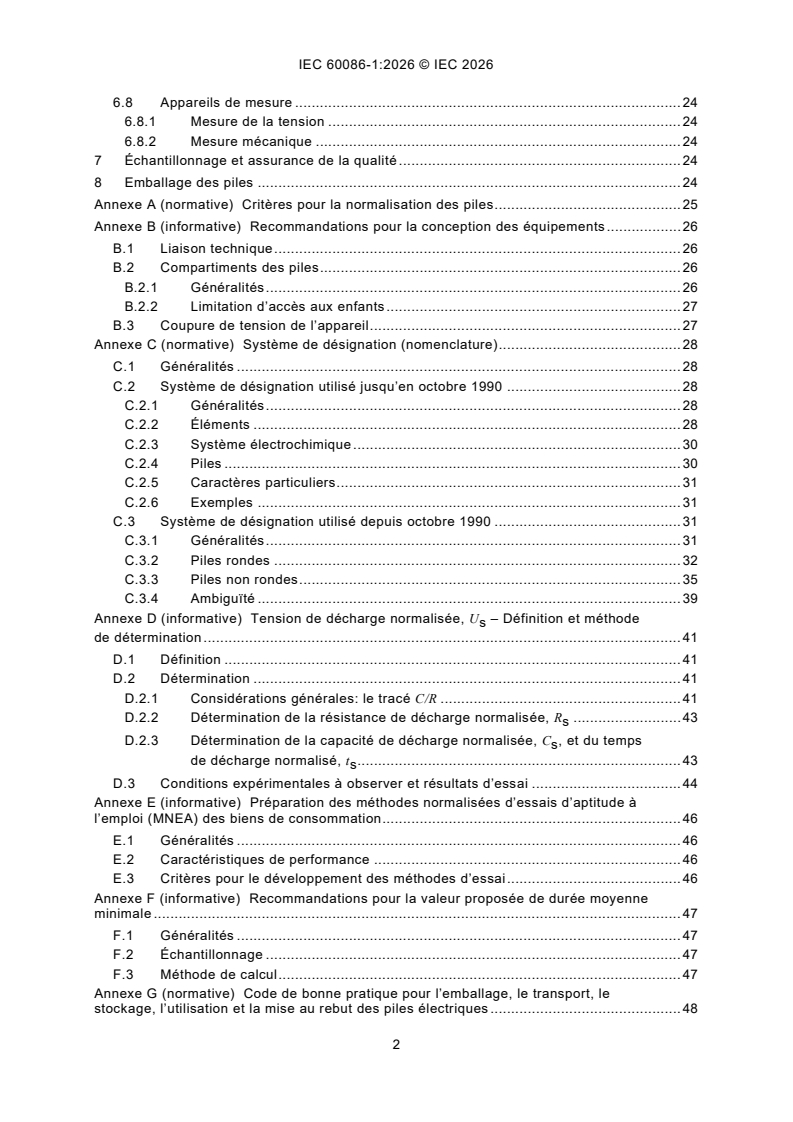
CONTENTS
FOREWORD . 5
INTRODUCTION . 7
1 Scope . 8
2 Normative references . 8
3 Terms and definitions . 8
4 Requirements . 12
4.1 General . 12
4.1.1 Design . 12
4.1.2 Battery dimensions . 12
4.1.3 Terminals . 12
4.1.4 Classification (electrochemical system) . 14
4.1.5 Designation . 15
4.1.6 Marking . 15
4.1.7 Interchangeability: battery voltage . 16
4.1.8 Other requirements, conformity checklist . 17
4.2 Performance . 17
4.2.1 Discharge performance . 17
4.2.2 Dimensional stability . 17
4.2.3 Leakage . 17
4.2.4 Open-circuit voltage limits . 17
4.2.5 Service output . 18
4.2.6 Safety . 18
4.2.7 Validity of testing . 18
5 Performance – Testing . 18
5.1 Capacity testing versus application and service output testing . 18
5.2 Discharge testing . 19
5.2.1 General . 19
5.2.2 Application tests . 19
5.2.3 Service output tests . 20
5.3 Conformance check to a specified minimum average duration . 20
5.4 Guidance for considering proposed value of minimum average duration . 20
5.5 OCV testing . 21
5.6 Insulation resistance . 21
5.7 Battery dimensions . 21
5.8 Leakage and deformation . 21
6 Performance – Test conditions . 21
6.1 Storage and discharge conditions . 21
6.2 Commencement of discharge tests after storage . 22
6.3 Discharge test conditions . 22
6.3.1 General . 22
6.3.2 Compliance . 22
6.4 Load resistance . 22
6.5 Time periods . 22
6.6 Test condition tolerances . 23
6.7 Activation of 'P'-system batteries . 23
6.8 Measuring equipment . 23
6.8.1 Voltage measurement . 23
6.8.2 Mechanical measurement . 23
7 Sampling and quality assurance . 23
8 Battery packaging . 23
Annex A (normative) Criteria for the standardization of batteries . 24
Annex B (informative) Recommendations for equipment design . 25
B.1 Technical liaison . 25
B.2 Battery compartment . 25
B.2.1 General . 25
B.2.2 Limiting access by children . 26
B.3 Equipment voltage cut-off . 26
Annex C (normative) Designation system (nomenclature) . 27
C.1 General . 27
C.2 Designation system in use up to October 1990 . 27
C.2.1 General . 27
C.2.2 Cells . 27
C.2.3 Electrochemical system . 29
C.2.4 Batteries . 29
C.2.5 Modifiers . 30
C.2.6 Examples . 30
C.3 Designation system in use since October 1990 . 30
C.3.1 General . 30
C.3.2 Round batteries . 31
C.3.3 Non-round batteries . 35
C.3.4 Ambiguity . 38
Annex D (informative) Standard discharge voltage Us – Definition and method of
determination . 40
D.1 Definition . 40
D.2 Determination . 40
D.2.1 General considerations: the C/R-plot . 40
D.2.2 Determination of the standard discharge resistor R . 42
s
D.2.3 Determination of the standard discharge capacity C and standard
s
discharge time t . 42
s
D.3 Experimental conditions to be observed and test results . 43
Annex E (informative) Preparation of standard methods of measuring performance
(SMMP) of consumer goods . 45
E.1 General . 45
E.2 Performance characteristics . 45
E.3 Criteria for the development of test methods . 45
Annex F (informative) Guidance for proposing value of minimum average duration . 46
F.1 General . 46
F.2 Sampling . 46
F.3 Calculation method . 46
Annex G (normative) Code of practice for packaging, shipment, storage, use and
disposal of primary batteries . 47
G.1 General . 47
G.2 Packaging . 47
G.3 Transport and handling . 47
G.4 Storage and stock rotation . 47
G.5 Displays at sales points . 48
G.6 Selection, use and disposal . 48
G.6.1 Purchase . 48
G.6.2 Installation . 48
G.6.3 Use. 49
G.6.4 Replacement . 49
G.6.5 Disposal . 49
Annex H (informative) Common designation . 50
Annex I (informative) Measurement methods for the determination of the performance
and durability of non-rechargeable portable batteries . 52
I.1 Overview . 52
I.2 Interoperability . 52
I.3 IEC designations of portable batteries of general use . 52
I.4 Performance and durability tests for non-rechargeable portable batteries of
general use . 53
I.4.1 Average duration of discharge . 53
I.4.2 Delayed discharge performance . 54
I.4.3 Resistance to leakage . 55
I.5 Determination of average duration for the purpose of labelling . 55
Annex J (informative) Compliance checklist . 56
Bibliography . 57
List of comments. 58
Figure 1 – Pulse tests with multiple load . 20
Figure C.1 – Designation system for round batteries: diameter d < 100 mm;
height h < 100 mm . 32
Figure C.2 – Diameter code for non-recommended diameters . 33
Figure C.3 – Height code for denoting the hundredths of a millimetre of height . 34
Figure C.4 – Designation system for round batteries: diameter d ≥ 100 mm;
height h ≥ 100 mm . 35
Figure C.5 – Designation system for non-round batteries, dimensions < 100 mm . 36
Figure C.6 – Designation system for non-round batteries, dimensions ≥ 100 mm . 37
Figure C.7 – Height code for discrimination per tenth of a millimetre . 38
Figure D.1 – Normalized C/R-plot (schematic) . 41
Figure D.2 – Standard discharge voltage (schematic) . 43
Table 1 – Standardized electrochemical systems . 14
Table 2 – Marking requirements . 16
Table 3 – Conditions for storage before and during discharge testing . 21
Table 4 – Resistive loads for tests . 22
Table 5 – Time periods for tests . 22
Table 6 – Test condition tolerances . 23
Table A.1 – Items necessary to standardize . 24
Table C.1 – Physical designation and dimensions of round cells and batteries . 28
Table C.2 – Physical designation and nominal overall dimensions of flat cells . 29
Table C.3 – Physical designation and dimensions of square cells and batteries . 29
Table C.4 – Examples of battery designations . 30
Table C.5 – Diameter code for recommended diameter . 33
Table C.6 – Physical designation and dimensions of round cell and batteries
based on Clause C.2 C.3 . 38
Table C.7 – Physical designation and dimensions of non-round batteries
based on Clause C.2 C.3 . 39
Table D.1 – Standard discharge voltage by system . 44
Table H.1 – Index . 50
Table I.1 – IEC and common formats of portable batteries of general use . 52
Table I.2 – Discharge testing of non-rechargeable portable batteries of general use . 53
INTERNATIONAL ELECTROTECHNICAL COMMISSION
____________
Primary batteries -
Part 1: General
FOREWORD
1) The International Electrotechnical Commission (IEC) is a worldwide organization for standardization comprising
all national electrotechnical committees (IEC National Committees). The object of IEC is to promote international
co-operation on all questions concerning standardization in the electrical and electronic fields. To this end and
in addition to other activities, IEC publishes International Standards, Technical Specifications, Technical Reports,
Publicly Available Specifications (PAS) and Guides (hereafter referred to as "IEC Publication(s)"). Their
preparation is entrusted to technical committees; any IEC National Committee interested in the subject dealt with
may participate in this preparatory work. International, governmental and non-governmental organizations liaising
with the IEC also participate in this preparation. IEC collaborates closely with the International Organization for
Standardization (ISO) in accordance with conditions determined by agreement between the two organizations.
2) The formal decisions or agreements of IEC on technical matters express, as nearly as possible, an international
consensus of opinion on the relevant subjects since each technical committee has representation from all
interested IEC National Committees.
3) IEC Publications have the form of recommendations for international use and are accepted by IEC National
Committees in that sense. While all reasonable efforts are made to ensure that the technical content of IEC
Publications is accurate, IEC cannot be held responsible for the way in which they are used or for any
misinterpretation by any end user.
4) In order to promote international uniformity, IEC National Committees undertake to apply IEC Publications
transparently to the maximum extent possible in their national and regional publications. Any divergence between
any IEC Publication and the corresponding national or regional publication shall be clearly indicated in the latter.
5) IEC itself does not provide any attestation of conformity. Independent certification bodies provide conformity
assessment services and, in some areas, access to IEC marks of conformity. IEC is not responsible for any
services carried out by independent certification bodies.
6) All users should ensure that they have the latest edition of this publication.
7) No liability shall attach to IEC or its directors, employees, servants or agents including individual experts and
members of its technical committees and IEC National Committees for any personal injury, property damage or
other damage of any nature whatsoever, whether direct or indirect, or for costs (including legal fees) and
expenses arising out of the publication, use of, or reliance upon, this IEC Publication or any other IEC
Publications.
8) Attention is drawn to the Normative references cited in this publication. Use of the referenced publications is
indispensable for the correct application of this publication.
9) IEC draws attention to the possibility that the implementation of this document may involve the use of (a)
patent(s). IEC takes no position concerning the evidence, validity or applicability of any claimed patent rights in
respect thereof. As of the date of publication of this document, IEC had not received notice of (a) patent(s), which
may be required to implement this document. However, implementers are cautioned that this may not represent
the latest information, which may be obtained from the patent database available at https://patents.iec.ch. IEC
shall not be held responsible for identifying any or all such patent rights.
This commented version (CMV) of the official standard IEC 60086-1:2026 edition 14.0 allows
the user to identify the changes made to the previous IEC 60086-1:2021 edition 13.0.
Furthermore, comments from IEC TC 35 experts are provided to explain the reasons of the most
relevant changes, or to clarify any part of the content.
A vertical bar appears in the margin wherever a change has been made. Additions are in green
text, deletions are in strikethrough red text. Experts' comments are identified by a blue-
background number. Mouse over a number to display a pop-up note with the comment.
This publication contains the CMV and the official standard. The full list of comments is available
at the end of the CMV.
IEC 60086-1 has been prepared by IEC technical committee 35: Primary cells and batteries. It
is an International Standard.
This fourteenth edition cancels and replaces the thirteenth edition published in 2021. This
edition constitutes a technical revision.
This edition includes the following significant technical changes with respect to the previous
edition:
a) In Clause 3, terms were reordered according to their functions: basic terms, electrochemical
systems, battery shapes, electrical characteristics, specifications, failure modes;
b) New letter "T" was added in Table 1, Standardized electrochemical systems of 4.1.4
classification;
c) Maximum open circuit voltage of letter "F" was changed from 1,83 V to 1,90 V;
d) Drawing of pulse tests with multiple load was moved from IEC 60086-2 to 5.2.2.2,
Application tests with multiple loads;
e) Annex F, Guidance for proposing value of minimum average duration was modified;
f) Annex D of IEC 60086-2:2021, Common designation, has been transferred to Annex H of
this document;
g) Table H.1, Common designation index, was modified to provide reference to IEC 60086-2-1
and IEC 60086-2-2 for each battery;
h) Annex I identifies the batteries of general use and the applicable tests to compare their
performance, in support of Regulation (EU) 2023/1542 (Batteries Regulation).
The text of this International Standard is based on the following documents:
Draft Report on voting
35/1590/FDIS 35/1600/RVD
Full information on the voting for its approval can be found in the report on voting indicated in
the above table.
The language used for the development of this International Standard is English.
This document was drafted in accordance with ISO/IEC Directives, Part 2, and developed in
accordance with ISO/IEC Directives, Part 1 and ISO/IEC Directives, IEC Supplement, available
at www.iec.ch/members_experts/refdocs. The main document types developed by IEC are
described in greater detail at www.iec.ch/publications.
A list of all parts in the IEC 60086 series, under the general title Primary batteries, can be found
on the IEC website.
The committee has decided that the contents of this document will remain unchanged until the
stability date indicated on the IEC website under webstore.iec.ch in the data related to the
specific document. At this date, the document will be
– reconfirmed,
– withdrawn, or
– revised.
INTRODUCTION
The technical content of this part of IEC 60086 provides fundamental requirements and
information on primary cells and batteries. All batteries within the IEC 60086 series are
considered dry cell batteries. In this sense, IEC 60086-1 is the main component of the
IEC 60086 series and forms the basis for the subsequent parts. For example, this part includes
elementary information on definitions, nomenclature, dimensions and marking. While specific
requirements are included, the content of this part tends to explain methodology (how) and
justification (why).
Over the years, this part has been changed to improve its content and remains under continual
scrutiny to ensure that the publication is kept up to date with the advances in both battery and
battery-powered device technologies.
Safety requirements and recommendations are available in IEC 60086-4, IEC 60086-5 and
IEC 62281. Specifications are available in IEC 60086-2 IEC 60086-2-1, IEC 60086-2-2 and
IEC 60086-3. Environmental aspects are dealt with in IEC 60086-6.
1 Scope
This part of IEC 60086 is intended to standardize primary batteries with respect to dimensions,
nomenclature, terminal configurations, markings, test methods, typical performance, safety and
environmental aspects.
This document on one side specifies requirements for primary cells and batteries. On the other
side, this document also specifies procedures of how requirements for these batteries are to be
standardised.
As a classification tool for primary batteries, this document specifies system letters, electrodes,
electrolytes, and nominal as well as maximum open circuit voltage of electrochemical systems.
The object of this part of IEC 60086 is to benefit primary battery users, device designers and
battery manufacturers by ensuring that batteries from different manufacturers are
interchangeable according to standard form, fit and function. Furthermore, to ensure
compliance with the above, this document specifies standard test methods for testing primary
cells and batteries.
This document also contains requirements in Annex A of this document justifying the inclusion
or the ongoing retention of batteries in the IEC 60086 series.
2 Normative references
The following documents are referred to in the text in such a way that some or all of their content
constitutes requirements of this document. For dated references, only the edition cited applies.
For undated references, the latest edition of the referenced document (including any
amendments) applies.
IEC 60086-2:2015, Primary batteries – Part 2: Physical and electrical specifications
IEC 60086-2-1:2026, Primary batteries - Part 2-1: Physical and electrical specifications of
batteries with aqueous electrolyte 1
IEC 60086-2-2:2026, Primary batteries - Part 2-2: Physical and electrical specifications of
lithium batteries 1
IEC 60086-3:2021, Primary batteries - Part 3: Watch batteries
IEC 60086-4, Primary batteries - Part 4: Safety of lithium batteries
IEC 60086-5, Primary batteries - Part 5: Safety of batteries with aqueous electrolyte
3 Terms and definitions
For the purposes of this document, the following terms and definitions apply. 2
ISO and IEC maintain terminology databases for use in standardization at the following
addresses:
– IEC Electropedia: available at https://www.electropedia.org/
– ISO Online browsing platform: available at https://www.iso.org/obp
3.1
cell
basic functional unit, consisting of an assembly of electrodes, electrolyte, container, terminals
and usually separators, that is a source of electric energy obtained by direct conversion of
chemical energy
[SOURCE: IEC 60050-482:2004, 482-01-01, modified – removal of Note]
3.2
battery
one or more cells electrically connected and fitted in a case, with terminals, markings and
protective devices etc., as necessary for use
[SOURCE: IEC 60050-482:2004, 482-01-04, modified – removal of "fitted with devices
necessary for use.]
one or more cells electrically connected and fitted with devices necessary for use, for example
case, labels, terminals, marking and protective devices etc.
[SOURCE: IEC 60050-482:2004, 482-01-04, modified – addition of "electrically connected",
"labels" and "etc."]
3.3
primary cell
primary battery
cell or battery that is not designed to be electrically recharged
3.4
round cell
round battery
cell or battery with circular cross section
3.5
button cell
button battery
small round cell or battery where the overall height is less than the diameter, containing
aqueous electrolyte
Note 1 to entry: See coin cell, coin battery, lithium button cell, lithium button battery.
[SOURCE: IEC 60050-482:2004, 482-02-40, modified – addition of "small round", "or battery",
removal of "e.g. in the shape of a button or a coin", addition of "containing aqueous electrolyte"]
3.6
coin cell
coin battery
lithium button cell
lithium button battery
small round cell or battery where the overall height is less than the diameter, containing non-
aqueous electrolyte
Note 1 to entry: The nominal voltage of lithium batteries is typically greater than 2 V.
Note 2 to entry: See button cell, button battery.
3.7
cylindrical cell
cylindrical battery
round cell or battery in which the overall height is equal to or greater than the diameter
[SOURCE: IEC 60050-482:2004, 482-02-39, modified – "cell with a cylindrical shape" replaced
with "round cell or battery"]
3.8
nominal voltage (of a primary battery)
U
n
suitable approximate value of the voltage used to designate or identify a cell, a battery or an
electrochemical system
[SOURCE: IEC 60050-482:2004, 482-03-31, modified – addition of "(of a primary battery)" and
U ]
n
3.9
open-circuit voltage
OCV
voltage across the terminals of a cell or battery when it is off discharge
3.10
closed-circuit voltage
CCV
voltage across the terminals of a battery when it is on discharge
[SOURCE: IEC 60050-482:2004, 482-03-28, modified – "voltage between the terminals of a cell
or battery" replaced by "voltage across the terminals of a battery"]
3.9
dry (primary) battery
primary battery in which the liquid electrolyte is essentially immobilized
[SOURCE:IEC 60050-482:2004, 482-04-14, modified – replacement of "containing an
immobilized electrolyte.]
3.11
end-point voltage
EV
specified voltage of a battery at which the battery discharge is terminated
[SOURCE: IEC 60050-482:2004, 482-03-30]
3.12
minimum average duration
MAD
acceptable minimum average time on discharge, which is met by testing a sample of batteries
according to specified methods, to be deemed compliant
Note 1 to entry: The discharge test is carried out according to the specified methods or standards and designed to
show conformity with the standard applicable to the battery types.
3.13
application test
simulation of the actual use of a battery in a specific application
3.14
discharge (of a primary battery)
operation during which a battery delivers current to an external circuit
3.15
service output (of a primary battery)
service life, or capacity, or energy output of a battery under specified conditions of discharge
3.16
service output test
test designed to measure the service output of a battery
Note 1 to entry: A service output test may be prescribed, for example, when
a) an application test is too complex to replicate;
b) the duration of an application test would make it impractical for routine testing purposes.
3.17
storage life
duration under specified conditions at the end of which a battery retains its ability to perform a
specified service output
[SOURCE: IEC 60050-482:2004, 482-03-47, modified – "function" replaced by "service output"]
3.18
terminal (of a primary battery)
conductive parts of a battery providing connection to an external circuit
[SOURCE: IEC 60050-482:2004, 482-02-22, modified – "conductive part of a device, electric
circuit or electric network, provided" replaced by to "conductive parts of a battery providing"
and "device, electric circuit or electric network to one or more external conductor" replaced by
"an external circuit"]
3.19
leakage
unplanned escape of electrolyte, gas or other material from a cell or battery
Note 1 to entry: Leakage in this sense should not be confused with the test evaluation criteria for leakage specified
in Clause 4 and Clause 5 of this document.
[SOURCE: IEC 60050-482:2004, 482-02-32]
3.20
terms applicable to Annex I
3.20.1
non-rechargeable battery
battery that is not designed to be electrically recharged
Note 1 to entry: The term "non-rechargeable" is used in the European Batteries Regulation in place of "primary".
[SOURCE: Batteries Regulation, Article 2(1), point (6), modified — Note to entry has been
added]
3.20.2
portable battery of general use
portable battery specifically produced to be interoperable and with the following common
formats: 4,5 Volts (3R12), button cell, D, C, AA, AAA, AAAA, A23, 9 Volts (PP3)
Note 1 to entry: See I.2 for more information on the meaning of "interoperable".
Note 2 to entry: See I.3 for a tabulation of portable non-rechargeable batteries of general use.
Note 3 to entry: (3R12) is not part of the common designation but part of some IEC designations. See Table I.1.
[SOURCE: Batteries Regulation, Article 2(1), point (10), modified — Notes to entry have been
added]
4 Requirements
4.1 General
4.1.1 Design
Primary batteries are sold mainly in consumer markets. In recent years, they have become more
sophisticated in both chemistry and construction, for example both capacity and rate capability
have increased to meet the growing demands from new, battery-powered equipment technology.
When designing primary batteries, the aforementioned considerations shall be taken into
account. Specifically, their dimensional conformity and stability, their physical and electrical
performance and their safe operation under normal use and foreseeable misuse conditions shall
be assured.
Additional information on equipment design can be found in Annex B of this document.
4.1.2 Battery dimensions
The dimensions for individual types of batteries are given in IEC 60086-2 IEC 60086-2-1,
IEC 60086-2-2 and IEC 60086-3.
4.1.3 Terminals
4.1.3.1 General
Terminals shall be in accordance with Clause 6 of IEC 60086-2:2015 Clause 8 of IEC 60086-2-
1:2026 and IEC 60086-2-2.
Their physical shape shall be designed in such a way that they ensure that the batteries make
and maintain good electrical contact at all times.
They shall be made of materials that provide good electrical conductivity and resistance to
corrosion.
4.1.3.2 Contact pressure resistance
Where stated in the battery specification tables or the individual specification sheets in
IEC 60086-2 IEC 60086-2-1 and IEC 60086-2-2, the following applies:
– a force of 10 N applied through a steel ball of 1 mm diameter at the centre of each contact
area for a period of 10 s shall not cause any apparent deformation which might prevent
satisfactory operation of the battery.
NOTE See also IEC 60086-3:2021, 4.5 for exceptions.
4.1.3.3 Cap and base
This type of terminal is used for batteries which have their dimensions specified according to
Figures 1 to 7 of IEC 60086-2:2015 Figures 1 to 6 of IEC 60086-2-1:2026 and Figures 1 to 4 of
IEC 60086-2-2:2026 which have the cylindrical side of the battery insulated from the terminals.
4.1.3.4 Cap and case
This type of terminal is used for batteries which have their dimensions specified according to
Figures 8, 9, 10, 14, 15 and 16 of IEC 60086-2:2015 Figures 7, 8, 9, 13, 14 of IEC 60086-2-
1:2026 and Figures 5, 6, 7 of IEC 60086-2-2:2026, but in which the cylindrical side of the battery
forms part of the positive terminal.
4.1.3.5 Screw terminals
This contact consists of a threaded rod in combination with either a metal or insulated metal
nut.
4.1.3.6 Flat contacts
These are essentially flat metal surfaces adapted to make electrical contact by suitable contact
mechanisms bearing against them.
4.1.3.7 Flat or spiral springs
These contacts comprise flat metal strips or spirally wound wires which are in a form that
provides pressure contact.
4.1.3.8 Plug-in-sockets
These are made up of a suitable assembly of metal contacts, mounted in an insulated housing
or holding device and adapted to receive the corresponding pins of a mating plug.
4.1.3.9 Snap fasteners
4.1.3.9.1 General
These contacts are composed of a combination comprising a stud (non-resilient) for the positive
terminal and a socket (resilient) for the negative terminal.
They shall be of suitable metal so as to provide efficient electrical connection when joined to
the corresponding parts of an external circuit.
4.1.3.9.2 Snap fastener
This type of terminal consists of a stud for the positive terminal and a socket for the negative
terminal. These shall be made from nickel plated steel or other suitable material. They shall be
designed to provide a secure physical and electrical connection, when fitted with similar
corresponding parts for connection to an electrical circuit.
4.1.3.10 Wire
Wire leads may be single or multi-strand flexible insulated tinned copper. The positive terminal
wire covering shall be red and the negative black.
4.1.3.11 Other spring contacts or clips
These contacts are generally used on batteries when the corresponding parts of the external
circuit are not precisely known. They shall be of spring brass or of other material having similar
properties.
4.1.4 Classification (electrochemical system)
Primary batteries are classified according to their electrochemical system.
Each system, with the exception of the zinc-ammonium chloride, zinc chloride-manganese
dioxide system, has been allocated a letter denoting the particular system.
The electrochemical systems that have been standardized up to now are given in Table 1.
Table 1 – Standardized electrochemical systems
Maximum
Negative Nominal
Letter Electrolyte Positive electrode open-circuit
electrode voltage
voltage
V V
No letter Zinc (Zn) Ammonium chloride, Manganese dioxide (MnO ) 1,5 1,73
zinc chloride
A Zinc (Zn) Ammonium chloride, Oxygen (O ) 1,4 1,55
zinc chloride
B Lithium (Li) Organic electrolyte Carbon monofluoride (CF) 3,0 3,7
x
C Lithium (Li) Organic electrolyte Manganese dioxide (MnO ) 3,0 3,7
E Lithium (Li) Non-aqueous Thionyl chloride (SOCl ) 3,6 3,9
inorganic
F Lithium (Li) Organic electrolyte Iron disulfide (FeS ) 1,5
1,83 1,90 3
G Lithium (Li) Organic electrolyte Copper (II) oxide (CuO) 1,5 2,3
L Zinc (Zn) Alkali metal hydroxide Manganese dioxide (MnO ) 1,5 1,68
P Zinc (Zn) Alkali metal hydroxide Oxygen (O ) 1,4 or 1,45 1,59
S Zinc (Zn) Alkali metal hydroxide Silver oxide (Ag O) 1,55 1,63
T Zinc (Zn) Alkali metal hydroxide Manganese dioxide (MnO ) / 1,5
1,75 4
Nickel (III) oxide (NiO )
x
W Lithium (Li) Organic electrolyte Sulfur dioxide (SO ) 3,0 3,05
Y Lithium (Li) Non-aqueous Sulfuryl chloride (SO Cl ) 3,9 4,1
2 2
inorganic
Z Zinc (Zn) Alkali metal hydroxide Nickel oxyhydroxide 1,5 1,78
(NiOOH)
NOTE 1 The value of the nominal voltage is not verifiable; therefore it is only given as a reference.
NOTE 2 The maximum open-circuit voltage (see 3.9) is measured as defined in 5.5 and 6.8.1.
NOTE 3 When referring to an electrochemical system, common protocol is to list negative electrode first, followed
by positive electrode, e.g. lithium-iron disulfide.
NOTE 4 Reference to the electrochemical systems of this table usually appears in a simplified form such as, for
example, "B and C system batteries" or "batteries of the no letter system".
The required criteria for standardization of batteries are provided in Annex A of this document.
4.1.5 Designation
The designation of primary batteries is based on their physical parameters, their
electrochemical system as well as modifiers, if needed.
A comprehensive explanation of the designation system (nomenclature) can be found in
Annex C of this document.
4.1.6 Marking
4.1.6.1 General
For an overview of marking requirements refer to Table 2. With the exception of batteries too
small to mark with all items (see 4.1.6.2), each battery shall be marked with the following
information:
a) designation, IEC or common;
a) expiration of a recommended usage period or year and month or week of manu
...
IEC 60086-1 ®
Edition 14.0 2026-06
NORME
INTERNATIONALE
Piles électriques -
Partie 1: Généralités
ICS 29.220.10 ISBN 978-2-8327-1214-6
Droits de reproduction réservés. Sauf indication contraire, aucune partie de cette publication ne peut être reproduite ni
utilisée sous quelque forme que ce soit et par aucun procédé, électronique ou mécanique, y compris la photocopie et
les microfilms, sans l'accord écrit de l'IEC ou du Comité national de l'IEC du pays du demandeur. Si vous avez des
questions sur le copyright de l'IEC ou si vous désirez obtenir des droits supplémentaires sur cette publication, utilisez
les coordonnées ci-après ou contactez le Comité national de l'IEC de votre pays de résidence.
IEC Secretariat Tel.: +41 22 919 02 11
3, rue de Varembé info@iec.ch
CH-1211 Geneva 20 www.iec.ch
Switzerland
A propos de l'IEC
La Commission Electrotechnique Internationale (IEC) est la première organisation mondiale qui élabore et publie des
Normes internationales pour tout ce qui a trait à l'électricité, à l'électronique et aux technologies apparentées.
A propos des publications IEC
Le contenu technique des publications IEC est constamment revu. Veuillez vous assurer que vous possédez l’édition la
plus récente, un corrigendum ou amendement peut avoir été publié.
Recherche de publications IEC - IEC Products & Services Portal - products.iec.ch
webstore.iec.ch/advsearchform Découvrez notre puissant moteur de recherche et consultez
La recherche avancée permet de trouver des publications gratuitement tous les aperçus des publications, symboles
IEC en utilisant différents critères (numéro de référence, graphiques et le glossaire. Avec un abonnement, vous aurez
texte, comité d’études, …). Elle donne aussi des toujours accès à un contenu à jour adapté à vos besoins.
informations sur les projets et les publications remplacées
ou retirées. Electropedia - www.electropedia.org
Le premier dictionnaire d'électrotechnologie en ligne au
IEC Just Published - webstore.iec.ch/justpublished monde, avec plus de 22 500 articles terminologiques en
Restez informé sur les nouvelles publications IEC. Just anglais et en français, ainsi que les termes équivalents
dans 25 langues additionnelles. Egalement appelé
Published détaille les nouvelles publications parues.
Disponible en ligne et une fois par mois par email. Vocabulaire Electrotechnique International (IEV) en ligne.
Service Clients - webstore.iec.ch/csc
Si vous désirez nous donner des commentaires sur cette
publication ou si vous avez des questions contactez-
nous: sales@iec.ch.
SOMMAIRE
AVANT-PROPOS . 5
INTRODUCTION . 7
1 Domaine d’application . 8
2 Références normatives . 8
3 Termes et définitions . 9
4 Exigences . 12
4.1 Généralités . 12
4.1.1 Conception . 12
4.1.2 Dimensions des piles . 12
4.1.3 Bornes . 12
4.1.4 Classification (système électrochimique) . 14
4.1.5 Désignation . 15
4.1.6 Marquage . 15
4.1.7 Interchangeabilité: tension de la pile . 16
4.1.8 Autres exigences, liste de contrôle de conformité . 17
4.2 Performance . 17
4.2.1 Performance de décharge . 17
4.2.2 Stabilité dimensionnelle . 17
4.2.3 Fuites . 18
4.2.4 Limites de tension en circuit ouvert . 18
4.2.5 Capacité . 18
4.2.6 Sécurité . 18
4.2.7 Validité des essais . 18
5 Performance – essais . 18
5.1 Essais de capacité par rapport aux essais d’application et de capacité . 18
5.2 Essais de décharge . 19
5.2.1 Généralités . 19
5.2.2 Essais d’application . 19
5.2.3 Essais de capacité . 20
5.3 Vérification de conformité à une durée moyenne minimale spécifiée . 21
5.4 Recommandations pour la prise en compte de la valeur proposée de durée
moyenne minimale . 21
5.5 Essais de tension en circuit ouvert . 21
5.6 Résistance d’isolement . 21
5.7 Dimensions des piles . 21
5.8 Fuites et déformation . 22
6 Performance – conditions d’essai . 22
6.1 Conditions de stockage et de décharge. 22
6.2 Commencement des essais de décharge après stockage . 22
6.3 Conditions d’essai de décharge . 23
6.3.1 Généralités . 23
6.3.2 Conformité . 23
6.4 Résistance de décharge . 23
6.5 Périodes . 23
6.6 Tolérances pour les conditions d’essai . 23
6.7 Activation des piles du système "P" . 24
6.8 Appareils de mesure . 24
6.8.1 Mesure de la tension . 24
6.8.2 Mesure mécanique . 24
7 Échantillonnage et assurance de la qualité . 24
8 Emballage des piles . 24
Annexe A (normative) Critères pour la normalisation des piles . 25
Annexe B (informative) Recommandations pour la conception des équipements . 26
B.1 Liaison technique . 26
B.2 Compartiments des piles . 26
B.2.1 Généralités . 26
B.2.2 Limitation d’accès aux enfants . 27
B.3 Coupure de tension de l’appareil . 27
Annexe C (normative) Système de désignation (nomenclature) . 28
C.1 Généralités . 28
C.2 Système de désignation utilisé jusqu’en octobre 1990 . 28
C.2.1 Généralités . 28
C.2.2 Éléments . 28
C.2.3 Système électrochimique . 30
C.2.4 Piles . 30
C.2.5 Caractères particuliers . 31
C.2.6 Exemples . 31
C.3 Système de désignation utilisé depuis octobre 1990 . 31
C.3.1 Généralités . 31
C.3.2 Piles rondes . 32
C.3.3 Piles non rondes . 35
C.3.4 Ambiguïté . 39
Annexe D (informative) Tension de décharge normalisée, U – Définition et méthode
s
de détermination . 41
D.1 Définition . 41
D.2 Détermination . 41
D.2.1 Considérations générales: le tracé C/R . 41
D.2.2 Détermination de la résistance de décharge normalisée, R . 43
s
D.2.3 Détermination de la capacité de décharge normalisée, C , et du temps
s
de décharge normalisé, t . 43
s
D.3 Conditions expérimentales à observer et résultats d’essai . 44
Annexe E (informative) Préparation des méthodes normalisées d’essais d’aptitude à
l’emploi (MNEA) des biens de consommation . 46
E.1 Généralités . 46
E.2 Caractéristiques de performance . 46
E.3 Critères pour le développement des méthodes d’essai . 46
Annexe F (informative) Recommandations pour la valeur proposée de durée moyenne
minimale . 47
F.1 Généralités . 47
F.2 Échantillonnage . 47
F.3 Méthode de calcul . 47
Annexe G (normative) Code de bonne pratique pour l’emballage, le transport, le
stockage, l’utilisation et la mise au rebut des piles électriques . 48
G.1 Généralités . 48
G.2 Emballage . 48
G.3 Transport et manutention . 48
G.4 Stockage et rotation des stocks . 48
G.5 Présentation aux points de vente . 49
G.6 Choix, utilisation et mise au rebut . 49
G.6.1 Achat . 49
G.6.2 Installation . 49
G.6.3 Utilisation . 50
G.6.4 Remplacement. 50
G.6.5 Mise au rebut. 50
Annexe H (informative) Désignation commune . 51
Annexe I (informative) Méthodes de mesure pour la détermination de la performance
et de la durabilité des piles portables non rechargeables . 53
I.1 Aperçu . 53
I.2 Interopérabilité . 53
I.3 Désignations IEC des piles portables d’utilisation courante . 53
I.4 Essais de performance et de durabilité pour les piles portables non
rechargeables d’utilisation courante . 54
I.4.1 Durée moyenne de décharge . 54
I.4.2 Performance de décharge retardée . 55
I.4.3 Résistance aux fuites . 56
I.5 Détermination de la durée moyenne à des fins d’étiquetage . 56
Annexe J (informative) Liste de contrôle de conformité . 57
Bibliographie . 58
Figure 1 – Essais d’impulsions à charges multiples . 20
Figure C.1 – Système de désignation des piles rondes: diamètre d < 100 mm;
hauteur h < 100 mm . 32
Figure C.2 – Code de diamètre pour les diamètres non recommandés . 33
Figure C.3 – Code de hauteur pour indiquer les centièmes de millimètres de hauteur . 34
Figure C.4 – Système de désignation des piles rondes: diamètre d ≥ 100 mm;
hauteur h ≥ 100 mm . 35
Figure C.5 – Système de désignation des piles non rondes de dimensions < 100 mm . 37
Figure C.6 – Système de désignation des piles non rondes, dimensions ≥ 100 mm . 38
Figure C.7 – Code de hauteur pour indiquer les dixièmes de millimètres . 39
Figure D.1 – Tracé normalisé C/R (schématique) . 42
Figure D.2 – Tension de décharge normalisée (schématique) . 44
Tableau 1 – Systèmes électrochimiques normalisés . 14
Tableau 2 – Exigences relatives au marquage . 16
Tableau 3 – Conditions de stockage avant et pendant l’essai de décharge . 22
Tableau 4 – Charges résistives pour les essais . 23
Tableau 5 – Périodes pour les essais . 23
Tableau 6 – Tolérances pour les conditions d’essai . 24
Tableau A.1 – Informations nécessaires à la normalisation . 25
Tableau C.1 – Désignation physique et dimensions des éléments et piles ronds . 29
Tableau C.2 – Désignation physique et dimensions nominales hors tout des éléments
plats . 30
Tableau C.3 – Désignation physique et dimensions des éléments et piles
parallélépipédiques . 30
Tableau C.4 – Exemples de désignations de piles . 31
Tableau C.5 – Code de diamètre pour les diamètres recommandés . 33
Tableau C.6 – Désignation physique et dimensions des éléments et piles ronds basées
sur l’Article C.3 . 39
Tableau C.7 – Désignation physique et dimensions des piles non rondes basées sur
l’Article C.3 . 40
Tableau D.1 – Tension de décharge normalisée par système . 44
Tableau H.1 – Index . 51
Tableau I.1 – Modèles IEC et communs des piles portables d’utilisation courante . 53
Tableau I.2 – Essais de décharge des piles portables non rechargeables d’utilisation
courante . 54
COMMISSION ÉLECTROTECHNIQUE INTERNATIONALE
____________
Piles électriques -
Partie 1: Généralités
AVANT-PROPOS
1) La Commission Électrotechnique Internationale (IEC) est une organisation mondiale de normalisation composée
de l’ensemble des comités électrotechniques nationaux (Comités nationaux de l’IEC). L’IEC a pour objet de
favoriser la coopération internationale pour toutes les questions de normalisation dans les domaines de
l’électricité et de l’électronique. À cet effet, l’IEC – entre autres activités – publie des Normes internationales,
des Spécifications techniques, des Rapports techniques, des Spécifications accessibles au public (PAS) et des
Guides (ci-après dénommés "Publication(s) de l’IEC"). Leur élaboration est confiée à des comités d’études,
aux travaux desquels tout Comité national intéressé par le sujet traité peut participer. Les organisations
internationales, gouvernementales et non gouvernementales, en liaison avec l’IEC, participent également aux
travaux. L’IEC collabore étroitement avec l’Organisation Internationale de Normalisation (ISO), selon des
conditions fixées par accord entre les deux organisations.
2) Les décisions ou accords officiels de l’IEC concernant les questions techniques représentent, dans la mesure du
possible, un accord international sur les sujets étudiés, étant donné que les Comités nationaux de l’IEC intéressés
sont représentés dans chaque comité d’études.
3) Les Publications de l’IEC se présentent sous la forme de recommandations internationales et sont agréées
comme telles par les Comités nationaux de l’IEC. Tous les efforts raisonnables sont entrepris afin que l’IEC
s’assure de l’exactitude du contenu technique de ses publications; l’IEC ne peut pas être tenue responsable de
l’éventuelle mauvaise utilisation ou interprétation qui en est faite par un quelconque utilisateur final.
4) Dans le but d’encourager l’uniformité internationale, les Comités nationaux de l’IEC s’engagent, dans toute la
mesure possible, à appliquer de façon transparente les Publications de l’IEC dans leurs publications nationales
et régionales. Toutes divergences entre toutes Publications de l’IEC et toutes publications nationales ou
régionales correspondantes doivent être indiquées en termes clairs dans ces dernières.
5) L’IEC elle-même ne fournit aucune attestation de conformité. Des organismes de certification indépendants
fournissent des services d’évaluation de conformité et, dans certains secteurs, accèdent aux marques de
conformité de l’IEC. L’IEC n’est responsable d’aucun des services effectués par les organismes de certification
indépendants.
6) Tous les utilisateurs doivent s’assurer qu’ils sont en possession de la dernière édition de cette publication.
7) Aucune responsabilité ne doit être imputée à l’IEC, à ses administrateurs, employés, auxiliaires ou mandataires,
y compris ses experts particuliers et les membres de ses comités d’études et des Comités nationaux de l’IEC,
pour tout préjudice causé en cas de dommages corporels et matériels, ou de tout autre dommage de quelque
nature que ce soit, directe ou indirecte, ou pour supporter les coûts (y compris les frais de justice) et les dépenses
découlant de la publication ou de l’utilisation de cette Publication de l’IEC ou de toute autre Publication de l’IEC,
ou au crédit qui lui est accordé.
8) L’attention est attirée sur les références normatives citées dans cette publication. L’utilisation de publications
référencées est obligatoire pour une application correcte de la présente publication.
9) L’IEC attire l’attention sur le fait que la mise en application du présent document peut entraîner l’utilisation d’un
ou de plusieurs brevets. L’IEC ne prend pas position quant à la preuve, à la validité et à l’applicabilité de tout
droit de brevet revendiqué à cet égard. À la date de publication du présent document, l’IEC n’avait pas reçu
notification qu’un ou plusieurs brevets pouvaient être nécessaires à sa mise en application. Toutefois, il y a lieu
d’avertir les responsables de la mise en application du présent document que des informations plus récentes
sont susceptibles de figurer dans la base de données de brevets, disponible à l’adresse https://patents.iec.ch.
L’IEC ne saurait être tenue pour responsable de ne pas avoir identifié de tels droits de brevet.
L’IEC 60086-1 a été établie par le comité d’études 35 de l’IEC: Piles. Il s’agit d’une Norme
internationale.
Cette quatorzième édition annule et remplace la treizième édition parue en 2021. Cette édition
constitue une révision technique.
Cette édition inclut les modifications techniques majeures suivantes par rapport à l’édition
précédente:
a) à l’Article 3, les termes ont été réordonnés en fonction de leurs fonctions: termes de base,
systèmes électrochimiques, formes des piles, caractéristiques électriques, spécifications,
modes de défaillance;
b) la nouvelle lettre "T" a été ajoutée dans le Tableau 1, Systèmes électrochimiques
normalisés, de 4.1.4 classification;
c) la tension maximale en circuit ouvert de la lettre "F" a été modifiée de 1,83 V à 1,90 V;
d) le schéma des essais d’impulsions à charges multiples a été déplacé de l’IEC 60086-2 à
5.2.2.2, Essais d’application avec plusieurs décharges;
e) l’Annexe F, Recommandations pour la valeur proposée de durée moyenne minimale, a été
modifiée;
f) l’Annexe D de l’IEC 60086-2:2021, Désignation commune, a été transférée à l’Annexe H du
présent document;
g) le Tableau H.1, Index de désignation commune, a été modifié pour fournir une référence à
l’IEC 60086-2-1 et à l’IEC 60086-2-2 pour chaque pile;
h) l’Annexe I identifie les piles d’utilisation courante et les essais applicables pour comparer
leur performance, à l’appui du règlement (UE) 2023/1542 (règlement relatif aux batteries).
Le texte de cette Norme internationale est issu des documents suivants:
Projet Rapport de vote
35/1590/FDIS 35/1600/RVD
Le rapport de vote indiqué dans le tableau ci-dessus donne toute information sur le vote ayant
abouti à son approbation.
La langue employée pour l’élaboration de cette Norme internationale est l’anglais.
Ce document a été rédigé selon les Directives ISO/IEC, Partie 2, il a été développé selon les
Directives ISO/IEC, Partie 1 et les Directives ISO/IEC, Supplément IEC, disponibles sous
www.iec.ch/members_experts/refdocs. Les principaux types de documents développés par
l’IEC sont décrits plus en détail sous www.iec.ch/publications.
Une liste de toutes les parties de la série IEC 60086, publiées sous le titre général
Piles électriques, se trouve sur le site Web de l’IEC.
Le comité a décidé que le contenu de ce document ne sera pas modifié avant la date de stabilité
indiquée sur le site web de l’IEC sous webstore.iec.ch dans les données relatives au document
recherché. À cette date, le document sera
– reconduit,
– supprimé, ou
– révisé.
INTRODUCTION
Le contenu technique de la présente partie de l’IEC 60086 fournit les exigences et des
informations fondamentales sur les piles électriques. Dans ce contexte, l’IEC 60086-1 constitue
la partie principale de la série IEC 60086 et sert de base aux autres parties. La présente partie
inclut, par exemple, les informations élémentaires sur les définitions, la nomenclature, les
dimensions et le marquage. S’il intègre des exigences spécifiques, le contenu de la présente
partie tend surtout à expliquer la méthodologie (comment) et la justification (pourquoi).
Avec les années, la présente partie a été modifiée pour en améliorer le contenu et elle est
surveillée en permanence pour s’assurer que la publication est maintenue à jour avec les
avancées, à la fois dans le domaine des piles électriques et des technologies, des dispositifs
qui les utilisent.
Les exigences de sécurité et des recommandations sont données dans l’IEC 60086-4, dans
l’IEC 60086-5 et dans l’IEC 62281. Les spécifications sont données dans l’IEC 60086-2-1,
l’IEC 60086-2-2 et l’IEC 60086-3. Les aspects environnementaux sont traités dans
l’IEC 60086-6.
1 Domaine d’application
La présente partie de l’IEC 60086 est destinée à normaliser les piles électriques en ce qui
concerne les dimensions, la nomenclature, les configurations des bornes, les marquages,
les méthodes d’essai, la performance type, la sécurité et les aspects environnementaux.
Le présent document spécifie d’une part les exigences pour les piles électriques. D’autre part,
le présent document spécifie également des procédures de normalisation des exigences
relatives à ces piles.
En tant qu’outil de classification des piles électriques, le présent document spécifie les lettres
des systèmes, les électrodes, les électrolytes et les tensions nominales, ainsi que maximales
en circuit ouvert, des systèmes électrochimiques.
L’objectif de la présente partie de l’IEC 60086 est d’assurer aux utilisateurs, aux concepteurs
de dispositifs et aux fabricants de piles que les piles de différents fabricants sont
interchangeables par leur forme, leur montage et leur fonction. De plus, pour assurer la
conformité avec ce qui précède, le présent document spécifie des méthodes d’essai
normalisées pour les piles électriques.
Le présent document contient également des exigences à l’Annexe A du présent document qui
justifient l’introduction ou le maintien de piles dans la série IEC 60086.
2 Références normatives
Les documents suivants sont cités dans le texte de sorte qu’ils constituent, pour tout ou partie
de leur contenu, des exigences du présent document. Pour les références datées,
seule l’édition citée s’applique. Pour les références non datées, la dernière édition du document
de référence s’applique (y compris les éventuels amendements).
IEC 60086-2-1:2026, Piles électriques - Partie 2-1: Spécifications physiques et électriques des
piles à électrolyte aqueux
IEC 60086-2-2:2026, Piles électriques - Partie 2-2: Spécifications physiques et électriques des
piles au lithium
IEC 60086-3:2021, Piles électriques - Partie 3: Piles pour montres
IEC 60086-4, Piles électriques - Partie 4: Sécurité des piles au lithium
IEC 60086-5, Piles électriques - Partie 5: Sécurité des piles à électrolyte aqueux
3 Termes et définitions
Pour les besoins du présent document, les termes et définitions suivants s’appliquent.
L’ISO et l’IEC tiennent à jour des bases de données terminologiques destinées à être utilisées
en normalisation, consultables aux adresses suivantes:
– IEC Electropedia: disponible à l’adresse https://www.electropedia.org/
– ISO Online browsing platform: disponible à l’adresse https://www.iso.org/obp
3.1
élément
unité fonctionnelle de base, consistant en un assemblage d’électrodes, d’électrolyte,
de conteneur, de bornes et généralement de séparateurs, qui est une source d’énergie
électrique obtenue par transformation directe d’énergie chimique
[SOURCE: IEC 60050-482:2004, 482-01-01, modifiée – suppression de la Note]
3.2
pile
un ou plusieurs éléments raccordés électriquement et équipés des dispositifs nécessaires pour
l’emploi, par exemple boîtier, étiquettes, bornes, marquage et dispositifs de protection, etc.
[SOURCE: IEC 60050-482:2004, 482-01-04, modifiée – ajout de "raccordés électriquement et",
"étiquettes" et "etc."]
3.3
pile
pile électrique
élément ou pile qui n’est pas conçu pour être rechargé électriquement
3.4
élément rond
pile ronde
élément ou pile de section circulaire
3.5
élément bouton
pile bouton
petit élément ou petite pile de forme ronde dont la hauteur totale est inférieure au diamètre,
contenant un électrolyte aqueux
Note 1 à l’article: Voir élément bouton, pile bouton, élément bouton au lithium, pile bouton au lithium.
[SOURCE: IEC 60050-482:2004, 482-02-40, modifiée – ajout de "petit . de forme ronde",
"ou petite pile", suppression de "par exemple en forme de bouton ou de pièce de monnaie",
ajout de "contenant un électrolyte aqueux"]
3.6
élément bouton
pile bouton
élément bouton au lithium
pile bouton au lithium
petit élément ou petite pile de forme ronde dont la hauteur totale est inférieure au diamètre,
contenant un électrolyte non aqueux
Note 1 à l’article: Typiquement, la tension nominale des piles au lithium est supérieure à 2 V.
Note 2 à l’article: Voir élément bouton, pile bouton.
3.7
élément cylindrique
pile cylindrique
élément ou pile de forme ronde dont la hauteur totale est supérieure ou égale au diamètre
[SOURCE: IEC 60050-482:2004, 482-02-39, modifié – L’expression "élément de forme
cylindrique dans laquelle" a été remplacée par "élément ou pile de forme ronde dont".]
3.8
tension nominale
U
n
valeur approchée appropriée d’une tension utilisée pour désigner ou identifier un élément,
une pile ou un système électrochimique
[SOURCE: IEC 60050-482:2004, 482-03-31, modifiée – ajout de U ]
n
3.9
tension en circuit ouvert
OCV
tension électrique aux bornes d’un élément ou d’une pile lorsque le courant de décharge est
nul
3.10
tension en circuit fermé
CCV
tension électrique aux bornes d’une pile pendant la décharge
Note 1 à l'article: L’abréviation "CCV" est dérivée du terme anglais développé correspondant "Closed-Circuit
Voltage".
[SOURCE: IEC 60050-482: 2004, 482-03-28, modifiée – L’expression "tension électrique entre
les bornes d’un élément ou d’une batterie" a été remplacée par "tension électrique aux bornes
d’une pile".]
3.11
tension d’arrêt
EV
tension spécifiée pour laquelle la décharge de la pile est terminée
[SOURCE: IEC 60050-482:2004, 482-03-30]
3.12
durée moyenne minimale
MAD
temps de décharge moyen minimal acceptable obtenu à partir d’un échantillon de piles soumis
à essai selon les méthodes spécifiées, considérées comme conformes
Note 1 à l’article: L’essai de décharge est réalisé conformément aux méthodes ou normes spécifiées et il est conçu
afin de démontrer la conformité à la norme applicable aux types de piles.
3.13
essai d’application
simulation de l’utilisation réelle d’une pile dans une application spécifique
3.14
décharge
opération par laquelle une pile fournit du courant à un circuit externe
3.15
capacité
durée utile ou capacité ou puissance d’une pile dans des conditions de décharge définies
3.16
essai de capacité
essai conçu pour mesurer la capacité d’une pile
3.17
durée de stockage
durée, dans des conditions spécifiées, à la fin de laquelle une pile a conservé son aptitude à
fournir une capacité spécifiée
[SOURCE: IEC 60050-482:2004, 482-03-47, modifiée – L’expression "accomplir une fonction
spécifiée" a été remplacée par "fournir une capacité spécifiée".]
3.18
borne
parties conductrices d’une pile destinées à la connecter à un circuit externe
[SOURCE: IEC 60050-482:2004, 482-02-22, modifiée – L’expression "partie conductrice d’un
dispositif, d’un circuit électrique ou d’un réseau électrique, destinée à le connecter" a été
remplacée par "parties conductrices d’une pile destinées au raccordement" et l’expression "un
ou plusieurs conducteurs extérieurs" a été remplacée par "un circuit externe".]
3.19
fuite
perte imprévue d’électrolyte, de gaz ou d’autres substances provenant d’un élément ou d’une
pile
[SOURCE: IEC 60050-482:2004, 482-02-32]
3.20
termes applicables à l’Annexe I
3.20.1
batterie non rechargeable
batterie qui n’est pas conçue pour être rechargée électriquement
Note 1 à l’article: Le terme "batterie non rechargeable" est utilisé dans le règlement européen relatif aux batteries
à la place du terme "pile".
[SOURCE: règlement relatif aux batteries, Article 2, paragraphe 1, point 6), modifié — La note
à l’article a été ajoutée.]
3.20.2
batterie portable d’utilisation courante
batterie portable spécifiquement produite pour être interopérable et comportant les modèles
communs suivants: 4,5 Volts (3R12), élément bouton, D, C, AA, AAA, AAAA, A23, 9 Volts (PP3)
Note 1 à l’article: Voir I.2 pour plus d’informations sur la signification de "interopérable".
Note 2 à l’article: Voir I.3 pour un tableau des batteries portables non rechargeables d’utilisation courante.
Note 3 à l’article: (3R12) ne fait pas partie de la désignation commune, mais fait partie de certaines désignations
IEC. Voir Tableau I.1.
[SOURCE: règlement relatif aux batteries, Article 2, paragraphe 1, point 10), modifié —
Les notes à l’article ont été ajoutées.]
4 Exigences
4.1 Généralités
4.1.1 Conception
Les piles électriques sont principalement vendues sur les marchés grand public. Au cours des
dernières années, elles sont devenues plus sophistiquées à la fois du point de vue chimique et
du point de vue de leur construction, par exemple leur capacité et leur aptitude à des décharges
à régime élevé ont augmenté pour satisfaire aux besoins croissants des nouvelles technologies
utilisant l’alimentation par pile.
Lors de la conception des piles électriques, les considérations indiquées ci-dessus doivent être
prises en compte. En particulier, leur conformité dimensionnelle et leur stabilité,
leurs performances physique et électrique et leur fonctionnement en toute sécurité en utilisation
normale, ainsi que dans les conditions de mauvais usage prévisible, doivent être assurés.
L’Annexe B du présent document donne des informations supplémentaires sur la conception
des appareils.
4.1.2 Dimensions des piles
Les dimensions des types individuels de piles sont données dans l’IEC 60086-2-1,
l’IEC 60086-2-2 et l’IEC 60086-3.
4.1.3 Bornes
4.1.3.1 Généralités
Les bornes doivent être conformes à l’Article 8 de l’IEC 60086-2-1:2026 et de l’IEC 60086-2-2.
Leur forme physique doit être conçue de manière à assurer que les piles offrent et maintiennent
un bon contact électrique à tout moment.
Elles doivent être réalisées dans des matériaux qui offrent une bonne conductivité électrique
et une résistance à la corrosion.
4.1.3.2 Résistance des contacts à la pression
Lorsque cela est indiqué dans les tableaux de spécifications ou les fiches techniques des piles
de l’IEC 60086-2-1 et l’IEC 60086-2-2, ce qui suit s’applique:
– une force de 10 N appliquée par l’intermédiaire d’une bille d’acier de 1 mm de diamètre au
centre de chaque surface de contact pendant une durée de 10 s ne doit pas entraîner de
déformation apparente qui pourrait empêcher un fonctionnement satisfaisant de la pile.
NOTE Voir aussi l’IEC 60086-3:2021, 4.5, pour les exceptions.
4.1.3.3 Capot et fond
Ce type de borne est utilisé pour les piles dont les dimensions sont celles spécifiées aux
Figures 1 à 6 de l’IEC 60086-2-1:2026 et aux Figures 1 à 4 de l’IEC 60086-2-2:2026 et dont la
paroi cylindrique de la pile est isolée des bornes.
4.1.3.4 Capot et boîtier
Ce type de borne est utilisé pour les piles dont les dimensions sont celles spécifiées aux
Figures 7, 8, 9, 13, 14 de l’IEC 60086-2-1:2026 et aux Figures 5, 6, 7 de l’IEC 60086-2-2:2026,
mais dont la paroi cylindrique de la pile fait partie de la borne positive.
4.1.3.5 Bornes à vis
Ce contact se compose d’une tige filetée combinée à un écrou métallique ou métallique isolé.
4.1.3.6 Contacts plats
Il s’agit de surfaces métalliques pratiquement plates assurant une liaison électrique convenable
avec les contacts appliqués sur celles-ci.
4.1.3.7 Lames plates élastiques, ressorts spiralés
Ces contacts sont des lames plates métalliques ou des fils enroulés en spirale qui sont disposés
de manière à assurer un contact par pression.
4.1.3.8 Broches et alvéoles
Elles sont réalisées comme un assemblage convenable de contacts métalliques montés dans
un support isolant ou un dispositif de maintien et elles sont adaptées pour recevoir les broches
correspondantes du bouton.
4.1.3.9 Boutons à pression
4.1.3.9.1 Généralités
Ces contacts sont constitués d’un bouton (non élastique) pour la borne positive et d’une douille
(élastique) pour la borne négative.
Elles doivent être réalisées dans un métal convenable offrant une liaison électrique efficace
lorsqu’elles sont assemblées aux parties correspondantes d’un circuit externe.
4.1.3.9.2 Bouton à pression
Ce type de borne est constitué d’un bouton pour la borne positive et d’une douille pour la borne
négative. Ces bornes doivent être réalisées en acier nickelé ou revêtu d’un matériau approprié.
Elles doivent être conçues pour assurer une liaison électrique et physique sûre, lorsqu’elles
sont équipées de parties correspondantes similaires pour le raccordement à un circuit
électrique.
4.1.3.10 Fil
Les fils peuvent être souples en cuivre étamé isolé à un ou plusieurs brins. La gaine du fil positif
doit être rouge et celle du fil négatif, noire.
4.1.3.11 Autres contacts ou pinces à ressort
Ces contacts sont généralement utilisés avec les piles lorsque les parties correspondantes du
circuit externe ne sont pas connues avec précision. Ils doivent être en laiton ou dans un autre
matériau ayant des propriétés équivalentes.
4.1.4 Classification (système électrochimique)
Les piles électriques sont classées en fonction de leur système électrochimique.
À l’exception du système zinc-chlorure d’ammonium et chlorure de zinc-bioxyde de manganèse,
les autres systèmes sont désignés par une lettre.
Le Tableau 1 donne les systèmes électrochimiques qui ont été normalisés jusqu’à ce jour.
Tableau 1 – Systèmes électrochimiques normalisés
Tension
Électrode Tension maximale en
Lettre Électrolyte Électrode positive
négative nominale circuit
ouvert
V V
Pas de Chlorure Dioxyde de manganèse
Zinc (Zn) 1,5 1,73
lettre d’ammonium,
chlorure (MnO )
de zinc
A Zinc (Zn) Chlorure Oxygène (O ) 1,4 1,55
d’ammonium,
chlorure
de zinc
B Lithium (Li) Électrolyte organique Monofluorure de carbone 3,0 3,7
(CF)
x
C Lithium (Li) Électrolyte organique Dioxyde de manganèse
3,0 3,7
(MnO )
E Lithium (Li) Non aqueux minéral Chlorure de thionyle (SOCl ) 3,6 3,9
F Lithium (Li) Électrolyte organique Disulfure de fer (FeS ) 1,5 1,90
G Lithium (Li) Électrolyte organique Oxyde de cuivre (II) (CuO) 1,5 2,3
L Zinc (Zn) Hydroxyde de métal Dioxyde de manganèse 1,5 1,68
alcalin (MnO )
P Zinc (Zn) Hydroxyde de métal Oxygène (O ) 1,4 or 1,45 1,59
alcalin
S Zinc (Zn) Hydroxyde de métal Oxyde d’argent (Ag O) 1,55 1,63
alcalin
Hydroxyde de métal Dioxyde de manganèse
T Zinc (Zn) 1,5 1,75
alcalin (MnO )/Oxyde de nickel (III)
(NiO )
x
W Lithium (Li) Électrolyte organique Dioxyde de soufre (SO ) 3,0 3,05
Y Lithium (Li) Non aqueux minéral Chlorure de sulfuryle 3,9 4,1
(SO Cl )
2 2
Tension
Électrode Tension maximale en
Lettre Électrolyte Électrode positive
négative nominale circuit
ouvert
V V
Z Zinc (Zn) Hydroxyde de métal Oxyhydroxyde de nickel 1,5 1,78
alcalin (NiOOH)
NOTE 1 La valeur de la tension nominale n’est pas vérifiable; c’est la raison pour laquelle, elle n’est donnée
qu’à titre de référence.
NOTE 2 La tension maximale en circuit ouvert (voir 3.9) est mesurée comme cela est défini en 5.5 et en 6.8.1.
NOTE 3 Lorsqu’il est fait référence à un système électrochimique, le protocole commun consiste à indiquer
l’électrode négative d’abord, puis l’électrode positive (lith
...