


Car Informatics Standards: On-Board Computer Systems for Advanced Automated Driving
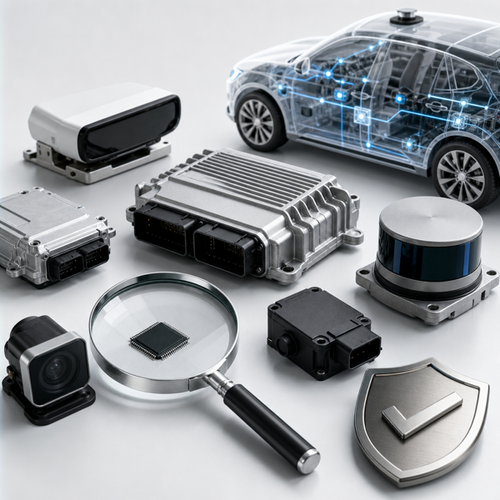
Modern automotive technology has progressed rapidly, with car informatics and on-board computer systems at the heart of innovations from advanced driver assistance systems (ADAS) to fully automated vehicles. As these solutions become more complex, standardized interfaces between vehicle sensors and data fusion units have become a must-have for businesses integrating new technologies. Each standard in the ISO 23150 series addresses a critical link in how road vehicles perceive and interpret their environment, providing the consistency, scalability, and cybersecurity essential to stay competitive, productive, and resilient in an ever-evolving automotive landscape. In this article, we examine four cornerstone ISO standards governing the logical interfaces for automated driving functions: ISO 23150-11:2026 (radar interfaces), ISO 23150-14:2026 (ultrasonic interfaces), ISO 23150-20:2026 (supportive and sensor input interfaces), and ISO 23150-2:2026 (object level interfaces).
Overview / Introduction
Automotive informatics—specifically the digital nerve center of modern cars—involves complex networks connecting sensors, processing units, actuators, and human-machine interfaces. On-board computer systems for automated driving rely on seamless, robust data exchange between components. This is especially pressing in the era of connected vehicles, where interoperability, safety, and upgradability distinguish market leaders.
Standardization in on-board data exchange is no longer optional. Uniform logical interfaces ensure radar, ultrasonic, and other environmental sensors can quickly and reliably transmit information to data fusion units, where the vehicle’s perception of the world is created and acted upon by driving algorithms. Adopting these ISO specifications accelerates integration, supports high productivity, hardens cybersecurity, and empowers automotive teams to scale and evolve their systems safely and efficiently.
In this guide, you’ll learn:
- The scope and practical requirements of each featured standard
- How these standards contribute directly to security, productivity, and system scaling
- Why compliance is essential for automotive innovators and businesses
- Best practices and steps for implementation
Let’s dive into the fundamentals of each ISO standard shaping the connected cars of tomorrow.
Detailed Standards Coverage
ISO 23150-11:2026 - Radar Sensor Interface for Automated Driving
Road vehicles — Logical interface between sensors and data fusion unit for automated driving functions — Part 11: Radar specific interfaces
What it covers
ISO 23150-11:2026 establishes the logical (software/data) interface requirements for radar sensors or radar sensor clusters installed in road vehicles equipped with automated driving features. Rather than specifying hardware (electrical, mechanical) or raw data protocols, it prescribes how radar sensor outputs, processed at various abstraction levels, are to be formatted and communicated to the vehicle’s data fusion unit.
Three interface levels are defined:
- Feature Level Interface (FLI): Relational or aggregate features detected by radar (not specified for radar in this edition)
- Advanced Detection Level Interface (ADLI): High-confidence detection lists (not defined for radar in this edition)
- Detection Level Interface (DLI): Lists of individual radar detections and their attributes
The emphasis is on the Detection Level, allowing for precise, timely recognition of road elements like vehicles, obstacles, and other objects critical for safe driving automation.
Who needs to comply?
- Automotive OEMs and Tier 1 suppliers integrating radar sensors for ADAS or autonomous vehicles
- Radar sensor manufacturers
- Automotive software developers working on sensor-to-fusion-unit interfaces
Key implications and features:
- Dynamic data structures for flexible reporting of detections
- Uniform interface headers for versioning, cycling, and sensor reference
- Mandatory support for ambiguity signals (e.g., to communicate uncertainty in detection, such as velocity ambiguity)
- Clear differentiation between technology-dependent and generic interface elements
- Reference to generic signals and profiles defined in ISO 23150-1 for consistency across all sensor types
Adopting ISO 23150-11 ensures compatible, robust integration of advanced radar capabilities into futureproof automated driving systems.
Key highlights:
- Logical interface for radar sensors in vehicles
- Focus on detection level data critical for real-time driving decisions
- Supports flexible, future-ready architecture for sensor fusion
Access the full standard:View ISO 23150-11:2026 on iTeh Standards
ISO 23150-14:2026 - Ultrasonic Sensor Interface for Automated Driving
Road vehicles — Logical interface between sensors and data fusion unit for automated driving functions — Part 14: Ultrasonic specific interfaces
What it covers
ISO 23150-14:2026 provides logical interface requirements for ultrasonic sensors and sensor clusters, integral in applications such as parking assist and near-field obstacle detection in automated vehicles. It defines structured formats and communication rules for:
- Feature Level Interface (UFI): Exchanging high-level detected features, such as the contour or type of nearby objects
- Advanced Detection Level Interface (ADLI): Detailed detection data (as applicable)
- Detection Level Interface (UDI): Individual ultrasonic sensor measurements relevant for immediate control logic
Interfaces specify not just what data is sent, but required headers with versioning, sensor status, cycle counters, and confidence/probability values for critical detections. Importantly, this standard also lays groundwork for sensor clusters—multiple ultrasonic sensors working in concert.
Who needs to comply?
- Car manufacturers building or upgrading park assist, collision avoidance, or autonomous valet features
- Ultrasonic sensor OEMs and integrators
- Developers of on-board computer systems processing near-field sensor inputs
Key implications and features:
- Rich semantic signals supporting various levels of data abstraction (feature, detection)
- Profiles for vehicle coordinate systems, sensor pose, calibration, and cluster integration
- Probabilistic status and measurement error fields for robust decision-making
- Aggregation and classification schemas to maximize the utility of sensor clusters
- Error handling and interface version control that ensure long-term compatibility and security
Implementing ISO 23150-14 ensures full exploitation of ultrasonic sensing capabilities, making in-car automated maneuvers safer and more reliable.
Key highlights:
- Logical integration for ultrasonic sensors in on-board computer systems
- Supports both individual and clustered sensor architectures
- Ensures trustworthy sensor information for near-field vehicle automation
Access the full standard:View ISO 23150-14:2026 on iTeh Standards
ISO 23150-20:2026 - Supportive and Sensor Input Interfaces for Automated Driving
Road vehicles — Logical interface between sensors and data fusion unit for automated driving functions — Part 20: Supportive and sensor input interfaces
What it covers
ISO 23150-20:2026 fills a vital gap in car informatics—how supportive functions, health data, calibration information, and input commands/interfaces are organized and exchanged between sensors, clusters, and data fusion units. This promotes lasting interoperability and streamlined diagnostics for automated vehicles.
The standard covers distinct logical interfaces:
- Sensor Performance Interface (SPI): Shares environmental impairments (rain, fog), sensor field of view, performance metrics, and recognized object types
- Sensor Health Information Interface (SHII): Diagnostic and fault information, status of cleaning or maintenance requirements, and sensor operational integrity
- Sensor Calibration Interface (SCI): Calibration parameters, including both position in the vehicle and software calibration status
- Common Sensor Input Interface (CSII): Uniform method for sending commands and parameter settings (for example, switching operational modes, applying recalibration)
Who needs to comply?
- Automotive engineering teams responsible for system-level integration
- Diagnostic tool providers
- Sensor manufacturers requiring compatibility with next-generation fusion units
- Developers of ECUs and middleware for command and configuration interfaces
Key implications and features:
- Consistent performance and health management across sensor types
- Complete abstraction from hardware, supporting software-defined vehicle architectures
- Enables scalable system topologies—supporting expansion and new feature adoption
- Definable interface profiles for system design flexibility (multiple ECUs, sensor clusters, etc.)
- Easier compliance with automotive cybersecurity and functional safety requirements
ISO 23150-20 is foundational for enabling predictive maintenance, streamlined troubleshooting, and remote over-the-air (OTA) updates in modern vehicles.
Key highlights:
- Comprehensive coverage of health, performance, and input interfaces
- Supports multi-sensor and multi-ECU environments
- Essential for diagnostics, maintenance, and secure, scalable architecture design
Access the full standard:View ISO 23150-20:2026 on iTeh Standards
ISO 23150-2:2026 - Object Level Sensor Interface for Automated Driving
Road vehicles — Logical interface between sensors and data fusion unit for automated driving functions — Part 2: Object level interfaces
What it covers
While individual sensor detections are critical, real-world decisions require understanding higher-level objects (vehicles, pedestrians, obstacles, and free spaces). ISO 23150-2:2026 formalizes object-level interfaces—how composite data is normalized and reported by sensors or clusters to fusion units.
Components of the object level interface:
- Potentially Moving Object Interface (PMOI): For dynamic entities like other vehicles or humans
- Road Object Interface (RDOI): Road infrastructure elements (lanes, markings, signage)
- Static Object Interface (SOI): Immobile objects or structures
- Free-Space Object Interface (FSOI): Identifies drivable or non-drivable areas
Each object type is described by a structured list with metadata, positional information, confidence levels, motion and classification states, and temporal tracking.
Who needs to comply?
- Suppliers designing perception software for ADAS and automated vehicles
- OEMs seeking reliable, modular data fusion from multi-sensor sources
- Developers building scene interpretation or environment modeling algorithms
Key implications and features:
- Support for a wide variety of object types, both dynamic and static
- Consistent headers and structures for time-stamped, versioned object reports
- Mandatory probability/confidence attributes for each object type
- Advanced error handling and redundancy features
- Preparedness for extending to new object classes as technology evolves
ISO 23150-2 provides the backbone for multi-sensor fusion and robust perception algorithms powering automated driving functions.
Key highlights:
- Specifies object-level data exchange for all major scene elements
- Enables accurate, modular perception across diverse vehicle systems
- Lays groundwork for future ADAS and fully automated mobility
Access the full standard:View ISO 23150-2:2026 on iTeh Standards
Industry Impact & Compliance
The Value Proposition of Standardized Car Informatics
The ISO 23150 series, including the four parts covered above, enables safe, scalable, and innovative automated vehicles by establishing:
- Interoperability: With a uniform logical interface for sensor data, systems from diverse suppliers, technology generations, and architectures can interact reliably.
- Cybersecurity and Safety: Standardized interfaces reduce the risk of vulnerabilities arising from ad hoc integration and support thorough validation and monitoring.
- Scalability: Modular, version-controlled schemas mean adding new sensors, upgrading hardware, or increasing system complexity is simplified, minimizing integration overhead.
- Productivity: Developers can focus on value-added functionality rather than compatibility issues, and system integrators avoid costly custom interface work.
- Regulatory Alignment: Increasingly, regulators demand traceability and robustness in ADAS systems. ISO compliance meets expectations for safety and transparency.
Risks of Non-Compliance:
- Higher integration/maintenance costs
- Difficulty in achieving required levels of functional safety (ISO 26262) and cybersecurity
- Slower time-to-market and potential regulatory hurdles
- Reduced vehicle resale value and interoperability
Implementation Guidance
Common Approaches
- Early Integration Simulation: Employ simulation environments with ISO-standardized sensor interfaces as mockups, enabling developers to test fusion logic and interface robustness.
- Modular Software Design: Architect control units in a way that decouples the sensor-specific data processing from core fusion and actuation logic by means of compliance with ISO 23150 logical interfaces.
- Vendor Certification: Work with suppliers and partners who can guarantee interface compliance and provide certification.
- Incremental Adoption: Adopt standards in a phased manner—start with new ECU or sensor designs, retrofit into legacy systems where possible.
Best Practices
- Documentation and Training: Train engineering and integration teams on ISO standards terminology and data modeling techniques (such as logical signal groups, entity representation, and interface profiles).
- Version Control: Rigorously track interface versions and dependencies—a key benefit of the standardized headers and profile management in these standards.
- Security Reviews: Periodically audit interface implementations for vulnerabilities that might arise from incorrect or incomplete compliance—leverage built-in redundancy and health reporting for early indication of abnormal behavior.
- Collaboration: Participate in automotive industry consortia and working groups to stay ahead of future updates and to shape emerging standards.
Resources for Organizations
- iTeh Standards Platform: Provides the latest, authoritative versions of each ISO and other major automotive standard, with tools for procurement, compliance tracking, and project documentation (standards.iteh.ai).
- ISO and SAE Memberships: Join relevant industry groups and standardization bodies to access depth resources, training, and peer networking.
Conclusion / Next Steps
As the automotive industry pivots rapidly toward smart mobility, connected vehicles, and safe automated driving, the adoption of proven, comprehensive standards like those in the ISO 23150 series is a cornerstone for success. Businesses leveraging these standards not only accelerate their development cycle but also gain on productivity, cybersecurity, safety, and future scalability—traits demanded by both regulators and the marketplace.
Key takeaways:
- The ISO 23150-11, -14, -20, and -2 standards establish logical, modular, and secure interfaces essential for automated vehicle perception and interpretation.
- Compliance simplifies integration of new sensor types, supports diagnostics, maintenance, and system scaling.
- Accessing and embedding these standards within organizational processes ensures readiness for the next wave of automotive innovation.
Recommendation: For automotive manufacturers, suppliers, and system integrators—begin by accessing the current ISO standards referenced above, review your on-board informatics architecture, and develop a phased plan to achieve full compliance. Enhance your market competitiveness, reduce risk, and position your business at the leading edge of intelligent vehicle technology.
Stay informed and access all car informatics standards at iTeh Standards. Ensure your business is ready for the future of automated mobility.
Categories
- Latest News
- New Arrivals
- Generalities
- Services and Management
- Natural Sciences
- Health Care
- Environment
- Metrology and Measurement
- Testing
- Mechanical Systems
- Fluid Systems
- Manufacturing
- Energy and Heat
- Electrical Engineering
- Electronics
- Telecommunications
- Information Technology
- Image Technology
- Precision Mechanics
- Road Vehicles
- Railway Engineering
- Shipbuilding
- Aircraft and Space
- Materials Handling
- Packaging
- Textile and Leather
- Clothing
- Agriculture
- Food technology
- Chemical Technology
- Mining and Minerals
- Petroleum
- Metallurgy
- Wood technology
- Glass and Ceramics
- Rubber and Plastics
- Paper Technology
- Paint Industries
- Construction
- Civil Engineering
- Military Engineering
- Entertainment