

ASTM E2334-09(2023)
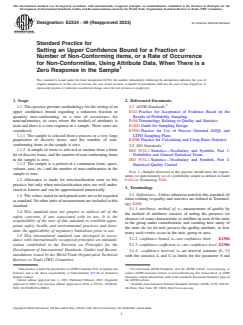
(Practice)Standard Practice for Setting an Upper Confidence Bound for a Fraction or Number of Non-Conforming items, or a Rate of Occurrence for Non-Conformities, Using Attribute Data, When There is a Zero Response in the Sample
General Information
- Abstract
ABSTRACT
This practice presents methodology for the setting of an upper confidence bound regarding an unknown fraction or quantity non-conforming, or a rate of occurrence for nonconformities, in cases where the method of attributes is used and there is a zero response in a sample. Three cases are considered. In Case 1, the sample is selected from a process or a very large population of interest. In Case 2, a sample of n items is selected at random from a finite lot of N items. In Case 3, there is a process, but the output is a continuum, such as area (for example, a roll of paper or other material, a field of crop), volume (for example, a volume of liquid or gas), or time (for example, hours, days, quarterly, etc.) The sample size is defined as that portion of the �continuum� sampled, and the defined attribute may occur any number of times over the sampled portion.
SIGNIFICANCE AND USE
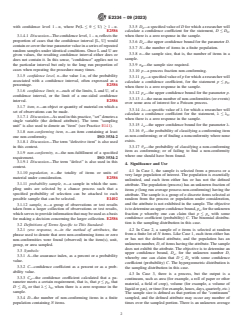
4.1 In Case 1, the sample is selected from a process or a very large population of interest. The population is essentially unlimited, and each item either has or has not the defined attribute. The population (process) has an unknown fraction of items p (long run average process non-conforming) having the attribute. The sample is a group of n discrete items selected at random from the process or population under consideration, and the attribute is not exhibited in the sample. The objective is to determine an upper confidence bound, pu, for the unknown fraction p whereby one can claim that p ≤ pu with some confidence coefficient (probability) C. The binomial distribution is the sampling distribution in this case.
4.2 In Case 2, a sample of n items is selected at random from a finite lot of N items. Like Case 1, each item either has or has not the defined attribute, and the population has an unknown number, D, of items having the attribute. The sample does not exhibit the attribute. The objective is to determine an upper confidence bound, Du, for the unknown number D, whereby one can claim that D ≤ Du with some confidence coefficient (probability) C. The hypergeometric distribution is the sampling distribution in this case.
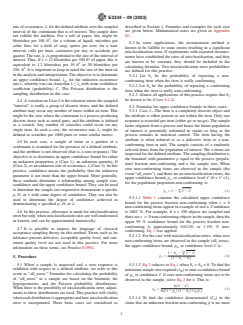
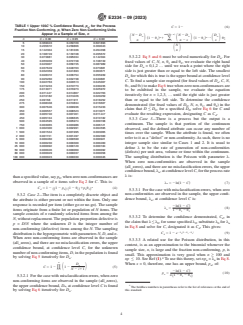
4.3 In Case 3, there is a process, but the output is a continuum, such as area (for example, a roll of paper or other material, a field of crop), volume (for example, a volume of liquid or gas), or time (for example, hours, days, quarterly, etc.) The sample size is defined as that portion of the “continuum” sampled, and the defined attribute may occur any number of times over the sampled portion. There is an unknown average rate of occurrence, λ, for the defined attribute over the sampled interval of the continuum that is of interest. The sample does not exhibit the attribute. For a roll of paper, this might be blemishes per 100 ft2; for a volume of liquid, microbes per cubic litre; for a field of crop, spores per acre; for a time interval, ca...
SCOPE
1.1 This practice presents methodology for the setting of an upper confidence bound regarding a unknown fraction or quantity non-conforming, or a rate of occurrence for nonconformities, in cases where the method of attributes is used and there is a zero response in a sample. Three cases are considered.
1.1.1 The sample is selected from a process or a very large population of discrete items, and the number of non-conforming items in the sample is zero.
1.1.2 A sample of items is selected at random from a finite lot of discrete items, and the number of non-conforming items in the sample is zero.
1.1.3 The sample is a portion of a continuum (time, space, volume, area, etc.) and the number of non-conformities in the sample is zero.
1.2 Allowance is made for misclassification error in this practice, but only when misclassification rates are well understood or known and can be approximated numerically.
1.3 The values stated in inch-pound units are to be regarded as standard. No other units of measurement are included in this standard.
1.4 This ...
- Status
- Published
- Publication Date
- 31-Dec-2022
- Technical Committee
- E11 - Quality and Statistics
- Drafting Committee
- E11.30 - Statistical Quality Control
Overview
ASTM E2334-09(2023) is the internationally recognized standard practice for setting an upper confidence bound for the fraction, number, or rate of non-conforming items or non-conformities, when attribute data yields zero observed non-conformances in a sample. Developed by ASTM Committee E11 on Quality and Statistics, this standard provides robust methodology for quantifying defects or non-conformities in processes or populations, especially when no issues are found during inspection. It addresses critical quality assurance needs across manufacturing, process control, and auditing by supporting risk-informed decision-making in cases of apparent defect-free samples.
Key Topics
- Zero Response Sampling: Provides statistical methods for cases in which inspection or sampling yields no non-conforming items or observed non-conformities.
- Three Sampling Scenarios:
- Infinite population/process: Sampling from an essentially unlimited process or very large population, such as ongoing production runs.
- Finite lot sampling: Random samples from a known total (finite lot), common in batch inspections.
- Continuous output: Evaluates a continuum output (such as area, volume, or time), for example, miles of cable or square meters of sheet material.
- Confidence Bounds Calculation: Establishes procedures to set upper confidence bounds for unknown non-conforming proportions (p), counts (D), or rates (λ), using appropriate statistical distributions (binomial, hypergeometric, Poisson).
- Allowance for Misclassification Error: The standard accommodates known misclassification rates in interpretation, provided these rates are reliably established.
- Sample Size Determination: Offers guidance on calculating required sample sizes to demonstrate specified quality levels with defined confidence.
- Terminology: Standardizes key terms related to quality, defects, non-conformities, and confidence limits, enhancing clarity in quality assurance communications.
Applications
- Manufacturing Quality Control: Enables producers to demonstrate compliance with quality requirements when zero defects are detected during sampling or inspection.
- Supplier and Batch Acceptance: Supports acceptance decisions for lots or shipments based on defect-free sample inspections, with quantifiable statistical assurance.
- Regulatory Compliance: Provides recognized methods for demonstrating conformance to quality regulations or customer standards when no non-conformities are found.
- Process Auditing and Surveillance: Useful in ongoing process monitoring, allowing organizations to quantify the upper limit of potential non-conformities when regular surveillance yields “all clear” results.
- Continuous Process Monitoring: Ideal for industries dealing with roll goods, fluids, crops, or processes measured over area, volume, or time, where zero events are observed in the sample.
- Risk Assessment: Supports risk-based decision-making by quantifying the maximum likely rate or count of non-conforming items even when none are directly observed.
Related Standards
For comprehensive application of ASTM E2334-09(2023) and best practices in quality measurement and statistical sampling, consider the following related documents:
- ASTM E141 – Practice for Acceptance of Evidence Based on Probability Sampling Results
- ASTM E456 – Terminology Relating to Quality and Statistics
- ASTM E1402 – Guide for Sampling Design
- ASTM E1994 – Practice for Use of AOQL and LTPD Sampling Plans
- ASTM E2586 – Practice for Calculating and Using Basic Statistics
- ISO 3534-1 & ISO 3534-2 – Statistics – Vocabulary and Symbols, especially in the context of statistical quality control
Conclusion
ASTM E2334-09(2023) is an essential tool for any organization seeking to present statistically defendable confidence in product conformity, particularly under circumstances where no defective or non-conforming items are observed. By providing standardized methods to set upper confidence bounds using attribute data and zero event samples, the standard empowers manufacturers, auditors, and quality professionals to communicate clear, quantitative assurances of product and process quality. This supports trust, compliance, and effective risk management across global supply chains and regulated industries.
Keywords: ASTM E2334-09(2023), zero response sampling, quality assurance, upper confidence bound, non-conforming items, process monitoring, attribute data, defect-free sampling.
Relations
- Effective Date
- 01-Nov-2023
- Effective Date
- 01-Nov-2023
- Effective Date
- 01-Apr-2022
- Effective Date
- 01-Apr-2019
- Effective Date
- 01-Nov-2018
- Effective Date
- 01-Apr-2018
- Effective Date
- 01-Oct-2017
- Effective Date
- 01-Oct-2017
- Effective Date
- 01-Jun-2014
- Effective Date
- 15-Nov-2013
- Effective Date
- 15-Nov-2013
- Effective Date
- 15-Nov-2013
- Effective Date
- 15-Nov-2013
- Effective Date
- 01-Oct-2013
- Effective Date
- 15-Aug-2013
Get Certified
Connect with accredited certification bodies for this standard

BSI Group
BSI (British Standards Institution) is the business standards company that helps organizations make excellence a habit.

Bureau Veritas
Bureau Veritas is a world leader in laboratory testing, inspection and certification services.

DNV
DNV is an independent assurance and risk management provider.
Sponsored listings
Frequently Asked Questions
ASTM E2334-09(2023) is a standard published by ASTM International. Its full title is "Standard Practice for Setting an Upper Confidence Bound for a Fraction or Number of Non-Conforming items, or a Rate of Occurrence for Non-Conformities, Using Attribute Data, When There is a Zero Response in the Sample". This standard covers: ABSTRACT This practice presents methodology for the setting of an upper confidence bound regarding an unknown fraction or quantity non-conforming, or a rate of occurrence for nonconformities, in cases where the method of attributes is used and there is a zero response in a sample. Three cases are considered. In Case 1, the sample is selected from a process or a very large population of interest. In Case 2, a sample of n items is selected at random from a finite lot of N items. In Case 3, there is a process, but the output is a continuum, such as area (for example, a roll of paper or other material, a field of crop), volume (for example, a volume of liquid or gas), or time (for example, hours, days, quarterly, etc.) The sample size is defined as that portion of the �continuum� sampled, and the defined attribute may occur any number of times over the sampled portion. SIGNIFICANCE AND USE 4.1 In Case 1, the sample is selected from a process or a very large population of interest. The population is essentially unlimited, and each item either has or has not the defined attribute. The population (process) has an unknown fraction of items p (long run average process non-conforming) having the attribute. The sample is a group of n discrete items selected at random from the process or population under consideration, and the attribute is not exhibited in the sample. The objective is to determine an upper confidence bound, pu, for the unknown fraction p whereby one can claim that p ≤ pu with some confidence coefficient (probability) C. The binomial distribution is the sampling distribution in this case. 4.2 In Case 2, a sample of n items is selected at random from a finite lot of N items. Like Case 1, each item either has or has not the defined attribute, and the population has an unknown number, D, of items having the attribute. The sample does not exhibit the attribute. The objective is to determine an upper confidence bound, Du, for the unknown number D, whereby one can claim that D ≤ Du with some confidence coefficient (probability) C. The hypergeometric distribution is the sampling distribution in this case. 4.3 In Case 3, there is a process, but the output is a continuum, such as area (for example, a roll of paper or other material, a field of crop), volume (for example, a volume of liquid or gas), or time (for example, hours, days, quarterly, etc.) The sample size is defined as that portion of the “continuum” sampled, and the defined attribute may occur any number of times over the sampled portion. There is an unknown average rate of occurrence, λ, for the defined attribute over the sampled interval of the continuum that is of interest. The sample does not exhibit the attribute. For a roll of paper, this might be blemishes per 100 ft2; for a volume of liquid, microbes per cubic litre; for a field of crop, spores per acre; for a time interval, ca... SCOPE 1.1 This practice presents methodology for the setting of an upper confidence bound regarding a unknown fraction or quantity non-conforming, or a rate of occurrence for nonconformities, in cases where the method of attributes is used and there is a zero response in a sample. Three cases are considered. 1.1.1 The sample is selected from a process or a very large population of discrete items, and the number of non-conforming items in the sample is zero. 1.1.2 A sample of items is selected at random from a finite lot of discrete items, and the number of non-conforming items in the sample is zero. 1.1.3 The sample is a portion of a continuum (time, space, volume, area, etc.) and the number of non-conformities in the sample is zero. 1.2 Allowance is made for misclassification error in this practice, but only when misclassification rates are well understood or known and can be approximated numerically. 1.3 The values stated in inch-pound units are to be regarded as standard. No other units of measurement are included in this standard. 1.4 This ...
ABSTRACT This practice presents methodology for the setting of an upper confidence bound regarding an unknown fraction or quantity non-conforming, or a rate of occurrence for nonconformities, in cases where the method of attributes is used and there is a zero response in a sample. Three cases are considered. In Case 1, the sample is selected from a process or a very large population of interest. In Case 2, a sample of n items is selected at random from a finite lot of N items. In Case 3, there is a process, but the output is a continuum, such as area (for example, a roll of paper or other material, a field of crop), volume (for example, a volume of liquid or gas), or time (for example, hours, days, quarterly, etc.) The sample size is defined as that portion of the �continuum� sampled, and the defined attribute may occur any number of times over the sampled portion. SIGNIFICANCE AND USE 4.1 In Case 1, the sample is selected from a process or a very large population of interest. The population is essentially unlimited, and each item either has or has not the defined attribute. The population (process) has an unknown fraction of items p (long run average process non-conforming) having the attribute. The sample is a group of n discrete items selected at random from the process or population under consideration, and the attribute is not exhibited in the sample. The objective is to determine an upper confidence bound, pu, for the unknown fraction p whereby one can claim that p ≤ pu with some confidence coefficient (probability) C. The binomial distribution is the sampling distribution in this case. 4.2 In Case 2, a sample of n items is selected at random from a finite lot of N items. Like Case 1, each item either has or has not the defined attribute, and the population has an unknown number, D, of items having the attribute. The sample does not exhibit the attribute. The objective is to determine an upper confidence bound, Du, for the unknown number D, whereby one can claim that D ≤ Du with some confidence coefficient (probability) C. The hypergeometric distribution is the sampling distribution in this case. 4.3 In Case 3, there is a process, but the output is a continuum, such as area (for example, a roll of paper or other material, a field of crop), volume (for example, a volume of liquid or gas), or time (for example, hours, days, quarterly, etc.) The sample size is defined as that portion of the “continuum” sampled, and the defined attribute may occur any number of times over the sampled portion. There is an unknown average rate of occurrence, λ, for the defined attribute over the sampled interval of the continuum that is of interest. The sample does not exhibit the attribute. For a roll of paper, this might be blemishes per 100 ft2; for a volume of liquid, microbes per cubic litre; for a field of crop, spores per acre; for a time interval, ca... SCOPE 1.1 This practice presents methodology for the setting of an upper confidence bound regarding a unknown fraction or quantity non-conforming, or a rate of occurrence for nonconformities, in cases where the method of attributes is used and there is a zero response in a sample. Three cases are considered. 1.1.1 The sample is selected from a process or a very large population of discrete items, and the number of non-conforming items in the sample is zero. 1.1.2 A sample of items is selected at random from a finite lot of discrete items, and the number of non-conforming items in the sample is zero. 1.1.3 The sample is a portion of a continuum (time, space, volume, area, etc.) and the number of non-conformities in the sample is zero. 1.2 Allowance is made for misclassification error in this practice, but only when misclassification rates are well understood or known and can be approximated numerically. 1.3 The values stated in inch-pound units are to be regarded as standard. No other units of measurement are included in this standard. 1.4 This ...
ASTM E2334-09(2023) is classified under the following ICS (International Classification for Standards) categories: 03.120.30 - Application of statistical methods. The ICS classification helps identify the subject area and facilitates finding related standards.
ASTM E2334-09(2023) has the following relationships with other standards: It is inter standard links to ASTM E1402-13(2023), ASTM E141-10(2023), ASTM E456-13a(2022)e1, ASTM E2586-19e1, ASTM E1402-13(2018), ASTM E141-10(2018), ASTM E456-13A(2017)e1, ASTM E456-13A(2017)e3, ASTM E2586-14, ASTM E456-13ae2, ASTM E456-13ae1, ASTM E456-13ae3, ASTM E456-13a, ASTM E2586-13, ASTM E456-13. Understanding these relationships helps ensure you are using the most current and applicable version of the standard.
ASTM E2334-09(2023) is available in PDF format for immediate download after purchase. The document can be added to your cart and obtained through the secure checkout process. Digital delivery ensures instant access to the complete standard document.
Standards Content (Sample)
This international standard was developed in accordance with internationally recognized principles on standardization established in the Decision on Principles for the
Development of International Standards, Guides and Recommendations issued by the World Trade Organization Technical Barriers to Trade (TBT) Committee.
Designation: E2334 − 09 (Reapproved 2023) An American National Standard
Standard Practice for
Setting an Upper Confidence Bound for a Fraction or
Number of Non-Conforming items, or a Rate of Occurrence
for Non-Conformities, Using Attribute Data, When There is a
Zero Response in the Sample
This standard is issued under the fixed designation E2334; the number immediately following the designation indicates the year of
original adoption or, in the case of revision, the year of last revision. A number in parentheses indicates the year of last reapproval. A
superscript epsilon (´) indicates an editorial change since the last revision or reapproval.
1. Scope 2. Referenced Documents
1.1 This practice presents methodology for the setting of an 2.1 ASTM Standards:
upper confidence bound regarding a unknown fraction or E141 Practice for Acceptance of Evidence Based on the
quantity non-conforming, or a rate of occurrence for Results of Probability Sampling
nonconformities, in cases where the method of attributes is E456 Terminology Relating to Quality and Statistics
used and there is a zero response in a sample. Three cases are E1402 Guide for Sampling Design
considered. E1994 Practice for Use of Process Oriented AOQL and
1.1.1 The sample is selected from a process or a very large LTPD Sampling Plans
population of discrete items, and the number of non- E2586 Practice for Calculating and Using Basic Statistics
conforming items in the sample is zero.
2.2 ISO Standards:
1.1.2 A sample of items is selected at random from a finite
ISO 3534-1 Statistics—Vocabulary and Symbols, Part 1:
lot of discrete items, and the number of non-conforming items
Probability and General Statistical Terms
in the sample is zero.
ISO 3534-2 Statistics—Vocabulary and Symbols, Part 2:
1.1.3 The sample is a portion of a continuum (time, space,
Statistical Quality Control
volume, area, etc.) and the number of non-conformities in the
NOTE 1—Samples discussed in this practice should meet the require-
sample is zero.
ments (or approximately so) of a probability sample as defined in Guide
E1402 or Terminology E456.
1.2 Allowance is made for misclassification error in this
practice, but only when misclassification rates are well under-
3. Terminology
stood or known and can be approximated numerically.
3.1 Definitions—Unless otherwise noted in this standard, all
1.3 The values stated in inch-pound units are to be regarded
terms relating to quality and statistics are defined in Terminol-
as standard. No other units of measurement are included in this
ogy E456.
standard.
3.1.1 attributes, method of, n—measurement of quality by
1.4 This standard does not purport to address all of the
the method of attributes consists of noting the presence (or
safety concerns, if any, associated with its use. It is the
absence) of some characteristic or attribute in each of the units
responsibility of the user of this standard to establish appro-
in the group under consideration, and counting how many of
priate safety, health, and environmental practices and deter-
the units do (or do not) possess the quality attribute, or how
mine the applicability of regulatory limitations prior to use.
many such events occur in the unit, group or area.
1.5 This international standard was developed in accor-
3.1.2 confidence bound, n—see confidence limit. E2586
dance with internationally recognized principles on standard-
3.1.3 confidence coeffıcient, n—see confidence level. E2586
ization established in the Decision on Principles for the
Development of International Standards, Guides and Recom-
3.1.4 confidence interval, n—an interval estimate [L, U]
mendations issued by the World Trade Organization Technical
with the statistics L and U as limits for the parameter θ and
Barriers to Trade (TBT) Committee.
1 2
This practice is under the jurisdiction of ASTM Committee E11 on Quality and For referenced ASTM Standards, visit the ASTM website, www.astm.org, or
Statistics and is the direct responsibility of Subcommittee E11.30 on Statistical contact ASTM Customer Service at service@astm.org. For Annual Book of ASTM
Quality Control. Standards volume information, refer to the standard’s Document Summary page on
Current edition approved Jan. 1, 2023. Published February 2023. Originally the ASTM website.
approved in 2003. Last previous edition approved in 2018 as E2334 – 09(2018). Available from American National Standards Institute (ANSI), 25 W. 43rd St.,
DOI: 10.1520/E2334-09R23. 4th Floor, New York, NY 10036, http://www.ansi.org.
Copyright © ASTM International, 100 Barr Harbor Drive, PO Box C700, West Conshohocken, PA 19428-2959. United States
E2334 − 09 (2023)
with confidence level 1 – α, where Pr(L ≤ θ ≤ U) ≥ 1 – α. 3.3.5 D —a specified value of D for which a researcher will
E2586 calculate a confidence coefficient for the statement, D ≤ D ,
3.1.4.1 Discussion—The confidence level, 1 – α, reflects the when there is a zero response in the sample.
proportion of cases that the confidence interval [L, U] would
3.3.6 D —the upper confidence bound for the parameter D.
u
contain or cover the true parameter value in a series of repeated
3.3.7 N—the number of items in a finite population.
random samples under identical conditions. Once L and U are
3.3.8 n—the sample size, that is, the number of items in a
given values, the resulting confidence interval either does or
sample.
does not contain it. In this sense, “confidence” applies not to
the particular interval but only to the long run proportion of 3.3.9 n —the sample size required.
R
cases when repeating the procedure many times.
3.3.10 p—a process fraction non-conforming.
3.1.5 confidence level, n—the value 1-α, of the probability
3.3.11 p —a specified value of p for which a researcher will
associated with a confidence interval, often expressed as a
calculate a confidence coefficient, for the statement p ≤ p ,
percentage. E2586
when there is a zero response in the sample.
3.1.6 confidence limit, n—each of the limits, L and U, of a
3.3.12 p —the upper confidence bound for the parameter p.
u
confidence interval, or the limit of a one-sided confidence
3.3.13 λ—the mean number of non-conformities (or events)
interval. E2586
over some area of interest for a Poisson process.
3.1.7 item, n—an object or quantity of material on which a
3.3.14 λ —a specific value of λ for which a researcher will
set of observations can be made.
calculate a confidence coefficient for the statement, λ ≤ λ ,
3.1.7.1 Discussion—As used in this practice, “set” denotes a
when there is a zero response in the sample.
single variable (the defined attribute). The term “sampling
3.3.15 λ —the upper confidence bound for the parameter λ.
unit” is also used to denote an “item” (see Practice E141). u
3.3.16 θ —the probability of classifying a conforming item
3.1.8 non-conforming item, n—an item containing at least
as non-conforming; or of finding a nonconformity where none
one non-conformity. ISO 3534-2
exists.
3.1.8.1 Discussion—The term “defective item” is also used
in this context. 3.3.17 θ —the probability of classifying a non-conforming
item as conforming; or of failing to find a non-conformity
3.1.9 non-conformity, n—the non-fulfillment of a specified
where one should have been found.
requirement. ISO 3534-2
3.1.9.1 Discussion—The term “defect” is also used in this
4. Significance and Use
context.
4.1 In Case 1, the sample is selected from a process or a
3.1.10 population, n—the totality of items or units of
very large population of interest. The population is essentially
material under consideration. E2586
unlimited, and each item either has or has not the defined
3.1.11 probability sample, n—a sample in which the sam-
attribute. The population (process) has an unknown fraction of
pling units are selected by a chance process such that a
items p (long run average process non-conforming) having the
specified probability of selection can be attached to each
attribute. The sample is a group of n discrete items selected at
possible sample that can be selected. E1402
random from the process or population under consideration,
and the attribute is not exhibited in the sample. The objective
3.1.12 sample, n—a group of observations or test results
is to determine an upper confidence bound, p , for the unknown
taken from a larger collection of observations or test results,
u
fraction p whereby one can claim that p ≤ p with some
which serves to provide information that may be used as a basis u
confidence coefficient (probability) C. The binomial distribu-
for making a decision concerning the larger collection. E2586
tion is the sampling distribution in this case.
3.2 Definitions of Terms Specific to This Standard:
4.2 In Case 2, a sample of n items is selected at random
3.2.1 zero response, n—in the method of attributes, the
from a finite lot of N items. Like Case 1, each item either has
phrase used to denote that zero non-conforming items or zero
or has not the defined attribute, and the population has an
non-conformities were found (observed) in the item(s), unit,
unknown number, D, of items having the attribute. The sample
group, or area sampled.
does not exhibit the attribute. The objective is to determine an
3.3 Symbols:
upper confidence bound, D , for the unknown number D,
u
3.3.1 A—the assurance index, as a percent or a probability
whereby one can claim that D ≤ D with some confidence
u
value.
coefficient (probability) C. The hypergeometric distribution is
3.3.2 C—confidence coefficient as a percent or as a prob-
the sampling distribution in this case.
ability value.
4.3 In Case 3, there is a process, but the output is a
3.3.3 C —the confidence coefficient calculated that a pa-
d
continuum, such as area (for example, a roll of paper or other
rameter meets a certain requirement, that is, that p ≤ p , that
material, a field of crop), volume (for example, a volume of
D ≤ D or that λ ≤ λ , when there is a zero response in the
0 0
liquid or gas), or time (for example, hours, days, quarterly, etc.)
sample.
The sample size is defined as that portion of the “continuum”
3.3.4 D—the number of non-conforming items in a finite sampled, and the defined attribute may occur any number of
population containing N items. times over the sampled portion. There is an unknown average
E2334 − 09 (2023)
rate of occurrence, λ, for the defined attribute over the sampled described in Section 4. Formulas and examples for each case
interval of the continuum that is of interest. The sample does are given below. Mathematical notes are given in Appendix
not exhibit the attribute. For a roll of paper, this might be X1.
blemishes per 100 ft ; for a volume of liquid, microbes per
5.2 In some applications, the measurement method is
cubic litre; for a field of crop, spores per acre; for a time
known to be fallible to some extent resulting in a significant
interval, calls per hour, customers per day or accidents per
misclassification error. If experiments with repeated measure-
quarter. The rate, λ, is proportional to the size of the interval of
ments have established the rates of misclassification, and they
interest. Thus, if λ = 12 blemishes per 100 ft of paper, this is
are known to be constant, they should be included in the
equivalent to 1.2 blemishes per 10 ft or 30 blemishes per
calculating formulas. Two misclassification error probabilities
250 ft . It is important to keep in mind the size of the interval
are defined for this practice:
in the analysis and interpretation. The objective is to determine
5.2.1 Let θ be the probability of reporting a non-
an upper confidence bound, λ , for the unknown occurrence
u
conforming item when the item is really conforming.
rate λ, whereby one can claim that λ ≤ λ with some confidence
u
5.2.2 Let θ be the probability of reporting a conforming
coefficient (probability) C. The Poisson distribution is the
item when the item is really non-conforming.
sampling distribution in this case.
5.2.3 Almost all applications of this practice require that θ
be known to be 0 (see 6.1.2).
4.4 A variation on Case 3 is the situation where the sampled
“interval” is really a group of discrete items, and the defined
5.3 Formulas for upper confidence bounds in three cases:
attribute may occur any number of times within an item. This
5.3.1 Case 1—The item is a completely discrete object and
might be the case where the continuum is a process producing
the attribute is either present or not within the item. Only one
discrete items such as metal parts, and the attribute is defined
response is recorded per item (either go or no-go). The sample
as a scratch. Any number of scratches could occur on any
items originate from a process and hence the future population
single item. In such a case, the occurrence rate, λ, might be of interest is potentially unlimited in extent so long as the
defined as scratches per 1000 parts or some similar metric.
process remains in statistical control. The item having the
attribute is often referred to as a defective item or a non-
4.5 In each case, a sample of items or a portion of a
conforming item or unit. The sample consists of n randomly
continuum is examined for the presence of a defined attribute,
selected items from the population of interest. The n items are
and the attribute is not observed (that is, a zero response). The
inspected for the defined attribute. The sampling distribution is
objective is to determine an upper confidence bound for either
the binomial with parameters p equal to the process (popula-
an unknown proportion, p (Case 1), an unknown quantity, D
tion) fraction non-conforming and n the sample size. When
(Case 2), or an unknown rate of occurrence, λ (Case 3). In this
zero non-conforming items are observed in the sample (the
practice, confidence means the probability that the unknown
event “all_zeros”), and there are no misclassification errors, the
parameter is not more than the upper bound. More generally,
upper confidence bound, p , at confidence level C (0 < C <1),
u
these methods determine a relationship among sample size,
for the population proportion non-conforming is:
confidence and the upper confidence bound. They can be used
n
to determine the sample size required to demonstrate a specific
p 5 1 2 =1 2 C (1)
u
p, D, or λ with some degree of confidence. They can also be
5.3.1.1 Table 1 contains the calculated upper confidence
used to determine the degree of confidence achieved in
bound for the process fraction non-conforming when x = 0
demonstrating a specified p, D, or λ.
non-conforming items appear in a sample of size n. Confidence
4.6 In this practice, allowance is made for misclassification
is 100C %. For example, if n = 250 objects are sampled and
error but only when misclassification rates are well understood
there are x = 0 non-conforming objects in the sample, then the
or known, and can be approximated numerically.
upper 95 % confidence bound for the process fraction non-
conforming is approximately 0.01191 or 1.191 % non-
4.7 It is possible to impose the language of classical
conforming. Eq 1 was applied.
acceptance sampling theory on this method. Terms such as lot
5.3.1.2 For the case with misclassification errors, when zero
tolerance percent defective, acceptable quality level, and con-
non-conforming items are observed in the sample (all_zeros),
sumer quality level are not used in this practice. For more
the upper confidence bound, p , at confidence level C is:
u
information on these terms, see Practice E1994.
n
1 2 θ 2 =1 2 C
p 5 (2)
5. Procedure u
1 2 θ 2 θ
~ !
1 2
5.1 When a sample is inspected and a zero response is
5.3.1.3 Eq 2 reduces to Eq 1 when θ = θ = 0. To find the
1 2
exhibited with respect to a defined attribute, we refer to this
minimum sample size required (n ) to state a confidence bound
R
event as “all_zeros.” Formulas for calculating the probability
of p at confidence C if zero non-conforming items are to be
u
of “all_zeros” in a sample are based on the binomial, the
observed in the sample, solve Eq 2 for n. This is:
hypergeometric and the Poisson probability distributions.
ln 1 2 C
~ !
When there is the possibility of misclassification error, adjust-
n 5 (3)
R
ln~~1 2 p ! ~1 2 θ !1p θ !
u 1 u 2
ments to these distributions are used. This practice will clarify
when each distribution is appropriate and how misclassification 5.3.1.4 To find the confidence demonstrated (C ) in the
d
error is incorporated. Three basic cases are considered as claim that an unknown fraction non-conforming p is no more
E2334 − 09 (2023)
TABLE 1 Upper 100C % Confidence Bound, p , for the Process
u C 5 12 (6)
Fraction Non-Conforming, p, When Zero Non-Conforming Units
min D , n
Appear in a Sample of Size, n ~ !
u
N 2 D N 2 D D
u u u
n n2x x
~1 2 θ ! 1 ~1 2 θ ! θ
S D S D S D
1 ( 1 2
n C = 0.90 C = 0.95 C = 0.99
n n 2 x x
x51
5 0.369043 0.450720 0.601893
N
10 0.205672 0.258866 0.369043
S D
n
15 0.142304 0.181036 0.264358
20 0.108749 0.139108 0.205672
5.3.2.2 Eq 5 and 6 must be solved numerically for D . For
30 0.073881 0.095034 0.142304
u
40 0.055939 0.072158 0.108749
fixed values of C, N, n, θ and θ , we evaluate the right hand
1 2
50 0.045007 0.058155 0.087989
side for D = 0,1,2 … until we reach a point where the right
u
60 0.037649 0.048703 0.073881
70 0.032359 0.041893 0.063671 side is just greater than or equal to the left side. The smallest
80 0.028372 0.036754 0.055939
D for which this is true is the upper bound at confidence level
u
90 0.025260 0.032738 0.049881
C. To find a sample size required (for fixed values of D , C, N,
u
100 0.022763 0.029513 0.045007
θ , and θ ) to make Eq 6 true when zero non-conformances are
150 0.015233 0.019773 0.030235
1 2
175 0.013071 0.016973 0.025972
to be exhibited in the sample, we evaluate the equation
200 0.011447 0.014867 0.022763
iteratively for n = 1,2,3, … until the right side is just greater
225 0.010182 0.013226 0.020259
250 0.09168 0.011911 0.018252 than or equal to the left side. To determine the confidence
275 0.008338 0.010834 0.016607
demonstrated (for fixed values of D , N, n, θ , and θ ) in the
0 1 2
300 0.007646 0.009936 0.015233
claim that D ≤ D , for a specified D , solve Eq 6 for C and
350 0.006557 0.008523 0.013071 0 0
400 0.005740 0.007461 0.011447 evaluate the resulting expression, designating C as C .
d
450 0.005104 0.006635 0.010182
5.3.3 Case 3—There is a process but the output is a
500 0.004595 0.005974 0.009168
continuum. The sample is that portion of the continuum
750 0.003065 0.003986 0.006121
1 000 0.002300 0.002991 0.004595
observed, and the defined attribute can occur any number of
1 500 0.001534 0.001995 0.003065
times over the sample. When the attribute is found, we often
2 000 0.001151 0.001497 0.002300
refer to it as a “defect” or non-conformity. As such, there is no
5 000 0.000460 0.000599 0.000921
10 000 0.000230 0.000300 0.000460 integer sample size similar to Cases 1 and 2. It is usual to
25 000 0.000092 0.000120 0.000184
define λ to be the rate of generation of non-conformities
50 000 0.000046 0.000060 0.000092
(defects) per unit area, volume or time within the continuum.
80 000 0.000029 0.000037 0.000058
100 000 0.000023 0.000030 0.000046 The sampling distribution is the Poisson with parameter λ.
When zero non-conformities are observed in the sample
(all_zeros), and there are no misclassification errors, the upper
confidence bound, λ , at confidence level C, for the process rate
u
λ is:
than a specified value, say p , when zero non-conformances are
observed in a sample of n items solve Eq 2 for C. This is:
λ 5 2ln~1 2 C! (7)
u
n
C 5 1 2 1 2 p 1 2 θ 1p θ (4)
~~ ! ~ ! !
d 0 1 0 2
5.3.3.1 For the case with misclassification errors, when zero
non-conformities are observed in the sample, the upper confi-
5.3.2 Case 2—The item is a completely discrete object and
dence bound, λ , at confidence level C is:
the attribute is either present or not within the item. Only one u
response is recorded per item (either go or no-go). The sample
2ln~1 2 C!
λ 5 (8)
u
items originate from a finite lot or population of N items. The
1 2 θ 2 θ
1 2
sample consists of n randomly selected items from among the
5.3.3.2 To determine the confidence demonstrated, C , in
d
N, without replacement. The population proportion defective is
the claim that λ ≤ λ , for some specified λ , substitute λ for λ
0 0 0 u
p = D/N where the unknown D is the integer number of
in Eq 8 and solve for C, designated it as C . This gives:
d
non-conforming (defective) items among the N. The sampling
2λ 12θ 2θ
~ !
0 1 2
C 5 1 2 e (9)
distribution is the hypergeometric with parameters N, D, and n.
d
When zero non-conforming items are observed in the sample
5.3.3.3 A related use for the Poisson distribution, in this
(all_zeros), and there are no misclassification errors, the upper
context, is as an approximation to the binomial whenever the
confidence bound, at confidence level C, for the unknown
sample size, n, is large and the fraction non-conforming, p, is
number of non-conforming items, D, in the population is found
small. This approximation is very good when n ≥ 100 and
by solving Eq 5 iteratively for D .
u
np ≤ 10. See Ref (1). To use this theory, set np = λ in Eq 8.
u u
n
D
When x = 0, therefore, one has an upper bound, p , of:
u
u
C 5 1 2 1 2 (5)
S D
)
N 2 i11
i51
2ln 1 2 C
~ !
p 5 (10)
u
n~1 2 θ 2 θ !
5.3.2.1 For the case with misclassification errors, when zero
1 2
non-conforming items are observed in the sample (all_zeros),
the upper confidence bound, D , at confidence level C is found 4
u
The boldface numbers in parentheses refer to the list of references at the end of
by solving Eq 6 iteratively for D . this standard.
u
E2334 − 09 (2023)
5.3.3.4 In each of the equations of Section 5, we may set θ θ were really as high as 0.1, the probability that zero
1 1
or θ , or both, equal to zero if that misclassification error non-conforming items would result in a sample of 400 items
parameter is negligible. We shall see in Section 7 that we often can be shown to be approximately 5E-19, or essentially 0.
set θ = 0, particularly for large sample sizes. Again, using C = 0.9 and p = 0 to begin with, even when
n = 50, the probability of zero non-conforming items when
6. Illustrations and Examples
θ = 0.1 is approximately 0.005, a rare event. Because of
6.1 Case 1 Examples and Illustrations:
these problems and the rather drastic effect that θ has on the
6.1.1 An injection-molding machine produces plastic com- case of a sample containing all conforming items, it is
ponents for the automotive industry. The machine may some-
recommended that θ be known equal to 0 in this practice.
times produce an incomplete part referred to in the trade as a 6.1.3 Consider the effect of misclassifying a non-
“short shot.” On a daily basis an inspector will look at a sample
conforming item as a conforming one. Again, suppose for the
of n = 400 parts from this process for the presence of the “short example in 6.1.1 that θ = 0 and θ = 0.1. Using Eq 2 we find
1 2
shot.” When zero non-conformances are exhibited in the
that: p = 0.00638. Here p increases by a modest amount from
u u
sample, the day’s production is accepted. Determine the 90 % 0.00574, without misclassification error. Now a sample size of
upper confidence bound for the process fraction non- n = 360, but with no misclassification error, would also achieve
conforming for this sampling scheme. Assume misclassifica-
approximately p = 0.00638. Thus, the elimination of misclas-
u
tion errors are negligible. Using Eq 1 we have: sification error, in this example, would effectively reduce the
400 sample size by 40 observations.
p 5 1 2 5 0.00574 (11)
u
=120.9
6.2 Case 2 Examples and Illustrations:
6.1.1.1 A sample design question is whether n = 400 is
6.2.1 A lot of N = 5000 items was just received and a sample
adequate. Suppose the consumer desires that there be 90 %
of n = 200 indicated zero defective items. At 90 % confidence
confidence in the claim that p = p = 0.004. What sample size
0 what is the upper bound, D , for the number of non-conforming
u
will provide this protection? Using Eq 3 with misclassification
items, D, in the lot? Use Eq
...