

ASTM B197/B197M-20e1
(Specification)Standard Specification for Copper-Beryllium Alloy Wire
General Information
- Abstract
ABSTRACT
This specification establishes the requirements for copper-beryllium alloy (Copper Alloy UNS Nos. C17200 and C173002) wires in coils, spools, or other forms except straight lengths, of any uniform cross section. Products shall be available in the following tempers: solution heat-treated TB00, and cold-worked TD00 to TD04, which shall be precipitation heat treated after forming. Products that are already precipitation heat treated by the manufacturer shall be available in tempers TF00 (AT), and TH01 to TH04. Products shall be sampled and prepared, then tested accordingly to examine their conformance to dimensional (diameter, thickness, length, width, and straightness), mechanical (tensile and bend strength, Rockwell hardness, and elongation), physical (grain size and count), and chemical composition requirements.
SCOPE
1.1 This specification establishes the requirements for copper-beryllium alloy wire in coils, spools, or other than straight lengths, of any uniform cross section. Copper Alloy UNS Nos. C17200 and C173002 are included.
1.2 Unless otherwise required, Copper Alloy UNS No. C17200 shall be the alloy furnished whenever Specification B197/B197M is specified without any alloy designation.
1.3 The values stated in either inch-pounds units or SI units are to be regarded separately as standard. Within the text, the SI units are shown in brackets. The values stated in each system are not necessarily exact equivalents; therefore, to ensure conformance with the standard, each system shall be used independently of the other, and values from the two systems shall not be combined.
1.4 The following safety hazard caveat pertains only to the test methods described in this specification:
1.4.1 This standard does not purport to address all of the safety concerns, if any, associated with its use. It is the responsibility of the user of this standard to establish appropriate safety, health, and environmental practices and determine the applicability of regulatory limitations prior to use.
1.5 This international standard was developed in accordance with internationally recognized principles on standardization established in the Decision on Principles for the Development of International Standards, Guides and Recommendations issued by the World Trade Organization Technical Barriers to Trade (TBT) Committee.
- Status
- Published
- Publication Date
- 31-May-2020
- Technical Committee
- B05 - Copper and Copper Alloys
- Drafting Committee
- B05.02 - Rod, Bar, Wire, Shapes and Forgings
Overview
ASTM B197/B197M-20e1 – Standard Specification for Copper-Beryllium Alloy Wire outlines requirements for copper-beryllium alloy wire, specifically Copper Alloy UNS Nos. C17200 and C17300, supplied in coils, spools, or other non-straight forms of any uniform cross section. This standard covers a range of tempers, including solution heat-treated, cold-worked, and precipitation heat-treated by the manufacturer. Key aspects include mechanical, physical, dimensional, and chemical properties, ensuring product quality and consistency for critical applications.
This international ASTM standard was developed in line with the World Trade Organization's principles for standardization, making it highly recognized and accepted worldwide. It is also approved for use by agencies of the U.S. Department of Defense.
Key Topics
Material and Alloy Requirements:
- Specifies copper-beryllium alloys C17200 and C17300.
- Default to C17200 unless a different alloy is specified.
Product Forms and Tempers:
- Applicable to wire provided in coils, spools, reels, or similar non-straight forms.
- Available tempers include:
- Solution heat-treated (TB00)
- Cold-worked (TD00–TD04; requires precipitation heat treatment after forming)
- Precipitation heat-treated by the manufacturer (TF00, TH01–TH04)
Dimensional and Mechanical Requirements:
- Strict tolerances for diameter, thickness, length, width, and straightness.
- Mechanical properties addressed:
- Tensile strength
- Bend strength
- Rockwell hardness
- Elongation
Physical and Chemical Testing:
- Grain size and grain count
- Chemical composition compliance per specified limits
Inspection and Certification:
- Detailed inspection, sampling, and reporting protocols.
- Certification and traceability options.
International and Dual Unit System:
- Accepts both inch-pound and SI units, but requires use of one system exclusively for conformity.
Safety and Environmental Guidance:
- Emphasis on user responsibility for safety and regulatory compliance during testing and use.
Applications
Copper-beryllium alloy wire conforming to ASTM B197/B197M is extensively used where a combination of mechanical strength, electrical conductivity, and durability is essential. Key application areas include:
- Electronic Components: For springs, connectors, and relays due to high fatigue strength and conductivity.
- Aerospace and Defense: Utilized in precision instruments and components requiring stable mechanical properties.
- Automotive Industry: Employed in switches, sensors, and various electrical contacts.
- Medical Devices: Preferred for its resistance to wear and corrosion, and reliable mechanical characteristics.
- Industrial Machinery: Used in load cells, precision springs, and other critical movement components.
Related Standards
For comprehensive implementation and understanding, reference to related ASTM standards is essential. Key associated documents include:
- ASTM B250/B250M – General requirements for wrought copper alloy wire, including terminology, material properties, dimensions, and workmanship.
- ASTM B601 – Classification for temper designations for copper and copper alloys.
- ASTM B846 – Terminology for copper and copper alloys.
- ASTM E8/E8M – Test methods for tension testing of metallic materials.
- ASTM E112 – Methods for determining average grain size.
- ASTM E527 – Guidance for numbering metals and alloys (Unified Numbering System).
Following the ASTM B197/B197M standard for copper-beryllium alloy wire ensures reliability, safety, and compliance for demanding technical and industrial applications. This specification is critical for manufacturers, suppliers, and end-users looking to meet international quality requirements and maintain performance across a broad range of applications.
Relations
- Replaces
ASTM B197M-93 - Standard Specification for Copper-Beryllium Alloy Wire [Metric] (Withdrawn 1998) - Effective Date
- 01-Jan-1993
- Effective Date
- 01-Jan-2024
- Refers
ASTM B250/B250M-19 - Standard Specification for General Requirements for Wrought Copper Alloy Wire - Effective Date
- 01-Oct-2019
- Effective Date
- 01-Aug-2019
- Effective Date
- 01-Jan-2019
- Effective Date
- 01-Oct-2018
- Effective Date
- 01-Mar-2018
- Refers
ASTM B250/B250M-16 - Standard Specification for General Requirements for Wrought Copper Alloy Wire - Effective Date
- 01-Oct-2016
- Effective Date
- 01-Oct-2016
- Effective Date
- 15-Jul-2016
- Effective Date
- 01-Feb-2015
- Effective Date
- 01-Jun-2013
- Refers
ASTM B250/B250M-13 - Standard Specification for General Requirements for Wrought Copper Alloy Wire - Effective Date
- 01-Apr-2013
- Effective Date
- 15-Nov-2012
- Refers
ASTM B250/B250M-12 - Standard Specification for General Requirements for Wrought Copper Alloy Wire - Effective Date
- 01-Oct-2012
Get Certified
Connect with accredited certification bodies for this standard

Element Materials Technology
Materials testing and product certification.

Inštitut za kovinske materiale in tehnologije
Institute of Metals and Technology. Materials testing, metallurgical analysis, NDT.
Sponsored listings
Frequently Asked Questions
ASTM B197/B197M-20e1 is a technical specification published by ASTM International. Its full title is "Standard Specification for Copper-Beryllium Alloy Wire". This standard covers: ABSTRACT This specification establishes the requirements for copper-beryllium alloy (Copper Alloy UNS Nos. C17200 and C173002) wires in coils, spools, or other forms except straight lengths, of any uniform cross section. Products shall be available in the following tempers: solution heat-treated TB00, and cold-worked TD00 to TD04, which shall be precipitation heat treated after forming. Products that are already precipitation heat treated by the manufacturer shall be available in tempers TF00 (AT), and TH01 to TH04. Products shall be sampled and prepared, then tested accordingly to examine their conformance to dimensional (diameter, thickness, length, width, and straightness), mechanical (tensile and bend strength, Rockwell hardness, and elongation), physical (grain size and count), and chemical composition requirements. SCOPE 1.1 This specification establishes the requirements for copper-beryllium alloy wire in coils, spools, or other than straight lengths, of any uniform cross section. Copper Alloy UNS Nos. C17200 and C173002 are included. 1.2 Unless otherwise required, Copper Alloy UNS No. C17200 shall be the alloy furnished whenever Specification B197/B197M is specified without any alloy designation. 1.3 The values stated in either inch-pounds units or SI units are to be regarded separately as standard. Within the text, the SI units are shown in brackets. The values stated in each system are not necessarily exact equivalents; therefore, to ensure conformance with the standard, each system shall be used independently of the other, and values from the two systems shall not be combined. 1.4 The following safety hazard caveat pertains only to the test methods described in this specification: 1.4.1 This standard does not purport to address all of the safety concerns, if any, associated with its use. It is the responsibility of the user of this standard to establish appropriate safety, health, and environmental practices and determine the applicability of regulatory limitations prior to use. 1.5 This international standard was developed in accordance with internationally recognized principles on standardization established in the Decision on Principles for the Development of International Standards, Guides and Recommendations issued by the World Trade Organization Technical Barriers to Trade (TBT) Committee.
ABSTRACT This specification establishes the requirements for copper-beryllium alloy (Copper Alloy UNS Nos. C17200 and C173002) wires in coils, spools, or other forms except straight lengths, of any uniform cross section. Products shall be available in the following tempers: solution heat-treated TB00, and cold-worked TD00 to TD04, which shall be precipitation heat treated after forming. Products that are already precipitation heat treated by the manufacturer shall be available in tempers TF00 (AT), and TH01 to TH04. Products shall be sampled and prepared, then tested accordingly to examine their conformance to dimensional (diameter, thickness, length, width, and straightness), mechanical (tensile and bend strength, Rockwell hardness, and elongation), physical (grain size and count), and chemical composition requirements. SCOPE 1.1 This specification establishes the requirements for copper-beryllium alloy wire in coils, spools, or other than straight lengths, of any uniform cross section. Copper Alloy UNS Nos. C17200 and C173002 are included. 1.2 Unless otherwise required, Copper Alloy UNS No. C17200 shall be the alloy furnished whenever Specification B197/B197M is specified without any alloy designation. 1.3 The values stated in either inch-pounds units or SI units are to be regarded separately as standard. Within the text, the SI units are shown in brackets. The values stated in each system are not necessarily exact equivalents; therefore, to ensure conformance with the standard, each system shall be used independently of the other, and values from the two systems shall not be combined. 1.4 The following safety hazard caveat pertains only to the test methods described in this specification: 1.4.1 This standard does not purport to address all of the safety concerns, if any, associated with its use. It is the responsibility of the user of this standard to establish appropriate safety, health, and environmental practices and determine the applicability of regulatory limitations prior to use. 1.5 This international standard was developed in accordance with internationally recognized principles on standardization established in the Decision on Principles for the Development of International Standards, Guides and Recommendations issued by the World Trade Organization Technical Barriers to Trade (TBT) Committee.
ASTM B197/B197M-20e1 is classified under the following ICS (International Classification for Standards) categories: 77.150.30 - Copper products. The ICS classification helps identify the subject area and facilitates finding related standards.
ASTM B197/B197M-20e1 has the following relationships with other standards: It is inter standard links to ASTM B197M-93, ASTM E8/E8M-24, ASTM B250/B250M-19, ASTM B846-19a, ASTM B846-19, ASTM B601-18a, ASTM B601-18, ASTM B250/B250M-16, ASTM B601-16, ASTM E8/E8M-16, ASTM E8/E8M-15, ASTM E8/E8M-13, ASTM B250/B250M-13, ASTM E112-12, ASTM B250/B250M-12. Understanding these relationships helps ensure you are using the most current and applicable version of the standard.
ASTM B197/B197M-20e1 is available in PDF format for immediate download after purchase. The document can be added to your cart and obtained through the secure checkout process. Digital delivery ensures instant access to the complete standard document.
Standards Content (Sample)
This international standard was developed in accordance with internationally recognized principles on standardization established in the Decision on Principles for the
Development of International Standards, Guides and Recommendations issued by the World Trade Organization Technical Barriers to Trade (TBT) Committee.
´1
Designation:B197/B197M −20
Standard Specification for
Copper-Beryllium Alloy Wire
This standard is issued under the fixed designation B197/B197M; the number immediately following the designation indicates the year
of original adoption or, in the case of revision, the year of last revision. A number in parentheses indicates the year of last reapproval.
A superscript epsilon (´) indicates an editorial change since the last revision or reapproval.
This standard has been approved for use by agencies of the U.S. Department of Defense.
ε NOTE—A temper code in 7.1 was corrected editorially in November 2022.
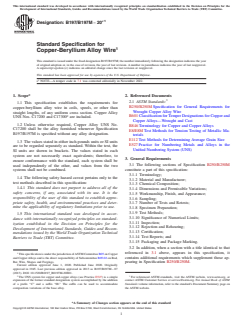
1. Scope* 2. Referenced Documents
2.1 ASTM Standards:
1.1 This specification establishes the requirements for
B250/B250M Specification for General Requirements for
copper-beryllium alloy wire in coils, spools, or other than
Wrought Copper Alloy Wire
straight lengths, of any uniform cross section. Copper Alloy
B601 Classification forTemper Designations for Copper and
UNS Nos. C17200 and C17300 are included.
Copper Alloys—Wrought and Cast
1.2 Unless otherwise required, Copper Alloy UNS No.
B846 Terminology for Copper and Copper Alloys
C17200 shall be the alloy furnished whenever Specification
E8/E8M Test Methods for Tension Testing of Metallic Ma-
B197/B197M is specified without any alloy designation.
terials
E112 Test Methods for Determining Average Grain Size
1.3 The values stated in either inch-pounds units or SI units
E527 Practice for Numbering Metals and Alloys in the
are to be regarded separately as standard. Within the text, the
Unified Numbering System (UNS)
SI units are shown in brackets. The values stated in each
system are not necessarily exact equivalents; therefore, to
3. General Requirements
ensure conformance with the standard, each system shall be
3.1 The following sections of Specification B250/B250M
used independently of the other, and values from the two
constitute a part of this specification:
systems shall not be combined.
3.1.1 Terminology;
1.4 The following safety hazard caveat pertains only to the
3.1.2 Material and Manufacturer;
test methods described in this specification:
3.1.3 Chemical Composition;
1.4.1 This standard does not purport to address all of the
3.1.4 Dimensions and Permissible Variations;
safety concerns, if any, associated with its use. It is the
3.1.5 Workmanship, Finish, and Appearance;
responsibility of the user of this standard to establish appro-
3.1.6 Sampling;
priate safety, health, and environmental practices and deter-
3.1.7 Number of Tests and Retests;
mine the applicability of regulatory limitations prior to use.
3.1.8 Specimen Preparation;
3.1.9 Test Methods;
1.5 This international standard was developed in accor-
3.1.10 Significance of Numerical Limits;
dance with internationally recognized principles on standard-
3.1.11 Inspection;
ization established in the Decision on Principles for the
3.1.12 Rejection and Rehearing;
Development of International Standards, Guides and Recom-
3.1.13 Certification;
mendations issued by the World Trade Organization Technical
3.1.14 Test Reports; and
Barriers to Trade (TBT) Committee.
3.1.15 Packaging and Package Marking.
3.2 In addition, when a section with a title identical to that
referenced in 3.1 above, appears in this specification, it
ThisspecificationisunderthejurisdictionofASTMCommitteeB05onCopper
contains additional requirements which supplement those ap-
and CopperAlloys and is the direct responsibility of Subcommittee B05.02 on Rod,
Bar, Wire, Shapes and Forgings.
pearing in Specification B250/B250M.
Current edition approved June 1, 2020. Published June 2020. Originally
approved in 1945. Last previous edition approved in 2013 as B197/B197M – 07
(2013). DOI: 10.1520/B0197_B0197M-20E01.
2 3
The UNS system for copper and copper alloys (see Practice E527) is a simple For referenced ASTM standards, visit the ASTM website, www.astm.org, or
expansion of the former standard designation system accomplished by the addition contact ASTM Customer Service at service@astm.org. For Annual Book of ASTM
of a prefix “C” and a suffix “00.” The suffix can be used to accommodate Standards volume information, refer to the standard’s Document Summary page on
composition variations of the base alloy. the ASTM website.
*A Summary of Changes section appears at the end of this standard
Copyright © ASTM International, 100 Barr Harbor Drive, PO Box C700, West Conshohocken, PA 19428-2959. United States
´1
B197/B197M−20
4. Terminology established and analysis required by agreement between the
manufacturer or supplier and purchaser.
4.1 For definitions of terms related to copper and copper
alloys, refer to Terminology B846. 6.3 For alloys in which copper is listed as “remainder,”
copper is the difference between the sum of results of all other
4.2 Definitions of Terms Specific to This Standard:
elements determined and 100 %.
4.2.1 grain count—thenumberofgrainsperstockthickness.
6.4 When all the elements in Table 1 are determined, the
5. Ordering Information
sum of results shall be 99.5 % min.
5.1 Include the following specified choices when placing
7. Temper
orders for product under this specification, as applicable:
5.1.1 ASTM specification designation and year of issue;
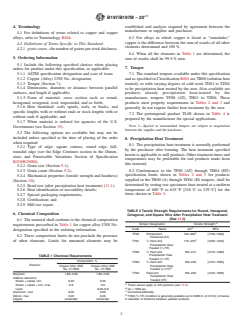
7.1 The standard tempers available under this specification
5.1.2 Copper (Alloy) UNS No. designation; and as specified in Classification B601 are TB00 (solution heat
5.1.3 Temper (Section 7);
treated), or with varying degrees of cold work TD01 to TD04
5.1.4 Dimensions, diameter, or distance between parallel to be precipitation heat treated by the user. Also available are
surfaces, and length if applicable;
products already precipitation heat-treated by the
5.1.5 Form of material: cross section such as round, manufacturer, tempers TF00 (AT), TH01 to TH04. These
hexagonal, octagonal, oval, trapezoidal, and so forth;
products meet property requirements in Tables 2 and 3 and
5.1.6 How furnished: coils spools, reels, or bucks, and
generally do not require further heat treatment by the user.
specific lengths with or without ends or stock lengths with or
7.2 The pretempered product TL08 shown in Table 4 is
without ends if applicable; and
prepared by the manufacturer for special applications.
5.1.7 When material is ordered for agencies of the U.S.
NOTE 1—Special or nonstandard tempers are subject to negotiation
Government (see Section 15).
between the supplier and the purchaser.
5.2 The following options are available but may not be
included unless specified at the time of placing of the order
8. Precipitation Heat Treatment
when required:
8.1 The precipitation heat treatment is normally performed
5.2.1 Type of edge: square corners, round edge, full-
by the purchaser after forming. The heat treatment specified
rounded edge (see the Edge Contours section in the Dimen-
herein is applicable to mill products. Other treatment times and
sions and Permissible Variations Section of Specification
temperatures may be preferable for end products made from
B250/B250M);
this material.
5.2.2 Grain size (Section 9.1);
8.2 Conformance to the TF00 (AT) through TH04 (HT)
5.2.3 Grain count (Section 9.2);
specification limits shown in Tables 2 and 3 for products
5.2.4 Mechanical properties (tensile strength and hardness)
supplied in the TB00 (A) through TD04 (H) tempers, shall be
(Section 10);
determined by testing test specimens heat-treated at a uniform
5.2.5 Bend test (after precipitation heat treatment) (11.1);
temperature of 600 °F to 625 °F [316 °C to 329 °C] for the
5.2.6 Heat identification or traceability details;
times shown in Table 5.
5.2.7 Special packaging requirements;
5.2.8 Certification; and
5.2.9 Mill test report.
TABLE 2 Tensile Strength Requirements for Round, Hexagonal,
6. Chemical Composition
Octagonal, and Square Wire After Precipitation Heat Treatment
(See 11.2)
6.1 The material shall conform to the chemical composition
A
Temper Designation Tensile Strength,
requirements prescribed in Table 1 for copper alloy UNS No.
B
Code Name ksi MPa
designation specified in the ordering information.
C
TF00 Precipitation 160–200 [1105–1380]
6.2 These composition limits do not preclude the presence
Hardened (AT)
C
of other elements. Limits for unnamed elements may be TH01 ⁄4 Hard and 175–210 [1205–1450]
Precipitation Heat
Treated ( ⁄4 HT)
TH02 ⁄2 Hard and 185–215 [1275–1480]
Precipitation Heat
TABLE 1 Chemical Requirements
Treated ( ⁄2 HT)
Composition, %
TH03 ⁄4 Hard and 190–230 [1310–1585]
Element
Copper Alloy UNS Copper Alloy UNS Precipitation Heat
D
Treated ( ⁄4 HT)
No. C17200 No. C17300
TH04 Hard and 195–230 [1345–1585]
Beryllium 1.80–2.00 1.80–2.00
Precipitation Heat
Additive elements:
Treated (HT)
Nickel + cobalt, min 0.20 0.20
A
Nickel + cobalt + iron, max 0.6 0.6
These values apply to mill products (see 11.2).
B
Lead . . . 0.20–0.6 ksi = 1000 psi.
C
Aluminum, max 0.20 0.20
Corrected editorially.
D
Silicon, max 0.20 0.20 TH03 ( ⁄4 HT) condition is generally available up to 0.080 in. [2.0 mm], inclusive,
Copper remainder remainder
in diameter or distance between parallel surfaces.
´1
B197/B197M−20
A
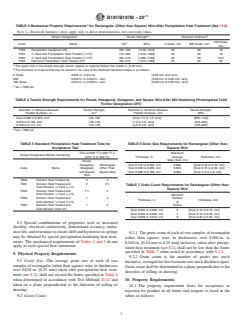
TABLE 3 Mechanical Property Requirements for Rectangular (Other than Square) Wire After Precipitation Heat Treatment (See 11.2)
NOTE 1—Rockwell hardness values apply only to direct determinations, not converted values.
A B
Temper Designation Tensile Strength Rockwell hardness
15N Scale,
C
Code Name ksi MPa C Scale, min 30N Scale, min
min
TF00 Precipitation Hardened (AT) 165–190 [1140–1310] 36 56 78
1 1
TH01 ⁄4 Hard and Precipitation Heat Treated ( ⁄4 HT) 175–200 [1210–1380] 38 58 79
1 1
TH02 ⁄2 Hard and Precipitation Heat Treated ( ⁄2 HT) 185–210 [1280–1450] 39 59 79.5
TH04 Hard and Precipitation Heat Treated (HT) 190–215 [1310–1480] 40 60 80
A
The upper limit in the tensile strength column applies to material thicker than 0.020 in. [0.50 mm].
B
The thickness of material that may be tested in the case of the Rockwell hardness scales is as follows:
C Scale 0.032 in. and over [0.80 mm and over]
30N 0.020 in. to 0.032 in., excl [0.50 mm to 0.80 mm, excl]
15N Scale 0.015 in. to 0.020 in., excl [0.38 mm to 0.50 mm, excl]
C
ksi = 1000 psi.
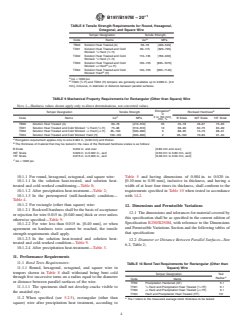
TABLE 4 Tensile Strength Requirements for Round, Hexagonal, Octagonal, and Square Wire After Mill Hardening (Pretempered TL08-
Former Designation XHT)
Diameter or Distance Between Tensile Strength, Diameter or Distance Between Tensile Strength,
A
Parallel Surfaces, in. ksi Parallel Surfaces, mm MPa
Over 0.050 to 0.075, excl 140–165 [Over 1.2 to 1.9, excl] [965–1140]
0.075 to 0.100, excl 120–140 [1.9 to 2.5,
...