

ASTM C968-19
(Test Method)Standard Test Methods for Analysis of Sintered Gadolinium Oxide-Uranium Dioxide Pellets
General Information
- Abstract
SIGNIFICANCE AND USE
4.1 The test methods in this method are designed to show whether a given material is in accordance with Specification C922.
SCOPE
1.1 These test methods cover procedures for the analysis of sintered gadolinium oxide-uranium dioxide pellets to determine compliance with specifications.
1.2 The analytical procedures appear in the following order:
Section
Carbon (Total) by Direct Combustion—Thermal Conductivity Method
2
C1408 Test Method for Carbon (Total) in Uranium Oxide Powders and Pellets By Direct Combustion-Infrared Detection Method
3
Chlorine and Fluorine by Pyrohydrolysis Ion-Selective Electrode Method
4
C1502 Test Method for Determination of Total Chlorine and Fluorine in Uranium Dioxide and Gadolinium Oxide
3
Gadolinia Content by Energy-Dispersive X-Ray Spectrometry
4
C1456 Test Method for Determination of Uranium or Gadolinium (or both) in Gadolinium Oxide-Uranium Oxide Pellets or by X-Ray Fluorescence (XRF)
3
Hydrogen by Inert Gas Fusion
4
C1457 Test Method for Determination of Total Hydrogen Content of Uranium Oxide Powders and Pellets by Carrier Gas Extraction
3
Isotopic Uranium Composition by Multiple-Filament Surface-Ionization Mass Spectrometric Method
2
C1413 Test Method for Isotopic Analysis of Hydrolyzed Uranium Hexafluoride And Uranyl Nitrate Solutions By Thermal Ionization Mass Spectrometry
3
C1347 Practice for Preparation and Dissolution of Uranium Materials for Analysis
3
Nitrogen by Distillation—Nessler Reagent (Photometric) Method
7 to 17
Oxygen-to-Metal Ratio of Sintered Gadolinium Oxide-Uranium Dioxide Pellets
4
C1430 Test Method for Determination of Uranium, Oxygen to Uranium (O/U), and Oxygen to Metal (O/M) in Sintered Uranium Dioxide and Gadolinia-Uranium Dioxide Pellets by Atmospheric Equilibration
3
Spectrochemical Determination of Trace Impurity Elements
4
C1517 Test Method for Determination of Metallic Impurities in Uranium Metal or Compounds by DC-Arc Emission Spectroscopy
3
Total Gas by Hot Vacuum Extraction
2
Ceramographic Determination of Free Gd2O3 and Free UO2 to Estimate the Homogeneity of (U,Gd)O2 Pellets
18 to 25
Ceramographic Determination of Average Grain Size by Linear Intercept after Chemical Etching
26 to 33
1.3 The values stated in SI units are to be regarded as the standard.
1.4 This standard does not purport to address all of the safety concerns, if any, associated with its use. It is the responsibility of the user of this standard to establish appropriate safety, health, and environmental practices and determine the applicability of regulatory limitations prior to use.
1.5 This international standard was developed in accordance with internationally recognized principles on standardization established in the Decision on Principles for the Development of International Standards, Guides and Recommendations issued by the World Trade Organization Technical Barriers to Trade (TBT) Committee.
- Status
- Published
- Publication Date
- 31-Aug-2019
- Technical Committee
- C26 - Nuclear Fuel Cycle
- Drafting Committee
- C26.05 - Methods of Test
Buy Documents
ASTM C968-19 - Standard Test Methods for Analysis of Sintered Gadolinium Oxide-Uranium Dioxide Pellets
REDLINE ASTM C968-19 - Standard Test Methods for Analysis of Sintered Gadolinium Oxide-Uranium Dioxide Pellets
Overview
ASTM C968-19 is an internationally recognized standard from ASTM International that provides comprehensive test methods for the analysis of sintered gadolinium oxide-uranium dioxide (Gd₂O₃-UO₂) pellets. These nuclear fuel pellets are critical components in advanced nuclear reactors, where both chemical composition and material homogeneity impact performance and safety. The standard serves as a quality assurance protocol to verify that the pellets meet the requirements defined in ASTM C922.
This standard establishes procedures for the analytical assessment of major and trace components, impurities, and material structure, using a variety of chemical and physical testing methods. All values are expressed in SI units, ensuring international consistency.
Key Topics
ASTM C968-19 encompasses multiple analytical procedures, each targeting specific quality attributes relevant to nuclear fuel manufacturing:
- Determination of Major and Minor Elements: Methods address quantification of carbon, chlorine, fluorine, gadolinium, uranium, hydrogen, nitrogen, and oxygen-to-metal (O/M) ratio within the pellets.
- Trace Impurity Detection: The detection and quantification of metallic impurities and other minor constituents that could adversely affect fuel pellet performance.
- Isotopic Composition Analysis: Testing uranium isotopic content to confirm compliance with fuel enrichment and safety criteria.
- Ceramographic Analysis: Evaluation of pellet microstructure to assess grain size, homogeneity, and distribution of free gadolinia and uranium dioxide phases.
- Homogeneity Assessment: Measurement of the evenness of gadolinia distribution using microstructural imaging techniques.
- Quality Control: Standardized procedures for sample preparation, reagent purity, and calibration to enable reproducibility and accuracy.
Applications
ASTM C968-19 is essential for organizations involved in the nuclear fuel cycle, particularly at the stages of fuel fabrication and quality assurance. Applications include:
- Quality Verification: Confirm that sintered Gd₂O₃-UO₂ pellets meet international fuel specifications under ASTM C922, supporting reactor licensing and regulatory compliance.
- Process Development: Aid manufacturers in developing and refining pellet manufacturing processes by providing clear guidelines for material assessment.
- Support for Safety Reviews: Deliver precise, reproducible data for reactor operators and regulatory bodies tasked with ensuring nuclear fuel safety.
- Research and Development: Equip laboratories and R&D facilities with established methodologies to analyze advanced fuel materials for new reactor designs.
- Trace Impurity Control: Help manage and document impurity levels that could impact fuel performance or safety over a reactor cycle.
Related Standards
ASTM C968-19 references and operates in tandem with other key ASTM standards to create a comprehensive analytical framework, including:
- ASTM C922 - Specification for Sintered Gadolinium Oxide-Uranium Dioxide Pellets
- ASTM C1408 - Total Carbon in Uranium Oxide Powders and Pellets
- ASTM C1502 - Total Chlorine and Fluorine in Uranium Dioxide and Gadolinium Oxide
- ASTM C1456 - Determination of Uranium or Gadolinium by X-Ray Fluorescence (XRF)
- ASTM C1457 - Total Hydrogen Content by Carrier Gas Extraction
- ASTM C1413 - Isotopic Analysis of Uranium by Mass Spectrometry
- ASTM C1517 - Determination of Metallic Impurities by DC-Arc Emission Spectroscopy
- ASTM C1347 - Preparation and Dissolution of Uranium Materials for Analysis
- ASTM C1430 - Oxygen-to-Metal Ratio in Sintered Uranium Dioxide and Gadolinia-Uranium Dioxide Pellets
For definitions and additional terminology, ASTM C859 is recommended.
By following ASTM C968-19, organizations can demonstrate a rigorous, standardized approach to analyzing and qualifying sintered gadolinium oxide-uranium dioxide pellets, which is critical in the nuclear energy sector for ensuring product quality, reliability, and regulatory compliance.
Relations
- Effective Date
- 01-Sep-2019
- Effective Date
- 01-Jan-2024
- Effective Date
- 01-Nov-2018
- Effective Date
- 01-Nov-2018
- Effective Date
- 01-Feb-2018
- Effective Date
- 01-Feb-2018
- Effective Date
- 01-Apr-2016
- Effective Date
- 01-Mar-2016
- Effective Date
- 15-Jan-2016
- Effective Date
- 15-Jun-2014
- Effective Date
- 15-Jan-2014
- Effective Date
- 01-Jul-2013
- Effective Date
- 01-Jun-2013
- Effective Date
- 01-May-2013
- Effective Date
- 15-Nov-2012
Buy Documents
ASTM C968-19 - Standard Test Methods for Analysis of Sintered Gadolinium Oxide-Uranium Dioxide Pellets
REDLINE ASTM C968-19 - Standard Test Methods for Analysis of Sintered Gadolinium Oxide-Uranium Dioxide Pellets
Get Certified
Connect with accredited certification bodies for this standard

DNV
DNV is an independent assurance and risk management provider.

Lloyd's Register
Lloyd's Register is a global professional services organisation specialising in engineering and technology.
DNV Energy Systems
Energy and renewable energy certification.
Sponsored listings
Frequently Asked Questions
ASTM C968-19 is a standard published by ASTM International. Its full title is "Standard Test Methods for Analysis of Sintered Gadolinium Oxide-Uranium Dioxide Pellets". This standard covers: SIGNIFICANCE AND USE 4.1 The test methods in this method are designed to show whether a given material is in accordance with Specification C922. SCOPE 1.1 These test methods cover procedures for the analysis of sintered gadolinium oxide-uranium dioxide pellets to determine compliance with specifications. 1.2 The analytical procedures appear in the following order: Section Carbon (Total) by Direct Combustion—Thermal Conductivity Method 2 C1408 Test Method for Carbon (Total) in Uranium Oxide Powders and Pellets By Direct Combustion-Infrared Detection Method 3 Chlorine and Fluorine by Pyrohydrolysis Ion-Selective Electrode Method 4 C1502 Test Method for Determination of Total Chlorine and Fluorine in Uranium Dioxide and Gadolinium Oxide 3 Gadolinia Content by Energy-Dispersive X-Ray Spectrometry 4 C1456 Test Method for Determination of Uranium or Gadolinium (or both) in Gadolinium Oxide-Uranium Oxide Pellets or by X-Ray Fluorescence (XRF) 3 Hydrogen by Inert Gas Fusion 4 C1457 Test Method for Determination of Total Hydrogen Content of Uranium Oxide Powders and Pellets by Carrier Gas Extraction 3 Isotopic Uranium Composition by Multiple-Filament Surface-Ionization Mass Spectrometric Method 2 C1413 Test Method for Isotopic Analysis of Hydrolyzed Uranium Hexafluoride And Uranyl Nitrate Solutions By Thermal Ionization Mass Spectrometry 3 C1347 Practice for Preparation and Dissolution of Uranium Materials for Analysis 3 Nitrogen by Distillation—Nessler Reagent (Photometric) Method 7 to 17 Oxygen-to-Metal Ratio of Sintered Gadolinium Oxide-Uranium Dioxide Pellets 4 C1430 Test Method for Determination of Uranium, Oxygen to Uranium (O/U), and Oxygen to Metal (O/M) in Sintered Uranium Dioxide and Gadolinia-Uranium Dioxide Pellets by Atmospheric Equilibration 3 Spectrochemical Determination of Trace Impurity Elements 4 C1517 Test Method for Determination of Metallic Impurities in Uranium Metal or Compounds by DC-Arc Emission Spectroscopy 3 Total Gas by Hot Vacuum Extraction 2 Ceramographic Determination of Free Gd2O3 and Free UO2 to Estimate the Homogeneity of (U,Gd)O2 Pellets 18 to 25 Ceramographic Determination of Average Grain Size by Linear Intercept after Chemical Etching 26 to 33 1.3 The values stated in SI units are to be regarded as the standard. 1.4 This standard does not purport to address all of the safety concerns, if any, associated with its use. It is the responsibility of the user of this standard to establish appropriate safety, health, and environmental practices and determine the applicability of regulatory limitations prior to use. 1.5 This international standard was developed in accordance with internationally recognized principles on standardization established in the Decision on Principles for the Development of International Standards, Guides and Recommendations issued by the World Trade Organization Technical Barriers to Trade (TBT) Committee.
SIGNIFICANCE AND USE 4.1 The test methods in this method are designed to show whether a given material is in accordance with Specification C922. SCOPE 1.1 These test methods cover procedures for the analysis of sintered gadolinium oxide-uranium dioxide pellets to determine compliance with specifications. 1.2 The analytical procedures appear in the following order: Section Carbon (Total) by Direct Combustion—Thermal Conductivity Method 2 C1408 Test Method for Carbon (Total) in Uranium Oxide Powders and Pellets By Direct Combustion-Infrared Detection Method 3 Chlorine and Fluorine by Pyrohydrolysis Ion-Selective Electrode Method 4 C1502 Test Method for Determination of Total Chlorine and Fluorine in Uranium Dioxide and Gadolinium Oxide 3 Gadolinia Content by Energy-Dispersive X-Ray Spectrometry 4 C1456 Test Method for Determination of Uranium or Gadolinium (or both) in Gadolinium Oxide-Uranium Oxide Pellets or by X-Ray Fluorescence (XRF) 3 Hydrogen by Inert Gas Fusion 4 C1457 Test Method for Determination of Total Hydrogen Content of Uranium Oxide Powders and Pellets by Carrier Gas Extraction 3 Isotopic Uranium Composition by Multiple-Filament Surface-Ionization Mass Spectrometric Method 2 C1413 Test Method for Isotopic Analysis of Hydrolyzed Uranium Hexafluoride And Uranyl Nitrate Solutions By Thermal Ionization Mass Spectrometry 3 C1347 Practice for Preparation and Dissolution of Uranium Materials for Analysis 3 Nitrogen by Distillation—Nessler Reagent (Photometric) Method 7 to 17 Oxygen-to-Metal Ratio of Sintered Gadolinium Oxide-Uranium Dioxide Pellets 4 C1430 Test Method for Determination of Uranium, Oxygen to Uranium (O/U), and Oxygen to Metal (O/M) in Sintered Uranium Dioxide and Gadolinia-Uranium Dioxide Pellets by Atmospheric Equilibration 3 Spectrochemical Determination of Trace Impurity Elements 4 C1517 Test Method for Determination of Metallic Impurities in Uranium Metal or Compounds by DC-Arc Emission Spectroscopy 3 Total Gas by Hot Vacuum Extraction 2 Ceramographic Determination of Free Gd2O3 and Free UO2 to Estimate the Homogeneity of (U,Gd)O2 Pellets 18 to 25 Ceramographic Determination of Average Grain Size by Linear Intercept after Chemical Etching 26 to 33 1.3 The values stated in SI units are to be regarded as the standard. 1.4 This standard does not purport to address all of the safety concerns, if any, associated with its use. It is the responsibility of the user of this standard to establish appropriate safety, health, and environmental practices and determine the applicability of regulatory limitations prior to use. 1.5 This international standard was developed in accordance with internationally recognized principles on standardization established in the Decision on Principles for the Development of International Standards, Guides and Recommendations issued by the World Trade Organization Technical Barriers to Trade (TBT) Committee.
ASTM C968-19 is classified under the following ICS (International Classification for Standards) categories: 27.120.30 - Fissile materials and nuclear fuel technology. The ICS classification helps identify the subject area and facilitates finding related standards.
ASTM C968-19 has the following relationships with other standards: It is inter standard links to ASTM C968-12, ASTM C859-24, ASTM C1413-18, ASTM C1456-13(2018), ASTM C1430-18, ASTM C1457-18, ASTM C1517-16, ASTM C1408-16, ASTM C1502-16, ASTM C859-14a, ASTM C859-14, ASTM C1456-13, ASTM C859-13a, ASTM C859-13, ASTM E112-12. Understanding these relationships helps ensure you are using the most current and applicable version of the standard.
ASTM C968-19 is available in PDF format for immediate download after purchase. The document can be added to your cart and obtained through the secure checkout process. Digital delivery ensures instant access to the complete standard document.
Standards Content (Sample)
This international standard was developed in accordance with internationally recognized principles on standardization established in the Decision on Principles for the
Development of International Standards, Guides and Recommendations issued by the World Trade Organization Technical Barriers to Trade (TBT) Committee.
Designation: C968 − 19
Standard Test Methods for
Analysis of Sintered Gadolinium Oxide-Uranium Dioxide
Pellets
This standard is issued under the fixed designation C968; the number immediately following the designation indicates the year of
original adoption or, in the case of revision, the year of last revision.Anumber in parentheses indicates the year of last reapproval.A
superscript epsilon (´) indicates an editorial change since the last revision or reapproval.
1. Scope
Section
Ceramographic Determination of Average Grain Size by Linear 26 to 33
1.1 These test methods cover procedures for the analysis of
Intercept after Chemical Etching
sintered gadolinium oxide-uranium dioxide pellets to deter-
1.3 The values stated in SI units are to be regarded as the
mine compliance with specifications.
standard.
1.2 Theanalyticalproceduresappearinthefollowingorder:
1.4 This standard does not purport to address all of the
Section
safety concerns, if any, associated with its use. It is the
Carbon (Total) by Direct Combustion—Thermal Conductivity Method
responsibility of the user of this standard to establish appro-
C1408 Test Method for Carbon (Total) in Uranium Oxide Powders
priate safety, health, and environmental practices and deter-
and Pellets By Direct Combustion-Infrared Detection Method
Chlorine and Fluorine by Pyrohydrolysis Ion-Selective Electrode
mine the applicability of regulatory limitations prior to use.
Method
1.5 This international standard was developed in accor-
C1502 Test Method for Determination of Total Chlorine and Fluorine
in Uranium Dioxide and Gadolinium Oxide dance with internationally recognized principles on standard-
Gadolinia Content by Energy-Dispersive X-Ray Spectrometry
ization established in the Decision on Principles for the
C1456 Test Method for Determination of Uranium or Gadolinium (or
Development of International Standards, Guides and Recom-
both) in Gadolinium Oxide-Uranium Oxide Pellets or by X-Ray
Fluorescence (XRF) mendations issued by the World Trade Organization Technical
Hydrogen by Inert Gas Fusion
Barriers to Trade (TBT) Committee.
C1457 Test Method for Determination of Total Hydrogen Content of
Uranium Oxide Powders and Pellets by Carrier Gas Extraction
2. Referenced Documents
Isotopic Uranium Composition by Multiple-Filament Surface-
Ionization Mass Spectrometric Method
2.1 ASTM Standards:
C1413 Test Method for Isotopic Analysis of Hydrolyzed Uranium
C859Terminology Relating to Nuclear Materials
Hexafluoride And Uranyl Nitrate Solutions By Thermal Ionization
Mass Spectrometry C922SpecificationforSinteredGadoliniumOxide-Uranium
C1347 Practice for Preparation and Dissolution of Uranium Materials
Dioxide Pellets
for Analysis
C1347Practice for Preparation and Dissolution of Uranium
Nitrogen by Distillation—Nessler Reagent (Photometric) Method 7 to 17
Oxygen-to-Metal Ratio of Sintered Gadolinium Oxide-Uranium Diox- Materials for Analysis
ide Pellets
C1408Test Method for Carbon (Total) in Uranium Oxide
C1430 Test Method for Determination of Uranium, Oxygen to Ura-
Powders and Pellets By Direct Combustion-Infrared De-
nium (O/U), and Oxygen to Metal (O/M) in Sintered Uranium Diox-
ide and Gadolinia-Uranium Dioxide Pellets by Atmospheric Equili-
tection Method
bration
C1413Test Method for Isotopic Analysis of Hydrolyzed
Spectrochemical Determination of Trace Impurity Elements
Uranium Hexafluoride and Uranyl Nitrate Solutions by
C1517 Test Method for Determination of Metallic Impurities in Ura-
nium Metal or Compounds by DC-Arc Emission Spectroscopy Thermal Ionization Mass Spectrometry
Total Gas by Hot Vacuum Extraction
C1430Test Method for Determination of Uranium, Oxygen
Ceramographic Determination of Free Gd O and Free UO to Esti- 18 to 25
2 3 2
to Uranium (O/U), and Oxygen to Metal (O/M) in
mate the Homogeneity of (U,Gd)O Pellets
Sintered Uranium Dioxide and Gadolinia-Uranium Diox-
ide Pellets by Atmospheric Equilibration
1 C1456Test Method for Determination of Uranium or Gado-
These test methods are under the jurisdiction of ASTM C26 on Nuclear Fuel
Cycle and are the direct responsibility of C26.05 on Methods of Test.
linium (or both) in Gadolinium Oxide-Uranium Oxide
Current edition approved Sept. 1, 2019. Published September 2019. Originally
Pellets or by X-Ray Fluorescence (XRF)
approved in 1981. Last previous edition approved in 2012 as C968–12. DOI:
C1457Test Method for Determination of Total Hydrogen
10.1520/C0968-19.
ContentofUraniumOxidePowdersandPelletsbyCarrier
Discontinued 1999. See C968–94.
For referenced ASTM standards, visit the ASTM website, www.astm.org, or
Gas Extraction
contact ASTM Customer Service at service@astm.org. For Annual Book of ASTM
C1502TestMethodforDeterminationofTotalChlorineand
Standards volume information, refer to the standard’s Document Summary page on
Fluorine in Uranium Dioxide and Gadolinium Oxide
the ASTM website.
Discontinued 2005. See C968–99. C1517TestMethodforDeterminationofMetallicImpurities
Copyright © ASTM International, 100 Barr Harbor Drive, PO Box C700, West Conshohocken, PA 19428-2959. United States
C968 − 19
in Uranium Metal or Compounds by DC-Arc Emission CARBON (TOTAL) BY DIRECT COMBUSTION—
Spectroscopy THERMAL CONDUCTIVITY METHOD
D1193Specification for Reagent Water This Test Method was discontinued in January 1999 and
E112Test Methods for Determining Average Grain Size replaced by Test Method C1408
E146Methods of Chemical Analysis of Zirconium and
CHLORINE AND FLUORINE BY PYROHYDROLYSIS
ZirconiumAlloys(Silicon,Hydrogen,andCopper)(With-
5 ION-SELECTIVE ELECTRODE METHOD
drawn 1989)
This Test Method was discontinued in March 2005 and
replaced by Test Method C1502
3. Terminology
GADOLINIA CONTENT BY ENERGY-DISPERSIVE
3.1 For definitions of terms used in this test method but not
X-RAY SPECTROMETRY
defined herein, refer to Terminology C859.
This Test Method was discontinued in March 2005 and
replaced by Test Method C1456
4. Significance and Use
4.1 The test methods in this method are designed to show HYDROGEN BY INERT GAS FUSION
whether a given material is in accordance with Specification This Test Method was discontinued in March 2005 and
C922. replaced by Test Method C1457
ISOTOPIC URANIUM COMPOSITION BY
5. Reagents
MULTIPLE-FILAMENT SURFACE-IONIZATION
5.1 Purity of Reagents—Reagent grade chemicals shall be
MASS SPECTROMETRIC METHOD
used in all tests. Unless otherwise indicated, it is intended that
This Test Method was discontinued in January 1999 and
all reagents shall conform to the specifications of the commit-
replaced with C1413
tee on Analytical Reagent of the American Chemical Society,
Samples can be dissolved using the appropriate dissolu-
where such specifications are available. Other grades may be
tion techniques described in Practice C1347
used, provided it is first ascertained that the reagent is of
NITROGEN BY DISTILLATION—NESSLER
sufficiently high purity to permit its use without lessening the
REAGENT (PHOTOMETRIC) METHOD
accuracy of the determination.
5.2 Purity of Water—Unless otherwise indicated, references
7. Scope
towatershallbeunderstoodtomeanreagentwaterconforming
7.1 Thistestmethoddescribesthedeterminationofnitrogen
to Type IV of Specification D1193.
in gadolinium oxide-uranium dioxide pellets (Gd O /UO ).
2 3 2
Witha2to5-g sample, concentrations from 5 to 100 µg of
6. Safety Precautions
nitrogen are determined without interference.
6.1 Properprecautionsshouldbetakentopreventinhalation
or ingestion of gadolinium oxide or uranium dioxide dust
8. Summary of Test Method
during grinding or handling operations.
8.1 Pelletsamplesofgadoliniumoxide-uraniumdioxideare
crushed, then dissolved in phosphoric acid. Hydrochloric acid
with hydrogen peroxide can also be used. The resulting
The last approved version of this historical standard is referenced on
solution is made alkaline with sodium hydroxide, and the
www.astm.org.
Reagent Chemicals, American Chemical Society Specifications, American
nitrogen is separated as ammonia by steam distillation (see
Chemical Society, Washington, DC. For suggestions on the testing of reagents not
MethodE146).Nesslerreagentisaddedtothedistillatetoform
listed by the American Chemical Society, see Analar Standards for Laboratory
the yellow ammonium complex, and the absorbance of the
Chemicals, BDH Ltd., Poole, Dorset, U.K., and the United States Pharmacopeia
and National Formulary, U.S. Pharmacopeial Convention, Inc. (USPC), Rockville,
MD.
C968 − 19
solution is measured at approximately 430 nm, using a cell ammonia-free water, mix, and allow the solution to stand
depth of 2 cm (1, 2). overnight.Decantthesupernatantliquidandstoreitinabrown
NOTE1—Thisprocedurehasbeenwrittenforacellhavinga2-cmlight
bottle. This reagent is stable indefinitely.
path.Therangeofthemethodcanbeextendedbysuitablyvaryingsample
11.2 Ammonium Chloride (NH Cl)—Dry the ammonium
mass, aliquot size, amounts of reagents, and cell depth. 4
chloride at 110 to 120°C for 2 h.
9. Interferences
11.3 Nitrogen Reference Solution (1 mL = 10 µg N)—
9.1 There are no known interfering elements.
Dissolve 3.819 g of dried NH Cl in water and dilute the
solution to 1 L. Transfer 10 mL of this solution to a 1-L
10. Apparatus
volumetric flask and dilute it to volume with water.
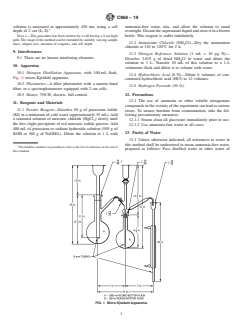
10.1 Nitrogen Distillation Apparatus, with 100-mL flask,
11.4 Hydrochloric Acid (6 N)—Dilute 6 volumes of con-
Fig. 1; micro-Kjeldahl apparatus.
centrated hydrochloric acid (HCl) to 12 volumes.
10.2 Photometer—A filter photometer with a narrow-band
11.5 Hydrogen Peroxide (30%).
filter; or a spectrophotometer equipped with 2-cm cells.
12. Precautions
10.3 Heater, 750-W, electric, full-control.
12.1 The use of ammonia or other volatile nitrogenous
11. Reagents and Materials
compoundsinthevicinityoftheexperimentcanleadtoserious
11.1 Nessler Reagent—Dissolve 50 g of potassium iodide
errors. To ensure freedom from contamination, take the fol-
(KI) in a minimum of cold water (approximately 35 mL).Add
lowing precautionary measures:
a saturated solution of mercuric chloride (HgCl ) slowly until
12.1.1 Steam clean all glassware immediately prior to use.
the first slight precipitate of red mercuric iodide persists. Add
12.1.2 Use ammonia-free water in all cases.
400 mL of potassium or sodium hydroxide solution (505 g of
13. Purity of Water
KOH or 360 g of NaOH/L). Dilute the solution to 1 L with
13.1 Unless otherwise indicated, all references to water in
this method shall be understood to mean ammonia-free water,
Theboldfacenumbersinparenthesesrefertothelistofreferencesattheendof
prepared as follows: Pass distilled water or other water of
this standard.
FIG. 1 Micro-Kjeldahl Apparatus
C968 − 19
equivalent purity through a mixed-bed resin demineralizer. 15.2 Reference Solution—Carry a reagent blank through the
Prepare all solutions in an ammonia-free atmosphere and store entire procedure, using the same amount of all reagents.
them in tightly stoppered chemical-resistant glass bottles. Boil
15.3 Photometry—Take the photometric reading of the
all rubber stoppers used for 30 min in sodium hydroxide
samples as described in 14.3.
solution (100 g NaOH/L) and rinse them with ammonia-free
water.
16. Calculation
14. Preparation of Calibration Curve 16.1 Correct for the blank and convert the photometric
reading of the sample to micrograms of nitrogen by means of
14.1 Calibration Solutions—Pipet 5, 10, 25, 50, 100, and
the calibration curve.
150µgofthereferencenitrogensolution(1mL=10µgN)into
50-mL volumetric flasks containing 25 mL of water. Pipet 1.0
16.2 Calculate the nitrogen content, N, in micrograms per
mL of Nessler reagent into each flask and dilute to the mark
gram of sample as follows:
with water. Stopper the flask and mix well.
N 5 A/W (1)
14.2 Reference Solution—Pipet 1.0 mL of Nessler reagent
where:
into a small volume of water in a 50-mL volumetric flask.
A = micrograms of nitrogen found, and
Dilute to volume with water. Stopper and mix well.
W = sample mass, grams of Gd O /UO .
2 3 2
14.3 Photometry—Transfer a suitable portion of water to a
2-cm absorption cell and adjust the photometer to the initial
17.
...
This document is not an ASTM standard and is intended only to provide the user of an ASTM standard an indication of what changes have been made to the previous version. Because
it may not be technically possible to adequately depict all changes accurately, ASTM recommends that users consult prior editions as appropriate. In all cases only the current version
of the standard as published by ASTM is to be considered the official document.
Designation: C968 − 12 C968 − 19
Standard Test Methods for
Analysis of Sintered Gadolinium Oxide-Uranium Dioxide
Pellets
This standard is issued under the fixed designation C968; the number immediately following the designation indicates the year of
original adoption or, in the case of revision, the year of last revision. A number in parentheses indicates the year of last reapproval. A
superscript epsilon (´) indicates an editorial change since the last revision or reapproval.
1. Scope
1.1 These test methods cover procedures for the analysis of sintered gadolinium oxide-uranium dioxide pellets to determine
compliance with specifications.
1.2 The analytical procedures appear in the following order:
Section
Carbon (Total) by Direct Combustion—Thermal Conductivity Method
C1408 Test Method for Carbon (Total) in Uranium Oxide Powders
and Pellets By Direct Combustion-Infrared Detection Method
Chlorine and Fluorine by Pyrohydrolysis Ion-Selective Electrode
Method
C1502 Test Method for Determination of Total Chlorine and Fluorine
in Uranium Dioxide and Gadolinium Oxide
Gadolinia Content by Energy-Dispersive X-Ray Spectrometry
C1456 Test Method for Determination of Uranium or Gadolinium, or
Both, in Gadolinium Oxide-Uranium Oxide Pellets or by X-Ray
Fluorescence (XRF)
C1456 Test Method for Determination of Uranium or Gadolinium (or
both) in Gadolinium Oxide-Uranium Oxide Pellets or by X-Ray
Fluorescence (XRF)
Hydrogen by Inert Gas Fusion
C1457 Test Method for Determination of Total Hydrogen Content of
Uranium Oxide Powders and Pellets by Carrier Gas Extraction
Isotopic Uranium Composition by Multiple-Filament Surface-
Ionization Mass Spectrometric Method
C1413 Test Method for Isotopic Analysis of Hydrolysed Uranium
Hexafluoride And Uranyl Nitrate Solutions By Thermal Ionization
Mass Spectrometry
C1413 Test Method for Isotopic Analysis of Hydrolyzed Uranium
Hexafluoride And Uranyl Nitrate Solutions By Thermal Ionization
Mass Spectrometry
C1347 Practice for Preparation and Dissolution of Uranium Materials
for Analysis
Nitrogen by Distillation—Nessler Reagent (Photometric) Method 6 to 16
Nitrogen by Distillation—Nessler Reagent (Photometric) Method 7 to 17
Oxygen-to-Metal Ratio of Sintered Gadolinium Oxide-Uranium Diox-
ide Pellets
C1430 Test Method for Determination of Uranium, Oxygen to
Uranium, and Oxygen to Metal (O/M) in Sintered Uranium Dioxide
and Gadolinia-Uranium Dioxide Pellets by Atmospheric Equilibra-
tion
C1430 Test Method for Determination of Uranium, Oxygen to Ura-
nium (O/U), and Oxygen to Metal (O/M) in Sintered Uranium Diox-
ide and Gadolinia-Uranium Dioxide Pellets by Atmospheric Equili-
bration
Spectrochemical Determination of Trace Impurity Elements
These test methods are under the jurisdiction of ASTM C26 on Nuclear Fuel Cycle and are the direct responsibility of C26.05 on Methods of Test.
Current edition approved Jan. 1, 2012Sept. 1, 2019. Published February 2012September 2019. Originally approved in 1981. Last previous edition approved in 20062012
as C968 – 06.C968 – 12. DOI: 10.1520/C0968-12.10.1520/C0968-19.
Discontinued 1999. See C968 – 94.
For referenced ASTM standards, visit the ASTM website, www.astm.org, or contact ASTM Customer Service at service@astm.org. For Annual Book of ASTM Standards
volume information, refer to the standard’s Document Summary page on the ASTM website.
Discontinued 2005. See C968 – 99.
Copyright © ASTM International, 100 Barr Harbor Drive, PO Box C700, West Conshohocken, PA 19428-2959. United States
C968 − 19
Section
C1517 Test Method for Determination of Metallic Impurities in Ura-
nium Metal or Compounds by DC-Arc Emission Spectroscopy
Total Gas by Hot Vacuum Extraction
Ceramographic Determination of Free Gd O and Free UO to Esti- 17 to 24
2 3 2
mate the Homogeneity of (U,Gd)O Pellets
Ceramographic Determination of Free Gd O and Free UO to Esti- 18 to 25
2 3 2
mate the Homogeneity of (U,Gd)O Pellets
Ceramographic Determination of Average Grain Size by Linear 25 to 32
Intercept after Chemical Etching
Ceramographic Determination of Average Grain Size by Linear 26 to 33
Intercept after Chemical Etching
1.3 The values stated in SI units are to be regarded as the standard.
1.4 This standard does not purport to address all of the safety concerns, if any, associated with its use. It is the responsibility
of the user of this standard to establish appropriate safety safety, health, and healthenvironmental practices and determine the
applicability of regulatory limitations prior to use.
1.5 This international standard was developed in accordance with internationally recognized principles on standardization
established in the Decision on Principles for the Development of International Standards, Guides and Recommendations issued
by the World Trade Organization Technical Barriers to Trade (TBT) Committee.
2. Referenced Documents
2.1 ASTM Standards:
C859 Terminology Relating to Nuclear Materials
C922 Specification for Sintered Gadolinium Oxide-Uranium Dioxide Pellets
C1347 Practice for Preparation and Dissolution of Uranium Materials for Analysis
C1408 Test Method for Carbon (Total) in Uranium Oxide Powders and Pellets By Direct Combustion-Infrared Detection Method
C1413 Test Method for Isotopic Analysis of Hydrolyzed Uranium Hexafluoride and Uranyl Nitrate Solutions by Thermal
Ionization Mass Spectrometry
C1430 Test Method for Determination of Uranium, Oxygen to Uranium (O/U), and Oxygen to Metal (O/M) in Sintered Uranium
Dioxide and Gadolinia-Uranium Dioxide Pellets by Atmospheric Equilibration
C1456 Test Method for Determination of Uranium or Gadolinium (or both) in Gadolinium Oxide-Uranium Oxide Pellets or by
X-Ray Fluorescence (XRF)
C1457 Test Method for Determination of Total Hydrogen Content of Uranium Oxide Powders and Pellets by Carrier Gas
Extraction
C1502 Test Method for Determination of Total Chlorine and Fluorine in Uranium Dioxide and Gadolinium Oxide
C1517 Test Method for Determination of Metallic Impurities in Uranium Metal or Compounds by DC-Arc Emission
Spectroscopy
D1193 Specification for Reagent Water
E112 Test Methods for Determining Average Grain Size
E146 Methods of Chemical Analysis of Zirconium and Zirconium Alloys (Silicon, Hydrogen, and Copper) (Withdrawn 1989)
3. Terminology
3.1 For definitions of terms used in this test method but not defined herein, refer to Terminology C859.
4. Significance and Use
4.1 The test methods in this method are designed to show whether a given material is in accordance with Specification C922.
5. Reagents
5.1 Purity of Reagents—Reagent grade chemicals shall be used in all tests. Unless otherwise indicated, it is intended that all
reagents shall conform to the specifications of the committee on Analytical Reagent of the American Chemical Society, where such
specifications are available. Other grades may be used, provided it is first ascertained that the reagent is of sufficiently high purity
to permit its use without lessening the accuracy of the determination.
5.2 Purity of Water—Unless otherwise indicated, references to water shall be understood to mean reagent water conforming to
Type IV of Specification D1193.
The last approved version of this historical standard is referenced on www.astm.org.
Reagent Chemicals, American Chemical Society Specifications, American Chemical Society, Washington, DC. For suggestions on the testing of reagents not listed by
the American Chemical Society, see Analar Standards for Laboratory Chemicals, BDH Ltd., Poole, Dorset, U.K., and the United States Pharmacopeia and National
Formulary, U.S. Pharmacopeial Convention, Inc. (USPC), Rockville, MD.
C968 − 19
6. Safety Precautions
6.1 Proper precautions should be taken to prevent inhalation or ingestion of gadolinium oxide or uranium dioxide dust during
grinding or handling operations.
CARBON (TOTAL) BY DIRECT COMBUSTION—THERMAL CONDUCTIVITY METHOD
This Test Method was discontinued in January 1999 and replaced by Test Method C1408
CHLORINE AND FLUORINE BY PYROHYDROLYSIS ION-SELECTIVE ELECTRODE METHOD
This Test Method was discontinued in March 2005 and replaced by Test Method C1502
GADOLINIA CONTENT BY ENERGY-DISPERSIVE X-RAY SPECTROMETRY
This Test Method was discontinued in March 2005 and replaced by Test Method C1456
HYDROGEN BY INERT GAS FUSION
This Test Method was discontinued in March 2005 and replaced by Test Method C1457
ISOTOPIC URANIUM COMPOSITION BY MULTIPLE-FILAMENT SURFACE-IONIZATION MASS
SPECTROMETRIC METHOD
This Test Method was discontinued in January 1999 and replaced with C1413
Samples can be dissolved using the appropriate dissolution techniques described in Practice C1347
NITROGEN BY DISTILLATION—NESSLER REAGENT (PHOTOMETRIC) METHOD
6. Scope
6.1 This test method describes the determination of nitrogen in gadolinium oxide-uranium dioxide pellets (Gd O /UO ). With
2 3 2
a 2 to 5-g sample, concentrations from 5 to 100 μg of nitrogen are determined without interference.
7. Scope
7.1 This test method describes the determination of nitrogen in gadolinium oxide-uranium dioxide pellets (Gd O /UO ). With
2 3 2
a 2 to 5-g sample, concentrations from 5 to 100 μg of nitrogen are determined without interference.
8. Summary of Test Method
8.1 Pellet samples of gadolinium oxide-uranium dioxide are crushed, then dissolved in phosphoric acid. Hydrochloric acid with
hydrogen peroxide can also be used. The resulting solution is made alkaline with sodium hydroxide, and the nitrogen is separated
as ammonia by steam distillation (see Method E146). Nessler reagent is added to the distillate to form the yellow ammonium
complex, and the absorbance of the solution is measured at approximately 430 nm, using a cell depth of 2 cm (1, 2).
NOTE 1—This procedure has been written for a cell having a 2-cm light path. The range of the method can be extended by suitably varying sample
mass, aliquot size, amounts of reagents, and cell depth.
9. Interferences
9.1 There are no known interfering elements.
10. Apparatus
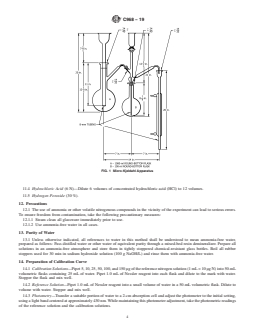
10.1 Nitrogen Distillation Apparatus, with 100-mL flask, Fig. 1; micro-Kjeldahl apparatus.
10.2 Photometer—A filter photometer with a narrow-band filter; or a spectrophotometer equipped with 2-cm cells.
10.3 Heater, 750-W, electric, full-control.
11. Reagents and Materials
11.1 Nessler Reagent—Dissolve 50 g of potassium iodide (KI) in a minimum of cold water (approximately 35 mL). Add a
saturated solution of mercuric chloride (HgCl ) slowly until the first slight precipitate of red mercuric iodide persists. Add 400 mL
of potassium or sodium hydroxide solution (505 g of KOH or 360 g of NaOH/L). Dilute the solution to 1 L with ammonia-free
water, mix, and allow the solution to stand overnight. Decant the supernatant liquid and store it in a brown bottle. This reagent
is stable indefinitely.
11.2 Ammonium Chloride (NH Cl)—Dry the ammonium chloride at 110 to 120°C for 2 h.
11.3 Nitrogen Reference Solution (1 mL = 10 μg N)—Dissolve 3.819 g of dried NH Cl in water and dilute the solution to 1 L.
Transfer 10 mL of this solution to a 1-L volumetric flask and dilute it to volume with water.
The boldface numbers in parentheses refer to the list of references at the end of this standard.
C968 − 19
FIG. 1 Micro-Kjeldahl Apparatus
11.4 Hydrochloric Acid (6 N)—Dilute 6 volumes of concentrated hydrochloric acid (HCl) to 12 volumes.
11.5 Hydrogen Peroxide (30 %).
12. Precautions
12.1 The use of ammonia or other volatile nitrogenous compounds in the vicinity of the experiment can lead to serious errors.
To ensure freedom from contamination, take the following precautionary measures:
12.1.1 Steam clean all glassware immediately prior to use.
12.1.2 Use ammonia-free water in all cases.
13. Purity of Water
13.1 Unless otherwise indicated, all references to water in this method shall be understood to mean ammonia-free water,
prepared as follows: Pass distilled water or other water of equivalent purity through a mixed-bed resin demineralizer. Prepare all
solutions in an ammonia-free atmosphere and store them in tightly stoppered chemical-resistant glass bottles. Boil all rubber
stoppers used for 30 min in sodium hydroxide solution (100 g NaOH/L) and rinse them with ammonia-free water.
14. Preparation of Calibration Curve
14.1 Calibration Solutions—Pipet 5, 10, 25, 50, 100, and 150 μg of the reference nitrogen solution (1 mL = 10 μg N) into 50-mL
volumetric flasks containing 25 mL of water. Pipet 1.0 mL of Nessler reagent into each flask and dilute to the mark with water.
Stopper the flask and mix well.
14.2 Reference Solution—Pipet 1.0 mL of Nessler reagent into a small volume of water in a 50-mL volumetric flask. Dilute to
volume with water. Stopper and mix well.
14.3 Photometry—Transfer a suitable portion of water to a 2-cm absorption cell and adjust the photometer to the initial setting,
using a light band centered at approximately 430 nm. While maintaining this photometer adjustment, take the photometric readings
of the reference solution and the calibration solutions.
C968 − 19
14.4 Calibration Curve—Correct for the blank (referenc
...