

ASTM D2669-16
(Test Method)Standard Test Method for Apparent Viscosity of Petroleum Waxes Compounded with Additives (Hot Melts)
General Information
- Abstract
SIGNIFICANCE AND USE
5.1 This test distinguishes between hot melts having different apparent viscosities. It is believed that apparent viscosity determined by this procedure is related to flow performance in application machinery operating under conditions of low shear rate. Apparent viscosity as determined by this method may not correlate well with end use applications where high shear rates are encountered.
5.2 Materials of the type described in this procedure may be quite non-Newtonian and as such the apparent viscosity will be a function of shear rate under the conditions of test. Although the viscometer described in this test generally operates under conditions of relatively low shear rate, differences in shear effect can exist depending upon the spindle and rotational speed conditions selected for the test program. Maximum correlation between laboratories, therefore, depends upon testing under conditions of equivalent shear.
SCOPE
1.1 This test method covers the determination of the apparent viscosity of petroleum waxes compounded with additives (hot melts). It applies to fluid hot melts having apparent viscosities up to about 20 Pa·s at temperatures up to 175 °C (347 °F).
Note 1: For petroleum waxes and their blends having low apparent viscosities, below about 15 mPa·s, Test Method D445, is especially applicable.
1.2 The values stated in SI units shall be regarded as the standard.
1.2.1 Exception—Alternative units in parentheses are for information purposes only.
Note 2: One Pascal second (Pa·s) = 1000 centipoises (cP). One milliPascal second (mPa·s) = 1 centipoise (cgs units).
1.3 WARNING—Mercury has been designated by many regulatory agencies as a hazardous material that can cause central nervous system, kidney and liver damage. Mercury, or its vapor, may be hazardous to health and corrosive to materials. Caution should be taken when handling mercury and mercury containing products. See the applicable product Material Safety Data Sheet (MSDS) for details and EPA’s website—http://www.epa.gov/mercury/faq.htm—for additional information. Users should be aware that selling mercury and/or mercury containing products into your state or country may be prohibited by law.
1.4 This standard does not purport to address all of the safety concerns, if any, associated with its use. It is the responsibility of the user of this standard to establish appropriate safety and health practices and determine the applicability of regulatory limitations prior to use.
- Status
- Published
- Publication Date
- 31-May-2016
- Technical Committee
- D02 - Petroleum Products, Liquid Fuels, and Lubricants
Buy Documents
ASTM D2669-16 - Standard Test Method for Apparent Viscosity of Petroleum Waxes Compounded with Additives (Hot Melts)
REDLINE ASTM D2669-16 - Standard Test Method for Apparent Viscosity of Petroleum Waxes Compounded with Additives (Hot Melts)
Overview
ASTM D2669-16 is the Standard Test Method for Apparent Viscosity of Petroleum Waxes Compounded with Additives (Hot Melts). Developed by ASTM International, this standard outlines the procedures for determining the apparent viscosity of fluid petroleum wax-based hot melt materials with additives. The method provides a consistent approach to testing apparent viscosity for viscosities up to approximately 20 Pa·s at temperatures reaching 175 °C (347 °F). This test plays a critical role in distinguishing between hot melts of varying flow characteristics, particularly for applications involving low shear rates, which are common in hot melt process machinery.
Key Topics
Scope of the Standard
- Applies to petroleum waxes compounded with additives (hot melts) with apparent viscosities up to 20 Pa·s.
- Standardizes test procedures for temperatures up to 175 °C (347 °F).
- For blends with low apparent viscosities (<15 mPa·s), alternative methods such as ASTM D445 are recommended.
Apparatus Requirements
- Specifies the use of rotational viscometers (such as Brookfield models with stainless steel spindles).
- Details on the configuration of sample containers, heating mantles, temperature baths, stirring equipment, and data recording devices.
Test Methodology
- Involves melting approximately 800 g of sample and stabilizing test temperatures.
- The apparent viscosity is measured during cooling at controlled intervals and plotted against temperature on semilogarithmic paper.
- Emphasizes the need for consistent shear conditions, as hot melts often behave as non-Newtonian fluids.
Precision and Safety
- Addresses the importance of consistent spindle speed and shear rate between tests for reliable comparison.
- Includes important safety guidance on handling hazardous substances, including mercury, which may be part of some viscometers.
Applications
Quality Control in Manufacturing
- Ensures consistent flow properties of petroleum wax-based hot melt adhesives used in packaging, bookbinding, woodworking, and product assembly.
Process Optimization
- Enables manufacturers to predict and control the behavior of hot melts during application by comparing apparent viscosities across different formulations.
- Supports troubleshooting in cases where hot melt application machinery experiences flow irregularities.
Product Development
- Aids formulators in designing new hot melt blends by quantifying the influence of various additives on viscosity under process-relevant conditions.
Inter-Laboratory Correlation
- Promotes reliable comparison of viscosity data across different production sites or quality control laboratories when equivalent spindle and shear configurations are used.
Related Standards
ASTM D445 - Test Method for Kinematic Viscosity of Transparent and Opaque Liquids
- Recommended for petroleum waxes and blends with low apparent viscosity.
ASTM E1 - Specification for ASTM Liquid-in-Glass Thermometers
- Reference for temperature measurement devices used during the test process.
ASTM E180 - Practice for Determining the Precision of ASTM Methods
- (Withdrawn) Previously established guidelines for evaluating repeatability and reproducibility.
Keywords: ASTM D2669, apparent viscosity, petroleum waxes, hot melts, viscosity testing, rotational viscometer, quality control, manufacturing standards, non-Newtonian fluids, adhesive formulation
By adhering to ASTM D2669-16, manufacturers, laboratories, and quality assurance professionals can assure the reliable assessment of apparent viscosity in petroleum wax-based hot melts, supporting product performance and process consistency in a wide range of industrial applications.
Relations
- Effective Date
- 01-Apr-2024
- Effective Date
- 01-Nov-2023
- Effective Date
- 15-Dec-2016
- Effective Date
- 01-Jul-2014
- Effective Date
- 01-Jul-2014
- Effective Date
- 15-Apr-2012
- Effective Date
- 15-May-2006
- Effective Date
- 01-Nov-2004
- Effective Date
- 01-Nov-2004
- Effective Date
- 01-May-2004
- Effective Date
- 10-Mar-2003
- Effective Date
- 10-Jan-2001
Buy Documents
ASTM D2669-16 - Standard Test Method for Apparent Viscosity of Petroleum Waxes Compounded with Additives (Hot Melts)
REDLINE ASTM D2669-16 - Standard Test Method for Apparent Viscosity of Petroleum Waxes Compounded with Additives (Hot Melts)
Get Certified
Connect with accredited certification bodies for this standard

Element Materials Technology
Materials testing and product certification.

ABS Group Brazil
ABS Group certification services in Brazil.

ABS Quality Evaluations Inc.
American Bureau of Shipping quality certification.
Sponsored listings
Frequently Asked Questions
ASTM D2669-16 is a standard published by ASTM International. Its full title is "Standard Test Method for Apparent Viscosity of Petroleum Waxes Compounded with Additives (Hot Melts)". This standard covers: SIGNIFICANCE AND USE 5.1 This test distinguishes between hot melts having different apparent viscosities. It is believed that apparent viscosity determined by this procedure is related to flow performance in application machinery operating under conditions of low shear rate. Apparent viscosity as determined by this method may not correlate well with end use applications where high shear rates are encountered. 5.2 Materials of the type described in this procedure may be quite non-Newtonian and as such the apparent viscosity will be a function of shear rate under the conditions of test. Although the viscometer described in this test generally operates under conditions of relatively low shear rate, differences in shear effect can exist depending upon the spindle and rotational speed conditions selected for the test program. Maximum correlation between laboratories, therefore, depends upon testing under conditions of equivalent shear. SCOPE 1.1 This test method covers the determination of the apparent viscosity of petroleum waxes compounded with additives (hot melts). It applies to fluid hot melts having apparent viscosities up to about 20 Pa·s at temperatures up to 175 °C (347 °F). Note 1: For petroleum waxes and their blends having low apparent viscosities, below about 15 mPa·s, Test Method D445, is especially applicable. 1.2 The values stated in SI units shall be regarded as the standard. 1.2.1 Exception—Alternative units in parentheses are for information purposes only. Note 2: One Pascal second (Pa·s) = 1000 centipoises (cP). One milliPascal second (mPa·s) = 1 centipoise (cgs units). 1.3 WARNING—Mercury has been designated by many regulatory agencies as a hazardous material that can cause central nervous system, kidney and liver damage. Mercury, or its vapor, may be hazardous to health and corrosive to materials. Caution should be taken when handling mercury and mercury containing products. See the applicable product Material Safety Data Sheet (MSDS) for details and EPA’s website—http://www.epa.gov/mercury/faq.htm—for additional information. Users should be aware that selling mercury and/or mercury containing products into your state or country may be prohibited by law. 1.4 This standard does not purport to address all of the safety concerns, if any, associated with its use. It is the responsibility of the user of this standard to establish appropriate safety and health practices and determine the applicability of regulatory limitations prior to use.
SIGNIFICANCE AND USE 5.1 This test distinguishes between hot melts having different apparent viscosities. It is believed that apparent viscosity determined by this procedure is related to flow performance in application machinery operating under conditions of low shear rate. Apparent viscosity as determined by this method may not correlate well with end use applications where high shear rates are encountered. 5.2 Materials of the type described in this procedure may be quite non-Newtonian and as such the apparent viscosity will be a function of shear rate under the conditions of test. Although the viscometer described in this test generally operates under conditions of relatively low shear rate, differences in shear effect can exist depending upon the spindle and rotational speed conditions selected for the test program. Maximum correlation between laboratories, therefore, depends upon testing under conditions of equivalent shear. SCOPE 1.1 This test method covers the determination of the apparent viscosity of petroleum waxes compounded with additives (hot melts). It applies to fluid hot melts having apparent viscosities up to about 20 Pa·s at temperatures up to 175 °C (347 °F). Note 1: For petroleum waxes and their blends having low apparent viscosities, below about 15 mPa·s, Test Method D445, is especially applicable. 1.2 The values stated in SI units shall be regarded as the standard. 1.2.1 Exception—Alternative units in parentheses are for information purposes only. Note 2: One Pascal second (Pa·s) = 1000 centipoises (cP). One milliPascal second (mPa·s) = 1 centipoise (cgs units). 1.3 WARNING—Mercury has been designated by many regulatory agencies as a hazardous material that can cause central nervous system, kidney and liver damage. Mercury, or its vapor, may be hazardous to health and corrosive to materials. Caution should be taken when handling mercury and mercury containing products. See the applicable product Material Safety Data Sheet (MSDS) for details and EPA’s website—http://www.epa.gov/mercury/faq.htm—for additional information. Users should be aware that selling mercury and/or mercury containing products into your state or country may be prohibited by law. 1.4 This standard does not purport to address all of the safety concerns, if any, associated with its use. It is the responsibility of the user of this standard to establish appropriate safety and health practices and determine the applicability of regulatory limitations prior to use.
ASTM D2669-16 is classified under the following ICS (International Classification for Standards) categories: 75.140 - Waxes, bituminous materials and other petroleum products. The ICS classification helps identify the subject area and facilitates finding related standards.
ASTM D2669-16 has the following relationships with other standards: It is inter standard links to ASTM D445-24, ASTM D445-23, ASTM D445-16, ASTM D445-14e1, ASTM D445-14, ASTM D445-12, ASTM D445-06, ASTM D445-04e1, ASTM D445-04e2, ASTM D445-04, ASTM D445-03, ASTM D445-97. Understanding these relationships helps ensure you are using the most current and applicable version of the standard.
ASTM D2669-16 is available in PDF format for immediate download after purchase. The document can be added to your cart and obtained through the secure checkout process. Digital delivery ensures instant access to the complete standard document.
Standards Content (Sample)
This international standard was developed in accordance with internationally recognized principles on standardization established in the Decision on Principles for the
Development of International Standards, Guides and Recommendations issued by the World Trade Organization Technical Barriers to Trade (TBT) Committee.
Designation: D2669 − 16
Standard Test Method for
Apparent Viscosity of Petroleum Waxes Compounded with
Additives (Hot Melts)
This standard is issued under the fixed designation D2669; the number immediately following the designation indicates the year of
original adoption or, in the case of revision, the year of last revision. A number in parentheses indicates the year of last reapproval. A
superscript epsilon (´) indicates an editorial change since the last revision or reapproval.
1. Scope* Development of International Standards, Guides and Recom-
mendations issued by the World Trade Organization Technical
1.1 This test method covers the determination of the appar-
Barriers to Trade (TBT) Committee.
ent viscosity of petroleum waxes compounded with additives
(hot melts). It applies to fluid hot melts having apparent
2. Referenced Documents
viscosities up to about 20 Pa·s at temperatures up to 175 °C
(347 °F). 2.1 ASTM Standards:
D445 Test Method for Kinematic Viscosity of Transparent
NOTE 1—For petroleum waxes and their blends having low apparent
and Opaque Liquids (and Calculation of Dynamic Viscos-
viscosities, below about 15 mPa·s, Test Method D445, is especially
ity)
applicable.
1.2 The values stated in SI units shall be regarded as the
3. Terminology
standard.
1.2.1 Exception—Alternative units in parentheses are for 3.1 Definitions:
information purposes only. 3.1.1 viscosity, n—the ratio of shear stress to shear rate.
Viscosity of a liquid is a measure of the internal friction of the
NOTE 2—One Pascal second (Pa·s) = 1000 centipoises (cP). One milli-
liquid in motion. The unit of dynamic viscosity is the Pascal
Pascal second (mPa·s) = 1 centipoise (cgs units).
second. For a Newtonian liquid, the viscosity is constant at all
1.3 WARNING—Mercury has been designated by many
shear rates. For a non-Newtonian liquid, viscosity will vary
regulatory agencies as a hazardous material that can cause
depending on shear rate.
central nervous system, kidney and liver damage. Mercury, or
3.1.2 viscosity, apparent, n—the viscosity determined by
its vapor, may be hazardous to health and corrosive to
this method, expressed in Pascal seconds. Its value may vary
materials. Caution should be taken when handling mercury and
with the spindle and rotational speed selected because many
mercury containing products. See the applicable product Ma-
hot melts are non-Newtonian.
terial Safety Data Sheet (MSDS) for details and EPA’s
website—http://www.epa.gov/mercury/faq.htm—for addi-
4. Summary of Test Method
tional information. Users should be aware that selling mercury
and/or mercury containing products into your state or country
4.1 Approximately 800 g of sample are melted on a hot
may be prohibited by law.
plate or in an oven. An 800 mL glass container is filled with the
melted sample to a level of about 25 mm (1 in.) from its top
1.4 This standard does not purport to address all of the
and placed in a temperature bath. The viscometer, with
safety concerns, if any, associated with its use. It is the
attached spindle and guard, is positioned in the test specimen.
responsibility of the user of this standard to establish appro-
Stirring is begun and continued while the temperature of the
priate safety, health, and environmental practices and deter-
sample is brought to slightly above the highest desired test
mine the applicability of regulatory limitations prior to use.
temperature. Heating is discontinued and stirring is maintained
1.5 This international standard was developed in accor-
until the sample cools to the chosen temperature. At this time,
dance with internationally recognized principles on standard-
stirring is stopped and the apparent viscosity is determined.
ization established in the Decision on Principles for the
Additional determinations are made over a range of tempera-
tures as the sample cools. Results of temperature and apparent
This test method is under the jurisdiction of ASTM Committee D02 on
Petroleum Products, Liquid Fuels, and Lubricants and is the direct responsibility of
Subcommittee D02.10 on Properties of Petroleum Waxes and Alternative Wax-like
Materials. For referenced ASTM standards, visit the ASTM website, www.astm.org, or
Current edition approved June 1, 2016. Published July 2016. Originally approved contact ASTM Customer Service at service@astm.org. For Annual Book of ASTM
ɛ1
in 1967. Last previous edition approved in 2012 as D2669 – 06 (2012) . DOI: Standards volume information, refer to the standard’s Document Summary page on
10.1520/D2669-16. the ASTM website.
*A Summary of Changes section appears at the end of this standard
Copyright © ASTM International, 100 Barr Harbor Drive, PO Box C700, West Conshohocken, PA 19428-2959. United States
D2669 − 16
viscosity determinations are plotted on semilog paper, and
values at any particular temperature are determined from the
curve.
5. Significance and Use
5.1 This test distinguishes between hot melts having differ-
ent apparent viscosities. It is believed that apparent viscosity
determined by this procedure is related to flow performance in
application machinery operating under conditions of low shear
rate. Apparent viscosity as determined by this method may not
correlate well with end use applications where high shear rates
are encountered.
5.2 Materials of the type described in this procedure may be
quite non-Newtonian and as such the apparent viscosity will be
a function of shear rate under the conditions of test. Although
the viscometer described in this test generally operates under
conditions of relatively low shear rate, differences in shear
effect can exist depending upon the spindle and rotational
speed conditions selected for the test program. Maximum
correlation between laboratories, therefore, depends upon test-
ing under conditions of equivalent shear.
6. Apparatus
6.1 Viscometer, Rotational—The essential instrumentation
required providing the minimum rotational viscometer analyti-
cal capability includes:
6.1.1 A drive motor, to supply a unidirectional displacement
to the specimen at a rate between 0.5 r ⁄min and 60 r ⁄min
FIG. 1 Spindle Configuration
constant to 61 %.
6.1.2 A force sensor to measure the torque developed by the
specimen to within 1 %.
6.1.3 A coupling shaft, or other means to transmit the
rotation displacement from the motor to the specimen.
6.1.8.1 A level to indicate the vertical plumb of the drive
motor, shaft and spindle.
NOTE 3—It is helpful to have a mark on the shaft to indicate appropriate
6.1.8.2 A guard to protect the rotational element from
test fluid level.
mechanical damage.
6.1.4 A rotational element, spindle or tool, composed of
stainless steel or other insulating material, to fix the specimen
6.2 A temperature bath and controller to provide a con-
between the draft shaft and a stationary position of the type trolled isothermal temperature environment for the specimen
shown in Fig. 1.
over the temperature range of 100 °C to 175 °C constant to
within 61 °C.
NOTE 4—Each spindle typically covers a range of about 2 decades of
NOTE 7—A glass heating mantle of suitable size for the container and
viscosity. The spindle is selected so that the measured viscosity is between
an autotransformer have been found suitable for this purpose.
10 % and 90 % of the range of that spindle.
6.3 A temperature sensor or temperature measuring device
6.1.5 A specimen container to contain 800 mL of the test
to provide an indication of the specimen temperature over the
specimen during testing.
range of 100 °C to 200 °C to within 60.1 °C.
NOTE 5—A low form, glass Griffin beaker has been found suitable for
this purpose. 6.4 Laboratory Stirrer Motor, variable speed.
6.1.6 A data collection device, to provide a means of
6.5 Propeller and Shaft, stainless steel 51 mm (2 in.) in
acquiring, storing, and displaying measured or calculated
diameter, three blades to fit 7.9 mm by 475 mm ( ⁄16 in. by
signals, or both. The minimum output signals required for
18 in.) stainless steel shaft.
rotational viscosity are torque, rotational speed, temperature
6.6 Hot Plate, with continuously adjustable temperature
and time.
control.
NOTE 6—Manual observation and recoding of data are acceptable
6.7 Laboratory Jack, scissors-type.
6.1.7 A stand to support, level and adjust the height of the
6.8 Ring Stands and Clamps, for mounting stirrer and
drive motor, shaft and spindle.
temperature measuring device.
6.1.8 Auxiliary instrumentation considered useful in con-
ducting this method includes: 6.9 Semilog Graph Paper, two cycles.
D2669 − 16
7. Procedure 7.3.2 The temperature of the sample will begin to lower, and
when it becomes 0.5 °C (1 °F) above the intended test
7.1 Selection of Spindle—From the estimated viscosity of
temperature, stop the stirrer, b
...
This document is not an ASTM standard and is intended only to provide the user of an ASTM standard an indication of what changes have been made to the previous version. Because
it may not be technically possible to adequately depict all changes accurately, ASTM recommends that users consult prior editions as appropriate. In all cases only the current version
of the standard as published by ASTM is to be considered the official document.
´1
Designation: D2669 − 06 (Reapproved 2012) D2669 − 16
Standard Test Method for
Apparent Viscosity of Petroleum Waxes Compounded with
Additives (Hot Melts)
This standard is issued under the fixed designation D2669; the number immediately following the designation indicates the year of
original adoption or, in the case of revision, the year of last revision. A number in parentheses indicates the year of last reapproval. A
superscript epsilon (´) indicates an editorial change since the last revision or reapproval.
ε NOTE—Added mercury caveat editorially in April 2012.
1. Scope Scope*
1.1 This test method covers the determination of the apparent viscosity of petroleum waxes compounded with additives (hot
melts). It applies to fluid hot melts having apparent viscosities up to about 20 Pa·s 20 Pa·s at temperatures up to 175°C
(347°F).175 °C (347 °F).
NOTE 1—For petroleum waxes and their blends having low apparent viscosities, below about 15 mPa·s, 15 mPa·s, Test Method D445, is especially
applicable.
1.2 The values stated in SI units shall be regarded as the standard. One pascal second (Pa·s) = 1000 centipoises (cP). One
millipascal second (mPa·s) = 1 centipoise (cgs units).
1.2.1 Exception—Alternative units in parentheses are for information purposes only.
NOTE 2—One Pascal second (Pa·s) = 1000 centipoises (cP). One milliPascal second (mPa·s) = 1 centipoise (cgs units).
1.3 WARNING—Mercury has been designated by many regulatory agencies as a hazardous material that can cause central
nervous system, kidney and liver damage. Mercury, or its vapor, may be hazardous to health and corrosive to materials. Caution
should be taken when handling mercury and mercury containing products. See the applicable product Material Safety Data Sheet
(MSDS) for details and EPA’s website—http://www.epa.gov/mercury/faq.htm—for additional information. Users should be aware
that selling mercury and/or mercury containing products into your state or country may be prohibited by law.
1.4 This standard does not purport to address all of the safety concerns, if any, associated with its use. It is the responsibility
of the user of this standard to establish appropriate safety and health practices and determine the applicability of regulatory
limitations prior to use.
2. Referenced Documents
2.1 ASTM Standards:
D445 Test Method for Kinematic Viscosity of Transparent and Opaque Liquids (and Calculation of Dynamic Viscosity)
E1 Specification for ASTM Liquid-in-Glass Thermometers
E180 Practice for Determining the Precision of ASTM Methods for Analysis and Testing of Industrial and Specialty Chemicals
(Withdrawn 2009)
3. Terminology
3.1 Definitions:
3.1.1 viscosity—viscosity, n—the ratio of shear stress to shear rate. Viscosity of a liquid is a measure of the internal friction of
the liquid in motion. The unit of dynamic viscosity is the pascalPascal second. For a Newtonian liquid, the viscosity is constant
at all shear rates. For a non-Newtonian liquid, viscosity will vary depending on shear rate.
3.1.2 viscosity, apparent—apparent, n—the viscosity determined by this method, expressed in pascalPascal seconds. Its value
may vary with the spindle and rotational speed selected because many hot melts are non-Newtonian.
This test method is under the jurisdiction of ASTM Committee D02 on Petroleum Products, Liquid Fuels, and Lubricants and is the direct responsibility of Subcommittee
D02.10.0A on Physical/Chemical Properties.
Current edition approved April 15, 2012June 1, 2016. Published April 2012July 2016. Originally approved in 1967. Last previous edition approved in 20062012 as
ɛ1
D2669D2669 – 06 (2012) –06. DOI: 10.1520/D2669-06(2012)E01.10.1520/D2669-16.
For referenced ASTM standards, visit the ASTM website, www.astm.org, or contact ASTM Customer Service at service@astm.org. For Annual Book of ASTM Standards
volume information, refer to the standard’s Document Summary page on the ASTM website.
*A Summary of Changes section appears at the end of this standard
Copyright © ASTM International, 100 Barr Harbor Drive, PO Box C700, West Conshohocken, PA 19428-2959. United States
D2669 − 16
4. Summary of Test Method
4.1 Approximately 800 g 800 g of sample are melted on a hot plate or in an oven. An 800-mL800 mL glass beaker which is
jacketed with an electric heating mantle is container is filled with the melted sample to a level of about 25 mm (1 in.) from its top.
25 mm (1 in.) from its top and placed in a temperature bath. The viscometer, with attached spindle and guard, is properly
positioned. positioned in the test specimen. Stirring is begun and continued while the temperature of the sample is brought to
slightly above the highest desired test temperature. Heating is discontinued and stirring is maintained until the sample cools to the
chosen temperature. At this time, stirring is stopped and the apparent viscosity is determined. Additional determinations are made
over a range of temperatures as the sample cools. Results of temperature and apparent viscosity determinations are plotted on
semilog paper, and values at any particular temperature are determined from the curve.
5. Significance and Use
5.1 This test distinguishes between hot melts having different apparent viscosities. It is believed that apparent viscosity
determined by this procedure is related to flow performance in application machinery operating under conditions of low shear rate.
Apparent viscosity as determined by this method may not correlate well with end use applications where high shear rates are
encountered.
5.2 Materials of the type described in this procedure may be quite non-Newtonian and as such the apparent viscosity will be
a function of shear rate under the conditions of test. Although the viscometer described in this test generally operates under
conditions of relatively low shear rate, differences in shear effect can exist depending upon the spindle and rotational speed
conditions selected for the test program. Maximum correlation between laboratories, therefore, depends upon testing under
conditions of equivalent shear.
6. Apparatus
6.1 Viscometer—Viscometer, Rotational—Brookfield Synchro-Lectric Viscometer, Models LVF or LVT with numbers 1, 2, 3,
and 4 stainless steel spindles and V-shaped stand with leveling screws.The essential instrumentation required providing the
minimum rotational viscometer analytical capability includes:
6.1.1 A drive motor, to supply a unidirectional displacement to the specimen at a rate between 0.5 r ⁄min and 60 r ⁄min constant
to 61 %.
6.1.2 A force sensor to measure the torque developed by the specimen to within 1 %.
6.1.3 A coupling shaft, or other means to transmit the rotation displacement from the motor to the specimen.
NOTE 3—It is helpful to have a mark on the shaft to indicate appropriate test fluid level.
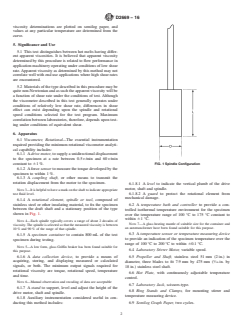
6.1.4 A rotational element, spindle or tool, composed of stainless steel or other insulating material, to fix the specimen between
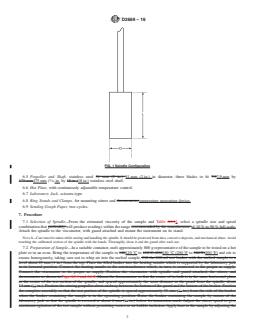
the draft shaft and a stationary position of the type shown in Fig. 1.
NOTE 4—Each spindle typically covers a range of about 2 decades of viscosity. The spindle is selected so that the measured viscosity is between 10 %
and 90 % of the range of that spindle.
6.1.5 A specimen container to contain 800 mL of the test specimen during testing.
NOTE 5—A low form, glass Griffin beaker has been found suitable for this purpose.
6.1.6 A data collection device, to provide a means of acquiring, storing, and displaying measured or calculated signals, or both.
The minimum output signals required for rotational viscosity are torque, rotational speed, temperature and time.
NOTE 6—Manual observation and recoding of data are acceptable
6.1.7 A stand to support, level and adjust the height of the drive motor, shaft and spindle.
6.1.8 Auxiliary instrumentation considered useful in conducting this method includes:
6.1.8.1 A level to indicate the vertical plumb of the drive motor, shaft and spindle.
6.1.8.2 A guard to protect the rotational element from mechanical damage.
6.2 Glass Beaker, A 800-mL Griffın standard form.temperature bath and controller to provide a controlled isothermal
temperature environment for the specimen over the temperature range of 100 °C to 175 °C constant to within 61 °C.
6.3 Glass Heating Mantle, for 800-mL beaker.
NOTE 7—A glass heating mantle of suitable size for the container and an autotransformer have been found suitable for this purpose.
6.4 Autotransformer, variable.
6.3 Thermometers, A ASTM Precision Thermometer 88C having a range from 10 to 200°C or Thermometer 88F
havingtemperature sensor or temperature measuring device a range from 50 to 392°F as prescribed in Specificationto provide an
indication of the E1 are suitable.specimen temperature over the range of 100 °C to 200 °C to within 60.1 °C.
6.4 Laboratory Stirrer Motor, variable speed.
D2669 − 16
FIG. 1 Spindle Configuration
6.5 Propeller and Shaft, stainless steel 51 mm (2 in.) 51 mm (2 in.) in diameter, three blades to fit 7.97.9 mm by
475-mm475 mm ( ⁄16 in. by 18-in.)18 in.) stainless steel shaft.
6.6 Hot Plate, with continuously adjustable temperature control.
6.7 Laboratory Jack, scissors-type.
6.8 Ring Stands and Clamps, for mounting stirrer and thermometer.temperature measuring device.
6.9 Semilog Graph Paper, two cycles.
7. Procedure
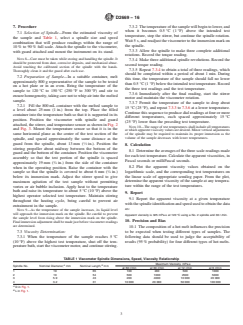
7.1 Selection of Spindle—From the estimated viscosity of the sample and Table A1.11, select a spindle size and speed
combination that preferably will produce readings within the range recommended by the manufacturer. of 10 % to 90 % full scale.
Attach the spindle to the viscometer, with guard attached and mount the instrument on its stand.
NOTE 8—Care must be taken while storing and handling the spindle. It should be protected from dust, corrosive deposits, and mechanical abuse. Avoid
touching the calibrated section of the spindle with the hands. Thoroughly clean it and the guard after each use.
7.2 Preparation of Sample—In a suitable container, melt approximately 800 g representative of the sample to be tested on a hot
plate or in an oven. Bring the temperature of the sample to 120120 °C to 150°C (250150 °C (250 °F to 300°F)300 °F) and stir to
ensure homogeneity, taking care not to whip air into the melted sample. Fill the 800-ml test beaker with the melted sample to a
level about 25 mm (1 in.) from the top. Place the filled beaker into the heating mantle which is supported by the laboratory jack
in its lowered position. Connect the heating mantle to the autotransformer which, in turn, is connected to the proper ac supply.
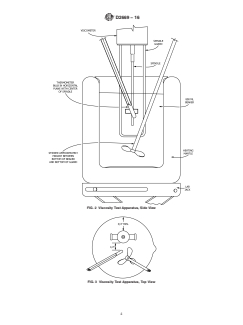
Connect the viscometer to its proper ac supply. Position the viscometer with spindle and guard attached, the stirrer, and
thermometer as shown in Figs. A1.1 and A1.2. Mount the thermometer so that the center of its bulb is in the same horizontal plane
as the center of the test section of the spindle, and spaced approximately the same distance as the guard from the spindle, about
13 mm ( ⁄2 in.). Position the stirring propeller about midway between the bottom of the guard and the bottom of the beaker. Position
the complete assembly so that the test portion of the spindle is spaced approximately 19 mm ( ⁄4 in.) from the side of the beaker
when the beaker containing the sample is in the operating position. Raise the beaker containing the sample by means of the
laboratory jack so that the spindle is covered to about 6 mm ( ⁄4 in.) below its immersion mark. Adjust the stirrer speed to give
maximum agitation of the test sample without permitting vortex or air bubble inclusion. Apply heat to the sample by adjusting the
...