

ASTM E1231-19
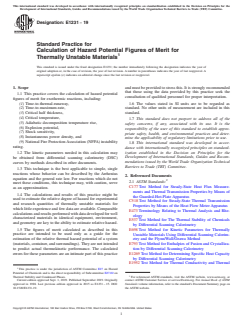
(Practice)Standard Practice for Calculation of Hazard Potential Figures of Merit for Thermally Unstable Materials
General Information
- Abstract
SIGNIFICANCE AND USE
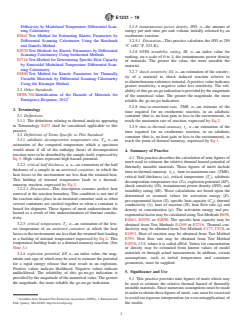
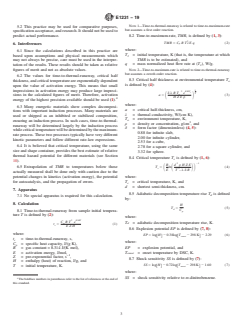
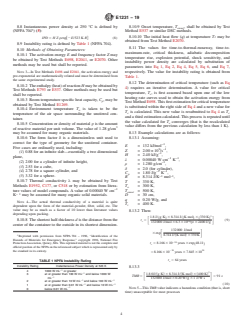
5.1 This practice provides nine figures of merit which may be used to estimate the relative thermal hazard of thermally unstable materials. Since numerous assumptions must be made in order to obtain these figures of merit, care must be exercised to avoid too rigorous interpretation (or even misapplication) of the results.
5.2 This practice may be used for comparative purposes, specification acceptance, and research. It should not be used to predict actual performance.
SCOPE
1.1 This practice covers the calculation of hazard potential figures of merit for exothermic reactions, including:
(1) Time-to-thermal-runaway,
(2) Time-to-maximum-rate,
(3) Critical half thickness,
(4) Critical temperature,
(5) Adiabatic decomposition temperature rise,
(6) Explosion potential,
(7) Shock sensitivity,
(8) Instantaneous power density, and
(9) National Fire Protection Association (NFPA) instability rating.
1.2 The kinetic parameters needed in this calculation may be obtained from differential scanning calorimetry (DSC) curves by methods described in other documents.
1.3 This technique is the best applicable to simple, single reactions whose behavior can be described by the Arrhenius equation and the general rate law. For reactions which do not meet these conditions, this technique may, with caution, serve as an approximation.
1.4 The calculations and results of this practice might be used to estimate the relative degree of hazard for experimental and research quantities of thermally unstable materials for which little experience and few data are available. Comparable calculations and results performed with data developed for well characterized materials in identical equipment, environment, and geometry are key to the ability to estimate relative hazard.
1.5 The figures of merit calculated as described in this practice are intended to be used only as a guide for the estimation of the relative thermal hazard potential of a system (materials, container, and surroundings). They are not intended to predict actual thermokinetic performance. The calculated errors for these parameters are an intimate part of this practice and must be provided to stress this. It is strongly recommended that those using the data provided by this practice seek the consultation of qualified personnel for proper interpretation.
1.6 The values stated in SI units are to be regarded as standard. No other units of measurement are included in this standard.
1.7 This standard does not purport to address all of the safety concerns, if any, associated with its use. It is the responsibility of the user of this standard to establish appropriate safety, health, and environmental practices and determine the applicability of regulatory limitations prior to use.
1.8 This international standard was developed in accordance with internationally recognized principles on standardization established in the Decision on Principles for the Development of International Standards, Guides and Recommendations issued by the World Trade Organization Technical Barriers to Trade (TBT) Committee.
- Status
- Published
- Publication Date
- 31-Aug-2019
- Technical Committee
- E27 - Hazard Potential of Chemicals
- Drafting Committee
- E27.02 - Thermal Stability and Condensed Phases
Buy Documents
ASTM E1231-19 - Standard Practice for Calculation of Hazard Potential Figures of Merit for Thermally Unstable Materials
REDLINE ASTM E1231-19 - Standard Practice for Calculation of Hazard Potential Figures of Merit for Thermally Unstable Materials
Overview
ASTM E1231-19 is the internationally recognized standard practice for the calculation of hazard potential figures of merit for thermally unstable materials. Published by ASTM International, this standard outlines procedures for estimating the relative thermal hazard of exothermic reactions in materials with uncertain or limited historical safety data. By focusing on comparative analysis rather than predictive accuracy, ASTM E1231-19 provides a structured approach to assess the potential hazards tied to thermal instability, guiding safer handling, storage, and research.
Key Topics
This standard details methods for calculating nine core hazard potential figures, each offering a specific perspective on the risks associated with thermally unstable substances:
- Time-to-thermal-runaway: Estimate of how long before a self-accelerating reaction becomes uncontrollable in an adiabatic container.
- Time-to-maximum-rate: Duration to reach peak reaction rate under adiabatic conditions.
- Critical half thickness: Maximum safe sample half-thickness beyond which thermal runaway may occur.
- Critical temperature: Lowest temperature at which the material in a container is at risk of uncontrolled reaction.
- Adiabatic decomposition temperature rise: Potential temperature increase if decomposition occurs with no heat loss.
- Explosion potential: Index value reflecting the likelihood of a rapid energy release or explosion.
- Shock sensitivity: Measure of susceptibility to detonation or violent reaction upon mechanical shock, relative to a standard.
- Instantaneous power density: Energy output rate per unit volume at a reference temperature.
- NFPA instability rating: Classification of material instability based on power density, using the National Fire Protection Association’s scale (0–4).
The required kinetic parameters can be obtained from differential scanning calorimetry (DSC) or referenced methods, emphasizing the standard's compatibility with established thermal analysis procedures.
Applications
ASTM E1231-19 is used across various industries and research settings where the thermal hazards of unstable chemicals must be understood before scaling up, transporting, or processing materials. Key applications include:
- Comparative risk assessment: Enables users to compare relative hazards among different materials or formulations, especially when limited empirical safety data exists.
- Specification acceptance: Supports compliance and acceptance testing by providing standardized criteria for hazard estimation.
- Preliminary research screening: Assists in identifying materials requiring further risk evaluation or special controls during early-stage R&D.
- Process safety management: Offers valuable insights for process engineers, safety officers, and laboratory managers seeking to develop safe protocols for storage, shipment, and use of potentially hazardous substances.
- Guidance for emergency planning: Through integration of NFPA ratings, the standard helps inform emergency response strategies and material classification in compliance with regulatory frameworks.
It is important to note that figures of merit from this standard are intended as relative guides and should not be used to predict actual kinetic performance. ASTM E1231-19 should be applied with caution and ideally interpreted by qualified professionals, due to the inherent assumptions and uncertainties in the calculations.
Related Standards
To ensure accurate and reliable calculation of hazard potential figures, ASTM E1231-19 references several key documents:
- ASTM E537: Thermal stability of chemicals by differential scanning calorimetry.
- ASTM E698, E2041, E2070, E2890: Methods for deriving kinetic parameters using DSC.
- ASTM E1269, E2716: Determination of specific heat capacity.
- ASTM C177, C518, E1952: Methods for measuring thermal conductivity and heat flux.
- ASTM E793: Measurement of enthalpy changes, such as fusion or crystallization, by DSC.
- NFPA 704: Standard system for identification of material hazards for emergency response.
Using this integrated suite of standards ensures robust data collection and enhances the reliability of hazard potential assessments for thermally unstable materials.
Keywords: thermal hazard, thermally unstable materials, differential scanning calorimetry, explosion potential, shock sensitivity, NFPA instability rating, ASTM E1231-19, hazard assessment, process safety, exothermic reactions.
Relations
- Effective Date
- 01-Sep-2019
- Effective Date
- 01-Oct-2023
- Effective Date
- 01-Oct-2023
- Effective Date
- 01-Feb-2020
- Effective Date
- 01-Apr-2018
- Effective Date
- 01-Apr-2018
- Effective Date
- 01-Sep-2015
- Effective Date
- 15-Aug-2014
- Effective Date
- 15-Sep-2013
- Effective Date
- 15-Sep-2013
- Effective Date
- 01-Dec-2012
- Effective Date
- 01-Sep-2012
- Effective Date
- 01-Sep-2012
- Effective Date
- 01-Sep-2012
- Effective Date
- 01-Aug-2011
Buy Documents
ASTM E1231-19 - Standard Practice for Calculation of Hazard Potential Figures of Merit for Thermally Unstable Materials
REDLINE ASTM E1231-19 - Standard Practice for Calculation of Hazard Potential Figures of Merit for Thermally Unstable Materials
Get Certified
Connect with accredited certification bodies for this standard

CIS Institut d.o.o.
Personal Protective Equipment (PPE) certification body. Notified Body NB-2890 for EU Regulation 2016/425 PPE.

Kiwa BDA Testing
Building and construction product certification.
Kmetijski inštitut Slovenije
Agricultural Institute of Slovenia. Soil testing, plant health, agricultural product analysis.
Sponsored listings
Frequently Asked Questions
ASTM E1231-19 is a standard published by ASTM International. Its full title is "Standard Practice for Calculation of Hazard Potential Figures of Merit for Thermally Unstable Materials". This standard covers: SIGNIFICANCE AND USE 5.1 This practice provides nine figures of merit which may be used to estimate the relative thermal hazard of thermally unstable materials. Since numerous assumptions must be made in order to obtain these figures of merit, care must be exercised to avoid too rigorous interpretation (or even misapplication) of the results. 5.2 This practice may be used for comparative purposes, specification acceptance, and research. It should not be used to predict actual performance. SCOPE 1.1 This practice covers the calculation of hazard potential figures of merit for exothermic reactions, including: (1) Time-to-thermal-runaway, (2) Time-to-maximum-rate, (3) Critical half thickness, (4) Critical temperature, (5) Adiabatic decomposition temperature rise, (6) Explosion potential, (7) Shock sensitivity, (8) Instantaneous power density, and (9) National Fire Protection Association (NFPA) instability rating. 1.2 The kinetic parameters needed in this calculation may be obtained from differential scanning calorimetry (DSC) curves by methods described in other documents. 1.3 This technique is the best applicable to simple, single reactions whose behavior can be described by the Arrhenius equation and the general rate law. For reactions which do not meet these conditions, this technique may, with caution, serve as an approximation. 1.4 The calculations and results of this practice might be used to estimate the relative degree of hazard for experimental and research quantities of thermally unstable materials for which little experience and few data are available. Comparable calculations and results performed with data developed for well characterized materials in identical equipment, environment, and geometry are key to the ability to estimate relative hazard. 1.5 The figures of merit calculated as described in this practice are intended to be used only as a guide for the estimation of the relative thermal hazard potential of a system (materials, container, and surroundings). They are not intended to predict actual thermokinetic performance. The calculated errors for these parameters are an intimate part of this practice and must be provided to stress this. It is strongly recommended that those using the data provided by this practice seek the consultation of qualified personnel for proper interpretation. 1.6 The values stated in SI units are to be regarded as standard. No other units of measurement are included in this standard. 1.7 This standard does not purport to address all of the safety concerns, if any, associated with its use. It is the responsibility of the user of this standard to establish appropriate safety, health, and environmental practices and determine the applicability of regulatory limitations prior to use. 1.8 This international standard was developed in accordance with internationally recognized principles on standardization established in the Decision on Principles for the Development of International Standards, Guides and Recommendations issued by the World Trade Organization Technical Barriers to Trade (TBT) Committee.
SIGNIFICANCE AND USE 5.1 This practice provides nine figures of merit which may be used to estimate the relative thermal hazard of thermally unstable materials. Since numerous assumptions must be made in order to obtain these figures of merit, care must be exercised to avoid too rigorous interpretation (or even misapplication) of the results. 5.2 This practice may be used for comparative purposes, specification acceptance, and research. It should not be used to predict actual performance. SCOPE 1.1 This practice covers the calculation of hazard potential figures of merit for exothermic reactions, including: (1) Time-to-thermal-runaway, (2) Time-to-maximum-rate, (3) Critical half thickness, (4) Critical temperature, (5) Adiabatic decomposition temperature rise, (6) Explosion potential, (7) Shock sensitivity, (8) Instantaneous power density, and (9) National Fire Protection Association (NFPA) instability rating. 1.2 The kinetic parameters needed in this calculation may be obtained from differential scanning calorimetry (DSC) curves by methods described in other documents. 1.3 This technique is the best applicable to simple, single reactions whose behavior can be described by the Arrhenius equation and the general rate law. For reactions which do not meet these conditions, this technique may, with caution, serve as an approximation. 1.4 The calculations and results of this practice might be used to estimate the relative degree of hazard for experimental and research quantities of thermally unstable materials for which little experience and few data are available. Comparable calculations and results performed with data developed for well characterized materials in identical equipment, environment, and geometry are key to the ability to estimate relative hazard. 1.5 The figures of merit calculated as described in this practice are intended to be used only as a guide for the estimation of the relative thermal hazard potential of a system (materials, container, and surroundings). They are not intended to predict actual thermokinetic performance. The calculated errors for these parameters are an intimate part of this practice and must be provided to stress this. It is strongly recommended that those using the data provided by this practice seek the consultation of qualified personnel for proper interpretation. 1.6 The values stated in SI units are to be regarded as standard. No other units of measurement are included in this standard. 1.7 This standard does not purport to address all of the safety concerns, if any, associated with its use. It is the responsibility of the user of this standard to establish appropriate safety, health, and environmental practices and determine the applicability of regulatory limitations prior to use. 1.8 This international standard was developed in accordance with internationally recognized principles on standardization established in the Decision on Principles for the Development of International Standards, Guides and Recommendations issued by the World Trade Organization Technical Barriers to Trade (TBT) Committee.
ASTM E1231-19 is classified under the following ICS (International Classification for Standards) categories: 13.230 - Explosion protection. The ICS classification helps identify the subject area and facilitates finding related standards.
ASTM E1231-19 has the following relationships with other standards: It is inter standard links to ASTM E1231-15, ASTM E473-23b, ASTM E2070-23, ASTM E537-20, ASTM E2070-13(2018), ASTM E1269-11(2018), ASTM C518-15, ASTM E473-14, ASTM E2070-13, ASTM E2041-13e1, ASTM E537-12, ASTM E2890-12e1, ASTM E793-06(2012), ASTM E2890-12, ASTM E1952-11. Understanding these relationships helps ensure you are using the most current and applicable version of the standard.
ASTM E1231-19 is available in PDF format for immediate download after purchase. The document can be added to your cart and obtained through the secure checkout process. Digital delivery ensures instant access to the complete standard document.
Standards Content (Sample)
This international standard was developed in accordance with internationally recognized principles on standardization established in the Decision on Principles for the
Development of International Standards, Guides and Recommendations issued by the World Trade Organization Technical Barriers to Trade (TBT) Committee.
Designation: E1231 − 19
Standard Practice for
Calculation of Hazard Potential Figures of Merit for
Thermally Unstable Materials
This standard is issued under the fixed designation E1231; the number immediately following the designation indicates the year of
original adoption or, in the case of revision, the year of last revision.Anumber in parentheses indicates the year of last reapproval.A
superscript epsilon (´) indicates an editorial change since the last revision or reapproval.
1. Scope andmustbeprovidedtostressthis.Itisstronglyrecommended
that those using the data provided by this practice seek the
1.1 This practice covers the calculation of hazard potential
consultation of qualified personnel for proper interpretation.
figures of merit for exothermic reactions, including:
(1)Time-to-thermal-runaway, 1.6 The values stated in SI units are to be regarded as
(2)Time-to-maximum-rate, standard. No other units of measurement are included in this
(3)Critical half thickness, standard.
(4)Critical temperature,
1.7 This standard does not purport to address all of the
(5)Adiabatic decomposition temperature rise,
safety concerns, if any, associated with its use. It is the
(6)Explosion potential,
responsibility of the user of this standard to establish appro-
(7)Shock sensitivity,
priate safety, health, and environmental practices and deter-
(8)Instantaneous power density, and
mine the applicability of regulatory limitations prior to use.
(9)NationalFireProtectionAssociation(NFPA)instability
1.8 This international standard was developed in accor-
rating.
dance with internationally recognized principles on standard-
ization established in the Decision on Principles for the
1.2 The kinetic parameters needed in this calculation may
Development of International Standards, Guides and Recom-
be obtained from differential scanning calorimetry (DSC)
mendations issued by the World Trade Organization Technical
curves by methods described in other documents.
Barriers to Trade (TBT) Committee.
1.3 This technique is the best applicable to simple, single
reactions whose behavior can be described by the Arrhenius
2. Referenced Documents
equation and the general rate law. For reactions which do not
2.1 ASTM Standards:
meet these conditions, this technique may, with caution, serve
C177Test Method for Steady-State Heat Flux Measure-
as an approximation.
ments and Thermal Transmission Properties by Means of
1.4 The calculations and results of this practice might be
the Guarded-Hot-Plate Apparatus
used to estimate the relative degree of hazard for experimental
C518Test Method for Steady-State Thermal Transmission
and research quantities of thermally unstable materials for
Properties by Means of the Heat Flow Meter Apparatus
whichlittleexperienceandfewdataareavailable.Comparable
E473Terminology Relating to Thermal Analysis and Rhe-
calculationsandresultsperformedwithdatadevelopedforwell
ology
characterized materials in identical equipment, environment,
E537Test Method for The Thermal Stability of Chemicals
and geometry are key to the ability to estimate relative hazard.
by Differential Scanning Calorimetry
1.5 The figures of merit calculated as described in this
E698Test Method for Kinetic Parameters for Thermally
practice are intended to be used only as a guide for the Unstable Materials Using Differential Scanning Calorim-
estimation of the relative thermal hazard potential of a system
etry and the Flynn/Wall/Ozawa Method
(materials,container,andsurroundings).Theyarenotintended E793Test Method for Enthalpies of Fusion and Crystalliza-
to predict actual thermokinetic performance. The calculated
tion by Differential Scanning Calorimetry
errors for these parameters are an intimate part of this practice E1269Test Method for Determining Specific Heat Capacity
by Differential Scanning Calorimetry
E1952Test Method for Thermal Conductivity and Thermal
This practice is under the jurisdiction of ASTM Committee E27 on Hazard
Potential of Chemicals and is the direct responsibility of Subcommittee E27.02 on
Thermal Stability and Condensed Phases. For referenced ASTM standards, visit the ASTM website, www.astm.org, or
Current edition approved Sept. 1, 2019. Published September 2019. Originally contact ASTM Customer Service at service@astm.org. For Annual Book of ASTM
approved in 1988. Last previous edition approved in 2015 as E1231–15. DOI: Standards volume information, refer to the standard’s Document Summary page on
10.1520/E1231-19. the ASTM website.
Copyright © ASTM International, 100 Barr Harbor Drive, PO Box C700, West Conshohocken, PA 19428-2959. United States
E1231 − 19
Diffusivity by Modulated Temperature Differential Scan- 3.2.5 instantaneous power density, IPD, n—the amount of
ning Calorimetry energy per unit time per unit volume initially released by an
E2041Test Method for Estimating Kinetic Parameters by exothermic reaction.
Differential Scanning Calorimeter Using the Borchardt 3.2.5.1 Discussion—This practice calculates the IPD at 250
and Daniels Method °C (482 °F, 523 K).
E2070Test Methods for Kinetic Parameters by Differential
3.2.6 NFPA instability rating, IR, n—an index value for
Scanning Calorimetry Using Isothermal Methods
ranking, on a scale of 0 to 4, the instantaneous power density
E2716Test Method for Determining Specific Heat Capacity
of materials. The greater the value, the more unstable the
by Sinusoidal Modulated Temperature Differential Scan-
material.
ning Calorimetry
3.2.7 shock sensitivity, SS, n—an estimation of the sensitiv-
E2890Test Method for Kinetic Parameters for Thermally
ity of a material to shock induced reaction relative to
Unstable Materials by Differential Scanning Calorimetry
m-dinitrobenzenereferencematerial.Apositivevalueindicates
Using the Kissinger Method
greater sensitivity; a negative value less sensitivity. The reli-
2.2 Other Standards:
abilityofthisgo-no-goindicationisprovidedbythemagnitude
NFPA704Identification of the Hazards of Materials for
of the numerical value. The greater the magnitude, the more
Emergency Response, 2012
reliable the go-no-go indication.
3.2.8 time-to-maximum-rate, TMR, n—an estimate of the
3. Terminology
time required for an exothermic reaction, in an adiabatic
3.1 Definitions:
container (that is, no heat gain or loss to the environment), to
3.1.1 The definitions relating to thermal analysis appearing reach the maximum rate of reaction, expressed by Eq 2.
in Terminology E473 shall be considered applicable to this
3.2.9 time-to-thermal-runaway, t,n—an estimation of the
c
practice.
time required for an exothermic reaction, in an adiabatic
3.2 Definitions of Terms Specific to This Standard:
container (that is, no heat gain or loss to the environment), to
3.2.1 adiabatic decomposition temperature rise, T,n—an
d reach the point of thermal runaway, expressed by Eq 1.
estimation of the computed temperature which a specimen
would attain if all of the enthalpy (heat) of decomposition
4. Summary of Practice
reactionweretobeabsorbedbythesampleitself,expressedby
4.1 This practice describes the calculation of nine figures of
Eq 5. High values represent high hazard potential.
merit used to estimate the relative thermal hazard potential of
3.2.2 critical half thickness, a, n—an estimation of the half
thermally unstable materials. These figures of merit include
thickness of a sample in an unstirred container, in which the
time-to-thermal-runaway (t ), time-to-maximum-rate (TMR),
c
heat losses to the environment are less than the retained heat.
critical half thickness (a), critical temperature (T ), adiabatic
c
This buildup of internal temperature leads to a thermal-
decomposition temperature rise (T ), explosion potential (EP),
d
runaway reaction, expressed by Eq 3.
shock sensitivity (SS), instantaneous power density (IPD), and
3.2.2.1 Discussion—This description assumes perfect heat
instability rating (IR). These calculations are based upon the
removal at the reaction boundary. This condition is not met if
determined or assumed values for activation energy (E),
the reaction takes place in an insulated container such as when
pre-exponential factor (Z), specific heat capacity (C ), thermal
p
several containers are stacked together or when a container is
conductivity (λ), heat of reaction (H), heat flow rate (q) and
boxed for shipment. These figures of merit underestimate the
density or concentration (ρ). The activation energy and pre-
hazard as a result of this underestimation of thermal conduc-
exponentialfactormaybecalculatedusingTestMethodsE698,
tivity.
E2041, E2070,or E2890. The specific heat capacity may be
3.2.3 critical temperature, T,n—an estimation of the low-
obtained from Test Methods E1269 or E2716. Thermal con-
c
est temperature of an unstirred container at which the heat ductivity may be obtained from Test Methods C177, C518,or
lossestotheenvironmentarelessthantheretainedheatleading
E1952. Heat of reaction may be obtained from Test Method
to a buildup of internal temperature expressed by Eq 4. This E793. Heat flow rate may be obtained from Test Method
temperature buildup leads to a thermal-runaway reaction. (See
E2070, 13.5, where it is called dH/dt. Values for concentration
Note 3.) or density may be estimated from known values of model
materials or through actual measurement. In addition, certain
3.2.4 explosion potential, EP, n—an index value, the mag-
assumptions, such as initial temperature and container
nitude and sign of which may be used to estimate the potential
geometries, must be supplied.
for a rapid energy release that may result in an explosion.
Positive values indicate likelihood. Negative values indicate
5. Significance and Use
unlikelihood. The reliability of this go-no-go indication is
provided by the magnitude of the numerical value.The greater
5.1 This practice provides nine figures of merit which may
the magnitude, the more reliable the go-no-go indication.
be used to estimate the relative thermal hazard of thermally
unstablematerials.Sincenumerousassumptionsmustbemade
inordertoobtainthesefiguresofmerit,caremustbeexercised
to avoid too rigorous interpretation (or even misapplication) of
Available from National Fire Protection Association (NFPA), 1 Batterymarch
Park, Quincy, MA 02269, http://www.nfpa.org. the results.
E1231 − 19
NOTE 1—Time-to-thermal-runaway is related to time-to-maximum-rate
5.2 This practice may be used for comparative purposes,
but assumes a first order reaction.
specification acceptance, and research. It should not be used to
predict actual performance. 8.2 Time-to-maximum-rate, TMR, is defined by (1, 3):
TMR 5 C RT ⁄Eq (2)
p 1
6. Interferences
where:
6.1 Since the calculations described in this practice are
T = initial temperature, K (that is, the temperature at which
based upon assumptions and physical measurements which
TMR is to be estimated), and
may not always be precise, care must be used in the interpre-
q = mass normalized heat flow rate at (T ), W/g.
tation of the results. These results should be taken as relative 1
figures of merit and not as absolute values. NOTE 2—Time-to-maximum-rate is related to time-to-thermal-runaway
but assumes a zeroth order reaction.
6.2 The values for time-to-thermal-runaway, critical half
8.3 Critical half thickness at environmental temperature T
thickness,andcriticaltemperatureareexponentiallydependent
o
is defined by (4):
upon the value of activation energy. This means that small
imprecisions in activation energy may produce large impreci-
2 E/RT
o
δλRT e 2
o
sions in the calculated figures of merit. Therefore, activation a 5 (3)
S D
HZE ρ
energy of the highest precision available should be used (1).
where:
6.3 Many energetic materials show complex decomposi-
a = critical half-thickness, cm,
tions with important induction processes. Many materials are
λ = thermal conductivity, W/(cm K),
used or shipped as an inhibited or stabilized composition,
T = environment temperature, K,
o
ensuring an induction process. In such cases, time-to-thermal-
ρ = density or concentration, g/cm , and
runaway will be determined largely by the induction process
δ = form factor (dimensionless) (4, 5):
whilecriticaltemperaturewillbedeterminedbythemaximum-
0.88 for infinite slab,
rate process.These two processes typically have very different
2.00 for infinite cylinder,
kinetic parameters and follow different rate-law expressions.
2.53 for a cube,
6.4 It is believed that critical temperature, using the same
2.78 for a square cylinder, and
size and shape container, provides the best estimate of relative
3.32 for sphere.
thermal hazard potential for different materials (see Section
8.4 Critical temperature T is defined by (1, 6):
c
10).
2 21
R d ρHZE
6.5 Extrapolation of TMR to temperatures below those
T 5 ln (4)
S S DD
c 2
E T λδ R
c
actually measured shall be done only with caution due to the
potential changes in kinetics (activation energy), the potential where:
for autocatalysis, and the propagation of errors.
T = critical temperature, K, and
c
d = shortest semi-thickness, cm.
7. Apparatus
8.5 Adiabatic decomposition temperature rise T is defined
d
7.1 No special apparatus is required for this calculation.
by:
8. Calculation
H
T 5 (5)
d
C
8.1 Time-to-thermal-runaway from sample initial tempera-
p
ture T is defined by (2):
where:
2 E/RT
C RT e
p T = adiabatic decomposition temperature rise, K.
d
t 5 (1)
c
EZH
8.6 Explosion potential EP is defined by (7, 8):
where:
EP 5log H 20.38log T 2298K 22.29 (6)
@ # @ #
onset
t = time-to-thermal-runaway, s,
c
where:
C = specific heat capacity, J/(g K),
p
R = gas constant=8.314 J/(K mol), EP = explosion potential, and
E = activation energy, J/mol, T = onset temperature by DSC, K.
onset
−1
Z = pre-exponential factor, s ,
8.7 Shock sensitivity SS is defined by (7):
H = enthalpy (heat) of reaction, J/g, and
SS 5log H 20.72log T 2298K 21.60 (7)
T = initial temperature, K. @ # @ #
onset
where:
4 SS = shock sensitivity relative to m-dinitrobenzene.
Theboldfacenumbersinparenthesesrefertothelistofreferencesattheendof
this standard.
E1231 − 19
8.8 Instantaneous power density at 250 °C is defined by 8.10.9 Onset temperature, T , shall be obtained by Test
onset
(NFPA704 ) (5): Method E537 or similar DSC methods.
8.10.10 The initial heat flow (q) at temperature T may be
IPD 5HZ ρexp@2E/523K R# (8)
obtained from Test Method E2070.
8.9 Instability rating is defined by Table 1 (NFPA704).
8.11 The values for time-to-thermal-runaway, time-to-
8.10 Methods of Obtaining Parameters:
maximum-rate, critical thickness, adiabatic decomposition
8.10.1 The activation energy E and frequency factor Z may
temperature rise, explosion potential, shock sensitivity, and
be obtained by Test Methods E698, E2041,or E2070. Other
instability power density are calculated by substitution of
methods may be used but shall be reported.
parameters into Eq 1, Eq 2, Eq 4, Eq 5, Eq 6, and Eq 7,
NOTE 3—In Test Methods E698 and E2041, the activation energy and
respectively. The value for instability rating is obtained from
pre-exponential are mathematically related and must be determined from
Table 1.
the same experimental study.
8.12 The determination of critical temperature (such as Eq
8.10.2 Theenthalpy(heat)ofreactionHmaybeobtainedby
4) requires an iterative determination. A value for critical
Test Methods E793 or E537. Other methods may be used but
temperature, T , is first assumed based upon one of the low
c
shall be reported.
heating rate curves used to obtain the activation energy from
8.10.3 Room temperature specific heat capacity, C , may be
p
TestMethodE698.Thisfirstestimationforcriticaltemperature
obtained by Test Method E1269.
is substituted within the right side of Eq 4 and a new value for
8.10.4 Environment temperature T is taken to be the
o
T is calculated. This new value is resubmitted to Eq 4 as T
c c
temperature of the air space surrounding the unstirred con-
andathirdestimationcalculated.Thisprocessisrepeateduntil
tainer.
the value calculated for T converges (that is the recalculated
c
8.10.5 Concentration or density of material ρ is the amount
value differs from the previous calculation by less than 1 K).
of reactive material per unit volume. The value of 1.28 g/cm
8.13 Example calculations are as follows:
may be assumed for many organic materials.
8.10.6 The form factor δ is a dimensionless unit used to 8.13.1 Assuming:
correct for the type of geometry for the unstirred container.
−1
E = 132 kJ/mol ,
Five cases are ordinarily used, including:
9 −1
Z = 2.00×10 /s ,
(1)0.88 for an infinite slab—essentially a two dimensional
−1
H = 2.40 kJ/g ,
plane,
−1 −1
λ = 0.00040 W cm K ,
(2)2.00 for a cylinder of infinite height,
−3
ρ = 1.280 g/cm ,
(3)2.53 for a cube,
δ = 2.0 (for cylinder),
(4)2.78 for a square cylinder, and −1 −1
C = 1.80 J/g K ,
p
−1 −1
(5)3.32 for
...
This document is not an ASTM standard and is intended only to provide the user of an ASTM standard an indication of what changes have been made to the previous version. Because
it may not be technically possible to adequately depict all changes accurately, ASTM recommends that users consult prior editions as appropriate. In all cases only the current version
of the standard as published by ASTM is to be considered the official document.
Designation: E1231 − 15 E1231 − 19
Standard Practice for
Calculation of Hazard Potential Figures of Merit for
Thermally Unstable Materials
This standard is issued under the fixed designation E1231; the number immediately following the designation indicates the year of
original adoption or, in the case of revision, the year of last revision. A number in parentheses indicates the year of last reapproval. A
superscript epsilon (´) indicates an editorial change since the last revision or reapproval.
1. Scope
1.1 This practice covers the calculation of hazard potential figures of merit for exothermic reactions, including:
(1) Time-to-thermal-runaway,
(2) Time-to-maximum-rate,
(3) Critical half thickness,
(4) Critical temperature,
(5) Adiabatic decomposition temperature rise,
(6) Explosion potential,
(7) Shock sensitivity,
(8) Instantaneous power density, and
(9) NFPA National Fire Protection Association (NFPA) instability rating.
1.2 The kinetic parameters needed in this calculation may be obtained from differential scanning calorimetry (DSC) curves by
methods described in other documents.
1.3 This technique is the best applicable to simple, single reactions whose behavior can be described by the Arrhenius equation
and the general rate law. For reactions which do not meet these conditions, this technique may, with caution, serve as an
approximation.
1.4 The calculations and results of this practice might be used to estimate the relative degree of hazard for experimental and
research quantities of thermally unstable materials for which little experience and few data are available. Comparable calculations
and results performed with data developed for well characterized materials in identical equipment, environment, and geometry are
key to the ability to estimate relative hazard.
1.5 The figures of merit calculated as described in this practice are intended to be used only as a guide for the estimation of
the relative thermal hazard potential of a system (materials, container, and surroundings). They are not intended to predict actual
thermokinetic performance. The calculated errors for these parameters are an intimate part of this practice and must be provided
to stress this. It is strongly recommended that those using the data provided by this practice seek the consultation of qualified
personnel for proper interpretation.
1.6 The values stated in SI units are to be regarded as standard. No other units of measurement are included in this standard.
1.7 There is no ISO standard equivalent to this practice.
1.7 This standard does not purport to address all of the safety concerns, if any, associated with its use. It is the responsibility
of the user of this standard to establish appropriate safety, health, and environmental practices and determine the applicability of
regulatory limitations prior to use.
1.8 This international standard was developed in accordance with internationally recognized principles on standardization
established in the Decision on Principles for the Development of International Standards, Guides and Recommendations issued
by the World Trade Organization Technical Barriers to Trade (TBT) Committee.
This practice is under the jurisdiction of ASTM Committee E27 on Hazard Potential of Chemicals and is the direct responsibility of Subcommittee E27.02 on Thermal
Stability and Condensed Phases.
Current edition approved Nov. 1, 2015Sept. 1, 2019. Published January 2016September 2019. Originally approved in 1988. Last previous edition approved in 20102015
as E1231 – 10.E1231 – 15. DOI: 10.1520/E1231-15.10.1520/E1231-19.
Copyright © ASTM International, 100 Barr Harbor Drive, PO Box C700, West Conshohocken, PA 19428-2959. United States
E1231 − 19
2. Referenced Documents
2.1 ASTM Standards:
C177 Test Method for Steady-State Heat Flux Measurements and Thermal Transmission Properties by Means of the
Guarded-Hot-Plate Apparatus
C518 Test Method for Steady-State Thermal Transmission Properties by Means of the Heat Flow Meter Apparatus
E473 Terminology Relating to Thermal Analysis and Rheology
E537 Test Method for The Thermal Stability of Chemicals by Differential Scanning Calorimetry
E698 Test Method for Kinetic Parameters for Thermally Unstable Materials Using Differential Scanning Calorimetry and the
Flynn/Wall/Ozawa Method
E793 Test Method for Enthalpies of Fusion and Crystallization by Differential Scanning Calorimetry
E1269 Test Method for Determining Specific Heat Capacity by Differential Scanning Calorimetry
E1952 Test Method for Thermal Conductivity and Thermal Diffusivity by Modulated Temperature Differential Scanning
Calorimetry
E2041 Test Method for Estimating Kinetic Parameters by Differential Scanning Calorimeter Using the Borchardt and Daniels
Method
E2070 Test Methods for Kinetic Parameters by Differential Scanning Calorimetry Using Isothermal Methods
E2716 Test Method for Determining Specific Heat Capacity by Sinusoidal Modulated Temperature Differential Scanning
Calorimetry
E2890 Test Method for Kinetic Parameters for Thermally Unstable Materials by Differential Scanning Calorimetry Using the
Kissinger Method
2.2 Other Standards:
NFPA 704 Identification of the Hazards of Materials for Emergency Response, 2012
3. Terminology
3.1 Definitions:
3.1.1 The definitions relating to thermal analysis appearing in Terminology E473 shall be considered applicable to this practice.
3.2 Definitions of Terms Specific to This Standard:
3.2.1 adiabatic decomposition temperature rise, T —, n—an estimation of the computed temperature which a specimen would
d
attain if all of the enthalpy (heat) of decomposition reaction were to be absorbed by the sample itself, expressed by Eq 5. High
values represent high hazard potential.
3.2.2 critical half thickness, a—a, n—an estimation of the half thickness of a sample in an unstirred container, in which the heat
losses to the environment are less than the retained heat. This buildup of internal temperature leads to a thermal-runaway reaction,
expressed by Eq 3.
3.2.2.1 Discussion—
This description assumes perfect heat removal at the reaction boundary. This condition is not met if the reaction takes place in an
insulated container such as when several containers are stacked together or when a container is boxed for shipment. These figures
of merit underestimate the hazard as a result of this underestimation of thermal conductivity.
3.2.3 critical temperature, T —, n—an estimation of the lowest temperature of an unstirred container at which the heat losses
c
to the environment are less than the retained heat leading to a buildup of internal temperature expressed by Eq 4. This temperature
buildup leads to a thermal-runaway reaction. (See Note 3.)
3.2.4 explosion potential, EP—EP, n—an index value, the magnitude and sign of which may be used to estimate the potential
for a rapid energy release that may result in an explosion. Positive values indicate likelihood. Negative values indicate
unlikelihood. The reliability of this go-no-go indication is provided by the magnitude of the numerical value. The greater the
magnitude, the more reliable the go-no-go indication.
3.2.5 instantaneous power density, IPD—IPD, n—the amount of energy per unit time per unit volume initially released by an
exothermic reaction.
3.2.5.1 Discussion—
This practice calculates the IPD at 250°C (482°F, 250 °C (482 °F, 523 K).
For referenced ASTM standards, visit the ASTM website, www.astm.org, or contact ASTM Customer Service at service@astm.org. For Annual Book of ASTM Standards
volume information, refer to the standard’sstandard’s Document Summary page on the ASTM website.
Available from National Fire Protection Association (NFPA), 1 Batterymarch Park, Quincy, MA 02269, http://www.nfpa.org.
E1231 − 19
3.2.6 NFPA instability rating, IR—IR, n—an index value for ranking, on a scale of 0 to 4, the instantaneous power density of
materials. The greater the value, the more unstable the material.
3.2.7 shock sensitivity, SS—SS, n—an estimation of the sensitivity of a material to shock induced reaction relative to
m-dinitrobenzene reference material. A positive value indicates greater sensitivity; a negative value less sensitivity. The reliability
of this go-no-go indication is provided by the magnitude of the numerical value. The greater the magnitude, the more reliable the
go-no-go indication.
3.2.8 time-to-maximum-rate, TMR—TMR, n—an estimate of the time required for an exothermic reaction, in an adiabatic
container (that is, no heat gain or loss to the environment), to reach the maximum rate of reaction, expressed by Eq 2.
3.2.9 time-to-thermal-runaway, t —, n—an estimation of the time required for an exothermic reaction, in an adiabatic container
c
(that is, no heat gain or loss to the environment), to reach the point of thermal runaway, expressed by Eq 1.
4. Summary of Practice
4.1 This practice describes the calculation of nine figures of merit used to estimate the relative thermal hazard potential of
thermally unstable materials. These figures of merit include time-to-thermal-runaway (t ), time-to-maximum-rate (TMR), critical
c
half thickness (a), critical temperature (T ), adiabatic decomposition temperature rise (T ), explosion potential (EP), shock
c d
sensitivity (SS), instantaneous power density (IPD), and instability rating (IR). These calculations are based upon the determined
or assumed values for activation energy (E), pre-exponential factor (Z), specific heat capacity (C ), thermal conductivity (λ), heat
p
of reaction (H), heat flow rate (q) and density or concentration (ρ). The activation energy and pre-exponential factor may be
calculated using Test Methods E698, E2041, E2070, or E2890. The specific heat capacity may be obtained from Test Methods
E1269 or E2716. Thermal conductivity may be obtained from Test Methods C177, C518, or E1952. Heat of reaction may be
obtained from Test Method E793. Heat flow rate may be obtained from Test Method E2070, 13.5, where it is called dH/dt.dH/dt.
Values for concentration or density may be estimated from known values of model materials or through actual measurement. In
addition, certain assumptions, such as initial temperature and container geometries, must be supplied.
5. Significance and Use
5.1 This practice provides nine figures of merit which may be used to estimate the relative thermal hazard of thermally unstable
materials. Since numerous assumptions must be made in order to obtain these figures of merit, care must be exercised to avoid
too rigorous interpretation (or even misapplication) of the results.
5.2 This practice may be used for comparative purposes, specification acceptance, and research. It should not be used to predict
actual performance.
6. Interferences
6.1 Since the calculations described in this practice are based upon assumptions and physical measurements which may not
always be precise, care must be used in the interpretation of the results. These results should be taken as relative figures of merit
and not as absolute values.
6.2 The values for time-to-thermal-runaway, critical half thickness, and critical temperature are exponentially dependent upon
the value of activation energy. This means that small imprecisions in activation energy may produce large imprecisions in the
calculated figures of merit. Therefore, activation energy of the highest precision available should be used (1).
6.3 Many energetic materials show complex decompositions with important induction processes. Many materials are used or
shipped as an inhibited or stabilized composition, ensuring an induction process. In such cases, time-to-thermal-runaway will be
determined largely by the induction process while critical temperature will be determined by the maximum-rate process. These two
processes typically have very different kinetic parameters and follow different rate-law expressions.
6.4 It is believed that critical temperature, using the same size and shape container, provides the best estimate of relative thermal
hazard potential for different materials (see Section 10).
6.5 Extrapolation of TMR to temperatures below those actually measured shall be done only with caution due to the potential
changes in kinetics (activation energy), the potential for autocatalysis, and the propagation of errors.
7. Apparatus
7.1 No special apparatus is required for this calculation.
8. Calculation
8.1 Time-to-thermal-runaway from sample initial temperature T is defined by (see Ref (2))::
2 E/RT
C R T e
p
t 5 (1)
c
E Z H
The boldface numbers in parentheses refer to the list of references at the end of this standard.
E1231 − 19
where:
t = time-to-thermal-runaway, s,
c
C = specific heat capacity, J/(g K),
p
R = gas constant = 8.314 J⁄(K mol),
R = gas constant = 8.314 J/(K mol),
E = activation energy, J/mol,
−1
Z = pre-exponential factor, s ,
H = enthalpy (heat) of reaction, J/g, and
T = initial temperature, K.
NOTE 1—Time-to-thermal-runaway is related to time-to-maximum-rate but assumes a first order reaction.
8.2 Time-to-maximum-rate, TMR, is defined by (see Refs (1), and (3))::
TMR 5 C R T ⁄E q (2)
p 1
where:
T = initial temperature, K (that is, the temperature at which TMR is to be estimated), and
q = mass normalized heat flow rate at (T ), W/g.
NOTE 2—Time-to-maximum-rate is related to time-to-thermal-runaway but assumes a zeroth order reaction.
8.3 Critical half thickness at environmental temperature T is defined by (see Ref (4))::
o
2 E/RT
o
δ λ R T e
o
a 5 (3)
S D
H Z E ρ
where:
a = critical half-thickness, cm;
λ = thermal conductivity, W/(cm K);
T = environment temperature, K;
o
ρ = density or concentration, g/cm ; and
δ = form factor (dimensionless) (4, 5):
a = critical half-thickness, cm,
λ = thermal conductivity, W/(cm K),
T = environment temperature, K,
o
ρ = density or concentration, g/cm , and
δ = form factor (dimensionless) (4, 5):
0.88 for infinite slab,
2.00 for infinite cylinder,
2.53 for a cube,
2.78 for a square cylinder, and
3.32 for sphere.
0.88 for infinite slab,
2.00 for infinite cylinder,
2.53 for a cube,
2.78 for a square cylinder, and
3.32 for sphere.
8.4 Critical temperature T is defined by (see Refs (1), and (6))::
c
2 21
R d ρ H Z E
T 5 ln (4)
S S DD
c 2
E T λ δ R
c
where:
T = critical temperature, K, and
c
d = shortest semi-thickness, cm.
8.5 Adiabatic decomposition temperature rise T is defined by:
d
H
T 5 (5)
d
C
p
where:
T = adiabatic decomposition temperature rise, K.
d
8.6 Explosion potential EP is defined by (7, 8):
E1231 − 19
EP 5 log H 2 0.38log T 2 298 K 2 2.29 (6)
@ # @ #
onset
where:
EP = explosion potential, and
T = onset temperature by DSC, K.
onset
8.7 Shock sensitivity SS is defined by (7):
SS 5 log H 2 0.72log T 2 298 K 2 1.60 (7)
@ # @ #
onset
where:
SS = shock sensitivity relative to m-dinitrobenzene.
E1231 − 19
8.8 Instantaneous power density at 250°C 250 °C is defined by (NFPA 704):(NFPA 704 ) (5):
IPD 5 H Z ρexp@2E/523 K R# (8)
8.9 Instability rating is defined by Table 1 (NFPA 704).
8.10 Methods of Obtaining Parameters:
8.10.1 The activation energy E and frequency factor Z may be obtained by Test Methods E698, E2041, or E2070. Other methods
may be used but shall be reported.
NOTE 3—In Test Methods E698 and E2041, the activation energy and pre-exponential are mathematically related and must be determined from the same
experimental study.
8.10.2 The enthalpy (heat) of reaction H may be obtained by Test Methods E793 or E537. Other methods may be used but shall
be reported.
8.10.3 Room temperature specific heat capacity, C , may be obtained by Test Method E1269.
p
8.10.4 Environment temperature T is taken to be the temperature of the air space surrounding the unstirred container.
o
8.10.5 Concentration or density of material ρ is the amount of reactive material per unit volume. The value of 1.28 g/cm may
be assumed for many organic materials.
8.10.6 The form factor δ is a dimensionless unit used to correct for the type of geometry for the unstirred container. Five cases
are ordinarily used, including:
(1) 0.88 for an infinite slab—essentially a two dimensional plane,
(2) 2.00 for a cylinder of infinite height,
(3) 2.53 for a cube,
(4) 2.78 for a square cylinder, and
(5) 3.32 for a sphere.
8.10.7 Thermal conductivity λ may be obtained by Test Methods E1952, C177, or C518 or by estimation from literature values
−1 − 1
of model compounds. A value of 0.00040 W cm K may be assumed for many organic solid materials.
NOTE 4—The actual thermal conductivity of a material is quite dependent upon the form of the material–powder, fiber, solid, etc. The value may be
as much as a factor of 10 lower than literature values depending upon packing.
8.10.8 The shortest half-thickness d is the distance from the center of the container to the outside in its shortest dimension.
8.10.9 Onset temperature, T , shall be obtained by Test Method E537 or similar DSC methods.
onset
8.10.10 The initial heat flow (q) at temperature T may be obtained from Test Method E2070.
8.11 The values for time-to-thermal-runaway, time-to-maximum-rate, critical thickness, adiabatic decomposition temperature
rise, explosion potential, shock sensitivity, and instability power density are calculated by substitution of parameters into Eq 1, Eq
2, Eq 4, Eq 5, Eq 6, and Eq 7, respectively. The value for instability rating is obtained from Table 1.
8.12 The determination of critical temperature (such as Eq 4) requires an iterative determination. A value for critical
temperature, T , i
...