

ASTM E2070-23
(Test Method)Standard Test Methods for Kinetic Parameters by Differential Scanning Calorimetry Using Isothermal Methods
General Information
- Abstract
SIGNIFICANCE AND USE
6.1 These test methods are useful for research and development, quality assurance, regulatory compliance, and specification acceptance purposes.
6.2 The determination of the order of a chemical reaction or transformation at specific temperatures or time conditions is beyond the scope of these test methods.
6.3 The activation energy results obtained by these test methods may be compared with those obtained from Test Method E698 for nth order and accelerating reactions. Activation energy, pre-exponential factor, and reaction order results by these test methods may be compared to those for Test Method E2041 for nth order reactions.
SCOPE
1.1 Test Methods A, B, and C determine kinetic parameters for activation energy, pre-exponential factor and reaction order using differential scanning calorimetry (DSC) from a series of isothermal experiments over a small (≈10 K) temperature range. Test Method A is applicable to low nth order reactions. Test Methods B and C are applicable to accelerating reactions such as thermoset curing or pyrotechnic reactions and crystallization transformations in the temperature range from 300 K to 900 K (nominally 30 °C to 630 °C). These test methods are applicable only to these types of exothermic reactions when the thermal curves do not exhibit shoulders, double peaks, discontinuities or shifts in baseline.
1.2 Test Methods D and E also determines the activation energy of a set of time-to-event and isothermal temperature data generated by this or other procedures
1.3 The values stated in SI units are to be regarded as standard. No other units of measurement are included in this standard.
1.4 This standard does not purport to address all of the safety concerns, if any, associated with its use. It is the responsibility of the user of this standard to establish appropriate safety, health, and environmental practices and determine the applicability of regulatory limitations prior to use. Specific precautionary statements are given in Section 8.
1.5 This international standard was developed in accordance with internationally recognized principles on standardization established in the Decision on Principles for the Development of International Standards, Guides and Recommendations issued by the World Trade Organization Technical Barriers to Trade (TBT) Committee.
- Status
- Published
- Publication Date
- 30-Sep-2023
- Technical Committee
- E37 - Thermal Measurements
- Drafting Committee
- E37.01 - Calorimetry and Mass Loss
Buy Documents
ASTM E2070-23 - Standard Test Methods for Kinetic Parameters by Differential Scanning Calorimetry Using Isothermal Methods
REDLINE ASTM E2070-23 - Standard Test Methods for Kinetic Parameters by Differential Scanning Calorimetry Using Isothermal Methods
Overview
ASTM E2070-23: Standard Test Methods for Kinetic Parameters by Differential Scanning Calorimetry Using Isothermal Methods provides standardized procedures for determining kinetic parameters-such as activation energy, pre-exponential factor, and reaction order-using differential scanning calorimetry (DSC) under isothermal conditions. Developed by ASTM International, this standard ensures accurate, repeatable evaluations of reaction kinetics for a wide range of exothermic reactions, facilitating research, quality assurance, regulatory compliance, and specification acceptance in diverse industrial and laboratory settings.
Key Topics
- Differential Scanning Calorimetry (DSC): Utilized as a precise thermal analysis technique to monitor heat flow during chemical reactions at controlled, constant temperatures.
- Isothermal Methods: The standard outlines several test methods (A, B, C, D, E) focusing on isothermal experiments over a narrow temperature range (approximately 10 K).
- Test Method A: Suitable for low nth order reactions.
- Test Methods B & C: Designed for accelerating reactions, such as thermoset curing and crystallization, in the 300 K to 900 K temperature range.
- Kinetic Parameters: Calculation and comparison of activation energy, pre-exponential factor, and reaction order are central, supporting both nth order and accelerating reactions.
- Scope Limitations: The test methods are only applicable to exothermic reactions with smooth thermal curves, free from shoulders or discontinuities. Determination of reaction order at specific temperatures or under certain conditions is beyond the scope.
- Comparison to Other Standards: Results can be compared to those obtained under ASTM E698 and E2041, broadening context and application.
Applications
ASTM E2070-23 provides practical value in several areas:
- Research & Development: Offers reliable kinetic parameter measurements aiding new product development, material characterization, and process optimization.
- Quality Assurance: Facilitates consistent monitoring of batch-to-batch variations and ensures materials meet kinetic specifications.
- Regulatory Compliance: Supports documentation and substantiation of kinetic data for safety, performance, and environmental regulations.
- Specification Acceptance: Used to verify that materials or products meet contractual or regulatory kinetic requirements.
- Material Types: Commonly applied to the study of thermoset polymers, explosives/pyrotechnics, lubricants, and crystalline materials where exothermic transformations occur.
- Analytical Comparisons: Enables benchmarking of experimental results with established methods, supporting data validation and scientific rigor.
Related Standards
The following ASTM standards are frequently referenced alongside ASTM E2070-23 for comprehensive analysis and calibration:
- ASTM E698: Test Method for Kinetic Parameters for Thermally Unstable Materials Using DSC.
- ASTM E2041: Test Method for Estimating Kinetic Parameters by DSC Using the Borchardt and Daniels Method.
- ASTM E967: Test Method for Temperature Calibration of DSC and Differential Thermal Analyzers.
- ASTM D3895, D5483, D6186: Methods for oxidation induction time in polymers and lubricants by DSC.
- ASTM E537: Test Method for Thermal Stability of Chemicals by DSC.
- ASTM E473, E1142, E1445: Terminology related to thermal analysis and hazard potential of chemicals.
These related standards complement ASTM E2070-23, enabling integrated approaches to thermal analysis, kinetic parameter calculation, and laboratory best practices.
Keywords: ASTM E2070-23, kinetic parameters, differential scanning calorimetry, isothermal methods, activation energy, reaction order, pre-exponential factor, thermal analysis, exothermic reactions, material testing, quality assurance, regulatory compliance, research and development.
Relations
- Effective Date
- 01-Oct-2023
- Effective Date
- 15-Nov-2023
- Effective Date
- 01-Oct-2023
- Effective Date
- 01-Oct-2023
- Effective Date
- 01-Aug-2023
- Effective Date
- 01-May-2023
- Effective Date
- 01-Feb-2015
- Effective Date
- 01-Oct-2023
- Effective Date
- 01-Oct-2023
- Effective Date
- 01-Oct-2023
- Effective Date
- 01-Oct-2023
- Effective Date
- 01-Oct-2023
Buy Documents
ASTM E2070-23 - Standard Test Methods for Kinetic Parameters by Differential Scanning Calorimetry Using Isothermal Methods
REDLINE ASTM E2070-23 - Standard Test Methods for Kinetic Parameters by Differential Scanning Calorimetry Using Isothermal Methods
Get Certified
Connect with accredited certification bodies for this standard

BSMI (Bureau of Standards, Metrology and Inspection)
Taiwan's standards and inspection authority.
Sponsored listings
Frequently Asked Questions
ASTM E2070-23 is a standard published by ASTM International. Its full title is "Standard Test Methods for Kinetic Parameters by Differential Scanning Calorimetry Using Isothermal Methods". This standard covers: SIGNIFICANCE AND USE 6.1 These test methods are useful for research and development, quality assurance, regulatory compliance, and specification acceptance purposes. 6.2 The determination of the order of a chemical reaction or transformation at specific temperatures or time conditions is beyond the scope of these test methods. 6.3 The activation energy results obtained by these test methods may be compared with those obtained from Test Method E698 for nth order and accelerating reactions. Activation energy, pre-exponential factor, and reaction order results by these test methods may be compared to those for Test Method E2041 for nth order reactions. SCOPE 1.1 Test Methods A, B, and C determine kinetic parameters for activation energy, pre-exponential factor and reaction order using differential scanning calorimetry (DSC) from a series of isothermal experiments over a small (≈10 K) temperature range. Test Method A is applicable to low nth order reactions. Test Methods B and C are applicable to accelerating reactions such as thermoset curing or pyrotechnic reactions and crystallization transformations in the temperature range from 300 K to 900 K (nominally 30 °C to 630 °C). These test methods are applicable only to these types of exothermic reactions when the thermal curves do not exhibit shoulders, double peaks, discontinuities or shifts in baseline. 1.2 Test Methods D and E also determines the activation energy of a set of time-to-event and isothermal temperature data generated by this or other procedures 1.3 The values stated in SI units are to be regarded as standard. No other units of measurement are included in this standard. 1.4 This standard does not purport to address all of the safety concerns, if any, associated with its use. It is the responsibility of the user of this standard to establish appropriate safety, health, and environmental practices and determine the applicability of regulatory limitations prior to use. Specific precautionary statements are given in Section 8. 1.5 This international standard was developed in accordance with internationally recognized principles on standardization established in the Decision on Principles for the Development of International Standards, Guides and Recommendations issued by the World Trade Organization Technical Barriers to Trade (TBT) Committee.
SIGNIFICANCE AND USE 6.1 These test methods are useful for research and development, quality assurance, regulatory compliance, and specification acceptance purposes. 6.2 The determination of the order of a chemical reaction or transformation at specific temperatures or time conditions is beyond the scope of these test methods. 6.3 The activation energy results obtained by these test methods may be compared with those obtained from Test Method E698 for nth order and accelerating reactions. Activation energy, pre-exponential factor, and reaction order results by these test methods may be compared to those for Test Method E2041 for nth order reactions. SCOPE 1.1 Test Methods A, B, and C determine kinetic parameters for activation energy, pre-exponential factor and reaction order using differential scanning calorimetry (DSC) from a series of isothermal experiments over a small (≈10 K) temperature range. Test Method A is applicable to low nth order reactions. Test Methods B and C are applicable to accelerating reactions such as thermoset curing or pyrotechnic reactions and crystallization transformations in the temperature range from 300 K to 900 K (nominally 30 °C to 630 °C). These test methods are applicable only to these types of exothermic reactions when the thermal curves do not exhibit shoulders, double peaks, discontinuities or shifts in baseline. 1.2 Test Methods D and E also determines the activation energy of a set of time-to-event and isothermal temperature data generated by this or other procedures 1.3 The values stated in SI units are to be regarded as standard. No other units of measurement are included in this standard. 1.4 This standard does not purport to address all of the safety concerns, if any, associated with its use. It is the responsibility of the user of this standard to establish appropriate safety, health, and environmental practices and determine the applicability of regulatory limitations prior to use. Specific precautionary statements are given in Section 8. 1.5 This international standard was developed in accordance with internationally recognized principles on standardization established in the Decision on Principles for the Development of International Standards, Guides and Recommendations issued by the World Trade Organization Technical Barriers to Trade (TBT) Committee.
ASTM E2070-23 is classified under the following ICS (International Classification for Standards) categories: 17.200.10 - Heat. Calorimetry. The ICS classification helps identify the subject area and facilitates finding related standards.
ASTM E2070-23 has the following relationships with other standards: It is inter standard links to ASTM E2070-13(2018), ASTM E1445-08(2023), ASTM E1142-23b, ASTM E473-23b, ASTM E473-23a, ASTM E1142-23a, ASTM E1445-08(2015), ASTM E1860-23, ASTM E2781-16, ASTM E1231-19, ASTM E3174-22, ASTM E2046-19. Understanding these relationships helps ensure you are using the most current and applicable version of the standard.
ASTM E2070-23 is available in PDF format for immediate download after purchase. The document can be added to your cart and obtained through the secure checkout process. Digital delivery ensures instant access to the complete standard document.
Standards Content (Sample)
This international standard was developed in accordance with internationally recognized principles on standardization established in the Decision on Principles for the
Development of International Standards, Guides and Recommendations issued by the World Trade Organization Technical Barriers to Trade (TBT) Committee.
Designation: E2070 − 23
Standard Test Methods for
Kinetic Parameters by Differential Scanning Calorimetry
Using Isothermal Methods
This standard is issued under the fixed designation E2070; the number immediately following the designation indicates the year of
original adoption or, in the case of revision, the year of last revision. A number in parentheses indicates the year of last reapproval. A
superscript epsilon (´) indicates an editorial change since the last revision or reapproval.
1. Scope* 2. Referenced Documents
1.1 Test Methods A, B, and C determine kinetic parameters 2.1 ASTM Standards:
for activation energy, pre-exponential factor and reaction order D3350 Specification for Polyethylene Plastics Pipe and Fit-
using differential scanning calorimetry (DSC) from a series of tings Materials
isothermal experiments over a small (≈10 K) temperature D3895 Test Method for Oxidative-Induction Time of Poly-
range. Test Method A is applicable to low nth order reactions. olefins by Differential Scanning Calorimetry
Test Methods B and C are applicable to accelerating reactions D4565 Test Methods for Physical and Environmental Per-
such as thermoset curing or pyrotechnic reactions and crystal- formance Properties of Insulations and Jackets for Tele-
lization transformations in the temperature range from 300 K communications Wire and Cable
to 900 K (nominally 30 °C to 630 °C). These test methods are D5483 Test Method for Oxidation Induction Time of Lubri-
applicable only to these types of exothermic reactions when the cating Greases by Pressure Differential Scanning Calorim-
thermal curves do not exhibit shoulders, double peaks, discon- etry
tinuities or shifts in baseline. D6186 Test Method for Oxidation Induction Time of Lubri-
cating Oils by Pressure Differential Scanning Calorimetry
1.2 Test Methods D and E also determines the activation
(PDSC)
energy of a set of time-to-event and isothermal temperature
E473 Terminology Relating to Thermal Analysis and Rhe-
data generated by this or other procedures
ology
1.3 The values stated in SI units are to be regarded as
E537 Test Method for Thermal Stability of Chemicals by
standard. No other units of measurement are included in this
Differential Scanning Calorimetry
standard.
E698 Test Method for Kinetic Parameters for Thermally
1.4 This standard does not purport to address all of the Unstable Materials Using Differential Scanning Calorim-
safety concerns, if any, associated with its use. It is the
etry and the Flynn/Wall/Ozawa Method
responsibility of the user of this standard to establish appro- E967 Test Method for Temperature Calibration of Differen-
priate safety, health, and environmental practices and deter-
tial Scanning Calorimeters and Differential Thermal Ana-
mine the applicability of regulatory limitations prior to use. lyzers
Specific precautionary statements are given in Section 8.
E968 Practice for Heat Flow Calibration of Differential
1.5 This international standard was developed in accor- Scanning Calorimeters (Withdrawn 2023)
dance with internationally recognized principles on standard-
E1142 Terminology Relating to Thermophysical Properties
ization established in the Decision on Principles for the E1445 Terminology Relating to Hazard Potential of Chemi-
Development of International Standards, Guides and Recom-
cals
mendations issued by the World Trade Organization Technical E1858 Test Methods for Determining Oxidation Induction
Barriers to Trade (TBT) Committee.
Time of Hydrocarbons by Differential Scanning Calorim-
etry
1 2
These test methods are under the jurisdiction of ASTM Committee E37 on For referenced ASTM standards, visit the ASTM website, www.astm.org, or
Thermal Measurements and is the direct responsibility of Subcommittee E37.01 on contact ASTM Customer Service at service@astm.org. For Annual Book of ASTM
Calorimetry and Mass Loss. Standards volume information, refer to the standard’s Document Summary page on
Current edition approved Oct. 1, 2023. Published October 2023. Originally the ASTM website.
approved in 2000. Last previous edition approved in 2018 as E2070 – 13 (2018). The last approved version of this historical standard is referenced on
DOI: 10.1520/E2070-23. www.astm.org.
*A Summary of Changes section appears at the end of this standard
Copyright © ASTM International, 100 Barr Harbor Drive, PO Box C700, West Conshohocken, PA 19428-2959. United States
E2070 − 23
₥ n
E1860 Test Method for Elapsed Time Calibration of Ther- f α 5 α 1 2 α (3)
~ ! ~ !
mal Analyzers ~p 2 1!⁄p
f ~α! 5 p~1 2 α!@2 1 n ~1 2 α!# (4)
E1970 Practice for Statistical Treatment of Thermoanalytical
where:
Data
n, ₥, and p = partial reaction order terms.
E2041 Test Method for Estimating Kinetic Parameters by
NOTE 1—There are a large number of conversion function expressions
Differential Scanning Calorimeter Using the Borchardt
for [f(α)]. Those described here are the most common but are not the only
and Daniels Method
functions suitable for these test methods Eq 1 is known as the general rate
E2046 Test Method for Reaction Induction Time by Thermal 5,6
equation while Eq 3 is the accelerating (or Sestak-Berggren) equation.
Analysis
Eq 4 is the accelerating Avrami equation. Eq 2 is used for nth order
reactions while Eq 3 or Eq 4 are used for accelerating reaction, such as
3. Terminology thermoset cure and crystallization transformations.
5.3 For a reaction conducted at temperature (T), the accel-
3.1 Specific technical terms used in these test methods are
erating rate Eq 3 and the rate equation Eq 1 may be cast in their
defined in Terminologies E473, E1142, and E1445, including
logarithmic form.
the terms calorimeter, Celsius, crystallization, differential
scanning calorimetry, general rate law, isothermal, peak, and ₥ n
dα/dt 5 k~T! α ~1 2 α! (5)
reaction.
ln dα/dt 5 ln k T 1₥ ln α 1n ln 1 2 α (6)
@ # @ ~ !# @ # @ #
4. Summary of Test Method
This equation has the form z = a + bx + cy and may be solved
using multiple linear regression analysis where x = ln[α], y =
4.1 A test specimen is held at a constant temperature in a
ln[1 – α], z = ln[dα/dt], a = ln[k(T)], b = ₥ and c = n.
differential scanning calorimeter throughout an exothermic
reaction. The rate of heat evolution, developed by the reaction,
NOTE 2—The rate equation (Eq 3) reduces to the simpler general rate
is proportional to the rate of reaction. Integration of the heat
equation (Eq 2) when the value of reaction order parameter ₥ equals zero
thereby reducing the number of kinetic parameters to be determined.
flow as a function of time yields the total heat of reaction.
5.4 For reactions conducted at temperature (T), the acceler-
4.2 An accelerating (Sestak-Berggren or Avrami models),
4,5,6
ating rate equation of Eq 4 may be cast as:
nth order data, or model free treatment is used to derive the
kinetic parameters of activation energy, pre-exponential factor
ln 2 ln 1 2 α 5 p ln k T 1p ln t (7)
@ ~ !# @ ~ !# @ #
and reaction order from the heat flow and total heat of reaction
This equation has the form of y = mx + b and may be solved
information obtained in 4.1. (See Basis for Methodology,
by linear regression where x = ln[t], y = ln[-ln(1 – α)], with p
Section 5.)
= m, b = p ln[k(T)], and t = time.
5. Basis of Methodology
5.5 The Arrhenius equation describes how the reaction rate
changes as a function of temperature:
5.1 Reactions of practical consideration are exothermic in
2E/RT
nature; that is, they give off heat as the reaction progresses.
k~T! 5 Z e (8)
Furthermore, the rate of heat evolution is proportional to the
where:
rate of the reaction. Differential scanning calorimetry measures
–1
Z = pre-exponential factor (s ),
heat flow as a dependent experimental parameter as a function
–1
E = activation energy (J mol ),
of time under isothermal experimental conditions. DSC is
T = absolute temperature (K),
useful for the measurement of the total heat of a reaction and
–1 –1
R = gas constant = (8.314 J mol K ), and
the rate of the reaction as a function of time and temperature.
e = natural logarithm base = 2.7182818.
5.2 Reactions may be modeled with a number of suitable
5.6 Eq 8 cast in its logarithmic form is:
equations of the form of:
ln k T 5 ln Z 2 E/RT (9)
@ ~ !# @ #
dα/dt 5 k~T! f~α! (1)
Eq 9 has the form of a straight line, y = mx + b, where a plot
where:
of the logarithm of the reaction rate constant (ln[k(T)]) versus
–1
dα/dt = reaction rate (s ),
the reciprocal of absolute temperature (l/T) is linear with the
α = fraction reacted (dimensionless),
–1 slope equal to –E/R and an intercept equal to ln[Z].
k (T) = specific rate constant at temperature T (s ),
f (α) = conversion function. Commonly used functions 5.7 As an alternative to Eq 6 and Eq 7, the rate and
include: Arrhenius equations combined and cast in logarithmic form is:
n
f α 5 1 2 α (2) ln dα/dt 5 ln Z 2 E/RT1m ln α 1n ln 1 2 α (10)
~ ! ~ ! @ # @ # @ # @ #
Eq 10 has the form, z = a + bx + cy + dw, and may be solved
4 using multiple linear regression analysis.
Sbirrazzuoli, N., Brunel, D., and Elegant, L., “Differential Kinetic Equation
Analysis” Journal of Thermal Analysis, Vol 38, 1992, pp. 1509–1524.
where:
Sestak, J., and Berggren, G., “Study of the Kinetics of the Mechanism of
Solid-State Reactions at Increasing Temperatures” Thermochimica Acta, Vol 3,
z = ln[dα/dt]
1971, pp. 1–12.
a = ln[Z]
Gorbachiev, V.M., “Some Aspects of Sestak’s Generalized Kinetic Equation in
b = -E/R
Thermal Analysis” Journal of Thermal Analysis, Vol 18, 1980, pp. 193–197.
E2070 − 23
where:
x = 1/T
c = ₥
H = total heat of reaction (mJ),
y = ln[α]
dH/dt = instantaneous heat flow (mW),
d = n, and b = constant, and
w = ln[1 – α].
m = slope (K).
5.8 If activation energy values only are of interest, Eq 11 Eq 12 has the form of a straight-line y = mx + b, where a plot
may be solved under conditions of constant conversion to
of the logarithm of the heat flow (ln[dH/dt]) at the peak of the
yield: exotherm under a series of differing isothermal temperature
conditions versus the reciprocal of the absolute temperature
ln ∆t 5 E/RT1b (11)
@ #
(1/T) is linear with a slope equal to E/R.
where:
5.10 A series of isothermal experiments by Test Method A,
∆t = lapsed time (s), at constant conversion and at isothermal
B, and C described in Section 11 at four or more temperatures,
temperature, T, and
determines the kinetic parameters of activation energy, pre-
b = constant.
exponential factor and reaction order. Alternatively, the time to
Eq 11 has the form of a straight line, y = mx + b, where a plot
a condition of constant conversion for a series of experiments
of the logarithm of the lapsed time under a series of differing
at four or more temperatures obtained by this or alternative
isothermal conditions versus the reciprocal of absolute tem-
Test Method D, described in Section 12, may be used to
perature (l/T) is linear with a slope equal to E/R.
determine activation energy only.
5.9 If activation energy values only are of interest, Eq 11
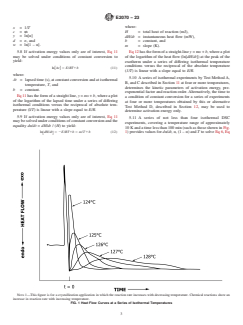
5.11 A series of not less than four isothermal DSC
may be solved under conditions of constant conversion and the
experiments, covering a temperature range of approximately
equality dα/dt = dH/dt / (H) to yield:
10 K and a time less than 100 min (such as those shown in Fig.
ln@dH/dt# 5 2E/RT1b 5 m/T1b (12) 1) provides values for dα/dt, α, (1 – α) and T to solve Eq 6, Eq
NOTE 1—This figure is for a crystallization application in which the reaction rate increases with decreasing temperature. Chemical reactions show an
increase in reaction rate with increasing temperature.
FIG. 1 Heat Flow Curves at a Series of Isothermal Temperatures
E2070 − 23
7, Eq 9, and Eq 10. by these test methods may be compared to those for Test
Method E2041 for nth order reactions.
5.12 A series of not less than four isothermal DSC experi-
ments covering a temperature range of approximately 10 K and
7. Interferences
a time less than 100 min provides dH/dt and T to solve Eq 12
7.1 The approach is applicable only to exothermic reactions.
5.13 A variety of time-to-event experiments such as oxida-
tion induction time methods (Specification D3350 and Test
NOTE 3—Endothermic reactions are controlled by the rate of the heat
Methods D3895, D4565, D5483, D6186, and E1858) and
transfer of the apparatus and not by the kinetics of the reaction and may
reaction induction time methods (Test Method E2046) provide
not be evaluated by these test methods.
values for ∆t and T to solve equation Eq 11.
7.2 These test methods are intended for a reaction mecha-
nism that does not change during the transition. These test
6. Significance and Use
methods assume a single reaction mechanism when the shape
6.1 These test methods are useful for research and
of the thermal curve is smooth (as in Fig. 2 and Fig. 3) and does
development, quality assurance, regulatory compliance, and
not exhibit shoulders, multiple peaks, or discontinuation steps.
specification acceptance purposes.
7.3 Test method precision is enhanced with the selection of
6.2 The determination of the order of a chemical reaction or
the appropriate conversion function [f(α)] that minimizes the
transformation at specific temperatures or time conditions is
number of experimental parameters determined. The shape of
beyond the scope of these test methods.
the thermal curve, as described in Section 11, may confirm the
6.3 The activation energy results obtained by these test
selection of the nth order or accelerating models.
methods may be compared with those obtained from Test
Method E698 for nth order and accelerating reactions. Activa- 7.4 Typical nth order reactions include those in which all
tion energy, pre-exponential factor, and reaction order results but one of the participating species are in excess.
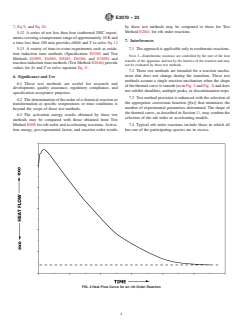
FIG. 2 Heat Flow Curve for an nth Order Reaction
E2070 − 23
FIG. 3 Heat Flow Curve for an Accelerating Reaction
7.5 Typical accelerating reactions include thermoset cure, 9. Apparatus
crystallization and pyrotechnic reactions.
9.1 A differential scanning calorimeter (DSC) that provides
7.6 For nth order kinetic reactions, these test methods the minimum calorimetric capability for these test methods
anticipate that the value of n is small, non-zero integers, such includes:
as 1 or 2. These test methods should be used carefully when 9.1.1 A DSC Test Chamber, composed of:
values of n are greater than 2 or are not a simple fraction, such 9.1.1.1 A Furnace(s), that provides uniform controlled heat-
as ⁄2 = 0.5. ing of a specimen and reference to constant temperature at a
constant rate between 300 K and 900 K.
7.7 Accelerating kinetic reactions anticipate that m and n are
9.1.1.2 A Temperature Sensor, that indicates the specimen/
fractions between 0 and 2 and that their sum (m + n) is less than
furnace temperature readable to 60.01 K.
3.
9.1.1.3 A Differential Sensor, that detects heat flow differ-
7.8 Accelerating kinetic reactions anticipate that p is an
ences between the specimen and reference equivalent to 1 μW.
integer often with a value of ≤4.
9.1.1.4 A means of sustaining a purge gas rate of
7.9 Since these test methods use milligram quantities, it is
10 mL ⁄min to 50 mL ⁄min 6 5 mL/min in the test chamber.
essential that the test specimens are homogeneous and repre-
NOTE 4—Typically inert purge gases that inhibit sample oxidation are
sentative of the larger samples from which they are taken.
99.9+ % pure nitrogen, helium or argon. Dry gases are recommended for
all experiments unless the effect of moisture is part of the study.
7.10 Test specimens may release toxic and corrosive efflu-
ents that may be harmful to personnel or apparatus. Operation
9.1.2 A Temperature Controller, capable of executing a
with a venting or exhaust system is recommended.
specific temperature program by operating the furnace(s)
between 300 K and 900 K at a rate of temperature change of up
–1 –1
8. Hazards
to 100 K min constant to 60.1 K min or at an isothermal
8.1 Special precautions shall be taken to protect personnel temperature constant to 60.1 K.
and equipment when the apparatus in use requires the insertion 9.1.3 A Data Collection Device, to provide a means of
of specimens into a heated furnace. These special precautions acquiring, storing, and displaying measured or calculated
include adequate shielding and ventilation of equipment and signals, or both. The minimum output signals required for DSC
face and hand protections for users (see Note 7). are heat flow, temperature and time.
E2070 − 23
9.2 Containers (pans, crucibles, vials, etc. and lids) that are to a maximum (after tens of seconds) and then decays, as
inert to the specimen and reference materials of suitable shown in Fig. 3, is likely to be an accelerating reaction.
structural shape and integrity to contain the specimen and
11.8 If the reaction is nth order, then use Procedure A. If the
reference.
reaction is accelerating, then use either Procedures B or C.
9.3 A Balance, to weigh specimens or containers, or both, to
12. Procedure (Test Method A for nth Order Reactions)
610 μg with a capacity of at least 100 mg.
12.1 Weight 4 mg to 7 mg of test specimen into a tared
9.4 Calculation, capability to perform multiple linear re-
sample container. Hermetically seal the container. Record the
gression analysis for four or more unknowns.
total weight of the specimen and the container to 610 μg.
10. Calibration
12.2 Place the test specimen and similar empty reference
10.1 Perform set up and calibration procedures according to
container in the apparatus. Close the DSC sample chamber.
the instrument operator’s manual.
12.3 Use a heating rate of 20 K/min or greater to raise the
10.2 Calibrate the DSC temperature signal over the range of
furnace temperature quickly from ambient temperature to the
–1
the reaction at a heating rate of 1 K min using Test Method
experimental isothermal temperature and that produces no
E967.
more than 1 K overshoot at the experimental temperature. Start
the clock and collect the isothermal test data of heat flow and
10.3 Calibrate the DSC heat flow signal using Practice
time when the specimen test temperature reaches 61 K of the
E968.
isothermal test temperature.
10.4 Confirm that the elapsed time conformity of the ther-
NOTE 6—A dynamic test, such as Test Method E537 may be used to
mal analyzer clock is better than 0.1 % using Test Method
determine the experimental isothermal test temperature. Isothermal test
E1860.
temperatures typically are selected to be those between 1 % and 10 % of
the total reaction by Test Method E537.
NOTE 5—Calibration or calibration verification of all signals at least
annually is recommended. NOTE 7—In some apparatus, it may not be possible to achieve less than
1 K overshoot. In such a case, load the specimen and reference into the
11. Procedure (Determination of Reaction Type)
furnace preheated to the isothermal test temperature. This practice is
contrary to good laboratory practice and is discouraged for safety reasons.
11.1 Differing forms of the rate equation are used for nth
If practiced, protective safety equipment shall be used to ensure the safety
order and accelerating reactions. This section describes a
of the operator from thermal burns and from premature rupture of the
useful test procedure for identifying the reaction type appli-
specimen container.
cable to the material under test.
12.4 Record the specimen temperature as, T, 5 min into the
11.2 Weigh 4 mg to 7 mg of the test specimen into a tarred experiment.
sample container and hermetically seal the container. Do NOT
12.5 Terminate the isothermal experiment when the reaction
load the test specimen into the apparatus. Load an equivalent
exotherm is complete, that is, when the thermal curve is
empty specimen container as the reference into the apparatus.
horizontal to the time axis.
Close the DSC sample chamber and prepare the apparatus for
12.6 Cool the test specimen to ambient temperature at any
an experimental run.
convenient rate. The thermal curve need not be recorded.
11.3 Select an isothermal test temperature corresponding to
Reweight the specimen and container. Record and report any
10 % of the peak area from a scouting run performed by Test
change in mass greater than 0.1 mg from that measured in 12.1.
Method E537. Equilibrate the apparatus at this test temperature
12.7 Repeat 12.1 – 12.6 with freshly prepared test speci-
for at least two minutes.
mens at (at least) three additional isothermal test temperatures.
11.4 Initiate the experiment recording heat flow as a func-
Select the experimental temperatures so that total isothermal
tion of time.
test times to complete the exotherm reaction are between
15 min and 100 min.
11.5 Open the DSC sample chamber and load the test
specimen into the apparatus. Immediately close the sample
12.8 Using the thermal curves from 12.1 – 12.7, calculate
chamber. Record the thermal curve for 20 min or until the
activation energy (E) , natural logarithm of the pre-exponential
exothermic event is complete (that is, the rate of heat flow
factor (ln[Z]) and reaction order (n) according to the procedure
approaches zero). (Warning—Burn hazard. The sample
described in Section 13.
chamber, heat shields and covers present a burn hazard to the
operator. Exercise great care in this operation. Protective safety
13. Calculation (Test Method A for nth Order Reactions)
equipment shall be used to ensure the safety of the operator
13.1 Prepare a display for each isotheral thermal curve
(See Note 7).)
obtained in 12.1 – 12.7, with heat flow on the Y-axis and time
11.6 Prepare a display of the heat flow on the Y-axis and
on the X-axis. Construct a linear baseline from a point on the
time on the X-axis.
baseline immediately before the reaction exotherm to a point
on the baseline immediately after the reaction exotherm for
11.7 Observe the shape of the resultant thermal curve. An
each thermal curve.
nth order reaction is likely when the heat flow curve reaches a
maximum within seconds of being placed in the DSC then
NOTE 8—An nth order reaction may require extrapolation of the
slowly decays as shown in Fig. 2. A heat flow curve that builds baseline at the end of the experiment forward in time as shown in Fig. 2.
E2070 − 23
NOTE 14—For ten-time intervals as described in 13.4, the values for
13.2 Integrate the total peak areas bounded by the peaks
(1 – α) should range between 0.9 and 0.1.
themselves and the constructed baselines to obtain the heat of
reaction (∆H) in mJ for each thermal curve.
13.7 Calculate the natural logarithm for the rate of the
–1
reaction (ln[dα/dt]), where dα/dt has the units of s , for each
NOTE 9—It is important that the reaction g
...
This document is not an ASTM standard and is intended only to provide the user of an ASTM standard an indication of what changes have been made to the previous version. Because
it may not be technically possible to adequately depict all changes accurately, ASTM recommends that users consult prior editions as appropriate. In all cases only the current version
of the standard as published by ASTM is to be considered the official document.
Designation: E2070 − 13 (Reapproved 2018) E2070 − 23
Standard Test Methods for
Kinetic Parameters by Differential Scanning Calorimetry
Using Isothermal Methods
This standard is issued under the fixed designation E2070; the number immediately following the designation indicates the year of
original adoption or, in the case of revision, the year of last revision. A number in parentheses indicates the year of last reapproval. A
superscript epsilon (´) indicates an editorial change since the last revision or reapproval.
1. Scope Scope*
1.1 Test Methods A, B, and C determine kinetic parameters for activation energy, pre-exponential factor and reaction order using
differential scanning calorimetry (DSC) from a series of isothermal experiments over a small ( ≈10 (≈10 K) temperature range.
Test Method A is applicable to low nth order reactions. Test Methods B and C are applicable to accelerating reactions such as
thermoset curing or pyrotechnic reactions and crystallization transformations in the temperature range from 300300 K to 900 K
(nominally 30 to 630°C).30 °C to 630 °C). These test methods are applicable only to these types of exothermic reactions when the
thermal curves do not exhibit shoulders, double peaks, discontinuities or shifts in baseline.
1.2 Test Methods D and E also determines the activation energy of a set of time-to-event and isothermal temperature data
generated by this or other procedures
1.3 The values stated in SI units are to be regarded as standard. No other units of measurement are included in this standard.
1.4 These test methods are similar but not equivalent to ISO DIS 11357, Part 5, and provides more information than the ISO
standard.
1.4 This standard does not purport to address all of the safety concerns, if any, associated with its use. It is the responsibility
of the user of this standard to establish appropriate safety, health, and environmental practices and determine the applicability of
regulatory limitations prior to use. Specific precautionary statements are given in Section 8.
1.5 This international standard was developed in accordance with internationally recognized principles on standardization
established in the Decision on Principles for the Development of International Standards, Guides and Recommendations issued
by the World Trade Organization Technical Barriers to Trade (TBT) Committee.
2. Referenced Documents
2.1 ASTM Standards:
D3350 Specification for Polyethylene Plastics Pipe and Fittings Materials
D3895 Test Method for Oxidative-Induction Time of Polyolefins by Differential Scanning Calorimetry
D4565 Test Methods for Physical and Environmental Performance Properties of Insulations and Jackets for Telecommunications
Wire and Cable
D5483 Test Method for Oxidation Induction Time of Lubricating Greases by Pressure Differential Scanning Calorimetry
These test methods are under the jurisdiction of ASTM Committee E37 on Thermal Measurements and is the direct responsibility of Subcommittee E37.01 on Calorimetry
and Mass Loss.
Current edition approved April 1, 2018Oct. 1, 2023. Published May 2018October 2023. Originally approved in 2000. Last previous edition approved in 20132018 as
E2070 – 13.E2070 – 13 (2018). DOI: 10.1520/E2070-13R18.10.1520/E2070-23.
For referenced ASTM standards, visit the ASTM website, www.astm.org, or contact ASTM Customer Service at service@astm.org. For Annual Book of ASTM Standards
volume information, refer to the standard’s Document Summary page on the ASTM website.
*A Summary of Changes section appears at the end of this standard
Copyright © ASTM International, 100 Barr Harbor Drive, PO Box C700, West Conshohocken, PA 19428-2959. United States
E2070 − 23
D6186 Test Method for Oxidation Induction Time of Lubricating Oils by Pressure Differential Scanning Calorimetry (PDSC)
E473 Terminology Relating to Thermal Analysis and Rheology
E537 Test Method for Thermal Stability of Chemicals by Differential Scanning Calorimetry
E698 Test Method for Kinetic Parameters for Thermally Unstable Materials Using Differential Scanning Calorimetry and the
Flynn/Wall/Ozawa Method
E967 Test Method for Temperature Calibration of Differential Scanning Calorimeters and Differential Thermal Analyzers
E968 Practice for Heat Flow Calibration of Differential Scanning Calorimeters (Withdrawn 2023)
E1142 Terminology Relating to Thermophysical Properties
E1445 Terminology Relating to Hazard Potential of Chemicals
E1858 Test Methods for Determining Oxidation Induction Time of Hydrocarbons by Differential Scanning Calorimetry
E1860 Test Method for Elapsed Time Calibration of Thermal Analyzers
E1970 Practice for Statistical Treatment of Thermoanalytical Data
E2041 Test Method for Estimating Kinetic Parameters by Differential Scanning Calorimeter Using the Borchardt and Daniels
Method
E2046 Test Method for Reaction Induction Time by Thermal Analysis
2.2 ISO Standard:
ISO DIS 11357 Part 5: Determination of Temperature and/or Time of Reaction and Reaction Kinetics
3. Terminology
3.1 Specific technical terms used in these test methods are defined in Terminologies E473, E1142, and E1445, including the terms
calorimeter, Celsius, crystallization, differential scanning calorimetry, general rate law, isothermal, peak, and reaction.
4. Summary of Test Method
4.1 A test specimen is held at a constant temperature in a differential scanning calorimeter throughout an exothermic reaction. The
rate of heat evolution, developed by the reaction, is proportional to the rate of reaction. Integration of the heat flow as a function
of time yields the total heat of reaction.
4,5,6
4.2 An accelerating (Sestak-Berggren or Avrami models), nth order data, or model free treatment is used to derive the kinetic
parameters of activation energy, pre-exponential factor and reaction order from the heat flow and total heat of reaction information
obtained in 4.1. (See Basis for Methodology, Section 5.)
5. Basis of Methodology
5.1 Reactions of practical consideration are exothermic in nature; that is, they give off heat as the reaction progresses.
Furthermore, the rate of heat evolution is proportional to the rate of the reaction. Differential scanning calorimetry measures heat
flow as a dependent experimental parameter as a function of time under isothermal experimental conditions. DSC is useful for the
measurement of the total heat of a reaction and the rate of the reaction as a function of time and temperature.
5.2 Reactions may be modeled with a number of suitable equations of the form of:
dα/dt 5 k T f α (1)
~ ! ~ !
where:
–1
dα/dt = reaction rate (s ),
α = fraction reacted (dimensionless),
–1
k (T) = specific rate constant at temperature T (s ),
f (α) = conversion function. Commonly used functions include:
n
f α 5 12 α (2)
~ ! ~ !
₥ n
f ~α!5 α ~12 α! (3)
The last approved version of this historical standard is referenced on www.astm.org.
Sbirrazzuoli, N., Brunel, D., and Elegant, L., “Differential Kinetic Equation Analysis” Journal of Thermal Analysis, Vol 38, 1992, pp. 1509–1524.
Sestak, J., and Berggren, G., “Study of the Kinetics of the Mechanism of Solid-State Reactions at Increasing Temperatures” Thermochimica Acta, Vol 3, 1971, p.pp.
11.–12.
Gorbachiev, V.M., “Some Aspects of Sestak’s Generalized Kinetic Equation in Thermal Analysis” Journal of Thermal Analysis, Vol 18, 1980, pp. 193–197.
E2070 − 23
p 2 1 ⁄p
~ !
f α 5 p 1 2 α 2 1 n 1 2 α (4)
~ ! ~ !@ ~ !#
where:
n, ₥, and p = partial reaction order terms.
NOTE 1—There are a large number of conversion function expressions for [f(α)]. Those described here are the most common but are not the only functions
5,6
suitable for these test methods Eq 1 is known as the general rate equation while Eq 3 is the accelerating (or Sestak-Berggren) equation. Eq 4 is the
accelerating Avrami equation. Eq 2 is used for nth order reactions while Eq 3 or Eq 4 are used for accelerating reaction, such as thermoset cure and
crystallization transformations.
5.3 For a reaction conducted at temperature (T), the accelerating rate Eq 3 and the rate equation Eq 1 may be cast in their
logarithmic form.
₥ n
dα/dt 5 k T α 12 α (5)
~ ! ~ !
ln dα/dt 5 ln k T 1₥ln α 1nln 12 α (6)
@ # @ ~ !# @ # @ #
This equation has the form z = a + bx + cy and may be solved using multiple linear regression analysis where x = ln[α], y =
ln[1 – α], z = ln[dα/dt], a = ln[k(T)], b = ₥ and c = n.
NOTE 2—The rate equation (Eq 3) reduces to the simpler general rate equation (Eq 2) when the value of reaction order parameter ₥ equals zero thereby
reducing the number of kinetic parameters to be determined.
5.4 For reactions conducted at temperature (T), the accelerating rate equation of Eq 4 may be cast as:
ln 2 ln 1 2 α 5 pln k T 1pln t (7)
@ ~ !# @ ~ !# @ #
This equation has the form of y = mx + b and may be solved by linear regression where x = ln[t], y = ln[-ln(1 – α)], with p =
m,b = p ln[k(T)], and t = time.
5.5 The Arrhenius equation describes how the reaction rate changes as a function of temperature:
2E/RT
k T 5 Z e (8)
~ !
where:
–1
Z = pre-exponential factor (s ),
–1
E = activation energy (J mol ),
T = absolute temperature (K),
–1 –1
R = gas constant = (8.314 J mol K ), and
e = natural logarithm base = 2.7182818.
5.6 Eq 8 cast in its logarithmic form is:
ln@k~T!# 5 ln@Z# 2 E/RT (9)
Eq 9 has the form of a straight line, y = mx + b, where a plot of the logarithm of the reaction rate constant (ln[k(T)]) versus the
reciprocal of absolute temperature (l/T) is linear with the slope equal to –E/R and an intercept equal to ln[Z].
5.7 As an alternative to Eq 6 and Eq 7, the rate and Arrhenius equations combined and cast in logarithmic form is:
ln dα/dt 5 ln Z 2 E/RT1mln α 1nln 12 α (10)
@ # @ # @ # @ #
Eq 10 has the form, z = a + bx + cy + dw, and may be solved using multiple linear regression analysis.
where:
z = ln[dα/dt]
a = ln[Z]
b = -E/R
x = 1/T
c = ₥
y = ln[1 – α]
y = ln[α]
E2070 − 23
d = n, and
w = ln[1 – α].
5.8 If activation energy values only are of interest, Eq 11 may be solved under conditions of constant conversion to yield:
ln@∆t# 5 E/RT1b (11)
where:
∆t = lapsed time (s), at constant conversion and at isothermal temperature, T, and
b = constant.
Eq 11 has the form of a straight line, y = mx + b, where a plot of the logarithm of the lapsed time under a series of differing
isothermal conditions versus the reciprocal of absolute temperature (l/T) is linear with a slope equal to E/R.
5.9 If activation energy values only are of interest, Eq 11 may be solved under conditions of constant conversion and the equality
dα/dt = dH/dt / (H) to yield:
ln@dH/dt# 52E/RT1b 5 m/T1b (12)
where:
H = total heat of reaction (mJ),
dH/dt = instantaneous heat flow (mW),
b = constant, and
m = slope (K)
m = slope (K).
Eq 12 has the form of a straight line straight-line y = mx + b, where a plot of the logarithm of the heat flow (ln[dH/dt]) at the
peak of the exotherm under a series of differing isothermal temperature conditions versus the reciprocal of the absolute temperature
(1/T)1/T) is linear with a slope equal to E/R.
5.10 A series of isothermal experiments by Test Method A, B, and C described in Section 11 at four or more temperatures,
determines the kinetic parameters of activation energy, pre-exponential factor and reaction order. Alternatively, the time to a
condition of constant conversion for a series of experiments at four or more temperatures obtained by this or alternative Test
Method D, described in Section 12, may be used to determine activation energy only.
5.11 A series of not less than four isothermal DSC experiments, covering a temperature range of approximately 10 K and a time
less than 100 min (such as those shown in Fig. 1) provides values for dα/dt, α, (1 – α) and T to solve Eq 6, Eq 7, Eq 9, and Eq
10.
5.12 A series of not less than four isothermal DSC experiments covering a temperature range of approximately 10 K and a time
less than 100 min provides dH/dt and T to solve Eq 12
5.13 A variety of time-to-event experiments such as oxidation induction time methods (Specification D3350 and Test Methods
D3895, D4565, D5483, D6186, and E1858) and reaction induction time methods (Test Method E2046) provide values for ∆t and
T to solve equation Eq 11.
6. Significance and Use
6.1 These test methods are useful for research and development, quality assurance, regulatory compliance, and specification
acceptance purposes.
6.2 The determination of the order of a chemical reaction or transformation at specific temperatures or time conditions is beyond
the scope of these test methods.
6.3 The activation energy results obtained by these test methods may be compared with those obtained from Test Method E698
for nth order and accelerating reactions. Activation energy, pre-exponential factor, and reaction order results by these test methods
may be compared to those for Test Method E2041 for nth order reactions.
E2070 − 23
NOTE 1—This figure is for a crystallization application in which the reaction rate increases with decreasing temperature. Chemical reactions show an
increase in reaction rate with increasing temperature.
FIG. 1 Heat Flow Curves at a Series of Isothermal Temperatures
7. Interferences
7.1 The approach is applicable only to exothermic reactions.
NOTE 3—Endothermic reactions are controlled by the rate of the heat transfer of the apparatus and not by the kinetics of the reaction and may not be
evaluated by these test methods.
7.2 These test methods are intended for a reaction mechanism that does not change during the transition. These test methods
assume a single reaction mechanism when the shape of the thermal curve is smooth (as in Fig. 2 and Fig. 3) and does not exhibit
shoulders, multiple peaks, or discontinuation steps.
7.3 Test method precision is enhanced with the selection of the appropriate conversion function [f(α)] that minimizes the number
of experimental parameters determined. The shape of the thermal curve, as described in Section 11, may confirm the selection of
the nth order or accelerating models.
7.4 Typical nth order reactions include those in which all but one of the participating species are in excess.
7.5 Typical accelerating reactions include thermoset cure, crystallization and pyrotechnic reactions.
7.6 For nth order kinetic reactions, these test methods anticipate that the value of n is small, non-zero integers, such as 1 or 2.
These test methods should be used carefully when values of n are greater than 2 or are not a simple fraction, such as ⁄2 = 0.5.
E2070 − 23
FIG. 2 Heat Flow Curve for an nth Order Reaction
7.7 Accelerating kinetic reactions anticipate that m and n are fractions between 0 and 2 and that their sum (m + n) is less than 3.
7.8 Accelerating kinetic reactions anticipate that p is an integer often with a value of ≤4.
7.9 Since these test methods use milligram quantities, it is essential that the test specimens are homogeneous and representative
of the larger samples from which they are taken.
7.10 Test specimens may release toxic and corrosive effluents that may be harmful to personnel or apparatus. Operation with a
venting or exhaust system is recommended.
8. Hazards
8.1 Special precautions shall be taken to protect personnel and equipment when the apparatus in use requires the insertion of
specimens into a heated furnace. These special precautions include adequate shielding and ventilation of equipment and face and
hand protections for users (see Note 67).
9. Apparatus
9.1 A differential scanning calorimeter (DSC) that provides the minimum calorimetric capability for these test methods includes:
9.1.1 A DSC Test Chamber, composed of:
9.1.1.1 A Furnace(s), that provides uniform controlled heating of a specimen and reference to constant temperature at a constant
rate between 300300 K and 900 K.
E2070 − 23
FIG. 3 Heat Flow Curve for an Accelerating Reaction
9.1.1.2 A Temperature Sensor, that indicates the specimen/furnace temperature readable to 60.01 K.
9.1.1.3 A Differential Sensor, that detects heat flow differences between the specimen and reference equivalent to 1 μW.
9.1.1.4 A means of sustaining a purge gas rate of 1010 mL ⁄min to 5050 mL ⁄min 6 5 mL/minutemL/min in the test chamber.
NOTE 4—Typically inert purge gases that inhibit sample oxidation are 99.9+ % pure nitrogen, helium or argon. Dry gases are recommended for all
experiments unless the effect of moisture is part of the study.
9.1.2 A Temperature Controller, capable of executing a specific temperature program by operating the furnace(s) between
–1 –1
300300 K and 900 K at a rate of temperature change of up to 100 K min constant to 60.1 K min or at an isothermal temperature
constant to 60.1 K.
9.1.3 A Data Collection Device, to provide a means of acquiring, storing, and displaying measured or calculated signals, or both.
The minimum output signals required for DSC are heat flow, temperature and time.
9.2 Containers (pans, crucibles, vials, etc. and lids) that are inert to the specimen and reference materials of suitable structural
shape and integrity to contain the specimen and reference.
9.3 A Balance, to weigh specimens or containers, or both, to 610 μg with a capacity of at least 100 mg.
9.4 Calculation, capability to perform multiple linear regression analysis for four or more unknowns.
E2070 − 23
10. Calibration
10.1 Perform set up and calibration procedures according to the instrument operator’s manual.
–1
10.2 Calibrate the DSC temperature signal over the range of the reaction at a heating rate of 1 K min using Test Method E967.
10.3 Calibrate the DSC heat flow signal using Practice E968.
10.4 Confirm that the elapsed time conformity of the thermal analyzer clock is better than 0.1 % using Test Method E1860.
NOTE 5—Calibration or calibration verification of all signals at least annually is recommended.
11. Procedure (Determination of Reaction Type)
11.1 Differing forms of the rate equation are used for nth order and accelerating reactions. This section describes a useful test
procedure for identifying the reaction type applicable to the material under test.
11.2 Weigh 44 mg to 7 mg of the test specimen into a tarred sample container and hermetically seal the container. Do NOT load
the test specimen into the apparatus. Load an equivalent empty specimen container as the reference into the apparatus. Close the
DSC sample chamber and prepare the apparatus for an experimental run.
11.3 Select an isothermal test temperature corresponding to 10 % of the peak area from a scouting run performed by Test Method
E537. Equilibrate the apparatus at this test temperature for at least two minutes.
11.4 Initiate the experiment recording heat flow as a function of time.
11.5 Open the DSC sample chamber and load the test specimen into the apparatus. Immediately close the sample chamber. Record
the thermal curve for 20 min or until the exothermic event is complete (that is, the rate of heat flow approaches zero).
(Warning—Burn hazard. The sample chamber, heat shields and covers present a burn hazard to the operator. Exercise great care
in this operation. Protective safety equipment shall be used to ensure the safety of the operator (See Note 67).)
11.6 Prepare a display of the heat flow on the Y-axis and time on the X-axis.
11.7 Observe the shape of the resultant thermal curve. An nth order reaction is likely when the heat flow curve reaches a maximum
within seconds of being placed in the DSC then slowly decays as shown in Fig. 2. A heat flow curve that builds to a maximum
(after tens of seconds) and then decays, as shown in Fig. 3, is likely to be an accelerating reaction.
11.8 If the reaction is nth order, then use Procedure A. If the reaction is accelerating, then use either Procedures B or C.
12. Procedure (Test Method A for nth Order Reactions)
12.1 Weight 44 mg to 7 mg of test specimen into a tared sample container. Hermetically seal the container. Record the total weight
of the specimen and the container to 610 μg.
12.2 Place the test specimen and similar empty reference container in the apparatus. Close the DSC sample chamber.
12.3 Use a heating rate of 20 K/min or greater to raise the furnace temperature quickly from ambient temperature to the
experimental isothermal temperature and that produces no more than 1 K overshoot at the experimental temperature. Start the clock
and collect the isothermal test data of heat flow and time when the specimen test temperature reaches 61 K of the isothermal test
temperature.
NOTE 6—A dynamic test, such as Test Method E537 may be used to determine the experimental isothermal test temperature. Isothermal test temperatures
typically are selected to be those between 11 % and 10 % of the total reaction by Test Method E537.
E2070 − 23
NOTE 7—In some apparatus, it may not be possible to achieve less than 1 K overshoot. In such a case, load the specimen and reference into the furnace
preheated to the isothermal test temperature. This practice is contrary to good laboratory practice and is discouraged for safety reasons. If practiced,
protective safety equipment shall be used to ensure the safety of the operator from thermal burns and from premature rupture of the specimen container.
12.4 Record the specimen temperature as, T, 5 min into the experiment.
12.5 Terminate the isothermal experiment when the reaction exotherm is complete, that is, when the thermal curve is horizontal
to the time axis.
12.6 Cool the test specimen to ambient temperature at any convenient rate. The thermal curve need not be recorded. Reweight the
specimen and container. Record and report any change in mass greater than 0.1 mg from that measured in 12.1.
12.7 Repeat 12.1 – 12.6 with freshly prepared test specimens at (at least) three additional isothermal test temperatures. Select the
experimental temperatures so that total isothermal test times to complete the exotherm reaction are between 1515 min and 100 min.
12.8 Using the thermal curves from 12.1 – 12.7, calculate activation energy (E) , natural logarithm of the pre-exponetialpre-
exponential factor (ln[Z]) and reaction order (n) according to the procedure described in Section 13.
13. Calculation (Test Method A for nth Order Reactions)
13.1 Prepare a display for each isotheral thermal curve obtained in 12.1 – 12.7, with heat flow on the Y-axis and time on the X-axis.
Construct a linear baseline from a point on the baseline immediately before the reaction exotherm to a point on the baseline
immediately after the reaction exotherm for each thermal curve.
NOTE 8—An nth order reaction may require extrapolation of the baseline at the end of the experiment forward in time as shown in Fig. 2.
13.2 Integrate the total peak areas bounded by the peaks themselves and the constructed baselines to obtain the heat of reaction
(∆H) in mJ for each thermal curve.
NOTE 9—It is important that the reaction go to completion. This may be observed by an unchanging baseline under expanded scale conditions following
the reaction exotherm.
NOTE 10—In nth order reactions, an appreciable fraction of the reaction may ta
...