


ASTM D3884-09(2017)
(Guide)Standard Guide for Abrasion Resistance of Textile Fabrics (Rotary Platform, Double-Head Method)
Standard Guide for Abrasion Resistance of Textile Fabrics (Rotary Platform, Double-Head Method)
SIGNIFICANCE AND USE
5.1 The measurement of the resistance to abrasion of textile and other materials is very complex. The resistance to abrasion is affected by many factors, such as the inherent mechanical properties of the fibers; the dimensions of the fibers; the structure of the yarns; the construction of the fabrics; and the type, kind, and amount of finishing material added to the fibers, yarns, or fabric.
5.2 The resistance to abrasion is also greatly affected by the conditions of the tests, such as the nature of abradant, variable action of the abradant over the area of specimen abraded, the tension of the specimen, the pressure between the specimen and abradant, and the dimensional changes in the specimens.
5.3 Abrasion tests are all subject to variation due to changes in the abradant during specific tests. The abradant must accordingly be discarded at frequent intervals or checked periodically against a standard. With disposable abradants, the abradant is used only once or discarded after limited use. With permanent abradants that use hardened metal or equivalent surfaces, it is assumed that the abradant will not change appreciably in a specific series of tests. Similar abradants used in different laboratories will not change at the same rate, due to differences in usage. Permanent abradants may also change due to pick up of finishing or other material from test fabrics and must accordingly be cleaned at frequent intervals. The measurement of the relative amount of abrasion may also be affected by the method of evaluation and may be influenced by the judgment of the operator.
5.4 The resistance of textile materials to abrasion as measured on a testing machine in the laboratory is generally only one of several factors contributing to wear performance or durability as experienced in the actual use of the material. While “abrasion resistance” (often stated in terms of the number of cycles on a specified machine, using a specified technique to produce a specified degree o...
SCOPE
1.1 This guide covers the determination of the abrasion resistance of textile fabrics using the rotary platform, double-head tester (RPDH).
Note 1: Other procedures for measuring the abrasion resistance of textile fabrics are given in Test Methods D3885, D3886, D4157, D4158, D4966, and AATCC 93.
1.2 The values stated in SI units are to be regarded as standard: the values in English units are provided as information only and are not exact equivalents.
1.3 This standard does not purport to address all of the safety problems, if any, associated with its use. It is the responsibility of the user of this standard to establish appropriate safety and health practices and determine the applicability of regulatory limitations prior to use.
1.4 This international standard was developed in accordance with internationally recognized principles on standardization established in the Decision on Principles for the Development of International Standards, Guides and Recommendations issued by the World Trade Organization Technical Barriers to Trade (TBT) Committee.
General Information
Buy Standard
Standards Content (Sample)
NOTICE: This standard has either been superseded and replaced by a new version or withdrawn.
Contact ASTM International (www.astm.org) for the latest information
Designation: D3884 − 09 (Reapproved 2017)
Standard Guide for
Abrasion Resistance of Textile Fabrics (Rotary Platform,
Double-Head Method)
This standard is issued under the fixed designation D3884; the number immediately following the designation indicates the year of
original adoption or, in the case of revision, the year of last revision. A number in parentheses indicates the year of last reapproval. A
superscript epsilon (´) indicates an editorial change since the last revision or reapproval.
1. Scope D4158 Guide for Abrasion Resistance of Textile Fabrics
(Uniform Abrasion)
1.1 This guide covers the determination of the abrasion
D4850 Terminology Relating to Fabrics and Fabric Test
resistance of textile fabrics using the rotary platform, double-
Methods
head tester (RPDH).
D4966 Test Method for Abrasion Resistance of Textile
NOTE 1—Other procedures for measuring the abrasion resistance of
Fabrics (Martindale Abrasion Tester Method)
textile fabrics are given in Test Methods D3885, D3886, D4157, D4158,
D5034 TestMethodforBreakingStrengthandElongationof
D4966, and AATCC 93.
Textile Fabrics (Grab Test)
1.2 The values stated in SI units are to be regarded as
D5035 Test Method for Breaking Force and Elongation of
standard: the values in English units are provided as informa-
Textile Fabrics (Strip Method)
tion only and are not exact equivalents.
D7255 Test Method for Abrasion Resistance of Leather
1.3 This standard does not purport to address all of the (Rotary Platform, Abraser Method)
safety problems, if any, associated with its use. It is the
2.2 Other Documents:
responsibility of the user of this standard to establish appro-
AATCC 93 Abrasion Resistance of Fabrics: Accelerator
priate safety and health practices and determine the applica-
Method
bility of regulatory limitations prior to use.
3. Terminology
1.4 This international standard was developed in accor-
dance with internationally recognized principles on standard-
3.1 For all terminology relating to D13.60, Fabric Test
ization established in the Decision on Principles for the
Methods, Specific, refer to Terminology D4850.
Development of International Standards, Guides and Recom-
3.1.1 The following terms are relevant to this standard:
mendations issued by the World Trade Organization Technical
abrasion, abrasion cycle, breaking force.
Barriers to Trade (TBT) Committee.
3.2 For all other terminology related to textiles, refer to
Terminology D123.
2. Referenced Documents
2.1 ASTM Standards:
4. Summary of Test Method
D123 Terminology Relating to Textiles
4.1 Aspecimenisabradedusingrotaryrubbingactionunder
D1776 Practice for Conditioning and Testing Textiles
controlled conditions of pressure and abrasive action. The test
D3885 Test Method for Abrasion Resistance of Textile
specimen, mounted on a turntable platform, turns on a vertical
Fabrics (Flexing and Abrasion Method)
axis, against the sliding rotation of two abrading wheels. One
D3886 Test Method for Abrasion Resistance of Textile
abrading wheel rubs the specimen outward toward the periph-
Fabrics (Inflated Diaphragm Apparatus)
ery and the other, inward toward the center. The resulting
D4157 Test Method for Abrasion Resistance of Textile
abrasion marks form a pattern of crossed arcs over an area of
Fabrics (Oscillatory Cylinder Method)
approximately 30 cm . Resistance to abrasion is evaluated by
various means which are described in Section 13.
This guide is under the jurisdiction of ASTM Committee D13 on Textiles and
5. Significance and Use
is the direct responsibility of Subcommittee D13.60 on Fabric Test Methods,
Specific.
5.1 The measurement of the resistance to abrasion of textile
Current edition approved July 15, 2017. Published August 2017. Originally
ɛ1
and other materials is very complex.The resistance to abrasion
approved in 1980. Last previous edition approved in 2013 as D3884 – 09(2013) .
DOI: 10.1520/D3884-09R17.
For referenced ASTM standards, visit the ASTM website, www.astm.org, or
contact ASTM Customer Service at service@astm.org. For Annual Book of ASTM Available from American Association of Textile Chemists and Colorists
Standards volume information, refer to the standard’s Document Summary page on (AATCC), P.O. Box 12215, Research Triangle Park, NC 27709, http://
the ASTM website. www.aatcc.org.
Copyright © ASTM International, 100 Barr Harbor Drive, PO Box C700, West Conshohocken, PA 19428-2959. United States
D3884 − 09 (2017)
is affected by many factors, such as the inherent mechanical a definite need for measuring the relative resistance to
properties of the fibers; the dimensions of the fibers; the abrasion, this is one of the several procedures that is useful to
structure of the yarns; the construction of the fabrics; and the help minimize the inherent variation in results that may occur.
type,kind,andamountoffinishingmaterialaddedtothefibers,
5.7 Before definite predictions of fabric usefulness can be
yarns, or fabric.
drawn from an abrasion test as made on the rotary platform,
5.2 The resistance to abrasion is also greatly affected by the double-head (RPDH) abrader (Fig. 1), actual end-use trials
conditions of the tests, such as the nature of abradant, variable should be conducted and related to the abrasion test. Different
action of the abradant over the area of specimen abraded, the types of wear (for example, wear on men’s clothing at cuffs,
tension of the specimen, the pressure between the specimen crotch, etc.) may correspond to different ratings of the RPDH
and abradant, and the dimensional changes in the specimens. test.
5.3 Abrasion tests are all subject to variation due to changes 5.8 In making a comparison of different fabrics (that is, of
in the abradant during specific tests. The abradant must different fibers, weights, etc.) the RPDH test will not always
accordingly be discarded at frequent intervals or checked reveal a difference known to exist when the fabrics are actually
used.Therefore,end-usetrialsshouldbeconductedinconjunc-
periodically against a standard. With disposable abradants, the
abradant is used only once or discarded after limited use. With tion with the RPDH abrasion test, at least as a guide for future
testing of these fabrics.
permanent abradants that use hardened metal or equivalent
surfaces, it is assumed that the abradant will not change
5.9 Uncontrolled manufacturing or finishing variations oc-
appreciably in a specific series of tests. Similar abradants used
curring within a fabric or within lots of the same style of fabric
in different laboratories will not change at the same rate, due to
can, however, be detected satisfactorily with the RPDH tester.
differencesinusage.Permanentabradantsmayalsochangedue
5.10 Because of the conditions mentioned above, techni-
to pick up of finishing or other material from test fabrics and
cians frequently fail to get good agreement between results
must accordingly be cleaned at frequent intervals. The mea-
obtainedonthesametypeoftestinginstrumentbothwithinand
surement of the relative amount of abrasion may also be
between laboratories, and the precision of these test methods is
affected by the method of evaluation and may be influenced by
uncertain. This test method is accordingly not recommended
the judgment of the operator.
for acceptance testing in contractual agreements between
5.4 The resistance of textile materials to abrasion as mea-
purchaser and supplier because of the poor between-laboratory
sured on a testing machine in the laboratory is generally only
precision of the test method.
one of several factors contributing to wear performance or
5.11 If there are differences of practical significance be-
durability as experienced in the actual use of the material.
tween reported test results for two laboratories (or more),
While “abrasion resistance” (often stated in terms of the
comparative tests should be performed to determine if there is
number of cycles on a specified machine, using a specified
a statistical bias between them, using competent statistical
technique to produce a specified degree or amount of abrasion)
assistance. As a minimum, the test samples used are to be as
and “durability” (defined as the ability to withstand deteriora-
homogeneous as possible, drawn from the material from which
tionorwearingoutinuse,includingtheeffectsofabrasion)are
the disparate test results were obtained, and randomly assigned
frequently related, the relationship varies with different end
in equal numbers to each laboratory for testing.The test results
uses, and different factors may be necessary in any calculation
from the two laboratories should be compared using a statis-
of predicted durability from specific abrasion data. Laboratory
tical test for unpaired data, at a probability level chosen prior
tests may be reliable as an indication of relative end-use
to the testing series. If bias is found, either its cause must be
performance in cases where the difference in abrasion resis-
found and corrected, or future test results must be adjusted in
tanceofvariousmaterialsislarge,buttheyshouldnotberelied
consideration of the known bias.
upon where differences in laboratory test findings are small. In
general, they should not be relied upon for prediction of actual
6. Apparatus
wear-life in specific end uses unless there are data showing the
6.1 Rotary Platform, Double-Head (RPDH) Abrader (Fig.
specific relationship between laboratory abrasion tests and
1), consisting of the following elements described in 6.1.1 –
actual wear in the intended end-use.
6.1.5
5.5 These general observations apply to all types of fabrics,
6.1.1 Removeable, turntable platform that includes a rubber
including woven, nonwoven, and knit apparel fabrics, house-
pad, clamp plate and knurled nut, and clamp ring to secure the
hold fabrics, industrial fabrics, and floor coverings. It is not
specimen. The specimen holder shall be motor driven, and
surprising, therefore, to find that there are many different types
mounted so as to produce circular surface travel of a flat
of abrasion testing machines, abradants, testing conditions,
specimen in the plane of its surface.
testing procedures, methods of evaluation of abrasion resis-
6.1.2 Pair of pivoted arms to which the abrasive wheels and
tance and interpretation of results.
accessory weights are attached.
5.6 All the test procedures and instruments that have been
The sole source of supply of the apparatus known to the committee at this time
developed for abrasion resistance of fabrics may show a high
is Taber Industries, 455 Bryant St. North Tonawanda, NY 14120. If you are aware
degree of variability in results obtained by different operators
of alternate suppliers, please provide this information to ASTM headquarters. Your
and in different laboratories, however, they represent the
comments will receive careful consideration at a meeting of the responsible
procedures most widely used in the industry. Because there is technical committee, which you may attend.
D3884 − 09 (2017)
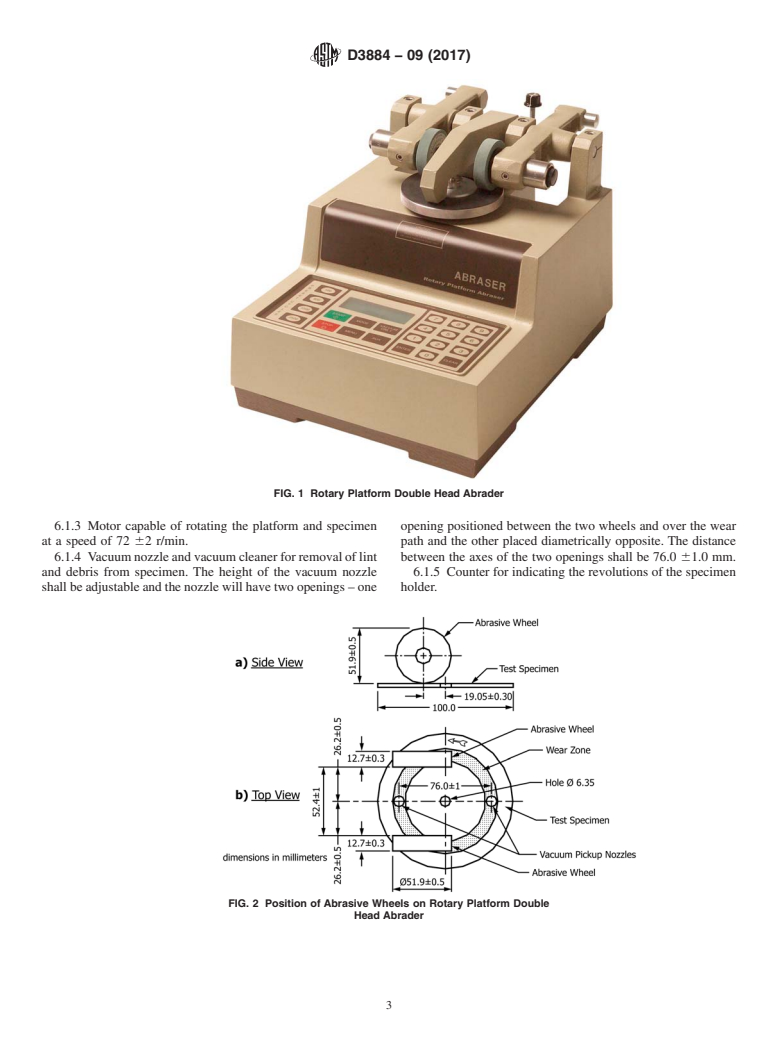
FIG. 1 Rotary Platform Double Head Abrader
6.1.3 Motor capable of rotating the platform and specimen opening positioned between the two wheels and over the wear
at a speed of 72 62 r/min. path and the other placed diametrically opposite. The distance
6.1.4 Vacuumnozzleandvacuumcleanerforremovaloflint between the axes of the two openings shall be 76.0 61.0 mm.
and debris from specimen. The height of the vacuum nozzle 6.1.5 Counter for indicating the revolutions of the specimen
shallbeadjustableandthenozzlewillhavetwoopenings–one holder.
FIG. 2 Position of Abrasive Wheels on Rotary Platform Double
Head Abrader
D3884 − 09 (2017)
6.2 Abrasive wheels, which are attached to the free end of 8.2 Take specimens from garment samples as agreed upon
the pivoted arms and rotate freely about horizontal spindles. by all interested parties.
6.2.1 Their internal faces shall be 52.4 61.0 mm apart and
8.3 Cut ten specimens approximately 15 cm (6 in.) square,
the hypothetical line through the two spindles shall be 19.05
five for abrasion tests and five reserved for controls. For the
60.3 mm away from the central axis of the turntable (see Fig.
fivespecimenstobeabraded,cuta6-mm( ⁄4-in.)diameterhole
2). When resting on the specimen, the wheels will have a
in the center of the specimen.
peripheral engagement with the surface of the specimen, the
8.3.1 For fabric widths 125 mm (5 in.) or more, take no
direction of travel of the periphery of the wheels and of the
specimen closer than 25 mm (1 in.) from the selvage edge.
specimen at the contacting portions being at acute angles, and
8.3.2 For fabric widths less than 125 mm (5 in.), use the
the angles of travel of one wheel periphery being opposite to
entire width for specimens.
that of the other. Motion of the abrasive wheels, in opposite
8.3.3 Cut specimens representing a broad distribution di-
directions, is provided by rotation of the specimen and the
agonally across the width of the laboratory sampling unit.Take
associated friction therefrom.
lengthwise specimens from different positions across the width
6.2.2 The abrasive wheels are either resilient or vitrified-
of the fabric. Take widthwise specimens from different posi-
based.Bothtypesofwheelsconsistofhardparticlesembedded
tions along the length of the fabric.
in a binder material and are manufactured in different grades of
8.3.4 Ensure specimens are free of folds, creases, or
abrasive quality. The wheels shall be 12.7 60.3 mm thick and
wrinkles.Avoidgettingoil,water,grease,etc.onthespecimens
have an external diameter of 51.9 60.5 mm when new, and in
when handling.
no case less than 44.4 mm.
8.3.5 If the fabric has a pattern, ensure that the specimens
6.3 Accessory Loads, The RPDH abrader is provided with a
are a representative sampling of the pattern.
load adjustment for varying the load of the abrader wheels on
the specimen. The pivoted abrader arms without auxiliary
9. Preparation, Calibration, and Verification of
weights or counter weights apply a load against the specimen
Apparatus
of 250 g per wheel (exclusive of the mass of the wheel itself).
9.1 Wheel Position—The wheels should be spaced equally
The manufacturer provides additional weights that can be used
on both sides from the wheel-mounting flange to the center of
to increase the load to 500 or 1000 g per wheel, and a
the specimen holder. The distance from the inside of the wheel
counterweight attachment that can be used to reduce the load
mounting flange to the center of the specimen holder should be
on the specimen to 125 g per wheel.
38.9 60.5 mm (1.53 in.).
6.4 Auxiliary Apparatus—Resurfacing discs (S-11), of
9.2 Wheel Bearings—The abrader wheel bearings,
...
This document is not an ASTM standard and is intended only to provide the user of an ASTM standard an indication of what changes have been made to the previous version. Because
it may not be technically possible to adequately depict all changes accurately, ASTM recommends that users consult prior editions as appropriate. In all cases only the current version
of the standard as published by ASTM is to be considered the official document.
´1
Designation: D3884 − 09 (Reapproved 2013) D3884 − 09 (Reapproved 2017)
Standard Guide for
Abrasion Resistance of Textile Fabrics (Rotary Platform,
Double-Head Method)
This standard is issued under the fixed designation D3884; the number immediately following the designation indicates the year of
original adoption or, in the case of revision, the year of last revision. A number in parentheses indicates the year of last reapproval. A
superscript epsilon (´) indicates an editorial change since the last revision or reapproval.
ε NOTE—This standard was corrected back to a Guide editorially in February 2014. No content was changed.
1. Scope
1.1 This guide covers the determination of the abrasion resistance of textile fabrics using the rotary platform, double-head tester
(RPDH).
NOTE 1—Other procedures for measuring the abrasion resistance of textile fabrics are given in Test Methods D3885, D3886, D4157, D4158, D4966,
and AATCC 93.
1.2 The values stated in SI units are to be regarded as standard: the values in English units are provided as information only
and are not exact equivalents.
1.3 This standard does not purport to address all of the safety problems, if any, associated with its use. It is the responsibility
of the user of this standard to establish appropriate safety and health practices and determine the applicability of regulatory
limitations prior to use.
1.4 This international standard was developed in accordance with internationally recognized principles on standardization
established in the Decision on Principles for the Development of International Standards, Guides and Recommendations issued
by the World Trade Organization Technical Barriers to Trade (TBT) Committee.
2. Referenced Documents
2.1 ASTM Standards:
D123 Terminology Relating to Textiles
D1776 Practice for Conditioning and Testing Textiles
D3885 Test Method for Abrasion Resistance of Textile Fabrics (Flexing and Abrasion Method)
D3886 Test Method for Abrasion Resistance of Textile Fabrics (Inflated Diaphragm Apparatus)
D4157 Test Method for Abrasion Resistance of Textile Fabrics (Oscillatory Cylinder Method)
D4158 Guide for Abrasion Resistance of Textile Fabrics (Uniform Abrasion)
D4850 Terminology Relating to Fabrics and Fabric Test Methods
D4966 Test Method for Abrasion Resistance of Textile Fabrics (Martindale Abrasion Tester Method)
D5034 Test Method for Breaking Strength and Elongation of Textile Fabrics (Grab Test)
D5035 Test Method for Breaking Force and Elongation of Textile Fabrics (Strip Method)
D7255 Test Method for Abrasion Resistance of Leather (Rotary Platform, Abraser Method)
2.2 Other Documents:
AATCC 93 Abrasion Resistance of Fabrics: Accelerator Method
3. Terminology
3.1 For all terminology relating to D13.60, Fabric Test Methods, Specific, refer to Terminology D4850.
3.1.1 The following terms are relevant to this standard: abrasion, abrasion cycle, breaking force.
3.2 For all other terminology related to textiles, refer to Terminology D123.
This guide is under the jurisdiction of ASTM Committee D13 on Textiles and is the direct responsibility of Subcommittee D13.60 on Fabric Test Methods, Specific.
Current edition approved July 1, 2013July 15, 2017. Published September 2013August 2017. Originally approved in 1980. Last previous edition approved in 20092013
ɛ1
as D3884 – 09.D3884 – 09(2013) . DOI: 10.1520/D3884-09R13E01.10.1520/D3884-09R17.
For referenced ASTM standards, visit the ASTM website, www.astm.org, or contact ASTM Customer Service at service@astm.org. For Annual Book of ASTM Standards
volume information, refer to the standard’s Document Summary page on the ASTM website.
Available from American Association of Textile Chemists and Colorists (AATCC), P.O. Box 12215, Research Triangle Park, NC 27709, http://www.aatcc.org.
Copyright © ASTM International, 100 Barr Harbor Drive, PO Box C700, West Conshohocken, PA 19428-2959. United States
D3884 − 09 (2017)
4. Summary of Test Method
4.1 A specimen is abraded using rotary rubbing action under controlled conditions of pressure and abrasive action. The test
specimen, mounted on a turntable platform, turns on a vertical axis, against the sliding rotation of two abrading wheels. One
abrading wheel rubs the specimen outward toward the periphery and the other, inward toward the center. The resulting abrasion
marks form a pattern of crossed arcs over an area of approximately 30 cm . Resistance to abrasion is evaluated by various means
which are described in Section 13.
5. Significance and Use
5.1 The measurement of the resistance to abrasion of textile and other materials is very complex. The resistance to abrasion is
affected by many factors, such as the inherent mechanical properties of the fibers; the dimensions of the fibers; the structure of the
yarns; the construction of the fabrics; and the type, kind, and amount of finishing material added to the fibers, yarns, or fabric.
5.2 The resistance to abrasion is also greatly affected by the conditions of the tests, such as the nature of abradant, variable
action of the abradant over the area of specimen abraded, the tension of the specimen, the pressure between the specimen and
abradant, and the dimensional changes in the specimens.
5.3 Abrasion tests are all subject to variation due to changes in the abradant during specific tests. The abradant must accordingly
be discarded at frequent intervals or checked periodically against a standard. With disposable abradants, the abradant is used only
once or discarded after limited use. With permanent abradants that use hardened metal or equivalent surfaces, it is assumed that
the abradant will not change appreciably in a specific series of tests. Similar abradants used in different laboratories will not change
at the same rate, due to differences in usage. Permanent abradants may also change due to pick up of finishing or other material
from test fabrics and must accordingly be cleaned at frequent intervals. The measurement of the relative amount of abrasion may
also be affected by the method of evaluation and may be influenced by the judgment of the operator.
5.4 The resistance of textile materials to abrasion as measured on a testing machine in the laboratory is generally only one of
several factors contributing to wear performance or durability as experienced in the actual use of the material. While “abrasion
resistance” (often stated in terms of the number of cycles on a specified machine, using a specified technique to produce a specified
degree or amount of abrasion) and “durability” (defined as the ability to withstand deterioration or wearing out in use, including
the effects of abrasion) are frequently related, the relationship varies with different end uses, and different factors may be necessary
in any calculation of predicted durability from specific abrasion data. Laboratory tests may be reliable as an indication of relative
end-use performance in cases where the difference in abrasion resistance of various materials is large, but they should not be relied
upon where differences in laboratory test findings are small. In general, they should not be relied upon for prediction of actual
wear-life in specific end uses unless there are data showing the specific relationship between laboratory abrasion tests and actual
wear in the intended end-use.
5.5 These general observations apply to all types of fabrics, including woven, nonwoven, and knit apparel fabrics, household
fabrics, industrial fabrics, and floor coverings. It is not surprising, therefore, to find that there are many different types of abrasion
testing machines, abradants, testing conditions, testing procedures, methods of evaluation of abrasion resistance and interpretation
of results.
5.6 All the test procedures and instruments that have been developed for abrasion resistance of fabrics may show a high degree
of variability in results obtained by different operators and in different laboratories, however, they represent the procedures most
widely used in the industry. Because there is a definite need for measuring the relative resistance to abrasion, this is one of the
several procedures that is useful to help minimize the inherent variation in results that may occur.
5.7 Before definite predictions of fabric usefulness can be drawn from an abrasion test as made on the rotary platform,
double-head (RPDH) abrader (Fig. 1), actual end-use trials should be conducted and related to the abrasion test. Different types
of wear (for example, wear on men’s clothing at cuffs, crotch, etc.) may correspond to different ratings of the RPDH test.
5.8 In making a comparison of different fabrics (that is, of different fibers, weights, etc.) the RPDH test will not always reveal
a difference known to exist when the fabrics are actually used. Therefore, end-use trials should be conducted in conjunction with
the RPDH abrasion test, at least as a guide for future testing of these fabrics.
5.9 Uncontrolled manufacturing or finishing variations occurring within a fabric or within lots of the same style of fabric can,
however, be detected satisfactorily with the RPDH tester.
5.10 Because of the conditions mentioned above, technicians frequently fail to get good agreement between results obtained on
the same type of testing instrument both within and between laboratories, and the precision of these test methods is uncertain. This
test method is accordingly not recommended for acceptance testing in contractual agreements between purchaser and supplier
because of the poor between-laboratory precision of the test method.
5.11 If there are differences of practical significance between reported test results for two laboratories (or more), comparative
tests should be performed to determine if there is a statistical bias between them, using competent statistical assistance. As a
minimum, the test samples used are to be as homogeneous as possible, drawn from the material from which the disparate test
results were obtained, and randomly assigned in equal numbers to each laboratory for testing. The test results from the two
D3884 − 09 (2017)
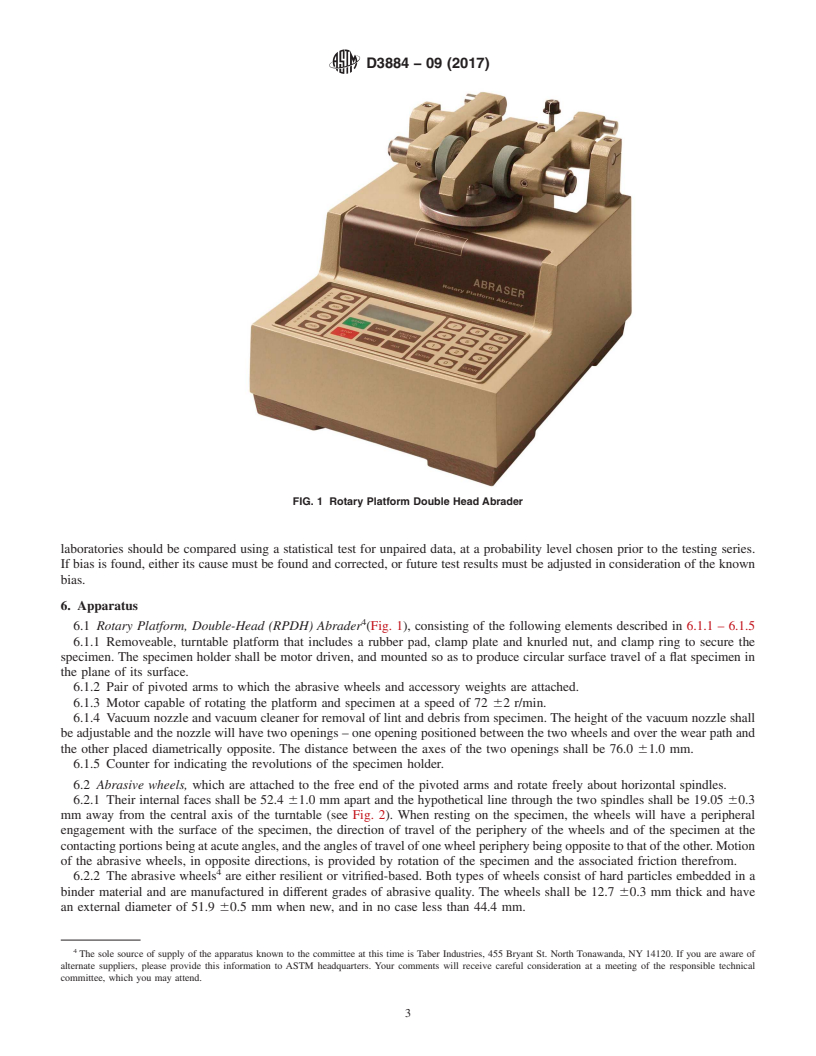
FIG. 1 Rotary Platform Double Head Abrader
laboratories should be compared using a statistical test for unpaired data, at a probability level chosen prior to the testing series.
If bias is found, either its cause must be found and corrected, or future test results must be adjusted in consideration of the known
bias.
6. Apparatus
6.1 Rotary Platform, Double-Head (RPDH) Abrader (Fig. 1), consisting of the following elements described in 6.1.1 – 6.1.5
6.1.1 Removeable, turntable platform that includes a rubber pad, clamp plate and knurled nut, and clamp ring to secure the
specimen. The specimen holder shall be motor driven, and mounted so as to produce circular surface travel of a flat specimen in
the plane of its surface.
6.1.2 Pair of pivoted arms to which the abrasive wheels and accessory weights are attached.
6.1.3 Motor capable of rotating the platform and specimen at a speed of 72 62 r/min.
6.1.4 Vacuum nozzle and vacuum cleaner for removal of lint and debris from specimen. The height of the vacuum nozzle shall
be adjustable and the nozzle will have two openings – one opening positioned between the two wheels and over the wear path and
the other placed diametrically opposite. The distance between the axes of the two openings shall be 76.0 61.0 mm.
6.1.5 Counter for indicating the revolutions of the specimen holder.
6.2 Abrasive wheels, which are attached to the free end of the pivoted arms and rotate freely about horizontal spindles.
6.2.1 Their internal faces shall be 52.4 61.0 mm apart and the hypothetical line through the two spindles shall be 19.05 60.3
mm away from the central axis of the turntable (see Fig. 2). When resting on the specimen, the wheels will have a peripheral
engagement with the surface of the specimen, the direction of travel of the periphery of the wheels and of the specimen at the
contacting portions being at acute angles, and the angles of travel of one wheel periphery being opposite to that of the other. Motion
of the abrasive wheels, in opposite directions, is provided by rotation of the specimen and the associated friction therefrom.
6.2.2 The abrasive wheels are either resilient or vitrified-based. Both types of wheels consist of hard particles embedded in a
binder material and are manufactured in different grades of abrasive quality. The wheels shall be 12.7 60.3 mm thick and have
an external diameter of 51.9 60.5 mm when new, and in no case less than 44.4 mm.
The sole source of supply of the apparatus known to the committee at this time is Taber Industries, 455 Bryant St. North Tonawanda, NY 14120. If you are aware of
alternate suppliers, please provide this information to ASTM headquarters. Your comments will receive careful consideration at a meeting of the responsible technical
committee, which you may attend.
D3884 − 09 (2017)
FIG. 2 Position of Abrasive Wheels on Rotary Platform Double
Head Abrader
6.3 Accessory Loads, The RPDH abrader is provided with a load adjustment for varying the load of the abrader wheels on the
specimen. The pivoted abrader arms without auxiliary weights or counter weights apply a load against the specimen of 250 g per
wheel (exclusive of the mass of the wheel itself). The manufacturer provides additional weights that can be used to increase the
load to 500 or 1000 g per wheel, and a counterweight attachment that can be used to reduce the load on the specimen to 125 g
per wheel.
6.4 Auxiliary Apparatus—Resurfacing discs (S-11), of carborundum-coated paper, are used to resurface the resilient wheels.
6.5 Abrasion Wheel Resurfacing Device, for resurfacing vitrified based wheels or for correcting uneven wheel wear.
7. Sampling
7.1 Take a lot sample as directed in the applicable material specification, or as agreed upon by the purchaser and seller. In the
absence of such a specification or other agreement, take a laboratory sample as directed in 7.1.1. Consider rolls or pieces of fabric
to be the primary sampling unit.
7.1.1 Take a laboratory sample that is the full width of the fabric and at least 50 cm (approximately 20 in.) long, from each roll
or piece of fabric in the lot sample. The laboratory sample should be taken no closer than 1 m (1 yd) from the end of each roll
or piece of fabric.
7.2 Sample shipments of garments as agreed upon by purchase
...
Questions, Comments and Discussion
Ask us and Technical Secretary will try to provide an answer. You can facilitate discussion about the standard in here.