

ASTM C1812/C1812M-22
(Practice)Standard Practice for Design of Journal Bearing Supports to be Used in Fiber Reinforced Concrete Beam Tests
General Information
- Abstract
SIGNIFICANCE AND USE
4.1 The presence of friction in the supporting rollers used when testing a fiber-reinforced concrete beam will increase the apparent load resistance of the beam. Roller supports designed in accordance with this practice will provide a relatively low and consistent value of friction at the supports.
4.2 Two types of rollers are used to support a beam. One includes a cylindrical bearing that allows the roller assembly to rotate along an axis parallel to the longitudinal axis of the beam and thereby accommodate any warping introduced during specimen fabrication. The other roller does not include the cylindrical bearing.
4.3 The rollers are designed for use with 150 mm [6 in.] or 100 mm [4 in.] deep beams of square cross-section.
4.4 A method is provided for correcting the apparent load resistance measured using the roller with a known value of the effective coefficient of friction of the roller supports to obtain an estimate of the load resistance in the absence of friction.
SCOPE
1.1 This practice prescribes the design of journal-bearing type rollers to support each end of fiber-reinforced concrete beams tested using Test Method C1399/C1399M or Test Method C1609/C1609M. The roller design is intended to provide a consistent and relatively low value of effective coefficient of friction at the beam supports. The bearing design incorporates metal-on-metal sliding surfaces lubricated with grease.
Note 1: During the progress of a test, a crack or cracks open on the underside of the beam between the loaded third points causing the underside of each portion of the beam to move away from the center. The design is intended to provide for unlimited rotation of the roller at the point of contact with the test beam in response to this motion.
Note 2: The design of the supporting rollers is a significant factor in determining the magnitude of the arching forces that cause error in flexural test results.2 Improperly designed supporting rollers can influence the apparent flexural behavior of fiber-reinforced concrete beams.3 The effective coefficient of friction can be determined using a method similar to that described by Bernard.4
1.2 The text of this standard refers to notes and footnotes that provide explanatory material. These notes and footnotes (excluding those in tables and figures) shall not be considered as requirements of the standard.
1.3 Units—The values stated in either SI units or inch-pound units are to be regarded separately as standard. The values stated in each system are not necessarily exact equivalents; therefore, to ensure conformance with the standard, each system shall be used independently of the other, and values from the two systems shall not be combined.
1.4 This standard does not purport to address all of the safety concerns, if any, associated with its use. It is the responsibility of the user of this standard to establish appropriate safety, health, and environmental practices and determine the applicability of regulatory limitations prior to use.
1.5 This international standard was developed in accordance with internationally recognized principles on standardization established in the Decision on Principles for the Development of International Standards, Guides and Recommendations issued by the World Trade Organization Technical Barriers to Trade (TBT) Committee.
- Status
- Published
- Publication Date
- 14-Dec-2022
- Technical Committee
- C09 - Concrete and Concrete Aggregates
- Drafting Committee
- C09.42 - Fiber-Reinforced Concrete
Buy Documents
ASTM C1812/C1812M-22 - Standard Practice for Design of Journal Bearing Supports to be Used in Fiber Reinforced Concrete Beam Tests
REDLINE ASTM C1812/C1812M-22 - Standard Practice for Design of Journal Bearing Supports to be Used in Fiber Reinforced Concrete Beam Tests
Overview
ASTM C1812/C1812M-22 defines the standard practice for the design of journal bearing supports for use in the flexural testing of fiber-reinforced concrete beams. This standard is crucial for ensuring accurate flexural test results by specifying the roller supports used at each end of the beam during third-point loading test methods, particularly ASTM C1399/C1399M and ASTM C1609/C1609M. The primary aim is to minimize and control the friction at the supports, as inconsistent or excessive friction can artificially increase the measured load resistance and distort test outcomes.
ASTM C1812/C1812M-22 provides guidelines on the selection, design, manufacture, and maintenance of the roller assemblies, including recommendations for materials, surface finish, lubrication, and dimensional tolerances. The standard also includes a method for correcting apparent load resistance values, accounting for the influence of support friction.
Key Topics
- Friction in Beam Supports: Explains how friction at roller supports can affect the apparent load resistance of fiber-reinforced concrete beams during flexural tests.
- Journal Bearing Roller Design: Specifies requirements for rollers featuring metal-on-metal sliding surfaces, lubricated with grease, to ensure low and consistent friction coefficients.
- Applicability to Beam Sizes: Covers roller assemblies for both 150 mm (6 in.) and 100 mm (4 in.) deep beams with square cross-sections.
- Roller Types:
- One type accommodates rotation parallel to the beam’s longitudinal axis, addressing any warping in test specimens.
- The other type remains fixed to prevent beam overturning during testing.
- Correction Method: Provides a calculation for adjusting apparent beam load resistance measurements to account for known friction at the supports.
- Maintenance Guidelines: Recommends regular cleaning and greasing schedules to maintain roller function and friction performance.
Applications
- Flexural Testing of Fiber-Reinforced Concrete: Used in labs and quality control environments to ensure accurate measurement of residual strength and post-crack behavior in fiber-reinforced concrete beams.
- Test Method Compliance: Ensures proper support conditions for ASTM C1399/C1399M and ASTM C1609/C1609M, which assess the flexural performance of concrete using third-point loading.
- Structural Materials Research: Supports development and validation of new concrete composites by minimizing systematic error from test setup friction.
- Industry Quality Assurance: Facilitates repeatable, standardized tests across laboratories, supporting regulatory compliance and product certification for concrete containing fibers.
Related Standards
- ASTM C125: Terminology Relating to Concrete and Concrete Aggregates.
- ASTM C1399/C1399M: Test Method for Obtaining Average Residual-Strength of Fiber-Reinforced Concrete.
- ASTM C1609/C1609M: Test Method for Flexural Performance of Fiber-Reinforced Concrete (Using Beam With Third-Point Loading).
- ASTM D4950: Classification and Specification for Automotive Service Greases, referenced for lubrication of roller assemblies.
- SAE J404: Chemical Composition of SAE Alloy Steels, referred for material selection of the roller components.
Keywords: ASTM C1812/C1812M, fiber reinforced concrete, flexural beam test, journal bearing supports, roller supports, test method compliance, concrete testing standards, friction correction, laboratory quality assurance, structural materials testing.
This standard is essential in achieving reliable and consistent results in flexural testing of fiber-reinforced concrete beams by controlling roller support design and minimizing the impact of friction in laboratory environments.
Relations
- Effective Date
- 01-Jan-2024
- Effective Date
- 15-Dec-2019
- Effective Date
- 15-Dec-2019
- Effective Date
- 01-May-2019
- Effective Date
- 01-Jan-2019
- Effective Date
- 01-Oct-2018
- Effective Date
- 01-Jul-2018
- Effective Date
- 01-Jan-2018
- Effective Date
- 15-Dec-2016
- Effective Date
- 15-Dec-2015
- Effective Date
- 01-Jul-2015
- Effective Date
- 01-Jul-2015
- Effective Date
- 01-Feb-2015
- Effective Date
- 01-Dec-2014
- Effective Date
- 01-Aug-2014
Buy Documents
ASTM C1812/C1812M-22 - Standard Practice for Design of Journal Bearing Supports to be Used in Fiber Reinforced Concrete Beam Tests
REDLINE ASTM C1812/C1812M-22 - Standard Practice for Design of Journal Bearing Supports to be Used in Fiber Reinforced Concrete Beam Tests
Get Certified
Connect with accredited certification bodies for this standard

DIBt (Deutsches Institut für Bautechnik)
German Institute for Building Technology.
DIN CERTCO
DIN Group product certification.

Aboma Certification B.V.
Specialized in construction, metal, and transport sectors.
Sponsored listings
Frequently Asked Questions
ASTM C1812/C1812M-22 is a standard published by ASTM International. Its full title is "Standard Practice for Design of Journal Bearing Supports to be Used in Fiber Reinforced Concrete Beam Tests". This standard covers: SIGNIFICANCE AND USE 4.1 The presence of friction in the supporting rollers used when testing a fiber-reinforced concrete beam will increase the apparent load resistance of the beam. Roller supports designed in accordance with this practice will provide a relatively low and consistent value of friction at the supports. 4.2 Two types of rollers are used to support a beam. One includes a cylindrical bearing that allows the roller assembly to rotate along an axis parallel to the longitudinal axis of the beam and thereby accommodate any warping introduced during specimen fabrication. The other roller does not include the cylindrical bearing. 4.3 The rollers are designed for use with 150 mm [6 in.] or 100 mm [4 in.] deep beams of square cross-section. 4.4 A method is provided for correcting the apparent load resistance measured using the roller with a known value of the effective coefficient of friction of the roller supports to obtain an estimate of the load resistance in the absence of friction. SCOPE 1.1 This practice prescribes the design of journal-bearing type rollers to support each end of fiber-reinforced concrete beams tested using Test Method C1399/C1399M or Test Method C1609/C1609M. The roller design is intended to provide a consistent and relatively low value of effective coefficient of friction at the beam supports. The bearing design incorporates metal-on-metal sliding surfaces lubricated with grease. Note 1: During the progress of a test, a crack or cracks open on the underside of the beam between the loaded third points causing the underside of each portion of the beam to move away from the center. The design is intended to provide for unlimited rotation of the roller at the point of contact with the test beam in response to this motion. Note 2: The design of the supporting rollers is a significant factor in determining the magnitude of the arching forces that cause error in flexural test results.2 Improperly designed supporting rollers can influence the apparent flexural behavior of fiber-reinforced concrete beams.3 The effective coefficient of friction can be determined using a method similar to that described by Bernard.4 1.2 The text of this standard refers to notes and footnotes that provide explanatory material. These notes and footnotes (excluding those in tables and figures) shall not be considered as requirements of the standard. 1.3 Units—The values stated in either SI units or inch-pound units are to be regarded separately as standard. The values stated in each system are not necessarily exact equivalents; therefore, to ensure conformance with the standard, each system shall be used independently of the other, and values from the two systems shall not be combined. 1.4 This standard does not purport to address all of the safety concerns, if any, associated with its use. It is the responsibility of the user of this standard to establish appropriate safety, health, and environmental practices and determine the applicability of regulatory limitations prior to use. 1.5 This international standard was developed in accordance with internationally recognized principles on standardization established in the Decision on Principles for the Development of International Standards, Guides and Recommendations issued by the World Trade Organization Technical Barriers to Trade (TBT) Committee.
SIGNIFICANCE AND USE 4.1 The presence of friction in the supporting rollers used when testing a fiber-reinforced concrete beam will increase the apparent load resistance of the beam. Roller supports designed in accordance with this practice will provide a relatively low and consistent value of friction at the supports. 4.2 Two types of rollers are used to support a beam. One includes a cylindrical bearing that allows the roller assembly to rotate along an axis parallel to the longitudinal axis of the beam and thereby accommodate any warping introduced during specimen fabrication. The other roller does not include the cylindrical bearing. 4.3 The rollers are designed for use with 150 mm [6 in.] or 100 mm [4 in.] deep beams of square cross-section. 4.4 A method is provided for correcting the apparent load resistance measured using the roller with a known value of the effective coefficient of friction of the roller supports to obtain an estimate of the load resistance in the absence of friction. SCOPE 1.1 This practice prescribes the design of journal-bearing type rollers to support each end of fiber-reinforced concrete beams tested using Test Method C1399/C1399M or Test Method C1609/C1609M. The roller design is intended to provide a consistent and relatively low value of effective coefficient of friction at the beam supports. The bearing design incorporates metal-on-metal sliding surfaces lubricated with grease. Note 1: During the progress of a test, a crack or cracks open on the underside of the beam between the loaded third points causing the underside of each portion of the beam to move away from the center. The design is intended to provide for unlimited rotation of the roller at the point of contact with the test beam in response to this motion. Note 2: The design of the supporting rollers is a significant factor in determining the magnitude of the arching forces that cause error in flexural test results.2 Improperly designed supporting rollers can influence the apparent flexural behavior of fiber-reinforced concrete beams.3 The effective coefficient of friction can be determined using a method similar to that described by Bernard.4 1.2 The text of this standard refers to notes and footnotes that provide explanatory material. These notes and footnotes (excluding those in tables and figures) shall not be considered as requirements of the standard. 1.3 Units—The values stated in either SI units or inch-pound units are to be regarded separately as standard. The values stated in each system are not necessarily exact equivalents; therefore, to ensure conformance with the standard, each system shall be used independently of the other, and values from the two systems shall not be combined. 1.4 This standard does not purport to address all of the safety concerns, if any, associated with its use. It is the responsibility of the user of this standard to establish appropriate safety, health, and environmental practices and determine the applicability of regulatory limitations prior to use. 1.5 This international standard was developed in accordance with internationally recognized principles on standardization established in the Decision on Principles for the Development of International Standards, Guides and Recommendations issued by the World Trade Organization Technical Barriers to Trade (TBT) Committee.
ASTM C1812/C1812M-22 is classified under the following ICS (International Classification for Standards) categories: 91.100.30 - Concrete and concrete products. The ICS classification helps identify the subject area and facilitates finding related standards.
ASTM C1812/C1812M-22 has the following relationships with other standards: It is inter standard links to ASTM C1609/C1609M-24, ASTM C125-19a, ASTM C1609/C1609M-19a, ASTM C1609/C1609M-19, ASTM C125-19, ASTM C125-18b, ASTM C125-18a, ASTM C125-18, ASTM C125-16, ASTM C125-15b, ASTM C1399/C1399M-10(2015), ASTM C125-15a, ASTM C125-15, ASTM D4950-14, ASTM C125-14. Understanding these relationships helps ensure you are using the most current and applicable version of the standard.
ASTM C1812/C1812M-22 is available in PDF format for immediate download after purchase. The document can be added to your cart and obtained through the secure checkout process. Digital delivery ensures instant access to the complete standard document.
Standards Content (Sample)
This international standard was developed in accordance with internationally recognized principles on standardization established in the Decision on Principles for the
Development of International Standards, Guides and Recommendations issued by the World Trade Organization Technical Barriers to Trade (TBT) Committee.
Designation: C1812/C1812M − 22
Standard Practice for
Design of Journal Bearing Supports to be Used in Fiber
Reinforced Concrete Beam Tests
This standard is issued under the fixed designation C1812/C1812M; the number immediately following the designation indicates the
year of original adoption or, in the case of revision, the year of last revision. A number in parentheses indicates the year of last
reapproval. A superscript epsilon (´) indicates an editorial change since the last revision or reapproval.
1. Scope* system shall be used independently of the other, and values
from the two systems shall not be combined.
1.1 This practice prescribes the design of journal-bearing
1.4 This standard does not purport to address all of the
type rollers to support each end of fiber-reinforced concrete
safety concerns, if any, associated with its use. It is the
beams tested using Test Method C1399/C1399M or Test
responsibility of the user of this standard to establish appro-
Method C1609/C1609M. The roller design is intended to
priate safety, health, and environmental practices and deter-
provide a consistent and relatively low value of effective
mine the applicability of regulatory limitations prior to use.
coefficient of friction at the beam supports. The bearing design
1.5 This international standard was developed in accor-
incorporates metal-on-metal sliding surfaces lubricated with
dance with internationally recognized principles on standard-
grease.
NOTE 1—During the progress of a test, a crack or cracks open on the ization established in the Decision on Principles for the
underside of the beam between the loaded third points causing the
Development of International Standards, Guides and Recom-
underside of each portion of the beam to move away from the center. The
mendations issued by the World Trade Organization Technical
design is intended to provide for unlimited rotation of the roller at the
Barriers to Trade (TBT) Committee.
point of contact with the test beam in response to this motion.
NOTE 2—The design of the supporting rollers is a significant factor in
determining the magnitude of the arching forces that cause error in 2. Referenced Documents
flexural test results. Improperly designed supporting rollers can influence
2.1 ASTM Standards:
the apparent flexural behavior of fiber-reinforced concrete beams. The
C125 Terminology Relating to Concrete and Concrete Ag-
effective coefficient of friction can be determined using a method similar
to that described by Bernard. gregates
C1399/C1399M Test Method for Obtaining Average
1.2 The text of this standard refers to notes and footnotes
Residual-Strength of Fiber-Reinforced Concrete
that provide explanatory material. These notes and footnotes
C1609/C1609M Test Method for Flexural Performance of
(excluding those in tables and figures) shall not be considered
Fiber-Reinforced Concrete (Using BeamWithThird-Point
as requirements of the standard.
Loading)
1.3 Units—The values stated in either SI units or inch-
D4950 Classification and Specification for Automotive Ser-
pound units are to be regarded separately as standard. The
vice Greases
values stated in each system are not necessarily exact equiva-
2.2 SAE International Standard:
lents; therefore, to ensure conformance with the standard, each
J 404 Chemical Composition of SAE Alloy Steels
3. Terminology
This practice is under the jurisdiction of ASTM Committee C09 on Concrete
3.1 Definitions:
andConcreteAggregatesandisthedirectresponsibilityofSubcommitteeC09.42on
Fiber-Reinforced Concrete.
3.1.1 For definitions of terms used in this practice, refer to
Current edition approved Dec. 15, 2022. Published January 2023. Originally
Terminology C125.
approved in 2015. Last previous edition approved in 2015 as C1812/C1812M–15.
3.2 Definitions of Terms Specific to This Standard:
DOI: 10.1520/C1812_C1812M-22.
3.2.1 effective coeffıcient of friction, n—a dimensionless
Zollo,R.F.,2013.“AnalysisofSupportApparatusforFlexuralLoad-deflection
Testing: Minimizing Bias,” Journal of Testing and Evaluation,ASTM International,
ratio of the horizontal force required to initiate rotation of the
Vol. 41, No. 1, pp. 1-6.
Wille, K. and Parra-Montesinos, G.J., 2012. “Effect of Beam Size, Casting
Method, and Support Conditions on Flexural Behavior of Ultra-High-Performance
Fiber-Reinforced Concrete,” ACI Journal of Materials, Vol. 109, No. 3, pp. For referenced ASTM standards, visit the ASTM website, www.astm.org, or
379-388. contact ASTM Customer Service at service@astm.org. For Annual Book of ASTM
Bernard, E.S., 2014. “Influence of friction in supporting rollers on the apparent Standards volume information, refer to the standard’s Document Summary page on
flexural performance of third-point loaded fibre reinforced concrete beams,” the ASTM website.
Advanced Civil Engineering Materials, ASTM International Vol. 2, No. 1, pp. Available from SAE International (SAE), 400 Commonwealth Dr.,Warrendale,
158-176. PA 15096, http://aerospace.sae.org.
*A Summary of Changes section appears at the end of this standard
Copyright © ASTM International, 100 Barr Harbor Drive, PO Box C700, West Conshohocken, PA 19428-2959. United States
C1812/C1812M − 22
roller support applied at the contact point between the roller between sliding surfaces within each roller will generate a
and test beam divided by the normal force applied at the same small resistance to rotation of the barrel relative to the
point (see Fig. 1). mounting (see Fig. 1). A roller fabricated in accordance with
this practice will exhibit an effective coefficient of friction of
3.2.2 roller, n—a journal bearing capable of continuous
about 0.10. Journal bearing supports manufactured in confor-
rotation without exhibiting a significant variation in resistance
mance with this practice do not need to be tested to confirm
to rotation.
that the effective coefficient of friction meets requirements.
4. Significance and Use
5.1.1 One of the two rollers supporting the underside of the
beam shall be able to rotate about an axis parallel to the
4.1 The presence of friction in the supporting rollers used
longitudinal axis of the beam to accommodate a warped test
when testing a fiber-reinforced concrete beam will increase the
beam surface that could induce torsion in the beam during
apparent load resistance of the beam. Roller supports designed
testing (see Note 3 and Fig. 2). The other roller shall be fixed
in accordance with this practice will provide a relatively low
against rotation about a longitudinal axis to prevent the beam
and consistent value of friction at the supports.
from overturning during installation and testing (see Fig. 3).
4.2 Two types of rollers are used to support a beam. One
Rotation about a longitudinal axis shall be accommodated by
includes a cylindrical bearing that allows the roller assembly to
inclusion of a cylindrical bearing surface under the roller
rotatealonganaxisparalleltothelongitudinalaxisofthebeam
mount with a center of rotation that coincides with the plane of
and thereby accommodate any warping introduced during
the contacting surface between roller and bottom of the beam.
specimen fabrication. The other roller does not include the
The base of the cylindrical bearing surface shall include bolt
cylindrical bearing.
holes to facilitate fixing the roller to the testing machine. The
4.3 The rollers are designed for use with 150 mm [6 in.] or
roller that is fixed against rotation about a longitudinal axis
100 mm [4 in.] deep beams of square cross-section. (Fig. 3 and Fig. 6) shall incorporate a similar mounting so that
the total height is the same as the roller assembly shown in Fig.
4.4 A method is provided for correcting the apparent load
2andFig.5andthebeamismaintainedlevelduringatest.The
resistance measured using the roller with a known value of the
barrel of each roller is fabricated from one piece of steel. Caps
effective coefficient of friction of the roller supports to obtain
secure the roller barrel in place so that it may rotate but not
an estimate of the load resistance in the absence of friction.
displace during a test. The cylindrical
...
This document is not an ASTM standard and is intended only to provide the user of an ASTM standard an indication of what changes have been made to the previous version. Because
it may not be technically possible to adequately depict all changes accurately, ASTM recommends that users consult prior editions as appropriate. In all cases only the current version
of the standard as published by ASTM is to be considered the official document.
´1
Designation: C1812/C1812M − 15 C1812/C1812M − 22
Standard Practice for
Design of Journal Bearing Supports to be Used in Fiber
Reinforced Concrete Beam Tests
This standard is issued under the fixed designation C1812/C1812M; the number immediately following the designation indicates the
year of original adoption or, in the case of revision, the year of last revision. A number in parentheses indicates the year of last
reapproval. A superscript epsilon (´) indicates an editorial change since the last revision or reapproval.
ε NOTE—The designation was corrected editorially in June 2016 to conform with the units statement (1.2).
1. Scope Scope*
1.1 This practice prescribes the design of journal-bearing type rollers to support each end of fiber-reinforced concrete beams tested
using Test Method C1399/C1399M or Test Method C1609/C1609M. The roller design is intended to provide a consistent and
relatively low value of effective coefficient of friction at the beam supports. The bearing design incorporates metal-on-metal sliding
surfaces lubricated with grease.
NOTE 1—During the progress of a test, a crack or cracks open on the underside of the beam between the loaded third points causing the underside of each
portion of the beam to move away from the center. The design is intended to provide for unlimited rotation of the roller at the point of contact with the
test beam in response to this motion.
NOTE 2—The design of the supporting rollers is a significant factor in determining the magnitude of the arching forces that cause error in flexural test
2 3
results. Improperly designed supporting rollers can influence the apparent flexural behavior of fiber-reinforced concrete beams. The effective coefficient
of friction can be determined using a method similar to that described by Bernard.
1.2 The text of this standard refers to notes and footnotes that provide explanatory material. These notes and footnotes (excluding
those in tables and figures) shall not be considered as requirements of the standard.
1.3 Units—The values stated in either SI units or inch-pound units are to be regarded separately as standard. The values stated in
each system mayare not benecessarily exact equivalents; therefore, to ensure conformance with the standard, each system shall be
used independently of the other. Combiningother, and values from the two systems may result in non-conformance with the
standard.shall not be combined.
1.4 This standard does not purport to address all of the safety concerns, if any, associated with its use. It is the responsibility
of the user of this standard to establish appropriate safety safety, health, and healthenvironmental practices and determine the
applicability of regulatory limitations prior to use.
1.5 This international standard was developed in accordance with internationally recognized principles on standardization
established in the Decision on Principles for the Development of International Standards, Guides and Recommendations issued
by the World Trade Organization Technical Barriers to Trade (TBT) Committee.
This practice is under the jurisdiction of ASTM Committee C09 on Concrete and Concrete Aggregates and is the direct responsibility of Subcommittee C09.42 on
Fiber-Reinforced Concrete.
Current edition approved July 1, 2015Dec. 15, 2022. Published September 2015January 2023. Originally approved in 2015. Last previous edition approved in 2015 as
C1812/C1812M–15. DOI: 10.1520/C1812_C1812M-15E01.10.1520/C1812_C1812M-22.
Zollo, R. F., 2013. “Analysis of Support Apparatus for Flexural Load-deflection Testing: Minimizing Bias,” Journal of Testing and Evaluation, ASTM International, Vol.
41, No. 1, pp. 1-6.
Wille, K. and Parra-Montesinos, G.J., 2012. “Effect of Beam Size, Casting Method, and Support Conditions on Flexural Behavior of Ultra-High-Performance
Fiber-Reinforced Concrete,” ACI Journal of Materials, Vol. 109, No. 3, pp. 379-388.
Bernard, E.S., 2014. “Influence of friction in supporting rollers on the apparent flexural performance of third-point loaded fibre reinforced concrete beams,” Advanced
Civil Engineering Materials, ASTM International Vol. 2, No. 1, pp. 158-176.
*A Summary of Changes section appears at the end of this standard
Copyright © ASTM International, 100 Barr Harbor Drive, PO Box C700, West Conshohocken, PA 19428-2959. United States
C1812/C1812M − 22
2. Referenced Documents
2.1 ASTM Standards:
C125 Terminology Relating to Concrete and Concrete Aggregates
C1399/C1399M Test Method for Obtaining Average Residual-Strength of Fiber-Reinforced Concrete
C1609/C1609M Test Method for Flexural Performance of Fiber-Reinforced Concrete (Using Beam With Third-Point Loading)
D4950 Classification and Specification for Automotive Service Greases
2.2 SAE International Standard:
J 404 Chemical Composition of SAE Alloy Steels
3. Terminology
3.1 Definitions:
3.1.1 For definitions of terms used in this practice, refer to Terminology C125.
3.2 Definitions of Terms Specific to This Standard:
3.2.1 effective coeffıcient of friction, n—a dimensionless ratio of the horizontal force required to initiate rotation of the roller
support applied at the contact point between the roller and test beam divided by the normal force applied at the same point (see
Fig. 1).
3.2.2 roller, n—a journal bearing capable of continuous rotation without exhibiting a significant variation in resistance to rotation.
4. Significance and Use
4.1 The presence of friction in the supporting rollers used when testing a fiber-reinforced concrete beam will increase the apparent
load resistance of the beam. Roller supports designed in accordance with this practice will provide a relatively low and consistent
value of friction at the supports.
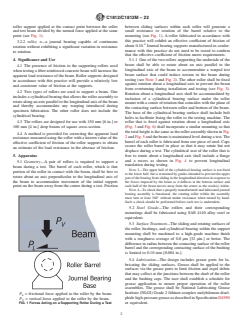
P = frictional force applied to the roller by the beam.
L
P = vertical force applied to the roller by the beam.
V
FIG. 1 Forces Acting on a Supporting Roller During a Test
For referenced ASTM standards, visit the ASTM website, www.astm.org, or contact ASTM Customer Service at service@astm.org. For Annual Book of ASTM Standards
volume information, refer to the standard’s Document Summary page on the ASTM website.
Available from SAE International (SAE), 400 Commonwealth Dr., Warrendale, PA 15096, http://aerospace.sae.org.
C1812/C1812M − 22
4.2 Two types of rollers are used to support a beam. One includes a cylindrical bearing that allows the roller assembly to rotate
along an axis parallel to the longitudinal axis of the beam and thereby accommodate any warping introduced during specimen
fabrication. The other roller does not include the cylindrical bearing.
4.3 The rollers are designed for use with 150 mm [6 in.] or 100 mm [4 in.] deep beams of square cross-section.
4.4 A method is provided for correcting the apparent load resistance measured using the roller with a known value of the effective
coefficient of friction of the roller supports to obtain an estimate of the load resistance in the absence of friction.
5. Apparatus
5.1 Geometry—A pair of rollers is required to support a beam during a test. The barrel of each roller, which is that portion of the
roller in contact with the beam, shall be free to rotate about an axis perpendicular to the longitudinal axis of the beam to
accommodate movement of the initial support point on the beam away from the center during a test. Friction between sliding
surfaces within each roller will generate a small resistance to rotation of the barrel relative to the mounting (see Fig. 1). A roller
fabricated in accordance with this practice will exhibit an effective coefficient of friction of about 0.10. Journal bearing supports
manufactured in conformance with this practice do not need to be tested to confirm that the effective coefficient of friction meets
requirements.
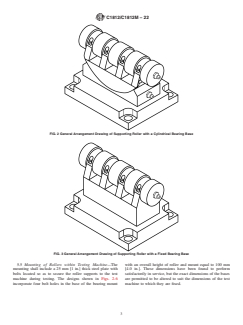
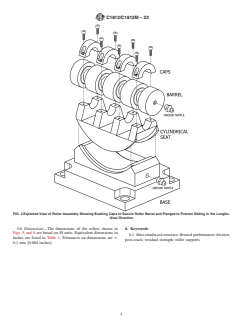
5.1.1 One of the two rollers supporting the underside of the beam shall be able to rotate about an axis parallel to the longitudinal
axis of the beam to accommodate a warped test beam surface that could induce torsion in the beam during testing (see Note 3 and
Fig. 2). The other roller shall be fixed against rotation about a longitudinal axis to prevent the beam from overturning during
installation and testing (see Fig. 3). Rotation about a longitudinal axis shall be accommodated by i
...