

ASTM C1609/C1609M-24
(Test Method)Standard Test Method for Flexural Performance of Fiber-Reinforced Concrete (Using Beam With Third-Point Loading)
General Information
- Abstract
SIGNIFICANCE AND USE
5.1 The first-peak strength characterizes the flexural behavior of the fiber-reinforced concrete up to the onset of cracking, while residual strengths at specified deflections characterize the residual capacity after cracking. Specimen toughness is a measure of the energy absorption capacity of the test specimen. The appropriateness of each parameter depends on the nature of the proposed application and the level of acceptable cracking and deflection serviceability. Fiber-reinforced concrete is influenced in different ways by the amount and type of fibers in the concrete. In some cases, fibers may increase the residual load and toughness capacity at specified deflections while producing a first-peak strength equal to or only slightly greater than the flexural strength of the concrete without fibers. In other cases, fibers may significantly increase the first-peak and peak strengths while affecting a relatively small increase in residual load capacity and specimen toughness at specified deflections.
5.2 The first-peak strength, peak strength, and residual strengths determined by this test method reflect the behavior of fiber-reinforced concrete under static flexural loading. The absolute values of energy absorption obtained in this test are of little direct relevance to the performance of fiber-reinforced concrete structures since they depend directly on the size and shape of the specimen and the loading arrangement.
5.3 The results of this test method may be used for comparing the performance of various fiber-reinforced concrete mixtures or in research and development work. They may also be used to monitor concrete quality, to verify compliance with construction specifications, obtain flexural strength data on fiber-reinforced concrete members subject to pure bending, or to evaluate the quality of concrete in service.
5.4 The results of this standard test method are dependent on the size of the specimen.
Note 5: The results obtained using one size molded ...
SCOPE
1.1 This test method evaluates the flexural performance of fiber-reinforced concrete using parameters derived from the load-deflection curve obtained by testing a simply supported beam under third-point loading using a closed-loop, servo-controlled testing system.
1.2 This test method provides for the determination of first-peak and peak loads and the corresponding stresses calculated by inserting them in the formula for modulus of rupture given in Eq 1. It also requires determination of residual loads at specified deflections, the corresponding residual strengths calculated by inserting them in the formula for modulus of rupture given in Eq 1 (see Note 1). It provides for determination of specimen toughness based on the area under the load-deflection curve up to a prescribed deflection (see Note 2) and the corresponding equivalent flexural strength ratio.
Note 1: Residual strength is not a true stress but an engineering stress computed using simple engineering bending theory for linear elastic materials and gross (uncracked) section properties.
Note 2: Specimen toughness expressed in terms of the area under the load-deflection curve is an indication of the energy absorption capability of the particular test specimen, and its magnitude depends directly on the geometry of the test specimen and the loading configuration.
1.3 This test method utilizes two preferred specimen sizes of 100 mm by 100 mm by 350 mm [4 in. by 4 in. by 14 in.] tested on a 300 mm [12 in.] span, or 150 mm by 150 mm by 500 mm [6 in. by 6 in. by 20 in.] tested on a 450 mm [18 in.] span. A specimen size different from the two preferred specimen sizes is permissible.
1.4 Units—The values stated in either SI units or inch-pound units are to be regarded separately as standard. The values stated in each system may not be exact equivalents; therefore, each system shall be used independently of the other. Combining values from the two systems may...
- Status
- Published
- Publication Date
- 31-Dec-2023
- Technical Committee
- C09 - Concrete and Concrete Aggregates
- Drafting Committee
- C09.42 - Fiber-Reinforced Concrete
Buy Documents
ASTM C1609/C1609M-24 - Standard Test Method for Flexural Performance of Fiber-Reinforced Concrete (Using Beam With Third-Point Loading)
REDLINE ASTM C1609/C1609M-24 - Standard Test Method for Flexural Performance of Fiber-Reinforced Concrete (Using Beam With Third-Point Loading)
Overview
ASTM C1609/C1609M-24: Standard Test Method for Flexural Performance of Fiber-Reinforced Concrete (Using Beam With Third-Point Loading) sets forth procedures for assessing the flexural performance of fiber-reinforced concrete (FRC). This method measures key parameters such as first-peak strength, peak strength, residual strengths, load-deflection behavior, and specimen toughness. By utilizing a standardized approach, the method ensures consistent comparison of different fiber-reinforced concrete mixes and provides valuable data for design, construction, quality control, and research purposes.
Key Topics
- Flexural Performance Assessment: The standard outlines protocols for evaluating the flexural behavior of fiber-reinforced concrete beams using third-point loading.
- First-Peak and Peak Strengths: Quantifies the flexural strength at the point of initial cracking (first-peak) and the maximum force resisted by the specimen (peak strength).
- Residual Strengths: Evaluates load-carrying capacities after cracking at specified deflections, providing insight into the post-crack performance of FRC.
- Specimen Toughness: Measures the energy absorption capacity, a critical indicator of the ductility and durability provided by fiber reinforcement.
- Load-Deflection Curve Analysis: Derived parameters are based on load versus deflection data, supporting performance-based assessments of FRC under bending.
- Specimen Size Dependency: Specifies preferred specimen dimensions and notes that results are influenced by the size and shape of both the specimen and loading arrangement.
- Applicability to Various Fibers: The standard acknowledges that both the amount and type of fiber affect performance, and outlines how their influence is captured by the test parameters.
Applications
ASTM C1609/C1609M-24 is widely used across the concrete industry to:
- Material Comparison: Compare flexural performance of different fiber-reinforced concrete mixtures for R&D or quality assurance.
- Design Verification: Obtain essential performance data for structural elements in applications where crack resistance and energy absorption are important, such as slabs, pavements, industrial floors, and precast elements.
- Quality Control: Monitor and verify compliance with project specifications and check material uniformity during construction.
- Evaluation of In-situ Concrete: Assess structural integrity and flexural performance of existing fiber-reinforced concrete via cores or beams extracted from service structures.
- Research and Development: Support the development of new FRC products and optimize fiber content/type for targeted performance.
- Regulatory and Code Compliance: Provide required data for code acceptance and regulatory submissions involving fiber-reinforced concrete technology.
Related Standards
For comprehensive evaluation and compliance, the following ASTM standards are commonly referenced alongside ASTM C1609/C1609M:
- ASTM C78/C78M: Test Method for Flexural Strength of Concrete (Using Simple Beam with Third-Point Loading)
- ASTM C42/C42M: Test Method for Obtaining and Testing Drilled Cores and Sawed Beams of Concrete
- ASTM C31/C31M and C192/C192M: Practices for Making and Curing Concrete Test Specimens in the Field and Laboratory
- ASTM C172/C172M: Practice for Sampling Freshly Mixed Concrete
- ASTM C823/C823M: Practice for Examination and Sampling of Hardened Concrete in Constructions
- ASTM E4: Practices for Force Calibration and Verification of Testing Machines
- ASTM C1812/C1812M: Practice for Design of Journal Bearing Supports (specific to FRC testing)
Practical Value
Adoption of ASTM C1609/C1609M-24 enables engineers, specifiers, and quality control professionals to accurately assess and compare the flexural performance of fiber-reinforced concrete. Its standardized procedure provides reliable, reproducible data critical for design optimization, quality assurance, safety analysis, and performance documentation. Employing this standard leads to the selection of FRC mixtures that enhance durability, crack resistance, and structural resilience in a broad range of civil engineering and infrastructure projects.
Keywords: fiber-reinforced concrete, flexural performance, ASTM C1609, third-point loading, residual strength, specimen toughness, load-deflection, quality control, concrete testing, construction standards.
Relations
- Effective Date
- 01-Jan-2024
- Refers
ASTM C31/C31M-24a - Standard Practice for Making and Curing Concrete Test Specimens in the Field - Effective Date
- 01-Apr-2024
- Refers
ASTM C31/C31M-24 - Standard Practice for Making and Curing Concrete Test Specimens in the Field - Effective Date
- 01-Jan-2024
- Refers
ASTM C31/C31M-23 - Standard Practice for Making and Curing Concrete Test Specimens in the Field - Effective Date
- 01-Jun-2023
- Effective Date
- 01-Jan-2024
- Effective Date
- 01-Jan-2024
- Effective Date
- 01-Jan-2024
- Effective Date
- 01-Jan-2024
Buy Documents
ASTM C1609/C1609M-24 - Standard Test Method for Flexural Performance of Fiber-Reinforced Concrete (Using Beam With Third-Point Loading)
REDLINE ASTM C1609/C1609M-24 - Standard Test Method for Flexural Performance of Fiber-Reinforced Concrete (Using Beam With Third-Point Loading)
Get Certified
Connect with accredited certification bodies for this standard

DIBt (Deutsches Institut für Bautechnik)
German Institute for Building Technology.
DIN CERTCO
DIN Group product certification.

Aboma Certification B.V.
Specialized in construction, metal, and transport sectors.
Sponsored listings
Frequently Asked Questions
ASTM C1609/C1609M-24 is a standard published by ASTM International. Its full title is "Standard Test Method for Flexural Performance of Fiber-Reinforced Concrete (Using Beam With Third-Point Loading)". This standard covers: SIGNIFICANCE AND USE 5.1 The first-peak strength characterizes the flexural behavior of the fiber-reinforced concrete up to the onset of cracking, while residual strengths at specified deflections characterize the residual capacity after cracking. Specimen toughness is a measure of the energy absorption capacity of the test specimen. The appropriateness of each parameter depends on the nature of the proposed application and the level of acceptable cracking and deflection serviceability. Fiber-reinforced concrete is influenced in different ways by the amount and type of fibers in the concrete. In some cases, fibers may increase the residual load and toughness capacity at specified deflections while producing a first-peak strength equal to or only slightly greater than the flexural strength of the concrete without fibers. In other cases, fibers may significantly increase the first-peak and peak strengths while affecting a relatively small increase in residual load capacity and specimen toughness at specified deflections. 5.2 The first-peak strength, peak strength, and residual strengths determined by this test method reflect the behavior of fiber-reinforced concrete under static flexural loading. The absolute values of energy absorption obtained in this test are of little direct relevance to the performance of fiber-reinforced concrete structures since they depend directly on the size and shape of the specimen and the loading arrangement. 5.3 The results of this test method may be used for comparing the performance of various fiber-reinforced concrete mixtures or in research and development work. They may also be used to monitor concrete quality, to verify compliance with construction specifications, obtain flexural strength data on fiber-reinforced concrete members subject to pure bending, or to evaluate the quality of concrete in service. 5.4 The results of this standard test method are dependent on the size of the specimen. Note 5: The results obtained using one size molded ... SCOPE 1.1 This test method evaluates the flexural performance of fiber-reinforced concrete using parameters derived from the load-deflection curve obtained by testing a simply supported beam under third-point loading using a closed-loop, servo-controlled testing system. 1.2 This test method provides for the determination of first-peak and peak loads and the corresponding stresses calculated by inserting them in the formula for modulus of rupture given in Eq 1. It also requires determination of residual loads at specified deflections, the corresponding residual strengths calculated by inserting them in the formula for modulus of rupture given in Eq 1 (see Note 1). It provides for determination of specimen toughness based on the area under the load-deflection curve up to a prescribed deflection (see Note 2) and the corresponding equivalent flexural strength ratio. Note 1: Residual strength is not a true stress but an engineering stress computed using simple engineering bending theory for linear elastic materials and gross (uncracked) section properties. Note 2: Specimen toughness expressed in terms of the area under the load-deflection curve is an indication of the energy absorption capability of the particular test specimen, and its magnitude depends directly on the geometry of the test specimen and the loading configuration. 1.3 This test method utilizes two preferred specimen sizes of 100 mm by 100 mm by 350 mm [4 in. by 4 in. by 14 in.] tested on a 300 mm [12 in.] span, or 150 mm by 150 mm by 500 mm [6 in. by 6 in. by 20 in.] tested on a 450 mm [18 in.] span. A specimen size different from the two preferred specimen sizes is permissible. 1.4 Units—The values stated in either SI units or inch-pound units are to be regarded separately as standard. The values stated in each system may not be exact equivalents; therefore, each system shall be used independently of the other. Combining values from the two systems may...
SIGNIFICANCE AND USE 5.1 The first-peak strength characterizes the flexural behavior of the fiber-reinforced concrete up to the onset of cracking, while residual strengths at specified deflections characterize the residual capacity after cracking. Specimen toughness is a measure of the energy absorption capacity of the test specimen. The appropriateness of each parameter depends on the nature of the proposed application and the level of acceptable cracking and deflection serviceability. Fiber-reinforced concrete is influenced in different ways by the amount and type of fibers in the concrete. In some cases, fibers may increase the residual load and toughness capacity at specified deflections while producing a first-peak strength equal to or only slightly greater than the flexural strength of the concrete without fibers. In other cases, fibers may significantly increase the first-peak and peak strengths while affecting a relatively small increase in residual load capacity and specimen toughness at specified deflections. 5.2 The first-peak strength, peak strength, and residual strengths determined by this test method reflect the behavior of fiber-reinforced concrete under static flexural loading. The absolute values of energy absorption obtained in this test are of little direct relevance to the performance of fiber-reinforced concrete structures since they depend directly on the size and shape of the specimen and the loading arrangement. 5.3 The results of this test method may be used for comparing the performance of various fiber-reinforced concrete mixtures or in research and development work. They may also be used to monitor concrete quality, to verify compliance with construction specifications, obtain flexural strength data on fiber-reinforced concrete members subject to pure bending, or to evaluate the quality of concrete in service. 5.4 The results of this standard test method are dependent on the size of the specimen. Note 5: The results obtained using one size molded ... SCOPE 1.1 This test method evaluates the flexural performance of fiber-reinforced concrete using parameters derived from the load-deflection curve obtained by testing a simply supported beam under third-point loading using a closed-loop, servo-controlled testing system. 1.2 This test method provides for the determination of first-peak and peak loads and the corresponding stresses calculated by inserting them in the formula for modulus of rupture given in Eq 1. It also requires determination of residual loads at specified deflections, the corresponding residual strengths calculated by inserting them in the formula for modulus of rupture given in Eq 1 (see Note 1). It provides for determination of specimen toughness based on the area under the load-deflection curve up to a prescribed deflection (see Note 2) and the corresponding equivalent flexural strength ratio. Note 1: Residual strength is not a true stress but an engineering stress computed using simple engineering bending theory for linear elastic materials and gross (uncracked) section properties. Note 2: Specimen toughness expressed in terms of the area under the load-deflection curve is an indication of the energy absorption capability of the particular test specimen, and its magnitude depends directly on the geometry of the test specimen and the loading configuration. 1.3 This test method utilizes two preferred specimen sizes of 100 mm by 100 mm by 350 mm [4 in. by 4 in. by 14 in.] tested on a 300 mm [12 in.] span, or 150 mm by 150 mm by 500 mm [6 in. by 6 in. by 20 in.] tested on a 450 mm [18 in.] span. A specimen size different from the two preferred specimen sizes is permissible. 1.4 Units—The values stated in either SI units or inch-pound units are to be regarded separately as standard. The values stated in each system may not be exact equivalents; therefore, each system shall be used independently of the other. Combining values from the two systems may...
ASTM C1609/C1609M-24 is classified under the following ICS (International Classification for Standards) categories: 91.100.40 - Products in fibre-reinforced cement. The ICS classification helps identify the subject area and facilitates finding related standards.
ASTM C1609/C1609M-24 has the following relationships with other standards: It is inter standard links to ASTM C1609/C1609M-19a, ASTM C31/C31M-24a, ASTM C31/C31M-24, ASTM C31/C31M-23, ASTM C1903-24, ASTM C1116/C1116M-23, ASTM C1812/C1812M-22, ASTM C1856/C1856M-17. Understanding these relationships helps ensure you are using the most current and applicable version of the standard.
ASTM C1609/C1609M-24 is available in PDF format for immediate download after purchase. The document can be added to your cart and obtained through the secure checkout process. Digital delivery ensures instant access to the complete standard document.
Standards Content (Sample)
This international standard was developed in accordance with internationally recognized principles on standardization established in the Decision on Principles for the
Development of International Standards, Guides and Recommendations issued by the World Trade Organization Technical Barriers to Trade (TBT) Committee.
Designation: C1609/C1609M − 24
Standard Test Method for
Flexural Performance of Fiber-Reinforced Concrete (Using
Beam With Third-Point Loading)
This standard is issued under the fixed designation C1609/C1609M; the number immediately following the designation indicates the
year of original adoption or, in the case of revision, the year of last revision. A number in parentheses indicates the year of last
reapproval. A superscript epsilon (´) indicates an editorial change since the last revision or reapproval.
1. Scope* 1.5 This standard does not purport to address all of the
safety concerns, if any, associated with its use. It is the
1.1 This test method evaluates the flexural performance of
responsibility of the user of this standard to establish appro-
fiber-reinforced concrete using parameters derived from the
priate safety, health, and environmental practices and deter-
load-deflection curve obtained by testing a simply supported
mine the applicability of regulatory limitations prior to use.
beam under third-point loading using a closed-loop, servo-
1.6 This international standard was developed in accor-
controlled testing system.
dance with internationally recognized principles on standard-
1.2 This test method provides for the determination of
ization established in the Decision on Principles for the
first-peak and peak loads and the corresponding stresses
Development of International Standards, Guides and Recom-
calculated by inserting them in the formula for modulus of
mendations issued by the World Trade Organization Technical
rupture given in Eq 1. It also requires determination of residual
Barriers to Trade (TBT) Committee.
loads at specified deflections, the corresponding residual
strengths calculated by inserting them in the formula for
2. Referenced Documents
modulus of rupture given in Eq 1 (see Note 1). It provides for 2
2.1 ASTM Standards:
determination of specimen toughness based on the area under
C31/C31M Practice for Making and Curing Concrete Test
the load-deflection curve up to a prescribed deflection (see
Specimens in the Field
Note 2) and the corresponding equivalent flexural strength
C42/C42M Test Method for Obtaining and Testing Drilled
ratio.
Cores and Sawed Beams of Concrete
NOTE 1—Residual strength is not a true stress but an engineering stress
C78/C78M Test Method for Flexural Strength of Concrete
computed using simple engineering bending theory for linear elastic
(Using Simple Beam with Third-Point Loading)
materials and gross (uncracked) section properties.
C125 Terminology Relating to Concrete and Concrete Ag-
NOTE 2—Specimen toughness expressed in terms of the area under the
load-deflection curve is an indication of the energy absorption capability
gregates
of the particular test specimen, and its magnitude depends directly on the
C172/C172M Practice for Sampling Freshly Mixed Con-
geometry of the test specimen and the loading configuration.
crete
1.3 This test method utilizes two preferred specimen sizes
C192/C192M Practice for Making and Curing Concrete Test
of 100 mm by 100 mm by 350 mm [4 in. by 4 in. by 14 in.]
Specimens in the Laboratory
tested on a 300 mm [12 in.] span, or 150 mm by 150 mm by
C823/C823M Practice for Examination and Sampling of
500 mm [6 in. by 6 in. by 20 in.] tested on a 450 mm [18 in.]
Hardened Concrete in Constructions
span. A specimen size different from the two preferred speci-
C1140/C1140M Practice for Preparing and Testing Speci-
men sizes is permissible.
mens from Shotcrete Test Panels
C1812/C1812M Practice for Design of Journal Bearing Sup-
1.4 Units—The values stated in either SI units or inch-
ports to be Used in Fiber Reinforced Concrete Beam Tests
pound units are to be regarded separately as standard. The
E4 Practices for Force Calibration and Verification of Test-
values stated in each system may not be exact equivalents;
ing Machines
therefore, each system shall be used independently of the other.
Combining values from the two systems may result in non-
3. Terminology
conformance with the standard.
3.1 Definitions—The terms used in this test method are
defined in Terminology C125.
This test method is under the jurisdiction of ASTM Committee C09 on
Concrete and Concrete Aggregates and is the direct responsibility of Subcommittee
C09.42 on Fiber-Reinforced Concrete. For referenced ASTM standards, visit the ASTM website, www.astm.org, or
Current edition approved Jan. 1, 2024. Published February 2024. Originally contact ASTM Customer Service at service@astm.org. For Annual Book of ASTM
approved in 2005. Last previous edition approved in 2019 as C1609/C1609M – 19a. Standards volume information, refer to the standard’s Document Summary page on
DOI: 10.1520/C1609_C1609M-24. the ASTM website.
*A Summary of Changes section appears at the end of this standard
Copyright © ASTM International, 100 Barr Harbor Drive, PO Box C700, West Conshohocken, PA 19428-2959. United States
C1609/C1609M − 24
of the weighted equivalent load up to a net deflection of L/150 over the
3.2 Definitions of Terms Specific to This Standard:
first-peak load multiplied by 100. The R value is equivalent to the R
T, 150 e,3
3.2.1 end-point deflection, n—the deflection value on the
value defined in the Technical Report No. 34 of the Concrete Society.
load-deflection curve equal to ⁄150 of the span length, or a
larger value as specified at the option of the specifier of tests.
4. Summary of Test Method
3.2.2 first-peak load, P , n—the load value at the first point
4.1 Molded or sawn beam specimens having a square
on the load-deflection curve where the slope is zero.
cross-section of fiber-reinforced concrete are tested in flexure
3.2.3 first-peak deflection, δ , n—the net deflection value on
using a third-point loading arrangement with a closed-loop,
the load-deflection curve at first-peak load.
servo-controlled testing system and roller supports under the
3.2.4 first-peak strength f , n—the stress value obtained ends of the beam that are free to rotate on their axes as
when the first-peak load is inserted in the formula for modulus described in Practice C1812/C1812M. The testing machine
of rupture given in Eq 1. shall conform to the requirements of the sections on Basis of
Verification, Corrections, and Time Interval Between Verifica-
3.2.5 load-deflection curve, n—the plot of load versus net
tions of Practices E4. Load and net deflection are monitored
deflection of a flexural beam specimen loaded to the end-point
and recorded to an end-point deflection of at least ⁄150 of the
deflection.
span. Data are recorded and plotted by means of an X-Y
3.2.6 net deflection, n—the deflection measured at mid-span
plotter, or they are recorded digitally and subsequently used to
of a flexural beam specimen exclusive of any extraneous
plot a load-deflection curve. Points termed first-peak, peak, and
effects due to seating or twisting of the specimen on its
residual loads at specified deflections are identified on the
supports or deformation of the support and loading system.
curve, and are used to calculate flexural performance param-
3.2.7 peak load, P , n—the maximum load on the load-
P
eters.
deflection curve.
5. Significance and Use
3.2.8 peak-load deflection, δ , n—the net deflection value
P
on the load-deflection curve at peak load.
5.1 The first-peak strength characterizes the flexural behav-
3.2.9 peak strength, f , n—the stress value obtained when ior of the fiber-reinforced concrete up to the onset of cracking,
P
the peak load is inserted in the formula for modulus of rupture
while residual strengths at specified deflections characterize the
given by Eq 1. residual capacity after cracking. Specimen toughness is a
measure of the energy absorption capacity of the test specimen.
3.2.10 D—nominal depth of the beam specimen in mm.
The appropriateness of each parameter depends on the nature
NOTE 3—To simplify nomenclature, the nominal beam depth is shown
of the proposed application and the level of acceptable crack-
in units of mm for both the SI and inch-pound version of this test method.
ing and deflection serviceability. Fiber-reinforced concrete is
3.2.11 L—span length or distance between the supports.
influenced in different ways by the amount and type of fibers in
D
3.2.12 residual load, P , n—the load value corresponding
the concrete. In some cases, fibers may increase the residual
to a net deflection of L/600 for a beam of nominal depth D.
load and toughness capacity at specified deflections while
D
producing a first-peak strength equal to or only slightly greater
3.2.13 residual load, P , n—the load value corresponding
than the flexural strength of the concrete without fibers. In
to a net deflection of L/150 for a beam of nominal depth D.
other cases, fibers may significantly increase the first-peak and
D
3.2.14 residual strength, f , n—the stress value obtained
peak strengths while affecting a relatively small increase in
D
when the residual load P is inserted in the formula for
residual load capacity and specimen toughness at specified
modulus of rupture given in Eq 1.
deflections.
D
3.2.15 residual strength, f , n—the stress value obtained
5.2 The first-peak strength, peak strength, and residual
D
when the residual load P is inserted in the formula for
strengths determined by this test method reflect the behavior of
modulus of rupture given in Eq 1.
fiber-reinforced concrete under static flexural loading. The
D
3.2.16 specimen toughness, T , n—toughness of beam
absolute values of energy absorption obtained in this test are of
specimen of nominal depth D at a net deflection of L/150.
little direct relevance to the performance of fiber-reinforced
D
3.2.17 equivalent flexural strength, f , n—the average
concrete structures since they depend directly on the size and
e, 150
stress value obtained from the flexural toughness of the beam
shape of the specimen and the loading arrangement.
specimen (absorbed energy calculated from the load-deflection
5.3 The results of this test method may be used for com-
curve), using Eq 3.
paring the performance of various fiber-reinforced concrete
D
mixtures or in research and development work. They may also
3.2.17.1 Discussion—ACI 544.4R-18 refers to f as f .
e, 150 e, 3
D be used to monitor concrete quality, to verify compliance with
3.2.18 equivalent flexural strength ratio, R , n—the
T, 150
construction specifications, obtain flexural strength data on
equivalent flexural strength divided by the first-peak strength,
fiber-reinforced concrete members subject to pure bending, or
expressed as a percentage.
to evaluate the quality of concrete in service.
NOTE 4—The equivalent flexural strength ratio is calculated as the ratio
3 4
ACI 544.4R-18: Guide to Design with Fiber-Reinforced Concrete, American “Concrete Industrial Ground Floors—A Guide to Design and Construction,”
rd
Concrete Institute, Farmington Hills, MI, http://www.concrete.org. Technical Report 34, 3 edition, Concrete Society, Slough, United Kingdom, 2003.
C1609/C1609M − 24
5.4 The results of this standard test method are dependent contact with appropriate brackets attached to the specimen.
on the size of the specimen. The average of the measurements represents the net deflection.
NOTE 5—The results obtained using one size molded specimen may not
6.3 Data Recording System—An X-Y plotter coupled di-
correspond to the performance of larger or smaller molded specimens,
rectly to electronic outputs of load and deflection is an
concrete in large structural units, or specimens sawn from such units. This
acceptable means of obtaining the relationship between load
difference may occur because the degree of preferential fiber alignment
becomes more pronounced in molded specimens containing fibers that are
and net deflection—that is, the load-deflection curve. A data
relatively long compared with the cross-sectional dimensions of the mold.
acquisition system capable of digitally recording and storing
Moreover, structural members of significantly different thickness experi-
load and deflection data at a sampling frequency of at least 2.5
ence different maximum crack widths for a given mid-span deflection with
Hz is an acceptable alternative. After a net deflection of L/900
the result that fibers undergo different degrees of pull-out and extension.
has been exceeded, it is permissible to decrease the data
6. Apparatus acquisition sampling and recording frequency to at least 2 Hz.
This applies regardless of the rate of deflection used to load the
6.1 Testing Machine—The testing machine shall be capable
specimen.
of servo-controlled operation where the net deflection of the
NOTE 6—For X-Y plotters, accurate determination of the area under the
center of the beam is measured and used to control the rate of
load-deflection curve and the loads corresponding to specified deflections
increase of deflection. Testing machines that use stroke dis-
is only possible when the scales chosen for load and deflection are
placement control or load control are not suitable for estab-
reasonably large. A load scale chosen such that 25 mm [1 in.] corresponds
to a flexural stress of the order of 1 MPa [150 psi], or no more than 20 %
lishing the portion of the load-deflection curve immediately
of the estimated first-peak strength, is recommended. A recommended
after first-peak. The loading and specimen support system shall
deflection scale is to use 25 mm [1 in.] to represent about 10 % of the
be capable of applying third-point loading to the specimen
end-point deflection of ⁄150 of the span, which is 2 mm [0.08 in.] for a 350
without eccentricity or torque. The supporting rollers shall be
mm by 100 mm by 100 mm [14 in. by 4 in. by 4 in.] specimen size, and
able to rotate on their axes throughout the duration of a test and 3 mm [0.12 in.] for a 500 mm by 150 mm by 150 mm [20 in. by 6 in. by
6 in.] specimen size. When data are digitally stored, the test parameters
shall conform with Practice C1812/C1812M. The loading
may be determined directly from the stored data or from a plot of the data.
blocks shall conform to the requirements of Test Method
In the latter case, use a plot scale similar to that recommended for an X-Y
C78/C78M.
plotter.
6.2 Deflection-Measuring Equipment—Devices such as
7. Sampling, Test Specimens, and Test Units
electronic transducers or electronic deflection gages shall be
located in a manner that ensures accurate determination of the 7.1 General Requirements—The nominal maximum size of
net deflection at the mid-span exclusive of the effects of seating aggregate and cross-sectional dimensions of test specimens
or twisting of the specimen on its supports. One acceptable shall be in accordance with Practice C31/C31M or Practice
arrangement employs a rectangular jig, which surrounds the C192/C192M when using molded specimens, or in accordance
specimen and is clamped to it at mid-depth directly over the with Test Method C42/C42M when using sawn specimens,
supports (Figs. 1 and 2). Two electronic displacement trans- provided that the following requirements are satisfied:
ducers or similar digital or analog devices mounted on the jig 7.1.1 The length of test specimens shall be at least 50 mm [2
at mid-span, one on each side, measure deflection through in.] greater than three times the depth, and in any case not less
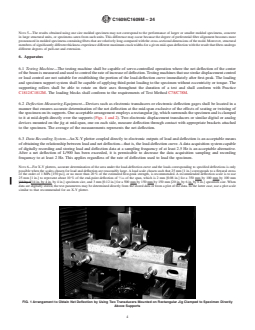
FIG. 1 Arrangement to Obtain Net Deflection by Using Two Transducers Mounted on Rectangular Jig Clamped to Specimen Directly
Above Supports
C1609/C1609M − 24
FIG. 2 Arrangement to Obtain Net Deflection by Using Two Transducers Mounted on Jig Secured to Specimen Directly Above Supports
distribution of the fibers are disturbed as little as possible during specimen
than 350 mm [14 in.]. The length of the test specimen shall not
fabrication. The amount of required overfilling will depend on the
be more than two times the depth greater than the span.
consistency of the concrete mixture. Trial and error may be required to
7.1.2 The tolerances on the cross-section of the test speci-
achieve complete filling after consolidation.
mens shall be within 6 2 %. The test specimens shall have a
7.2.2 Consolidate the concrete by external vibration only
square cross-section within these tolerances.
using apparatus as defined in Practice C192/C192M. Consoli-
7.1.3 The width and depth of test specimens shall be at least
dation is considered adequate when the top surface becomes
three times the maximum fiber length.
approximately level and entrapped air voids no longer break
7.1.4 When the specimen size is not large enough to meet all
through the surface. Consolidation by rodding or internal
the requirements of 7.1 – 7.1.3, specimens of square cross-
vibration is prohibited.
section large enough to meet the requirements shall be used.
NOTE 9—Generally, consolidation is achieved with about 10 s of
The three times maximum fiber length requirement for width
vibration. but longer times may be required for lower slump concrete.
and depth may be waived at the option of the specifier of tests
Vibration time should rarely have to exceed 20 s.
to permit specimens with a width and depth of 150 mm [6 in.]
7.2.3 Using a magnesium float, strike-off the excess con-
when using fibers of length 50 mm to 75 mm [2 in. to 3 in.].
crete from the mold starting in the middle and working to either
NOTE 7—The results of tests on beams with relatively stiff fibers, such
end using a sawing motion, so that the concrete surface is even
as steel fibers, longer than one-third the width and depth of the beam may
with the top of the mold (see Fig. 3c). Finish the surface with
not be comparable with test results of similar-sized beams with fibers
a minimum amount of manipulation so that it is free of
shorter than one-third the width and depth because of preferential fiber
alignment, and different size beams may not be comparable because of depressions or projections greater than 3 mm [
...
This document is not an ASTM standard and is intended only to provide the user of an ASTM standard an indication of what changes have been made to the previous version. Because
it may not be technically possible to adequately depict all changes accurately, ASTM recommends that users consult prior editions as appropriate. In all cases only the current version
of the standard as published by ASTM is to be considered the official document.
Designation: C1609/C1609M − 19a C1609/C1609M − 24
Standard Test Method for
Flexural Performance of Fiber-Reinforced Concrete (Using
Beam With Third-Point Loading)
This standard is issued under the fixed designation C1609/C1609M; the number immediately following the designation indicates the
year of original adoption or, in the case of revision, the year of last revision. A number in parentheses indicates the year of last
reapproval. A superscript epsilon (´) indicates an editorial change since the last revision or reapproval.
1. Scope*
1.1 This test method evaluates the flexural performance of fiber-reinforced concrete using parameters derived from the
load-deflection curve obtained by testing a simply supported beam under third-point loading using a closed-loop, servo-controlled
testing system.
1.2 This test method provides for the determination of first-peak and peak loads and the corresponding stresses calculated by
inserting them in the formula for modulus of rupture given in Eq 1. It also requires determination of residual loads at specified
deflections, the corresponding residual strengths calculated by inserting them in the formula for modulus of rupture given in Eq
1 (see Note 1). It provides for determination of specimen toughness based on the area under the load-deflection curve up to a
prescribed deflection (see Note 2) and the corresponding equivalent flexural strength ratio.
NOTE 1—Residual strength is not a true stress but an engineering stress computed using simple engineering bending theory for linear elastic materials
and gross (uncracked) section properties.
NOTE 2—Specimen toughness expressed in terms of the area under the load-deflection curve is an indication of the energy absorption capability of the
particular test specimen, and its magnitude depends directly on the geometry of the test specimen and the loading configuration.
1.3 This test method utilizes two preferred specimen sizes of 100 mm by 100 mm by 350 mm [4 in. by 4 in. by 14 in.] tested on
a 300 mm [12 in.] span, or 150 mm by 150 mm by 500 mm [6 in. by 6 in. by 20 in.] tested on a 450 mm [18 in.] span. A specimen
size different from the two preferred specimen sizes is permissible.
1.4 Units—The values stated in either SI units or inch-pound units are to be regarded separately as standard. The values stated in
each system may not be exact equivalents; therefore, each system shall be used independently of the other. Combining values from
the two systems may result in non-conformance with the standard.
1.5 This standard does not purport to address all of the safety concerns, if any, associated with its use. It is the responsibility
of the user of this standard to establish appropriate safety, health, and environmental practices and determine the applicability of
regulatory limitations prior to use.
1.6 This international standard was developed in accordance with internationally recognized principles on standardization
established in the Decision on Principles for the Development of International Standards, Guides and Recommendations issued
by the World Trade Organization Technical Barriers to Trade (TBT) Committee.
This test method is under the jurisdiction of ASTM Committee C09 on Concrete and Concrete Aggregates and is the direct responsibility of Subcommittee C09.42 on
Fiber-Reinforced Concrete.
Current edition approved Dec. 15, 2019Jan. 1, 2024. Published February 2020February 2024. Originally approved in 2005. Last previous edition approved in 2019 as
C1609/C1609M – 19.C1609/C1609M – 19a. DOI: 10.1520/C1609_C1609M-19A.10.1520/C1609_C1609M-24.
*A Summary of Changes section appears at the end of this standard
Copyright © ASTM International, 100 Barr Harbor Drive, PO Box C700, West Conshohocken, PA 19428-2959. United States
C1609/C1609M − 24
2. Referenced Documents
2.1 ASTM Standards:
C31/C31M Practice for Making and Curing Concrete Test Specimens in the Field
C42/C42M Test Method for Obtaining and Testing Drilled Cores and Sawed Beams of Concrete
C78/C78M Test Method for Flexural Strength of Concrete (Using Simple Beam with Third-Point Loading)
C125 Terminology Relating to Concrete and Concrete Aggregates
C172/C172M Practice for Sampling Freshly Mixed Concrete
C192/C192M Practice for Making and Curing Concrete Test Specimens in the Laboratory
C823/C823M Practice for Examination and Sampling of Hardened Concrete in Constructions
C1140/C1140M Practice for Preparing and Testing Specimens from Shotcrete Test Panels
C1812/C1812M Practice for Design of Journal Bearing Supports to be Used in Fiber Reinforced Concrete Beam Tests
E4 Practices for Force Calibration and Verification of Testing Machines
3. Terminology
3.1 Definitions—The terms used in this test method are defined in Terminology C125.
3.2 Definitions of Terms Specific to This Standard:
3.2.1 end-point deflection, n—the deflection value on the load-deflection curve equal to ⁄150 of the span length, or a larger value
as specified at the option of the specifier of tests.
3.2.2 first-peak load, P , n—the load value at the first point on the load-deflection curve where the slope is zero.
3.2.3 first-peak deflection, δ , n—the net deflection value on the load-deflection curve at first-peak load.
3.2.4 first-peak strength f , n—the stress value obtained when the first-peak load is inserted in the formula for modulus of rupture
given in Eq 1.
3.2.5 load-deflection curve, n—the plot of load versus net deflection of a flexural beam specimen loaded to the end-point
deflection.
3.2.6 net deflection, n—the deflection measured at mid-span of a flexural beam specimen exclusive of any extraneous effects due
to seating or twisting of the specimen on its supports or deformation of the support and loading system.
3.2.7 peak load, P ,n—the maximum load on the load-deflection curve.
P
3.2.8 peak-load deflection, δ ,n—the net deflection value on the load-deflection curve at peak load.
P
3.2.9 peak strength, f ,n—the stress value obtained when the peak load is inserted in the formula for modulus of rupture given by
P
Eq 1.
3.2.10 D—nominal depth of the beam specimen in mm.
NOTE 3—To simplify nomenclature, the nominal beam depth is shown in units of mm for both the SI and inch-pound version of this test method.
3.2.11 L—span length or distance between the supports.
D
3.2.12 residual load, P , n—the load value corresponding to a net deflection of L/600 for a beam of nominal depth D.
D
3.2.13 residual load, P , n—the load value corresponding to a net deflection of L/150 for a beam of nominal depth D.
For referenced ASTM standards, visit the ASTM website, www.astm.org, or contact ASTM Customer Service at service@astm.org. For Annual Book of ASTM Standards
volume information, refer to the standard’s Document Summary page on the ASTM website.
C1609/C1609M − 24
D D
3.2.14 residual strength, f , n—the stress value obtained when the residual load P is inserted in the formula for modulus of
600 600
rupture given in Eq 1.
D D
3.2.15 residual strength, f , n—the stress value obtained when the residual load P is inserted in the formula for modulus of
150 150
rupture given in Eq 1.
D
3.2.16 specimen toughness, T , n—toughness of beam specimen of nominal depth D at a net deflection of L/150.
D
3.2.17 equivalent flexural strength, f , n—the average stress value obtained from the flexural toughness of the beam specimen
e,150
(absorbed energy calculated from the load-deflection curve), using Eq 3.
3.2.17.1 Discussion—
D
ACI 544.4R-18 refers to f as f .
e,150 e,3
D
3.2.18 equivalent flexural strength ratio, R , n—the equivalent flexural strength divided by the first-peak strength, expressed as
T, 150
a percentage.
NOTE 4—The equivalent flexural strength ratio is calculated as the ratio of the weighted equivalent load up to a net deflection of L/150 over the first-peak
150 4
load multiplied by 100. The R value is equivalent to the R value defined in the Technical Report No. 34 of the Concrete Society.
e,3
T, 150
4. Summary of Test Method
4.1 Molded or sawn beam specimens having a square cross-section of fiber-reinforced concrete are tested in flexure using a
third-point loading arrangement with a closed-loop, servo-controlled testing system and roller supports under the ends of the beam
that are free to rotate on their axes as described in Practice C1812/C1812M. The testing machine shall conform to the requirements
of the sections on Basis of Verification, Corrections, and Time Interval Between Verifications of Practices E4. Load and net
deflection are monitored and recorded to an end-point deflection of at least ⁄150 of the span. Data are recorded and plotted by means
of an X-Y plotter, or they are recorded digitally and subsequently used to plot a load-deflection curve. Points termed first-peak,
peak, and residual loads at specified deflections are identified on the curve, and are used to calculate flexural performance
parameters.
5. Significance and Use
5.1 The first-peak strength characterizes the flexural behavior of the fiber-reinforced concrete up to the onset of cracking, while
residual strengths at specified deflections characterize the residual capacity after cracking. Specimen toughness is a measure of the
energy absorption capacity of the test specimen. The appropriateness of each parameter depends on the nature of the proposed
application and the level of acceptable cracking and deflection serviceability. Fiber-reinforced concrete is influenced in different
ways by the amount and type of fibers in the concrete. In some cases, fibers may increase the residual load and toughness capacity
at specified deflections while producing a first-peak strength equal to or only slightly greater than the flexural strength of the
concrete without fibers. In other cases, fibers may significantly increase the first-peak and peak strengths while affecting a relatively
small increase in residual load capacity and specimen toughness at specified deflections.
5.2 The first-peak strength, peak strength, and residual strengths determined by this test method reflect the behavior of
fiber-reinforced concrete under static flexural loading. The absolute values of energy absorption obtained in this test are of little
direct relevance to the performance of fiber-reinforced concrete structures since they depend directly on the size and shape of the
specimen and the loading arrangement.
5.3 The results of this test method may be used for comparing the performance of various fiber-reinforced concrete mixtures or
in research and development work. They may also be used to monitor concrete quality, to verify compliance with construction
specifications, obtain flexural strength data on fiber-reinforced concrete members subject to pure bending, or to evaluate the quality
of concrete in service.
5.4 The results of this standard test method are dependent on the size of the specimen.
ACI 544.4R-18: Guide to Design with Fiber-Reinforced Concrete, American Concrete Institute, Farmington Hills, MI, http://www.concrete.org.
rd
“Concrete Industrial Ground Floors—A Guide to Design and Construction,” Technical Report 34, 3 edition, Concrete Society, Slough, United Kingdom, 2003.
C1609/C1609M − 24
NOTE 5—The results obtained using one size molded specimen may not correspond to the performance of larger or smaller molded specimens, concrete
in large structural units, or specimens sawn from such units. This difference may occur because the degree of preferential fiber alignment becomes more
pronounced in molded specimens containing fibers that are relatively long compared with the cross-sectional dimensions of the mold. Moreover, structural
members of significantly different thickness experience different maximum crack widths for a given mid-span deflection with the result that fibers undergo
different degrees of pull-out and extension.
6. Apparatus
6.1 Testing Machine—The testing machine shall be capable of servo-controlled operation where the net deflection of the center
of the beam is measured and used to control the rate of increase of deflection. Testing machines that use stroke displacement control
or load control are not suitable for establishing the portion of the load-deflection curve immediately after first-peak. The loading
and specimen support system shall be capable of applying third-point loading to the specimen without eccentricity or torque. The
supporting rollers shall be able to rotate on their axes throughout the duration of a test and shall conform with Practice
C1812/C1812M. The loading blocks shall conform to the requirements of Test Method C78/C78M.
6.2 Deflection-Measuring Equipment—Devices such as electronic transducers or electronic deflection gages shall be located in a
manner that ensures accurate determination of the net deflection at the mid-span exclusive of the effects of seating or twisting of
the specimen on its supports. One acceptable arrangement employs a rectangular jig, which surrounds the specimen and is clamped
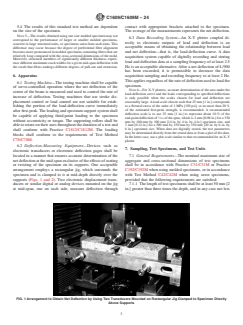
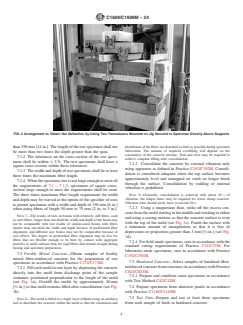
to it at mid-depth directly over the supports (Figs. 1 and 2). Two electronic displacement transducers or similar digital or analog
devices mounted on the jig at mid-span, one on each side, measure deflection through contact with appropriate brackets attached
to the specimen. The average of the measurements represents the net deflection.
6.3 Data Recording System—An X-Y plotter coupled directly to electronic outputs of load and deflection is an acceptable means
of obtaining the relationship between load and net deflection—that is, the load-deflection curve. A data acquisition system capable
of digitally recording and storing load and deflection data at a sampling frequency of at least 2.5 Hz is an acceptable alternative.
After a net deflection of L/900 has been exceeded, it is permissible to decrease the data acquisition sampling and recording
frequency to at least 2 Hz. This applies regardless of the rate of deflection used to load the specimen.
NOTE 6—For X-Y plotters, accurate determination of the area under the load-deflection curve and the loads corresponding to specified deflections is only
possible when the scales chosen for load and deflection are reasonably large. A load scale chosen such that 25 mm [1 in.] corresponds to a flexural stress
of the order of 1 MPa [150 psi], or no more than 20 % of the estimated first-peak strength, is recommended. A recommended deflection scale is to use
25 mm [1 in.] to represent about 10 % of the end-point deflection of ⁄150 of the span, which is 2 mm [0.08 in.] for a 350 mm by 100 mm by 100 mm
[14 by 4[14 in. by 4 in. by 4 in.] specimen size, and 3 mm [0.12 in.] for a 500 mm by 150 mm by 150 mm [20 in. by 6 in. by 6 in.] specimen size. When
data are digitally stored, the test parameters may be determined directly from the stored data or from a plot of the data. In the latter case, use a plot scale
similar to that recommended for an X-Y plotter.
FIG. 1 Arrangement to Obtain Net Deflection by Using Two Transducers Mounted on Rectangular Jig Clamped to Specimen Directly
Above Supports
C1609/C1609M − 24
FIG. 2 Arrangement to Obtain Net Deflection by Using Two Transducers Mounted on Jig Secured to Specimen Directly Above Supports
7. Sampling, Test Specimens, and Test Units
7.1 General Requirements—The nominal maximum size of aggregate and cross-sectional dimensions of test specimens shall be
in accordance with Practice C31/C31M or Practice C192/C192M when using molded specimens, or in accordance with Test
Method C42/C42M when using sawn specimens, provided that the following requirements are satisfied:
7.1.1 The length of test specimens shall be at least 50 mm [2 in.] greater than three times the depth, and in any case not less than
350 mm [14 in.]. The length of the test specimen shall not be more than two times the depth greater than the span.
7.1.2 The tolerances on the cross-section of the test specimens shall be within 6 2 %. The test specimens shall have a square
cross-section within these tolerances.
7.1.3 The width and depth of test specimens shall be at least three times the maximum fiber length.
7.1.4 When the specimen size is not large enough to meet all the requirements of 7.1 – 7.1.3, specimens of square cross-section
large enough to meet the requirements shall be used. The three times maximum fiber length requirement for width and depth may
be waived at the option of the specifier of tests to permit specimens with a width and depth of 150 mm [6 in.] when using fibers
of length 50 mm to 75 mm [2 in. to 3 in.].
NOTE 7—The results of tests on beams with relatively stiff fibers, such as steel fibers, longer than one-third the width and depth of the beam may not be
comparable with test results of similar-sized beams with fibers shorter than one-third the width and depth because of preferential fiber alignment, and
different size beams may not be comparable because of size effects. The degree of preferential fiber alignment may be less for fibers that are flexible
enough to be bent by contact with aggregate particles or mold surfaces than for rigid fibers that remain straight during mixing and specimen preparation.
7.2 Freshly Mixed Concrete—Obtain samples of freshly mixed fiber-reinforced concrete for the preparation of test specimens in
accordance with Practice C172/C172M.
7.2.1 Mold specimens in accordance with Practice C31/C31M or Practice C192/C192M, except that consolidation shall be by
external vibration. Consolidation may be considered to be adequate when entrapped air voids are no longer observed rising to the
surface of the specimen. Fill theFill each mold in one layer by using a wide shovel or scoop parallel dispensing the concrete directly
into the mold from discharge point of the sample container, positioned perpendicular to the length of the mold to(see Fig. 3place
the layer uniformly along the lengtha). Overfill the molds by approximately 20 mm [ ⁄4 of the mold. in.] so that mold remains filled
after consolidation (see Fig. 3b).
C1609/C1609M − 24
FIG. 3 Making Fiber-Reinforced Concrete Test Specimens
NOTE 8—Make sure that the time of vibration is sufficient to ensure adequate consolidation, as fiber-reinforced concrete requires a longer vibration time
than concrete without fibers, especially when the fiber concentration is relatively high.The mold is filled in a single layer without using an auxiliary tool
to distribute the concrete within the mold so that the orientation and distribution of the fibers are disturbed
...