

ASTM A524/A524M-21
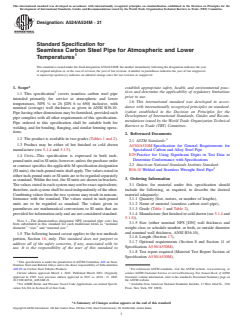
(Specification)Standard Specification for Seamless Carbon Steel Pipe for Atmospheric and Lower Temperatures
General Information
- Abstract
ABSTRACT
This specification covers seamless carbon steel pipe intended primarily service at atmospheric and lower temperatures. The steel shall be killed steel made by one or more of the following processes: open-hearth, electric-furnace, or basic-oxygen. The steel shall be made to fine grain practice and may be cast in ingots or may be strand cast. All hot-finished and cold-drawn pipe shall be heat treated and be cooled in air or in the cooling chamber of a controlled atmosphere furnace. The steel shall be subjected to flattening, hydrostatic, bend, and tensile tests. A retest shall be conducted if a specimen breaks in an inside or outside surface flaw.
SCOPE
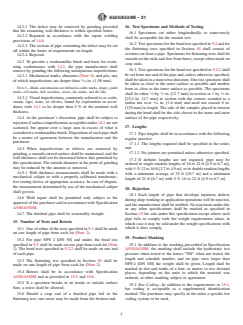
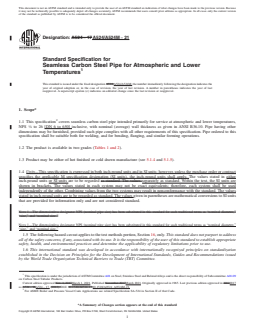
1.1 This specification2 covers seamless carbon steel pipe intended primarily for service at atmospheric and lower temperatures, NPS 1/8 to 26 [DN 6 to 650] inclusive, with nominal (average) wall thickness as given in ANSI B36.10. Pipe having other dimensions may be furnished, provided such pipe complies with all other requirements of this specification. Pipe ordered to this specification shall be suitable both for welding, and for bending, flanging, and similar forming operations.
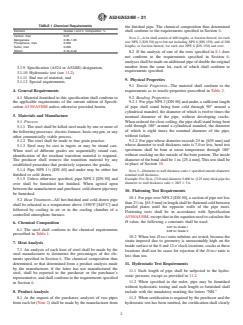
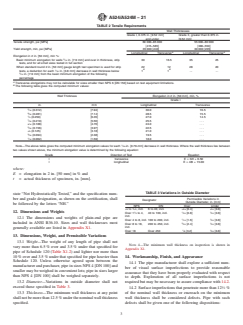
1.2 The product is available in two grades (Tables 1 and 2).
1.3 Product may be either of hot finished or cold drawn manufacture (see 5.1.4 and 5.1.5).
1.4 Units—This specification is expressed in both inch-pound units and in SI units; however, unless the purchase order or contract specifies the applicable M specification designation (SI units), the inch-pound units shall apply. The values stated in either inch-pound units or SI units are to be regarded separately as standard. Within the text, the SI units are shown in brackets. The values stated in each system may not be exact equivalents; therefore, each system shall be used independently of the other. Combining values from the two systems may result in nonconformance with the standard. The values stated in inch-pound units are to be regarded as standard. The values given in parentheses are mathematical conversions to SI units that are provided for information only and are not considered standard.
Note 1: The dimensionless designator NPS (nominal pipe size) has been substituted in this standard for such traditional terms as “nominal diameter,” “size,” and “nominal size.”
1.5 The following hazard caveat applies to the test methods portion, Section 16, only. This standard does not purport to address all of the safety concerns, if any, associated with its use. It is the responsibility of the user of this standard to establish appropriate safety, health, and environmental practices and determine the applicability of regulatory limitations prior to use.
1.6 This international standard was developed in accordance with internationally recognized principles on standardization established in the Decision on Principles for the Development of International Standards, Guides and Recommendations issued by the World Trade Organization Technical Barriers to Trade (TBT) Committee.
- Status
- Published
- Publication Date
- 28-Feb-2021
- Technical Committee
- A01 - Steel, Stainless Steel and Related Alloys
- Drafting Committee
- A01.09 - Carbon Steel Tubular Products
Buy Documents
ASTM A524/A524M-21 - Standard Specification for Seamless Carbon Steel Pipe for Atmospheric and Lower Temperatures
REDLINE ASTM A524/A524M-21 - Standard Specification for Seamless Carbon Steel Pipe for Atmospheric and Lower Temperatures
Overview
ASTM A524/A524M-21 is the standard specification developed by ASTM International for seamless carbon steel pipe intended primarily for service at atmospheric and lower temperatures. This specification covers both inch-pound and SI units, applying to pipes ranging from NPS 1/8 to 26 (DN 6 to 650) in nominal pipe sizes, with wall thicknesses as outlined in ANSI B36.10. The pipe is suitable for applications requiring welding, bending, flanging, and other forming operations, making it highly versatile for various industrial environments.
Key Topics
- Scope of Application: Designed for seamless carbon steel pipe used at atmospheric and lower temperatures, ensuring durability and performance in moderate to low-temperature service.
- Manufacturing Process: The specification requires the use of killed steel produced via open-hearth, electric-furnace, or basic-oxygen methods, with fine grain practice applied. Steel may be cast in ingots or via strand casting.
- Grades and Dimensions: Products are available in two grades and may be supplied as either hot finished or cold drawn. The standard provides specific ranges for wall thickness, diameter, and permissible variations.
- Mechanical and Test Requirements:
- Includes tensile, flattening, bending, and hydrostatic tests to ensure mechanical integrity.
- Test requirements for verifying yield strength, tensile strength, and elongation.
- Mandatory heat treatment at temperatures above 1550°F (845°C), followed by controlled cooling.
- Surface and Quality: Requirements cover visual finish, maximum depth of surface imperfections, and provisions for grinding or repair. Straightness and finish consistency are vital for conformity.
- Marking and Certification: Finished pipe must be clearly marked with size, schedule, hydrostatic testing status, and, if required, barcodes for identification and traceability.
Applications
ASTM A524/A524M-21 seamless carbon steel pipe is widely used in industries requiring reliable performance under atmospheric and low-temperature conditions. Common applications include:
- Pipelines for Air, Water, and Non-Aggressive Media: Transport of these substances under standard or mild service conditions.
- General Engineering and Construction: Used where structural reliability, ease of welding, and forming are necessary.
- Oil, Gas, and Petrochemical Plants: Installed in systems where temperature resistance and seamless pipe integrity are crucial.
- Boiler and Pressure Vessel Service: When specified, may be used in compliance with the ASME Boiler and Pressure Vessel Code (see SA-524).
This standard ensures the seamless carbon steel pipe is suitable for welding, bending, and other fabrication operations, offering flexibility and safety for project engineers and manufacturers.
Related Standards
For users implementing ASTM A524/A524M-21, the following standards are also relevant:
- ASTM A530/A530M: General requirements for specialized carbon and alloy steel pipe-applies to material furnished to A524/A524M-21 unless otherwise specified.
- ANSI B36.10: Covers welded and seamless wrought steel pipe dimensions and wall thicknesses.
- ASME SA-524: The equivalent specification under the ASME Boiler and Pressure Vessel Code.
- ASTM E29: Practice for using significant digits in test data for conformance to specifications.
ASTM A524/A524M-21 remains a key reference for specifying seamless carbon steel pipes, ensuring compliance with recognized international practices for material quality and dimensional integrity. This enhances the safety, reliability, and standardization of piping systems across industries operating in atmospheric and lower temperature environments.
Relations
- Effective Date
- 01-May-2012
- Effective Date
- 01-Apr-2010
- Effective Date
- 01-Oct-2008
- Effective Date
- 15-Nov-2006
- Effective Date
- 15-Sep-2006
- Effective Date
- 01-May-2006
- Effective Date
- 01-Dec-2004
- Effective Date
- 01-Oct-2004
- Effective Date
- 01-Mar-2004
- Effective Date
- 10-Sep-2003
- Effective Date
- 10-Sep-2002
- Effective Date
- 10-May-2002
- Effective Date
- 10-May-1999
Buy Documents
ASTM A524/A524M-21 - Standard Specification for Seamless Carbon Steel Pipe for Atmospheric and Lower Temperatures
REDLINE ASTM A524/A524M-21 - Standard Specification for Seamless Carbon Steel Pipe for Atmospheric and Lower Temperatures
Get Certified
Connect with accredited certification bodies for this standard

Institut za varilstvo d.o.o. (Welding Institute)
Slovenia's leading welding institute since 1952. ISO 3834, EN 1090, pressure equipment certification, NDT personnel, welder qualification. Only IIW Au
Sponsored listings
Frequently Asked Questions
ASTM A524/A524M-21 is a technical specification published by ASTM International. Its full title is "Standard Specification for Seamless Carbon Steel Pipe for Atmospheric and Lower Temperatures". This standard covers: ABSTRACT This specification covers seamless carbon steel pipe intended primarily service at atmospheric and lower temperatures. The steel shall be killed steel made by one or more of the following processes: open-hearth, electric-furnace, or basic-oxygen. The steel shall be made to fine grain practice and may be cast in ingots or may be strand cast. All hot-finished and cold-drawn pipe shall be heat treated and be cooled in air or in the cooling chamber of a controlled atmosphere furnace. The steel shall be subjected to flattening, hydrostatic, bend, and tensile tests. A retest shall be conducted if a specimen breaks in an inside or outside surface flaw. SCOPE 1.1 This specification2 covers seamless carbon steel pipe intended primarily for service at atmospheric and lower temperatures, NPS 1/8 to 26 [DN 6 to 650] inclusive, with nominal (average) wall thickness as given in ANSI B36.10. Pipe having other dimensions may be furnished, provided such pipe complies with all other requirements of this specification. Pipe ordered to this specification shall be suitable both for welding, and for bending, flanging, and similar forming operations. 1.2 The product is available in two grades (Tables 1 and 2). 1.3 Product may be either of hot finished or cold drawn manufacture (see 5.1.4 and 5.1.5). 1.4 Units—This specification is expressed in both inch-pound units and in SI units; however, unless the purchase order or contract specifies the applicable M specification designation (SI units), the inch-pound units shall apply. The values stated in either inch-pound units or SI units are to be regarded separately as standard. Within the text, the SI units are shown in brackets. The values stated in each system may not be exact equivalents; therefore, each system shall be used independently of the other. Combining values from the two systems may result in nonconformance with the standard. The values stated in inch-pound units are to be regarded as standard. The values given in parentheses are mathematical conversions to SI units that are provided for information only and are not considered standard. Note 1: The dimensionless designator NPS (nominal pipe size) has been substituted in this standard for such traditional terms as “nominal diameter,” “size,” and “nominal size.” 1.5 The following hazard caveat applies to the test methods portion, Section 16, only. This standard does not purport to address all of the safety concerns, if any, associated with its use. It is the responsibility of the user of this standard to establish appropriate safety, health, and environmental practices and determine the applicability of regulatory limitations prior to use. 1.6 This international standard was developed in accordance with internationally recognized principles on standardization established in the Decision on Principles for the Development of International Standards, Guides and Recommendations issued by the World Trade Organization Technical Barriers to Trade (TBT) Committee.
ABSTRACT This specification covers seamless carbon steel pipe intended primarily service at atmospheric and lower temperatures. The steel shall be killed steel made by one or more of the following processes: open-hearth, electric-furnace, or basic-oxygen. The steel shall be made to fine grain practice and may be cast in ingots or may be strand cast. All hot-finished and cold-drawn pipe shall be heat treated and be cooled in air or in the cooling chamber of a controlled atmosphere furnace. The steel shall be subjected to flattening, hydrostatic, bend, and tensile tests. A retest shall be conducted if a specimen breaks in an inside or outside surface flaw. SCOPE 1.1 This specification2 covers seamless carbon steel pipe intended primarily for service at atmospheric and lower temperatures, NPS 1/8 to 26 [DN 6 to 650] inclusive, with nominal (average) wall thickness as given in ANSI B36.10. Pipe having other dimensions may be furnished, provided such pipe complies with all other requirements of this specification. Pipe ordered to this specification shall be suitable both for welding, and for bending, flanging, and similar forming operations. 1.2 The product is available in two grades (Tables 1 and 2). 1.3 Product may be either of hot finished or cold drawn manufacture (see 5.1.4 and 5.1.5). 1.4 Units—This specification is expressed in both inch-pound units and in SI units; however, unless the purchase order or contract specifies the applicable M specification designation (SI units), the inch-pound units shall apply. The values stated in either inch-pound units or SI units are to be regarded separately as standard. Within the text, the SI units are shown in brackets. The values stated in each system may not be exact equivalents; therefore, each system shall be used independently of the other. Combining values from the two systems may result in nonconformance with the standard. The values stated in inch-pound units are to be regarded as standard. The values given in parentheses are mathematical conversions to SI units that are provided for information only and are not considered standard. Note 1: The dimensionless designator NPS (nominal pipe size) has been substituted in this standard for such traditional terms as “nominal diameter,” “size,” and “nominal size.” 1.5 The following hazard caveat applies to the test methods portion, Section 16, only. This standard does not purport to address all of the safety concerns, if any, associated with its use. It is the responsibility of the user of this standard to establish appropriate safety, health, and environmental practices and determine the applicability of regulatory limitations prior to use. 1.6 This international standard was developed in accordance with internationally recognized principles on standardization established in the Decision on Principles for the Development of International Standards, Guides and Recommendations issued by the World Trade Organization Technical Barriers to Trade (TBT) Committee.
ASTM A524/A524M-21 is classified under the following ICS (International Classification for Standards) categories: 23.040.10 - Iron and steel pipes. The ICS classification helps identify the subject area and facilitates finding related standards.
ASTM A524/A524M-21 has the following relationships with other standards: It is inter standard links to ASTM A530/A530M-12, ASTM A530/A530M-04a(2010), ASTM E29-08, ASTM E29-06b, ASTM E29-06a, ASTM E29-06, ASTM E29-04, ASTM A530/A530M-04a, ASTM A530/A530M-04, ASTM A530/A530M-03, ASTM A530/A530M-02, ASTM E29-02e1, ASTM E29-93a(1999). Understanding these relationships helps ensure you are using the most current and applicable version of the standard.
ASTM A524/A524M-21 is available in PDF format for immediate download after purchase. The document can be added to your cart and obtained through the secure checkout process. Digital delivery ensures instant access to the complete standard document.
Standards Content (Sample)
This international standard was developed in accordance with internationally recognized principles on standardization established in the Decision on Principles for the
Development of International Standards, Guides and Recommendations issued by the World Trade Organization Technical Barriers to Trade (TBT) Committee.
Designation:A524/A524M −21
Standard Specification for
Seamless Carbon Steel Pipe for Atmospheric and Lower
Temperatures
This standard is issued under the fixed designationA524/A524M; the number immediately following the designation indicates the year
of original adoption or, in the case of revision, the year of last revision.Anumber in parentheses indicates the year of last reapproval.
A superscript epsilon (´) indicates an editorial change since the last revision or reapproval.
1. Scope* establish appropriate safety, health, and environmental prac-
2 tices and determine the applicability of regulatory limitations
1.1 This specification covers seamless carbon steel pipe
prior to use.
intended primarily for service at atmospheric and lower
1.6 This international standard was developed in accor-
temperatures, NPS ⁄8 to 26 [DN 6 to 650] inclusive, with
dance with internationally recognized principles on standard-
nominal (average) wall thickness as given in ANSI B36.10.
ization established in the Decision on Principles for the
Pipehavingotherdimensionsmaybefurnished,providedsuch
Development of International Standards, Guides and Recom-
pipe complies with all other requirements of this specification.
mendations issued by the World Trade Organization Technical
Pipe ordered to this specification shall be suitable both for
Barriers to Trade (TBT) Committee.
welding, and for bending, flanging, and similar forming opera-
tions.
2. Referenced Documents
1.2 The product is available in two grades (Tables 1 and 2).
2.1 ASTM Standards:
1.3 Product may be either of hot finished or cold drawn
A530/A530MSpecification for General Requirements for
manufacture (see 5.1.4 and 5.1.5).
Specialized Carbon and Alloy Steel Pipe
E29Practice for Using Significant Digits in Test Data to
1.4 Units—This specification is expressed in both inch-
Determine Conformance with Specifications
poundunitsandinSIunits;however,unlessthepurchaseorder
2.2 American National Standards Institute Standard:
or contract specifies the applicable M specification designation
B36.10Welded and Seamless Wrought Steel Pipe
(SIunits),theinch-poundunitsshallapply.Thevaluesstatedin
eitherinch-poundunitsorSIunitsaretoberegardedseparately
3. Ordering Information
asstandard.Withinthetext,theSIunitsareshowninbrackets.
Thevaluesstatedineachsystemmaynotbeexactequivalents; 3.1 Orders for material under this specification should
therefore,eachsystemshallbeusedindependentlyoftheother. include the following, as required, to describe the desired
Combiningvaluesfromthetwosystemsmayresultinnoncon- material adequately:
formance with the standard. The values stated in inch-pound 3.1.1 Quantity (feet, meters, or number of lengths),
units are to be regarded as standard. The values given in 3.1.2 Name of material (seamless carbon steel pipe),
parentheses are mathematical conversions to SI units that are 3.1.3 Grade (Table 1 and Table 2),
providedforinformationonlyandarenotconsideredstandard. 3.1.4 Manufacture(hotfinishedorcolddrawn(see5.1.4and
5.1.5)),
NOTE 1—The dimensionless designator NPS (nominal pipe size) has
3.1.5 Size (either nominal NPS [DN] wall thickness and
been substituted in this standard for such traditional terms as “nominal
weight class or schedule number, or both, or outside diameter
diameter,” “size,” and “nominal size.”
and nominal wall thickness, ANSI B36.10),
1.5 The following hazard caveat applies to the test methods
3.1.6 Length (Section 17),
portion, Section 16, only. This standard does not purport to
3.1.7 Optional requirements (Section 8 and Section 11 of
address all of the safety concerns, if any, associated with its
Specification A530/A530M),
use. It is the responsibility of the user of this standard to
3.1.8 Test report required (Material Test Report Section of
Specification A530/A530M),
This specification is under the jurisdiction ofASTM Committee A01 on Steel,
Stainless Steel and RelatedAlloys and is the direct responsibility of Subcommittee
A01.09 on Carbon Steel Tubular Products. For referenced ASTM standards, visit the ASTM website, www.astm.org, or
Current edition approved March 1, 2021. Published March 2021. Originally contact ASTM Customer Service at service@astm.org. For Annual Book of ASTM
approved in 1965. Last previous edition approved in 2017 as A524–17. DOI: Standards volume information, refer to the standard’s Document Summary page on
10.1520/A0524_A0524M-21. the ASTM website.
2 4
For ASME Boiler and Pressure Vessel Code Applications see related Specifi- Available from American National Standards Institute, 11 West 42nd St., 13th
cation SA-524 in Section II of that Code. Floor, New York, NY 10036.
*A Summary of Changes section appears at the end of this standard
Copyright © ASTM International, 100 Barr Harbor Drive, PO Box C700, West Conshohocken, PA 19428-2959. United States
A524/A524M−21
TABLE 1 Chemical Requirements
the finished pipe. The chemical composition thus determined
Element Grades I and II, Composition, % shall conform to the requirements specified in Section 6.
Carbon, max 0.21
NOTE 2—Alotshallconsistof400lengths,orfractionthereof,foreach
Manganese 0.90–1.35
size NPS 2 [DN 50] up to but not including NPS 6 [DN 150], and of 200
Phosphorus, max 0.035
lengths, or fraction thereof, for each size NPS 6 [DN 150] and over.
Sulfur, max 0.035
Silicon 0.10–0.40
8.2 If the analysis of one of the tests specified in 8.1 does
not conform to the requirements specified in Section 6,
analysesshallbemadeonadditionalpipeofdoubletheoriginal
number from the same lot, each of which shall conform to
3.1.9 Specification (A524 or A524M) designation,
requirements specified.
3.1.10 Hydrostatic test (see 11.2).
3.1.11 End use of material, and
9. Physical Properties
3.1.12 Special requirements.
9.1 Tensile Properties—The material shall conform to the
4. General Requirements requirements as to tensile properties prescribed in Table 2.
4.1 Material furnished to this specification shall conform to 9.2 Bending Properties:
the applicable requirements of the current edition of Specifi- 9.2.1 For pipe NPS 2 [DN 50] and under, a sufficient length
cation A530/A530M unless otherwise provided herein. of pipe shall stand being bent cold through 90° around a
cylindrical mandrel, the diameter of which is twelve times the
5. Materials and Manufacture
nominal diameter of the pipe, without developing cracks.
When ordered for close coiling, the pipe shall stand being bent
5.1 Process:
cold through 180° around a cylindrical mandrel, the diameter
5.1.1 The steel shall be killed steel made by one or more of
of which is eight times the nominal diameter of the pipe,
the following processes: electric-furnace, basic-oxygen, or any
without failure.
other commercially viable process.
9.2.2 Forpipewhosediameterexceeds25in.[635mm]and
5.1.2 The steel shall be made to fine grain practice.
whose diameter to wall thickness ratio is 7.0 or less, bend test
5.1.3 Steel may be cast in ingots or may be strand cast.
specimens shall be bent at room temperature through 180°
When steel of different grades are sequentially strand cast,
without cracking on the outside of the bent portion.The inside
identification of the resultant transition material is required.
diameterofthebendshallbe1in.[25.4mm].Thistestshallbe
The producer shall remove the transition material by any
10.
in place of Section
established procedure that positively separates the grades.
5.1.4 Pipe NPS 1 ⁄2[DN 40] and under may be either hot
NOTE 3—Diameter to wall thickness ratio = specified outside diameter/
finished or cold drawn.
nominal wall thickness.
Example:For28in.[710mm]diameter5.000in.[125mm]thickpipethe
5.1.5 Unless otherwise specified, pipe NPS 2 [DN 50] and
diameter to wall thickness ratio = 28/5 = 5.6.
over shall be furnished hot finished. When agreed upon
betweenthemanufacturerandpurchaser,cold-drawnpipemay
10. Flattening Test Requirements
be furnished.
10.1 ForpipeoverNPS2[DN50],asectionofpipenotless
5.2 Heat Treatment—All hot-finished and cold-drawn pipe
than2 ⁄2in.[63.5mm]inlengthshallbeflattenedcoldbetween
shall be reheated to a temperature above 1550°F [845°C] and
parallel plates until the opposite walls of the pipe meet.
followed by cooling in air or in the cooling chamber of a
Flattening tests shall be in accordance with Specification
controlled atmosphere furnace.
A530/A530M, except that in the equation used to calculate the
H value, the following e constants shall be used:
6. Chemical Composition
0.07 for Grade I
6.1 The steel shall conform to the chemical requirements
0.08 for Grade II
prescribed in Table 1.
10.2 When low D-to-t ratio tubulars are tested, because the
strain imposed due to geometry is unreasonably high on the
7. Heat Analysis
insidesurfaceatthe6and12o’clocklocations,cracksatthese
7.1 An analysis of each heat of steel shall be made by the
locations shall not be cause for rejection if the D-to-t ratio is
steel manufacturer to determine the percentages of the ele-
less than ten.
ments specified in Section 6. The chemical composition thus
determined, or that determined from a product analysis made
11. Hydrostatic Test Requirements
by the manufacturer, if the latter has not manufactured the
11.1 Each length of pipe shall be subjected to the hydro-
steel, shall be reported to the purchaser or the purchaser’s
static pressure, except as provided in 11.2.
representative, and shall conform to the requirements specified
11.2 When specified in the order, pipe may be furnished
in Section 6.
without hydrostatic testing and each length so furnished shall
8. Product Analysis include with the mandatory marking the letters “NH.”
8.1 At the request of the purchaser, analyses of two pipes 11.3 When certification is required by the purchaser and the
fromeachlot(Note2)shallbemadebythemanufacturerfrom hydrostatic test has been omitted, the certification shall clearly
A524/A524M−21
TABLE 2 Tensile Requirements
Wall Thicknesses
Grade I, 0.375 in. [9.52 mm] Grade II, greater than 0.375 in.
and under [9.52 mm]
Tensile strength, psi [MPa] 60 000–85 000 55 000–80 000
[415–585] [380–550]
Yield strength, min, psi [MPa] 35 000 [240] 30 000 [205]
A A
Longitudinal Transverse Longitudinal Transverse
Elongation in 2 in. [50 mm], min %:
Basic minimum elongation for walls ⁄16 in. [7.9 mm] and over in thickness, strip 30 16.5 35 25
tests, and for all small sizes tested in full section
When standard round 2 in. [50 mm] gauge length test specimen is used for strip 22 12 28 20
B B
tests, a deduction for each ⁄32 in. [0.8 mm] decrease in wall thickness below 1 1 . .
⁄16 in. [7.9 mm] from the basic minimum elongation of the following
percentage
A
Transverse elongations may not be calculable for sizes smaller than NPS 6 [DN 150] based on test equipment limitations.
B
The following table gives the computed minimum values:
Wall Thickness Elongation in 2 in. [50 mm], min, %
Grade I
in. mm Longitudinal Transverse
⁄16 (0.312) [7.94] 30.0 16.5
⁄32 (0.281) [7.14] 28.5 15.5
⁄4 (0.250) [6.35] 27.0 14.5
⁄32 (0.219) [5.56] 25.5 . . .
⁄16 (0.188) [4.76] 24.0 . . .
⁄32 (0.156) [3.97] 22.5 . . .
⁄8 (0.125) [3.18] 21.0 . . .
⁄32 (0.094) [2.38] 19.5 . . .
⁄16 (0.062) [1.59] 18.0 . . .
Note—The above table gives the computed minimum elongation values for each ⁄32-in. [0.79-mm] decrease in wall thickness. Where the wall thickness lies between
two values shown above, the minimum elongation value is determined by the following equation:
Grade Direction of Test Equation
I transverse E = 32t + 6.50
I longitudinal E = 48t + 15.00
where:
E = elongation in 2 in. [50 mm] in% and
t = actual thickness of specimen, in. [mm].
TABLE 3 Variations in Outside Diameter
state “Not Hydrostatically Tested,” and the specification num-
ber and grade designation, as shown on the certification, shall Permissible Variations in
Designator
Outside Diameter, in. [mm]
be followed by the letters “NH.”
NPS DN Over Under
1 1 1 1
⁄8 to 1 ⁄2, incl. 6 to 40, incl. ⁄64 [0.4] ⁄32 [0.8]
12. Dimensions and Weights
1 1 1
Over 1 ⁄2 to 4, 40 to 100, incl. ⁄32 [0.8] ⁄32 [0.8]
incl.
12.1 The dimensions and weights of plain-end pipe are
1 1
Over 4 to 8, incl. 100 to 200, incl. ⁄16 [1.6] ⁄32 [0.8]
included in ANSI B36.10. Sizes and wall thicknesses most 3 1
Over 8 to 18, 200 to 450, incl. ⁄32 [2.4] ⁄32 [0.8]
incl.
generally available are listed in Appendix X1.
1 1
Over 18 Over 450 ⁄8 [3.2] ⁄32 [0.8]
13. Dimensions, Weight, and Permissible Variations
13.1 Weight—The weight of any length of pipe shall not
NOTE 4—The minimum wall thickness on inspection is shown in
vary more than 6.5% over and 3.5% under that specified for
Appendix X1.
pipe of Schedule 120 (Table X1.2) and lighter nor more than
10% over and 3.5% under that specified for pipe heavier than 14. Workmanship, Finish, and Appearance
Schedule 120. Unless otherwise agreed upon between the
14.1 The pipe manufacturer shall explore a sufficient num-
manufacturerandpurchaser,pipeinsizesNPS4[DN100]and
ber of visual surface imperfections to provide reasonable
smallermaybeweighedinconvenientlots;pipeinsizeslarger
assurance that they have been properly evaluated with respect
than NPS 4 [DN 100] shall be weighed separately.
to depth. Exploration of all surface imperfections is not
13.2 Diameter—Variations in outside diameter shall not required but may be necessary to assure compliance with 14.2.
exceed those specified in Table 3.
14.2 Surface imperfections that penetrate more than 12 ⁄2%
13.3 Thickness—The minimum wall thickness at any point of the nominal wall thickness or encroach on the minimum
shallnotbemorethan12.5%underthenominalwallthickness wall thickness shall be considered defects. Pipe with such
specified. defects shall be given one of the following dispositions:
A524/A524M−21
14.2.1 The defect may be removed by grinding provided 16. Test Specimens and Methods of Testing
that the remaining wall thickness is within specified limits.
16.1 Specimens cut either longitudinally or transversely
14.2.2 Repaired in accordance with the repair welding
shall be acceptable for the tension test.
provisions of 14.6.
16.2 Testspecimensforthebendtestspecifiedin9.2andfor
14.2.3 The section of pipe containing the defect may be cut
the flattening tests specified in Section 10 shall consist of
off within the limits of requirements on length.
sectionscutfromapipe.Specimensforflatteningtestsshallbe
14.2.4 Rejected.
smooth on the ends and free from burrs, except when made on
14.3 To provide a workmanlike finish and basis for evalu-
crop ends.
ating conformance with 14.2, the pipe manufacturer shall
16.3 Testspecimensforthebendtestspecifiedin9.2.2shall
remove by grinding the following noninjurious imperfections:
becutfromoneendofthepipeand,unlessotherwisespecified,
14.3.1 Mechanical marks, abrasions (Note 5), and pits, any
shallbetakeninatransversedirection.Onetestspecimenshall
of which imperfections are deeper than ⁄16 in. (1.58 mm).
be taken as close to the outer surface as possible and another
NOTE5—Marksandabrasionsaredefinedascablemarks,dinges,guide
from as close to the inner surface as possible. The specimens
marks, roll marks, ball scratches, scores, die marks, and the like.
1 1 1
shall be either ⁄2 by ⁄2 in. [12.7 mm] in section or 1 by ⁄2 in.
14.3.2 Visualimperfections,commonlyreferredtoasscabs,
[25.4 by 12.7 mm] in section with the corners rounded to a
seams, laps, tears, or slivers, found by exploration in accor- 1
radius not over ⁄16 in. [1.6 mm] and need not exceed 6 in.
dance with 14.1 to be deeper than 5% of the nominal wall
[152mm] in length. The side of the samples placed in tension
thickness.
during the bend shall be the side closest to the inner and outer
surface of the pipe respectively.
14.4 At the purchaser’s discretion, pipe shall be subject to
rejectionifsurfaceimperfectionsacceptableunder14.2arenot
17. Lengths
scattered, but appear over a large area in excess of what is
consideredaworkmanlikefinish.Dispositionofsuchpipeshall
17.1 Pipe lengths shall be in accordance with the following
be a matter of agreement between the manufacturer and the
regular practice:
purchaser.
17.1.1 The lengths required shall be
...
This document is not an ASTM standard and is intended only to provide the user of an ASTM standard an indication of what changes have been made to the previous version. Because
it may not be technically possible to adequately depict all changes accurately, ASTM recommends that users consult prior editions as appropriate. In all cases only the current version
of the standard as published by ASTM is to be considered the official document.
Designation: A524 − 17 A524/A524M − 21
Standard Specification for
Seamless Carbon Steel Pipe for Atmospheric and Lower
Temperatures
This standard is issued under the fixed designation A524;A524/A524M; the number immediately following the designation indicates the
year of original adoption or, in the case of revision, the year of last revision. A number in parentheses indicates the year of last
reapproval. A superscript epsilon (´) indicates an editorial change since the last revision or reapproval.
1. Scope*
1.1 This specification covers seamless carbon steel pipe intended primarily for service at atmospheric and lower temperatures,
NPS ⁄8 to 26 [DN 6 to 650] inclusive, with nominal (average) wall thickness as given in ANSI B36.10. Pipe having other
dimensions may be furnished, provided such pipe complies with all other requirements of this specification. Pipe ordered to this
specification shall be suitable both for welding, and for bending, flanging, and similar forming operations.
1.2 The product is available in two grades (Tables 1 and 2).
1.3 Product may be either of hot finished or cold drawn manufacture (see 5.1.4 and 5.1.5).
1.4 Units—This specification is expressed in both inch-pound units and in SI units; however, unless the purchase order or contract
specifies the applicable M specification designation (SI units), the inch-pound units shall apply. The values stated in either
inch-pound units or SI units are to be regarded as standard. The values separately as standard. Within the text, the SI units are
shown in brackets. The values stated in each system may not be exact equivalents; therefore, each system shall be used
independently of the other. Combining values from the two systems may result in nonconformance with the standard. The values
stated in inch-pound units are to be regarded as standard. The values given in parentheses are mathematical conversions to SI units
that are provided for information only and are not considered standard.
NOTE 1—The dimensionless designator NPS (nominal pipe size) has been substituted in this standard for such traditional terms as “nominal diameter,”
“size,” and “nominal size.”
NOTE 1—The dimensionless designator NPS (nominal pipe size) has been substituted in this standard for such traditional terms as “nominal diameter,”
“size,” and “nominal size.”
1.5 The following hazard caveat applies to the test methods portion, Section 16, only. This standard does not purport to address
all of the safety concerns, if any, associated with its use. It is the responsibility of the user of this standard to establish appropriate
safety, health, and environmental practices and determine the applicability of regulatory limitations prior to use.
1.6 This international standard was developed in accordance with internationally recognized principles on standardization
established in the Decision on Principles for the Development of International Standards, Guides and Recommendations issued
by the World Trade Organization Technical Barriers to Trade (TBT) Committee.
This specification is under the jurisdiction of ASTM Committee A01 on Steel, Stainless Steel and Related Alloys and is the direct responsibility of Subcommittee A01.09
on Carbon Steel Tubular Products.
Current edition approved Nov. 1, 2017March 1, 2021. Published November 2017March 2021. Originally approved in 1965. Last previous edition approved in 20122017
as A524 – 96A524 – 17. (2012). DOI: 10.1520/A0524-17.10.1520/A0524_A0524M-21.
For ASME Boiler and Pressure Vessel Code Applications see related Specification SA-524 in Section II of that Code.
*A Summary of Changes section appears at the end of this standard
Copyright © ASTM International, 100 Barr Harbor Drive, PO Box C700, West Conshohocken, PA 19428-2959. United States
A524/A524M − 21
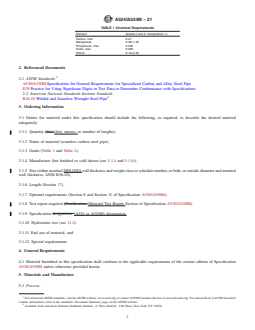
TABLE 1 Chemical Requirements
Element Grades I and II, Composition, %
Carbon, max 0.21
Manganese 0.90–1.35
Phosphorus, max 0.035
Sulfur, max 0.035
Silicon 0.10–0.40
2. Referenced Documents
2.1 ASTM Standards:
A530/A530M Specification for General Requirements for Specialized Carbon and Alloy Steel Pipe
E29 Practice for Using Significant Digits in Test Data to Determine Conformance with Specifications
2.2 American National Standards Institute Standard:
B36.10 Welded and Seamless Wrought Steel Pipe
3. Ordering Information
3.1 Orders for material under this specification should include the following, as required, to describe the desired material
adequately:
3.1.1 Quantity (feet (feet, meters, or number of lengths),
3.1.2 Name of material (seamless carbon steel pipe),
3.1.3 Grade (Table 1 and Table 2),
3.1.4 Manufacture (hot finished or cold drawn (see 5.1.4 and 5.1.5)),
3.1.5 Size (either nominal NPS [DN] wall thickness and weight class or schedule number, or both, or outside diameter and nominal
wall thickness, ANSI B36.10),
3.1.6 Length (Section 17),
3.1.7 Optional requirements (Section 8 and Section 11 of Specification A530/A530M),
3.1.8 Test report required (Certification (Material Test Report Section of Specification A530/A530M),
3.1.9 Specification designation, (A524 or A524M) designation,
3.1.10 Hydrostatic test (see 11.2).
3.1.11 End use of material, and
3.1.12 Special requirements.
4. General Requirements
4.1 Material furnished to this specification shall conform to the applicable requirements of the current edition of Specification
A530/A530M unless otherwise provided herein.
5. Materials and Manufacture
5.1 Process:
For referenced ASTM standards, visit the ASTM website, www.astm.org, or contact ASTM Customer Service at service@astm.org. For Annual Book of ASTM Standards
volume information, refer to the standard’s Document Summary page on the ASTM website.
Available from American National Standards Institute, 11 West 42nd St., 13th Floor, New York, NY 10036.
A524/A524M − 21
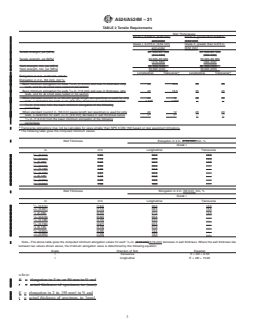
TABLE 2 Tensile Requirements
Wall Thicknesses
Grade I, 0.375 in. (9.52 mm) Grade II, greater than 0.375 in.
and under (9.52 mm)
Grade I, 0.375 in. [9.52 mm] Grade II, greater than 0.375 in.
and under [9.52 mm]
Tensile strength, psi (MPa) 60 000–85 000 55 000–80 000
(414–586) (380–550)
Tensile strength, psi [MPa] 60 000–85 000 55 000–80 000
[415–585] [380–550]
Yield strength, min, psi (MPa) 35 000 (240) 30 000 (205)
Yield strength, min, psi [MPa] 35 000 [240] 30 000 [205]
A A
Longitudinal Transverse Longitudinal Transverse
Elongation in 2 in. or 50 mm, min %:
Elongation in 2 in. [50 mm], min %:
Basic minimum elongation for walls ⁄16 in. (7.9 mm) and over in thickness, strip 30 16.5 35 25
tests, and for all small sizes tested in full section
Basic minimum elongation for walls ⁄16 in. [7.9 mm] and over in thickness, strip 30 16.5 35 25
tests, and for all small sizes tested in full section
When standard round 2 in. or 50 mm gauge length test specimen is used for strip 22 12 28 20
A A
tests, a deduction for each ⁄32 in. (0.8 mm) decrease in wall thickness below 1.50 1.00 . .
⁄16 in. (7.9 mm) from the basic minimum elongation of the following
percentage
When standard round 2 in. [50 mm] gauge length test specimen is used for strip 22 12 28 20
B B
tests, a deduction for each ⁄32 in. [0.8 mm] decrease in wall thickness below 1 1 . .
⁄16 in. [7.9 mm] from the basic minimum elongation of the following
percentage
A
Transverse elongations may not be calculable for sizes smaller than NPS 6 [DN 150] based on test equipment limitations.
B
The following table gives the computed minimum values:
Wall Thickness Elongation in 2 in. or 50 mm, min, %
Grade I
in. mm Longitudinal Transverse
⁄16 (0.312) 7.94 30.0 16.5
⁄32 (0.281) 7.14 28.5 15.5
⁄4 (0.250) 6.35 27.0 14.5
⁄32 (0.219) 5.56 25.5 . . .
⁄16 (0.188) 4.76 24.0 . . .
⁄32 (0.156) 3.97 22.5 . . .
⁄8 (0.125) 3.18 21.0 . . .
⁄32 (0.094) 2.38 19.5 . . .
⁄16 (0.062) 1.59 18.0 . . .
Wall Thickness Elongation in 2 in. [50 mm], min, %
Grade I
in. mm Longitudinal Transverse
⁄16 (0.312) [7.94] 30.0 16.5
⁄32 (0.281) [7.14] 28.5 15.5
⁄4 (0.250) [6.35] 27.0 14.5
⁄32 (0.219) [5.56] 25.5 . . .
⁄16 (0.188) [4.76] 24.0 . . .
⁄32 (0.156) [3.97] 22.5 . . .
⁄8 (0.125) [3.18] 21.0 . . .
⁄32 (0.094) [2.38] 19.5 . . .
⁄16 (0.062) [1.59] 18.0 . . .
Note—The above table gives the computed minimum elongation values for each ⁄32-in. (0.79-mm)[0.79-mm] decrease in wall thickness. Where the wall thickness lies
between two values shown above, the minimum elongation value is determined by the following equation:
Grade Direction of Test Equation
I transverse E = 32t + 6.50
I longitudinal E = 48t + 15.00
where:
E = elongation in 2 in. or 50 mm in % and
t = actual thickness of specimen, in. (mm).
E = elongation in 2 in. [50 mm] in % and
t = actual thickness of specimen, in. [mm].
A524/A524M − 21
5.1.1 The steel shall be killed steel made by one or more of the following processes: open-hearth, electric-furnace, or
basic-oxygen. basic-oxygen, or any other commercially viable process.
5.1.2 The steel shall be made to fine grain practice.
5.1.3 Steel may be cast in ingots or may be strand cast. When steel of different grades are sequentially strand cast, identification
of the resultant transition material is required. The producer shall remove the transition material by any established procedure that
positively separates the grades.
5.1.4 Pipe NPS 1 ⁄2 and [DN 40] and under may be either hot finished or cold drawn.
5.1.5 Unless otherwise specified, pipe NPS 2 [DN 50] and over shall be furnished hot finished. When agreed upon between the
manufacturer and purchaser, cold-drawn pipe may be furnished.
5.2 Heat Treatment—All hot-finished and cold-drawn pipe shall be reheated to a temperature above 1550 °F (845°C) 1550°F
[845°C] and followed by cooling in air or in the cooling chamber of a controlled atmosphere furnace.
6. Chemical Composition
6.1 The steel shall conform to the chemical requirements prescribed in Table 1.
7. Heat Analysis
7.1 An analysis of each heat of steel shall be made by the steel manufacturer to determine the percentages of the elements specified
in Section 6. The chemical composition thus determined, or that determined from a product analysis made by the manufacturer,
if the latter has not manufactured the steel, shall be reported to the purchaser or the purchaser’s representative, and shall conform
to the requirements specified in Section 6.
8. Product Analysis
8.1 At the request of the purchaser, analyses of two pipes from each lot (Note 2) shall be made by the manufacturer from the
finished pipe. The chemical composition thus determined shall conform to the requirements specified in Section 6.
NOTE 2—A lot shall consist of 400 lengths, or fraction thereof, for each size NPS 2 [DN 50] up to but not including NPS 6, 6 [DN 150], and of 200 lengths,
or fraction thereof, for each size NPS 6 [DN 150] and over.
8.2 If the analysis of one of the tests specified in 8.1 does not conform to the requirements specified in Section 6, analyses shall
be made on additional pipe of double the original number from the same lot, each of which shall conform to requirements specified.
9. Physical Properties
9.1 Tensile Properties—The material shall conform to the requirements as to tensile properties prescribed in Table 2.
9.2 Bending Properties:
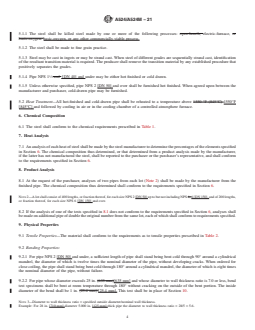
9.2.1 For pipe NPS 2 [DN 50] and under, a sufficient length of pipe shall stand being bent cold through 90° around a cylindrical
mandrel, the diameter of which is twelve times the nominal diameter of the pipe, without developing cracks. When ordered for
close coiling, the pipe shall stand being bent cold through 180° around a cylindrical mandrel, the diameter of which is eight times
the nominal diameter of the pipe, without failure.
9.2.2 For pipe whose diameter exceeds 25 in. (635 mm)[635 mm] and whose diameter to wall thickness ratio is 7.0 or less, bend
test specimens shall be bent at room temperature through 180° without cracking on the outside of the bent portion. The inside
diameter of the bend shall be 1 in. (25.4 mm).[25.4 mm]. This test shall be in place of Section 10.
NOTE 3—Diameter to wall thickness ratio = specified outside diameter/nominal wall thickness.
Example: For 28 in. [710 mm] diameter 5.000 in. [125 mm] thick pipe the diameter to wall thickness ratio = 28/5 = 5.6.
A524/A524M − 21
10. Flattening Test Requirements
10.1 For pipe over NPS 2, 2 [DN 50], a section of pipe not less than 2 ⁄2 in. (63.5 mm)[63.5 mm] in length shall be flattened cold
between parallel plates until the opposite walls of the pipe meet. Flattening tests shall be in accordance with Specification
A530/A530M, except that in the equation used to calculate the H value, the following e constants shall be used:
0.07 for Grade I
0.08 for Grade II
10.2 When low D-to-t ratio tubulars are tested, because the strain imposed due to geometry is unreasonably high on the inside
surface at the 6 and 12 o’clock locations, cracks at these locations shall not be cause for rejection if the D-to-t ratio is less than
ten.
11. Hydrostatic Test Requirements
11.1 Each length of pipe shall be subjected to the hydrostatic pressure, except as provided in 11.2.
11.2 When specified in the order, pipe may be furnished without hydrostatic testing and each length so furnished shall include with
the mandatory marking the letters “NH.”
11.3 When certification is required by the purchaser and the hydrostatic test has been omitted, the certification shall clearly state
“Not Hydrostatically Tested,” and the specification number and grade designation, as shown on the certification, shall be followed
by the letters “NH.”
12. Dimensions and Weights
12.1 The dimensions and weights of plain-end pipe are included in ANSI B36.10. Sizes and wall thicknesses most generally
available are listed in Appendix X1.
13. Dimensions, Weight, and Permissible Variations
13.1 Weight—The weight of any length of pipe shall not vary more than 6.5 % over and 3.5 % under that specified for pipe of
Schedule 120 (Table X1.2) and lighter nor more than 10 % over and 3.5 % under that specified for pipe heavier than Schedule 120.
Unless otherwise agreed upon between the manufacturer and purchaser, pipe in sizes NPS 4 [DN 100] and smaller may be weighed
in convenient lots; pipe in sizes larger than NPS 4 [DN 100] shall be weighed separately.
13.2 Diameter—Variations in outside diameter shall not exceed those specified in Table 3.
TABLE 3 Variations in Outside Diameter
NPS Permissible Variations in Outside
Designator Diameter, in. (mm)
Over Under
1 1 1 1
⁄8 to 1 ⁄2, incl ⁄64 (0.4) ⁄64 (0.8)
1 1 1
Over 1 ⁄2 to 4, ⁄32 (0.8) ⁄32 (0.8)
incl
1 1
Over 4 to 8, incl ⁄16 (1.6) ⁄16 (0.8)
3 3
Over 8 to 18, incl ⁄32 (2.4) ⁄32 (0.8)
1 1
Over 18 ⁄8 (3.2) ⁄8 (0.8)
TABLE 3 Variations in Outside Diameter
Permissible Variations in
Designator
Outside Diameter, in. [mm]
NPS DN Over Under
1 1 1 1
⁄8 to 1 ⁄2, incl. 6 to 40, incl. ⁄64 [0.4] ⁄32 [0.8]
1 1 1
Over 1 ⁄2 to 4, 40 to 100, incl. ⁄32 [0.8] ⁄32 [0.8]
incl.
1 1
Over 4 to 8, incl. 100 to 200, incl. ⁄16 [1.6] ⁄32 [0.8]
3 1
Over 8 to 18, 200 to 450, incl. ⁄32 [2.4] ⁄32 [0.8]
incl.
1 1
Over 18 Over 450 ⁄8 [3.2] ⁄32 [0.8]
A524/A524M − 21
13.3 Thickness—The minimum wall thickness at any point shall not be more than 12.5 % under the nominal wall thickness
specified.
NOTE 4—The minimum wall thickness on inspection is shown in Appendix X1.
14. Workmanship, Finish, and Appearance
14.1 The pipe manufacturer shall explore a sufficient number of visual surface imperfections to provide reasonable assurance that
they have been properly evaluated with respect to depth. Exploration of all surface imperfections is not required but may be
necessary to assure compliance with 14.2.
14.2 Surface imperfections that penetrate more than 12 ⁄2 % of the nominal wall thickness or encroach on the minimum wall
thickness shall be considered defects. Pipe with such defects shall be given one of the following dispositions:
14.2.1 The defect may be removed by grinding provided that the remaining wall thickness is within specified limits.
14.2.2 Repaired in accordance with the repair welding provisions of 14.6.
14.2.3 The section of pipe containing the defect may be cut off within the limits of requirements on length.
14.2.4 Rejected.
14.3 To provide a workmanlike finish and basis for evaluating conformance with 14.2, the pipe manufacturer shall remove by
grinding the following noninjurious imperfections:
14.3.1 Mechanical marks, abrasions (Note 5), and pits, any of which imperfections are deeper than ⁄16 in. (1.58 mm).
NOTE 5—Marks and abrasions are defined as cable marks, dinges, guide marks, roll marks, ball scratches, scores, die marks, and the like.
14.3.2 Visual imperfections, commonly referred to as scabs, seams, laps, tears, or slivers, found by exploration in accordance with
14.1 to be deeper than 5 % of the nominal wall thickness.
14.4 At the purchaser’s discretion, pipe shall be subject to rejection if surface imperfections acceptable under 14.2 are not
scattered, but appear over a large area in excess of what is considered a workmanlike finish. Disposition of such pipe shall be a
matter of agreement between the manufacturer and the purchaser.
14.5 When imperfections or defects are removed by grinding, a smooth curved surface shall be maintained, and the wall thickness
shall not be decreased below that permitted by this specification. The outside diameter at the point of grinding may be reduced
by the amount so removed.
14.5.1 Wall thickness measurements shall be made with a mechanical caliper or with a properly calibrated nondestruc-tive testing
device of appropriate accuracy. In case of dispute, the measurement determined by use of the mechanical caliper shall govern.
14.6 Weld repair shall be permitted only subject to the approval of the purchaser and in accordance with Specification
A530/A530M.
14.7 The finished pipe shall be reasonably straight.
15. Number of Tests and Retests
15.1 One of either of the tests specified in 9.1 shall be made on one length of pipe from each lot (Note 2).
15.2 For pipe NPS 2 [DN 50] and under, the bend test specified in 9.2 shall be made on one pipe from each lot (Note 2). The bend
tests specified in 9.2.2 shall be made on one end of each pipe.
A524/A524M − 21
15.3 The flattening test specified in Section 10 shall be made on one length of pipe from each lot (Note 2).
15.4 Retests shall be in accordance with Specification A530/A530M and as provided in 15.5 and 15.6.
15.5 If a specimen breaks in an inside or outside surface flaw, a retest shall be allowed.
15.6 Should a crop end of a finished pipe fail in the flattening test, one retest may be made from the broken end.
16. Test Specimens and Methods of Testing
16.1 Specimens cut either longitudinally or transversely shall be acceptable for the tension test.
16.2 Test specimens for the bend test specified in 9.2 and for the flattening tests specified in Section 10 shall consist of sections
cut from a pipe. Specimens for flattening tests shall be smooth on the ends and free from burrs, except when made on crop ends.
16.3 Test specimens for the bend test specified in 9.2.2 shall be cut from one end of the pipe and, unless otherwise specified, shall
be taken in a transverse direction. One test specimen shall be taken as close to the outer surface as possible and another from as
1 1 1
close to the inner surface as possible. The specimens shall be either ⁄2 by ⁄2 in. (12.7 mm)[12.7 mm] in section or 1 by ⁄2 in.
(25.4[25.4 by 12.7 mm)mm] in section with the corners rounded to a radius not over ⁄16 in. (1.6 mm)[1.6 mm] and need not exceed
6 in. (152 mm)[152 mm] in length. The side of the samples placed in tension during the bend shall be the side closest to the inner
and outer surface of the pipe respectively.
17. Lengths
17.1 Pipe lengths shall be in accordance with the following regular practice:
17.1.1 The lengths required shall be specified in the order, and
17.1.2 No jointers are permitted unless otherwise specified.
17.2 If definite lengths are not required, pipe may be ordered in single random lengths of 16 to 22 ft (4.9[4.9 to 6.7 m),m], with
5 % 12 to 16 ft (3.7[3.7 to 4.9 m),m], or in double random lengths with a minimum average of 35 ft (10.7 m)[10.7 m] and a
minimum length of 22 ft [6.7 m] with 5 % 16 to 22 ft. ft [4.9 to 6.7 m].
18. Rejection
18.1 Each length of pipe that develops injurious defects during shop working or application operations will be rejected, and the
manufacturer shall be notified. No rejections under this or any other specifications shall be marked as specified in Section 19 for
sale under this specification except where such pipe fails to comply with the weight requirements alone, in which case it may be
sold under the weight specifications with which it does comply.
19. Product Marking
19.1 In addition to the marking prescribed in Specification A530/A530M, the marking shall include the hydrostatic test pressure
when tested or the letters “NH” when not tested, the length and schedule number, and on pipe sizes larger than NPS 4 [DN 100]
the weight shall be given. Length shall be marked in feet and tenths of a foot, or metres to two decimal places, depending on the
units to which the material was ordered, or other marking subject to agreement.
19.2 Bar Coding—In addition to the requirements in 19.1, bar coding is acceptable as a supplemental identification method. The
purchaser may specify in the order a specific bar coding system to be used.
A524/A524M − 21
APPENDIX
(Nonmandatory Information)
X1. DIMENSIONS AND WALL THICKNESSES
X1.1 Following are Tables X1.1 and X1.2, cited in the text of this standard.
SUMMARY OF CHANGES
Committee A01 has identified the location of selected changes to this specification since the last issue
(A524 – 96 (2012)A524 – 17) that may impact the use of this standard. (Approved Nov. 1, 2017.)March 1, 2021.)
(1) Formatted as a combined specification.
(2) Updated 3.1.8 based on Specification A530/A530M.
(3) Included grades (Added a second footnoteTable 2) and manufacture to Table 2 hot finished or cold drawn in the scope.based
on equipment limitations.
ASTM International takes no position respecting the validity of any patent rights asserted in connection with any item mentioned in
this standard. Users of this standard are expressly advised that determination of the validity of any such patent rights, and the risk
of infringement of such rights, are entirely their own responsibility.
This standard is subject to revision at any time by the responsible technical committee and must be reviewed every five years and
if not revised, either reapproved or withdrawn. Your comments are invited either for revision of this standard or for additional standards
and should be addressed to ASTM International Headquarters. Your comments will receive careful consideration at a meeting of the
responsible technical committee, which you may attend. If you feel that your comments have not received a fair hearing you should
make your views known to the ASTM Committee on Standards, at the address shown below.
This standard is copyrighted by ASTM International,
...